



Abstract
Using a framework that intersects strategic management and institutional economics, we show how differences in institutional environments and firm resources influence different types of strategic change (i.e., internationalization, innovation, and diversification) in family firms. We review 193 quantitative and qualitative articles to identify differences in strategic change and their performance consequences among family firms and between family and nonfamily firms. We conclude that institutional environments and firm resources impact not only the extent family firms engage in different types of strategic change but also their performance and long-term survival.
Family firms are typically defined by family involvement in the ownership and governance of a firm as well as by a vision of how the firm will provide transgenerational benefits to the family (Chrisman & Patel, 2012; Chua et al., 1999). Given that family firms are the most prevalent form of business organization in the world (La Porta et al., 1999; Villalonga & Amit, 2006), scholars have been increasingly interested in this important organizational form (Gedajlovic et al., 2012). Of particular significance is the topic of strategic change in family firms. Generally, strategic change captures entrepreneurial behavior that alters a firm’s product/market domain (Ansoff, 1957; Penrose, 1959) in response to external or internal factors (e.g., Kunisch et al., 2017) to improve performance and long-term survival (Barney, 1991; Ginsberg, 1988; Penrose, 1959; Sirmon et al., 2008). Indeed, adaptation to environmental shifts is often necessary for firm survival, growth, and profitability (Zajac et al., 2000). However, family firms have been shown to engage in strategic change less often (Fang et al., 2021) and in smaller amounts (Gómez-Mejía et al., 2010) than nonfamily firms. Understanding how, when, why, and with what effect strategic changes occur in family firms is therefore an important topic. The importance of this topic is magnified by the notion that the difference between the approaches of family firms and nonfamily firms is primarily a function of family-centered noneconomic goals that create and preserve socioemotional wealth (Chrisman et al., 2012; Gómez-Mejía et al., 2011) and the unique governance systems of family firms that make such pursuits possible (e.g., Carney, 2005; Gedajlovic et al., 2012).
In recent decades, the research on strategic change in family firms has been growing with numerous scholarly articles and literature reviews on topics pertaining to strategic change such as internationalization (e.g., Arregle et al., 2021; Pukall & Calabrò, 2014; Sirmon et al., 2008), innovation (e.g., Calabrò et al., 2019; De Massis et al., 2015; Filser et al., 2018), and diversification (e.g., Feldman et al., 2016, 2019; Gómez-Mejía et al., 2010; Worek, 2017). However, these studies tend to focus on either the impact of firms’ external environments (e.g., Gedajlovic et al., 2012; Miroshnychenko et al., 2022) or internal resources (e.g., Fernández & Nieto, 2005; Kao & Kuo, 2017) on types of strategic change (i.e., internationalization, innovation, and diversification) and performance. While this approach has led to important findings, examining the impact of external and internal environments simultaneously should provide a more comprehensive view of strategic change, as the alterations that firms make in their product/market domains depend on both. We, therefore, advance our understanding of different types of strategic change in family firms by broadly examining the literature using a framework based on institutional environments and firm resources to draw our conclusions.
In this review article, using the distinctions originally made by Ansoff (1957), we focus on strategic change stemming from product development (innovation), market development (internationalization), and diversification (e.g., Brunninge et al., 2007; Chrisman & Patel, 2012; Marano et al., 2016; Miller et al., 2010), as these types of strategic change represent ways in which firms use their resources to renew or expand their product/market domain to seize opportunities. Following guidance from Pettigrew (1990) for studying the context of strategic change over time, we organize our review along two dimensions—environment (institutional environment) and firm resources (size)—which were selected independently of the studies themselves. In selecting these dimensions, it was necessary to be mindful of the variations in the studies so we could make deductive (Hall et al., 2023; Simsek et al., 2023) cross-study comparisons in our literature review. 1
To account for the environment, we examine strategic change in family firms according to the institutional environments that previous studies sampled. We use the institutional environments in which firms compete as our measure of environment because institutional environments influence the risk of expropriation, the availability of capital, and societal trust and, therefore, affect opportunities and threats (cf., Burkart et al., 2003; Gedajlovic et al., 2012; La Porta et al., 1999; North, 1990). Thus, we review contexts that may significantly impact strategic change and strategic outcomes (e.g., Kunisch et al., 2017; Pettigrew, 1987, 1992; Pettigrew et al., 2001). This approach is worthwhile as the current literature is still unclear about whether or why family firms are more likely to thrive than nonfamily firms in different institutional environments (Gedajlovic et al., 2012).
To account for firm resources, we explore strategic change in family firms according to the size of the firms examined in the studies we reviewed. We adopt this measure because firm size (Dass et al., 2015; Foss et al., 2018)is related to firm resources, and it can be assessed across a wide variety of studies. Importantly, the literature suggests that firms of different sizes have different levels of resources, which may significantly influence the types and intensity of strategic change. For instance, Stewart and Hitt (2012) argue that strategic changes and performance of small and large family firms may vary systematically, but such comparisons are rare, and the basis for the differences is unclear (Gedajlovic et al., 2012).
Both the institutional environment and firm size enable us to uncover novel findings regarding strategic change in family firms at the macro level. To this end, we review 193 articles on internationalization, innovation, and diversification that have appeared in 28 leading management, entrepreneurship, finance, and family business journals from 1996 to 2022. 2
We contribute to the literature by using a strategic management framework based on key determinants of strategy to uncover how family firms internationalize, innovate, and diversify in different contexts. By selecting variables (i.e., institutional environment and firm size) that are consistent with the determinants of strategy and independent of the sampled studies a priori, we avoid problems of endogeneity inherent in conducting a review based on a framework derived from the studies themselves. The application of a framework that returns to the fundamental aspects of strategy yields conclusions that help reconcile previously inconsistent findings on strategic change. We demonstrate that strategic change in family firms varies according to the institutional environment and firm size. We show that in most contexts family firms make fewer strategic changes than nonfamily firms but also find that small- and medium-sized (SME) family firms approach change more aggressively in favorable institutional environments. Furthermore, our review indicates that strategic change in large family firms is idiosyncratic regardless of the pressures associated with the institutional environment, which explains why researchers have been unable to tell which environment is more conducive to large family firms.
We further contribute to the literature by identifying differences in internationalization, innovation, and diversification between family and nonfamily firms, which are contingent upon the institutional environment and firm size. Indeed, the interaction between the institutional environment and firm size helps explain the extent to which family firms pursue internationalization, innovation, and diversification and generates a better understanding of how environmental heterogeneity and firm resources influence strategic behaviors and performance in family firms. Finally, we contribute to the literature by integrating and summarizing the evidence obtained through our review in a way that provides a basis for further research.
Strategic Change: Review Framework
Consistent with the strategic management literature (e.g., Kunisch et al., 2017), we define strategic change as the alterations a firm makes over time in the form, quality, or state of their products and markets (Hofer & Schendel, 1978; Rajagopalan & Spreitzer, 1997; Van de Ven & Poole, 1995) to improve firm performance and/or survival. 3 These changes may be prompted by new opportunities or threats, by aspiration gaps, by slack or new resources, or by the pursuit of new goals based on the need to satisfy the preferences of members of the dominant coalition of decision makers (e.g., Cyert & March, 1963; Hofer & Schendel, 1978). However, regardless of the reason, strategic change always involves attempts to develop new and superior matches between the environment and firm resources. We focus on changes in the content of strategy, which Ginsberg (1988) suggests involves alterations in a firm’s product/market domain. Thus, we capture the most commonly studied forms of strategic change—market development, product development, and diversification, which involve changes to both products and markets (Ansoff, 1957)—by reviewing studies on internationalization, innovation, and diversification, respectively. Although not mutually exclusive in practice, for our review, we consider each form of strategic change independently.
Internationalization refers to competing in foreign markets through exporting, foreign direct investment, or strategic alliances (e.g., Arregle et al., 2021; Rugman & Verbeke, 2005). In essence, internationalization captures market-related strategic changes. Internationalization is a source of firm growth, which can generate economies of scale and scope, lower labor costs, and provide access to new opportunities (Pukall & Calabrò, 2014). Going international also permits firms to diversify across different national markets, thus reducing overall business risk (e.g., Duran et al., 2017).
Innovation refers to activities such as exploratory and exploitative investments in R&D (Patel & Chrisman, 2014), new product development, and process improvements (e.g., De Massis et al., 2013; Van de Ven, 1986). Unlike internationalization, innovation is primarily associated with product-related strategic change. Innovation activities are critical for the long-term survival of all firms, including family firms (Duran et al., 2016). Thus, family firms must constantly find ways to create additional value by investing in new technologies, products, or processes.
Finally, diversification is an approach by which firms alter their products and/or markets through mergers, acquisitions, and divestments to increase their growth, profitability, and survival (e.g., Pinelli et al., 2023). Unlike internationalization and innovation, which primarily focus on market and product-based strategic change, respectively, diversification involves product and market change simultaneously. For instance, firms may acquire other firms to expand both their product scope and their market scope.
To examine internationalization, innovation, and diversification in a more nuanced way, we consider the impact of institutional environments and firm resources. We focus on the institutional environment as one dimension of understanding family firms’ strategic change because the literature suggests that the nature of the institutional environment varies around the world and is dependent on the influence of laws and societal norms (La Porta et al., 2000; Levy-Carciente, 2019). Indeed, it has been suggested that the behaviors and performance of firms in countries with strong institutions differ considerably from the behaviors and performance of firms in countries with weak institutions (Burkart et al., 2003; Johnson et al., 2002). In addition, scholars argue that the institutional environment determines the ability of firms to use, derive income from, and transfer their property/resources without fear of expropriation (Alchian & Demsetz, 1972; Schulze & Zellweger, 2021). Therefore, the institutional environment provides a useful indicator of the attractiveness and impediments of the environment that condition a firm’s strategy. Given variations in the goals of family and nonfamily firms (e.g., Chrisman et al., 2012; Gómez-Mejía et al., 2007), strategic change is expected to vary among family firms and between family and nonfamily firms in different institutional environments.
As noted earlier, we use firm size as a measure of the resources available to a firm to engage in strategic change. Firms with more resources are likely to exhibit different approaches to strategic change than firms with fewer resources (Barney, 1991; Hofer & Schendel, 1978). Because family firms are known to differ from nonfamily firms and from each other (Chrisman et al., 2013), it is likely that the extent to which family SMEs and large family firms engage in strategic change will be heterogeneous and divergent from nonfamily firms.
Overall, by reviewing studies of family firms from different institutional environments and of different sizes, we can assess the extent to which the determinants of strategy influence family firms’ engagement in internationalization, innovation, and diversification.
Review Method
To conduct our review of strategic change in family firms, we followed best practices from prior work (e.g., Alvesson & Sandberg, 2020; Elsbach & Van Knippenberg, 2020; Post et al., 2020; Short, 2009). Using Elsevier’s Scopus database and EBSCOhost (ABI/Inform ProQuest and Business Source Complete), we searched for keywords relevant to strategic change in the titles, abstracts, and keywords of peer-reviewed articles in journals that publish research on family business, following prior studies conducted in the domain (e.g., Daspit et al., 2016; Tabor et al., 2018). Keywords denoting or potentially related to internationalization, innovation, and diversification as types of strategic change were used in conjunction with keywords denoting family involvement in a firm to capture the family firm’s focus on strategic change. We did not impose any restrictions on when an article was published. Our search yielded an initial sample of 635 articles across 52 journals (cf. Daspit et al., 2016; Tabor et al., 2018) from 1985 through 2022. 4
Three authors independently reviewed the titles, abstracts, keywords, and text of each article to establish which were relevant to our review. Disagreements were discussed until a consensus was reached. Because we focus on peer-reviewed quantitative and qualitative articles, we followed prior research (e.g., Daspit et al., 2016; Toft-Kehler et al., 2016) and eliminated literature reviews, meta-analyses, conceptual articles, conference proceedings, non-English papers, book chapters, introductions to special issues, and duplicates (n=185), leaving us with 450 articles. Given our focus on strategic change, we classified studies dealing with (a) investment and entry into foreign markets as internationalization; (b) corporate entrepreneurship, innovation, and R&D as innovation, and (c) mergers, acquisitions, and divestments as diversification. Studies that did not explicitly focus on internationalization, innovation, or diversification in family firms, as defined above, were excluded (n=187), leaving us with 263 articles. As we wanted to understand the independent impact of internationalization, innovation, and diversification, we excluded nine studies that simultaneously dealt with multiple types of strategic changes. This left us with 254 articles.
We then categorized each article according to the strength of the institutional environment. To do this, we first identified the countries where the sample was drawn. To determine the strength of the institutional environment, we consulted the International Property Right Index (IPRI) of Levy-Carciente (2019). The IPRI assigns a score to each country from 0 (the lowest value) to 10 (the highest value) based on the (a) legal and political environment, (b) physical property rights, and (c) intellectual property rights. The IPRI assumes the three indicators are equally important and thus takes their average to arrive at the final score for each country. 5
The IPRI divides institutional environments into quintiles. 6 The largest number of the studies in our review were conducted in countries in the first quintile with the strongest institutional environments. The number of studies conducted among firms in countries in the other quintiles, particularly the fourth and fifth quintiles, was much smaller. Therefore, we categorized the institutional environments of countries in the first quintile (top 20%) as strong, the institutional environments of countries in the second and third quintiles as medium (next 40%), and the institutional environments of countries in the fourth and fifth quintiles as weak (bottom 40%).
The IPRI for 2019 includes scores for 129 countries. We excluded two studies with samples from Iraq (Abdulmuhsin & Tarhini, 2022) and Kosovo (Toska, Ramadani, Dana, Rexhepi, & Zeqiri, 2022), respectively, for which scores were not available. In addition, 31 articles with samples that included firms from two or more countries that were classified in different cells of our scheme were omitted from our review (e.g., Granata & Chirico, 2010; Scholes, Wright, Westhead, & Bruining, 2010). For example, we did not include studies with firms from both Italy (an institutional environment classified as medium) and Germany (an institutional environment classified as strong) in our review. After this adjustment, we were left with 221 studies.
As suggested earlier, the determinants of strategy depend upon both the environment where a firm competes and the resources it can deploy, which we measured according to the size of the firms studied in each article. We classified studies according to the authors’ descriptions of the types of firms in the sample and information provided on the average size of the firms in the sample (e.g., number of employees). We then categorized the studies according to whether they focus on small to medium size (SME) firms or large to very large (Large) firms. Consistent with the 2022 US Small Business Profiles (“Technical Note”), firms with fewer than 500 employees were considered SMEs, and firms with 500 or more employees were considered large firms. 7 Studies that mixed SMEs and large firms (n=28) together were excluded from our review (e.g., De Cesari et al., 2016). Overall, using these selection criteria, the number of articles in our review was reduced from 635 across 52 journals to 193 across 28 journals from 1996 through 2022 (see Table 1 for brief descriptions of all of the articles reviewed for our study). 8
Review of Strategic Change in the Family Business Literature.
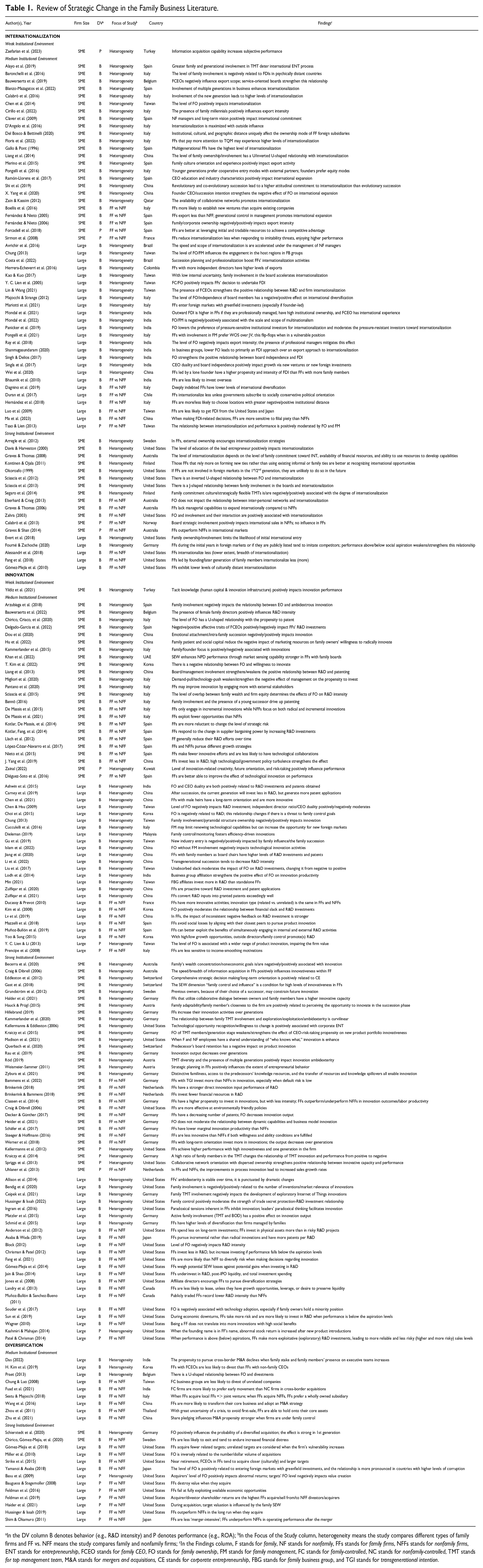
In the DV column B denotes behavior (e.g., R&D intensity) and P denotes performance (e.g., ROA); bIn the Focus of the Study column, heterogeneity means the study compares different types of family firms and FF vs. NFF means the study compares family and nonfamily firms; cIn the Findings column, F stands for family, NF stands for nonfamily, FFs stands for family firms, NFFs stands for nonfamily firms, ENT stands for entrepreneurship, FCEO stands for family CEO, FO stands for family ownership, FM stands for family management, FC stands for family-controlled, NC stands for nonfamily-controlled, TMT stands for top management team, M&A stands for mergers and acquisitions, CE stands for corporate entrepreneurship, FBG stands for family business group, and TGI stands for transgenerational intention.
To examine previous strategic change research, we focused on two types of work. First, articles exploring firm’s strategic change as behavior were those where internationalization, innovation, or diversification was the dependent variable. This group of articles centers on the antecedents or causes of strategic change (e.g., level of family ownership, involvement, control). Second, we identified articles that focused on the performance outcomes or consequences of strategic change where internationalization, innovation, or diversification is an independent, moderator, or mediator variable. In addition, we also distinguished between studies that focus on how the heterogeneity of family firms (Daspit et al., 2021; Daspit et al., 2023) influences strategic change by comparing different types of family firms (e.g., family firms in early versus later generations) and those that focus on comparing strategic change between family and nonfamily firms.
Most of the studies in our review focus on factors that influence strategic change (n=170) rather than how strategic change influences performance (n=23). We first review the 68 studies on internationalization, then the 103 studies that deal with innovation, followed by the 22 studies on diversification (see Table 1). Our first level of comparison is based on the various combinations of institutional environments and firm size (resources). In each of these sections we consider studies that focus on differences in strategic change (a) among heterogeneous family firms, (b) between family and nonfamily firms, and then (c) studies that focus on how strategic change influences firm performance. As few studies reviewed dealt with firm performance, we do not attempt to subdivide that category further. Articles are reviewed according to the type of institutional environment (i.e., weak, medium, strong) and size of the firms studied (i.e., SMEs, large). Later in the Discussion section, we compare family firms of different sizes and in different institutional environments to better understand how opportunities and resources interact to influence strategic change.
Strategic Change Research on Internationalization
Weak Institutional Environments
Internationalization of SMEs (n=1)
Heterogeneity and Family Versus Nonfamily
We found no studies that fit into either of these categories. More research is necessary.
Performance
We found only one study on the internationalization of SMEs in weak institutional environments. Zaefarian et al. (2023) find that capabilities to acquire international market information influence perceptions of the relationship between participative governance and performance more than the actual relationship. This reflects the perceived importance of keeping decision-making within the family to preserve socioemotional wealth (SEW) and avoid expropriation by outsiders (Ilias, 2006). 9
Internationalization of Large Firms (n=0)
We found no studies of internationalization on the heterogeneity of large firms, comparisons of large family versus nonfamily firms, or family firm performance in weak institutional environments. More research is necessary in these areas.
Medium Institutional Environments
Internationalization of SMEs (n=24)
Heterogeneity
Scholars suggest that when family involvement increases, international entrepreneurship decreases among SMEs (Alayo et al., 2019). Family involvement has also been shown to be negatively related to foreign direct investments (FDIs) in physically distant countries (Baronchelli et al., 2016). Some studies even suggest that family CEOs negatively impact exports (Bauweraerts et al., 2019). However, other studies point out that family ownership (Chen et al., 2014; X. Yang et al., 2020), long-term vision (Claver et al., 2009), family culture and experience (Merino et al., 2015), and involvement of multiple generations in business (Cirillo et al., 2022) positively impact internationalization activities. Further complicating matters, Liang et al. (2014) find that family ownership has a U-shaped relationship and family management has an inverted U-shaped relationship with internationalization. Notably, family firms that have the support of outsiders (D’Angelo et al., 2016) such as nonfamily managers (Claver et al., 2009) or collaborative networks (Zain & Kassim, 2012) have higher levels of internationalization.
Family Versus Nonfamily
Only a few studies examine the difference between family and nonfamily SMEs. Those studies suggest that in comparison to nonfamily firms, family firms are more likely to establish new ventures than acquire firms in foreign markets (Boellis et al., 2016). Family firms also appear to export significantly less than nonfamily firms (Fernández & Nieto, 2005, 2006).
Performance
The only performance studies of SMEs in medium institutional environments show that despite investing less in internationalization activities than nonfamily firms, family firms reduce their international activities to a lesser extent when faced with imitability threats (Sirmon et al., 2008) and are better at leveraging their resources to achieve a competitive advantage (Forcadell et al., 2018).
Internationalization of Large Firms (n=25)
Heterogeneity
Among large firms competing in nations with medium institutional environments, some studies show that family ownership negatively influences internationalization (Ray et al., 2018; Singla et al., 2017) while other studies show that family ownership is associated with more FDIs (Y. C. Lien et al., 2005). Board independence seems to yield positive results for internationalization (Herrera-Echeverri et al., 2016; Majocchi & Strange, 2012), and some scholars argue that family ownership strengthens the positive relationship between board independence and FDI (Singh & Delios, 2017). When the institutional environment is characterized by low uncertainty, family involvement on boards promotes and even accelerates internationalization (Kao & Kuo, 2017). Overall, the impact of family ownership on internationalization among large family firms appears mixed but the composition of the board of directors has a strong influence.
Family Versus Nonfamily
Large family firms tend to invest less overseas than nonfamily firms (Bhaumik et al., 2010) and, when deeply indebted, have lower levels of international diversification (Dagnino et al., 2019). The influence of the institutional environment is particularly evident when it comes to the orientation of the government. Specifically, Duran et al. (2017) suggest that family firms internationalize less than nonfamily firms except when the government’s political orientation is socially conservative. Interestingly, another study indicates that family firms tend to locate their international activities in countries with negative institutional distance, that is, countries with lower-quality institutions than their home country (Hernández et al., 2018).
Performance
We identified only one study that examined the relationship between internationalization and the performance of large firms in medium institutional environments. In that study, Tsao and Lien (2013) find that among Taiwanese family firms, family ownership and family management positively moderate the influence of internationalization on performance.
Strong Institutional Environments
Internationalization of SMEs (n=13)
Heterogeneity
Studies of internationalization in family SMEs in strong institutional environments indicate that there is a U-shaped relationship between family ownership and internationalization (Sciascia et al., 2012) and a J-shaped relationship between family member involvement on boards and internationalization (Sciascia et al., 2013). If family firms do not internationalize in the first or second generation, they tend to place less emphasis on internationalization in subsequent generations (Okoroafo, 1999), perhaps because the family’s culture is negatively disposed to it (Segaro et al., 2014). Indeed, family commitment is an important determinant of internationalization (Graves & Thomas, 2008). Arregle and colleagues (2012) also demonstrate that external parties, such as outside directors, have a positive influence on both the scope and the scale of internationalization.
Family Versus Nonfamily
Studies that compare family and nonfamily firms show that family ownership and family involvement in management and/or the board of directors, as well as the interaction of family ownership and involvement, are positively related to internationalization (Zahra, 2003). On the contrary, Graves and Thomas (2006) suggest that family firms lack the managerial capabilities necessary to pursue international strategies. Furthermore, the use of interpersonal and interorganizational networking positively influences the pursuit of internationalization but family ownership diminishes this effect (Eberhard & Craig, 2013).
Performance
The study by Graves and Shan (2014) illustrates that family SMEs outperform their nonfamily counterparts in international markets. However, Calabrò et al. (2013) find that the strategic involvement of boards of directors positively impacts international sales in nonfamily firms but has no impact in family firms.
Internationalization of Large Firms (n=5)
Heterogeneity
Studies of family firm heterogeneity suggest that higher family involvement and family ownership may decrease the likelihood of internationalization (Evert et al., 2018). When large family firms do enter international markets, they tend to imitate competitors (Fourné & Zschoche, 2020). Interestingly, performance below aspirations strengthens, and performance above aspirations weakens, the internationalization efforts of large family firms (Fourné & Zschoche, 2020).
Family versus Nonfamily
Alessandri et al. (2018) argue that the extent and breadth of internationalization is less in large family firms than in nonfamily firms, especially when the family firm is run by the first generation (Fang et al., 2018). This may be because family firms choose greenfield investments and full ownership in foreign markets to preserve the noneconomic benefits of their socioemotional wealth (SEW).
Performance
We found no studies that fit into this category. More research is necessary.
Summary of Internationalization Literature
Overall, family firms of both sizes (i.e., SME and large) in both institutional environments (i.e., medium and strong) appear to invest less in internationalization than nonfamily firms and invest differently as well. However, despite investing less there is preliminary evidence indicating that family SMEs in both environments obtain more performance benefits from internationalization than nonfamily SMEs (Forcadell et al., 2018).
These findings imply that, in general, the strategies of family firms are driven more by noneconomic goals that generate SEW (e.g., Gómez-Mejía et al., 2011) and the personalistic and particularistic governance tendencies of family owners and managers (Carney, 2005) than by opportunities or resources. Thus, internationalization appears to be primarily a function of the level of family ownership, management, and board participation. This suggests, directly, that family governance, and indirectly, that family goals are the reasons for the differences between family and nonfamily firms and the heterogeneity of family firms regarding internationalization.
Strategic Change Research on Innovation
Weak Institutional Environments
Innovation of SMEs (n=1)
Heterogeneity
There is only one study examining innovation by family SMEs in weak institutional environments. Examining 293 family firms in Turkey, Yıldız et al. (2021) suggest that to successfully innovate in an efficiency-driven economy, family firms must focus on internal competencies (i.e., tacit knowledge) while leveraging the external resources available from vertical and horizontal channels of collaboration.
Family Versus Nonfamily and Performance
We found no studies that fit into this category. More research is necessary.
Innovation of Large Firms (n=0)
No studies of innovation by large family firms (i.e., heterogeneity, family versus nonfamily firms, and performance) in weak institutional environments were found. Again, more research is needed.
Medium Institutional Environments
Innovation of SMEs (n=24)
Heterogeneity
Several studies indicate that characteristics of family goals and governance moderate the relationship between family involvement and innovation in family SMEs. First, family ownership seems to have a U-shaped relationship with the propensity of family SMEs to patent (Chirico, Criaco, et al., 2020) and a negative relationship with the willingness of the firm to innovate (T. Kim et al., 2022). Second, the relationship between R&D investments and patenting is strengthened by family involvement in the board of directors and weakened by family involvement in the top management team (Liang et al., 2013). Third, the presence of a female family member on the board of directors (Bauweraerts et al., 2022) and a family’s engagement with external stakeholders (Pantano et al., 2020) positively impacts R&D intensity and innovation activities, respectively. Studies also find that a family’s emotional attachment to the firm negatively impacts the firm’s innovation activity while intra-family succession positively influences innovation activity (Dou et al., 2020). Finally, from a macro perspective, research suggests that the propensity of family SMEs to invest in innovation is negatively associated with demand-pull opportunities and positively associated with technology-push opportunities (Migliori et al., 2020).
Family Versus Nonfamily
In medium institutional environments, family SMEs appear to be more cautious innovators than nonfamily SMEs. As such, family firms invest less in R&D (J. Yang et al., 2019), exploit fewer opportunities (De Massis et al., 2021; Nieto et al., 2015), invest primarily in incremental innovations (De Massis et al., 2015), and are less likely to produce technological innovations (Diéguez-Soto et al., 2016) than nonfamily firms. Family SMEs are also more reluctant to change their level of strategic risk than nonfamily SMEs (Kotlar, De Massis, et al., 2014), which potentially explains why they decrease rather than increase their R&D investments over time (Llach et al., 2012).
Performance
Given the above findings, it is interesting to note that even though family SMEs are less likely to produce technological innovations, when they do they seem to benefit more in terms of financial performance (Diéguez-Soto et al., 2016) in comparison to nonfamily SMEs. Their performance is enhanced by innovation-related creativity, future orientation, and risk-taking propensity (Zainal, 2022).
Innovation of Large Firms (n=25)
Heterogeneity
Despite the proactiveness of large family firms toward R&D investments and patent applications (Zulfiqar et al., 2020), in environments with medium levels of institutional protection, family ownership has a negative relationship with R&D activities (Chen & Hsu, 2009; Choi et al., 2015; Liu et al., 2017), and family involvement negatively influences innovation (Chung, 2013). However, family firms are proficient at converting R&D investments into patents (Zulfiqar et al., 2021), especially when the board chair is a family member (Jiang et al., 2020). Similarly, family control and monitoring facilitate efficiency-driven innovations (Dieleman, 2019).
Family Versus Nonfamily
Large family firms appear to be more effective than large nonfamily firms when engaging in internal and external R&D activities (Muñoz-Bullón et al., 2019) and have the ability to create a more diverse set of innovative activities (Ducassy & Prevot, 2010). Studies also show that large family firms are better able to avoid social losses because they closely align with their peers when it comes to pursuing product innovations (Mazzelli et al., 2018). Overall, when opportunities for growth are high, outside directors enhance family firms’ R&D activities. But when opportunities for growth are low, having family control serves family firms better when they pursue innovations (Yoo & Sung, 2015).
Performance
Performance studies reveal that large family firms tend to engage in a wider range of product innovations, which may impair future firm value (Y. C. Lien & Li, 2013). Still, at least in the short-term, family firms are less likely than nonfamily firms to engage in earnings management to reduce market fluctuations (Prencipe et al., 2008).
Strong Institutional Environments
Innovation of SMEs (n=31)
Heterogeneity
Research on SMEs in strong institutional environments identifies several characteristics that make family firms more innovative. Overall, innovation increases in family SMEs in later generations (Hillebrand, 2019) and when firms conduct strategic planning (Eddleston et al., 2012; Weismeier-Sammer, 2011). Moreover, family SMEs in strong institutional environments that are willing to change often engage in higher levels of corporate entrepreneurship than those that are not (Kellermanns & Eddleston, 2006). Studies also suggest that both the noneconomic goals of family firms (Becerra et al., 2020) and shared understanding between family and nonfamily employees (Madison et al., 2021) enrich innovative activities.
Family Versus Nonfamily
The findings of studies comparing family and nonfamily SMEs in strong institutional environments indicate that family firms out-innovate nonfamily firms, but their advantage tends to diminish in later generations (Decker & Günther, 2017; Werner et al., 2018). Brinkerink (2018) finds that family firms’ R&D investments are more effective in terms of generating innovations. Classen, Carree, van Gils, and Peters (2014) find that family firms have a higher propensity to invest in innovations but do so at a lower intensity. Also, family firms appear to be more effective at implementing environmentally friendly policies that lead to innovation and higher firm performance (Craig & Dibrell, 2006). Other salient traits that give family SMEs a competitive advantage in innovation include their long-term perspective and lower workforce turnover rates (Werner et al., 2018).
Performance
Studies show that when family and nonfamily firms improve process innovation, their sales growth increases (Uhlaner et al., 2013). Research also demonstrates that innovativeness in family firms with only one generation in the firm is associated with higher performance (Kellermanns et al., 2012).
Innovation of Large Firms (n=22)
Heterogeneity
Studies show that large family firms with nonfamily management have higher levels of innovation than family firms that are family-managed (Ingram et al., 2016; Schmid et al., 2015). In addition, Bendig et al. (2020) suggest that family involvement has a negative relationship with the number of inventions but a positive relationship with the market relevance of such innovations. Notably, the extent to which large family firms pursue exploratory and exploitative innovation activities simultaneously appears stable over time (Allison et al., 2014).
Family Versus Nonfamily
Most studies on innovation in large family firms in strong institutional environments focus on differences between family and nonfamily firms. These studies reveal that family firms invest less in R&D than nonfamily firms (Block, 2012; Jain & Shao, 2014; Muñoz-Bullón & Sánchez-Bueno, 2011), and when family firms do invest, it is not necessarily in innovations that are more socially beneficial (Wagner, 2010). A possible reason for the lower investments in innovation among large family firms is their aversion to losses of SEW (Gómez-Mejía et al., 2014). However, others assert that family firms invest less in R&D because they prefer to invest in physical assets, which are perceived to be less risky (Anderson et al., 2012). Asaba and Wada (2019) suggest that unlike nonfamily firms, family firms pursue incremental rather than radical innovations, resulting in more patents per R&D investment.
Overall, large family firms invest less in R&D than their nonfamily counterparts. However, the variability of family firms’ R&D investments is high; those with intentions for transgenerational control tend to invest higher amounts than nonfamily firms, whereas those without such intentions tend to invest less (Chrisman & Patel, 2012). Large family firms also significantly alter their behavior if performance drops below aspiration levels, investing more in R&D in such situations (Chrisman & Patel, 2012). Similar behavior seems to occur during economic downturns (Sun et al., 2019).
Performance
Patel and Chrisman (2014) shed light on actions family firms take when performance is below or above aspirations. The authors argue that family firms pursue exploitative R&D investments when performance is above aspirations to obtain lower but more reliable rates of sales growth. When performance is below aspirations, however, family firms favor exploratory R&D investments that produce higher but more variable rates of sales growth. Furthermore, Kashmiri and Mahajan (2014) suggest that when family firms are named after the founding family, they enjoy increased abnormal stock returns after introducing new products.
Summary of Innovation Literature
The literature suggests that family SMEs in medium institutional environments tend to be more cautious with their innovation activities and thus invest less, yet they are better at converting their technological innovations into firm performance than nonfamily SMEs.
Family SMEs in strong institutional environments seem to be more likely to engage in innovation than nonfamily SMEs (Classen et al., 2014); however, great heterogeneity among family SMEs exists. Perhaps family SMEs more readily engage in innovation because of the favorable nature of the institutional environments and the protections these environments provide. The more aggressive stance on innovation shown by these firms seems to lead to higher performance (Uhlaner et al., 2013).
By contrast, large family firms in strong institutional environments tend to invest less in innovation than nonfamily firms overall, but their investments are often conditional on past performance. Potentially due to loss aversion, particularly regarding SEW, family firms invest less when performance is above aspirations and invest more when performance is below aspirations. Thus, although large family firms in strong institutional environments have enough power to alter their strategies with relatively less risk of expropriation than family SMEs in the same institutional environments, they appear to behave more cautiously than nonfamily firms of comparable size unless they perceive their economic and noneconomic performance to be threatened.
Strategic Change Research on Diversification
Weak Institutional Environments
Diversification of SMEs (n=0)
No studies of diversification by family SMEs (i.e., heterogeneity, family versus nonfamily firms, and performance) in weak institutional environments were found. More research is necessary.
Diversification of Large Firms (n=0)
No studies of diversification by large family firms (i.e., heterogeneity, family versus nonfamily firms, and performance) in weak institutional environments were found. Again, more research is needed.
Medium Institutional Environments
Diversification of SMEs (n=0)
No studies of diversification by family SMEs (i.e., heterogeneity, family versus nonfamily firms, and performance) in medium institutional environments were identified. This is another area where more research is needed.
Diversification of Large Firms (n=9)
Heterogeneity
Our review indicates that diversification is a viable option for large family firms in countries with medium institutional environments. Research shows a U-shaped relationship between family ownership and divestments (Praet, 2013) and family firms with family CEOs are less likely to divest than family firms with nonfamily CEOs (H. Kim et al., 2019). Importantly, with an increased family stake and family members’ presence on executive teams, the propensity to pursue cross-border mergers and acquisitions (M&A) declines (Das, 2022).
Family Versus Nonfamily
When large family firms are compared with large nonfamily firms, the literature shows that these family firms are less likely to divest unrelated businesses (Chung & Luo, 2008), more likely to adopt an M&A strategy (Wang et al., 2016), and more able to hold onto their core assets, especially when the uncertainty associated with a crisis increases (Zhou et al., 2011). Meanwhile, Sestu and Majocchi (2018) reveal that in international diversification if both the acquiring firm and the acquired local firm are family firms, forming an international joint venture is preferred, while establishing a wholly owned subsidiary is more likely if only the acquiring firm is a family firm.
Performance
We found no studies that fit into this category. More research is necessary.
Strong Institutional Environments
Diversification of SMEs (n=2)
Heterogeneity
Schierstedt, Henn, and Lutz’s (2020) examination of heterogeneity among family SMEs shows that family ownership has a positive impact on the probability of engaging in acquisitions. The finding is particularly relevant for family SMEs that are still run by the first generation.
Family Versus Nonfamily
Chirico, Gómez-Mejia, et al. (2020) study how SEW influences the exit options of family and nonfamily SMEs. The authors find that family SMEs are more likely to exit via a merger when performance is suffering, as this option may preserve SEW even though outright sale may offer more economic benefits.
Performance
We found no studies that fit into this category. More research is necessary.
Diversification of Large Firms (n=11)
Heterogeneity
We found no studies that fit into this category. More research is necessary.
Family Versus Nonfamily
The bulk of the studies on diversification explore large family firms in strong institutional environments. While family firms prefer targets that are related and culturally close (Gómez-Mejía et al., 2010; Strike et al., 2015), nonfamily firms make acquisitions more often (Gómez-Mejía et al., 2018). Indeed, Miller et al. (2010) suggest that family ownership is negatively related to the number and dollar volume of acquisitions. However, Gómez-Mejía et al. (2018) find that when performance falls below aspirations, family are more likely than nonfamily firms to increase their efforts to acquire other firms.
Performance
Scholars focusing on diversification suggest that family firms destroy value when they acquire (Bauguess & Stegemoller, 2008). They are also less likely to merge or benefit from mergers (Shim & Okamuro, 2011). On the other hand, Hussinger and Issah (2019) find that family firms are more likely than nonfamily firms to create long term value through M&As.
During the acquisition process, the valuation of the target seems to be influenced by the family’s SEW, especially when the target is characterized as having better public governance (Haider et al., 2021). Basu, Dimitrova, and Paeglis’s (2009) study suggests that the acquirers’ level of family ownership positively influences abnormal returns, while the level of family ownership of the firm being acquired brings about negative value creation. Furthermore, Feldman et al. (2016) find that family firms can realize the highest returns by either acquiring from nonfamily divestors or divesting to nonfamily acquirers (Feldman et al., 2019).
Summary of Diversification Literature
Only two studies have attempted to understand diversification in family SMEs and only in strong institutional environments. These studies suggest that family SMEs with more family ownership are more likely to engage in acquisitions and when performance suffers, they may be more likely to exit via a merger. We suspect that a lack of studies on diversification of family SMEs is directly related to the resources that SMEs have, which may not be enough to consider strategic change via diversification.
Large family firms in medium institutional environments tend to be less likely to divest unrelated targets if family CEOs are in charge. An increase in family ownership and involvement seems to lead to lower levels of diversification. On the contrary, in strong institutional environments, large family firms seem to prefer to acquire culturally related targets but make fewer acquisitions than large nonfamily firms. However, it is unclear from the literature whether large family firms are more likely to create or destroy long-term value through their acquisitions.
Discussion
While scholars have shown a tremendous interest in understanding the behavior and performance of family firms regarding strategic change, the findings of studies on those topics are divergent. Strategic change is the process that anticipates or responds to the conditions in the internal and external environments (Kunisch et al., 2017). We reviewed 193 quantitative and qualitative articles in 28 leading management, entrepreneurship, finance, and family business journals from 1996 to 2022 on three types of strategic change (internationalization, innovation, and diversification) using the determinants of strategy, measured by the nature of the firms’ institutional environment and firm size as an indicator of resources, as the basis for our review. Our review examines whether and why some family firms are more willing and able to engage in strategic change than others. We find that family firms’ involvement in strategic change is (at least partially) a function of the institutional environment in which they compete and the resources (i.e., size) that they possess. In the following sections, we compare the findings of family firms in different environments and of different sizes regarding strategic change. First, we compare the influence of institutional environments on firms of comparable size, and then we compare the influence of variations in firm size when institutional environments are similar. Table 2 provides a summary of key findings.
Summary of Findings to Guide Future Research.
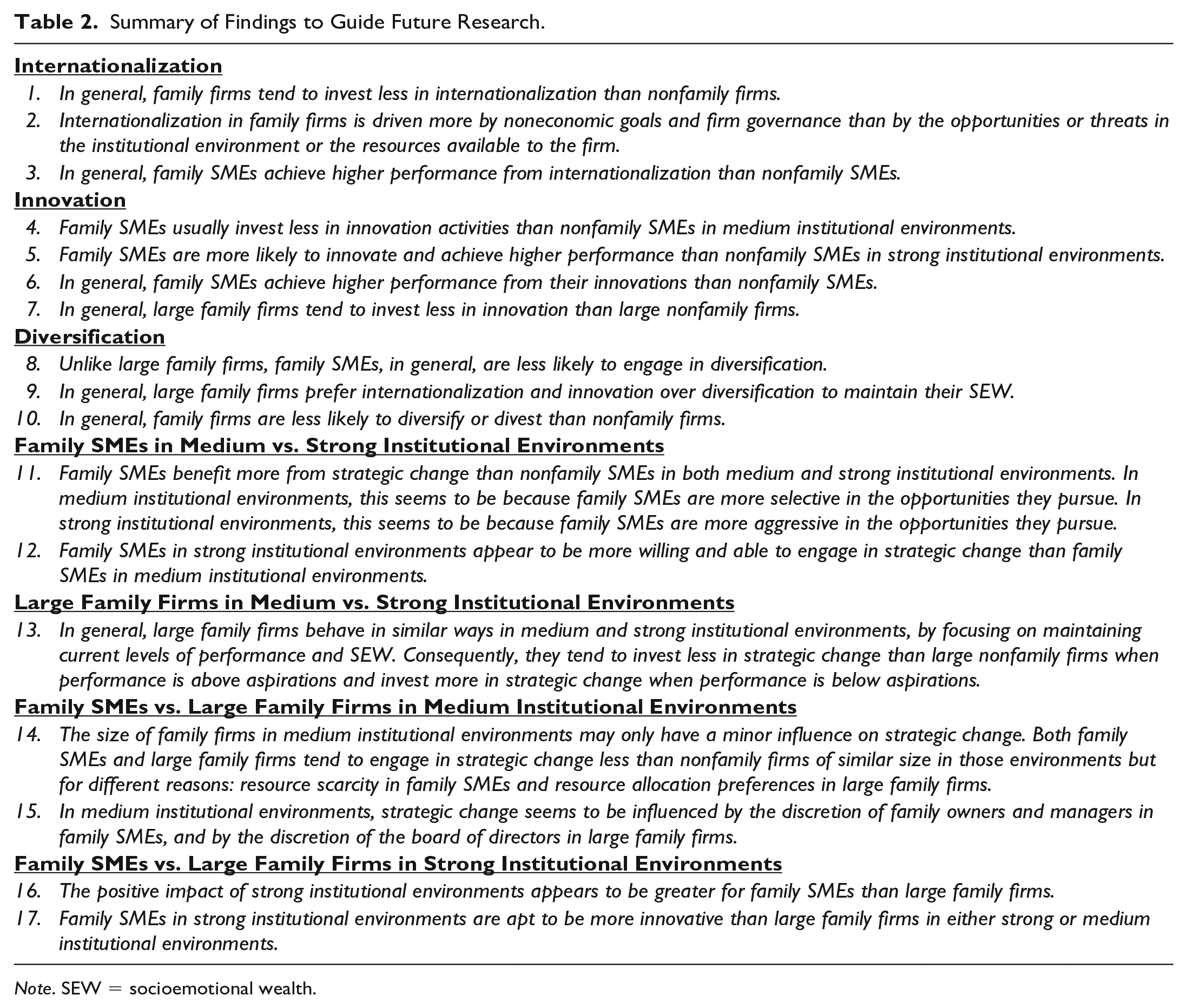
Note. SEW = socioemotional wealth.
Family SMEs in Medium Versus Strong Institutional Environments
There are important differences between the strategic change and performance of family SMEs in medium and strong institutional environments. On the one hand, the literature suggests that family SMEs in medium institutional environments invest less in internationalization and innovation than their nonfamily counterparts (e.g., De Massis et al., 2021; J. Yang et al., 2019). On the contrary, studies show that family SMEs in strong institutional environments have a higher propensity to engage in strategic change, particularly innovation activities, compared with nonfamily SMEs (Bammens et al., 2022). For example, Brinkerink (2018) shows that family SMEs have greater absorptive capacity for exploitative innovations but lower absorptive capacity for exploratory innovations. Studies in both environments point to some similarities in family SMEs, such as limited managerial capacity (e.g., Graves & Thomas, 2006) and the importance of the level of family ownership and family involvement in affecting a firm’s strategic change (Decker & Günther, 2017; Zahra, 2003). We suspect that a reason family SMEs in medium institutional environments are less inclined to engage in strategic change is that SEW endowments are more at risk due to the turbulence and uncertainty imposed by such an environment (Bannò, 2016; J. Yang et al., 2019). By contrast, in strong institutional environments, the reduced levels of risk to the SEW of family SMEs due to institutionally based protection mechanisms available in these environments (Brinkerink & Rondi, 2021) may make strategic change more attractive.
Interestingly, while there is a limited amount of research on financial performance, family SMEs in both types of institutional environments seem to benefit more from strategic change than nonfamily SMEs. We suspect that in medium institutional environments, this occurs because family SMEs are more cautious and selective in the opportunities they pursue, and they have the advantage of combining their heterogeneous family resources with resources acquired in the external market (Forcadell et al., 2018). In strong institutional environments, the superior performance of family SMEs seems to come from a willingness to more aggressively engage in strategic change than nonfamily SMEs partially because of the strong protection mechanisms available in these environments. This interpretation is consistent with prior literature that suggests family firms are more likely to occupy strategic positions that are on the extremes of those occupied by nonfamily firms (e.g., Chrisman & Patel, 2012; Miller & Le Breton-Miller, 2021). Our review adds to this knowledge by providing evidence that the position that family firms occupy is often influenced by the institutional environment.
Large Family Firms in Medium Versus Strong Institutional Environments
We suggested previously that strategic change in family SMEs is strongly affected by the institutional environment (medium versus strong) where the firm resides. However, similar findings were not apparent for large family firms in different institutional environments. In both environments, large family firms tend to engage in strategic change less than nonfamily firms of comparable size, although this interpretation is better supported among large firms in strong institutional environments. Indeed, there is enough contradictory evidence in medium institutional environments (Muñoz-Bullón et al., 2019) to suggest that much more research is needed. Overall, our interpretation of the findings is that large family firms in both environments are secure in their strategic positions and focus on maintaining their current economic and SEW endowments (cf., Gómez-Mejía et al., 2011). It is also worth noting that in strong institutional environments, the motivation of large family firms to engage in strategic change appears to be greater when their performance is below aspiration levels. In such circumstances, large family firms surpass large nonfamily firms in both innovation and internationalization activities (Chrisman & Patel, 2012; Gómez-Mejía et al., 2010). Although similar behaviors might occur among large family firms in medium institutional environments, more work is needed to be sure.
Family SMEs Versus Large Family Firms in Medium Institutional Environments
Our findings suggest that in medium institutional environments, large family firms behave in a fashion that is not markedly dissimilar from family SMEs, although large family firms are perhaps slightly more likely to innovate. Evidently, although large family firms have the resources to engage in strategic change, they do not consistently do so either because they focus on preserving SEW or do not find any additional value in dedicating more resources to strategic change initiatives, given the associated risks. When they do engage in strategic change, they seem more likely to innovate than internationalize or diversify.
As suggested above, family SMEs in medium institutional environments are less involved in strategic change than nonfamily SMEs, seemingly because they lack the managerial and financial capacity necessary to protect their economic and SEW endowments. Similarly, while it seems that family SMEs rely heavily on family ownership and management, large family firms count on their boards of directors (e.g., Kao & Kuo, 2017). We suspect that the explanation of such differences goes back to the idea that family SMEs have fewer resources to appoint professionals to their board of directors from whom they can gain expert guidance. For example, professionalization can boost internationalization in large family firms (e.g., Costa et al., 2022; Ray et al., 2018). Bringing outsiders onto the board may also reduce family control in family SMEs relatively more than in large family firms. Thus, the similarities in strategic change of family SMEs and large family firms in medium institutional environments may come from different sources: resource scarcity versus resource allocation preferences, respectively.
Our review also shows that both family SMEs and large family firms in medium institutional environments are less likely to engage in internationalization than their nonfamily counterparts (e.g., Alayo et al., 2019; Singla et al., 2017). It appears that both family SMEs and large family firms focus on maintaining positions in their existing markets and, therefore, dedicate most of their slack resources to competing within their national borders.
Family SMEs Versus Large Firms in Strong Institutional Environments
The most interesting and surprising findings from our review came from comparing family SMEs and large family firms in strong institutional environments. Earlier, we reported that family SMEs in strong institutional environments are more engaged in strategic change than SMEs in medium institutional environments. We suspected that because size was held constant, the environment greatly contributed to these differences, as would be expected. Therefore, as large family firms in strong institutional environments would also have more resources to both protect and enhance their strategic positions than family SMEs in the same environment, we expected that large family firms would engage in strategic change to a greater extent. However, our review suggests the opposite at least as far as innovation is concerned: Family SMEs are more aggressively engaged in innovation than large family firms in strong institutional environments.
Our review appears to suggest that the findings regarding family influence on strategic change seem to be more consistent among large family firms from strong institutional environments. For example, large family firms are generally found to be less likely to internationalize (Alessandri et al., 2018; Evert et al., 2018) or diversify (Gómez-Mejía et al., 2018; Miller et al., 2010) and have lower levels of R&D investment (Block, 2012) in strong institutional environments. However, the findings based on family SME samples from a strong institutional environment seem to be less consistent. While family SMEs are generally less likely to internationalize than nonfamily firms (e.g., Arregle et al., 2012), they appear more likely to innovate (e.g., Brinkerink, 2018; Werner et al., 2018) in strong institutional environments. The same conclusion holds when comparing family SMEs in strong institutional environments with large family firms in medium institutional environments, family SMEs seem to engage in more strategic change than family firms in other contexts. Such behavior could be because family SMEs have greater growth aspirations and/or greater aspirations for transgenerational succession (Chua et al., 1999) while at the same time being able to count on institutional protections for their economic and noneconomic endowments.
Thus, under favorable conditions, family SMEs may perceive their noneconomic goals to be compatible or even synergistic with their economic goals. If this is the case, then a favorable institutional environment provides opportunities to achieve and preserve those goals. By contrast, environments that offer lower institutional protection constrain the perceived ability to achieve firm goals, creating conditions for the achievement of economic and noneconomic goals that are conflicting rather than complementary. In favorable circumstances, family SMEs are willing and believe themselves able to engage in strategic change, particularly innovation, to a relatively greater extent than large family firms.
In contrast, the impact of a favorable institutional environment on large family firms with greater resources to protect and expand their strategic positions is muted by their overall reluctance to take risks and engage in strategic change. Our review of the literature implies that large firms have the power to insulate themselves from the vagaries of the institutional environment and can afford to be more cautious. In other words, greater resources allow large family firms the discretion to restrain the amount of strategic change they undertake to preserve the ability to achieve their noneconomic goals without undue sacrifice of their economic goals.
Future Research Directions
Aside from the findings offered (see Table 2), there appear to be several research avenues available to further investigate strategic change in family firms. First, we identified only two articles on family SMEs in weak institutional environments and no studies of large family firms in such environments. Arguably, family firms represent the dominant governance structure in many emerging economies which usually are characterized by weak institutional environments (Fang et al., 2022; N. H. Lien et al., 2018), but it is unclear whether and how the strategic change behaviors of family SMEs and large family firms in these environments are similar or different from their behaviors in medium and strong institutional environments. For instance, can informal networks in weak institutional environments replace formal property rights protections, or do informal networks tend to support autocratic government controls that allow resource appropriation from family firms or by family firms? Are there differences in how family and nonfamily firms engage in strategic change in these environments? Are family firms more homogeneous or heterogeneous due to weak institutional protections? Scholarship in this area will help provide a clearer picture of family firms in weak institutional environments, especially in relation to the role of family as a mitigating or triggering factor for strategic change.
Second, our findings suggest that family SMEs in strong institutional environments are more innovative than nonfamily firms of similar sizes in those environments, and more innovative than large family firms and family SMEs in other environments. To extend this finding, scholars may wish to conduct comparative studies of family firms of different sizes and/or in different institutional environments (e.g., Crawford et al., 2022; Markin et al., 2022). Moreover, as suggested by the study of Lohwasser et al. (2022), comparisons of strategic change among family firms and between family and nonfamily firms with different types and amounts of resources would be useful in institutional environments that vary in their stability as well as their strength.
Given the importance of a firm’s intellectual property, it would be useful to know how intellectual property rights vary among family and nonfamily firms of different sizes with different sets of resources across institutional environments, especially given the potential for intellectual property theft in environments that suffer from institutional voids. What mechanisms do family firms utilize in weak and medium institutional environments to protect their intellectual property rights? Do they rely on the same mechanisms as nonfamily firms and if not, what is the relative effectiveness of the mechanisms family firms use? Are family firms that are strongly embedded in their local and national communities afforded informal institutional protection that compensates for a lack of formal institutional protection?
Nonetheless, intellectual property rights are only a part of the bundle of property rights in the institutional environment (Levy-Carciente, 2019). The other two components that should be studied in the future are the legal/political environment and physical property rights. For instance, scholars could study how family firms in different environments protect their physical property rights. This is an interesting avenue for future research because the protections afforded by the legal and political environment in which family firms are embedded may be different for physical property rights than the protections provided for intellectual property rights. Moreover, there is preliminary evidence that physical property rights might be more important than intellectual property rights to family firms (e.g., Anderson et al., 2012).
Finally, firm financial performance is one of the most important outcome variables in management research (Yu et al., 2012). To our surprise, out of 193 studies reviewed, only 23 or roughly 11.9% focus on (family) firm performance as the dependent variable. 10 For example, we found only one study of the relationship between internationalization and the performance of large family firms (Tsao & Lien, 2013). While we need to learn more about strategic change in family firms, it is vital to have a stronger understanding of how those behaviors affect the performance of family firms with diverse levels and types of resources in different institutional environments. For instance, firm innovation has been shown to have a positive impact on firm performance in strong institutional environments for both family SMEs (e.g., Craig & Dibrell, 2006) and large family firms (e.g., Patel & Chrisman, 2014). How well do these findings hold in weak and medium institutional environments? What mechanisms do family firms in different environments utilize to increase their performance? Do family firms have similar performance aspirations in different institutional environments? Without a stronger comprehension of the impact of strategic change on the performance (cf., Skorodziyevskiy et al., 2022) of family firms in different institutional environments with varying levels and types of resources, we may end up recommending strategic change in situations where it offers no performance benefits.
Limitations
Despite the utility of our findings, our review has limitations. First, our review and interpretation of each possible combination of institutional environments, levels of resources, and types of strategic change is based on a relatively small number of articles. Second, the results of our review may have been limited by our selection process; there may be other contributions to this literature that reside outside of the scope of our review. For example, the decision to limit the articles reviewed to those published in 52 top journals in management, entrepreneurship, finance, and family business was made based on the journals used in similar reviews (e.g., Daspit et al., 2016; Tabor et al., 2018). We recognize that this choice might have directly influenced the results of our review. Likewise, the keywords used in our literature review may have resulted in some publications being excluded. Our method of measuring the environment and firm resources may also have affected our findings as we excluded studies that mixed firms of varying sizes and in varying institutional environments.
Third, our framework combining the logic of strategic management and institutional economics to organize and summarize strategic change in family firms over the last two decades is also not without limitations. Specifically, we considered the size of firms as a proxy for resources, but size may not always be the best indicator of whether a firm has the capacity to invest in strategic change or how firms adapt in a particular institutional context. In addition, we employed the 2019 IPRI to distinguish between nations with weak, medium, and strong institutional environments. However, not every nation in the world is included in the IPRI index. Other sources, such as TheGlobalEconomy.com or the World Bank, may be alternative options. Furthermore, there are other ways of capturing environmental opportunities and threats as well as firm resources than the ones we selected. 11 These alternatives should be explored in future studies.
Fourth, although we considered external (i.e., institutional environment) and internal (i.e., firm resources) factors, additional factors, such as the industry environment, could not be accounted for in our theoretical framework because few studies were conducted on firms in a single industry. Nevertheless, the industry environment affects the capacity for strategic change and should be considered in future research.
Finally, our review focused on the content and context of strategic change using a definition that focused on how firms align changes with resources and opportunities. Thus, the concern for changing conditions in both the internal and external environments is an important characteristic of this definition (Kunisch et al., 2017). However, future research may wish to adopt a broader definition that includes other aspects of organizational change such as change processes, the speed of change, and the types of change (e.g., disruptive or continuous). Likewise, knowledge may be gained by using a narrower definition that focuses on specific aspects of strategic change, such as strategic renewal (Agarwal & Helfat, 2009). There is still a need to examine the literature on how the strategic change process operates in family and nonfamily firms, how strategic change unfolds, and how different actors and time dimensions play a role in the dynamics of the strategic change process (De Massis et al., 2016; Kunisch et al., 2017; Müller & Kunisch, 2018; Nordqvist, 2012).
Conclusion
We use the determinants of strategy to examine the literature on the content of strategic change in family firms. Our review goes beyond a catalog of recent research and builds upon and extends the prior review of Gedajlovic et al. (2012) by explicitly comparing types of strategic change (i.e., internationalization, innovation, and diversification) among family firms and between family and nonfamily firms with differing resource capacities in different institutional environments. Overall, we found that using a strategy framework that considered institutional environments and resources was helpful in operationalizing the determinants of strategy and in explaining strategic change in family firms.
Supplemental Material
sj-docx-1-fbr-10.1177_08944865231221841 – Supplemental material for Strategic Change in Family Firms: A Review From an Institutional Environment and Firm Size Perspective
Supplemental material, sj-docx-1-fbr-10.1177_08944865231221841 for Strategic Change in Family Firms: A Review From an Institutional Environment and Firm Size Perspective by Vitaliy Skorodziyevskiy, Chelsea Sherlock, Emma Su, James J. Chrisman and Clay Dibrell in Family Business Review
Footnotes
Declaration of Conflicting Interests
The author(s) declared no potential conflicts of interest with respect to the research, authorship, and/or publication of this article.
Funding
The author(s) received no financial support for the research, authorship, and/or publication of this article.

Supplemental Material
Supplemental material for this article is available online.
Notes
Author Biographies
References
Supplementary Material
Please find the following supplemental material available below.
For Open Access articles published under a Creative Commons License, all supplemental material carries the same license as the article it is associated with.
For non-Open Access articles published, all supplemental material carries a non-exclusive license, and permission requests for re-use of supplemental material or any part of supplemental material shall be sent directly to the copyright owner as specified in the copyright notice associated with the article.
