




Abstract
Innovation literature increasingly considers the importance of the temporal dimension of knowledge search. In particular, several qualitative studies demonstrate how family firms successfully search for and recombine mature knowledge into innovations. This paper extends this line of research by quantitatively examining knowledge search in family versus non-family firms in a unique dataset in global wine technology between 1956 and 2013. Our data show that family firms use mature knowledge in their innovation processes to a greater extent than non-family firms. Furthermore, family firms seem to draw higher value from mature knowledge than non-family firms.
Introduction
To innovate, firms need to effectively search and recombine existing knowledge components 1 into novel combinations (Gupta et al., 2006; Henderson & Clark, 1990). Innovation literature traditionally has focused on two dimensions of the knowledge search process: “search depth” as the extent to which firms access knowledge components from particular sources (Laursen & Salter, 2006; Terjesen & Patel, 2017), “search breadth” as the extent to which firms access knowledge components from different domains (Katila & Ahuja, 2002). Family–firm research has agreed that family firms behave differently from non-family firms in terms of how they source and use their knowledge on those two dimensions (Brinkerink, 2018; Classen et al., 2012) affecting their innovation activities (Matzler et al., 2015).
Over the past years, academic interest in a third dimension, the “temporal search” aspect as the extent to which firms access and recombine knowledge that was developed at different times, has grown (Capaldo et al., 2017; Katila & Ahuja, 2002; Kok et al., 2019; Nerkar, 2003). For a long time, when investigating the temporal process of innovation, scholars have fallen prey to a so-called “recency bias” (Argote, 2012; De Massis et al., 2016), assuming that older knowledge becomes outdated and less relevant over time and bears substantially less value than newer knowledge (Capaldo et al., 2017; Kok et al., 2019). However, it has been recently argued that mature knowledge can be useful and valuable, especially for family firms, in the innovation process (De Massis et al., 2016; Messeni Petruzzelli et al., 2018). The temporal search process is closely intertwined with the concept of tradition, referring to the stock of knowledge, competencies, processes, values, and beliefs about the past (De Massis et al., 2016; Petruzzelli et al., 2012). It involves the accumulation of know-how, symbolic, and cultural content handed down in organizations across time and generations, thereby shaping the organization (Hibbert & Huxham, 2010). Due to their often long tradition and longevity (Cassia et al., 2012), strong links with the past reinforced by long-lasting family involvement in ownership and management (Calabrò et al., 2018; Lumpkin & Brigham, 2011), socioemotional wealth considerations (De Massis et al., 2014), and associated risk aversion (J. H. Block, 2011; Chrisman & Patel, 2012; Kotlar et al., 2014) family firms might be more inclined to search for and recombine knowledge from the past (De Massis et al., 2016) than non-family firms.
In addition, due to their unique characteristics, resources, and capabilities such as continuous organizational routines and rituals (Hibbert & Huxham, 2010; Shils, 1981), family firms might also be better equipped to beneficially leverage mature knowledge in their innovation process compared with non-family firms. Utilizing past knowledge is less cost-intensive (Cohen & Levinthal, 1990), increases reliability, and bears a lower level of risk while leading to an increased number and more novel knowledge (re)combinations (Rosenkopf & McGrath, 2011), allowing for unique innovations (Petruzzelli & Savino, 2014). At the same time, non-family firms are more likely to struggle with misinterpretations, misunderstandings, and misapplications (Argote, 2012; De Massis et al., 2016) due to memory decay (Capaldo et al., 2017). However, a recent review on innovation in family firms points out that we still lack a clear understanding of how family and non-family firms differ in the extent they search for knowledge in the past and how the value of innovation is affected (Calabrò et al., 2018).
This study, therefore, aims at adding to the first qualitative insights of family–firm research (De Massis et al., 2016; Magistretti et al., 2020; Messeni Petruzzelli et al., 2018) by quantitatively investigating and validating the innovation through tradition (ITT) argument and studying whether family firms indeed are (a) more prone to and (b) better at using mature knowledge in their innovation process than non-family firms. We test our hypotheses in a unique longitudinal dataset within the context of wine technology, a context that is especially known for its tradition and longevity (Gallucci & D'Amato, 2013; Soler et al., 2017) and that has been qualitatively investigated multiple times in family–firm research (e.g., Jaskiewicz et al., 2015; Kammerlander et al., 2015; Reay et al., 2015; Soler et al., 2017; Steen & Welch, 2006; Woodfield & Husted, 2017). Our sample includes 9,615 wine technology patents attributable to 1,837 patent families that were filed by 183 family and non-family firms between 1956 and 2013.
Our study contributes to knowledge search literature and family–firm research by showing that (a) family firms’ knowledge search process accesses and recombines more mature knowledge than non-family firms and (b) this mature knowledge is more beneficially leveraged by family firms than non-family firms. Although our data support the findings of general innovation management literature that older knowledge is associated with less inventive value, we found that this relationship is indeed context-specific. Family firms seem more capable of drawing value from mature knowledge components than family firms. These findings are relevant as they give substance to a new stream of literature that promotes the reconsideration of old knowledge as a unique resource for the competitive advantage of firms.
Theory and Development of Hypotheses
The Maturity of Knowledge in Family Firms
Knowledge maturity, or the extent to which organizations draw on already well-known and well-established knowledge components—compared with newer, less established knowledge—in their innovation processes, is expected to vary across contexts (Hohberger, 2014). Prior research has shown that knowledge search behavior generally differs between family and non-family firms (Mazzelli et al., 2020). It has, therefore, been suggested that family firms also represent an organizational form that is particularly well suited to draw on more mature knowledge in their search and recombination process in the context of innovation than non-family firms (De Massis et al., 2016). Following De Massis et al. (2016) and prior family–firm research, we focus on family firms as firms that are defined as being governed and/or managed with the intention to shape and pursue the vision of business held by a dominant coalition controlled by members of the same family or a small number of families that is potentially sustainable across generations, (Chua et al., 1999, p. 25).
We argue that family firms, in particular, are more likely to search for and access mature knowledge that was developed in the past in their innovation processes compared with non-family firms due to several reasons including strong links with the past, long-term orientation reinforced by long-lasting involvement in ownership and management, socioemotional wealth and associated risk preferences (De Massis et al., 2016).
Family firms, more than non-family firms, build on their tradition that is rooted in the past (Zahra et al., 2008). Within family firms, the values and beliefs of founding families are often handed down across generations for decades, sometimes centuries, such that organizational cultures and identities closely reflect the way firms have operated in the past (Gagné et al., 2014; Tàpies & Ward, 2008). In family firms, family history pervades business practices. Producing and reinforcing shared values, norms, and beliefs over time create a strong bond with the past (Zellweger, Kellermanns et al., 2012). Stories of the past are commonly shared among its members, making older knowledge more present in the minds of employees and management (Kammerlander et al., 2015). Family firms are generally perceived to be conservative and highly traditional, sticking to the way things have been done in the past (Gómez-Mejía et al., 2007). In this context, also emotional ties to resources, such as existing knowledge components, might be stronger in family firms (König et al., 2013). Conversely, employees within family firms might also be less committed to using the most recent knowledge, as the past has more value than in non-family firms (Kammerlander et al., 2015). Therefore, heeding the status quo and following current trends are likely to be less important in family firms than in non-family firms. The importance of heritage and tradition (Zahra et al., 2008) makes the older knowledge more accepted or even desired (Classen et al., 2012).
Due to their long tradition and longevity, family firms are typically also more long-term oriented than non-family firms (Cassia et al., 2012). It has to be considered that by referring to continuity (Lumpkin & Brigham, 2011), long-term orientation also comprises some elements of futurity, such as attention for and concern about the distant future, which is associated with proactively engaging in knowledge search and combination processes per se (Lumpkin & Brigham, 2011). Although continuity in the context of long-term orientation thereby connects the past with the present and the future, it has been generally found to be associated with valuing “a strong link to the past” and having a strong interest in tradition (Bearden et al., 2006). The longevity of family firms and their focus on tradition allows them to keep the knowledge within their organization even though this knowledge has been generated many years before. Family firms are also more likely to maintain a link to their past due to their long-term involvement in ownership and management (Zellweger & Dehlen, 2012). Managers belonging to a family usually have a longer tenure on the management board, with greater continuity in the firm’s innovation trajectory (Calabrò et al., 2018; Lumpkin & Brigham, 2011). Within family firms, especially family members often gain very early and deep exposure and develop a significant stock of knowledge and skills (Bertrand & Schoar, 2006; Miller & Le Breton-Miller, 2005; Miller et al., 2013) which is typically enhanced through longer terms in office (Le Breton-Miller & Miller, 2006). Family firms are thereby able to draw on often long-established relationships that cut across the family and firm domains (Habbershon et al., 2003; Habbershon & Williams, 1999; Miller et al., 2013). These unique and close relationships with internal and external stakeholders (Berrone et al., 2012), which are mutually reinforcing and interdependent, are critically developed and cultivated over time (Sauerwald et al., 2016). Their longevity (Miller & Le Breton-Miller, 2005) and continuity allow family firms to reach further into the past and give them more privileged access to mature knowledge (De Massis et al., 2016).
Finally, family managers tend to pursue family-centered noneconomic goals (e.g., family harmony, family social status), which is less associated with risk-taking (J. H. Block, 2011; Chrisman & Patel, 2012; Kotlar et al., 2014). Their managers are keen to preserve the socioemotional wealth (SEW) of their family firm, intending to sustain family control influencing the strategic decisions made by the firm (De Massis et al., 2014), even when sacrificing higher financial gains (Kotlar et al., 2018). Family firms try to keep ownership or control within the family (Cassia et al., 2012) and are therefore more reluctant to engage in riskier innovation options. Family firms, therefore, might prefer to engage in competence-enhancing innovation which builds upon and reinforces existing competencies, skills, and know-how, in contrast to the reliance on new knowledge components, which, is more likely to result in competence-destroying innovation, which obsolesces and overturns existing competencies, skills, and know-how (Gatignon et al., 2002). Searching across time and accessing knowledge components that have matured reduce the risk of incorrect applications of new knowledge, increases the reliability (Heeley & Jacobson, 2008) and legitimacy (Hargadon & Douglas, 2001), and risk of retaliation and are thus perceived as less risky (Capaldo et al., 2017).
Swarovski, an Austrian family firm, can illustrate family firms’ reliance on mature knowledge while being innovative at the same time. The founder of the company, Daniel Swarovski, developed a sophisticated technology that allowed cutting crystal glass more precisely than any other existing method back in the 1890s. This technology was continuously refined, improved, and upgraded in the company. The long-term orientation of the founder (he was called an “avant-gardist”) and his successors and the continuous reliance on this unique, well-established technology over decades allowed the firm to explore new markets with new products like gemstones, jewelry and couture, chandeliers, optical instruments, abrasive and cutting tools, road safety products (Bailom et al., 2007). All these consecutive innovations were based on a mature technology that was developed long ago and was deeply rooted and preserved in the family firm’s technological heritage.
Given their particular risk preferences, family firms are likely to rely on more mature knowledge components than non-family firms. Thus, we hypothesize:
Hypothesis 1 (H1): Family firms use more mature knowledge in their innovation process than non-family firms.
Knowledge Maturity and Innovation Value
General management and innovation management research have focused on the value a firm can appropriate from innovation (Capaldo et al., 2017; Hess & Rothaermel, 2011; Phene et al., 2006). Broadly, two types of value can be distinguished: financial value a firm derives from commercialization, and scientific (Capaldo et al., 2017) or technological value (Kok et al., 2019) a firm derives from potential contribution to further technology development and impact on subsequent innovation (Capaldo et al., 2017; Nerkar, 2003). When knowledge is used as an input, as a knowledge component, for subsequent innovations (Capaldo et al., 2017; Kok et al., 2019), it has been shown to be a sign of both its economic (J. Block et al., 2013; Hall et al., 2005) and technological value (Benson & Magee, 2015).
Generally, there are opposing directions regarding how the maturity of the underlying knowledge components determines the value of innovation. Although extant innovation literature reports on the benefits of new knowledge due to its greater relevance to the current needs of the environment (Capaldo et al., 2017; Sørensen & Stuart, 2000), most recently it has been increasingly acknowledged that mature knowledge also bears benefits (Messeni Petruzzelli et al., 2018). On one hand, knowledge decreases in value over time due to obsolescence (Capaldo et al., 2017; Nerkar, 2003), memory decay (Capaldo et al., 2017; Nerkar, 2003), and depreciation (Levinthal & March, 1981). On the other hand, it has been argued that mature knowledge might get more valuable with time as its reliability increases (Nerkar, 2003), and it becomes more established and well understood (Capaldo et al., 2017) and can lead to novel knowledge recombinations increasing innovations’ uniqueness (Petruzzelli & Savino, 2014).
The extant literature on the temporal knowledge search process generally points to a negative relationship between knowledge maturity and innovation value (e.g., Ahuja & Morris Lampert, 2001; Ardito et al., 2020; Argote, 2012; Capaldo et al., 2017; Kok et al., 2019). While arguments are mainly focused on the usefulness of recent knowledge in current innovation processes due to its novelty and relevance (Rosenkopf & McGrath, 2011), mature knowledge is argued to lose value over time due to a decreasingly effective search process. With longer periods between the creation of a knowledge component and its application, it is assumed to become more difficult and laborious to retrieve, apply and adapt the component to current uses (Miller et al., 2007; Phene et al., 2006). Memory decay may be induced by staff turnover and the loss of transcripts and artifacts that were originally associated with creating the knowledge component (Argote, 2012). With the increasing age of a knowledge component, it becomes increasingly difficult to de-code the originally intended meaning and thus more difficult to successfully connect past ideas to current uses. Current R&D personnel might be trained with current technologies finding it increasingly difficult to retrieve and apply mature knowledge components (Sørensen & Stuart, 2000).
Thus, we argue that generally the potential benefits of mature knowledge are outweighed by the problems outlined above and, therefore, hypothesize:
Hypothesis 2 (H2): The relationship between knowledge maturity and innovation value is negative.
However, the value of knowledge components for innovations not only resides in components’ characteristics but also in the firm’s unique capabilities to leverage and combine them (Yayavaram & Ahuja, 2008). We argue that family firms’ capabilities to leverage mature knowledge components are superior to non-family firms.
Although mature knowledge is often perceived negatively and associated with negative innovation outcomes, it also presents opportunities in terms of reliability, legitimacy, and uniqueness of innovations that we argue can be more efficiently leveraged by family firms. Due to family firms’ unique characteristics and their preferences for older knowledge, they can more effectively utilize older knowledge that is recombined in the innovation process.
In knowledge recombination literature, memory decay is one of the main causes for the devaluation of old knowledge (Capaldo et al., 2017). Due to family firms’ focus on tradition and constant reflection on past feats and achievements, they have more privileged access to past knowledge than non-family firms (De Massis et al., 2016). Hence, family firms’ greater effectiveness in recombining already existing, well-established, and mature knowledge components is argued to come from their greater capability to conserve, access, and process mature knowledge within the organization. Over time, family firms are endowed with unique capabilities that allow them to make the past more available and understandable to employees involved in the innovation process (De Massis et al., 2016). This is realized through organizational routines that ensure continuity across time and generations (Shils, 1981) and preserve the original meaning and content of past knowledge (Hibbert & Huxham, 2010). This is argued to increase the value of temporal search by overcoming the risk of misinterpretations, misunderstandings, and misapplications (Argote, 2012; De Massis et al., 2016).
In addition, the sticky and embedded nature of tradition and its path dependency makes it more difficult to understand and to imitate or copy knowledge and thus contributes to its uniqueness, distinctiveness, and rarity (Holmquist et al., 2019). Recombinant processes allow innovation by establishing new combinations between old knowledge components (Petruzzelli & Savino, 2014). Thus, family firms can build on such knowledge from the past representing a unique resource and giving them a competitive advantage (De Massis et al., 2016).
Family firms also possess higher human capital due to long-term and trust-based relationships with employees (Miller & Le Breton-Miller, 2005), which leads to higher levels of “experiences and deep task-, product-, and market-specific knowledge among employee,” (Duran et al., 2016, p. 1230). Longer tenure of executives and a lower turnover of key employees in family firms lead to higher social capital that fosters the effective use of internally specialized knowledge (Brinkerink, 2018).
In his organizational learning perspective on innovation, Brinkerink (2018) argues that family firms have superior abilities to “retain and integrate specialized knowledge, to effectively transfer it through time and across people, and to reinterpret and rejuvenate historical knowledge assets” (p. 299) that results in a lower knowledge “depreciation rate” (Boone et al., 2008).
Hence, family firms are better able to release the potential advantages of temporally distant knowledge in their innovation processes due to a more developed past, knowledge interiorization, and reinterpretation capabilities. In addition to family firms’ higher propensity to use mature knowledge, we hypothesize that family firms can make better use of mature knowledge components setting off some of the disadvantages older knowledge has compared with recent knowledge. Thus, we hypothesize:
Hypothesis 3 (H3): The negative relationship between knowledge maturity and innovation value will be reduced in family firms.
Method
Sample and Data Collection
To test our hypotheses, we build a unique long-term dataset spanning several decades between 1956 and 2013. We thereby rely on patenting data from global wine technology. We selected the wine sector because (a) it has already existed for a long time, (b) it is sufficiently patent-intensive, (c) and with its relatively high number of family firms, it has been identified as a relevant context for family firm research (e.g., Jaskiewicz et al., 2015; Kammerlander et al., 2015; Reay et al., 2015; Soler et al., 2017; Steen & Welch, 2006).
To investigate our hypothesized relationships quantitatively, we rely on patent data. Patenting is a common practice among innovative organizations (Ardito et al., 2020; Hagedoorn & Cloodt, 2003). Although patent analysis has its drawbacks, as not all innovations are or can be patented (Griliches, 1990; Silverman, 1999), this research method allows us to contribute meaningfully to the discussion of knowledge search and recombination in family firms. In the standardized patent system, specific types of technology embodied in innovations can be objectively captured and traced over time (Aharonson & Schilling, 2016; Ardito et al., 2020). Despite potential limitations, patents are a widely used data source to analyze inventive activities, technical change, and technology management (Kim & Lee, 2006; Petruzzelli & Savino, 2014; Quintana-García & Benavides-Velasco, 2008) and innovation in the family–firm context (Asaba & Wada, 2019; J. Block et al., 2013; Ceipek et al., 2020; Dieleman, 2019; Matzler et al., 2015).
In our sample selection process, we closely and carefully followed previous research and initially relied on the full Derwent Innovation dataset of wine technology patents from 1886 to 2020 (Derwent 2021). 2 Similar to the sampling procedure adopted by Kok et al. (2019), we focused on coding the parent firms with the most patents in wine technology—both from privately and publicly held firms. To identify the most frequent patentors, we grouped patent families based on the information of their current ultimate parent 3 firms, only including patent families which reported a single parent firm as an assignee. We coded ultimate parents with six or more patent families or with twelve or more individual patents in wine technology, amounting to a total of 394 ultimate parents considered for analysis. As patents might have changed ownership after filing, we needed to verify whether the original assignee of these patents also has been part of the current ultimate parent at the priority date or not. Derwent data provides accurate ownership data as of the time of data collection in January 2021, reducing the workload of aggregating by subsidiaries of the same firms. Yet, we further needed to manually determine each patent family’s ultimate parent at the priority date to ensure the patent family was subsequently matched with the correct firm-level data and correctly coded as internal or external forward/backward citations of patents. As our analysis relies on examining backward citations of focal patents to capture the recombination of knowledge components of innovations (Jaffe & de Rassenfosse, 2017; Phene et al., 2006; Rosenkopf & McGrath, 2011), aggregating individual patents from patent families provides more accurate patent-level variables compared with only investigating at the patent family level (e.g., Nakamura et al., 2015). Following Kok et al. (2019) and Nerkar (2003), we aggregated all individual patents belonging to the same patent family to capture the most information available on these patents.
Our final sample includes 1,837 wine technology patent families consisting of 9,615 individual patents between 1956 and 2013. The cutoff year of 2013 was necessary as we captured forward citations in a 7-year window. The patent families are attributable to 47 family firms (533 patent families) and 136 non-family firms (1,304 patent families). Of all examined firms, 67% exclusively operate in the beverage sector, while the remaining firms are diversified, including operations in, for example, chemicals, biotechnology, or food. It is noteworthy, while wine technology might evoke pictures of rural vineyards in Tuscany (Italy) or Bordeaux (France), our final dataset consists of 56% patent families from Japan, 11% from China, and only 16% from Europe. The Japanese-based alcoholic beverage company Suntory, founded in 1899 and owned by the family clans of Torii and Saji (Nikkei, 2015), is the firm with the most patent families in our sample. Suntory not only operates vineyards in Japan but also in Bordeaux (France), the Rheingau (Germany), and other areas in the world (Suntory, 2022). It is an example of how particularly Japanese wine and sake producers take up a significant share of our sample, firms that operate globally, in an industry characterized by a long tradition (Rose, 2018).
Measures
Knowledge maturity was captured by the median number of years between the priority year of the focal patent and the patents it cites (Kok et al., 2019; Nerkar, 2003). Previous studies have demonstrated the usefulness of using patent citations for measuring the maturity of knowledge components (e.g., Ardito et al., 2019; Capaldo et al., 2017).
Innovation value was measured as the number of forward citations made to the focal patent. To reduce the bias that older patents get more citations than more recent ones, we only accounted for patent citations within 7 years after the filing date (see e.g., Ardito et al., 2019). The 7-year citation window after the filing date was found to be a good threshold to capture the value of patents, as the value of innovation decreases significantly after the first years of patent filing (Nooteboom et al., 2007). Due to wine technology’s lower patenting intensity, compared with other faster-paced high-tech technologies such as, e.g., fuel cells, a 7-year window is likely more appropriate (Ardito et al., 2019). Forward citations have been used by previous studies on patent data (Jaffe & de Rassenfosse, 2017; Penner-Hahn & Shaver, 2005; Van de Vrande, 2013) and have been shown to correlate with the rate of technological improvement (Benson & Magee, 2015) and the economic value of the focal patent (J. Block et al., 2013; Hall et al., 2005).
Family firm status was captured with a dummy variable. A focal firm was defined as a family firm when one of the two characteristics was present at the priority date of the patent: when a family member was CEO, president, managing director, or chairman of the board; or when the owner family had substantial ownership of the firm, which was the case if a family was the majority shareholder or inherited the largest portion of shares among all shareholders. By considering elements of either management and/or ownership, we rely on the definition of Chua et al. (1999) frequently used in family firm research (e.g., De Massis et al., 2016; Kellermanns et al., 2008; Zellweger, Nason et al., 2012). It has been argued that if a family member holds central management functions or the family possesses significant ownership, the family can shape and pursue the vision of the business held by a dominant coalition controlled by members of the same family or a small number of families in a manner that is potentially sustainable across generations of the family or families (Chua et al., 1999, p. 25).
Accordingly, a family firm definition based on management is not uncommon in family business research (e.g., Moss et al., 2014; Randøy & Goel, 2003; Singal & Gerde, 2015; Zachary et al., 2011). We collected information on family–firm status from annual reports, firm websites, national directories, yearbooks, and historical archives. We identified family members based on the historic descriptions presented in these sources. Surnames of managers and board members were an important indication of family affiliation. We cross-checked information for changes in the names of the members over time (Amore et al., 2014). To make sure family members were indeed related to the founding family, we further validated their descent cross-checking their biography with the history of the firm (Zachary et al., 2011).
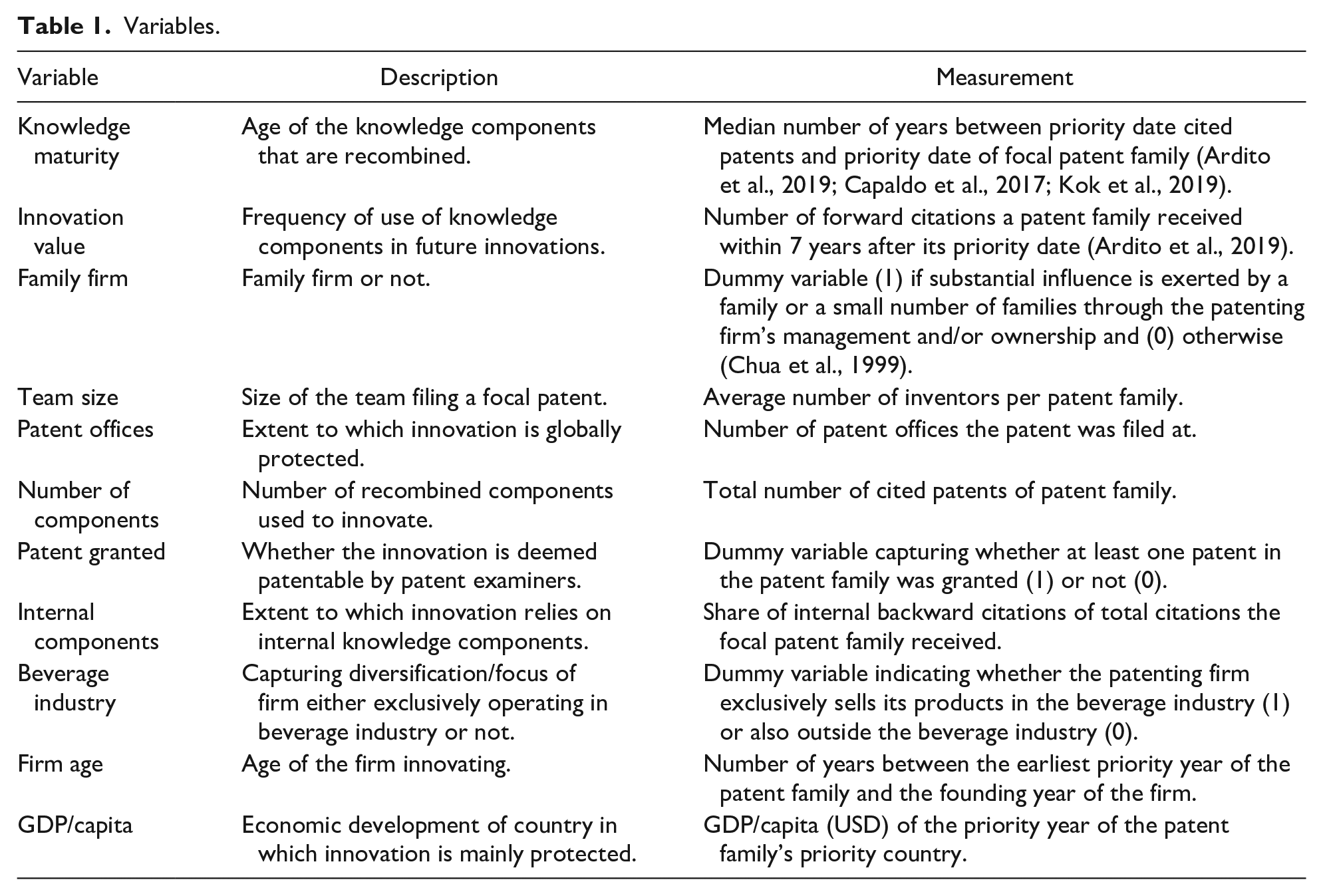
Consistent with prior studies on the value of innovation and knowledge components, we included several controls on the patent level in our analysis. Patent-level controls were derived from Derwent data. Patent granted refers to a dummy variable that captures if at least one patent in the focal patent family was granted. We also control for the number of patent offices the patent was filed to account for the breadth of global intellectual property protection. The number of components of the focal patent family controls for the number of knowledge components that are recombined to create the innovation and includes all cited references of a patent family (Kok et al., 2019). Next, we account for team size capturing the number of inventors quoted on the application per patent family. Team size has been found to affect the outcome value of innovation (Singh & Fleming, 2010). On the firm level, we have control for firm age measured as the number of years between the founding date of the firm and the filing date of the patent. The information was collected from firm websites, yearbooks, and historical archives (Capaldo et al., 2017; Sørensen & Stuart, 2000). Firm age also controls for the longevity of family firms, as more traditional family firms are likely to have imprinted values from earlier generations that influence the adoption and processing of knowledge components across time (Jaskiewicz et al., 2015). We also control for the degree to which a company cites its own patents by calculating the percentage of internal backward citations (internal components) to the total number of backward citations (Kok et al., 2019). To account for potential country and institutional effects, we include GDP per capita, measured as the annual GDP rate per country where the patent was filed, which was obtained from The World Bank database (The World Bank, 2021). Furthermore, we include a dummy variable to account for industry-related differences between firms that exclusively operate in the beverage industry and others that are diversified beyond. We further included firm dummies to control for possible firm-specific characteristics affecting the patenting behavior, as well as year dummies for the variations over time. All models include robust standard errors to correct for heteroscedasticity. An overview of the variables and their operationalizations can be found in Table 1.
Variables.
Data Analysis
As our dependent variables represent count variables displaying signs of overdispersion, we applied a negative binomial regression model to test our hypotheses. Overdispersion is present when the variance of the variable is many times larger than its mean (Hilbe, 2007). We conducted a likelihood ratio test for overdispersion and found the alpha parameter significantly different from zero for both dependent variables ([1]
Results
Table 2 shows the summary statistics, including mean, standard deviation, and the correlation of all the variables used in our analysis. Preceding the regression analysis, we calculated the variance inflation factors to check for multicollinearity. Being well below the threshold of 10 (Mason & Perreault, 1991) with an average value of 1.16 and a maximum value of 1.43, we are confident that multicollinearity is not an issue in our analysis.
Descriptive Statistics and Correlation Table.
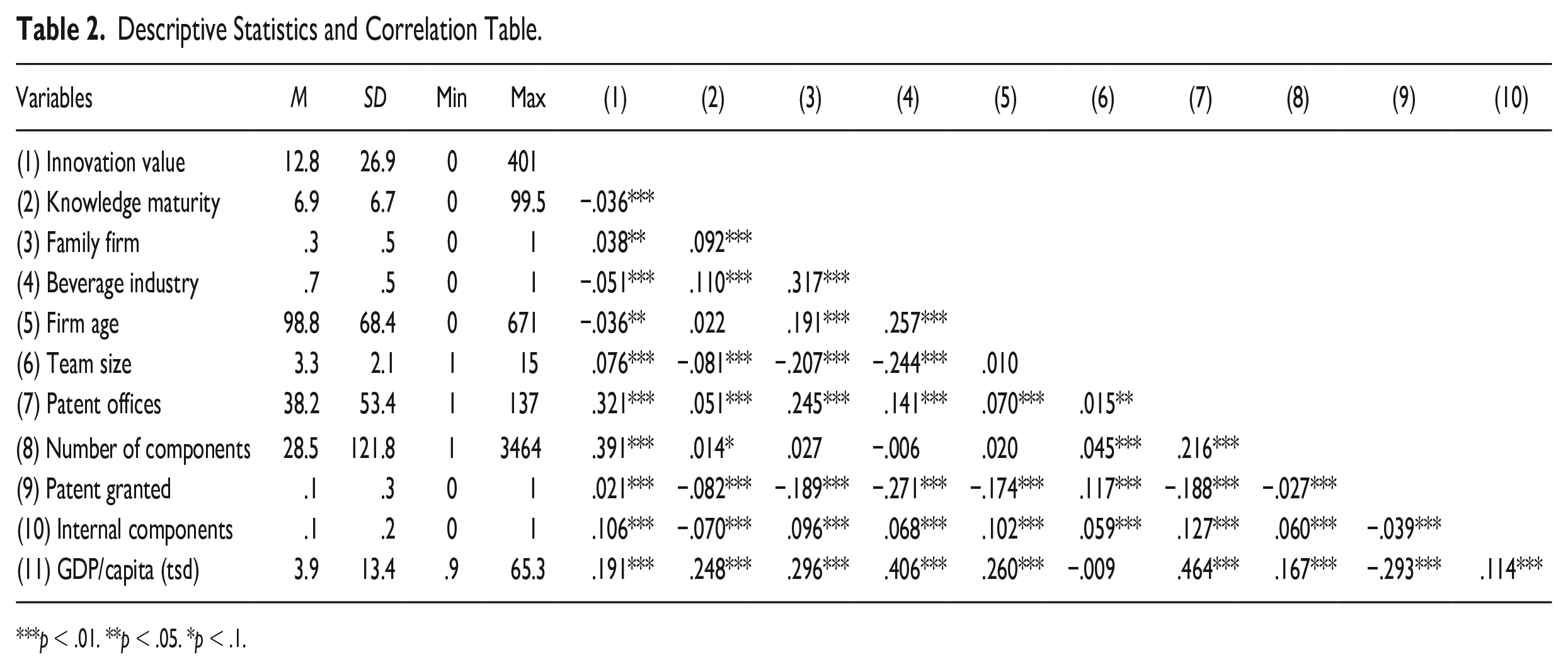
p < .01. **p < .05. *p < .1.
Tables 3 and 4 report the results of our negative binomial regression analysis. In addition to the coefficients, we also report the incidence rate ratio (IRR) in all our models, which is the factor change of the respective variable for a unit increase of the independent variable, all other variables being equal (Hilbe, 2007). The alpha value of all models is significant (p < .000), indicating a good fit for all our models.
Negative Binomial Regression Analysis of Family Firm on Knowledge Maturity.
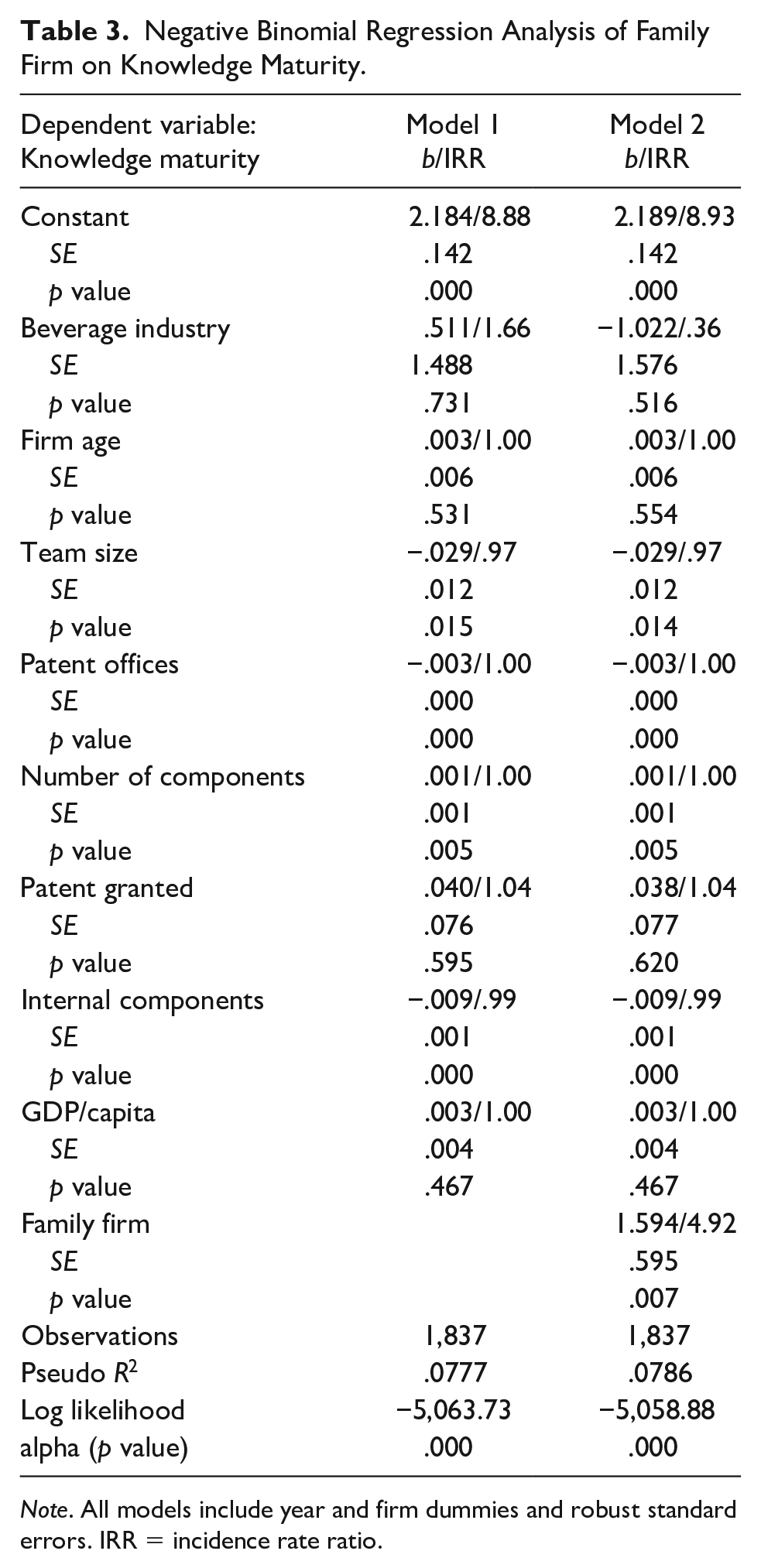
Note. All models include year and firm dummies and robust standard errors. IRR = incidence rate ratio.
Negative Binomial Regression Analysis of Knowledge Maturity on Innovation Value.
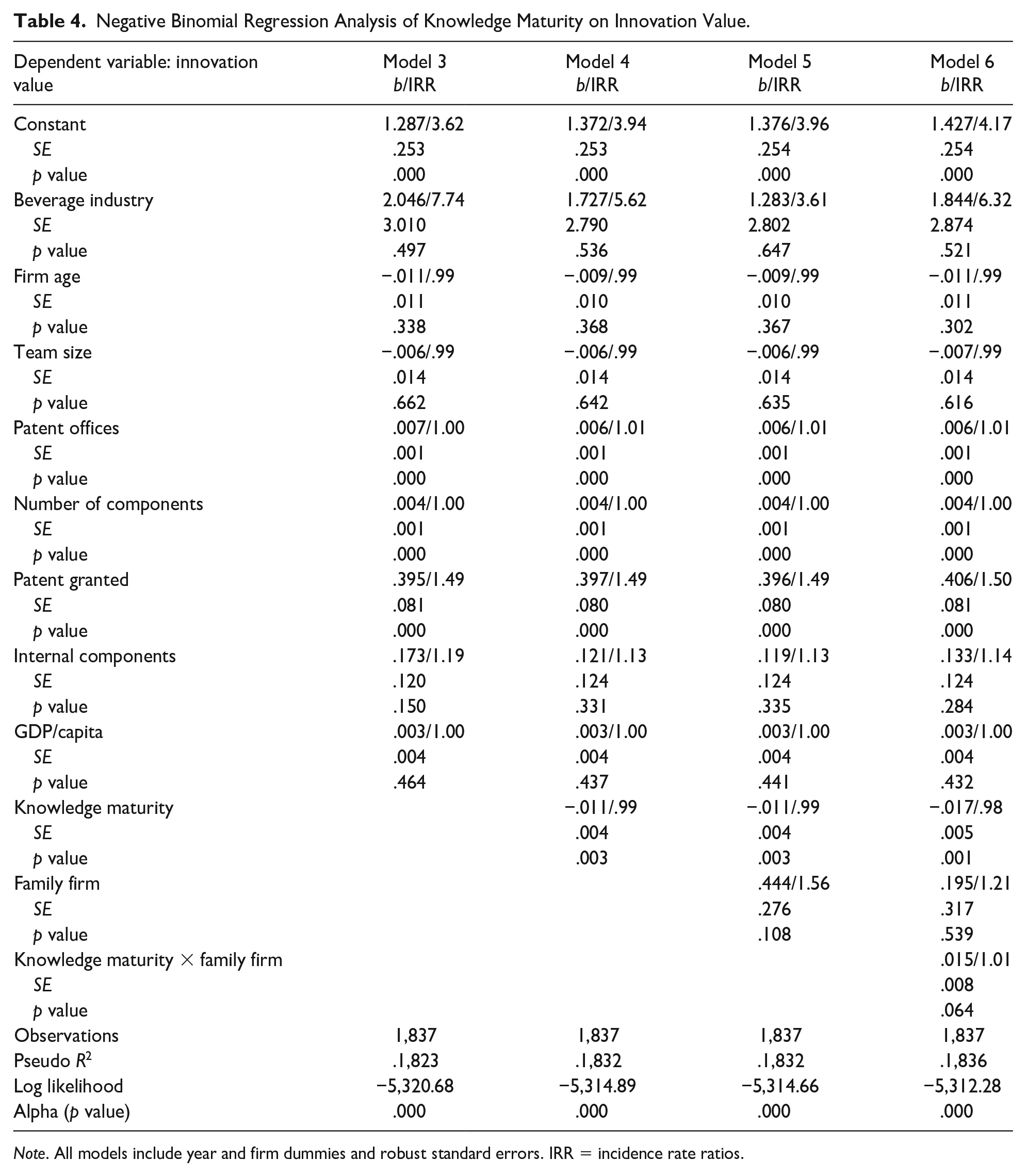
Note. All models include year and firm dummies and robust standard errors. IRR = incidence rate ratios.
Table 3 presents the results testing our H1 that family firms are positively associated with increased knowledge maturity. In Table 3, Model 1 shows the results only including the control variables, and Model 2 adds the independent variable family firm. In line with our H1, we find a positive and statistically significant effect, indicating that family firms indeed are associated with the use of older knowledge than non-family firms when innovating (β = 1.59, p = .007). In fact, the IRR of 4.92 shows us that family firms compared with non-family firms are expected to be associated with 4.92 times greater knowledge maturity.
Table 4 reports the findings for our models testing the relationship between knowledge maturity on innovation value and whether family firms are positively moderating this relationship (H2 and H3). Model 3 presents the effect of the control variables on innovation value. Model 4 adds knowledge maturity. We find a negative linear relationship between knowledge maturity (β = −.011, p = .003) and the value of innovation supporting our H2. The IRR of .99 implies that with every year a patent matures, its innovation value decreases by 1% (IRR = .99), keeping all other variables equal.
Model 6 adds the interaction effect of knowledge maturity with family–firm status. In line with H3, we find that family firms positively moderate the relation between knowledge maturity and innovation value (β = .015, IRR = 1.01, p = .064). The effect size of the interaction between knowledge maturity and family firm depends on the value of knowledge maturity. For example, with knowledge maturity at a level of 7 years 4 the average predicted innovation value is 15.52 for non-family firms and 20.92 for family firms. This difference indicates the alleviating effect family–firm status on the negative relationship between knowledge maturity and innovation value. Figure 1 shows the research model of the hypothesized relationships. In line with our first hypothesis, we find that family firms use more mature knowledge than non-family firms in their innovation process. The negative relationship between knowledge maturity and innovation value (H2) is reduced in family firms (H3).
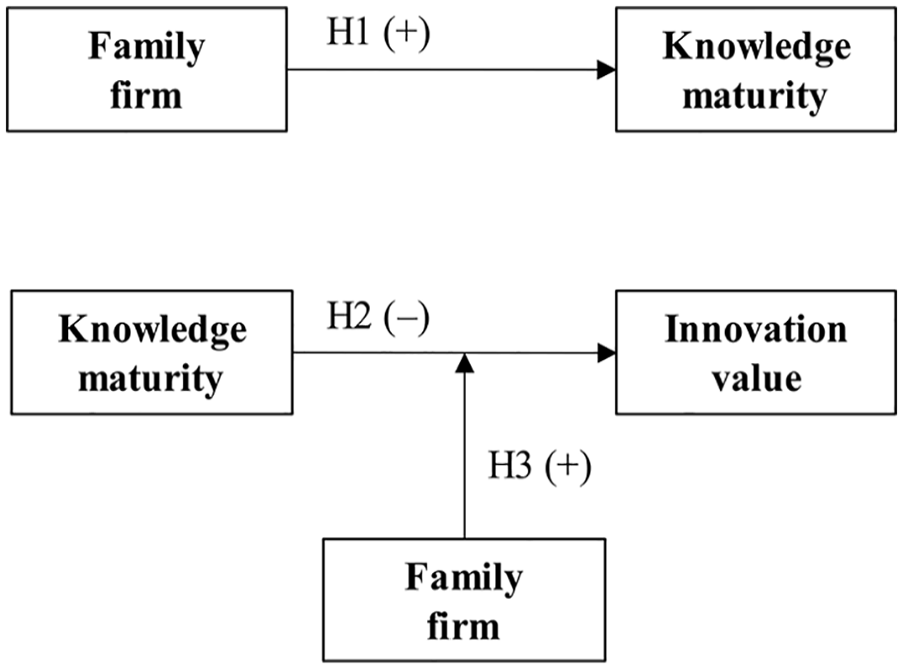
Research model of hypothesized relationships.
To check the robustness of our results, we performed several additional analyses with adapted models and variable specifications. First, we tested variations of the knowledge maturity variable. Following prior research (Nerkar, 2003), we tested a model excluding patents with zero backward citations indicating “zero recency” when calculating knowledge maturity. We still find support for all our three hypotheses. As patents citing only one patent may not reflect knowledge recombination requiring combining knowledge from multiple sources, we also tested a model excluding single backward citations (Kok et al., 2019). All three hypotheses remain supported. Second, we also used an alternative 6-year period instead of the 7-year period to capture innovation value (Ardito et al., 2019; Nooteboom et al., 2007). All our models remained supported. Third, we conducted an additional split sample analysis by separately estimating our models on the relationship between knowledge maturity and innovation value for family firms (N = 533) and non-family firms (N = 1,304). Although we find a significant and negative effect in the non-family firm sample, its effect in family firms is not significant. Fourth, we re-ran our models based on a subsample of family firms, purely defined through family ownership. Our results for the moderating impact of family firms on the relationship between knowledge maturity and innovation value (H2 and H3) stay the same and significant, although due to the reduced sample size, our estimation of the relationship between family firm status and knowledge maturity (H1) no longer converges. Fifth, we tested the sensitivity of our results by excluding each of the three most frequently patenting firms one by one and also all at once. The findings remained the same and were significant across all three hypotheses.
Discussion
In this study, we investigate how temporal preferences of knowledge recombination differ between family and non-family firms in terms of reliance on mature knowledge and if family firms are better able than non-family firms to leverage this maturity of knowledge in terms of creating innovation value. We thereby contribute to the family–firm literature and the general knowledge search literature in the following ways:
First, we contribute to the family–firm literature by quantitatively investigating and validating the ITT argument (De Massis et al., 2016; Petruzzelli & Savino, 2014) and extending this argument to family–firm research in the wine sector (e.g., Jaskiewicz et al., 2015; Kammerlander et al., 2015; Reay et al., 2015; Soler et al., 2017; Steen & Welch, 2006; Woodfield & Husted, 2017). Our findings show that family firms, more than non-family firms, are associated with the use of mature knowledge in their innovation processes. These findings are in line with suggestions of prior research that “family firm decision makers manifest a strong tendency to integrate past knowledge into their search efforts” (Mazzelli et al., 2020, p. 2). Our findings suggest that temporal preferences in the knowledge search and recombination process are indeed context-specific (see Hohberger, 2014) and rooted in the very characteristics of firms. The greater reliance on mature knowledge components of family firms could be attributed to their comparative preference for the proven effectiveness of mature knowledge compared with more risky, newer knowledge.
Our finding of family firms’ greater association with more mature knowledge is further in line with theoretical arguments that family firms approach knowledge search processes differently than non-family firms due to socio-cognitive factors (Mazzelli et al., 2020; Nason et al., 2019). Family firms tend to prefer to preserve socioemotional wealth rather than to maximize financial wealth (Berrone et al., 2012). This can be associated with more reliable and well-known knowledge components that require traditional rather than state-of-the-art knowledge creation technology to make mature knowledge accessible (Argote, 2012).
At the same time, our findings correspond with literature suggesting that family firms are more conservative and less risk-taking (J. H. Block, 2011; Chrisman & Patel, 2012; Gómez-Mejía et al., 2007), thus making them likely to actively seek and recombine reliable, well-established, and well-understood knowledge components. Family firms’ risk-taking has been shown to decrease with the tenure times of CEO founders, for example (Zahra, 2005), an effect that might shift preferences away from newer, less established knowledge. Although our findings indicate family firms’ greater preference for mature knowledge, the microfoundations of this preference in the temporal search context—how and to what extent the social context family leaders operate in (Mazzelli et al., 2020) compared with their individual characteristics influence search behavior would be avenues for future research.
Second, we add to general management literature on innovation and knowledge search (e.g., Ahuja & Morris Lampert, 2001; Ardito et al., 2020; Argote, 2012; Capaldo et al., 2017; Kok et al., 2019), generally suggesting a negative effect of knowledge maturity on innovation value. Previous studies have shown this relationship in technologically intensive industries such as fuel cells (Kok et al., 2019) or pharmaceuticals (Capaldo et al., 2017). Although we show that these findings are context-specific in terms of firm characteristics, we extend these findings and can confirm that the negative knowledge maturity–innovation value relationship also holds beyond high-tech industries for non-family firms.
Third, we add to family–firm literature by providing evidence rendering the knowledge maturity–innovation value relationship context-specific. Our findings show that family influence significantly and positively moderates the relationship between the use of mature knowledge components and the value of the resulting innovations. Thus, family firms indeed not only rely on older knowledge, but they seem to be capable of drawing more value from mature knowledge components than non-family firms. We reason family influence, either through management or ownership, may make it easier to conserve, access, and process mature knowledge due to their focus on tradition (Zahra et al., 2008), their long-term orientation (Cassia et al., 2012; Le Breton-Miller & Miller, 2006; Lumpkin & Brigham, 2011), and their values, norms, and beliefs being shared across generations (Kammerlander & Ganter, 2015; Zellweger & Dehlen, 2012).
De Massis et al. (2016, p. 95) call for a reconsideration of the conventional view of the past in innovation research and the recommendation for innovation managers to dismiss the old to make way for the new, which is based on the assumption that the value of knowledge decreases over time.
Indeed, family firms’ abilities to better interiorize and reinterpret knowledge in the innovation process (Brinkerink, 2018) might also be extended to temporal search, where family firms are able to rather leverage the benefits of reliability, legitimacy, and uniqueness of mature knowledge than of the risky new knowledge. While utilizing more mature knowledge can be a disadvantage in terms of reactiveness to current market needs, family firms may be better protected against “recency biases” (De Massis et al., 2016; Mazzelli et al., 2020).
Family firms’ value of tradition might allow them to make hedged bets on the future by falling less for new technology hypes that later turn out overly optimistic. For example, the family-owned German pharmaceutical Merck continued building up knowledge in a technology that was not foreseen to be economically attractive for decades. Later, relying on mature knowledge it created internally and also bought externally, it dominated the market when applications became attractive based on its superior innovations. The family noted: We collected all the patents from our competitors when everybody else was giving up on it [. . .] This is the real advantage of a family business: we can stay in the business when the wisdom, or lack of thereof, of the market would have you exit, (Leleux & Glemser, 2009, p. 7).
Thus, family firms might be particularly capable of making safer bets on technologies, more effectively using existing knowledge. In contrast, non-family firms tend to more closely follow market logic and riskier state-of-the-art technology.
Our data showed that family–firm influence positively moderates the negative knowledge–maturity relationship. Although this negative relationship was robust in the overall sample and the non-family firm sample, we could find support for neither a positive nor a negative relationship in the family–firm sample. The nonsignificant result for family firms is noteworthy as previous studies across industries consistently found robustly negative associations between knowledge maturity and innovation value (Capaldo et al., 2017; Kok et al., 2019; Nerkar, 2003). Although our data show the negative association also holds in wine technology overall, family–firm status seems to make a difference. These findings indicate that the value of older knowledge seems context-specific and that the knowledge recombination effectiveness of family firms could make a difference in innovation success. Our data are in line with arguments for context-specificity of recombination effectiveness of mature knowledge (Capaldo et al., 2017), indicating that family firms, due to their unique characteristics, might draw a competitive advantage (De Massis et al., 2016) when accessing old knowledge, presumably particularly when they can recombine knowledge that is yet unexploited in the industry (Petruzzelli & Savino, 2014).
As family firms are able to better access the past, they could turn their more readily available knowledge stock comparatively better than non-family firms. An example of such practices is Moët Hennessy Louis Vuitton, a family firm from our sample, demonstrating its commitment to recombining mature and recent knowledge components for successful innovations: The combination of creativity and innovation is the foundation of our Maisons. This is what enables them to achieve the delicate balance needed to continually renew our offer, resolutely looking to the future while respecting their unique heritage. Modernity fuses with history to create timeless products [. . .], (LVMH, 2022).
Our findings substantiate qualitative evidence that emphasizes the value of mature knowledge for innovation (e.g., Petruzzelli & Savino, 2014), particularly within the family–firm context (De Massis et al., 2016), by demonstrating how family firms’ recombination of mature knowledge is associated with higher innovation value than for non-family firms. Thus, there might indeed be opportunities for managers of non-family firms to “learn from the family businesses that successfully use ‘innovation through traditio,’ to create and nurture a competitive advantage” (De Massis et al., 2016, p. 93). Yet, our findings also caution against overly optimistic calls advising excessive or exclusive focusing on mature knowledge for innovation—despite family firms seem to be doing better—the overall relationship between knowledge maturity and innovation value seems robustly negative, as has been shown by the extant literature. Future studies are needed to more closely define the aspects of mature knowledge components required for successful innovations (see e.g., Petruzzelli & Savino, 2014).
By illustrating how family firms are unique in their knowledge search and recombination activities, we also add to general management literature. Knowledge search not only depends on patent-level characteristics (Capaldo et al., 2017) but seems to also depend on the unique characteristics of (family) firms. Our findings, omitting family–firm characteristics, are in line with previous patent-based research on dynamic industries such as biotechnology, fuel cells, or pharmaceuticals (Ahuja & Morris Lampert, 2001; Capaldo et al., 2017; Kok et al., 2019; Nerkar, 2003). It would be interesting to learn whether the family–non-family firm differences in knowledge recombination can also be demonstrated in these technologically dynamic industries.
Limitations and Future Research Directions
Our findings need to be interpreted in light of some limitations. First, while our sample—a selection of (family) firms most actively patenting wine technology—presents a novel view of the innovation activities of family firms, our choice of wine technology also has some disadvantages. The wine industry is less patent-intensive, thus leading to a sample based on fewer observations per firm (10 patent families/firm) compared with studies examining high-tech fields, such as fuel cells (152/firm, Kok et al., 2019], or pharmaceuticals (465/firm, Nerkar, 2003]. To account for lower patenting per firm, we decided not to restrict the time frame and code more firms than in previous studies on knowledge search. Furthermore, we validated our results based on the smaller sample size, used robust standard errors in our models, and conducted various robustness tests.
Second, 27% of our sampled firms are family firms. Although we cannot verify the overall share of family firms within the global wine sector, there is an indication of a substantial presence of family firms. For example, a study randomly sampling 520 Spanish wine firms coded 60% as family firms (Soler et al., 2017), suggesting that with a share of 27%, family firms are likely under-represented in our sample. A reason might be that many small wineries are family-owned yet might not see the need to protect their intellectual property through patents (J. Block et al., 2013). Similar to other family–firm studies relying on patent data (e.g., Ardito et al., 2020; Asaba & Wada, 2019; J. Block et al., 2013; Ceipek et al., 2020; Dieleman, 2019; Matzler et al., 2015), our findings need to be interpreted in the light of this limitation.
A third limitation is related to the nature of our chosen research method. Similar to past studies involving patent data, we relied on measures that have been demonstrated to be robust (Ardito et al., 2019; Capaldo et al., 2017; Kok et al., 2019), yet only allow us to make inferences captured by patenting practice. Patent information does not inform about why and which knowledge components were particularly useful. Although we provided several potential explanations for family firms’ preference for more mature knowledge components, it would be interesting to investigate the specific reasons qualitatively.
Fourth, following previous family–firm research (Kim & Lee, 2006), we measured family firms with a dummy variable indicating whether the family has a significant stake in governance or ownership of the firm (for a recent discussion see Miroshnychenko et al., 2022). The unique characteristics of our sample determined by our specific research question only allowed us to apply this dichotomous measure of family firms. The requirement to rely on historical data from a long time ago, often especially in the context of private family firms, prevented us from gathering more detailed data on ownership (i.e., shares and shareholders) needed for more fine-grained measurement of family–firm status. Yet, future research could incorporate subtypes of family firms in more selective samples (e.g., public only) in more patent-intensive sectors (Daspit et al., 2021) to identify possible contingencies in knowledge recombination effectiveness. For example, past research has shown that family members’ individual characteristics and their role in the family firm may influence the strategic direction and goals of the firm (Williams et al., 2018). Particularly, leadership changes in family firms through succession might affect how knowledge of different maturities is recombined and to what extent these recombinations create value.
Conclusion
Empirically investigating firms patenting wine technology, our findings show that family firms rely more on mature knowledge than non-family firms and that they can more effectively use this mature knowledge to draw innovation value. With these findings, we can give substance to qualitative evidence indicating family firms’ particular successes in utilizing mature knowledge in their innovation activities (De Massis et al., 2016). Highlighting the potential relative higher effectiveness of knowledge recombination in family firms is important, as extant management literature is affected by a “recency bias” largely exclusively attributing value to novel knowledge or state-of-the-art components (De Massis et al., 2016). The exclusive focus on the new is likely not good advice for all firms. We find that family firms seem to have unique knowledge preferences and recombination capabilities. Due to their unique characteristics, such as the preservation of SEW, they seem to rely more heavily on old knowledge, also because for them relying on mature knowledge seems to be associated with more innovation value compared with non-family firms. Thus, particularly for family firms, mature knowledge could be considered a valuable resource from which they could derive a competitive advantage compared with firms that are less equipped to access and recombine knowledge from a long time ago. Thus, family firms demonstrate that innovation can indeed come through tradition.
Footnotes
Declaration of Conflicting Interests
The author(s) declared no potential conflicts of interest with respect to the research, authorship, and/or publication of this article.
Funding
The author(s) disclosed receipt of the following financial support for the research, authorship, and/or publication of this article: This work was supported by the Austrian National Bank (OeNB) [18701]; and the Tiroler Wissenschaftsförderung (TWF) [F.33420/7-2021].
