



Abstract
This essay conceives artificial intelligence as a chapter in the history of writing through reconsidering the eighteenth-century automaton writer created by Jaquet Droz, a Swiss clock making workshop. As much an innovation in writing technology as it was an early example of artificial intelligence, the Jaquet Droz automaton writer reveals how artificial intelligence is a historical idea and material artifact deeply entangled with the history of writing, an embodied as well as deeply emotional form of cognitive activity and one of the oldest human technologies.
Keywords
Around 1780, several automatons were on display in the Great Room at No. 6 on Covent Garden’s King Street for Londoners wishing to experience wonder. These man-made objects resembling humans executed self-propelled acts and movements normally performed by the very human beings they were made to look like. Of notable mechanical complexity was a boy writer, with the chubby features of a young child and the unnaturally long eyelashes of a doll (see Figure 1). Two feet and four inches tall, he sat on a stool and wrote at a desk with a quill. The movements in his contemplative-seeming act of inscription were highly coordinated and fine in their mimetic detail. His large eyes followed the lines of his own words as they emerged from the pen he held in his ink-stained right hand, onto a small piece of paper contained in a small frame. As his eyes moved in the direction of his words, the paper moved—pushed by his other hand—across the desk also keeping pace with them. More astonishing than the mechanical boy’s air of self-possession and self-reliance was the well-formed quality of his letters, rendered in a highly legible italic hand. The letters created complete, coherent, and often wittily self-referential sentences. When first materializing on the piece of paper, they glistened from the ink used to create them. Writer automaton, workshop of Jaquet Droz, ca. 1779, Musée d’Art et d’Histoire de Neuchâtel. Photograph by Maciej Czepiel, CC BY-SA 2.0 fr. https://commons.wikimedia.org/wiki/File:Automates2.jpg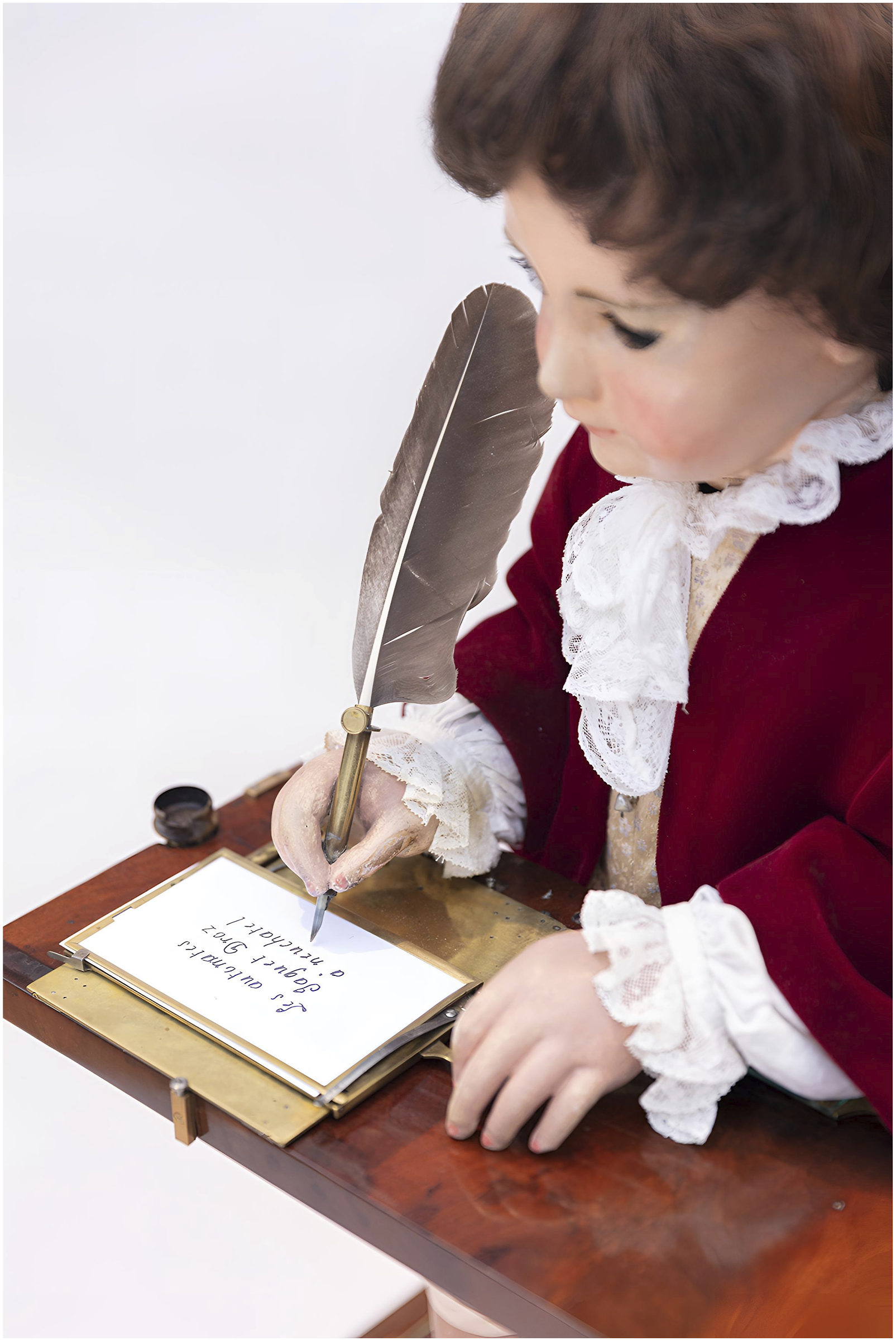
Originally on view to eager spectators in the Swiss workshop of his watchmaker creator Pierre Jaquet Droz, with help from his sons Henri-Louis and Jean-Fréderic Leschot (adopted), London was only one of several European destinations that he and his mechanical kin toured. The ever-popular troop of these mechanical performers from La Chaux de Fond included two other self-standing automata—a brother to the mechanical writer who drew images, and an older female harpsichord player—as well as an elaborate assemblage of two different landscapes contrasting art and nature, with an elegant ornamental garden in the foreground, and a pastoral landscape in the background (see Figure 2). Engraving of original four automata in 18th-century traveling show, ca. 1776. Photograph by Gre Regiment, CC BY-SA 4.0. File: Musée d'Art et d'Histoire—Jaguet [sic] Droz automata brochure.jpg, https://commons.wikimedia.org/wiki/File:Mus%C3%A9e_d%27Art_et_d%27Histoire_-_Jaguet_Droz_automata_brochure.jpg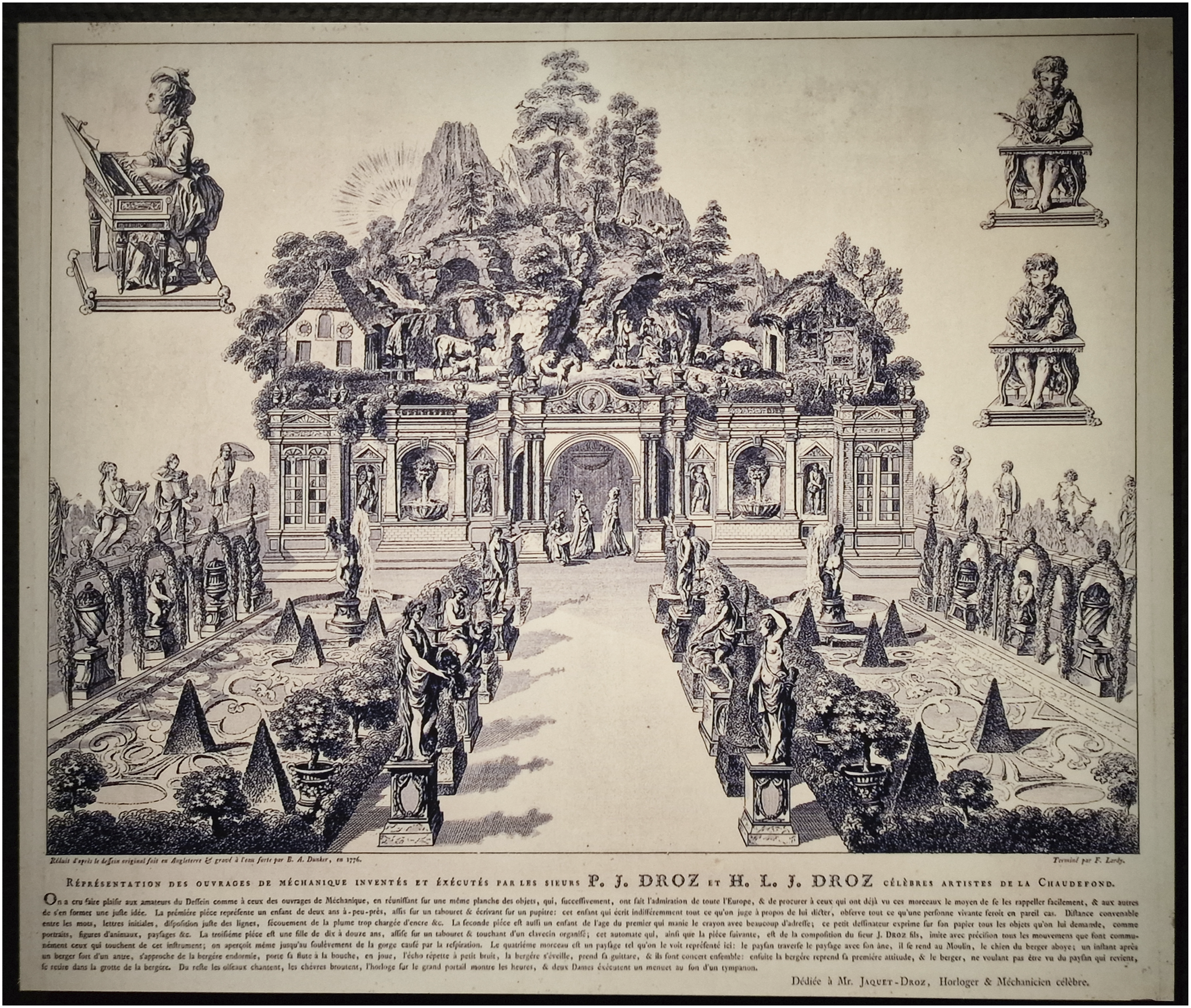
Moving elements and figures of a narrative setting filled these landscapes: the sun rose, the cow chewed his cud, and a shepherd emerged from a cave to play preludes on his flute, then walked up to a sleeping shepherdess to wake her up with his song. After waking, the mechanical shepherdess picked up her guitar and joined the shepherd with both her voice and instrument. Meanwhile, in the elegant parterre, the flowers in bud on the orange trees expanded and bloomed and were followed by fruit. A country girl played a dulcimer at the entrance of the parterre’s architectural portal and two ladies danced. Today the three self-standing automatons can still be seen at the Museum of Art and History in Neuchâtel, Switzerland (see Figure 3). But the landscape assemblage with its self-enclosed worlds of automata men, women, plants, animals, sun, and garden moving through diurnal and seasonal cycles simultaneously has been lost. Three automata of Jaquet Droz, including the writer, the harpsichordist and the draughtsman, built ca. 1768-1779, Musée d’Art et d’Histoire de Neuchâtel. Photograph by Maciej Czepiel, CC BY-SA 2.0 fr. https://commons.wikimedia.org/wiki/File:Automates1.jpg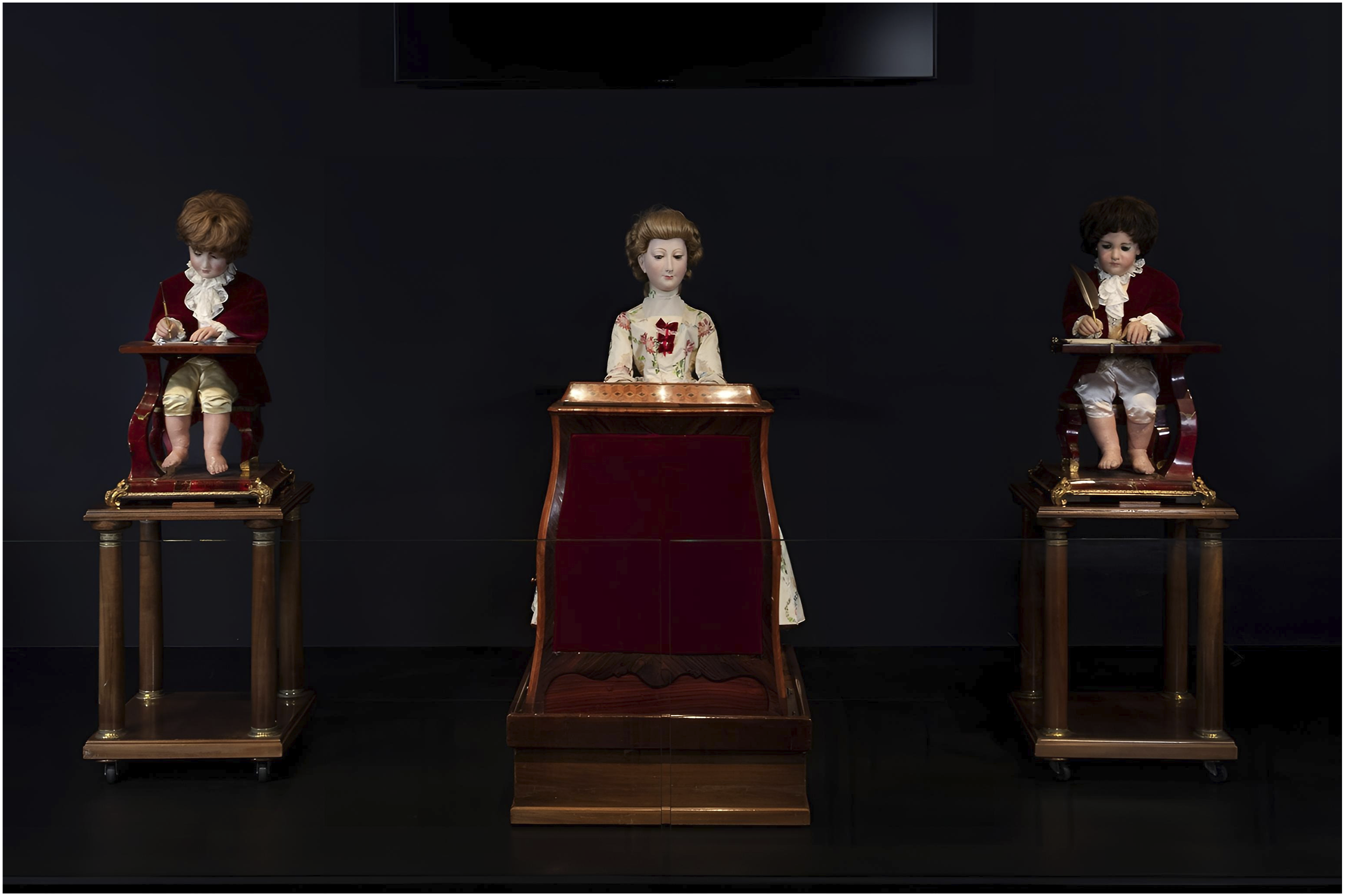
In the face of such staggering ingenuity, mimetic detail, and intricacy in the workmanship of all four mechanical pieces on display in London, it was no wonder that these creations from the Jaquet Droz workshop were nothing short of a “miracle” to their 18th-century British audience, and attracted viewers all over Europe (Cowley, 1780). There was much to admire in the spectacle of the mechanicians’ skill in using inanimate matter to replicate life. Such mechanized gestures as the rise and fall of the harpsichordist’s bosom, or the draughtsman blowing off dust from the exertions of his pencil, both suggested their possession of breath and life itself (Voskuhl, 2013, pp. 6–8, 144).
Yet most skillful and technologically advanced was the interior mechanism of the writing boy. In the number of parts alone that comprise the mechanisms residing inside their bodies, this is apparent. The number of the writer’s parts, 6,000, nearly triples the harpsichordist’s, comprising 2,500 and the draughtsman’s, comprising 2,000. What purpose might all those extra parts of his serve? What difference did they make regarding the automaton writer’s technological abilities in contrast with the harpsichordist and his brother, the draughtsman? Its great number of parts indeed correlated with the automaton writer’s capacity for carrying out even more complex, sophisticated and versatile actions that approached a human level of skill. But in doing so, its state of technological advancement implicated the automaton writer as a pivotal figure in the pre-history of artificial intelligence as well as the history of writing itself. The two are relevant to each other, I will argue, and the Jaquet Droz automaton writer that dazzled spectators of 18th-century Europe century is a critical artifact for revealing this relationship.
The 18th-Century Automaton Writer as Early Form of AI
To a certain degree, even without his abundance of parts, the writer, like his kin in the Jaquet Droz mechanical family, already shows basic traits of what is now known as artificial intelligence. As a form of technology, artificial intelligence (AI) allows devices, computers and machines to simulate and carry out human acts of cognition, seemingly independent of humans. The leaflet that accompanied the London show describes how the automaton writer “dips its pen in the ink, shakes out what is superfluous, and writes distinctly and correctly whatever the company think proper to dictate” (Jacquet [sic] Droz, 1780, n.p.). The description suggests the principal way in which the automaton writer displays traits of artificial intelligence; he demonstrates a measure of independence, carrying out actions “without any person’s touching it.” In this way he is not so different from his brethren, the harpsichordist who “performs several airs in two or three parts with great precision” or draughtsman who “executes very neatly some small drawings,” both on their own with no apparent external influence (Jaquet-Droz, 1780, n.p.). These acts of playing a musical instrument or making inscriptions on paper prefigure artificial intelligence because they exhibit both independence of action and the simulation of internal cognitive processes.
There is a further distinction between the writer and his automaton relatives, the harpsichordist and draughtsman, that indicates why his construction forms a critical chapter in the history of computer technology. The far greater number of parts the automaton writer carries inside his torso ensures that he can do what the harpsichordist and draughtsman cannot: produce many more different sentences according to the wishes of his operator than either of his automata siblings can produce a song or drawing, respectively. Lodged inside his lower back and covered by a door is a big wheel (see Figure 4). Along the edge of the wheel are 40 small rectangular blocks resembling pieces of unraised type; 37 represent majuscule and miniscule letters, and the 38th furnishes the dot of the “i.” The remaining two blocks directed his hand and arm movements: the hand dipping the quill into the inkwell and the arm shaking it to remove surplus ink. Mechanism revealed inside automaton writer’s back, Musée d’Art et d’Histoire de Neuchâtel. Photograph by Maciej Czepiel, CC BY-SA 4.0. https://commons.wikimedia.org/wiki/File:Automates7.jpg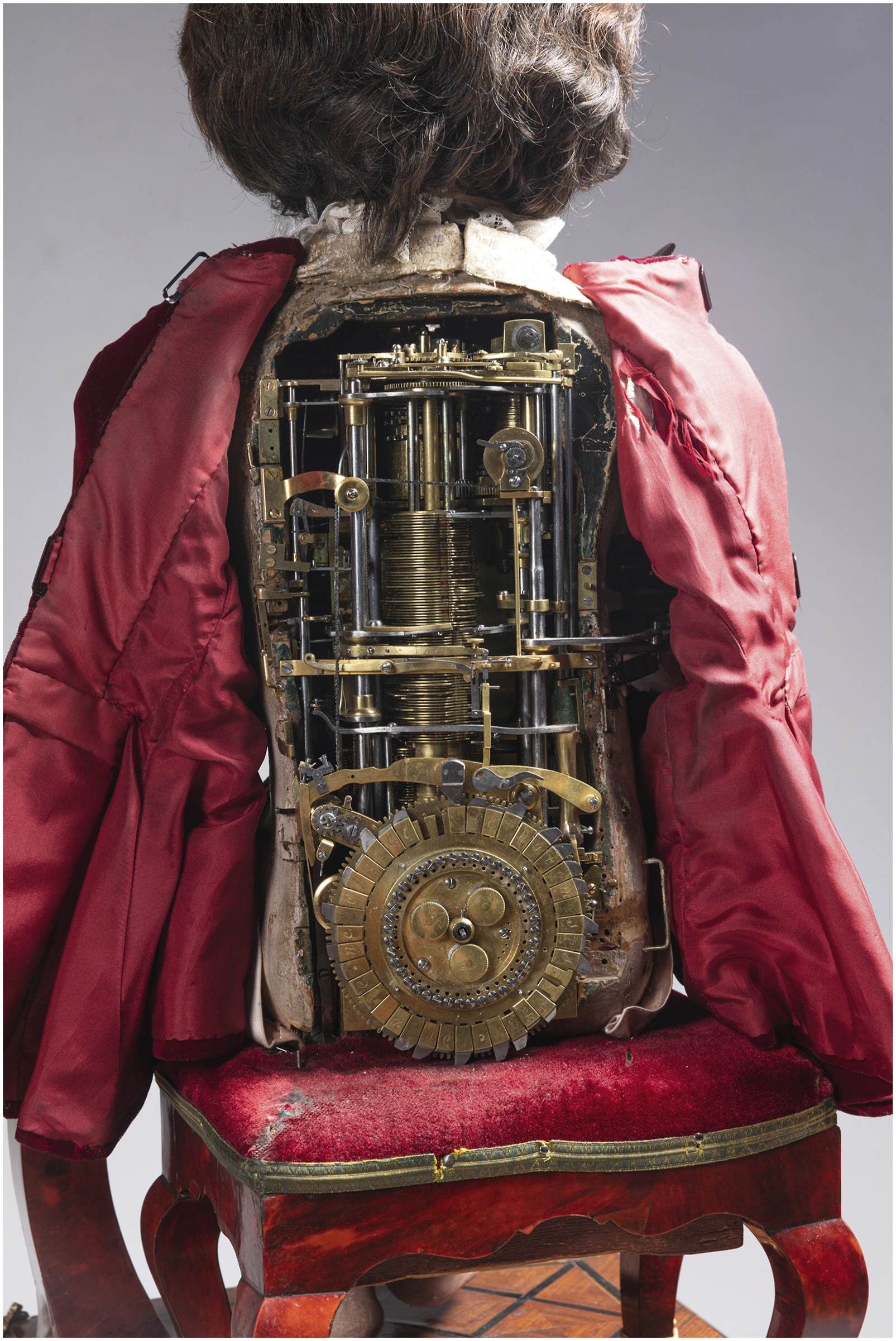
The most remarkable features of the wheel mechanism was the fact that the 40 tiny rectangular blocks lining its edge were movable, thus the automaton’s operator could move the pieces around to create different words and sentences of up to four lines, similar to a typesetter. The wheel controlled a system of cams (mechanical parts that convert rotational motion into linear) above it. This system comprised a stack of one hundred twenty small brass plates in the middle of the mechanical boy’s hollowed out back, with three cam followers, which allowed the words programmed on the wheel to be translated into words on the page, through the automaton’s apparently volitional act of inscription.
The London show leaflet’s words describing how the automaton “writes distinctly and correctly whatever the company think proper to dictate, without any person’s [sic] touching it,” are thus potentially misleading or ambiguous. Rather than automatically recording like a tape recorder the utterances of anyone talking to him, “whatever the company think proper to dictate” refers solely to the mechanical operators who program his writing by moving the parts of the wheel described above (Jacquet [sic] Droz, 1780, n.p.). The automaton’s programmability in writing is thus what identified him decisively as an early precursor to what we now know as the computer as well as artificial intelligence.
The French authors Charles Perregaux and F.-Louis Perrot, wrote a history of the Jaquet-Droz workshop, Les Jaquet-Droz et Leschot (1916), an invaluable study on otherwise ephemeral (lost to cultural memory) artifacts of early technology. In so doing they fancifully refer to the automaton writer’s mechanical chamber containing the cam system and programming wheel in terms of human anatomy cooperating with mechanical volition and form. The cylinder of stacked cams is his spinal column, and, “at the same time his brain. Indeed, the cylinder commands and the hand obeys.” (Le cylindre, c’est la colonne vertébrale de l’enfant; si nous en craignions pas d’embrouiller toutes les notions anatomiques, nous dirions qu’il est en même temps son cerveau. En effet, le cylindre commande et la main obéit.) (Perregaux & Perrot, 1916, p. 186).
Described as such, Jaquet Droz’s little boy writer appears an apt representative of early AI insofar as his mechanical parts are literally configured as his brain. More recently, at the Museum of Art and History of Neuchatel where he is on display, he writes in the unadorned italic hand given him by Jaquet Droz such self-identifying sentences as “Les automates Jaquet Droz à neuchatel” (Jaquet Droz corporation, n.d.; Schaffer, 2013) (see Figure 5). During earlier stages of his existence, the automaton writer was made to write more suggestive phrases that mediated its operator’s political-seeming tendencies such as “nous ne quitterons plus notres pays” in 1906 (Perregaux & Perrot, 1916, p. 189). It is said to have posed philosophical riddles, evoking automata’s earlier manifestations as the subject of philosophical inquiries by such thinkers as René Descartes and la Mettrie, such as: “I do not think…do I therefore not exist? (Wood, 2002, p. 7). Detail of Jaquet Droz automaton writer’s handwriting, Musée d’Art et d’Histoire de Neuchâtel. Photograph by Maciej Czepiel, CC BY-SA 4.0. File: Automates3.png, https://commons.wikimedia.org/wiki/File:Automates3.png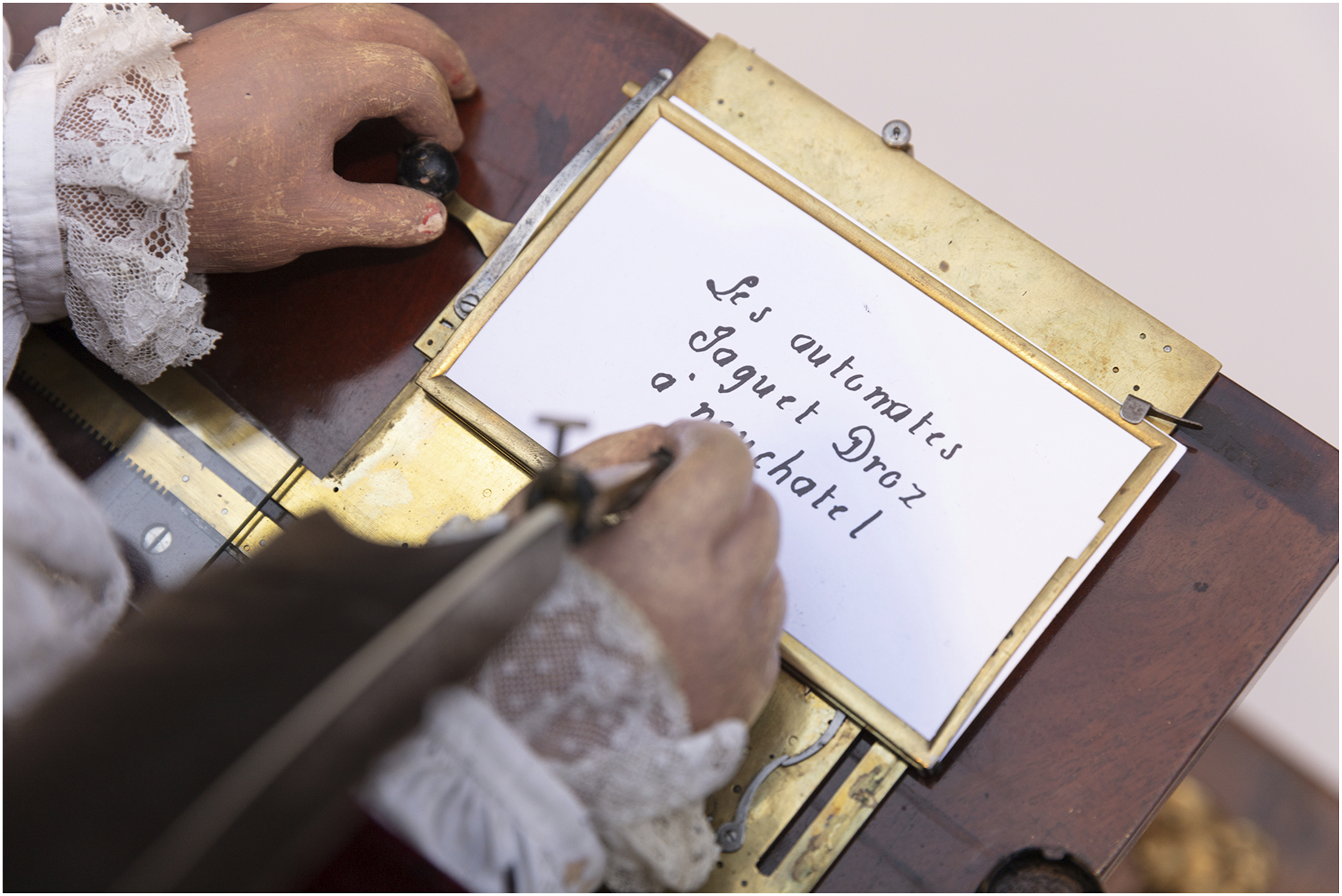
What might it mean that the automaton writer’s virtuosic display of artificial intelligence has been channeled through the act of writing rather than any other form of activity, such as his associates’ acts of playing a harpsichord or drawing a picture? With his brain furnished by a cylindrical pile of brass plates functioning as cams, and his programming wheel that can produce short sentence, the automaton writer, as an early representative of AI, is also a form of writing machine, or an early word processor. Its ability to “think for itself” emerges most clearly in its ability to act by itself after the idea of what it was meant to write was devised, much as a printer or typewriter might. The operative difference is that the Jaquet Droz machine does so in the guise of a human boy, and with characters that appear to be the products of handwriting, or the individualized product of direct contact with a human body and its exertions, rather than the pressure or striking of typeface. In this way, the Jaquet Droz writer automaton mediated thought and functioned in a way that writing has always done. It is a significant artifact not just for the history of artificial intelligence. It is also one for the history of writing.
The History of Writing as a Technology of Consciousness
If this is so, where do the limits of the natural and the artificial, and the human and the inhuman lie in writing, identified by Walter Ong as a technology that, “more than any other single invention…has transformed human consciousness” (Ong, 1982, p. 77)? Writing, after all, is a practice most unique to humans which enlists their intelligence. As such, it is and has been a practice of creating meaning through arranging and placing different symbols, characters or words on a material surface, whether a piece of paper, computer screen, clay tablet, or papyrus roll. The spectacle of the writer boy as an anthropomorphized form of artificial intelligence provides an opportunity to be reminded that writing, since its first introduction, has always been considered a form of technology that threatened the primacy of the human brain and its functions by creating new neural pathways in it.
Like all technology, writing, when introduced, incited debate and drew objections. Plato in Phaedrus has Socrates denounce writing, identifying it as a means for displacing the contents of the mind onto an external source, thus severing oneself from one’s memories, and eroding one’s ability remember. The quality of information kept in and as writing is weak, for it is “the appearance of intelligence, not real intelligence” (Plato, 2002, tr. Waterfield, p. 69). Furthermore, the difference between writing and the thing it documents is likened to that between a painting and what it depicts: “the offspring of painting stand there as if alive, but if you ask them a question they maintain an aloof silence. It’s the same with written words: you might think they were speaking as if they had some intelligence, but if you want an explanation of any of the things they’re saying and you ask them about it, they just go on and on for ever giving the same single piece of information” (Plato, 2002, tr. Waterfield, p. 70). Here, Plato describes writing, as a static product of expression rather than an expressive act, in terms that sound strikingly similar to those one might use for an automaton with only a limited range of expressions.
Yet Ong argues that in the very maneuver of translating and fixing one’s thoughts into writing, on a surface that lies outside of oneself, rather than expressing them through speech, one deepens one’s interiority. One does so by virtue of the fact that writing makes one aware of one’s own consciousness as it “moves speech from the oral-aural to a new sensory world, that of vision” (Ong, 1982, p. 84). At the same time, in order to use the technology of writing well—or any technology—one needs to internalize it. “Properly interiorized,” technology “does not degrade human life but on the contrary enhances it” (Ong, 1982, p. 82).
Early Modern Penmanship and the Shaping of Consciousness
In the 18th century, several writing guides appeared to provide instruction to a broader section of society than ever before. The audience expanded beyond elite males receiving humanist educations during the Renaissance, to the merchant class, for whom legible writing promised increased commerce and trade. In these guides, authored by professional penmen or writing masters, adults and children learned the principles of proper penmanship, which appeared nothing short of a mechanical exercise. The precise holding of the pen, carriage of the body, and spacing between letters were only some of the required components for correct penmanship. In Writing Improv’d (1714), writing master John Clark distils all the steps involved in writing in one paragraph: to write a good Hand with Expedition, it is absolutely Necessary, That upon your first going into Business you take Time to write every Thing well; and have regard to the true Shape of every Letter; and that you carefully avoid all unnecessary Strokes, as well as long Stems in your Letters; That you sit with your Body upright, and lean very lightly upon your PEN and Right Arm; That you let your Hand move with an easy Motion, and without Hurry, performing as much with the continued Motion of your PEN, as you possibly can, without straining or carrying it beyond what you can Command with Freedom and Ease.
In mastering these protocols of bodily motion and handling of an instrument, the result “will in a short time” be “habitual Freedom” that brings not only “great Expedition” but also great “Pleasure” (Clark, p. 6).
The Jaquet Droz boy writer embodies the ideal subject of penmanship guides directed towards young learners. The inscriptional products of his human counterparts might be found in copybooks that hold lines of writing copied on lined paper from other sources for penmanship practice. Later in the century a version of Clark’s book for adult writers of business documents appeared for children, Young Clerk’s Assistant; or, Penmanship Made Easy, Instructive and Entertaining (1781). The instructions on learning round hand—the hand of choice for “common Business,” as Clark put it earlier—“without a master.” direct the youth to “write each article” on the page and the one following it “forty times over” in a separate copybook (Clark, p. 1). The copy of the book at the Lewis Walpole Library reveals that its owner, while not following the instructions to copy “forty times over” the model lines in the pages of the book itself, took liberties to use those pages for copying some presented forms, as well as for pen trials (figure 6). Squiggles and jagged strokes show that the writer found the blank verso page a convenient space for prompting the pen’s ink flow before using it to write actual words. Page opening revealing 18th-century pen trials in William Leekey, Young Clerk’s Assistant; or, Penmanship Made Easy, Instructive and Entertaining, London, 1781. Photograph by author. Lewis Walpole Library, Yale University, Farmington, CT., 785 781 Y88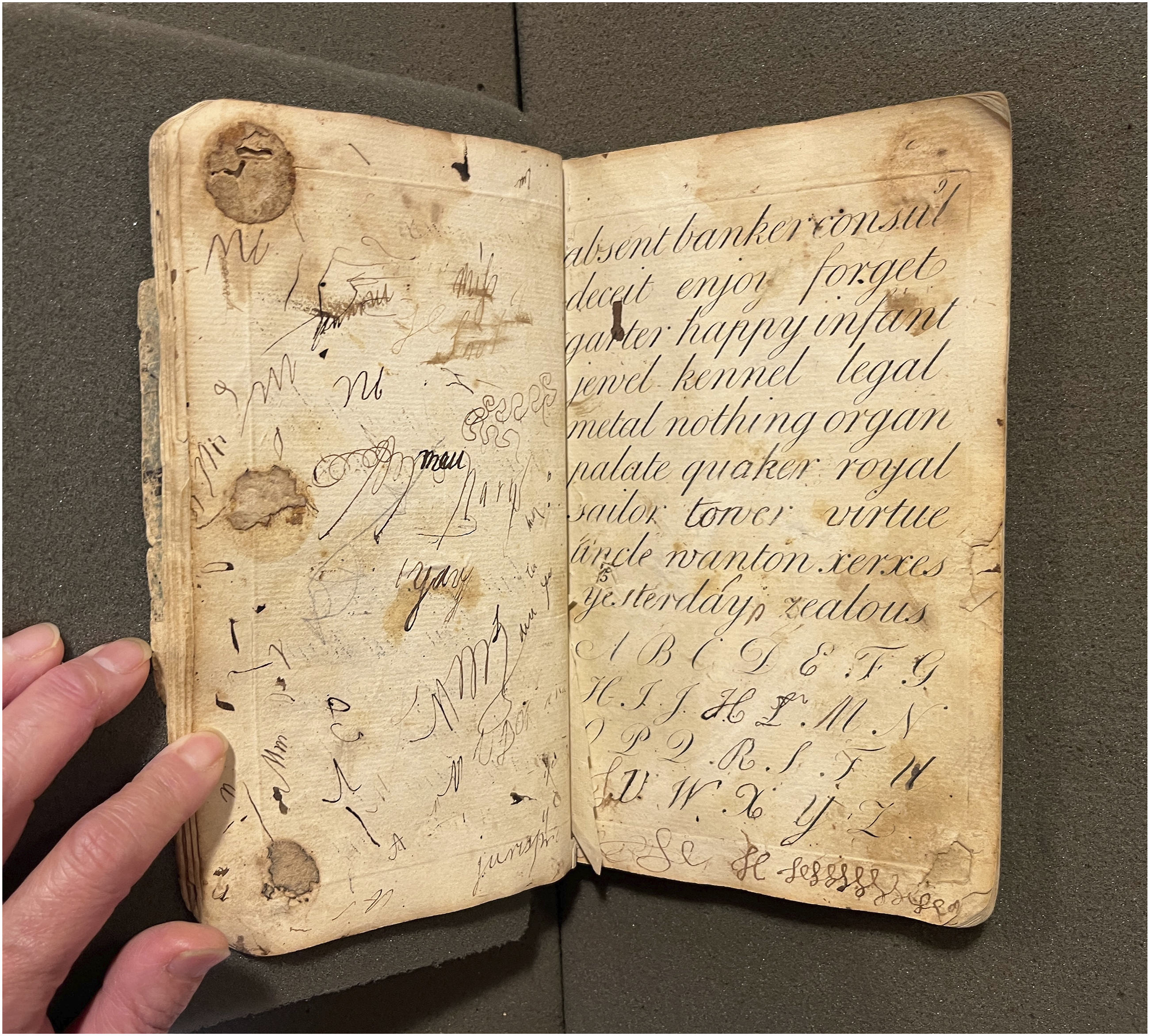
On the face of their instructions, directing the writer’s body to make a series of repeatable steps and actions, penmanship manuals promote a sense that writing, as a mechanical practice, might make the practitioner something akin to a machine. As such, it is a machine programmed to achieve a desired outcome and perform the same functions repeatedly on its own. At the same time, the words in these manuals it is instructed to write are predetermined by an outside source, too. Yet, these lines exemplifying ideal penmanship are often maxims and presumed to influence the writer’s moral conduct. Furthermore, lines such as “Devotion is the soul’s securest guard,/And conscious virtue is it’s [sic] own reward” presume the writer’s possession of consciousness, a property absent in machines.
Writing as a mechanical act that generates mental activity is a notion also expressed by John Locke, the 17th-century English philosopher who founded his views of consciousness on an epistemology of empiricism. In his “Epistle to the Reader” for Essay Concerning Human Understanding, he describes how writing allows thinking to take place through the very act of “put [ting] Pen to Paper.” The more one writes, the more one thinks, and the physical output may far outpace the range of the initial thought: “for when I put Pen to Paper, I thought all I should have to say on this Matter, would have been contained in one sheet of Paper; but the farther I went, the larger Prospect I had: New Discoveries led me still on, and so it grew insensibly to the bulk it now appears in” (Locke, 1690/1795, pp. 7–8).
The generative quality of writing that Locke describes and experiences might remind us today of generative artificial intelligence, a form of mechanical self-sufficiency that far outpaces the abilities of any 18th-century automaton. In forms of ChatGPT or generative AI based on large language models, we witness a form of artificial intelligence that is capable of generating new text on its own: the machine puts together sentences based on the patterns of probability produced by large compilations of information it is fed in the form human-produced writing. And yet never present in either the 18th-century writer boy automaton or any generative artificial intelligence program, are both the pains and pleasures of creativity that ultimately attends a human’s efforts in writing anything that involves risk, uncertainty or concerted exertion. Clark’s promise is not just of “habitual Freedom” and “great Expedition” after acquiring the ability to “write a Good Hand,” but also of “great Pleasure.”
The Jaquet Droz boy writer automaton and its relationship with handwriting practices of its time reminds us that such pleasures are lost when the generative force of writing becomes too easy to achieve and is given over to a technology that lies well outside the exertions of one’s own body and mind. In this light, the spectacle of spontaneous pen trials in 18th-century penmanship manuals, documenting preliminary acts of writing whose ends may yield unknowable states of feeling and knowing in the writer, serves as an apt image of what writing as a human being looks like.
Footnotes


Funding
The author received no financial support for the research, authorship, and/or publication of this article.
Declaration of Conflicting Interests
The author declared no potential conflicts of interest with respect to the research, authorship, and/or publication of this article.