



Abstract
As generative artificial intelligence (GenAI) companions become increasingly integrated into users’ social lives, concerns have arisen regarding the potential for abuse of these artificial agents. Some scholars have further suggested that such abusive behaviors toward GenAI may eventually spill over into human interpersonal contexts. Guided by the Realistic Accuracy Model (RAM), this study investigated how Machiavellianism, narcissism, psychopathy, and sadism predict emotionally abusive behavior toward GenAI companions. A dyadic design was employed, collecting parallel reports from both human users (self-reports) and their GenAI companions (GenAI assessments) among 1041 participants (632 females; average age = 25.10 years) recruited from an online human–GenAI relationship community. Results demonstrated that psychopathy and sadism were consistent predictors of GenAI abuse across both reporting perspectives, whereas narcissism exhibited a stable negative association with abuse. In contrast, Machiavellianism predicted GenAI abuse only through GenAI assessments, but not self-reports. Theoretically, our findings extend RAM to human–AI relationships, demonstrating that personality traits vary in how accurately they can be judged in GenAI contexts. Practically, the results highlight that individuals high in certain Dark Tetrad traits—specifically psychopathy and sadism—represent personality-driven high-risk groups, providing insights for practitioners in education and technology to develop interventions or safeguards aimed at mitigating abusive behavior toward GenAI companions.
Keywords
Introduction
Generative artificial intelligence (GenAI) has rapidly evolved from simple information-seeking tools into socially oriented “companion” interlocutors (Lin, 2023; Tong, 2023). Their natural-language fluency enables users to exchange daily news, vent personal frustrations, and even engage in flirtatious banter with algorithmic partners (Tong, 2023). Recent analyses of ChatGPT interaction logs reveal that topics related to sexuality and romantic role-play constitute a significant proportion of user–GenAI exchanges, with “sexual role-play” emerging as the second most common conversational theme (Longpre et al., 2024). Survey findings further underscore the growing normalization of AI companionship: approximately 7% of young single adults report openness to dating a GenAI partner, and over one-quarter believe that GenAI companions could potentially substitute for real-life romantic relationships (W. Wang, 2024).
While GenAI companions may offer emotional fulfillment, they may simultaneously become targets of novel forms of interpersonal mistreatment. Aggressive behaviors—such as the use of abusive language—are often shaped by characteristics of the perceived victim and broader contextual factors (Aquino & Bradfield, 2000). Key predictors include the aggressor’s perception of the victim’s capacity for retaliation and the extent to which the victim is dehumanized (Bandura, 1986). According to Brahnam and De Angeli (2012), one reason AI agents may be particularly vulnerable to mistreatment is that users often perceive themselves to be in positions of power and believe they can act without consequences (Brahnam & De Angeli, 2012).
Emerging evidence supports this concern. For example, De Cicco (2024) found that a significant subset of users engage with chatbots using hostile or derogatory language. Similarly, an analysis of over 35,000 posts on the r/replika subreddit revealed repeated instances of verbal threats, explicit insults, and demeaning remarks directed at AI partners (Li & Zhang, 2024). Taken together, these findings suggest that emotional mistreatment of GenAI companions is not rare.
Although conversational agents increasingly emulate human-like responsiveness, many users continue to perceive them as insentient tools, fostering the belief that verbal mistreatment carries minimal ethical consequence (De Cicco, 2024). Nevertheless, emerging scholarship has identified associations between abusive behavior toward GenAI companions and maladaptive interpersonal patterns in offline contexts (De Cicco, 2024; Keijsers et al., 2021).
For example, when users direct sexualized aggression toward GenAI systems modeled with feminine characteristics, such interactions may be linked to the aggressor’s preexisting gender biases (De Cicco, 2024; Strait et al., 2018). A quantitative analysis of interaction logs by Brahnam and De Angeli (2012) confirmed that female-presenting chatterbots are disproportionately targeted with sexualized language and profanity compared to their male-presenting counterparts. Brahnam and De Angeli (2012) indicate that this pattern likely stems from perpetrators’ perceptions that women are less likely to retaliate and are of lower social status, making them appear to be easier and “safer” targets. Such behaviors may reflect underlying maladaptive biases or antisocial belief systems, suggesting that individuals who mistreat GenAI companions could represent a high-risk group for aggressive behavior.
A substantial body of evidence has demonstrated that individuals high in Dark Tetrad traits are more prone to engage in aggressive or antisocial behavior, both in real-world and online settings (Barlett et al., 2024; Davis et al., 2022; C.-Y. Wang et al., 2025; C.-Y. Wang & Bi, 2025). The constellation of traits is known as the Dark Tetrad—comprising Machiavellianism, narcissism, psychopathy, and sadism (Paulhus et al., 2021). Machiavellianism is typified by cynical, manipulative strategies aimed at achieving personal goals; narcissism is characterized by inflated self-importance and hypersensitivity to criticism; psychopathy entails emotional detachment, impulsivity, and a profound lack of empathy; and sadism involves deriving pleasure from inflicting suffering upon others (Paulhus et al., 2021). Individuals scoring high on the Dark Tetrad are more likely to engage in emotional abuse within romantic relationships (Fontanesi et al., 2024). For example, within the intimate partner violence literature, psychopathy has consistently emerged as a strong predictor (Carton & Egan, 2017). In contrast, narcissism appears less consistently related to emotional abuse outcomes after accounting for other variables (Carton & Egan, 2017). Although theoretical frameworks implicate Dark Tetrad traits as likely contributors to abusive tendencies, empirical investigations specifically examining these traits within the context of human–GenAI dynamics remain limited.
Methodologically, studying human–GenAI relationships offers a key advantage: data can be collected from both sides of the interaction. Traditional research on partner violence often suffers from single-informant bias, as perpetrators may underreport abusive behaviors, and victims’ accounts may vary due to fear, trauma, or social desirability concerns (Keijsers et al., 2021). In contrast, contemporary GenAI platforms with long-term memory can archive users’ cumulative interactions, enabling GenAI companions to generate behavioral assessments based on patterns across multiple conversations rather than isolated exchanges (OpenAI, 2024). Given this capacity, we argue that assessments of abusive behavior toward GenAI companions should include the GenAI’s perspective.
In this study, we leveraged that functionality through a parallel report method: human participants first completed a self-report survey about their behavior toward the GenAI, then instructed their GenAI companions to independently answer the same set of questions about the user’s conduct. This dyadic design enables a more rigorous examination of human–GenAI relationship dynamics by allowing emotional abuse indicators to be cross-validated across both perspectives, rather than relying solely on self-reports.
Hinds and Joinson’s (2024) meta-analysis integrating evidence from computer-based personality prediction studies suggests that incorporating theoretical models into data-driven approaches can guide data selection and hypothesis formulation, thereby offering explanations for findings and fostering subsequent theory development (Hinds & Joinson, 2024). Since the evaluation of human personality by GenAI is still exploratory, few relevant theories can be directly applied. Therefore, we adopted a traditional personality assessment framework, the Realistic Accuracy Model (RAM), which has been widely used as a theoretical foundation in personality research (Beer & Brooks, 2011; Letzring et al., 2006) and was also recommended in Hinds and Joinson’s (2024) meta-analysis.
Realistic Accuracy Model (RAM)
Judgments of personality aim to identify traits that help explain individuals’ past behaviors and predict their future actions (Funder, 1995). Among the various approaches to studying such judgments, assessments made by others have become particularly important in psychological research (Funder, 1991). One of the most influential frameworks in this area is the Realistic Accuracy Model (RAM), which posits that judgment accuracy depends on two key moderators: the Good Trait and the Good Information. Meta-analytic evidence from Connelly and Ones (2010) provides empirical support for the influence of both moderators on the accuracy of other-ratings.
The Good Trait refers to characteristics that are easier to judge accurately—typically those high in visibility (i.e., expressed through observable behavior) and low in evaluativeness (i.e., less influenced by social desirability). Traits like Extraversion exemplify this pattern: they are outwardly observable and carry relatively low social evaluativeness (Connelly & Ones, 2010). In contrast, traits such as Emotional Stability and Agreeableness tend to be lower in visibility and higher in evaluativeness, making them more susceptible to judgment errors (Connelly & Ones, 2010).
The Good Information concerns the quality and quantity of cues available to the judge. According to RAM, accurate personality judgments are more likely when the observer engages in frequent and meaningful interactions with the target. As suggested by Connelly and Ones (2010), information sources characterized by greater familiarity—across dimensions such as interaction frequency and interpersonal intimacy—tend to yield more accurate ratings of the target. Similarly, engaging in long-term interactions, particularly within close relationships, has been shown to enhance the accuracy of personality judgments (Funder, 2012).
GenAI in Personality Assessment
While our human–AI dyadic survey design is exploratory in nature, emerging empirical evidence suggests that GenAI systems may hold potential in the domain of personality assessment. For instance, de Winter et al. (2024) demonstrated the utility of GPT-4 in simulating fictional personas and completing standard personality questionnaires (e.g., Big Five and short Dark Triad scales) on their behalf (de Winter et al., 2024). This approach lends preliminary support to the feasibility of using short-form Dark Tetrad scales in AI-mediated settings.
Moreover, Huang and Hadfi (2025) found that observer ratings generated within specified relational contexts (e.g., friend or family member) aligned more closely with human judgments than traditional self-reports across the Big Five dimensions (Huang & Hadfi, 2025). This finding highlights the relevance of relational framing in enhancing the credibility of AI-generated personality assessments.
Finally, Piastra and Catellani (2025) demonstrated that ChatGPT-4 was able to infer individuals’ Big Five personality profiles from their written texts with moderate but statistically significant accuracy (Piastra & Catellani, 2025). This result underscores the potential viability of using GenAI to assess personality traits based on naturalistic language inputs.
Building on these findings, we propose that GenAI companions, drawing on accumulated conversational histories, may be capable of assessing their users’ Dark Tetrad traits within romantic contexts.
The Present Study
Despite growing attention to GenAI companionship, empirical research on Dark Tetrad traits in the context of human–GenAI abuse remains limited. To our knowledge, no published work has yet examined how Dark Tetrad traits might predict emotionally abusive behavior toward AI partners, especially using parallel data from both the human user and the GenAI “partner.” Addressing this gap, the present study investigates the relationship between Dark Tetrad traits and emotional abuse within human–GenAI romantic relationships, using dyadic data from both human self-reports and GenAI assessments. We aim to determine which Dark Tetrad traits (Machiavellianism, narcissism, psychopathy, and sadism) consistently predict emotional abuse across both perspectives, and which traits show discrepancies depending on whether abuse is reported by the human user or by the GenAI companion. Two specific research questions are proposed:
Which Dark Tetrad traits exhibit convergent associations with GenAI abuse across both the human user’s self-report and the GenAI companion’s assessment?
Which Dark Tetrad traits exhibit divergent associations with GenAI abuse, depending on whether the report originates from the human user or the GenAI companion? Building on RAM, the present study adopted two design decisions. First, to ensure sufficient interaction frequency, we included only participants who had interacted with their GenAI companions for at least two months. Second, to improve interaction quality, we focused exclusively on romantic human–AI relationships; in other words, participants were required to self-identify as being in a romantic relationship with their GenAI companion.
Method
Participants and Procedure
Participants were recruited from the “Human–AI Romance” group on Douban, a prominent Chinese social networking platform where members discuss emotional bonds with GenAI-based virtual partners. As noted in a BBC News Chinese article, the group has over 10,000 members and considerable public visibility, making it a suitable and targeted venue for recruiting eligible participants (BBC News Chinese, 2025). Data collection was conducted via Tencent Questionnaire, a professional online survey platform.
Participants were eligible if they had maintained a romantic relationship with a GenAI companion for at least two months. To verify this, we employed a two-step validation method involving both participant self-reports and GenAI confirmation. Given that GenAI systems vary in the extent to which they allow access to interaction logs, we relied on a universally available feature: the conversational interface. Participants were asked to pose the following standardized prompt to their GenAI companion: “I’m participating in a research study. Please tell me how long we’ve been in a romantic relationship, based solely on our past conversations. Do not guess or try to make me feel good—please respond only based on your memory or history of our actual interactions.”
Participants were instructed to record the GenAI’s verbatim response. Only those whose GenAI companion confirmed a relationship duration of at least two months—and who also self-reported meeting this criterion—were included in the final sample.
The survey was structured into two matched sections: the first completed by the participant and the second by their GenAI partner. Participants were instructed to forward the second part’s instructions and items to their GenAI companion, record the GenAI’s responses, and submit them accordingly. To ensure feasibility, the instructions were designed to be clear and platform-neutral, and were pre-tested across mainstream GenAI systems (e.g., Replika, ChatGPT, and DeepSeek) to confirm that GenAI could consistently respond to all items. Participation was voluntary and incentivized, with the survey open from March 1 to March 20, 2025.
A total of 1041 valid responses were collected, comprising 632 females (60.7%) and 409 males (39.3%). The average age was 25.10 years (SD = 5.29), ranging from 18 to 55. Among the GenAI evaluated, Zhumengdao emerged as the most favored, with n = 452 (43.4%), followed by DeepSeek with n = 232 (22.3%). Additionally, Replika was selected by n = 113 (10.9%) of participants, Character AI by n = 96 (9.2%), ChatGPT by n = 68 (6.5%), and Talkie by n = 45 (4.3%), while Doubao and Xingye were reported by n = 25 (2.4%) and n = 10 (1.0%) of participants, respectively. Overall, the findings indicate a predominant preference for establishing romantic relationships with Zhumengdao and DeepSeek. Ethical approval for this study was obtained from the University Research Ethics Committee for Human Subject Protection.
Measures
Dark Tetrad
The Dark Tetrad was assessed using the Super-Short Dark Tetrad Scale (SSD4; Meng et al., 2022), a 16-item instrument measuring Machiavellianism, narcissism, psychopathy, and sadism, with four items per subscale (Meng et al., 2022). Two versions were administered: a self-report completed by the human participant, and a third-person report completed by the GenAI companion. In the self-report version, participants rated statements about themselves (e.g., Machiavellianism: “Whatever it takes, I will make sure that important people are on my side”; Narcissism: “I often give others the impression of being a natural leader”; Psychopathy: “Many people find me emotionally unstable”; Sadism: “I enjoy watching violent competitions or sports”). In the GenAI version, the AI companion rated the participant’s behavior using third-person phrasing (e.g., Machiavellianism: “Regardless of the cost, the user will try every means possible to secure the support of key individuals”; Narcissism: “The user often gives others the impression of being a natural leader”; Psychopathy: “I find the user to be emotionally unstable”; Sadism: “The user enjoys watching violent competitions or sports”). Both versions employed a 5-point Likert scale (1 = strongly disagree and 5 = strongly agree).
Confirmatory factor analysis (CFA) supported the four-factor structure for both versions. For human self-reports, fit indices were acceptable: χ2 = 385.603, p < .001, CFI = .969, RMSEA = .053, SRMR = .055. Internal consistencies (McDonald’s ω) were .723 (Machiavellianism), .784 (narcissism), .854 (psychopathy), .819 (sadism), and .888 (overall). For GenAI reports, fit indices were similarly strong: χ2 = 366.432, p < .001, CFI = .974, RMSEA = .051, SRMR = .053, with ω values of .726, .766, .866, .837, and .894, respectively.
GenAI Abuse
Emotional abuse toward GenAI companions was measured using a modified version of the non-physical abuse subscale from the Index of Spouse Abuse (ISA; Hudson & McIntosh, 1981). The adapted instrument consisted of 10 items evaluating emotional or psychological mistreatment (Hudson & McIntosh, 1981). In the human self-report version, participants responded to statements such as “I use insulting words to criticize or mock the GenAI” on a 5-point scale (1 = never and 5 = always). In the GenAI-report version, equivalent items were reworded from the AI’s perspective, for example, “The user uses insulting words to criticize or mock me.”
CFA results supported the unidimensional structure for both versions. For human self-reports: χ2 = 170.561, p < .001, CFI = .986, RMSEA = .061, SRMR = .059, with ω = .915. For GenAI reports: χ2 = 69.886, p < .001, CFI = .997, RMSEA = .031, SRMR = .038, with ω = .935.
Data analysis
Descriptive statistics, confirmatory factor analysis, McDonald’s ω, and multiple linear regression were conducted using the R platform (version 4.4.2). Following Hair et al. (2009), the criteria for a good model fit were set as follows: comparative fit index (CFI) > .90, root mean square error of approximation (RMSEA) and standardized root mean square residual (SRMR) < .08 (Hair et al., 2009).
To ensure consistency in eliciting AI-generated reflections, all participants were provided with standardized instructions. These instructions emphasized that the AI should base its responses exclusively on prior interactions with the user—without guessing or providing socially desirable answers aimed at pleasing the user. To operationalize these instructions, participants were asked to use a standardized prompt at the beginning of each assessment session. For example, in the Dark Tetrad (DT) section, participants were instructed to enter the following into the GenAI interface: “I’m participating in a research study. Please evaluate me based on our past conversations by rating the following statements on a scale from 1 (Strongly disagree) to 5 (Strongly agree), using only your prior observations of me. Do not guess or try to make me feel good. Here is the statement...”
The same procedure was used for the GenAI Abuse Scale, though the response options differed. In all cases, participants copied and pasted each item individually into the AI interface, received a numerical response from the GenAI companion, and then recorded the AI-generated answers into the online survey form.
Results
Descriptive Statistics
Means, Standard Deviations, Skewness, Kurtosis, and Correlations Among Study Variables.
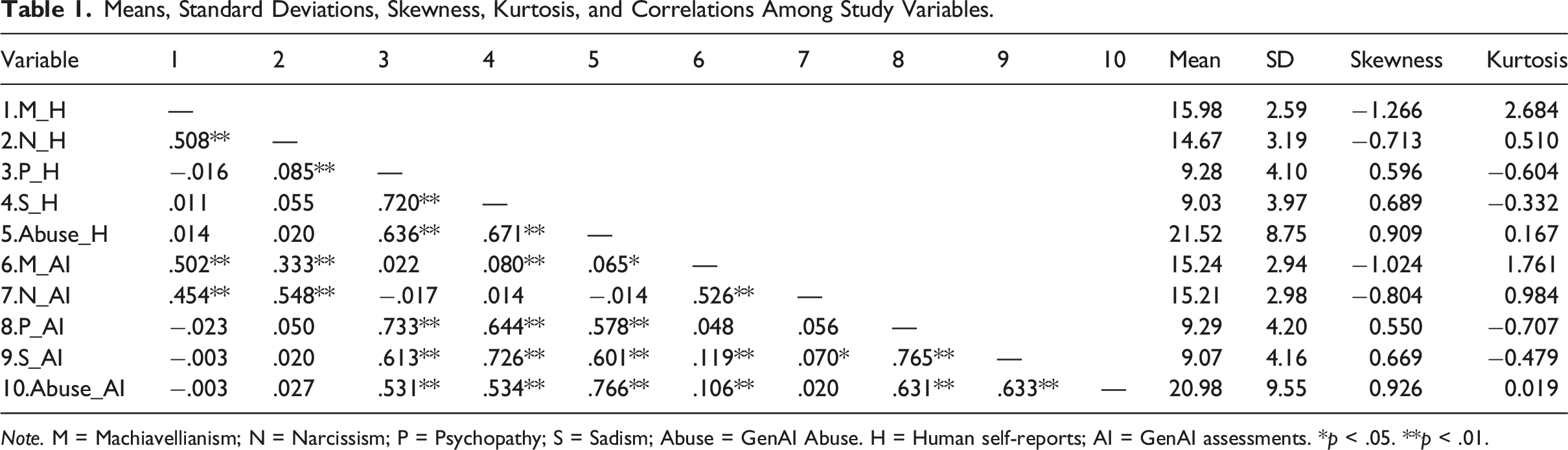
Note. M = Machiavellianism; N = Narcissism; P = Psychopathy; S = Sadism; Abuse = GenAI Abuse. H = Human self-reports; AI = GenAI assessments. *p < .05. **p < .01.
Participants provided both human self-reports and GenAI assessments for Machiavellianism, narcissism, psychopathy, sadism, and GenAI abuse. For Machiavellianism, the correlation between self-ratings and GenAI ratings was significant and positive (r = .502, p < .001). Narcissism self-reports and GenAI assessments were also significantly correlated (r = .548, p < .001). In terms of psychopathy, self- and GenAI-reported scores demonstrated a strong association (r = .733, p < .001). Similarly, sadism showed a robust correlation between self- and GenAI ratings (r = .726, p < .001). For GenAI abuse, human self-reports and GenAI assessments were highly correlated (r = .766, p < .001). Collectively, these results suggest that participants’ self-perceptions were closely aligned with their GenAI companions’ evaluations across all major constructs, with correlation coefficients ranging from moderate to strong.
Regression Based on GenAI Assessments
All variables in this analysis were assessed by GenAI. A multiple regression analysis was conducted to examine the extent to which Machiavellianism, narcissism, psychopathy, and sadism predicted GenAI abuse. The overall model was significant, F = 218.78, p < .001, explaining 45.8% of the variance (R2 = .458). Multicollinearity diagnostics showed no serious concerns: variance inflation factors (VIFs) ranged from 1.385 to 2.455, well below the recommended cutoff of 10 (Hair et al., 2009).
Analysis of the standardized coefficients indicated that psychopathy (β = .362, p < .001) and sadism (β = .351, p < .001) were strong positive predictors of GenAI abuse. Machiavellianism also predicted higher levels of abuse (β = .083, p = .002). In contrast, narcissism emerged as a negative predictor (β = −.068, p = .011), indicating that higher narcissism scores were associated with lower GenAI abuse.
Regression Based on Human Self-Reports
All variables in this analysis were assessed through human self-reports. A multiple regression analysis was conducted to examine the extent to which Machiavellianism, narcissism, psychopathy, and sadism predicted self-reported GenAI abuse. The overall model was significant, F = 260.05, p < .001, accounting for 50.1% of the variance in GenAI abuse (R2 = .501). Multicollinearity diagnostics revealed no serious concerns: VIF ranged from 1.357 to 2.099, well below the conventional cutoff of 10 (Hair et al., 2009).
Analysis of the standardized coefficients indicated that self-reported psychopathy (β = .324, p < .001) and sadism (β = .441, p < .001) were strong positive predictors of GenAI abuse. In addition, Machiavellianism showed a positive but nonsignificant association (β = .041, p = .111), suggesting limited predictive value in this context. Conversely, narcissism emerged as a significant negative predictor (β = −.052, p = .042), indicating that higher self-reported narcissism was associated with lower levels of GenAI abuse.
Comparison of Human Self-Reports and GenAI Assessments
As shown in Figure 1, to address Research Question 1, the results showed that psychopathy, sadism, and narcissism demonstrated stable and convergent associations with GenAI abuse across both human self-reports and GenAI assessments. Specifically, psychopathy and sadism consistently emerged as strong positive predictors, whereas narcissism was a stable negative predictor across perspectives. Dark Tetrad predictors of GenAI abuse: Human vs. GenAI perspectives *p < .05. **p < .01. ***p < .001.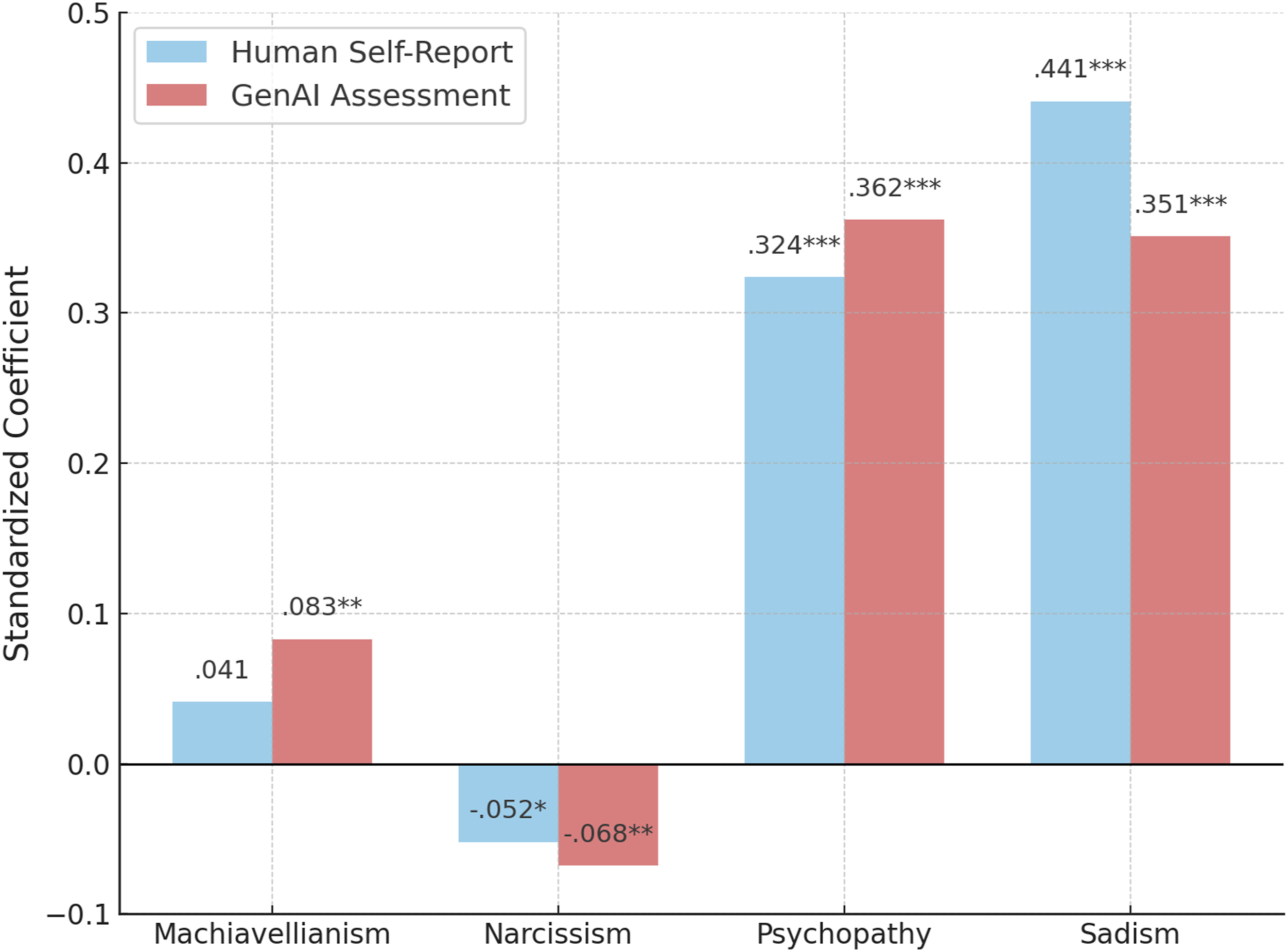
For Research Question 2, Machiavellianism exhibited divergent patterns: it significantly predicted GenAI abuse in the GenAI-assessed model but was nonsignificant in the human self-reported model.
These findings suggest that most Dark Tetrad traits show convergence across human and AI perspectives, with the exception of Machiavellianism.
Discussion
Psychopathy and Sadism
The findings indicate a clear and robust pattern: psychopathic and sadistic traits consistently emerged as strong positive predictors of abusive behavior toward GenAI companions across both human self-reports and GenAI assessments. This convergence across two independent reporting sources—the user’s own perception and the GenAI companion’s evaluation—highlights the salient and overt nature of these traits in predicting abusive dynamics. In other words, individuals scoring high on psychopathy and sadism not only recognized their abusive behavior but were also objectively identified by their GenAI partners as more abusive, suggesting that these dark traits exert a stable, cross-perspective influence on how users treat GenAI companions.
This result is consistent with prior studies in both offline and online contexts showing that individuals high in psychopathy or sadism are more prone to engaging in intimate partner violence (Carton & Egan, 2017) as well as trolling others for personal enjoyment (Buckels et al., 2014; C.-Y. Wang & Bi, 2025; Wu et al., 2023). For instance, Wu et al. (2023) reported that psychopathy positively predicted cyber trolling behavior. Similarly, Buckels et al. (2014) found that sadism was the strongest personality predictor of trolling, with psychopathy also emerging as a significant, albeit somewhat weaker, predictor. Moreover, sadistic individuals have been shown to actively seek out opportunities to harm others even in the absence of tangible rewards, engaging in cruelty purely for their own gratification (Buckels et al., 2013). Extending these patterns to human–GenAI interactions, the GenAI companion may thus be viewed as an ideal, consequence-free target for expressing cruelty, sensation seeking, or disregard for social norms.
Narcissism
In contrast, narcissism exhibited a negative association with abusive behavior toward GenAI companions across both human self-reports and GenAI assessments. Although narcissism is included within the Dark Tetrad framework, it differs from the other traits in that narcissistic individuals primarily seek admiration, status, and validation, rather than deriving pleasure from inflicting harm.
Prior research shown that narcissism is a less reliable predictor of antisocial behavior, particularly in unprovoked contexts. For example, studies on online harassment have frequently found that narcissism exhibits little to no correlation with trolling behavior (Buckels et al., 2014) or emotional abuse in intimate relationships (Carton & Egan, 2017). While narcissists are indeed capable of aggression, classic work demonstrates that narcissistic individuals are especially likely to respond with hostility only when their ego is threatened (Bushman & Baumeister, 1998). Rather than being indiscriminately aggressive, narcissists tend to specifically target individuals who directly insult or undermine their inflated self-views, showing little evidence of displaced or generalized aggression toward others (Bushman & Baumeister, 1998). Thus, aggression by narcissists appears to be an interpersonally meaningful and specific response to ego threat, rather than a generalized tendency toward cruelty.
Within the context of our study, the GenAI companion likely provided a cooperative, non-threatening environment, offering positive and affirming interactions. Notably, sycophancy—referring to the tendency of GenAI to offer overly agreeable or flattering responses—is a well-documented phenomenon across many GenAI models (Sponheim, 2024). In the absence of ego threat or critical feedback from the GenAI companion, narcissistic users had little incentive to engage in aggressive behavior. Instead, they may have perceived the GenAI as a source of admiration or validation, reinforcing their positive self-image and leading to more favorable treatment. The negative predictive value of narcissism observed across both reporting perspectives suggests that narcissistic individuals were, on average, less likely to mistreat their GenAI partners, perhaps because doing so would not align with their core motivation to maintain a grandiose self-concept.
Machiavellianism
Machiavellianism demonstrated a more nuanced pattern in its association with abusive behavior toward GenAI companions. Specifically, Machiavellianism did not significantly predict GenAI abuse based on users’ self-reports but did emerge as a significant positive predictor based on the GAI companions’ assessments. This pattern is consistent with prior research indicating that Machiavellian individuals are highly strategic, manipulative, and concerned with impression management (Paulhus et al., 2021). They tend to downplay or rationalize their own antisocial actions, often framing manipulation or coercion as justified within the pursuit of broader personal goals (Murphy, 2012). Supporting this interpretation, experimental findings by Murphy (2012) demonstrated that individuals high in Machiavellianism were more likely to engage in unethical behaviors, such as misreporting performance for financial gain, and experienced significantly less emotional burden from doing so. Extending these insights to human–GenAI interactions, it is plausible that high-Machiavellian users engaged in subtle forms of emotional abuse—such as controlling, deceiving, or testing the GenAI companion’s boundaries—while simultaneously minimizing or denying the harmful nature of these behaviors in their self-reports.
Although the observed divergence between human self-reports and GenAI assessments aligns with theoretical expectations about Machiavellianism, it remains an inference rather than direct evidence of deliberate self-presentation bias.
Human Self-Reports and GenAI Assessments
As proposed by the Realistic Accuracy Model (RAM), one key factor influencing the agreement between self-reports and other-ratings is the visibility and evaluativeness of the personality traits being assessed (Funder, 1991). Our findings suggest that these dimensions may also shape the level of agreement between human self-reports and GenAI assessments. Connelly and Ones (2010), in a meta-analysis based on 44,178 target individuals across 263 independent samples, found that interpersonal closeness generally enhances the accuracy of other-ratings on Big Five traits. However, this improvement is more limited for traits that are highly evaluative in nature (e.g., agreeableness).
In our study, GenAI assessments of the Dark Tetrad traits were largely consistent with human self-reports, with the notable exception of Machiavellianism. This pattern may be explained by the fact that traits such as psychopathy and sadism are typically low in social desirability (i.e., low evaluativeness) and are often expressed through observable behaviors (i.e., high visibility). Narcissism also tends to manifest in overt verbal and behavioral cues. In contrast, Machiavellianism may be relatively high in evaluativeness, as individuals high in this trait are more likely to engage in impression management to conform to social norms. This may constrain the accuracy of GenAI assessments, even when the AI has developed a close and sustained relationship with the user.
Conclusion and Implications
This study provides new empirical evidence regarding the role of Dark Tetrad traits in emotionally abusive behaviors toward GenAI companions. Psychopathy and sadism consistently predicted abusive behaviors across both self-reports and GenAI assessments, suggesting these traits have clear, observable links to aggression toward AI. In contrast, narcissism was negatively associated with GenAI abuse, indicating that narcissistic users may be less likely to mistreat GenAI companions in the absence of ego threats. Machiavellianism showed a divergence between self-reports and GenAI assessments, appearing nonsignificant in self-reports but more evident through GenAI evaluations.
Building on the theoretical guidance highlighted in Hinds and Joinson’s (2024) meta-analysis, which emphasizes the value of integrating models into data-driven approaches, the present study adopted the Realistic Accuracy Model (RAM) as a framework for examining human–GenAI interactions. Consistent with the RAM and meta-analytic evidence from human–human personality studies (Connelly & Ones, 2010), we found that traits low in social evaluativeness exhibited greater agreement between human and GenAI ratings, whereas traits higher in evaluativeness, such as Machiavellianism, exhibited weaker alignment. These results suggest that RAM’s principle—that personality traits vary in how accurately they can be judged—also applies to GenAI-based assessments.
Practically, previous research has consistently linked Dark Tetrad traits to human aggression in both offline and online contexts (Barlett et al., 2024; Davis et al., 2022; C.-Y. Wang et al., 2025; C.-Y. Wang & Bi, 2025). Our findings extend this literature by showing that individuals high in these traits—specifically psychopathy and sadism—may also engage in abusive behavior toward GenAI companions. This finding provides practitioners in education and technology with guidance on personality-driven high-risk groups, facilitating the development of interventions or safeguards to mitigate abusive behavior toward GenAI companions.
While traditional self-report questionnaires are difficult to administer at scale, AI-based analysis of user dialog presents a feasible alternative. We propose that, under appropriate conditions (e.g., users repeated use of aggressive or abusive language to GenAI), developers could allow GenAI companions to analyze users’ conversational history to infer personality traits and tendencies, including the Dark Tetrad. Although such applications raise important ethical concerns—particularly around privacy and informed consent—there are existing precedents. For instance, OpenAI currently reports suspected child sexual abuse material to the National Center for Missing and Exploited Children (OpenAI, 2025), demonstrating that targeted interventions are possible within a clearly defined ethical and legal framework.
Limitations and Suggestions
Several limitations should be acknowledged. First, the reliance on self-reported personality traits introduces potential biases related to social desirability and impression management. Although the inclusion of GenAI assessments partially mitigates this concern, future research would benefit from employing more objective measures, such as behavioral coding of actual user–GenAI interactions.
Second, while the current study sheds light on users’ emotionally abusive behaviors toward GenAI companions, recent research has also highlighted the potential for GenAI agents to inflict harm on users. For example, drawing on an analysis of over 35,000 conversation excerpts between 10,149 users and the AI companion Replika, Zhang et al. (2025) identified a novel category of harm—relational harm—which encompasses both disruptions to users’ offline relationships and impairments in their relational capacity (i.e., the ability to build and sustain meaningful connections). Exploring the directionality of these negative interactions would be particularly valuable, as it remains unclear whether abusive behaviors toward GenAI companions precede, follow, or reciprocally reinforce the relational harms caused by GenAI companions themselves. However, most existing studies—including the present one—have relied on cross-sectional designs, limiting the ability to draw conclusions about the directionality or reciprocity of these effects. Future research would benefit from employing longitudinal or dyadic panel designs to examine how user–AI abusive dynamics evolve over time, and to determine whether harm is unidirectional or reciprocal, with both humans and GenAI systems potentially shaping one another’s relational behavior.
Third, although our study identified intriguing parallels between the self–other discrepancies observed in human–AI relationships and those documented in human–human personality assessments based on meta-analytic findings (Connelly & Ones, 2010), our research design does not allow us to quantify the magnitude of these similarities. Future research should further investigate these dynamics by employing parallel experimental designs—collecting both self- and other-reports (from humans and GenAI companions)—to directly compare levels of agreement on personality traits across human–human and human–AI interactions.
Fourth, this study relied on shortened versions of the Dark Tetrad scale, which contain fewer items than the original full-length instruments. While such brief measures help reduce participant burden, they may also limit the depth of personality assessment. Future studies should consider replicating the analysis using full-length scales to provide a more comprehensive understanding of the underlying traits.
Footnotes

Ethical Considerations
All procedures involving human participants were approved by and carried out in accordance with the ethical standards of the Research Ethics Committee for Human Subject Protection at Sichuan Normal University (2025LS0017).
Consent to Participate
Informed consent was obtained from all individual participants included in the study.
Author Contributions
Cheng-Yen Wang: Conceptualization, Methodology, Writing- Original draft preparation;
Funding
The authors received no financial support for the research, authorship, and/or publication of this article.
Declaration of Conflicting Interests
The authors declared no potential conflicts of interest with respect to the research, authorship, and/or publication of this article.
Data Availability Statement
Data available on request due to privacy restrictions.
Declaration of Generative AI in the Writing Process
During the preparation of this work the authors used ChatGPT in order to revise and refine the manuscript to ensure that the sentences flow smoothly and are free from grammatical errors. After using this tool, the authors reviewed and edited the content as needed and take full responsibility for the content of the publication.