



Abstract
Many forms of online political incivility threaten democratic norms, contribute to polarization, and are often directed at women and racial minorities. Recent research shows that online political incivility may come from a minority of users that are just as hostile offline as they are online, meaning that individual differences in personality traits may be an important predictor of online political incivility. Drawing upon a large sample of adults living in Canada (N = 1725), we examined the association between personality traits and online political incivility using robust measures of psychopathy, narcissism, Machiavellianism, and the general traits of the HEXACO. While controlling for a variety of sociodemographic and political variables, we found that people who score higher in honesty-humility, agreeableness, and conscientiousness, as well as the planfulness facet of Machiavellianism, are less likely to report engagement in online political incivility. People who score higher in extraversion, several facets of psychopathy, grandiose and vulnerable narcissism, and antagonistic Machiavellianism, by contrast, are more likely to report engagement in online political incivility. In general, the personality traits that predict offline aggression and antisocial behaviour tend to be the same traits that predict self-reports of vulgarity, stereotyping, and threats in online political discussions. Interventions to reduce online incivility may benefit from considering the dispositional tendencies of uncivil users.
Introduction
There is a large public concern surrounding the hostility, vitriol, and overall quality of political discourse that takes place online (Auxier, 2020). When discussing politics on social media sites like Facebook and Twitter, for example, users often violate traditional norms of cooperative communication (Bormann et al., 2022). It is not uncommon to see users swear, name-call, exaggerate, misrepresent, stonewall, and lie. While less common, many users also threaten liberal and democratic norms when they are racist or sexist, threaten politicians, exclude and marginalize certain voices, or operate under a false identity (Bormann et al., 2022). Online political incivility is associated with a plethora of negative consequences as it has been shown to induce anger (Gervais, 2015), increase polarization (Kim & Kim, 2019), reduce trust in institutions (Borah, 2013), and encourage politicians to retreat from participating in meaningful online discussions (Theocharis et al., 2016). Given the long list of negative consequences, an emerging body of research has begun to explore the underlying correlates of online political incivility (Heseltine & Dorsey, 2022; Kim & Kim, 2019; Rains et al., 2017; Rasmussen et al., 2022; Vargo & Hopp, 2017). Much of this research has focussed on political (e.g. Snydor, 2019) and sociodemographic (e.g. Heseltine & Dorsey, 2022) explanations. Less studied, by contrast, have been psychological correlates such as personality traits, which reliably predict a wide variety of behaviours and life outcomes (e.g. Anglim et al., 2020; Wilmot & Ones, 2019), including political behaviours and attitudes (Chen et al., 2021; Pruysers et al., 2019).
Building on the emerging personality and political incivility research that does exist (Bor & Petersen, 2022; Frischlich et al., 2021; Koban et al., 2018; Rasmussen et al., 2022), this paper explores both the antagonistic (Machiavellianism, psychopathy, and narcissism) and general (i.e. honesty-humility, extraversion, agreeableness, concientiousness, emotionality, and openness to experience) personality correlates of self-reported online political incivility. Importantly, we explore the role of personality while also controlling for a variety of theoretically informed covariates such as age, gender, political ideology, and satisfaction with democracy, while simultaneously utilizing full and validated measures of personality that are less likely to underestimate the contribution of personality for political outcomes (Bakker & Lelkes, 2018).
Online Political Incivility
Political incivility remains a contested concept (Coe et al., 2014). Masullo Chen et al. (2019, p. 1), for example, suggest that ‘nobody really agrees on what incivility is’ and Bormann et al. (2022, p. 333) argue that ‘there is little consistency regarding the definition and operationalization of incivility’. Given the lack of conceptual clarity and consensus in the literature, Salgado et al. (2024, p. 226) conclude that the concept of incivility is still at the centre of ‘meaningful’ and ‘consequential’ debates that are currently unfolding across multiple disciplines and literatures.
For some, political incivility is regarded as the violation of established norms of interpersonal and social interactions. In this view, incivility is considered as general rudeness and impoliteness in the context of political discourse, and therefore includes the use of name-calling, pejoratives, vulgarity, and all-caps (e.g. Coe et al., 2014; Gervais, 2015). As Mutz (2015, p. 6) puts it, incivility is ‘the type of behavior that would be considered impolite in face-to-face contexts’. Others, however, argue that incivility should not be confined to mere rudeness (i.e. discussions can be impolite without being uncivil); rather incivility should be defined as ‘disrespect for the collective traditions of democracy’ (Papacharissi, 2004, p. 267). In this conception, incivility is embodied in actions such as racism or sexism or proposing to overthrow a democratic government. Other definitions, by contrast, are far more encompassing – combining both impoliteness and antidemocratic forms of speech under a single umbrella. Writing in the context of tweets, Theocharis et al. (2020, p. 7) define incivility as follows: ‘An ill-mannered, disrespectful tweet that may contain offensive language. This includes threatening one’s rights, assigning stereotypes or hate speech, name calling, aspersion, pejorative speak or vulgarity, sarcasm, ALL CAPS, and incendiary, obscene, and/or humiliating language’. Here, incivility is not just violations of accepted interpersonal norms (i.e. rudeness) but also normatively problematic behaviours (i.e. hate speech and threats). In this view, incivility is seen as more of a spectrum, with impoliteness and rudeness on one end and hate speech and threats on the other. 1
Some scholars have been critical of definitions and conceptualizations of incivility that include both impoliteness (i.e. swearing) and more serious and normatively troubling behaviours (i.e. use of hate speech, threats, etc.) under the same umbrella. Rossini (2022, p. 400), for example, argues that rudeness, impoliteness, and the use of profanities can ‘coexist with democratically desirable characteristics of discourse’ 2 and that it is therefore necessary to separate these uncivil elements from intolerant behaviours that include racism, sexism, xenophobia, and homophobia. For scholars like Rossini, incivility is not a spectrum with racism and sexism at the extremes. Instead, incivility and intolerance are entirely distinct concepts. At the same time, others have criticized current conceptualizations of incivility from a different angle, arguing that impoliteness and disrespect are often context-dependent, and that neither can be deemed inherently harmful from a normative perspective. Masullo Chen et al. (2019), for example, suggest that impoliteness can sometimes be necessary and beneficial to democracy, especially when it mobilizes attention to important social and political issues or challenges harmful ideas and stereotypes.
While debate continues, a number of recent conceptualizations suggest that incivility does indeed include impolite speech acts (e.g. vulgarity, name-calling, etc.) on the one hand, and behaviours that are more genuinely threatening to liberal-democratic norms on the other (e.g. hate speech, proposing to overthrow the government). The existence of these two kinds of speech acts was found empirically in Hopp’s (2019) network analysis of self-report measures of incivility. Using exploratory factor analysis and exploratory graph analysis on 10 different measures of incivility (each containing six to eight items), Hopp (2019) identified two dimensions of incivility: violations of speech-based norms (e.g. profanity, deception, and direct threats) and violations of inclusion-based norms (e.g. suppressing discussion, excluding groups, and stereotyping). While the two dimensions were distinguishable, they were also strongly related to one another (r = .70). This, according to Hopp (2019, p. 219) ‘calls into doubt the notion that impoliteness and incivility in political discussion are starkly different in character’. The present study draws upon the conceptualizations of Hopp (2019), Theocharis et al. (2020), Bormann et al. (2022) and others to treat ‘undemocratic’ speech, or what Rossini (2022) would term intolerance, as a subset of political incivility. As we note in more detail in the methods discussion, we draw upon a measure of incivility that includes both violations of speech-based norms (i.e. the use of profanity) and inclusion-based norms (i.e. the use of stereotyping).
Although the impolite elements of incivility may not always be harmful or incompatible with democratic norms (Masullo Chen et al., 2019; Papacharissi, 2004; Rossini, 2022), incivility, especially when involving more than mere rudeness and impoliteness, can have widespread negative consequences for individuals and institutions. When individuals are presented with uncivil comments from political opponents (i.e. all-caps, hyperbole, name-calling, and vulgarity), they tend to report greater feelings of anger (Gervais, 2015, 2017) and anxiety (Lu & Myrick, 2016). Exposure to incivility (i.e. insults and mocking) may also lead to heightened perceptions of a polarized public (Hwang et al., 2014). Kim and Kim (2019), for example, found that when participants were presented with either respectful or uncivil comments (i.e. containing swears and insults) related to gun control, participants viewing uncivil comments reported more extreme political attitudes, and were less willing to read further comments on the issue. Taken together, online incivility may further exacerbate the growing problems of polarization (Kubin & von Sikorski, 2021) and may lead to mistrust in government institutions (Borah, 2013; Klein & Robison, 2020).
It is not surprising, then, that online political incivility also affects the way that citizens and politicians communicate with each other. When elected politicians and candidates receive hostility from social media users, they often respond by limiting their reciprocal dialogue with constituents (e.g. responding to comments on Facebook posts) and resort to broadcasting their political platforms instead (Theocharis et al., 2016, 2020). Moreover, women and racial minorities are disproportionate targets of incivility (Gardiner, 2018; Rheault et al., 2019; Santana, 2015). Given the often widespread and negative consequences of political incivility, it is necessary to understand who drives online incivility and why.
Previous work has explored various sociodemographic predictors of online incivility, including age (Frischlich et al., 2021; Rasmussen et al., 2022; Vargo & Hopp, 2017), sex (Frischlich et al., 2021; Heseltine & Dorsey, 2022), income (Frischlich et al., 2021; Vargo & Hopp, 2017), education (Frischlich et al., 2021; Vargo & Hopp, 2017), and ethnicity (Heseltine & Dorsey, 2022). Scholars have also examined the role of political correlates, including ideology (Frischlich et al., 2021; Heseltine & Dorsey, 2022; Rains et al., 2017), political interest (Rasmussen et al., 2022), political self-efficacy (Rasmussen et al., 2022), and online commenting frequency (Hutchens et al., 2015; Kim et al., 2021). This paper extends the analysis to consider the role of individual differences in personality.
Personality
Personality refers to individual differences in thinking, feeling, and behaving that are relatively stable across different situations and over time (Larsen & Buss, 2017). The HEXACO model of personality (Ashton & Lee, 2009), for example, includes six general personality traits: honesty-humility (e.g. sincerity, fairness), emotionality (e.g. worry, empathy), extraversion (e.g. sociability, energy), agreeableness (e.g. kindness, warmth), conscientiousness (e.g. organization, discipline), and openness (e.g. curiosity, imaginativeness). General personality traits, like those captured by the HEXACO, reliably predict a variety of attitudes and outcomes, including workplace performance (Lee et al., 2019; Wilmot & Ones, 2019), ambition (Blais et al., 2019), wellbeing (Anglim et al., 2020), and political preferences (Blais et al., 2022; Osborne et al., 2021; Pruysers, 2021).
The Dark Triad is another model of personality that encompasses three of the more antagonistic personality traits: psychopathy, narcissism, and Machiavellianism. Psychopathy is often characterized by four underlying facets: interpersonal manipulation (e.g. lying, being glib, and superficial), blunted affect (e.g. callousness, lack of empathy), irresponsible lifestyle (e.g. impulsive, not planning ahead), and antisocial behaviour (general rule breaking; Williams & Paulhus, 2004). Machiavellianism has recently been characterized by three factors: antagonism (e.g. manipulativeness, selfishness), agency (e.g. achievement-striving, self-confidence), and planfulness (i.e. deliberation, order; Collison et al., 2018). There are two general dimensions of narcissism: grandiose narcissism reflects an unrealistic sense of superiority, authority, and arrogance (Rosenthal et al., 2020) while vulnerable narcissism reflects a sense of hypersensitivity, fragility, and vengefulness (Crowe et al., 2018). At their core, the Dark Triad traits reflect different flavours of manipulativeness and antagonism (Moshagen et al., 2018). Like general personality traits, Dark Triad traits are reliably predictive of a host of antisocial outcomes, including aggression (Dinić & Wertag, 2018), prejudice (Pruysers, 2020), criminal behaviour (Flexon et al., 2016), and cyberbullying (Geng et al., 2021)
A small number of studies have, to date, examined the relationship between personality traits and online political incivility (e.g. Bor & Petersen, 2022; Frischlich et al., 2021; Kluck & Krämer, 2020; Koban et al., 2018; Rasmussen et al., 2022; Santana & Hopp, 2022). In one study, participants were asked to rate how they would likely respond to a series of political posts on Facebook (Koban et al., 2018). Those who were lower in openness to experience (i.e. more conventional, more unimaginative) and lower in agreeableness (i.e. more quarrelsome, more toughminded) were significantly more likely to respond in an uncivil manner (Koban et al., 2018). Uncivil commenters also scored higher in sensation seeking (i.e. experience seeking, boredom proneness) and attentional impulsivity (i.e. trouble concentrating; Koban et al., 2018). Rasmussen et al. (2022), by contrast, found that only agreeableness was negatively correlated with self-reports of uncivil online commenting. Research also demonstrates that when online political comments contain vulgarity or name-calling, people who are lower in agreeableness may be less likely to perceive those comments as uncivil (Kenski et al., 2020).
Since online incivility often contains antagonism toward others, a small number of studies have examined the contribution of antagonistic personality traits. For example, Bor and Petersen (2022) found that uncivil commenters scored higher in status-driven risk-taking, an antagonistic trait that reflects impulsivity and competitiveness (Ashton et al., 2010). Status-driven risk-taking is also strongly correlated with self-reports of intentions to commit political violence, intentions to share hostile political rumours, and a willingness to fight over politics on social media (Petersen et al., 2021). In a study by Frischlich et al. (2021), Machiavellianism and psychopathy were positively associated with self-reported uncivil online participation. Similarly, Kluck and Krämer (2020) found that psychopathy, Machiavellianism, and negative social potency (i.e. gratification from inflicting cruelty) positively predicted aggression motives, which in turn predicted the frequency of uncivil commenting. Kluck and Krämer (2022), likewise, find that those scoring higher in psychopathy are less likely to view incivility as aggressive. In another study, American politicians who were rated by experts as higher in antagonistic traits tended to be more harsh, vulgar, and offensive in their social media posts (Nai & Maier, 2020). In contrast to these studies, Koban et al. (2018) were unable to uncover any associations between Dark Triad traits and uncivil replies to political comments. Thus, while there is an emerging literature on the topic, a consistent set of results has not yet fully emerged.
While an important contribution to the incivility literature, the studies noted above have several limitations that will be addressed in the present research. First, many studies fail to control for known correlates of incivility, including age, gender, political ideology, or political interest (e.g. Bor & Petersen, 2022; Rasmussen et al., 2022). Second, previous studies have relied on the Five Factor Model of personality (e.g. Koban et al., 2018), and therefore less is known about the association between online incivility and HEXACO personality traits. The third limitation is that previous studies have, almost exclusively, employed shorter measures of antagonistic personality traits (e.g. Frischlich et al., 2021). As a consequence, the multidimensionality of each trait has been ignored (Miller et al., 2019), and the contribution of personality has likely been underestimated (Bakker & Lelkes, 2018). A final limitation is that analyses in previous studies involved partialling: examining the ‘unique’ contribution of each Dark Triad trait by modelling all traits simultaneously (e.g. Frischlich et al., 2021). Since all three traits have significant overlap with one another (Moshagen et al., 2018), removing the shared variance can complicate how results are subsequently interpreted (Hoyle et al., 2022). For example, it’s unclear what narcissism becomes once its overlap with psychopathy and Machiavellianism has been statistically removed. Antagonism and manipulativeness appear to be core to all three traits and so the partialed version of narcissism may no longer include these important aspects. We overcome the interpretive difficulties associated with partialling by computing separate models for each Dark Triad trait.
The Current Study
In light of these limitations and research gaps, the objective of the present study is to examine whether general (i.e. HEXACO) and antagonistic (i.e. narcissism, Machiavellianism, and psychopathy) personality traits are associated with online political incivility, controlling for variables that are known to predict incivility, such as sociodemographic variables, political variables, and social media use. Using data from a cross-sectional survey administered to a large sample of adults living in Canada, we examine several hypotheses.
We begin with the general personality traits found in the HEXACO. Here we put forward two hypotheses. First, since those who are lower in honesty-humility exploit others, show little cooperation in social situations, and are comfortable breaking rules (Ashton & Lee, 2009; Zettler et al., 2020), we expect that honesty-humility will be negatively related to self-reported online political incivility (H1). Second, those who are low in agreeableness are stubborn, argumentative, and prone to anger and resentment (Ashton & Lee, 2009), and as a result we anticipate that agreeableness will be negatively related to self-reported online incivility (H2).
Turning to the antagonistic traits, beginning with psychopathy, we put forward three hypotheses. First, since uncivil commenters may have deficits in maintaining healthy relationships with others, we expect that the interpersonal manipulation facet of psychopathy will be positively associated with self-reported online political incivility (H3). Second, given that the lifestyle facet of psychopathy is associated with a disregard for societal norms (Hare & Neumann, 2009), and that uncivil online behaviour is counter to typical interpersonal and democratic norms of civility, we expect that the lifestyle facet of psychopathy will be positively associated with self-reported online political incivility (H4). Finally, given that the antisocial facet of psychopathy is related to law-breaking behaviour (Hare & Neumann, 2009), and that incivility often contains a disregard for rules, community standards, and terms of service of online platforms, we anticipate that the antisocial facet will be positively related to self-reported online political incivility (H5).
Moving to Machiavellianism, we expect that one facet in particular will be related to self-reported online political incivility. Given that callous and cynical remarks are common in online incivility (Quandt, 2018) we anticipate that the antagonism facet of Machiavellianism (e.g. callousness, cynicism) will be positively associated with self-reported online incivility (H6). Ending with narcissism, we put forward two final expectations. Uncivil online commenting often contains an element of grandiosity, in which uncivil commenters assert their opinions above others. As such, we anticipate that grandiose narcissism will be positively associated with greater self-reported online political incivility (H7). Likewise, the vulnerable aspects of narcissism often result in individuals being hypersensitive and therefore prone to lashing out at others when in conflict (Okada, 2012). Here too we expect a positive relationship between vulnerable narcissism and self-reported online political incivility (H8).
Such expectations regarding personality and online political incivility are consistent with other antisocial behaviours (both online and offline). Bullies in school and the workplace, for example, tend to be lower in honesty-humility and agreeableness (Lee et al., 2005; Mitsopoulou & Giovazolias, 2015), and tend to be higher in psychopathy and Machiavellianism (Baughman et al., 2012; Davis et al., 2022). Likewise, cyberbullies also tend to score lower in honesty-humility (Geng et al., 2021) and higher in Dark Triad traits (Kurek et al., 2019). Dark Triad traits are positively related to intentions for political violence (Gøtzsche-Astrup, 2021) and unconventional political action, such as blocking streets, destroying property, attending illegal demonstrations (Rogoza et al., 2022). People scoring higher in Dark Triad traits are also more likely to admit that they participate in politics to produce confusion and chaos (Rogoza et al., 2022). Taken together, we have good reason to expect similar patterns with regards to online political incivility.
Estimating the contribution of personality traits should account for several alternative factors, including sociodemographic and political variables. For example, online political incivility is more common among younger people (Rasmussen et al., 2022), men (Frischlich et al., 2021), and among those with lower income or education (Vargo & Hopp, 2017). Incivility is also more common among those who are politically extreme or who have right-wing populist ideologies (Oh et al., 2021; Rega et al., 2023). People who are highly interested in politics (Rasmussen et al., 2022), or who use social media more often (Hutchens et al., 2015; Kim et al., 2021) may also be more prone to engage in online incivility. Finally, online political incivility may be driven in part by a ‘sore losers’ effect, in which affiliation with a loser or challenging political party leads to greater online incivility (Heseltine & Dorsey, 2022). Our analysis therefore includes several covariates to help account for these factors in order to gain a better understanding of the unique contributions of personality.
Method
Participants
Participants were recruited through an online Qualtrics panel between June and July of 2020 (median time to complete = 29 minutes). Although the sampling method involved an online, non-probability, sample, a variety of measures were taken to ensure that participants were reflective of the broader electorate. Consistent with the approach adopted by the Canadian Election Study (Stephenson et al., 2020), we included a number of sample quotas based on census data. Data include quotas for gender (i.e. 50% men, 50% women), age (45% under 44 years old), and income (35% with a household income less than $49,999). A total of 1,725 3 individuals are included in the resulting dataset which included questions about respondent background, political activities, personality, and a variety of antagonistic behaviours. Respondent age ranged between 19 and 80, with the average age being 48.96 (SD = 16.64). Fifty percent of participants were women, 49.5% were men, and 0.5% identified as non-binary. A majority of the sample identified as White (75.5%). Table A1 in the Appendix compares key demographics of our sample with Canadian census data from 2016 (Statistics Canada, 2017).
Measures
Political Incivility
Factor Analysis of Incivility Items.
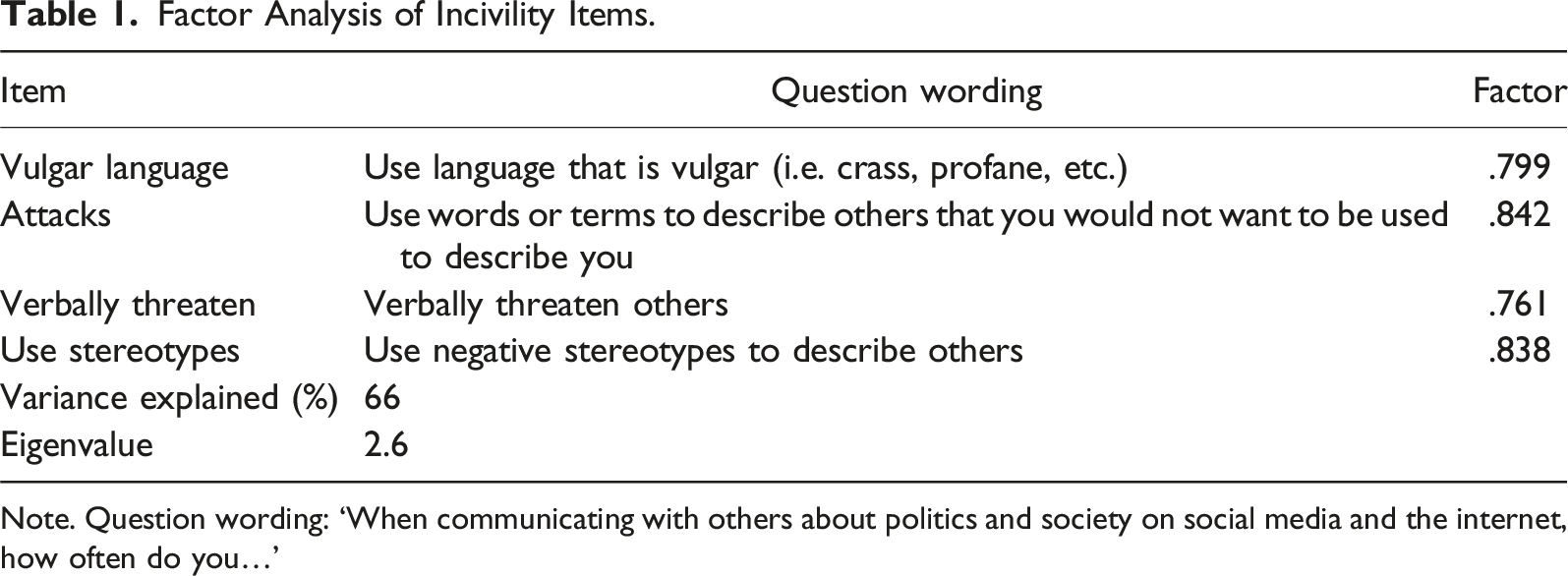
Note. Question wording: ‘When communicating with others about politics and society on social media and the internet, how often do you…’
There are at least three grounds on which we defend the use of a self-report measure of incivility in our analysis. First, self-report measures of antisocial behaviours are not uncommon and have been used to study a variety of online (i.e. cyberbullying, trolling) and offline (i.e. criminality) behaviours (Berlin et al., 2021; Geng et al., 2021; Lee et al., 2023; March et al., 2023; Zhou et al., 2023). Second, the existing incivility literature has called for more self-report data. As Hopp et al. (2020, p. 585) note, ‘prior research on incivility has generally focused on either individual-level perceptions of uncivil communication or the degree to which deliberative spaces feature uncivil or otherwise toxic language. Missing from the literature is an assessment of the ability of online discussion participants to self-identify the degree to which they communicate in an uncivil manner’. Third, while some research speaks to Hopp et al.’s call for an analysis of self-reported incivility, most studies make use of their own, unvalidated, scales (Bor & Petersen, 2022; Hmielowski et al., 2014; Sude & Dvir-Gvirsman, 2023). Unlike this past research, we draw upon an existing scale of incivility that has already been shown to be correlated with behavioural measures of incivility (Hopp et al., 2020).
Personality
HEXACO
The 60-item HEXACO personality inventory (Ashton & Lee, 2009) was used to measure general personality, covering the six dimensions of honesty-humility, emotionality, extraversion, agreeableness, conscientiousness, and openness to experience. Participants rate their agreement with statements using a five-point Likert scale from 1 (strongly disagree) to 5 (strongly agree). A score is computed for each trait by taking the average of available responses, with possible scores ranging from one to five. Higher scores indicate greater presence of the trait.
Psychopathy
Psychopathy was measured using the 29-item Self-Report Psychopathy Scale – fourth edition (Paulhus et al., 2016). This scale measures the interpersonal, affective, antisocial, and lifestyle facets of psychopathy. Participants rate their agreement with statements using a five-point Likert scale from 1 (strongly disagree) to 5 (strongly agree). A score is computed for each facet by taking the average of available responses, with possible scores ranging from one to five. Higher scores indicate greater psychopathy.
Machiavellianism
Machiavellianism was measured using the 52-item Five-Factor Machiavellianism Scale (Collison et al., 2018) which measures the antagonism, agency, and planfulness factors. Participants rate their agreement with statements using a five-point Likert scale from 1 (disagree strongly) to 5 (agree strongly). A score is computed for each factor by taking the average of available responses, with possible scores ranging from one to five. Higher scores indicate greater Machiavellianism.
Narcissism
Narcissism was measured using the 7-item narcissistic grandiosity scale (NGS; Rosenthal et al., 2020) and 11-item narcissistic vulnerability scale (NVS; Crowe et al., 2018). For both the NVS, and NGS, participants rate the extent to which adjectives match their personality using a 7-point Likert scale ranging from 1 (not at all) to 7 (extremely). For both scales, a score is computed by taking the average of available responses, with possible scores ranging from one to seven. Higher scores indicate greater narcissism.
Control Variables
In addition to personality traits, the analyses control for a robust set of other known correlates. Beginning with sociodemographic characteristics, we include controls for respondent gender, 4 age, household income, and highest level of education. We also control for a number of political attitudes and behaviours. This includes political ideology, party identification, satisfaction with democracy, political interest, and social media usage. Ideology was measured using the following item: ‘Where would you place yourself on the scale below?’. Participants placed themselves on an 11-point left-right Likert scale, ranging from 0 (left) to 10 (right). A participant’s distance from the midpoint in the scale (squared) was also taken as a proxy for how ‘extreme’ the ideology was, with greater distance from the midpoint (in either direction) indicating greater self-identification with the political extremes of the scale. To measure political interest, participants were asked: ‘How interested are you in politics generally?’ on a 11-point Likert scale ranging from 0 (no interest at all) to 10 (a great deal of interest). Higher scores indicate greater interest in politics.
To control for a sore loser’s effect – the possibility that the recent electoral defeat of a participant’s preferred political party contributes to online political incivility – we capture their party identification. Participants were asked a standard multiple-choice question: ‘In federal politics, do you usually think of yourself as a:’. Participants could identify as Liberal, Conservative, New Democrat, Green, Bloc Québécois, Other, or none. A series of dummy variables for party identification were then created for the analysis. Doing so allows us to consider whether ‘losers’ of the most recent election are more uncivil than others. Relatedly, we also capture (dis)satisfaction with democracy. Participants were asked: ‘On the whole, how would you rate your level of satisfaction with the way democracy works in Canada?’ on a four-point Likert scale, ranging from 1 (very satisfied) to 4 (not satisfied at all). A higher score indicates greater dissatisfaction with democracy.
Finally, we include a measure of social media usage. Participants’ usage of Facebook – the largest social media platform to date with billions of users worldwide – was taken as a proxy for general social media use. Participants were asked how often they visited Facebook, and responded using a six-point Likert scale ranging from 0 (never) to 5 (several times a day). Higher scores indicated greater social media use.
Results
Correlations Between Personality and Online Political Incivility.
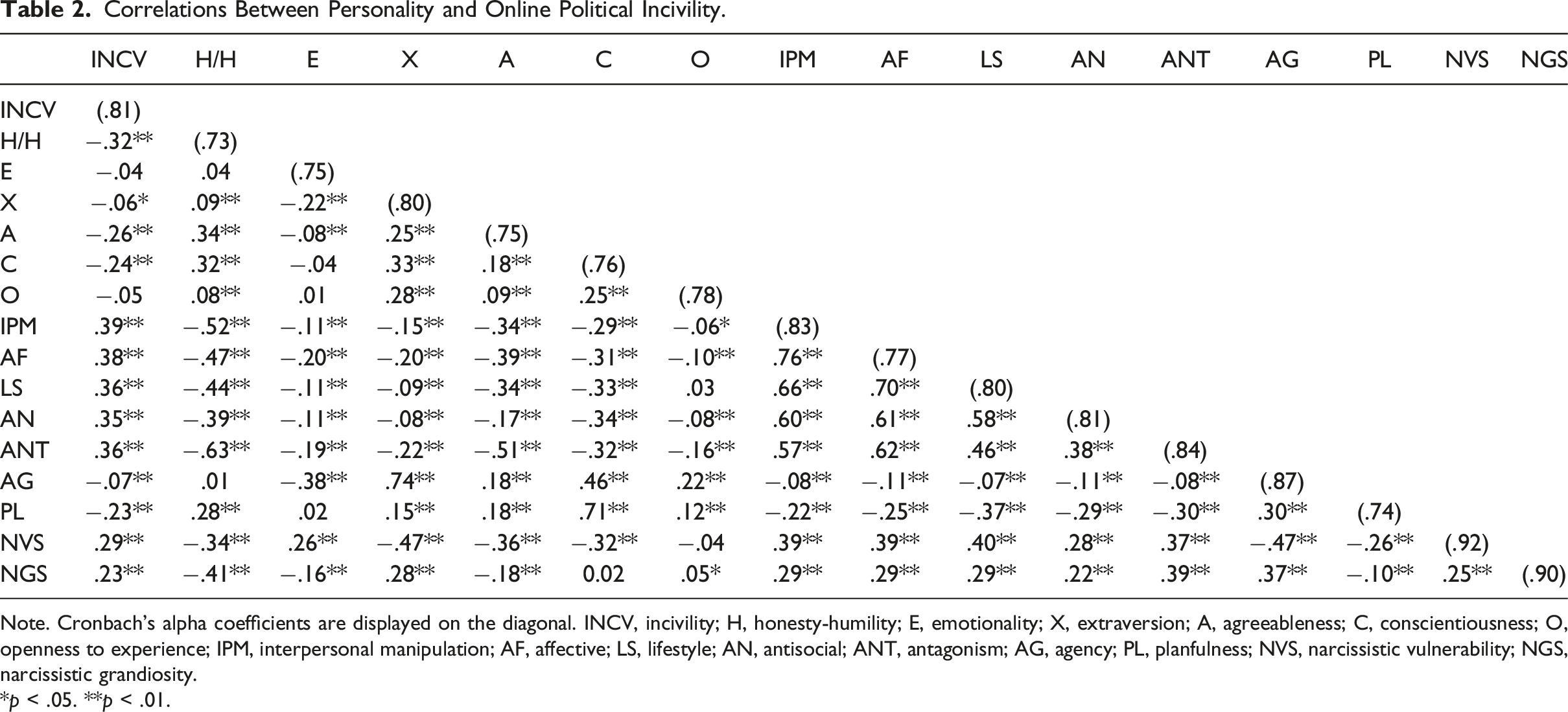
Note. Cronbach’s alpha coefficients are displayed on the diagonal. INCV, incivility; H, honesty-humility; E, emotionality; X, extraversion; A, agreeableness; C, conscientiousness; O, openness to experience; IPM, interpersonal manipulation; AF, affective; LS, lifestyle; AN, antisocial; ANT, antagonism; AG, agency; PL, planfulness; NVS, narcissistic vulnerability; NGS, narcissistic grandiosity.
*p < .05. **p < .01.
Moving to our multivariate analysis, Figure 1 plots the personality results (controls not shown), while Table 3 provides the full multivariate results. All models include age, gender, income, education, left-right political ideology, political partisanship, extremism, political interest, dissatisfaction with democracy, and Facebook use. Model 1 includes the general traits of the HEXACO; Model 2 includes the facets of psychopathy; Model 3 includes the facets of Machiavellianism; and Model 4 includes grandiose and vulnerable narcissism. The R2 for all models are reported in Table 3 and explain approximately 20% of the total variance. The omnibus tests for all models are significant at the .001 level. Standardized Regression Coefficients Across All Models. Note. Estimates are standardized regression coefficients. Each model controls for age, gender, income, education, ideology, extremism, satisfaction with democracy, Facebook use, and partisanship. Model 1 = HEXACO; Model 2 = psychopathy; Model 3 = Machiavellianism; Model 4 = narcissism. H = Honesty-humility; E = Emotionality; X = Extraversion; A = Agreeableness; C = Conscientiousness; O = Openness to Experience; IPM = Interpersonal Manipulation; AF = Affective; LS = Lifestyle; AN = Antisocial; ANT = Antagonism; AG = Agency; PL = Planfulness; NVS = Narcissistic Vulnerability; NGS = Narcissistic grandiosity. Personality and Political Incivility (Ordinary Least Squares Regression). Note. Dissatisfaction, dissatisfaction with democracy; CPC, support for the Conservative Party of Canada; NDP, support for the New Democratic Party; Other, support for the Green Party of Canada, the Bloc Québéquois, or ‘Other’; No party, no party identification; H/H, honesty-humility; E, emotionality; X, extraversion; A, agreeableness; C, conscientiousness; O, openness to experience; IPM, interpersonal manipulation; AF, affective; LS, lifestyle; AN, antisocial; ANT, antagonism; AG, agency; PL, planfulness; NVS, narcissistic vulnerability; NGS, narcissistic grandiosity. *p < .05. **p < .01. ***p < .00.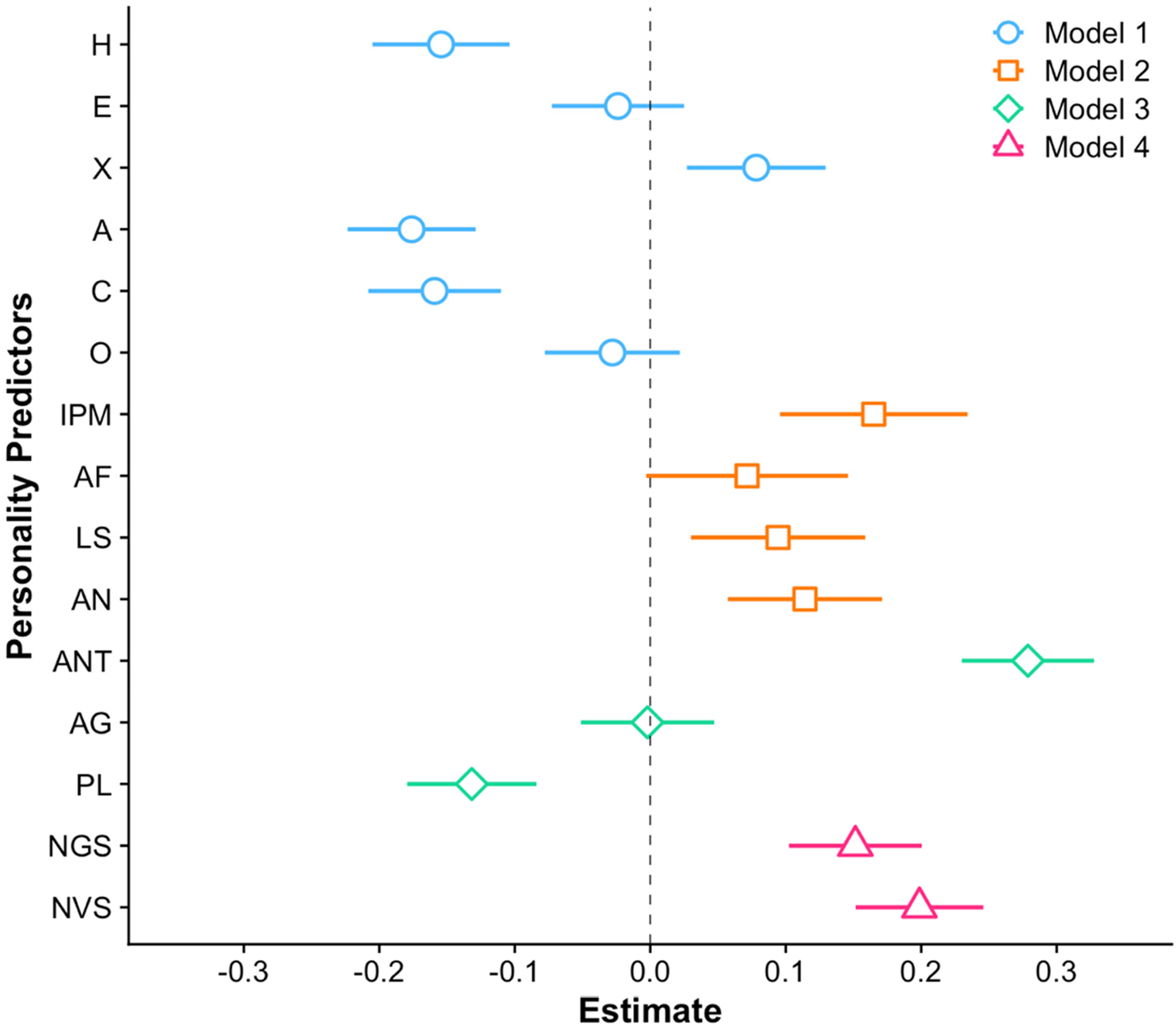
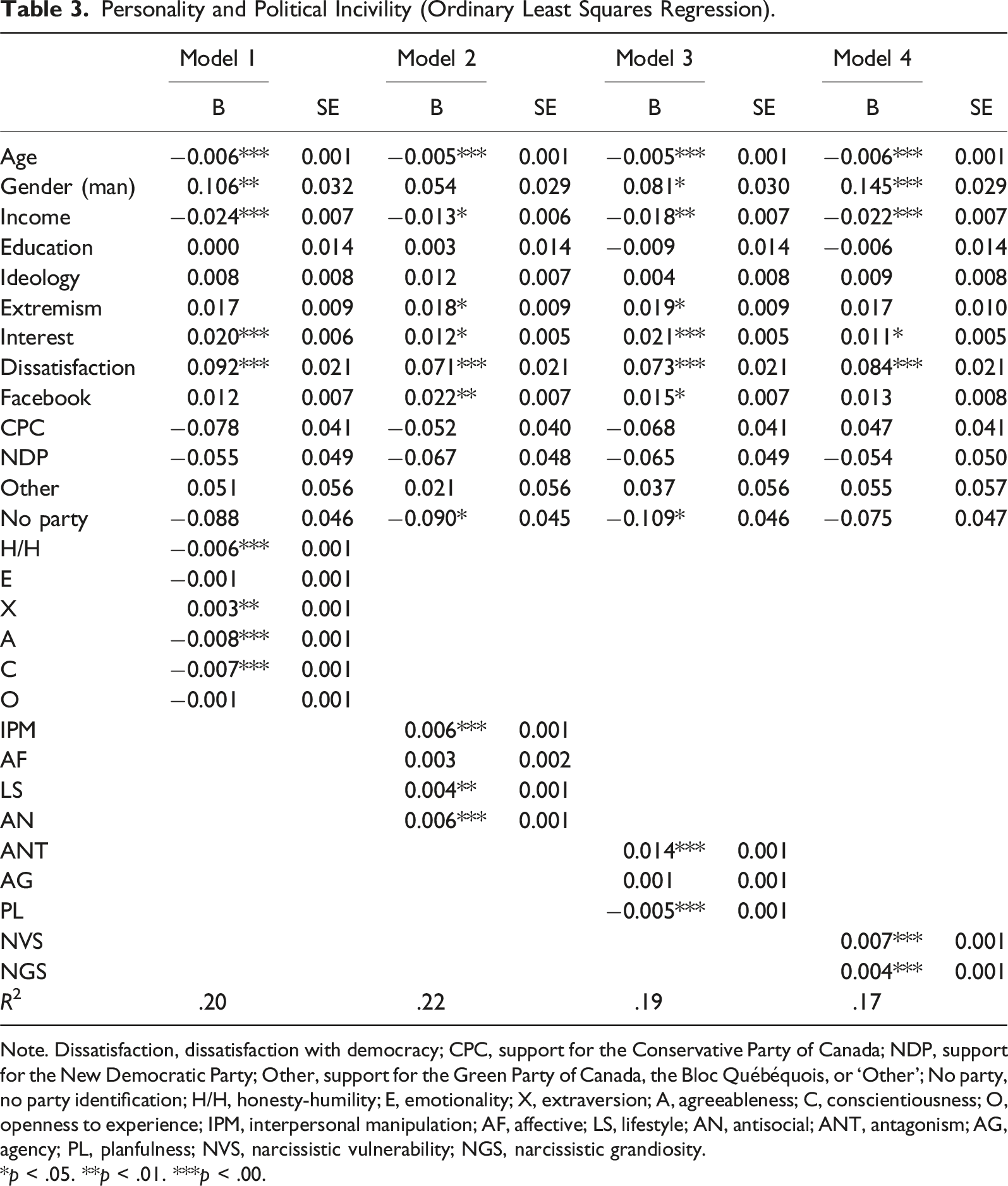
As shown in Table 3, age, gender, and income are consistent predictors of self-reported online political incivility. Higher levels of online political incivility are reported among younger people, those with lower household incomes, and men. For the political controls, those who are more interested in politics report higher levels of online political incivility, as well as those who feel dissatisfied with how democracy is performing. Self-reported online incivility is not, however, consistently associated with (left-right) political ideology, Facebook usage, or partisanship.
Table 3 shows that both general and antagonistic personality traits are reliably associated with self-reported online political incivility – even while controlling for the sociodemographic and political variables noted above. Consistent with our hypotheses for HEXACO traits, those who report engaging in online political incivility are lower in honesty-humility (H1) and lower in agreeableness (H2). We also find two additional relationships worth highlighting: those scoring higher in extraversion are more likely to report engaging in political incivility whereas those higher in conscientiousness are less likely to report engaging in this kind of behaviour.
Consistent with our expectations for psychopathy (Model 2), those who score higher in interpersonal manipulation (H3), lifestyle factors such as impulsivity (H4), and antisocial behaviour (H5), report greater engagement in online incivility. The affective facet of psychopathy (i.e. the callous and unemotional elements) is not related to our outcome. Turning to Model 3, our Machiavellianism results reveal that those who score higher in antagonism report greater levels of online political incivility (H6). Consistent with the finding regarding conscientiousness, the planfulness facet of Machiavellianism is negatively related to online incivility. Finally, Model 4 indicates that both the grandiose (H7) and vulnerable (H8) varieties of narcissism are positively associated with greater online incivility, which is in line with our expectations.
Discussion
Democracy is resilient and online political incivility, especially when it takes the form of impoliteness, is not inherently harmful. As Masullo Chen et al. (2019) correctly point out, rude and impolite behaviour may sometimes be necessary to sanction harmful ideas and raise awareness for others. Nonetheless, online incivility, especially when involving more than mere rudeness, can induce negative emotions, reduce peoples’ trust in institutions, and contribute to polarization. Some forms of incivility, such as hate speech (including racism, sexism, etc.), are also directly threatening to liberal-democratic norms. Making matters worse, such uncivil online political discourse appears to be becoming more commonplace (Frimer et al., 2022). Seeking to understand its psychological antecedents, we investigated the personality traits associated with self-reported online political incivility among a large sample of voting-aged Canadians. People who scored higher in traits such as honesty-humility, agreeableness, and conscientiousness, as well as the planfulness facet of Machiavellianism, were less likely to report engagement in online political incivility. On the other hand, people who scored higher in extraversion, several facets of psychopathy, grandiose and vulnerable narcissism, and antagonistic Machiavellianism, were more likely to report engagement in political incivility online. Such behaviour is more commonly reported among those who are antagonistic, manipulative, boastful, stubborn, sociable, impulsive, and lazy. People who are altruistic, kind, compassionate, humble, lenient, reserved, diligent, and self-controlled, by contrast, tend not to report engagement in online political incivility. These results hold while controlling for a robust set of sociodemographic and political controls (age, gender, interest, ideology, etc.), suggesting that personality is indeed an important piece of the puzzle.
There are two main implications of this research. The first concerns the nature of online discussions. Some have suggested that the features of online social media platforms (e.g. loss of social cues, incentivization of attentional salience, anonymity, etc.) may cause people to lose empathy for others, and therefore behave with more incivility in online environments than they typically do in offline environments (Bor & Petersen, 2022; Voggeser et al., 2018; Wolchover, 2012). Such a view of the online realm implies that anyone can ‘go dark’; even kind and self-controlled people can become uncivil in the right circumstances (Cheng et al., 2017). One implication from the current study, however, is that antisocial behaviour may not be radically different between the online and offline environments. After all, highly agreeable, honest, altruistic, and self-controlled individuals did not report levels of online political incivility that are ‘out of character’ with their core traits. Instead, we find that the personality traits that predict offline aggression and antisocial behaviour (Blais et al., 2014; Hyatt et al., 2019; Lambe et al., 2018; Pruysers, 2020) tend to be the same traits that predict self-reports of vulgarity, stereotyping, and threats in online political discussions. This is consistent with recent evidence from Bor and Petersen (2022) who show a .84 correlation between online and offline incivility, suggesting that uncivil commenters tend to be just as uncivil online as they are offline. While the online environment surely incentivizes uncivil behaviour through features like anonymity, it does not appear to be drawing in an entirely new cohort of uncivil actors.
A second implication that stems from this research is that any meaningful attempt to curtail the more harmful forms of online political incivility (e.g. racism, sexism) will likely need to account for the personality traits of uncivil users. Social media platforms already impose sanctions on users who violate their terms of service (e.g. removal of content, the restriction of direct messages, account suspension, etc.), but our results suggest that penalties may be less effective for those who perpetrate incivility the most. Incivility is reported more often by reckless people (i.e. low conscientiousness, parasitic psychopathy) so these users may engage in incivility regardless of potential consequences. In addition, uncivil users may also have general tendencies for rule-breaking (i.e. antisocial psychopathy) and self-victimization (i.e. vulnerable narcissism) and therefore sanctions may actually exacerbate uncivil behaviour for these users. Platforms have tried to ‘nudge’ users away from incivility by having them reconsider posts that include harmful language, but these suggestions may be ignored by uncivil users, who may be impulsive and irresponsible (i.e. low conscientiousness, parasitic psychopathy). Moreover, since uncivil users may enjoy being argumentative (i.e. low agreeableness), mean, and manipulative (i.e. Machiavellian antagonism, low honesty-humility), appeals to constructive debate may prove ineffective as well. In short, the development of new methods of curbing the harmful forms of incivility (threats, stereotypes, etc.) will need to account for individual differences in personality.
Limitations and Future Directions
While we provided a defence of the use of self-report measures earlier, such measures do have limitations. The most notable limitation is that we are not capturing actual behaviour, but rather self-reported behaviour. The association between trace and self-report measures of online behaviour can be somewhat small (Araujo et al., 2017). A related shortcoming is the possibility that our measure was affected by recall bias, social desirability, and recency bias. For example, Hopp et al., (2020) found that people tended to overreport profanity and name-calling (i.e. behaviours that are more common and less memorable) while underreporting threatening language and stereotyping (i.e. behaviours that are more socially sanctioned). In addition, participants may have only reported their very recent online behaviours, neglecting behaviours from weeks or months before. Thus, while the measure of self-report measure of incivility employed here has been shown to be correlated with actual behavioural incivility (Hopp et al., 2020), we do risk underestimating incivility among our sample. A final limitation is that our measure of incivility is short and therefore unable to capture the full multidimensional nature of incivility (Hopp, 2019).
Despite these limitations, our study has notable strengths. First, we drew from a large sample of the Canadian population with quotas in place to increase the representativeness of the sample and allow for greater generalizability within the Canadian case. Second, the use of full measures of personality traits allowed us to examine more fine-grained associations between personality and incivility. Our measure of Machiavellianism, for instance, allowed us to find diverging relationships: the antagonistic factor was positively related to self-reported incivility, while the planful facet was negatively related. Finally, our study employed a variety of political and sociodemographic controls, which provides further confidence that personality is, in fact, an important predictor of self-reported online political incivility.
Conclusion
The incivility of online political discussions is a concerning aspect of contemporary politics and may also contribute to the growing problem of political polarization. We do not think that social media and other online spaces should be ‘sanitized’ from impoliteness and incivility writ large (Masullo Chen et al., 2019). However, if we wish to reduce forms of incivility that are truly harmful (e.g. threats, racism, and sexism), these interventions should be informed by a robust understanding of the enduring and underlying motivations and personality traits of those who perpetrate incivility the most. Based on our findings, interventions to curtail online political incivility are unlikely to be effective without taking into consideration the individual differences in personality that help explain this behaviour. Given the relatively stable nature of personality, it will likely be very difficult to change the behaviour of those commenters that are driven by antisocial and antagonistic personality traits.
Footnotes
Declaration of Conflicting Interests
The author(s) declared no potential conflicts of interest with respect to the research, authorship, and/or publication of this article.
Funding
The author(s) disclosed receipt of the following financial support for the research, authorship, and/or publication of this article: The research was funded by a Social Sciences and Humanities Research Council (SSHRC) Insight Development Grant (430-2018-00950).

Data Availability Statement
Requests for access to the data for the purposes of verifying the findings of this article can be addressed to the first author, Luke Mungall, at
Notes
Appendix
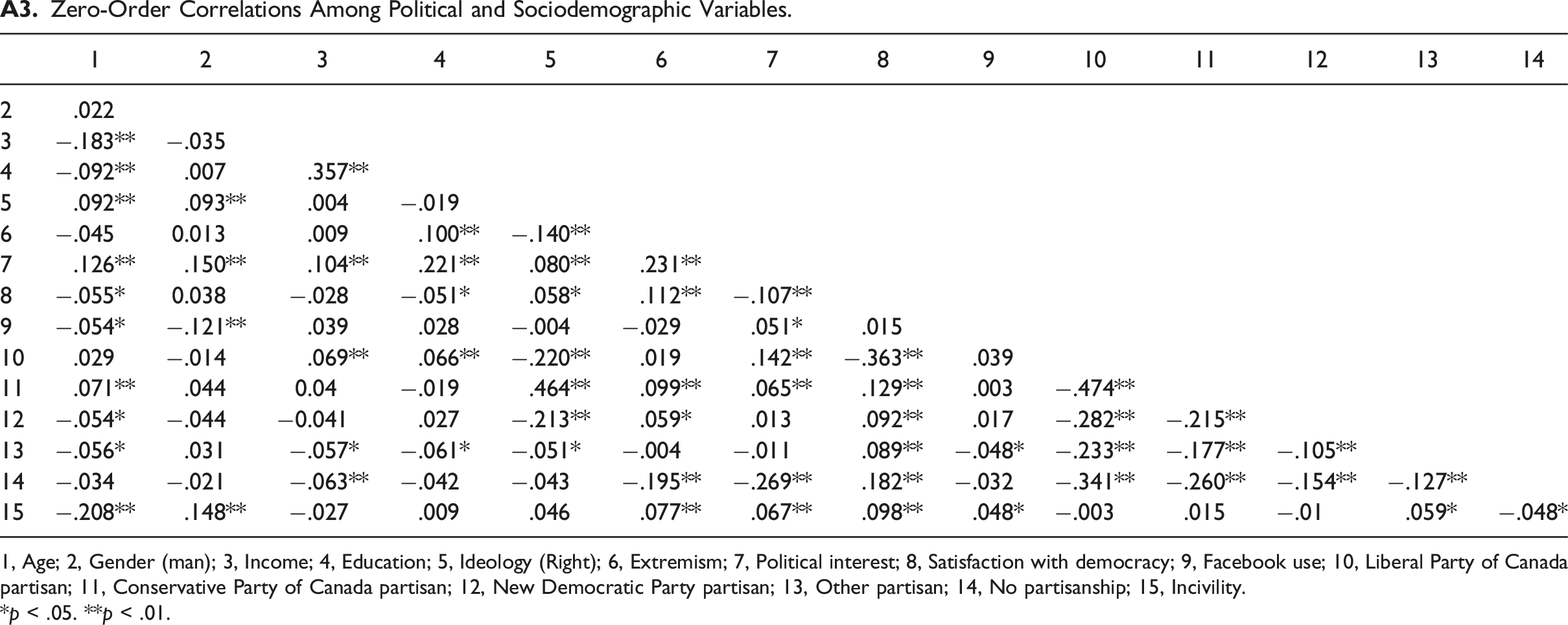
Zero-Order Correlations Among Political and Sociodemographic Variables.
| 1 | 2 | 3 | 4 | 5 | 6 | 7 | 8 | 9 | 10 | 11 | 12 | 13 | 14 | |
|---|---|---|---|---|---|---|---|---|---|---|---|---|---|---|
| 2 | .022 | |||||||||||||
| 3 | −.183** | −.035 | ||||||||||||
| 4 | −.092** | .007 | .357** | |||||||||||
| 5 | .092** | .093** | .004 | −.019 | ||||||||||
| 6 | −.045 | 0.013 | .009 | .100** | −.140** | |||||||||
| 7 | .126** | .150** | .104** | .221** | .080** | .231** | ||||||||
| 8 | −.055* | 0.038 | −.028 | −.051* | .058* | .112** | −.107** | |||||||
| 9 | −.054* | −.121** | .039 | .028 | −.004 | −.029 | .051* | .015 | ||||||
| 10 | .029 | −.014 | .069** | .066** | −.220** | .019 | .142** | −.363** | .039 | |||||
| 11 | .071** | .044 | 0.04 | −.019 | .464** | .099** | .065** | .129** | .003 | −.474** | ||||
| 12 | −.054* | −.044 | −0.041 | .027 | −.213** | .059* | .013 | .092** | .017 | −.282** | −.215** | |||
| 13 | −.056* | .031 | −.057* | −.061* | −.051* | −.004 | −.011 | .089** | −.048* | −.233** | −.177** | −.105** | ||
| 14 | −.034 | −.021 | −.063** | −.042 | −.043 | −.195** | −.269** | .182** | −.032 | −.341** | −.260** | −.154** | −.127** | |
| 15 | −.208** | .148** | −.027 | .009 | .046 | .077** | .067** | .098** | .048* | −.003 | .015 | −.01 | .059* | −.048* |
1, Age; 2, Gender (man); 3, Income; 4, Education; 5, Ideology (Right); 6, Extremism; 7, Political interest; 8, Satisfaction with democracy; 9, Facebook use; 10, Liberal Party of Canada partisan; 11, Conservative Party of Canada partisan; 12, New Democratic Party partisan; 13, Other partisan; 14, No partisanship; 15, Incivility.
*p < .05. **p < .01.