




Abstract
Consuming conspiracy theories erodes trust in democratic institutions, while conspiracy beliefs demotivate democratic participation, posing a potential threat to democracy. The proliferation of social media, especially the emergence of numerous alternative platforms with minimal moderation, has greatly facilitated the dissemination and consumption of conspiracy theories. Nevertheless, there remains a dearth of knowledge concerning the origin and evolution of specific conspiracy theories across different platforms. This study aims to address this gap through a large-scale, cross-platform examination of the genesis of new conspiracy theories surrounding the death of Jeffrey Epstein. Through a (semi-) automated content analysis conducted on a distinctive dataset comprising N = 8,020,314 Epstein-related posts posted on both established platforms (Twitter, Reddit) and alternative platforms (Gab and 4Chan), we demonstrate that conspiracy theories emerge early and influence public discourse well in advance of reports from established media sources. Our data shows that users of the studied platforms immediately turn to conspirational explanations, exhibiting skepticism towards the official representation of events. Especially on alternative platforms, this skepticism swiftly transformed into unwarranted conspiracy theorizing, partly bolstered by references to alternative news media sources. The present study shows how conspirational explanations thrive in low information environments and how alternative media plays a role in turning rational skepticism into unwarranted conspiracy theories.
Keywords
Introduction
“Most of us don't believe Official Narratives in the first place. Can't trust the fake news, politics, alphabet agencies, central bankers” (Gab post, published 2019-08-18 16:26:48 UTC)
In recent years, there has been a mounting concern regarding the proliferation of conspiracy theories across social media platforms. Exposure to such theories has been shown to undermine trust in democratic institutions (van Prooijen et al., 2022) and the belief in conspiracies diminishes the inclination towards legitimate political engagement while fostering a greater tolerance for illegitimate and potentially violent political actions (Imhoff et al., 2020).
Yet, conspiracy theories can also be understood as a form of political communication: Following McNair (2011), political communication is “purposeful communication about politics” and conspiracy theories are (often) both about politics and purposeful. Regarding their content, in most conspiracy theories, the central actors of the narrative are politicians or political institutions, either as the conspirators themselves or as the enablers of some nefarious plot, due to an assumed naivete or corrupt behavior. Used both by citizens and by political actors (Schlipphak et al., 2022), conspiracy theories are also purposeful in multiple ways: They can be used as a form of propaganda or misinformation to spread uncertainty and distrust in societal institutions (van Prooijen et al., 2022). In this vein, they are also conceptually and practically closely related to populist politics (Bergmann, 2018; Jessen, 2019): They can serve to construct the populist understanding of a “corrupt elite” that is diametrically opposed to a homogenous “will of the people.” From a less normative perspective conspiracy theories can also be understood as a tool that enables the critique of established forms of knowledge (production). Turning towards conspiracy theories also seems to be motivated by societal crises and the feelings of fear, uncertainty, and a perceived lack of control. They can shape historical narratives and form the “basis for how people subsequently remember and mentally represent a historical event” (van Prooijen & Douglas, 2017, p. 323). By understanding conspiracy theories as purposeful communication about politics, we can investigate how societal institutions react to skeptical citizens’ need for information in uncertain situations and how the public discourse is shaped by collective sensemaking.
Despite the accumulating evidence highlighting the corrosive impact of conspiracy beliefs, there remains a notable gap in our understanding of the genesis and evolution of specific conspiracy theories. By means of a large-scale computational content analysis (N = 8,020,314 posts), the current study provides unique insights into the early moments of new conspiracy theories around the sudden death of US financier and sex offender Jeffrey Epstein in his cell in April 2019, paying special attention to the role both established and alternative social platforms and established and alternative news media played within the genesis of conspiracy theories.
This article makes a threefold contribution. First by examining four distinct platforms, representing two types of social media (microblogs and discussion boards) and encompassing both established (Twitter, Reddit) and alternative social media spaces (Gap, 4Chan), we deepen our understanding of political communication dynamics across platforms. Second, we offer unique insights into the swift emergence and subsequent evolution of specific conspiracy theories in the aftermath of a significant event. Finally, through the examination of the roles played by established and alternative, we situate our observations in the larger media landscape.
Defining Conspiracy Theories
Across the multidisciplinary literature on the phenomenon of conspiracy theories, there are multiple definitions of the term currently used by scholars. In its simplest form, conspiracy theories can be defined semantically as “theories about conspiracies,” (Dentith, 2016, p. 8), where a theory is understood as an explanation or a mental model and a conspiracy as the secret plans of a group of actors (Keeley, 116). Others focus their definitions on the unrealistic assumptions about the conspirators’ power (such as their absolute control over information flows), their corrupted epistemology, and on their Manichean worldview (Baden & Sharon, 2021). Going beyond a purely semantic definition and definitions that focus on the epistemic and logical defects of conspiracy theories, there are two core elements of conspiracy theories found in the literature: The view of conspiracy theories as (1) a form of knowledge and (2) its heterodox (i.e., opposing official, orthodox interpretations) positioning to other forms of knowledge. From this epistemological perspective, conspiracy theories are seen as often, but not necessarily always wrong explanatory patterns that are used to explain events in an alternative, heterodox way, in contrast to the (presumed to be factually correct) official, orthodox view. Thus, drawing from the early definitory works of Keeley (1999) and Pigden (1995), we herein define conspiracy theories as: ... a heterodox explanatory pattern that attributes events and phenomena essentially to a group of people acting in secret (conspirators) who want to mislead the public and whose goal, from the conspiracy theorists’ point of view, is a state that is undesirable for society. Conspiracy theorists use knowledge that is scientifically unchecked or interpreted unscientifically.
When dealing with conspiracy theories, it is sometimes hard to draw the line between “healthy skepticism” and “unhealthy conspiracy theorizing.” Especially in the context of the events described in the current study, it is necessary to acknowledge that there is a body of research arguing that conspiracy theorizing cannot prima facie be seen as irrational and misinformed. This topic, that is, whether conspiracy theories can be a “healthy” form of thought and argument is subject to a debate between researchers in psychology and philosophy (e.g., with Dentith, 2019 arguing for; and e.g., Wagner-Egger et al., 2019 arguing against healthy conspiracy theories). As this debate goes beyond the scope of this study, we use the theoretical distinction between “warranted” and “unwarranted” conspiracy theories introduced by Keeley (1999). Keeley argues that the distinction between rational skepticism and irrational conspiracy theorizing lies not in the central claim (e.g., in this case, “Epstein didn't kill himself”), but the argumentative framework that is supposed to support that claim. Using this distinction, the statement “There are some unresolved issues with the official account of Epstein’s death and the true perpetrator is being hidden from the public” can be seen as a “warranted conspiracy theory,” while claiming that “the Clintons assassinated Epstein to hide their involvement in a secret satanic human trafficking ring” can be seen as “unwarranted conspiracy theorizing.” The availability of evidence that supports the statement and the plausibility of the statement itself are the basis of this decision; that is, it is not important whether the statement “is true,” but if it reasonably “could be true.”
Individual and Societal Effects of Conspiracy Theories
The ramifications of conspiracy theories can be profound. Consuming them erodes trust in democratic institutions both immediately afterwards (Einstein & Glick, 2015; Kim & Cao, 2016) and over time (Pummerer et al., 2020). Belief in conspiracy theories is linked to a reduced inclination towards behaviors that benefit the collective good, such as engaging in climate-friendly practices (Jolley & Douglas, 2014) or adhering to pandemic-control measures (Imhoff & Lamberty, 2020). Additionally, conspiracy beliefs foster a greater tolerance for illegitimate political actions (Imhoff et al., 2020) and are associated with political extremism (Rottweiler & Gill, 2020). Understanding the genesis of conspiracy theories and the belief in them is crucial to prevent such harms.
So far, extensive research has explored the psychological correlates of conspiracy beliefs (for overviews, see Douglas et al., 2017; Uscinski, 2017; Uscinski et al., 2022a). Within this context, a distinction can be made between peoples’ general propensity to believe in various conspiracy theories, termed conspiracy mentality (Brotherton et al., 2013; Bruder et al., 2013) and their belief in specific conspiracy theories (Goertzel, 1994). While conspiracy mentality tends to be relatively stable and normally distributed in society, the belief in specific conspiracies is skewed and subject to change (Imhoff et al., 2022; Uscinski, Enders, et al., 2022). This raises the question of where specific conspiracy theories originate.
Historians assert that “conspiratorial thinking has been part and parcel of history” (Yablokov et al., 2020, p. 527), with its roots stretching back to the French revolution, the Middle Ages, and even antiquity. This strand of research focuses on what Michael Barkun terms “superconspiracy theories” or “systemic conspiracy theories” (Barkun, 2014, p. 9)—overarching narratives that underlie many specific conspiracy theories (e.g., antisemitism). In contrast to a particular conspiracy theory (e.g., “9/11 was an inside job”), these “conspiracy myths” (Nocun & Lamberty, 2020, p. 20) often recur throughout history, adapting to contemporary circumstances.
Research dealing with the origin of specific conspiracy theories is less prevalent. Kreis (2020) scrutinized conspiracy theories that emerged in the aftermath of the terrorist attack on the French newspaper Charlie Hebdo in January 2015, revealing that the label “conspiracy theory” was employed in a broad sense and not always devoid of ideological presuppositions (p. 38). Bricker (2013) delved into the responses and subsequent surge in accusations of conspiracies directed at climate scientists following the leak of unlawfully obtained emails from a Climate Research Unit, illustrating how quickly conspiracy theories can arise after pivotal incidents.
More recently, Bruns et al. (2020) demonstrated that the conspiracy theory linking 5G to COVID-19 emerged by merging two existing conspiracy theories—one positing that the pandemic was a deliberate event and the other asserting that 5G emissions have adverse health effects. Notably, the authors underscored the dynamic dissemination of the 5G conspiracy theory across Facebook, originating from “obscure origins in pre-existing conspiracist groups, spreading to more diverse communities, and ultimately gaining substantial traction through endorsement by celebrities, sports figures, and media outlets” (Bruns et al., 2020, p. 1). The current study adds to the literature by examining the emergence of a specific conspiracy theory across social media platforms and situating it within the broader media landscape.
Alternative Social Media Platforms
While conspiracy theories have been a recurrent feature throughout human history (van Prooijen & Douglas, 2017), the advent of social media has profoundly amplified the possibility to spread, disseminate, and consume them (Zeng et al., 2022). Conspiracy theories proliferate on all major social media platforms, including Facebook (Boberg et al., 2020), YouTube (Röchert et al., 2022), Instagram (Bloom & Moskalenko, 2021), and Reddit (Schatto-Eckrodt et al., 2020), often finding fertile ground within specialized communities (Bessi et al., 2015; Stempel et al., 2007). Although it remains challenging to quantify the exact share of conspiracy theories due to the lack of independent access to social media data (Bruns, 2019), it is evident that the pressure on social media platforms to manage such content has increased over time for instance due to the European Digital Services Act (DSA) which now mandates larger platforms to handle harmful content rapidly. Indeed, in 2020, Meta deleted several accounts associated with Qanon, an apocalyptic conspiracy theory originating from the US, and in 2021 YouTube banned German conspiracy proponent Ken Jebsen.
Several individuals banned from larger platforms have sought refuge on an expanding array of smaller alternative social media platforms, sometimes also referred to as “dark platforms” (Zeng & Schäfer, 2021). Drawing from relational conceptualizations of alternative news media (Holt et al., 2019) and the heterodoxic nature of conspiracy theories (Anton et al., 2014), we understand alternative social media as those platforms that position themselves as counter-public spaces, against the perceived “mainstream” digital public spheres in a given context. They often advertise themselves a space for actors or perspectives that perceive themselves as inadequately represented or marginalized within the mainstream discourse (Frischlich et al., 2022b). Two categories of alternative social media seem particularly relevant for the dissemination of conspiracy theories: Social counter-media platforms, which emulate large-scale platforms in design and functionality but present themselves as safe havens for content not tolerated elsewhere (e.g., Gab, Bitchute, Parler), and fringe communities like 4Chan or 8Kun, characterized by distinct niche online cultures (Phillips, 2012) that allow even extremely norm-violating content within their anonymous exchange spaces (Frischlich et al., 2022b). Previous research has indicated that conspiracy theories thrive on both types of platforms (Kou et al., 2017; Zeng & Schäfer, 2021) but fringe communities may host an even larger share of explicitly hostile content (Rieger et al., 2021).
Alternative News Media
Conspiracy theories flourish in times of uncertainty (van Prooijen & Jostmann, 2013). They can be viewed as a form of collective sensemaking “in which individuals work together to analyze and understand issues” (Kou et al., 2017, p. 3). Addressing individuals with timely information about current events can help alleviate uncertainty (Chan et al., 2017; Wood, 2018), wherefore established or “mainstream” news media have a central orienting function in times of crises (Perse & Lambe, 2016). In consequence, the availability of news coverage about a critical event could reduce the spread of conspiracy theories by reducing the need for sensemaking in the collective.
However, in our increasingly fragmented digital public spheres (Van Aelst et al., 2017), established news media find themselves sharing digital space with an ever-growing multitude of alternative news sources that challenge the legitimacy of established news outlets (Figenschou & Ihlebæk, 2019). Alternative news media position themselves as a “corrective of ‘traditional’, ‘legacy’ or ‘mainstream’ news media in a given sociocultural and historical context” (Holt et al., 2019).
While they do not always explicitly promote conspiracy theories, they do contribute to their spreading (Boberg et al., 2020), and attract users with higher levels of conspiracy mentality (Frischlich, Kuhfeldt, et al., 2022). Furthermore, alternative news media often employ implicit cues (i.e., “just asking,” “who might benefit”), which can illicit conspiracy believes among the audience (Lyons et al., 2019) and might increase uncertainty about unfolding events. Additionally, alternative news stance of opposition to established institutions mirrors the positioning of conspiracy theories as an alternative to dominant interpretations of events. This might explain why alternative news media are shared frequently in social media communities that endorse conspiracy theories (Frischlich et al., 2020; Schatto-Eckrodt et al., 2020).
Research Questions
The primary objective of this study is (1) to investigate the dynamics of the emergence of new conspiracy theories, (2) the impact of established and alternative social media platforms on their spread, and (3) to contextualize this emergence within the broader media landscape, considering both established and alternative news sources. As there is little empirical research focusing on the early moments of new, emerging conspiracy theories, we pose the following research question:
When and how do conspirational interpretations of the event enter the discourse?
Regarding the differences between social media platforms, the two alternative social networks Gab and 4chan and their users have a history of spreading and endorsing conspiracy theories (see Tuters et al., 2018 for 4chan’s involvement in the “Pizzagate” conspiracy theory; and Zannettou et al., 2018 for Gab’s connection to the phenomenon).Yet, conspiracy theories are also shared and discussed on mainstream social media (Schatto-Eckrodt et al., 2020). By investigating the early moments of a newly emerged conspiracy theory, we ask how the users of alternative and mainstream social media platform differ in their reactions and use of conspiracy theories:
Do the dynamics of the emergence and spread of a new conspiracy theory differ between alternative and mainstream social media platforms?
As outlined above, alternative news media questions established media’s (epistemic) authority and often rely on alternative production routines, such as those described for “critical media” (Fuchs, 2010), cite voices usually not heard in the mainstream, or publish alternative topics, or by employing diverging epistemologies, like conspiracy theorizing. While not always explicitly evoking conspiracy theories, alternative news media often works with implicit cues (i.e. “just asking questions”), which have been shown to be able to illicit conspirational believes in media users (Lyons et al., 2019). Many alternative news media outlets actively position themselves as a counterforce or watchdog to “established news media.” This opposition to established institutions mirrors the aforementioned positioning of conspiracy theories as an alternative to the official interpretations of the world. The use of alternative media sources might be connected with a turn towards conspirational interpretations of the event. Thus, we pose the following research question:
How do users incorporate established versus alternative news media in their discussions regarding the pivotal event?
The Current Study
To answer our research questions, this study delves into the digital discourse surrounding an event that garnered extensive discussion within online communities endorsing conspiracy theories: the death of Jeffrey Epstein. Epstein, a well-connected US financier and convicted sex offender, was discovered deceased in his cell on August 10th, 2019, at 10:30 UTC (06:30 a.m. local time, EDT). The official determination of Epstein’s demise as a suicide was made by New York City’s medical examiner (Sisak et al., 2019). However, this conclusion was contested by Epstein’s legal representation and family, prompting them to enlist the services of Michael Baden, a renowned forensic pathologist, to conduct an independent autopsy. Baden's investigation suggested homicidal strangulation as the cause of death, countering the initial ruling of suicide.
In the wake of Epstein’s passing, a wave of rumors and conspiracy theories disseminated online. The phrase “Epstein didn't kill himself” swiftly evolved into a meme, adopted by individuals across various political spectrums, though without uniform agreement on the specifics of Epstein’s demise (Ellis, 2019). The prompt turn toward conspiracy theorizing can be partially attributed to Epstein’s prior mentioning in the Pizzagate conspiracy theory. Pizzagate alleges the involvement of several high-ranking Democratic Party officials in a human trafficking and child sex ring. The theory originated from a rumor related to Jeffrey Epstein’s legal case, specifically referencing his so-called “Lolita Express” plane, which he purportedly used to transport his acquaintances and underage girls to his private Caribbean islands (Cosentino, 2020, p. 68). The conspiracy theories were further fueled by former US president Donald Trump, who “retweeted a message by a right-wing personality alleging that the Clintons were involved in the murder of Epstein” (Cosentino, 2020, p. 69). Overall, the conspiracy theories surrounding Epstein’s death can be seen as the “sum of many different theories bound together” (Uscinski, cited in Ellis, 2019). The entities attributed with responsibility for Epstein’s death range from the democratic representatives the Clintons to Donald Trump himself. The multitude of distinct perspectives on the same central notion, coupled with the early and sustained inclination of public discourse towards conspiratorial interpretations of the event, render this a compelling case study for dissecting the genesis of conspiracy theories and comprehending the role played by established and alternative (news) media across distinct platforms.
Methods
Platform Selection
As the current study investigates the rise of conspiracy theories across four different social media platforms, understanding the differences of the technical affordances and the user characteristics of Twitter, Reddit, Gab, and 4chan is relevant to the following analysis. The four platforms can be separated into forum-like discussion boards on the one hand, using the logic of threads and comments (Reddit and 4chan), and microblogs, networked information-sharing platforms (Twitter and Gab). They can also be differentiated into mainstream (Twitter and Reddit) and alternative social media (4chan and Gab).
Twitter is used by a sizable share of regular media users (22% of American adults use Twitter) (Wojcik & Hughes, 2019), but also policy makers, celebrities, activists, and journalists of traditional and new media organizations (Groshek & Tandoc, 2016; Paulussen & Harder, 2014). Although the platform experienced a decline in user engagement following the takeover by Elon Musk (Chang et al., 2023), as of September 19, 2023, the website maintained a global ranking of 5 (similarweb.com). During the time of our data collection well before Musk took over, Twitter had positioned itself against hateful and misleading content.
Reddit functions as a discussion-board style online forum. Users have profiles, but these are often pseudonymous. Discussions are organized around various topics within designated subreddits. Each subreddit has its own set of moderators, resulting in distinct communication norms between different subreddits (Gibson, 2019). Overall, Reddit is being used by a smaller share of users than Twitter (6% of American adults, Smith & Duggan, 2013), but, with the exception of some extreme sub-communities, its user base is representative for young, male US citizens, regarding political leaning.
Gab closely mirrors Twitter in functionality and design but positions itself as a proponent of free-speech, with little to no moderation of its users, which “attracts alt-right users, conspiracy theorists, and other trolls” (Zannettou et al., 2018, p. 1007). In contrast to Twitter, with the exception of only a small share of popular far-right figures such as Richard B. Spencer, Mike Cernovich, and Alex Jones, there are less public figures active on the platform (Zannettou et al., 2018). Gab can be characterized as a “social counter-media platform,” which emulate large-scale platforms in design and functionality but present themselves as safe havens for content not tolerated elsewhere (Frischlich et al., 2022b).
4Chan, a “fringe community” (ibd.), follows a similar discussion-board format to Reddit, but its communication dynamics are heavily influenced by its subculture, making it often challenging for outsiders to grasp. Most content is posted anonymously as 4Chan does not require registration (Papasavva et al., 2020). The platform permits “racist and pornographic content only in selected boards” in its terms of service, indicating a particularly loose approach to moderation. 4Chan is widely recognized for its role in propagating conspiracy theories like Pizzagate (Tuters et al., 2018). Nonetheless, the platform ranked 765 globally as by September 19, 2023 (similarweb.com).
The four selected platforms share some structural similarities (i.e., the open network structures of Twitter and Gab; the discursive forum-like structure of Reddit and 4chan), but are situated at either the fringes of social media (i.e., Gab and 4chan) or the mainstream (i.e., Twitter and Reddit). These differences in both structure and user characteristics make it possible to not only track the evolution of a newly born conspiracy theory over time, but also across and within platforms.
Database
Immediately following the first reports of Epstein’s death, we conducted a comprehensive data crawl encompassing all content containing the term “Epstein” across all four platforms. Live streaming of tweets (via the Standard Streaming API) was performed using the tweepy Python library from August 11 to August 26, 2019. Additionally, tweets posted from August 8 to August 11, 2019, were gathered through the Standard Search API. Corresponding Reddit comments were crawled using the PRAW Python library on September 1, 2019. 4chan posts were sourced from 4plebs.org, an unofficial archive of specific boards on 4chan.org. We exclusively extracted posts from/pol/, a board whose content “deviate[s] firmly (and proudly) from the normal discursive emphasis of ‘politically correct’ understanding and inclusion” (Ludemann, 2018, p. 2). This yielded a total of N = 8,020,314 Epstein-related posts, with the majority being in English (> 90%).
To gain a nuanced understanding of the temporal dynamics of the discourse, we partitioned the dataset into three segments: (1) posts published prior to Epstein’s death (4.77% of posts), (2) posts published on August 10, 2019, the day of Epstein’s death (21.40%), and (3) posts published on August 11, 2019 and thereafter (73.83%). This segmentation allows us to scrutinize the discourse preceding the pivotal event of Epstein’s death, the immediate aftermath where conspiracy theories took shape or evolved, and the sustained public discussion on the topic. Additionally, for each platform and time segment, we randomly selected 25 posts, resulting in a dataset of n = 300 posts for manual coding of warranted and unwarranted conspiracy theories, as described in the following section.
Analytical Approach
We employed a (semi-)automated content analysis, utilizing co-occurrence graphs in conjunction with manual coding to scrutinize our database and answer our research questions. Co-occurrence analysis involves examining pairwise connections between elements in a given set, with these connections represented by the occurrence of two elements within a subset of all elements. In content analysis, the elements are typically words, the subsets are documents, and the entire set constitutes the corpus. Co-occurrence analysis allows for the construction of networks, or graphs, illustrating the centrality of terms and the connections between words, thereby revealing thematic clusters (Buzydlowski, 2015). In our study, we leveraged co-occurrence graphs to gain insights into the linguistic patterns within the discourse. This application of semantic networks as an analytical tool has been previously employed in the realm of conspiracy theories, shedding light on the characteristics of conspiratorial narrative networks (Tangherlini et al., 2020).
To achieve a more nuanced comprehension of the material, we conducted a manual coding of the n = 300 posts selected for manual analysis. Specifically, our focus was on differentiating between warranted and unwarranted conspiracy theories as delineated by Keeley (1999). This determination is based on the availability of evidence supporting the statement and the plausibility of the statement itself. In other words, it is not about whether the statement “is true,” but whether it is reasonably conceivable to be true. For each post, we coded whether they contain a reference to an unwarranted conspiracy theory or not (Krippendorff’s α = .89). We considered a post to contain a reference to an unwarranted conspiracy theory if the interpretation of the current situation involves a conspiracy that surpasses the factual knowledge at the time and is inherently implausible. For example, the statement “There are some unresolved issues with the official account of Epstein’s death and the true perpetrator is being hidden from the public” can be viewed as a warranted. Conversely, asserting that “the Clintons assassinated Epstein to hide their involvement in a secret satanic human trafficking ring” can be seen as unwarranted.
Preprocessing
In (semi)-automated content analysis, preprocessing plays a crucial role and involves significant decisions made by the researcher (Denny & Spirling, 2018; Maier et al., 2018). In this study, we conducted preprocessing of the posts which encompassed removing non-word characters and tokenizing the posts, by removing stop words, by stemming, and by pruning the single tokens. We have made available all scripts and comprehensive details of the preprocessing and analytical pipeline through the Open Science Framework (link removed for blinded peer-review).
Results
Preliminary Analyses
Number of Posts per Platform.
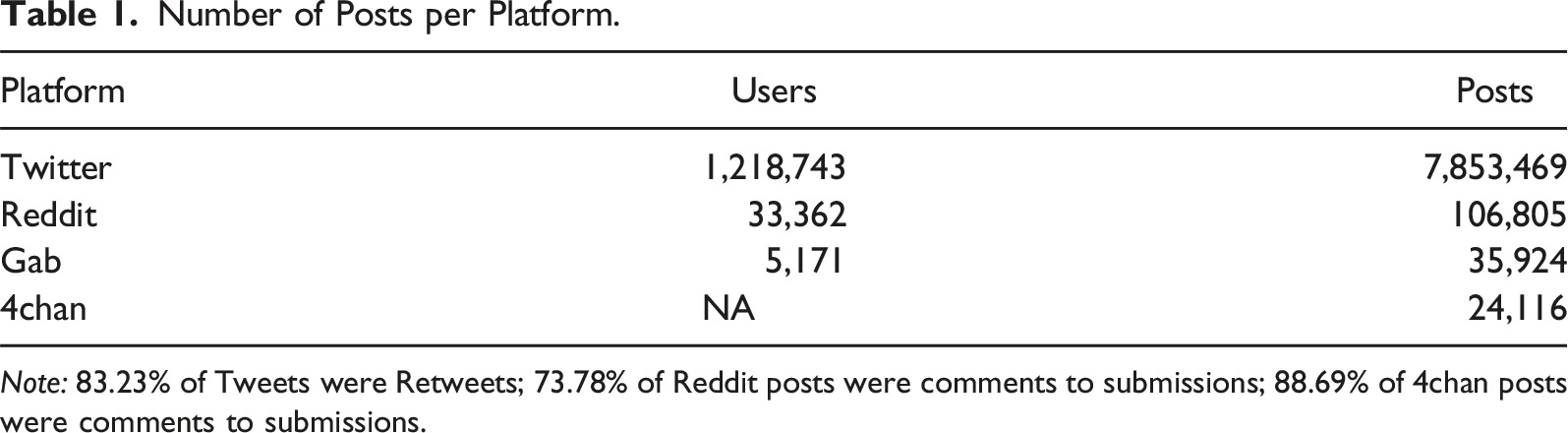
Note: 83.23% of Tweets were Retweets; 73.78% of Reddit posts were comments to submissions; 88.69% of 4chan posts were comments to submissions.
On average, the posts were relatively short with tweets (M = 150.02, SD = 87.66 characters) and Reddit comments (M = 190.05, SD = 374.20 characters) being even shorter than posts on Gab (M = 287.06, SD = 353.07 characters) and 4Chan (M = 337.29, SD = 405.12 characters).
Discourse Dynamics
RQ 1 sought to understand the dynamics of the discourse surrounding the central events across the examined platforms. An examination of the number of posts per hour revealed a similarity in posting activity across these platforms. Figure 1 illustrates how the volume of posts per hour experienced a sharp increase even before the news of Epstein’s death was officially announced at approximately 13:00 on August 10, as reported by established news sources (Rashbaum, 2019). This surge, which represents the initial 24 hours of social media’s response to the event, accounted for a relatively significant portion of the posts in our dataset. Such posting behavior aligns with typical patterns observed in event-driven online discussions (Tsytsarau et al., 2014). It's characterized by an initial peak in posts followed by a rapid decline in post volume over the subsequent days; that is, the discussion commences with a substantial influx of users engaging with the event, connecting with fellow users, and then wanes as the event's newsworthiness diminishes. Number of posts over time. (A) 4chan posts over time, (B) Gab posts over time, (C)Twitter posts over time, and (D) Reddit posts over time.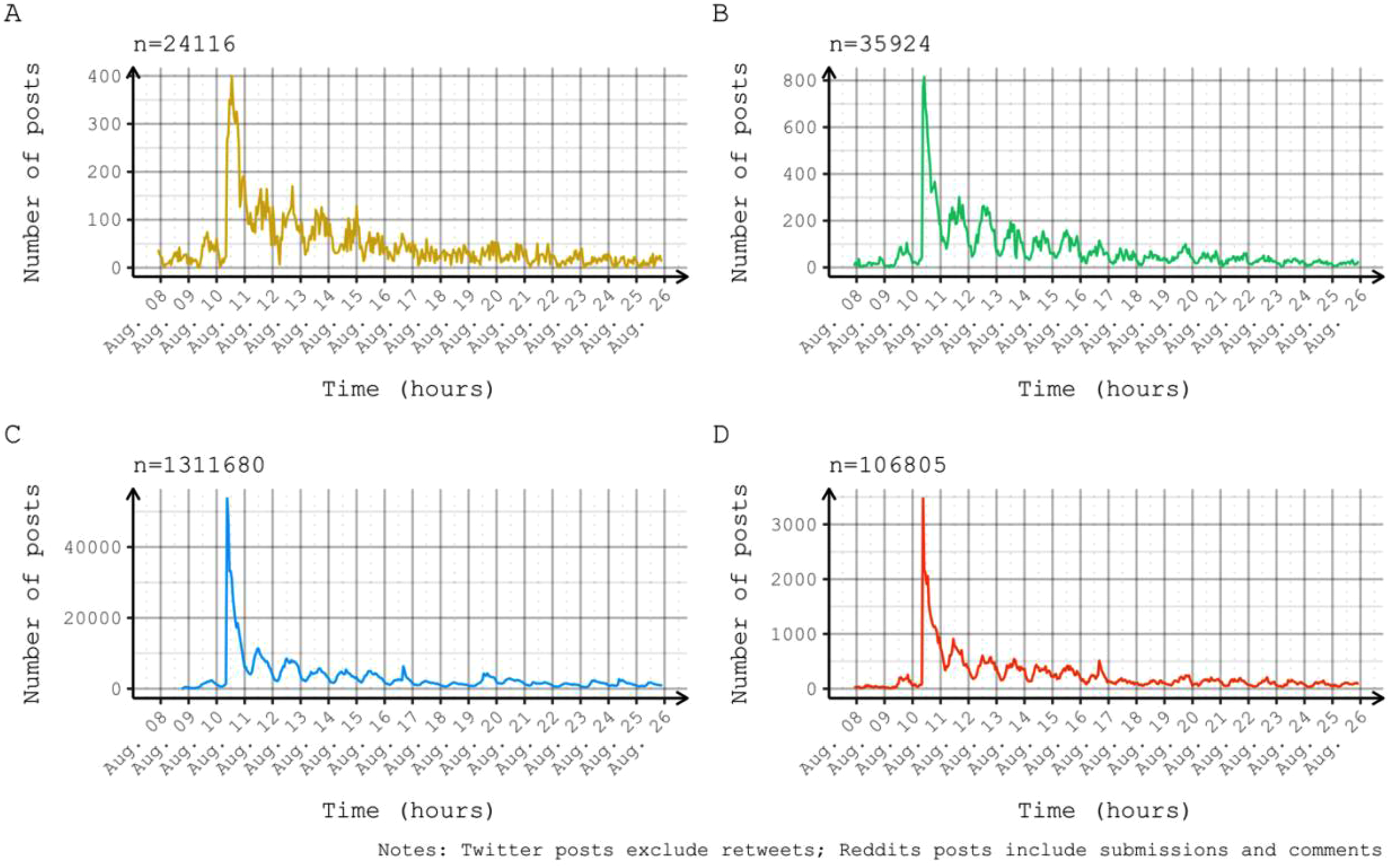
The four platforms exhibited distinct patterns in the decay of the discussion. On Twitter, the peak was more pronounced, accounting for a larger share of all tweets (5.25%), compared to the other platforms (Reddit: 3.88%, Gab: 3.60%, 4chan: 3.57%).
In addressing RQ 2, our sample of the four platforms did not display significant differences in general posting patterns, which all aligned with typical responses to news events. The event impacted all four platforms in a similar manner, leading to a surge in post-volume shortly after Epstein’s death. In this initial quantitative analysis, no platform exhibited significantly faster reactions to the event, although on 4chan, the debate extended for a longer duration compared to the other platforms.
The Genesis of (Unwarranted) Conspiracy Theories
RQ 2 asked when and how conspiracy theories entered the discourse. As previously mentioned, the discussion surrounding Jeffrey Epstein's death was significantly shaped by the narrative that he did not die by suicide but was instead killed by an unidentified party. To gain a comprehensive overview of the conspiratorial narratives associated with this general suspicion, we utilized co-occurrence graphs to construct a semantic network based on the content of the posts. Figure 2 illustrates the most prominent co-occurrences, categorized by platform. Top 50 edges by number of co-occurrences by platform. (A) Twitter co-occurrence graph, (B) Gap co-occurrence graph, (C) Reddit co-occurrence graph, and (D) 4chan co-occurrence graph.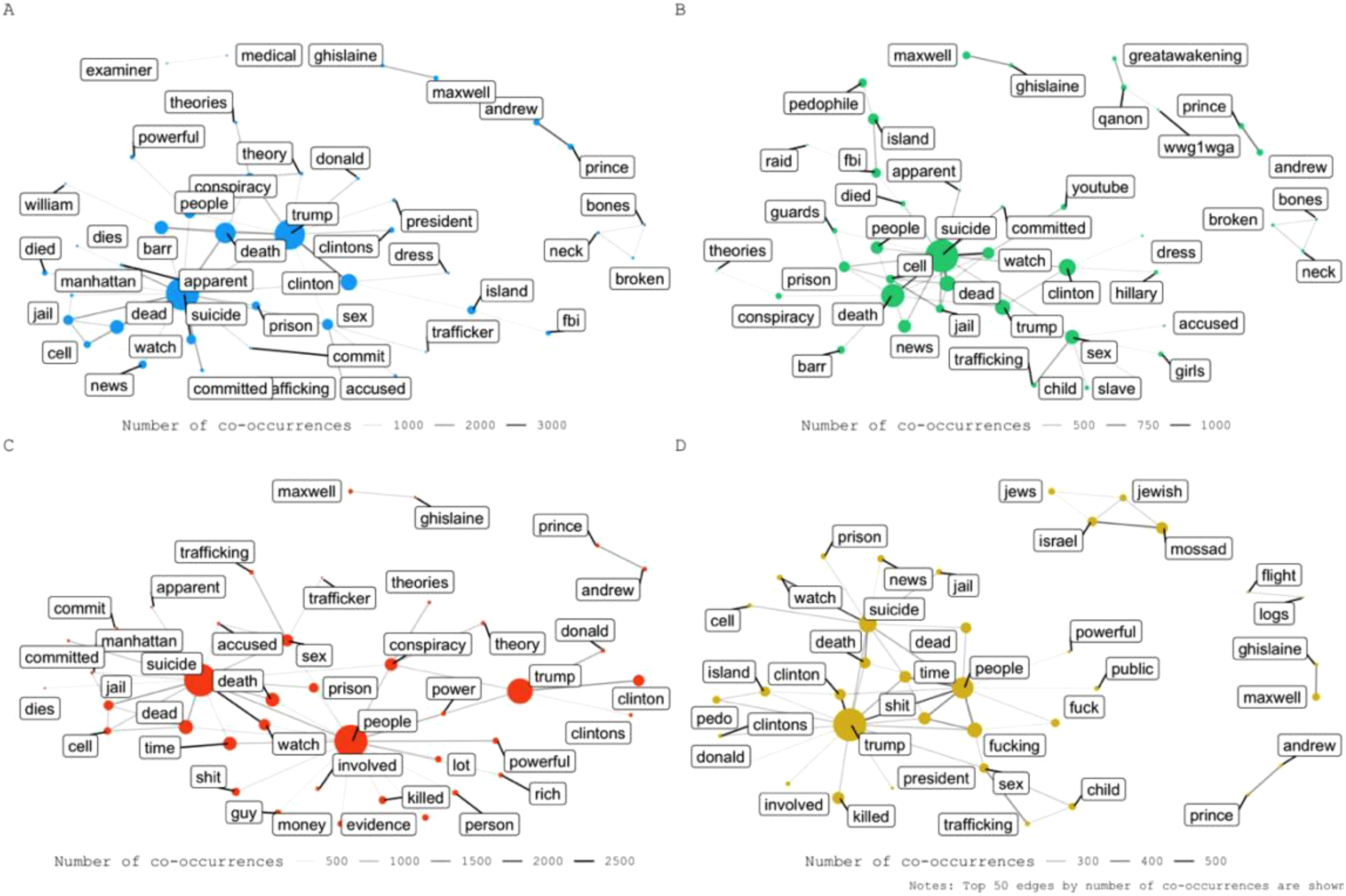
These co-occurrence graphs illuminate how users link Epstein's death to a multitude of different actors, often echoing the Pizzagate conspiracy theory. The foremost sub-cluster of co-occurring words revolves around the alleged connection to Donald Trump, Bill, and Hillary Clinton. Posts within this cluster suggest that Epstein was silenced by one (or both) of these politicians. The hashtags #trumpBodyCount and #clintonBodyCount (and their variations) gained traction shortly after news of Epstein's death broke, both on Twitter and Gab. Another sub-cluster of co-occurrences raises the involvement of one or multiple U.S. and international intelligence agencies in Epstein's death.
Most notably on 4chan, but also present on the other three platforms, were antisemitic conspiracy theories, accusing an alleged global Jewish conspiracy against the West of being responsible for Epstein's death. According to this theory, Epstein, who supposedly named prominent conspirators and unveiled the larger conspiracy, had to be silenced.
On Gab, a sub-cluster centered on the QAnon conspiracy theory was evident. QAnon serves as a successor to the Pizzagate conspiracy theory. Believers refer to posts by an eponymous “Q,” a self-proclaimed member of the U.S. intelligence community, who purports to disclose information about a clandestine plan to overthrow Donald Trump. According to the conspiracy theory, Epstein was murdered to prevent him from testifying against influential members of the conspiracy. Linked to the QAnon cluster were several references to a clandestine satanic cult, believed to be accountable for Epstein's death. In sum, the co-occurrence graphs vividly demonstrate the abundance and interconnectivity of the various conspiratorial interpretations of Epstein's death.
The manual coding of n = 300 posts revealed, that, overall, 34.00% of the posts contained an unwarranted conspiracy theory. The share of unwarranted conspiracy theories shifted slightly over time. Before the official announcement of Epstein’s death on August 10, 36.00% posts contained a reference to an unwarranted conspiracy theory, on that day itself, the amount was slightly higher (38.00%), and in the aftermath of the event, the amount decreased slightly (28.00%). Furthermore, 4Chan (56.00%) and Gab (42.67%) both contained more unwarranted conspiracy theories, than Twitter (22.67%) and Reddit (14.67%), pointing towards differences in the emergence of such content in alternative as compared to established social media spaces.
Users’ Reliance on Established and Alternative News Media
RQ 3 asked for users’ reliance on established versus alternative news media sources during the early emergence of conspiracy theories. To answer this question, we extracted all external URLs contained in the dataset. Overall, 40.99% post contain at least one URL. On Gab, (74.28%) and Twitter (44.71%) the share of URLs was higher, whereas posts on 4Chan (12.98%) and Reddit (31.24%) used URLs less frequently. This is mostly due to the structural differences between the platforms’ microblog-style (Twitter and Gab) and the forum-style (4Chan and Reddit): On discussion boards like Reddit, users mostly post comments in threads that is started by a user posting a link to an external piece of media. The commenting users rely less on external sources than the initiators of the thread. Twitter and Gab on the other hand are used by many users to specifically share links to other media outlets.
Of the 48,069 unique URLs that had been shared, almost three quarter (73.88%) were posted only once. Less than 0.1% of the URLs were shared more than 100 times. Analyzing the most frequently shared URLs per platform revealed that the most shared URLs led to established news media outlets reporting on Epstein’s death (4.41%, n = 13,162), although alternative news media outlets were also present (3.64%, n = 10,860). URLs linking to non-news outlets (e.g., blogs) or private social media channels were almost completely missing form the most shared URLs. The exception to this is 4Chan: While users on this platform did share some URLs linking to established news outlets (e.g., the first official news report confirming Epstein’s death published by the New York Times), other news outlets, alternative and established alike, are mostly missing from out sample. Most URLs contained links to leaked documents relevant to Epstein’s death, like his flight logs or court documents. This shows that 4Chan users rely less on external sources in their discussion of current events, which could be explained by the general culture of the platform, where opinions and statements are usually not backed by supporting sources but serve more like a prompt for more or less topical discussions.
Top Sources.
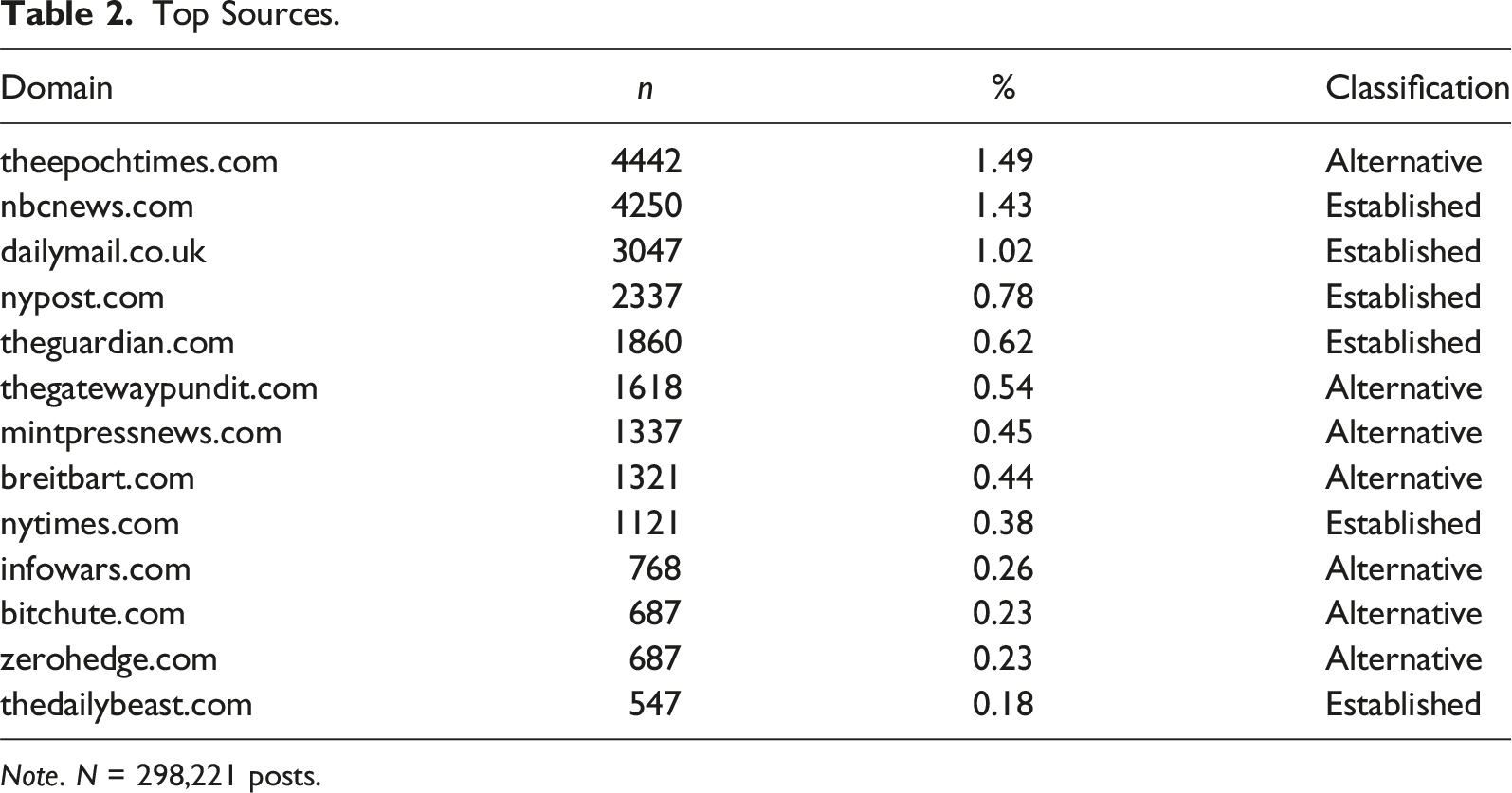
Note. N = 298,221 posts.
We then used this list of established media sources to build a corpus of posts by users who shared an established media source and those who shared an alternative media source to be able to examine platform differences. The posts were aggregated on the user level, combining all posts published by one user to form a single document. We then calculated the co-occurrence graphs for both corpora.
On Twitter and Reddit, most users shared established media sources (Twitter: 74.64%, Reddit: 88.59%), and only a small share of users (< 5%) shared both established and alternative media sources. On Gab on the other hand, users shared fewer established media sources (52.81%) than alternative media sources (71.77%) and almost a quarter shared both (24.58%). 4Chan users shared little from any news media source (with the exception of a New York Times article breaking the news of Epstein’s death), but mainly shared direct sources used to support the formation of conspirational narratives, like flight logs.
Analyzing the two resulting co-occurrence graphs reveals that users who did not share established media sources referenced to the unwarranted conspiracy theory, that Epstein was killed by a secret group of actors involved in a global human trafficking ring to hinder his testimony against them (see Figure 3, graph B, lower right corner). The co-occurrence graph of the post by those users who shared established media sources is more similar to the general co-occurrence graph calculated above, indicating that these sources are used by a multitude of users (see Figure 3, graph A). While the corpus used to build the co-occurrence graph of users sharing established media sources contains around three times the number of posts than the one of users sharing alternative media sources, it is much more complex and less monothematic. The mean number of connections between words is more than 10 times higher, and the graph also has a lower centrality than its counterpart, hinting at a thematically less centralized discussion, that is, a discussion that lacks a central narrative. Top 75 edges by number of co-occurrences. (A) Users posting established sources and (B) Users posting alternative sources.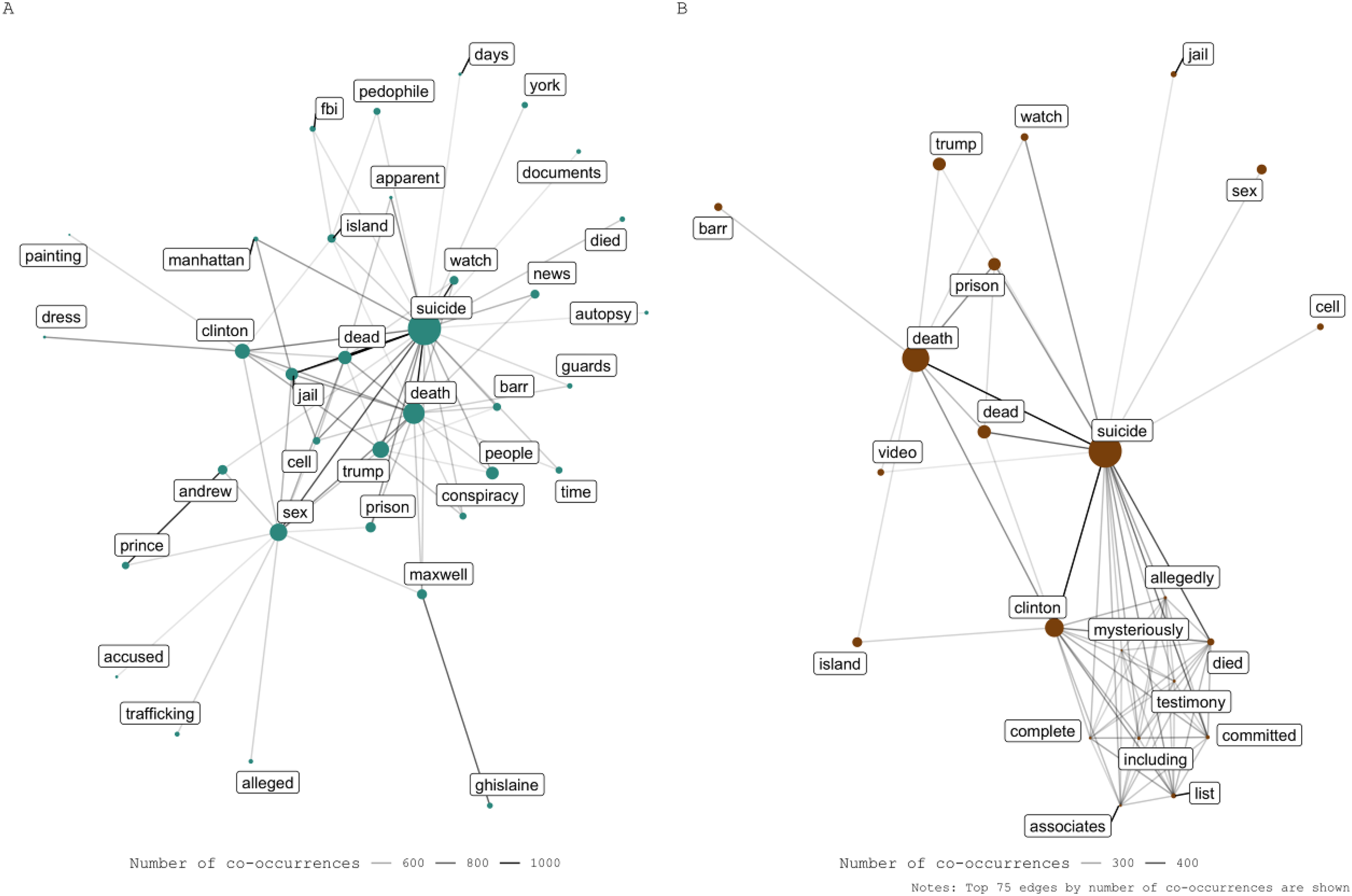
Answering RQ 3, users who shared established media sources tended to post like those who didn’t share these sources at all, yet they were less likely to reference one of the most prominent unwarranted conspiracy theories found in the data. Our data also confirms that users of alternative social media platforms tend to utilize more alternative news media outlets.
Discussion
Conspiracy theories are a persistent part of social media discourses and consuming them can have severe consequences. This study took a first step in examining the genesis and evolution of specific conspiracy theories across established and alternative social media platforms, while also considering the role of established and alternative news media. Using the death of Jeffrey Epstein as a case study, we employed a combination of (semi-) automated and manual content analyses of over eight million Epstein-related posts on four social media platforms with distinct levels of alternativeness (Twitter vs. Gab, Reddit vs. 4Chan).
Addressing RQ 1, we demonstrated that across all examined platforms, the dynamics of the discourse were similar, characterized by a sharp increase in content related to Epstein even before the first official announcement of the events by established news sources. None of the platforms exhibited significantly faster reactions to the event, although the debate extended for a longer duration on 4 Chan than on the other platforms. Overall, our findings align with the assumption that conspiracy theories flourish in times of uncertainty (van Prooijen & Jostmann, 2013) and serve as a form of collective sense making (Kou et al., 2017).
In response to RQ 2, we demonstrated that conspiracy theories emerged early and influenced the public discourse before established media sources had time to comment. Like Lego bricks, specific conspiracy theories in the aftermath of a pivotal event seemed to build upon existing conspiracy myths (e.g., antisemitism), already circulating theories (e.g., Pizzagate), and thrive on animosities (e.g., towards political opponents). This is in line with prior work on the merge of conspiracy theories (Bruns et al., 2020, p. 1) but also implies that, just as conspiracy mentality represents the foil on which distinct conspiracy beliefs flourish (Imhoff et al., 2022), these more general conspiracy myths and established conspiracy theories provide the lens through which pivotal events can be immediately interpreted in a conspiracy-theoretical manner. Most posts were critical of the official representation of events, and over a third of all posts spread unwarranted conspiracy theories. This indicates too that the speed of social media and the ready-to-build nature of conspiracy theories pose severe challenges to journalists that aim at providing an orienting function in times of uncertainty. At the same time, a substantial share of posts included healthy skepticism rather than unwarranted conspiracy theories underscoring the challenges moderators of digital discourses face particularly in the aftermath of pivotal events in preserving constructive critical discussion opportunities while simultaneously reducing the noxious effects of unwarranted conspiracy theories.
Conspiracy-theoretical interpretations were particularly prominent on alternative social media, with 4chan contributing heavily to the spread of antisemitic narratives, and Gab providing a home for QAnon-related discourses. Thus, our findings are consistent with prior research showing that alternative social media and particularly fringe communities like 4Chan provide a welcoming environment for the spread of toxic content (Finkelstein et al., 2020; Rieger et al., 2021; Zannettou et al., 2018), likely due to their self-positioning as safe havens for such statements and their corresponding loose moderation rules (Frischlich et al., 2022b).
RQ 3 addressed the situatedness of conspiracy theories’ emergence in the larger context of established and alternative news media sources. Links to established news sources were more frequent than those to alternative news sources across all platforms, consistent with prior research on links shared in conspiracy-theories-endorsing online communities (Schatto-Eckrodt et al., 2020). However, the most shared sources contained an equal amount of alternative and established media, in line with prior work showing the centrality of alternative news media for conspiracy-theories-endorsing online channels (Frischlich et al., 2020). Users who shared alternative (vs. established) news media were more likely to refer to unwarranted conspiracy theories, indicating that alternative news media might play a role in the genesis of conspiracy theories.
Limitations and Future Research Directions
The current study has some limitations that should be considered when evaluating the generalizability of our results. First, we present a comparative case study of a single event. Future research on other events needs to examine the stability of the observed dynamics to test the generalizability of our results. Although our comparison of established and alternative social media platforms provides a comprehensive overview of text-based platforms, future research entailing video- and image-based networks would enhance our understanding of cross-channel dynamics.
Second, to account for the sheer amount of data, we used a mixed design of (semi-)automated and manual content analysis. Many of the intricacies of conspiracy theory practices (e.g., the use of coded language) would benefit from a more extensive qualitative approach. Particularly, deeper analyses of different users’ contributions across platforms would provide deeper insights into cross-platform network dynamics. Finally, the evidence presented in this study cannot be used to draw assumptions about individual users’ beliefs or individual sharing motivations. Here, additional research using self-reports is needed.
We also did not analyze the content of the shared sources. Our distinction of established and alternative media sources, representing the distinction between orthodox and heterodox interpretations of events, does not consider the possibility of established news outlets spreading unwarranted conspiracy theories, or alternative news sources confirming orthodox views, albeit prior research indicates that alternative news does share conspiracy theories more often (Boberg et al., 2020). Future research might address this by specifically analyzing the posted URLs, which are shared in our repository on the Open Science Framework.
Conclusion
Despite these limitations, our study deepened our understanding of political communication dynamics across social media platforms with different types and levels of “alternativeness” and offered unique insights into the swift emergence and subsequent evolution of specific conspiracy theories in the aftermath of a significant event, namely, the death of Jeffrey Epstein. As dealing with uncertainty and how citizens react to it is a key issue of current political communication, this case study shows how alternative platforms and media outlets shape the public discourse on competing explanation for current events. By understanding conspiracy theories as purposeful communication about politics (McNair, 2011), our study can illustrate how uncertainty can be a driver of a turn towards conspirational explanations, which in turn may erode trust in societal institutions. Methodically, separating unwarranted conspiracy theories from warranted conspiracy theorizing and skepticism enables political communication researchers to study conspiracy theories not only as illegitimate forms of knowledge, but also as a natural first reaction to uncertain events. Finally, we showed how this emergence and evolution are situated in the larger news system, with both established and alternative news media sites being entangled with the discourse around pivotal events.
Footnotes
Authors Note
Twitter data was provided through the Twitter API. We acknowledge that this was provided to only selected researchers. However, we did not receive further support from Twitter nor did Twitter see or influence the results of our analysis prior to publication.
Acknowledgments
We used ChatGPT to check the manuscript for clarity and consistence using the following prompt “Imagine you are a language editor with expertise in communication science that provides critical but constructive feedback on an academic text. Please check the following section for clarity, consistency, grammar, and typos.” We want to express our gratitude to Jason Baumgartner that provided substantial parts of the data through the Pushshift API.
Declaration of Conflicting Interests
The author(s) declared no potential conflicts of interest with respect to the research, authorship, and/or publication of this article.
Funding
The author(s) disclosed receipt of the following financial support for the research, authorship, and/or publication of this article: This research was supported by the Digital Society research program funded by the Ministry of Culture and Science of the German State of North Rhine-Westphalia, Grant number 005-1709-001.
