




Abstract
In recent decades, the public sector has been looking for ways to accommodate increasingly critical citizens by striving towards a less bureaucratic and more efficient organization, as well as more direct forms of communication. Government institutions try to respond more quickly to citizens’ concerns and want to ensure that citizens can contact them more easily and find relevant and accurate information promptly. To achieve this, they often turn to technological aids. This article focuses on how municipalities analyze and follow up minor violations and street nuisances. We used semi-structured interviews with key informants from the relevant services of the municipality of Schaerbeek, a district of Brussels (Belgium), to examine how the technological innovations implemented within the municipality transform the relations between local authorities and their citizens, as well as the internal relations between the different municipal services. Although the respondents were unanimous about the added value of these technological solutions, our analysis shows four clearly recurrent issues : (1) the “functional reduction” associated with technological innovations leaves little room for the complex context of social nuisance; (2) government services are currently flooded by a “tsunami” of communication flows; (3) so-called “innovative” technological solutions often mimic old bureaucratic processes; (4) new communication tools are not equally integrated into all levels of local administration.
Keywords
Introduction
Citizens look at the traditional, bureaucratic, and centralized organization of government institutions with increasing frustration. Sensitive to this evolution, local authorities are looking for new ways to reconnect and engage with their residents. Capitalizing on the growing digital literacy of citizens, the development of information and communication technologies (ICTs), and the growth of e-government, electronic participation (e-participation) became an instrument used by local authorities around the world (Le Blanc, 2020). E-participation entails the use of ICTs to engage citizens in public service delivery and decision-making (Medaglia, 2012). Participation is a fundamental part of this construct and the desired goal, based on the idea that this contributes to inclusive societies, whereas e-participation can also play a more significant role in increasing government accountability, hence making government institutions more responsive to the needs of citizens (Le Blanc, 2020).
However, when exploring e-participation programs across Europe, a less optimistic picture emerges. In 255 investigated cases (Tambouris et al., 2015), the majority of these e-participation programs approached “participation” merely as a means of providing information (147) or as deliberation and consultation facilities (143) rather than as a tool for generating interactive debate. When citizens' input is indeed valued, there is a lurking danger of promoting the needs of the digitally literate have-nets (Scott, 2000) over the needs of the have-nots, citizens with no or limited access to the internet. Government institutions that act on partial information garnered from privileged social groups with a strong online voice run the risk of e-participation initiatives creating a new exclusionary medium that undermines its promise. In other words, e-participation can also stand in the way of an inclusive society, government accountability, and meeting citizens' needs.
This paper aims to explore how e-participation innovations transform the relations of local authorities with citizens, and the internal relations between the different municipal services. More concretely, it deals with interactions that arise after reporting and while following up on incidents such as minor offenses and nuisances, issues that mainly fall within the jurisdiction of municipalities. The attitudes of municipality workers and communication flows between the municipal authorities and citizens are the primary focus of this study, which identifies and analyzes the challenges and limitations of e-participation, according to the employees of the municipal services concerned.
The analysis draws on data collected from in-depth interviews with interlocutors at the municipality of Schaerbeek. Schaerbeek is a municipality with one of the largest and most heterogeneous populations in the Brussels-Capital Region. The FixMyStreet (FMS) e-participation platform in Brussels was used as a point of departure during the interviews. This “mobile city app” (Walravens, 2015) was developed by MySociety, originally a citizen collective from the UK (MySociety, 2021b), and rolled out by the Brussels-Capital Region in 2013 to allow citizens to report incidents of urban disorder, minor offenses, and nuisance in the streets. Since its introduction, the tool has seen a strong rise in popularity. In the first year, 6012 incidents were reported by citizens, whereas, in 2023, as many as 53,075 incidents were reported according to the open data (see Figure 1). Furthermore, the open data contains only 51% of all reported incidents, since not all incidents are retained (Steenhout & Volinz, 2022). Brussels Mobility (2022) states that incidents might be refused when they do not concern a problem that needs to be verified, have already been reported, fall outside the scope of FMS, or contain abusive or illegal content. Number of incidents based on the open data offered by the FMS API.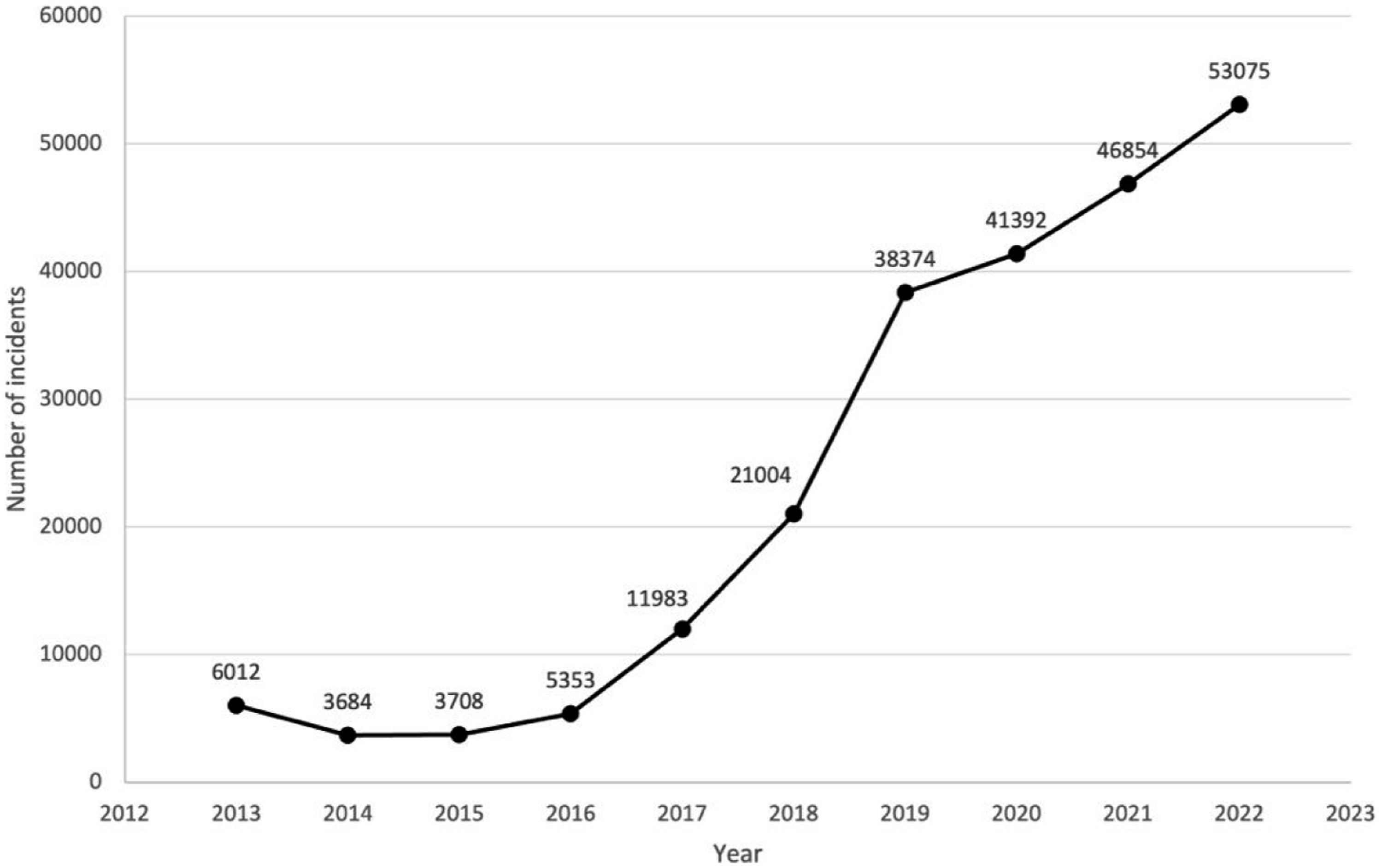
Reports of citizens or city services are passed on to the relevant authorities (BeWapp, 2021). The fact that the app’s purpose was to bundle incidents of urban disorder, minor offenses, and nuisances in the street and pass them on to the concerned authorities, provides a valuable case when studying the dynamics between the services involved in the analysis and follow-up of these types of incidents. Moreover, the process flow—from the actual notification by a citizen to the eventual follow-up of the incident by a municipal service—can be followed in near real-time.
When it comes to the area of law enforcement that deals with nuisance and prevention at the municipal level, Belgium has an entangled, complex web of authorities with divergent responsibilities (for a detailed overview, see Mincke et al., 2009). As a result, local government organizations find themselves in a complicated position where they must consider a large number of stakeholders who each have their own roles and limitations: the local and federal police, various regional authorities, local prevention departments, road works services, parks and green services, and others (Volinz et al., 2021). The different authorities may have a clear view of who is responsible for what, yet this is often not the case for citizens. This complex situation becomes apparent, for example, when citizens want to file an illegal dumping complaint. If the waste is found on a regional road, it falls under the responsibility of the Brussels-Capital Region; otherwise it is a municipal matter. To file a complaint without the assistance of FMS, citizens should already be aware of the distinction between regional and municipal responsibilities to know which service to address. Each government service thus contributes to a landscape of fragmented information, characterized by specific administrative protocols and a specific institutional configuration, partly generated by their own technological tools (Dunleavy et al., 2006).
Literature Review
Over the last decade, there has been a notable increase in digital experiments in cities and municipalities that aim to increase citizen participation. One of the main concerns is the deepening gap between citizens and the government (Metallo et al., 2020). Western European society suffers from increasing public frustration toward political and governmental institutions (Geissel, 2013). Bureaucratic and centralized government institutions, in particular, are evaluated more negatively by citizens (Norris, 2002). Citizens expect to be able to share their questions and frustrations quickly and directly with the appropriate government institution via digital interfaces (Volinz et al., 2021). This is particularly visible in the cultivating of interest groups, neighborhood work, and internet activism (Newton, 2012). If no successful digital solution is offered by the government, neighborhood prevention networks find their way to existing commercial applications, such as Whatsapp, through which vigilant citizens and victims seek to partake in crime prevention and control (Mols & Pridmore, 2021). WhatsApp neighborhood crime prevention groups are quite popular in the Netherlands: neighbors exchange warnings and information about incidents, and (allegedly) suspicious situations in their area. These citizens, however, often “operate on intuition and instinct, lack professional training, and can further be motivated by excitement” (Mols & Pridmore, 2021, p. 284).
Politicians worldwide seem to adjust their priorities to meet citizens’ demands for a higher degree of participation (Inglehart & Welzel, 2005). Since the 1980s, this has been translated into attempts by government agencies to actively respond to citizens’ criticism through so-called New Public Management (NPM). The motivation behind NPM is to modernize bureaucratic processes and make the public sector more efficient (Hood, 1991). In addition, NPM pays more attention to “citizenship” and assigns a central role to e-participation and e-governance (Rose et al., 2015).
The innovations behind NPM are usually “technological innovations,” and the function of e-government is to restructure the organization of public services to promote communication among different entities, thus simplifying processes (Santos et al., 2013). For quite some time, humans have commonly utilized technological approaches as a means to tackle social, political, and cultural obstacles (Johnston, 2018). However, this approach has become particularly prominent in modern culture. The rapid pace of innovation has fostered a widespread recognition of the possibilities offered by technologies to enhance our modern lives and society. We can observe the echoes of this mindset in the portrayal of the future in popular media and the increasing tendency to view and tackle contemporary issues through a narrow technological lens. For example, the “smart city” idea promotes the improvement of the urban context through an intensive and innovative use of ICT, and strives to do so with fewer resources. A recent development within NPM is the mobile city apps (MCAs) for following up nuisances and minor offenses. Examples of minor offenses are punishable offenses on the lower spectrum of the criminal scale, like illegal dumping and graffiti, whereas nuisances are not necessarily criminal, but might create disorder or tension in a neighborhood in a manner that may require municipal intervention. Loitering youngsters can, for example, create friction in a neighborhood. MCAs enable residents to report incidents of disorder in the urban environment, such as potholes or faulty street lighting, but are also used to enforce and prevent nuisances and minor offenses. They have the potential to provide a central role for citizens in a process of democratic innovation that focuses on sensitizing, empowering, and informing citizens while safeguarding a link with existing municipality services (Newton, 2012). Such a link should provide transparency and accountability for municipal interventions.
To date, there is no solid proof that MCAs deliver on their promises. Gurstein (2011) argues that these initiatives only tend to empower the already empowered. Lopes et al. (2021, p. 3) state that shifting from control to non-state actors can be considered a “fundamental shift, transforming the very nature of governance.” Neighborhood networks, often building on the efforts of the already privileged, can induce a recalibration of conduct that deserves policing and control while creating a hostile and exclusionary space against “undesirables.” Although these citizen-led crime prevention networks might provide valuable neighborhood information to municipal prevention services and police, one of the challenges is to integrate these initiatives within a municipality’s existing prevention and policing structures to guarantee the rights and needs of most citizens.
New developments bring new challenges. ICT generates changes in government structures and in the underlying relationships within these structures. Within government institutions, for example, there is an increase in communication services in which specialized employees monitor online communication and engage in direct dialogue with citizens. There is a growing awareness among municipal policymakers and stakeholders of the mobilizing power of social networks. However, local authorities are also increasingly bound by the limited technological tools that are available to them. These technological tools both standardize and classify, since they require someone to determine how to convert complex everyday work processes into technical codes (Busch, 2000). By standardizing procedures, these tools also impose a standardized approach on anyone who uses them, potentially limiting individual creativity and flexibility. However, once embedded in everyday working procedures, selected standards and classifications become less visible, while “conflict and multiplicity are often buried beneath layers of obscure representation” (Bowker & Star, 2000, p. 47). The result is a kind of “blindness” that springs from basing the actual reality on the descriptions of a system. Luhmann (2012) summarizes this as a “marked space” that manifests itself based on previous selection processes, while the “unmarked space” becomes elusive and may allow exclusionary processes to go unnoticed. Standards are embedded in codes. These codes produce a system that is sensitive to specific events, which then becomes indifferent to everything else. It reduces a complex situation to a small window of relevance. One example is the FixMyStreet app (FMS). FMS was initially developed to tackle physical defects in street infrastructure (potholes, broken sidewalks, blocked sewers, or faulty street lights) by allowing residents to report such incidents to their local authorities (MySociety, 2021b). Over the years, the extension of the marked space manifested itself as a growing number of potential incidents (codes) being added to the program over time, to enlarge the visibility of incidents for both municipality services and citizens. When not carefully considered, however, these additional codes risk prioritizing the concerns of particular social groups at the expense of others. Indeed, in some regions, such applications are now used for more socially oriented problems and also support codes for reporting anti-social behavior on trains and busses, or for reporting empty homes (MySociety, 2021a; Nesta, 2021).
There is clearly an interdependency between technological tools and the social context in which they are embedded. Barry (2001) argues that technology plays a central role in reconfiguring the relationships between the services involved and, in this case, between government institutions and citizens. Moreover, this role is not limited to one particular government institution. Lanzarra (2014, p. 10) argues that technological tools “spread across political, functional and geographical spaces by re-scaling traditional hierarchies and connecting single and self-contained administrative agencies into multiple networks.” The nature of these institutions and the network in which they are embedded are changing drastically but steadily, as they become increasingly intertwined in various transversal partnerships.
New organizational forms are gradually emerging. While Bryson et al. (2014) already mentioned a real paradigm shift from a traditional bureaucratic administration to an innovative NPM, Klijn and Koppenjan (2000) argue that “collaborative modes of governance” is not always obvious for administrative services and may encounter some resistance. For example, citizen participation can also be regarded as an attack on one's own political power. If we extend this to municipal services, it is not inconceivable that municipal workers view citizen participation as an assault on their work autonomy. It is important to note, therefore, that participation exists in many forms. Arnstein's ladder of citizen participation offers a framework that captures the varying degrees of citizen participation (Arnstein, 1969). At the bottom end, we find “non-participation,” which aims to “cure” and “educate” citizens based on the idea that whatever the governmental institution proposes is in the citizens’ best interest and should therefore be supported. In the middle, we find what Arnstein describes as ‘tokenism,’ a phase composed of three elements: “consultation,” “placation,” and “information.” “Citizen power,” by contrast, requires a partnership between citizens and governmental institutions, as well as the delegation of power. This is the top-end of citizen participation, in which citizens handle the job of planning, policy-making, and program management. This is, for example, the case for neighborhood corporations that function without intermediaries.
Citizen participation also presupposes committed citizens, which is not necessarily the case. There are, however, strong indications that participation is greater among citizens who trust government services (Scholz et al., 2017). Governments are also increasingly confronted with smaller local protests, which are gaining importance because of the internet. The attention which safety issues attract online, however, does not necessarily reflect their importance within the general population. The growth of online petitions and forms of pressure is exemplary in this respect (Dalton, 2020). Yet due to the increase in scale and visibility, government agencies can no longer ignore this evolution.
In this article, Luhmann's (2012) social systems approach is used to explore the changes of rules and procedures within a traditional bureaucratic institutional context through the introduction of technology. This involves paying particular attention to what Lanzara (2014), inspired by Deleuze & Guattari (1980), calls “assemblages,” which result “from the encounter and multiple mediation” between different nodes, such as municipal applications and existing services within the municipalities (institutional systems). Municipal services are heterogeneous components with their own codes and internal logic (Luhmann, 2012). From this perspective, these assemblages are not formed by hybrid systems but by operationally closed systems with an open interactional character. In other words, they operate according to their own rules and procedures, and municipal services cannot simply be directed from outside. Institutional systems retain their specificity but interact with other systems that may influence or guide them. In this approach, technology is not merely an instrument for performing tasks, but becomes a “formative” element of the cognitive and institutional context within which tasks and routines are executed and acquire meaning (Ciborra & Lanzara, 2009). Therefore, the question of what technology does to institutional relationships and the normative frameworks is central to this research.
Methodology
Research Design
We used a multi-source generic qualitative design (Caelli et al., 2003) to collect data on how relations of local authorities with citizens are transformed and how internal relations between municipal services have been changed by technological innovations, such as FMS. This generic approach includes an inductive, data-driven process. We collected data via semi-structured interviews with key stakeholders who use FMS within the municipality of Schaerbeek.
Participants and Recruitment
The Social Sciences' Ethics Committee of the Vrije Universiteit Brussel (ECHW_239) granted ethical approval for this study. The data was collected through 7 in-depth, semi-structured online interviews with key informants tasked with prevention and enforcement in the municipality of Schaerbeek. As municipal workers, these key informants also use FMS and other tools. They deploy their employees and execute policy based on the data provided by these tools. Employees of the following services were interviewed: • The Territorial and Thematic Support Service (TTS, n = 2): this service aims to develop an analysis with all actors involved and to develop a common vision regarding situations and issues that cause insecurity. In addition, it formulates positive responses to these situations and problems, and implements this advice in the field. The service is responsible for supporting the Urban Prevention Program and works with local actors in the field of prevention (preventing theft, radicalization, or drug addiction, controlling prostitution, managing neighborhood problems, and involving residents). • Community Guards (CG, n = 2): this service is responsible for public security issues that do not involve the police. They form a link between the municipality and the population and have the task of signaling problems to the relevant municipal services or to the police. • The Brussels Regional Informatics Center (BRIC, n = 1): this service is responsible for developing and bundling high-tech infrastructures, ICT platforms and systems, as well as data handling within the Brussels Capital Region. This service was also responsible for rolling out the FMS app. • Technical Road Service (TRS, n = 2): this service is responsible for the maintenance of municipal and regional roads on the territory of Schaerbeek.
To recruit participants, we asked the municipality of Schaerbeek for the contact details of employees who worked directly with FMS. Participants were selected and informed based on an email list provided by the municipality of Schaerbeek. The interviews took place during working hours. This implies that the employer had to grant permission for the employees’ participation. At the start of the data collection, participants were asked to read and sign an informed consent form, indicating their voluntary participation and agreeing to the audio recording of the data. In addition, participants were informed about the goal of the study, the potential effects, the confidential nature of their answers, and the right to withdraw at any moment. Names in this article are fictitious; jobs do not necessarily match the exact job profile of the interviewee. Neither the content of the interviews nor the names of the interviewees were shared with the municipality.
Data Collection
The interviews took place between January 2020 and March 2021. Although we originally planned face-to-face interviews, the social restrictions due to the COVID-19 pandemic forced us to switch to online video interviews or interviews by email and telephone. The video interviews lasted from 45 to 90 minutes. Interviews by email and telephone were deliberately kept short (15 questions max.) because respondents could be disturbed more easily, which would increase the risk of them dropping out. Interviews were conducted by the first and second authors of this article, either in French or Dutch, depending on the interviewees’ native language. All quotes used in this text were translated into English to increase readability.
Sampling
Purposive sampling was used to select information-rich cases (Marshall, 1996). The sample size of 7 interviewees was deliberately small to allow “a deep case-oriented analysis” (Patton, 1990, p. 169), but large enough to guarantee a “new and richly textured understanding” (Sandelowski, 1995, p. 163) of the context in which the respondents operate.
Method of Analysis
The video and telephone interviews were transcribed verbatim and provided with thick descriptions in NVivo. The emails exchanged were also added to Nvivo. Memos, including emerging reflections, were written down during analysis to enhance data exploration. NVivo was used to further organize and code the data from the interviews using a generic inductive approach. During thematic coding, the material was sorted according to the effects on the work process. Multiple consecutive thematic maps were constructed during the data analysis, as coding, identification, and redefinition of the themes were conducted in a recursive, non-linear manner. Once the relationships between codes and themes were clear, and no additional relevant information could be identified from the data, no additional interviews were conducted for this analysis.
By targeting different services (data triangulation), using different data collection methods (methodological triangulation), and conducting the interviews with at least two researchers (investigator triangulation), methodological quality was improved.
Results
Although all the key informants were familiar with FMS and were unanimously positive about its participatory element, the application was not used as intensively in all municipal departments. Four major themes were identified as obstructing the tool’s integration within the different services: (1) a “functional reduction,” associated with technological innovations, leaves little room for the complex context of social nuisance, (2) the “tsunami” of communication flows that employees have to deal with, (3) the fact that technological solutions often mimic bureaucratic processes, and (4) the fact that new communication tools are not equally integrated into all levels of local administration. Each factor is summarized below and then framed theoretically. Other tools, such as phone and email, were often used to follow up on minor offenses and nuisances. If this was the case, they were included in the interview.
Limitations of Technological Solutions to Social Problems
The limited categories and handling modes within FMS were mentioned in all the interviews.
“The problems we deal with are loitering youngsters, noise complaints, speeding in the streets. No point turning to FMS because there's no code for those things” (Josh, CG)
At present, the incidents can be grouped under eight main categories (see Figure 2), which may entail the loss of critical information that does not fall into the chosen category. However, the categories are subject to change. The fact they are continuously updated was also clearly stated by Tom (BRIC):
“Since the implementation of FixMyStreet in 2013, more and more categories have been added. This can be done at the request of the relevant services, if necessary. However, this makes it difficult to compare results over the years.”
Main categories within FMS.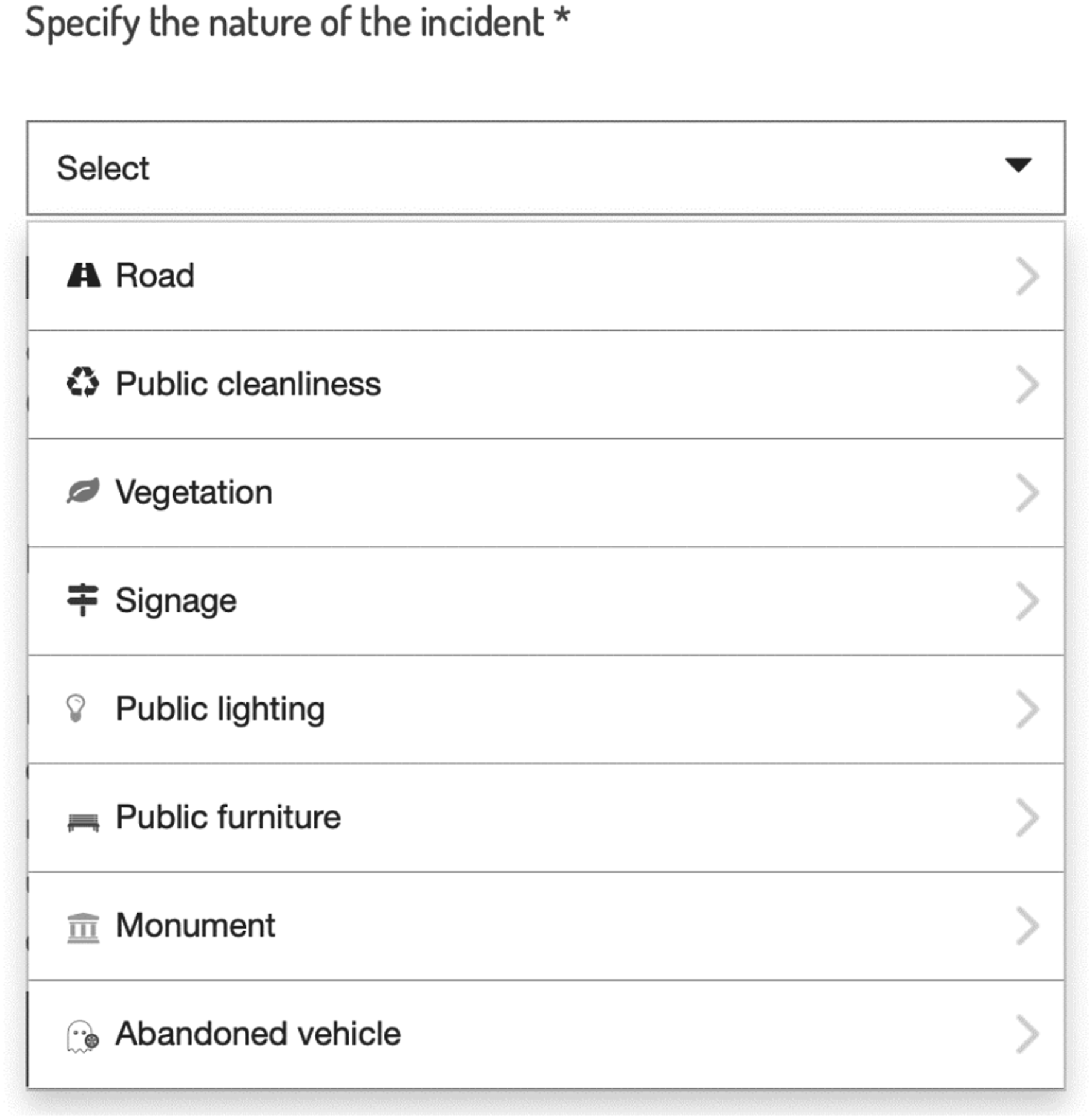
According to the key informants, citizens do not seem to confine themselves to the available categories but show creative ways of reporting social issues—which require a more prevention-oriented approach—under an umbrella category that can be solved with a fast “technical” solution. Consequently, prevention services may not be aware of the social context, which then eliminates the possibility for preventive and proactive social interventions. Nuisance caused by drug users can, for example, be reported as a mere problem of “public cleanliness,” since syringes are found in the streets as a result of their drug use. A homelessness problem may be reduced to a littering problem because humans leave traces of their presence. Ultimately, only one specific service is assigned to each reported issue and this service will also ensure the manner in which it is followed up. The incidents in our examples above would be routed to one of several Brussels cleaning services: the public cleaning service of the City of Brussels (PCS), the Regional Cleaning Agency (RCA), the Green Spaces Unit (GSU), Brussels Environment (BE), Brussels Intermunicipal Transport Company (STIB, or incidents in metro stations), or SNCB (for incidents in train stations). 1 Due to the coding that strips away any further context, the focus in following up the incident risks to be purely on littering, not on drug prevention or homelessness.
In FMS, there is no procedure available to engage other municipal services in cases where further (social) intervention is required. Sofie, one of our respondents within TTS, confirmed that the application leaves little room to address underlying social issues: “FMS expects answers with a deadline, a clear traceable calendar, where you can follow the progress, … Our work, however, often results in a long process. The response delays are complex and unpredictable, because behind it all is an entire socio-economic context that needs to be taken into account… Our results don't really fit in this type of application. A mediator is often required, someone who can explain the work in detail and contextualize the complexity involved and why it takes so much time to reach results.”
The solutions that are possible within the FMS platform are limited to solutions that fall within the scope of a more technical and prompt follow-up by the municipal services dealing with infrastructure, road maintenance, and public cleanliness, as well as their regional partners. “Fixing the streets” entails more than this, however. Structural initiatives to prevent minor offenses (e.g., due to drug use or homelessness), cannot be formulated and implemented within the limited time frame and scope of the intervention prompted by the FMS application. Furthermore, the possibility of including a “mediator” to communicate with citizens, as proposed by Sofie (TTS), goes against the FMS aim of allowing quick and unmediated communication between citizens and municipal or regional services.
Technological solutions always introduce a “functional reduction” (Luhmann, 2012): activities, tasks, or operations that are the subject of a technological settlement are standardized and streamlined to a certain extent, in order to allow a directed intervention. The present case introduces fixed yet limiting categories by assigning only one service to solve the incidents by means of a rather technical intervention. This allows the citizen reporting the incident to receive immediate feedback within the application. However, it might not always be the type of “fix” the citizen had envisioned. Technological or more broadly, technical solutions tend to be “outcome oriented” (Castoriadis, 1987). Although the full complexity of an incident is also lost in written reports, introducing technological tools causes a further functional reduction by only capturing what the underlying code allows. In this respect, Lessig (2008) unambiguously coined the phrase “code is law,” according to which organizations embed code procedures in such a way that both the application and the organization can deal with them. However, complex social issues risk going unnoticed due to this simplification of the social world.
Social problems invariably require a form of “objectification,” to prevent individual grievances from being projected onto the whole neighborhood. However, this cannot be assessed based on a notification within a mobile city application such as FMS. As Marilène (TTS) reported: “In the end, these (notifications) are not representative of the majority that lives in the same street. So, it's kind of hard to assess the importance and impact of a specific incident.”
Municipal staff has to ensure that public spaces remain open to all citizens and do not become exclusionary spaces for upper or middle-class residents. Although policymakers often view citizens as benevolent and active citizens as having no hidden agenda, Dorn et al. (1992) warn that informants can also have bad intentions and may be after personal gain. Marilène mentioned: “In terms of heterogeneity, animation, public space, there’s many things we can do to make spaces more appealing and more diverse in terms of the public, etc., and not merely dedicated to a specific audience.”
Marilène indirectly touched on the potential underlying motivation of citizens who report minor violations. When MCAs become a platform for the already empowered, the applications can transform the social fabric within a community by paying disproportionate attention to privileged citizens who accuse individuals or communities of “anti-social behavior,” an umbrella term often used to marginalize or discriminate against minorities and young people (Millie, 2007). The idea that the interests of the heterogeneous population—the so-called “public good”—prevail over those of the individual was clearly present among the respondents. Marilène continued: “Often, it's just one person complaining about a situation. And so our role is to visit the location and try to objectify the situation. […] We try to judge whether a complaint is justified or not.”
The key informants reported that partnerships were set up outside of FMS or other tools. In such cases, communication took place through various channels (telephone, email, meetings, etc.) and the resulting information was fragmentarily stored within each service, often on separate, non-compatible and, at times, self-developed platforms.
“Tsunami” of Communication Flows
The respondents reported that citizens signaled issues of a more technical nature, which could be solved rather immediately by a technical service, as well as social problems that required a more preventive approach through various channels provided by the municipal authorities. For example, both TRS respondents reported that FMS is an extension of the phone “hotline” that preceded it, and which is still used intensively. In contrast to the MCA, which allows users to send images and indicate locations on a map (with the possibility of text descriptions), the phone hotline requires more time for each report and, therefore, more effort is needed to describe the problem. Moreover, citizens who report issues via the hotline receive no further feedback.
An additional disadvantage of having multiple channels to report incidents is that municipal services may receive duplicate notifications for the same incident. This can cause critical incidents to be buried under notifications of less urgent incidents, making it difficult to take effective and immediate action. To address this issue, FMS has been developed in such a way that citizens can immediately see which incidents have already been reported in their neighborhood when entering the location, thus preventing duplicate reports. However, despite this solution, the multiplicity of communication platforms still regularly leads to redundant communication flows. These demand time from the municipal services involved, highlighting the need for further streamlining of reporting systems. Ultimately, a more unified reporting system with better feedback to citizens could help to improve the effectiveness of incident reporting and response. Bertrand (TRS) confirmed: “As for the proportion of incidents that are reported by email, phone, letter, or FixMyStreet: I simply don't know. […] What we’d really like, me and other colleagues, is for FixMyStreet to bundle all these incidents in the future. But as I said earlier, it all comes down to additional work. I'm not exaggerating when I tell you that we simply don’t have the time to enter every incident that we receive in the FixMyStreet platform.”
The previous quote confirms the wide range of possibilities for contacting the services involved, as well as the lack of centralization when it comes to reporting incidents. In addition, other, independent tools are also used to bundle incident reports. The GSU, for example, has opted for a completely different system for internal use, despite the fact that notifications for this service are also possible within FMS. While there are agreements regarding the follow-up of these types of incidents, the multitude of distinct and incompatible systems introduces an additional complexity when analyzing incidents within the municipality. Bertrand stated: “Green Spaces told us 'When you send us an incident report, 24 hours later you can just close that incident. It will be solved by then.' But they’ll never actually confirm that something has been solved or not.”
Although it seems inconceivable that all incidents can be closed within 24 hours, citizens are invariably informed about the closure of the incident report—albeit not by the GSU, but by a third party due to a settlement protocol. In FMS, however, it is now impossible to determine how long the intervention actually lasted and whether it took place at all. Moreover, this method creates a false sense of transparency. By only looking at the FMS platform, one could wrongly assume that the GSU operates quickly and efficiently, yet the open data that can be consulted via FMS does not present citizens with an accurate picture.
Sometimes citizens also rely on politicians or other local stakeholders to report incidents, who then interpellate the service in charge. Several services mentioned that this type of incident reports is often prioritized, even if there are other, more pressing issues on the agenda: “If the mayor calls us and tells us 'do this right away', we just do it right away… We drop everything else, even when – in our opinion – there’s something more urgent to be taken care off. It's normal, it's just how it is. But as I said, you’ve got to remain diplomatic, even though it’s not always easy.” (Bertrand, TRS)
According to Bruggeman (2008), networks and partnerships are on the rise, though, within the Belgian context, mayors are still largely in control. As a result, there is no real network formation, precisely because of the presence of hierarchical relationships. A mayor is simultaneously a “coordinator, inspirator, stimulator” (Bauwens et al., 2011, p. 48) of the local security policy. Within their mission, they must simultaneously satisfy the citizen, accommodate residents as well as (local) security actors, while also going along within the new assemblages (see above). However, immediately visible interventions risk gaining the upper hand over a more sustainable approach to the problem. Sofie (TTS) confirmed:
“There’s also the political pressure, especially for administrative services, to come up with results and concrete solutions that can be communicated directly to the citizens.”
Public services often operate within a web of complex political intrigue and power games. As Bertrand reported above, this may require public servants to take on the role of diplomats. Although four respondents reported something similar, their cautious wording was noteworthy. For example, they immediately alluded to the fact that the mayor's actions are also prompted by the mayor’s accountability to the Brussels Capital Region. During the interviews, the presence of this hierarchical political organization seemed to permeate the conversations, even though no politician was present. This suggests that hierarchical relationships, irrespective of any underlying motivation, remain particularly present within the municipality.
Social media channels also appeared to play an important role. Incidents are reported via Facebook and Twitter, for example. Milène (TTS) reported:
“There's also the world of social networks, where a lot of things happen. And I think that, from our side, we should also invest in checking who says what on these networks when it comes to neighborhood matters. There’s someone in charge, someone who manages a Facebook account for the municipality and who's responsible for answering questions formulated by citizens. So, this is really a new function, that needs to align directly with the expectations of both citizens and the municipality, and requires moving along with a rhythm that's a bit faster than the regular rhythm of public services.”
Milène alluded to the fact that work processes undergo drastic changes. Even though the roll-out of NPM is not thoughtless and incremental, citizens are finding new forms and channels of communication. These, in turn, lead to new organizational forms of collaboration, and present a new arsenal of technical and administrative potential to citizens which was previously unthinkable. On the other hand, it is not always trivial to follow all these distinct communication flows within the municipality. However, the importance of such channels was not underestimated. Indeed, the municipality has appointed someone to monitor communication and respond on social media. This is remarkable since FMS has an application programming interface (API) that provides an interface between social media channels (and other applications) and FMS. Therefore, municipality employees could directly forward the incident reports to FMS with little effort, after which follow-up is ensured, and the follow-up of the incident can be traced by citizens as well.
Mimicking Existing Bureaucratic Work Protocols
The power of technological innovation does not lie in translating existing bureaucratic processes into an application. Schon (1970) already warned that much of the “old world” seeps into the new during innovation processes, to the extent that, paradoxically, innovation becomes a means of reproducing the status quo. For example, the GSU, the TRS, the CG, and the TTS indicated that they each had their own systems for registering incident reports. As a result, they perpetuate old working methods, leaving little room for innovative work processes. Although the services and individual employees are increasingly “connected,” the expected network thinking is not yet fully implemented in the work procedures. Mylene reported: “I think there's a process of reflection going on, at least within the administration services internally, about how we’re evolving. There's more flexibility in our answers and interactions with citizens. I'm not sure this is already sufficiently visible in the formal procedures, but the reflection and flexibility are already present in the daily operations and will be gradually implemented.”
The introduction of technological tools requires a new kind of public service. It involves changing work processes, job descriptions, and competencies of public service providers (Sandor, 2012). All respondents also indicated that they were aware of this, although it was not always reflected when they described their work procedures. All too often, the existence of rigid structures stands in the way of the much-needed flexibility to tackle the problems of today's disruptive society in a targeted manner. Mylène explained:
“I do see a difficulty here, in case we have to develop action plans. When we try to move beyond the well-trodden paths and propose something that's a bit more innovative regarding the way we handle incidents, it's always hard to mobilize other services since, in general, they already have a delineated action plan. So, to add a new project, or implement another way of working in a specific neighborhood that isn’t on the agenda of that service, can be quite challenging.”
The current situation suggests that citizens have become less tolerant of prolonged bureaucratic decision-making, which demands a change in organizational structure. A vertical, hierarchical approach offers limited flexibility compared to a horizontal or network-based model. To make this shift, it is essential to delegate tasks to specialized services that enjoy a sufficient level of trust.
New Communication Tools are not Equally Integrated into all Levels of Local Administration
Although there are advantages to introducing new technologies into the work of local authorities, they also create (new) problems. Numerous examples are found in the literature detailing the arduous process of any public sector reform (Hanseth & Lyytinen, 2010; Kotter, 1990; Ogland, 2016). Reforms are delayed or even blocked by the numerous, and often influential, parties that have to be mediated. Clear incentives are needed for all the actors involved to embrace these innovations. Hanseth and Ciborra (2007) found that imposing new working methods through a top-down approach is often a recipe for failure. Looking at the support base for technological innovations, Brunsson (1989) identifies two constitutive elements within public services that must be met: (1) the government employees who use the innovation must be convinced that the tool simplifies their work processes and that it meets a specific need in the field, (2) the innovation must offer motivation and rhetoric to substantiate and defend its methods to the outside world. Mark (CG) explained: “It's the Technical Road Service that told us to use this app (FMS). The Brussels Capital Region developed an application. They wanted us to use it. Before, we just sent our incident reports directly to the Technical Road Service.”
The above quote illustrates that the respondent felt that FMS had been imposed on him. However, he could not see the added value within his own work processes. As a result, he did not feel the desire to use the application beyond what is required. He went on to say: “I can imagine you can do a lot with this tool (FMS), but I don't know it and it's not my job to know it either.”
Even though a new tool can improve public services as a whole, the danger exists that this improvement will be perceived as too limited and specific by a number of people from other echelons (Brunsson, 1989). This reinforces the idea that what really happens “in the field” is insufficiently taken into account. Moreover, the fact that reforming government services is already a complex and challenging matter, increases the chances of a true innovation being blocked (Kotter, 1990). The services that have to use the application are not the only party involved in these negotiations; politicians also notice how their policy and power are impacted by this type of innovation. After all, the move toward NPM offers more transparency regarding policy and can therefore lead to concrete, measurable results. Accountability thus becomes very tangible. Moreover, NPM is increasing the pressure on hierarchical structures, while network forms are gaining importance (Kallinikos, 2006; Sassen, 2006). Nevertheless, these transformations are long-term processes (Ogland, 2016).
It must be clear to all parties that the application improves the work processes within the services concerned. The innovation should also take into account what workers experience in practice. At the same time, it should be obvious for management circles that these tools are a means to arrive at new ideas, provide motivation to support policy and decisions, and account for them to third parties. As already mentioned above, however, not all services were convinced of the importance of an umbrella application for bundling incidents. Yvan (TRS) reported: “The Green Spaces cleaning service doesn't want to work with FixMyStreet because they have their own tool, which is more performant. They've been using that for a long time and are even developing a new app, so they're very strong at this. They also have lots of agents on the ground who oversee things quickly.”
Yvan continued: “Illegal garbage dumping and that sort of thing… is for the cleaning service. And we, we just communicate the incident report. But in most cases, they're already aware of the problem via their own system. They notice things fast. There are other incidents, like bikes being left in the street. We're supposed to work with the community guards and a third party, Cyclo, to make sure the bikes are removed.”
This quote also refers to the fragmented information flows within the municipality. Apparently, there is no added value for GSU in using FMS because their own system is more performant.
There is also a lingering danger of underestimating the work involved when deploying a new application. Since the work processes are not yet in sync, learning to work with an additional application requires additional effort. However, the much-needed resources, guidelines, and tutorials are often not provided either. Yvan (TRS) also reported: “Our service is action-oriented. We're told about something, and we want to act right away. You see? We also have to find the means to do so, but the means… that's finding the people to act …whenever there's an email, whenever someone finds us via an alternative route and not via FixMyStreet.”
Lauvsnes (2013) argues that NPM could lead to a better overview within government agencies and better methods to control the work process, but she also warns that there can be a flip side to this coin. For example, NPM can entail a slight increase in bureaucracy and even lead to a reduction in quality and cost efficiency. Bertrand (TRS) stated: “But there’s also the older generation that doesn't have a cell phone, or doesn’t know how to use it, or doesn't own a computer, or doesn't use it for this type of things either. These people call us, sometimes they even send letters to the mayor, who in turn communicates the issue to us a week or two later.”
The problem Bertrand mentioned shows that FMS is used in addition to the old communication channels. This points out the necessity of traditional channels of communication. As a result, there is the risk of creating a parallel circuit of communications, while other channels must also be followed. Since communicating incident reports via FMS is much faster, it risks enlarging the problem of the “tsunami” of communication flows mentioned above.
Discussion and Conclusion
Theoretical and Policy Implications
Our findings align with Klijn and Koppenjan's (2000) earlier conclusion that “collaborative modes of governance” for administrative services are not trivial and may encounter obstacles. The testimonies of our key informants suggest that municipalities are still struggling to find a position in the virtual environment. The action radius of government services has become “dislocated” due to the introduction of technological tools (Barry, 2001). At the same time, fewer guidelines are available to guide the newly formed “assemblages” while addressing social problems, and organizational structures have mainly remained unchanged. As a result, it seems that municipal workers tend to fall back on old work procedures. Hence, the introduction of FMS, as implemented in Schaerbeek, should not be seen as an invasive transformation of existing communication structures and municipal procedures, but rather as an enhancement and continuation of the status quo. At the moment, no “helicopter view” is possible and important causes of nuisance or minor crimes risk going unnoticed. Furthermore, these new channels co-exist with older communication flows, while each municipal service is still predominantly guided by the same rigid organizational structures that prevent the fast and fluent distribution of information. This contrasts with what Edelmann et al. (2012, p. 34) coined as the “Civil Servant 2.0,” a civil servant expected to navigate fluently between the available information, the internet and social media, while showing a profound understanding of network effects and acting as a knowledge worker. This Civil Servant 2.0 can only exist when supported by “organizational change following a corporate culture of disclosure and openness.”
Certain aspects that went unmentioned during the interviews are also worth noting, such as how e-participation can extend beyond using citizens as informants and how to communicate the final results of accumulated interventions. Even when directly polled, answers were often beside the point. Within FMS, citizens can consult (information) and report the location of the incidents(consultation), but the municipal services will ultimately decide whether or not to act on the request (placation). As soon as a problem has been reported, mediation is no longer possible within the application. Eventually, interventions may take place, but in principle, the reporter only receives limited feedback after the incident has been closed. The FMS application can thus be considered “tokenism” (Arnstein, 1969). Other applications mentioned by our respondents do not use “open data” and provide even less insight into the follow-up of incidents. The participative component in e-participation is often assumed and considered a means of achieving better information, wider information availability, and improved information exchange, leading to higher degrees of accountability and transparency. However, Edelmann et al. (2012, p. 34) argue that “information and transparency are enablers of participation and thus collaborative value production; thus, they are a mean instead of an effect.” They continue to state that “[t]he effect of transparency and disclosure is participation, not the other way around.”
Each service still acts as a gatekeeper for its own information, deciding what is passed on to external parties, whether they be citizens or other services. However, research indicates that “public value is more likely to result when citizens are directly involved in solving public problems, or at least indirectly transmitting their public values to their representatives” (Bryson et al., 2014, p. 371). Legitimacy, social justice, inclusion, transparency, and efficient governance help to create involved and engaged citizens (Fung, 2015). Activating citizens is not a passive process. Coleman and Gotze (2001, p. 6) argue that “methods of public engagement can be described as deliberative when they encourage citizens to scrutinize, discuss and weigh up competing values and policy options.” This goes beyond using citizens as sensory nodes, simply because using citizens as a resource allows for the surveillance of a larger area than when one is limited to municipal services alone.
Often, technological innovations are considered catalysts to promote communication among different entities, thus simplifying processes (Santos et al., 2013). Technology alone, however, cannot solve this problem. A mere technological strategy can be disruptive and may reflect negatively on governmental institutions as it does not consider the numerous societal considerations that are critical for an innovation to function efficiently. As argued by Luhmann, these societal considerations include organizational structure, processes, and culture, but also societal context and acceptance by both organizations and citizens. Furthermore, ICTs must be designed and supported in such a way that they help to narrow the gap between the “information rich” and the “information poor”; otherwise, the spontaneous development of ICT might even widen the gap (Hacker & Van Dijk, 2000). When implementing a technological strategy, there is a tendency to overestimate the adoption of the innovation and the generalizability of the tool by different actors. There is also a risk of underestimating the efforts and costs of a more integrated approach.
Before deploying innovations, such as mobile city applications, the core strategy should at least include a communication strategy that allows clear and streamlined communication. This already implies an institutional re-organization that allows faster communication with citizens, improved information disclosure, and a stimulating environment for residents to engage in e-participation projects. This aligns with Newton's (2012, p. 5) claim that “[i]nnovation implies discontinuity or a qualitative break with the existing state of affairs.”
Without neglecting the potential of mobile city apps, this paper breaks with the pervasive notion that the introduction of MCAs alone will promote communication among different municipal services, simplify procedures within municipalities, provide transparency and legibility, and empower citizens in their relationship with their municipality. The paper adds to a growing body of research that critically examines the actual transformative nature of e-participation apps. Introducing such tools requires different work processes, job descriptions, and competencies of public servants. In addition, there is a need to understand and adapt to online behaviors, and to co-workers' and citizens' expectations. Without adequate attention to these factors, the potential benefits of e-participation will not be realized. Within a government setting, unraveling the complex political and organizational network and exploring new ways of communicating with other municipal services and citizens should be considered part of the process of change. This paper hopes to ameliorate this process by clearly identifying the pitfalls reported by our key informants.
Conclusion
This paper mainly focused on how Schaerbeek, the largest municipality in Brussels, follows up minor violations and nuisances, which can be reported via the e-participation tool, FixMyStreet. Our research demonstrated that the transition to a new virtual environment is not a smooth process for municipal administrations. The traditionally closed and hierarchical structures and the permanence of information silos prevent data disclosure between governance structures and citizens.
FMS is not equally integrated at all levels of local administration. Although, thanks to contemporary ICT, potential data could perfectly be exchanged between platforms, such a solution has not been implemented. The case of FMS illustrates how citizens' reports are standardized into codes that do not fully grasp the reported content. This promotes fast “technical” solutions over long-term prevention processes. The application, therefore, prompts symptom treatment rather than offering an integral or targeted approach to solve the underlying problem of reported nuisances. While reducing social contexts to codes is inevitable when introducing technological tools, better options for preventive action could be incorporated. Procedures can be implemented to automatically inform prevention services, while also notifying the citizen reporting the issue that a technical solution (e.g., removing syringes) might be performed directly, but that the competent services are also working on long-term solutions (e.g., drug problems). Furthermore, different information silos persist, and their data remains beyond the reach of citizens, contradicting the idea of openness and transparency. The plethora of ICT solutions has resulted in a “tsunami'” of data for municipal services. Not only does this prevent an accurate analysis of the data, while not necessarily creating a more efficient and cheaper administration since public servants are having a hard time keeping track of all communication flows, but it may further endanger transparency and accountability as well. In fact, so-called “innovative” technological solutions often seemed to mimic the old bureaucratic processes. They are layered on top of traditional communication channels, with little regard for the integration of these channels. Instead of facilitating the work of public servants, this often seems to add to their existing workload.
Footnotes
Declaration of Conflicting Interests
The author(s) declared no potential conflicts of interest with respect to the research, authorship, and/or publication of this article.
Funding
The author(s) disclosed receipt of the following financial support for the research, authorship, and/or publication of this article: This research was conducted with support from Innoviris grant PUL-MOBIL.
