



Abstract
TikTok—the world’s most downloaded app since 2020, has become a place for more than silly dancing and lip-syncing. TikTok users are increasingly turning to TikTok for news content. Meanwhile, news publishers are embracing TikTok to reach a younger audience. We aim to examine the content strategy adopted by the most-followed news publishers on TikTok and how effective their TikTok strategy is in spurring audience engagement in terms of liking, commenting, and sharing. This study retrieved 101,292 TikTok news videos as of November 22, 2022. With the help of computer vision, natural language processing, and sentiment analysis, we found that TikTok news videos containing negative sentiment and more second-person view shots are associated with significantly higher audience engagement. In addition, this study demonstrated that the TikTok video features and engagement levels differ between the news publishers and other TikTok creators. Moderator analysis shows that both the effect of negative sentiment on engagement and the effect of the second-person view on engagement are moderated by the TikTok account type. The impact of negative sentiment and second-person view on engagement behaviors becomes smaller or even insignificant for news publisher TikTok videos. Theoretical and practical implications are discussed in this study.
Keywords
Introduction
Launched in 2016, TikTok (formerly called Musical.ly) has retained its spot as the most downloaded app since 2020. TikTok is an entertainment-driven app where people act in front of the camera with background music, performing dance routines, comedy skits, and lip-syncing.
The popularity of TikTok has rocketed among the younger generation, and it’s not just for entertainment purposes. A recent Pew Research report (2022) shows that the number of Americans who regularly get news on TikTok has tripled from 3% to 10% between 2020 and 2022, which is in stark contrast to the fact that self-reported news consumption on other major social media platforms (e.g., Twitter, Facebook, Reddit) has been on the decline over the past few years. Besides, among those who regularly use TikTok for news, about 31% are between 18 and 24 years old, and 20% are between 25 and 34 years old (Newman et al., 2021). Nowadays, TikTok has become an essential outlet for young people to gain political information and news (Newman et al., 2021; Newman, 2022), communicate with others about political issues (Medina Serrano et al., 2020), and participate in social activism (Hautea et al., 2021). However, much of the research on social media news consumption has mainly focused on Facebook, Twitter, and Instagram. It remains under-researched how the young audience engages with the news content on TikTok.
This study has several goals. First, we investigate if there’s a significant difference between the news publisher TikTok videos and other creator videos regarding video features and engagement metrics. The second goal is to examine how the two specific video features (i.e., sentiment and second-person camera view) are associated with the user engagement of the TikTok news videos, including user likes, comments, and shares. Third, we aim to investigate whether the impact of video features on audience engagement will be moderated by TikTok account type. To answer the research questions, we collected 101,292 TikTok news videos and analyzed the video’s audiovisual features using computational social science approaches of computer vision and sentiment analysis and linear regression statistical analysis.
Literature Review
The Video Characteristics of TikTok
According to TikTok (2020), the For You page is where all users first land when they open the app and where most users spend their time during the use of TikTok. This personalized scrollable stream of videos is curated to the user’s interest, unlike the feed on other social networks such as Instagram and Twitter, where only the contents of the following accounts will be displayed. TikTok’s recommendation system ranks the videos based on a combination of three factors: user interaction and engagement activities (the videos they like, share, comment, and create), video information (sounds, captions, hashtags), and device and account settings (e.g., language, country, device type). Like any other video-sharing social platform, users can engage with the videos with “hearts” (i.e., the likes), comments, and shares, which are important indicators of the success of a TikTok video.
TikTok users can record their video, which ranges from 15 seconds to 10 minutes, then select a song or add a voice-over. TikTok offers various video editing and customization functions. Namely, users can add songs, soundbites, texts, special effects, and filters to their videos, similar to Instagram and Whatsapp. Besides, TikTok has interactive features or affordances that successfully encourage viewers to participate in video creation (Guinaudeau et al., 2022). The imitation and replication enabled by TikTok’s memetic elements have constructed a novel type of networked public (Zulli & Zulli, 2022). For instance, the duet feature allows users to create their video alongside another TikTok creator’s video in a split-screen format, driving the viral success of many TikTok videos. By dueting, users can react to the original video, join the trending challenge, show the behind-the-scenes videos, etc.
The visual and audio elements in TikTok are where all the fun is. They are intended to delight viewers and increase participation and have offered a unique way for content creators to boost engagement with their audience (Hautea et al., 2021; Schellewald, 2021). For example, visual effects such as green screen (i.e., changing the background of video to any image the user likes) and a library of filters that change the color and feel of the videos have blown up in popularity. Audio, in the form of verbal speech, song, or sound bites, is essential for expression, which adds meaning to the videos (Literat & Kligler-Vilenchik, 2019; Vijay & Gekker, 2021).
Existing scholarship has primarily focused on how TikTok creators utilize a range of audio, visual, and performing features for public communications in the following theoretical contexts: (1) Health professionals and institutions using TikTok to deliver health-related messages (Chen et al., 2021; Li et al., 2021; Zhu et al., 2019; see McCashin & Murphy, 2022 for review), which is a prevalent health communication strategy during the covid-19 crisis; (2) Citizen’s and political parties’ political expression and participation on TikTok (Cervi & Marín-Lladó, 2021; Literat & Kligler-Vilenchik, 2019; MedinaSerrano et al., 2020; Vijay & Gekker, 2021; Zeng & Abidin, 2021); (3) News publishers’ news creation and distribution on TikTok (Newman, 2022; Vázquez-Herrero et al., 2022).
Thus far, TikTok video features such as theme, emotional valence, visual effects, camera angle, background music, language feature, video length, and hashtag use have been extensively investigated. For example, Ling et al. (2022) collected a dataset of 400 TikTok videos and found that close-up shots and texts on video predict video virality. Chen et al. (2021) and Zhu et al. (2019) found that shorter TikTok videos garnered more likes. Li et al. (2021) analyzed 331 covid-19 related TikTok videos and found that videos with human characters and subtitles were shared more. TikTok dance videos were shared significantly more than news, pictorial slide shows, and acting videos.
TikTok as a News Source
The widespread use of digital devices and social networking sites has changed how news content is created, presented, and consumed (Burgess & Hurcombe, 2021). A recent report by Pew Research (2022) reveals that the majority of U.S. adults aged between 18 and 29 prefer to access news through digital devices (91%), while less than half use traditional news platforms. 1 Firstly, due to their portability and interactive touchscreen-based interface, smartphones are more commonly used for information-seeking purposes than personal computers or television (Vaccari et al., 2015). Secondly, social media app use has facilitated the seamless integration of young people’s news consumption with their social media activities, making incidental news consumption a popular way of acquiring information. This differs from the high-routinization of news consumption typically seen with traditional TV, print, or online news media (Boczkowski et al., 2017). Additionally, social media users are exposed to more personalized news through algorithm filters, a phenomenon not typically observed among traditional news consumers (Weeks & Holbert, 2013). This new information environment enables users to stay informed about news anytime and anywhere.
As TikTok is gaining traction among young news users, many news publishers (49%) have created TikTok accounts and regularly posted content (Newman, 2022). Newman (2022) conducted in-depth interviews with top news publishers about their motivations and strategies for engaging TikTok users. Firstly, many publishers desire to “do journalism” on TikTok. News publishers are motivated to provide quality and reliable news for the young audience, inform the public amid the world health (e.g., Covid-19) and political crisis (e.g., Russian-Ukraine war) and combat the misinformation spread on TikTok. Second, news publishers mainly used two types of content strategies—(1) creator-first approach, where news publishers create entertaining contents that adapt the tone and language of TikTok, which is less like traditional news and more relevant to the younger generations. (2) the newsroom-led approach where publishers made minimal changes to the existing news reporting tones and contents, which is similar to the news content on broadcast media.
TikTok provides the legacy news media an opportunity to present the news clip in an entertaining and engaging manner by using a variety of TikTok-specific audio and video editing techniques to capture the user’s attention. Salb (2021) observed that legacy news media have adapted to the TikTok logic by using short and simple texts and visually creative textual elements on TikTok videos. Klug and Autenrieth (2022) concluded the three communicative strategies of legacy news providers on TikTok: (1) the existing news material with original sound, (2) behind-the-scene materials with an explanation of the news, and (3) soft news mixed with trending sounds and filters. Vázquez-Herrero et al. (2022) studied the content posted by 19 legacy news media accounts on TikTok. They found that informational content is the most common, followed by funny and silly content, promotion content, and TikTok challenges.
Now the question becomes, what are the key ingredients for a successful TikTok news video? A few research gaps are identified in the existing literature, which merits further attention. First, previous TikTok analyses mostly applied content analysis, thematic analysis, or case study methods to describe the video features. With the relatively small sample size, the generalizability of the findings decreases (e.g., Cervi & Marín-Lladó, 2021; Chen et al., 2021; Vázquez-Herrero et al., 2022; Zhu et al., 2019). Second, the existing studies on TikTok news videos (Klug & Autenrieth, 2022; Newman, 2022; Salb, 2021; Vázquez-Herrero et al., 2022) have assumed that the creator-led approach, which experiments with TikTok visual effects and playful tone will be more attention-grabbing. As Newman (2022) indicates, “…there is common agreement that grabbing attention early, using simple language, having a light touch, and being open to a conversation are key ingredients for a successful TikTok account.” However, to our knowledge, no study has tested how the TikTok news video features relate to the audience’s engagement. It remains unknown whether the current TikTok content strategy of the news publisher is successful. Third, since the audience pays attention not only to the new publishers but also to the influencers and ordinary people on TikTok, it’s theoretically important to understand how the news publisher’s TikTok strategy might differ from the other content creators. With the help of computer vision, natural language processing, and regression analysis, this study tried to address these existing research gaps.
Sentiment Valence
News users tend to value the unexpected and drama in the news; hence, emotional news information is more likely to be promoted (Berger & Milkman, 2012; Guadagno et al., 2013; Kim, 2015). The most successful online video news usually contains strong emotional elements (Kalogeropoulos et al., 2016). The evocation of intense emotion is associated with message virality (Dobele et al., 2007). According to the theory of social sharing of emotions, everyday emotions stimulate interpersonal communication. The more disruptive and intense the emotional experience is, the more frequently the event is shared with social partners (Rimé et al., 1992; 1998).
There are two possible but opposite hypotheses about which type of news is more likely to receive more engagement and propagation. First, bad news travels fast. People tend to pass along negative news more than good news because human beings are wired to keep an eye on threats in the environment. Bad news helps people anticipate and prepare for possibly bad outcomes (Heath, 1996). According to the negativity bias theory, people are more likely to be attentive to negative political information online (Knobloch-Westerwick et al., 2020). The presence of anxiety in an individual indicates the possibility of harm or unfavorable consequences, which activates a surveillance mechanism and unique cognitive approaches to managing the surroundings (Damasio, 2000). Negative emotions, such as anxiety, make individuals vigilant and attentive, making them more likely to seek new information (Marcus & MacKuen, 1993). Valentino et al. (2008) have presented experimental evidence that anxiety and anger amplify individuals’ interest and attention to political events. Similarly, Brader et al. (2008) and Hutchings et al. (2006) have found that anxiety can increase threat-relevant information-seeking behavior and learning about politics.
On the contrary, the good news hypothesis suggests that people like to transmit news that pictures the world positively (Heath, 1996). Positive emotion creates a good experience for the audience and a positive image of the sharer (Vargo et al., 2019). Some research suggests that positive Tweet news (Al-Rawi, 2019) and news articles (Kim, 2015) elicited more sharing. Both hypotheses are supported by empirical evidence, although the negativity bias theory has received more empirical support so far (e.g., Hansen et al., 2011; Soroka et al., 2019; Stieglitz & Dang-Xuan, 2013).
In the context of TikTok news content, literature shows inconsistent results on how emotional valence leads to engagement behavior. Ling et al. (2022) found a null effect of emotion valence on TikTok virality. Some found that the TikTok titles with positive titles received higher shares (Chen et al., 2021). Facial analysis of U.S. partisan TikTok videos showed that both republicans and democrats expressed happiness and surprise more often than negative emotions since many individual TikTok creators used dancing and acting to mock the opposite political parties (Medina Serrano et al., 2020). Some found the negative-valenced TikToks received more comments (Li et al., 2021). For instance, negative emotions like alarm and concern in videos about the severity of covid-19 received more comments, supporting the notion that perceived susceptibility to negative events predicts message diffusion (Meng et al., 2018).
In fact, news publishers adopted mixed content strategies on TikTok according to the prior content analysis studies (Klug & Autenrieth, 2022; Newman, 2022; Salb, 2021; Vázquez-Herrero et al., 2022). On the one hand, some early adopters incorporate comedy elements in line with the style of TikTok, which is assumed to elicit positive emotions in the viewers. On the other hand, many news publishers believe that comedy is not for every news story. They emphasize the information utility in a TikTok news video, intending to convey factual news information to young audiences in an accessible and interactive format. A content creator in the Washington Post said, “We can’t do a sketch about Russia’s invasion of Ukraine or a record number of Covid death.” (Newman, 2022). Considering the distinctive TikTok content strategies by the news publishers, we ask the research question:
What is the relationship between the sentiment valence of the news media TikTok content and engagement metrics (like, comment, and share)?
Second-Person View
The audience’s psychological experiences of immersion and presence may be amplified through certain camera angles (Wang, 2020). What’s different in TikTok is that audience will feel that the content creator is talking directly to you. There are mainly three types of camera view in the news TikTok: (1) The first-person view represents what the character sees. It allows the viewer to perceive that they have virtually entered the situation described in the news stories (De la Peña et al., 2010). The downside is that first-person videos may have camera shakes and more out-of-focus subjects (see Figure 1). (2) The second-person view shows that the character talks or dances directly to the viewer in front of the camera, which is very common in TikTok videos and is perceived to be more engaging (see Figure 2). (3) The third-person view presents the narrator as an outsider of the event, and the character is seen at a distance from different perspective angles (see Figure 3). In second-person view videos, when the speaker is talking directly to the camera, they are perceived to be addressing the viewer, representing a mass-mediated version of monologue (Dynel, 2014). Example of TikTok news video with a first-person view. Example of TikTok news video with a second-person view. Example of TikTok news video with a third-person view.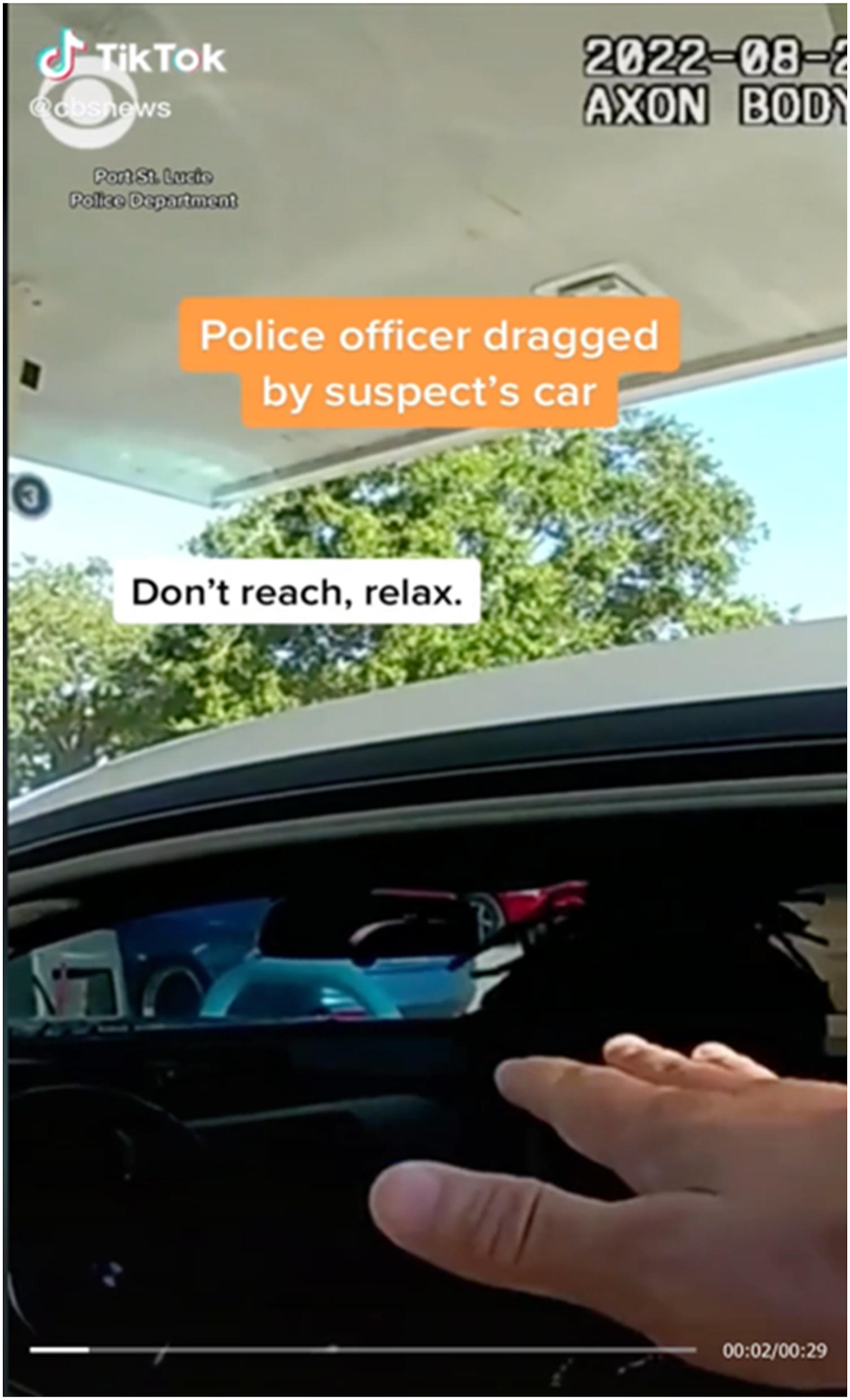


Acting as “News explainers” has become an important content strategy for news publishers on TikTok (Newman, 2022). While some TikTok news videos simply reuse existing video news assets, the news explainer videos mix the pre-produced or third-party news video with explanations or commentary from journalists and experts (Klug & Autenrieth, 2022). The news explainer videos are usually filmed with a second-person camera view, in which a correspondent on the ground provides updates on an event or an expert explains and comments on a political news event. We suggest that these news explainer videos can help TikTok news users obtain more information about the complex and rapidly changing political events beyond what is covered in broadcast media. As Newman (2022) points out, on TikTok, young people can have someone explain what is happening in the world to them, which is “more fun and innovative than TV.”
News explainer videos have the potential to offer cognitive benefits for TikTok users, especially those who are less politically efficacious or interested in politics (Chadwick et al., 2017). Research on dual screening suggests that when people watch political programs such as debates or election coverage on traditional media, they are motivated to use social media to acquire additional information about politics, leading to increased political expression and discussion (Gil de Zúñiga et al., 2015; Vaccari et al., 2015). According to Chadwick and colleagues (2017), individuals with low political efficacy who perceive information gaps in routine campaign news on TV are more likely to use dual screening to gather political information. Moreover, research has shown that using social media to supplement traditional news consumption can improve factual political knowledge (Houston et al., 2013; Ran & Yamamoto, 2019). However, evidence also indicates adverse or insignificant effects of second-screen use on political learning (Gottfried et al., 2017; Yamamoto et al., 2021).
Following the discussion above, we propose the research question:
What is the relationship between the second-person view in the news media TikTok content and engagement metrics (like, comment, and share)?
Last but not least, this study aims to examine if the effect of video content features on engagement differs between the TikTok videos created by news publishers and those created by other TikTok users (e.g., ordinary TikTok users, popular content creators, and journalists). Some studies have observed a difference in the use of visual elements between legacy news media and the most popular content creators (Salb, 2021). However, to date, no studies systematically study the difference between these news publishers’ accounts and other TikTok accounts regarding their video features and engagement outcomes (Klug & Autenrieth, 2022; Newman, 2022; Vázquez-Herrero et al., 2022). Therefore, we ask the following research questions:
Is there a difference in the video content features (second-person view and sentiment valence) between news publishers’ TikTok videos and other content creators’ TikTok videos?
Is there a difference in the effect of news sentiment on engagement metrics (like, comment, and share) between news publishers’ TikTok videos and other content creators’ TikTok videos?
Is there a difference in the effect of second-person view on engagement metrics (like, comment, and share) between news publishers’ TikTok videos and other content creators’ TikTok videos?
Data and Method
Our analysis consists of five sections: building a TikTok video database, converting the spoken speech to text, conducting sentiment analysis, facial analysis, and statistical analysis. Figure 4 below describes the workflow of the proposed data collection and analysis plan. Workflow diagram for the analysis plan.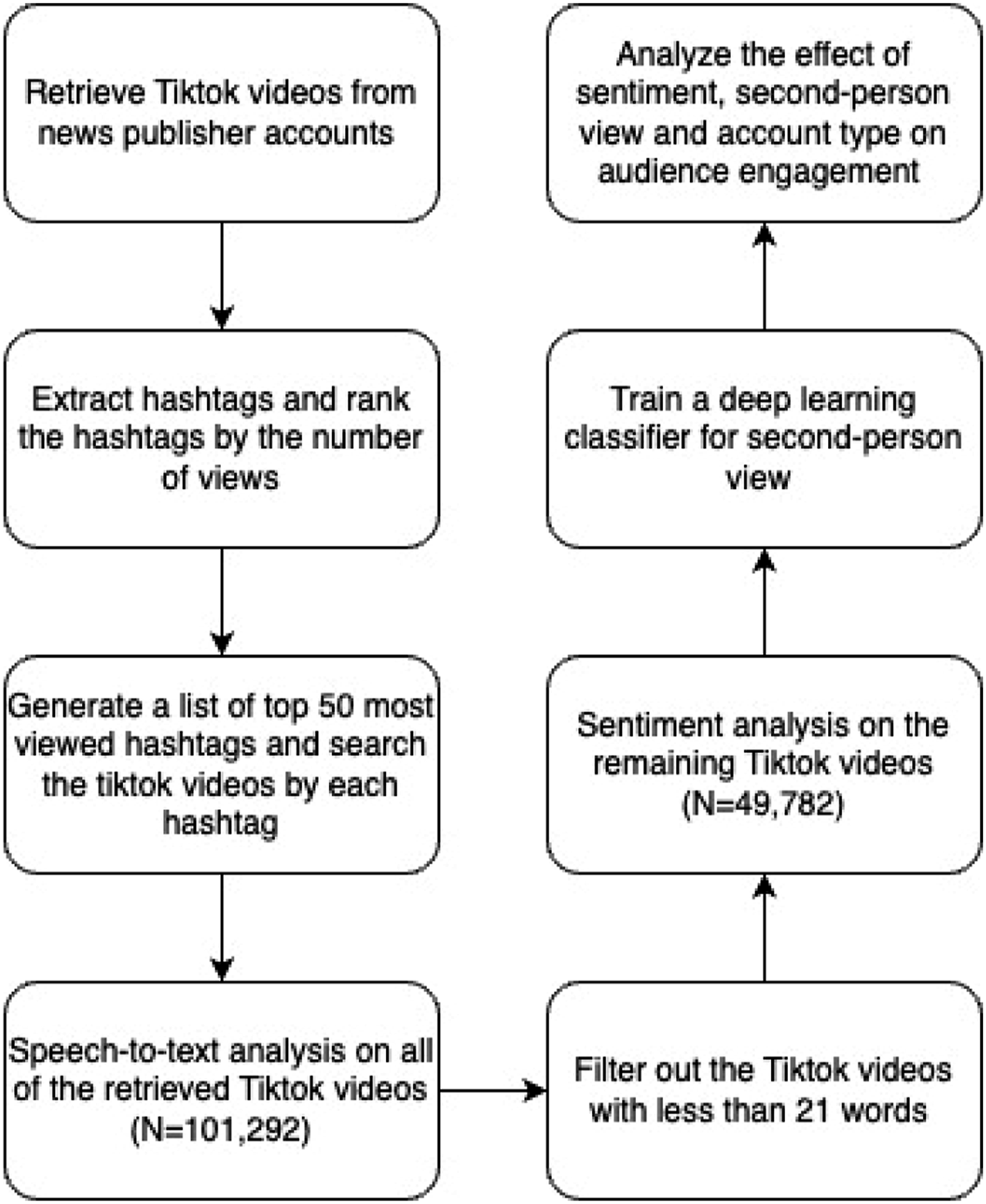
Data Collection
We started with building the TikTok video database, which involves a series of steps. First, we identified the 11 most followed U.S. and Europe-based news organizations’ TikTok accounts, including ABC news (4.6M followers), Daily Mail (4.2M followers), NBC News (3.9M followers), CBS News (3M followers), SKY News (3M followers), Vice World News (2.6M followers), Yahoo News (2.3M followers), Washington Post (1.5M followers), The Sun (1.2M followers), ITV News (1.4M followers), and CNN (1.2M followers). We used a web scraper called TikTok API (GitHub, 2022) to retrieve all the TikTok videos posted on the news publishers’ accounts, from the first ever published video to the latest video as of November 13, 2022. Second, we collected the hashtags (N = 9923) contained in the closed captions of the videos and ranked the hashtags in descending order according to the number of views on TikTok. Then we selected the top 50 most-viewed hashtags, for example, #biden, #Ukraine, #trump, #Russia, and #abortion, which tap a broad range of political news and public issues (for the complete hashtag list, see Table A1 in the Appendix). We searched the hashtags on the Discover page to retrieve the TikTok videos created by non–news-publishers accounts. Each hashtag returned slightly less than 1000 TikTok videos. Our preliminary TikTok dataset contains a total of 101,292 TikTok news videos created by news publishers and other content creators.
Speech-to-Text Conversion
Given that the news content TikTok videos often use existing news materials with added explanatory spoken language (Klug & Autenrieth, 2022; Newman, 2022), we transcribed the speech to written text using Google API. Since we based the sentiment analysis on the spoken words and sounds occurring in the video, TikTok videos with less than 21 words were removed. After filtering, 49,782 TikToks remained in the dataset, with 14,656 TikToks from news publishers and 35,126 TikToks from other content creators.
Sentiment Analysis
After identifying the spoken words in the TikTok videos, we performed the sentiment analysis on each TikTok transcript. The sentiment classifier is a support vector machine (SVM) trained using word embedding of a labeled opinion lexicon comprising about 6800 labeled positive or negative words (Hu & Liu, 2004). The sentiment classifier predicts the sentiment score of the words that occur in the text, which ranges from −1 to 1, with −1 standing for negative sentiment, 0 for neutral, and 1 for positive sentiment.
Facial Analysis
To conduct the facial analysis, first, we divided the video into images. Each TikTok video was split into one image per second. In other words, a one-minute TikTok video contains 60 images. Then we calculated the second-view ratio for each video. The second-person view ratio is equal to the number of images that contain a second-person view divided by the total number of images in a video.
We first trained a binary classifier for the second-person view (1 = second-person view, 0 = non–second-person view), which is operationalized as a person talking directly to the audience with a close-up shot. Two independent manual coders completed labeling (Krippendorff’s α = .91). ResNet-50 is a 50-layer convolutional neural network. It has an architecture based on the previous ResNet models but with a crucial difference: using the bottleneck design for the building block (He et al., 2016). A ResNet-50-based deep learning classifier was trained to study the second-person view prevalence across all the TikTok videos. The classicization accuracy reached 99.5% according to the testing set. For each video, a score for the second-person view ratio will be generated, which ranges from 0 (no second-person view existing in the video) to 1 (all second-person views throughout the video).
Statistical Analysis
Lastly, we ran a series of regression analyses to answer the research questions. We used the like-to-view ratio, comment-to-view ratio, and share-to-view ratio as criterion variables instead of the number of likes, comments, and shares to control the effect of views. TikTok's algorithmically generated feed on the “for you” page determines what videos users view. The TikTok algorithm is not entirely based on the users’ social network activities or the accounts that users have followed (Medina Serrano et al., 2020). If a video is “viewed,” it doesn’t mean that a person actively engages with this video because the second a video is played on the “for you” page, the platform count it as a “view.” Therefore, we assume that dividing the number of likes/comments/shares by the number of views will be a more accurate way to roughly estimate how successful and engaging a video is on TikTok. In the regression model, we included the video length, video created time, the second-person view, and sentiment score and examined each variable’s significance and coefficient betas. We also ran a moderator analysis to examine how the effect of sentiment on engagement metrics might differ between news publishers and other content creators.
Results
Linear Regression Analysis Among All TikTok News Videos.
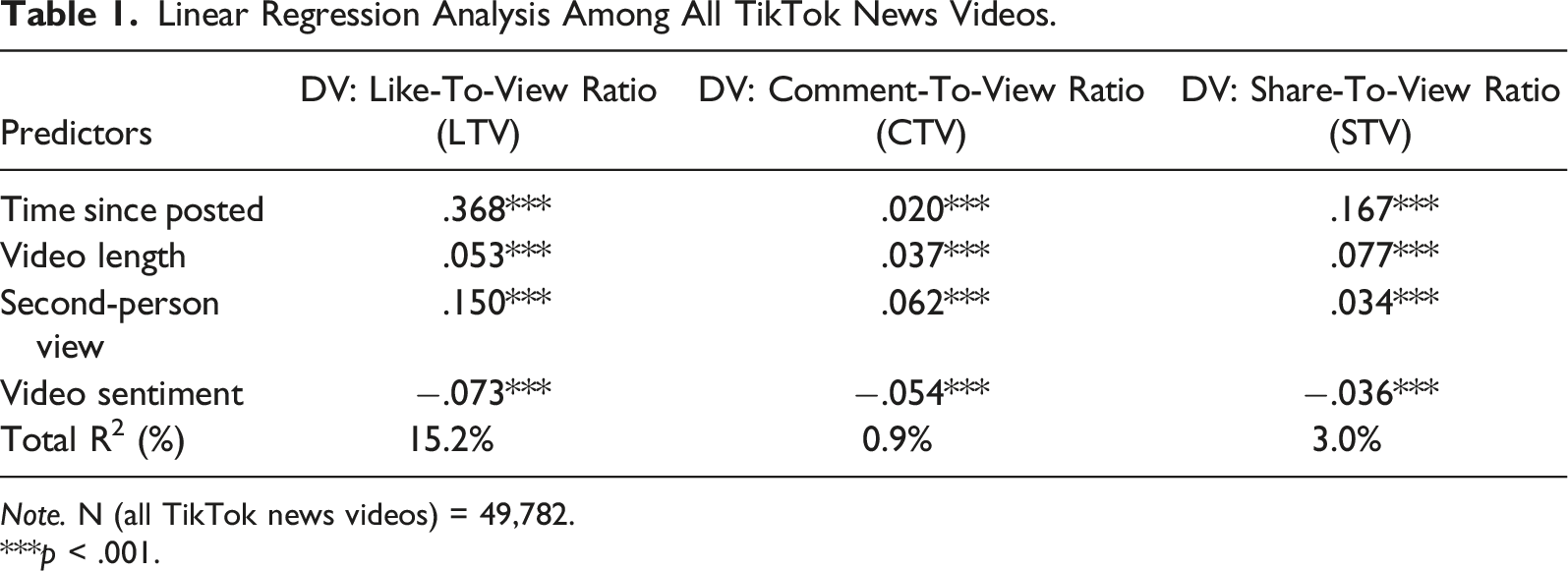
Note. N (all TikTok news videos) = 49,782.
***p < .001.
TikTok Video Features (News Publishers vs. Other Content Creators).
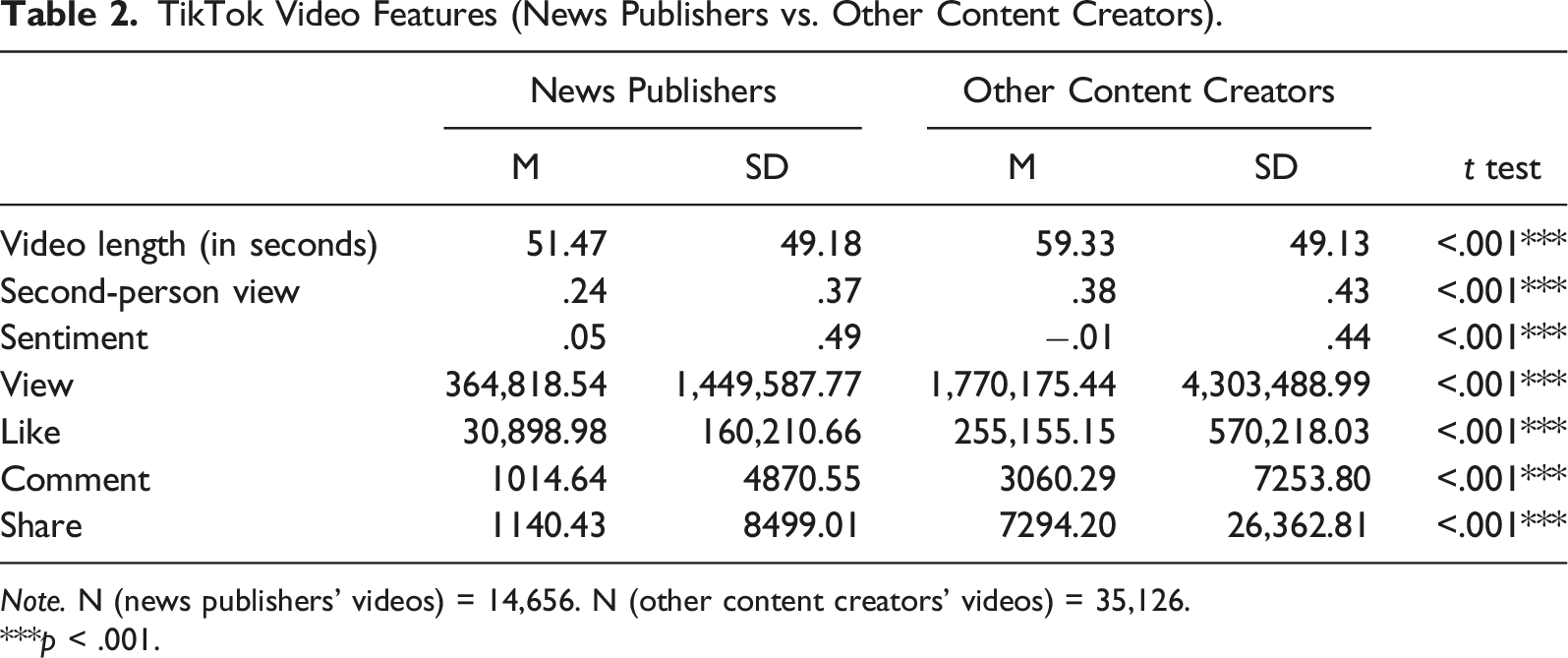
Note. N (news publishers’ videos) = 14,656. N (other content creators’ videos) = 35,126.
***p < .001.
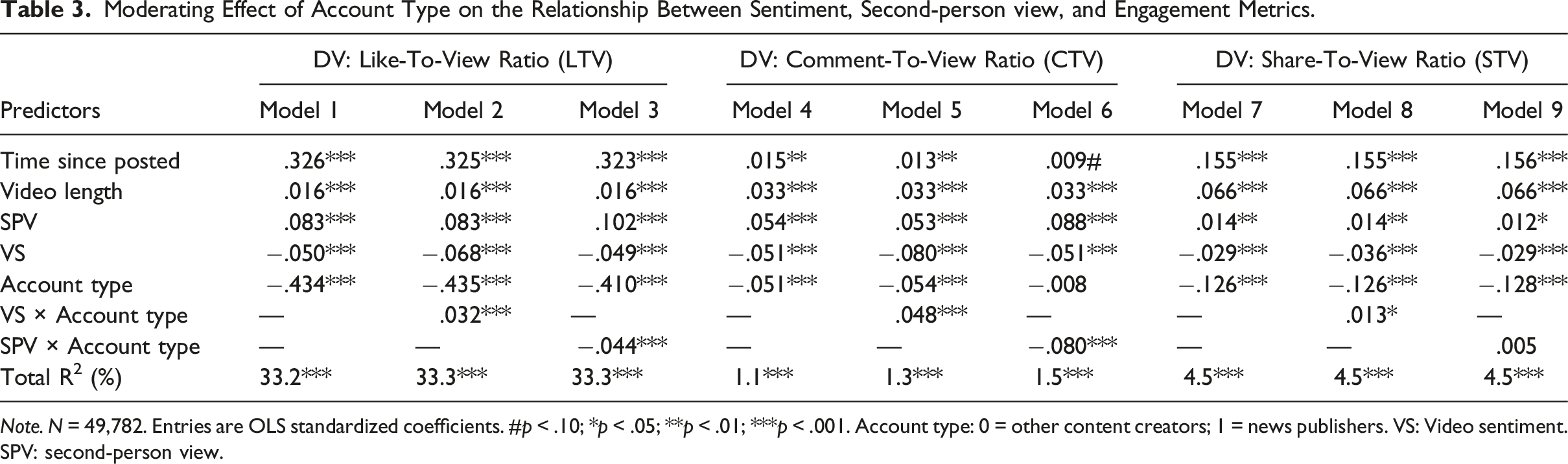
Moderating Effect of Account Type on the Relationship Between Sentiment, Second-person view, and Engagement Metrics.
Note. N = 49,782. Entries are OLS standardized coefficients. #p < .10; *p < .05; **p < .01; ***p < .001. Account type: 0 = other content creators; 1 = news publishers. VS: Video sentiment. SPV: second-person view.
Figure 5A shows that TikTok account type significantly moderates the relationship between sentiment and like-to-view ratio (β = .032, p < .001). Negative TikTok videos received more likes, and the impact is much stronger in other creators’ videos. Figure 5B shows that TikTok account type significantly moderates the relationship between sentiment and comment-to-view ratio (β = .048, p < .001). The role of negative sentiment in the comment-to-view ratio is stronger for other content creators than news publishers. Figure 5C also suggests a significant moderating effect of account type (β = .013, p < .05). Similarly, the impact of negative emotion on a higher share-to-view ratio is stronger in other creators’ videos than in news publishers’ videos. The effect of sentiment on the like-to-view ratio, comment-to-view ratio, and share-to-view ratio. (A). Sentiment on like-to-view ratio. (B). Sentiment on comment-to-view ratio. (C). Sentiment on share-to-view ratio. Note: The moderator analyses have controlled the time since posted, video length, and second-person view.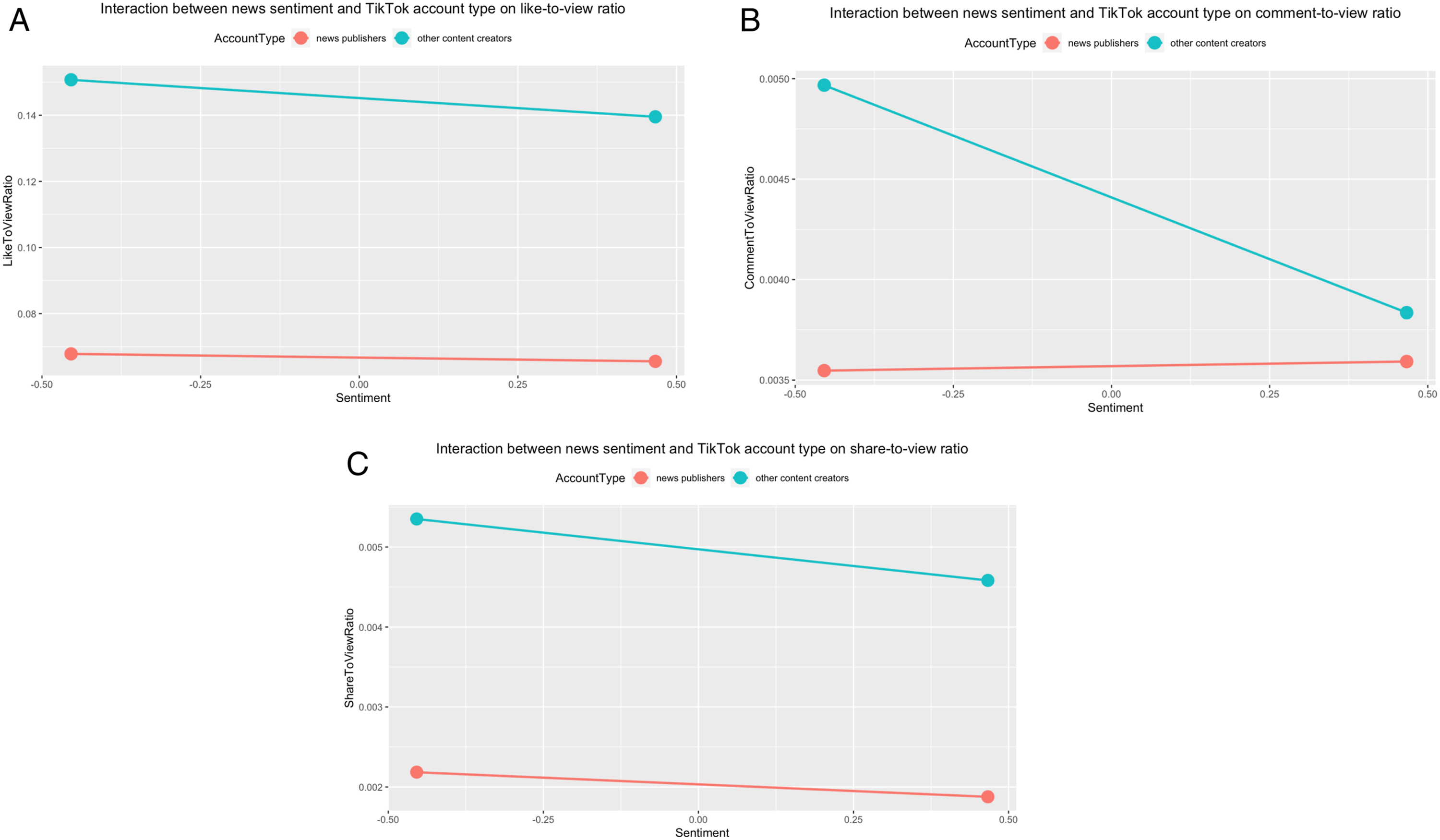
Altogether, Figure 5A, B and C and Table 3 illustrate the significant moderating effect of TikTok account type on the relationship between video sentiment and engagement metrics. While negative emotion appears to increase the engagement of the videos from both types of accounts, the role of negative emotion for news audience engagement is less salient for news publishers TikTok.
From Figure 6A, we conclude that there’s a significant moderator effect of account type (β = −.044, p < .001). When the second-person view occurs more in the video, the like-to-view ratio will increase significantly in both the news publishers’ and the other videos. Note that the impact of the second-person view is stronger for the videos created by other TikTok creators. In Figure 6B, we also observe a significant moderating effect of the TikTok account type (β = −.08, p < .001). Interestingly, the second-person view leads to less commenting on the news publishers’ TikTok videos but is associated with more comments on other creators’ TikTok videos. Lastly, in Figure 6C, we didn’t find a significant moderating effect of account type (β = .005, p > .05), indicating the relationship between second-person view and sharing behavior doesn’t differ between videos created by news publishers and other content creators. The effect of the second-person view on the like-to-view ratio, comment-to-view ratio, and share-to-view ratio. (A). Second-person view on like-to-view ratio. (B). Second-person view on comment-to-view ratio. (C). Second-person view on share-to-view ratio. Note: The moderator analyses have controlled for time since posted, video length, and sentiment score.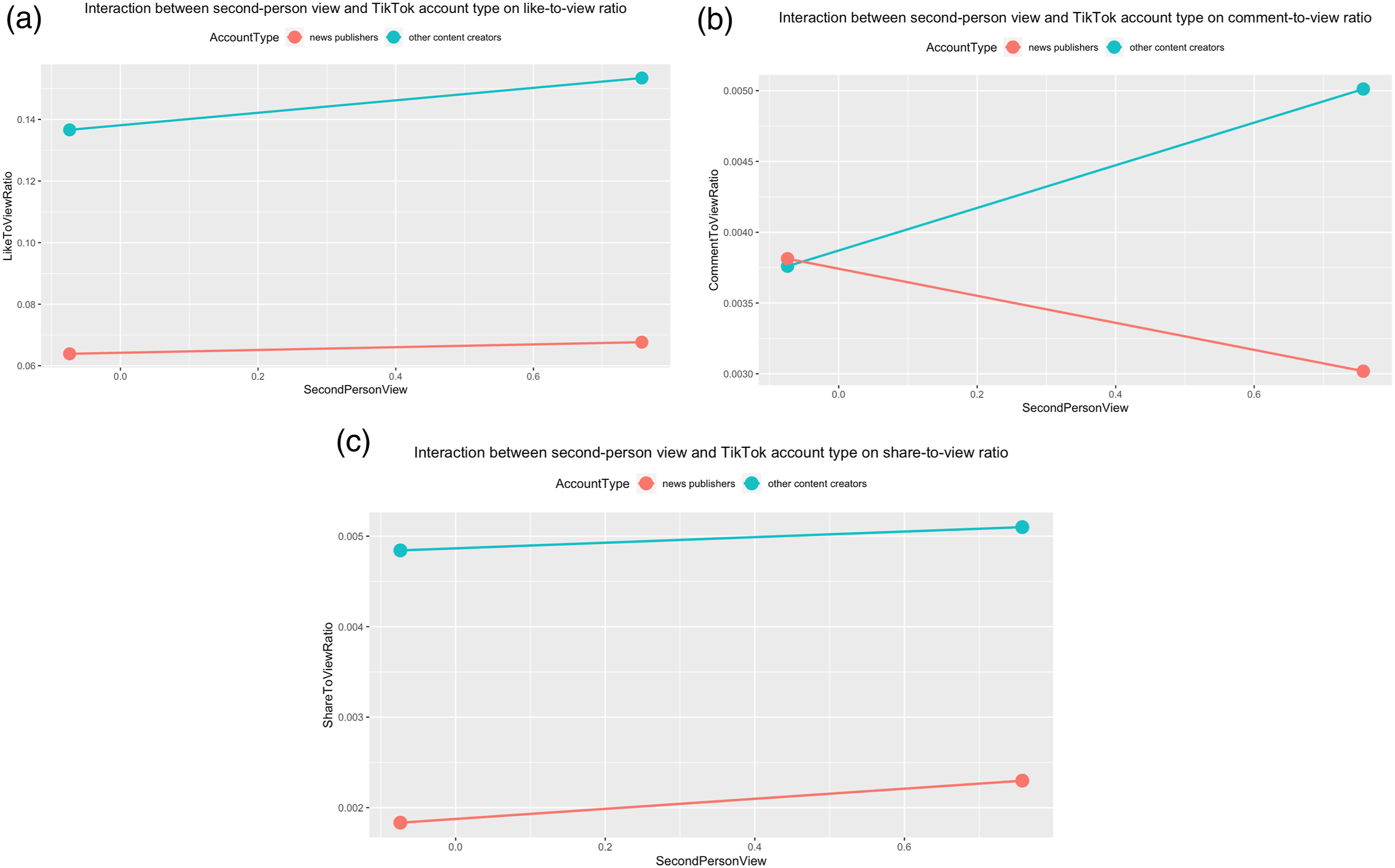
Concluding from Figure 6A, B and C and Table 3, we found TikTok account type significantly moderates the relationship between the second-person view and the like-to-view ratio as well as the relationship between the second-person view and the comment-to-view ratio. The positive impact of the second-person view on the engagement metrics is consistent for the other content creators’ TikTok. As for the news publishers’ TikTok, using a second-person view increases liking and sharing but decreases commenting.
Discussion
As news publishers have begun to take TikTok seriously, this exploratory study explores the relationship between different news content strategies and TikTok users’ engagement. On TikTok, there are many unique audiovisual features. First, it’s an entertainment app, so its content is fun-driven. Past content analysis has found that TikTok videos contain a wide range of visual features like special effects, visual filters, split, stickers, and so on (Vázquez-Herrero et al., 2022). This study has found that the second-person view is associated with more views, likes, comments, and shares, suggesting the audience’s presence will be amplified when the speaker talks directly to the camera (Dynel, 2014; Ling et al., 2022). In the context of news TikToks, when the character explains the news to the audience eye-to-eye, the audience will be more engaged with the news TikToks (Klug & Autenrieth, 2022). The content strategy—news explainer TikToks, adds accessible explanation to the existing broadcast news materials and are more likely to engage the next generation of news users. Like the second screeners who use social media to obtain more information about the TV news (Gil de Zúñiga et al., 2015; Vaccari et al., 2015), TikTok news users’ informational needs might be fulfilled by watching the news explainer TikTok.
In addition, this study found that videos that display negative sentiment will generate more likes, comments, and shares, which is aligned with the negativity bias theory in the journalism literature (Knobloch-Westerwick et al., 2020; Hansen et al., 2011; Soroka et al., 2019; Stieglitz & Dang-Xuan, 2013). The negative news or political issues will attract more attention because they tend to be more diagnostic (Skowronski & Carlston, 1989), more relevant to the risks and threats in the environment (Lengauer et al., 2012) and more sensational (Trussler & Soroka, 2014) compared to the positive news.
Since users get political news information not only from news publishers but also from other content creators such as political influencers, commentators, politicians, or other digital native news accounts, we investigated if the content strategies and engagement metrics differ between the news publishers and the other content creators. News videos posted by news publishers are shorter, with fewer second-person camera views and more positive sentiment. The news publishers’ TikTok received fewer views, likes, comments, and shares when compared to the other content creators. This finding is consistent with Newman’s (2022) and Salb’s (2021) observation that news publishers have just begun to create news content on TikTok and are yet to employ all the innovative audiovisual features in the news videos. More often, they use existing news videos to explain the news instead of creating a fun dancing and acting video that adapts to the tone and language of TikTok.
Interestingly, we found the significant effect of negative TikToks and second-person view on engagement are moderated by TikTok account type. Negative news-related videos created by non-news publisher accounts are more likely to elicit user engagement. Besides, the effect of the second-person view on engagement is smaller or even non-significant for news publishers’ videos. For instance, the second-person view is associated with fewer comments for news publishers’ videos.
The moderating effects suggest that how TikTok viewers engage with the news publishers’ content differs from how they engage with the other content creators. Users’ engagement with news publishers’ TikTok is less influenced by the emotional valence or the second-person view presented in the video. One possible explanation is that when people watch the well-known reputed news publishers’ TikTok, they shift from the “entertainment” mindset to the “information” mindset. News credibility, accuracy (Thorson et al., 2010) and trust in legacy news media sources (Fletcher & Park, 2017) may play more important roles in predicting one’s engagement with the news publisher’s TikTok. However, we will need further research, such as in-depth interviews or surveys, to understand how TikTok users perceive and process the publishers’ and non-publishers’ TikTok differently.
We also noticed a very small variance in the comment-to-view ratio and share-to-view ratio explained by the proposed variables—sentiment, second-person view, and account type. The distinctions between the three TikTok engagement behaviors (like, comment, and share) align with the previous literature that clicking likes is emotion-driven, but commenting and sharing behaviors involve the cognitive process (Kim & Yang, 2017). Future studies might explore other factors contributing to commenting and sharing TikTok news videos.
To some extent, our findings indicate no single recipe for success on TikTok. TikTok-specific video features may not play a crucial role in the success of engaging the news publishers’ audience on TikTok. As suggested by Newman (2022), News publishers can use the existing assets, highlight their expertise in covering news stories and focus on providing reliable news content on TikTok. Meanwhile, they need to make TikTok news videos that young people will not find boring. Plausible strategies include creating concise news videos, using understandable language to interpret the news, and increasing the interaction with the audience (Klopfenstein Frei et al., 2022; Marchi, 2012; Oeldorf-Hirsch & Srinivasan, 2022). Traditional news values like quality and truth are still solid for young news users. Serious news topics such as Russia-Ukraine War are popular among the TikTok audience, indicating that the younger generations are not tuned out from the world of politics and are motivated to learn complex information on TikTok.
The present study has several limitations. First, this study only selected the U.S. and Europe-based news publishers’ TikTok videos, affecting the findings’ generalizability. Since the adoption of TikTok by mainstream news companies is the highest in Indonesia, Australia, France, and Spain, then followed by the U. K. and the U.S. (Newman, 2022), future studies can investigate how the relationship between video features and audience engagement may vary from country to country. Second, the significant moderating effect warrants future analyses of the information practices and content strategies of other TikTok accounts. There is a wide array of news sources than the legacy news outlets on TikTok, such as digital native news media, political influencers, journalists, activists, and politicians.
In addition, this study focuses on two video features—sentiment and second-person view. Future studies can examine how other communicative forms, such as filters and stickers, affect engagement (Zeng & Abidin, 2021; Zulli & Zulli, 2022). Interactivity is one of the critical features of TikTok, and it’s theoretically important to understand how interactive TikTok functions, such as challenges and duets enabling the interaction between the character and audience (Vázquez-Herrero et al., 2022). Besides, given the distinctive pattern between news publisher videos and other creators’ TikTok, future studies can adopt survey design or qualitative interviews to investigate why people perceive the news publishers’ videos and other videos differently. Another direction is to explore how messages containing discrete emotions like anger, disgust, surprise, sadness, and fear predict message virality (e.g., de León & Trilling, 2021; Dobele et al., 2007; Lin & Utz, 2015). Also, our sentiment analysis was based on evaluating the emotional valence of the spoken information in the news TikTok. To gain a valid sentiment score for each TikTok, we had to remove the TikTok videos with less than 21 words. It’s likely that the videos without narration but did convey the news information to the audience were removed in the data cleaning process. Future studies can address this limitation by analyzing other input (e.g., facial expression) for sentiment analysis. This study only looks into the features of the video itself. Based on the literature, what other TikTok users posted in the comment section might influence one’s decision to engage with the original post. Evidence has shown that others’ emotional reactions to the news (Larsson, 2018) and uncivil comments (Su et al., 2021) will affect one’s news engagement behavior (Larsson, 2018). Finally, future studies can examine if the news consumption pattern on TikTok is ideologically biased or diverse. It would be interesting to see whether people live in political bubbles on TikTok by linking the profile and digital trace data (Eady et al., 2019; Shin, 2020; Song & Cho, 2021).
Footnotes
Declaration of Conflicting Interests
The author(s) declared no potential conflicts of interest with respect to the research, authorship, and/or publication of this article.
Funding
The author(s) received no financial support for the research, authorship, and/or publication of this article.

Note
Appendix
Top 50 Most-Viewed Hashtags on TikTok.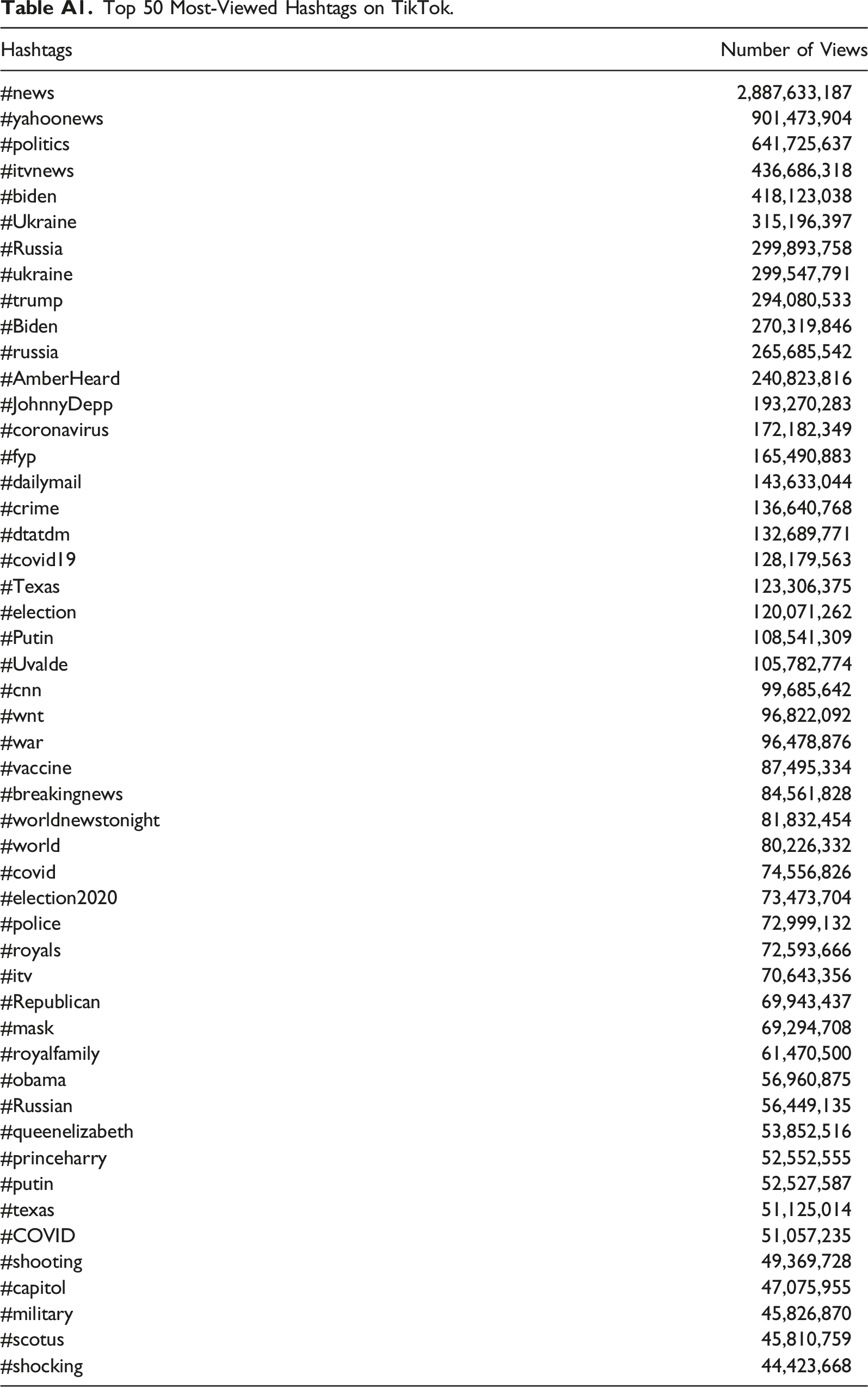
Hashtags
Number of Views
#news
2,887,633,187
#yahoonews
901,473,904
#politics
641,725,637
#itvnews
436,686,318
#biden
418,123,038
#Ukraine
315,196,397
#Russia
299,893,758
#ukraine
299,547,791
#trump
294,080,533
#Biden
270,319,846
#russia
265,685,542
#AmberHeard
240,823,816
#JohnnyDepp
193,270,283
#coronavirus
172,182,349
#fyp
165,490,883
#dailymail
143,633,044
#crime
136,640,768
#dtatdm
132,689,771
#covid19
128,179,563
#Texas
123,306,375
#election
120,071,262
#Putin
108,541,309
#Uvalde
105,782,774
#cnn
99,685,642
#wnt
96,822,092
#war
96,478,876
#vaccine
87,495,334
#breakingnews
84,561,828
#worldnewstonight
81,832,454
#world
80,226,332
#covid
74,556,826
#election2020
73,473,704
#police
72,999,132
#royals
72,593,666
#itv
70,643,356
#Republican
69,943,437
#mask
69,294,708
#royalfamily
61,470,500
#obama
56,960,875
#Russian
56,449,135
#queenelizabeth
53,852,516
#princeharry
52,552,555
#putin
52,527,587
#texas
51,125,014
#COVID
51,057,235
#shooting
49,369,728
#capitol
47,075,955
#military
45,826,870
#scotus
45,810,759
#shocking
44,423,668