




Abstract
Current social challenges have increased the interest in globally spread collective actions, especially those taking place in virtual space. Crowdfunding is one form of online activism that has recently gained importance. Although research conducted so far indicates the significance of social motives among participants of crowdfunding campaigns, knowledge about the psychosocial mechanisms involved in its effectiveness is limited. This article attempts to reinforce the position of crowdfunding as one of the forms of collective action and to expand knowledge about possible psychosocial factors that could shape participation in crowdfunding campaigns. In three pre-registered studies (N = 823), we found that the social identity based on a shared worldview positively correlated with the intention to participate in prosocial crowdfunding. Moreover, the relationship between opinion-based group identity and collective action varied depending on participation type (predicted vs. experienced engagement in a campaign). In other words, when people gather in communities built around shared opinions on a given social issue, they develop a sense of community, which can translate into activities for the benefit of the group such as supporting crowdfunding campaigns. However, in the case of actual behaviour, unlike with the declaration of participation, the strength of the relationship with social identity significantly diminishes. The results are discussed in relation to the theory of collective action.
Keywords
Introduction
Individuals’ membership in groups has significant implications for their experience and behaviour (Cartwright & Zander, 1968; Turner et al., 1987). Recent years have also seen an increase in research on collective actions within online communities (Agostini & van Zomeren, 2021). For example, campaigns coordinated by ‘Fridays for Future’ involved at least four thousand people to fund several projects on climate activism (raising almost $300,000). People cooperating within online groups could be driven by numerous psychosocial factors. Previous research demonstrated that other orientation (Zhang & Chen, 2019), prosocial motives (Dai & Zhang, 2019) and willingness to help others (Choy & Schlagwein, 2016) play meaningful roles in sharing financial resources online. Still, the phenomenon of crowdfunding remains on the margins of the debate conducted by social psychologists, and knowledge about its theoretical background and psychosocial components is scant. In this article, we attempt to address the question of whether the strength of collective identities predicts the motivation to unite, support and fund a project on prosocial crowdfunding.
We try to expand our understanding on why a group of strangers is willing to donate their money online, mostly anonymously and without any tangible rewards, to create goods that will benefit their group. Building on past collective action findings and, in particular, those that have documented the role of group identity in prosocial behaviour, the following research question is pursued: Does the social identification in opinion-based groups translate into participation in prosocial crowdfunding? We predict that (H1) strong social identity in opinion-based groups positively correlates with the intention to participate in prosocial crowdfunding campaigns, and (H2) the relationship between opinion-based social identity and collective action varies depending on participation type (predicted vs. experienced engagement in a campaign).
Psychosocial Factors of Collective Actions
In the classical offline approach, collective action is defined as a collective effort aimed at improving the status of the in-group (disadvantaged), when it is situated in a more unfavourable position than the out-group (advantaged; Wright, 2009). From that perspective, it occurs mainly in the form of participation in protests and mass demonstrations, signing petitions, donating money to non-profit organisations or engaging in political participation (i.e. campaigning for a political party, Teorell et al., 2007) or political consumerism (i.e. boycotting certain products for ethical reasons, Stolle et al., 2005). When perceived threat from the disadvantaged group is relatively low, advantaged group members are more likely to experience collective guilt about their privileges, which decreases negative attitudes towards the disadvantaged group (Wohl et al., 2006) and increases the likelihood of allyship (Selvanathan et al., 2018). Currently, the outlined characterisation has also been extended to include acts of political solidarity with other groups (Becker & Tausch, 2015). Among the psychological predictors of this phenomenon at the group level, a special role is ascribed to social identity, which will be the main focus of this article.
The relationship between social identity and collective action has been demonstrated in many theoretical models emphasising the sense of belonging as a key factor of group mobilisation. According to the Social Identity Model of Collective Action (SIMCA), people take collective actions when they experience strong affective reactions to injustice, believe that their groups’ actions can be effective and belong to social groups that can mobilise action (van Zomeren et al., 2018). However, according to the Encapsulated Model of Social Identity in Collective Action (EMSICA), the stronger the feeling of injustice and the belief in the group's effectiveness, the greater the identification with the group, which then translates into the tendency to participate in collective actions (Thomas et al., 2012). The recent Model of Belonging, Individual differences, Life experience and Interaction Sustaining Engagement (MOBILISE) suggests that participation in collective action is shaped on many levels: individual differences and life experiences lead to the formation of group consciousness, which in turn is the proximal predictor of collective action (Thomas et al., 2022). Undoubtedly, the role of social identity as a driver of collective action has been at the centre of scientific attention. Therefore, it is worth focusing on the precise comprehension of its definition and specific aspects.
According to Tajfel (1978), social identity is ‘that part of an individual’s self-concept which derives from his knowledge of his membership of a social group together with the value and emotional significance attached to that membership’ (Tajfel, 1978, p. 63). Indeed, group identity forms both the attitudes and behaviour of members of a given community. As a result, individuals prefer their own group over out-groups and obey group norms or engage in activities aimed at maintaining the group's status. In general, group membership based on a nominal social category is noted as being equivalent to a subjective sense of belonging to a group. Keeping this in mind, women would always be an out-group to men, and vice versa.
However, collective action is often possible when group identity also includes ideological norms that emphasise intergroup competition and condemn the out-group, that is, when politicised social identity occurs (Turner-Zwinkels & van Zomeren, 2021). For this reason, identification with a specific social movement predicts participation in demonstrations more strongly than identification with a disadvantaged group solely (Stürmer & Simon, 2004). For example, identification with the feminist movement anticipated collective actions to a greater extent than just being a woman (Kelly & Breinlinger, 1995). The sense of belonging to a group is intensely subjective, and people do not become members of the group until they feel as though they are part of it (McGarty et al., 2009). In other words, to analyse the mechanisms underlying collective actions in the most reliable manner, it is crucial to consider not only social identities based on objectively assigned social categories (i.e. nationality or gender) but rather social identities formed on sharing common ideas (opinion-based groups).
Collective identification based on a shared worldview (opinion-based groups) builds a sense of group belonging when a given opinion on a specific social issue is experienced as a collective aspect of the self (Thomas & McGarty, 2009). Opinion-based groups offer a useful way of capturing participation amongst those who are apparently acting as members of collectives but do not identify with a formal organisation or as an activist (Bliuc et al., 2007). Research has shown that group identity based on a shared worldview determines collective action against global poverty (Thomas et al., 2012), support for migrants (Thomas et al., 2019), climate change (Bliuc et al., 2015), and support for LGBT (Górska et al., 2017). Overall, the perspective of group membership based on like-minded people seems to be the most adequate for analysing current global challenges, which definitely go beyond the nominal intergroup divisions.
Crowdfunding as an Online Collective Action
As discussed earlier, the scope of activities defined as collective action has expanded over the past 20 years. Formerly, it was identified mainly with participation in protests, demonstrations or strikes (Klandermans, 2002). Subsequent research covered the many ways that individuals can take action to alter the group’s position. One of the innovative courses highlights the transition from direct to indirect group actions, such as displaying flags in windows, honking car horns or toggling lights on and off. Those activities are noteworthy because of the low cost of participation, which enables non-activists to engage and easily express their support for the cause (see Baysu & Phalet, 2017).
Another recent development is the trend towards research on online engagement (Smith et al., 2018). Calls to action disseminated through social networks have been shown to increase mobilisation in the virtual world (Thomas et al., 2022). Mutual reinforcement between offline and online community activities has been demonstrated repeatedly (Foster et al., 2019). What is crucial is that collective engagement for the benefit of the group is directed by similar motivations on the Internet and in the real world. A recent meta-analysis confirmed that, despite the virtual environment, group-level identity remains a key predictor of online collective action (Akfırat, et al., 2021). However, some researchers argue that online activism is not a direct driver of social change, does not represent genuine forms of mobilisation and may even reduce it (Morozov, 2009). Simultaneously, the paradigm of collective action in cyberspace is rapidly evolving.
A common characteristic of crowdfunding is the existence of a project founder who launches an online campaign to provide collective financial resources. The main idea is to enable small funding increments (e.g. 1$, 5$ and 10$) via social networking platforms (e.g. Kickstarter, Patreon and GoFundMe) and allow funders to communicate with each other as well as with funding recipients (Agrawal et al., 2015). In general, four main categories of platforms are distinguished depending on the resources obtained through the call: donations, rewards, debts and equity. In the current article, we refer mainly to donation crowdfunding.
Most studies of crowdfunding focus on the determinants of campaign success, analysing the characteristics of the project itself, personal attributes of project initiators or the crowdfunding experience of funders (Deng et al., 2022). Past research has identified several economic and psychological factors, and motivational components explaining involvement in projects from the backer’s perspective, such as self-presentation and a willingness to improve social image (Cox et al., 2018), intrinsic and extrinsic motivation (Bagheri et al., 2019), the expected impact of one’s donation (Kuppuswamy & Bayus, 2017), entrepreneurial intentions, perceived risk and perceived trust (Fanea-Ivanovici & Baber, 2021a, 2021b).
The goals of the initiatives represent a wide spectrum, including various prosocial actions aimed solely at community benefits. Indeed, prosocial, public-oriented campaigns tend to raise more money, which shows that people want to invest their social and financial resources in ventures that contribute to the community (Pietraszkiewicz, et al., 2017). Thousands of individuals may cooperate with others and distribute one’s private money to the community (Dai & Zhang, 2019) and ones in need (Choy & Schlagwein, 2016). Zhang and Chen (2019) demonstrated that other orientation, defined as a backer’s altruistic motivation to help others, has an impact on funding decisions. To put it another way, crowdfunding equips society with the apparatus to address and reach shared goals by relying on collective effort.
Among the factors enhancing involvement, the willingness to support the community of like-minded people and the desire to be part of a joint initiative has been revealed (Greenberg & Mollick, 2017). Qualitative research by Gerber and Hui (2013) proved that financial support through crowdfunding platforms can be an explicit way to signal an attachment to a specific social group. Gleasure and Feller’s (2018) analysis of the records from Pledgie.com suggested that sharing collective objectives around identity was associated with more effective fundraising. However, group identification in the referred studies is defined in an imprecise manner, distinct from the conceptualisation and operationalisation applied in the field of social psychology.
To the best of our knowledge, the study by Wang et al. (2019) was one of the few that included the measurement of social identity in reference to the intention to participate in crowdfunding. In line with the hypothesis, it was confirmed that potential donors, who identified with the group engaging in charity, declared a higher willingness to participate in such campaigns (r = .34, p < .001). Also, Rodriguez-Ricardo et al. (2018) showed that social identification with the crowdfunding community has a positive and significant effect on the intention to participate in crowdfunding (β = 0.48, p < .001). We plan to replicate this effect, but rather than with any type of crowdfunding projects, we selected only prosocial crowdfunding projects which were opinion based. Thus, these are the first studies on the relationship between opinion-based social identity and the intention to participate or actual participation in a prosocial crowdfunding campaign.
It is also worth noting that the relationship between opinion-based social identity and collective action may vary depending on the type of participation (predicted vs. experienced engagement in a campaign). In other words, individuals who identify as a part of a like-minded group may exaggerate their intention to donate money more than if they were actually spending it. Nonetheless, the measurement of declarations alone appears to be predominant in the field. A meta-analysis by van Zomeren et al. (2008) found that 79% of studies on collective action were based on declared intentions. Collective action research has been criticised in the past as being in large parts a ‘science of self-report measures’ (Berger & Wyss, 2021), which may affect the accuracy of drawn conclusions. Smith and McSweeney (2007) found that the intention to fund collective goals predicted the actual behaviour. However, the amount of variance in donating behaviours explained by intentions was quite small (14–16%). Moreover, the meta-analysis by Akfırat et al. (2021) showed that in the case of online collective actions, the relationship between group identity and intention was stronger than for actual involvement. This means that examining solely declarations may lead to oversimplification in explaining social behaviour.
Overview of the Current Research
The aim of this article was threefold. First, we sought to establish that crowdfunding is one form of collective action. Secondly, we discussed possible psychosocial factors underlying participation in crowdfunding. Thirdly, we examined how the type of investigated participation may correspond with the accuracy of forecasted societal changes. More specifically, we investigate whether group identification coexists with engagement in a donation type of crowdfunding campaign. Additionally, we applied the opinion-based social identity concept to estimate the level of belongingness to the group. Moreover, we explore this relationship for two types of participation in collective action: willingness to donate money (intention) and archival donations (real behaviour). We predict that (H1) strong social identity in opinion-based groups positively correlates with the intention to participate in prosocial crowdfunding campaigns, and (H2) the relationship between opinion-based social identity and collective action varies depending on participation type (predicted vs. experienced engagement in a campaign).
The accuracy of forecasted societal change is conceptualised as the level of estimated discrepancy between declarative and actual behaviour. The validity of the links between psychosocial motives and collective action may vary depending on the operationalisation of the action. This issue will be addressed by testing two types of participation: predicted (declarative) versus experienced (real) engagement in a project. We present the results of three preregistered studies exploring the link between social identity and the intention to support crowdfunding campaigns (Study 1 and Study 2) or the actual support for a crowdfunding campaign (Study 3). In each study, we used a description of a genuine crowdfunding campaign from Kickstarter (Study 1 and Study 2) or Patreon (Study 3). In all studies, the minimum number of participants required was determined by an a priori power analysis using the software G*Power 3.1. A meta-analysis of the social identity-collective action relationship (N = 10,051) found a medium-sized effect (= .38) for measures of group identity and participation in collective action across a variety of groups, contexts, issues, samples and methods (van Zomeren et al., 2008). Our power analysis indicated that a sample size of 260 would be sufficient to detect a marginally interesting effect (r = .20) with a power of .95 and an α = .05. Datasets and the codebook from all studies are publicly available at https://osf.io/kab93/.
Study 1
In Study 1, we investigated whether the social identity of supporting environmental causes (healthy planet supporters) is positively correlated with the declared intention to support the cause of a belief-based crowdfunding campaign promoting ecological education (Hypothesis 1).
Method
Participants and Procedure
Two hundred sixty-eight participants (N = 268, 176 men) were recruited through Mechanical Turk without any additional requirements, except for speaking English, and were paid $0.3 US for completing a brief online questionnaire. The average age of the participants was 34.98 years (SD = 11.47). We excluded participants based on predetermined criteria: multiple participation attempts and failed attention checks.
First, we asked participants to carefully read the description of the crowdfunding project called ‘World in Green’ (which aimed to support a podcast about maintaining a healthy diet and a healthy planet – see Appendix A at https://osf.io/kab93/). This was a genuine Kickstarter campaign, chosen by three competent judges in the process of a detailed evaluation of 27 previously successful campaigns (based on the project’s prosocial character).
Next, we asked participants if they would support the podcast project and how much they identify with the group relevant to the project’s goal (healthy planet supporters). The intention to support the campaign was defined as the average value of a declared donation to the project and was measured by asking participants ‘How much money would you donate for this campaign?’ using an original scale that ranged from 1 ($0) to 7 ($500). Next, social identity was measured using a 5-item scale (Bliuc et al., 2007) which captures different identity dimensions: similarity, content, identification as well as future and respect (e.g. ‘I am like the other people who support healthy eating for a healthy planet’ [α = .91]). The questions were adjusted in reference to the relevant group (healthy planet supporters). Participants rated their level of identity with each item using scales that ranged from 1 (definitely not) to 7 (definitely yes). Responses to items were averaged to create an overall index of social identity.
Results
Correlation and Descriptive Statistics of Social Identity and Level of Support in Studies 1–3.
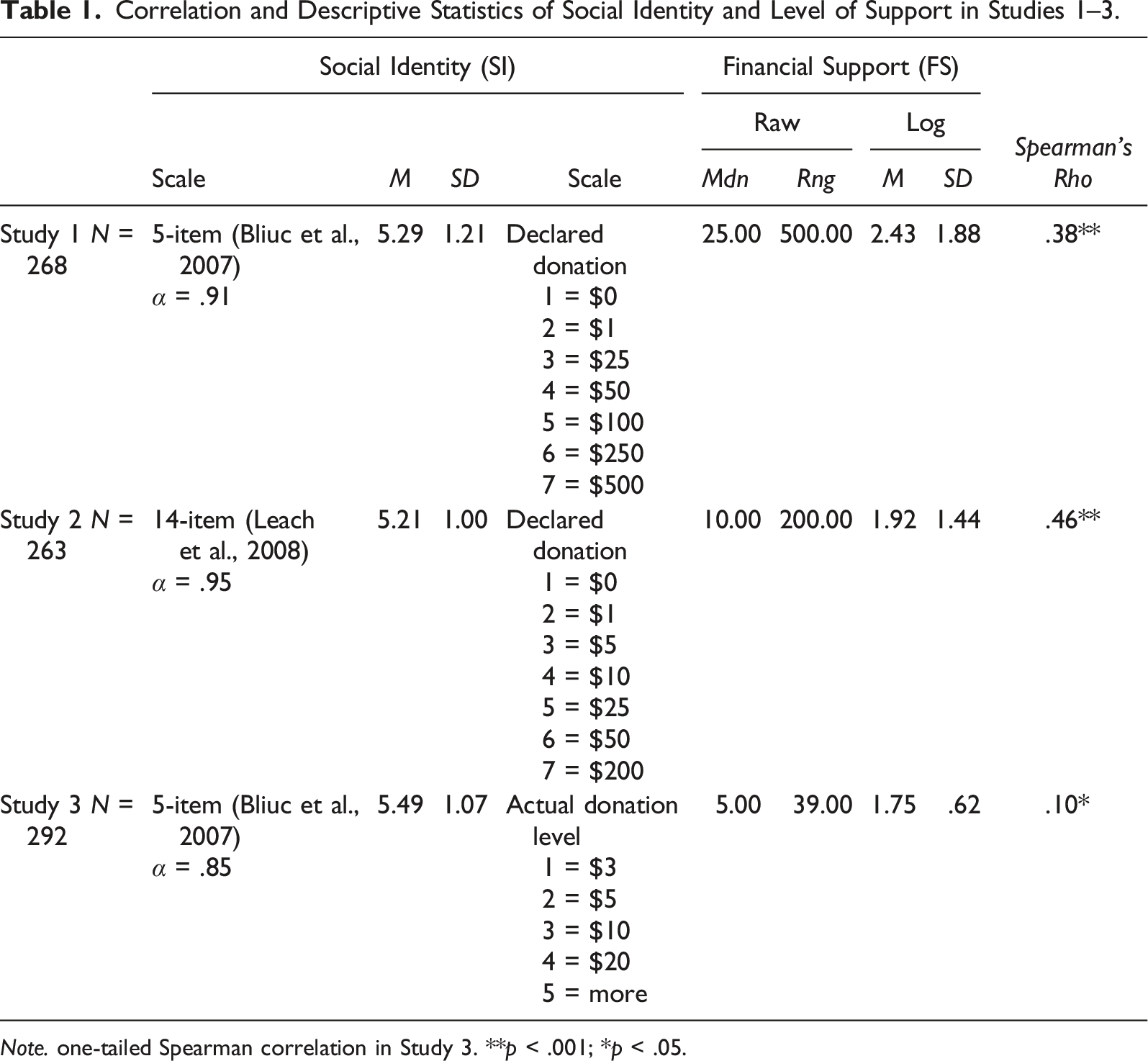
Note. one-tailed Spearman correlation in Study 3. **p < .001; *p < .05.
Correlation and Descriptive Statistics of Social Identity Dimensions and Level of Support in Studies 1–3.
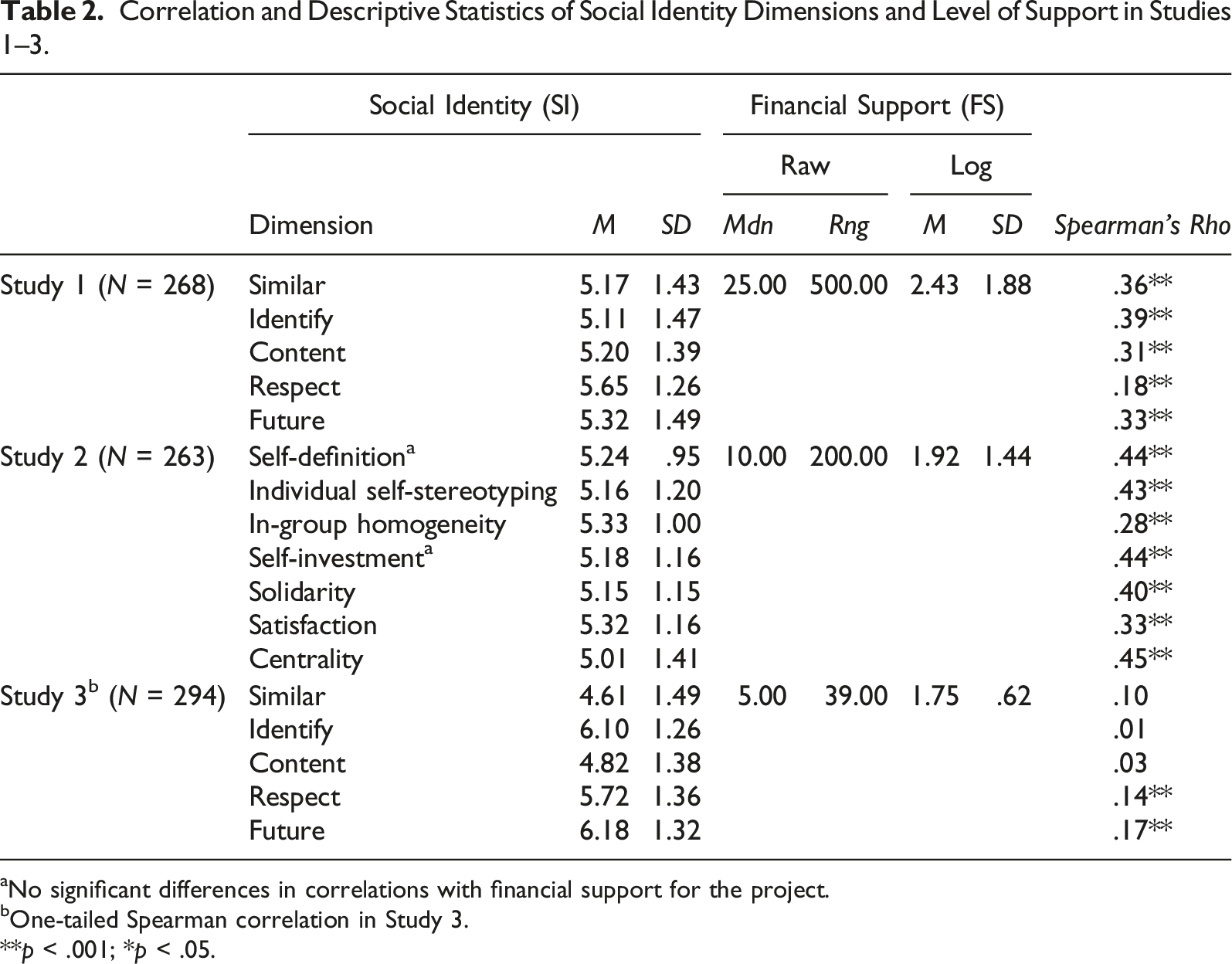
aNo significant differences in correlations with financial support for the project.
bOne-tailed Spearman correlation in Study 3.
**p < .001; *p < .05.
Study 2
In order to exclude the alternative explanations and replicate our finding, we aimed to test whether the same positive correlation appears when we switch the context of the crowdfunding campaign to a different cause, namely, diversity and cultural tolerance. Additionally, this time we measured social identity first, and we used more detailed sub-scales for its measurement.
Method
Participants and Procedure
A sample of two hundred sixty-three English-speaking participants (N = 263, 160 men) was recruited through Mechanical Turk without any additional requirements. We offered a small compensation for completing a brief online questionnaire ($0.3 US). The average age of the participants was 34.40 years (SD = 10.90), with a range of 19–76 years. We used the same exclusion criteria as in the previous study.
This time, participants first rated their identity with the community of activists advocating for tolerance, respect and acceptance for all cultural representatives, and afterwards, their task was to carefully read the description of the crowdfunding project called ‘Power in Diversity’ (which aimed to support the podcast promoting diversity and multiculturalism). This was a real Kickstarter campaign, chosen from a strictly selected successful campaign with similar criteria to those used in Study 1 (details are presented in SM). Finally, their intention to support the project was measured.
Measures
We employed an alternative and more detailed social identity measurement scale using a 14-item scale (Leach et al., 2008) which consists of two subscales capturing self-definition (on two dimensions: individual self-stereotyping and in-group homogeneity) and self-investment (on three dimensions: solidarity, satisfaction and centrality; e.g. ‘I feel committed to diversity and multiculturalism supporters’[α = .95]). The purpose of that modification was to test whether the self-investment dimension, including solidarity with the group component, would be specifically related to the willingness to act for the benefit of the group (see Leach et al., 2008). The questions were adjusted in reference to the relevant group (diversity and tolerance supporters). Participants rated their level of identity with each item using scales that ranged from 1 (definitely not) to 7 (definitely yes). Responses to these items were averaged to create an overall index of social identity.
Next, similarly to the previous study, the intention to support the campaign was defined as an average value of a declared donation to the project and was measured by asking participants ‘How much money would you donate for this campaign’ using an original scale of support from 1 ($0) to 7 ($200). It is also worth noting that to maximise mundane realism in Studies 1 and 2, we used a scale of financial support corresponding to the real campaigns on Kickstarter. In the authentic projects, the participants could not indicate any amount but could only decide on a predefined value for the donation.
Results
As seen in Table 1, a correlational analysis again revealed that the level of social identity with the diversity group is related to the quantity of declared financial support, rho = .46, p < .001. All measured identity subscales and dimensions were related with the intention to back the campaign on a similar level, except for in-group homogeneity rho = .28, p < .001 and satisfaction rho = .33, p < .001 with slightly smaller effects (see Table 2). The results imply that people who felt closer to the members of the social group encouraging multiculturalism declared more financial support for the diversity-promoting podcast. Interestingly, the correlation between social identity and declared support was stronger than in Study 1. This difference in the strength of the correlation could possibly be attributed to more relatable context of the study, namely, social inequalities and racial discrimination. Another likely explanation is that we may have primed all participants with the feeling of belongingness to the particular group by asking them to rate their social identity before they read the description of the campaign. According to the Inclusion/Exclusion Model (Schwarz & Bless, 1992), chronically or temporarily accessible information influences our judgement. This might result in an assimilation effect, meaning that comparison with other pro-environmentalists could have strengthened self-categorisation as a campaign funder, which led to larger declared support.
Study 3
In our final study, we again wanted to replicate the pattern of obtained results and further test the hypothesis using an authentic crowdfunding project. This time, we analysed actual support for an ongoing real-life campaign among planet protection supporters.
Method
Participants and Procedure
Two hundred ninety-two participants (N = 292, 279 men) were recruited from the group of supporters of the ‘Just Have a Think’ project via the Patreon platform, which aims to educate people about planet protection and raise awareness for environmental issues. The actual project’s creator was involved in collecting the data: all backers received invitations to participate in our study without any exclusions. The average age of the final sample of participants was 57.46 years (SD = 14.50), with a range of 21–85 years.
The supporters’ task was to indicate the amount of money donated every month to the project funder. Afterwards, they rated their identity with the community of activists building awareness of environmental issues.
Actual support for the project was measured by identifying participants’ level of monthly donation (in dollars) using an original scale of support from 1 ($3) to 4 ($20). Due to no significant differences in correlations with particular sub-dimensions of social identity subscales in Study 2 (see Table 2), we used the 5-item scale of social identity (Bliuc et al., 2007) (α = .85) from Study 1. The questions were adjusted in reference to the relevant group (planet protection supporters). Participants rated their level of identity with each item using scales that ranged from 1 (definitely not) to 7 (definitely yes). Responses to these items were averaged to create an overall index of social identity.
Results
As seen in Table 1, actual support for the project is again positively correlated with social identity, yet the strength of this relationship is significantly smaller, rho = .10, p = .03 (one-sided). This finding revealed that people who actually provided financial support for the pro-environmental podcast were high-identifiers with the planet protection social group 1 . It is also worth noting the specificity of the Patreon platform, which is more engaging and recursive than Kickstarter. Kickstarter is mainly used for one-time projects, while backers on Patreon provide financial support on a monthly basis, with the possibility of resignation at any time. Nevertheless, even the assumption that a single Kickstarter donation may ultimately be higher than the total Patreon support does not explain such a significant difference in correlations. Moreover, it seems that in the model of regular payments, the expected relationship between the sense of belonging to a group and financial support should be even stronger than in the case of a single payment.
Table 2 presents results detailing the different components of group identity in opinion-based groups. In Study 1, all measured identity dimensions have been related with the intention to back the campaign. In Study 2, we found no significant differences in correlations with particular social identity subscales. Additionally, since the self-investment dimension, including solidarity with the group component, did not have a significantly stronger relation to the willingness to act for the benefit of the group, rho = .40, p < .001, than other components, we decided to continue our examination with the previously implemented scale. Study 3 showed that only Future and Respect components are correlated with financial support for the project. Overall these results are in line with our assertion that prosocial behaviours would be associated with advocacy of the like-minded community and the desire to become a member of a joint initiative (Greenberg & Mollick, 2017).
Discussion
The main goal of our study was to extend the knowledge of psychosocial factors underlying predicted versus experienced participation in online collective actions. It is worth highlighting that we examined genuine Kickstarter campaigns, chosen by three competent judges in the process of a detailed evaluation. By employing authentic projects, we attempted to maximise the realism and validity of our line of research. We demonstrated that the sense of social identity in groups based on a shared worldview positively correlates with the intention to participate in prosocial crowdfunding in different contexts: pro-ecological (Study 1) and multicultural (Study 2). Moreover, the relationship between opinion-based social identity and collective action varies depending on participation type: predicted versus experienced engagement in a campaign (Study 3). Put simply, people who gather in communities built around shared opinions on a given social issue develop a sense of community, which can translate into activities for the benefit of the group such as supporting crowdfunding campaigns. However, in the case of actual behaviour, unlike a declaration of participation, the strength of this relationship with social identity significantly diminishes. Overall, our research expands the knowledge about possible psychosocial factors that could shape participation in collective actions in cyberspace.
In general, our analysis broadens the perspective of online collective actions with the scope of participation in crowdfunding campaigns. According to the extended definition, collective actions can be addressed not only to members of the in-group but also as a gesture of solidarity with the out-group (Becker & Tausch, 2015). Prosocial projects aimed at supporting the community can be framed by the discussed theoretical background. Furthermore, as a medium predominantly devoted to global challenges, they seem to represent collective actions of a conversionary type (Wright, 2009). Specifically, their goal is not to improve the status of the in-group (as in competitive collective actions) but rather to convert as many non-members as possible to join the in-group and adapt its normative worldview. To illustrate, in the pro-environmental community for the most part the offered general message is that ‘everyone should be an environmentalist’, instead of ‘environmentalists should be treated better’. Expanding the domain of collective actions in a virtual world with crowdfunding could provide the most appropriate theoretical lenses and advance the comprehension of novel forms of social activism.
Although our work replicated and extended past research, some authors argue that group identity may not be crucial in crowdfunding. Bennett et al. (2008) propose a new concept of connective action that does not operate on the basis of shared group identity. Particularly, Bennett and Segerberg (2012) argued that collective action of the new, digital era calls for a different structuring principle, namely, the logic of connective action. In their view, communication technologies imply an organisational guideline that differs from notions of collective action based on basic assumptions about the role of resources, networks and social identity. In connective logic, participating in public effort or contributing to a common good translates into the act of personal expression and recognition or self-validation rather than a group-inspired response to a crucial social matter.
Our research highlights a different set of dynamics than those presented by Bennett and Segerberg (2012). Our data show that in crowdfunding settings, social identity plays a significant role in committing to collective efforts. We propose that the personal decision to support opinion-based in-groups may stem from identification with a community of like-minded individuals. It is important to note that in the discourse associated with this standpoint, online activities are particularly applicable only to social media usage (e.g. Priante et al., 2018).
In general, the key conclusion of our research is that the intention to contribute to crowdfunding campaigns (predicted involvement) is strongly associated with group identity. More precisely, people who gather in communities built around the same opinions on a given social issue develop a sense of collective that can result in predicted collective action for the group’s benefit. Our findings are consistent with the theoretical models of collective action, where social identity performs a leading role (see, e.g. Thomas et al., 2022). Additionally, it confirms the results of numerous studies showing that identification with a group is a moderately strong predictor of households’ pro-environmental behaviours (Fielding & Hornsey, 2016; Keshavarzi et al., 2021), citizens’ willingness to integrate with immigrants (Pinto et al., 2020), approval for racial equity (Selvanathan et al., 2018) and supportive attitudes towards different sexual orientations (Górska et al., 2017). Moreover, we shed light on the validity of incorporating the concept of opinion-based group identity to explore the motivations of social activists in cyberspace. Indeed, despite the lack of physical proximity, people with similar worldviews are able to organise themselves and mobilise others on a massive scale. Individuals prove able (now as ever) to succeed in harnessing social identities that connect and integrate people across individuals’ social networks (Spears & Postmes, 2015). According to a recent meta-analysis by Agostini and van Zomeren (2021), identification with an opinion-based group has as strong a moderate effect (r = .44) on collective action as a politicised identity. Nevertheless, it is important to stress that the sense of group identity is not utterly constant but rather dynamic and flexible, as it can be adjusted depending on the relevant context (Fielding & Hornsey, 2016). In a world where people have multiple social identities and belong to different groups, an opinion-based perspective may be essential to apprehend the commitment to social change (Besta et al., 2019).
The results of our three studies also extend the state of knowledge to be used by practitioners, that is, creators of crowdfunding campaigns. Based on the conclusion that people who gather in communities built around shared opinions on a given social topic develop a sense of community which can translate into activities for the benefit of the group, some practical tips can be created. First of all, in the description of the campaign, it is worth emphasising the worldview behind it, especially in relation to the purpose of the project. Strengthening the message to the representatives whose specific views are addressed in the campaign should activate the sense of community with a group that unites forces for a prosocial goal. In addition, it is also vital to frame the sense of community by using the forms ‘we’, ‘us’, and ‘with us’ in the message and focus on intrinsic cues, which could also activate identity at the group level (see Defazio et al., 2021).
Another way to strengthen backers’ involvement in campaigns is to shape the community around the project, using social media. Social media interactions are a crucial discriminating factor for the success of crowdfunding campaigns (Borst et al., 2018). Importantly, group members not only become donors themselves, but they may also recruit people from their social networks to the project. This path affects not only targeting the right group but also expanding the circle of potential fundraiser participants (see Salem et al., 2022). To overcome social fragmentation and latent ties in the external networks of leading activists, project funders should expand their cooperation by reaching new audiences. Establishing relationships with relevant public and social figures could help reduce limitations related to network dispersion and homophily (González-Cacheda & Cancela, 2022).
Additionally, we demonstrated that the type of investigated participation may influence the accuracy of forecasted societal changes. More precisely, the relationship between opinion-based social identity and collective action varied depending on participation type (predicted vs. experienced engagement in a campaign). Although many theoretical models explaining human behaviours, such as the theory of reasoned action (Ajzen & Fishbein, 1980), the theory of planned behaviour (Ajzen, 1991) or attitude-behaviour theory (Triandis, 1980), suggest that behavioural intentions are a reliable indicator of actual performance, there is a growing body of the literature that recognises the importance of the behavioural gap between declarations and behaviours (see Doliński, 2018). As a matter of fact, a meta-analysis showed that a medium-to-large change in intention leads to a small-to-medium change in behaviour (Rhodes & Dickau, 2012; Webb & Sheeran, 2006). Below we will discuss possible explanations for the presented results.
The first category of rationales is an attempt to clarify how the specificity of the main collective action motivators themselves could have contributed to the discrepancy between behaviours and declarations. The key considered direction seems to be the dynamics of changes in the level of perceived group identification during the process. According to Klandermans (2002), the relationship between identification and protest participation can go either way: identity fosters participation, and participation reinforces identification. That implies that after participating in a successful campaign, group identity should increase and be even more strongly associated with activity for the benefit of the group. On the other hand, studies on the consequences of collective mobilisation focus mainly on protests, are qualitative (Vestergren et al., 2019) and rarely include people who only declare their willingness to participate in such activities. Therefore, future analyses could explore and cover the entire process of identity stimulation, development and strengthening (see Priante et al., 2018), especially in the context of cyberspace.
Another aspect to consider is the potential impact of group identification on the superordinate level. Namely, the global nature of social issues in the investigated crowdfunding projects could stimulate identification with humanity to a greater extent than with the opinion-based group itself. Following the logic of Social Identity Theory, McFarland et al. (2012) demonstrated that identification with all humanity predicts greater concern for global human rights and humanitarian needs. In line with these findings, it has been shown that identifying with the global community enhances the intentions of pro-ecological activities and intergroup support (Reysen & Katzarska-Miller, 2013). Conversely, research suggests that invoking a superordinate identity or common humanity might not serve as a social panacea for global mobilisation (Ufkes et al., 2016). Part of the problem is defining ‘what it means’ to be human, that is, what specific norms, values and beliefs this implies (Greenaway & Louis, 2010). Moreover, attempts to create an inclusive, superordinate group almost inevitably anticipate minimising subgroup (advantaged and disadvantaged) differences and might further undermine or ‘pacify’ disadvantaged group members (Wright & Lubensky, 2009). Nevertheless, our study examined neither advantaged nor disadvantaged groups; thus, it seems that superior identity could not reduce identification with relevant subgroups or significantly impact the declarations-behaviour dimension.
An alternative perspective is to scrutinise what the potential barriers of participation in collective action may be and whether they could explain the discrepancy between declarations and actual behaviour. When it is necessary to improve the in-group status, apart from engaging in a group effort or upward mobility (i.e. leaving the group), members of the community can also employ social creativity strategies (Becker, 2012). This concept covers alternative ways of identity management, such as comparing one’s group to a different group that fares worse on this dimension (‘minorities have a lot fewer rights in other communities’) or endowing in-group morality on an alternative dimension (‘we pay a lot of foreign aid’). However, acknowledged strategies are applicable to the groups emerging around the asymmetry of power and status, while the mechanism in the case of opinion-based groups remains uncovered. It seems more likely that actual participation in crowdfunding projects may be inhibited by the belief in a just world (Jost & Banaji, 1994). Indeed, studies showed that people who believe in a just world are less interested in collective effort because they are assured that in a just world all will turn out well eventually (Stroebe, 2013). From that standpoint, potential supporters of prosocial campaigns dedicated to cultural diversity may believe that the global community will naturally lead to equality between representatives of different cultures, so their involvement is unnecessary.
Another possible explanation for this lip service in terms of support for groups might also be social desirability bias (Wood et al., 2016). In general, respondents’ need for social approval, self-presentation concerns and impression management strategies yield socially desirable responses on the individual level (Krumpal, 2013). We all strive to be viewed favourably by others, and this may influence our declarations of financial support since the amount donated is a token of generosity and thoughtfulness. This effect should be even larger for pro bono and volunteering projects (as paid work and consumerism projects instigate weaker group ties, see Bauman, 2007). That effect is also expected to be stronger considering the prosocial causes of hypothetical help. Thus, participants could have simply increased the levels of their declared and hypothetical (potential) donations. Moreover, research proved that people tend to be much more generous when a donation is made in public rather than in private settings, which is likewise driven by reputational concerns (Sjåstad, 2019). As a matter of fact, it may be possible to increase helping behaviour by directly priming self-representations that are compatible with benevolence (Kraut, 1973).
Limitations
The current study has several limitations. It seems possible that changes in the order of variable measurement might impact the results. Still, we made two attempts with different approaches (measuring social identity first and measuring intention to participate in a crowdfunding campaign first) and achieved consistent effects. Notably, it is also important to stress that we did not control the potential impact of social identities based on nominal social categories (e.g. nationality). Future research could explore the interplay of group identities and their influence on mobilisation in the virtual world (see Akfırat et al., 2021).
Another one would be to interpret the current results by the agency of human motivation and its cognitive implications. According to the theory of identity-based motivation (IBM), people prefer to make sense of situations and act in ways that feel congruent with their important social and personal identities (Oyserman & Dawson, 2020). It means that we simply ask ourselves what feels more like an ‘us’ thing to do and follow that identity-relevant course of action without paying attention to message quality. If the identity-based approach offers simple-to-answer questions, then the information-based approach requires coping with complicated-to-answer questions. Yet, the low strength of an association between social identity and actual behaviour (Study 3) may be attributed to a stronger preference for more absorbing information processing among pro-environmentalists. In other words, backers who are equipped with advanced knowledge of ecological issues and are accustomed to formidable questions may not need to convert to identity cues.
Conclusions
In conclusion, we demonstrated that decisions about financial support for prosocial projects may be guided by a sense of group identification with other people who share a similar worldview. In addition, actual crowdfunders seem to be less prone to social identity than declarative supporters. Our research shows that online collective action represents a valuable direction for further research, especially when considering the discrepancy between the intentions and behaviour of potential activists.
Footnotes
Acknowledgments
The authors would like to thank Konrad Bocian, Tomasz Besta, Theofilos Gkinopoulos and Sebastian Binyamin Skalski-Bednarz for their helpful and encouraging feedback on the preliminary draft of this manuscript and to extend their gratitude to the reviewers for their suggestions.
Declaration of Conflicting Interests
The authors declared no potential conflicts of interest with respect to the research, authorship, and/or publication of this article.
Funding
The author(s) disclosed receipt of the following financial support for the research, authorship, and/or publication of this article: This work was supported by a grant from the National Science Centre and the DFG Beethoven no. 2016/23/G/HS6/01775 awarded to Michal Parzuchowski.