




Abstract
Since the conception and exponential growth of social networking sites (SNSs), technology has advanced sufficiently to allow access to them at any moment for any reason. This has given users a “virtual space” (VS) in which to communicate and “live” within (e.g., Facebook), a space which disparate research has shown to have an impact on users’ behaviors, thoughts, and emotions. The present study aimed to examine the potential for SNSs to influence the physical, mental, and social well-being of undergraduate students. To explore this in a unified fashion, we conducted in-depth interviews with 25 participants across three qualitative studies. All interview transcripts were analyzed using a recursive deductive thematic analysis. Lefebvre’s trialectic of space was examined for its applicability to students’ experiences of VS vis-à-vis SNSs. Lefebvre’s spatial triad provides a novel and coherent framework to untangle and explain the multifaceted and often complicated nature of SNS use. Analysis found correspondence between Lefebvrian triadic space and SNSs to explain the pervasive, dominant, and sometimes pathological role that SNSs can have upon everyday functioning. Implications are that a Lefebvrian approach can inform future research as a means to untangle and explain the multifaceted and often complicated nature of SNS use.
Introduction
Since the conception and exponential growth of social networking sites (SNSs; Facebook, Twitter, Instagram), technology has advanced sufficiently to be able to access SNSs at any moment for any reason (Greenhow et al., 2017). For example, in college students, it has been shown that 89% used at least one SNS (College Board and Arts & Science Group, 2009), 52% immediately checked a notification from a SNS like Facebook, and 28% stated that they felt compelled to use their mobile device as they were addicted to it (Vaidya et al., 2016). This has led authors to state that mobile technology and the ease of access to online spaces are “permanently changing the way we work, live and love” (Fowler & Noyes, 2015, p. 4717).
Research on the impact of SNSs, particularly “selfie-posting,” has gathered momentum in recent years (Bond, 2016; Dempsey et al., 2019; Elhai et al., 2017; Katz & Crocker, 2015), although findings have been mixed. On the one hand, many studies report a positive relationship between SNS use and emotional health. For example, viewing self-relevant information increases self-surveillance (Katz & Crocker, 2015); optimal self-presentation can stabilize self-perception (Tiidenberg & Gomez Cruz, 2015) and improve self-esteem (Gonzales & Hancock, 2011). Furthermore, SNS use is reported to have a positive effect on individuals with low mental and emotional well-being (Bargh & McKenna, 2004), and social networking and online social proficiency have some application in the real world (Bouchillon, 2020). On the other hand, research has shown that university students who had a higher frequency SNS use were more likely to suffer the effects of envy or sensing that others were better-off (Krasnova et al., 2015). Cognizing social comparisons (Feinstein et al., 2013; Vogel et al., 2014; Vogel & Rose, 2016) and selfie-posting can have a detrimental effect on appearance satisfaction (Coulthard & Ogden, 2018) and self-appraisal, which in turn devalues self-esteem (Vogel et al., 2014). In addition, problematic SNS use is associated with mood modification and social withdrawal that can be detrimental to academic progression among young adults (Marino et al., 2018).
Recent research has also cut across the behavioral constructs of compulsivity, preoccupation, and habitual or frivolous checking (van den Eijnden et al., 2016). Checking behaviors are associated with repetitive negative thoughts, which in turn are conceptualized as rumination representing the cognitive aspect of social anxiety (Elhai et al., 2018; Wegmann et al., 2017). Checking is associated with the “fear of missing out” (FoMO) and shown to be mediated by depression and anxiety (Billieux et al., 2015; Dempsey et al., 2019; Liu & Ma, 2019; Przybylski et al., 2013). Furthermore, the role of being permanently online/permanently connected and FoMO can influence approach and avoidance orientations, respectively (Dickson & Macleod, 2004; Schneider & Hitzfeld, 2019). It seems clear that the frequency of both social and process SNS use can affect mental health (Elhai et al., 2017; Van Deursen et al., 2015).
Relevant to the present article, research investigating the impact of SNS has applied a range of theoretical approaches. For example, Baker and White (2010) applied extensions of Ajzen’s theory of planned behavior to predict the use of SNS, and Liu and Ma (2019) have drawn upon attachment theory to explore emotion regulation and SNS addiction. The concept of social capital has been applied to computer-mediated competence, sociability, and trust over time (Bouchillon, 2019). Other researchers have developed conceptual frameworks and applied concept-mapping methodology to explain how we interact with SNSs (Moreno et al., 2013), and meta-analysis has been utilized to conduct research on young people, digital media, and engagement (Boulianne & Theocharis, 2018). Recently, in the field of psychology, Dailey et al. (2020) applied the biopsychosocial model of addiction to broaden the scope with which academic research understands social media use. This interdisciplinary approach showed that age, social comparisons, stress, vulnerability, resilience, and conscientiousness could predict normal SNS use and social media addiction. An evolving and contemporary approach, related to the present article, is this psychodynamic perspective, which aims to understand online interactions and relational dynamics of SNS users (Emmert-Streib et al., 2019). The psychodynamic approach, as applied to SNSs, has sought to understand how behavior manifests itself within the overall sociocultural sphere and meaning of the individual living in two worlds: the physical and the virtual world (Balick, 2018; Hinchliffe, 2017). We extend this approach in the present article, as there is an empirical need to provide an alternative theoretical approach, one that interprets rich, complex experiential material through the application of epistemological research.
The present article follows the old proposition of Hume that “Reason is…a slave of the passions” (Hume et al., 2000, p. 3) and shifts the focus to the “lived” experience of virtual space (VS). Indeed, the conception of space in its social sense has not received enough scholarly attention in the psychological literature as it has in the social, cultural, and human geography literature (see Bunce, 2008; Carp, 2008; Parkin & Coomber, 2011). To address this, this qualitative article broadens conceptual knowledge and theoretical understanding of the SNS phenomena within the sociocultural sphere of VS and human experience. The present article provides a novel methodological advancement of Lefebvre’s (1991) trialectic of space to understand how undergraduate students produce and experience VS via SNSs.
Theoretical Background and Lefebvrian Framework
It is therefore evident that as people spend more time “online,” this increases the communication and influence of VS on physical space and vice versa (Bouchillon, 2020; Kasza, 2017; Kosari & Amoori, 2018). For clarity, we draw upon Afzal’s (2012) definition of VS as “an environment in which individuals…are continuously producing, packaging, re-packaging, recording, discarding, modifying, transferring, disseminating, accessing, and using information.” In contrast, we contend that physical space is concrete and separate from the immersed VS (Saker & Frith, 2020); it is the space in which all material objects are located and all events occur (Zlatanova et al., 2020). Further, we agree with Kosari and Amoori (2018), who stated that virtual and physical spaces have the capacity to shape each other, that as users switch between the two spaces, “they live in a blended synthetic Third Space that has the characteristics” (p. 181) of virtual and physical spaces. The concept of Third Space as used by key authors such as Bhabha (1994), Soja (1996), Fauconnier and Turner (2002), and Kosari and Amoori (2018) is key to the present discussion on the interplay between virtual and physical spaces. Kosari and Amoori (2018) stated that the Third Space is a cognitive space that blends the realities of both virtual and physical spaces and exists in order to mediate the relationship and demands between virtual and physical spaces. As noted by Saker and Frith (2019), “the shared norms of…[physical] space dislocate the user…[and] remain a constraint upon actions in the virtual space” (p. 10). Alternatively, the immersive nature of the VS can influence experiences in physical space; for example, underestimation of time spent online or playing video games (see Wood & Griffiths, 2007). This phenomenon is, in part, attributable to what Lee (2004) defined as virtual presence, which is the “psychological state in which virtual objects are experienced as actual objects in either sensory or non-sensory ways” (p. 37). Within the present discussion on SNS use in students, we expect to see examples of this Third Space emerge due to the constant use, transition between, and conflicts caused between virtual and physical spaces and vice versa. For example, consider someone who takes a “selfie” before a night out, modifies the picture using filters, and then immediately posts it on a SNS. In this instance, VS is a product of human experience and vice versa (Kasza, 2017). It has a profound influence on an individual’s physical (habitual use of mobile technology; Fowler & Noyes, 2015), mental (impact of SNSs on spatial practices in physical space; Kasza, 2017), and social (social comparisons of “ideal” self in SNSs to the detriment of real-self; Yongzhan, 2019) realities.
Thus, in the present article, we have drawn upon Lefebvre’s (1991) trialectic of space for its applicability to the physical, mental, and social aspects of human experience within a produced VS. Doing so allows us to acknowledge the impact of these three facets upon SNS users per se and to develop in a qualitative manner theoretical expositions of authors such as Edirisinghe et al. (2011) and their concept of Third Space within SNSs and Lefebvre’s trialectic. Importantly, Lefebvre’s triad has been previously used to understand how people produce space in cultural geography (urban policy planning, Carp, 2008; leisure/tourism, Bunce, 2008; social production of harmful practice, Parkin & Coomber, 2011) and VS (Kosari & Amoori, 2018). Lefebvre (1991) saw space not as a passive container but rather as an active arena that interacts with and produces thought and behavior; that is, the produced social space. It is the “production” of space rather than the space per se that is the fundamental object of interest, and as we discussed above, with the production of VS comes consequences on physical space. As such, Lefebvre (1991) integrated physical, mental, and social spaces to unify the main elements of the produced space, which in spatial terms he referred to as “spatial practice,” “representations of space,” and “representational space,” respectively (p. 40). Figure 1 depicts a methodological advancement of Lefebvre’s trialectic to understand how undergraduate students produce and experience VS via SNSs.
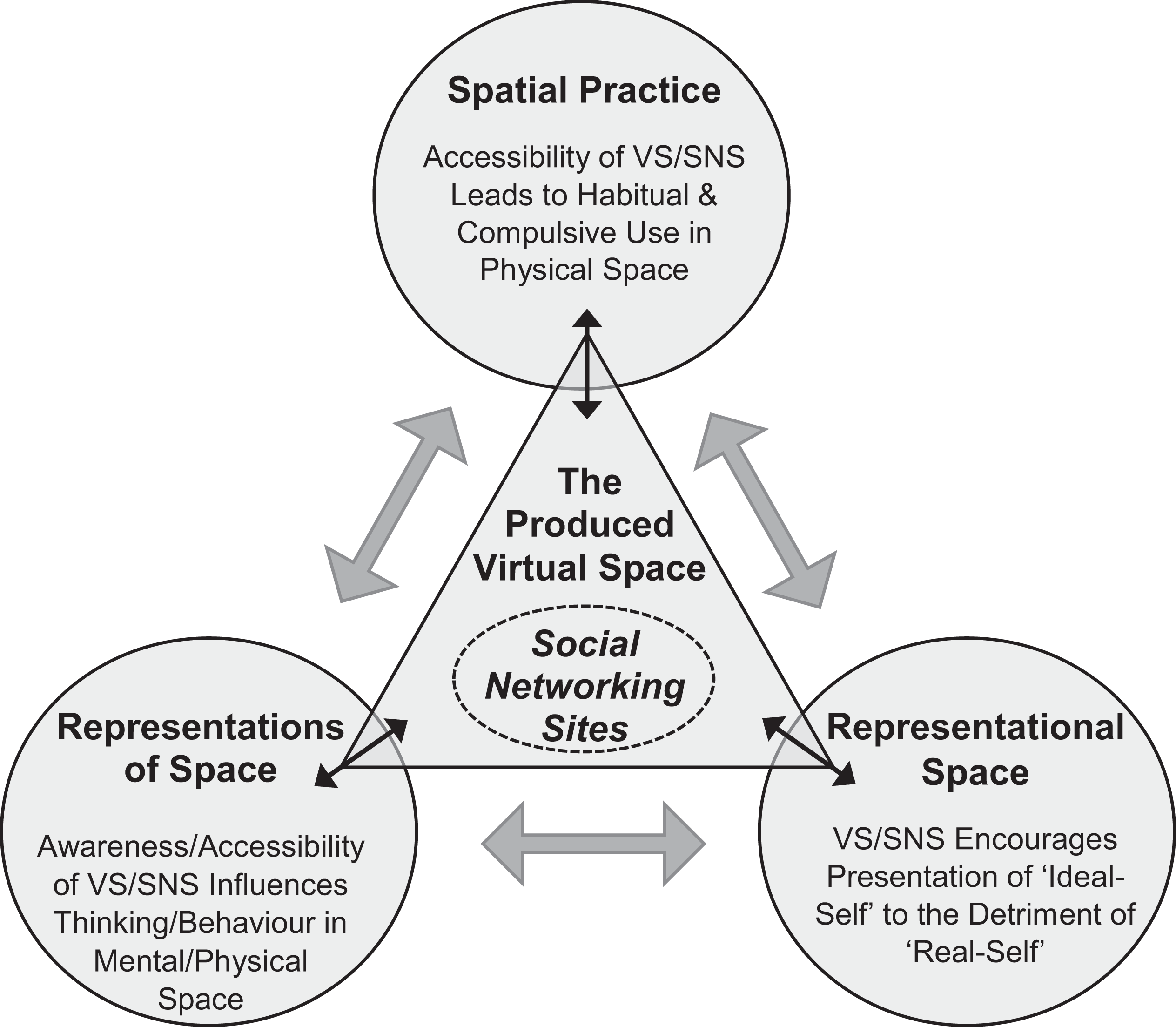
Lefebvre’s trialectic of space as applied to the produced VS via social networking sites.
Aims of the Study
The present research examined three key research questions (RQs) across three intentionally selected groups. Specifically, we explored if (a) access to SNSs can be defined according to Lefebvre’s triad as a VS as depicted in Figure 1, (b) VS will transcend physical space by being accessible (spatial practice) and a constant consideration (representations of space), and (c) impacts of VS on self-esteem will be perceived to carry across to physical space (representational space). Below we highlight each feature of Lefebvre’s triad as applied to VS and SNSs and identify the RQs for spatial practice, representations of space, and representational space.
Spatial Practice, VS, and SNSs
Lefebvre (1991) proposed that spatial practices exist in people’s habits, rituals, and patterns of movement that they adopt in space. Spatial practices explain the manner in which daily routines are “concretized over time” (Urry, 1995, p. 25) via repetition in the space they occur.
When applied to VS, spatial practice represents the manner in which easy access to mobile devices encourages habitual interaction with SNSs. This is supported by data that show people spend ∼8 hr a day on their mobile phones (Roberts et al., 2014) and 2 hr on SNSs specifically (Social Media Today, 2016). Usage patterns such as this led Shambare et al. (2012) to conclude that mobile phones and SNSs encourage a form of use that is potentially “dependency-forming, habitual, and addictive” (p. 577). As observed by Robinson (2018), a demand of “digital connectivity” is to constantly update or be ignored, thus creating a feedback loop between use and identity, which could develop into compulsive SNS use (Alavi et al., 2018). Therefore, it seems logical to explore students’ social practices and routine habits in VS so that we can understand some of the pitfalls of SNS use relative to dependency-forming, habitual, compulsive checking, or addictive spatial practices. We explore the following RQ relative to spatial practice.
Representations of Space, VS, and SNSs
Representations of space relate to how space is conceived, represented, and constructed (Lefebvre, 1991). It reflects how our mental constructions of a given space are reflected in thought, ideation, planning, and categorization (Carp, 2008). Representations of space refer to the manner in which we impose meaning and purpose of a given space via abstract and symbolic representations (Lefebvre, 1991).
When applied to VS, representations of space represent the manner in which VS/SNS shapes thinking (“This would make a good picture to post on Facebook.”) and/or spatial practices (i.e., taking the picture due to the previous thought) in physical space. As observed in a discussion of the “selfie” by Walsh and Baker (2017) and the manner in which it influences the boundary between the private and public domains of an individual, this offers an interesting insight into the way in which VS reconstructs the phenomenology of physical space, with individuals expressing representations of space in how they plan and think about real-world space/events in the VS of SNSs. In extreme cases, individual images of space could be staged purely to satisfy the perceived demands of SNSs and serve to represent their selves in the best possible manner. This is pertinent to the present study given the potential for highly prevalent spatial practices depicted in the previous section in relation to mobile devices vis-a-vis SNSs. We explore the following RQ relative to representations of space.
Representational Space, VS, and SNSs
Representational space relates to the “lived,” produced, and reproduced experiences of space (Lefebvre, 1991). This “lived space” can evoke a sense of meaning and a strong sense of “in-the-moment awareness of being alive or fully present” (Carp, 2008, p. 135). Representational space is not experienced via purely physical properties, but rather an amalgamation of visual, verbal, and/or kinesthetic symbolism, which we observe in pictures, writing, music, gestures, metaphors, signs, or rapt attention (Carp, 2008), that evokes memories and emotions, imposes social norms, and can create a strong sense of social belonging (Buser, 2012). Therefore, representational space is experienced as a fleeting-enhanced consciousness in the lived moment or a retrospective representation, or both.
When applied to VS, all of these are inherently intertwined with an individual’s “lived” experience in SNSs. In that, the design of many SNSs encourages users to present “idealized” pictures of themselves (e.g., using filters to improve the quality of their appearance in a picture), include positive text and music along with those images, and ultimately garner attention through “likes,” “looks,” and “shares” (Nadkarni & Hofmann, 2012). It is a point supported by Vogel and Rose (2016) who reported that Facebook encourages users to construct identities that present themselves favorably. In these instances, we create and project an ideal identity to the potential detriment of who we really are, as we continually attempt to attain the lofty standards that others and we present online (Kasza, 2017).
Promoting an “ideal-self” in a representational space in order to satisfy (with/without explicit awareness/understanding) is a prevalent social norm of SNSs (i.e., taking a “great” selfie, in an interesting location, is what gets “likes” on SNSs, or an “ego boost”; Ward, 2016). Presenting an ideal-self in VS can encourage a psychological phenomenon that Festinger (1954) called “social comparison” (Vogel et al., 2014); that is, judging their own “lived” lives relative to the ideal-selves which others also present online (Chou & Edge, 2012). This sets up a situation whereby people compare their insides to others’ outsides, a comparison they often lose. These can occur in an upward direction, whereby people compare themselves to the social norms and/or others that they believe are better than they are (Collins, 1995). Alternatively, individuals can employ downward social comparison as a means of self-enhancement (Wills, 1981); for example, posting a picture with a friend that they think is more attractive than or is better than what someone else posted. Importantly, Vogel et al. (2014) reported that upward and downward comparisons on SNSs (e.g., high activity as indicated via a high number of “likes” and comments) resulted in lower and higher self-esteem/self-evaluations, respectively.
The impact of chronic exposure to SNS social comparison information on self is likely to create a psychological state which Rogers (1961) called incongruence; that is, a discrepancy “between the self as perceived [ideal-self], and the actual experience [real-self]” of the person (p. 61). As stated by Kasza (2017), the “virtual identity [ideal-self]…often seems to dialogue or compete with the real one, constantly reminding us about our limitations or weaknesses…mainly because often our…[ideal-self] takes over the existing reality” (p. 48). Thus, in the present study, we explore the extent to which high-frequent use of social comparisons and idealization in which incongruence is prevalent can potentially lead to affective consequences such as emotional distress or psychiatric harm. We explore the following RQ relative to representational space.
Method
Participants
Studies 1 (n = 7), 2 (n = 8), and 3 (n = 10) included undergraduate university students (18–25 years) who engaged with VS via SNSs such as Facebook, Instagram, and Twitter. Then within each study, participants had to satisfy the following criteria, which allowed us to probe different aspects of SNS use, specifically (a) posted any original content (i.e., of themselves, others, objects, and places) to VS (Study 1); (b) accessed specific VSs (i.e., Instagram) for the specific purpose of, for example, viewing and liking images (Study 2); and (c) viewed, liked, and posted selfies to VS (Study 3). All participants provided full written informed consent prior to participation. The protocol was granted ethical approval by the Manchester Metropolitan University Ethics Committee and was conducted in accordance with the Declaration of Helsinki (World Medical Association, 2013).
Procedure
One-to-one semi-structured interviews were conducted with each participant. The interviewer explained the purpose of the study, what the interviewee would be asked to discuss, for whom the information was being gathered, how it would be used, and the expected implications of the study. All questions were designed to be open-ended with a number of possible probes. Strict ethical protocol was maintained throughout the study in accordance with the Declaration of Helsinki (World Medical Association, 2013). Interviewees were assured that all data would be kept strictly confidential, and sensitivity to “realities” where interviewees may not be wholly aware of their thoughts and actions was assured. Informed consent forms were completed by interviewees, to which they granted permission to audiotape the interview. All interviews were conducted and recorded using an iPhone 6 recording app and lasted between 30 and 45 min. An electronic trail was kept throughout the study by the researchers to help clarify personal thought processes, methodological decisions, and the reasons for making them. This was considered important for any future audit check. To maintain the agreement of anonymity, each interviewee was assigned an ID number and a pseudonym.
Interview Guide
The interviews required interviewees to “describe their general use and experiences of VS in the SNS environment” via questions and probes. Study 1 relating to RQ1 targeted experiences such as the process of posting to VS. Example question: “Can you tell me about your activities on social media?” Example probes: “How often are selfies a true representation of yourself or your friends?” “Do posts always truly reflect the situation?” Study 2 relating to RQ2 explored the posting and viewing of pictures on VS. Questions targeted motivations and impacts of viewing and posting on Instagram. Example question: “How do you feel when you receive comments or likes/dislikes on an Instagram post?” Example probes: “Have some of the comments altered the way you think or feel about yourself?” “Can you tell me a bit more about the way this has affected you?” Finally, to expand on the responses indicating pictures as a form of communication, Study 3 relating to RQ3 explored the posting and viewing of selfies on VS. Questions were designed to explore the selfie phenomenon. Example question: “What motivates you to take selfies?” Example probe: “Is there a kind of decision process behind what you do and do not post?”
Data Analysis and Establishing Trustworthiness
Data analysis was carried out using computer-assisted qualitative data analysis software QSR NVivo 11, drawing on recursive deductive thematic analysis following the three-stage procedure outlined by Braun and Clarke (2006). A reliability check on the first step of the inductive analysis utilized an independent external check and, secondly, a member-check to ensure that the summary statements accurately reflect the interviewees’ quotations. To establish trustworthiness, one third of interviewees were shown their data interpretations and asked to give feedback on the representativeness of the main categories. This helped the investigator to explore biases and clarify interpretations and decisions made and generally played the role of “devil’s advocate.” The “thick description” shown in the Results section provides sufficient details to allow others to make a judgment about the quality, transferability, and credibility of the research.
Results
We now discuss the main findings as they pertain to our RQs within Lefebvre’s trialectic; that is, spatial practice, representations of space, and representational space.
Spatial Practice
RQ1 concerned the extent to which mobile devices vis-à-vis SNSs modulate the occurrence of habitual and compulsive spatial practices in VS.
With respect to SNSs, spatial practice occurs primarily through people’s mobile devices and as such occurs frequently, in any location, and even automatically. …it also helps that it’s on your mobile phone, so it’s basically attached to your hand all of the time. (Study(S)2. Participant(P)5) It’s quick and easy to just have a scroll. (S2.P5) I’m always on [social media], so I’m always scrolling through Instagram, Twitter, and Facebook. (S1.P4) Probably 15 times a day. I could check it 5 times within half an hour. (S2.P5) Just kind of for the sake of it. (S1.P7) It’s the first thing I check in the morning after turning off my alarm and it’s the last thing I look at before going to sleep. (S2.P1) It’s one of those things that I do to keep my hands and mind occupied, even if it’s not in the way I want it to be. (S2.P4)
The present study also found evidence for the normal engagement with VS, such as facilitating social interaction, communicative, and informational purposes. I don’t post all that often but when I do it tends to be like, pictures of like me and my family, me and my boyfriend err, pictures of me when I’ve gone somewhere so like I went to south end so I found a really pretty castle so I took a picture of that. (S1.P4) I suppose it’s something to show everyone else I’m happy and I’m doing well and enjoying life and…yeah this is what is going on. (S3.P5)
Representations of Space
RQ2 concerned the extent that constant awareness and interaction with SNSs can influence spatial practices in physical space.
The analysis indicates that VS is produced and conceived across multiple locations, which is in contrast to physical space, which is limited to specific zones and centers. VS appears to be a consistent consideration while participants occupy physical spaces. My thought process has changed majorly because before I got involved and obsessed with Instagram and others’ opinion, I would have never stopped people eating or attempted to take videos of clinking glasses of wine with the girls or champagne with my boyfriend. (S2.P1) I think it depends what it is…If it was from a night out, then I would probably put it on that night…I think?! [Pause] Yeah, I normally post them on the same day I take them. (S3.P5)
Accessing VS while occupied in physical space can affect the experiences within physical space. Engagement in VS, even just for checking, may come to the detriment of physical space experiences in the form of procrastination, distraction, and poor time-management (Kuss & Griffiths, 2011), poor academic performance (Kirschner & Karpinski, 2010), and even poorer recall for photographs of physical space experiences (Henkel, 2014). The experience of VS appears to have ramifications for the participants within physical space, a point supported by research that shows people who share SNS networks share behaviors; that is, eating disorders (Christakis & Fowler, 2007) and smoking cessation (Fowler & Christakis, 2008). Indeed, we also observed that how participants wish to present themselves and the decisions they make in physical space can be influenced strongly by experiences within VS. I’ll maybe go out and buy similar clothes to other posters. (S1.P2) I went to London and we went in the ice bar, and it was freezing, and you literally went in, took the pictures and then went. It was purely to get the pictures and then we left. (S1.P5)
Representational Space
RQ3 was concerned with the psychological (e.g., upward social comparisons) and affective consequences (e.g., anxiety) of constantly presenting (and viewing others) idealized self in SNSs.
The “lived experiences” within VS include social comparisons (Vogel et al., 2014) and presentation of the best version of the self (Kasza, 2017). It is thought that every user of SNSs takes part in social comparisons (Neira & Barber, 2014), and the participants of the present study were no different. Even though you know, because everyone is going on about photoshop and how much that’s used in magazines and whatever and even knowing that the pictures you are viewing have been kind of photoshopped, you’re still going to compare yourself to them. (S2.P2) It used to make me feel down, I’d compare my life to others whose lives are completely different to mine, so obviously they are going to have things in life that I don’t have. (S2.P6) If we are all dressed up for a night out and if I’m stood next to [redacted] and [redacted] who are the smallest of us all, it does make me feel as if I’m a whale and I won’t usually post that picture. But, if I’m stood next to [redacted] who is my size or [redacted] or [redacted] who are bigger than me then I will post that image. I suppose it makes you look slimmer, so you feel better with the way that you look. (S2.P5) I do make more of an effort when I am going to take a photo to post online. Sometimes I’ll use a filter which can sometimes hide some blemishes or can mask some lumps and bumps on a full-length photo. (S2.P3) It’s so negative. It’s made me hate myself. (S2.P1) It was one thing that brought my physical and mental health down. (S2.P6) The one thing that I have had a lot of trouble with since spending so much time on Instagram is my body and my self-esteem. (S2.P7) When I have my hair down, because I have my hair up quite a lot, when people see me with my hair down because people see me day to day, when I have my hair down I always get nice comments about my hair being down because I do wear it up a lot day to day so I don’t really post photos with my hair up, I post photos with my hair down because I’ve got quite a lot of positive feedback from that. (S1.P2) If I got someone commenting that was like a horrible comment I would be really offended and be upset about it, and if I put a post-up and it got no likes I’d probably delete it. (S1.P7) I want to see people’s reactions to the selfies. It makes me feel bad when I don’t get likes, I don’t feel very good about myself. (S3.P10)
The impact of the prolonged overuse of VS on psychological well-being may depend on the type of SNS used, along with the spatial practices expressed and the varying degrees of self-disclosure (Valkenburg & Peter, 2009), although the meaning of “overuse” in the context of SNS is quite often ambiguous (Andreassen et al., 2012). There is a continuous thread throughout the current study suggesting that high-competent engagement with VS can be attributable to normal use. However, this can depend on the motivational affordances of the individual and their desire to seek out and react adaptively to the SNS environment. The response from one participant clearly depicts the lived experience of an everyday user with a strong sense of self-awareness and an appreciation of the altered affects that different SNS environments can have on self-concept. The overarching message from this participant is that the lived experience of VS is positive and a fun place to be, although at times it can be psychologically challenging. Um, I think, generally, for an everyday user, it’s a positive platform. You are able to keep in contact with people, like if you follow, there are so many different accounts that you can follow. You can follow pages and learn things or whatever. I think it depends on your mind-set, if you are already in a negative place and mind set and you already have body issues then it might not be the best thing for you. Sometimes it can make you not want to leave the house if you’ve seen that other people are out and didn’t invite you…For an everyday person though, it’s a fun place to be, if it’s used in the right way. If you don’t have the right mind-set it could make you feel very alone and isolated, it could also make you feel like what you are doing is not good enough. (S2.P2)
Summary of the Findings
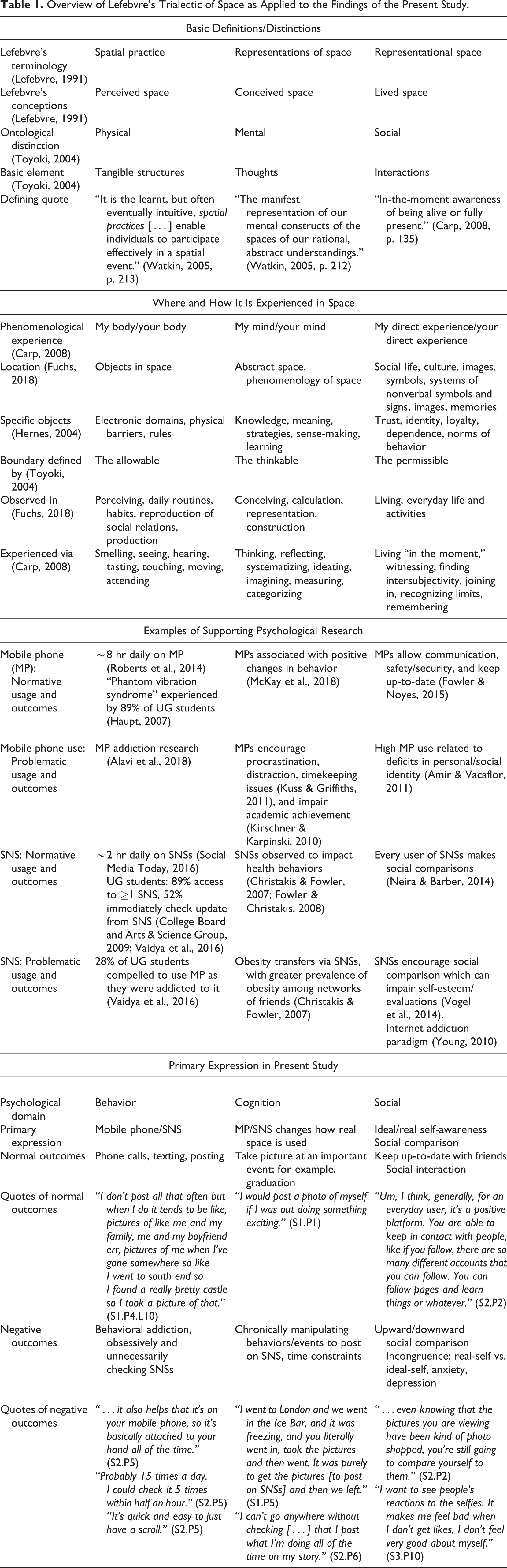
With the aforementioned points in mind, we argue that the responses of the students are a logical extension of Lefebvre’s triad and as such explain why we see the type and nature of responses that we do. To this end, we present Table 1, where for each arm of Lefebvre’s trialectic we identify (i) the main definitions, (ii) how and where each aspect is experienced, (iii) the parallel to extant psychological research, and (iv) how the responses of the current students fit within them.
Overview of Lefebvre’s Trialectic of Space as Applied to the Findings of the Present Study.
Discussion
The preceding Lefebvrian analysis offers a multidimensional means to decipher, categorize, and understand the complicated and often obsessive physical, mental, and social realities of SNS use in undergraduate students. The innovation of the present research is to connect Lefebvre’s trialectic, extant research, and our data within one conclusive study with three specific RQs, namely (i) high, bordering on obsessional use of mobile devices vis-à-vis SNSs (Vaidya et al., 2016); (ii) SNSs influence thinking/practices in physical space (Kosari & Amoori, 2018; Kuss & Griffiths, 2011); and (iii) SNSs are a space that encourages social comparison, incongruence, and subsequent anxiety and depression in users (Kasza, 2017; Vogel et al., 2014). However, it is important to note that we observed normal usage and outcomes across the three aspects of Lefebvre’s triad.
An important consideration is that as we attempt to analyze each arm of Lefebvre’s triad, this can give the impression that they operate independently rather than as an integrated whole. For example, it was evident that spatial practice was intrinsically linked with representations of space, wherein accessibility of mobile devices influenced their frequency of use in physical space. We also saw that an awareness of the need to present an idealized self on SNSs (a demand of representational space) influenced spatial practices designed to achieve that goal in physical space. Lastly, we also saw evidence of a clear bidirectional relationship between the impact of constant social comparison and real/ideal self-incongruence (representational space) and chronic SNS checking (spatial practice). It is evident that not only do these students produce VS online but that it also has a drastic impact on how they function physically, mentally, and socially. Furthermore, our findings are in line with the observation of Kosari and Amoori (2018); that is, that while students live in physical space, they spend a large majority of their time interacting in VS and switching between the two. As we highlighted in the Introduction section, this switching produces a new space to “live” called the Third Space which is defined as an amalgamation, “a blended synthetic” (Kosari & Amoori, 2018) of the physical, mental, and social inputs of SNS use.
The current findings suggest that we have to consider how people experience space in SNSs, and how this affects their physical, mental, and social realities. This is in contrast to focusing on, for example, excessive mobile phone/SNS use in isolation and suggesting that the solution is to use it less. The present findings may help address some criticisms highlighted within the SNS literature. For example, the “Internet addiction” paradigm (Aboujaoude, 2017) has been criticized as the majority of SNS users (Table 1) do not necessarily satisfy definitions of addiction; this can leave them “feeling deceptively immune to the psychological impact of this medium” (p. 1). As observed in the present findings, and in agreement with Aboujaoude (2017), it is evident that the majority of people who use SNSs experience subtle yet definitive psychological changes that are as pervasive as the Internet/SNS itself. Furthermore, our findings are congruent with the literature that shows that mobile devices and the ease of access to SNSs exacerbate impulsivity (Aboujaoude, 2017) and narcissism (Buffardi & Campbell, 2008) and may support the “Online Disinhibition Effect” (Suler, 2004); that is, why when online “some people self-disclose or act out more frequently or intensely than they would in person” (Suler, 2004, p. 321).
The “Online Disinhibition Effect” appears to be an inherent feature of representational space in the present study (Table 1), whereby students often exhibited impulsive, narcissistic, and emotionally intense “lived” experiences when they interacted with SNSs. For example, in the following quote, we see all of these psychological components: “If I got someone commenting that was like a horrible comment I would be really offended and be upset about it [intense emotional response], and if I put a post-up and it got no likes [narcissistic] I’d probably delete it [emotionally motivated impulsive behavior].” In these examples, we see that the production of space in SNSs creates a closed feedback loop that the user is in a sense trapped, wherein a person sees what does well on SNSs (i.e., others idealized presentations of self), which then motivates them to do the same. This, however, only serves to increase the incongruence between their real-self and ideal-self, which results in self-evaluations that are more negative and devalues their self-esteem. This then increases the awareness and negative impact of upward social comparison targets, which brings them back to attempt to match this (i.e., through manipulation of their pictures via filters) in their own posts.
This turns our attention to how the present findings can inform future research as a means to better understand and implement interventions directed at problematic/addictive mobile phone/SNS use. One area that we have been relatively quiet on is the manner in which the produced VS is gendered; that is, the extent that it may encourage agency in one gender and potentially limit it for the other (see Wrede, 2015). As Massey (1994) stated, “From the symbolic meaning of spaces/places and the clearly gendered messages they transmit, to straightforward exclusion by violence, spaces and places are not only themselves gendered but, in their being so, both reflect and affect the ways in which gender is constructed and understood” (p. 179). The importance of gender in SNS use is further underlined by a meta-analysis conducted by Tifferet (2020), who showed that females both give and receive more social support than males. More specifically, research has indicated that females are more likely to use SNSs to compare themselves to others, whereas men are more likely to look at others’ profiles and find friends (see Haferkamp et al., 2012). Thus, we advise future research to explore gender differences in spatial practice (e.g., physical habits in relation to SNSs), representations of space (e.g., cognitive representations of SNSs), and representational space (e.g., lived experience of SNSs), and more importantly how the three arms of Lefebvre’s trialectic combine to result in gendered differences in the produced VS.
In summary, SNSs can be dynamic and challenging environments that evolve movement toward natural engagement, purpose, and perseverance. The suggestion is that the lived experience can be positive and that overcoming initial vulnerabilities and developing resilience are an outcome of successful adaptation processes that can restore and maintain emotional well-being. Developing interventions to build resilience in young people can enhance self-efficacy and emotional competence, minimize vulnerability, and increase the likelihood that they will make appropriate and safe decisions in their VSs. We further advise future research to try to untangle the deeply emotional experiences that people experience when they produce and reproduce space in SNSs.
Footnotes
Data Availability
The anonymized data are available from Dr. Benjamin Harkin;
Declaration of Conflicting Interests
The authors declared no potential conflicts of interest with respect to the research, authorship, and/or publication of this article.
Funding
The authors received no financial support for the research, authorship, and/or publication of this article.