



Abstract
Smartphones are ubiquitous and frequently used in copresent interactions. This behavior is often seen as inappropriate and thus has been termed phubbing, compromising the words “phone” and “snubbing.” Although being a worldwide phenomenon, little is known about what predicts phubbing behavior in the first place. Drawing on injunctive norms (i.e., what ought to be done), the study’s aim was to shed light on the relationship between mobile phone norms (MPN) and phubbing behavior. Furthermore, the role of being permanently online and permanently connected (POPC) and fear of missing out (FOMO), reflecting approach and avoidance orientations, respectively, as additional predictors and moderators was investigated. As expected, the findings of an online survey (N = 278) supported the assumption that MPN were negatively related to phubbing behavior. Moreover, results showed that both FOMO and POPC were significantly positively connected to phubbing behavior but did not play significant moderating roles concerning the norm–phubbing relationship.
Keywords
In today’s always-on society, smartphones are an integral part of our daily life. Current data show that around 7.9 billion people worldwide have a mobile subscription (Cerwall, Jonsson, & Carson, 2019). Particularly, younger individuals look at their smartphones more than 10 times a day (e.g., Bitkom, 2017). Most people have become inseparable from their smartphones (Turkle, 2011). This allows them to stay connected with relevant others which can be beneficial for social interactions (Ling, 2004). Therefore, smartphones provide many advantages, especially with regard to maintaining social relations. Nevertheless, constant smartphone use may demand their users’ attention and, thus, may be detrimental to social interactions with persons who are physically present (e.g., Misra, Cheng, Genevie, & Yuan, 2016; Roberts & David, 2016; Vanden Abeele, Antheunis, & Schouten, 2016). Such a situation, in which one person interacts with at least one other person who is physically present, is called a copresent interaction (for a discussion of copresence in a mobile media environment, see Burchell, 2017). By focusing on one’s phone instead of paying attention to the interlocutor(s), interpersonal communication is disturbed (e.g., Chotpitayasunondh & Douglas, 2016; Kushlev & Heintzelman, 2018).
In 2012, the Macquarie Dictionary invented a word for snubbing the communication partner with one’s phone, namely phubbing. The term has achieved worldwide attention and has opened wide-ranging debates (Ugur & Koc, 2015). Researchers on phubbing have often focused on its consequences and seem to agree that those effects are rather detrimental to health and personal relationships (e.g., on trust, social relationship quality, or well-being; Chotpitayasunondh & Douglas, 2018a; David & Roberts, 2017; Misra et al., 2016; Przybylski & Weinstein, 2013; Roberts & David, 2016, 2017). With regard to the question what determines phubbing behavior, however, the answer is less clear. Phubbing was connected to behavioral addictions (e.g., Chotpitayasunondh & Douglas, 2016; Davey et al., 2018; Karadağ et al., 2015) and, more recently, to personality traits (e.g., Błachnio & Przepiorka, 2018; Erzen, Odaci, & Yeniçeri, 2019).
In the present article, we want to examine the predictors of phubbing behavior from a less pathological perspective. Instead, we focus on normative and situational aspects. In doing so, we want to combine predictors of phubbing that have rarely been researched so far. More specifically, we want to shed light on how mobile phone norms (MPN; e.g., Hall, Baym, & Miltner, 2014), being permanently online and permanently connected (POPC; Vorderer, Hefner, Reinecke, & Klimmt, 2018; Vorderer, Krömer, & Schneider, 2016), and fear of missing out (FOMO; Przybylski, Murayama, DeHaan, & Gladwell, 2013) may predict phubbing behavior in a specific situation.
Nowadays, being POPC is taken for granted (Burchell, 2015; Ling, 2012). Thus, it is not surprising that phubbing behavior finds its place in various situations: being at home with family, while going out with friends, or at the office with colleagues. Such situations in which it is possible to communicate online and face-to-face at the same time require new norms about how to behave (Vorderer et al., 2016). Using one’s phone in copresent interactions implies inappropriate manner, which is why smartphones “clash…with many social situations” (Ling, 2004, p. 125). Consequently, smartphones can be regarded as challengers of social norms. Given that social norms predict behavior (e.g., Cialdini, Kallgren, & Reno, 1991; Cialdini, Reno, & Kallgren, 1990), it is assumed that there is a relationship between social norms and phubbing behavior. Accordingly, injunctive (i.e., ought) norms provide a suitable framework for analyzing the (in)appropriateness of smartphone usage when being with others. What is ought to be done with one’s smartphone is hereinafter referred to as MPN (Hall et al., 2014, p. 135), which are assumed to predict phubbing behavior.
One central aim of the study is to investigate the relationship between MPN and phubbing behavior. However, the influence of norms on certain behavior can depend on additional conditions (Staub, 1972). To examine such boundary conditions, a rather well-established predictor of phubbing, FOMO (e.g., Chotpitayasunondh & Douglas, 2016; Davey et al., 2018), and a recently developed construct that taps into online vigilance while being POPC (Klimmt, Hefner, Reinecke, Rieger, & Vorderer, 2018; Reinecke et al., 2018) are also investigated. They could serve as additional predictors of phubbing and as moderators of the relationship between normative phone use and phubbing. Whereas FOMO represents an avoidance motivation (e.g., because individuals do not want to miss out on what’s going on in online conversations on social media, they turn to their smartphone), online vigilance can be characterized as an approach motivation, an orientation toward the mobile device and its affordances.
Theoretical Framework
Phubbing
Smartphones are ubiquitous in everyday life. In copresent interactions, however, smartphone usage has often been regarded as a disturbance (e.g., Błachnio & Przepiorka, 2018; Chotpitayasunondh & Douglas, 2016; Karadağ et al., 2015; Kushlev & Heintzelman, 2018; Ling, 2012), which may cause social dilemmas (Inbar, Joost, Hemmert, Porat, & Tractinsky, 2014). By focusing on their phones, individuals risk their full participation in copresent interactions (Cahir & Lloyd, 2015; Vanden Abeele et al., 2016). Being physically copresent but mentally elsewhere is referred to as “absent presence” (Gergen, 2002, p. 227) or “connected presence” (Licoppe, 2004, p. 135). By using the smartphone in copresent interactions, thereby focusing on a physically absent person, one neglects the physically present other (Campbell, 2007), who then feels ignored and excluded (Chotpitayasunondh & Douglas, 2018a; David & Roberts, 2017). Sometimes, even the pure presence of phones negatively affects social interactions (Przybylski & Weinstein, 2013; Turkle, 2015). Consequently, the use of phones in such situations negotiates the social responsibilities of the physically present partners (e.g., Humphreys, 2005). This means that by not focusing on one’s phone, one devotes full attention to the physically present other and therefore shows desirable behavior. Previous inquiries have linked (smart)phone use in copresent interactions to violation of norms (e.g., Inbar et al., 2014), conversation quality (e.g., Misra et al., 2016; Przybylski & Weinstein, 2013; Vanden Abeele et al., 2016), relationship quality (e.g., Chotpitayasunondh & Douglas, 2018a; Hall et al., 2014), romantic relationships (e.g., Roberts & David, 2016), and psychological well-being (e.g., Gonzales & Wu, 2016). In all these studies, using one’s phone while being with others was regarded as “rude and socially inappropriate” (Vanden Abeele et al., 2016, p. 562).
Smartphone use in copresent interactions is indeed often considered a disruption. However, obviously ignoring those being present may be seen as even more negative or interpreted as a “[l]ack of care” (Cahir & Lloyd, 2015, p. 716). This has been coined phubbing—a portmanteau composed of the words phone and snubbing. Phubbing is the act of snubbing copresent people by focusing on one’s phone (Chotpitayasunondh & Douglas, 2016; Haigh, 2015; Turkle, 2015). Phubbers can be found in almost every social situation (Ugur & Koc, 2015). Although the phenomenon of ignoring others via phone is not a new one, there has not yet been a lot of research on phubbing. Due to the increasing permanent connectedness and the availability to access online services almost anywhere and anytime, it seems plausible that mobile phones are not only used when people are alone but that these habits are also transferred into copresent situations. For instance, with regard to romantic relationships, focusing on one’s phone instead of focusing on the conversation partner leads to lower partner trust and a lower perception of both relationship quality and empathy (e.g., Misra et al., 2016; Przybylski & Weinstein, 2013; Roberts & David, 2016). Moreover, pathological predictors such as problematic smartphone or Internet use were positively linked to phubbing behavior (e.g., Chotpitayasunondh & Douglas, 2016; Davey et al., 2018; Karadağ et al., 2015). However, with regard to common and nonpathological use of smartphones, only self-control and FOMO were examined as predictors of phubbing behavior (Chotpitayasunondh & Douglas, 2016). Most recently, there have been some rare attempts to focus on further characteristics of the person (e.g., loneliness, self-esteem, and satisfaction with life, Błachnio & Przepiorka, 2018; conscientiousness and neuroticism, Erzen et al., 2019).
Although several predictors of phubbing have already been examined, the fact that MPN may be associated with phubbing behavior and that this relationship may be moderated by approach or avoidance orientations has been neglected so far. Thus, the question arises how do MPN (e.g., Hall et al., 2014), FOMO as an avoidance motivation (Przybylski et al., 2013) and online vigilance as an approach orientation (Reinecke et al., 2018) predict phubbing behavior.
Injunctive Norms and MPN
As daily life is inseparably connected with using smartphones (Turkle, 2011), the emergence of etiquettes is imperative (Ling & McEwen, 2010). How to use one’s phone is often referred to as mobile phone etiquette—“a commonly agreed upon set of customs, rules or manners by people in society for the use of mobile phones in both public and private spaces…” (Totten, Lipscomb, & Irtisam, 2015, p. 267; see also e.g., Katz, 2003, 2006; Ling, 1997, 2004). Etiquettes, and especially their noncompliance, help individuals to assess the (in)appropriateness of mobile phone use in certain situations (Ling, 2012). For instance, making a phone call in a restaurant is regarded inappropriate as users tend to speak loudly on their phone, which furthermore bothers physically present others (Ling, 1997). Mobile phone etiquette closely resemble the core meaning of social norms.
Social norms are individual guidelines of how to behave within society (Cialdini et al., 1991). As social norms have several meanings, it is difficult to define them clearly. With regard to MPN, the common distinction between injunctive and descriptive norms is of particular interest for the present study. Generally, the former indicates what ought to be done referring to moral (dis)approval, whereas the latter refers to what is actually done by the majority of one’s social group and is therefore regarded as “normal” (Cialdini et al., 1991; Cialdini et al., 1990). Injunctive norms are connected with how individuals expect themselves and others to behave (Ling & McEwen, 2010). This can be linked to any behavioral intention. For instance, whether one ought to check one’s smartphone can be determined by the individual sense of injunctive norms depending on the social context. Particularly, MPN describe the perception of acceptable and unacceptable use of mobile phones in various situations (Hall et al., 2014), for instance, whether one perceives texting on a smartphone in a copresent situation as acceptable or not. As new technologies have always been a challenger of social norms (Simpson, 2010), it is not surprising that smartphones have also raised problems concerning how to behave in society (Rainie & Zickuhr, 2015), especially with regard to (in)appropriate behavior (Ling & McEwen, 2010). Thus, it seems plausible that social norms of phone usage can also influence phubbing behavior. More specifically, the stronger individuals adhere to MPN, the less they phub. In other words, we expected that MPN will be negatively related to phubbing behavior (Hypothesis 1).
Assuming that individuals’ strong MPN may prevent or reduce phubbing behavior, the question arises why some may engage in phubbing although they perceive MPN as important. When investigating the relationship between norms and behavior, it is important to take additional influences into account (e.g., Staub, 1972).
FOMO and Phubbing
Given an “always-on” mentality, especially young people tend to continually check their digital devices in order to not miss out on the experiences of others within their social spheres. As missing out on the experiences of others can lead to feeling excluded (e.g., Schneider et al., 2017; Vorderer & Schneider, 2017), the solution lies within permanent monitoring of what is happening in the social online environment (Klimmt et al., 2018).
FOMO (Przybylski et al., 2013) refers to “a pervasive apprehension that others might be having rewarding experiences from which one is absent” (p. 1841). This desire of staying permanently connected with others in order to know what they are experiencing while not being with them can explain an individual’s constant usage of smartphones (Vorderer et al., 2016). FOMO is negatively associated with general mood and overall life satisfaction and arises from a deficiency in need satisfactions (Przybylski et al., 2013). This, in turn, can trigger self-regulative behavior in such a way that individuals engage more in sharing information on social media (e.g., Alt, 2015, 2018; Buglass, Binder, Betts, & Underwood, 2017; Przybylski et al., 2013). Even prohibited actions, such as texting while driving, may occur due to the anxiety of missing out on what is occurring online. Young adults high in FOMO were more vigilant to texts, e-mails, and their phone in general while driving than those low in FOMO (Przybylski et al., 2013). Besides violating the law, the contempt of social norms is a negative aspect of FOMO. While being in a face-to-face conversation, individuals’ FOMO should be satisfied because they are not missing out on information provided in this current situation. What is occurring online, however, cannot be known unless checking one’s digital device during the face-to-face communication. As a result, individuals seem to focus on both the communication partner(s) offline as well as the one(s) online (Vorderer et al., 2016). Thus, they must divide their attention (e.g., Cahir & Lloyd, 2015; Humphreys, 2005; Ling & McEwen, 2010) to avoid the FOMO on something “better.” Ironically, by checking online content and dividing one’s attention in a copresent situation, the individual indeed misses out on necessary offline conversations.
The urge to check one’s phone in order to avoid missing out on something happening online can be a reason why individuals reach for their phones even when being with physically present others (Chotpitayasunondh & Douglas, 2016; Davey et al., 2018). Therefore, we assumed that FOMO directly relates to phubbing behavior (Hypothesis 2a). Moreover, the contempt of social norms occurs in the sense of dividing one’s attention instead of focusing on the present communication partner(s). As sufferers of FOMO want to constantly check online content to not miss out on online experiences, FOMO could also explain why people tend to phub even when strongly adhering to MPN. We additionally assumed that FOMO serves as a moderator of the relationship between MPN and phubbing behavior. More precisely, if FOMO is high, the correlation between MPN and phubbing will be weakened (Hypothesis 2b).
POPC and Phubbing
The ubiquity of mobile online devices allows for accessing online content independent of time and place and staying connected with others (Rainie & Zickuhr, 2015; Vorderer et al., 2016; Vorderer et al., 2018). This phenomenon has been termed POPC, which comprises the permanent use of online content (PO) and the permanent participation in online interactions (PC) contemporaneous with other offline activities (Vorderer et al., 2016). On the one hand, POPC encompasses the usage of online services. On the other hand, it includes the subjective tendency of being constantly connected to others. This also implies being “permanently on the call” (Halfmann & Rieger, 2019) and refers to “a psychological state of permanent communicative vigilance” (Vorderer et al., 2016, p. 695). The phone users’ constant awareness that online communication and content is permanently available and the fact that they are motivated to approach both in order to meet expectations of POPC have been coined online vigilance (e.g., Klimmt et al., 2018; Reinecke et al., 2018).
Although research on effects of being POPC is still in its infancy, some studies found that related behaviors negatively impact individuals’ well-being (for an overview, see Reinecke, 2018). Being POPC in social situations, however, is an aspect that requires further research: POPC may enter new areas which were not regarded as appropriate before and that “these new forms of behavior will at least at times conflict with already existing social rules about how to behave in specific contexts” (Vorderer et al., 2016, p. 702). Although being POPC is less common in copresent interactions (Vorderer et al., 2016), the phenomenon of constantly checking one’s phone when others are present is taking place in various everyday situations (Oulasvirta, Rattenbury, Ma, & Raita, 2012; Turkle, 2015). Individuals seem unable to ignore their phones when receiving a text message (Cahir & Lloyd, 2015), even while being interviewed (Burchell, 2015). However, as it clashes with MPN, individuals perceive phone use in copresent interactions as inappropriate behavior (e.g., Vanden Abeele et al., 2016). Nevertheless, because they are highly motivated (Turkle, 2011), people may engage in phubbing behavior, even though they adhere to MPN. Thus, we assumed that POPC directly relates to phubbing behavior (Hypothesis 3a) but also moderates the relationship between MPN and phubbing behavior. More precisely, we predicted that POPC will weaken the negative norm–phubbing relationship (Hypothesis 3b).
Method
Participants and Procedure
To test the hypotheses, an online survey was conducted. Participants were recruited via social networking sites (e.g., Facebook). The final convenient sample consisted of N = 278 participants (74% female, Mage = 26.78; SDage = 10.00). Most of them indicated having a higher education entrance qualification (51%) or a university degree (28%). In total, the questionnaire consisted of 54 items. All questions had to be answered in order to avoid missing data. Data are available via the Open Science Framework (https://osf.io/dgm7s/).
Measures
Phubbing behavior
To assess phubbing behavior, a text was presented to the participants, indicating that nowadays it is possible to use one’s smartphone almost always and everywhere and that sometimes smartphones are used in the presence of others without including them in the process of checking one’s phone. Afterward, the participants should describe their last lunch situation with a friend. Lunchtime was chosen because it usually lasts about 1 hr. Thus, an estimation of phubbing frequency and duration may allow for a comparison between the participants. Moreover, lunch as opposed to dinner (which could also indicate a romantic date) was assumed to be rather spent in the circle of friends or colleagues. Participants reported that their lunch took between 30 and 120 min. First, participants were asked about their own and their friend’s frequency of phubbing in this situation. Second, the question was repeated now referring to the duration of the phubbing episodes. If participants indicated that they and/or their friend had not engaged in phubbing at all, the following questions concerning the duration were skipped. In order to avoid bias, the items of phubbing frequency and duration of oneself and of the friend were presented in a randomized order. In line with the approach of Chotpitayasunondh and Douglas (2016), participants’ phubbing behavior was measured by the frequency and duration of phubbing. Frequency was rated on a scale from 1 (never) to 7 (very frequently) and duration from 1 (extremely short) to 7 (extremely long). In contrast to Chotpitayasunondh and Douglas (2016), who used a sum score, a multiplicative index was built with the following formula: phubbing frequency × phubbing duration. In comparison to an additive index, a multiplicative index has the advantage that high values in one variable cannot compensate for low values in another. However, the multiplicative index was almost identical to the additive version (r = .95), and results of analyses using the additive index showed no substantive differences.
MPN
Participants’ perception of (in)appropriate mobile phone behavior was measured with seven items of MPN in private conversation contexts (Hall et al., 2014). As social norms always depend on situational contexts (Cialdini et al., 1990), in this study, MPN were reduced to copresent situations in which two friends interact (i.e., private context; Hall et al., 2014). Participants had to rate statements concerning the private conversation of two friends (e.g., “During a private conversation, it should not be texted on the smartphone” or “During a private conversation, none of the two people should watch a video alone on the smartphone”) on a Likert-type scale from 1 (do not agree at all) to 7 (fully agree).
FOMO
FOMO was assessed using the FOMO Scale (Przybylski et al., 2013). All items (e.g., “I fear my friends have more rewarding experiences than me” or “When I have a good time it is important for me to share the details online”) were rated on a scale from 1 (does not apply at all) to 7 (fully applies) in terms of to what degree the statements applied to the participants personally.
POPC
Participants’ awareness of the permanent availability of online communication and content was measured with the German Online Vigilance Scale (OVS; Reinecke et al., 2018). In total, the OVS consists of 12 items that are equally allocated to three subscales, namely Salience (e.g., “My thoughts often drift to online content”), Monitoring (e.g., “I constantly monitor what is happening online presently”), and Reactibility (e.g., “When I receive an online message, I immediately give it my full attention”). Participants were asked to indicate their answers on a Likert scale from 1 (does not apply at all) to 7 (fully applies).
We also included a brief measure of social desirability in our questionnaire (Paulhus, 1984; Schneider, 2012). However, these measures showed low reliability estimates and were not related to phubbing behavior. Thus, we excluded them from our analyses.
Results
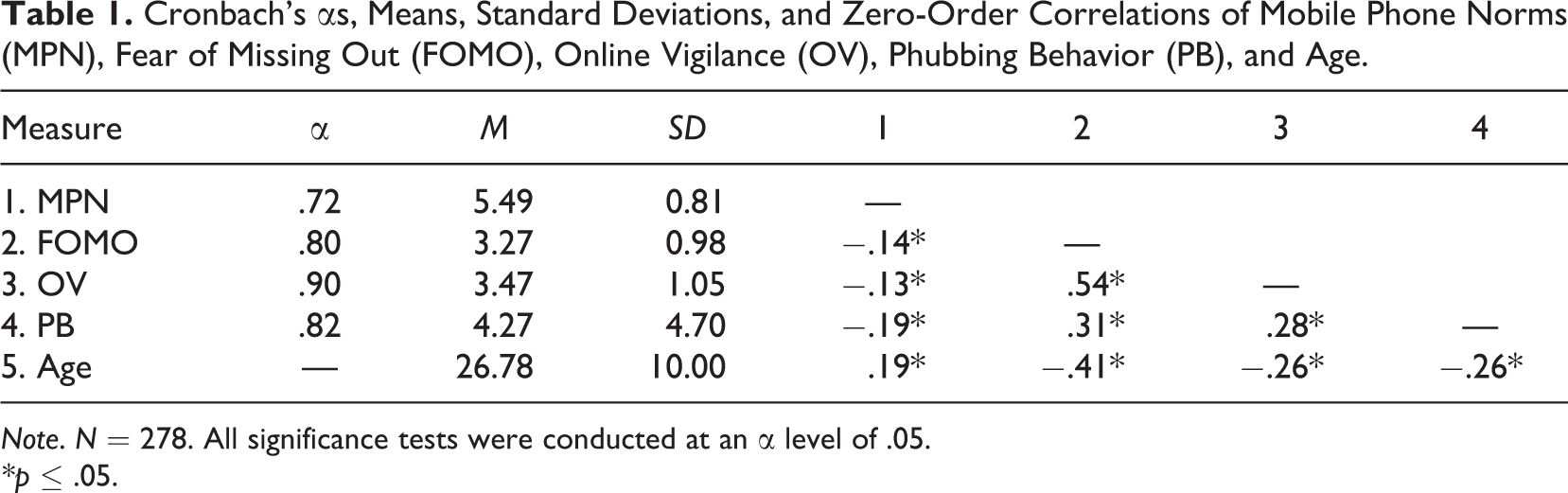
Table 1 presents the means, standard deviations, and the zero-order correlations as well as the scales’ reliability estimates. Participants showed relatively high levels of MPN. Concerning the moderators, participants reported moderate levels of FOMO and POPC. As age was significantly related to all constructs of interest, it was included in the analyses as well. Building two-way and three-way interaction terms with age neither returned significant coefficients nor significantly changed the amount of explained variance. However, age was a significant predictor of phubbing behavior. Accordingly, we added age as a covariate in the analysis.
Cronbach’s αs, Means, Standard Deviations, and Zero-Order Correlations of Mobile Phone Norms (MPN), Fear of Missing Out (FOMO), Online Vigilance (OV), Phubbing Behavior (PB), and Age.
Note. N = 278. All significance tests were conducted at an α level of .05.
*p ≤ .05.
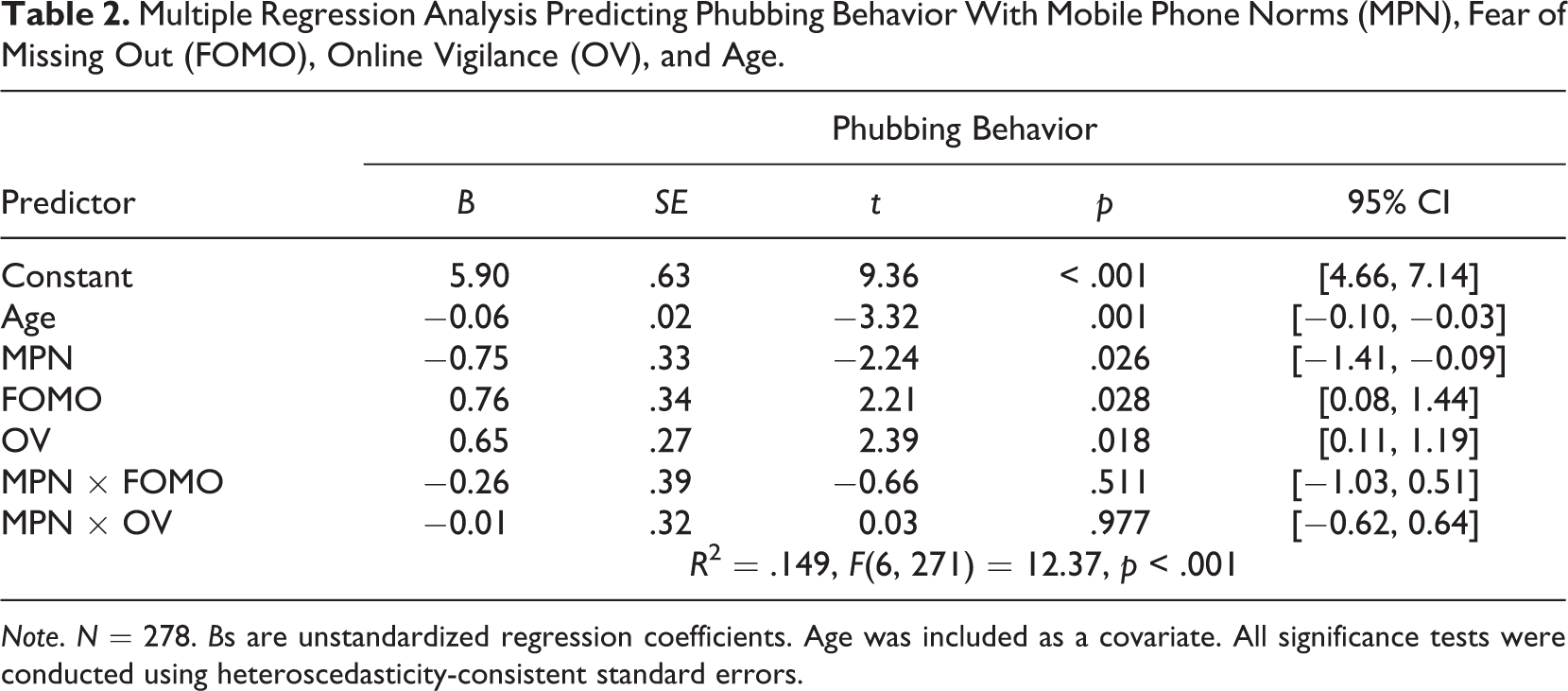
In order to test the hypotheses, we ran a multiple regression analysis applying the SPSS PROCESS macro (Version 3.3) of Hayes (2018). As the assumption of homoscedasticity was violated, heteroscedasticity-consistent standard errors were used. All predictors were mean-centered. Table 2 shows the results. Unstandardized coefficients are reported.
Multiple Regression Analysis Predicting Phubbing Behavior With Mobile Phone Norms (MPN), Fear of Missing Out (FOMO), Online Vigilance (OV), and Age.
Note. N = 278. Bs are unstandardized regression coefficients. Age was included as a covariate. All significance tests were conducted using heteroscedasticity-consistent standard errors.
As expected in Hypothesis 1, the stronger an individual’s MPN, the less phubbing behavior occurred (B = −.75, p = .026). However, this relationship was neither moderated by FOMO (B = −.26, p = .511) nor by POPC (B = −.01, p = .977)—unlike as expected in Hypotheses 2b and 3b, respectively. Examining the unique contributions of FOMO (B = .76, p = .028) and POPC (B = .65, p = .018) to explain variance in phubbing behavior (Hypotheses 2a and 3a, respectively) showed that both of them were significantly positively related to phubbing behavior (see Table 2). Moreover, age was significantly negatively associated with pubbing behavior (B = −.06, p = .001) The complete model accounted for 15% of the variance in phubbing behavior, F(6, 271) = 12.37, p < .001.
To check for a potential bias due to the high number of female respondents in our sample, we also ran exploratory analyses including gender as a covariate and as part of additional interaction terms. None of these analyses showed any significant increase in R2 or yielded significant coefficients including gender.
Discussion
Phubbing means ignoring communication partners in copresent interactions by focusing on one’s mobile phone. To extend previous research on the determinants of phubbing, one major goal of the present study was to investigate the interplay of relatively new predictors such as mobile phone norms (MPN), fear of missing out (FOMO), and being permanently online and permanently connected (POPC) for the first time. Most importantly, drawing on social injunctive norms, we assumed that MPN are negatively associated with phubbing behavior. Indeed, the findings revealed that individuals with strong MPN tended to engage in less phubbing. Thus, MPN can be regarded as an important correlate of phubbing. This is in line with an experimental study, which showed that social norms are important factors in identifying effects of public phone usage and emphasized the outcome of copresent mobile phone use on one’s mental state (Gonzales & Wu, 2016). These findings also extend research on the determinants of phubbing as this study is the first that specifically includes MPN.
Of course, MPN are not the only predictors of phubbing. Thus, this study only offers one part of the puzzle. For instance, human behavior is also dependent on an internal sense of what is regarded as correct and incorrect behavior (Ling & McEwen, 2010). Moreover, a second set of norms exists, namely those referring to the absent person(s): While writing an online message, for instance, the sender expects an answer, and vice versa, the recipient expects the sender to expect an answer (Mai, Freudenthaler, Schneider, & Vorderer, 2015, p. 298). Such reciprocal expectations of being constantly in contact have become the norm as well (Bayer, Campbell, & Ling, 2016). Accordingly, despite being able to distinguish between appropriate and inappropriate behaviors, individuals constantly face the problem to “balance interpretations of emergent social conventions with personal desires to connect at the moment” (Ling & McEwen, 2010, p. 12). Thus, norms with regard to the relevant others online must be taken into account too. It might be as well regarded as inappropriate to not answer to an online message immediately and, thus, put pressure on the receiver of a message (Halfmann & Rieger, 2019; Mai et al., 2015). Additionally, it is important to emphasize that social norms and perceptions of appropriate mobile phone use depend on different contexts and people (Vanden Abeele et al., 2016) as well as on various cultures (e.g., Campbell, 2007). In line with this context dependency, for example, accessing a second communication device during a video interaction had only little effect on experiencing the conversation (Sprecher, Hampton, Heinzel, & Felmlee, 2016). Such a “hyperconnectivity” may neither be detrimental to the actor nor to the partner but could shape social norms in the long run (Sprecher et al., 2016). Thus, it seems necessary to take specific features of various situations into account and include aspects of multitasking in future studies. Finally, investigating norms and motivations related to disconnection in copresent interactions may be a worthwhile endeavor as well. This does not only include the mobile phone’s disconnective affordances (Mannell, 2019) but also how to negotiate everyday communication across many social situations (e.g., family, work) on a continuum from “networked” presence and absence (Burchell, 2017).
Besides MPN, we tested the moderating roles of being POPC (as an approach orientation) as well as FOMO (as an avoidance orientation) on the norm–phubbing relationship. However, both assumed moderations were not significant. One reason could be that participants indicated only moderate levels of POPC and FOMO. Thus, a sample with higher levels of and more variance in POPC and FOMO might have led to different results. Moreover, POPC is defined in terms of general online use and connectedness over the Internet and FOMO is a predictor for general social media engagement (e.g., Alt, 2018). As smartphones are not only used for accessing the Internet or for using social media but also for other reasons, these two constructs may be too broad to function as particular moderators in the context of smartphone use, norms, and phubbing. Nevertheless, the results showed that both FOMO and POPC are significantly positively connected to phubbing behavior. Although FOMO and POPC are not seen as pathological, these findings are in line with previous research that found that similar concepts like the need for communication or mobile phone addiction predicted phubbing (e.g., Chotpitayasunondh & Douglas, 2016; Karadağ et al., 2015). Moreover, the fact that POPC was positively associated with phubbing but negatively with MPN lends support to the idea that new forms of approaching and dealing with online content can conflict with social rules (Vorderer et al., 2016). Although conceptually different, the same holds true for FOMO. Individuals nowadays tend to continually check their digital devices in order to avoid missing out on the experiences of others, especially of those within their social online environment. Thus, the constant threat of missing out may lead to habitual checking which, in turn, could result in problematic use of one’s electronic device, especially of one’s phone in copresent situations.
Finally, the predictive validity of the sociodemographic variables, gender and age, was examined. Although our sample was mainly female, gender did not bias the results when being included as a control or moderating variable. However, we found that the participants’ age was significantly related to all constructs of interest. Although age did not moderate the relationships between predictor and criterion variables, it significantly contributed to the prediction of phubbing. Older people indicated less phubbing. As the sample included mainly younger female persons, it would be interesting to look at samples with more variability in sociodemographics in general and at older people in particular.
With all these contributions in mind, there are also some limitations to mention. Firstly, the main limitation of the study is its cross-sectional design. Although the negative MPN–phubbing association has been based on theoretical assumptions, it is also possible that if individuals phub others, this may, in turn, influence their perception of social norms (Chotpitayasunondh & Douglas, 2016). Phubbing behavior could therefore be regarded as less inappropriate when often using one’s smartphone in copresent interactions. Although the correlational design prevents causal claims, we assumed that MPN are rather stable individual characteristics that influence phubbing behavior in a specific situation. The same may hold true for POPC and FOMO. However, in the long run and with regard to specific targets, phubbing behavior may influence an individual’s perception of MPN. Thus, the causal relation could also work the other way around. Future research should conduct experimental or appropriately designed longitudinal studies to delineate the causal relationships.
Secondly, as norms serve as predictors of behavior (Cialdini et al., 1991; Cialdini et al., 1990), it was assumed that individuals with weaker adherence to MPN would phub more. Although we found support for this assumption, the mean of the phubbing index was very low. This measure was based on the phubbing index by Chotpitayasunondh and Douglas (2016). Alternative avenues could apply the Partner Phubbing Scale (Roberts & David, 2016) or the newly developed Generic Scale of Phubbing (Chotpitayasunondh & Douglas, 2018b).
As this study focused on friendship dyads solely, future research could also consider other relationships: Phubbing behavior in romantic relationships (Roberts & David, 2016) and in groups (Turkle, 2015) might be different from phubbing behavior between two friends. The research field of phubbing behavior is relatively new, which opens much potential for future research. Considering that, the study’s results may provide a suitable starting point for future investigations of the norm–phubbing relationship or examination of other moderating factors. For instance, despite existing norms and laws concerning texting while driving, individuals do so nevertheless due to automatic behavior (Panek, Bayer, Dal Cin, & Campbell, 2015). Individuals with a high mindfulness and a strong self-control, in turn, are able to resist this automaticity (Panek et al., 2015). Similarly, if individuals experience mindful, self-controlled, and meaningful interactions, this may strengthen their sense of coherence and make them less vulnerable for the negative effects of POPC (cf. Schneider, Halfmann, & Vorderer, 2019). Accordingly, it would be interesting to test whether automaticity serves as a predictor of phubbing and how self-control and mindfulness could work against it.
Conclusion
MPN relate to smartphone use in copresent interactions. Our findings show that the stronger one’s adherence to MPN, the less phubbing behavior occurs. Thus, it could be helpful to define explicit etiquettes for smartphone usage in order to present a common guideline about how to behave with the digital devices when being with others. By developing common and strong MPN, phubbing behavior could be reduced if individuals focus more on physically present others and pay more attention to copresent interactions.
Following previous studies which found that smartphone use in copresent interactions negatively affected relationship quality (e.g., Hall et al., 2014; Roberts & David, 2016), we assume phubbing behavior to negatively influence relationships as well. Consequences of permanently focusing on one’s phone can be observed in various everyday situations. Recalling what ought to be done when being with others might help prevent possible damage on relationships. By checking one’s phone in copresent interactions, individuals gain stimulating information but lose the conversation, the attribution of meaning, and the feelings of the copresent person(s) (Turkle, 2015). By managing and limiting one’s availability via smartphones (Mannell, 2019) and instead focusing on the physically present other, individuals might strengthen their interpersonal relationships. In conclusion, smartphones offer many advantages but “[j]ust because we can use [them] to connect with others any time from any place doesn’t mean that we should” (Simpson, 2010, p. 81).
Footnotes

Declaration of Conflicting Interests
The authors declared no potential conflicts of interest with respect to the research, authorship, and/or publication of this article.
Funding
The publication of this article was funded by the Ministry of Science, Research and the Arts Baden-Württemberg (Germany) and the University of Mannheim.
Software Information
Data analyses were conducted using IBM SPSS Version 24 and the SPSS PROCESS macro (Version 3.3, Hayes, 2018).