




Abstract
Democratic election campaigns require informed citizens. Yet, while the Internet allows for broader information through greater media choices, algorithmic filters, such as search engines, threaten to unobtrusively shape individual information repertoires. The purpose of this article is to analyze what search results people encounter when they employ various information orientations, and how these results reflect people’s attributions of issue ownership. A multimethod approach was applied during the 2017 German Federal Election campaign. First, human search behavior depicting various information orientations was simulated using agent-based testing to derive real search results from Google Search, which were then manually coded to identify information sources and ascribe issue ownerships. Second, a survey asked participants about which issues they attribute to which party. We find that search results originated mainly from established news outlets and reflected existing power relations between political parties. However, issue-ownership attributions of the survey participants were reflected poorly in the search results. In total, the results indicate that the fear of algorithmic constraints in the context of online search might be overrated. Instead, our findings (1) suggest that political actors still fail to claim their core issues among political search results, (2) highlight that news media (and thus existing media biases) feature heavily among search results, and (3) call for more media literacy among search engine users.
Democratic societies and particularly democratic elections require informed citizens (Strömbäck, 2005). Yet digitization and the Internet have introduced various changes in political information environments throughout recent decades. These changes have both fostered and challenged the aforementioned truism about informed citizens. For example, while greater media choices allow for broader information, algorithmic filters threaten to unobtrusively shape individual information repertoires (Van Aelst et al., 2017). In addition, the traditional gatekeeping role of journalism has been partly eroded, allowing an “increased number of political advocates and ‘political mediators,’ [to play] a more decisive role” as communicators in today’s political information environments (Dahlgren, 2005, p. 150).
Traditionally as well as online, citizens are expected to turn to the media whenever they feel a need for orientation (Camaj & Weaver, 2013; Weaver, 1980). In doing so, citizens employ different information orientations. For example, in order to inform themselves about upcoming electoral decisions, citizens might catch up with up-to-date news, consult independent websites to compare the parties’ stances on given issues, or search for specific terms of interest (e.g., events, candidates); they might conduct informational searches for specific issues or navigational searches for well-known news outlets (see Broder, 2002). Moreover and especially during election campaigns, citizens may also focus on political parties or candidates (Gil De Zúñiga, Puig-I-Abril, & Rojas, 2009) as well as parties’ issue ownerships (Petrocik, Benoit, & Hansen, 2003).
Yet information provided online may not always be as objective as it normatively ought to be (O’Callaghan, Greene, Conway, Carthy, & Cunningham, 2015). Algorithmic filters, as they are in place within search engines or social network sites (SNS), unobtrusively decide which informational sources match a given citizen’s request best (Whyte, 2016). That is, while citizens may be provided with an abundance of informational sources online (Gil De Zúñiga et al., 2009), decisions on what sources are to be displayed are based on unknown parameters which in turn are influenced by search engine and social media optimization (Webster, 2014). Hence, search results may originate from—among others—journalists, political parties and candidates, governments, companies, and nongovernmental organizations (NGOs), or even propagandistic actors seeking to influence election outcomes (Valentino, Hutchings, & Williams, 2004). Given this relevance of online information in the realm of elections and the various potentials to influence the selection of displayed information, we look at the extent of such potentials. That is, we analyze what search results people encounter when they employ the aforementioned information orientations, and how these results reflect people’s attributions of issue ownership.
While several recent studies have examined the use of search engines during election campaigns (e.g., Arendt & Fawzi, 2018; Trevisan, Hoskins, Oates, & Mahlouly, 2018), the actual content of election-related search results has received less attention. Thus, to address this research gap, we followed a multimethod approach during the 2017 German Federal Election campaign, using two sources of data. First, we applied various information orientations during the final phase of the election campaign using an agent-based testing approach. That is, we simulated human search behavior and thereby collected real search results from Google Search for a variety of election-related search queries over a period of 24 days leading up to the election. Afterward, the results were coded to identify information sources and ascribe issue ownerships based on algorithmically filtered websites. Second, a survey asked participants about which issues they attribute to which party. This data set serves as our normative baseline for issue ownerships to compare them with our collection of algorithmically filtered ownerships.
Use of Search Engines in Political Information and Voting Behavior
Search engines represent one of the most important gateways to online news and political information today (Newman, Fletcher, Kalogeropoulos, & Kleis Nielsen, 2019). Still, the actual amount of political information-seeking within search engines is hard to pin down. Examining global Google Trends data between 2010 and 2016, Dutton, Reisdorf, Dubois, and Blank (2017) conclude that search “terms have become slightly more political over time” (p. 55). Also relying on Google Trends data, several recent studies have examined campaign events like televised debates and party conventions as “search catalysts” (Trevisan et al., 2018, p. 119; see also Arendt & Fawzi, 2018) that resulted in spikes of political Google queries. Furthermore, in a representative survey that asked German citizens about their primary sources for political opinion formation, Google was named the second most frequent source, right behind the Tagesschau, Germany’s most watched prime-time television news program (Hasebrink & Schmidt, 2013). Consequently, Google has been named the most important online source of (political) information by German online users (Stark, Magin, & Jürgens, 2017). Furthermore, informational search engine queries were found to be the most common gateway to online news in a recent tracking study of Dutch online users (Möller, van de Velde, Merten, & Puschmann, 2019). Thus, search engines may be considered a decisive factor in political opinion formation and, subsequently, voting intentions. Given search engines’ algorithmic content curation, this leads to the question of what kind of information users will encounter when using search engines to find political information—and if this information is biased in certain ways.
Biases in Political Search Engine Results
The notion of (political) biases in search engines has been the subject of academic debates for close to two decades (Granka, 2010; Introna & Nissenbaum, 2000). Tavani (2016) lists three major “concerns” commonly associated with search engine bias. The first concern relates to the naive assumption that web technologies, such as search engines, are neutral and value-free, while their design and features are embedded with weightings and impairments of specific values (e.g., privacy, autonomy). Second, search engines systematically favor some (types of) sites over others, both in indexing and in ranking, for example, due to paid inclusions of advertisements, the promotion of affiliated content or sources (e.g., YouTube links in Google Search), or geographical proximity (Vaughan & Zhang, 2007). Third, search engines do not use “objective criteria” (Tavani, 2016) in determining their rankings. For example, prior research has focused on search engines’ reliance on measures that indicate site popularity to generate rankings, resulting in detrimental effects to content diversity (Granka, 2010). More recently, discussions have shifted to the personalization of search results (Bozdag, 2013). These concerns are closely linked to a lack of openness and transparency of ranking algorithms: While it is estimated that, in the case of Google, more than 200 different parameters, both within (e.g., queries, language, and location settings) and outside (e.g., the determined popularity of a given website) the control of the searcher, are used to compute the rankings, neither the specific factors used nor their weightings are accessible to neutral investigators (Evans, 2007; Ørmen, 2016).
However, one may argue that generating bias—that is, introducing rules, systematically weighting certain factors over others and thus preferring some items—is the “core” concept of a search engine (Lewandowski, 2017, p. 67; see also Goldman, 2008). After all, what would be a search engine’s purpose if it did not tailor search results to search queries? It is therefore not feasible to asses “bias” without a normative baseline to compare it to. In general, such normative baselines may include expectances of the diversity within sets of results or the composition of results for the same query across different users to examine personalization biases. Especially for political search queries, relevant normative baselines include content and source diversity as well as the representation of different political viewpoints to enable an informed public. We thus argue that a political election campaign may serve as an appropriate and important case to investigate search engine bias. Patterns found in search results—for example, the distribution of sources or parties—may be compared to baselines of other social reality, such as the source diversity in other media contexts or patterns of party distribution in the parliament.
Sources and contents of search engine results for political queries
While numerous analyses from the field of health communication have dealt with the composition of search engine results pages (e.g., Law, Mintzes, & Morgan, 2011; Madden, Nan, Briones, & Waks, 2012; Scullard, Peacock, & Davies, 2010; Wang et al., 2012), so far there have been only few studies on the results of political searches that may serve as points of comparison. Recent studies concentrated on news search engines like Google News (Beiler, 2013; Haim, Graefe, & Brosius, 2017), which by definition should include many political results (Dutton, Reisdorf, Dubois, & Blank, 2017). While the results from those news-aggregating search engines may differ from universal search engines in their used indices and ranking algorithms, with a greater weight given to recency factors and thus favoring news websites even more so than universal search engines, they can still be examined for source and content diversity. For example, Haim, Graefe, and Brosius (2017) found an overrepresentation of conservative news outlets, a concentration on only a few news sites (with just 11 sites accounting for almost 9 out of 10 articles found), and comparably little influence of site popularity (as defined by audience reach) in Google News. Considering source diversity of universal search engines, one recent study examined the results of five search engines for queries from various issues in German politics (Magin et al., 2015). For all five search engines, the average result page could be described as rather media diverse: Although more than one third of all search results—and, in the case of Google Search, more than half of all results—originated from well-known news brands, other media types (e.g., governmental or publicly owned websites) received comparably large shares as well. We would thus expect political queries to lead to a diverse selection of hosts and media types, with a dominance of well-known news brands. However, it is still unclear whether and which existing media, party, and issue conditions—for example, audience reach, majority ratios of government parties—are represented in results pages. We therefore pose the following two research questions:
Issue ownerships in political search engine results
While these first two research questions pertain to the diversity of search results, a diversity of political positions may not be a realistic expectation. Especially for issue-oriented searches and during election campaigns, the diversity of political positions may vary as parties selectively decide which issues to highlight and which issues to deemphasize. Issue-ownership theory states that parties differ in their reputation on how to handle specific issues, that the party most strongly linked to an issue in citizens’ minds owns that issue, and that these issue ownerships may both explain party–campaign behavior and citizens’ voting behavior (Petrocik et al., 2003; van der Brug, 2004; Walgrave, Lefevere, & Nuytemans, 2009). Moreover, issue ownerships can be explained on two dimensions, association and competence; that is, which party do citizens first think about when hearing about a given issue and which party do citizens think is best able to deal with an issue (Walgrave, Tresch, & Lefevere, 2015). For example, left-leaning, progressive parties may be more salient for voters with regard to social welfare and environmental issues, while right-leaning, conservative parties may be more salient for issues of migration and internal security.
We argue that such issue ownerships may also be represented in political search results. Research has repeatedly shown that parties may gain competitive advantages in elections if they focus their media campaigns on their owned issues (Ansolabehere & Iyengar, 1994; Petrocik et al., 2003). Consequently, parties and candidates may actively seek to highlight these issues in search results through search engine optimization. Such issue ownerships in search results may be further amplified by the dominance of news organizations as sources in the result sets, given that media coverage is influenced by issue ownerships—“reporters expect to hear Republican issues from Republicans and that is the theme of their reporting; they expect to hear Democratic issues from Democratic candidates” (Petrocik et al., 2003, p. 623). Against this backdrop, we pose our third research question:
Method
We conducted our study during the election campaign of the German Federal Election 2017. While election forecasts during the final phase in the campaign did suggest a clear winner at the top—chancellor Merkel’s party (Christian Democratic/Social Union) was expected to win the popular vote ahead of the Social Democrats (SPD)—forecasters expected a tight race for the third place between four parties. These four parties, the far-left Left Party, the Greens, the liberal Free Democratic Party (FDP), and the right-wing populist Alternative for Germany (AfD), heavily tried to mobilize their voters. Moreover, Germany’s multiparty system prompts the government to have at least 50% of the popular vote, which in turn usually requires the formation of coalitions. As such, voting patterns not only depict party affiliations but also strategic voting. Since strategic voters are known to be especially susceptible to last-minute information (Irwin & van Holsteyn, 2008), we focus on the final weeks up to the election and thus conducted our study between September 1 and the day of the election (September 24).
Our study followed a multimethod design: First and foremost, we use agent-based testing to employ various information orientations in order to automatically and regularly query Google’s search engine. Agent-based testing depicts a systematic computational data-capturing approach that has been employed by several studies in the past (e.g., Haim, Arendt, & Scherr, 2017; Hannak et al., 2013). The retrieved search results were then coded for originating sources as well as party and candidate mentions in the snippet. Second, we combine survey and agent-based testing data to compare issue ownerships as ascribed by people (survey) and Google Search (search results).
Agent-Based Testing
Information-seeking personas
We created five prototypical personas for our agents following distinct information orientations based on information typically sought for by citizens during election campaigns. The seminal Michigan model (Campbell, Converse, Miller, & Stokes, 1960) has established party identification as the most important and stable internal factor directly influencing any voting decision. Besides this direct effect, voting decisions are also indirectly shaped by party identifications via their mediating effects on issue and candidate orientation. Consequently, we set up personas that focused on (1) party, (2) candidate, and (3) issue information. Furthermore and especially in multiparty systems that require the formation of governmental coalitions, a voter’s decision may also be based on strategic considerations. Voters may elect potential coalition partners rather than their preferred party in order to boost its chances to be part of the next government. Alternatively, such strategic voters may split their votes between several potential coalition partners. 1 For these voters, information about parties, candidates, and issues is of less relevance than information about the election itself, such as expected voter turnout, election forecasts, and so forth (see Irwin & van Holsteyn, 2008). Thus, we created a persona that was interested in (4) election facts. Finally, a fifth persona simulated users who directly turn to search engines for (5) election guidance on who to vote for, seeking direct input for their voting decision. As Google Trends rankings in Germany (Google, 2018) after data collection show, these last two information orientations seemed to be of particular relevance to German users: Both the election-fact query “Bundestagswahl” (federal election) and the election-guidance query “Was soll ich wählen?” (what should I vote for?) were reported to be among the most sought-for terms in 2017.
For each of the five prototypical personas, we set up a collection of search queries: Party and candidate queries included all six major parties and their top candidates, respectively. Issue queries were derived from the “Wahl-O-Mat,” a German governmental online platform which allows users to estimate their party preference based on opinion questions to various issues. The issues in question are selected manually by the platform’s editors based on an election’s dominating issues. We included all 38 issues from the “Wahl-O-Mat” in its edition for the German Federal Election 2017, both with and without the suffix “Bundestagswahl.” The queries for election facts included “Bundestagswahl” as well as a variety of similar terms and abbreviations (e.g., “btw”). Finally, the election-guidance information orientation employed a variety of formulations of the question “what should I vote for.” The list of all 111 queries used is available on the study’s Open Science Framework repository.
Procedure
Over the course of 24 days up to the election (September 1 until 24), we simulated human search behavior through automated virtual agents following the five aforementioned information-orientation personas (searching for parties, candidates, issues, election facts, or election guidance) and their 111 search queries. The virtual agents emulated human web browsing through Casper JS.org, a server-based JavaScript browser engine. Every 10 min a new agent was launched, which itself started a new browser environment without any cookies or other identifiable information from prior browsing. It then navigated to https://www.google.de and entered one randomly drawn query from its collection of search queries. For example, an agent following the “party” persona might use the query “SPD” when being launched at 10:30, while another agent following the “party” persona, launched at 10:40, might use “FDP.” The agents then stored all organic search results from the first result page, including each result’s ordinal rank, headline, URL, and preview text. The number of organic results per page thereby varies between 8 and 10, depending on the inclusion of additional nonorganic results, such as Google News, Google Images, or sponsored links. For later analytical processing, we kept the number of results constant across all searches. In line with prior research, which indicates that most of users’ attention is directed at the top-ranked results (Pan et al., 2007; Unkel & Haas, 2017), we eliminated organic search results on Positions 9 or 10. Hence, while we employed 85,354 virtual agents to query Google’s search engine over the course of 24 days, our sample ultimately consists of a total of 682,832 organic search results.
Like similar studies (e.g., Dou, Song, & Wen, 2007; Haim, Arendt, & Scherr, 2017; Hannak et al., 2013), we found the number of unique search results to be disproportionately small. The 682,832 organic search results consisted of only 3,484 uniquely different URLs. Looking at hosts only, the number decreases even further to only 538 uniquely different hosts from which all organic search results originate.
Coding of information sources and issue ownerships
We coded these 538 uniquely different hosts into search-result-originating media types, following a hierarchically deductive approach. That is, for every host, we first visited its home page. Websites providing editorial content on a regular basis were coded as news, either (1) general-interest news (i.e., providing a variety of sections; e.g., spiegel.de) or (2) special interest news (i.e., focusing on just a few specific sections; e.g., finanzen.net). Second, we coded (3) SNS (e.g., facebook.com) and (4) encyclopedias/dictionaries (e.g., wikipedia.org) as such. If a website was not considered to be one of the above, we finally consulted its imprint. Depending on the website’s legal provider, we coded it as (5) governmental, (6) company-owned, (7) owned publicly or by a NGO or umbrella organization, (8) owned by a political party or a candidate, (9) owned by a university, or (10) owned by a private citizen. This covered 98.0% of all hosts in our sample. Remaining websites (e.g., because no imprint was found) were coded as (11) other. All 538 hosts were jointly coded by both authors.
In order to identify issue ownership within Google search results, we conducted case-insensitive full-text searches across both headline and preview texts. For each of the major parties, we searched for all of their common names as well as their top candidates’ last names. For every search result, we then coded dichotomously whether a party or its candidate was mentioned or not. In total, 62.2% of all unique organic search results mention at least one party or candidate.
Survey
We conducted an online survey from September 11–23, 2017, thus starting 2 weeks prior to the election. We recruited our participants through the SoSci Panel (Leiner, 2016), a noncommercial online panel for convenience samples of German respondents. As such, our sample (N = 598) is more heterogeneous than usual student samples regarding age (M = 42.2, SD = 15.4), gender (49.8% female, 49.2% male, and 1.0% nonbinary/other), and formal education (60.2% hold a university degree). Although our sample is not representative of the German population, especially due to its high level of formal education, this overrepresentation of highly educated citizens is in line with former sociodemographic characteristics of so-called late-deciding voters (Gopoian & Hadjiharalambous, 1994).
Participants were asked to answer sociodemographic questions as well as questions regarding their political leaning and interests, and media and search-engine use. Importantly, to acquire issue-ownership measures, five issues were randomly drawn from the list of 38 issues used in the agent-based testing approach per participant. Every participant was then asked to select the party, if any, leading the public discourse about the given issue for each of the five issues. This question was chosen to focus on the associative dimension of issue ownership for two reasons: First, ascribing issue ownerships in search results through raw-text mentions (see above) should also represent “associative” issue ownerships. Second, the competence dimension has been shown to be influenced by individual party preferences, which may invalidate responses especially in nonrepresentative surveys (Walgrave et al., 2015). In addition, we asked participants about their personal relevance of a given issue for the upcoming election on 5-point scales. Across all participants and for each issue, this leaves us with party shares of average perceived issue ownership and mean values of personal relevance.
Results
Party Representations in Search Results
In order to answer the question of how political parties were represented in Google’s search engine during the election campaign (Research Question 1), we turn to the coded search results from the agent-based testing approach. For each party, search query, and day, we calculate the percentage of search results in which the respective party was mentioned at least once (i.e., in the result’s snippet). We focus on the three information orientations of issues, election facts, and election guidance; that is, we ignore the information orientations for parties and candidates since their queries mainly yield party mentions for the respective party/candidate that was searched for. For each of the three information orientations, all queries are taken equally into consideration to reliably estimate the share of party representation results over time.
Party representation differs noticeably between these three information orientations (see Figure 1). For the issue-orientation queries, party mentions very closely depict the actual election campaign and result. That is, the incumbent Union leads the field ahead of the SPD, whereas the four smaller parties are grouped closely together at about 10% of all mentions each. However, when searching for election facts (e.g., “Bundestagswahl”), a different picture emerges, with the AfD competing with SPD for second place. This may be considered a bias in favor of the AfD, as the party received much more attention in these queries than the three parties of comparable electoral weight. Finally, party mentions in the election-guidance queries appear to be centered on the incumbent parties Union and SPD, with mentions of the other parties following no discernible patterns and appearing to be much more volatile.
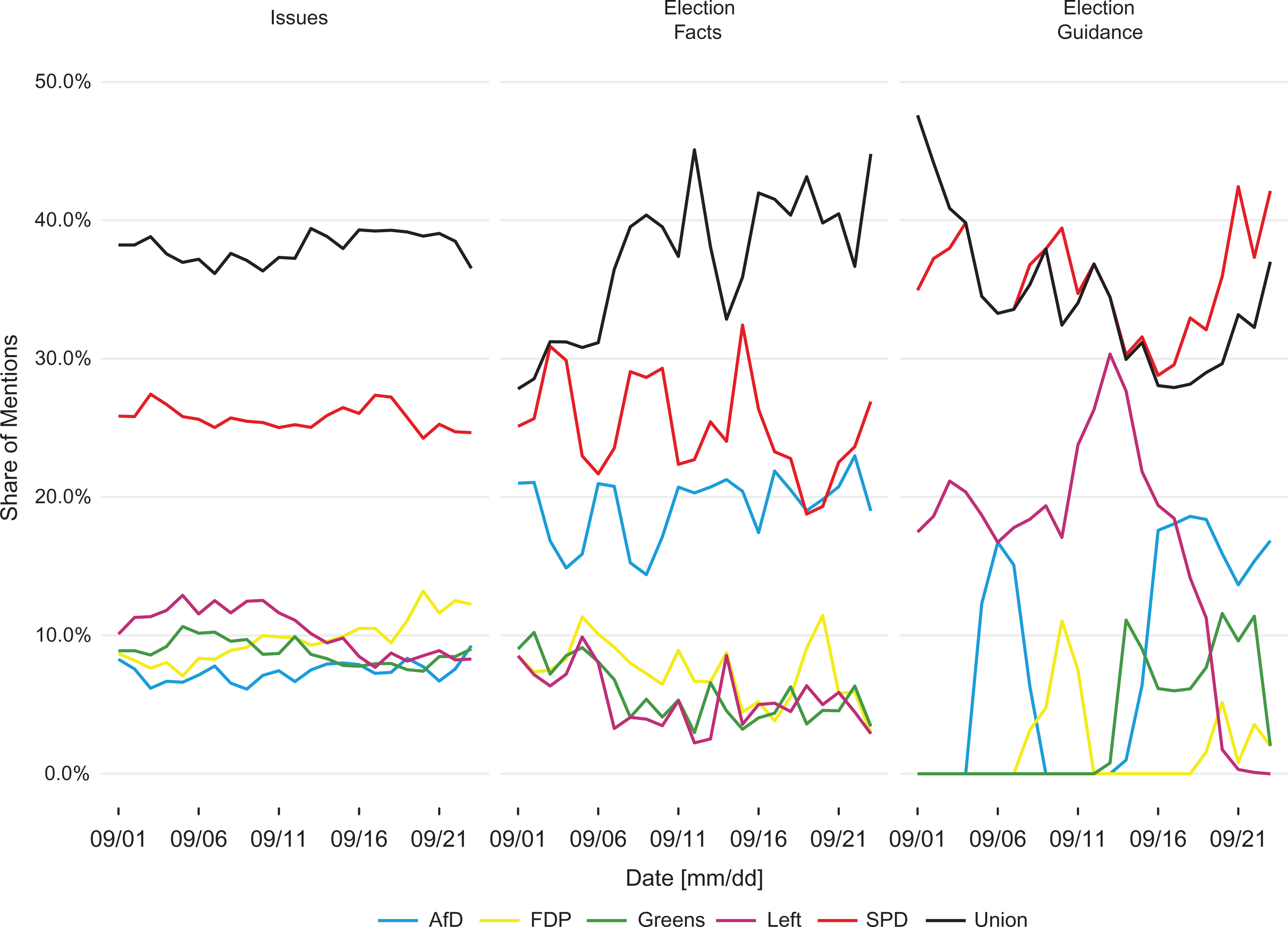
Party mentions in search results over time. Lines depict the share among all search results per day in which a given party or their respective candidates were mentioned within the headline or preview text. Multiple mentions within one search result are counted as one.
Media Types in Search Results
To answer Research Question 2, we look at media types from which the search results originate. Across all search results from all five information orientations, almost half of the results originate from general-interest news websites (see Figure 2). This was to be expected, especially due to previous findings (e.g., Magin et al., 2015) and short update cycles among news websites as well as the importance of such update cycles for Google’s search engine (Hannak et al., 2013).
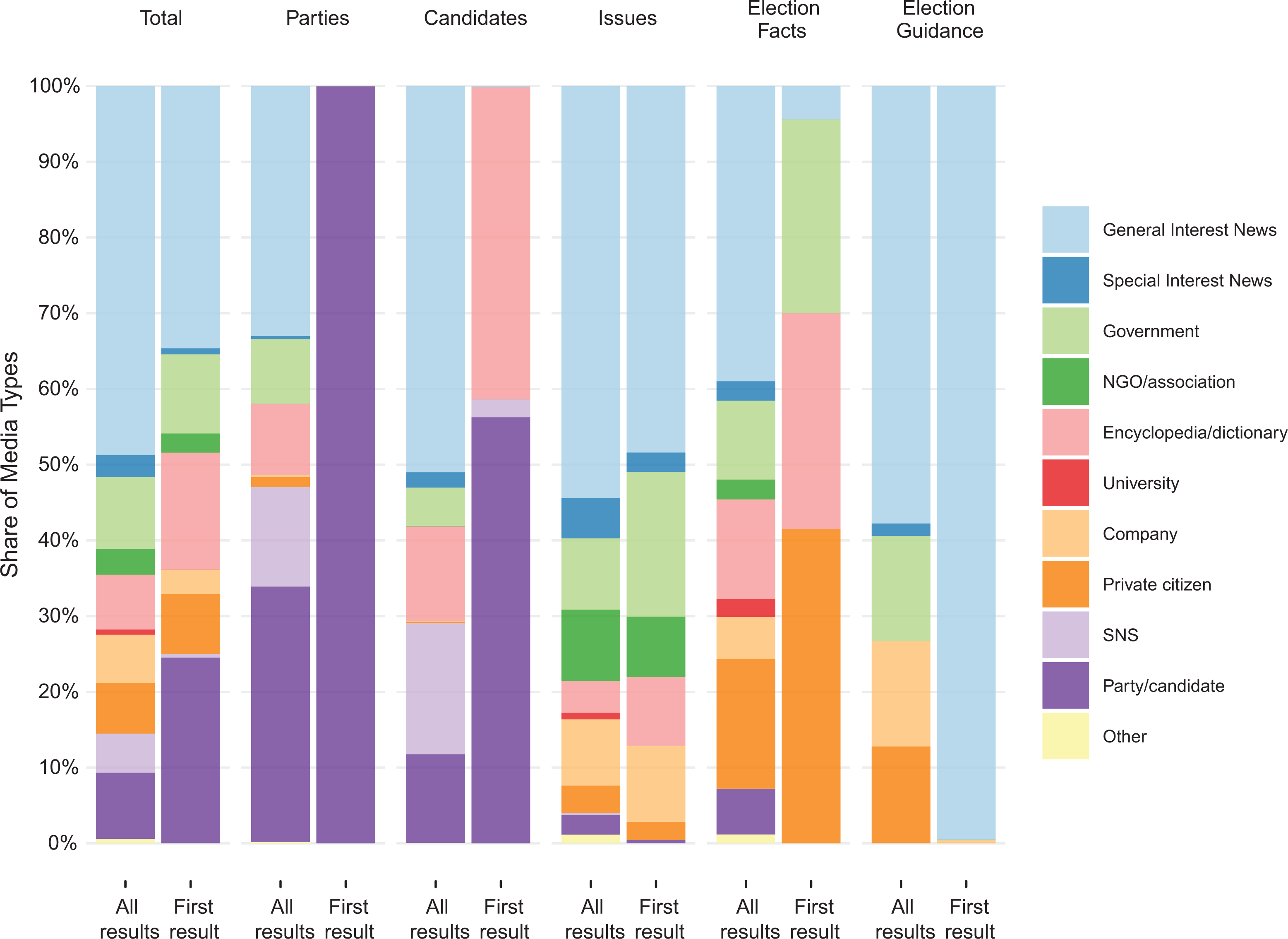
Media types per information orientation. Bars depict the share of each media type in the search queries for the respective information orientations. The left bars show the shares across all search results, the right bars show the shares among the top-ranked (i.e., first) search results.
Yet shares of media types differ considerably between information orientations. Notably, more than half of all sources in party-oriented queries originate from media types that are controlled by political actors (party/candidate websites, their SNS outlets, and governmental websites), from which only partisan information can be expected (Puschmann, 2019). This bias is exacerbated by the fact that the top-ranked result links to the respective party’s main website in virtually all queries. However, one would also expect to find partisan information when searching for these queries. In contrast, candidate queries show larger shares of journalistic sources, which in part may be attributable to some candidates not running their own website (e.g., AfD’s Alexander Gauland). Issue queries more closely resemble the overall diverse representation of sources with a dominance of general-interest news, whereas the comparably large share of privately operated websites stands out for election-fact queries. Finally, news outlets also dominate election-guidance queries, which may seem surprising at first, as German news media traditionally do not endorse specific candidates or parties (Esser & Hemmer, 2009); however, several news outlets heavily featured the “Wahl-O-Mat,” which partly explains the large share in this information orientation. Focusing on specific information sources, we also examine the share of single hosts in the search results (see Table 1). Again, the dominance of general-interest news websites is clearly visible, as seven of the top-10 hosts in the data set belong to that media type; however, the official site of the German parliament, the omnipresent Wikipedia, and, surprisingly, a privately run website with election information are also among the top 10.
Top-10 hosts across search results.
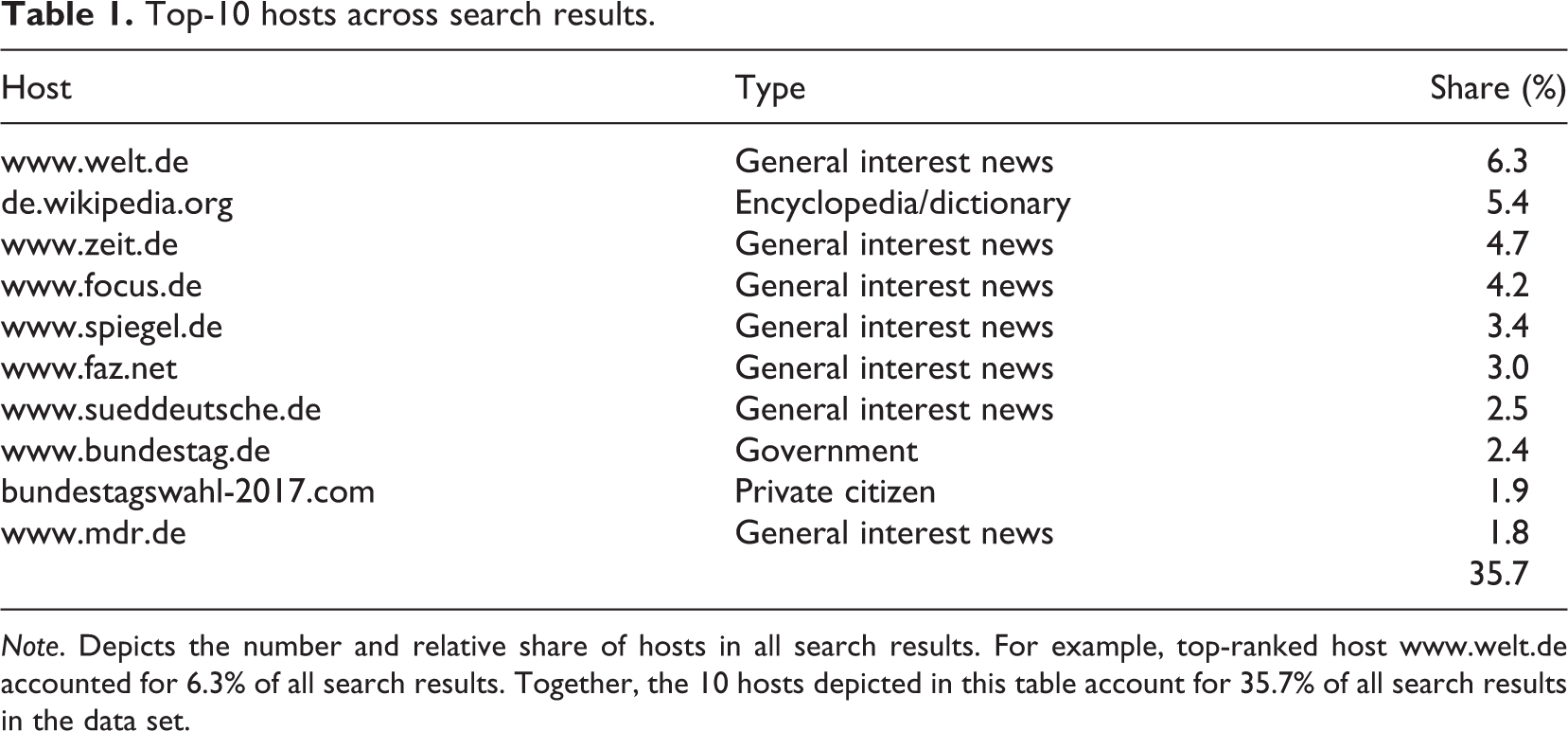
Note. Depicts the number and relative share of hosts in all search results. For example, top-ranked host www.welt.de accounted for 6.3% of all search results. Together, the 10 hosts depicted in this table account for 35.7% of all search results in the data set.
Combining the results to the first two research questions, we furthermore analyzed whether parties were equally represented by different types of media. Figure 3 displays the relative share of media types that contribute to party mentions in the search results for each party. Overall, similar patterns emerge with about 20–30% of mentions from general news coverage and about one fourth of all mentions deriving from party-controlled information sources (party and campaign websites as well as SNS). The two largest and incumbent parties Union and SPD received the highest share of media coverage, while the four members of the parliament leading up to the election (Union, SPD, Left, and Greens) also show comparable shares of governmental sources. Notably, AfD has the highest share of general-interest news mentions across the four smaller parties and received a considerable amount of mentions from privately operated websites.
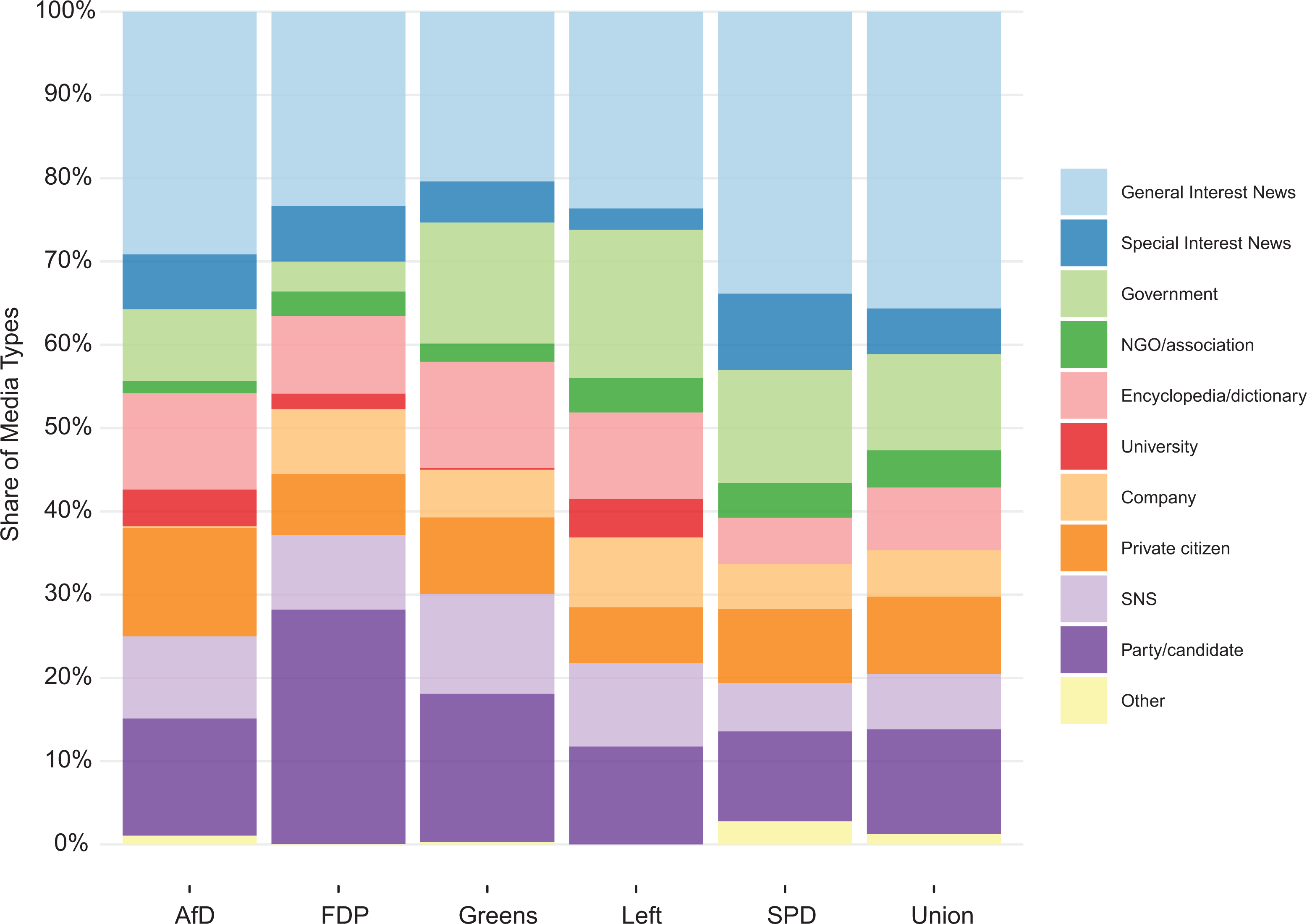
Party mentions by media type. Bars depict the shares of search-result-originating media types for all search-result mentions of each party.
Correspondence of Issue Ownerships in Search Results and People’s Perceptions
Finally, to answer the question of how issue ownerships on Google Search correspond to people’s perceptions (Research Question 3), we turn to the combination of coded search results from the agent-based testing approach and survey results. For each party, we compare issue-ownership rankings for all issues based on search-result mentions for the respective issue queries and attributed issue ownerships in the survey. Rank-order correlations (Spearman’s ρ) between these rankings show medium, positive correlations for Union (ρ = .51, p = .001), FDP (ρ = .44, p = .006), AfD (ρ = .39, p = .014), Left (ρ = .37, p = .022), and SPD (ρ = .19, p = .037), and no significant correlation for the Greens (ρ = .21, p = .207).
Yet, while these correlations indicate that, apart from the Greens, issue ownerships are at least somewhat comparable in the search results and people’s perceptions, the results suffer from biased distributions of party mentions within search results. That is, for a variety of issues, no or only one search result mentions a party or candidate. We thus looked more closely at the nine issues deemed most relevant by the survey participants which reveal that issue-ownership overlaps are largely absent (Figure 4). For example, the issue of possible German cooperation within the European Union is an issue that survey participants ascribe to the two incumbent parties (Union, SPD), whereas search results only partly mention the Union. Instead, most search-result mentions can be ascribed to the FDP since the party has included a call for stronger cooperation with Eastern European countries in their electoral manifesto. Overall, issue ownerships within search results largely depend on single search result mentions. Consequently, issue-ownership overlaps only match in rare single instances (e.g., for the Greens and the issue of eco farming).
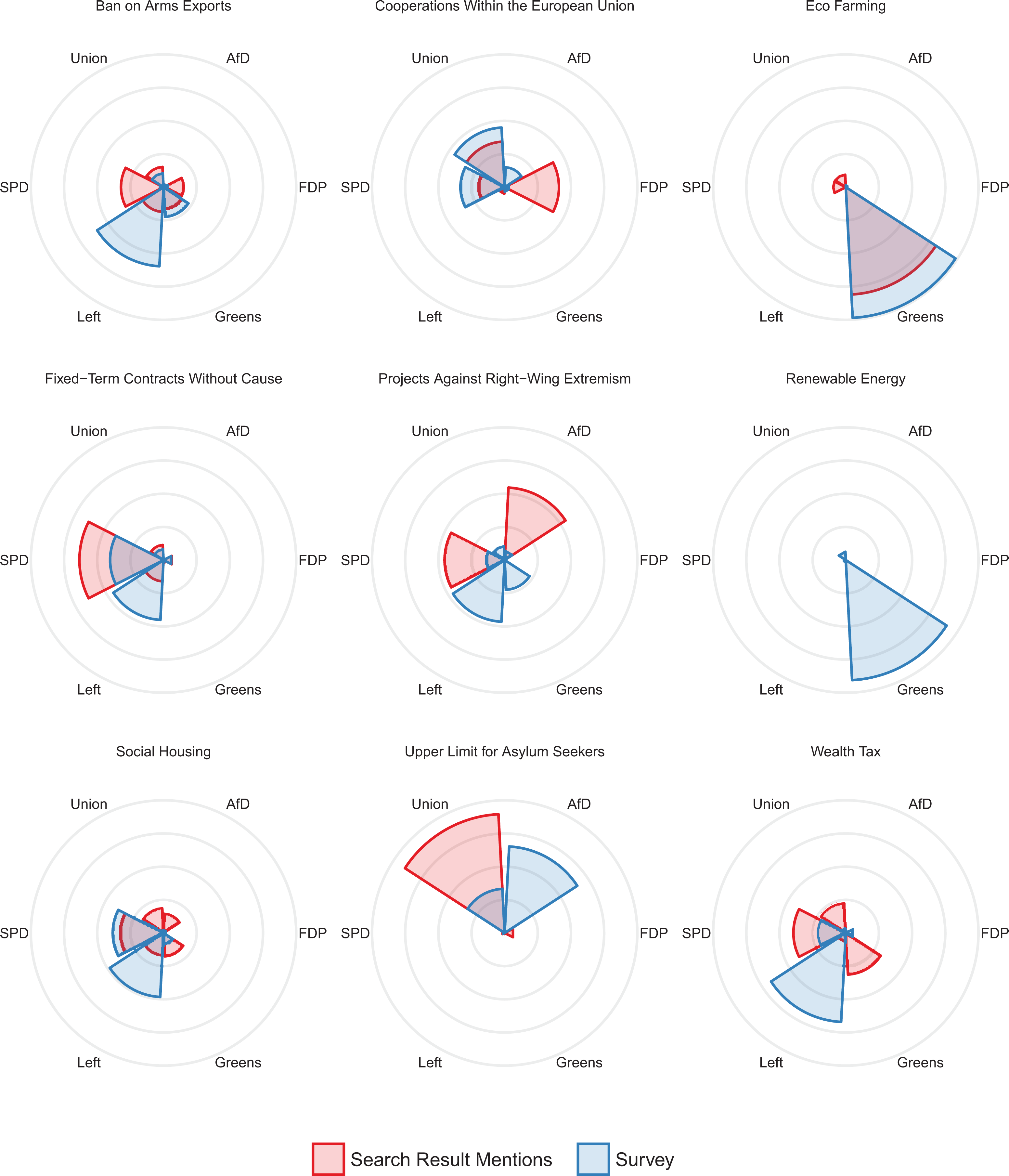
Issue ownerships across survey and search results. Each radar chart compares average perceived issue ownership (survey) with party/candidate mentions in search results for the respective issue. Rings indicate 25% intervals. Nine topmost rated issues in terms of personal relevance (as indicated by survey participants) are depicted. For example, while 100% of survey participants attribute eco farming to the Greens, mentions were found mainly for the Greens but also for SPD and Union. When searching for the issue of renewable energy, no mentions were found in the search results.
Discussion
Recent public debates about filter bubbles (e.g., Bakshy, Messing, & Adamic, 2015), computational propaganda (e.g., Woolley, 2016), or the rise of right-wing populism (e.g., Engesser, Fawzi, & Larsson, 2017) have pointed at various algorithmic online phenomena as causes of constrained access to information online, especially during election campaigns. Pointedly, after a series of experiments, Epstein and Robertson (2015) conclude that biased search rankings may be able to decisively shift the voting preferences of undecided voters and term this the “search engine manipulation effect.” At least in the case of the German Federal Election 2017, however, our findings indicate that the fear of algorithmic constraints in the context of online search might be overrated.
First, while search result mentions are somewhat skewed toward the two incumbent parties, by and large all six major parties are represented in our set of search queries. For example, party mentions for issue-oriented searches reflect existing power relations and align closely with the actual election results. The overrepresentation of right-wing populist AfD as compared to the other three “smaller” parties in the election-fact results may deserve more concern, especially as this information orientation included the queries with highest amount of actual search volume (Google, 2018). However, it is debatable if this result is indicative of a genuine search engine bias or rather a more general media bias, as the AfD received a comparably large share of their mentions through news media coverage.
Second, most of the search engine result pages for equal search queries look the same. That is, the 682,832 single search results across 111 distinct queries and 24 days can be reduced to only 538 unique hosts. For example, for the query “Bundestagswahl,” the query with the highest search volume, we find a mere 20 different hosts during the full period of investigation, among them 14 general-interest news sites, 3 government-operated sites, and 1 site each run by a company, an encyclopedia, and a private citizen. Across all investigated search queries, the composition of represented media types highlights previous empirical results on political search queries (see Magin et al., 2015, pp. 508–509), particularly the large share (48.8%) of search results originating from general-interest news outlets. Yet we also find relevant shares for almost all coded media types among most queries, whereas party run—and, as such, providing partisan perspectives by definition—information sources are, for the most part, only present in the search rankings when explicitly searching for parties or their candidates. Notably, the website bundestagswahl-2017.com operated by a private citizen is among the 10 most present hosts, benefiting from a clever domain choice. While this certainly raises questions about responsibilities and (institutional) oversight of civil information providers, the inclusion of actors typically underrepresented in other media contexts, such as NGOs and citizens, also points to a rather large “diversity in site ownership” (Granka, 2010, p. 370) in the search results. Furthermore, similarly to the findings of Haim, Arendt, and Scherr (2017, p. 6), single news outlets are over- or underrepresented in the search results as compared to other baselines. That is, general-interest news results are led by Die Welt and ZEIT online, two outlets that neither usually have the highest reach among German online news outlets, 2 nor are among the news outlets named as most decisive for political opinion formation (Hasebrink & Schmidt, 2013, p. 8).
Finally, as indicated by the comparably little relevance of party-run information sources for issue-oriented queries, parties seemingly have little control over issue-centric information. Furthermore, even if issue ownerships can be detected, they oftentimes contradict people’s perceived issue ownerships. For most parties, their core issues, as both indicated by their respective electoral manifestos and ascribed by our survey participants, are not reflected in search-result mentions for respective queries. For example, typical left-wing issues such as the introduction of wealth taxes and a ban on arms exports do not reveal any search-result mentions at all for the Left party. Moreover, issue ownerships as represented by party mentions in the search results are oftentimes based only on a small amount of search results, sometimes even just one search result. Thus, parties are not yet able to claim their issues on Google.
Limitations
Our design faces a number of limitations. First, our agent-based testing approach might raise concerns about external validity. That is, while we justified our selection of search queries with prior findings from Google Trends, previous research, and external sources such as the “Wahl-O-Mat,” users may use rather different queries when searching for political information online. This applies in particular to the issue queries, where other wordings would also be conceivable. That being said, while we chose our issues based on externally valid election–campaign observation through the “Wahl-O-Mat,” prior reports from Google Trends indicate nonetheless that issue queries only play a minor role in electoral search volume. Conversely, queries in the realms of election-facts and election-guidance information orientations are among the most used political search queries of 2017 (Google, 2018).
Second, our identification of issue ownership among search results is built solely on raw-text mentions. Thus, we ignore valence and lose contextual information. For example, one mention which we ascribed to the Left party actually read “Voting for the Left? I’d rather shoot myself.” Yet, as prior research has shown (Koch, 2017), even simple and context-free connections of terms strengthen cognitive associations and thereby foster issue ownerships from oftentimes cropped preview texts among Google’s search results. Furthermore, search-engine users most often do not read whole snippets or even pages but rather skim search results for certain key words; they are thus not necessarily aware of contextual information (Lorigo et al., 2008, p. 1044).
Finally, our agents always queried Google from the same location and with a “clean slate” (no search history, no profile, and no cookies). We are thus unable to examine personalization biases in our data. However, while prior studies have similarly kept their geographic location constant to eliminate this influence (Haim, Arendt, & Scherr, 2017), a recent study by Puschmann (2019) also found algorithmic personalization within both Google Search and Google News during the 2017 German Federal Election to be rather limited across a wide variety of geographic locations, at least for party and candidate-oriented queries. This is also in line with similar previous empirical findings (e.g., Courtois, Slechten, & Coenen, 2018; Krafft, Gamer, & Zweig, 2018; Scherr, Haim, & Arendt, 2019). Still, future studies should continue to systematically address the effects of personalization factors such as IP addresses and geographic location (see Ørmen, 2016) on the composition of (political) search results.
Conclusion
Our findings have implications for a variety of stakeholders. For political actors in Germany, Google Search still seems to be somewhat new grounds, as even originally web-affine parties (e.g., the Greens) fail to claim their core issues among the search results. For news outlets, our findings highlight their persisting importance despite ongoing fears of their replacement by intermediaries; thus, our findings should remind them of their societal responsibility to adequately cover all democratically elected parties and candidates. As compared to other parties of equal electoral relevance, the AfD and its top candidates gained disproportionately large amounts of news coverage. In that sense, it seems both provocative and logically consistent that AfD’s Alexander Gauland does not even run an own website. Indeed, the large share of news outlets among the search results indicates that complaints about biased Google Search results may at least partly be the result of biased news coverage.
For users, searching for political information is somewhat more cumbersome than it seems. Although generally diverse and representative of all major parties, search results’ sources and party mentions differed substantially between the five information orientations. This is critical in light of the fact that users primarily search for rather generic political search terms (see Google, 2018) and seemingly trust search engines blindly by selecting only the top-ranked results (Pan et al., 2007; Unkel & Haas, 2017). Thus, our findings call for more media literacy—not only in technological terms but also in terms of information research and reflective news usage. Scholars have recommended that search-engine users should employ—and politics should foster the development of—a variety of different search engines to avoid inherent indexing and algorithmic biases (Lewandowski, 2017, p. 75). Accordingly, we recommend search-engine users to use a selection of different search queries, representing a variety of information orientations, to give them a sufficient overview of a complex issue such as a political election.
Finally, information intermediaries deserve some rest from public hostility. Given our findings, fears of algorithmic determinism in the context of search seem to be overrated. That said, intermediaries’ importance to news and political information consumers is still on the rise and thus requires constant and ongoing scientific observation and control. We thus encourage more content-focused research on search engine results and biases, especially in politically and socially highly relevant contexts, such as election campaigns.
Footnotes
Data Availability

Declaration of Conflicting Interests
The author(s) declared no potential conflicts of interest with respect to the research, authorship, and/or publication of this article.
Funding
The author(s) received no financial support for the research, authorship, and/or publication of this article.
Software Information
All analyses were conducted in R (Version 3.5.2 on Windows 10) using various packages from the tidyverse (Version 1.2.1) package collection, namely dplyr (Version 0.8.0.1, group_by, mutate, summarize and count functions) for data handling and preparation, stringr (Version 1.4.0, str_count function) for text pattern recognition, and ggplot2 (Version 3.1.0, ggplot function) for plotting all figures, as well as the lubridate (Version 1.7.4, ymd function) package for preparing time-series data.