




Abstract
While gendered online harassment has received increased attention in academic and public debates, there is a lack of empirical studies examining gender differences in experiences with online harassment. Relying on two independent large-scale population surveys carried out in Norway, this article examines whether women experience more—and different—online harassment than men, to what extent different types of online harassment silence its targets, and whether there are gendered patterns in how online harassment works as a silencing mechanism. Analytically, we distinguish between different levels of severity of online harassment and what the harassment is directed toward. Contrary to popular expectations, we find that more men than women have experienced online harassment. The main reason is that men receive more comments directed at their opinions and attitudes; women and men are equally exposed to harassment directed toward group characteristics. However, targeted women are more likely than targeted men to become more cautious in expressing their opinions publicly. Furthermore, the gender differences increase as the harassment becomes more aggressive and directed toward group characteristics.
This article is the part of the SSCR special issue on “Gender and Online Politics”, guest edited by Shelley Boulianne (MacEwan University), Karolina Koc-Michalska (Audencia Business School), & Thierry Vedel (Sciences Po).
The Internet and social media have created a forum of free expression of unprecedented scope, reducing the significance of the traditional media’s gatekeeping role (Bruns, 2005). This is commonly considered as contributing to a democratization of the public sphere (e.g., Ash, 2016). However, the seemingly unlimited possibilities for free speech have also raised concerns about the polarization of public debate, aggressive styles of communication, and the silencing effects of online harassment. A well-functioning democracy relies on an open and enlightened public discourse that is open to diverse perspectives without systematically excluding any groups or voices. However, the, at times, aggressive style of communication found online can scare off potential participants and ultimately represent a challenge to the exercise of free speech (e.g., Fladmoe & Nadim, 2017).
There is growing attention to gender-based online harassment both in the research literature and in the public debate. Numerous reported examples leave a clear impression that women are particularly vulnerable to fall victim of online harassment (Bartlett, Norrie, Patel, Rumpel, & Wibberley, 2014; Jane, 2014a). Jane (2017) argues that an increasing number of women are targeted by online harassment and that experiences with gendered cyberhate are no longer limited to women who are visible in the public sphere. However, claims that women are particularly vulnerable to online harassment are usually based on the experiences of high-profile women or analyses of online content (e.g., Jane, 2014a, p. 559). There is a lack of empirical studies examining gender differences in experiences with online harassment in the population as a whole.
This article adds to the literature on online harassment and hate speech in at least two ways. First, by examining the degree to which experiences with online harassment appear as a “woman problem” among average Internet users. Second, through studying experiences of online harassment along two analytical dimensions, (1) the level of aggressiveness in the tone or style of the comment and (2) what the message targets. Drawing on two large-scale population surveys in Norway, we examine the gendered nature of online harassment and ask: Do women experience more—and different—online harassment than men? To what extent are there gendered patterns in how online harassment works as a silencing mechanism?
Gender-Based Harassment and Hate
Feminist scholars understand gendered online harassment as a reflection of broader cultural understandings of gender and women’s inferior place in society (e.g., Jane, 2016; Perry, 2001). For instance, Jane (2014a) argues that gendered online hate is rooted in “old” misogynistic discourses that insist on women’s inferiority to men. For Perry, gender-based hate is an attempt to reassert the “natural” dominance of men, which emerges in situations when men perceive that they are losing their relative position (Perry, 2001, p. 87, see also Berdahl, 2007). Gender-based hate and sexual harassment are intended to restore both women and men to “their place” and reinforce the difference between the genders. Thus, gendered online harassment is seen as off-line misogyny moved to a new arena. At the same time, there are some specific challenges to online harassment, among other things related to its potentially anonymous nature and long life span, as a single comment can travel between forums and be linked to endlessly (Gagliardone, Gal, Alves, & Martinez, 2015).
Based on a textual analysis of a large archive of material from Anglophone sources, Jane (2014a, 2014b) shows that online harassment toward women tends to rely on hyperbolic and sexualized derision, and it commonly includes charges of unintelligence, hysteria, and ugliness in combination with threats and/or fantasies of violent sex acts which are often framed as “correctives.” However, it is not always clear how online misogynistic language should be interpreted. Based on a Twitter analysis, Bartlett and colleagues (2014) conclude that a substantial amount of misogynistic language online can be classified as “casual misogyny,” where terms such as “rape,” “slut,” and “whore” are used in a casual or metaphorical way, without being threatening or abusive. Meanwhile, Sue (2010) underscores that also more subtle and less aggressive expressions directed toward women, such as sexual objectification, second-class citizenship, and use of sexist language, still communicate that women are undeserving or incapable in some way.
Studies of online content conclude that there is substantially more online hate directed toward women than there is toward men (e.g., Bartlett et al., 2014; Jane, 2014b). The same was found in an experiment using fake male and female usernames in a chat room. While users with female names received on average 100 sexually explicit or threatening messages daily, men only received 3.5 such messages on average per day. Thus, in online fora, women appear to be more vulnerable to online harassment and hate than men (Meyer & Cukier, 2006).
A recent review of research on gender-based and sexualized online harassment similarly shows that the few studies including adults are relatively consistent in finding that sexual harassment disproportionately affects women both in extent and impact and that young women are particularly exposed (Henry & Powell, 2018). However, other studies have found that gender differences in experiences with online harassment are small but that women and men experience different varieties of online harassment. Men experience more name-calling and physical threats, while women are more likely to experience sexual harassment (Pew Research Center, 2014; Powell & Henry, 2015). Pew Research Center (2014) additionally finds that young women experience certain severe forms of harassment at disproportionally high levels. The existing research literature is thus inconclusive regarding whether women overall are more exposed to online harassment than men, but there seems to be a consistent finding that men and women experience different types of online harassment and hate.
The Harm in Group-Based Harassment
The literature on hate speech suggests that group-based harassment has wider consequences and “hurts more” than other forms of harassment as it attacks a person’s core identity or “difference” (cf. Chakraborti & Garland, 2015, p. 13). Based on a study of sexual minorities, Herek, Cogan, and Gillis (2002) argue that even less severe expressions of hostility against minorities can be experienced as traumatic because minorities carry with them a consciousness of the violence and injustice members of their group have been subject to. Similarly, Boeckmann and Liew (2002) find that group-based hate speech produces stronger emotional responses in recipients than do other forms of degrading speech. Thus, since hate speech triggers the awareness of belonging to a vulnerable group, it can incite more fear than other types of degrading speech.
Furthermore, group-based harassment and hate can function as message crimes (Chakraborti & Garland, 2015) as it—intentionally or not—targets and affects not only the direct victim but also the wider community sharing the victim’s identity traits. For women, perceptions of other women’s experiences—and consequently the knowledge about the risk of being subject to the same oneself—can incite fear, even if they themselves have no personal experiences with harassment or hate speech (Gelber & McNamara, 2016; Perry, 2001).
Perry (2001) argues that group-based harassment and hate is a way of “doing difference” through a rhetoric of exclusion, fear, and contempt for individuals and groups that are deemed to be different. The purpose is to guard and highlight the boundaries between women and men and remind women of their “rightful place” in the social hierarchy as others (see also Berdahl, 2007). Regardless of the explicit intentions of the perpetrator, gender-based harassment conveys a message to women as a group, as well as to the individual target, that they are somehow different or do not belong in a given context (Chakraborti & Garland, 2015; Perry, 2001). Thus, the research literature on online harassment and hate speech makes a clear distinction between group-based harassment targeting someone for who they are and other types of harassment, arguing that group-based harassment has wider consequences and “hurts more.” However, how people experience online harassment will depend on not only the type and nature of harassment but also their previous experiences and a range of other factors such as psychological and physical strength and status (Leets, 2002).
Online harassment can be experienced as frightening, and one possible consequence may be that people withdraw from expressing their opinions and participate in public debates. One purpose of online harassment and hate is to incite fear in the groups targeted and to remind those who are considered “different” or “other” that they do not belong (cf. Perry, 2001). Studies have shown that experiences with online harassment, in addition to incite fear and other emotional symptoms, can lead individuals to become more cautious in expressing their views (Boeckmann & Liew, 2002; Fladmoe & Nadim, 2017; Gelber & McNamara, 2016; Herek, Cogan, & Gillis, 2002; Leets, 2002). As such, online harassment can pose a threat to ideals of equality and an enlightened democratic debate where all group-based interests are represented.
Measuring Online Harassment
There is no shared definition of online harassment. In this article, we use the term as an overarching concept that covers a range of behaviors—from less severe utterances, such as unpleasant comments, to more severe forms of hate speech and threats. Analytically, we distinguish instances of online harassment along two dimensions: (1) the level of aggressiveness in the tone or style of the comment and (2) what the comment targets. The first dimension captures that online harassment can range from name-calling, insults, and comments the receiver perceives as unpleasant to more severe behavior in the form of hateful comments and threats, which might even be unlawful. The second dimension concerns the content of the comment and specifically what the comment attacks, or the ground(s) the message is directed toward. We make a distinction between online harassment directed at what you think—your opinions and the content of your arguments—and harassment attacking who you are—your individual or group characteristics. This distinction speaks to the literature on the harm in group-based harassment (cf. Chakraborti & Garland, 2015, p. 13), and it is also relevant within the field of law, where for instance hate speech legislation typically protects specific minority groups from being attacked for who they are (Bleich, 2011).
The degree to which women and men are exposed to online harassment depends also on characteristics other than gender. In this study, we look into two possibly relevant mechanisms affecting the likelihood of being exposed: political ideology and online behavior. First, people holding political views that deviate from mainstream politics may be more exposed to online harassment. A society’s “opinion climate” has been described as heavily loaded with social and normative meaning, guiding what is seen as acceptable attitudes and behaviors (Noelle-Neumann, 1974). Thus, expressing opinions that transgress mainstream politics may be risky, and consequently gender differences in political views may affect gender differences in experiences with online harassment. Men are overrepresented in extreme political groups (Kimmel, 2018), and they also, to a larger extent than women, vote for populist right parties (Aardal, Bergh, & Karlsen, 2015), meaning that they more often than women hold opinions transgressing mainstream politics. Second, a fundamental prerequisite for being harassed online is that you are present in relevant online fora. People engaging on areas of the Internet where hate speech flourishes, or engage in online discussions with an aggressive style of communication, are more likely to experience online harassment. Studies suggest that men engage in more “risky behavior” online (cf. Notten & Nikken, 2016), and this might make them more exposed to online harassment. For instance, harassing language is a common mode of communication in online gaming, an arena where far more men than women participate (Ask, Svendsen, & Karlstrøm, 2016).
In the present study, we systematically compare women’s and men’s experiences of online harassment and hate. First, we examine gender differences in exposure to various forms of online harassment, and second, we analyze gendered patterns in how online harassment may silence its targets from expressing their opinions publicly.
Although previous research provides a mixed picture as to whether women receive more online harassment than men, we would expect women and men to receive different types of online harassment: More specifically, we expect women to receive more harassment targeting who they are, while men receive proportionally more harassment targeting what they think. Furthermore, we expect that more severe harassment affects the recipients more than less severe harassment, and we expect that messages targeting “who people are,” in terms of group belonging or as individuals, have wider consequences than online harassment directed toward one’s attitudes or arguments.
Summed up, the empirical analyses will be guided by the following hypotheses:
Data and Method
We rely on two separate population-based surveys carried out by means of web questionnaire in 2013 and 2016 by TNS Gallup Norway. In both surveys, the samples were drawn from TNS’ web panel, which is a probability-based panel consisting of approximately 50,000 Internet users. In both surveys, people with university/college education are overrepresented (samples: 52–57%, population: 33%), while people of immigrant background are underrepresented (samples: 4–6%, population: ∼14%). The mean age of the respondents is 49–52 years, while the mean age in the population is ∼46 years. In the descriptive analyses, we therefore present predicted values controlling for age, education, and immigrant background. This technique produces somewhat more conservative estimates than including a weight variable adjusting for gender, age, and education (weighted analyses in Table A1 in the Online Appendix). The obvious implication when people of immigrant background are underrepresented in the survey is that the data underreport online harassment toward immigrant-related grounds (ethnicity, skin color, nationality).
When we use survey data to study the prevalence of online harassment, we rely on subjective assessments. Different respondents may have different conceptions of what constitutes harassment and will therefore interpret the same utterance differently. At the same time, an utterance is always interpreted in a context. A comment that appears as clear harassment for a bystander might simply reflect a jargon among friends, while a seemingly innocent comment might be experienced as a threat in a given context. Although we do not know the exact content of the utterances reported, we would argue that it is relevant to study subjective assessments of online harassment when we are interested in experiences of online harassment and its effects. In order for comments to affect their targets, the recipients must necessarily experience them as problematic.
The two surveys allow us to study variations in online harassment across the two dimensions introduced above: (1) the level of aggressiveness of the comment and (2) what the comment targets. First, whereas the survey from 2013 asked whether people had received “unpleasant or patronizing comments,” the 2016 survey asked respondents specifically about experiences with “hate speech in social media.” Hate speech is more aggressive and severe than unpleasant messages. Second, in both surveys, we can distinguish between messages directed toward group characteristics, individual characteristics, or attitudes/arguments. The variables used in the analyses are described in more detail below.
Dependent Variable 1: Received Online Harassment
The first dependent variable—received online harassment—was constructed in two steps. First, respondents were asked whether they, after participating in a discussion and expressing themselves publicly (online or in a media outlet), had experienced receiving unpleasant or patronizing comments (2013 survey) or whether they had received hate speech via social media (2016 survey). In the 2013 survey, “unpleasant or patronizing” was not defined, but in the Norwegian context, such comments may include relatively “mild” forms of harassment. In the 2016 survey, “hate speech” was defined as statements that are “degrading, threatening, harassing, or stigmatizing.” 1 While hate speech in the Anglo-Saxon context is generally used as a synonym for racist or discriminatory speech, this is not the case in the Norwegian context. In everyday language, the term connotes expressions with a very negative tone or style, irrespective of which attributes it targets. Therefore, it is more precise to say that the 2016 survey captures experiences with “hateful comments.”
Second, in both surveys, those who responded that they had received online harassment were followed up with a question of what grounds these messages were most often directed toward. It was possible to select one or more attributes from a list of 10/13. 2 In the analyses, we have grouped these attributes into three categories. Group characteristics include respondents who had received online harassment directed toward at least one of the following attributes: gender, ethnicity, nationality, skin color, religion, disability, or sexual orientation. Individual characteristics include respondents who had received online harassment directed toward their personality and/or their appearance, whereas attitudes/arguments include respondents who had only received online harassment directed toward their political views and/or the content of their arguments. Those who said they had received online harassment but did not tick any of the listed attributes are grouped as other.
Dependent Variable 2: Cautiousness in Expressing Opinions Publicly
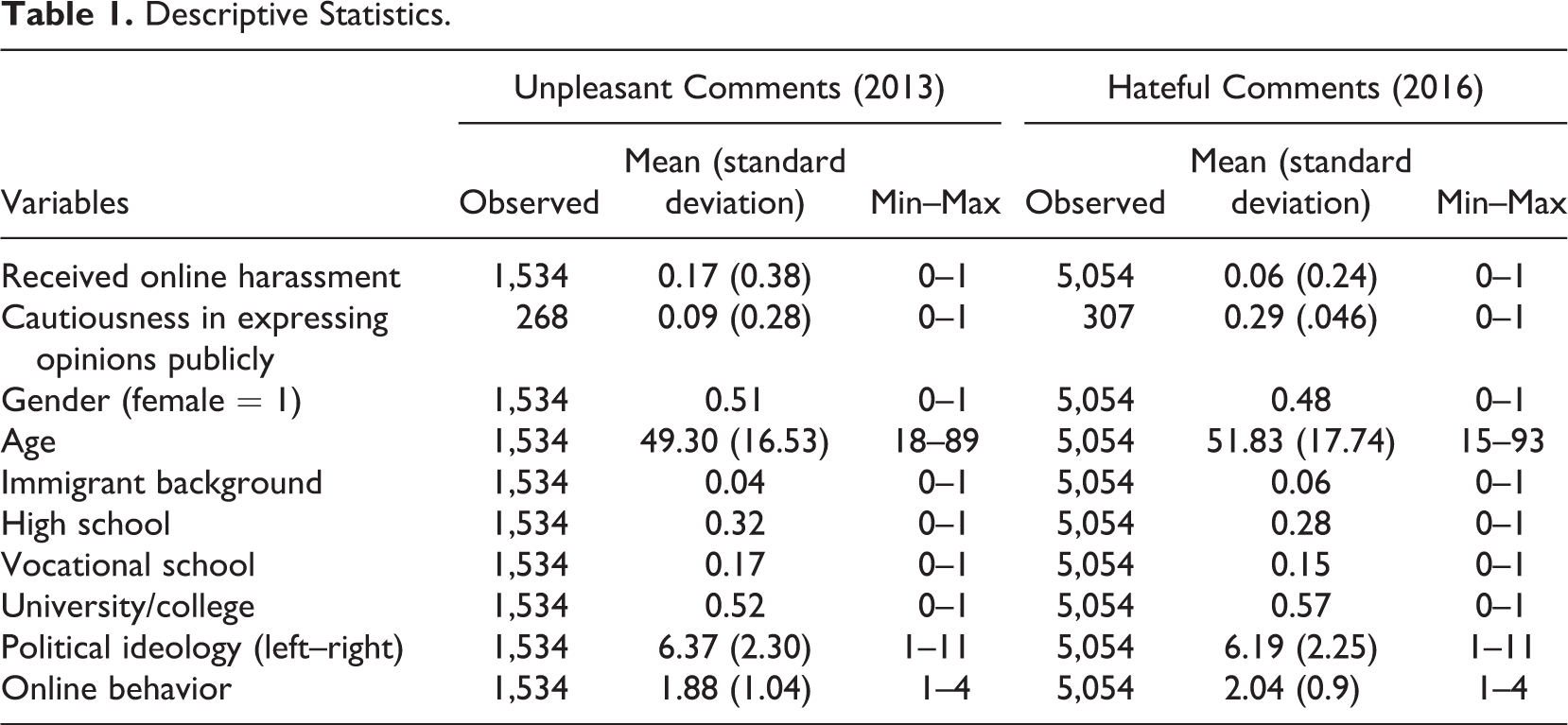
Both surveys included a second follow-up question of whether experiences with online harassment had caused the respondents to become more cautious in expressing their opinions publicly: “After experiencing [unpleasant or patronizing comments/hate speech], have you become more cautious in express opinions publicly? (Yes/No)” (see Table 1 for descriptive statistics).
Descriptive Statistics.
Independent Variables
We include the following independent variables (see Table 1): gender, age, education (high school, higher vocational, higher academic), and immigrant background. Regarding immigrant background, we included a dummy variable distinguishing between the majority population and respondents born abroad or born in Norway of two foreign-born parents (=1). Unfortunately, we have limited information about the country of origin of respondents with immigrant backgrounds, and the variable is only included as a control.
Furthermore, as described above, we look into two possibly relevant mechanisms that are likely to be correlated with experiences with online harassment: political ideology and online behavior. Political ideology was measured using self-placement on the left–right scale (0 = far left, 10 = far right). The expectation is that people holding views that transgress mainstream politics are more likely to experience online harassment. Thus, in order to capture such a curvilinear relationship, we also included squared transformations of the left–right scale in the analyses. Online behavior was constructed on the basis of items measuring respondents’ propensity to share personal opinions on the Internet. In the 2013 survey, the variable was constructed on the basis of an item measuring how often respondents expressed opinions through social media (1 = never/don’t know, 5 = daily). Very few responded “daily,” so this option was collapsed with (4) “several times a week.” In the 2016 data, the variable was based on an item asking respondents: “How often do you share opinions on the Internet” (1 = never, 4 often). The two different operationalizations yield fairly similar answer distributions, and the difference in mean value on the 1–4 scale is only 0.16 (higher in 2016).
Results
We present our results in two steps. First, we estimate the share of women and men who have experienced online harassment and how gender differences vary according to the tone or style of the messages (unpleasant comments vs. hateful comments) and the content of the messages (directed toward group characteristics, individual characteristics, and attitudes/arguments). Second, we explore gender differences in how different types of online harassment may discourage people from expressing opinions publicly.
Experiences With Online Harassment
Table 2 summarizes the list of attributes and the share of women and men reporting they had received online harassment. As described above, the table reports percentages based on predicted values from logistic regression models, keeping age, education, and immigrant background constant at mean values. This way, the gender differences reported in the table are based on a hypothetical situation where women and men have the same age distribution and average level of education.
Has Received Online Harassment and What These Messages Were Directed Toward.
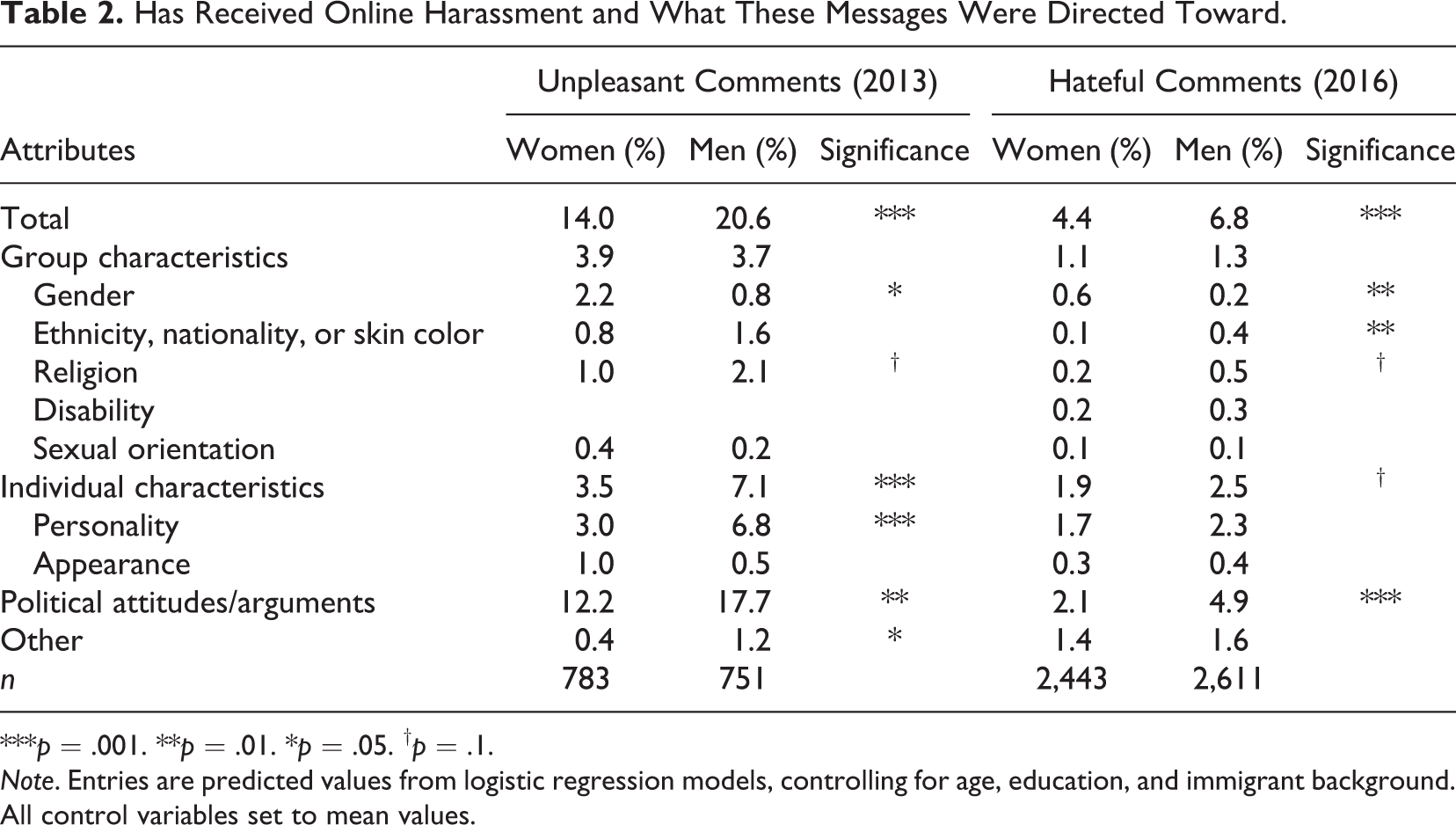
***p = .001. **p = .01. *p = .05. † p = .1.
Note. Entries are predicted values from logistic regression models, controlling for age, education, and immigrant background. All control variables set to mean values.
The table shows that in both surveys more men than women report that they have experienced online harassment. Holding age, level of education, and immigrant background constant at mean score, among men a predicted share of 20.6% have received unpleasant comments and 6.8% have received hateful comments. Among women, the corresponding numbers are 14% and 4.4%. Both men and women most often receive online harassment directed toward their political attitudes/arguments, and second, directed toward their personality. But while gender is the third most reported ground for online harassment for women, it is less common for men.
Table 2 further suggests that the gender differences are largest when it comes to online harassment directed toward political attitudes/arguments, followed by individual characteristics. If we only consider harassment directed toward group characteristics, there are no significant differences between women and men. A little more than 1% have experienced group-based hateful comments, whereas almost 4% have experienced group-based unpleasant comments. Women report more group-based harassment directed toward their gender, while men report more group-based harassment directed toward their ethnicity, nationality, skin color, or religion. A first summary is therefore that men experience more online harassment than women but that this gender difference is mainly explained by men receiving more harassment directed toward their attitudes and arguments and also to some extent their individual characteristics.
Are these gender differences contingent upon political ideology—that men hold more “extreme” views than women—or online behavior—that men express opinions on the Internet more frequently than women? Table 3 reports results from logistic regression models where political ideology (Model 1) and online behavior (Model 2), in addition to age, education, and immigrant background, have been included as controls stepwise. By holding independent variables at mean values, the table compares women and men with similar mean scores on the political left–right scale and on the online behavior scale, in addition to equal sociodemographics. 3 The full regression models are included in Table A2 in the Online Appendix.
Has Received Online Harassment, Directed Toward Group Characteristics, Individual Characteristics, and Attitudes/Arguments.
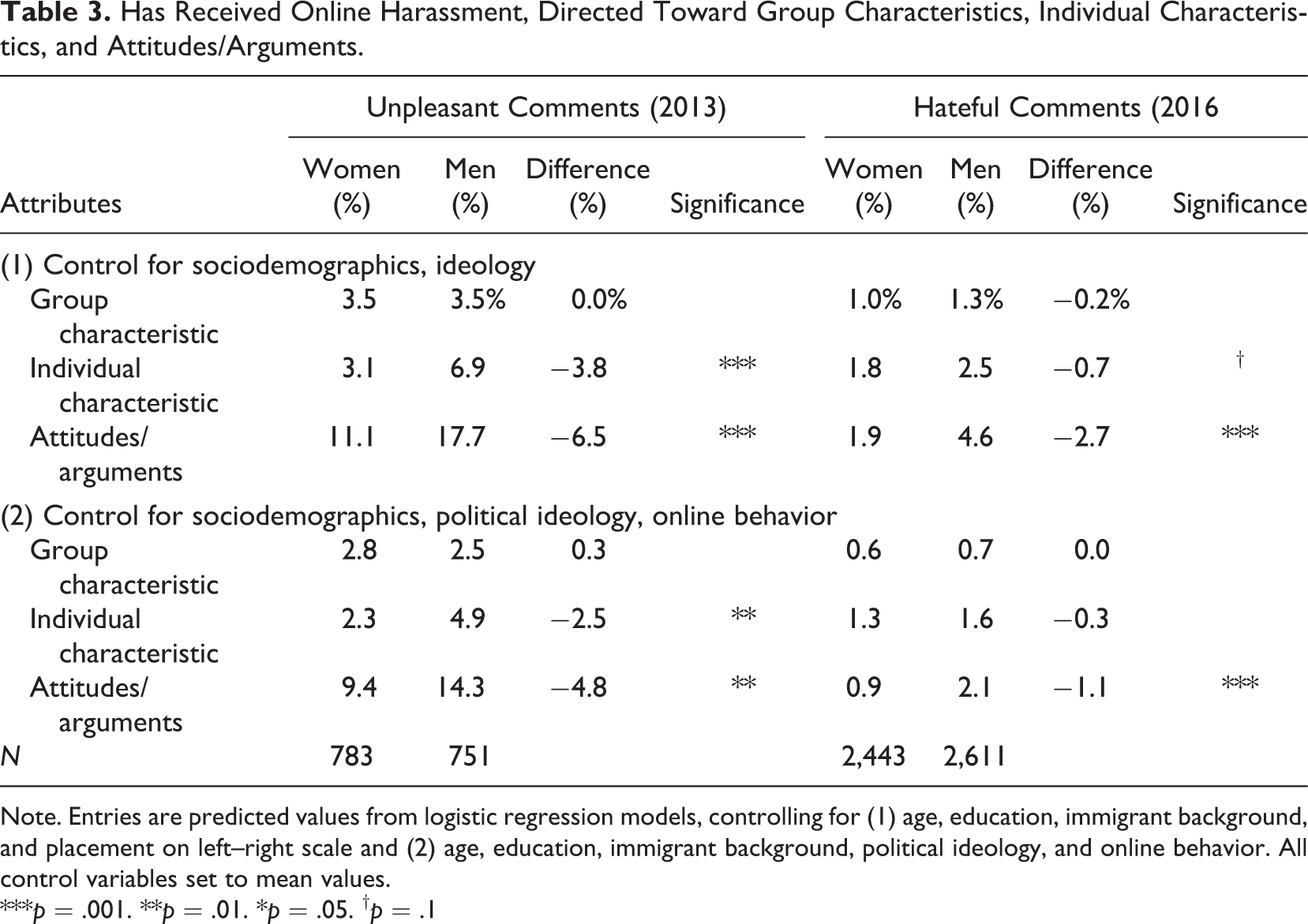
Note. Entries are predicted values from logistic regression models, controlling for (1) age, education, immigrant background, and placement on left–right scale and (2) age, education, immigrant background, political ideology, and online behavior. All control variables set to mean values.
***p = .001. **p = .01. *p = .05. † p = .1
The results in Table 3 suggest that introducing political ideology as a control variable has limited effect compared to only controlling for sociodemographics. That is, the gender differences reported in Model 1 in Table 3 are fairly similar to the gender differences reported in Table 2. However, controlling for online behavior reduces the gender differences, most profoundly when it comes to online harassment directed toward attitudes/arguments. In Model 1, the gender difference on this particular variable is 6.5 (unpleasant comments) and 2.7 points (hateful comments). In Model 2, the differences are reduced to 4.8 and 1.1 points, respectively. A similar but smaller reduction is observed concerning harassment directed toward individual characteristics. Thus, these results suggest that part of the reason why more men than women have received online harassment is that men are more likely to expose themselves online by sharing their opinions publicly. However, online behavior does not fully explain the observed differences, suggesting that there are some unobserved gender characteristics explaining why more men than women receive online harassment. We discuss other possible gender differences more thoroughly in the final section of the article.
Cautiousness in Expressing Opinions Publicly
Next, we look at one possible consequence of receiving online harassment, namely cautiousness in expressing opinions publicly. As in the previous section, we distinguish between harassment directed toward group characteristics, individual characteristics, and attitudes/arguments. The following analyses are based only on the respondents who had experienced online harassment; consequently, the number of observations is limited, and the results must be treated with caution.
Table 4 summarizes the share of women and men who said they will become more cautious in expressing their opinions publicly after having received online harassment. Again, the entries in the table are predicted values from logistic regression models controlling for (1) sociodemographics and political ideology and (2) sociodemographics, political ideology, and online behavior. The full regression models are reported in Table A3 in the Online Appendix.
Cautiousness in Expressing Opinions Publicly After Receiving Online Harassment. Messages Directed Toward Group Characteristics, Individual Characteristics, and Attitudes/Arguments.
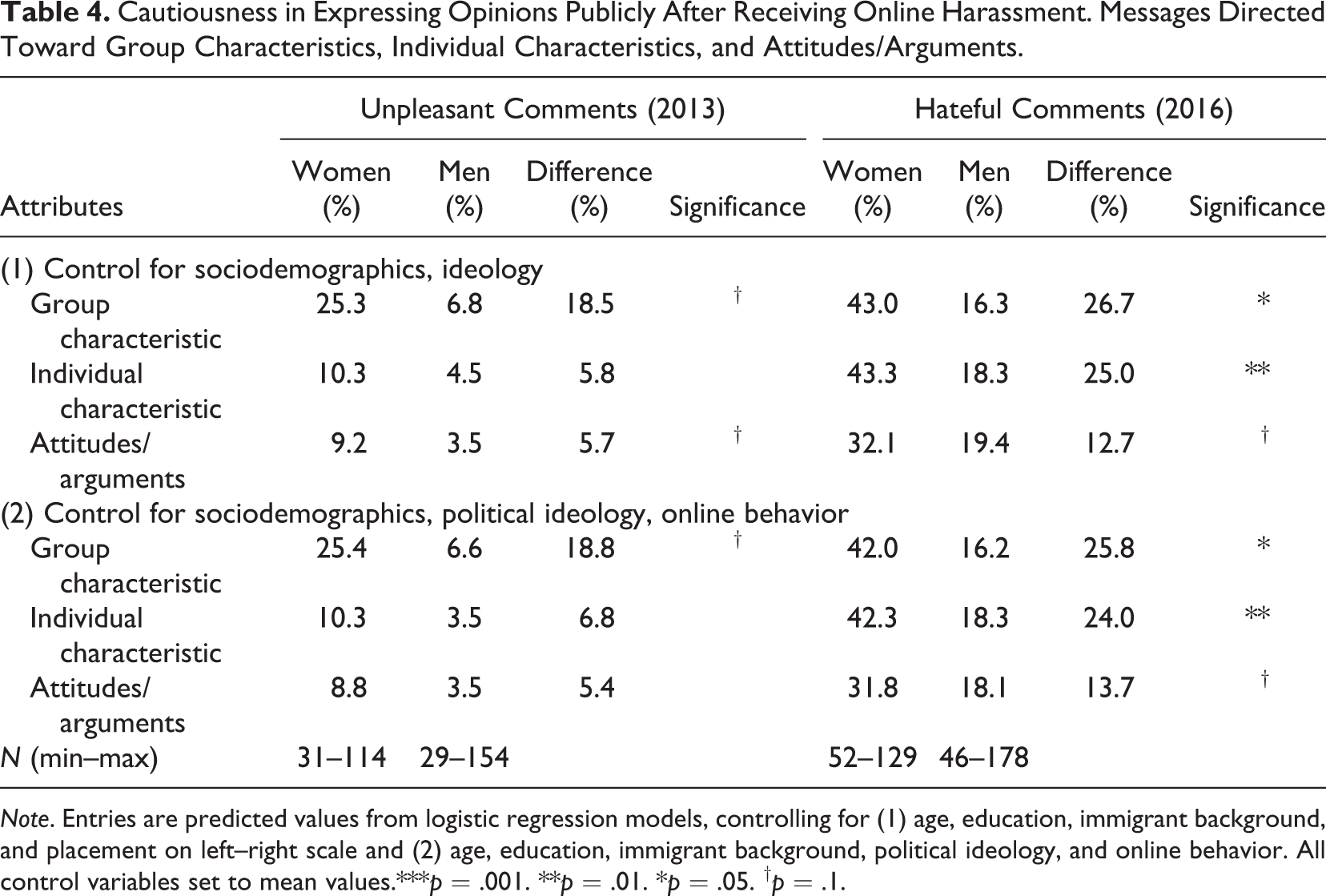
Note. Entries are predicted values from logistic regression models, controlling for (1) age, education, immigrant background, and placement on left–right scale and (2) age, education, immigrant background, political ideology, and online behavior. All control variables set to mean values.***p = .001. **p = .01. *p = .05. † p = .1.
Overall, Table 4 shows that women have a stronger tendency than men to become more cautious in expressing their opinions publicly, after having received online harassment. The results suggest that both the tone or style of the messages and what the messages target matter. First, the share of respondents who said they will be more cautious is higher among those who received hateful comments than among those who received unpleasant comments. Furthermore, while the tone or style of the messages matters for men, it seems to matter even more for women. Among those who have received online harassment directed toward group characteristics, 42% (hateful comments) and 25% (unpleasant comments) of the women say they will become more cautious (Model 2). The corresponding numbers among men are 16% (hateful comments) and 7% (unpleasant comments). Thus, these results suggest that as the messages become more aggressive, the gender differences increase.
Second, concerning what the messages target, for women, online harassment directed toward “who they are” (group and individual characteristics) has more serious consequences than harassment directed toward “what they think” (attitudes/arguments). The share of women stating that they would become more cautious drops to 32% and 8% among those who have “only” received harassment directed toward attitudes/arguments. Among men, the content of the messages appears more or less irrelevant: The predicted share of men saying that they will be more careful varies between 16% and 18% (hateful comments) and 3.5% and 6.6% (unpleasant comments), depending on the content of the messages.
Finally, the results suggest that, controlling for sociodemographics, neither political ideology nor online behavior affect these results. The implication of these findings is that the differences in how women and men are affected by online harassment are largest when the tone or style of the messages is most aggressive and when the messages are directed toward group or individual characteristics, that is, targeting “who they are.”
Discussion and Conclusion
Although there is growing academic and public attention to the challenges of online harassment toward women, there have been little empirical research examining gendered experiences of online harassment among “average” Internet users. This study contributes with knowledge from two population surveys and asks, first, whether women experience more—and different—harassment than men and, second, whether there are gendered patterns in how online harassment silences its targets in terms of making them more careful in expressing their opinions.
Perhaps contrary to popular belief, we find that in the general population women are not more likely than men to experience online harassment. Two unique surveys capturing experiences with online harassment of different levels of severity find that men are more likely than women to have experienced both unpleasant or patronizing comments and hateful comments, mirroring results from general population studies of online harassment in the United States and Australia (Pew Research Center, 2014; Powell & Henry, 2015). Thus, while studies of online content or the experiences of high-profile women (e.g., Bartlett et al., 2014; Jane, 2014b; Meyer & Cukier, 2006) find that women, when online, are more exposed to online harassment than men, general population surveys demonstrate that among average Internet users, online harassment does not appear as specifically a “woman problem.”
Our first hypothesis (Hypothesis 1) was that, irrespective of the total amount of online harassment, men and women receive different types of harassment. The results largely confirm this hypothesis. The main reason why men receive more online harassment than women is that they receive more messages directed toward “what they think”—that is, they more often than women report that they have received unpleasant or hateful comments directed toward their arguments or political attitudes. If we only consider group-based online harassment, thus circling in on what is conventionally considered as hate speech, the gender differences disappear. Women are more exposed to online harassment directed toward gender than men. The data do not allow for a more nuanced consideration of the gendered content of online harassment. It may well be that comments that respondents have categorized as targeting personality and appearance are in fact also highly gendered in nature, so that the gendered nature of online harassment is underestimated in our results. At the same time, women might more readily attribute comments to their gender than men might, as gender is often a more salient category for women (cf. Hagen, 2015).
The analysis further suggests that part of the reason why men are more subject to online harassment than women is their online behavior. Men are more likely to expose themselves online by being more prone to sharing their opinions publicly and thus receive more harassment in return. As such, our findings are not necessarily at odds with studies showing that there is more online content harassing women (e.g., Bartlett et al., 2014; Jane, 2014b; Meyer & Cukier, 2006). While women may be more vulnerable to receiving online harassment, they might actually receive less partly because they are less active in online environments and behaviors that make them exposed.
Still, the gender differences did not disappear completely when controlling for online behavior. One possible explanation is that more men than women have a “risky” online behavior, making men generally more exposed to online harassment. Unfortunately, we did not have a precise measure of risky online behavior in our data, but other studies have indeed suggested that men (boys) are more likely than women (girls) to have risky online behavior (Notten & Nikken, 2016).
Our second hypothesis (Hypothesis 2) was that online harassment targeting “who people are,” in terms of group belonging or as individuals, is more likely to silence its targets than online harassment directed toward “what people think.” This hypothesis is also supported by the data—but mainly among women. Both the tone or style of the messages and what the messages target are related to its silencing effect—especially for women. While men are more affected by hateful than by unpleasant comments, the level of aggressiveness has a more pronounced effect on women. Further, while the content of the message has little impact on men’s reactions to online harassment, women are more strongly affected by messages directed toward “who they are” than by messages targeting “what they think.” As such, the analysis gives support to the argument that group-based harassment and hate speech “hurts more” than other types of harassment (cf. Chakraborti & Garland, 2015)—but mainly among women.
Our study cannot answer why online harassment has stronger effects on women than men, in terms of discouraging them from expressing their opinions publicly. One possible explanation is that women react more strongly to online harassment because they receive comments of a different kind than men. For instance, we see that the level of aggressiveness in the messages seems to matter more for women than for men, as there are larger gender differences in the consequences of hateful comments than unpleasant comments. Women also receive proportionally more of the type of harassment that “hurts more,” that is, comments directed toward who they are rather than toward their opinions. Although we have limited information about the content of the comments the respondents have received, previous research suggests that gender-based harassment against women often takes the form of sexualized scorn combined with threats and/or fantasies of violence (Jane, 2014b). This is a type of content that no doubt might be experienced as more taxing and frightening than for instance messages attacking the content of one’s argument. Thus, women might react more strongly than men to comments with the same level of aggressiveness because the content of the comments is somehow more problematic.
Furthermore, online harassment might trigger awareness of vulnerability among women in a way that is less relevant for men. Most women live with an awareness that they are physically weaker than men and that they belong to a historically vulnerable and exposed group. They might also be well aware of the harassment that other women have been subject to online and perceive that there is a particular risk to being a woman online. Online harassment may therefore be perceived as more threatening to women than to men. This would explain why women react disproportionately stronger than men to more aggressive comments. It could also explain why women react more strongly to group-based online harassment. Group-based harassment or hate speech attacks the victim’s core identity and a “difference” that is often immutable. For individuals belonging to groups that might be perceived as exposed, online harassment can trigger precisely the awareness of belonging to a vulnerable group and may therefore incite more fear and stronger reactions than it does in other individuals (Boeckmann & Liew, 2002; Herek et al., 2002).
An alternative explanation why women react more strongly to the most aggressive messages, especially when targeting group-based characteristics, is that women are simply more easily discouraged from expressing their opinions than men. Studies have for instance shown that women more than men refrain from expressing their opinions to avoid being ridiculed or harassed or to avoid offending or hurting others (Enjolras & Steen-Johnsen, 2014). The awareness of what other women are exposed to online might in itself scare women from expressing their opinions, regardless of whether or not they have experienced severe online harassment themselves. Again, the silencing effect of “merely” witnessing the experiences of others one identifies with might be stronger for women than for men because women—at least in some contexts—perceive themselves as belonging to a vulnerable group. More research is needed in order to understand why women and men react differently to online harassment, and the analytical approach introduced in this article, capturing both the level of aggressiveness and the content of online harassment, can contribute to advancing our knowledge.
This article has demonstrated that online harassment can contribute to silencing individuals and make them more careful in expressing their opinions and that online harassment affects women more than men. The results should encourage more research into the gendered nature and effects of online harassment, in particular more detailed studies on the causes of the observed gender differences. Furthermore, we need studies that are not limited to the online realm and that compare the effects of online versus off-line harassment. An enlightened democratic debate presumes that all relevant voices and groups are included. If women are systematically silenced and excluded from the public debate as a result of online harassment, online harassment becomes a threat not only to the exercise of free speech but also to a well-functioning democracy and an enlightened public debate.
Supplemental Material
Supplemental Material, Nadim_Fladmoe_online_appendix - Silencing Women? Gender and Online Harassment
Supplemental Material, Nadim_Fladmoe_online_appendix for Silencing Women? Gender and Online Harassment by Marjan Nadim and Audun Fladmoe in Social Science Computer Review
Footnotes
Authors’ Note
The authors would like to thank the editors and three anonymous referees for their constructive feedback. An earlier version of this article was presented at the Politikkseminar at the Institute for Social Research, Oslo. We greatly appreciate all comments from the seminar participants. The data can be made available upon request; please contact corresponding author Marjan Nadim. Email:
Declaration of Conflicting Interests
The authors declared no potential conflicts of interest with respect to the research, authorship, and/or publication of this article.
Funding
The authors disclosed receipt of the following financial support for the research, authorship, and/or publication of this article: The authorship of this article was funded by the Institute for Social Research, Oslo.
Supplemental Material
Supplemental material for this article is available online.
Notes
References
Supplementary Material
Please find the following supplemental material available below.
For Open Access articles published under a Creative Commons License, all supplemental material carries the same license as the article it is associated with.
For non-Open Access articles published, all supplemental material carries a non-exclusive license, and permission requests for re-use of supplemental material or any part of supplemental material shall be sent directly to the copyright owner as specified in the copyright notice associated with the article.
