Abstract
The purpose of this essay is to present more thoughts about the environment. This essay is about the internal environment whereas a previous essay published in 2022 was about the external environment. This essay includes an overall understanding of internal environment as well as descriptions or definitions of internal environment given in selected nursing conceptual models. A possible interpretation of internal environment from a Native American perspective is mentioned. A call is issued for understanding of internal environment by persons from diverse cultures.
The purpose of this essay is to present additional thoughts about environment, as a follow up to a previous essay about environment (Fawcett, 2022). The central thesis of these two essays is that nurses’ traditional concern with environment has, in recent years, expanded to include not only the immediate surroundings and significant others of persons, but also to the entire world, so that the emphasis now is on the global environment. Although the environment now includes the global environment, this essay is from a Eurocentric, white, privileged, female-gender perspective, with a background of several generations of relatives born in the United States and residing in mid-Atlantic and New England states.
Internal Environment
The previous essay (Fawcett, 2022) focused on external environment. The focus of this essay is the internal environment. Obviously, internal environment is the opposite of external environment and, therefore, can be considered “everything that is me,” which is the opposite of what Einstein stated is the external environment, that is, “everything that isn’t me” (cited by Roper et al., 2000, p. 68).
Prescott and Grauke (2001) explained that the internal environment is “a very complex structure. It serves a far greater purpose than merely that of a transportation system. (Of course, it does transport and house nutrients; hormones; neuropeptides; immune cells; etc.)” (pp. 23–24).
They traced the development of the concept of internal environment to the work of Claude Bernard, a 19th century French physiologist who identified and described the milieu intérieur (internal environment) as a physiological form of self-regulation within the body, emphasizing the nervous system and extracellular fluid while recognizing “the body’s . . . capacity for harmonious interaction within the internal environment” (Prescott & Grauke, 2001, p. 24).
However, the internal environment is much more than a physiological phenomenon as, for some persons, this component of environment encompasses not only all body systems but also thoughts and feelings about, and perceptions of, experiences. These thoughts, feelings, and perceptions are similar to what Nidamboor (2022) called the “inner self” (p. 1), which is described as the mind, or more specifically, the “divine ‘mindful’ soul” [which] is not only vibrant energy, but also a celestial constituent that allows us to experience the infinite tempo of our (un)conscious self” (p. 2).
Nursing Views of Internal Environment
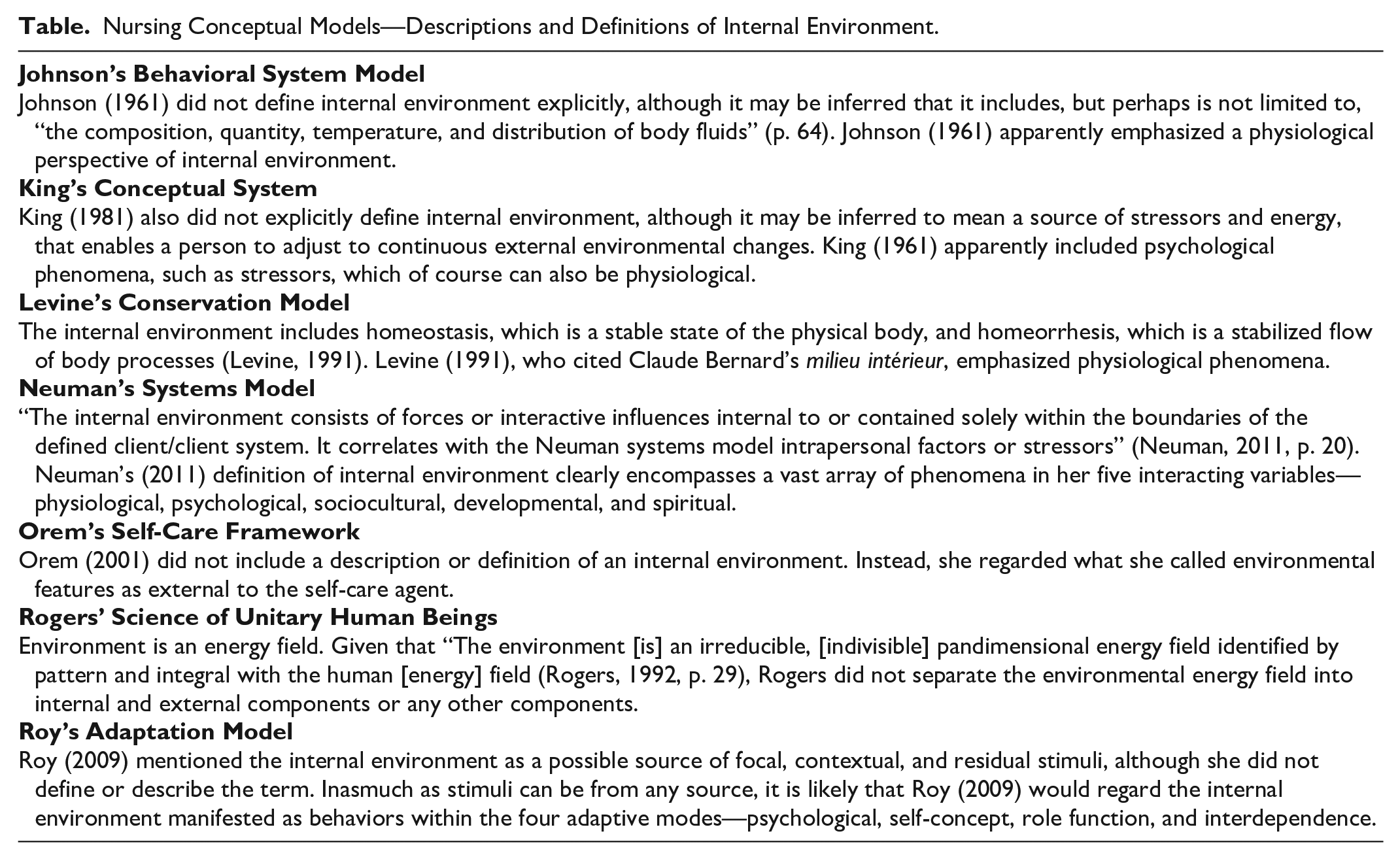
Descriptions or definitions of internal environment given by the authors of a few widely used nursing conceptual models are listed in the Table. Of note is that each of these nursing conceptual models was developed by a white woman and from a Euro-centric perspective. The table also includes my interpretation of the meaning of internal environment to each of these nurse theorists.
A Native American View of Internal Environment
Isaac et al. (2018) drew our attention to the Native American understanding of environment, which they claimed is, in part, a social construction. They emphasized the external environment as a social determinant of health, stating that environment is “for many Indigenous peoples, historically initiated and must include an understanding of the consequence of colonization” (Isaac et al., 2018, p. 125002-2). Perhaps, though, their understanding of the external environment may be extended to the internal environment and its effects on the health of human beings. Noteworthy, and of concern, is that a late February 2023 search of the CINAHL Ultimate (Cumulative Index of Nursing and Allied Health Literature) did not yield any other papers about the understanding of the internal environment by nurse authors of diverse cultures.
Conclusion
I gratefully acknowledge the contribution of my colleague, Dr. Lisa Sundean, a faculty member at Fairfield University, for giving me the reference to the Isaac et al. (2018) article. I welcome readers’ thoughts about internal environment, including critique of my understanding of what the internal environment encompasses and my interpretations of the nurse theorists’ descriptions and definitions of internal environment (see Table). I also welcome and encourage contributions about views of the internal environment from perspectives of persons of diverse cultures, including Indigenous persons and persons of color.
Nursing Conceptual Models—Descriptions and Definitions of Internal Environment.