



Abstract
Feeling ashamed is a universal humanuniverse living experience. According to humanbecoming, all persons choose to feel ashamed or not from moment to moment. Therefore, it is significant to discover the newknowings of the phenomenon of feeling ashamed. The investigation method was Parsesciencing, a unique mode of inquiry within the humanbecoming paradigm. The investigation included 10 historians between the ages of 18 and 65 years, who were willing to share their experiences of feeling ashamed. The inquiry stance was: What is the discerning extant moment of the universal humanuniverse living experience of feeling ashamed? The major discovery of this Parsesciencing inquiry was the discerning extant moment: Feeling ashamed is profound agonizing regretfulness with persistent unwelcome recollections arising with desired concealment with distancing affiliations.
Shame was poorly discussed in the literature of various disciplines; therefore, it is hard to separate shame from other related concepts. People who experience shame often feel vulnerable, less worthy, and rejected. According to Zahavi (2010), “to feel ashamed is to feel unworthy, is to feel that the negative assessment of the other is deserved” (p. 218). In addition, the experience of shame has been described as the “inner, critical voice that judges a person’s actions as wrong, inferior, or worthless" (Miller, 2006, p. 2). In the philosophy discipline, Maibom (2010) and Maley (2015), described shame as the most common painful emotion directed to the self as a result of failing to live up to others’ expectations or standards. Scheff (2014), a professor in sociology, argued that shame is one of the most common feelings in modern societies, but people prefer to keep it hidden, concealed, and unseen. According to Scheff (2003), shame was described by most researchers as “the master emotion of everyday life” (p. 244).
From the humanbecoming perspective, shame is an individual choice of living. To discover the meaning of shame, it is essential to understand that it is an indivisible, unpredictable, everchanging experience. It is a universal humanuniverse living experience that can be described by individuals of all ages. Shame is found in Parse’s humanbecoming ethos as a tenet of dignity. According to Parse (2010), human dignity has four tenets, and shame is one of them. The newknowings that arose from this Parsesciencing inquiry on feeling ashamed added to nursing knowledge and contributed to understanding of the humanbecoming paradigm. The aim of this Parsesciencing inquiry was to discover the discerning extant moment of the universal humanuniverse living experience of feeling ashamed.
Horizon of Inquiry
The humanbecoming paradigm was the horizon of inquiry for this investigation (Parse, 2014). Feeling ashamed is a universal humanuniverse living experience which makes the humanbecoming paradigm the most appropriate mode of inquiry to investigate universal humanuniverse living experiences.
Parse developed nine philosophical assumptions, four postulates, three principles, concepts and paradoxes as the nature of existence. The nine assumptions of humanbecoming define the humanuniverse, the ethos, and living quality. Humanuniverse is defined as “a cocreation that cannot be divided” (Parse, 2014, p. 30). Parse elaborated that Humanuniverse is “indivisible, unpredictable, everchanging, cocreating reality as a seamless symphony of becoming with the illimitable mystery with contextually construed pattern preferences” (Parse, 2014, p. 31). The ethos of humanbecoming makes explicit four tenants of dignity that are reverence (presence), awe (existence), betrayal (trust), and shame (worth). In addition, updated conceptualized paradoxes were introduced by Parse (2018), which are revering-betraying and aweing-shaming. These paradoxes are “living rhythms, unfolding possibilities for choosing pattern preferences” (Parse, 2018, p. 261). Parse (2018) described aweing-shaming as “an all-at-once wondering-recoiling, an approaching-escaping phenomenon” (p. 261). In aweing-shaming, individuals live this paradox by choosing to live feelings of respect and admiration while all-at-once trying to escape moments filled with shame and embarrassment. Moreover, living quality is the “becoming visible-invisible becoming of the emerging now, the everchanging whatness of becoming, the personal expression of uniqueness” (Parse, 2014, p. 31).
The four postulates of humanbecoming are ideas about the nature of existence; they are illimitability, paradox, freedom, and mystery. Parse (2007) explained illimitability as “the indivisible unbounded knowing extended to infinity, the all-at-once remembering and prospecting with the moment” (p. 308). Paradox was explained as “an intricate rhythm expressed as a pattern preference” (p. 309). Paradox is a living rhythm. Freedom is “contextually construed liberation” (p. 309) that refers to “a humanuniverse coconstitution inherent in personal choosings that gives birth to meaning” (Parse, 2014, p. 32). Another postulate of humanbecoming is mystery. Mystery is the unexplained unknown, as Parse (2007) elaborated, “No one or no thing is completely knowable; there is always the unfathomable with the indivisible, unpredictable, everchanging humanuniverse” (p. 309).
The principles of the humanbecoming emerged from the following themes: meaning, rhythmicity, and transcendence (Parse, 2014). The first principle is “structuring meaning is the imaging and valuing of languaging” (Parse, 2014, p. 37). It means “with humanuniverse, there is the structuring of personal meaning in cocreating reality illimitably with paradoxical rhythms: the explicit-tact and reflective-prereflective of imaging, the confirming-not confirming of valuing, and the speaking-being silent and moving-being still of languaging” (Parse, 2014, p. 37). The concepts of structuring meaning are imaging, valuing, and languaging. The second principle is “configuring rhythmical patterns is the revealing-concealing and enabling-limiting of connecting-separating” (Parse, 2014, p. 43). It means “with humanuniverse, there is configuring rhythmical patterns in cocreating reality illimitably with the paradoxical rhythms: disclosing-not disclosing of revealing-concealing, the potentiating-restricting of enabling-limiting, and attending-distancing of connecting-separating” (Parse, 2014, p. 43). The concepts of this principle are revealing-concealing, enabling-limiting, and connecting-separating. The third principle is “cotranscending with possibles is the powering and originating of transforming” (Parse, 2014, p. 47). It means “humanuniverse is the grounding for cotranscending with possibles in cocreating a seamless reality illimitably with the paradoxical rhythms: pushing-resisting, affirming-not affirming, and being-nonbeing of powering; the certainty-uncertainty and conformity-nonconformity of originating; and the familiar-unfamiliar of transforming” (Parse, 2014, p. 47). The concepts of the third principle are powering, originating, and transforming. All of the principles of humanbecoming, with the concepts and paradoxes in each principle, emphasize the idea of humanbecoming as an indivisible cocreation (Parse, 2014).
Foreknowings
The foreknowings are “what is known and believed about the universal humanuniverse living experience from the literature and other sources” (Parse, 2016, p. 272). Foreknowings are theoretical and conceptual. In this investigation, the theoretical foreknowing was the humanbecoming paradigm (Parse, 2014). The conceptual foreknowings are shown as themes of the living experience of feeling ashamed. There is limited research on the phenomenon of feeling ashamed within different disciplines, including nursing, theology, philosophy, psychology, and sociology. Dwelling with printed material among the various disciplines guided this scholar to explore with pattern preferences to discover the meaning of the universal humanuniverse living experience of feeling ashamed. The scholar crafted the following three themes from this deep exploration: shame is a threat to dignity; shame arises with unfavorable disclosure; and shame emerges with mortifying disgrace.
Inquiry Stance
What is the discerning extant moment of the universal humanuniverse living experience of feeling ashamed?
Historians
The historians of this inquiry were 10 individuals who spoke English, 18 years of age and older, and willing to engage in dialoguing about the universal humanuniverse living experience of feeling ashamed. Historians were invited through posted signs in public places, such as schools and community centers. The dialoging-engaging was conducted through a private online Parsesciencing dialogue using the Zoom application. As an ethical consideration, this investigation sought approval from the Institutional Review Board of Binghamton University. Historians were requested to sign a consent form that permits the use of audio and visual recording. Consents were voluntary with the choice of withdrawal at any time under any circumstances. Before starting the investigation, historians were able to ask any question, and all concerns were addressed and answered to protect the historians’ rights. Moreover, the audio files and transcripts were stored under encryption password security. Also, to ensure the anonymity of the historians, a code name was assigned to each of them.
Mode of Inquiry
Parsesciencing (Parse, 2016) is the appropriate mode of inquiry for the investigation of feeling ashamed; it is consistent with the humanbecoming paradigm. Furthermore, Parsesciencing involves “coming to know the truth for the moment and meanings of universal humanuniverse living experiences” (Parse, 2016, p. 271). Parsesciencing includes three phases, which are dialoguing-engaging, distilling-fusing, and heuristic interpreting (Parse, 2016). These phases guided the scholar to answer the inquiry stance, which is: What is the discerning extant moment of the universal humanuniverse living experience of feeling ashamed? Each phase in relation to this Parsesciencing is discussed next.
Dialoging-Engaging
In this phase, the scholar was in true presence with the historians while they described their experiences of feeling ashamed. Parse (2016) argued that true presence is different from interviewing. She stated: “True presence is not an interview but rather an up close and personal presence of scholar with historian, where the historian is invited to share a description of the experience in dialogue without interruption from the scholar” (p. 272). True presence is the art of humanbecoming (Parse, 2014) and can only be lived by individuals who study, understand, and believe the humanbecoming paradigm.
After inviting the historians to describe their experiences of feeling ashamed, the scholar began by saying: “Tell me about your experience of feeling ashamed.” The scholar was in true presence with the historian without interruption. With the scholar’s intention to discover the discerning extant moment of the universal humanuniverse living experience of feeling ashamed, only encouraging statements were used like, “say more” or “go on,” to pursue the meaning of the experience. The truth of the moment for each historian arose in the “becoming visible-invisible becoming of the emerging now” (Parse, 2016, p. 272). During dialoging-engaging, the historians’ descriptions of their experiences were recorded and then transcribed to be used in the next phase, distilling-fusing.
Distilling-Fusing
Distilling-fusing is “dwelling with and inventing” (Parse, 2016, p. 272). The scholar dwelled with the historians’ transcribed and recorded descriptions by listening to the recordings and reading and rereading the transcripts. The scholar captured the central ideas with distilling a story from the historians’ descriptions of the universal humanuniverse living experience of feeling ashamed. The scholar identified essences in the language of the historians, then in the scholar’s language at a higher level of abstraction. Simultaneously, the scholar’s essences were fused to be stated as “the language-art” (Parse, 2016, p. 272) for historians. The scholar in deep contemplation with the historians’ descriptions, the recorded dialogues, and the language-art of all historians identified the core ideas. These core ideas were fused to create the discerning extant moment of the universal humanuniverse living experience of feeling ashamed, which is the major discovery of this investigation that illuminates the inquiry stance. The next phase of Parsesciencing is the heuristic interpretation, where the scholar moved the discerning extant moment to a higher level of abstraction and then to a level within the humanbecoming paradigm.
Heuristic Interpreting
The last phase of Parsesciencing is the heuristic interpreting phase. This phase included transmogrifying, transsubstantiating, metaphorical emergings, and artistic expressions. Transmogrifying is clear language shifting. It is “transmuting and metamorphosing and portends moving and everchanging” (Parse, 2016, p. 273). Transsubstantiating is the shapeshifting to humanbecoming language. Transsubstantiating is “moving the abstract transmogrified language to the core language of humanbecoming” (Parse, 2016, p. 273). The metaphorical emergings are the historians’ words that were used to explain in symbolic language their experiences of feeling ashamed. The artistic expression was the scholar’s choice of the artform that reflected her experience with Parsesciencing and the newknowings that arose from the investigation. It was with heuristic interpreting that the truth for the moment of the living experience of feeling ashamed as articulated in the discerning extant moment was moved to higher levels of abstraction.
Historians’ Truths
The historians’ truth for the moment emerged from the dialoging-engaging, distilling-fusing, and heuristic interpreting of Parsesciencing inquiry (Parse, 2016). Including below are the stories of three selected historians, their essences, the scholar’s essences, and the language-art of each historian. For additional clarity, Tables 1 and 2 illustrate the language-art of all 10 historians and the core ideas across different levels of abstraction.
Language-Art of All Historians.
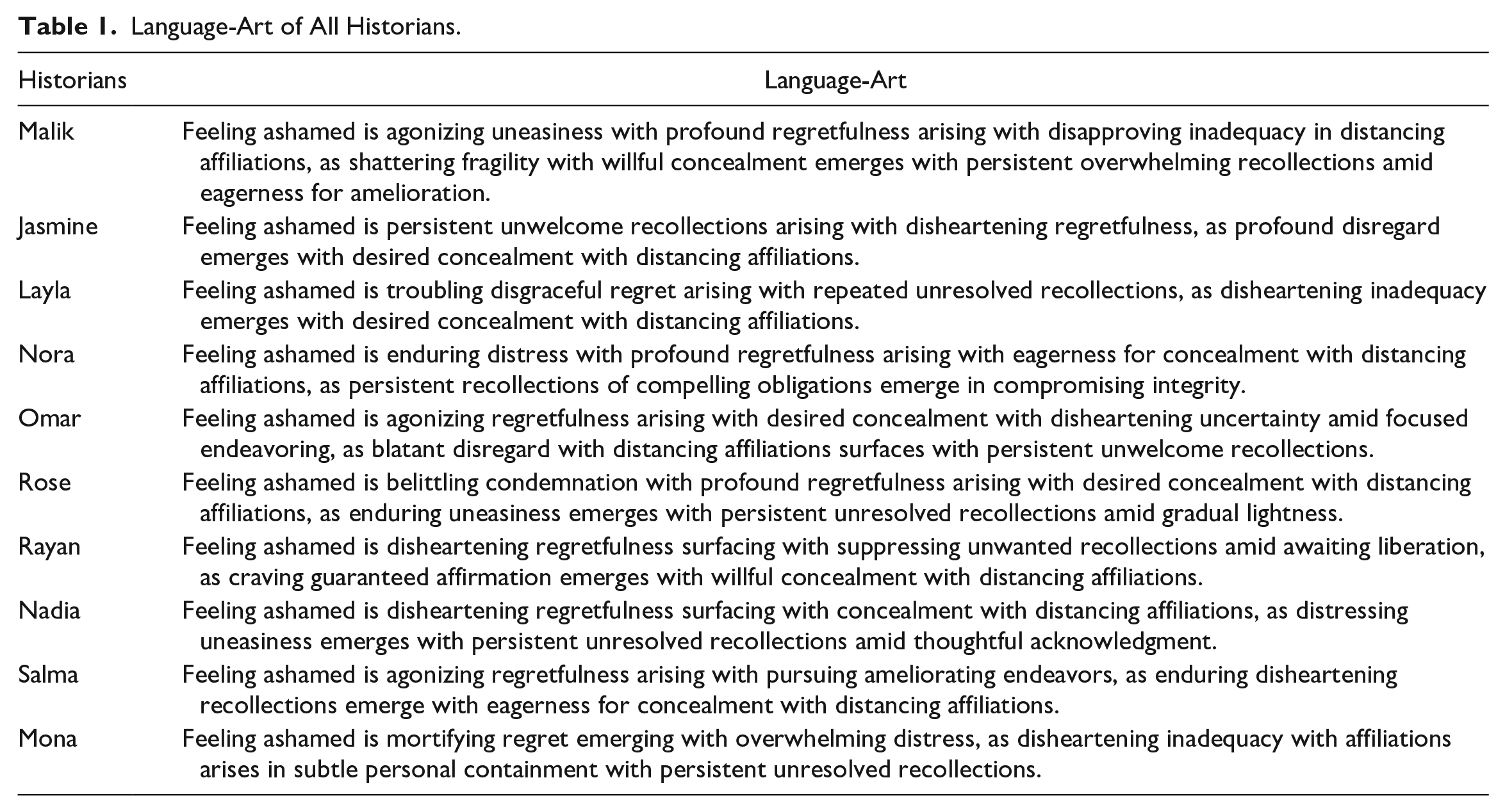
Core Ideas of Feeling Ashamed Across Levels of Abstraction.


Rose’s Story
Rose said that feeling ashamed is to feel small like a child who has gotten in trouble. She elaborated, “I feel like I crumple up in my mind’s eye, I feel small. I feel stupid.” It is to feel like everyone else is bigger and has authority. When Rose feels ashamed, she “wants to run away” and “never come back to that place again.” She elaborated by saying, “I want to hide,” “I do not want anybody to know.” She described feeling ashamed as “hard to let go,” and she lives it again every time she thinks about it. She tries to “rationalize it or numb it.” She wishes that she could hit a “re-do button.” When feeling ashamed, Rose feels like her whole body turns liquid inside with no structure holding her up. She stated that feeling ashamed is not an experience to keep crying about, and eventually, you laugh about it.
Essences: Rose’s Language
Feeling ashamed is to feel small like a child who is being corrected by someone in authority for doing something wrong. It is not wanting others to know and running away to hide, never come back.
Feeling ashamed is like being crumpled and stupid. It is hard to let go and requires rationalization to be numbed. It is lived again when thinking about it and is laughed at eventually.
Essences: Scholar’s Language
Belittling condemnation with profound regretfulness arises with desired concealment with distancing affiliations.
Enduring uneasiness emerges with persistent unresolved recollections amid gradual lightness.
Rose’s Language-Art
Feeling ashamed is belittling condemnation with profound regretfulness arising with desired concealment with distancing affiliations, as enduring uneasiness emerges with persistent unresolved recollections amid gradual lightness.
Nadia’s Story
Nadia said that feeling ashamed is a choice she makes. It is doing something wrong or something she should not have done. Feeling ashamed for her is a feeling she brought on herself, not others. It is to feel embarrassed and disappointed. Nadia elaborated, feeling ashamed is to feel “uncomfortable” with “a pit in the stomach.” It is an experience that she always thinks about and tries to talk herself out of it. Feeling ashamed is a feeling that is “hard to sit with and accept” because that would mean she did wrong and knew it was wrong at the time. In the end, Nadia thinks it is better just to accept this feeling, so she learns from it not to do wrong again. Nadia concluded, “I am ashamed about something that I have to be secretive about,” and “I don’t want anyone to know about it; it is something I want to hide.”
Essences: Nadia’s Language
Feeling ashamed is to feel embarrassed and disappointed about doing something wrong. It is a choice that has to be secretive and hidden from others.
Feeling ashamed is like a pit in the stomach. It is an uncomfortable experience hard to sit with that is often thought about. It is a feeling that is but better to accept; something is learned from it.
Essences: Scholar’s Language
Disheartening regretfulness surfaces with concealment with distancing affiliations.
Distressing uneasiness emerges with persistent unresolved recollections amid thoughtful acknowledgment.
Nadia’s Language-Art
Feeling ashamed is disheartening regretfulness surfacing with concealment with distancing affiliations, as distressing uneasiness emerges with persistent unresolved recollections amid thoughtful acknowledgment.
Malik’s Story
Malik said, “feeling ashamed is to feel bad and guilty.” He is ashamed when doing something not acceptable, like deviating from his moral standards. He said, “I feel ashamed when I do something wrong that I should not have done.” He elaborated that he is shameful when not being able to meet the standards he set for himself. Feeling ashamed is to cover something with a lie rather than handling it. He described shame as a “burden block” that he thinks about quite often and as “a window to bounce back and do better next time.” In shameful moments, Malik tries to avoid the situation because it makes him vulnerable to feelings of guilt. Malik said that feeling ashamed is an avenue to do something correctly when having similar situations. To feel ashamed for Malik is to misbehave and be confronted with being wrong. It is to disappoint others who expected more from him, and he desires to reverse the past and do better. Malik said, “I feel ashamed when I put my loved ones in a certain place and try my best not to do anything that will hurt them or make them feel bad.” Feeling ashamed is to feel down, embarrassed, terrible, and remorseful. When he feels ashamed, he does not feel alive or happy. Malik elaborated that feeling ashamed for him “brings a sense of being in the back seat and not being in control.” Feeling ashamed makes Malik feel vulnerable to negative feelings.
Essences: Malik’s Language
Feeling ashamed is to feel bad, embarrassed, guilty, and remorseful. It is a disappointment in deviating from personal standards and not meeting others’ expectations with desires to reverse the past.
Feeling ashamed is to be vulnerable and not in control, like in the back seat. It is to avoid the situation, since it is thought about quite often. There is a window to bounce back, an avenue to do something correctly when having similar situations.
Essences: Scholar’s Language
Agonizing uneasiness with profound regretfulness arises with disapproving inadequacy in distancing affiliations.
Shattering fragility with willful concealment emerges with persistent overwhelming recollections amid eagerness for ameliorating.
Malik’s Language-Art
Feeling ashamed is agonizing uneasiness with profound regretfulness arising with disapproving inadequacy in distancing affiliations, as shattering fragility with willful concealment emerges with persistent overwhelming recollections amid eagerness for amelioration.
Ensuing Discoveries
Profound Agonizing Regretfulness
Profound agonizing regretfulness arose from all the historians when asked about their experiences of feeling ashamed. Profound agonizing regretfulness is the first core idea of the universal humanuniverse living experience of feeling ashamed. It is transmogrified to unbearable anguish and transubstantiated to imaging, from the first principle of humanbecoming, “structuring meaning is the imaging and valuing of languaging” (Parse, 2014, p. 37).
In this investigation, profound agonizing regretfulness is the explicit-tacit knowings of disappointment, embarrassment, guilt, and remorse that were cocreated in the becoming visible-invisible becoming of the emerging now. Some examples of the historians’ descriptions of feeling ashamed that arose as profound agonizing regretfulness were: “Feeling ashamed is to feel bad, embarrassed, guilty, and remorseful”; “it is to feel like a victim, bullied and not valued”; “feeling ashamed is feeling guilty and disappointed”; “feeling ashamed is a feeling of dread, sweating and stomach dropping”; “feeling ashamed is to feel bad, remorse, depressed, and incapable”; “it is an experience not to share, it is to feel small, rejected, not accepted by others”; “feeling ashamed is like being crumpled and stupid. It is hard to let go and requires rationalization to be numbed”; “feeling ashamed is to feel guilty of doing something wrong”; “feeling ashamed is like a pit in the stomach”; and “feeling ashamed is to feel depressed, sad, and guilty. It is a heavy feeling like pressure on the chest. It is to feel anxious with the heart going faster, and palms getting sweaty.”
In the discipline of nursing, some scholars’ findings were similar to the core idea of profound agonizing regretfulness. For example, Shaughnessy (2020), in a Parsesciencing inquiry of feeling ashamed with 10 historians from upstate New York, found the core idea to be penetrating encumbrance, which was transmogrified to oppressive disquietude and transubstantiated to the concept of imaging from the first principle of humanbecoming. The historians in Shaughnessy’s investigation described their experience of feeling ashamed as “terrifying and uncomfortable with a pit in the stomach” (p, 72); “it is feeling restless, depressed, irritable, and embarrassed with gut churning, mind racing, and about to cry”; and “feeling not worthy, never good enough, not a good person” (p. 76). These descriptions were similar to the core idea of profound agonizing regretfulness from this investigation when historians talked about their experiences of feeling ashamed as “a pit in the stomach”; “feeling bad, remorse, depressed, and incapable”; and “as if not being adequate with deficiencies and losing confidence in doing things.”
Another scholar, Hawkins (2017), conducted a Parse method study on feeling disrespected with 10 obese women. Hawkins discovered the core concept of mortifying disheartenment, which was transposed to discordant ponderings then conceptually integrated with humanbecoming as imaging. Mortifying disheartenment was described as “a profound sadness when recalling moments of experiencing disregard. It is an assault on the strength and vitality of human flourishing” (p. 156). Participants in the Hawkins study talked about moments of “feeling sad, depressed, humiliated” and “being made fun of with jokes and personally offended” when disrespected, which was similar to how historians of this investigation described feeling ashamed as “feeling depressed, sad, and guilty” and “being laughed at and losing confidence.”
In anthropology, Bartlett (2007) studied shame, literacy, and social relations among 36 youth and adult literacy students in two Brazilian cities. After the researcher analyzed the narratives, shame had emerged as a central theme, and some individuals had moments of profound agonizing regretfulness. For example, one of the participants, Bia, was experiencing shame from her neighbor, Dora, who was constantly making fun of Bia’s speech and correcting her pronunciation and grammar. When feeling ashamed, Bia reported extreme somatic symptoms: “I got so nervous” and “I got so sick. I had a fever, then cold, a headache, and at night I would get a kind of stress” (p. 557). She talked about feeling ashamed as “it was something on top of me, like a person wanting to kill me. A mind disturbance” (p. 557). By the same token, historians in this investigation reported extreme somatic responses when feeling ashamed: “Feeling ashamed is to feel depressed, sad, and guilty. It is a heavy feeling like pressure on the chest. It is to feel anxious with the heart going faster and palms getting sweaty.” Beyond profound agonizing regretfulness, persistent unwelcome recollections surfaced when individuals experienced feeling ashamed.
Persistent Unwelcome Recollections
The second core idea of the universal humanuniverse living experience of feeling ashamed is persistent unwelcome recollections. The transmogrifying of persistent unwelcome recollections is unwavering reminiscence and the transubstantiating is languaging powering. The concept of languaging arises from the first principle of humanbecoming, “structuring meaning is the imaging and valuing of languaging” (Parse, 2014, p. 37), and powering arises from the third principle of humanbecoming, “cotranscending with possibles is the powering and originating of transforming” (Parse, 2014, p. 47). Languaging is explained by Parse (2014) as “signifying valued images with speaking-being silent and moving-being still” (p. 40), and powering is “the pushing-resisting of affirming-not affirming being in light of nonbeing” (p. 48).
In this Parsesciencing inquiry, historians expressed moments of persistent unwelcome recollections in their feeling ashamed experiences. For example, historians described persistent unwelcome recollections as: “to avoid the situation, since it is thought about quite often”; “a bad non-forgettable experience, heartbreaking like losing a loved one”; “questioning and thinking about the experience over and over with the desire to change the situation”; “it is always remembered”; “an experience not to share. It is to feel small, rejected, not accepted by others”; “hard to let go and requires rationalization to be numbed. It is lived again when thinking”; “an uncomfortable experience hard to sit with that is often thought about”; and “difficult to let go and sticks around for a while like days, years, and decades.”
From psychology literature, moments of persistent unwelcome recollections were manifested by individuals. Lewis (1971) explained that individuals experiencing shame could express their shame in two different ways, and one of them was bypassed shame. In bypassed shame, the shameful moments bring unwelcome pain that lasts for some time. In these moments, a person imagines replaying differently to change the situation and avoid feeling ashamed. Scheff (2015) tried to explain bypassed shame as “a brief painful feeling, usually fleeting, followed by obsessive and rapid thought or speech” (p. 117). Similarly, historians in the current study talked about feeling ashamed as “questioning and thinking about the experience over and over with the desire to change the situation” and “difficult to let go and sticks around for a while like days, years, and decades.”
Other researchers from the discipline of medicine, Lindström et al. (2011), explored medical students’ reflections on shameful experiences in clinical settings. Seventy-five students from the Medical School of Umea University, Sweden, were recruited to write down their memories of shameful experiences. Three themes emerged from that study, which are difficulties in disclosing shame, shame-inducing circumstances, and avoiding or addressing shame. Under the theme of difficulties in disclosing shame, participants emphasized the core idea of persistent unwelcome recollections by describing feeling ashamed as an uncomfortable adhesive feeling. One participant talked about his feeling following a shameful experience as: “Now, afterwards, I still feel ashamed about the way I answered” (p. 1019). Other participants mentioned that they relive the shameful experience whenever they recall it. They re-experienced an uneasiness and bodily symptoms: “I willingly admit that, though more than six months have passed, I feel an icy lump in my stomach when I write down the memories” (p. 1019). By the same token, historians in this investigation experienced persistent unwelcome recollections. They felt “a bad non-forgettable experience.” Others talked about feeling ashamed as “hard to let go and requires rationalization to be numbed. It is lived again when thinking.”
Moreover, Guenther (2011) explored Sartre, Levinas, and Beauvoir’s phenomenological analyses of shame in light of philosophy and social theory. Guenther articulated that shame makes people feel stuck and rethink the shameful scenario over and over and that can relate to moments of persistent unwelcome recollections. Guenther claimed, “Shame makes me feel frozen in time, stuck to a moment that goes nowhere, opens onto no future, gives me no possibility of becoming otherwise” (p. 25). Similarly, historians of this investigation explained feeling ashamed with “questioning and thinking about the experience over and over with the desire to change the situation.” As persistent unwelcome recollections unfolds, it also points to the next core idea of desired concealment with distancing affiliations.
Desired Concealment with Distancing Affiliations
Desired concealment with distancing affiliations is the third core idea of the universal humanuniverse living experience of feeling ashamed. It was transmogrified to alienation with sequestering alliances that was transubstantiated to connecting-separating. The paradox of connecting-separating surfaces from the second principle of humanbecoming, “configuring rhythmical patterns is the revealing-concealing and enabling-limiting of connecting-separating” (Parse, 2014, p. 43). Parse (2014) defined connecting-separating as “it is living being with and apart from others, ideas, objects, and situations all-at-once” (p. 45).
Historians shared moments that arose as desired concealment with connecting-separating when feeling ashamed. The desired concealment with distancing affiliations was the explicit-tacit knowings of wanting to disappear, be unseen, be isolated from others, and running away to hide to avoid the situation. For example, historians described desired concealment with distancing affiliations in many ways: “to avoid the situation” for “not meeting others’ expectations with desires to reverse the past”; “wanting to be isolated from others and disappear”; “being less than others for not meeting expectations. It is wishing to disappear and be unseen”; “require running away to hide and avoid the situation”; “it is as if not being adequate with deficiencies. It is to feel small, rejected, not accepted by others”; and “it is not wanting others to know and running away to hide, never come back.”
In the discipline of nursing, Shaughnessy (2020) explored the universal humanuniverse living experience of feeling ashamed in a Parsesciencing investigation and discovered the two core ideas of isolating concealment and diverse affiliations. Isolating concealment was transmogrified to veiled solitude and transubstantiated to languaging powering, while diverse affiliations was transmogrified to varied alliances and transubstantiated to connecting-separating. Similarly, here desired concealment with distancing affiliations was transubstantiated to connecting-separating as well. One historian in Shaughnessy’s study described moments of “wanting to recoil, hide, and make it go away but having to live with it. It is wanting to avoid eye contact and others” (p. 73), which is similar to what historians described in this Parsesciencing inquiry of feeling ashamed with “wishing to disappear and be unseen” and “wanting to be isolated from others and disappear.” Another historian described feeling ashamed as “self-loathing” (p. 75), which was similar to “feel stupid and unlikable that goes with negative self-talk.” In addition, historians in Shaughnessy’s investigation spoke of distancing themselves from people around them when feeling ashamed by “keeping to self, not liking to be around people, not wanting people to find out, and closing off from opportunities” (p. 79). Historians in this investigation described feeling ashamed as “not wanting others to know” and “requires running away to hide and avoid the situation.”
Likewise, another nurse scholar, Bunkers (2016), conducted a Parsesciencing inquiry on feeling unsure with 10 Native American women aged between 33 and 62 years who were living in an urban Midwestern city. Historians in Bunkers’s investigation revealed the core idea of joining with-distancing from affiliations when feeling unsure that was transmogrified to togetherness-aloneness and transubstantiated to connecting-separating. One historian in Bunkers’s study described her experience of feeling unsure as “being abandoned, not liking to socialize or make friends” (p. 293). This statement is similar to the core idea of desired concealment with distancing affiliations where historians described feeling ashamed as “it is to feel small, rejected, not accepted by others” and “wanting to be isolated.” Historians in Bunkers’s study wished not to be around others when they experienced feeling unsure. One historian said, “Feeling unsure is getting a divorce and not wanting to be around others” (p. 294) that is akin to a historian’s description in this investigation of feeling ashamed as “it is a choice that has to be secretive and hidden from others,” and “it is not wanting others to know and running away to hide, never come back.”
In philosophy and phenomenological research, moments of desired concealment with distancing affiliations were emphasized. When studying shame, violence, and morality, Thomason (2015) described the feeling of shame as “the emotion we feel when we fail to live up to standards, norms, or ideals” (p. 1); in this inquiry, feeling ashamed was described as “being less than others for not meeting expectations. It is wishing to disappear and be unseen.” Further, Deonna and her colleagues (2011) described individuals feeling ashamed as “the subject is painfully revealed to herself as having an incapacity” (p. 177) and reported the most common aspects of shame that are feeling “small” and “shrunken” (p. 108). And in this current investigation, historians talked about feeling ashamed as “it is as if not being adequate with deficiencies. It is to feel small, rejected, not accepted by others.” All of these studies from various disciplines discussed ways in which individuals moved in living the rhythm of attending-distancing from diverse affiliations when feeling ashamed as they focused on being with and away from others, ideas, and objects.
Scholar’s Conceptualization and the Discerning Extant Moment: A Comparison
The scholar’s now-truth was articulated as “feeling ashamed is unbearable stillness with desired escape arising with isolating affiliations” (Alanizi, 2021, p. 180). This novel conceptualization was shapeshifted to the level of humanbecoming as ingenuous proclamation as “feeling ashamed is languaging the powering of connecting-separating” (Alanizi, 2021, p. 180) in addition to the artform, a painting by Rosa Gunasingha (2014) titled Shame. By comparing the scholar’s theoretical and conceptual foreknowings to the discovery of this Parsesciencing inquiry of the living experience of feeling ashamed, few differences were found.
The discerning extant moment of the universal humanuniverse living experience of feeling ashamed of this Parsesciencing inquiry is feeling ashamed is profound agonizing regretfulness with persistent unwelcome recollections surfacing with desired concealment with distancing affiliations. The discerning extant moment was transubstantiated to feeling ashamed is imaging the languaging powering of connecting-separating. This discerning extant moment precisely answers the question of this inquiry, what is it like to feel ashamed? For instance, profound agonizing regretfulness expresses the explicit-tacit knowings of disappointment, embarrassment, guilt, and remorse that historians experienced when feeling ashamed. In addition, the concept of desired escape with isolating affiliations was captured in the now-truth, while desired concealment with distancing affiliations was conceptualized in the discerning extant moment. It is clear that individuals experiencing feeling ashamed longed for concealment and desired escape, along with distancing themselves from people around them by “wishing to disappear and be unseen.” Moreover, the artistic expression of The Shame painting by Zelal Guzlan (2010) was chosen to illustrate the discerning extant moment of the universal humanuniverse living experience of feeling ashamed and the scholar’s experience with Parsesciencing.
When looking at the humanbecoming level, the concept of imaging only existed in the discerning extant moment and not in the ingenuous proclamation. Imaging is “reflective-prereflective coming to know the explicit-tacit all-at-once” (Parse, 2014, p. 38). It was the explicit-tacit knowings of feeling ashamed that were cocreated in the becoming visible-invisible becoming of the emerging now for historians in the investigation.
Metaphorical Emergings
Metaphorical emergings are the historians’ statements that include symbolic language describing their living experiences (Parse, 2016). In this Parsesciencing investigation of the universal humanuniverse living experience of feeling ashamed, no metaphorical emergings have been described by the historians during dialoging-engaging.
Artistic Expression
The artistic expression is the scholar’s chosen artform to share her experience with the Parsesciencing. In this section, the scholar selected a painting by Zelal Guzlan (2010) titled The Shame (see Figure) as an artistic expression. This artform illustrates both the scholar’s experience with Parsesciencing and the discerning extant moment of the universal humanuniverse living experience of feeling ashamed (Parse, 2016). The artform, The Shame, portrays many female figures. The main two figures are the two girls on the left and front of the painting. The three core ideas of the scholar’s discerning extant moment of this Parsesciencing inquiry are discussed with the artistic expression to further elaborate the universal humanuniverse living experience of feeling ashamed.
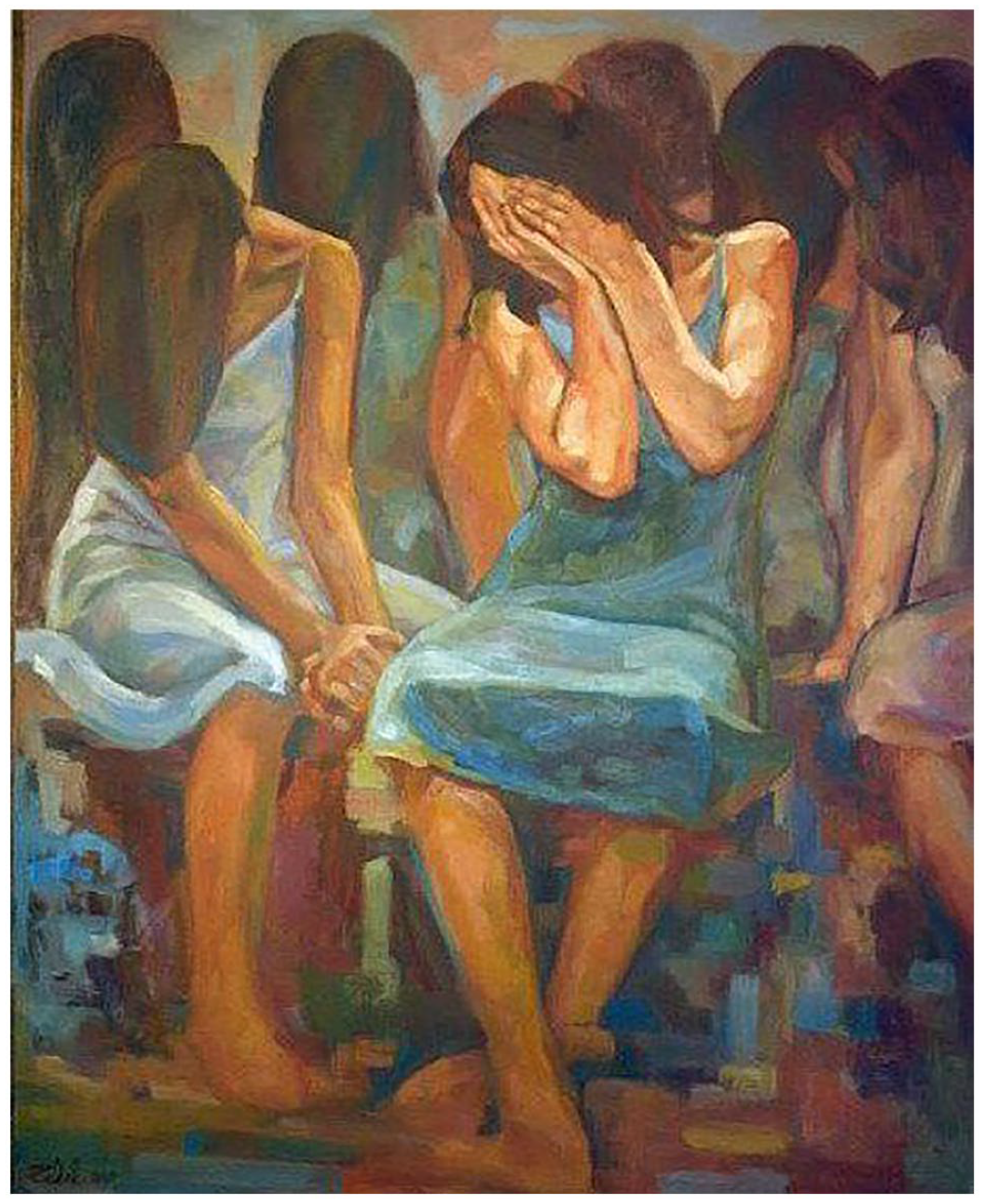
The Shame by Zelal Guzlan (2010). Reprinted with permission.
The first core idea of the discerning extant moment of the universal living experience of feeling ashamed is profound agonizing regretfulness. All of the historians in this investigation expressed meanings of a profound agonizing regretfulness by speaking about disappointment, remorse, guilt, embarrassment, sadness, feeling bad, and more. In this artform, the explicit-tacit knowings of all figures are clearly demonstrated in the profound agonizing regretfulness. The figures are looking down with hair over their faces to show anguish and regret. The girl in the front covers her face with her hands to avoid the glare of others. The girl on the left is bending with her head down and holding her hands together very tightly, emphasizing the unbearable feeling of the moment. The speaking-being silent and moving-being still are presented in the girls’ choice to confirm-not-confirm the unbearable anguish. With profound agonizing regretfulness, persistent unwelcome recollections emerge with the now moment.
The second core idea of the discerning extant moment of the universal living experience of feeling ashamed is persistent unwelcome recollections. With the historians’ experiences of feeling ashamed, they expressed moments of unresolved recollections, persistent destructive thoughts, and repeated non-forgettable memories. They were questioning their feelings and thinking about the shameful situation over and over. All figures in the painting are languaging their feelings of shame with persistent unwelcome recollections, with looking away as if hiding and moving with the sense of disregard of nonbeing. They chose the persistent unwelcome recollections as affirming values that cocreated speaking being silent with a special personal meaning surfacing with becoming visible-invisible becoming of the emerging now. With the speaking-being silent paradox of languaging, it appears that the girls lowering their heads and not participating in any verbal communication are living the disregard of being non-being. The girl in the front covers her face with her hands to avoid speaking. It is painful for her to reminisce with the self-critical thoughts, such as not being good enough, unlikable, and worthless, as with what the historians spoke of in this investigation of feeling ashamed. It is uncomfortable to speak about shameful moments. The girls in the painting appear to have no words to symbolize their thoughts and no way to ignore them. With the moving-being still paradox, the girls showed stillness that expressed the meaning moment of the becoming visible-invisible becoming of the emerging now. Stillness is a way of being that might have helped the figures to clear their thinking and be free from destructive thoughts, yet it is also a way to shut out all surroundings. The girl’s body in the left side of the painting seems in tense holding her hands together firmly. She is having difficulty relaxing and quieting unwelcome recollections. All girls have these unwavering reminiscences that are not expressed with words, but expressed within the whole context of the situation, including posture and silent movements. In addition, in the painting, the figures language a continuous affirming-not affirming being in the presence of the possibility of nonbeing. Nonbeing in the painting seems to be concerned with losing value and being rejected, unaccepted, and unworthy. The figures are confirming-not confirming their worth. With powering, it appears that the girls continuously attempt to push and at-once resist unwelcome recollections with considering other possibilities. Possibilities could help to numb unwavering reminiscences. With the clinging hands and covering face, the two girls incarnate their intentions with the pushing-resisting that shows tension and conflict with themselves as they live silence and stillness. All of the figures are burdened with enduring thoughts of their experiences of feeling ashamed. They appear to attempt to overcome the feeling of shame and not be in constant suffering of unresolved recollections as were the historians in this investigation of feeling ashamed. With persistent unwelcome recollections, the desired concealment with distancing affiliations emerged.
The desired concealment with distancing affiliations is the third core idea of the discerning extant moment of the universal living experience of feeling ashamed. All historians discussed moments of attending-distancing from others, ideas, objects, and situations. They spoke of wanting to disappear, be unseen, and isolated from others. They wanted to run, hide, and avoid feeling ashamed. In the painting, the figures in the back with heads down seem to be distancing and isolating from others. The apparent feeling of deep inadequacy noted in the figures in the forefront emerged as hiding. They appear to withdraw from the figures behind them, as illustrated in the girl on the left who seems to be fidgeting, trying to imagine that she is not there, or to show others that she does not care. These figures’ experiences of shame are present in the becoming visible-invisible becoming of the emerging now. They illustrate the urge to shy away and not engage with alliances, as was clear with the historians in the investigation of feeling ashamed. The artform, The Shame by Zelal Guzlan (2010), was chosen by the scholar as incarnation of her experience with Parsesciencing and illuminated the discerning extant moment of the universal humanuniverse living experience of feeling ashamed.
Newknowings
Innumerable possibilities are found that view the familiar in new light and beyond with newknowings. In this Parsesciencing inquiry, the newknowings include:
Feeling ashamed is profound agonizing regretfulness with persistent unwelcome recollections surfacing with desired concealment with distancing affiliations.
Profound agonizing regretfulness as the reflective-prereflective coming to know the explicit-tacit all-at-once is significant to feeling ashamed.
Persistent unwelcome recollections arise with pushing-resisting with possibilities of being-nonbeing in the experience of feeling ashamed.
Desired concealment with distancing affiliations when feeling ashamed is being with and away from others, ideas, objects, and situations all-at-once.
Feeling ashamed is a non-forgettable heartbreaking experience that is not to be shared or relived.
Beyond the Horizon
The humanbecoming paradigm provides scholars with a mode of inquiry to enhance understanding of universal humanuniverse living experiences like feeling ashamed. From the humanbecoming perspective, it is crucial to recognize and respect individuals’ choices and value priorities. Therefore, the scholar’s goal is to emphasize more attention and raise awareness about the significance of respectful treatment, honoring dignity, and acknowledging others’ feelings. A deep understanding of what it is like to feel ashamed can advance nursing knowledge and guide nurses to contribute to living quality of others while living the art of humanbecoming. The universal humanuniverse living experience of feeling ashamed is very important in considering individuals’ dignity and living quality. This Parsesciencing inquiry (Parse, 2016) on feeling ashamed was the second investigation conducted on this phenomenon; the first one was conducted by Shaughnessy (2020). These investigations contributed to the expansion of nursing knowledge on the phenomenon of feeling ashamed, the humanbecoming paradigm, and living quality. The uncovered newknowings of this investigation contribute to additional insight into living the art of humanbecoming with individuals experiencing feeling ashamed.
Since feeling ashamed is a rarely studied phenomenon, the scholar recommends further inquiries for the advancement of nursing knowledge on this living experience. For more understanding of feeling ashamed, investigations using the humanbecoming modes of inquiry and other research methods are suggested. The newknowings of this inquiry include core ideas that can be investigated broadly. For further understanding of profound agonizing regretfulness, the scholar proposes investigating feeling embarrassed, feeling remorseful, feeling guilty, feeling disappointed, feeling vulnerable, feeling unvalued, and feeling bullied. In addition, to gain more knowledge of persistent unwelcome recollections, it is recommended to study feeling rejected, feeling unaccepted, feeling unworthy, feeling unconfident, feeling stupid, and feeling uncomfortable. Eventually, to deeply comprehend desired concealment with distancing affiliations, a thorough investigation on feeling isolated, hiding, and being secretive should be conducted. The knowledge of the nursing discipline and profession can be expanded with more discernment of these universal experiences.
