




Abstract
Background
Identity anchors are powerful communication resources that reflect and impact organizational resilience. Family business members draw on identity discourses to explain who they are to themselves, others, and in relation to threats or hardships.
Purpose
This paper seeks to better understand what identity anchors contribute to family farm businesses' resilience as they navigate uncertainty and contemporary challenges.
Research Design
This study include analysis of interviews with 16 family maple farm businesses.
Results
We identified three identy anchors that were discursively shared, reinforced, and transformed: (I) High-Quality Producers, (II) Family Farm, and (III) Financially Focused Farm Enterprise. We argue that the sustainability of family farm businesses depends on how families construct and adapt organizational identity anchors.
Conclusions
Resilience emerges when members can use them to negotiate the tension between change and continuity, as well as tensions created by pressures within the family, farm, and business systems. Results will be discussed in terms of their theoretical contributions and offer insights into managing resilience in family farm businesses.
Introduction
Family farm business resilience is best understood as a dynamic, adaptive-transformative process triggered by disruptions that foster reintegration and productive change (Buzzanell, 2010, 2017, 2018). Like other agricultural operations, family farm businesses face distress due to economic volatility, environmental instability, and market pressures (Paskewitz et al., 2023; Yilmaz et al., 2024). However, family farm businesses face additional challenges due to their unique structure, including navigating intergenerational values, childcare, and farm succession (Inwood & Stengel, 2020; Kammerlander et al., 2015; Paskewitz et al., 2023). Understanding how families respond to challenges related to their farm business is particularly important because the stressors and resulting managerial decisions prompt ripples across home life, daily farm work, and broader business strategy (Yilmaz et al., 2024).
Resilience emerges and is sustained in these contexts through everyday communication among family members as they engage in farm labor, sit around kitchen tables, and interact with consumers (Darnhofer et al., 2016; Wilson & Tonner, 2020). These conversations are inseparable from the material and environmental conditions that shape daily work and decision making (Wilson & Tonner, 2020) as well as the political and historical contexts that structure agricultural life (Lillie & Sánchez, 2022). From this perspective, resilience is not a fixed quality but an emergent accomplishment, continually (re)created as family members make sense of disruption, reaffirm shared meanings, and respond to shifting demands (Buzzanell, 2010).
Identity plays a central role in resilience communication processes. Buzzanell’s (2010) Communication Theory of Resilience (CTR) frames affirming identity anchors as one of five interrelated communication processes that support resilience, alongside those that craft normalcy, foreground productive action, draw on positive emotion, and build communication networks. Identity anchors reflect clusters of discourses, including roles, values, narratives, coordinated actions, and traditions that reflect the core characteristics of an organization. Identity discourses provide the “who we are” stories, roles, and values that guide how families interpret disruptions, decide which options they consider legitimate, and determine which strategies they are willing to implement (Kammerlander et al., 2015; Lucas & Buzzanell, 2012; Paskewitz et al., 2023).
Identity anchors serve as both stabilizing and adaptive-transformative resources for family businesses navigating challenges (Buzzanell, 2017, 2018). The stable, enduring aspects of identity anchors provide coherence amid uncertainty. At the same time, the symbolic nature of identity allows members to adapt or transform as they respond to challenges. Navigating these tensions of continuity and change serves to reinforce identities while simultaneously providing interpretive frameworks that can support short- and long-term transformation (Lucas & Buzzanell, 2012).
Hatum et al. (2012) argued that “There is little doubt that organizational identity… mediates in adaptive processes…exactly how this mediation takes place, and whether it is favorable or unfavorable to adaptation, must still be fully established” within family business contexts (p. 305). Drawing on 32 interviews with members of 16 family maple farm businesses, this study examines the discursive practices surrounding organizational identity anchors, their applications, and implications on emergent resilience. Understanding the role of organizational identity in the emergence of resilience is particularly critical in family farm businesses where everyday decisions carry both economic and relational consequences.
Farm Business Resilience Communication
Resilience in the family business context includes processes “of positive individual, group, and organizational adjustment to persistent stressors and discontinuous events” (Yilmaz et al., 2024, p. 60). When members communicate about disruption, they shape how the disruption is understood and what is required moving forward (Buzzanell, 2017). Their interpretive work influences whether a stressor is framed as a temporary hurdle, a collective challenge, or an existential crisis. The framing matters because it guides emotion, action, and family relationships.
Buzzanell’s CTR (2010, 2017, 2018) conceptualizes resilience as a set of communicative processes through which members craft normalcy, affirm identity anchors, maintain and activate networks, and foreground alternative logics during disruption. Crafting normalcy discursively develops new routines, so work feels familiar and normal again. Affirming identity anchors are concepts that reinforce core roles, values, and narratives that stabilize collective identity during disruptions, while remaining flexible enough to shift and evolve overtime. Maintaining and using networks mobilizes relational ties for informational and emotional support. Foregrounding alternative logics legitimizes reframing, innovation, and new courses of action. For example, open communication and storytelling among family farm business members supports positive outlooks (Paskewitz et al., 2023).
In addition to using these communication processes for stability and to reinforce past routines, members can adjust how they communicate processes in all five of these areas to foster positive adaptive-transformation (Buzzanell, 2017, 2018; Ishak & Williams, 2018). For example, as members craft normalcy, they balance preserving familiar routines with adjusting them to fit new conditions. As they activate networks, they rely on established relationships while renegotiating roles and expectations. As they foreground alternative logics, they simultaneously honor organizational traditions and open space for innovation.
Navigating these tensions shapes how families engage in an ongoing process of becoming. In this process, individuals and organizations are transformed by their experiences rather than merely returning to their previous state (Buzzanell, 2017, 2018). Family farm succession highlights resilience as a process of becoming and the outcomes of this process on families and farm businesses. Family farm succession is a particularly vulnerable time of change during which family members navigate a dialectical tension of continuity and change. When managed effectively, families are more likely to experience sustained farm performance, reduced family conflict, and successful succession (Pitts et al., 2009). However, poor communication can lead to avoidance, stalled succession, and an increased risk of farm dissolution.
Identity Anchors: Core Resources for Resilience
Identity anchors are central to understanding how organizations navigate uncertainty and disruptions (Buzzanell, 2010, 2018; Kuhn, 2006). These anchors are clusters of roles, values, narratives, traditions, and symbols that make organizational identity tangible and actionable. For example, they may include identifying as fifth generation, affirming values of hard work, recounting stories of surviving adverse weather events, sharing stories about the farm founder, or preserving the family name on farm signage (Czakon et al., 2023; Kammerlander et al., 2015).
Family business identity is shaped by the overlap of social roles (Tagiuri & Davis, 1996). The boundaries between “family member,” “farmer,” and “business owner” are often blurred. Individuals are not just performing a job. Their actions and interactions uphold a family legacy, uphold shared values, fulfill expectations, and maintain relationships. This means that, in addition to not just economic logic, decisions about business operations or farm management are influenced by family values, traditions, relationships to the land, and emotional ties (Byfuglien et al., 2024). Over time, family businesses become symbols through which members enact and share identity, often seeing the business as an extension of the family itself (Berrone et al., 2012).
This deep identification influences how families respond to trigger events, forming a key part of their resilience. In family contexts, when members discursively frame stressors as “our” problem, they engage in communal coping, shift into shared sensemaking, and coordinate a response (Afifi et al., 2016). When members of family farm businesses develop an integrated identity, it strengthens commitments and helps decision-making (Sundaramurthy & Kreiner, 2008). It can also help farm families align entrepreneurial strategies with shared values and historical narratives (Fitz-Koch et al., 2018).
While relatively enduring, identity anchors are not fixed; as social constructs, they are continually produced and negotiated through interaction (Kuhn, 2006). Resilience emerges as family business members navigate tensions between continuity and change in their identity work (Agarwal & Buzzanell, 2015; Buzzanell, 2010, 2017). Members draw on stable elements of identity for grounding while simultaneously reworking them in response to new challenges. Reaffirming deep-rooted values, such as connection to land, legacy, and family ties, provides stability (Fitz-Koch et al., 2018). Even as members integrate entrepreneurial strategies such as diversification and technology adoption into these enduring narratives, the core values remain intact.
Ishak and Williams (2018) argued that organizations tend to have identity anchors that orient them toward adaptive-transformative or stabilizing processes when faced with challenges. These orientations shape communication across all CTR dimensions. During times of succession, Kammerlander et al. (2015), similarly, found that families who emphasized founder-centered stories were more likely to make decisions that reinforce legacy and tradition. On the other hand, firms that draw on more family-centered narratives cultivated identities that more readily embraced innovation and transformation.
Understanding how identity anchors are enacted and transformed can illuminate how resilience emerges and is sustained. Because of their complex structures and value-laden nature, Yilmaz et al. (2024) argued that family businesses are valuable organizational sites for exploring the link between resilience and organizational identity. Accordingly, this study asks: RQ1: What identity anchors do family farm businesses draw on or co-create to make sense of their family farm business identity? RQ2: How are identity anchors co-produced, reinforced, and adapted through symbolic processes during times of organizational disruption or uncertainty? RQ3: How do identity anchors enable or constrain the resilience of family farm businesses as they navigate emergent disruptions? Results will highlight how resilience emerges through ongoing, everyday discourses within family farm businesses and organizations more broadly.
Methods
To better understand and describe identity anchors and their application in family farm business settings, this study examines the case of family maple farms in Vermont. These enterprises exemplify how agricultural businesses and family heritage contexts intertwine to shape resilience. Farming more broadly faces persistent challenges, including climate variability, economic uncertainty, and generational succession. Family farm businesses face unique challenges related to the complexity of relationships and intergenerational transfer of information and assets. Yet for many families, farming is more than a livelihood; it is a way of life imbued with cultural, symbolic, and historical meaning.
Context: Vermont Maple Family Farm Businesses
Maple production in Vermont is closely tied to the state’s cultural identity, history, and seasonal landscape (Hinrichs, 1998; Lange, 2018; Morse, 2005). Maple sugar is made from maple trees, which thrive in Vermont’s cool temperatures. Indigenous Americans first developed the science of caring for maple woodlands, maple silviculture, which included maple sugar production. Later, they taught these techniques to European colonists (Crockett, 1915; Kay, 1984; Keller, 1989; Sargent, 1890/1947). Through the 18th and 19th Centuries, maple sugar was a primary sweetener in North America and an important source of income for many farms in the US Northeast and Canada (Farrell & Chabot, 2012).
The Vermont maple industry has diversified over time. Once almost entirely comprised of small family farms, today’s maple producers range from centuries-old intergenerational family farm businesses (Morse, 2005) to backyard hobbyists (Lovell et al., 2010) to new, very large-scale and capital-intensive commercial enterprises (Egan & Pollack, 2018). Most Vermont maple businesses continue to operate as a family farm, often owned by a farm couple (Becot et al., 2015).
While maple production can be a resilience strategy for farmers, it remains equally susceptible to various risks and challenges (Wang et al., 2025). All maple businesses, but especially smaller-scale family farms, currently face a range of multidimensional threats, including climate change impacting production, market competition driving down prices, rising equipment costs slimming profit margins, and business succession (Snyder et al., 2019). Some maple producers are proactively adapting to new conditions. However, many smaller family-farm producers have struggled with these transitions. Some see learning about effective adaptation strategies as a barrier to adoption, while others lack the capital to invest in new technologies. For others, increasing reliance on costly technological adaptations threatens not only their family farm business’s economic viability, but also their family traditions and community norms (Lind-Riehl et al., 2015).
Participants
After obtaining human subjects exempt approval from the University of Vermont’s Research Protections Office (STUDY00000476). We identified potential participants using a database comprised of previous respondents to a statewide maple producer survey (n = 172). The original database included registries from the Northeast Organic Farming Association of Vermont, Vermont Sugar Makers’ Association, and Vermont Farm to Plate. To participate in the study, maple producers had to be at least 18 years old, working with their spouse, and tapping more than 500 trees annually.
In line with Tracy’s (2010) “big tent” criteria for qualitative research, our sampling strategy prioritized relational depth, multivocality, and meaningful coherence between our research questions and participants. We included spouse pairs to diversify perspectives, as most research interviews only one, usually male, representative of a family farm business, despite these organizations’ complexity (Fitzgerald & Muske, 2002). Respondents to the earlier survey were invited to participate in follow-up interviews by telephone or email and offered a $50 incentive ($25 each).
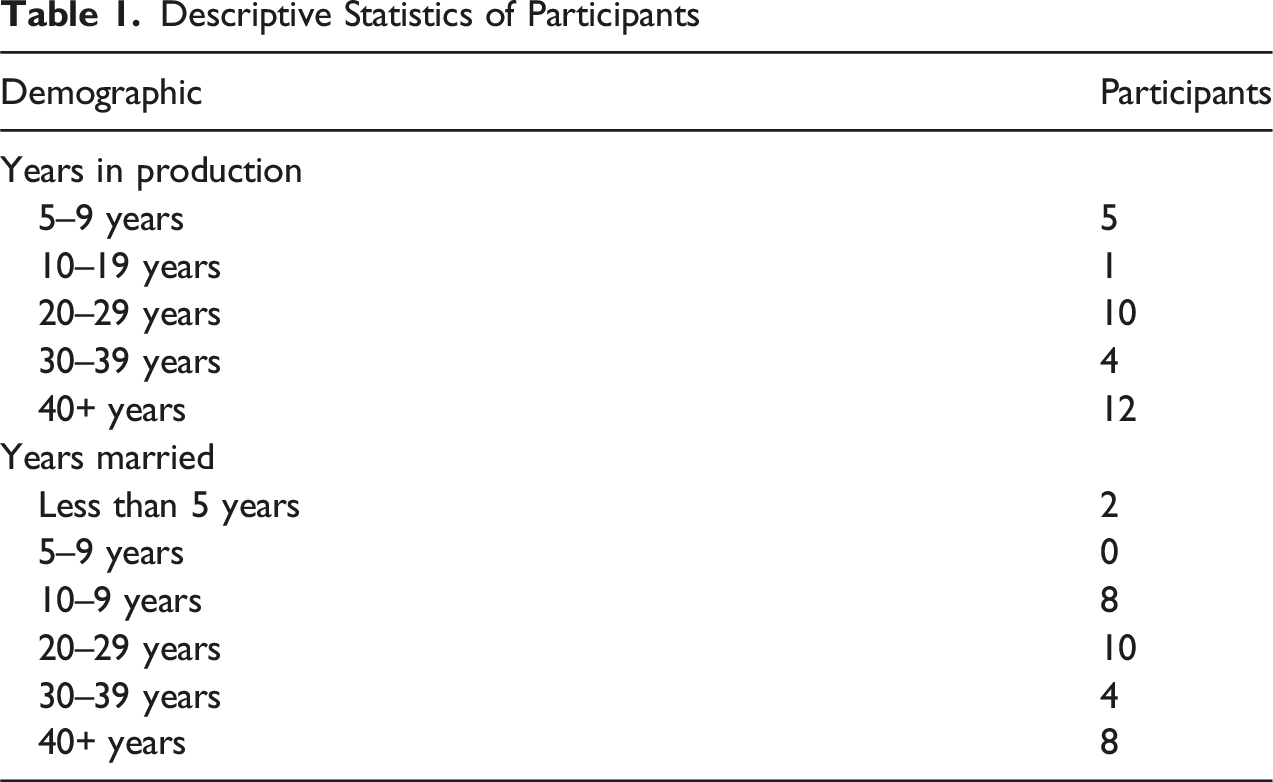
Descriptive Statistics of Participants
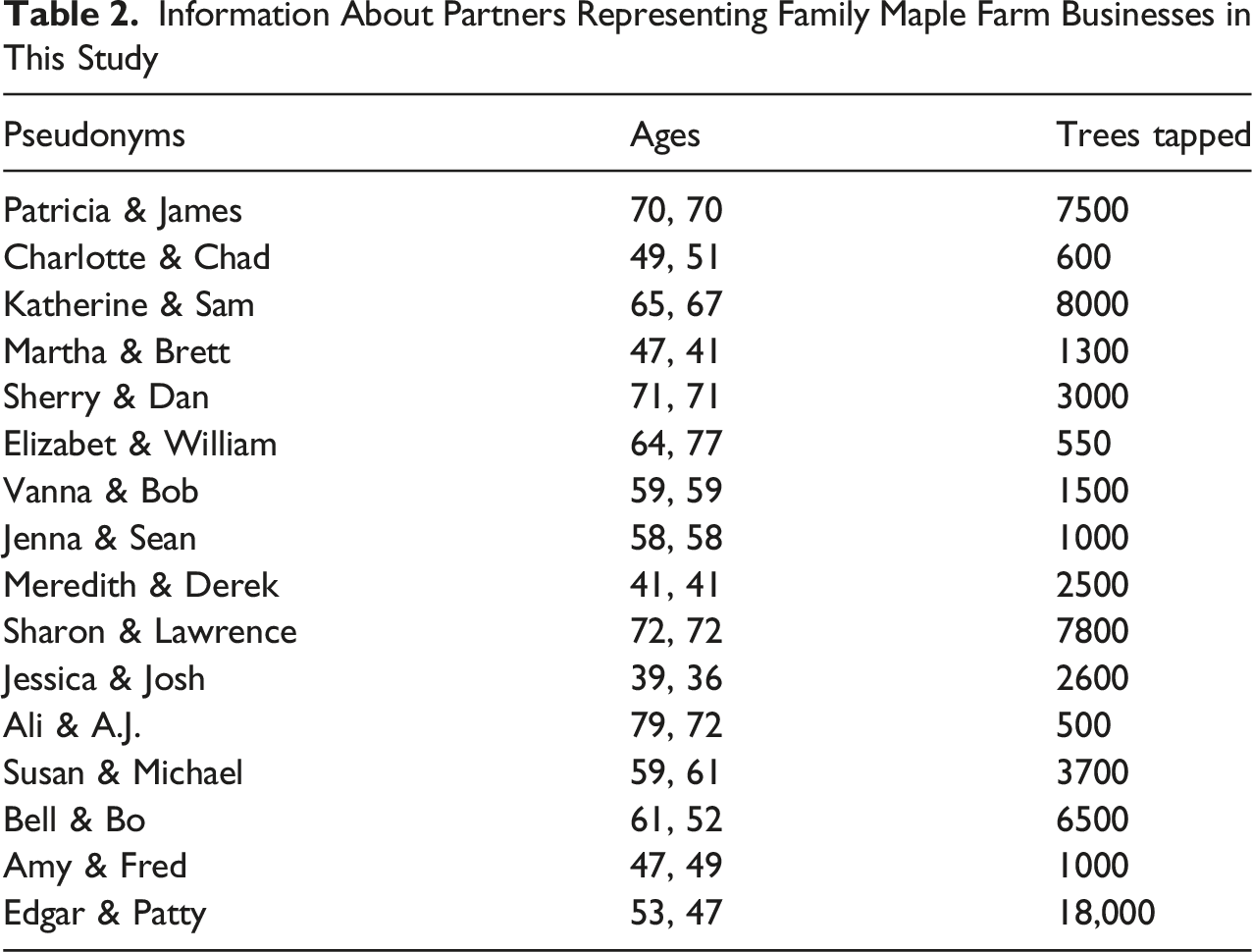
Information About Partners Representing Family Maple Farm Businesses in This Study
Participants represented maple farms spread across nine of Vermont’s fourteen counties, reflecting how land and local traditions shape the practice. Counties like Orleans and Washington, which were represented by three operations, are in areas with strong maple sugaring traditions, dense forests, and the right weather conditions for collecting sap most seasons (Wang et al., 2025). These regions are known for their deep roots in family-run sugaring and a mix of old and new methods. This study did not include counties like Addison, Franklin, and Grand Isle. These areas have more farmland and fewer woods, which makes maple sugaring less common. Regional representation is shown in Figure 1. Location and number of participants, by county in Vermont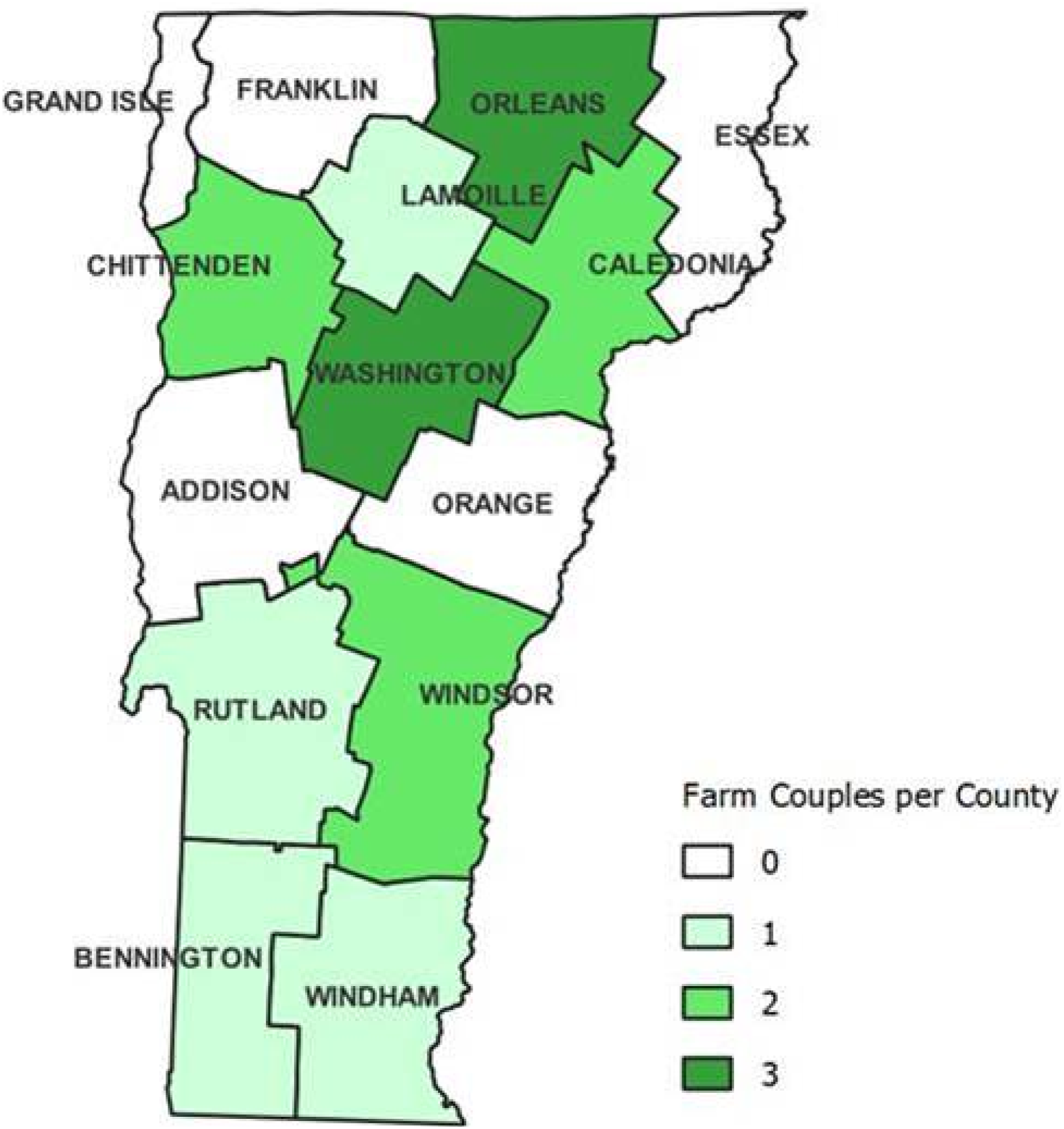
Procedures
Semi-structured interviews (Lune & Berg, 2017) consisted of seven primary questions focused on business practices, resilience, and communication. The first two questions asked about roles and responsibilities in the maple business. The next three questions explored perceptions of business risk and resilience. The last two questions explored communication between spouses about their business. The semi-structured nature of the interviews produced a dialogue that reflected both the interviewer’s pre-planned questions as well as topics that interviewees wanted to talk about (Heyl, 2001; Tracy, 2020).
We interviewed spouses separately to ensure participant confidentiality. Semi-structured phone interviews lasted 30–60 min each, totaling about 26.5 hr. We recorded and transcribed them verbatim via Speechpad.com, producing 890 pages of transcripts. All transcripts were reviewed for accuracy. We replaced participant and business names with pseudonyms, as seen in Table 2.
Analysis Strategy
We used constant comparative methods to identify themes in the interview transcript. Constant comparative analysis is an iterative and systematic method of processing, reducing, and explaining patterns within and across interviews and relevant scholarship (Charmaz, 2006; Lindlof & Taylor, 2017). As a transdisciplinary team, we began with line-by-line open coding to identify how participants described resilience, family dynamics, and business practices. Following independent coding, we met as a full team to compare code lists, discuss areas of agreement and divergence, and refine operational definitions. Discrepancies were resolved through discussion until consensus was reached, strengthening analytic consistency across coders.
In early rounds, perceptions of risk and resilience related to business practices and environmental uncertainty were most salient. Through continued comparison, however, we observed that participants repeatedly referenced enduring values, conversations, and shared meanings that shaped how they faced challenges. At this point, the multidisciplinary team revisited relevant literature on identity anchors and resilience communication to refine our analytic lens. We identified these patterned references as identity anchors. We then engaged in second-cycle focused coding, systematically re-examining transcripts for how identity anchors were co-produced, reinforced, and adapted. Team meetings occurred between coding iterations to compare interpretations, refine categories, and ensure coherence across analyses. After two additional rounds of coding and comparison, no new categories, properties, or relationships were identified as relevant to the research focus (Boeije, 2002).
The manuscript was drafted and edited collaboratively by all members of the research team. To enhance the trustworthiness of the analysis, we included representative excerpts from the interview transcripts. These excerpts illustrate and support the interpretive claims advanced, ensuring that our findings remain grounded in participants’ perspectives (Lincoln & Guba, 1985).
Results
Family-run maple farm businesses in Vermont face a complex mix of challenges. Climate variability affects sap yields, while market pressures and rising equipment costs strain operations. Succession concerns and commitments to family tradition add further tension. In our analysis of 16 family maple farms, participants also described risks tied to market competition, shifting weather patterns, changes in organizational membership, and evolving labor expectations. Families navigated these pressures in varied ways, revealing both resilience and vulnerability. We argue that these businesses co-created and reinforced three discursive identity anchors: (I) High-Quality Producers, (II) Family Farm, and (III) Financially Focused Farm Enterprise. The application of these anchors served to help or hinder different dimensions of the family farm business. Our findings suggest that resilience emerged from members’ ability to maintain continuity while flexibly interpreting and adapting these anchors as conditions changed.
Identity Anchor I: Family as High-Quality Maple Producer
Many participants drew on discourses that anchored their identity in a reputation for high-quality products, production methods, and business practices. In moments of environmental changes and market uncertainty, this emphasis on quality became a communicative resource that helped families justify decisions and sustain confidence. The focus on quality provided continuity and confidence in the face of technological and market changes. However, it sometimes limited opportunities for business growth and slowed the adoption of new technologies. Thus, “quality” operated as a discursive anchor that both enabled and constrained certain adaptive possibilities.
Quality Maple Products
Maple syrup itself functioned as a tangible and symbolic product through which the “quality producer” identity anchor was enacted and reinforced. Bob said, “People at church buy my syrup there. Right there. They know they like our syrup, so they buy from us.” Similarly, Bo said, “We make a nice light syrup up here [Vermont]. Folks around here know if it’s got our name on it, it’s good syrup.” Katherine explained, “People can buy cheap syrup anywhere, but ours, you taste our syrup. It costs more, but that’s our Northeast Kingdom syrup.” These participants discussed maple as more than a commodity. It served as a performative artifact. By invoking quality in these interactions, producers reaffirmed a shared interpretive frame that buffered against market uncertainty. With every purchase, buyers contributed to the business’s bottom line and reinforced the farmer’s belief in the quality of their maple products. In this way, transactions became communicative affirmations of identity continuity.
The smaller-scale producers perceived larger firms in their areas to have business models grounded in high-volume production, resources that the small-scale producers did not have. Rather than dwelling on this disadvantage, farmers drew on quality-over-quantity discourses to legitimize the value of their farm business. For example, Ali explained, “I don’t think we can do much to mitigate the fact that everybody thinks that… a huge sugar operation in Vermont is a good investment.” Instead, she said, “What we try to do is try to make sure we make the very, very, very best syrup, and … we’ve maintained our markets quite well.” Ali used othering practices to reinforce her “high-quality producer” identity anchor and justify their commitment to selling a high-quality maple product. The anchor reframed structural disadvantage as moral and market distinction. Similarly, William drew quantity-over-quality to rationalize this role in the marketplace: [large operations] can do the fancy shows and just hire somebody to do it [marketing] for them…I can’t afford to do stuff like that. I’m just a one-man band or a family band, just making a very nice product that is different than what these large producers are making. And they can say what they want, but there is a difference.
Ali and William’s comments reinforced a quality-focused identity for maple producers, contrasting with the perceived profit-driven identities they associated with larger enterprises. A focus on quality products allowed them to dismiss concerns about new, larger enterprises. In their view, a quality product outweighed extensive marketing and resources and supported the reinforced value of their small farm businesses. Thus, the quality anchor functioned as a discursive shield, transforming potential threats into confirmations of distinctiveness.
Quality Production Methods
Producers’ commitment to quality extended beyond the final product to the production methods themselves. “It takes about 40 gallons of sap to make one gallon of syrup. It’s a lot of work,” Lawrence, a 72-year-old producer, explained. “But once you catch that sweet steam rolling out of the sugar shack, you remember why your back hurts. We’re not making junk around here.” Lawrence’s comment highlighted how sugaring is a point of pride and purpose. Amy said, “My parents said stop worrying about how much we are making, selling. Focus on what you’re doing…We’re proud of what we’re doing.” Amy’s comment highlights a shift away from volume-driven metrics toward process-centered meaning-making across generations of her family. For Lawrence and Amy, quality is not just a standard for production, but a communicative practice that shapes how producers understand and sustain their work through changing conditions.
Producers demonstrated a commitment to traditional maple sugaring methods as a source of identity and their resilience. However, they framed this connection in slightly different ways. The smaller producers saw larger firms’ financial resources for innovation as a disadvantage, but instead of dwelling on this, producers highlighted quality over quantity to validate their farm’s value. For example, Susan explained: I focus more on the quality of the syrup… I do the equipment now; whereas, a lot of these big sugarhouses have, you know, you walk in and all you see is stainless steel, miles of it, and all the bells and whistles. Whereas we try to keep it as traditional as we can.
Michael, Susan’s spouse, also linked the sugaring process to the resilience of their maple business. He said, “If you are good at it [maple sugaring], you’ll survive. You find a way to get through it if you do it right.” By linking resilience to production methods, their talk illustrates how identity anchors operate through discourse to render uncertainty manageable.
Quality Business Practices
In addition to identifying with high-quality products and production techniques, the high-quality maple producer identity anchor emerged from and shaped how producers managed their businesses. Michael emphasized the importance of serving his customer base: … you’ve got to be very aware of your prices relative to other people’s prices, and there’s always a desire to want to do the wholesale price of syrup up a little. We’d like to make just a little more money all the time, of course, but … you’ve got to provide the best service you can to the customer… and to have the very best quality syrup [is] really, really important.
Similarly, Bob said, “I like selling syrup, sure, but I give a fair bit away too…We always have extra for the church breakfast and grandkid things… I like sitting down and enjoying it too.” Michael situates quality not only in the product itself but in how it sustains trusted customer relationships. Bob’s comment extends this logic by showing how maple syrup acts as a relational good. Beyond formal consumer transactions, quality maple circulates through community ties, family gatherings, and local events. Taken together, these examples show how maple functions discursively and materially to affirm quality relationships and community belonging, not just economic exchange. Through these everyday practices, the high-quality producer anchor became a durable yet adaptable discursive resource that sustained resilience.
Identity Anchor II: Family Farm
Some producers drew on discourses that supported a farm identity anchor as they navigated ongoing and emergent risks. This anchor discursively privileged the family dimensions over the business dimensions of the organization. Identities anchored in family farm tradition reflected and reinforced families’ decision-making around completing routine tasks, family involvement, agricultural practices, and preserving traditions. Through everyday talk and shared practices, members invoked “family farm” as a resource to guide action and make sense of change.
Family Tradition
Multigenerational family involvement served as a discursive reference point for producer and business management decisions. Vanna shared, “I don’t think we would be doing it if it wasn’t for working with our family.” She continued, “It’s very important that my son and our grandkids love to come up when we’re in the sugarhouse.” Similarly, Dan spoke about how his grandkids love to be a part of the maple production process. He said, “You can find a task for just about every one of them…sometimes you have an assembly line so one of them organizes the cap and passes it to the other one who then passes it to you.” The farm became an ongoing relational achievement spanning generations. Shared time in the sugarbush and sugar house allowed them to teach younger generations the family’s shared history, skills, and traditions, as well as maintain relationships. For Vanna and Dan, family provided meaning, motivation, and justification for ongoing participation in the enterprise. By narrating participation as relational inheritance, they reaffirmed continuity in the face of broader agricultural and market disruptions.
The family farm identity anchor also provided a discursive framework for short- and long-term business and agricultural decisions. For example, even as their family businesses faced the financial strain from higher taxes associated with the increasing value of their land, Susan said she and her husband, Michael, wanted to “continue on this family tradition as long as possible, and that it feels good.” Susan privileged the family tradition of sugaring over the business or agricultural elements of their identity. Her resilience was not grounded in economic factors; rather, it is grounded in relational commitments. It reframed hardship as meaningful sacrifice rather than failure.
Jessica explained that business decisions were central to everyday conversations, particularly around the size and capacity of their family business. She said that she and her spouse constantly discussed ways to grow their business “without trying to get so big that we can’t operate it [our]selves.” Jessica continued to say that, I feel like we’ve come together and come to some realizations on what capacity we can handle… and then trying to make the best of what we currently have … I feel like that has helped us grow our business and [brought] us more together.
Everyday talk and relational practices, particularly shared labor, served as discursive resources for reproducing and strengthening relationships and family identity over time. Through ongoing, reflective dialogue, Jessica and her spouse actively negotiated what constituted “appropriate” growth. These conversations used the family farm anchor to guide growth without disrupting relationships, with shared labor reinforcing both discussion and connection across generations.
Cooperative Family Labor
While family farm tradition was valued by many business owners, it was also complicated by the fact that many relied on unpaid family labor. A.J. explained, “In family operations, it’s just having manpower available. You can’t afford to pay much manpower on a 500-tap or a 700-tap operation.” A.J. emphasized that “having family members available to help out because ‘[they] enjoy doing it’ allows us to do this.” Due to financial constraints, A.J.'s small-scale maple operation relied entirely on unpaid family labor instead of hired help. This cooperative effort is vital to their family farm tradition, providing essential support for the business’s viability. However, it also presents a significant vulnerability, limiting their resilience despite enabling financial operations. As A.J. explained, “If one or two family members, for whatever reason, aren’t interested or can’t do it, the operation just grinds to a halt.” In this way, the same anchor that sustains relational meaning also introduces structural fragility when family availability shifts.
Ali, A.J.’s partner, made similar remarks about the general risks associated with relying on family labor. She said, I feel that backyard sugar makers are a dying breed, and that is concerning to me. I think families are now [busier]… kids are busier. They have more things that they must do all the time. They have … lessons, sports … music, and activities. And so, when we were out collecting back in the old days, we’d have all the kids out, ... now the kids aren’t around.
A.J. and Ali’s comments both highlight how the family farm tradition helped and hindered family farm business resilience. The anchor served to maintain family relationships; however, A.J. highlighted the risks of relying on family labor, while Ali raised concerns about the sustainability of traditional backyard sugaring. These tensions reveal that anchors do not uniformly enhance resilience; rather, their effects depend on how members reinterpret them in changing social contexts.
Cooperative family labor served as both a resource and a challenge in sustaining family and business resilience. For example, Patty explained that her family’s maple production had been “very dependent upon [their son] to be able to haul sap” and that now, with their son away at college, her husband must work “around the clock on consecutive days” to get the hauling and boiling done. While they still valued their identity as a family farm, Patty said they are careful “to make sure [their son] doesn’t feel compelled to leave school early or to forego his responsibilities [at school] to be home [to help with sugaring].” To resolve this tension, Patty and her husband decided to hire someone from outside the family to take over their son’s role. Their resilience emerged from and was reinforced by their ability to remain committed to family amid changes by shifting the meaning of the anchor from inclusion of just family to one that prioritized mutual respect and sustained family relationships. Rather than abandoning the family farm anchor, they redefined it in ways that preserved its relational core while allowing practices to change. This reframing highlights how identity anchors serve as dynamic discursive resources that sustain continuity while enabling adaptation.
Multigenerational Family Involvement
The family farm identity anchor was strengthened through conversations about intergenerational farm succession. Discussions around “who will carry this on” functioned as a forward-looking discursive practice that projected continuity into an uncertain future. On Sherry’s farm, her kids have “been out there since the time they were two. And the grandkids are still out there at that age.” Having family members share a passion for sugaring was important for sustaining the farm’s continuity as the older generation ages. Sherry says, “It’s kind of nice because as one person gets older, I do have one son who has the passion. So, he’ll do it, and then his children will do it for sure.” Sherry’s husband, Dan, shared similar sentiments. He said that their “business will be resilient as long as a member of the family wants to continue it.” While intergenerational farm succession planning relies on future generations to continue taking over management roles in the operation. By grounding resilience in family desire rather than market stability, Dan and Sherry discursively secured the farm’s future through relational commitment.
Some maple producers provided a unique perspective on farm business succession. For example, when describing the future of her family business, Amy said, “I think a lot of us are doing it for my dad. It’s his dream, and we’re supporting him.” As her dad gets older, physical labor has become more challenging for him to do on his own. “I think it’s pretty frustrating for him,” She said, “He still wants to be a part of it. And for him, it’s about getting all the family together, which I think is the best part.” Amy identified as a daughter who is trying to protect her aging father. For Amy, the family farm anchor prioritized relational care over operational efficiency, shaping how succession was interpreted and enacted.
Some producers sought to maintain continuity in practice during leadership changes, while others adapted to meet the unique needs of their immediate circumstances. When taking over the family business from Jessica’s father, Josh described how the family farm identity anchor shaped and was shaped by their roles as parents themselves. He said he and his spouse often discussed ways to spend more time at home with their children and sought to “simplify things [related to the business] … so [they] can get the work done more efficiently instead of working 18 hours a day.” Instead of keeping tradition fixed, Jessica and Josh redefined what sustainable management practices looked like for their stage of life, showing how the anchor grounded their identity while allowing practical change.
Identity Anchor III: Financially Focused Farm Enterprise
Some producers drew and reinforced a financially focused farm enterprise identity anchor. As a discursive resource, this anchor framed uncertainty in economic terms and positioned profitability, efficiency, and return on investment as rational guides for action. At the same time, prioritizing financial logic created tensions when economic imperatives intersected with relational, embodied, and place-based realities, highlighting the ongoing negotiation between continuity and transformation in farm practices.
Financial Decision-Making
Operating a maple enterprise as a family farm business was financially challenging for most participants. Patty said, “We look at the books and laugh… “Well, we’re not in it for the money,” Patty affirmed that revenues are a sign of who they are as a business and demonstrated how the family used humor to collectively cope with seasons where they fell short of their revenue goals. Humor functioned as a discursive strategy that softened financial strain while reaffirming their shared enterprise identity. Later, Patty talked about family conversations about hosting maple events for the public. Though she did not seem particularly excited about the work associated with hosting these events, she said, “If we can make money, we should.” This comment shows how the anchor was invoked to reframe the labor and emotions associated with hosting events as justifiable because it could potentially serve revenue goals. The enterprise anchor transformed reluctant labor into economically rational action.
Bell also drew on the farm enterprise anchor as she discussed business decision-making. She said her family approached financial decisions by “trying to take the feeling out. Looking at it more from [of] a, ‘here’s the numbers, here’s what it’s going to do for the business.” According to Bell, drawing on a farm enterprise identity made business decisions and conversations easier to navigate. The family was able to prioritize financial outcomes over others that may have had more emotional elements to them. By invoking financial rationality, they reduced interpersonal conflict and clarified decision criteria, thereby stabilizing both relational and organizational functioning.
Professional Skills
The farm-enterprise identity anchors privileged professional identities and skills. Katherine led the financial decision-making for her family business and investments. She explained that her “banking background does play a part…because when we have decided over the years to invest in something … we sat down to see, okay, is this going to pay off? Does this make sense? I’m good at answering those questions.” Applying her unique skills and knowledge contributed to the resilience of the farm business.
In addition to understanding their own role, the farm business identity anchor helped members make sense of others’ roles. Similarly, Bell and her husband, Bo, have been in the maple industry for over 20 years and sell about half of their products to wholesale markets. Bell attributed much of their resilience and success to her husband’s professional experience outside of the maple industry. Bell explained, “Because of his engineering background, [he’s] really good at looking at what the ROI (return on investment) is going to be, what the pros and cons are going to be, and how long it’s going take us to pay something back or [become] a profitable venture.” Bell’s insight further illustrates how a farm enterprise identity anchor can help to establish each family member’s particular contributions to the business. In highlighting her husband’s professional expertise, she positioned his financial decision-making as a vital asset to the farm’s success. By affirming his expertise, Bell supported smart investments and strengthened their partnership. Resilience emerged through conversations that linked professional skill to the farm’s long-term stability.
The Business of Aging Producers
While the farm enterprise identity anchor served to reinforce the businesses’ resilience, its application became complex over time as family members aged. Sherry worried about “older sugarmakers slipping on the ice,” and Bo said that he had experienced several “pretty big falls [because he was] not so quick on my feet anymore.” Other producers mentioned emerging challenges related to lifting and needing more rest. These changes were not merely physical risks for aging family members. Embodied changes like these were also disruptions to assumptions about productivity, capability, and contribution embedded in the enterprise identity. They altered who could perform certain tasks, which could shift how labor is distributed, timelines for production, and sometimes the economic stability of the operation.
Families drew on and reinforced the farm enterprise anchor when they made decisions regarding how to accommodate their shifting abilities. For example, Dan, an older producer, upgraded his evaporator a few years ago and now uses reverse osmosis on his farm. This was an expensive adaptation, but he said that it “was an investment that has paid me back simply because at 70 years old, I don’t have the energy that I used to have, and I can’t boil long nights.” Much later in the interview, Dan returned to this topic. He said, “Technology is helping me, but not necessarily to ramp up production as much as it’s helping me to save myself from overwork.” Framing accommodation as investment, Dan aligned aging with economic rationality rather than decline. His use of economic language discursively aligned his physical limitations with the practical demands of sustaining his business and served to legitimize adaptations that might otherwise be interpreted as signs of personal limitation.
Lawrence, 72, also changed his sugaring methods to maintain both his personal and business resilience. He explained that while technological adaptations “make good business sense,” maple producers, himself included, are “more apt to invest in things to increase efficiency and the ease of making syrup than [they] are at making more syrup.” Like Dan, Lawrence talked about the tension between embodied labor and business viability. Though his daily tasks would look different, he would still have a financially viable business. The enterprise anchor justified efficiency-oriented adaptations that protected both body and bottom line.
While some producers reflected on their own abilities and accommodations related to aging, others talked about how the farm enterprise identity anchor was a point of contention among family members. For example, Elizabeth said she had to convince her spouse, William, who is in his seventies, to “buy some new equipment that helped him make things easier.” She shared that her husband, William, had a tough time spending money on things and that his usual response was “Well, I could do without that.” Elizabeth said she often responded by saying, “I know you can do without it, but I think that you’d be better off with it.” Elizabeth’s efforts to persuade her aging spouse to invest in labor-saving equipment demonstrated how resilience is discursively co-constructed through negotiation and relational influence. William thought saving money contributed to the business’s success, but Elizabeth saw spending money on accommodation as being more important because it sustained his well-being and the farm. Their negotiations reveal competing interpretations of what financial responsibility means within the enterprise anchor.
Patty also discussed how the financial enterprise identity anchor became a source of tension in her family. She said she was often the “voice of reason” within the family business. Her husband, Edgar, was “still trying to do what he would’ve done 20 years ago.” Because the enterprise identity linked productivity to profitability, his physical capacity became symbolically tied to business continuity. By drawing on a farm enterprise identity anchor, Patty reinforced Edgar’s central, embodied role in the business while also expressing concern about the sustainability of that role. Like Elizabeth, she advocated for adaptations to support her husband’s physical well-being, but Patty was more explicit in linking business continuity to his physical capacity. Her perspective illustrates how resilience is not only an organizational strategy, but a relational process negotiated through attention to aging, embodiment, and care within the structure of the farm enterprise. Her account shows that resilience is not just strategy or outcome. It is a negotiated process through care, aging, and embodied work.
Discussion
Family farm businesses are the foundation of agriculture. The blending of family and business in light of increasing environmental, labor shortages, and economic pressures can negatively impact both business outputs and family relationships. However, the ability to be resilient and lean into the family farm identity anchors can help family farms navigate challenges. Identity anchors impact family, farm, and business resilience differently. The anchors supported family farm business resilience when members were able to draw on the anchors during times of hardship for continuity, while at the same time. Flexible enough for members to adapt as emergent conditions challenged the anchor.
Theoretical Implications
This study advances and complicates resilience research. Prior research highlights material, financial, policy, and environmental conditions enabling or constraining farm resilience (Wang et al., 2025). Our findings show that these conditions gain meaning through everyday conversations and shared symbols that families use to make sense of disruption and uncertainty. Our results position resilience as a communicative accomplishment, not simply a managerial result. Furthermore, resilience lies less in managers controlling external conditions and more in the communicative processes that sustain identity, relationships, and coordinated action amid uncertainty.
Our results address Yilmaz et al.’s (2024) call for further investigation into the social and symbolic processes that underpin family business resilience, while also responding to Hatum et al.’s (2012) appeal for research examining organizational identity as a factor in family business adaptation. Our findings demonstrate that identity anchors are ongoing relational, discursive accomplishments that contribute to family farm business resilience processes. Family farm business members in this study co-constructed, enacted, and legitimized three identity anchors: High-Quality Producers, Family Farms, and Financially Focused Enterprises. These identity anchors were made visible through everyday talk, managerial decisions, embodied labor, and material products.
Members used identity anchors to make sense of challenges and guide managerial responses. Consistent with CTR research (Buzzanell, 2010, 2017, 2018), the ability of family farm business members to discursively navigate a tension of continuity and change guided resilience. Our results show that organizational identities supported resilience best when they remained shared yet flexible enough to be reframed or adapted in the face of new incompatible circumstances or emergent conditions.
Finally, this study shows that adaptive transformative resilience in family farm businesses is both shaped by and shapes social and historical privilege (Buzzanell, 2017, 2018, 2019; Lillie & Sánchez, 2022). Aging and changes in physical capacity served as triggers for family farm business identity work. These identity anchors are embedded in the larger agricultural system, which historically underserved farmers of certain identities (e.g., based on race, gender, disability, or class) (USDA, n.d). However, the families in this study actively adjusted identity anchors to maintain the value of the aging members. At the same time, the resilience processes represented in our results were carried out by heteronormative White producers on Indigenous land, using practices adapted from Indigenous methods. Communication can thus promote inclusion for marginalized identities while simultaneously reinforcing advantages linked to social, material, and cultural resources.
Practical Implications
This study offers practical insights for business owners, firm advisors, and agricultural outreach professionals. Farmers, including maple producers, often rely on agricultural extension programs and trade associations for research-based guidance, technical support, and education. Our findings suggest that farm family business members may benefit from reflecting on their identity anchors and their role in the interpretation of and response to challenges and opportunities. Many offer services aimed at building communication skills that support farm resilience through consumer outreach, succession planning, and pre-crisis networks. Pitts et al. (2009) suggested that during times of succession, families could benefit from support in identifying and managing dialectical tensions. We also suggest that agricultural outreach professionals and advisors should assist family farm businesses in exploring the messages they share within their families. For example, workshops could focus on identity anchors, their construction, and their implications for business management, family dynamics, and resilience.
Our study also highlights pivotal life cycle moments that disrupt organizational roles and routines, such as leaving for college. Since identity anchors are social constructions and neither inherently true nor false, families can evolve anchors or choose identity anchors likely to contribute to their long-term resilience. First-time family farms might focus on developing a resilient identity anchor before an unknown but inevitable challenge. For multi-generational farm businesses, where anchors are stable and deeply ingrained, raising awareness of these anchors, their implications, and possible adaptations may be helpful.
Limitations
This study has several limitations. We only spoke to family farm businesses currently in operation. These enterprises have demonstrated some level of resilience. Future research should examine resilience communication, or lack thereof, in family farm businesses that are not thriving or have had to cease operation in recent years.
This study interviewed both spouses managing family farm businesses, offering a more comprehensive perspective than many agricultural business studies that only include one person. At the same time, participants noted that additional family members contributed to farm operations and decision-making. Because our sample included only copreneurial couples, other family and organizational voices may not be represented. Family farm businesses reflect the coordinated activities and shared understandings of multiple members. Examining the co-construction and implications of resilience identity anchors would benefit from including a broader range of family participants. Future research should incorporate multiple family members’ perspectives, particularly those whose identities and roles within the farm may differ from the primary managing partners.
Additionally, smaller Vermont family businesses are not representative of the entire maple industry, or even of family farms, limiting the application potential. Research should examine the resilience of communication practices and implications within the context of family businesses of varied sizes and in different agricultural sectors and locations. As well as the constitution, application, and implications of resilient organizational communication practices in the face of different disruptions or challenges. Responses to familiar challenges may differ from those to unfamiliar or acute crises, leading to different outcomes. Recognizing these distinctions helps us understand how communication shapes resilience.
Disruptions to maple sugaring are not occurring in isolation. They intersect with a deeper, often overlooked history. Indigenous communities, such as the Abenaki in Vermont, practiced sugaring as part of a seasonal, land-based culture rooted in sustainability, reciprocity, and respect for the natural world. Today’s transformations risk further marginalizing traditional ecological relationships and knowledge systems. Our research does not reflect contemporary Indigenous perspectives or identity anchors of today’s Indigenous maple producers in Vermont. We hope future work will provide a more inclusive representation of Vermont maple sugaring.
Future Research
By examining multi-system resilience within the concrete context of family farm businesses, this study builds on the work of Houston and Buzzanell (2020), as well as Rice and Jahn (2020). It shows how resilience emerges through the communicative work of identity anchors across interconnected systems: the family, the farm, the business. Future research could explore how resilience processes within family farm businesses influence and are influenced by the larger agricultural and food systems in which they operate.
This study found that organizational members navigate the tension between maintaining stable identity anchors that preserve continuity and evolving those anchors to adapt to new challenges. Partners often shared the same anchor but interpreted and applied it differently to accommodate a situation. These differences did not hinder resilience but created space for negotiation and adjustment. Participants did not mention relational stress caused by managing the farm business together. Neither did they mention their relationships being strengthened by these conversations. However, it would be valuable for future scholars to examine how adaptive-transformative processes needed to sustain the farm or business impact affect family relationships, especially communal coping and relational load (Afifi et al., 2016). Communal coping is when family members see a problem as “our problem” and work together to solve it. Relational load is the stress that builds up in relationships when family members have a lot of responsibilities or worries. Looking at these concepts in the context of a family farm business could show how working together helps families stay strong but can also put a strain on their relationships.
Identity anchors contributed to the assimilation of younger generations and the ongoing resilience of the family farm business. It would be valuable to learn whether and how other CTR practices are enacted and shared. For example, are communication practices associated with crafting a new normalcy or building and maintaining networks inherited? To what extent do these processes sustain different systems within the family farm business during mundane and challenging times? CTR could be applied to identify communication practices that support business and family resilience before, during, and after these times of change.
Conclusion
The rapidly changing environmental, technological, and market conditions of the maple syrup industry are becoming increasingly misaligned with the values and traditions of families who have long operated these maple farm businesses. These changes also threaten family interactions, connections to the land, and the cultural fabric of Vermont’s maple industry. How family farm businesses communicate and negotiate their identity anchors is important to their resilience.
Footnotes

Funding
The authors disclosed receipt of the following financial support for the research, authorship, and/or publication of this article: This project was funded by the Competitive Hatch Awards from the University of Vermont’s Agricultural Experiment Station (USDA Hatch #VT-H02802) and (USDA Hatch #VT-HO2605).
Declaration of Conflicting Interests
The authors declared no potential conflicts of interest with respect to the research, authorship, and/or publication of this article.