



Abstract
Socially and financially disadvantaged communities are disproportionately affected by increasingly frequent and cascading disasters, leaving them limited time to prepare, respond, and learn. Existing theory about resilience in disaster situations rarely integrates cultural considerations and the role of technology into resilience practices. To address these gaps, this study employed an anticipatory resilience framework to analyze 22 in-depth interviews, with community members involved in designing and implementing a community-owned disaster data portal. Following research methods respecting the participants’ language and culture, our grounded theory analysis revealed three core categories used to develop a new theory of resilience. Culturally anchored digital resilience theory claims that culture shapes the sensemaking, adoption, and knowledge production processes in resilient practices, challenging dominant narratives that exclude those most affected by disasters. The findings show how cultural context and communication can support technology-infused resilience initiatives and provide guidance for developing culturally sustained resilience tools.
Keywords
Disasters are increasingly impacting communities worldwide, with the United States facing a record-breaking number of costly natural disasters in recent years (National Centers for Environmental Information, 2023, 2024). The Southeastern region of the United States is particularly vulnerable, consistently incurring the highest costs across multiple disaster categories, including hurricanes, droughts, freezes, floods, winter storms, cyclones, and wildfires (National Centers for Environmental Information, 2023). As the frequency and severity of disasters continue to rise, communities have little time to recover between these disasters and must find new ways to cope (FEMA, 2011).
Cascading disasters, nonlinear, complex series of events, disproportionately affect socially and financially disadvantaged communities, and pose serious challenges to access to information, technical resources, and disaster preparedness (Cutter, 2018; Sun et al., 2024; Xu et al., 2024). These communities rely on communication and collaboration within social networks and across multiple sectors to build resilience (Houston et al., 2015), especially in cascading disasters (Sun et al., 2024). Taking a holistic approach to disasters that moves beyond considering them a single event and instead considers the multifaceted and interconnected nature of temporal experiences in crisis and disaster research can address these constraints (Chewning et al., 2024). In other words, as a result of the nonlinear disasters that disproportionately impact communities, it is important to understand how these communities adapt and navigate these continuous disasters through their development of resilience.
Resilience is a process in which individuals engage in communication to construct and reconstruct their new normal following a traumatic event or enacted as a result of perceived threats (Buzzanell, 2019). The resilience process can be reactive or anticipatory. Anticipatory resilience, which includes prior history, material items, and organizational concerns in understanding resilience and human behavior (Betts et al., 2022; Wilson et al., 2024), is vital for populations vulnerable to disasters. However, little is known about how communities engage in anticipatory resilience following and prior to disasters or how communities integrate new technologies to communicate and enhance community resilience (Stephens et al., 2021). By adopting a nonlinear conceptualization of cascading disasters (Cutter, 2018; Sun et al., 2024) and focusing on a predominately Latine/a/o and Hispanic community in a large Southwest U.S. city, this study aims to provide a cultural perspective on how a material structure—a codesigned website portal—functions in the resilience process.
Using anticipatory resilience as a theoretical framework, this study examines how an interconnected community draws on past narratives, technology, and culturally relevant concerns to shape technological adoption and precautionary practices. Specifically, this research focuses on how a web-based portal embodies and is shaped by the local knowledge of the community. We consider how resilience processes can alter the perception of time, leading to challenges around improvisation and issues of inclusion and exclusion (Ballard & Aguilar, 2020).
Our qualitative method provides an example of how organizational communication researchers can work toward decolonizing research practices, first by collecting and analyzing data using a community’s preferred language, and second, by presenting interviewees’ voices in their native language and transcribing and explaining non-English quotations as needed for clarification. This approach allows researchers to more thoroughly represent the cultural and linguistic significance of the interviewees’ quotes, while also making the meaning clear using the language preferences of the publishing journal. Based on grounded theory approaches, the findings led to the development of culturally anchored digital resilience theory, which foregrounds cultural practices as the foundation for successful technology-infused resilience initiatives while also serving as a reminder that technology is not a solution in and of itself. Next, we describe our theoretical framework that connects cascading disasters, anticipatory resilience, and technological affordances.
Contextual and Theoretical Framing
Cascading Disasters
Disasters are rarely isolated events; rather, they can initiate a cascading effect, where the failure of one infrastructure or social system leads to the breakdown of others, exacerbating the overall impact of a disaster. Cascading disasters, as described by Cutter (2018), account for the complex interplay between infrastructure systems and sociotechnical systems. When interconnected systems—such as transportation, communication, and healthcare—are weakened, the disaster recovery period is extended, increasing the likelihood that a community will suffer intensified negative impacts from future disruptive events (National Academies of Sciences, Engineering, and Medicine, 2024). Yet, since cascading disasters are nonlinear, these require considering systems beyond infrastructure.
Prior research shows how coupling cascading disasters with a cultural lens acknowledges how histories of neglect of infrastructure (Potts et al., 2024; Sun et al., 2024; Xu et al., 2024), warnings for disasters being non-adoptive to various individuals (Federici, 2022; Trujillo-Falcon et al., 2022), historic imbalances of access to resources both before and after a disastrous event, and the physical scars of previous disasters that reshaped the earth, impacting outcomes of future disasters (Niggli et al., 2022) work simultaneously and continuously and are not tied to one specific event. For instance, increased socioeconomic vulnerabilities and weakened systems due to past disasters make many coastal communities in the Gulf of Mexico especially susceptible to future disruptive events and their cumulative impacts, regardless of the severity of those events (National Academies of Sciences, Engineering, and Medicine, 2024). Cascading disasters can highlight the multiple, interrelated factors that complicate the resilience process for communities, including those that are culturally specific and are not limited to one specific occurrence, which are two important considerations for the community of this study and their efforts to implement a data portal containing information on different disasters.
Culture in Cascading Disaster
The relationship between cultural inequalities and disaster impacts reveals how structural biases create cascading effects that extend far beyond the initial hazardous event. Smith et al. (2022) argue that the interwoven nature of inequalities, structural biases, and disasters produces long-term and continuing effects, particularly for the health of affected populations. Power imbalances in institutions combine with persistent inequalities to become embedded within cascading disasters, potentially threatening the security of marginalized individuals. This interconnection becomes evident in the ways different cultural groups experience and respond to disasters. Spialek et al. (2021) examined Hurricane Harvey’s impact on Latinx residents, finding that preexisting material and sociocultural inequalities increased their vulnerability while perceptions of trust and discrimination created additional communication barriers. Their research demonstrates how underrepresented groups bring their experiences of shared stressors to the ways they experience and communicate about disasters, suggesting that disaster impacts cannot be understood without considering the cultural and structural contexts that shape vulnerability.
Cultural frameworks fundamentally shape both risk perception and disaster outcomes across different communities. Douglas (1990) and Douglas and Wildavsky (2019) articulate that perceptions of risk are culturally bound, with reactions to disasters extending beyond physical dangers and individual assessments to encompass communication patterns between communities and individuals. This cultural dimension manifests concretely in disaster preparedness and recovery disparities across the United States. Maldonado et al. (2016) found that U.S.-born non-Hispanic Whites were more likely to own homes, enabling self-protection during hurricanes, while foreign-born Hispanics faced compounded challenges, including limited access to government aid and financial resources that hindered both their preparedness and recovery. These findings emphasize how disasters cascade differently through various communities based on their social and economic positioning. Applying a cultural lens to cascading disasters thus reveals not only how single hazardous events generate additional hazards, but also how systems rooted in inequality create cycles of cascading disaster punctuated by temporary periods of normalcy, all contextualized through specific cultural influences that determine vulnerability and resilience.
Anticipatory Resilience
When studying resilience, scholars need to consider not only how people act and react to disasters in different ways, but also what influences their understanding and preparation for oncoming disasters. Resilience is a process in which people reimagine and recreate their new “normal” in response to real or anticipated triggering events through communicated means (Buzzanell, 2019). Buzzanell (2019) in the communication theory of resilience (CTR) suggests that resilience is enacted as a result of a triggering event and one that is curated and cultivated over time, i.e., anticipatory resilience. As clearly articulated in Wilson et al. (2024), anticipatory resilience is theoretically comprised of three components. First, anticipatory resilience involves both communicative and material preparations that can be relied upon during a disaster (Betts et al., 2022; Buzzanell, 2019) in that these preparations craft a mindset (Wilson et al., 2024). Second, anticipatory resilience is not tied to linearity because previous experiences and current events can work in tandem to inform each other (Lucas & Buzzanell, 2012; Wilson et al., 2024). Finally, anticipatory resilience is enacted with feelings of hope and optimism in their ability to engage in perceived future events (Wilson et al., 2024).
Discursive and material resources work together to shape how communities develop anticipatory resilience in the face of potential disasters. Discursive resources encompass the past histories and historical knowledge that frame how people understand future events, influencing their preparation strategies. Betts et al. (2022) and Lucas and Buzzanell (2012) demonstrate how these historical narratives shape anticipatory responses, while Miao and Zhang (2023) found that individuals with recent disaster experience tend to adopt more adaptive coping strategies, such as creating emergency plans or purchasing insurance in anticipation of future crises. The construction logics people use to understand and prepare for stressors are fundamentally shaped by power dynamics, social inequalities, and identity, as noted by Betts et al. (2022) and Houston (2018). These factors operate within specific cultural and historical contexts that determine how individuals and populations anticipate and respond to threats.
Material resources and community-based communication practices form the practical foundation of anticipatory resilience, enabling communities to translate awareness into actionable preparation. Stephens et al. (2023) emphasize that people require information from both community experiences and knowledgeable institutions to understand appropriate disaster behaviors and identify helpful resources, though they frame this as communication practices that develop resilience rather than explicitly using the term anticipatory resilience. Their case study of a community creating an evacuation plan illustrates this principle through the development of an emergency alert system capable of sending messages to residents’ phones, a response prompted not by direct experience but by witnessing fire-related deaths and destruction in neighboring communities. This example demonstrates that triggering events for anticipatory action need not originate from a community’s own experiences, and that technology can effectively support preventative behaviors. Sun et al. (2024) and Wilson et al. (2024) further expand this understanding by showing that anticipatory resilience transcends preparation for specific disasters, instead emerging within the context of multiple threats and the nonlinear cascading impacts of prior disaster events, suggesting that communities develop resilience through complex interactions between historical knowledge, material capabilities, and awareness of interconnected risks.
Culture in Anticipatory Resilience
Beyond the perceived threats that might evoke anticipatory resilience, scholars have noted that anticipatory resilience is culturally bounded (Kuang et al., 2022; Yu et al., 2025) and should be investigated to unpack cultural differences and similarities both within and between populations (Ungar, 2013). Specifically, Kuang et al. (2022) articulate that the resilience process is guided by the history and core principles of a population. In their research that tested CTR in a Chinese context they found that “identity” is culturally bound to extended past individual identity anchors and included both family and national identity. Ungar (2013) also suggested that resilience goes beyond individuals and into the quality of one’s environment, which includes cultural considerations. Given that this study focuses on a community co-constructed web portal in a culturally specific context, this project views resilience as a concept beyond the individual and into the collective. Therefore, the current study uses anticipatory resilience in the context of culture as its theoretical framework, specifically exploring the roles of discursive practice and materiality in assessing how a co-created website portal can assist communities with disaster-related information toward their resilience-building efforts.
An Affordance Lens
Understanding how people interact with technology’s features can be explained through the concept of affordances—the potential uses that emerge when users engage with technological tools (Majchrzak et al., 2013; Treem & Leonardi, 2013). These affordances are not fixed properties but rather develop through the relationship between users and technology (Treem & Leonardi, 2013), as seen in the co-designed nature of the web portal that is at the heart of this research. Connecting this affordance perspective with anticipatory resilience reveals how tools like website portals do more than just provide disaster information, they can serve as an organizing mechanism, i.e., a co-created web portal, and actively influence how communities make sense of and prepare for natural disasters, both past and future.
Information communication technologies (ICTs) play a crucial role during and after disasters, aiding in preparedness and response (Chewning et al., 2013; Kaur et al., 2022; Stephens et al., 2013). ICTs facilitate new ways of learning, knowledge production, information sharing, support, and resource finding, which are key to building resilience to disasters (Chewning et al., 2013; van Zoonen et al., 2021). Websites in particular offer real-time resources on disasters and emergency management. However, the effectiveness of ICTs in fostering resilience depends on whether and how people incorporate or perceive the incorporation of these technologies into their goals and social contexts (Mora et al., 2021).
Additionally, not all technological affordances have the same utility and might differ based on histories and culture of a community. For example, in access to information, weather and disaster warning system translations sometimes fail to consider cultural understandings of terms or dialectal differences among speakers. For example, Trujillo-Falcon et al. (2022) found that English and Spanish speakers differed considerably in their understandings of tornado “watch” versus “warning” messages. Thus, when contextual understanding and dialects are not considered in translations of weather- and disaster-related messages which are disseminated through technology, some individuals’ lives are at greater risk than others. Therefore, translations and cultural meanings of terminologies need to be accounted for in the design of technologies meant to assist communities more vulnerable to disasters.
The intersection of technological affordances, cultural specificity, and anticipatory resilience emerges as a crucial area for understanding how communities prepare for cascading disasters. Prior literature suggests that the resilience process can be guided by technological affordances while being fundamentally shaped by the varied cultural concepts of different communities. Within the context of this study, which examines community volunteers working alongside community partners to develop a culturally specific web portal, we explore how technological affordances function to build anticipatory resilience in the face of cascading disasters across diverse cultural contexts. This approach recognizes that technology does not operate in a cultural vacuum but rather interacts with and is shaped by the specific cultural frameworks, values, and practices of the communities it serves. The development of culturally tailored technological resources represents a potential pathway for communities to strengthen their anticipatory resilience while maintaining their unique cultural identities and leveraging their specific knowledge systems. Accordingly, we posit the following research question: RQ: How can a co-designed community disaster data portal serve as a material and culturally relevant structure in the ongoing development of community resilience?
Method
Mindful of the social-cultural characteristics of the study’s participants that make them more vulnerable to risks (Maldonado et al., 2016; Spialek et al., 2021) and recognizing that resilience is a construct that may be constrained and varied among certain groups of people due to historical marginalizations and other systemic inequities (Ballard & Aguilar, 2020; Houston & Buzzanell, 2018), researchers enacted a methodology that attends to these factors. Specifically, we sought to decolonize our approach by moving beyond multilingual and cultural considerations toward a more thoughtful understanding of the community and our research question. By incorporating self-reflexivity in recognizing relationships of power and centering the community volunteer’s voices in their preferred language (Banerjee & Sowards, 2022; Manzo et al., 2020), this study honors the important role community members hold in the knowledge production process.
This study was conducted in a predominantly low-income, Spanish-speaking Latine/a/o and Hispanic community in the southern United States, composed of individuals primarily from Mexico. The researchers selected this area for its history of flooding and its significant Latine/a/o and Hispanic population, where both Spanish and English are commonly spoken. In response to repeated disasters of varying types, the community has been working on implementing ways to capture community actions that can make the community more prepared to address these disasters: a website portal. More specifically, community leaders stressed that this web portal needed to be developed and hosted by trusted community partners because the community had experienced a series of disastrous occurrences such as freezing events, flooding events, and extreme heat events. Thus, community leaders working alongside community partners worked together not only to train volunteers on disaster preparedness and recovery through workshops, but also to co-create a portal in which any community member can receive disaster-related information and communicate with other members of the community.
The interviews for this project occurred during the final stages of collaboration between the groups on the co-created portal design. They revealed how volunteers drew on their prior experiences to collaborate with community partners in designing a portal tailored to their community’s needs. It should be noted that when these interviews were conducted, the web portal had not been publicly launched because it took substantial time to find a community partner with the capacity to host the system. It will be launched in 2026.
Participants
After receiving approval from their university’s Institutional Review Board (IRB), the researchers employed purposive sampling in collaboration with a nonprofit, non-governmental organization (NGO) to recruit participants. Twenty-two participants, all of Latine/a/o or Hispanic origin with one being male, were recruited through the NGO’s outreach to neighborhood leaders and community members who demonstrated interest in climate preparedness. To foster trust at the initiation of this project, the researchers did not collect data on income or citizenship status, but according to the NGO, the group recruited reflected the broader community’s diversity in terms of income levels, homeownership, and citizenship status. This strategic participation selection led to rich, qualitative data on the specific vulnerabilities experienced by this population, their historical experiences, and their interaction with the portal.
Data Collection
The data collection began in June 2024 and concluded in August 2024. A researcher, who had been working with the community for two years, used Zoom, teams, or phone calls, to conduct interviews. Interviews ranged from 36 to 82 minutes, with an average interview length of 51 minutes. Participants were compensated through the NGO for each interview. Utilizing a semi-structured interview guide with open-ended questions, the study explored participants’ history with the community, city and NGO leaders, and various members of the portal design team, as well as their perceptions of the website portal co-created with the community. Regarding the website portal, the interview guide included questions such as: “What about the portal stands out to you as being the most helpful and not helpful for the community?” “How do you see the portal being used in your community?” “How can the portal be used to strengthen the community?” “How do you see the portal being used in the future?” and “What information can be shared with the community to increase trust in using the portal?”. Since the portal was still in the testing phase, the questions enabled the researchers to access the community’s thoughts during this stage of its development prior to full implementation. These questions led to unexpected narratives shared by participants, which shaped the findings for this article. Additionally, the semi-structured interview allowed participants to ask clarifying questions and provided researchers with the opportunity to explore answers at a deeper level which gave space to offer the insights reflected in this article (Tracy, 2013). Participants were given a choice of language for their interview, and of the 22 total interviews, 17 were conducted, transcribed, and analyzed in Spanish by native Spanish speakers, and five were conducted, transcribed, and analyzed in English.
Data Analysis
The data analysis process drew from both Glaser and Strauss’s (1967) grounded theory and Charmaz’s (2009) constructivist grounded theory approaches, selected for their capacity to develop integrated concepts that provide theoretical explanations of social phenomena while maintaining methodological self-consciousness. Since this work seeks to honor decolonial practices by centering participants’ perspectives and decentering researchers’ individualistic viewpoints, practices of self-reflexivity became essential throughout the analysis. The diverse backgrounds of the coding team necessitated a collaborative approach in which coders continuously shared insights, offered suggestions, and questioned one another’s interpretations while maintaining both individual self-reflexivity and collective methodological consciousness. This collaborative reflexivity helped ensure that the analysis remained grounded in participants’ experiences rather than researchers’ assumptions. The analysis unfolded in two distinct stages that built upon each other: initial primary coding and constant comparison analysis following Glaser and Strauss (1967), followed by selective coding and theoretical development that allowed themes to emerge from the data while maintaining theoretical rigor.
The stage one analysis team consisted of six researchers, with two fluent in both Spanish and English. Guided by decolonizing approaches, the researchers fluent in both Spanish and English analyzed the 17 interviews conducted in Spanish. This approach aimed to minimize linguistic misinterpretation and provide a richer understanding of the participants’ experiences (Temple & Young, 2004). The interviews conducted in English were assigned to researchers fluent in English only. Throughout the stage one coding process, researchers meet weekly to discuss codes, refine the codebook, adapt research questions as needed to best reflect the participants’ experiences, and conduct a constant comparison analysis across both languages. These iterative discussions ensured that the analysis remained grounded in the data and responsive to emerging insights.
In accordance with grounded theory approaches (Charmaz, 2009; Glaser & Strauss, 1967), our team employed open and axial coding to make sense of the qualitative data (Corbin & Strauss, 1990). During the open coding phase, we reviewed the interview transcripts, identifying significant segments and assigning initial codes to these segments, resulting in 1,501 open codes, such as diversity of leadership, supportive community, and resource scarcity. Next, during the axial coding phase, we organized the initial codes into broader categories and explored the relationships among them using Corbin and Strauss’s (1990) constructs of phenomenon, causal conditions, context, strategies, consequences, and intervening conditions to guide our axial coding phase. The axial coding phase resulted in a total of 19 axial codes. For example, during axial coding the team grouped related codes into phenomena categories like community bonding and examined how factors such as diversity of leadership were causal conditions. This process allowed for a more nuanced understanding of the data and the identification of core categories and patterns.
Stage two of the analysis incorporated two additional researchers who had actively collected the data and worked with the community for over two years—one a native Spanish speaker and one an English speaker. They reviewed the stage one analysis and expanded it through selective coding to refine the narrative that addressed the research question (Strauss & Corbin, 1998).
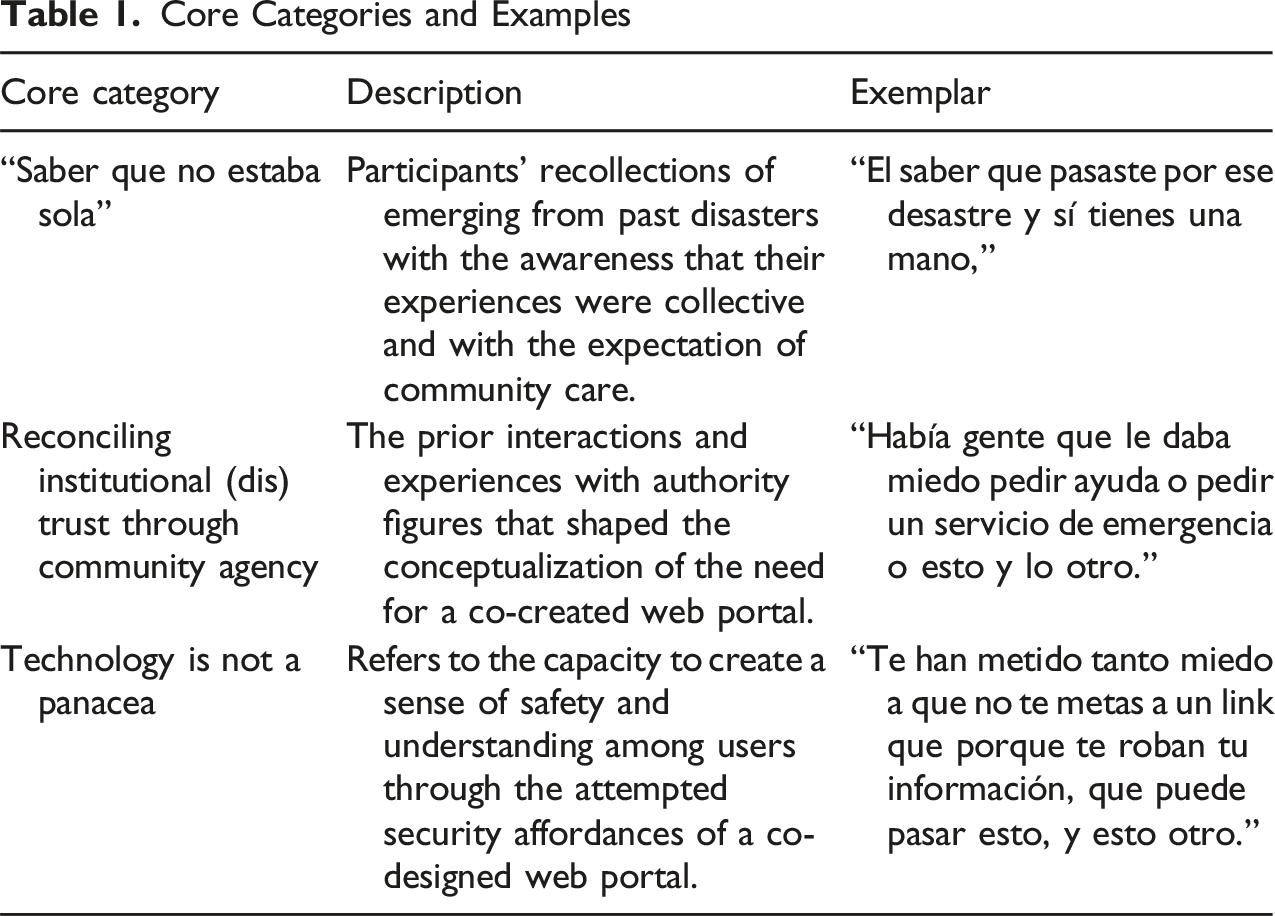
Using additional constant comparative analyses, the full team refined the analysis and identified three core categories that encapsulated the data as a whole: saber que no estaba sola, which translates to knowing I was not alone; reconciling institutional (dis)trust through community agency; and technology is not a panacea. Throughout the process the researchers aimed to follow as closely as possible to Charmaz and Thornberg’s (2021) guidelines for conducting a grounded theory study. Finally, the research team focused on developing theory to explain its findings. The resulting culturally anchored digital resilience theory provides a comprehensive understanding of the factors that connect cultural considerations, the technology portal, and the historical and adverse experiences within cascading disasters. Together, these framed the community’s collective anticipatory resilience.
Findings
The overarching research question asked how a co-designed web portal functions as a material and culturally relevant structure in the ongoing process of resilience. As noted above, three core categories describe how the codes combine to explain the community’s resilience processes: saber que no estaba sola, which means knowing I was not alone; reconciling institutional (dis)trust through community agency; and technology is not a panacea. The first category, saber que no estaba sola, addresses how the community’s shared experiences revealed that people relied on one another, and while the portal is a tool that can aid in community resilience, they will need to rely on each other to develop resilience. The second category, navigating institutional trust and mistrust, highlights how past experiences with authority figures and official institutions have shaped the community’s perceptions and the need for a community-driven solution. This core category also explains the importance of the co-design process in building trust. The final core category, technology is not a panacea, addresses the community’s mixed attitudes toward technology and the barriers to the community’s adoption of the portal. This category ties together the previous two core categories as it shows how the portal, aimed to address the community’s needs, also faced challenges in accessibility and usability.
Core Categories and Examples
Spanish-To-English Quotation Translations
The research team’s capacity to work across cultural and linguistic boundaries was essential for accurately representing how this community leveraged technology to respond to, prepare for, and learn from cascading disasters—in essence, their digital resilience. We attempted to embody decolonizing approaches to data analysis, grounded in qualitative self-reflexivity, which honored the community’s history and experiences. While we cannot claim that our methods alone were absolutely decolonial, we did take extra measures to embrace methodologies that brought us closer to a decolonializing approach. This strategy intentionally positioned the community as sources of knowledge and honored who was speaking and how. To maintain analytical rigor and cultural context, the coding process utilized the original Spanish transcriptions, emphasizing meaning-making over literal translation. While acknowledging the inherent challenges of interpretive work, this approach was crucial for authentically representing participants’ voices and highlighting their engagement in what De Onís (2024) describes as a relational process, where shared language, cultural traits, and histories foster community resilience during disasters.
Saber Que No Estaba Sola
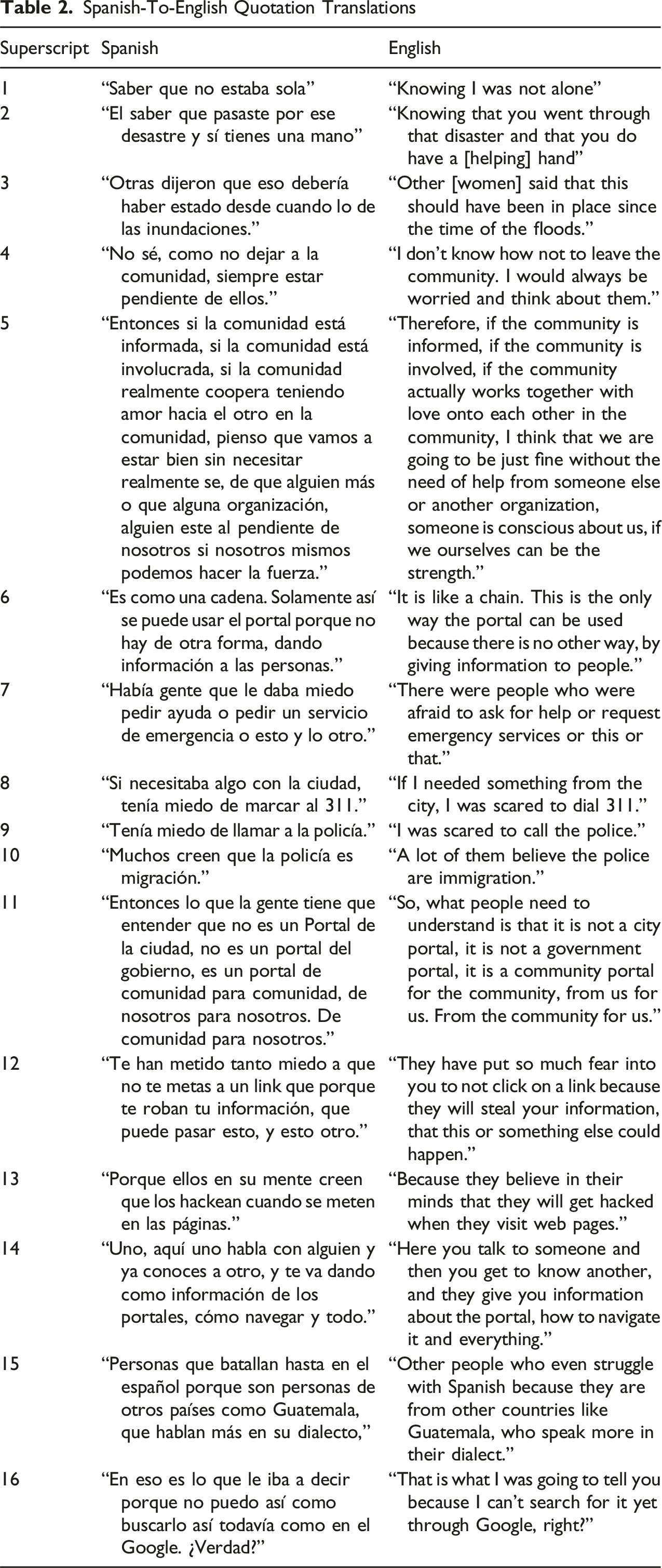
The core category “Saber que no estaba sola” [knowing I was not alone] was defined as participants’ reflections on past disasters, highlighting their recognition that these experiences were shared collectively and accompanied by an expectation of community care. “Saber que no estaba sola”1 (see Table 2 for English translations of each Spanish quote) was the in vivo language used by one participant to describe how individuals recognized that they were not experiencing a crisis event in isolation. The core category also revealed community members’ perceptions of and adaptation to the portal, as reflected in their narratives of past disaster experiences.
Often, these fragmented narratives comprise how individuals contextualized their resilience in past experiences as being community-driven. One participant stated, “el saber que pasaste por ese desastre y sí tienes una mano,”2 describing how knowing that others have gone through a similar or the same disaster confirmed that they feel supported and can make a difference in feeling like they are part of a community. These recollections also informed the community’s awareness of the resources that were available or missing during those critical incidents. Reflecting on such experiences highlighted the importance of having tools like the portal readily accessible for future challenges. One participant, for example, discussed how community members thought the portal would have been a valuable tool to have had during previous flooding: “Otras dijeron que eso debería haber estado desde cuando lo de las inundaciones.”3 These responses illustrated the community’s recognition of their mutual dependence and the importance of necessary resources that were shaped by previous disaster experiences.
Additionally, this core category extended participants’ relationships with one another and the portal by considering time and space. For example, several participants noted that they thought of their community in terms of other individuals in the city, neighbors, and family members. They emphasized that these communal ties inherently and continuously allowed them to express care for others. One participant stated that “No sé, como no dejar a la comunidad, siempre estar pendiente de ellos.”4 This participant described an internal battle of leaving the area where she resided but revealed that she will always look out for the community still living there. Such feelings of care and trust pertained to this large community, but those feelings also were attributed to the portal, with some residents viewing the portal as a community member. For instance, one person shared that “They [the community] are not alone, that the community can count on us [community leaders], and count on the portal.” The participant explicitly included the portal as trustworthy and fundamental to the community, much like a community leader.
A subcategory within this core category, community bonding, illustrated how the portal served as a tool to foster relationships and build a sense of community among members, and thus illustrated clear connections between the core categories. This subcategory emphasized the role of the portal in enabling members to support each other, collaborate on initiatives, enhance their collective resilience, and preparedness for disasters. One participant noted the interconnectivity (connectedness of the portal), stating, “It helps now to know that we can go to these places, or we can connect with each other … And when I spoke to the people I trained on using the portal, I made them aware of how we can communicate with each other.” This comment underscores how participants used the portal for both connecting with others and as a training tool.
On one hand, participants’ responses in reference to the portal emphasized how the community was able to foster relationships, support collaboration, and enhance collective resilience and preparedness. On the other hand, the portal was viewed as having significant limitations and barriers posed by the portal’s design and technology, which hindered engagement and effectiveness. This duality revealed both the community’s capacity to thrive beyond such constraints and the portal’s shortcomings. The linkage between connectedness and disconnectedness was evident when one participant stated: Entonces si la comunidad está informada, si la comunidad está involucrada, si la comunidad realmente coopera teniendo amor hacia el otro en la comunidad, pienso que vamos a estar bien sin necesitar realmente, de que alguien más o que alguna organización, alguien este al pendiente de nosotros si nosotros mismos podemos hacer la fuerza.5
This participant shared that even without the portal, the community was connected and was its own greatest source of strength. This comment expressed levels of uncertainty toward both the portal and an organization coming in to help and create the portal. It also revealed the conflicting nature of community resilience and how outside aid can introduce uncertainty toward new tools, especially when there is a history of distrust. Another response illuminated that the portal could not be effective without the input of community: “Es como una cadena. Solamente así se puede usar el portal porque no hay de otra forma, dando información a las personas.”6 In this claim, the participant used the metaphor of a chain to describe how the portal is dependent on people to be used effectively because information about it is passed from one person to another. Together, these reflections highlighted the coexistence of connectedness and disconnectedness, demonstrating participants’ ambivalence toward the portal while still emphasizing the community’s solidarity and mutual care.
Reconciling Institutional (Dis)trust Through Community Agency
The core category reconciling institutional (dis)trust through community agency was captured as prior interactions and experiences with authority figures that shaped the conceptualization of the need for a co-created web portal. Authority figures in the stories consisted of institutional powers such as government officials and the police. These figures were described as representatives of what these institutional powers could or would do in future events, and past views impacted the level of trust participants felt toward these figures.
Many participants described their relationship with institutions, often seen as responsible for helping them navigate disasters, as antagonistic. For example, one participant stated, “Había gente que le daba miedo pedir ayuda o pedir un servicio de emergencia o esto y lo otro.”7 This participant noted that some people in the community were afraid to request any assistance, even for emergency services. Some reasons for not reaching out included fearing that authorities were part of immigration enforcement or that the residents would be billed for services. Similarly, participants specifically expressed fear of contacting the city or 311 (a non-emergency phone line) for assistance (“si necesitaba algo con la ciudad, tenía miedo de marcar al 311”8) and fear of calling the police (“tenía miedo de llamar a la policía”9). Some participants believed that the police were the same as immigration officials (“muchos creen que la policía es migración”10), and those beliefs influenced the participants’ preparedness actions. Ultimately, these past experiences created a fear of authority figures rooted in the layered experiences of this community and their history of being ignored and disrespected.
These narratives spoke to the mistrust felt by the community, feelings that bled into how the portal was communicated to other community members. One participant stated, “Entonces lo que la gente tiene que entender que no es un portal de la ciudad, no es un portal del gobierno, es un portal de comunidad para comunidad, de nosotros para nosotros. De comunidad para nosotros.”11 Here the participant described how the portal is not for anyone other than the community itself and that it is detached from the government. The co-designed process of building the web portal helped participants navigate past experiences with authority and facilitated the trust needed to share the portal with other community members by overcoming negative historical experiences.
Note that trust was also developed through the co-creation process itself. Participants redefined what a trustworthy source was to them. In doing so, creators and participants who contributed to the making of the portal recognized the importance of creating something separate from authority figures, something that accounted for the culture and sensitivities of the community. Thus, participants who were more involved in constructing the portal appeared to trust the portal and its creators more. For example, one participant observed, “This wasn’t something created overnight. This was something where a lot of thought and process went into the creation of the portal.” This participant spoke about the trustability of the portal as they personally experienced it, and that the portal took time and effort to make. Even so, participants were concerned that the portal would not be perceived as trustworthy if it were not clear that the portal was separate from authority figures. Participants were connected through shared mistrust, and they organized to create a tangible, trustworthy representation of information to guide not only their own resilience but the community’s collective resilience. Hence, many individuals communicated with other members of the community on how the portal was built by or for the community itself, attempting to foster greater trust in the portal.
Technology Is Not a Panacea
The category Technology is not a panacea referred to the capacity to create a sense of safety and understanding among users through the attempted security affordances of a co-designed web portal. The web portal was designed to mitigate potential risks and maintain a sense of safety within the community (Fekete, 2012). This category included both the general perceptions of technology’s role and its specific application in facilitating anticipatory resilience during disasters. Materiality, or the tangible ways technology provided actionable resources and information, played a role in shaping these perceptions. In some instances, participants’ narratives revealed how past experiences with technology, as well as societal narratives about its risks, influenced their views of the web portal’s effectiveness and accessibility.
Participants expressed both caution about and reliance on technology, reflecting how past experiences shaped their trust in digital tools. For example, one participant described a fear of identity theft and hacking when accessing website links: “te han metido tanto miedo a que no te metas a un link que porque te roban tu información, que puede pasar esto, y esto otro.”12 This participant expressed worry about clicking links and how these were related to identity theft and other consequences of online activity. The mistrust of technology was further echoed by another participant who mentioned concern about getting hacked when visiting web pages: “porque ellos en su mente creen que los hackean cuando se meten en las páginas.”13 Such apprehensions revealed a significant barrier to the adoption of the web portal and hindered individuals’ resilience processes.
Despite these concerns, participants also shared examples of technology that had been instrumental during past disasters, such as text messages to disseminate vital information when other communication channels, such as phone lines, went down. One participant shared that she sent a text message seeking information on where to find shelter to keep warm during an extreme winter freeze: “Where can I go?” The recipient directed her to a local middle school, which the participant credited with saving her life. She explained: “She [the person I texted] sent me to the Middle School. So, otherwise I probably would’ve frozen to death in my house because I was in blankets and socks, and it was bad.” Another participant described how collaborative learning improved her ability to navigate different areas of the portal: “Uno, aquí uno habla con alguien y ya conoces a otro, y te va dando como información de los portales, cómo navegar y todo.”14 These experiences demonstrated that while technology could provoke anxiety and fear, it also empowered users when paired with collaborative and accessible design.
The web portal’s user-friendliness emerged as a factor that shaped its accessibility and perceived usefulness. Participants who found the portal intuitive appreciated its “clear and precise” features, describing it as easy to navigate. One participant highlighted the helpfulness of its visual design and appreciated how disaster information was categorized: “I like the fact that it is broken into sections based on whether [the disaster information] was concerned with heat, cold, or flooding.” In contrast, others found the portal overwhelming or inaccessible due to gaps in digital literacy. Many participants argued that the portal was not designed for all members of the community, particularly those who did not have access to technology or those who struggled to use technology independently, such as the older-adult community or people with disabilities. For example, one participant stated, “I think a lot of people struggle with technology. I myself am one of those. I do know a little bit of technology, but I don’t know a lot.”
Language barriers also shaped perceptions of the portal’s accessibility. While the web portal was available in both English and Spanish, some participants explained that certain Spanish dialects spoken by members of the community were not accounted for. Without language they could understand, their comprehension of information was limited, which also hindered their ability to participate in resilience-related efforts. One participant specifically commented that “Personas que batallan hasta en el español porque son personas de otros países como Guatemala, que hablan más en su dialecto,”15 emphasizing that technology skills are further impacted because people from Guatemala, for instance, struggle to understand the dominant Spanish spoken in the community and instead primarily speak their own dialect. Ultimately, the perception of the portal as being user-friendly was impacted by the user, the community members being considered in the design, and the user’s familiarity with technology itself. When navigating these challenges, individuals needed to adapt not only to technological demands but also to the linguistic nuances of their community. This gap signified the importance of designing resources that address linguistic diversity within multilingual communities.
Participants also identified gaps in the portal’s accessibility and functionality. For example, several community members struggled to recall how to access the portal, with one stating: “What is the link? Community resilience, or how is it? I don’t have it in front of me.” This memory lapse occurred despite the participant’s active involvement in the portal’s development. Another participant pointed out that the portal was not yet optimized for broader discovery, explaining, “En eso es lo que le iba a decir porque no puedo así como buscarlo así todavía como en el Google ¿Verdad?”16 This participant explained that the portal was not very useful to the community at the present moment, as it was not yet accessible via a simple Google search. These comments and observations highlight that even a well-designed resource can fall short if its users cannot easily locate it or remember how to access it.
Ultimately, the utility of the web portal and technology more broadly depended on the portal’s ability to meet the material and cultural needs of participants and their communities. For many participants, the portal’s co-design, inclusivity, and ease of access were important factors in determining its effectiveness in fostering resilience during disasters. In other words, while the portal was a tangible example of some participants’ anticipatory resilience, the extent of its effectiveness varied within the community, emphasizing the difference in resilience both between and within populations.
Discussion
This research examines how discursive and material practices influence anticipatory resilience through the personal histories and mindsets that community volunteers bring to their understanding of cascading disasters, providing a holistic view of resilience that extends beyond single events. The findings support arguments that resilience processes are cyclical rather than linear, aligning with calls for holistic approaches in resilience and cascading disaster research (Buzzanell, 2019; Chewning et al., 2024; Cutter, 2018; Sun et al., 2024). While the study demonstrates that a co-designed disaster data portal can foster community resilience, it also reveals that technological tools’ effectiveness depends on the complex social, cultural, and technological factors shaping community experiences. The importance of applying a cultural lens to community resilience and co-created affordances emerges clearly through the cultural theory of risk, particularly the framework for understanding risk assessment within cultural contexts (Douglas, 1990). This study both supports and extends Douglas’s theoretical framework by demonstrating how culture frames understanding of prior events while past crises underscore the politicized inequalities experienced by specific groups. These findings contribute to anticipatory resilience communication literature by illustrating that resilience is not only about preparing for a specific disaster but also about integrating community knowledge, communication practices, and technology to anticipate cascading and interconnected risks. This study also offers practical insights for developing culturally relevant resilience tools that acknowledge the dual role of culture in shaping both historical interpretation and contemporary inequality.
The web portal’s affordances demonstrate the practical contribution of this study to anticipatory resilience by facilitating easy access to resources and information. Multilingual and culturally tailored design ensures that diverse community members can access, interpret, and act on disaster information, emphasizing the relational nature of technology in supporting resilience. However, even when participants co-create the web portal, barriers can limit its effectiveness, particularly for communities marginalized by disasters and socioeconomic factors. In particular, addressing multilingualism is key given that even within a single language, varying dialects and colloquial understandings can be present. Prior studies highlighted the importance of accurate and culturally appropriate translations for enabling individuals to seek information, access help, and engage in preparedness strategies (Federici, 2022; Uekusa & Matthewman, 2023; Vázquez & Torres-del-Rey, 2019). Vázquez and Torres-del-Rey (2019) emphasize how multilinguistic access to information across all stages of a cascading disaster is essential to an effective response, prevention, and mitigation. These findings align with research on visibility and persistence as important technology affordances (Stephens et al., 2020; Treem & Leonardi, 2013), showing that linguistic and cultural barriers can undermine the portal’s ability to support resilience. Extending previous work, this study shows that multilingual considerations are most effective when they account for users’ linguistic and cultural diversity, highlighting the relational nature of affordances in shaping and being shaped by users’ needs.
Trust as Integral to Resilience Systems
Trust is a foundational element in disaster communication. Risk communication scholars have argued that trust plays a role in preparedness (Cadwell, 2020; Samaddar et al., 2012; Spialek et al., 2021). For example, Samaddar et al. (2012) showed that when people trust local authorities, individuals’ intention to prepare is higher. Cadwell (2020) examined the role of trust and distrust in disaster translation during the Great East Japan Earthquake in 2011 and found that translation efforts often rely on socially familiar people rather than authority or official figures. Finally, Spialek et al. (2021) found that after Hurricane Harvey, for Latine/a/o participants residing in nearby areas, social distrust disrupted their individual disaster communication and consequently their abilities to cope and engage in resilience, including participating in recovery efforts. This reliance signifies the importance of personal relationships and shared experiences between translators and those needing translation to build trust in disasters. Information poorly translated by authorities can lead to mistrust (Cadwell, 2020; Uekusa & Matthewman, 2023), leaving communities skeptical of official resources.
Trust in disaster contexts is further complicated by systemic stressors that historically undermine confidence in authorities. The fear of deportation and family separation is a persistent stressor within various immigrant communities (King et al., 2023; Manzo et al., 2020; Mendez Murillo & Kam, 2023). These historical and ongoing trust concerns repeatedly appeared in participants’ narratives. This illustrates how communities navigate resilience despite experiences of marginalization and fear. Understanding how a community with a shared history, language, and culture negotiates resilience is also valuable for advancing resilience research more broadly since diverse groups of people with varying degrees of vulnerability to disaster are present within national and state borders (Bean, 2018).
Community-researcher relationships fundamentally shape the success of co-creation processes in disaster resilience projects. Sun et al. (2024) identified how weak relationships between communities and researchers hinder convergence work, a challenge that emerged similarly in this study’s web portal development. Our findings reveal that participants’ distrust of authority figures, including university researchers, limited their disclosure of community needs during the co-creation process. This constrained communication was particularly problematic because participants’ trust in the portal depended directly on their involvement in its creation and their perception of genuine investment in the project. The interplay between trust, participation, and open communication thus emerged as a critical factor determining whether the technological tool would effectively serve the community.
Trust functions as the critical bridge between discursive and material elements of anticipatory resilience, determining whether communities will integrate technological tools into their disaster preparedness strategies (Betts et al., 2022; Buzzanell, 2019). Our findings reveal how participants’ skepticism toward authority figures directly affected their engagement with the portal, demonstrating that mistrust can fundamentally undermine technological solutions in resilience processes. This dynamic operated bidirectionally, with trust serving as both a prerequisite for and an outcome of successful anticipatory resilience practices in collaborative initiatives. Community members’ past experiences of marginalization—including apprehension about authority figures and difficulties accessing resources—heightened their awareness of disaster vulnerability while simultaneously shaping three key aspects of the portal development: their perceptions of its utility, the localized knowledge they contributed to its design, and the collective actions they envisioned for its implementation. These interconnected experiences ultimately determined whether the portal would become an effective tool for future disaster preparedness or remain an underutilized technological artifact disconnected from community needs.
Portal Affordances
By serving as a repository of community experiences and resilience practices, the portal enabled collaboration and communication among governments, organizations, and communities across different contexts and time. Community members could access historical resilience practices at any time, allowing them to learn from past experiences when needed. This feature directly addresses previous research concerns about maintaining long-term disaster preparedness (Chewning et al., 2024). As a living repository of resilience behaviors, the portal’s utility extends well beyond facilitating an immediate disaster response, remaining valuable from days to years after an event.
Finally, the portal simultaneously functions as both an anchor and a bridge: It physically anchors resilience knowledge in a web platform while extending resilience practices across time and space. When community members face heightened urgency, they can draw upon this stored knowledge to inform their response. This dynamically positions the portal itself as an act of anticipatory resilience, providing community members with a persistent resource they can utilize throughout their resilience processes, regardless of temporal or geographic constraints.
Developing the Culturally Anchored Digital Resilience Theory
The connections among the core categories reveal how culture and technology intertwine to both facilitate and constrain resilience processes, advancing theoretical understanding of anticipatory resilience. Culturally anchored digital resilience theory extends beyond Ballard and Aguilar’s (2020) temporal framework of past and present resilience, proposing that technology makes resilience tangible for future generations. The co-created portal exemplifies this concept by transforming intangible community knowledge into a concrete tool that helps those without preparedness knowledge recognize and enact resilience practices. This technological embodiment of resilience transcends the limitations of memorable messages passed through personal relationships (Boumis et al., 2023; Lucas & Buzzanell, 2012), creating instead a culturally relevant resource accessible to the entire community. The portal’s co-designed nature, strengthened by community partners’ knowledge and volunteers’ personal experiences, creates a collective virtual space that empowers individuals who are unaware of disaster threats while serving as a guide for future resilience processes. This dynamic pushes resilience from individual to community and back, marrying individual and community resilience processes through technology.
Culturally anchored digital resilience theory posits that effective resilience communication must be rooted in both individual lived realities and communities’ shared histories, language, and cultural understanding. The theory recognizes that communities possess inherent strengths, knowledge, and support networks that technology can transform into living, breathing structures for disaster preparedness and recovery. By employing decolonizing approaches that strengthen culturally representative constructs and highlight community experiences in native languages, this framework challenges dominant narratives that often marginalize the voices of those most vulnerable in disaster situations. The theory thus positions technology not as a neutral tool but as a culturally embedded resource that can either reinforce or challenge existing power structures in disaster resilience practices.
Central to culturally anchored digital resilience theory is the concept of trust-building through co-design and community ownership. The theory suggests that resilience communication tools and strategies are most effective when they are developed in collaboration with the community through trusted community members, rather than imposed from outside the community. It takes into consideration the cultural implications important to the community in the development of trust between communication tools and institutional organizations. This process of co-design helps to navigate the tensions between institutional mistrust and community interdependence, as it allows a community to shape the communication resources to meet its specific needs and cultural contexts.
The theory also emphasizes the importance of inclusive and accessible communication technologies, recognizing that the adoption and use of resilience communication tools may be hindered by language barriers, digital literacy gaps, and concerns about privacy and usability. Therefore, the theory advocates for the design of communication resources that are culturally and linguistically relevant, user-friendly, and sensitive to the community’s diverse needs and abilities. Ultimately, the culturally anchored digital resilience theory highlights the transformative potential of centering community voices and experiences in the development of communication strategies for resilience. This theory leans into prior organizational communication research and further develops an understanding of the interwoven nature of cultural relevance, power, and community resilience processes by exploring the meso-level behaviors of community-led organizing through micro-level individual experiences. By recognizing the community’s agency, strengths, and cultural context, the theory provides a framework for understanding how communication can be leveraged, made tangible, and extended beyond time to support the ongoing development of community resilience and individual resilience in the face of environmental challenges.
Implications, Limitations, and Future Directions
This study has several limitations that should be acknowledged. First, the participant sample primarily consisted of community leaders and members directly involved in the co-creation process of the web portal. While their insights are valuable, the data presented may disproportionately reflect their perspectives rather than those of the broader community members who interact with the web portal. Additionally, since the study focused on a single community, and participation was voluntary, this could have introduced the potential for selection bias, as the data may reflect the experiences and perspectives of those who chose to participate. Future studies should include a more diverse set of participants, particularly those who use the portal but were not involved in its creation, to better understand how technological tools and past experiences shape anticipatory resilience across an entire community.
Second, a majority of the interviews were conducted in Spanish, and while bilingual coders were utilized, there remains the potential for the intended meaning to be lost in translation, which could affect how others interpret the findings presented in Spanish. Even so, a strength of this study is that interviews were conducted and analyzed in Spanish, providing an example of how organizational communication scholars might adopt decolonizing research practices. This approach does require a research team of people whose experience and language skills reflect the community they study. As suggested by Banerjee and Sowards (2022), future research should involve experts in the linguistic and cultural nuances of studied communities to better capture participants’ experiences and enhance methodological rigor in qualitative research.
Third, all but one of the participants in this study were females residing in a Spanish-speaking community. Gender in predominantly Latine/a/o and Hispanic communities is a critical factor to consider when engaging, recruiting, and working in culturally nuanced settings (Manzo et al., 2020). Factors such as exposure, vulnerability, preparedness, and coping capacities to disasters are influenced by gender in distinct ways. For example, males may be more guarded and protective of their personal and community lives, which could affect the relational dynamics of factors associated with resilience (Erman et al., 2021). Therefore, we need to understand how gender-differentiated perspectives influence community resilience through individuals’ use of technology tools.
Future research should extend this study’s findings to investigate how co-created portals might function for community members who did not directly engage in the development of the tool. Furthermore, Banerjee and Sowards (2022) emphasize that engaged scholarship should extend beyond Western English-speaking contexts and journals to reach a broader audience and be understandable to the communities involved in the research. Future research could consider adopting our practices, which encourage communication scholars not only to be reflective within the community during research but also to emphasize culturally appropriate strategies within the methodology during the analysis and the writing of the research products.
Footnotes
Acknowledgments
We would like to thank the community members and city leaders for participating in this research. We would also like to acknowledge Katie E. Bradford for editing support, The University of Texas at Austin Planet Texas 2050 Grand Challenge, and the Technology & Information Policy Institute at the Moody College of Communication for their support.
ORCID iDs

Funding
The authors disclosed receipt of the following financial support for the research, authorship, and/or publication of this article: This work was supported by the National Science Foundation: Award #1952196, SCC-IRG Track2: Integrating Information Flows and Supporting Communities as Decision-Makers in Response to Acute and Chronic Stressors. Any opinions, findings, and conclusions or recommendations expressed in this material are those of the authors and do not necessarily reflect the views of the National Science Foundation.
Declaration of Conflicting Interests
The authors declared no potential conflicts of interest with respect to the research, authorship, and/or publication of this article.