




Abstract
Corporate social responsibility (CSR) communication faces significant challenges due to an increasing polarization of public discourses. This polarization oversimplifies societal differences into “us versus them” dynamics, complicating consensus building and eroding trust in democratic processes. Traditionally, CSR communication research has focused on how organizations negotiate meanings between various stakeholders. However, the rise in polarization necessitates a broader research scope to understand its impact on CSR practices and organizational relationships. This Special Issue of Management Communication Quarterly explores these evolving challenges, analyzing how polarization reshapes CSR communication and outlining strategies for businesses to navigate this fragmented landscape. The issue also reflects on the broader role of corporations amidst tendencies of polarization and suggests directions for future research.
Keywords
Introduction
“We’re not just fighting an epidemic; we’re fighting an infodemic,” the UN’s secretary general Dr. Tedros Adhanom Ghebreyesus remarked aptly in 2020 in response to the emerging COVID-19 pandemic. The statement suggests that the communicative landscape in which contemporary organizations operate has changed significantly over the past decade, creating challenging conditions under which organizations and their constituents engage in corporate social responsibility (CSR) communication. More specifically, a key challenge for CSR communication today is the polarization of public discourses (Weber et al., 2023). Polarization threatens Western democracies because it renders the achievement of compromises and consensus through public discourse increasingly difficult (Brüggemann & Meyer, 2023; Habermas, 2022). We define polarization here as “a process whereby the normal multiplicity of differences in a society increasingly align along a single dimension, and people increasingly perceive and describe politics and society in terms of ‘Us’ versus ‘Them’” (McCoy et al., 2018, p. 18). Such polarization dynamics are further exacerbated by “post-truth” tendencies in society, where traditional values of a fact-based information provision are eroding and doubts, even regarding scientific knowledge, are spreading (Knight & Tsoukas, 2019; Meyer & Quattrone, 2021). The algorithmic filters of digital media platforms that lead users to consume content primarily from their “filter bubbles” (Kitchens et al., 2020); and increasing loads of disinformation (Bennett & Livingston, 2020) and “fake news” (Knight & Tsoukas, 2019) shared on these platforms, make it difficult for actors to differentiate between trustworthy, fact-based news sources and dubious, deceptive ones. The resulting epistemic uncertainty challenges businesses to take action and to make the decisions.
This is especially the case in the context of morally loaded sociopolitical issues such as CSR, sustainability, and diversity where the polarization of public discourses is particularly salient. Companies are increasingly forced to take a stance toward these issues, leading them to be caught between vastly divergent and even mutually exclusive expectations that their various stakeholders might have regarding their actions and positions toward these topics (Dhanesh, 2024; Weber et al., 2023; Yang et al., 2020). Accordingly, polarization is not only a threat to democratic societies, as it can lead to the erosion of trust in democratic institutions and peaceful decision-making, but it also constitutes a fundamental challenge for businesses aiming to engage in CSR communication.
Thus far, CSR communication research and practice have been overwhelmingly concerned with how actors in and around organizations negotiate meanings surrounding CSR, including interactions with external stakeholders (e.g., non-governmental organizations [NGOs], the media) or internal stakeholders (e.g., employees) (Crane & Glozer, 2016; Schoeneborn et al., 2020; Schoeneborn & Trittin, 2013) as well as via digital media platforms (Capriotti, 2017; Etter, 2013; Maltseva et al., 2019). Yet, the rapidly changing communicative landscape characterized by increasing polarization, convinces us that CSR communication scholars need to broaden their scope of interest to account for how this important development is altering CSR communication practices, organizations’ relationships with stakeholders, and the institutional role corporations have in society. The various contributions of this Special Issue are indicative of such expansion in perspective, and we argue that our field of research must further recognize the new challenges that the age of polarization brings to organizations interested in engaging in CSR communication, as well as research on the matter (Glozer et al., 2019; Verk et al., 2021).
Consequently, with this Special Issue of Management Communication Quarterly, we aim to address the new challenges that businesses face when engaging CSR communication in a polarized communication environment. The intent of this Special Issue is to bring together research on how the conditions for CSR communication have changed in today’s globally accessible and dynamic communication environments, wherein polarized societal discourses are abundant. In the following, we attempt to systematize extant works related to CSR and polarization, including those studies published in this Special Issue. We reflect on how the polarization of CSR-related issues is organized in the public discourse. Furthermore, we discuss how firms may handle CSR communication in times of polarization. And finally, we engage in broader and normative reflections on the role of firms vis-à-vis polarization, before outlining avenues for further research.
Overview of Research on CSR Communication and Polarization
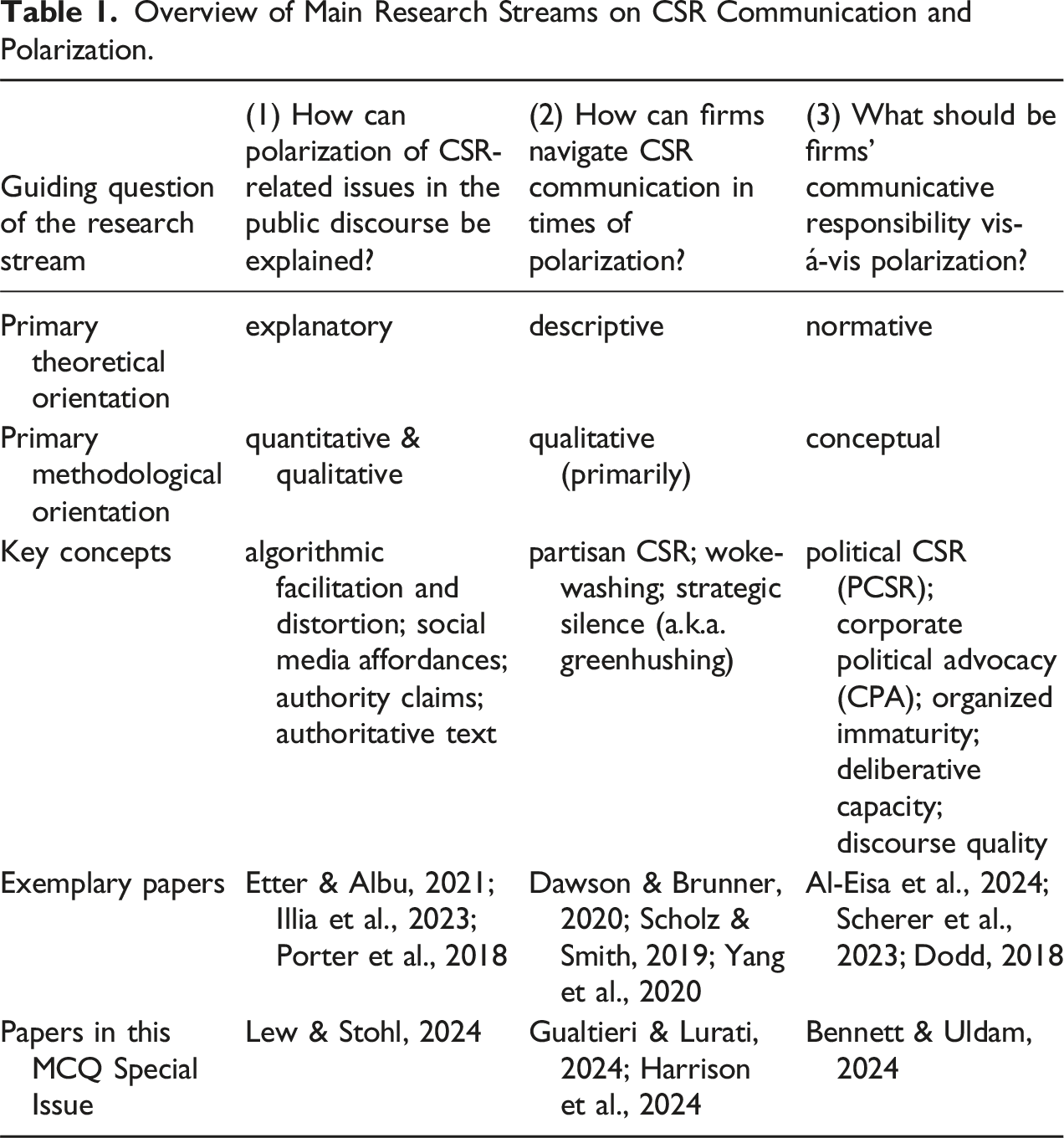
Overview of Main Research Streams on CSR Communication and Polarization.
How can Polarization of CSR-Related Issues in the Public Discourse be Explained?
The first stream of literature is explanatory in character. Specifically, it focuses attention on the antecedents of polarization around CSR and sustainability-related issues. In doing so, this stream aims to explain the origins of polarization as a central contemporary challenge for CSR communication in and around organizations. Understanding the antecedents of polarization related to CSR is important because it marks a macro-level shift that is altering organization–stakeholder relationships and influencing the ways in which CSR is practiced and communicated.
One key focus has been on the negotiation of authority claims around contentious issues such as climate change or inequality. Specifically, scientifically produced facts on large-scale societal challenges provide convincing arguments for social transformations aimed at tackling these challenges. Yet, as Porter et al. (2018) showed in the context of climate change, these arguments also raise diametrically opposed counter-positions, paralyzing public discourses and attempts to counteract them. As such, the presentation of facts by legitimate and knowledgeable actors and institutions does not seem to close off communication anymore. In contrast, facts seem to generate counter-facts and claims, rendering previously accepted facts debatable and allowing them to be contested.
One root cause for these dynamics can be found in the spread of fake news, what is facilitated by the rise of artificial intelligence (AI). Specifically, three problems with generative AI (such as ChatGPT) that Illia et al. (2023) discerned can be understood as main drivers of polarization: The “fake agenda problem [of] mass manipulation and disinformation” (p. 204) relates to the continuous reuse of tendentious content that reproduces and reinforces countervailing positions at scale. The “lowest denominator problem [of] massive low-quality but credible content production” (p. 205) plays into the imbalanced, unreflective uptake of reproduced positions, thus reducing opportunities to overcome chasms between opposed positions. Finally, the “mediation problem [involves] the creation a growing buffer in the communication between stakeholders” (p. 201), thus allowing the reproduction of mutually exclusive positions through an interface that does not require dialogues between proponents of these positions anymore.
The spread of fake news is not foreign to communication via social media. In their study of social media use by social movements, Etter and Albu (2021) drew attention to the affordances of social media as contributors to these dynamics. Specifically, they examined the role of social media’s algorithms in organizing collective action. They found that the filtering, ranking, and aggregation of content on social media enables collective action (algorithmic facilitation), whilst also constraining it through information overload, opacity, and disinformation (algorithmic distortion). Hence, as elicited through their study, social media’s algorithms have contributed to polarizing debates on CSR and sustainability issues, for better or worse.
As part of fake news, social media algorithms exacerbate polarization by creating “echo chambers,” that is, “a social epistemic structure from which other relevant voices have been actively excluded and discredited” (Nguyuen, 2020, p. 141). The sorting of content through algorithms on social media seems to contribute to the emergence of such structures, such that a prioritized position is eventually reproduced in and through them at the expense of others (Törnberg, 2022). As Lanier (2018) clarified, polarization and the emergence of echo chambers are not one-off outcomes that can easily be observed. Rather, they gradually emerge as a “statistical effect” (p. 11) of continually displaying small portions of like-minded content to be “liked,” followed, or commented on, as well as heated debates on counter-positions that provide tempting opportunities to write dismissive rebuttals. Controversial issues around responsibility and sustainability seem to be particularly prone to such developments. Therefore, Castelló (2021) highlighted the emergence of echo chambers on and through social media as central challenge for CSR communication.
Lew and Stohl (2024), in this issue, partly inform this line of inquiry. In their study, the authors examine actors’ willingness to contribute to CSR-related conversations on social media, and how to avoid the emergence of echo chambers. Among others, their results suggest that critical comments were more easily taken up and reproduced through similar comments. Especially the latter observation seems characteristic for communication on and through social media: It is the affective side of such communication that seems to contribute to the emergence of diametrically opposed positions (Törnberg, 2022). Furthermore, Lew and Stohl’s results suggest that polarized positions are increasingly taken up and reproduced when companies start the conversation through their CSR-related posts, thus potentially contributing to the emergence of echo chambers. As such, organizations may not just be “affected” by polarization but also contribute to it.
In sum, both prior research and some contributions to this Special Issue highlight that the sources of polarization around CSR and sustainability-related issues are deep-seated features of contemporary communication. Social media and AI are routinized parts of day-to-day communication for many people nowadays, and the commercial interests behind the use of distorting algorithms (Etter & Albu, 2021) will likely contribute sustaining features of these technologies that, in turn, contribute to polarization. Therefore, it is relevant to focus attention on firms’ ways of handling CSR communication in times of polarization—on which we will elaborate next.
How can Firms Navigate CSR Communication in Times of Polarization?
The second stream of literature is descriptive in character. Specifically, it focuses attention on how the increasing polarization and fragmentation of public discourses, coupled with an increasing mediatization of organizations (van der Meer et al., 2024; van der Meer & Jonkman, 2021), has elevated the social role of corporations. In doing so, this stream of research aims to describe the downstream implications of polarization, including how companies can interact and communicate with stakeholders in polarized times. More specifically, in today’s polarized communication climate, it has become difficult for firms to refrain from entering issue spaces altogether or taking a decided stance on social, political, or environmental issues under the umbrella of CSR, even if the issues are not directly related to their core business (Dodd & Supa, 2014; van der Meer & Jonkman, 2021). In the same context, van der Meer and Jonkman (2021) contend that “corporations can no longer stand by and ignore the politically polarized society” (p. 3), a position that is well supported by market research and public opinion surveys.
Although extant research often presents constructive and dialogical exchanges between companies and stakeholders as the preferred model for CSR communication in social-mediated communication (e.g., Kent & Taylor, 2021; Whelan et al., 2013), recent studies, including some of those that appear in this Special Issue, show that such an idealized model is often unattainable, especially in times of polarization. As a result, an emerging body of research focuses on how to address or manage tensions without the goal of stimulating productive and constructive dialogue with stakeholders (e.g., Dawson & Brunner, 2020). Some of these works acknowledge that relationships between organizations and stakeholders are not always inherently constructive; instead, they are complex, multifaceted, and sometimes prone to conflict (Heath, 2013).
In polarized, conflicting situations, companies may take a partisan approach to CSR communication by publicly supporting one side of controversial topics that align with their political views (e.g., Scholz & Smith, 2019; van der Meer & Jonkman, 2021; Weber et al., 2023). When faced with polarized opinions or increasing political divide, firms align their CSR communication with expectations based on their political position to avoid being isolated without support (Benton et al., 2022). However, Benton et al. (2022) also found that this could limit their ability to maneuver effectively, as their communication is anchored in their prior partisan stance.
Gualtieri & Lurati (2024), in this issue, also find that a company took a polarized position and adopted “partisan CSR” when advocating for or against 5G (a telecommunications standard for cellular networks), shifting the focus of CSR from all-public support and commitment to diversity to biased explicit support of specific ideals and values (see also Wettstein & Baur, 2016). Partisan CSR implies that CSR (communication) is “pushed” into the more controversial spectrum of corporate political advocacy (CPA), which favors high polarization and evokes strong bimodal sentiments from consumers and other stakeholders (Dhanesh, 2024; Weber et al., 2023). And yet, according to Gualtieri & Lurati (2024) by only interacting within a specific ongoing conversation to promote a certain view, while simultaneously disengaging from and remaining silent in the opposing discourse, a partisan approach to CSR can prevent potential backlash (e.g., online firestorms) that might otherwise be caused by reinforcing negative reactions toward firms from certain stakeholder groups. In such cases, firms typically respond to criticism by appeasing critics with explanatory or sympathetic responses, as guided by crisis communication guidelines (Qu et al., 2023). However, empirical evidence suggests that CSR firestorms can also be effectively managed by adopting an escalation strategy that involves “fighting back” (Scholz & Smith, 2019). “Fighting back” covers a range of tactics, including launching counterattacks and mobilizing brand supporters to launch their own attacks. It also involves framing one’s position in a way that highlights the ideological fault line between the company or brand and its critics (Scholz & Smith, 2019). In this respect, it is similar to partisan CSR (Gualtieri & Lurati, 2024).
According to a predictive model developed by Lyon and Maxwell (2023), more polarized times encourage more CSR activity, but also accusations of corporate “woke washing” (Vredenburg et al., 2020). Increasingly, stakeholders expect companies to be “woke.” The term “woke” was originally coined to highlight the prevalence of social injustices and discrimination of African Americans (Warren, 2022, p. 170) but has since evolved to signify the integrated diversity, equity and inclusion (DEI) strategies to achieve social sustainability (Prasad & Śliwa, 2024). Understood in this sense, “wokeism” represents a cultural shift as companies have taken the lead in advocating for social issues (Sobande et al., 2022) and can, therefore, be seen as an extension or reinterpretation of traditional CSR. Yet, in part, this notion is also used in pejorative terms within populist rhetoric aimed at dismissing DEI initiatives, which does not do justice to the complexity and richness of debates on DEI (see Prasad & Śliwa, 2024). This, again, showcases once more how polarization not only but especially affects topics such as CSR, sustainability, and DEI. Regardless of their underlying motivations (e.g., Moorman, 2020; Vredenburg et al., 2020), companies are making “woke” efforts, such as campaigning against racism or promoting diversity through LGBTQ + campaigns, part of their CSR communications. In doing so, they aim to make themselves visible and to be associated with enlightened and progressive values, especially among stakeholders with vested interests (Schopper et al., 2024; Vredenburg et al., 2020), usually by capitalizing on social media visibility while seeking a balance between the pressures and rewards of being recognized as “woke” (Sobande et al., 2022). However, such activities run the risk of being labeled as “woke washing” if consumers or other stakeholders, such as target communities or activists, detect a disconnect between corporate social initiatives or communications and the rest of the company’s business practices or values (Warren, 2022).
As an important counter-trend, recent evidence shows that companies may choose to engage in withdrawal behaviors, such as strategic silence (Carlos & Lewis, 2018) or “greenhushing”, that is, a firm’s deliberate withholding of information about its accomplishments in the area of corporate sustainability (Font et al., 2017), to avoid concerns about being perceived as hypocritical or to avoid the online firestorms most often associated with greenwashing or other forms of “-washing” (Qu et al., 2023). These are seen as useful strategies in times of polarization, when a few active and vocal stakeholders and certain media outlets can be quite successful in their attempts to initiate, channel, and amplify greenwashing (or other “-washing”) debates (Blazkova et al., 2023). Research by Qu et al. (2023) suggests that strategic silence—delaying or avoiding a response or choosing not to communicate at all on a particular issue—can be effective in avoiding negative word-of-mouth on social media. Similar conclusions were drawn from an analysis of Volkswagen’s communication on social media around the “Dieselgate” scandal, where this unconventional strategy of silence was at the forefront of the company’s response to the crisis (Stieglitz et al., 2019). Another study found that concerns about appearing hypocritical likely cause companies to remain silent and not communicate about green or CSR efforts at all (Carlos & Lewis, 2018), thus further facilitating greenhushing (Ettinger et al., 2021; Font et al., 2017). However, the absence of CSR communication as a strategic inaction is not without its problems, as it can stifle the progress of CSR behavior and leave more room for “pretenders” (Carlos & Lewis, 2018; Ettinger et al., 2021), and, consequently, further alienate or polarize consumer populations (e.g., Weber et al., 2021).
There are other strategies that firms find helpful in navigating tensions when communicating CSR to stakeholders with different interests. The case study by Harrison et al. (2024), in this issue, shows how the race car series Formula 1 attempted to open up a dialogic space with CSR communication, inviting critical and skeptical polarized responses. However, according to the authors, Formula 1 missed the opportunity to advance agonistic dialogue by simply ignoring the responses rather than welcoming their diversity. In contrast, the outdoor apparel firm Patagonia, known for its activist stance, employed a more sophisticated approach in its “The President Stole Your Land” initiative. This initiative involved the opening of a dialogic space by harnessing the collective power of heterogeneous stakeholder communities, coupled with the use of bold public statements to politicize the issue without engaging in the discussions (Dawson & Brunner, 2020). Examples like this show that organizations concentrated their resources on the strategic planning of CSR messages rather than on a deliberative CSR communication dialogue in order to elicit emotional responses from stakeholders and draw attention to the company and its cause (Dawson & Brunner, 2020). In another case of navigating tensions, German and Swedish companies changed their communication when a social issue became controversial to avoid a populist backlash (Johnsen et al., 2024). The companies navigated between opposing poles by avoiding taking a political stance on a controversial refugee crisis, not by “keeping silent” but by reframing the issue in terms of how it related to their business operations (Johnsen et al., 2024).
Prior research and articles in this Special Issue demonstrate that companies are aware of the challenges that polarization presents for CSR communication, particularly in social-mediated environments. In such settings, the outcomes of an organization’s communication with stakeholders or publics are significantly influenced by those who assume control of the issue arena (Luoma-aho & Vos, 2010) and depend on the communication networks in which the organization is embedded (Yang & Taylor, 2021). Moreover, the limited empirical studies indicate that firms may be more adept at responding to the rapidly evolving communicative landscape and practicing CSR communication on social media than prior literature suggests (Etter et al., 2019).
What Should be the Communicative Responsibility of Firms vis-à-vis Polarization?
The third stream of literature is normative in character. Specifically, it focuses attention on how the increasing polarization and fragmentation of public discourses has elevated the social role of corporations. In this section, we focus on the implications this “new CSR era” has on the roles and responsibilities of corporations in society.
The new era of CSR has occurred due, in part, to weakening government institutions, which has led to an increased role for corporations in spaces traditionally occupied by governments and NGOs (Matten & Crane, 2005; Scherer & Palazzo, 2011; Scherer & Voegtlin, 2020) across all industrial sectors (Scherer et al., 2016). As political actors, corporations influence democratic decisions by engaging in political and public deliberations, provide public goods, and offer solutions to public issues (Palazzo & Scherer, 2006). These changes have shifted CSR communication from the relatively staid, homogenous reporting of activities (O’Connor et al., 2021) focused primarily on non-controversial, universal topics (Miller Gaither & Austin, 2022; Nalick et al., 2016) to a form of advocacy wherein the corporation takes a clear stance on controversial issues being discussed in the public sphere. The new CSR field can be examined through three interrelated concepts that define these new forms of CSR and their implications for corporations and society.
Political corporate social responsibility (PCSR) is then defined as “the broadening role of the private sector’s responsibilities beyond the mere production of goods and services and toward activities previously undertaken by the states” (Al-Esia et al., 2024, p. 376). PCSR recognizes that the political environment is dynamic and influences the PCSR activities that corporations pursue (Korschun & Rafieian, 2019). For example, PCSR researchers (Al-Esia et al., 2024; Scherer et al., 2016) noted several shifts in the socio-political context, including the hardening of national identities, an increase in religious fundamentalism, a rise in populism digitization, and the weakening of democratic institutions and civic liberties, all of which are altering the CSR practices of corporations.
These same concerns are further developed by Bennett and Uldam (2024), in this issue The authors discuss how changes in the CSR communication context require new ways of thinking about CSR practice and research. The authors show how CSR communication and practice are nested within the broader political conversations taking place as well as a corporation’s past and current political activity. They elaborate on the ways in which polarization and disinformation make reasoned debate difficult and suggest different pathways of how corporations can reinvigorate CSR to help safeguard democracy and stand firmly against fundamentalism and populism.
Unlike CPA (as described above), which seeks to increase a firm’s value through political activities focused on meeting business goals (e.g., Hillman et al., 2004), CPA focuses on the broader set of social and political issues that are not necessarily tied to the company’s day-to-day operations (Wettstein & Baur, 2016). CPA is defined as “voicing or showing explicit and public support for certain individuals, groups, or ideals and values with the aim of convincing and persuading others to do the same” (Wettstein & Baur, 2016, p. 200). CPA is grounded in open, dialogical communication that emphasizes promoting values and issues (Wettstein & Baur, 2016) that may or may not align with stakeholder expectations of the firm (van der Meer & Jonkman, 2021). This communicative approach aligns with PCSR, which is grounded in an ethic of information transparency that allows for deliberative, quality discourse (Al-Esia et al., 2024; Della Porta, 2019).
Similar to CPA, CSA is “initiated on behalf of stakeholders despite the potential negative fallout for the company resulting from a negative public response” (Dodd, 2018, p. 179; emphasis in original). Like PCSR, the rise of CSA has been attributed to the decline of trust in the government and the rise of a post-nationalist society (Dodd, 2018). CSA communication commonly is grounded in clear moral values that align with support for a particular issue rather than negative issue attacks (Abitbol & VanDyke, 2023) and communicate strategies the company is enacting to support the issue (Miller Gaither & Austin, 2022). However, researchers have found that stakeholders’ a priori opinions (Miller Gaither et al., 2018) on the issue as well as stakeholder evaluations of corporate motivation for engaging in CSA (Austin et al., 2019) are important evaluative factors.
The aforementioned concepts (PCSR, CPA, CSA) are bound by two common threads that help us understand the normative expectations for corporations in society. First, corporations exist within a dynamic economic, sociocultural system and rely on some level of public acceptance to survive. Second, corporations are increasingly expanding the values and premises that define who and what they accept responsibility for. These threads expose the potential frailty of roles and responsibilities corporations have to the common good, as values and systems change in the new era of CSR.
All three concepts expose the ways in which the new era of CSR is influenced by the changing sociocultural contexts that have given rise to polarization, thereby requiring corporations to evaluate how CSR should be practiced and communicated. At the broadest level, the new era of CSR places corporations in the role of “protector and promoter of the political agendas of the public” (Dodd, 2018, p. 227). On the one hand, this extended role is a logical outcome of the changing expectations stakeholders have for corporations as political actors. It aligns with global stakeholders’ beliefs that corporations are uniquely suited to solve societal issues (Edelman, 2022) and lead the world during global challenges and uncertainty (Edelman, 2023). But, as Bennett and Uldam (2024) noted, there are increasing pressures on corporations to divest from CSR-related activities. This creates a double bind for corporations trying to discern how best to engage in the commons. Organizations as disparate as Harvard University (Patel & Hartocollis, 2024), the U.S. beer brand Anheuser Busch/Bud Light (CBS Mornings, 2023), or the Danish shoe producer Ecco (Mol et al., 2023) highlight the difficult choices facing corporations in the wake of vitriolic stakeholder dissent. Polarization has increased the “cross pressures” organizations face, the often irreconcilable differences between stakeholder groups, and the frailty of the political advantages in a corporate versus government setting (Bennett & Uldam, 2024). The concern is that corporations are unprepared to move into this new CSR era where their decisions must be clearly articulated, grounded in values, and sustained over time to increase stakeholder perceptions of corporate legitimacy (Yim, 2024). The fundamental concern, however, is not for corporations. Rather, the social issues corporations embrace and then discard raises important questions about corporations’ willingness to maintain engagement with controversial issues if they experience negative outcomes and highlight the precarity of an expansive role for corporations in society. When corporations communicate their support for a polarized social issue, the stakes are significant because corporations have the economic power, social legitimacy, and communication reach to amplify an issue.
Seeing corporations as political actors (Scherer & Palazzo, 2007), however, is not without concern either. Bakan (2020) argued that corporate and CEO activism largely is a communication activity that, at best results in minor changes and at worst is “bad for democracy” (p. 5) as it provides people with a false sense of hope that corporations are anything more than money-making entities. He suggested that CSR and its related concepts are performative and that corporations engage in good works primarily because they benefit the corporation in some way. His critique of the corporation rings true because there are numerous examples of corporations choosing power and money over communicated CSR values—a choice that renders corporations silent about issues previously supported. Further, the new era of CSR has not had time to provide much evidence that corporations will embrace their responsibility to advance the needs of society (Dodd, 2018) when faced with significant economic losses. In fact, there is some evidence that when corporations begin to face economic pressures (e.g., declining stock prices), CEOs and their boards of directors will pivot away from social commitments to focus on economic responsibilities (Gelles, 2019).
Bakan’s critique, combined with a lack of empirical evidence that corporations will remain committed to social issues when faced with economic losses, leads to a set of complicated discussions about what the role of corporations in the commons really ought to be. For decades, corporations and researchers have publicly eschewed the Friedman doctrine (1970) and professed a commitment to broader social concerns (e.g., climate change, inequality). The rise of CSR is testament to the belief by corporations and society that corporate engagement is necessary to solve social issues. CSR practice and communication can lead to change within individual companies and industries by establishing new norms and standards. From this view, corporate engagement in the commons is a positive; particularly in societies with ineffective governments, corporations can use their economic power, communication acumen, and social legitimacy to push necessary change forward for the betterment of all.
However, after decades of CSR practice and communication, many of the most pressing issues remain stubbornly entrenched. This begs consideration about the extent to which corporations can or will engage in systemic change when faced with public backlash, threats of political retaliation, or economic losses. In these instances, corporations may choose to remain silent (Vredenburg et al., 2020) or communicatively reframe an issue to suit their business purposes (Johnsen et al., 2024). In the latter case, CSR becomes a marketing phenomenon rather than a values-based activity, which has consequences for the legitimacy of social issues as well as the corporate activities focused on the issues due to concerns about motive and authenticity. Certainly, there are notable examples of corporations that remain publicly committed to their values regardless of public or political dissent (e.g., Patagonia, Ben & Jerry’s), but they seem to be the exception rather than the rule. The willingness of corporations to retrench their CSR commitments (e.g., Bud Light) or to become silent on social issues that were previously communicated (Carlos & Lewis, 2018) highlights how corporate responsibility to divisive issues may have constraints that are hidden in the glossy CSR/CSA communication. These hidden boundaries between social issues that are good (economically) for business and social issues that need business but may cost the business expose the fault lines in this new era of CSR communication and practice.
Discussion and Conclusion
Theoretical Implications
In this introduction to the Special Issue, we have compiled and systematized the emerging research that addresses interplay between CSR communication and the polarization of public discourses. Overall, our article makes three main theoretical contributions.
First, to the best of our knowledge, our article is the first in providing an overview of the literature that sets the areas of CSR communication research and the issue of the polarization of public discourses in direct relation to each other. In the same context, we contribute to a further integration of insights across disciplines by bringing together research from corporate/organizational communication, political communication, media studies, management and organization studies, as well as neighboring disciplines. We hope that our overview can provide a platform for further theoretical and empirical inquiries into the highly salient issue of polarization and how firms are navigating this new communicative landscape or could even contribute to diminishing the divisive effects of polarization.
Second, by putting the issue of the polarization of public discourses in the spotlight of attention, our study adds to moving CSR communication research beyond a predominant firm-centrism (i.e., how firms can best use CSR communication as a tool to accomplish their strategic goals; e.g., Du et al., 2010) and toward also addressing macro-societal issues, such as the polarization of public discourses. As the article by Bennett and Uldam (2024) in particular has outlined, one main implication of this move is that it provides CSR communication a new mandate, that is, firms’ communicative responsibility to contribute to upholding the deliberative capacities of public discourses and, with this, helping to safeguard democracy. In turn, this mandate would also assign a new role to CSR communication within the broader spectrum of CSR research. While a considerable part of CSR research is already concerned with questions of how firms can contribute to large-scale societal problems (sometimes even replacing tasks formerly undertaken by nation states; see Scherer & Palazzo, 2007), CSR communication can serve as the designated subfield that is concerned with how firms in their CSR activities can tackle especially the communication-born, large-scale societal challenges such as polarization. In turn, this can include that CSR communication must be ready to embrace the network-centric engagement with stakeholders (Yang & Taylor, 2021) or be “prepared” for the possibility that an organization’s role may be taken over by other stakeholders (e.g., Dawson & Brunner, 2020; Harrison et al., 2024). This does not imply that the organization is unable to influence the formation of discourse within networks; rather, the conversations are co-created by the organization and the engaged stakeholders (Yang & Taylor, 2021).
Third, our argumentation in this article followed the assumption that polarization has detrimental effects for democracy, society, and business (see also Bail, 2022; Bennett & Livingston, 2020). However, in a recent provocation, Kreiss and McGregor (2024) raise the question of whether polarization can also be useful and desirable to some degree, at least in giving attention to the voices of underprivileged groups or raising the interest in political processes more broadly (see also Weber et al., 2021, p. 199). In that sense, our article can hopefully also serve as a springboard for debating normative questions (such as about the desirability of polarized discourses) and their implications for CSR communication research—and, with this, to add to extant research that is primarily driven by descriptive and/or explanatory research aims (see, e.g., the overview articles by Crane & Glozer, 2016; Du et al., 2010; Schoeneborn et al., 2020).
Future Research
In closing, we would like to point out a few avenues for future research that our article can help illuminate. First, future research will need to place a stronger emphasis on the catalyst role of AI in polarization within the context of CSR communication. More specifically, this will need to involve taking into account the role of AI in creating polarizing content (e.g., fake news or other forms of disinformation) and how this affects corporations’ abilities to legitimize themselves vis-à-vis their stakeholders and the broader public (see also Illia et al., 2023). Second, our article creates the need for further in-depth research on how firms can navigate an increasingly polarized communication landscape (see Gualtieri & Lurati, 2024). In our view, this would need to involve finding pathways to prevent firms from becoming more and more hesitant to engage in CSR and sustainability communication at all. After all, such relapses into “strategic silence” (Carlos & Lewis, 2018) do not help the CSR and sustainability agenda either, especially as they undermine making use of the exploratory capacities of CSR communication (see Christensen et al., 2013). Third, the call for expanding the communicative responsibility of firms to help safeguard discourse quality and deliberative democracy (Bennett & Uldam, 2024) leads to the need for follow-up research on how this could be accomplished. In our view, this would require involving considerations on how firms can help strengthen the digital resilience of democratic societies (against disinformation, conspiracy theories, etc.), not only on an individual level but also on a collective level (see also Scherer et al., 2023). On a final note, as this Special Issue shows, there is perhaps no greater time than now—as polarization, rising nationalism, weakening governmental institutions, and climate change threaten society writ large—for firms to fully commit to the values espoused in their lofty CSR statements and live up to their communicated promises (see also Christensen et al., 2013).
Footnotes
Acknowledgements
This Special Issue was based on an open Call for Papers and involved one invited article (Bennett & Uldam, 2024). The Special Issue was additionally facilitated by the 6th International CSR Communication Conference held at Leuphana University of Lüneburg, Germany, in September 2022. We, the co-editors of this Special Issue, thank all participants for their contributions to the conference, which also helped bring this Special Issue to fruition. Moreover, we are grateful to MCQ editors Matt Koschmann and Rebecca Meisenbach for their helpful editorial guidance throughout the entire process.
Declaration of Conflicting Interests
The author(s) declared no potential conflicts of interest with respect to the research, authorship, and/or publication of this article.
Funding
The author(s) disclosed receipt of the following financial support for the research, authorship, and/or publication of this article: We acknowledge financial support we received for the 6th International CSR Communication Conference and subsequent publication of this research from the Ministry of Science in Lower Saxony, Germany (“Niedersächsisches Vorab”). Furthermore, parts of this research were supported by a public research grant from the Norwegian Research Council as part of the TOPFORSK project “Future Ways of Working in the Digital Economy” led by BI Norwegian Business School (project no. 275347).
