




Abstract
The organizational communication discipline has been criticized for not centering the voices of ethnic minority communities. This can be witnessed in the prevention of violence, where migrant communities are more vulnerable to the effects of violence but are underserved by Western models of violence prevention. Grounded in the culture-centered approach, the present study—drawing from interviews with 67 new migrants and 31 service providers—explores how organizations can assist in preventing violence among new migrant communities. The findings reveal how communication inequality reduces agency and can create an environment conducive to violence and how the current individualized model of service delivery does not attend to the cultural norms and needs of community members. Engaging with new migrant communities and addressing violence involves creating communicative avenues of dialogue and leveraging community agency in codeveloping infrastructures for transformation.
Keywords
Family violence and sexual violence are critical public health challenges globally, with the burden of violence disproportionately borne by ethnic migrant communities (Segrave, 2021). Aotearoa (New Zealand) has the highest rate of violence among OECD countries (Milne et al., 2018), costing the government $1.4 billion per year (Upston, 2018). Reports show that 76% of family violence in Aotearoa is not reported, and the numbers are likely to be higher in the migrant population (Gerrard & Lambie, 2018; Simon-Kumar, 2019). While studies examining violence among migrant communities in Aotearoa are scarce, Western models of violence prevention often overlook the importance of family and community in ethnic minority groups (Zheng & Gray, 2015); further, migrant communities have been found to face a range of language, structural and cultural barriers in accessing support services to prevent violence (Ministry of Business, Innovation, & Employment, 2019; Tse, 2007).
Against this backdrop, we explore how organizations can assist in preventing family violence and sexual violence among new migrant communities by drawing from interviews with 67 new migrants situated in the “margins of the margins” and 31 service providers working in family violence and/or sexual violence prevention in Aotearoa. This research is part of a larger community-led culture-centered intervention seeking to develop a policy framework for the prevention of sexual violence and family violence among high-risk groups. Rather than focusing on the organization as the center of inquiry—which can obscure other “organizational possibilities” (Mumby & Stohl, 1996, p. 58)—we examine perspectives from the positioning of the raced margins contributing to theorizing how services can be delivered more effectively to these communities and furthermore, how the organization can be reimagined to fit within the ecologies of everyday life in the margins. In this sense: “local meanings promise to offer an alternative imaginary for the organizing principles of social life that are not rooted in the principles of neoliberal organizing” (Pal, 2016, p. 421). With a lacuna of diverse community voices represented in the organizational communication field, our analysis is valuable in working towards the decolonization of the discipline, allowing us to revisit Cheney’s (1995) question: “What would organizations be like if we really created and maintained them for the persons?” (p. 196).
This article contributes to the body of culture-centered work that has challenged neoliberal narratives associating migration and mobility with agency and empowerment while neglecting how movements can be necessitated through structural disenfranchisement (e.g., Dutta, 2017; Dutta & Kaur-Gill, 2018). Our findings reveal how communication inequality reduces agency and can create an environment conducive to violence; thus, engaging with new migrant communities in preventing violence should begin with creating communicative avenues of dialogue. Participants further highlighted structural contributors of violence within the violence prevention sector, including immigration policies and a cultural disconnection in the delivery of services in consistence with community needs. The interconnection between cultural and structural frameworks that play out in experiences of communication inequality points to the need to explore the “fine grain” elements of migrant experiences and communication phenomena across different scopes and scales (see Na’puti & Cruz, 2022).
A Lacuna of Diverse Voices: The Representation of Race and Culture in the Organizational Communication Discipline
The academic study of race and culture is embedded within neocolonial formations of knowledge production. Anthropologists represented non-Western societies in terms of primitivity (Geertz, 1973), and knowledge about the ethnic other was collected, analyzed, and represented through imperial eyes (Said, 1993). As Smith (1999) described, research conducted on Indigenous peoples: “implicated in the worst excesses of colonialism remains a powerful remembered history for many of the world’s colonized peoples” (p. 1). Subsumed under hegemonic discourses of “modernity,” “development,” and “rational economy,” culture was positioned as being located “elsewhere,” as a hindrance to social progress (Ashcroft et al., 2013; Dutta, 2015). Yet prevailing racial inequalities and colonial formations of whiteness 1 continue to permeate mainstream communication scholarship by erasing and simplifying race and ethnicity (Allen, 2007; Lee Ashcraft & Allen, 2003; Grimes, 2001), being rooted in Western theory (Dutta & Pal, 2020; Magallanes-Blanco, 2022), and failing to represent voices of diverse communities (Broadfoot & Munshi, 2007; Cruz & Sodeke, 2020) and scholars (Broadfoot et al., 2008; Chakravartty et al., 2018; Ganesh et al., 2005).
Within the organizational communication discipline, there have been calls to represent more diverse communities in mainstream theorizing (e.g., Broadfoot & Munshi, 2007; Cruz & Sodeke, 2020; Grimes & Parker, 2009; Mumby & Stohl, 1996). The application of Western theories to understand non-Western contexts has been criticized, with Broadfoot and Munshi (2007) stating: “Diverse voices, if present at all, are still channeled through dominant Western loudspeakers, and Western notions of rationality silence any discussion of emotionality or subjectivity, both of which are crucial elements of diverse organizing practices” (p. 251). Ganesh et al. (2005) argued that the boundaries of organizational communication should be extended to have a broader focus on “grassroots organizing” (p. 189); the discipline was further critiqued by Cruz and Sodeke (2020) who stated that theoretical engagement with marginality “is lacking in organizational communication … By overlooking the disenfranchised, we suppress connections between the socio-economic struggle and suffering of poor people and global capitalism” (p. 528–529).
The absence of diverse voices and perspectives in organizational communication scholarship has had a corresponding impact whereby “the ways in which we routinely frame race preserve the whiteness of the field, even as we claim to do otherwise” (Lee Ashcraft & Allen, 2003, p. 6). This preservation of whiteness contributes to the erasure of race in mainstream theorizing (Lee Ashcraft & Allen, 2003; Grimes, 2001), whereby “mainstream communication theory is culturally biased because it neglects to delve into race in critical, substantive ways” (Allen, 2007, p. 259). When race is represented within dominant organizational communication textbooks, the representation tends to be in reduced to “a matter of practice, skill, or personal experience [rather] than of substantive theory … as a contemporary trend—like changing technologies, the postindustrial age, or a globalized economy—with which students must be prepared to cope” (Lee Ashcraft & Allen, 2003, p. 28–29). This framing overshadows how experiences of violence and other social issues are not uniform. African American women, for instance, face a heightened relative risk of encountering sexual harassment in American workplaces (Cassino & Besen-Cassino, 2023). In spite of this, little is known about how women of color experience sexual harassment (Richardson & Taylor, 2009), furthering the process of erasure.
Presenting simplified constructions of race lends itself to essentialist models that can pathologize culture. For example, Burman et al.’s (2004) analysis of support services for minoritized women revealed how: “Domestic violence emerges as something that can be overlooked or even excused for ‘cultural reasons,’ as a homogenized absence; or alternatively as a pathologized presence” (p. 332). Underpinning this framing of violence is a “culture-as-primitive” conceptualization that fixes migrant culture as static and backward, fortifying narratives of global imperialism (Abu-Lughod, 2008). Simultaneously, the movement toward adopting cultural sensitivity and cultural competence that frequently positions culture as a panacea for improving inequitable service delivery can also be grounded in essentialist reasoning. Cultural sensitivity involves adapting messages to the target audience’s cultural markers to meet the status quo’s agenda, contrasting with the culture-centered approach that builds theories within communities (Dutta, 2007). In this sense, cultural sensitivity constructs culture as a means of persuasion co-opted by the dominant hegemonic structure without creating real avenues for understanding community members’ cultural needs, values, and priorities.
Within the organization, critical scholars have emphasized that diversity programs are not enough to resolve deep-seated inequalities, as there is a need to consider how organizational structures are embedded in whiteness (Grimes, 2001). Significantly, there has been a movement towards the participation of diverse communities in ethical decision-making within organizations, with scholars citing various advantages of doing so, including potentially empowering individuals, organizations, and the wider society (Stohl & Cheney, 2001) by providing innovative solutions for social problems (Heath, 2007). In Aotearoa, there has been a rise of culturally sensitive organizations that deliver services in keeping with the cultural norms and needs of communities, such as E Tū Whānau, Pasefika Proud, and Shama Ethnic Women’s Centre. However, even when participation is deployed, there is the risk that the voices of the margins can be misused or co-opted (Dutta, 2015) or systematically erased (Dutta & de Souza, 2008), and there is no assurance that voices will be listened to or that corresponding infrastructures will change.
Marginality is often layered within communities and across contexts; even culturally-centered organizations may exclude members situated in the “margins of the margins” (see Elers, Dutta, & Elers, 2021). Although the aforementioned violence prevention organizations have positive engagements with the community members they serve, there is little academic scrutiny of culturally-centered organizations, lived experiences in the margins, or the prevention of violence within diverse communities. By examining the perspectives of service providers and new migrants situated in the “margins of the margins,” we provide an initial inquiry into this topic, outlining a series of recommendations going forward.
Culturally Centering Violence Prevention
Our research is grounded in Dutta’s (2008) culture-centered approach, a communication meta-theory that draws upon Subaltern Studies theory, recognizes the communicative inequalities that constitutes marginalization, and supports community agency as a source of social change. The focus of this approach is the subaltern—those who are absent in dominant discursive spaces—who are actively sought out from the “margins of the margins.” Within the culture-centered approach, culture is defined as shared values, practices, and meanings, which can be both static and dynamic; it is communicated through intergenerational relationships but can also transform over time through the participation of community members (Dutta, 2018). Culture is also constructed in negotiation with structure—forms of organizing mediated through power that determines resource distribution (Dutta, 2008)—and the two concepts can be complex, multi-layered, and intersecting.
The interplay between culture and structure can be observed in the provision of violence prevention services in that the organizational culture exhibited at the forefront of service delivery is co-constructed between members in response to internal structures such as the organization’s goals, hierarchies, and policies, as well as external structural determinants such as underfunding, significant demand, and disconnection between service providers (e.g., Ministry of Social Development, 2019). As Harris (2017) documented, organizational cultures, practices, and knowledges can be embedded in whiteness, masculinity, and heteronormativity. Nonprofit organizations can be compelled to respond to the interests of external funders—without which capacity would be limited—and “funders attempt to shape the organizational forms and political and social goals of immigrant-based or immigrant-serving groups” (Heyman et al., 2013, p. 139). While many grassroots organizations are established with the intention of serving migrant community members, an inherent issue in operating within hegemonic spaces is that organizations can become anchored in a neoliberal ideology by framing communities in the margins as service recipients that can perpetuate marginalization (Pine & De Souza, 2013).
Organizations act as a form of structure within communities, but so too can relationships embedded in local cultural customs, and so the movement to position culture sensitivity at the forefront of interventions and service delivery can be problematic because it does not consider how culture is entwined with structures of power configurations that can actually perpetuate subalternity. New migrants represent a highly heterogeneous grouping that is imbued with inequality in gender relations, class composition, and social hierarchies within and across ethnicities. There is a range of structural barriers attributed to the lower uptake of violence-related support services among migrant communities (Simon-Kumar, 2017); these include poor access to legal aid, challenges with securing a visa, institutional racism, and inadequate welfare support infrastructures (Ministry of Business, Innovation, & Employment, 2019).
Tied to structural and cultural challenges in receiving services is the concept of communication inequality: the inequality in both the distribution of information available and the access to communicative infrastructures to express voice in developing culturally appropriate health resources and interventions (Dutta, 2008). In contrast to traditional top-down health communication approaches that can strip community agency and may fail to recognize community needs and priorities, the culture-centered approach advocates for working with community members to identify problems and co-develop respective solutions and communicative resources (Dutta, 2007). This supports research findings that have emphasized the need to involve diverse migrant community members in developing culturally appropriate recourses to prevent violence (e.g., Shama Ethnic Women’s Centre, 2019; Simon-Kumar et al., 2017).
The culture-centered approach critically interrogates privilege and the consolidation of power in community spaces but is simultaneously hopeful and optimistic as culture is viewed as containing transformative possibilities to bring about changes in hegemonic structures. The transformative nature of the culture-centered approach is reflected in the methods utilized; culture-centered work starts by engaging with community members to identify localized issues and imaginaries before forming a community advisory board to thereafter govern the project in developing, implementing, and evaluating infrastructures to improve community health and wellbeing (for a more detailed overview, see Dutta, 2018). This process involves shifting decision-making capacities into the hands of community members, guided by principles of partnerships with subaltern communities, participation with external actors, the development of communication infrastructures, and researcher reflexivity (Dutta, 2018).
Materials and Methods
This article reports on a subset of a larger and ongoing project funded by Aotearoa’s Te Puna Aonui (see Ministry of Social Development, 2021) that examines primary prevention needs to address family violence and sexual violence 2 among four diverse high-risk groups: older people, disabled people, rainbow communities, and new migrant communities (as reported in this article). Undertaking this research came with a privilege, obligation, and responsibility to the participants, not just to ensure ethical research practices but to respond to their needs and aspirations to work toward transformation. Throughout our research, we were mindful of the sensitivities in seeking out perspectives of violence prevention strategies and well aware of the legacy of research embedded in colonialism that can continue to play out in the raced margins. For example, processes of defining and separating categories within recruitment criteria can, in itself, be a colonizing tool, and so too can notions of what counts as evidence that has historically been used to erase, unsee, and invisibilize work and knowledge in marginalized communities. There is an inherent critical challenge in recruiting participants for culture-centered work: the very people who are likely to be reluctant to engage in research or find it difficult to express their views—whether that be attributed to English fluency, distrust, trauma, or self-belief—are those who are marginalized. Moreover, they are often the most vulnerable. Yet centralizing these voices was fundamental to our research, and we would have otherwise perpetuated subalternity by erasing the insights, knowledge, and lived experiences in preventing violence that are missing from policy documents and other dominant discursive spaces.
The process of developing the study procedures involved taking time to collaborate with cultural facilitators, community members, and stakeholders throughout the research. We have been working with community members in Glen Innes and Palmerston North since 2018 (Elers, Jayan, et al., 2021), so we have established relationships and an understanding of these areas’ local contexts, challenges, and cultural norms. In Wellington and Levin, we sought additional cultural facilitators through community networks. Te Puna Aonui provided contact information for stakeholders we consulted, including E Tū Whānau and Pasefika Proud. The selection of participants was informed by Dutta’s (2018) concept of the “margins of the margins” which requires being attentive to the absences from spaces of participation, continually asking, “Who is not present here?” “Whose voices are missing from the discursive space?” and “How can we invite those voices in?” This concept of the “margins of the margins” is significant in considering the heterogeneous nature of new migrant communities.
Demographic Information of New Migrant Community Participants.
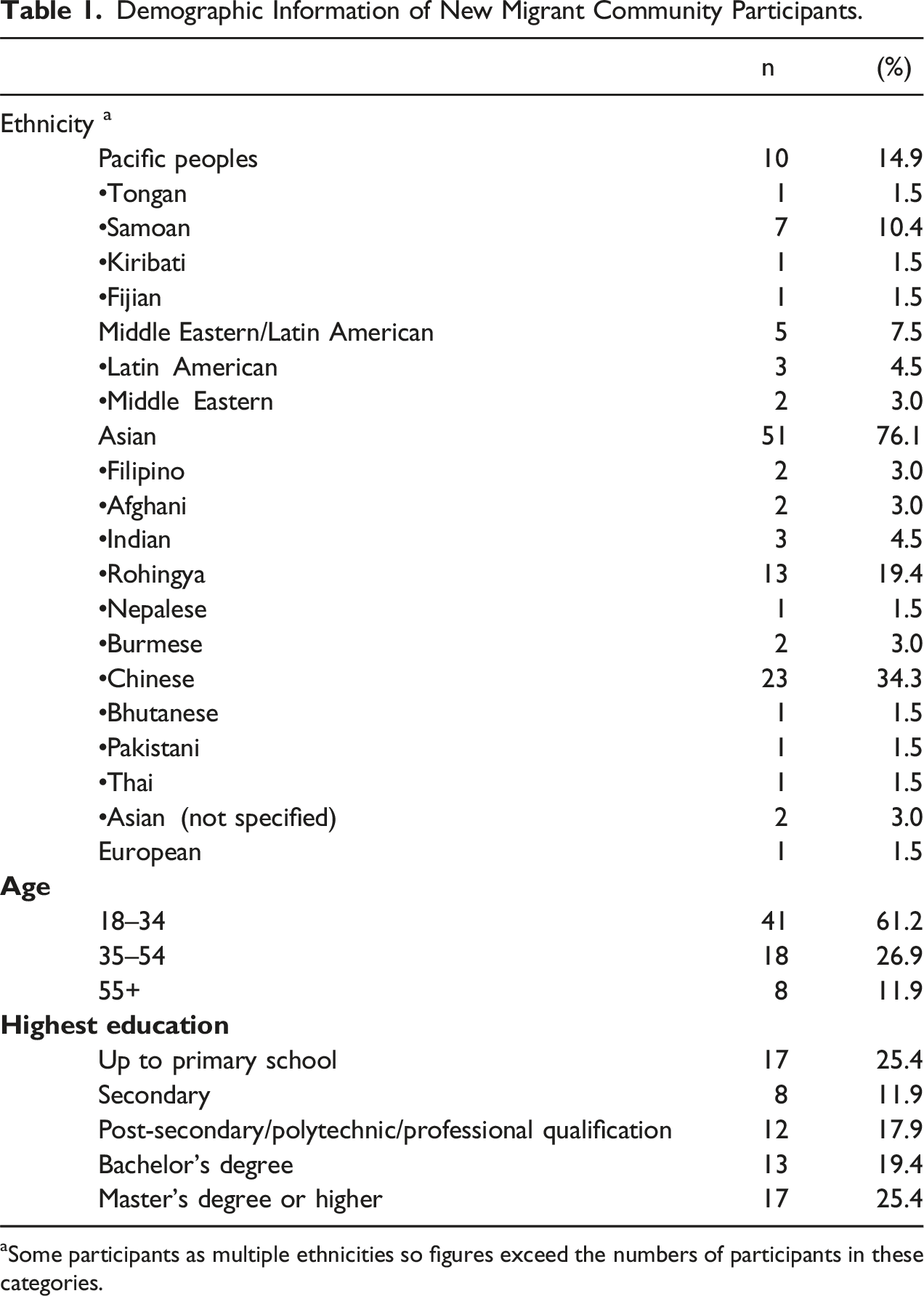
aSome participants as multiple ethnicities so figures exceed the numbers of participants in these categories.
The 37 service provider participants were initially identified by contacting relevant organizations and personal networks and then through snowball sampling. We can only provide limited demographic information about the service providers to maintain their anonymity in this relatively small field, but most were female, aged between 26-55 years old, of non-white ethnicity, and held a bachelor’s or master’s degree as their highest qualification. They worked in a mixture of social worker, navigator, and/or managerial roles located on the North Island of Aotearoa. Migrant community members were asked open-ended questions about potential strategies to prevent violence within their communities, while the service providers were asked about potential strategies for the four risk-risk groups. All participants were required to be at least 18 years old and give informed consent (translators were utilized when necessary). The interviews were undertaken with individual participants, except for two paired interviews (each involving two participants) with service providers, in keeping with their preferences.
From our ongoing consultations and reflections, key aspects of the study procedures assisted in ensuring culturally-safe research practices specific to the new migrant community members. First, we paid attention to cultural and gender matching in the interviewing process, with the interviewer in most cases reflecting the gender and cultural context of the interviewee. Second, we used translators as required. This was both a strength and a limitation of our research—it was the only practical way to include some community members but translating necessitates a form of filtering through the interpretation and rearticulation of meanings. Third, in being mindful of the representation of data, participants were given the option of replaying audio-recordings with the interviewer and reviewing their transcriptions to remove content as required and were invited to form an advisory board to discuss the research findings.
Finally, we were conscious of the trauma that can be evoked from discussing issues pertaining to violence and undertook strategies to create safe environments and protect those who contributed to the project. First, the interviews were undertaken in spaces of the participants’ choosing where anonymity could be maintained. This choice was crucial in fostering a sense of safety and comfort for individuals sharing their experiences where their identities could be protected. Second, our interview protocol focused on prevention strategies rather than personal experiences of violence. This deliberate approach aimed to minimize the likelihood of triggering distress while still enabling participants to contribute valuable insights. In cases where a participant did disclose personal experiences of violence, our interviewers prioritized active listening and, when necessary, facilitated referrals to appropriate support services. Third, the study’s information sheets provided contact information for support services. This was a proactive measure to provide participants with easily accessible resources for additional assistance or guidance if they felt emotionally affected by their participation in the research. We acknowledge that some of these services have limitations; nevertheless, they represented the sole available options for referring participants. Altogether, these three strategies were crucial in ensuring that participants felt supported and respected throughout their involvement in our study.
The interviews were transcribed and anonymized, including removing the names of organizations. The interview findings were coded using co-constructivist grounded theory (Charmaz, 2005), an iterative process in which line-by-line open coding identified initial concepts, axial coding formed relationships between concepts, and finally, selective coding provided theoretical integration. Altogether our research was a significant undertaking involving 723 cumulative hours in the field, transcribing, and analyzing, and our large research team included culture-centered researchers (academics trained in the CCA, with four of us migrants with origins in postcolonial contexts of the Global South) as well as community researchers from diverse communities at intersectional margins (including 7 researchers who identified as migrants, 5 among whom identified as refugees) who were trained in the key tenets of the CCA. With the heterogeneity of the participants and the significant dataset generated, our themes focus on overarching differences and areas of alignment between the themes anchored in diverse registers, while simultaneously considering the interrelationship of cultural and structural frameworks. Differentiations between participants tended to align with ethno-cultures, and we decided not to include the participants’ locations in the themes as this could risk revealing identities. Our analysis identified four themes: Erasure and Silence, Violent Structures, Cultural Disconnections in Violence Prevention Services, and Leveraging Agency.
Findings
For service providers and most community members, violence denoted an umbrella term to describe hurtful or controlling behaviors—ranging from physical, verbal, emotional, to financial abuse—though narratives tended to converge on physical violence. Some participants noted that their evolving view of violence was shaped by their migration experiences. Community identification linked closely to ethnicity or nationality, spanning numerous contexts and backgrounds, but many participants also identified by religion and other social groupings. Amidst the heterogeneity of communities—reflecting diverse cultures, histories, gender expectations, and linguistic competencies—a dominant thread emerged: communication inequality. The inequality in the distribution of resources for voice and participation inhibited individual and collective agency, fostering an environment that magnifies violence. This thread contrasted with some of the provider narratives that framed culture as static, tied to ethnicity, and seen as a barrier to violence prevention.
Communication inequality was reflected in the absence of voice infrastructures within communities, erasing community voices, and in doing so, reproducing violence, as we highlight in the first theme. This is set against structural contexts of violence demonstrated in the second theme, particularly through economic hardship and the immigration structure. Our third theme reveals how the violence prevention sector is part of a broader structure of communication inequality by failing to align with the cultural norms and needs of community members. The final theme speaks to optimism for change articulated by many participants in harnessing the reservoir of expertise within communities and leveraging community agency in co-creating infrastructures for transformation. Our presentation of each of the four overarching themes opens with a participant story that demonstrates its core components, illustrating how addressing the intersections of communication and structural inequality lies at the center of preventing sexual violence and family violence experienced by new migrant communities.
Erasure and Silence
Nina’s Story
Nina, a widow in her sixties, moved from India to live with her son and his family in Aotearoa. She has since been subjected to abuse: being coerced into doing extensive housework, yelled at for leaving her room when there are visitors, often going to bed hungry, and denied access to healthcare. Nina does not know whom to turn to for help – she has no other support networks in Aotearoa and does not know English. Her daughter-in-law has threatened to send Nina to a nursing home where she will not see her grandchildren if she does not listen to her instructions.
Nina’s story provides a snapshot of the ways in which migration contributes to marginalization in the “margins of the margins”. Her social isolation, narrated as “being invisible,” is tied to unequal power structures that restrict her access to information. Although cultural norms of respecting and caring for aging parents constitute the social fabric across diverse Indian contexts, migration processes rework power dynamics, dislocated from cultural spaces of support and cultural-based networks that offer connection. The power inequality that results from dependent visas in migration shapes alienation and isolation. Nina’s limited knowledge about violence prevention, support services, or related laws, rights, and entitlements reveal the consequences of this power inequality within the migration process.
Community Erasure and Social Isolation
The depiction of physical and social invisibility in Nina’s story accentuates the intensified plight experienced by migrant communities at the margins. Her social invisibility exacerbates her suffering, reflecting the workings of migration as a structure of dispossession, experienced as cultural loss. The feeling of “not knowing whom to turn to” echoed across multiple migrant accounts, uttered through phrases like “most of the women do not know” (Fijian woman), “when any crisis happens, then we do not know where to go” (Nepalese woman), and “most of them are not aware of their rights … what their husbands shouldn’t do” (Afghan woman). Many service providers also recognized social isolation as a significant challenge for new migrants experiencing violence, whereby “it becomes [a] really challenging situation for them because… sometimes, like, they don’t have any family support” (Provider – Chinese woman). The absence of family support intertwines with broader disconnection from supportive cultural resources and contexts.
The Erasure of Violence
Reflecting Nina’s story, participants pointed to the unequal distribution of power within families and communities that could work to normalize and erase violence and abuse, drawing on communicative inequalities within family and community spaces. Participants, particularly migrant women, pointed to the gendered structures that shape power and control within familial and community spaces, reproducing the erasure of women’s voices. Participants stated, “I come from a country where domestic violence is not talked about, but everybody witnesses domestic violence” (Indian woman) and “I come from a Muslim community, and mostly they believe that their husbands when they ask them, they should say ‘yes,’ even [when] they don’t want to” (Iranian woman). These statements depict the ways in which structures, drawing upon hegemonic narratives of traditional culture, reproduce violence and perpetuate silences around violence. This structural framing of traditional culture in perpetuating silence emerged across participant narratives, exhibited in the statements such as “these things are not talked about freely, about sexual harassment or family violence … They just hide it inside” (Nepali woman), “Other cultures, they can explain whatever happened in front of everyone, but in our culture … we have that, that limits of who to share to” (Samoan woman), and “they don’t speak up if they are [being abused]. Try and hide it” (Fiji-Indian woman). Another participant stated: I know women who have been here for fifteen years… [An] Iranian woman… I ask repeatedly, ask her to go to a counselor… She said, “I cannot talk in English for mental [health],” and some of it is because of her sex life. (Iranian woman)
As well as highlighting cultural and structural barriers to accessing services (discussed further in the third theme), the above quotation suggests that there can be cultural norms that inhibit discussing sex and sexuality, particularly with community outsiders. The silences, in turn, shape the experiences of migrant women in accessing violence prevention services.
Violent Structures
Santi’s Story
Santi, a Nepalese woman in her thirties, moved to Aotearoa with her two children through a visa tied to her husband. She experiences emotional and physical abuse from her husband, whom she relies on for transportation and finances. Her husband only allows her to speak to her family overseas when he is around, accompanies her on medical appointments, and threatens that the children will be taken away from her if she tells anyone about the abuse. Santi fears that she will be deported if she voices her issues to formal services.
Santi’s story depicts multiple layers of structures that constitute migrant experiences in the “margins of the margins,” depicting the interplays of communication at different scopes and scales (see Na’puti & Cruz, 2022). Consistent with other participants’ narratives, the abuse Santi described plays out within structural power inequities between genders, situated within a broader environment of economic hardship: living in a low-income household, having limited education, and not being employed. The immigration structure exacerbates these challenges – constructed by some participants as a site of violence. The structures of migration that determine the sponsorship of migrant women by their partners (re)produce power imbalances, creating fears and anxieties around deportation.
Economic Hardship
Both service providers and community members narrated how economic hardship and immigration policies are structural contributors to violence. Economic hardship, interwoven with the social environment, was strongly emphasized as a contributor to violence identified by service providers. They explained: “Violence comes out when there’s no money … Money speaks a lot of languages, and I see a lot of that where hardship happens, and they take it out on each other” (Provider – Māori woman) and “you’ve got generations of families living in one house living off only the income of the people that are actually supposed to be there … It creates a whole lot of issues” (Provider – Pacific woman). Community members similarly pointed to socio-structural contexts leading to inequities and violence: “Most of the women do not have jobs. They only stay home and look after the children … Sometimes the rent is very high, and so, the problem starts with money” (Fijian woman).
The Immigration Structure
Related to economic hardship were immigration policies and the associated inaccessibility to financial benefits and services. As illustrated in Santi’s story, the interaction between immigration policies and associated challenges, such as not having financial independence, poor social support structures, and associated inequitable power dynamics, could manifest in harrowing experiences. Consider the following excerpt from a survivor of intimate partner violence: I couldn’t go to the Women’s Refuge safe house because I wasn’t a resident. I had to wait for a month, over a month. When I rented a house, my ex-partner turned up. So, I went to another place … Then [another] house… I was pretty much on the run for two months (Brazilian woman).
This excerpt depicts how immigration policies can make community members unsafe and increase the risk of violence taking place through the inaccessibility to prevention services. Service providers correspondingly relayed difficulties and frustrations in working within the funding and immigration structure in endeavoring to serve migrant women, stating: “It’s sad, the lack of support that we have here for our migrant communities … They can't access things” (Provider – Pacific woman), “It's just more difficult … for Work and Income
3
… They won't support anything … so they [migrant community members] cannot go into emergency housing” (Provider – Chinese woman), and: They’ve had partners, umm, who have brought them from countries like Thailand, and then suddenly she’s like, “I'm so scared … but I don’t know where to go … I’m not allowed to drive, umm, and if I need money, he’s the person cause … I'm not a citizen, and he’s the sponsor.” … We have had to educate ourselves to support these women because we couldn't take them into our safe house purely because any woman that comes in pays. (Provider – Chinese-Pacific woman).
Although victims of family violence can apply for a resident visa in Aotearoa (New Zealand Immigration, 2023), this was not acknowledged by community members or service providers. Rather, the immigration structure contributed to the erasure of community members experiencing violence by installing the fear that in disclosing concerns or experiences of violence, their residency could be revoked. Participants explained: “After coming here, some violence may arise in the family … Women are dependent on their partners as they are the principal applicants. They worry as they might be sent back home” (Indian woman), and “They’re just very worried that if they go to the Police, they won't get residence, they won't get the visa, and that becomes a core problem” (Provider – Chinese woman).
Cultural Disconnection in Violence Prevention Services
Abul’s Story
Abul and his family arrived in a refugee resettlement center in Aotearoa, after years of being displaced across multiple countries. They are Rohingya, an ethnic group who have faced decades of discrimination and statelessness (Mahmood et al., 2017). Within this center, Abul was witnessed physically assaulting a family member, which led to his wife being questioned by Police and health officers. Abul feels that his wife should not have been questioned without him and that violence prevention policies in Aotearoa work to separate family members. He knows at least three other people who have had the same experience in his community.
Abul’s story illustrates the fundamental gap between the knowledge, experiences, and meanings around violence prevention solutions held in migrant communities at the margins and the hegemonic solutions advocated by dominant agencies in the settler colonial state. Abul was unfamiliar with the laws around family violence and from his experience, “in [the] case of family violence, police will try to separate husband-wife, rather to reunite them … New Zealand rules try to break up the families.” Note here, the fundamental disconnection between the Crown’s and Abul’s constructions of violence prevention.
Unfamiliar Structures
Many participants, like Abul, expressed an unfamiliarity with legal and judicial frameworks that undermine access to violence prevention resources. A survivor of intimate partner violence recounted her experience: “In the court, I did not understand anything that the judge said. The vocabulary was so different from what I had learned or heard. My social worker pretty much explained everything to me when we left the room” (Brazilian woman). As well as highlighting crucial language barriers, this woman’s experience reflects an unfamiliarity with the delivery of violence prevention services in Aotearoa. Providers acknowledged how more education on engaging effectively with migrant communities is needed, emphasizing how they work within a range of structural constraints, including limited resourcing and staffing.
Separating Families
Abul’s concern around separating families through violence prevention efforts reflects an individualistic approach exhibited by the criminal justice system and many organizations in Aotearoa; a reflection of the whiteness of settler colonialism that exists in continuity with the violence of the Crown. The separation of family members through violence prevention efforts was a crucial issue highlighted by some providers, particularly among Māori families, whereby “once it goes to court, [a] protection order is put in place [and] the family is separated. We’ve got a big problem with that” (Provider – Māori woman). One service provider shared an instance in which a family insisted on resolving issues within their cultural norms but perceived the approach inadequate: “The family has told her, ‘Sort it out. You don’t need any other services to help. This is how things are done in our culture’” (Provider – Chinese-Pacific woman). However, another service provider noted that violence prevention should “make sure that the family environment and unit is one” (Provider – Tongan woman). This difference in approaches adopted by service providers is reflective of the registers that have been built in Aotearoa in addressing violence prevention by Māori and Pacific organizations, centering the family and community as spaces for creating solutions in contrast to the overarching whiteness of the hegemonic approach to violence prevention that is reflected in the whiteness of organizations serving migrants.
Whiteness and Cultural Disconnection
Community members relayed differences in the hegemonic violence prevention approach in Aotearoa compared to approaches to prevention in their homelands, with one participant stating, “It [violence] is not a very big issue back in India, because it was settled by the people of India in their own way as compared to New Zealand, as I believe” (Indian woman). The community anxieties about seeking out services that are perceived as white were mirrored in the cultural essentialism that is reproduced by service providers. Note for instance the following explanation offered by a service provider: “Because of their ethnicity, because of their religion, their upbringing … they can feel particular shame and guilt … that can … stop them from accessing ours or any service” (Provider – NZ European woman). This portrayal perpetuates an “us versus them” narrative. Inherent in such portrayals is the lack of a nuanced analysis of power dynamics that fails to acknowledge opportunities for structural transformation within cultures, instead pathologizing culture. The cultural essentialism reflected by service providers perpetuates the mistrust and lack of engagement among migrant communities with the structures of service provision and prevention, exacerbating and magnifying the erasures and experiences of violence.
Leveraging Agency
Inaya’s Story
These topics are not generally disclosed. If there is any family or sexual violence, then they do not disclose it … and on the top of that there is lack of trust… Unless and until an ethnic person [is] coming through the door, explaining [to] them the process… and giving them the authority of their own story, their story does not come out of a positive outcome. So, give them the authority and tell them it is not controlled by Visa status or Police, it is not controlled by anyone else. When they can control your own story, then they respond to that. They don’t respond to the police or a white person walking through the door. (Inaya – Indian woman)
Inaya is employed at an organization dedicated to supporting ethnic communities in the prevention of family violence and sexual violence. She navigates between sector and community challenges in her role—from the silence and erasures to the changing migrant family dynamics in the new environment, language barriers, financial hardship, distrust of Police, and inaccessibility of services, among many other interweaving factors. As well as providing culturally appropriate resources and support, her organization strives to be a source of strength and empowerment for community members. Inaya described recent community-led initiatives, including workshops within ethnic communities and the production of videos in different languages where women discuss sexual violence. These resources have been successful in helping local ethnic communities and mainstream agencies, but the extent of the outreach has been constrained by her organization’s capacity and funding. Inaya positions the community as a source of social change, emphasizing the importance of community representations within violence prevention organizations and dialogues with communities.
Recommendation: Cultural Representation
Consistent with the community-led programs described by Inaya, a strong reoccurrence in the community members’ narratives was the vital role of the community in preventing family violence and sexual violence. It was clear that participants perceived community as a stronger resource than Crown agencies and non-governmental organizations reproducing the whiteness of the Crown, relying on their community networks as resources that supported them in navigating unfamiliar structures and the racism of the settler colonial space in Aotearoa. For some migrant participants, positioning community members in local implementation networks could leverage this expertise in addressing the significant discrepancy between diverse families, cultural contexts of community life, and the structure that constitutes family violence and sexual violence prevention. Participants noted: “If we have Indian people in a high position, then that would be more comfortable … They can speak their own language to share their problems, and then they would be more comfortable to express their feelings” (Indian woman), “representation from our community in any New Zealand Organization would be helpful” (Rohingya man), and “we have a preventative woman as a representative … of other women. That would be very helpful” (Iranian woman). Participants pointed to the expertise within the community that would strengthen prevention strategies: There are lot of qualified migrants …They can help … even if they cannot talk, they can have an interpreter, so in front of the man explaining to the husband/partner, explaining “this is your women’s rights … here this is a crime.” … I think it will be very encouraging for women if they do that … It gives more power to women. (Iranian woman)
Note here the erasure of migrant expertise shaping the organizing of violence prevention strategies and service delivery. Against this backdrop, the presence of migrants as translators and interlocutors could help to create the communicative infrastructures for the addressing violence prevention. Providers acknowledged that having practitioners from the same ethnic background could be beneficial and explained that they “try our level best to make it more cultural centric, as practically as possible” (Provider – Indian woman).
Recommendation: Involve Community Leaders in Violence Prevention Efforts
For Abul and other participants from the Rohingya 4 community, resolving conflicts typically involved consulting elders first and seeking resolution within the community rather than engaging formal service providers. The community members portrayed the need for cultural centered interventions within communities to address violence. They stated, “Culture has a great role to prevent the violence” (Afghan woman), and “It’s better to be a local community, because she can completely understand, you know women have challenges here, and … Iranian culture as well as the relationship between men and women” (Iranian woman). Community members identified community and religious leaders as being in key positions to help in the prevention of violence. Religious leaders often have close and trusting relationships, access to families’ homes, and can support communities at the margins. As a community member stated, “sometimes we take counseling from the preachers in our church. Take the husband, and we talk …We respect, like, follow what he’s telling you” (Tongan woman). Note here the contextually situated understanding and trust held by the preachers that constitute the texture of the conversation in addressing a conflict. This approach emphasizes including both partners in a dialogue, foregrounding the familial context in addressing conflicts.
Recommendation: Community Dialogue
Participants discussed building spaces for dialogues within their communities as anchors for prevention that disrupt silences around family violence and sexual violence, such as a “workshop in [a] mosque or Islamic center … there can be awareness emergency measures of any kind of violence. Because mosque is the place that everybody goes” (Pakistani woman). The mosque as a community space for conversations disrupts both the racist settler colonial norms that essentialize culture and community norms that reproduce silences. Another community member stated, “If they can go out and speak and share, that would help … What can be done to handle those kinds of violence. Getting those kinds of advice would really help” (Indian woman). Service providers echoed the role of conversations for greater awareness of violence prevention within communities. These discussions were seen as crucial for both increasing awareness about violence prevention and understanding the needs of local communities. Service providers stated, “a good Hui [collective meeting] I think would definitely be really good” (Provider – Māori Woman), and “more conversations with communities are required. The communities should start to talk about their needs. The communities should inform the services they require” (Provider Māori). These conversations could serve as a foundation for developing local resources that are community-led, designed, and owned by migrants from diverse cultural backgrounds. Notably, the emphasis on culture-centered, community-led, cultural strengths-based violence prevention solutions largely emerged from Māori service providers, highlighting the significant role of Kaupapa Māori organizing in resisting the whiteness of settler colonial approaches to violence prevention, offering insights into understanding family and sexual violence through the lens of colonialism, and in fostering tino rangatiratanga (sovereignty) expressed and enacted by communities in creating solutions for preventing family violence and sexual violence.
Discussion
Grounded in Dutta’s (2008) culture-centered approach, our research explored the ways in which organizations can support the prevention of family violence and sexual violence among new migrant communities in Aotearoa, drawing from interviews with 67 new migrants situated at the “margins of the margins” and 31 service providers in Aotearoa. The new migrant community members were highly heterogeneous, reflecting diverse cultural contexts, histories, and linguistic competencies, but their narratives converged in articulating the ways in which communication inequalities reduce agency and increase disenfranchisement. These communication inequalities are shaped by the whiteness of the settler colonial structure that undermines cultural knowledge held by communities, instead constructing culture as a static, monolithic tradition. The whiteness of hegemonic violence prevention, working alongside the existing racism of Crown services, further perpetuates mistrust, erasing the accounts of family violence and sexual violence in ethnic migrant communities.
These erasures are set against multilayered structural contexts of violence. Communication inequality, the inequality in the distribution of information and voice resources, is constituted by interweaving drivers, including language barriers, immigration policies, power inequities, and racism that underlies the organizing of services. The findings echo previous research that determined how language barriers can restrict participation among migrant community members (Tse, 2007) and how structural barriers restrict the uptake of violence-related support services among migrant communities (Ministry of Business, Innovation, & Employment, 2019; Simon-Kumar, 2017). The racism in the organizing of services is reflected in the portrayal of traditional culture as a barrier to preventing sexual violence and family violence and the individualized service delivery models. Even as providers discuss racism that shapes the erasure of experiences of sexual violence and family violence negotiated by migrant communities, they draw on culturally essentialist discourse.
We note here the gap between the cultural pathologization perpetuated by organizations reproducing the dominant ideology of whiteness and the culture-centered approach drawing on cultural strengths foregrounded by Māori, Pasifika, and ethnic migrant organizations (such as E Tū Whānau, Pasefika Proud, and Shama Ethnic Women’s Centre) working in the realm of family violence and sexual violence prevention. In spite of the powerful work carried out by Māori communities, activists, and advocates in de-centering the whiteness of the settler colonial structure that is designed to address family violence and sexual violence, the knowledge on culturally centering solutions that has emerged from this work has been largely enclosed and delimited to a specific context (addressing Māori communities), rather than being percolated through the Crown structures (Pihama et al., 2019). At the same time, the decolonizing register that emerges from Kaupapa Māori knowledge in culturally-centering interventions ought to be placed at the core of dismantling the overarching whiteness of the Crown.
This study documents the ways in which the settler colonial structure works alongside patriarchal structures to shape migrant women’s subordination. The voices of migrant women point out that intersecting layers of patriarchy reproduce the erasures of their voices and agentic capacities. The intersections of culture and structure produce silences, undermining the agency of migrant women and furthering their erasure and marginalization. Here it is vital to note the Crown’s salient role in perpetuating gender inequalities through immigration policies that create dependence on the sponsoring partners and restrict access to violence prevention services, such as safe houses. Such an acknowledgment resists essentialist models that frame the cultures of migrant communities as being fixed or backward (see Abu-Lughod, 2008), recognizing that culture is fluid and reconstructed against new cultural and structural landscapes through the participation of community members (Dutta, 2007, 2018). The immigration structure works to erase violence within new migrant communities, becoming a “systemic blind spot,” simultaneously obfuscating the Crown’s role as a mediator in the perpetuation of gender inequalities that cause harm. Migrant women at intersectional identities at the margins face enhanced risks of gender-based violence across diverse contexts (Amanor-Boadu et al., 2012). Gendered structures work alongside colonialism in reproducing the silencing of women and the erasure of their agency. Significantly, while participants attributed cultural norms to contributing to the silence around family violence and sexual violence and the barriers in accessing related services, community members expressed a desire for violence to be discussed within their communities as a strategy for its prevention.
The findings address the cognitive gaps between the conceptual frameworks imposed on the top-down design and delivery of family violence and sexual violence solutions and the everyday negotiations of family violence and sexual violence at the raced, classed, gendered margins of migration. Consider, for example, the disconnection between a family or community-based approach to preventing violence, which the community members were accustomed to, and the largely individualistic approach, which can separate family members exhibited by the criminal justice system and the dominant violence-related organizations in Aotearoa (as also documented by Zheng & Gray, 2015). Such a misalignment foregrounds the important role of representation, supporting the increasing arguments raised within the organizational communication discipline to have a stronger focus on marginalized voices (e.g., Broadfoot & Munshi, 2007; Cruz & Sodeke, 2020; Ganesh et al., 2005) and for the development of communicative strategies to be grounded within communities (Dutta, 2007, 2008). The individualized organizing of family violence and sexual violence prevention inherently invalidates many migrant women’s identities and priorities that are focused on the family, contributing to erasing their knowledge by the settler colonial state. As scholars have argued with other migrant contexts, the separation of family members, in itself, constitutes a form of gendered reproductive violence (Hernández, 2019; Lozano, 2019). Dismantling the whiteness of the Crown’s violence prevention strategy must begin by disrupting the assumptions circulated in this individualized approach.
Against this backdrop, engaging with new migrant communities and addressing violence should begin with creating communicative infrastructures for dialogue and voice at the margins. This process of creating voice infrastructures at the “margins of the margins” of migrant communities must work alongside advocacy to address the structural contexts of violence. In this realm, listening and collaboration, leveraging community and cultural safety emerged as mechanisms for organizations to connect with community members in ways that support them to enact agency in negotiating structures. The findings depict how community voices attended to the erasure of their articulations of family violence and sexual violence and narrate the ways in which these erasures are intertwined with the reproduction of violence in their lives. From a lack of access to readily translated information to the absence of communicative infrastructures to turn to when experiencing family violence and sexual violence, new migrant narratives foreground the overarching experience with communicative gaps. These gaps are exacerbated by silencing practices and erasures within community spaces. Worth noting here is the invisibility of support infrastructures, marked by absence in the narratives voiced by participants that suggest they do not know where to turn to, while the inadequate resources targeting these communities simultaneously perpetuate their erasure and marginalization. The physical and social invisibility experienced by ethnic new migrants at the “margins of the margins” perpetuates the experiences of violence, exacerbating the suffering of migrant communities at the margins.
Returning to Cheney’s (1995) question: “What would organizations be like if we really created and maintained them for the persons?” (p. 196), our study has valuable insights for organizations wishing to engage with ethnic minorities or new migrant communities. Although participants articulated that service providers should receive culture-centered pedagogy in delivering services to new migrant communities, this was situated against recommendations emphasizing how broader infrastructures are needed to facilitate dialogue, community engagement, and local co-governance for services to be effective. The articulations of listening and collaboration turn to community ownership of solutions, attending to the lived experiences and knowledge brought by members of diverse migrant communities in driving the co-creation of solutions. For violence prevention organizations working with migrant populations, dialogues around family violence and sexual violence within the communities are needed to understand contextually situated meanings. In this sense, conversations within and between communities and organizations to create policy and prevention frameworks relevant to communities’ lived experiences are critical, with the sovereignty over these conversations held by communities (see Dutta & Thaker, 2019). These conversations are integral to building and sharing information resources with communities in culturally meaningful ways, creating points of access to relevant services.
Footnotes
Declaration of Conflicting Interests
The author(s) declared no potential conflicts of interest with respect to the research, authorship, and/or publication of this article.
Funding
The author(s) disclosed receipt of the following financial support for the research, authorship, and/or publication of this article: This research was funded by Te Puna Aonui.
