




Abstract
This study investigates what we call proxy organizations (e.g., shell companies, front organizations, astroturfing efforts). Drawing on existing literature to better conceptualize proxy organizations and their communicative nature, we position these proxy organizations within scholarship on visibility management and hidden organizing. To answer research questions about public discourse around these proxies and their use of concealment strategies, we analyze news coverage of these organizations from 2001, 2011, and 2021. Findings suggest sizable increases in discourse about each proxy type. Additionally, analysis reveals several concealment themes in that media coverage: dark/secret money/finances, hidden owners, shadowy influence, anonymous proxies, covert links, online concealment, secret/illegal activities, and revelation safety/fear. We then draw conclusions, discuss implications, and suggest directions for future organizational communication research about proxy organizations.
“A front company and a fake identity: How the U.S. came to use spyware it was trying to kill” – New York Times, April 2, 2023 “Mormon church fined by the SEC for using 13 shell companies to hide a $32 billion investment portfolio” – Fortune, February 21, 2023 “Google tries to ‘astroturf’ the Supreme Court” – Politico, February 17, 2023
Recent headlines such as these point to organized efforts by corporate and other political actors that involve the creation of new organizations to conceal the entities hidden behind them. We see shell companies, front groups, and astroturfing efforts as examples of proxy organizations because they act as collectives that are substituting and speaking for other organizations hidden behind them. Proxy organizations could also include advocacy groups, think tanks, political action committees, and others. Although proxy in an organizational context is more commonly used to describe shareholder voting options and network servers, a proxy can also be an organization substituting for and acting on behalf of another entity not visible to most.
Thanks in large part to this communicative concealment, proxy organizations directly and indirectly influence the broader society. Shell companies can be used to hide taxable income from governments dependent on such monies (see Sharman, 2012). Front groups can allow foreign entities to interfere with another country’s democratic processes (see Fitzpatrick & Palenchar, 2006). Astroturfing organizations (which are created to look like grass-roots organizing, but are actually artificial entities funded by corporate or other political interests) have played a significant role in creating public uncertainty about issues such as global warming (see Dunlap & McCright, 2011). Though not all proxy organizations are equally influential or successful in their efforts—and not all are engaged in wrongdoing—there is little doubt that such organizations play a consequential role in shaping society as they speak for those they also conceal. Further, they are potentially numerous. In the big technology sector alone, the nonprofit watchdog Campaign for Accountability (n.d.) lists 944 mostly proxy organizations discreetly funded by tech giants.
Indeed, proxy organizations raise vital questions about pertinent communication topics such as information disclosure, transparency, image management, identity concealment, privacy, secrecy, source credibility, and potentially deceptive or manipulative messages linked to disinformation campaigns. The close historical ties of certain proxy organizations to public relations and propaganda efforts—including modern day propaganda (see Woolley, 2023)—further link them to organizational communication broadly. As we will describe, the growing media attention about proxy organizations also points to the important role of public discourse when talking about these entities. Thus, a discussion of proxy organizations in the form of shell companies, front groups, and astroturfing movements is fundamentally relevant to organizing and communicating. Despite these conceptual connections, however, very little organizational communication scholarship has examined proxy organizations and their concealment.
Our goals in this paper are two-fold. First, we use existing literature to better understand proxy organizations and their communicative nature. Although much of the scholarship about them has come from other disciplines, we see communication as essential to how these proxies operate. Second, we position these proxy organizations within scholarship on visibility management (see Flyverbom et al., 2016) and hidden organizing—where the organization and/or its members communicatively conceal their identity (Scott, 2013). We further those goals and contribute to those two areas of theorizing by analyzing news coverage to illustrate the growing role proxies play in public discourse and to examine the communicative concealment strategies of these consequential organizations. We then draw conclusions, discuss implications, and suggest directions for future organizational communication research about proxies.
Background Literature on Proxy Organizations
A proxy is commonly thought of as any agent who is authorized to act as the substitute for another and who can speak or act on that other’s behalf. Taking a much broader view, Mulvin (2021) describes proxies as intermediates or stand-ins that exist for the powerful to control various contexts. As he describes them, “proxies are real things, real places, real people; but they are also always memories of a world gone by and forecasts of a world to come” (p. 201). As examples of these proxies, he describes women who pose as test images, actors who embody disability and disease for medical students, a simulated town in Arizona that stands in for various towns across the world for military training, and the proxy nature of representative democracies.
Of relevance to the current work, Mulvin (2021) notes that “stories about proxies are full of acts of concealment, erasure, and disavowal” (p. 183). These surrogates can simulate reality in ways that make others believe they are real and proxies may even be hidden in plain sight. He further argues that even though proxies appear durable, they are ultimately porous, flexible, and even breakable. Though proxies are often an object or a person, they can also be organizations. Indeed, Mulvin’s (2021) work suggests that various powerful organizations may create proxies as needed and that these proxies are tied to broader visibility management practices (Flyverbom et al., 2016). Thus, proxy organizations are stand-ins, typically created by other organizations, and often for purposes of concealment. Based on that, we begin by describing three key types of proxy organizations and some of the relevant, if limited, research about each. More specifically, we highlight some of the communicative aspects of these proxies.
Shell Companies
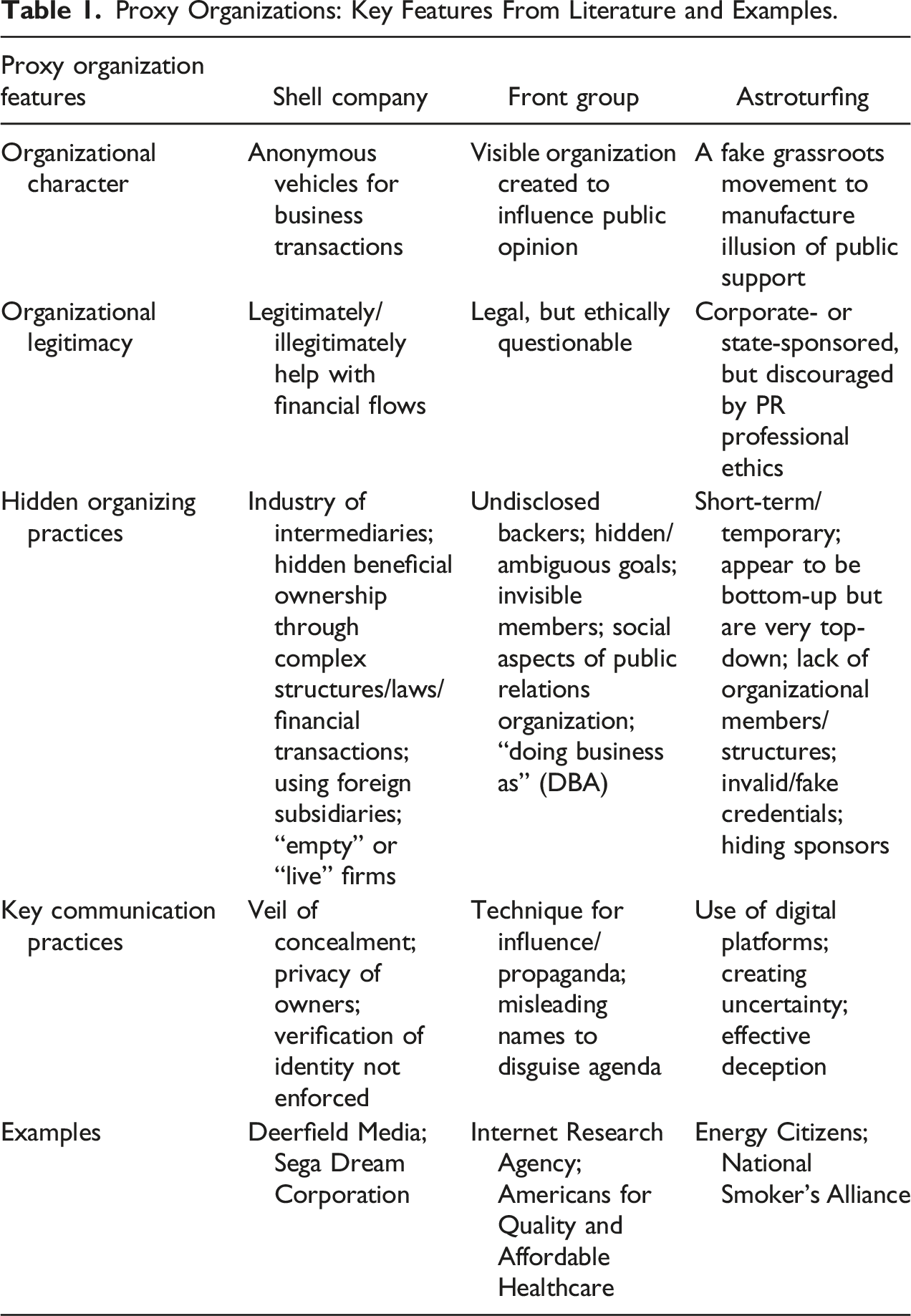
Shell companies are legal entities that act as anonymous vehicles for business transactions and have both legitimate (e.g., pooling investment, reverse merger) and illegitimate (e.g., money laundering, corruption, tax evasion) goals (Tiwari et al., 2020). Shell companies used for legitimate purposes help with investment flows from the developed to the developing world and with mergers and other complicated business transactions (Jancsics, 2017). However, these proxies may also hide the ownership of an organization to make corrupt financial activities untraceable. One anti-corruption resource center suggests that untraceable shell companies are often key players in facilitating corruption because they act as a “corporate veil” concealing corrupt organizations and as the “beneficial owners” who control those entities (Sharman, 2012). The 2016 leak of the Panama Papers highlighted the role of shell companies (in this case, based in Panama) in helping mostly government elites hide assets and avoid taxes. Investigations into the use of shell companies in high-end real estate have also drawn substantial attention to these organizations in the United States (Story & Saul, 2015).
There exists an entire industry of intermediaries, collectively known as corporate service providers, that specialize in establishing and selling shell companies. Though there are standards for collecting proof of identity from customers setting up such shells, there is little compliance or enforcement of such rules (Economist, 2016). Further, tracing illicit funds to a shell’s bank account is of little value when you do not know who controls that account and the amount of information collected about owners of these shells varies substantially across different jurisdictions—sometimes because ownership information can get lost along chains of intermediaries and in other cases due to active efforts to conceal (Economist, 2016).
Academic literature on shell companies is almost nonexistent—in part because their participants keep activities secret. In response, Jancsics (2017) analyzed newspaper articles (given the ability of investigative journalists to better uncover what is hidden here) about domestic shell companies used for corruption in Hungary. As he notes, these shells “typically have a multiplayer structure, involving three or more corrupt actors, both visible and secret owners, and other outsiders, who cooperate within an organizational context” (p. 5). The shell companies involved may be either “empty” (firms with no real operations) or “live” (functioning entities controlled by shadow owners), the latter of which may be similar to a front.
The most revealing study in this area is from Findley et al. (2015), who e-mailed nearly 4000 formation agents in 82 countries, posing as consultants looking to set up untraceable firms. No service providers in the Cayman Islands took the bait, but dozens in the United States did. Overall, 48% of the agents who replied failed to ask for proper identification. Only 10 out of 1722 U.S. providers required notarized documents in line with international standards and 1 in every 17 providers was willing to set up an anonymous shell for a terrorist financier.
Front Organizations
The term “front organization” is thought by some to have been most widely introduced in the United States by Senator Joe McCarthy in his attacks against communist front organizations; indeed, there were several legislative efforts designed to expose such organizations (see Chafee, 1950). Fitzpatrick and Palenchar (2006) suggest the modern history of front groups began with public relations pioneer Edward Bernays, who reportedly developed the third-party technique that evolved into front groups earlier in the 20th century: “Front groups are controversial public relations techniques used by organizations to influence public opinion and public policy on behalf of undisclosed special interests” (p. 203). More innocuous fronts may also include organizations “operating as” or “doing business as” (Scott, 2013).
Coombs and Holladay (2012) note that “the U.S. Supreme Court has ruled that the use of front groups is legal, but ethically questionable, due to the lack of transparency surrounding the financial resources available to corporations that enable the creation of these front groups” (p. 352). As the Center for Media and Democracy’s PR Watch warns, front organizations often have misleading names that disguise their real agenda (Landman, 2009). A variety of ethical concerns have been raised about the potentially manipulative nature of these organizations. As Fitzpatrick and Palenchar (2006) note, fronts can cloak an organization or industry’s self-interest in a way that deceives various stakeholders. However, a key issue is whether a government can force the disclosure of identity without violating First Amendment protections (Fitzpatrick & Palenchar, 2006).
Existing research suggests there is little question, however, that fronts have been used in questionable ways. Rudner (2010) describes how Hizbullah has used benevolent-sounding “front” organizations like the Islamic Resistance Support Organization to raise funds—and how it uses two other front organizations, Bayt al-Mal and the Yousser Company, to manage its assets. Fitzpatrick and Palenchar (2006) describe a front group called Citizens for a Free Kuwait formed by the public relations firm Hill and Knowlton to garner U.S. support for Kuwait during the Gulf War. Not surprisingly, the front was not funded by concerned citizens, but by the exiled Kuwait monarchy. Mintz (2000) reported that some of the largest utility companies in the U.S. “secretly funneled millions of dollars” (p. A10) through two front groups (Citizens for State Power and Electric Utility Shareholders Alliance) specifically formed to stop Congress from deregulating their industry. The efforts of these fronts were described as “discreet, guarded and highly confidential” (p. A10). Reitman (2011) claims that Scientology has also used numerous front organizations (e.g., The Way to Happiness Foundation, Narcanon, Applied Scholastics) to promote their cause without having to say “Scientology.” More recently, the Internet Research Agency has been widely identified as a Russian government front (National Intelligence Council, 2021).
Apollonio and Bero (2007) report on a case study of the front organization Get Government Off Our Backs, which was heavily funded by R. J. Reynolds to try to influence government regulation in general and smoking legislation in particular. Other scholars have noted additional front organizations for this industry (Solet, 2001): The Advancement of Sound Science Coalition (a tobacco industry front group controlled by an international public relations and lobbying company), the Center for Indoor Air Research (whose budget came almost exclusively from the four largest U.S. tobacco companies), and Citizens for the Integrity of Science (which may have had only one actual member). These entities may represent what Pietracatella and Brady (2020) call Social Aspects Public Relations Organizations, which they critique as front groups. More specifically, Pietracatella and Brady (2020) examine how risk industries (e.g., tobacco, gambling) use front organizations to mitigate public criticism. These front organizations for risk industries work to promote the ideas of personal responsibility and choice (deflecting attention away from the harmful products and activities themselves).
Even more concerning, the efforts of these front groups can influence legislation and change public opinion. Pfau et al. (2007) found that corporate front-group stealth campaigns succeed in influencing attitudes toward government restrictions on several business-related issues (e.g., federal legislation to control Medicare prescription prices). Indeed, shadowy corporate front organizations such as the Center for Medicine in the Public Interest and Americans for Quality and Affordable Healthcare were backed by the pharmaceutical industry (and unknown others) in an effort to defeat healthcare reform in the United States (Fang, 2009).
Astroturfing
U.S. Senator Lloyd Bentsen is often credited with coining the term “astroturfing” in 1985 to refer to what appears to be a grassroots movement of concerned citizens—but, just as astroturf is a synthetic grass, the movement is also fake in that it is the creation of some corporate or state-sponsored public relations effort. Thus, astroturf organizations actively engage policy makers without revealing the true identities of sponsoring organization and their interests (McNutt & Boland, 2007). Though the term is relatively recent, corporations and governments around the world have used such practices for well over a century to manufacture the illusion of public support or skepticism for various issues (see Greenberg et al., 2011).
In some ways, astroturfing is closely tied to the use of front groups. Coombs and Holladay (2012) explain that “the use of a front group to create the opinion that there is grass roots support for or against pending legislation or industry regulation has been called astroturfing” (p. 352). Thus, astroturf organizations may be a very specific type of front group involving the appearance of grassroots support. Another difference when compared to most fronts is that astroturf groups sporadically appear and disappear corresponding to particular events and policies (Dunlap & McCright, 2011). Most astroturfing efforts seek to increase or instill confusion and uncertainty in the general public about a sensitive issue. Indeed, Cho et al. (2011) found that astroturf organizations are effective in creating uncertainty for people exposed to their message (even when people knew the funding source behind the message).
Similar ethical and societal concerns exist for both front groups and these more specific astroturfing efforts. McNutt and Boland (2007) argue that astroturf organizations do not represent “legitimate political engagement’’ (p. 172) because of their manipulative use of media and other political techniques. They argue that astroturfing depends fundamentally on deception and these organizations are only successful when they are not recognized as fake. However, as these scholars point out, astroturfing done well can be very convincing. Furthermore, corporately-sponsored astroturfing does not have the same financial constraints as many actual grassroots groups, making them even more likely to succeed. Although astroturfing is actively discouraged by public relations professional associations for being unethical (Fitzpatrick & Palenchar, 2006), it can be very effective. As Durkee (2017) argues in her legal analysis, astroturfing that comes across as citizen-led efforts may gain additional credibility.
Some of the most interesting organizational scholarship about grassroots organizations centers on climate science denial efforts. Dunlap and McCright (2011) have identified several astroturf organizations that are part of what they call the climate change denial machine (e.g., Americans for Prosperity, Americans for Balanced Energy Choices, Energy Citizens). These supposed grassroots efforts are heavily funded by the fossil fuels industry as well as conservative think tanks and foundations. Many of these proxy organizations have the same founders, members, boards, and funding sources (Greenberg et al., 2011), and they have been effective in raising questions about climate science among the general public (Funk & Kennedy, 2016).
Astroturfing has been linked to communication, especially by public relations scholars. Sisson (2017) describes astroturfing as “inauthentic grassroots communication” (p. 788) that undermines public trust. Her content analysis of news coverage surrounding online astroturfing found that the tone of news articles about astroturfing, though mostly negative, was sometimes neutral or only slightly negative. Howard (2005) argued that the Internet makes it easier for lobbyists and political movements to give small groups of aggrieved citizens heightened importance in policy debates. Similarly, McNutt and Boland (2007) argued that information and communication technology (ICT) may accelerate the process of creating astroturf organizations.
More recent literature on astroturfing has been focused on the questionable use of social media and other ICTs for political astroturfing (Kovic et al., 2018). Keller et al. (2020) suggest astroturf organizations circulated disinformation via Twitter to shape recent elections in South Korea. Kovic et al. (2018) define digital astroturfing as manufactured, deceptive, and top-down online activity initiated by political actors to mimic bottom-up activity. They also warn that “digital astroturfing is cheaper, has a greater scope, and is potentially much more effective than regular astroturfing” (p. 70). This digital astroturfing regularly involves various organizations.
Proxies, Visibility Management, and Hidden Organizing
Proxy Organizations: Key Features From Literature and Examples.
Proxies and Visibility Management
Visibility management refers to making actions more or less visible by manipulating information available to others (Flyverbom, 2019; Flyverbom et al., 2016). As Albu (2022) explains, this is an umbrella term that involves not only transparency and disclosure, but also opacity, surveillance, and secrecy. As organizations manage their own visibility, they have to consider availability of information, approval to share it, and accessibility to third parties (Stohl et al., 2016). The more of those three characteristics that exist, the more visible the organization; the less of those elements, the more invisible the organization. We see proxies as one way to manage visibility—usually by making the organization behind the proxy less visible. Proxies conceal available information, obscure who has disclosure approval rights, and may work to restrict access by others through uncertainty or even misinformation. Thus, the proxies, rather than the organizations for which they speak, may become the focus of public attention.
Because (in)visibility, like other communicative processes, is socially constructed by various actors, efforts to manage it also include what others beyond the organization are saying. Given public discourse surrounding organizations about issues ranging from privacy to transparency, one has to consider such discourse when it comes to the visibility of proxies and the organizations behind them. Part of an organization’s visibility management thus also includes considerations about broader public discourse as revealed, for example, in the media.
If certain types of organizations are increasingly managing their invisibility through the use of proxies, we should begin to see increased evidence of that in public discourse. Similarly, in efforts to make the invisible more visible, other actors should also be giving more attention to the use of such proxies. It is possible that both dynamics may make public discourse about various types of proxy organizations increasingly prevalent. This leads to our first research question:
Are proxy organizations increasingly present in public discourse?
Hidden Organizing and Proxies
Scott (2013) characterizes hidden organizations as those where the organization and/or its members are communicatively concealed from key audiences. Hidden organizations include secret societies, anonymous support programs, hate groups, terrorist cells, covert military units, organized crime, parts of the informal economy, stigmatized businesses, etc. The existing literature suggests that these are the types of organizations most likely to need a proxy to conceal their unethical, covert, criminal, or otherwise stigmatized identities as they attempt to exert influence. In some cases, the proxy organization itself may also be at least somewhat hidden.
Relevant past work drawing on this framework has considered the communicative strategies used by organizations and their members to conceal their identity. Scott and Sahay (2018) identified five broad categories of concealment used by hidden organizations. The deception category, which involves the creation of “false information,” mentions fronts as a specific strategy. We would expand on this idea to suggest that the creation of any type of proxy organization is a concealment strategy—sometimes involving deception but sometimes also involving other concealment categories (e.g., missing information).
The exact nature of concealment could indeed take different forms and might vary across different types of proxies. Concealment strategies are also not something that most hidden organizations would likely discuss openly. Thus, we once again turn to more public discourse about these proxy organizations as a way to gain insights into specific types of communicative concealment in use. This leads to our second research question:
What concealment themes are present in public discourse about proxy organizations?
Method
To answer our research question, we examined news coverage as an effective way to get at public discourse about organizations. Given the challenges of securing other types of data in what can be dangerous and difficult to access organizations (see Peterson et al., 2022), media accounts provide evidence of both the level and nature of public attention given to these types of organizations. We also note that analysis of media coverage has been used in other research on proxy organizations (see Jancsics, 2017; Sisson, 2017) and has played a key role in the analysis of hidden organizations more generally (see Dobusch & Schoeneborn, 2015).
Proxy Organizations, Changes in News Coverage Across Time, and Concealment Themes.
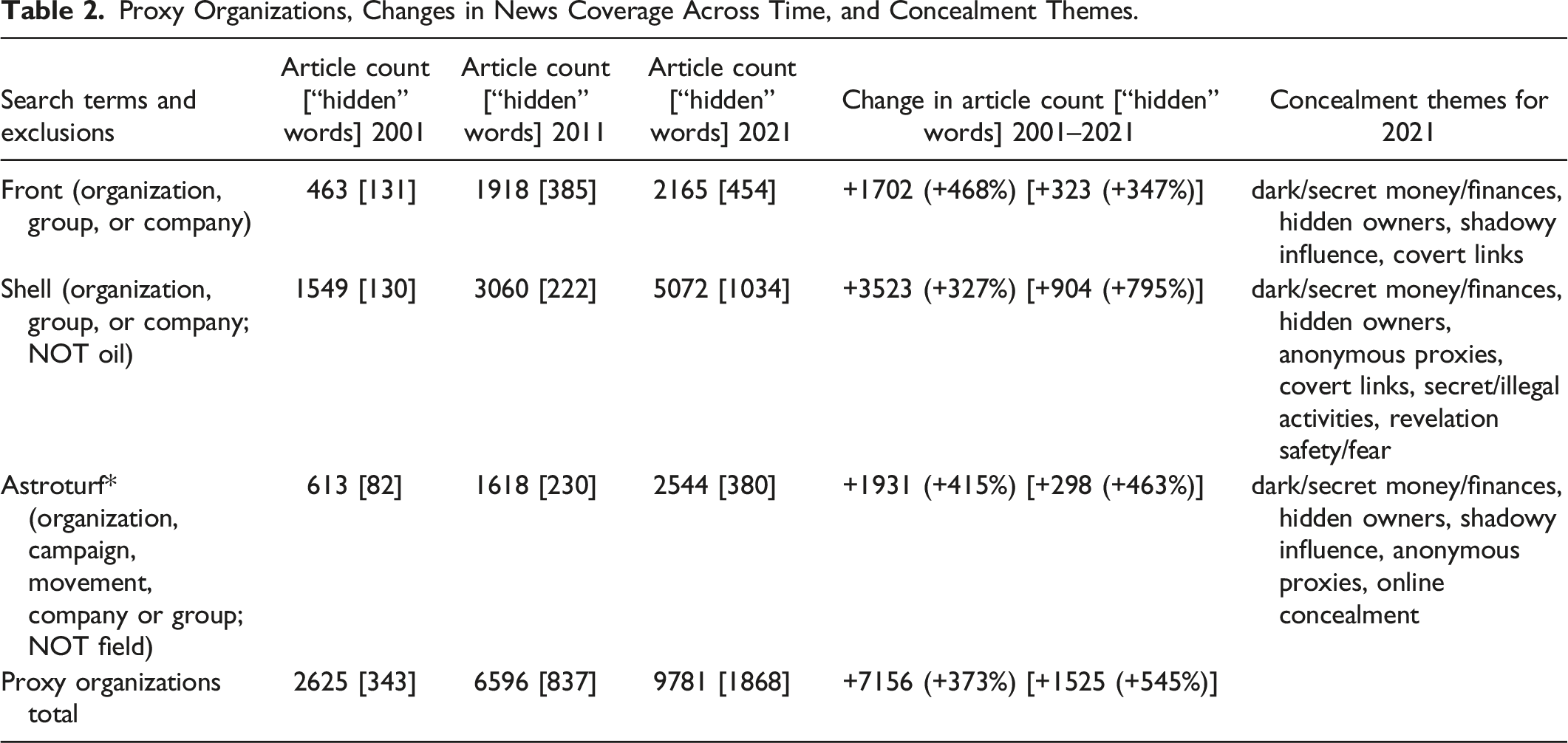
To address RQ1, we compared current news coverage of various proxy organizations with past media attention by examining three distinct 12-month time periods—2001, 2011, and 2021. Looking at an entire year helps avoid cyclical variations within any given year and looking across three time periods provides greater confidence in any changes we might observe. Separating the time periods by 10 years also allows for enough time to detect changes in the level of news coverage. To further understand the changing nature of that media coverage, we also searched for the frequency of root terms such as dark*, secret*, anonym*, and hidden that might get at the concealed nature of those proxy organizations.
To answer RQ2, reflexive thematic analysis (TA) was conducted on the news articles to establish fundamental themes and narratives related to each of the three types of proxy organizations. With accessibility and flexibility to discover repeated types of concealment in the media coverage examined (see Braun & Clarke, 2021), this analysis was guided by six steps that are suitable to explore diverse, but united, patterns related to concealment within and among the proxy organizations. For this analysis, we focused on the 2021 media coverage. We first identified the 50 most relevant articles (as determined by the Nexus Uni database) for each proxy type among those that contained one or more of the four concealment terms described previously. To familiarize ourselves with the data set for Step 1, the authors separately read the 50 articles for each proxy type. Then, we actively identified frequently noticed terms, stakeholders, and social contexts surrounding these proxies (Step 2) and categorized them systematically (Step 3). To assist with the analysis, we also considered the most frequently used terms/keywords in each set of articles using NVivo. The authors constantly compared themes, collapsed and separated themes, and after several rounds of discussion, we agreed on a set of concealment themes for each type of proxy organization (Step 4). To elaborate and refine those nuanced themes, we also used a constant comparative approach in which we compared any instance of concealment with existing themes to determine if a new theme was present (Step 5). We also noted similarities and differences across the proxy types and wrote the finalized themes (Step 6). While critically questioning and unpacking reported proxy practices, we completed the six steps of reflexive TA and collectively extracted several themes to answer our second research question.
Findings
Table 2 provides data on the number of articles in each time period mentioning each of the proxy organizations—as well as the number of articles using at least one of our concealment terms (dark, secret, anonymous, and/or hidden). News coverage on each proxy organization type clearly increased from 2001 to 2021 (with increases for each type between 2001–2011 and again from 2011–2021). Similar increases in the use of concealment terms were also observed.
The most frequently mentioned type of proxy at all time periods were shell companies, which were covered by 5072 articles in 2021 compared to 1549 in 2001 (a 327% increase). The rise in concealment terms connected to shell companies was even more dramatic, growing from 130 in 2001 to 1034 by 2021 (a 795% increase). Although front organizations are the least frequently covered proxy type at most time periods, they also had the largest percentage increase, growing by 468% from 2001 (463 news articles) to 2021 (2165 news articles). Conversely, front organizations had somewhat less growth in the use of concealment terms compared to other proxy organizations, but the 347% increase is still notable. Finally, coverage of astroturf movements more than quadrupled from 2001 (613 articles) to 2021 (2544 articles). The rise in concealment terms used to describe astroturfing was similar (up 463% from 2001 to 2021).
Our second research question asked what concealment themes are present in the public discourse around proxy organizations. Of note, the discourse related to concealment is mostly negative across the different proxy types—especially when discussing financing, hiding of relevant entities, influence, and various proxy activities. Because over half the themes can be found in more than one proxy type, we present the results in order of theme prominence.
Dark/Secret Money/Finances
The most prominent concealment theme, found across all three proxy types, centered around hidden funding. This theme was especially pronounced for front organizations, where news coverage referenced “dark money spending,” “dark money scheme,” dark money forces,” “dark money donors,” “dark money groups,” “dark money campaigns,” “dark money web,” “anonymous dark money,” “dark money influence,” “dark money ads,” and more. Dark money, which often refers to political spending by nonprofit organizations who do not have to disclose their identity, has risen dramatically in just the past two election cycles (OpenSecrets, 2022)—which may account for the heavy focus here. The fact that the financing and donors behind these organizations is unknown speaks clearly to concealment. In some cases, coverage talked about dark money groups like the Blue Dog Research Forum (later renamed Center Forward) or “dark-money-funded front groups” in general. In other cases, nonprofits like Americans for Prosperity, which was described by Senator Sheldon Whitehouse in the Congressional Record as “the front group at the heart of the Koch brothers’ political operation,” were described as being at the center of a political dark money web. Some coverage described legislation to end dark money groups, though other coverage was about “sweeping protections for anonymous dark money spending” and “locking in the dark money power of America’s influencer class.”
Secret financing was also mentioned in connection with shell companies, where the concealment was focused on hiding one’s money generally. Several articles mentioned the 2016 Panama Papers leak and the late 2021 Pandora Papers leak, both of which addressed how major public figures secretly hid their wealth. As MenaFN Business and Finance News reported, “the Pandora Papers shine a light on the role of shell companies in making it harder to tax high-net-worth people.” Part of this situation is blamed on “secretive financial laws.” Secretive funding also emerged as a concealment theme in astroturfing. The Electronic Urban Report described secret donors as part of an astroturfing effort. Other articles described a “dark money-funded astroturf group” but use of this term was much less common with astroturfing than with front organizations.
Hidden Owners
Unsurprisingly, another prominent concealment theme cutting across proxy organizations is the hiding of the organizations/owners behind these entities. Shell companies, and sometimes multiple shell companies, are used to hide actual owners. The Hindustan Times noted a scheme where owners “created 27 layers to hide the fact related to the ownership.” A BBC report described a racket in Uzbekistan involving the president’s daughter who was “giving shares to a shell company she secretly controlled.” Identifying owners is often a challenging goal for law enforcement when shells are used for criminal activity. Certain countries, as well as various U.S. states, have strong secrecy protections “which make [s] it easy to hide the true ownership.” Some articles referenced new legislation in the United States (the Corporate Transparency Act) designed to reveal the “beneficial owners” behind shell companies and provide for “the creation of a national database of owners of shell companies.” Articles were filled with other references to “nominal ownership,” “anonymously owned,” “secretly owned,” “obscurity about the identity of the owners,” and metaphors such as Russian dolls tucked one inside another to hide owners.
A front organization also functions to conceal the organization behind it. For example, a Rolling Stone article described how ExxonMobil “obscures its interests by working through a panoply of associations and front groups.” As Techdirt reported, companies like regional telecom monopolies will often hide their identity when running disinformation campaigns through front groups. The English version of CE Noticias Financieras described fronts like Citizen Go as “façade structures of the secret (or reserved) ultra-Catholic and anti-communist organization El Yunque.” A London-based TV-Eyes transcript noted when talking about ExxonMobil: “they can be very, very effective through front groups that screen out that it is ExxonMobil.” As reported in the Richmond Times Dispatch, one gubernatorial candidate suggested that a shadowy political group “hiding behind a front group is cowardly and wrong.” Interestingly, in some cases groups were accused of hiding behind a front, but instead claimed “we are not nameless or faceless.” Somewhat less frequently, media coverage described astroturfing as “masking the sponsors” of a message or disguising a paid campaign to make it look like grassroots support.
Shadowy Influence
Another prominent concealment theme, especially for front groups and astroturfing, concerned efforts to covertly influence. These influence efforts were discussed as going beyond dark money and operating outside the political realm. The Daily Caller reported about the Chinese government’s “use of front groups to influence U.S. policy towards Beijing” and other reports described proposed legislation to better identify when front groups influence foreign governments. Syndigate Media reported that Citizens for a Responsible Energy Future was a front group funded by Duke Energy that was running Facebook ads to try to influence state legislators in North Carolina. The St Louis Dispatch reported on Monsanto funding front groups to discredit critics. Several other articles also discussed the use of attack ads “from a shadowy front group” to attempt to influence voters. Among the most frequently mentioned terms in the media coverage of front groups were governments, public, states, courts, politics, and news—further suggesting that these organizations are clearly involved with influencing public opinion.
Similar discourse was found for astroturfing efforts. The Conversation (from the UK) noted that groups like Transparency International have warned against “hidden and informal influence” linked to corporate-sponsored grassroots lobbying. Various examples of corporate and other influence were found in the coverage of astroturfing campaigns. Governance, Risk and Compliance Monitor Worldwide reported on a secret campaign by the largest broadband companies in the U.S. to influence the FCC. Capacity Magazine noted the use of fake comments and responses in this same campaign. Although secretive influence is concerning because it is often effective, these front groups and astroturfing efforts are not always successful in their influence attempts. For example, the Energy and Policy Institute reported that the Colorado Public Utilities Commission rejected a Wyoming coal industry front group’s efforts to keep coal plants running.
Anonymous Proxies
Sometimes the proxy organizations themselves were described as concealed, though this occurred with less frequency. A Naked Capitalism report described an astroturfing group itself as “shadowy, nameless.” A smaller number of articles also focused on the shell companies themselves and their secretive nature. Intellinews reported on Transparency International’s description of Scottish shell firms as “Britain’s home-grown secrecy vehicles.” An American Banker article referred to these entities as “anonymous shell companies.” Even the often “offshore” nature of these “opaque corporate structures” helped to conceal them. We also noted a few instances where a front group was described as a “shadowy front group,” but it was rare for the front organization itself to be concealed.
With astroturfing, anonymity was more directly invoked in several ways. The Jerusalem Post described how “the Guardian published an anonymous letter ostensibly signed by 390 Google and Amazon employees,” further suggesting that such anonymity was used to conceal that this was not actual employees behind what they describe as astroturfing. A New York Times piece also described the role of anonymous articles as part of an astroturfing campaign.
Covert Links
One final theme that cut across multiple proxy types concerned concealment of various connections/relationships. A Baltic News Service article about a waste business criminal case in Tallinn noted the role of a shell company “to disguise the real links between [the owner] and the company.” The prosecutor in that case noted that corruption through these shell companies “is covert to hide connections.” Shells were also described as being used to conceal personal relationships. The English version of CE Noticias Financieras noted revelations in the Pandora Papers that shell companies were used by Russian President Putin to keep a personal relationship secret.
We also observed some instances of hidden links, networks, and coalitions involving front groups. A NewsCorp Australia article on political front groups reported on one member of Parliament claiming “we don’t know who is funding them, but one has a very strong link to a federal MP’s [member of Parliament] office.” The English version of CE Noticias Financieras described Wikileaks revelations from front groups such as Citizen Go that have “come to shed greater visibility on an old and vast subversive network.” India’s Sunday Guardian reported on underground ties between front leaders and a money-laundering network. Other coverage described the Nature Conservancy as a corporate-aligned front group who assembled “a secret coalition of corporations and trade associations” to help rewrite the Endangered Species Act. In some cases, even dark money was described as a “dark money funding network.”
Online Concealment
Some themes surfaced almost exclusively for a single type of proxy organization. Astroturfing efforts often construct campaigns to shape public opinion using online platforms such as Facebook, TikTok, and Twitter. In fact, three of the four most frequently mentioned terms in media coverage about these proxies are social, media, and tech (nology), with Internet not far behind. A sizable amount of astroturfing involves online activity, and the very nature of the Internet may make such efforts at least partially hidden. Some astroturfing was referred to as an “astroturfed social media campaign.” There were several examples of using social media and other online tools to carry out and further conceal astroturfing. A New York Times article detailed “behind the scene” efforts by Facebook to “inflict pain” on Apple and its CEO, Tim Cook. Part of that effort involved expanded work with Definers Public Affairs, a Washington firm specializing in opposition research, which “began an astroturfing campaign to draft Mr. Cook as a 2020 presidential candidate, presumably to put him in President Trump’s cross hairs” (though ultimately Definers’ work was traced back to them by the Times, at which point Facebook fired the opposition research firm). Other coverage described protests against Critical Race Theory as part of a centrally-organized astroturf campaign involving paid influencers, fake websites, and secret donors. The Jerusalem Post detailed an astroturf campaign by anti-Israel organizations, including the online hashtag #NoTechForApartheid, that included anonymous supporters and a lack of website transparency. Another article about Airbnb and Uber described the use of digital platforms and online petitions to try to make corporate lobbying appear to be grassroots lobbying. Governance, Risk and Compliance Monitor Worldwide reported on activists creating comments from “software-generated fake names and addresses.” In some cases, social media platforms were seen as part of the solution for confronting the misinformation associated with astroturfing. The National (Scotland) reported that “Facebook and Twitter have been urged to take action against a new secretive campaign group accused of spreading ‘disinformation and misinformation’” related to a COVID vaccine roll-out.
Secret/Illegal Activities
Another theme that only emerged for shell companies is the activities they help hide—especially when those acts are criminal or otherwise questionable. Several articles cited a U.S. Treasury fact sheet describing various business entities that are legally formed within the United States each year, but that “can also be used to facilitate illicit activity.” Several articles also covered remarks by U.S. Treasury Secretary Janet Yellen, reporting that “The United States is currently ‘the best place to hide and launder illicit profits’ through shell companies.” A number of reports were about investigations of criminal activity. An English language article from Agence France Presse cited investigative reports describing a shell company that “had served as ‘a vehicle to regime corruption’” in a case involving a former Democratic Republic of Congo president. An article from Law 360 Legal News described a Goldman Sachs banker who “orchestrated a scheme through his personal email account to hide the activity from compliance staff … who began asking questions about the shell company’s role.” Reports claimed that shell companies are used “to hide illegal funds.” Other articles described how shell companies “embezzled trade secrets,” were used to “covertly steal,” or were part of “misappropriating millions of dollars.”
Revelation Safety/Fear
One final and less prominent theme touches on issues related to the safety and protection that shell companies might, or might not, provide. One article noted that the users of these companies likely felt anonymous and safe when operating outside the United States. Even in the United States, some coverage suggested strong protections from these shell companies thanks to trust laws. However, several articles mentioning leaks of confidential information also suggested that perceptions of concealment when using shell companies may not be justified.
Discussion
This study has positioned proxy organizations (e.g., shell companies, front organizations, astroturfing efforts) within organizational communication scholarship on visibility management (Flyverbom et al., 2016) and hidden organizing (Scott, 2013). In response to our research questions about public discourse surrounding these consequential proxies, our findings suggest sizable increases in discourse about each proxy type and growing descriptions of the concealed nature of these proxies. Furthermore, we have identified a range of concealment themes that cut across proxies, helping to illustrate the communicative nature of these organizations. In this final section, we draw conclusions, discuss implications, and suggest directions for future organizational communication research about proxy organizations.
Key Conclusions
In response to RQ1, all types of proxy organizations are increasingly part of public discourse. Overall, news coverage of proxies has increased 373% over the past two decades. Although shell companies received the most coverage at all three time period, the largest relative increases in coverage were for front organizations and astroturfing. This overall rise in coverage was accompanied by even greater increases in the number of articles mentioning concealment (up over 500% from 2001 to 2021); interestingly, here the largest growth in the use of concealment terms was for shell companies (up nearly 800% over that same time period). By 2021, over 20% of the articles about shell companies (21% for front organizations and 15% for astroturfing) contained one or more of the concealment terms examined here. We see this growing discourse about proxies—and an even greater focus on the concealed nature of these entities in that discourse—as both a reflection of growing awareness and concern about proxies and as a means of shaping societal assumptions as these consequential organizations are talked into being.
In response to RQ2, we conclude that concealment takes several different, but interrelated, forms for proxy organizations. Some concealment themes are about how proxies conceal (e.g., dark money, covert links, going online). Other themes concern who is concealed (e.g., hidden owners, anonymous proxies themselves). Still other themes are about what the concealment affords (e.g., shadowy influence, secret activities, safety/fear of revelation). We see all these forms of concealment as fundamentally communicative, as each is part of the ongoing constitution of these hidden organizations. Although some aspects of concealment appear unique to certain proxy types (e.g., being hidden online was primarily linked to astroturfing but did not emerge much with brick-and-mortar front organizations or more legalistic shell companies), the majority of themes cut across multiple proxy types. Thus, we think it is reasonable for organizational communication scholars to discuss proxy organizations as a set.
Implications
We see several implications of this work for existing scholarship. First, we find the proxy label quite useful, as there is clear evidence of these shell companies, front organizations, and astroturfing efforts being stand-ins and substitutes for various other organizations. In some ways, this is very consistent with Mulvin’s (2021) work on proxies generally; in other ways, the focus on proxy organizations is an important extension to his work because it expands organizations from being the creator of proxies or the context in which we find proxies to being actual proxies themselves. Mulvin’s ideas of concealment and disavowal with proxies align well with the concealment themes we see in public discourse. His argument that such proxies are ultimately flexible and breakable suggests that these organizations may also be deconstituted (Bean & Buikema, 2015) by the discourse of various stakeholders given their often-harmful nature.
Our findings also suggest several implications for work on visibility management within organizational communication (see Flyverbom et al., 2016). Incorporation of proxy organizations can extend visibility management scholarship, as organizations may create proxy organizations to limit their own visibility. Furthermore, the proxies themselves engage in forms of visibility management as they make themselves more or less visible in order to further conceal the organization for which they are speaking. The amount of public discourse we found about these proxy organizations, including the growing depictions of their concealment practices, suggests that they are increasingly being used to manage visibility. Paradoxically, the more an organization uses proxies to reduce visibility, the greater the discourse about those proxies, which may unintentionally increase visibility. Consistent with Albu (2022), we find that visibility management is sometimes about secrecy, linking these proxies to related work on organizational secrets and secrecy (Birchall, 2021; Costas & Grey, 2016). We suspect that in certain circles, some proxy organizations are also open secrets.
Our findings also have implications for work on hidden organizing (Scott, 2013). We see clear evidence in the public discourse about these proxies of organizational identity concealment, which is the basis of hidden organizing. More specifically, this work can advance understanding of concealment strategies. Although Scott and Sahay (2018) mention fronts as a concealment strategy, they do not consider proxies more broadly. Furthermore, proxies may not always be a form of “deception” as those authors contend. By hiding owners, keeping activities secret, making links covert, etc., these proxies are also a strategy for creating partial or entirely missing information. In other ways, the creation of stand-ins to substitute for an organization may represent an entirely new concealment strategy for hidden organizations. Based on the public discourse seen in media coverage, most proxies appear to generally be hiding harmful organizations. Indeed, thinking about the ethics behind the concealment strategies linked to proxy organizations is important for organizational communication scholars using this framework and has implications for broader policy and regulatory decisions.
As a practical implication of our work, bringing attention to proxy organizations is a first step in generating even more public attention. Our examination of public discourse as seen in news accounts surrounding these organizations can help—but it is important we not assume growing media coverage automatically means more awareness by all stakeholders. In some ways, we were surprised that much of the coverage was not from mainstream news outlets. Thus, we need to encourage even broader attention from mainstream media and continued efforts to share what is found in more specialized outlets. This especially matters in those instances where proxies are involved in violations of the law, threats to democratic processes, or other ethical problems. Heightened public discourse is often a first step in eventual policy changes that address the concealed nature of these proxies.
Just as those creating proxies are often powerful agents seeking to further their power (see Iverson et al., 2018), we—as citizens, organizational members, and communication professionals—can also exercise agency to help address concerns about these entities. By identifying the specific forms of concealment linked to these proxies—how things are concealed, what is hidden, and what that concealment affords—we provide concrete elements policy makers and professional/industry organizations can use to better regulate proxies. To confront some of the negative consequences associated with proxies and the organizations behind them, we as concerned citizens and potentially even employees of these entities should be asking questions about ownership, funding, activities, influence motivations, linkages, etc. In short, these findings offer increased literacy around these types of organizations and their practices. Armed with better information, we can begin to recognize proxy organizations and respond to them more appropriately. Because proxy organizations likely benefit some groups more than others, we also see such efforts to confront them as potentially advancing forms of social justice and communication activism (see Carragee & Frey, 2016).
Future Research Directions
There are several limitations to this study that can be addressed in future research. For example, we focused on three main types of organizational proxies, but political actions committees (PACs), super-PACs, advocacy groups, think tanks, and so-called “pop-up” organizations also deserve attention as proxies. Our choice of concealment terms, while informed by existing literature, may also be limited. Several choices made in the selection of the media analyzed, while reasonable, could also have influenced the analysis (database used, years chosen, number of time points examined, search terms, etc.).
Another limitation of this research is the focus on news coverage. Future research could consider other data sources, some of which are outlined in recent work about dangerous, difficult, and hidden organizations (see Peterson et al., 2022). As these authors suggest, in some instances even traditional interviews or questionnaires with certain types of participants may be possible (e.g., interviewing experts from watchdog organizations that keep proxy organizations under surveillance or even from financial/legal experts focused on certain proxies). Analyzing organizational documents that are publicly available or accessible through FOIA and open records requests, network methods, and extensive case studies of specific proxy organizations (e.g., the Internet Research Agency) can also offer useful insights. Other work has suggested various methods to study proxy organizations, specifically astroturfing. For example, Lits (2020) has studied texts produced by astroturfing organizations and the level of correspondence to textual documents from the organizations behind the proxy. Lyon and Maxwell (2004) suggested checking the organizational chart of astroturfing organizations to see what information is publicly available and what is missing. Mahbub et al. (2019) identified specialized communication strategies and tremendous amounts of information as challenges for detecting astroturfing efforts, suggesting the need for more sophisticated computational techniques.
Beyond these limitations, we offer several other directions for future research. As some of our findings suggest, research needs to better consider ICTs and proxy organizations. Digital forms of work likely both enhance and complicate concealment efforts around a proxy organization. Similarly, social media not only allows proxy organizations to manage visibility strategically, but also puts them under surveillance (see Uldam, 2018). Lukito (2020) has noted how the Internet Research Agency effectively disseminates fake information across multiple social media platforms (e.g., Reddit, Twitter) to blur its identity; but those same platforms also pose risks for fronts through increased visibility. ICTs can make astroturfing more effective, but also more easily detected (McNutt & Boland, 2007; Woolley, 2023). Understanding how ICTs enable and constrain proxy organizations and their concealment is essential.
Proxy organizations provide a useful illustration of the complex structure surrounding many hidden organizations. A proxy organization’s connectivity with certain other organizations can help hide the connection with the organization(s) behind them. Thus, it is usually not enough to understand any one proxy; instead, we have to also consider the organizations that create such proxies, the funding organizations behind them, the legal and regulatory interests involved, watchdog and media organizations that may monitor proxies, etc. Thus, interorganizational networks may be especially appropriate for further research into these proxies. Relatedly, complex structures may cross national and disciplinary borders, demanding research efforts that are more global and that link communication with other key fields of study.
A focus by organizational communication scholars on these proxy organizations suggests several other important questions. From a view of communication as constitutive of organizations (Cooren, 2012), what communicative processes help bring these organizations into being, what is the role of communication in deconstituting these proxies, and in what ways are proxy organizations akin to ventriloquism? We might also ask what motivates organizational actors to increase or decrease levels of concealment over time? As one reviewer suggested to us, “are there certain stakeholders, work routines … or stages in the lifecycle of a proxy organization worth investigating?” We also see the work on front groups that Pietracatella and Brady (2020) call Social Aspects Public Relations Organizations and the role of these proxy organizations in spreading modern day propaganda and disinformation (Woolley, 2023) as deserving further research.
Today’s organizational landscape includes a number of hidden organizations needing to manage their visibility. Helping conceal those collectives is a growing and consequential set of entities usefully labeled as proxy organizations. It is our hope that raising awareness about the communicative nature of shell companies, front organizations, and astroturfing efforts—and then illustrating their growing prevalence in public discourse—will stimulate much needed organizational communication research into this area.
Footnotes
Acknowledgments
We would like to acknowledge the very helpful editorial guidance of former MCQ editor Dr. Rebecca Meisenbach, the appropriately concealed comments from several anonymous reviewers, the feedback from the UT Austin Center for Media Engagement, and the editing assistance of Dr. Karen Schlag. A previous version of this paper was the Top Paper in Organizational Communication at the annual convention of the Western States Communication Association (February, 2020).
Declaration of Conflicting Interests
The author(s) declared no potential conflicts of interest with respect to the research, authorship, and/or publication of this article.
Funding
The author(s) received no financial support for the research, authorship, and/or publication of this article.
