




Abstract
Environmental changes can render latent organizational tensions salient, and tensions can be viewed as a lens through which to study the social interactions of organizational actors. This study aims to uncover what kinds of tensions and their entanglements arise in knowledge workers’ collaboration and technology-mediated communication practices during a transition to remote work. The qualitative dataset was collected through an open-ended online survey at the start of the COVID-19 pandemic in 2020 from 569 remote workers, and the data were analyzed iteratively according to thematic content analysis methods and applying elements of contrapuntal analysis. The findings indicate emerging tensions and their entanglements in knowledge workers’ remote work and technology-mediated communication practices, here manifesting in process-, task-, and relationship-oriented interactions. The findings provide theoretical and practical implications for how entangled tensions in remote work could be managed to support effective communication, collaboration, and employee well-being during and beyond the pandemic situation.
Keywords
Modern knowledge-intensive work has become increasingly digitalized, and this trend gained momentum when the worldwide COVID-19 pandemic broke out, forcing many knowledge workers to rapidly shift to remote work. In the literature, remote work has been defined as distributed work arrangements that enable employees to communicate and collaborate over physical and temporal distances in which work is not bound to a particular place (Leonardi et al., 2010). In this study, we follow this definition but specifically focus on remote work in a situation in which national work-from-home mandates unexpectedly forced most knowledge-intensive workers in many countries to work from home through communication technologies during the COVID-19 pandemic. Even though remote work has gained popularity in years prior to the pandemic, it was still mostly seen as a secondary option to working at the office (e.g., Eurostat, 2020; Valo & Sivunen, 2020, p. 199).
In March 2020, many workplaces suddenly became completely dependent on communication technologies for collaboration (Leonardi, 2021), and the transition to working exclusively through digital technologies required changes in organizations’ communication practices. Remote work has been a central interest of organizational communication scholars for a long time (e.g., Leonardi et al., 2010), but following national mandates necessitated by the COVID-19 pandemic, it became the most prevalent way of working among knowledge-intensive workers. Therefore, it is critical to analyze the implications of the rapid shift to remote work to better understand communicative dynamics in a fully virtual environment.
Today’s digital technologies allow workers to communicate via text, audio, and video, and to share and edit data and documents both asynchronously and in real time (Leonardi, 2021). Technology-mediated communication—such as communication via emails, instant messages, collaborative technologies, and video conferencing through applications such as Microsoft Teams, Zoom, and Google Workspace—is essential for facilitating collaboration and communication during fully remote work. Previous studies have suggested that remote work can provide several advantages to employees, including reducing exhaustion because of extensive social interaction at the workplace and helping focus on concentration-intensive work tasks (Charalampous et al., 2019). Prior research has shown that part-time remote work allows employees to better control their time and can serve as a brief break from interpersonal interactions with colleagues, which can be refreshing (Windeler et al., 2017). Remote workers may also enjoy a level of autonomy and independence compared with office-based workers because of less awareness of general organizational politics (Charalampous et al., 2019).
However, communicating solely via communication technology can have its downsides, too. Working and communicating remotely may inhibit connectedness with colleagues or enable employees to disconnect purposefully (Fonner & Roloff, 2010); this can lead to isolation and loneliness (van Zoonen & Sivunen, 2021; Wang et al., 2021). Informal and contextual information may be more difficult to share through communication technologies (Cramton, 2011), even though informal communication plays a valuable role in remote employees’ well-being and job satisfaction (Fay & Kline, 2011). These types of parallel positive and negative implications show how technology use is dialectical in many ways and how remote work may raise tensions among workers or lead to larger organizational dilemmas or paradoxes. The current study contributes to the literature by unpacking the emerging and intertwined tensions related to technology-mediated communication and remote work practices in fully remote work where face-to-face contact is nonexistent.
Our research focuses on the initial responses of employees who shifted to working remotely after the COVID-19 pandemic started in March 2020. The transition to full-time remote work may have inflicted changes in the knowledge workers’ communication practices because they suddenly became completely dependent on communication technologies instead of using technology only as a support for frequent face-to-face encounters at the office. Therefore, we focus specifically on tensions related to technology-mediated work, and not, for example, on employees’ work-life tensions, though the pandemic certainly had implications on every area of life (see e.g., Sharma et al., 2021; Stephens et al., 2020). Prior research has shown that environmental changes can result in persistent tensions manifesting in organizations (Smith & Lewis, 2011). Our focus is on uncovering these potential tensions regarding technology-mediated communication practices that surface during full-time remote work. Our analysis shows the importance of understanding communication dynamics through the lens of tensions to manage them effectively in a fully virtual environment where all employees work remotely.
Theoretical Framework
Tensions and Paradoxes
Tensions are a normal and ubiquitous features of all organizational life (Ashcraft & Trethewey, 2004; Gibbs, 2017; Smith & Lewis, 2011) and based on the constitutive ontological assumption that these inherent paradoxical tensions are socially constructed (Mease, 2019). The concept of tension is often broad and ambiguous; thus, the language used to describe the conceptions and structure of tensions varies across the literature (Mease, 2019; Putnam et al., 2016; Smith & Lewis, 2011). However, tensions are often used to signify all paradoxical dynamics; thus, the concept of tension also underlies those of paradoxes, dualisms, contradictions, and dialectics.
For individuals, tensions can manifest as feeling states of stress, anxiety, frustration, tightness, blockage, or uncertainty when encountering incompatibilities and dilemmas, making choices, or moving forward in organizational situations (Putnam et al., 2016). Tensions will not necessarily need to be resolved or treated as something negative but rather managed (Ashcraft & Trethewey, 2004; Mease, 2019; Smith & Lewis, 2011). The dynamic interplay between the opposites can be seen as a source of creativity and dialogue (Putnam et al., 2016), and when communicatively managed, dialectical tensions—unnlike mutually exclusive contradictions or pragmatic paradoxes—can be productive because they allow for merging of the opposites through both options (Gibbs, 2017).
Contradictory features that exist simultaneously, cause tensions, and persist over time, have the potential to turn into paradoxes. Paradoxes create situations of nearly impossible choice, leading to absurd, irrational, or ironic outcomes (Putnam et al., 2016). Gibbs (2017) described a paradox as “an impossible choice between mutually exclusive options as in the saying ‘be spontaneous’” (p. 80). In a similar manner, Putnam et al. (2016) defined paradoxes as “interdependent and mutually exclusive opposites that reflect back on and impose on each other” (p. 76).
Language and discourse are seen as key in how tensions and paradoxes form and operate, moving beyond individuals’ feelings and cognitions. In other words, the constitutive view assumes that language, discourse, and interactions form reality rather than reflect it (Putnam et al., 2016). Organizational actors often develop competing interpretations of paradoxical situations based on their organizational roles, hierarchical positions, or socioeconomic attributes (Fairhurst et al., 2016). Hence, paradoxical tensions can be researched in multiple organizational arenas in which paradoxes are enacted. These include dyadic, team, intergroup, organizational, institutional, and societal levels (Putnam et al., 2016). Furthermore, despite the fact that previous research has mainly focused on singling out individual tensions and paradoxes in organizations, they can emerge simultaneously, be interrelated, and mutually affect one another in either amplifying or mitigating ways, resulting in entanglements (Fairhurst & Putnam, 2023; Putnam et al., 2016; Sheep et al., 2017). In the current study, we focus on both employees’ internal tensions and those tensions emerging at the team and organizational levels, as well as tensions that potentially entangle with one another in remote work.
Previous research has recognized tensions and paradoxes in the interactions of organizational actors and arenas, including tensions in the use of organizational spaces (Sivunen & Putnam, 2020) and related to organizational identity (Ban, 2016). Studies have also identified paradoxes related to communication technology use in organizations, such as the autonomy paradox (Mazmanian et al., 2013) and connectivity paradox (Fonner & Roloff, 2012; Leonardi et al., 2010). The autonomy paradox refers to the dilemma of professionals who can use communication technology to work autonomously anywhere but leads them to working constantly, everywhere, and all the time, thus diminishing their autonomy in practice (Mazmanian et al., 2013). In turn, the connectivity paradox means that the same communication technology used to facilitate remote, focused work can also cause interruptions, negating the benefits of the remote work arrangements (Leonardi et al., 2010).
Managing Tensions and Paradoxes
Previous studies on tensions arising in remote and digital work have included the contexts of global virtual teams (Gibbs, 2009), teleworkers (Leonardi et al., 2010), and the use of organizations’ social media platforms (Gibbs et al., 2013). Tensions surfacing in global virtual teams’ interactions were related to the team members’ autonomy–connectedness, inclusion–exclusion, and empowerment–disempowerment, which were negotiated among the team members through communicative practices (Gibbs, 2009). Research on organizations’ social media platforms found communicative tensions regarding visibility–invisibility, engagement–disengagement, and sharing–control (Gibbs et al., 2013), and the strategies to negotiate these tensions proved to be either productive or unproductive. The productive strategy to navigate tensions is transcendence, which allows team members to incorporate both poles of the tension in a positive and enabling manner and attend to conflicting goals (Gibbs, 2009; Gibbs et al., 2013). However, selection and withdrawal strategies could lead to unproductive outcomes because they endorse embracing one pole over the other or rejecting both poles entirely, thus limiting the actors’ choices to respond to tensions (Gibbs, 2009).
In a similar manner, Putnam et al. (2016) categorized responses to organizational tensions into three groups: either-or, both-and, or more-than responses, referring to choosing one option over the other, accepting the presence of contradictions by vacillating between the opposing poles, or transcending the contradiction with responses that prompt new options, respectively. Thus, when communicatively managed, organizational tensions in remote work can become a source of creativity and productivity and serve the purpose of enabling organizational actors to attend to multiple, even competing, goals simultaneously.
The sudden transition to remote work offers a unique opportunity to study tensions and paradoxes related to knowledge workers’ remote work and technology-mediated communication practices. Smith and Lewis (2011) pointed out that tensions may persist in organizations but remain latent or unperceived until cognitive efforts or environmental factors render the latent tensions salient to organizational actors’ experience. Therefore, it is likely that the changes in communication practices and transition to remote work caused by the COVID-19 pandemic were related to manifestations of tension in organizations. Thus, our research question is: What are the emergent and/or intertwined tensions related to remote work and technology-mediated communication practices arising from knowledge workers’ experiences during full-time remote work?
Methods
Data Collection
The dataset was collected—via an open-ended survey—three Nordic research and education organizations during a three-week time period in April–May 2020 at the beginning of the COVID-19 pandemic, when the knowledge workers had been working remotely full-time for one to two months. The participant organizations were chosen because most of their employees engaged in knowledge-intensive work tasks and worked in similar organizational settings. We acknowledge that the participants of this study were somewhat privileged as they were all able to work from home during the pandemic with high-quality computers and a stable internet connection. However, such sampling enabled us to study the tensions emerging early on after a quick transition to full-time remote work without the concern that the tensions were related to technological glitches.
Case organization A consists of 1028 professionals, including 581 teachers and researchers. Case organization B consists of 500 professionals working as teaching staff for 8500 students. Case organization C is a research organization that includes a staff of 650 researchers and other professionals. The data were collected through an online survey with a few simple background questions concerning the respondents’ age, gender, and occupation, as well as their work time in the organization and whether they had children living in the same household. The open-ended survey dealt with the sudden shift to remote work due to COVID-19 pandemic and its perceived benefits and challenges. All eight open-ended survey questions are presented in the Appendix.
Altogether, 569 respondents from the three organizations (NA = 166, NB = 253, NC = 150) took part in the qualitative survey. The respondents from organizations A and B provided 3075 responses to the eight open-ended questions, and the respondents from organization C provided 805 responses to six open-ended questions, excluding Question 5 and 6. These two questions were excluded because the organizational leadership requested a shorter open-ended survey. Our sample consists of 3880 open-ended survey responses varying in length from a few words to up to 188 words.
The respondents’ ages ranged from 19 to 67 years, and their mean age was 43 years. Of all the respondents, 36% identified themselves as male, 61% as female, and 2% did not report their gender. The organizational tenure of the respondents varied from less than a year to 41 years. The average tenure in organization A was 11 years, in organization B nine years, and in organization C 12 years. Before the pandemic, 51% of the respondents had worked remotely one day a week or less, 29% had worked remotely two to three days a week, and 3% had worked remotely four to seven days a week. In addition, 11% of the respondents had never worked remotely prior to the pandemic.
Data Analysis
Early in the analysis process, tensions surfaced from the data. The fast transition to remote work because of the COVID-19 pandemic evoked underlying tensions in employees’ communication practices because the shift to remote work was forced by national mandates. Therefore, although starting the data analysis according to thematic content analysis methods (Tracy, 2013), we soon applied elements of contrapuntal analysis (Baxter, 2011) through an iterative process. Contrapuntal analysis refers to a set of methodological practices based on Bakhtin’s (1984) textual analysis of literary works that focuses on the interplay of contrasting discourses; this method was further developed by Baxter to provide “a methodological primer” (2011, p. 151) to analyze contradictions. The musical term contrapuntal “refers to the playing of contrasting or counterpoint melodies in conjunction with one another” (Baxter, 2011, p. 152), which makes contrapuntal analysis a suitable tool when aiming at capturing multivocality. Mease (2019) pointed out that tensions represent turning points in organizations, and transitions or turning points are fruitful grounds for highlighting the discursive struggles (Baxter, 2011) in which contrapuntal intertextuality can be identified.
According to Baxter (2011), the salience of competing discourses can be recognized in the communicative meaning-making process by identifying ambivalence in the participants’ responses when asked about possible challenges in the communicative conduct of their relationships. Even though the present study does not focus on interpersonal relationships per se, this principle was applied to our analysis in a similar manner as in Ban (2016), who analyzed discursive tensions and identity in the context of a Chinese house church using contrapuntal methods. The data of the current study contained multivocality and ambivalence, especially in responses where knowledge workers’ remote work and technology-mediated communication practices with coworkers during the pandemic were described.
Data analysis was conducted inductively with an iterative approach by identifying themes and discourses from the data in an emergent way (Baxter, 2011). The first author started with thematic content analysis (Tracy, 2013) by performing a close reading of the responses to the open-ended survey. After becoming familiar with the data by reading it multiple times, the first author conducted a primary cycle coding with the help of Atlas.ti analysis software. The authors discussed the initial codes together to iterate the coding patterns.
After the primary cycle coding, the first author approached the data with a contrapuntal focus by leaning on the following guiding questions: “How does this articulation construct the knowledge workers’ perceptions of remote work and technology-mediated communication practices?” and “Are there competing discourses in the respondents’ experiences, and how is meaning constructed through their interplay?” (e.g., Baxter, 2011, p. 152). The analysis unit of this study was defined as any length or a segment of text from the open-ended survey responses necessary to answer the analytic question. (Baxter, 2011, p. 161) Three lexical markers outlined by Baxter (2011)—negating, countering, and entertaining—were used to capture the discourses positioned in counterpoint relation to one another. Negating refers to “disclaiming or acknowledging of an alternative, competing discourse for the purpose of rejecting it” (Baxter, 2011, p. 167). Countering means another kind of disclaiming, and is marked by those lexical choices that counter the implicit expectations, such as, however, but, yet, even, only, just, and still, aspiring to supplant an alternative discursive position. Entertaining refers to an indication of the possibility of at least one alternative option. The discourse markers for entertaining include lexical signals such as may, might, could, it is likely that, it seems, and apparently, expressing modality or uncertainty.
The primary cycle coding with a contrapuntal focus helped identify the relevant data for the purposes of the current study. At the end of the primary cycle coding, the dataset consisted of 1289 units of analysis retrieved from 3880 survey responses. The mean number of words in an analysis unit was 26 (varying from a few words up to 144 words). Some of the longer responses consisted of more than one unit of analysis that each included a lexical marker of negating, countering, or entertaining, whereas some of the shortest responses could also include a lexical marker and were analyzed as one unit of analysis, such as the response R178: “Communication works, but it’s distant.”
The analysis process was executed iteratively with multiple cycles of coding of the relevant data, and the emerging codes were organized and reorganized into groups, thus forming the key discourses. This state of analysis focused on the way competing discourses collaboratively constructed tensions in the knowledge workers’ experiences in each selected response from the data. Subsequently, the identified tensions were categorized into three groups according to interaction type (Whillan et al., 2021). In conclusion, our analysis revealed salient tensions in the knowledge workers’ task-, process-, and relationship-oriented interactions, with each category consisting of three subtensions.
Task-oriented tensions (24% of the analysis units) were seen as tensions related to increased versus decreased autonomy, improved versus decreased opportunities to focus on work, and communication technology being an enabler versus a hindrance of task-related interactions. Process-oriented tensions (35% of the analysis units) consisted of efficient versus inefficient information flow, efficient versus inefficient organizing of work, and communication technology being an enabler versus a hindrance of process-oriented interactions in remote work. Relationship-oriented tensions (41% of the analysis units) were seen as increased versus decreased opportunities of forming and maintaining social relationships, distance versus closeness of work community, and communication technology being an enabler versus a hindrance of relationship interactions. However, the co-occurring and mutually intertwined nature of tensions emerged throughout the iterative analysis process. For example, communication technology use was an intrinsic part of each main group of tensions categorized regardless of the interaction type.
Thus, in addition to recognizing tensions, we sought to further understand their entanglement. To recognize the interweaving of multiple tensions, we drew upon the work by Sheep et al. (2017) and focused on looking at the relevant components of each tension within an identified entanglement and how these tensions were articulated by the respondents or whether causality was constructed through their interweaving. For example, technology-mediatedness afforded remote work in general while it simultaneously enabled and hindered all communication. This way, communication technology use intertwined with all the other communicative tensions identified in this study, indicating the emergence of entanglements. In the next section, these tensions and their entanglements are presented (see Table 1).
Findings
Task-Oriented Tensions
Task-oriented tension between increased and decreased autonomy in remote work manifested through the increased flexibility of knowledge workers’ time management, allowing them to have more control over their own schedules and saving time from commuting. However, paradoxically, remote work also decreased the autonomy of the knowledge workers by intensifying their workload, by slowing down the pace of working because of the unaccustomed use of new digital tools, and by increasing the number of back-to-back online meetings. Additionally, respondents reported an increase in monitoring of their work, breaks being shorter in remote work compared with the office, and the boundaries between work and personal life becoming blurred. One 58-year-old respondent, who had no children living at home, described the binary relationship of increased and decreased autonomy in remote work in the following way: On one hand, I’ve gained more freedom and saved time because I don’t have to commute anymore. I can also work according to my own schedule at home. On the other hand, work takes more of my time now because I’m just learning to use the new technologies. At home, nothing stops me from working 24/7. … Workdays spread easily from morning until evening. In the meantime, I enjoy taking breaks during the workdays and go, for example, for a walk if I feel like it. These are the two sides of the same coin. (R 171)
Another task-oriented tension in remote work was improved versus decreased opportunities to focus on work. According to the responses, working from home improved workers’ concentration on focus-intensive work, but at the same time, remote work decreased the opportunity to focus. Some respondents reported having hoped that remote work would free up more time to focus on their tasks; instead, the expectation to be constantly connected and respond quickly to instant messages took all their time. A 50-year-old respondent who was in a leadership position and had no children at home, described the increased and decreased opportunity to focus on remote work as follows: On one hand, I’m able to focus better on my work at home because nobody comes to knock on my door like they would at the office. On the other hand, the pressure to respond quickly to instant messages has increased. (R 160)
The last category of task-oriented tensions was communication technology being an enabler versus a hindrance of task-related interactions. Performing work tasks remotely was possible only through technology-mediated communication. However, respondents reported technology-mediated communication as being a hindrance to task-related interactions because it required more time, effort, and planning compared with face-to-face interactions. The respondents also had concerns about interrupting others or occupying too much of their colleagues’ time when contacting them via communication technology. According to some respondents, having to choose whom to contact and what channel to use for work-related communication was a hindrance: Normally, I would have colleagues around me who give me quick comments about my work, but if I have a question now, I must think first whom to contact and what channel to use. This slows down my work significantly, especially if I’m not able to proceed with my work without the comments of others. (R 82)
In addition, for some, work-related technology-mediated communication was perceived as a constraint compared with face-to-face interactions. However, other respondents regarded technology-mediated communication as more efficient and productive in remote work compared with the office, even though it was less social. Interestingly, one respondent, who was already experienced in remote work, pointed out that communication technology itself may not be a hindrance in task-related interactions, but rather, the way in which communication technology is used hinders task-oriented interactions in remote work: Communication and collaboration are more efficient and productive [in remote work] but less social. I think now we’re communicating less than before. It [technology-mediated communication] is something we should learn. I suppose it depends more on our behavior and the way we choose to use technology, rather than the technology itself, the software, or time management. (R 112)
Even though communication technology enabled communication and working in remote ways, it also hindered it. This implies that communication technology related tension intertwines with the other task-oriented tensions. Finally, the findings also indicate that technology-mediated communication practices may be more important than the communication technology itself.
Process-Oriented Tensions
The process-oriented tension of efficient versus inefficient information flow stemmed from the changes in organizational informing and knowledge sharing caused by the sudden transition to fully remote work. The rapid shift to remote work increased the technology-mediated informing in organizations and induced a growing demand for virtual meetings. Thus, according to the respondents, remote work prompted faster, richer, and timelier informing in organizations than before the pandemic. However, despite the efficiency of organizational information flow, the respondents reported simultaneous difficulties in obtaining enough relevant information during remote work. According to the responses, an overflow of information, too many channels to follow, a lack of tacit knowledge, and disconnections in knowledge sharing contributed to inefficient information flow. As one respondent put it, “Now there’s too much information flowing around, and it’s challenging to keep up with everything” (R 26). A lack of face-to-face encounters added to this inefficiency: “Probably I’m still getting the same amount of information as before the pandemic, but the tacit knowledge is missing now” (R 1680). Another respondent explained inefficient knowledge sharing as follows: “Nowadays, the work conversations may happen over the phone only between two individuals, who might forget to share the relevant information with others whom it may concern” (R 63).
In addition to information flow, remote work created a tension between the efficient and inefficient organizing of work. According to the respondents, collaborating remotely requires more organizing compared with co-located settings, leading to improved and hindered process interactions in organizing work. For example, some respondents noted that collaboration had become more efficient in remote work because of efficient coordination, while others experienced a lack of process interactions, leading to a “silo mentality” and inefficient organizing of work compared with working at the office. This was also related to the need to schedule virtual meetings beforehand instead of coordinating work tasks spontaneously at the office. Planning the meetings beforehand may have reduced the interruptions during workdays, but it also made collaboration feel “rigid” and, therefore, inefficient: We need to make appointments for online meetings in advance, instead of just stopping by at each other’s office whenever something comes to mind. On the one hand, this type of collaboration feels rigid because we need to agree on a suitable time for both parties beforehand, instead of talking things over immediately. On the other hand, setting times for meetings in advance is positive because this way, we don’t interrupt each other constantly. (R 108)
Inefficient organizing of work also manifested as receiving insufficient instructions from leaders regarding work. According to some workers, remote work reduced the opportunities to ask spontaneous questions and clarify instructions, resulting in uncertainty and inefficient time management. Even though some workers reported being more productive in remote work because of reduced communication, it also led to the inefficient organization of work.
The final category of process-oriented tensions is communication technology being an enabler versus a hindrance to process-oriented interactions in remote work. Evidently, communication technology enables process interactions (e.g., planning and coordinating) in remote work but this category also includes the features of communication technology that enable and hinder process-oriented interactions. According to the responses, communication technology enabled equal participation in organizational communication, regardless of location, while also making communicating through multiple channels easy (e.g., writing in the chat alongside speaking). Despite communication technology being an enabler, it also hindered process-oriented interactions in remote work. According to the workers, connectivity issues, delays in the sound and video, disrupting background noises during the virtual meetings, or the participants having microphones muted and people talking over each other during conversations were perceived as hinderances to communication. One respondent who was experienced in remote work described this in the following way: We interact with each other, but it’s different. It is wonderful to see other people’s faces in Teams or Zoom meetings, but if the conversation is choppy because of connectivity issues, people talk over each other, someone’s mic is muted or there’s disrupting background noise, it’s depressing and frustrating. (R 407)
The respondents also reported that communication technology hinders communication because virtual platforms allow only one person to talk at a time, while others must listen. Additionally, becoming visible to others in the virtual environment required more effort compared with face-to-face meetings, even though communication technology simultaneously enabled easy access to the meetings for everyone: You will become visible to others in virtual meetings only by saying something. However, if there are many participants in the meeting, it can be intimidating to say anything. … At the same time, it is easy and convenient for everyone to join the meetings virtually. (R 1594)
As these findings show, communication technology was seen both as an enabler and a hindrance of process-oriented interactions, indicating how especially the communication technology related tensions entangled with other process-oriented tensions simultaneously allowing and preventing communication in remote work.
Relationship-Oriented Tensions
The sudden transition to full-time remote work raised tensions in workers’ relationship-oriented interactions alongside task- and process-oriented interactions. The first relationship-oriented tension was the increased versus decreased opportunity to form and maintain social relationships in remote work. This tension was manifested in the ambivalent responses regarding workers’ relational communication during the pandemic. Some respondents reported their interactions with coworkers as having decreased during remote work: “Communication has decreased remarkably in every way” (R 234). Other respondents described the challenges of maintaining social interactions in remote work. One younger respondent (22 years old) described it as follows: Maintaining social relationships has declined significantly because of remote communication. Work gets done successfully, but other types of communication don’t go well. For example, talking about how everyone is doing or discussions regarding any other general everyday topic is almost nonexistent. (R 288)
Some of the respondents reported their social circles as having shrunk and communication becoming more formal in remote work, while others expressed difficulties networking with new people. However, the workers also simultaneously reported positive experiences regarding the opportunity to create and maintain relationships in remote work: “It [communication] has improved significantly. I meet my colleagues daily in online meetings, sometimes even multiple times a day. If it wasn’t for that [remote working], I wouldn’t meet some of my colleagues at all” (R 167). Based on such responses, technology-mediated organizational communication opened new opportunities to network with the wider work community. In some cases, it even brought new people to the respondents’ social circles: “I’ve socialized with different people in online meetings than I usually interact with. I’ve also formed new contacts with colleagues from another campus” (R 187).
Second, working from home shifted knowledge workers’ perceptions of distance and closeness to the work community, rendering another tension salient. According to the respondents, before the pandemic, face-to-face interactions and physical proximity created a sense of “closeness” to coworkers, and technology-mediated communication was considered mainly as a means to connect with those who were far away. However, the sudden change to communicating exclusively via communication technology shifted the perception of distance and closeness of the work community, even for respondents who had experience in remote work: “Remote work has distanced me from my closest coworkers, whom I used to meet at the office, but it has also brought me closer to the colleagues I used to meet only online before the pandemic” (R 63). According to some respondents, remote work also resulted in feelings of isolation and loneliness, manifesting the tension between distance and closeness to the work community: We communicate regularly with my project group. However, we tend to start talking about work directly in online meetings and then finish the meeting precisely according to the schedule. It’s definitely efficient, but it makes me feel lonely and isolated, especially if I only have a small role in the meeting. (R 1589)
Some of the respondents reported feeling closer to their work community during remote work: “It’s not possible to communicate as easily as before. Nonetheless, it feels like [another city where colleagues are located] is closer to me than it used to be” (R 31).
Finally, communication technology enabled and hindered relationship interactions during remote work. According to the responses, after the transition to remote work, the relationship interactions became technology-mediated. However, the respondents reported that communicating through technology—especially through video conferencing tools about topics other than work—had declined. Similarly, the features of communication technology were reported as hindering relationship interactions: The social aspect of work is vital to me. … I think virtual meetings and coffee breaks with lagging internet connections, delays in sound and video without the opportunity to look others in the eyes cannot replace face-to-face interaction in a meaningful way. A real connection is missing. In fact, even a regular phone call is better than a video conference call. (R 1629)
Another respondent in a leadership role reported that video conferencing tools hindered the relational aspect of managing people: Managing people has changed the most. Communicating through technology fails to convey how people are actually doing. Many say, “I’m OK,” but seeing their facial expressions and body language would tell me so much more accurately how they really are. I used to meet my team every time I was at the office, and I had a better understanding of how everyone was doing compared with the remote work situation. (R 69)
The shift to remote work emphasized task-related communication at the expense of relational communication and informal interaction. Nonetheless, one respondent who was very experienced in remote work pointed out that video conferencing tools still provide an opportunity for relational communication: “Communication is different. Virtual meetings cannot replace real meetings, but they still provide support and some sense of a community” (R 22). According to the knowledge workers, a lack of relationship-oriented communication in remote work deteriorates team spirit and the sense of a community. Workers reported that relationship interactions support well-being at work, reduce loneliness, and sometimes even spark new ideas. Based on the responses, communication technology can enable and hinder relationship-oriented interaction simultaneously, and consequently this tension entwined with all the relationship-oriented tensions identified in this study.
Discussion
The current study applied a constitutive view of organizational tensions to knowledge workers’ remote work and technology-mediated communication practices during the early stages of the COVID-19 pandemic. The findings highlight various tensions that surface from knowledge workers’ task-, process-, and relationship-oriented interactions and also indicate a salient entanglement of these tensions. The task-oriented tensions are related to remote work practices and interactions aiming at executing work tasks (i.e., “the what”), whereas the process-oriented tensions manifest in those interactions focusing on planning and coordinating the execution of work, as well as in the technology-mediated communication practices (i.e., “the how”). Finally, relationship-oriented tensions arise in the interactions related to building and maintaining social relationships at work (i.e., “the who”) (see also Whillans et al., 2021). By exploring these tensions, the present study contributes to the theoretical and practical understanding of organizational tensions during fully remote work and provides practical implications applicable also beyond the pandemic context.
Theoretical Implications
The findings of this study align with previous literature of tensions related to remote work. Nonetheless, these tensions manifested in a unique way given the temporal context in which they emerged. Taking temporality into account makes our research findings unique, because research on tensions and their entanglement in fully virtual work is still in its early stages and has not been studied comprehensively prior to the pandemic. Based on this study, it seems that the more sudden and extensive the organizational change, the quicker the tensions emerge (see also Smith & Lewis, 2011) and the more amplified their entanglement may become through sociomaterial performances. Thus, it is possible that the rapid shift to remote work due to the pandemic accentuated the surfacing of organizational tensions and amplified their entanglement. This suggests that tensions of remote work during crises or organizational change may become emphasized and they have the potential to turn into organizational paradoxes (Putnam et al., 2016) or paradox knots. Such knots can lead to amplified effects of one paradox on another and exacerbating complex problems in organizations (Fairhurst & Putnam, 2023; Sheep et al., 2017).
For example, the tension between increased and decreased autonomy may have similar implications for knowledge workers as the autonomy paradox has had for professionals using communication technology to work autonomously anywhere and anytime, leading them to constantly work everywhere and all the time (Mazmanian et al., 2013). During the pandemic, many organizations were probably not prepared for the sudden transition to remote work, whereas the average employee selecting remote work outside of the pandemic may be. This situation accentuated the tension of increased and decreased autonomy compared to individuals who experience it as a part of their regular remote work positions through increased monitoring in organizations and by posing challenges with unfamiliarity of using communication technologies.
Similarly, the tensions identified in the study entangled with each other, and it is possible that the pandemic context amplified the entanglement. For example, relational interactions intertwined with process- and task-oriented interactions; workers noted that relational interactions support their well-being at work and contribute to achieving their work goals, and reciprocally, planning and performing work tasks intertwine with forming and maintaining work relationships. To provide another example, the findings show that working remotely may increase workers’ focus on concentration-intensive work tasks through reduced communication with the work community. However, despite the increased focus on work because of reduced interruptions, decreased communication also prevents task- and process-oriented interactions, debilitating collaboration, and the effective coordination of work tasks. Thus, remote work paradoxically both increases and decreases the efficiency of work through intertwined task-, process-, and relationship-oriented interactions.
Additionally, lack of relational communication contributed to workers’ loneliness and lack of connection; this in turn, was amplified by the pandemic, alongside with other possible individual circumstances, such as caregiving responsibilities or juggling more than work at home. Thus, micro-practices of talk and action can alter tensions interfacing across organizational (or global and local) levels and boundaries, which can escalate them or generate tensional knots (Fairhurst & Putnam, 2023; Sheep et al., 2017). Alongside with communication technology use and related practices in organizations, the fact that employees had to deal with the repercussions of the pandemic in all levels of their lives probably also exacerbated the entanglement of tensions in task-, process-, and relationship-oriented interactions in remote work.
Furthermore, tensions that are embedded in complex problems can produce tensional knots that continually interweave with one another and generate multiple paradoxes (i.e., Gordian knots). This means that knotted paradoxical tensions have the potential to affect and reflect back on one another with varying magnitude. (Fairhurst & Putnam, 2023). For example, the most prevalent tensions identified in the current study relate to technology-mediated communication. Communication technology as both an enabler and hindrance of communication in remote work intersects and entangles with all three main tensions of the current study, amplifying and attenuating them. This stems from the ways in which workers used the communication technologies, along with the technologies’ material features. Hence, an overarching tension between the social and material and knotting of tensions was identified in this study. Knotted paradoxical tensions have the potential to influence one another by attenuating multiple tensions that benefit from each other or they can spawn more intertwined tensions that amplify the negative effects of tensional knots (Fairhurst & Putnam, 2023; Sheep et al., 2017).
Previous research has offered insights into approaching the tension between the social and material. Putnam (2015) pointed out that discourse and materiality are inextricably intertwined and in dialectical relationships with each other, meaning that they influence each other reflexively but in an asymmetrical way. In light of the findings of the present study, materiality both enables and constrains interactions in remote work, but social interactions also shape how and for what purposes communication technologies are used in organizations. For example, the paradoxical tension emerging in remote work related to task-oriented versus relationship-oriented interactions may reflect the ways in which workers had been accustomed to using communication technology prior to their transition to fully remote work. It is possible that workers appropriated organizational communication technologies for task-related interactions instead of relational interactions. Previous research has shown that the use of communication technology and discussing the experiences and expectations of its utility with others frame its use at work, and such frames emerge specifically when the context of communication technology use is shifting (Treem et al., 2015). Therefore, the shift to remote work may also have reframed and shifted the context of communication technology use so that workers perceived organizational communication technologies as suitable mostly for task-related interactions.
Even though the material features of communication technologies have the potential to hinder interaction in remote work, the findings show that the ways of using communication technologies in organizations are often socially constructed. Communication technology is more than a tool: the ways it is used influences and shapes organizing, even though technologies alone do not determine organizational dynamics (Leonardi & Barley, 2010). For example, on the one hand, the knowledge workers expressed that the social practice of not keeping cameras on during virtual meetings restricted them from seeing others’ facial expressions, which was associated with potential miscommunication. On the other hand, not keeping the cameras on during virtual meetings was also described as “comfortable,” encouraging participation in the meetings. Thus, the sociomaterial performance of using cameras during virtual meetings was helpful in mitigating some tensions of remote work, but at the same time it reflected back on and attenuated or amplified other tensions of remote work by enabling and hindering communication (see also Fairhurst & Putnam, 2023; Sheep et al., 2017).
Furthermore, organizational changes occasioned by technologies are tied to those social dynamics that presumably vary across contexts (Leonardi & Barley, 2010). However, material artifacts, such as communication technology, lay a structural foundation for organizational practices and processes, and these sociomaterial practices have the capacity to moderate knotted tensions in organizations (Fairhurst & Putnam, 2023), especially in fully digital work environments. Navigating the emerging tensions caused by the rapid shift to remote work requires communicative sensemaking regarding technology-mediated communication practices. Leonardi and Barley (2010) asserted that to engage in dialogue about important workplace concerns, it is necessary to identify and discuss the ways that technologies enable and constrain social action.
Thus, the relationship between social and material can be approached as an imbrication of human agency and materiality, in which the material mediates the discursive based on organizational practices, while communication reflects the social reality but also shapes or alters organizing (Putnam, 2015). Therefore, as Fairhurst and Putnam (2023) point out, it is essential to include the material, such as the role of communication technologies, in understanding how paradoxical tensions in remote work interweave, amplify, and attenuate one another and generate tensional knots in organizations. In conclusion, the findings of the current study contribute to the tensions literature by demonstrating the outcomes of unexpected organizational change (as in the rapid shift to remote work due to the pandemic) regarding tensions of remote work and how temporality and sociomateriality as well as global and local levels amplify and attenuate those tensions, contributing to their entanglement.
Practical Implications
Tensions serve as decision points that fundamentally alter or create new organizations (Mease, 2019), so managing them may provide several advantages. Because the communicative tensions in remote work entangle with each other, managing them calls for responses that enable organizational actors to attend to multiple, even competing, goals simultaneously. For example, the opposite poles of the source of tension could be reframed as complementary (see also Sivunen & Putnam, 2020). In practice, this could mean broadening the meanings that organizational actors have assigned to communication technology use or extending the meanings assigned to task-, process-, and relationship-oriented interactions in remote work. For example, relationship-oriented interactions should not be neglected or treated as unimportant, as they can be helpful with achieving work goals and processes. Therefore, leaders of virtual teams could schedule meetings to be a bit longer than necessary to provide time for light small talk, mental health check-ins, or icebreaker conversations in the beginning or after small group meetings. Also, dedicating a virtual channel (e.g., Slack) specifically for non-work-related communication could be helpful.
Finally, considering the role of materiality (Fairhurst et al., 2016) and multiple interwoven tensions may provide additional useful responses managing communicative tensions in remote work. According to Fairhurst and Putnam (2023), effective responses to multiple paradoxical tensions imply strategies that avoid flattening them to singular paradoxes that need to be divided and conquered. Instead, effective responses include for example identifying the dialectical processes that enact tension or the configurations of multiple tensions and when they become knotted. Managing tensions is possible also by recognizing how sociomaterial practices (e.g., communication technology being an enabler vs. a hindrance of task-, process-, and relationship-oriented communication) mitigate or magnify knotted tensions.
For example, instead of privileging communication technology (i.e., the material) or the ways of using it in remote work (i.e., the social construction of meaning), leaders of virtual teams might benefit from examining how both the material and social have become mutually entangled with each other over time (Putnam, 2015). Virtual team leaders could explore what communication practices best support work in digital working environments. In practice, clarifying work goals, organizing opportunities to ask questions on digital platforms and establishing structure for work processes by providing consistent, sufficient, and easily accessible information to all team members, or considering which communication technologies could help reach the desired outcomes regarding organizational communication in remote work could be helpful. Engaging in a creative meaning-making process provides an opportunity for virtual team leaders and other organizational actors to transcend the communicative tensions in remote work.
Limitations and Future Research Directions
The current study has some limitations. The findings reflect a privileged study population, as well as the particular context of this study, one in which the dataset was collected soon after a rapid shift to full-time remote work in a pandemic situation. However, taking a tension-based approach and collecting data from a large number of respondents from several organizations, we were able to develop an analytical framework that goes beyond the particularities of one specific context.
Still, future research should consider the contextual and temporal aspects related to the emergence and entanglement of tensions of remote work. Future research might also include studying tensions management in remote work, as well as data triangulation by conducting qualitative interviews and observations or collecting longitudinal data through surveys or diary studies. Longitudinal studies would be needed to investigate the tensions of prolonged remote work. Finally, studying the tensions in remote work and technology-mediated communication practices in other types of organizations might add to the understanding of communicative tensions in remote organizing.
Footnotes
Acknowledgments
We thank Linda Putnam for the feedback and helpful insights from on an early draft of this article. We express our gratitude especially to Gail Fairhurst and Linda Putnam for kindly sharing a chapter of their current book on organizational paradoxes with us prior to its publication as it was immensely helpful for developing this article. We also thank the three anonymous reviewers for their insightful comments.
Declaration of Conflicting Interests
The author(s) declared no potential conflicts of interest with respect to the research, authorship, and/or publication of this article.
Funding
The author(s) received no financial support for the research, authorship, and/or publication of this article.

Appendix A
Units of Analysis in the Categories of Task-, Process-, and Relationship-Oriented Tensions.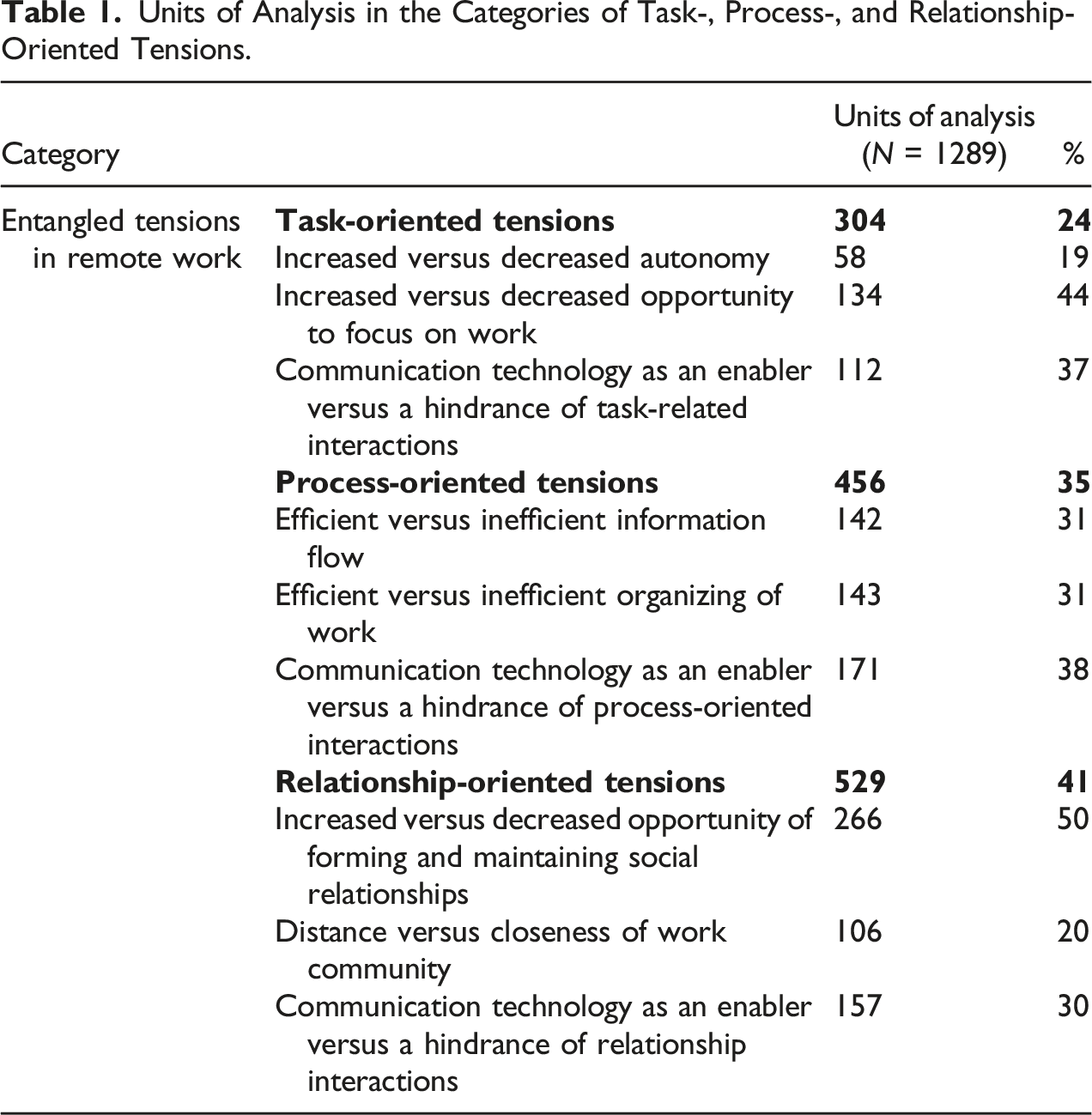
Category
Units of analysis (N = 1289)
%
Entangled tensions in remote work
Increased versus decreased autonomy
58
19
Increased versus decreased opportunity to focus on work
134
44
Communication technology as an enabler versus a hindrance of task-related interactions
112
37
Efficient versus inefficient information flow
142
31
Efficient versus inefficient organizing of work
143
31
Communication technology as an enabler versus a hindrance of process-oriented interactions
171
38
Increased versus decreased opportunity of forming and maintaining social relationships
266
50
Distance versus closeness of work community
106
20
Communication technology as an enabler versus a hindrance of relationship interactions
157
30
Appendix B
Table 2
Tensions in Knowledge Workers’ Remote Work and Technology-Mediated Communication Practices During the COVID-19 Pandemic.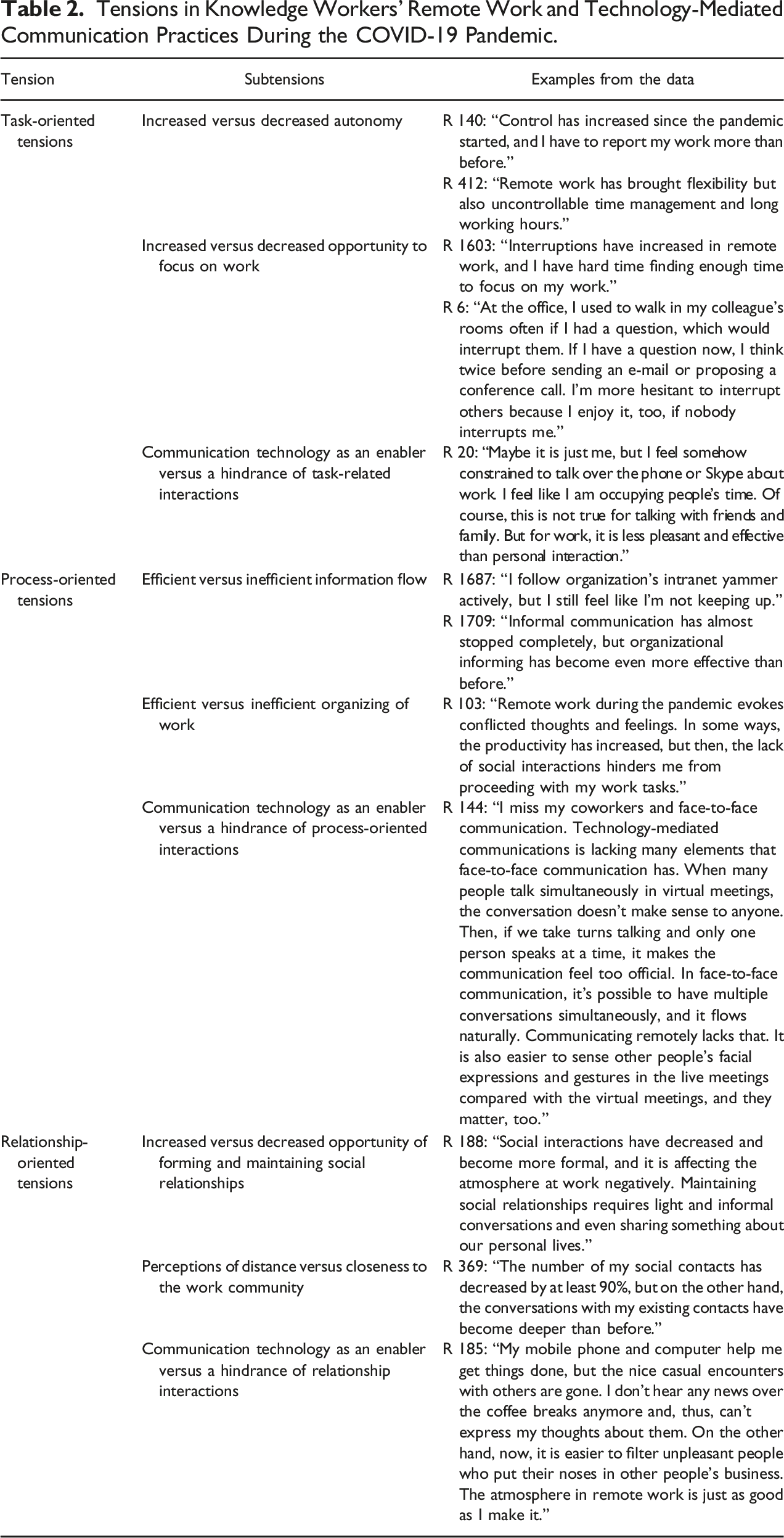
Tension
Subtensions
Examples from the data
Task-oriented tensions
Increased versus decreased autonomy
R 140: “Control has increased since the pandemic started, and I have to report my work more than before.”
R 412: “Remote work has brought flexibility but also uncontrollable time management and long working hours.”
Increased versus decreased opportunity to focus on work
R 1603: “Interruptions have increased in remote work, and I have hard time finding enough time to focus on my work.”
R 6: “At the office, I used to walk in my colleague’s rooms often if I had a question, which would interrupt them. If I have a question now, I think twice before sending an e-mail or proposing a conference call. I’m more hesitant to interrupt others because I enjoy it, too, if nobody interrupts me.”
Communication technology as an enabler versus a hindrance of task-related interactions
R 20: “Maybe it is just me, but I feel somehow constrained to talk over the phone or Skype about work. I feel like I am occupying people’s time. Of course, this is not true for talking with friends and family. But for work, it is less pleasant and effective than personal interaction.”
Process-oriented tensions
Efficient versus inefficient information flow
R 1687: “I follow organization’s intranet yammer actively, but I still feel like I’m not keeping up.”
R 1709: “Informal communication has almost stopped completely, but organizational informing has become even more effective than before.”
Efficient versus inefficient organizing of work
R 103: “Remote work during the pandemic evokes conflicted thoughts and feelings. In some ways, the productivity has increased, but then, the lack of social interactions hinders me from proceeding with my work tasks.”
Communication technology as an enabler versus a hindrance of process-oriented interactions
R 144: “I miss my coworkers and face-to-face communication. Technology-mediated communications is lacking many elements that face-to-face communication has. When many people talk simultaneously in virtual meetings, the conversation doesn’t make sense to anyone. Then, if we take turns talking and only one person speaks at a time, it makes the communication feel too official. In face-to-face communication, it’s possible to have multiple conversations simultaneously, and it flows naturally. Communicating remotely lacks that. It is also easier to sense other people’s facial expressions and gestures in the live meetings compared with the virtual meetings, and they matter, too.”
Relationship-oriented tensions
Increased versus decreased opportunity of forming and maintaining social relationships
R 188: “Social interactions have decreased and become more formal, and it is affecting the atmosphere at work negatively. Maintaining social relationships requires light and informal conversations and even sharing something about our personal lives.”
Perceptions of distance versus closeness to the work community
R 369: “The number of my social contacts has decreased by at least 90%, but on the other hand, the conversations with my existing contacts have become deeper than before.”
Communication technology as an enabler versus a hindrance of relationship interactions
R 185: “My mobile phone and computer help me get things done, but the nice casual encounters with others are gone. I don’t hear any news over the coffee breaks anymore and, thus, can’t express my thoughts about them. On the other hand, now, it is easier to filter unpleasant people who put their noses in other people’s business. The atmosphere in remote work is just as good as I make it.”
Appendix C
Open-Ended Survey Questions 1. What kinds of thoughts and feelings do you have related to the current work situation caused by the COVID-19 pandemic? 2. Please describe the nature and requirements of your work. What has changed the most in your work in the current situation? 3. What has been especially challenging because of the COVID-19 pandemic? 4. How do you feel about interaction and communication in the organization during the COVID-19 situation? 5. How has collaboration with coworkers and other people changed because of remote work? 6. How do you maintain social relationships with your coworkers while working remotely and not meeting them at work (coffee breaks, lunch, etc.)? 7. Has your opportunity to follow and participate in your organization’s operations changed because of the COVID-19 pandemic? How so? 8. On what work issues would you need support or training in the pandemic situation?