




Abstract
The occupational images associated with paid care work for older adults range from a job carried out by earthly angels to a form of stigmatized dirty work: This ambiguity makes maintaining a committed long-term care workforce challenging. Encouraging careworkers to view their work as meaningful has been touted as a potential solution. Moving beyond a purely subjective approach to meaningfulness, we explore how careworkers construe their work as meaningful and how relational others influence careworkers’ ability to speak about meaningfulness. Others’ messages matter, although their importance depends on relational others’ knowledge of care tasks and involvement in the care relationship. By documenting how others’ accounts both enhance and compromise careworkers’ ability to speak about meaningfulness and moments of meaninglessness, our study identifies sources of meaningfulness for careworkers, a socially essential workforce under-examined by meaningful work research, and extends meaningful work research in contexts where relationships are central to occupational identity.
Paul Osterman (2017) opens his analysis of sustainable long-term elder care systems with a vitally important question: “Many of us will need help when we get old – help with shopping, with getting dressed, with using the bathroom. Who will help us?” (p. 3). Ensuring assistance with the activities of daily living may involve hiring paid caregivers. Yet, in addition to low pay and difficult work conditions, the poor occupational image associated with elder care means that building capacity in the long-term care workforce is challenging (Nazio, 2019). Alongside positive images of careworkers as earthly angels (Percival et al., 2014) and saints (Solari, 2006), we find occupational narratives that position care work tasks as demeaning rather than meaningful: The web of meanings around care work often includes terms such as low status, physically demanding, routinized, non-professional and exploitative (McAllum & Elvira, 2015). Within this framing, workers who are marginalized due to gender, race, immigration status and/or lack of formal education perform dirty work that involves constant contact with stigmatized subjects such as bodily fluids, human waste, disease, and death. In addition to physical taint, care work can be viewed as socially tainted due to workers’ contact with stigmatized populations (Ashforth & Kreiner, 1999).
Despite emerging interest in the meanings of care work (Stacey, 2011), care work scholarship has paid little attention to how careworkers find meaning in work. Yet, the ability to engage in meaningful work has been linked to lower turnover and higher levels of organizational commitment, outcomes that could help ease the elder care crisis caused by the gap between the exponential care needs of a rapidly aging population and the ability to recruit and retain adequate numbers of paid careworkers (Stone, 2017). Humanistic scholars describe meaningful work as a fundamental human need and as a source of wellbeing that enables workers to avoid a meaningless “Monday to Friday kind of dying” (Terkel, 1974, p. xi; Yeoman, 2014).
The bulk of the meaningful work literature situates meaningful work as a subjective experience of flourishing in the workplace. This individualistic perspective overlooks the role that others play in shaping the meaning and significance of work (Lepisto & Pratt, 2017; Mitra & Buzzanell, 2017). By documenting how careworkers and others in their personal and professional networks talk about care work, this study analyzes how relational others’ messages influence meaningfulness. Our data shows that relational others both enhance and compromise careworkers’ ability to speak about sources of meaningfulness and moments of meaninglessness. Surprisingly, we discover that strategies assumed to boost a job’s social significance by broadening task and relational boundaries can harm meaningfulness instead. These findings contribute to the meaningful work literature in three ways: (1) We identify sources of meaningfulness for careworkers, a socially essential workforce under-examined by meaningful work research; (2) we pinpoint the significant role played by specific relational others in the experience of meaningfulness; and (3) we extend meaningful work research in contexts where relationships are central to occupational identity.
We begin with a review of the conceptual contours of meaningful work before turning to what we know about relational others’ contribution to meaningfulness. We then describe how our research context, data collection, and analytical strategy allowed us to integrate multiple relational perspectives on meaningfulness. Our findings weave together careworkers’ accounts of meaningfulness and analyze how organizational representatives, careworkers’ close others, and care recipients influence careworkers’ ability to speak about meaningfulness. The article concludes with implications and directions for future research.
Theoretical Background
The concept of meaningful work is multi-dimensional and lacks a universally agreed upon definition accepted across disciplinary boundaries (Bailey et al., 2019; Laaser & Bolton, 2021; Michaelson, 2021). In addition to this conceptual complexity, the meaningful work literature frequently conflates the meaning(s) of work, meaning at work, and meaning in work. Broadfoot et al. (2008) refer to all three meaning-making processes in their forum essay when they state that “people communicatively create and organize meaning about, through, and for their work and working lives” (p. 153). First, meanings of work, which can be positive, negative, or ambivalent, draw upon broader sociocultural discourses and beliefs about the nature and role of work (e.g., work as drudgery, as punishment, or as a calling) and the value of different occupations (Cheney et al., 2008; Yeoman, 2019). Second, studies of meaning at work examine both “the meaningfulness associated with a particular employer or workplace” (Zorn, 2017, p. 4), and how employers and other organizational representatives can strategically leverage job design, organizational culture, and leadership practices to promote positive workplace experiences for workers (Chalofsky, 2003; Lysova et al., 2019). Third, the ability to find meaning through or in work resonates with research that documents how workers view the occupational tasks they engage in as positive, valuable, and significant (Pratt & Ashforth, 2003; Laaser & Bolton, 2021).
Further complicating attempts to define meaningful work is the co-existence of two contrasting visions in the fields of management, business ethics, and workplace psychology that situate the locus of meaningfulness as either subjectively determined or socially recognized (Lepisto & Pratt, 2017; Michaelson, 2021). In the following sub-section, we outline the premises of both perspectives and problematize the self-other dichotomy underpinning the subjectively determined perspective. We then articulate our own communicative view of meaningful work, which takes an explicitly intersubjective, relational approach. Finally, we assess scholarly knowledge about how organizational dynamics and interactions with leaders, colleagues, and significant others influence workers’ access to meaningful work.
The Subjective-Social Dichotomy in Theories of Meaningful Work
What we call the subjectively determined perspective on meaningful work dominates popular and scholarly accounts of meaningfulness. According to much of this literature, jobs that offer opportunities for self-expression (creativity, task variety, interesting work), self-efficacy (autonomy, competence), self-connection (authenticity, integrity), and self-worth (impact, purpose, contribution) generate meaning in work (Bailey & Madden, 2016; Cheney et al., 2008; Lips-Wiersma & Morris, 2009; Pavlish & Hunt, 2012; Rosso et al., 2010). Another strand of the subjectively determined perspective asserts that it is workers’ attitude that enables them to flourish, irrespective of job characteristics and adverse circumstances (Ciulla, 2012). In this reading, the ability to find meaning in work is completely detached from socially shared meanings of work. When individuals are held to be “the ultimate arbiters of the meaning of their own work, meaningfulness becomes self-referential” or “meaningful for me” (Michaelson, 2021, p. 416; Michaelson et al., 2013), such that a job that is meaningless for one person may be highly meaningful for another.
Two problematic assumptions underpin the subjectively determined perspective. First, it takes for granted the existence of untrammeled individual agency or what Laaser and Bolton (2021) call “absolute autonomy” (p. 373). For instance, Wrzesniewski et al. (2013) propose that all employees have some latitude to engage in job-crafting or the proactive adjustment of the task, relational, and cognitive boundaries of their work. These changes, they argue, enable workers to alter the meaning of work and thus its significance or meaningfulness. Hospital cleaners, for instance, expanded their job’s relational boundaries by interacting with patients and family members. Nonetheless, the contribution of worker-initiated changes to meaningfulness was tempered by interactions with family members who criticized their work or deliberately made a mess, diminishing cleaners’ ability to envisage their work as worthy (Dutton et al., 2016). Individual agency runs up against interpersonal, institutional, social, and “political dynamics that shape the nature, availability and experience of MW [meaningful work]” (Laaser & Bolton, 2021, p. 10).
Second and relatedly, the subjectively determined perspective erroneously presupposes that finding meaning in work is an entirely individual accomplishment. However, we posit that meaningfulness, which is the “the output of having made sense of something” (Rosso et al., 2010, p. 94) and, in this case, of the work one does, is an intersubjective rather than subjective process. Such sense-making relies on collective efforts to assign meaning to equivocal experiences (Weick, 2001). The interpretation of events that a group retains also implies the selection of a particular identity for the actors involved (Kramer, 2017). For example, the home-based careworkers in Stacey’s (2011) ethnography interpreted their work as vocational, dignity-enhancing, and the expression of a “caring self.” By contrast, highly educated Zimbabwean migrant workers who took up care work positions on arrival in the United Kingdom viewed their job as degrading and meaningless. They ironically joked that they and their compatriots had become “bum technicians” or newly minted members of the BBC: “British Bottom Cleaners” (McGregor, 2007).
The sensemaking process often takes the form of sensegiving communication or persuasive attempts to orient others’ sensemaking “toward a preferred redefinition of (…) reality” (Gioia & Chittipeddi, 1991, p. 442). In the care work literature, managers and organizational leaders engage in sensegiving when they engineer meaningfulness at work for careworkers. Solari’s (2006) study of two religious resettlement institutions for Russian immigrant careworkers suggests that, by privileging certain sources of meaningfulness (e.g., autonomy or spirituality), each organization foreclosed others. Jewish workers, encouraged to view themselves as professionals, disliked providing intimate personal care and reported low relational satisfaction. By contrast, the Russian Orthodox organization framed workers as saints who developed quasi-familial relationships with clients. Orthodox workers experienced more joy at work but did more overtime. With good reason, commentators worry that organizations “paint an exaggerated picture of pro-social impact” (Michaelson et al., 2013, p. 86) to justify longer hours and lower pay, as the literature tends to dichotomize meaningfulness and money (Bunderson & Thompson, 2009). Indeed, managers in the Australian residential and community aged care sector reinforced a discursive opposition “between care as love-centred and work as money-centred” (Palmer & Eveline, 2012, p. 254). They drew upon a familial logic of care based on self-sacrifice and moral obligation to downplay careworkers’ skillfulness and perpetuate lower wages.
The social recognition perspective, which we present next, highlights the key role that others play in evaluating a job’s worth and thus its significance or meaningfulness (Ashforth & Kreiner, 1999; Dutton et al., 2016; Tosti-Kharas & Michaelson, 2021). Concepts such as occupational prestige, occupational stigma, social comparison, and social devaluation lay the theoretical groundwork for what Michaelson (2021) calls “social accounts” of work that are meaningful “in the eyes of others” (p. 419, italics in the original). When these accounts are negative, workers whose jobs are considered dull, dirty, or degrading may engage in stigma management communication (e.g., Meisenbach, 2010; Tracy & Scott, 2006; van Vuuren et al., 2018). The stigma management literature enumerates multiple strategies that enable members of stigmatized occupational groups to redefine the meanings attached to their work (Meisenbach, 2010). Strategies include (1) reframing or transforming work meanings by infusing organizational mission with positive value and recasting tasks as skillful and edifying; (2) recalibrating or adjusting the magnitude/valence of job attributes (e.g., making a smaller attribute more important); and (3) refocusing or shifting attention from stigmatized to non-stigmatized features of a job (Ashforth & Kreiner, 1999; Meisenbach, 2010).
However, the ability to transform occupational meanings depends on available socio-cultural discursive resources. Tracy and Scott (2006) found that correctional officers had trouble reframing feminized tasks like strip searches and chaperoning prisoners to the bathroom and were thus unable to shake off their image as the “scum” of law enforcement. Careworkers may face similar obstacles to meaningfulness. In addition to the physical taint associated with intimate body work, care work is often perceived as socially tainted due to workers’ contact with stigmatized populations. Older adults requiring care are often objectified, stripped of agency, and attributed a fragile, disempowered status as “soiled, hungry, anxious people who must be transformed into clean, replete, calm people” (Bolton & Wibberley, 2014, p. 684). Stigma-by-association (Kulik et al., 2008) is particularly pronounced for careworkers who work with older adults with dementia (Blum, 1991) and is compounded by the presumed relation of servility that links careworkers, whom Bolton (2007) labelled the 21st century servant class, to their clients. Indeed, the term service has roots in the Latin word servus, meaning slave or servant. Physical and social taint thus combine to construct care work as a job carried out by unskilled workers who do not have more attractive options, making justification of its value more difficult.
Yet, alternative occupational discourses do exist. Akin to the aura surrounding motherhood, care work occupies a “pedestal of respect” (England et al., 2002, p. 458) and is revered due to its link with unconditional love, sacrifice, and heroism (McAllum & Elvira, 2015). Twigg (2000) points out that the very term care “has a warm and loving quality to it, and it is difficult (…) to detach it from this halo effect. Simply to describe work as carework takes it into a special realm of value” (p. 393). Surprisingly, the literature offers few insights into how careworkers manage the tension between occupational discourses that present eldercare as either heroic or horrific as they justify the value of their work.
Another significant oversight in the social recognition literature, which focuses almost exclusively on individual workers’ micro-level attempts to transform negative macro-level discourses about their work, is analysis of the meso, interactional level (Dutton et al., 2016; Laaser & Bolton, 2021). To account for the impact of organizational leaders, colleagues, and significant others on workers’ experience of meaningfulness, we draw upon George Herbert Mead’s pragmatist philosophy to articulate a more communicative take on meaningful work.
A Communicative Lens on Meaningful Work
According to Mead, communication is constitutive of meaning. He argued that objects and experiences do not have intrinsic meaning; rather, actors learn how to interpret and act toward them through social interaction (Sandstrom, 2008). Meanings are retained and become “significant symbols” only when meaning is shared (Mead, 1934). Interaction also enables human beings to develop their sense of selfhood (the “Me” or the self as perceived by others) by anticipating and considering others’ responses to their social acts. This reflexive Me “arises in relationship to a specific or generalized other” (Aboulafia & Taylor, 2023, para. 13). Specific others are relational others with whom the Self interacts (Lundgren, 2004), whereas the generalized other refers to the “organized system of significant symbols that reflects the generalized attitudes, or discourse, of a social group or community” (Simpson, 2009, p. 1335).
The social recognition perspective of meaningful work has contributed much to our understanding of the influence of generalized others on occupational meanings and the agentic actions that workers use to adjust existing meanings or assign new ones. We believe, however, that little empirical work hones in on the role played by specific others at the “meso or interaction level of organizing and communicative practices” (Broadfoot et al., 2008, p. 157). The few studies that mention specific others (e.g., leaders, supervisors, colleagues, and extra-organizational others such as family members) do not center on interactions that connect “actors who are aspects of a relationally integrated whole” but on action “between actors who are (…) independent” (Simpson, 2009, p. 1334). For instance, Carton (2018) details how presidential discourses connecting small daily responsibilities with grand organizational objectives enhanced NASA employees’ ability to see their work as meaningful. Pavlish and Hunt (2012) identify nurse administrators’ constructive management practices as a crucial “environmental condition” (p. 118) enabling acute care nurses to engage in meaningful work. In both cases, specific others’ contribution is contextual rather than central to shared meaning-making.
This lack of focus on joint action also has methodological implications. Although studies may theoretically acknowledge relational others’ importance for meaningful work, researchers do not combine data from both workers and relational others. Oelberger’s (2019) study of how international aid workers’ engagement in deeply meaningful work affected their relationships with “close others” (spouses, partners, other family members, and friends) relies on data from aid workers. In contrast, Tosti-Kharas and Michaelson’s (2021) analysis of the New York Times’ Portraits of Grief, short narratives based on interviews with close relatives and friends of victims of the 9/11 terrorist attacks, focuses solely on close others’ interpretations of their loved ones’ work. They note that recent loss may have led grieving relatives to magnify work’s social value, but that these accounts could not be corroborated by or compared to workers’ own interpretations. Scarduzio et al. (2018) do integrate both parents’ and young adults’ reports of memorable messages about meaningfulness and work, but children were college students not yet in the workforce.
We thus surmise the need for a research design that explicitly incorporates workers’ and specific relational others’ accounts of meaningful work. Such a design, which enables critical reflection on how meaningfulness is enacted during interpersonal interactions, is especially relevant for careworkers who receive mixed messages about the value of their work. Social accounts of paid care work include overtly negative stereotypes of “dirty workers” and admiring, even heavenly, depictions of careworkers as “saints,” “angels,” and “heroes.” Yet, because seemingly positive characteristics such as saintliness, warmth, and loving care are symbolically entangled with the idea of personal sacrifice without reward and un- or under-paid feminized work, available social accounts implicitly position paid care as demanding, exploitative, low-status work. To understand how careworkers construe their work as meaningful amidst messages about care work present in their organizational and personal environments, we ask the following research questions:
How do paid careworkers explain the significance of their work?
How do relational others influence paid careworkers’ ability to speak about their work as meaningful?
Method
Research Sites
Research Site Characteristics.
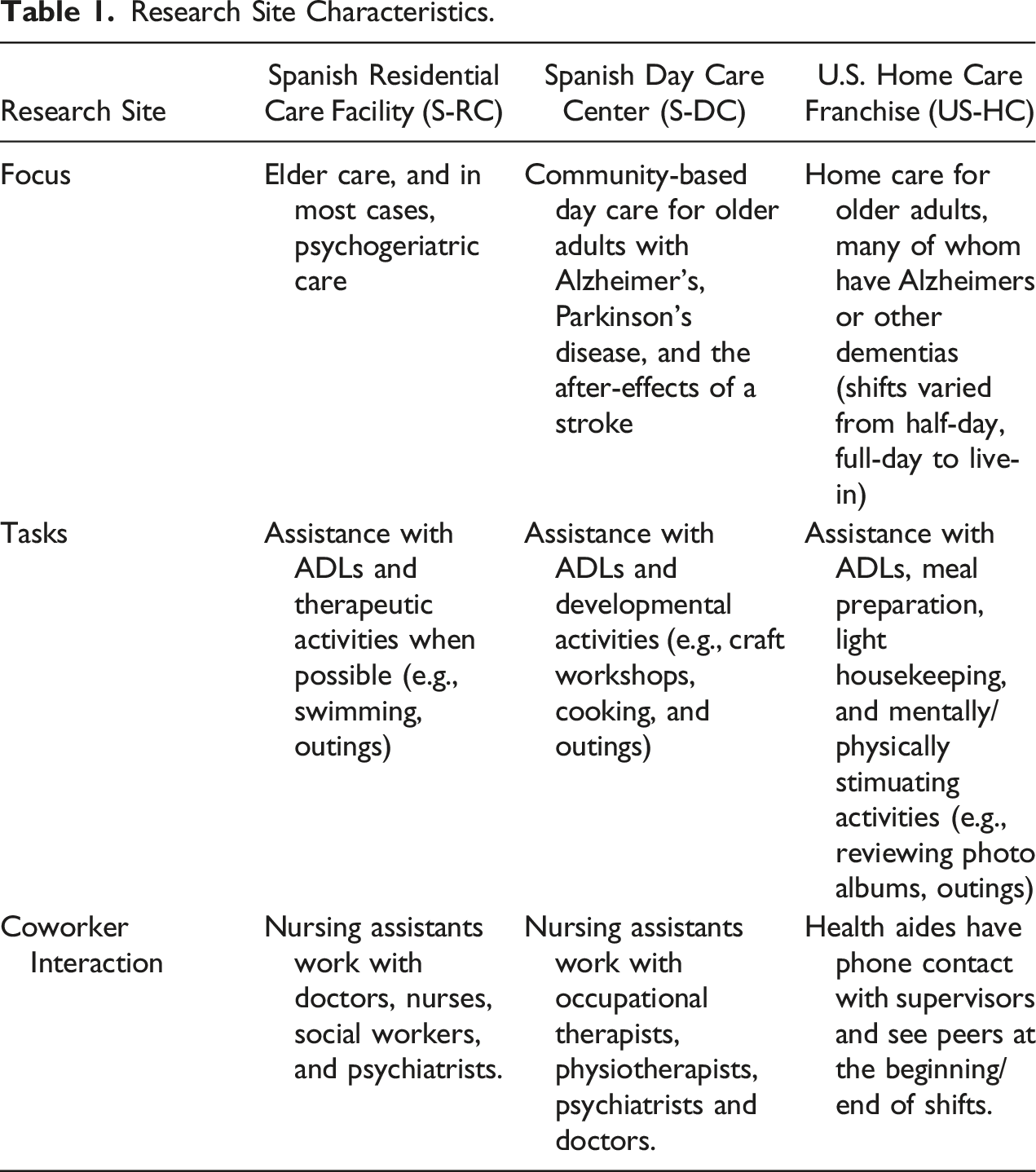
Although the core tasks of careworkers at all three sites were comparable, the accessibility of peer and managerial support and frequency of organizational contact with careworkers varied, allowing us to reflect on how relational others’ proximity impacts careworkers’ ability to speak about meaningful work.
Data Collection
Distribution of Interviews.
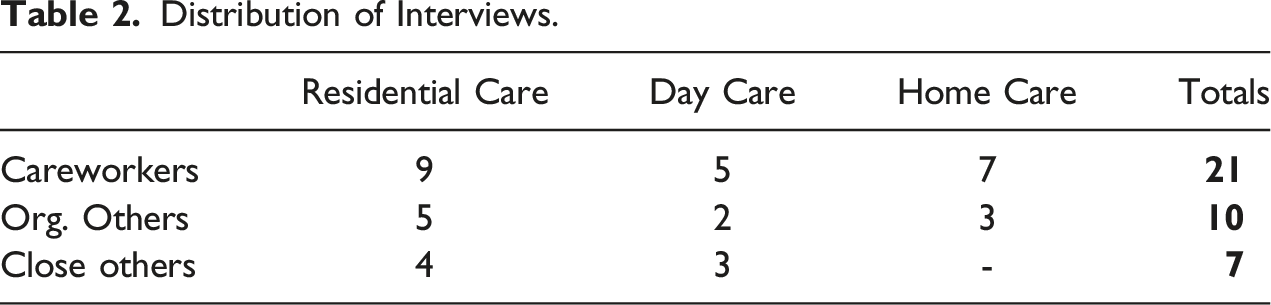
Of the 9 residential careworkers, the 8 women and 1 man had worked in care for 9–24 years (M = 17 years). The 5 day center workers counted 3 women and 2 men with 2–8 years’ experience (M = 5 years). In the two Spanish organizations, careworkers were citizens with a 2-year post-secondary qualification in healthcare. By contrast, of the 100 workers on the homecare franchise’s payroll, only five were born in the U.S. The 7 female home-care workers were all immigrants who had been careworkers for 3–15 years (M = 10 years) after completing the brief training course required for state licensing as a home healthcare aide.
We conducted interviews with careworkers and organizational others in meeting rooms, doctors’ clinics, and client homes. Questions for careworkers focused on their career trajectory, aspects of their work that were especially positive or challenging, and how they explained their job to care recipients, their families, and their close others. We also asked careworkers how relational others talked about care work and their response to those comments. We carried out interviews with close others at the careworker’s workplace or over the phone. Questions for organizational and close others probed for their views on care work, how recipients and their families value care work, and how careworkers talk about their job. Twenty-six hours of recorded data yielded 553 single-spaced pages of transcribed data.
We acknowledge that our positionality as White, educated, bilingual immigrant women mattered particularly during interviews with careworkers and organizational others in the United States. For careworkers, our bilingualism facilitated rapport; managers, who perceived us as part of the establishment, openly shared views on “immigrant” workers.
Data Analysis
Data analysis was a three-step process. To answer the first research question How do paid careworkers explain the significance of their work? we read careworkers’ transcripts multiple times and identified passages where they talked about their job’s importance, evaluated positive/negative work experiences, and justified their motivation to care. We then engaged in line-by-line in-vivo coding of this portion of the dataset in the original language 1 using NVivo data analysis software. First-level in-vivo codes focused on careworkers’ ability to identify and minimize discomfort (e.g., “I noticed she was in pain”), accompany care recipients in positive ways (e.g., “spending quality time,” “seeing them having a go”), and enjoy connecting (“I laughed till I cried,” “They’re my second family”). Following an iterative analysis that “alternates between emic, or emergent, readings of the data and an etic use of existing models, explanations, and theories” (Tracy, 2019, p. 209) from the meaningful work literature, we created second-level analytic codes that encapsulated four sources of meaningfulness: skillfulness; careworkers’ ability to enhance care recipients’ quality of life; personal development; and rich relationships.
To respond to the second research question How do relational others influence paid careworkers’ ability to speak about their work as meaningful? we sought out relational others’ accounts present in both relational others’ and careworkers’ transcripts. We coded relational others’ responses to questions such as “How do you describe care work?”, “How do you feel about [X] working as a careworker?” and “What is particularly rewarding or difficult about their job?” We also combed relational others’ transcripts for comments related to sources of meaningfulness identified by careworkers. Because careworkers’ perceptions of relational others’ views also shape what they choose to share, we then analyzed careworkers’ responses to questions such as “How do the family members of your client talk about your job?”, “What do your own friends and family say about your job?”, and “How does the organization value care work? How do you know this?” For example, first-level codes like “I [careworker] can express myself at work” and “They [organizational others] listen to our suggestions” show how organizational others who include careworkers in planning and feedback reinforce careworkers’ ability to speak about skillfulness as meaningful.
Our third analytical step involved parsing through careworkers’ self-reports (“How did you respond?”) about their reactions to relational others to identify how careworkers responded to these social accounts (see the Appendix for a detailed coding table).
Findings
Because careworkers’ voices tend to be silenced in workplace interactions, we first attend to careworkers’ explanations of their work’s meaningfulness – it is skillful, enhances care recipients’ quality of life, is a source of personal development, and is relationally rich. These facets of meaningfulness arise from interactions with care recipients, specific others who are directly implicated in the enactment of the physical (skillfulness; enhancing quality of life) and emotional dimensions of care (enhancing quality of life; personal development; rich relationships). These interactions lead to the development of a valuable, thriving, more capable “Me” (Mead, 1934). After describing each source of meaningfulness in turn, we analyze how relational others’ social accounts (drawn from relational others’ transcripts and careworkers’ descriptions of others’ comments and actions) helped or hindered careworkers’ ability to speak about meaningfulness. The final section documents strategies that careworkers used to push back against social accounts that framed care work as meaningless.
Throughout, we identify participants using an abbreviated code that indicates country (Spain, S or the United States, US), organizational context (RC, residential care; DC, day care; or HC, home care) and a unique numerical identifier. Names used are pseudonyms.
Skillfulness: Careworkers’ Perspective
For careworkers, their work is meaningful because it is skillful, requiring special knowledge of care recipients and an ability to prevent suffering by detecting slight changes in their condition and acting on observations to make appropriate interventions. The hours and, at times, years spent alongside care recipients meant that careworkers, who “walk around with one hundred eyes” (S-RC-3), knew what care recipients were “telling” them “just by looking at them. You know perfectly well what they’re saying without needing words” (S-RC-1). Interestingly, most participants used “we” rather than “I” to describe their observational skills: “We know, by the expression on their face, that they are in pain. And you try to help by giving them painkiller, and then you see they relax” (US-HC-4). Others insisted that because they knew care recipients “better than anybody else” and realized “that something’s going on or the patient will go to the caregiver to tell them” (S-RC-5), careworkers were “the primary source of information” (S-RC-5). S-RC-14 proudly claimed that “truly, the doctor obtains much less information in an interview than a nursing assistant.”
Alerting others to observed changes often had significant consequences. According to S-RC-5, when care recipients “attempt suicide, a careworker can make sure that it doesn’t succeed by communicating in time.” US-HC-7 called an ambulance when the care recipient seemed in more pain than usual: I looked at the [colostomy] bag and it looked too red to be urine. And when I looked closer, I said, “Wait a minute! That looks like blood.” I had to call 911. And it was true, it was the tool they had put in her – directly in her kidney.”
S-DC-1’s careful observation of one of his clients who was “reacting in a strange way” meant quicker identification and treatment of a stroke. He concluded, “We see all those things. We notice when something’s not right.”
Skillfulness: Relational Others’ Perspectives
Organizational others and care recipients’ relatives who directly witnessed task performance both reinforced and undermined careworkers’ ability to describe themselves as skillful. Recognizing skillfulness encouraged ever greater creativity and responsibility.
Organizational Others
Organizational others acknowledged skillfulness by including careworkers in planning and feedback, and by praising careworkers’ ability to overcome challenging obstacles, thus affirming care work’s complexity. In the first case, supervisors integrated careworkers’ knowledge of what would best serve care recipients’ welfare and development into care decisions. S-DC-3, a day center manager, explained that careworkers “contribute to my knowledge, letting me know, ‘With this person, doing it this way would be better.’” S-DC-6, a careworker in the same center, reiterated that she had “free rein” to propose and implement new activities. Organizational others who listened to careworkers’ opinions during meetings about patient care also enabled careworkers to communicate their knowledge: The hierarchy isn’t palpable. The medical coordinator taught us that there are no little people nor little opinions (...) That gave us a bit of freedom to say, “I’ll bring this up, this is what the patient has said, this is what I think, and I know him because I work constantly with him,” give importance to that, and as a result see what we could change in the unit to help him.” (Careworker S-RC-6)
Supervisors in the day center who included careworkers’ remarks in feedback sent to care recipients’ relatives likewise highlighted careworkers’ carefully honed observational skills.
Organizational others also affirmed skillfulness by acknowledging the job’s challenges. US-HC-10, a manager, regularly expressed gratitude for careworkers’ dedication to difficult clients. Careworker US-HC-2 appreciated her supervisor calling to tell her that she “did a wonderful job. ‘No-one has stayed there longer than this, but you stayed on.’ Saying that is really something. It means a lot to me.” Careworker S-RC-3 also valued praise that “this unit works wonderfully. They don’t tell you that every day, maybe once a year and with that you have enough to last you forever.”
Conversely, organizational others devalued careworkers’ skillfulness by ignoring their input. Careworker S-RC-5 felt upset when staff “don’t count on our opinion” and Careworker S-RC-9 observed that “when asking [if medication needs to be changed] they do listen, but when it’s the nursing assistant who takes the initiative, then they don’t. At times, the assistants notify them [about symptoms] and yet they’re not listened to. This happens every day.” Careworker S-RC-8 confirmed that telling the doctor directly that “today Pepito is so-so, because he’s said x, y or z, which is very strange for him” was generally ineffective.
Lack of thanks and acknowledgement of careworkers’ tasks also made skillfulness invisible. One supervisor insisted that giving positive feedback to a workforce composed of “Third World workers” was counter-productive, since “compliments are what you get whenever you don’t need to do your job well anymore” (Manager US-HC-9). Although it seems unlikely that careworkers were aware of such racist comments, they did notice omissions: “Many times they don’t acknowledge you, ‘Hey, you’re doing a good job’” (Careworker S-RC-15). After saving a choking patient, Careworker S-RC-8 wished that “the next day, someone could have said, ‘Whoa, what a tough afternoon you had yesterday. What a wonderful team we had.’”
Care Recipients’ Relatives
Careworkers appreciated comments from relatives that recognized the obstacles careworkers faced in their work, such as “Did she treat you alright? Oh, hang in there, honey” (US-HC-2) and “I know that you’re doing everything you can. If it weren’t for you, this wouldn’t be possible” (S-RC-15). More frequently, relatives undermined meaningfulness by failing to ask careworkers for feedback or casting doubt on careworkers’ skillfulness. Families typically asked medical professionals rather than careworkers for information (Careworker S-RC-9). Careworker S-RC-1 aired her frustration: Why ask the doctor if the assistant is next to you? (...) I can’t give you blood test data, but I can tell you how your father has spent this week, day by day, because it’s me who’s getting him up, feeding him, showering him, and putting him to bed.
Organizational representatives corroborated that families directed queries to other staff, checking in with the physiotherapist about mobility instead of “looking a bit at the nursing assistant who’s working hand in hand with their relative” (Manager S-DC-3). S-RC-4, a social worker, referred to careworkers’ invisibility in service provision when she explained that some families “write a thank you note to the doctor, the psychologist, the social worker, and the coordinator, but not to the nursing assistants.”
Care recipients’ family members could also diminish meaningfulness by questioning careworkers’ skillfulness. Careworker US-HC-7 reported having “stage fright” when the wife of a man who used a breathing mask watched her continually. Careworker S-RC-14 noted that “people are interested in seeing how you interact with their relative, possibly looking for a fault.” Criticism that insinuated that care was of inferior quality due to insufficient skill, attention, or affection expressed appreciation for the job itself but expressed concern about individual careworkers’ ability to carry it out.
Enhancing Quality of Life: Careworkers’ Perspective
Careworkers described their work as meaningful because it enhanced care recipients’ quality of life by acknowledging their personhood, being present to and with them; ensuring their physical comfort; and developing care recipients’ potential, increasing their independence and ability to participate in varied activities. The first aspect of acknowledging personhood involved being fully present to and with care recipients. US-HC-2 stated that “you have to live in a way that that person feels like they’re not alone.” S-RC-14 explained that this meant physical closeness, because if “the two of us are here, me needing to get up early to work and you who’re sick, we might as well laugh, kiss, touch so that you know ‘See, I’m here with you.’” Similarly, S-RC-5 insisted that her job was meaningful because attentive listening enabled care recipients who were feeling down to unburden themselves: “Perhaps you’ve said two words to them and they’re already smiling. That’s very rewarding.” For US-HC-3, “being there” meant spending three hours in a hospital waiting room so that a care recipient without family saw a familiar face when she came out of surgery.
Acknowledging personhood also involved ensuring care recipients’ physical comfort. Careworkers dealt with the difficulties of incontinence by describing how quality care improved recipients’ lived experience. US-HC-6 spoke at length: To see the clients having that glow in their face of fulfilment instead of screaming and shouting and grouchy. I like to see them have that face like, “I’m comfortable, I’m watching TV, I’m dry, I feel okay, I feel good.” Because that’s what we want. As a caregiver, we want dignity, and we want comfort. And we want them to be seen and heard. So that’s what I provide for them. I want to look at you. I want to see you. I want to hear you. I want to listen to you. I want to make sure you’re comfortable. I want you to be the way you lived, dignified and respectful.
Along the same lines, S-RC-15 explained that “You do have to put up with many unpleasant things but seeing that I can help someone who really needs it – for me nothing compares with that, absolutely nothing.”
Enhancing quality of life also entailed developing care recipients’ potential by increasing independence and ability to participate in activities. Careworkers enlarged the scope of everyday tasks which became opportunities for mental rehabilitation, social connection, and mobility development. US-HC-6 used household objects to help a care recipient with Alzheimer’s recall memories. They discussed “friends who sent her flowers, orchids, because she likes orchids (...) ‘Look at the orchids, look at the picture. Who is that person in the picture?’” S-RC-3 explained how developing a care recipient’s autonomy was meaningful: “She was going away to a beach camp – here they live better than kings! – but didn’t want to go because she didn’t know how to put in her denture.” Despite her initial annoyance, she later expressed her gratitude: “Thanks to you, I learnt to put in my denture. Otherwise, I wouldn’t have gone to camp.” For other careworkers, care recipients’ growth in confidence generated meaningful moments. S-DC-2 described her joy at seeing “this man who, when he first arrived, was almost unable to walk and now he happily walks on his own” and another who, after an outing to a museum, was able to go home and say “Wow, today I stood by myself!” S-DC-6 explained that thanks to her job, care recipients “feel fulfilled as people, they sometimes do things they’ve never had a chance to try before, and when they give them a go, they have a ball.”
Enhancing Quality of Life: Relational Others’ Perspectives
Care recipients contributed to careworkers’ ability to invoke quality of life as a source of meaningfulness when they expressed gratitude for careworkers’ efforts or when careworkers could blame lack of appreciation on recipients’ illnesses. However, this strategy was not feasible when careworkers’ close others spoke of care as undignified and degrading.
Care Recipients
Care recipients, who responded to careworkers’ presence by smiling, “grabbing your hand, and looking back at you” (Careworker S-DC-6), bolstered careworkers’ sense of their work’s significance, even if they could not articulate it fully. As Careworker S-RC-8 stated, “I’m unable to put into words what patients’ signs of gratitude about how important you are to them mean to someone who’s never experienced it” (Careworker S-RC-8). Careworker S-RC-3 explained: When I open the door and see Alberto who is probably sitting there [outside the office], he says to me, “Godmother, what a hard worker you are! You’re always the first to arrive. Good thing you replace the towel in the morning, because when they take them away, I have no towel after I brush my teeth—” That fulfills me.
Others described that “happiness for me is to see you well” (Careworker S-RC-3) and that “seeing their happy faces (...) goes a long way” (Careworker S-DC-2).
Other care recipients rejected outright the idea that careworkers improved their quality of life. Instead, they interpreted careworkers’ actions as an obstacle to their autonomy and reacted with physical resistance or verbal insults that denigrated careworkers’ interventions. Care recipients yelled out insults (S-RC-3), cursed (US-HC-1; US-HC-3), scratched, and bit (S-RC-3). This behavior did not necessarily lead careworkers to describe their work as meaningless if they could blame it on the illness: “It don’t really bother me anymore because I know it’s not them (US-HC-1); “That’s normal because they have Alzheimer’s” (US-HC-3); “It makes no difference (...) Mental illness is like that” (S-RC-3). When careworkers could not attribute criticisms to impairment, however, meaningfulness was elusive.
Careworkers’ Close Others
Close others who viewed care work as physically disgusting work that consisted mainly in toileting older adults (Careworker S-DC-3) diminished careworkers’ ability to speak about their contribution to care recipients’ dignity and development. Some close others claimed that careworkers were “crazy” to do this work (Careworker S-DC-9) and attempted to dissuade them from pursuing care work as a career (Careworker S-DC-2). Careworker S-RC-5’s friends found her career choice incomprehensible: “It’s like, ‘Ugh, do you need to shower them?’ ‘Ugh, how gross’ (...) There are all kinds of reactions, but almost everyone is like, ‘Ugh, a psychiatric unit,’ ‘Ugh, how scary.’” Others stymied careworkers’ ability to explain how their work improved care recipients’ quality of life by describing care work as dangerous and therefore meaningless. Relatives spoke about care work as unsafe, “physically exhausting work” (Close Other S-DC-10), “such a hard job, so tiring and yet so little recognized, one that pays a third-world salary (...), and that puts [her] physical integrity in danger” (Close Other S-RC-11). Careworker S-RC-15 acknowledged how difficult it was for her partner to see her bruises: “He tells me, ‘Don’t put up with it. If they’re hitting you, change jobs’ (...) but I know I’d miss it if I left.”
Personal Development and Rich Relationships: Careworkers’ Perspective
Careworkers spoke at length about care work as a means of personal development based on learning from care recipients; learning through their job; and learning about themselves, deepening their personal qualities, and identifying personal strengths. Careworkers explained how much they learnt from care recipients who “start telling you things from their youth, about their life, where they’ve worked” (S-DC-8) and who share “harsh stories about the calamities they’ve lived through” (S-RC-9) during the Depression or the Spanish civil war. US-HC-3 recalled that “I learned so much about the Holocaust and Hitler that I didn’t know from history books, from talking to patients.” She concluded, “it’s like a movie (...) hearing their stories, it’s like you’ve seen it, because you’re actually meeting somebody that went through it, that lost their whole family, their brothers, sisters, their mother, and they’re the only survivor.” Others learnt more than history. In one striking example, a 96-year-old care recipient taught her careworker (US-HC-6) to paint: She made me look at color in a different light: the color of sunset, the color of sunrise. I never knew there were so many colors. The ocean is aqua. I thought it was blue and green, but it’s aqua. You know, it’s not just a tree, plant, or flower. You have to look at everything individually. You have to focus. You have to enjoy. You have to look at the petals, at the different hues, the different highlights, shadows.
This participant continued to paint even after her client had passed away.
Careworkers also described the meaningfulness of learning through their job and continually upskilling. S-RC-7 noted that “every day you get more training, and it educates you. Sometimes you register someone new, and you have to go deeper into stuff you haven’t done before. Really, you never stop learning new things.” S-RC-14’s explanation was particularly poignant. She exclaimed that she could never sufficiently express her gratitude for what her work had taught her, as it enabled her to care for her teenage son with terminal cancer in the best possible way: “At every moment, I knew what was good for him and what wasn’t. (…) He didn’t develop ulcers, vein stains, or redness. He was clean and comfortable in bed all the time (...) That’s priceless.”
Personal development also involved learning about oneself, acquiring qualities such as maturity, responsibility, the ability to “open up” to people, greater patience, and adaptability. S-RC-5 stated that “It’s enriched me as a person. In the end, I think that working with people is the way you become more human.” Care work also revealed unsuspected personal strengths. Although the care recipient kicked her on her first day on the job, US-HC-2 hoped that her positive outlook on life might eventually rub off. She explained that “I wanted to take up the challenge and, in the process, you learn something about yourself. Oh my God, I didn’t know I am this strong! Oh my God, I can handle this, you know.”
Careworkers also frequently cited establishing rich, affection-filled relationships with care recipients as a source of meaningfulness. They described “loving friendships” (S-RC-14; US-HC-1) and being “like family” (S-RC-1; US-HC-7). US-HC-2 summarized, “When you hear, ‘You’re family,’ you feel a sense of fulfilment. You know, like, I can die.” Care workers enjoyed sharing laughs and receiving greetings or gifts for their own families. One care recipient spent an entire morning creating a drawing: “Though they don’t know anyone in your family, they say, ‘Here, take this for your mom.’ Wow, how cool” (S-RC-1).
Personal Development and Rich Relationships: Relational Others’ Perspectives
Astonishingly, although organizational supervisors alluded to how care work promoted interpersonal sensitivity, relational others never mentioned care work’s contribution to personal development. Instead, careworkers’ close others’ appreciation of emotionally satisfying or entertaining interactions encouraged careworkers to speak about rewarding careworker-care recipient relationships. S-RC-10, a careworker’s husband, commented that “it’s a job that if you really like this work with this kind of people, you’re hooked.” A daughter reported “being very moved” by the affection her mother received (S-RC-13).
The bulk of the data, however, suggests that close others avoided conversations about relationally draining work related to death and behavioral challenges. Close others glossed over or dodged discussions about death. Careworker S-RC-1, greatly saddened by a care recipient’s death, was told that it did not make sense to grieve for someone outside her family circle. S-DC-5’s parents, who felt close to people they heard so much about, asked her not to tell them when care recipients died because it pained them too much. When careworkers shared anecdotes about commonplace but difficult behavior, most close others recommended that they change jobs. A careworker’s husband insisted that “she shouldn’t (...) feel the pressure she’s under. I encourage her to look for a job that’s, in quotation marks, more office-based” (S-RC-11). When S-RC-14 recounted at home, “I had a bad day, this happened,” her family suggested, “If you don’t like it, look for another job,” insinuating that meaningful work should not entail excessive stress and suffering. US-HC-5’s children told her she needed to “relax a little bit (...) Do something for yourself, move on.” US-HC-2’s weekly conversations with her sister were similar: “‘So how is it going?’ I said, ‘It’s hard, but I’m coping.’ ‘Oh, knowing you, you will. But why don’t you take up. . .?’” US-HC-2’s adult children also pushed her to give up a client who was “a hundred times” more difficult to care for than their grandmother: “My boys ask, ‘Mom, why do you have to do that?’ Because I tell them, ‘It’s so challenging. It’s hard.’ ‘You don’t have to do that.’”
Careworkers’ Reactions to Social Accounts that Present Care Work as Meaningless
When confronted with criticism and stigmatizing messages, careworkers reported using reframing and refocusing, strategies assumed to augment a job’s social value and therefore its meaningfulness (Ashforth et al., 2007). Reports of reactions to organizational others are noticeably absent, an issue that we address in the discussion.
Reframing Work Meanings to Maintain Meaningfulness
Careworkers suffered when care recipients’ relatives complained that they did not care about their loved ones or that they cared for them poorly. For instance, Careworker S-RC-15 felt wounded when families “treat you as though you are the worst ever, that ‘You understand nothing, because my son is very ill’ (...) That hurts a lot because they’re telling you, ‘If this were your son.’” However, our data suggests that careworkers maintained a sense of meaningfulness by reframing their work as emotionally as well as technically skillful, requiring empathy and resilience or the ability to bounce back from adversity (Buzzanell, 2010). They described families’ emotional outbursts as “normal” and described their ability, as workers “at the ready” – literally “at the foot of the cannon” (Social Worker S-RC-2; Nurse S-RC-4) – to absorb negative emotions and worries. Careworker S-RC-5 explained that “we’re the ones closest to the family so they complain to us (. . .) In the end, that’s normal. Empathy – many people behave badly, but it must also be very difficult for them.” Careworker S-RC-1 confirmed that, “there are moments of fury and rage which are hurled against us as well, but you understand their situation too.”
Another source of meaninglessness came from care recipients who insinuated that intimate personal care was repulsive. Careworker US-HC-6 recounted how she reacted to a subtle criticism by orienting to the outcome of care, thus defending her work’s value: Mrs. Burgess said, “I could never do that job. I could never clean up somebody’s diaper.” I said, “But somebody has to do it for you. You can’t do it for yourself. You know, I have to do it for you because you can’t do it.” “Oh, you’re so good. You’re so good.” She says that and then she relaxes.
Yet, if care recipients rejected positive meanings, meaningfulness was fragile. Careworker US-HC-3 described a profoundly negative interaction with a care recipient who insisted that she must “like” performing intimate care. Her reply reframed the task’s connection with quality care and comfort: “No, don’t get the wrong idea. No, I don’t. I just got to make sure you are proper, because you could get a yeast infection and a number of things.”
Refocusing Through Occupational Advocacy
Careworkers reacted to close others’ stigmatizing social accounts by engaging in a form of occupational advocacy that focused relational others’ attention on care work’s contribution to quality of life. When confronted with individuals in her network with “pre-conceived, very stigmatized ideas (...) I tell them about the job. They say, ‘Well, I didn’t like old people before, but since you’ve been telling us things, maybe we wouldn’t mind working with this group one day’” (S-DC-3). Careworker S-DC-2 explained that “I like to show that what I studied is useful, that I like it, and that I’m useful. I have to show him [my father] the interesting challenges that I face.” Some close others became attuned to care work’s social value. S-DC-10, a careworker’s sister, exclaimed, “I didn’t know they did so many activities, or that the center was so positive for them!” and S-RC-9, a careworker’s husband, concluded, “It’s a beautiful job because, at the end of the day, you’re taking care of people.”
However, refocusing on the positive led careworkers to self-censor. They played down relational difficulties and stopped mentioning physical tasks that close others viewed as meaningless. Some careworkers seldom talked about their actual tasks (S-RC-5) or stopped sharing anecdotes, “because when I try, they only retain the part that he’d peed his pants” (S-RC-8). S-RC-14 corroborated, “Each day, I say less.” Others did share but described the day in such a way that “my father sees the part that is satisfying” (S-RC-5). US-HC-2 insisted that “I talk about it, but I don’t say the – the hard things, because she [her mother] would be worried.” US-HC-6 explained that “I don’t complain, so they [the children] love it.” When US-HC-7’s family “asks me ‘How was work?’ I’m like, ‘It was good.’” Several close others confirmed careworkers’ focus on positive relational aspects. The partner of one careworker reported that when they chatted about work, she just shared funny moments and updated him on the day’s craft activities (S-DC-7). A careworker’s sister mentioned that she “always laughs. She always tells anecdotes about people, though I don’t know their names – ‘You know, that lady who wanted to teach me German’” (S-DC-10). Insightfully, she reflected “Perhaps she only tells me what’s funny, but anyway.”
Insisting Upon Subjective Meaningfulness?
When close others did not target specific tasks but made global critiques (e.g., urging careworkers to change jobs), careworkers used expressions such as “I like,” “I’m content with,” “I love,” and “I enjoy” to deflect objections. When US-HC-2’s children demanded she quit, she replied, “I want to do it,” and “I would say – I don’t know, there’s something inside me that says ‘Go on. Hang in there.’” US-HC-3 responded to her friends’ view of care work as unskilled (“Oh, you’re so intelligent, you should go back to school”) by insisting “But I’m content with what I do.” US-HC-1’s response to her sisters’ query “Why don’t you want to leave this?” was similar: “Because I enjoy it, because I like doing it.” Although invoking subjective meaningfulness foregrounded careworkers’ autonomy, it failed to convince relational others of care work’s positive value. As US-HC-1 commented, “Right now, they [my friends] respect what I do. They realize that I like doing what I do, that I love it. So, they just leave me alone.”
Discussion
We set out to explore how careworkers construe their work as meaningful and how specific relational others influence their ability to speak about meaningfulness. For careworkers, sources of meaningfulness included skillfulness, contribution to recipients’ quality of life, personal development, and rich relationships. Contrary to the subjectively determined perspective on meaningful work, careworkers did not possess unlimited agency to craft meaningfulness as they saw fit. Our data suggests that, as the social recognition perspective on meaningfulness proposes, relational others mattered, but that the extent to which these specific others encouraged or prevented careworkers from speaking about their work’s significance depended on their knowledge of care tasks and involvement in the care relationship. Organizational others, who understood the nature and demands of care work, both limited and facilitated careworkers’ agency and thus their experience of meaningful work. Ironically, careworkers’ greater ability to envisage their work on their own terms during interactions with care recipients, their families, and their own close others narrowed the sources of meaningfulness to which they had access. As we discuss organizational others, care recipients and their families, and careworkers’ close others in turn, we show how meaningfulness is “refracted [differentially] through the perspective of others” (Bailey & Madden, 2019, p. 8).
Organizational managers and direct supervisors who ignored daycare and residential careworkers or excluded them from team decision-making meant that workers could not share information about symptoms (shutting down skillfulness) or suggest therapeutic activities (stifling initiatives to enhance quality of life). Lack of integration into the care team thus “impoverished opportunities for meaning” (Lepisto & Pratt, 2017, p. 108). As task-based exclusion makes workplace relationships colder and more fragile, it is unsurprising that careworkers appreciated receiving thanks but did not actively attempt to reclaim meaningfulness at work, perhaps due to their lower organizational status. Organizational others who deprived home-based careworkers of regular positive contact did not stop these workers from organizing the workspace in ways that enhanced recipients’ quality of life, but they failed to help aides deal with relational challenges that could lead to meaninglessness.
By contrast, organizational others who affirmed careworkers’ contribution to excellent care and thanked them for managing challenging situations reinforced careworkers’ conviction that their work was significant and worthy of respect (Bolton, 2007). Doing so communicatively confirmed workers’ expertise, which Treem and Leonardi (2016) define as the capacity to act with the best knowledge and to resolve specific types of problems, due to the acquisition of specialized skills and superior performance. Although Bailey and Madden’s (2016) study concluded that “the quality of leadership received virtually no mention when people described meaningful moments” (p. 55), our data suggests that an organizational culture that acknowledges technical as well as relational competence (Barbour et al., 2016; Scarduzio et al., 2018) may sustain meaningfulness, rather than manipulating meaningfulness by focusing solely on relational obligation (Lips-Wiersma & Morris, 2009; Michaelson et al., 2013; Palmer & Eveline, 2012; Solari, 2006). Organizational others who recognize careworkers’ expertise could also help other team members understand careworkers’ crucial role by referring questions about care to careworkers, creating space for dialog, and including careworkers’ observations/interventions in documentation shared within and outside the organization. These changes could also make careworkers’ contribution to quality of life more visible to care recipients’ families who lack sufficient cues to appropriately evaluate careworkers’ expertise (Treem & Leonardi, 2016, p. 3).
Somewhat counter-intuitively, care recipients’ and their families’ critiques of care quality did not appreciably dent careworkers’ ability to describe their work as meaningful. We resolve this conundrum by suggesting that relational others’ (inter)actions and omissions only hinder meaningfulness when those others are presumed to have sufficient agency. Whereas organizational actors are attributed control and power in constructing and evaluating the care environment, care recipients with cognitive impairment and emotionally distraught relatives who are incapable of self-reflexivity are not. Careworkers deflected negative evaluations by drawing on sources of meaningfulness that required an increased investment of the self, using their highly honed relational skills to absorb stressed relatives’ diatribes and reiterating their commitment to acknowledging care recipients’ personhood irrespective of their behavior (Stacey, 2011). Reframing meaningfulness in this way enabled careworkers to challenge relational others’ perception that they were callous, uncaring, and unskillful and the applicability of this stigmatizing account to themselves. Specifically, careworkers denied the stigma by “displaying behavior and traits that contradict assumptions associated with a stigma” (Meisenbach, 2010, p. 284).
Yet, foregrounding relational skillfulness and contribution to quality of life to compensate for criticism, a source of meaninglessness, meant unhealthy interpretations of work as sacrifice and a means of caring for others more than oneself (Chalofsky, 2003; Dempsey & Sanders, 2010). Similar to volunteers in the German refugee crisis who coped with challenges by framing their work as service (Florian et al., 2019), an “overflow” of meaningfulness may lead careworkers to accept poor treatment. As meaningful work can be both “binding and ennobling” (Bunderson & Thompson, 2009, p. 32), we must dig more deeply into how maintaining meaningfulness might enslave careworkers.
Although careworkers’ close others had no direct involvement in care relationships, they significantly influenced careworkers’ ability to talk about their work as meaningful. In the United States and in Spain, where careworkers had higher qualifications and citizenship status, most close others viewed care work as dangerous, dirty work (Ashforth & Kreiner, 1999; McAllum & Elvira, 2015). When close others described care work in stigmatized, meaningless ways or suggested that careworkers quit, careworkers adopted two strategies to reinforce their work’s meaningfulness. First, careworkers used refocusing to shift attention from stigmatized to non-stigmatized job features. They brushed aside negative, meaningless accounts of their work as dirty, demeaning, or dangerous and focused instead on fulfilling relationships and learning from care recipients. Second, careworkers generated self-oriented accounts of personal fulfillment and self-actualization (“loving,” “liking” their work) to justify their decision to keep working (Lepisto & Pratt, 2017; Rosso et al., 2010).
Taken together, these two strategies, which manifested careworkers’ agency, silenced careworkers. When careworkers employ discursive resources – linguistic “‘tools’ that guide interpretations of experience and shape the construction of preferred conceptions of persons and groups” (Kuhn et al., 2008, p. 163) – that focus exclusively on the rewarding components of care work, they deprive themselves of opportunities to discuss challenging behaviors. They must then use their emotional skill to regulate negative emotions at home as well as at work. Confronting meaninglessness by taking personal responsibility for managing the situation (“I want to do it”) (Bailey & Madden, 2019) likewise closes off careworkers’ ability to access social support from close others when workplace experiences are not meaningful. These findings indicate that popular conceptions of meaningfulness drawn from the subjectively determined perspective, with its focus on flourishing, pro-social impact, and positive contribution (Bailey & Madden, 2016; Cheney et al., 2008; Rosso et al., 2010), can be detrimental to workers. More nuanced understandings of meaningfulness that include trying experiences and even “harrowing situations” (Barreto et al., 2022, p. 2) may help careworkers to discuss the challenging as well as the positive aspects of their job.
Overall, our study contributes to theoretical conversations about the intersubjective construction of the meaningfulness of work by foregrounding the messiness of the “meso or interaction level” of communication (Broadfoot et al., 2008, p. 157). To meet “others’ expectations in pursuit of recognition, acceptance, and integration” (Bailey et al., 2019, p. 491) during the sense-making and sense-giving processes, careworkers chose from among a repertoire of relational selves or possible Me’s (Mead, 1934)– depending on the micro- or macro-level discourses employed by their interactional partners.
Limitations and Future Directions
Our study used interview data to obtain unique insights into how careworkers construe their work as meaningful and how relational others influence careworkers’ ability to speak about meaningfulness. Although our design integrated first-person and third-person accounts of meaningfulness, the study has two significant methodological limitations. First, the decision to use interviews did not allow us to analyze the interactional dynamics of meaningfulness. Future work that combines interviews with ethnographic fieldwork could generate longitudinal data that describes how relational others’ actions (e.g., gratitude, lack of appreciation, or criticism) affect meaningfulness over time. Second, while careworkers constantly mentioned care recipients’ (re)actions and how they contributed to meaningfulness by expressing gratitude, sharing life stories, developing mobility and independence, and calming down when accompanied, we did not interview care recipients. 2 We encourage subsequent studies to incorporate recipients’ perspectives of care work’s value.
Future research could also extend theorizing about meaningfulness in several ways. As distance from work tasks and relationships played a key role in how important relational others’ messages were, we call for further research on how physical, emotional, and mediated spaces structure the search for meaningful work. Given that Müller et al.’s (2019) study showed that distance between hospital laboratory workers and patients made meaningfulness more difficult to attain, we question how and when proximity enhances meaningfulness across different types of home/workspaces, and how meaningful proximity shifts according to relational others’ roles. In a similar vein, researchers could investigate how careworkers’ descriptions of meaningfulness vary when working with clients with different needs and levels of dependency. More critically oriented work should also assess how broader socio-cultural discourses about care work inform material conditions of work, pay structures, and organizational status across cultural contexts. We hope that such work will advance collective efforts to care about and for careworkers.
Supplemental Material
Supplemental Material - “I Only Tell Them the Good Parts:” How Relational Others Influence Paid Careworkers’ Descriptions of Their Work as Meaningful
Supplemental Material for “I Only Tell Them the Good Parts:” How Relational Others Influence Paid Careworkers’ Descriptions of Their Work as Meaningful by Kirstie McAllum, Marta M. Elvira and Marta Villamor in Management Communication Quarterly
Footnotes
Acknowledgments
We would like to thank Editor Matt Koschmann and the two anonymous reviewers for their deep engagement and thoughtful feedback during the review process. Yih-Teen Lee, Anneloes Raes, Lisa Cohen, Stephanie Fox and Mirjam Gollmitzer also provided invaluable suggestions that improved the manuscript. We are especially grateful to the three eldercare organizations who enabled this project to happen, and to Mary Hartigan for her unflagging encouragement.
Declaration of Conflicting Interests
The author(s) declared no potential conflicts of interest with respect to the research, authorship, and/or publication of this article.
Funding
The author(s) disclosed receipt of the following financial support for the research, authorship, and/or publication of this article: This work was supported by the Fonds de Recherche du Québec-Société et Cultur (2017-NP-198942), and FP7 People: Marie-Curie Actions (PIRGGA-2009-249235).

Supplemental Material
Supplemental material for this article is available online.
Notes
Author Biographies
References
Supplementary Material
Please find the following supplemental material available below.
For Open Access articles published under a Creative Commons License, all supplemental material carries the same license as the article it is associated with.
For non-Open Access articles published, all supplemental material carries a non-exclusive license, and permission requests for re-use of supplemental material or any part of supplemental material shall be sent directly to the copyright owner as specified in the copyright notice associated with the article.
