



Abstract
Given the personal nature of sexual harassment and the typically confidential, bureaucratic reporting processes in organizations, first-person stories about sexual harassment reporting are somewhat rare. In fact, targets of harassment are routinely silenced by the reporting process, with confidentiality rules protecting harassers, organizations, and only occasionally, harassment targets. Consequently, we know little about how those who experience sexual harassment from coworkers make sense of their experiences, what their experience reporting is like, and how they navigate the stigma of sexual harassment after they report. In this study, we draw upon in-depth interviews with a diverse group of workers to understand how they metaphorically frame their experiences as mysteries, battles, and games. We argue that these metaphors direct attention to the ways people make sense of harassment in wholly negative symbolic frames, with diminished agency, and implicate organizations as agents in the harassment process.
Given the typically bureaucratic, confidential procedures for reporting sexual harassment in organizations, stories of the process are rare. Despite the #MeToo movement’s enthusiastic encouragement for survivors to share publicly about harassment experiences, non-disclosure agreements and confidentiality rules routinely prevent discussion of reporting. Details of reporting may emerge from high profile scandals, court proceedings, or the proverbial grapevine, but most reporting experiences are privatized—whether survivors wish them to be or not. Indeed, survivors are routinely silenced by reporting processes (Clair, 1998; Clair et al., 2019)—with confidentiality rules protecting harassers, organizations, and only occasionally, survivors (Ford et al., 2021).
An essential question is: why do people not speak up more often about sexual harassment and formally report it? Privacy management—for survivors and harassers—is a key driver for not reporting harassment, and involves the desire to preserve work relationships, handle issues autonomously, avoid negative emotions (Scarduzio et al., 2019; 2020), and deal with privatization (Townsley & Geist, 2000). Reporting is associated with severe career, financial, physical, and emotional consequences (Bergman et al., 2002), as well as reduced resilience (Ford & Ivancic, 2020) and “estrangement from agency” (Dykstra-DeVette & Tarin, 2019, p. 382). When people do report, they may end up feeling like their needs have not been met (Ford et al., 2021).
Even in an age of #MeToo, where people have been more open about sexual harassment and abuse experiences, cultural sentiment about reporting still sways against survivors. Antifeminist backlash is associated with formal reporting (Sharoni, 2018) and paths to reporting are convoluted by bureaucratic and biased processes (Clair et al., 2019). For instance, the former Chancellor of the California State University system is under investigation for corruption after repeatedly ignoring harassment reports from a dozen women (Jacoby, 2022). The former Chancellor cited “improper reporting” as the reason for not investigating. In an extreme example, members of the United States (U.S.) National Gymnastics Team were systematically thwarted in reporting sexual assault by team doctor Larry Nassar. While Nassar was ultimately convicted of assaulting hundreds of women, university officials and USA Gymnastics ignored assault claims for decades, using organizational violence as a strategy to preserve the status quo (Way, 2021). Organizational violence included “intentional and carefully crafted” practices—such as enacting public humiliation for compliance gaining—embedded within routine organizational practices (Way, 2021, p. 593).
While reporting consequences are clear, less is known about how harassment targets make sense of reporting decisions, what reporting feels like, and how survivors navigate the stigma of sexual harassment after reporting. Because of this lack of detailed knowledge—in literature and organizations—sexual harassment regularly flourishes (Ford et al., 2021). Likewise, much understanding of sexual harassment comes from professional contexts, from predominantly white, straight, female, middle-class perspectives that ignore the deeply intertwined nature of gender, race, and class discrimination (see Buchanan et al., 2018, for an exception). For instance, Richardson and Taylor (2009) argue that women of color experience harassment differently than white women, as sexual harassment is bound up with racial and cultural identities. So too, sexual harassment research emphasizes heteronormative harassment, typically men targeting women, or harassment that upholds the values of hegemonic masculinity (Scarduzio et al., 2018b). And outside of youth educational settings, less is known about the harassment experiences of LGBTQ+ identifying people (Cubrich, 2020).
In this study, we draw upon in-depth interviews with a diverse group of workers—in terms of age, race/ethnicity, sexuality, and social class—to understand how they framed harassment experiences and navigated reporting processes. Specifically, we analyzed the metaphors and symbolic framings that participants used to discuss harassment reporting decisions, describing three categories of metaphors: Harassment as mystery, battle, and game. We argue that these metaphors illustrate how people depict harassment in wholly negative symbolic frames, with diminished agency. These framings have repercussions for survivors of harassment and point to serious, systemic organizational issues.
Theoretically, we extend research on agency and sexual harassment in organizations. We delineate how the metaphors highlight diminished agency for survivors, implicate organizations as agents in the harassment process, and suggest potential for contextualized “proxy” agency (Bandura, 2008; Kanal & Rottmann, 2021). Practically, we reveal how organizations can improve practices related to sexual harassment reporting and creating cultures of care (Dougherty, 2022).
Literature Review
We begin by defining sexual harassment, then discuss current understandings of sexual harassment reporting decisions and a rationale for our metaphor analysis theoretical framework.
Sexual Harassment and Reporting
Legal definitions depict sexual harassment in the U.S. as “unwelcome sexual advances, requests for sexual favors, and other verbal or physical harassment of a sexual nature” (Equal Employment Opportunity Commission [EEOC], 2019). While early definitions focused on the overt and transactional nature of sexual harassment (e.g., “quid pro quo” scenarios), harassment is routinely subtler and involves any unwanted sexual attention that makes a work environment hostile (EEOC, 2019).
Sexual harassment is a discursive process filled with paradoxical and frustrating situations (Dougherty, 2022). Sexual harassment can be hard to categorize, as it is often subtle and insidious, embedded in everyday features of interactions (Richardson & Taylor, 2009), and survivors do not always agree on what constitutes harassment (Dougherty, 2001). Furthermore, communication surrounding sexual harassment is embedded in organizational cultures that may be more or less harassment prone (Dykstra-DeVette & Tarin, 2019; Keyton et al., 2018). Thus, context should be considered when exploring reporting decisions.
Many harassment survivors describe feeling hesitant to report. Sexual harassment can facilitate the fracturing of identities (Scarduzio & Geist-Martin, 2008). When identities are fractured, targets may feel helpless and frustrated, which contributes to a lack of formal reporting. In a survey of more than 200 workers across various industries, two-thirds harassment survivors said they did not report due to fears of not being believed, not wanting to upset workplace culture, and fear of retribution, among other reasons (Scarduzio et al., 2020). As reporting processes are often sterile, bureaucratic, and cumbersome (Clair, 1998), reporting prioritizes organizational goals rather than protecting survivors. Likewise, reporting is associated with material, career, and health consequences (Bergman et al., 2002; Sharoni, 2018).
When survivors do report harassment, many cope in problem-focused and emotion-focused ways including seeking support and asking the harasser to stop (Scarduzio et al., 2018a). Coping behaviors are directly related to policies (or lack thereof) regarding sexual harassment (Scarduzio & Walker, 2020). As most organizations do not have nuanced policies that include contemporary sexual harassment, survivors often cope by remaining silent (Scarduzio & Walker, 2020).
Unfortunately, many harassment targets chose to leave their occupations rather than report (Scarduzio et al., 2020). However, when harassment goes unreported, it is difficult to address at the organizational level, leaving informal “whisper networks” in place (Dykstra-DeVette & Tarin, 2019). Thus, it is important to understand how sexual harassment and reporting are experienced and framed, to improve reporting processes, encourage reporting, and address harassment.
Metaphors of Harassment and Symbolic Framing
An important means of understanding traumatic experiences like harassment involves assessing how people frame and make sense of their worlds. Examining metaphors—linguistic devices that compare things not necessarily connected (Lakoff & Johnson, 1980)—enables understanding of how people focus attention and frame experiences (Kirby & Harter, 2003). How people frame experiences signals what is important, meaningful, and possible (Fairhurst & Sarr, 1996), which is useful to understand how people respond to traumatic experiences and contemplate possible responses. Framing devices such as metaphors, “can sequester narratives of sexual harassment or reinforce dominant gender ideology, or they can challenge and resist hegemonic systems of power” (Dykstra-DeVette & Tarin, 2019, p. 375).
When people speak about trauma like harassment, they may not have the language to describe trauma directly (Littlemore & Turner, 2020). Thus, “metaphors compactly convey the inexpressible: topics that are largely unacknowledged or unstudied, or are too emotionally shattering to articulate” (Malvini Redden et al., 2013, p. 3). Metaphor analysis has addressed and articulated solutions for challenging experiences, including substance-abuse treatment (Malvini Redden et al., 2013), coping in a global pandemic (Nardon & Hari, 2021), processing collective trauma (Stanley et al., 2021), pregnancy loss (Littlemore & Turner, 2020), and workplace bullying (Tracy et al., 2006). With workplace bullying—similar to sexual harassment in terms of the targeted, cyclical nature of abuse—metaphor analysis illustrated that bullying targets use metaphors to depict themselves as powerless and dehumanized, abusers as evil demons, and bullying as a devastating battle. These rich metaphors illuminated a traumatic experience in unique and eye-opening ways for readers and participants (Tracy et al., 2006). Further, “attending to the metaphors of abused workers serves not only to lay bare the feelings associated with [abuse] but also to diagnose current interpretations and provide cues for potential intervention and change” (Tracy et al., 2006, p. 178).
A recent forum on sexual harassment research (Clair et al., 2019) called for more investigations that focus on the expression of harassment, including “metaphors, narratives, policies, talk” that emphasize the meaning, materiality, and experience of harassment simultaneously (p. 114). With this call and extant literature in mind, we asked RQ1: How do people metaphorically frame experiences of sexual harassment and reporting decisions? To understand the ramifications of these metaphors, we also asked RQ2: What are the implications of sexual harassment and reporting metaphors for individuals and organizations?
Methods
We invited recruited people who have experienced coworker sexual harassment to participate in semi-structured interviews, as part of a larger research program examining harassment reporting decisions. Qualitative interviews are particularly appropriate for investigating challenging personal experiences and to understand the complexity and emotion associated with trauma (Alessi & Kahn, 2022). Accordingly, we asked people to narrate their harassment experiences and discuss reporting decisions, related consequences, and organizational responses. Below, we discuss our trauma-informed approach, participant demographics, interviewing process, and analytic techniques.
Trauma-Informed Approach to Interviewing
We used a trauma-informed approach, considering how trauma impacts behaviors and story-telling, emphasizing psychological safety, and avoiding re-traumatization (Grossman et al., 2021). During recruiting, we clearly described what we would ask participants so they were prepared. We also repeatedly emphasized that interviews were voluntary and participants could stop any time or skip questions. As researchers skilled at interviewing participants who have experienced trauma, we were attuned to nonverbal and verbal emotional responses that signal discomfort such as abrupt changes in tone, long pauses, or tearing up. When participants seemed upset, we reminded them they could stop or skip questions. Likewise, we enacted an open and non-judgmental interviewing stance, so that participants felt comfortable sharing their experiences. All participants were offered confidential resources to process their feelings privately, if needed.
Participants and Interview Process
After receiving institutional review board approval, we recruited participants by posting calls on social media and academic listservs. Criteria for participation included being 18 or older, working 30 or more hours per week, and having experienced sexual harassment from a coworker. Participants contacted us by email to arrange interviews.
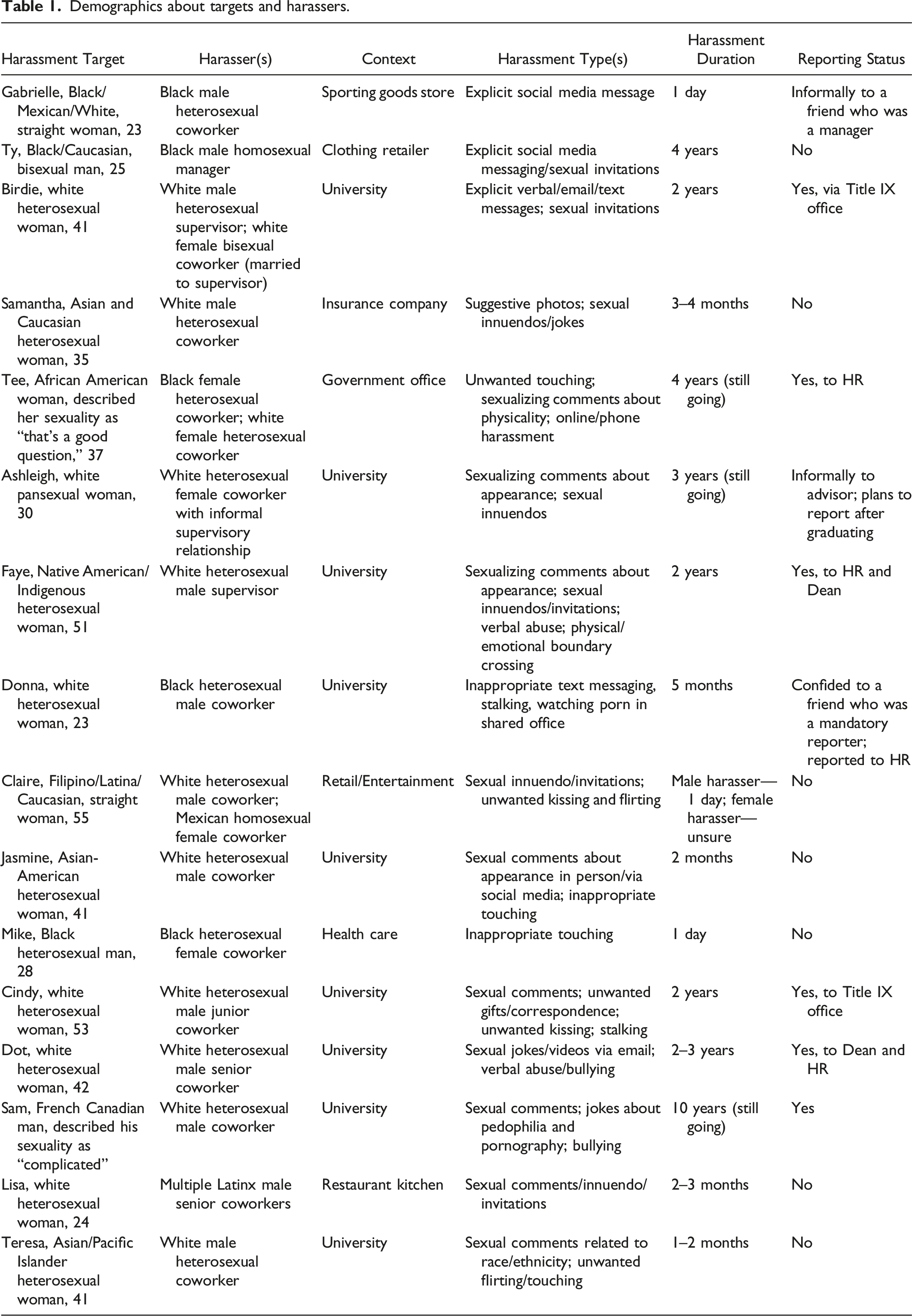
We spoke with 16 people, 13 who described themselves as female and women/cisgender, and three as male and men/cisgender. Participant ages ranged from 23 to 55—20s (n = 4); 30s (n = 3); 40s (n = 5); 50s (n = 4). Participants described their race/ethnicity as: African American or Black (2); Black/Mexican/White (1); Asian/Asian-American (2); Asian/Caucasian (1); Asian/Pacific Islander(1); Filipino/Latina/Caucasian (1); French Canadian (1); Native American/Indigenous (1); White (6), and their sexuality as bisexual (1); heterosexual/straight (12); pansexual (1); “complicated” (1); and “that’s a good question” (1). Participants worked in occupations including: customer service (2); higher education (9); state government (1); entertainment/retail (1); insurance (1); health care (1); restaurants (1). Six participants formally reported harassment; one reported informally, one planned to report after leaving their institution; one had reporting become mandated after confiding in a friend; and seven declined to report.
Demographics about targets and harassers.
Interviews ranged from 22 to 80 minutes, averaging 55 minutes, and occurred over the phone. Both authors conducted interviews independently, each conducting roughly half. With consent, interviews were recorded and professionally transcribed, resulting in 308 single-spaced pages. To protect confidentiality, participants chose pseudonyms. References to identifying details were removed from the data. Interviewees received a $15 electronic gift card for participation.
Multi-Phase Analysis
We conducted a multi-phase, collaborative, iterative inductive analysis (Tracy, 2020). To ensure analytic quality and trustworthiness, we employed consensus coding (Harry et al., 2005), which entailed discussing and agreeing on coding and analytic decisions, “with each point of difference being debated and clarified until [we] agreed on appropriate usage of [codes]” rather than relying on a numerical “reliability rating” (p. 6). We began analysis during data collection, discussing emerging reflections. After data collection, we read and re-listened to interviews, considering our overarching research goals to prioritize intersectionality (Crenshaw, 2017), and examine how intersecting identities, power, and status emerged.
We then chose two interviews to code independently—one that each of us had conducted, and that contrasted—conducting open coding where we identified salient themes (Tracy, 2020) including harassment types, responses, and reporting decisions. After discussing open codes, we agreed that issues related to intersectionality and sensemaking were most interesting and theoretically valuable. We conducted focused coding—coding connected to higher-level interpretation and theoretical terms—on the same two transcripts, resulting in 10–15 extra codes including sensemaking, social support, and emotion.
We crafted a preliminary codebook, adding definitions and examples, as well as collapsing some codes, expanding definitions, and rearranging to craft second-level theoretical codes. For instance, while we initially coded gender, race, and sexuality as first-level, descriptive codes, we moved “intersectionality” as a theoretical code to the second-level to capture when participants described how harassment was intertwined with interlocking systems of oppression (Crenshaw, 2017). We then used the codebook on two additional interviews to examine fit, discussing what codes should be added or adjusted (Harry et al., 2005). After finalizing the codebook, we split up the remaining interviews to code independently, discussing periodically.
During analysis, several metaphors stood out, and we re-coded transcripts looking for additional metaphors. Unlike approaches that asked participants to craft metaphors about experiences (e.g., Nardon & Hari, 2021; Stanley et al., 2021), we analyzed metaphors that emerged organically. An idiographic, “inductive approach is especially worthwhile for making sense of messy interactive processes... Such an analysis serves to name and make tangible a process that can be invisible” (Tracy et al., 2006, p. 174). We focused on vivid “live” metaphors, rather than “dead” metaphors which are so common as to have lost significant symbolic meaning, such as “teeth of a saw” (Tracy & Malvini Redden, 2015). While metaphorical, the phrase is not analytically rich. We also analyzed symbolic framings in participants’ speech that while not explicitly metaphors, evoked metaphorical concepts that aligned with our categorizing, similar to frame analysis (Fairhurst & Sarr, 1996).
After identifying all metaphors and symbolic framings, we compiled them into categories, although many overlapped. Categories included metaphors relating to: 1) survivors themselves, 2) harassers, 3) organizational contexts, 4) harassment situations, and 5) support networks. We then analyzed the metaphors and identified thematic categories following a consensus coding process.
Metaphors of Sexual Harassment
Harassment targets used metaphors and symbolic framings to describe sexual harassment by coworkers. Unsurprisingly, metaphors of harassment were almost exclusively negative in tone and deeply consequential. Below, we describe the three most prominent categories of metaphors that show how survivors frame and experience harassment, and reporting (or not), including: harassment as mysteries, battles, and games. 1
Framing Harassment as a Mystery
Many participants framed harassment as a mystery. They admitted feeling puzzled at finding themselves harassment targets and chagrined that they missed context cues leading up to harassment. Gabrielle, a 23-year old straight woman who described herself as Black, Mexican, and White, discussed being harassed online by a Black male coworker at the sporting goods shop where she worked on holidays. During social media exchanges, the coworker asked how long she would be working over break: “He said, ‘Oh cool. ’Cause I’m trying to see how much dick you can take while you’re at home.’” Stumbling for words, Gabrielle said the comment came “Completely out of nowhere. And I was like, so stressed because like, this was a situation I hadn’t been in before,” evoking surprise-oriented sensemaking (Louis, 1980).
Gabrielle handled the situation independently, telling the coworker she did not date at work. She said, “I made a lot of excuses to try and not read that [behavior] as like a It would reflect poorly on a community that I also identify [with]... [Many] times, Black men’s actions are used to represent the greater population... It just felt like it was gonna get bigger than him and me if I did that.
Despite a very graphic “red flag” message, Danielle made reporting decisions that factored in her and her harasser’s positionality as people of color, opting to protect her harasser, which is reflected in past research (Richardson & Taylor, 2009).
The language of clues was also used to describe surprise-oriented sensemaking (Louis, 1980) related to gender and sexuality. Claire, a 55-year old straight woman who described herself as Filipino, Latina, and Caucasian, was harassed by male and female coworkers while working in entertainment and retail industries. Claire discussed one work friend, described as Mexican and a lesbian, crossing boundaries: I didn’t set my boundaries... She was hitting on me and maybe I gave her the wrong cues... That was a strange situation because... I trust her... ’Cause she’s a woman... I really didn’t think of it as harassment...maybe I gave off some kind of cue or vibe or message that maybe she thought it was okay... But
However, Claire insisted her repeated harassment experiences afforded her extra skills: “I learned to be stronger and
In some cases, the harasser’s behavior was so overt as to trigger sensebreaking (Scarduzio & Tracy, 2015). Sam, a 52-year old French Canadian man who described his sexuality as “It’s complicated,” discussed being sexually harassed and bullied by a white male heterosexual university colleague. In addition to joking about wanting to date Sam’s 4-year old daughter and trying to get him deported, Sam’s abuser actually harassed his entire department. The harasser made regular homophobic jokes, sexualized comments, and assertions about being a pedophile in electronic correspondence and Zoom meetings. He even included a rape joke with an animated pig GIF in a conference presentation. Sam said: [There’s] the victim guilt where it’s like...I should have
The language of red flags, missed clues, and ignored signs forces the responsibility to recognize and intervene in harassment squarely on survivors. Participants described solving their own mysteries as they assessed organizational responses. Cindy, a White heterosexual woman in her 40s who was harassed by a junior coworker, described processing the outcome of her sexual harassment report. A full professor, she described that a White male assistant professor sent her inappropriate emails, handwritten letters, and gifts, at one point kissing her neck without consent.
After a public altercation where she demanded he stop, she reported to university administration, supplying 80 emails and 13 handwritten letters. After preliminary investigation, the Title IX office declined to pursue her grievance because she was in the position of power as a full professor, and her case did not meet the technical definitions of sexual harassment. Explaining how the provost and others ignored key pieces of evidence and chastised her for allowing the behavior to continue “too long” she said: The provost and the guy that was in charge of the investigation, both of them were retiring at the end of that summer, which I didn’t know at the time. And I realized they were just trying to
Survivors also used the language of mysteries to critique how reporting processes demand survivors do excess labor to protect themselves. Birdie, 41, a White heterosexual woman and university professor, was harassed by married coworkers, including her department chair. The duo grilled her about her martial sex life, bombarded her with suggestive text and social media messages, and invited her and her husband to participate in group sex. Birdie argued that reporting processes, which ostensibly protect confidentiality for targets and harassers, really serve to silence and isolate survivors while protecting the organization: [One problem] is that the university treats every case in an isolated way...They’re kind of treating it, like, it’s no big deal to protect him this one time. And the victims can’t find each other, unless we engage in like
Framing Harassment as a Battle
Harassment as battle was a prominent framing in participants’ responses. Some used battle metaphors to frame themselves as targets. Tyler, a mid-20s biracial and bisexual man, used battle metaphors to explain how he deflected harassment from his older supervisor whom he described as Black, male, and homosexual. Tyler mentioned the harassment continued for four years, through text and social media messages: “I kept
In contrast, some battle metaphors framed harassers. Donna, a 23-year old heterosexual White woman who was harassed by a Black male university coworker for 5 months, described her harasser as always in “
Likewise, Lisa, a White heterosexual woman experienced harassment at her college restaurant job. She described feeling camaraderie learning that other kitchen workers had been harassed, but referenced a “
Battle metaphors also illustrated intersecting identities that complicated harassment incidents. Jasmine, a 41-year-old heterosexual Asian-American woman, described how sexual harassment overlapped with racial harassment:
There’s a stereotype about Asian women. Like they are submissive...It’s like, ‘You can do pretty much anything to them, but they will not...act.’ It’s kind of [like they are seen as an] easy target. I feel that’s maybe the reason [I was harassed]. Jasmine believed that Asian women who are sexually harassed may also experience racial harassment simultaneously. This co-occurrence has been found in past research (Buchanan et al., 2018) and was echoed by Teresa, an Asian/Pacific Islander heterosexual woman who was harassed in her 20s by a university colleague in ways that implicated her identities as an Asian woman and international worker. Both Jasmine and Teresa likened racial stereotypes to a battle by explaining that Asian women are seen as “easy targets.” Due to stereotypes about Asian women being subservient and presumptions that they do not engage in conflict, Jasmine felt she was targeted for sexual harassment, with a lower chance of “winning” from the beginning.
Certainly, the complexity of race, gender, and age-related stereotypes complicated Jasmine’s reporting decisions. She explained: I was new...a young female...coming from a different country...I don’t know what is the best practice in that environment, facing [that] kind of situation...if it’s not like [sexual assault]? If I report, maybe they think I was making something of nothing... I don’t want it to
Some battle metaphors referenced coping strategies including social support (Scarduzio et al., 2018a). Ashleigh, a 30-year-old Caucasian pansexual woman was harassed by a fellow graduate student with informal supervisory status—a White female heterosexual woman who made sexualizing comments and innuendos. Ashleigh used battle metaphors to describe how trusted others protected her from additional harassment. She said her advisor would be “Like
Other social support battle metaphors discussed allies and how to choose them. Tee, an African American woman in her late 30s who described her sexuality as “that’s a good question,” was targeted by straight Black and White women in her government office. The harassers made sexual comments, physically invaded her space, and tormented her on social media. In advice to survivors, Tee admonished: “Pick the right people for [support], [who] are allies or who understand.
Battle metaphors also illustrated the organizational context and its role in harassment. Birdie felt like the organization itself was against her, especially after her harassing boss and his wife proactively filed a complaint against her. She explained the immense challenges of the Title IX process: I did everything right...The first time I read it [the Title IX report] and I’m allowed to take cursory notes, I take these notes...[And then my lawyer] was like, ‘they’re trying to
Birdie also explained how being silenced by the organizational process was an ongoing battle. She said, “It doesn’t necessarily silence all parties...It only silences the ones that could be penalized if they’re not quiet.” In other words, Birdie viewed the organizational policy of confidentiality as silencing her, while protecting harassers and letting them speak freely, ruining her reputation on campus. Birdie’s discussion of reporting policies likens penalties to being injured during a skirmish. Discovering the “rules of engagement,”—e.g. to be as defensive as possible—was something she had to suss out independently. Birdie’s battle metaphors also illustrate that organizations maintain an uneven playing field, being able to create the rules and operationalize policies inequitably, leaving harassment targets on the perpetual defensive.
Discussing the organizational context, Tee also implicated the organization as a culprit in her framing: Acknowledge that [sexual harassment] exists, acknowledge that
Framing Harassment as a Game
Participants also framed harassment as a game—which ordinarily suggests excitement and fun—but in the context of sexual harassment implies unpredictability and terror. In the “game” of sexual harassment, targets are almost always losers in contests they never signed up for and from which they cannot easily escape.
Most game-related metaphors referred to harassers specifically. Donna’s harasser, a fellow graduate student, would obsessively text her, watch porn in their shared office, invade her personal space, and follow her, including to the restroom between classes. Occasionally, he would jump out from behind walls “like a
The Jack in the Box metaphor also communicated her unease as the harasser would enact a different persona with colleagues—a genial “
Similarly, Samantha, a 35-year-old Caucasian/Asian heterosexual woman, said her White male heterosexual coworker at an insurance company while in their 20s would routinely make sexual conversation and jokes: “[He] would refer to himself as my quote unquote ‘ He thought it was sort of a game. He thought it was funny...to get me to look [at risqué photos] ‘cause he knew that I didn’t want to see...it was that
Framing harassers as having fun and viewing harassment as a game was a common theme among participants. Dot, a 40-something heterosexual White female university professor, described how very little scared her now because she’d “already met
Similarly, Sam symbolically framed his harasser as a trickster. He seemed to relish taunting Sam and others, largely getting away with it by lodging formal complaints against those he harassed, citing discrimination due to his disability. Even after ultimately being found responsible for harassment and told contacting Sam would be grounds for dismissal, “This
Other metaphors emphasized the temporality of harassment in game terms. Tee said: “[There was this]
Some participants framed their own situations as a game, specifically regarding reporting. Faye, a Native American/Indigenous heterosexual woman in her early 50s, was harassed by a White male coworker-turned-boss for two years. After reporting to her Dean and HR, she reflected on factors that perpetuated harassment: “This is why you’ll have a company policy that says that they have zero tolerance, but then you’ll have a corporate culture where it [sexual harassment] is
In both Faye and Birdie’s examples, the metaphor of games connects to the survivors’ responses to harassment reporting. Faye explained that reporting was a last-ditch effort—her last possible option and not a very good one—while Birdie’s description of waiting for the “next shitty thing” implies that she was a passive player in the game of harassment, where the only “play” was to take a medical leave and seek new employment. These game metaphors all emphasize unwilling participation, the inability to escape, and lack of substantive agency while facing organizational players willing to reset the game to avoid dealing with troubling issues.
Discussion & Implications
One of our study’s primary goals (RQ1) was to understand how people metaphorically frame experiences of sexual harassment and reporting decisions. Going in-depth with 16 participants representing diverse social identities and occupations, we show the complexity of harassment reporting situations not often represented in academic literature. Answering calls “to demonstrate what sexual harassment looks like in an embodied way—with real, organization-specific examples” (Keyton et al., 2018, p. 667) as well as for sexual harassment researchers to consider identity categories such as race/sexuality (Ford et al., 2021), we illustrate the painful, persistent, and nuanced nature of harassment through participants’ metaphors. Metaphors were primarily negative in tone and evoked frustration, fear, and conspiracy. Next, we explore theoretical and practical implications, addressing our second goal (RQ2) to examine the implications of sexual harassment and reporting metaphors for individuals and organizations.
Individual-Level Theoretical Implications
First, metaphors connote a distinct diminishment of agency for survivors. Agency is the ability to take action and influence one’s life, and it is critical for personal wellbeing, motivation, and goal achievement (Bandura, 2008). Participants described solving mysteries, fighting battles, and playing games they never consented to. That survivors communicated unagentic metaphors—phrases that signal their lack of control and disempowerment—is not surprising given what is known about other challenging organizational phenomena, including workplace bullying (Tracy et al., 2006) organizational change (Malvini Redden et al., 2019), and medication-assisted treatment (Malvini Redden et al., 2013). In fact, Dykstra-DeVette and Tarin (2019) illustrate that harassment survivors are “estranged from agency” when institutionalized policies and processes keep them isolated and perpetuate hostile environments.
The lack of agency in this context is especially concerning though, because reporting should be an agentic act—a choice enabling targets to stop or at least decrease, abuse. Indeed, cultural scripts suggest that reporting and speaking out (e.g., “the truth shall set you free”) will be rewarded with justice. Instead, participants described feeling like reporting was: not an option, coopted by their harasser, and/or a mystery, battle, and game they had to handle independently. Metaphors signaled that reporting (or lack thereof) left them feeling demoralized, frustrated, stressed, and cynical. The metaphors also reveal that participants felt reporting led to consequences for them personally, rather than their harasser(s), even when harassers were found culpable. These findings support past research suggesting that reporting has devastating consequences for survivors (Bergman et al., 2002) including reduced wellbeing and resilience (Ford & Ivancic, 2020).
While research on agency describes the importance of promoting self-efficacy as a means of overcoming material and symbolic constraints (Malvini Redden et al., 2013), our study shows that in the case of sexual harassment reporting, self-efficacy in stopping harassment is minimized at most every turn. Participants report being silenced by organizational processes, unsupported by organizational decisions and ineffective social support, and hamstrung by harassers who leverage organizational systems against them (especially in bureaucratic organizations). The implications for individuals are paradoxical—reporting does not solve the consequences of harassment, nor does ignoring it, and nor does leaving the organization. As most of our participants experienced mediated harassment, some harassment followed them into their next jobs via texts and social media, which is corroborated by past research (Ford et al., 2021).
Our analysis also shows that harassment reporting decisions are even more complicated for some due to the intersections of marginalized identities like race, gender, and sexuality. For instance, Jasmine felt that if she came forward no one would believe her because of stereotypes about Asian women. Tee described being harassed by other women of color and feeling constrained by questions about race and sexuality. Tyler’s experiences of fending off his manager, also a Black man from the LGBTQ+ community who was dating their mutual boss, seemed similarly fraught as Donna’s hesitation to report her harasser, a Black man with an intellectual disability, for fear of being perceived as racist and ablest. Past research shows that racial harassment can be intertwined with sexual harassment (Buchanan et al., 2018) but the connection between intersectionality and reporting decisions is less clear. Our study extends Buchanan et al.’s (2018) findings by analyzing intersectional harassment situations, illuminating that because of cultural perceptions about race, gender, sexuality, and ability, harassment survivors did not feel like it was even possible to exercise self-efficacy in advocating for themselves. Our study shows that the complex intersections of identities of the survivor and the harasser impact reporting decisions and outcomes.
In some instances, too, survivors described seeking to protect their harassers due to social identity categories, which while diminishing their agency in addressing harassment, did show an exercise of choice to protect others. Recall Gabrielle, who did not report her harasser due to concerns that his behavior would be disproportionately punitive to the larger reputation of Black men. Lisa also explained part of her hesitation to report stemmed from cultural differences between herself and the Latinx senior cooks who harassed her. She expressed concern that reports might even hurt their immigration status. These results extend research about agency and coping, and the need for more analyses of contextual agency (Kanal & Rottmann, 2021). Through metaphors and symbolic framings, we can see how painful these agentic choices are in the case of sexual harassment.
Organizational-Level Theoretical Implications
Metaphors also illustrate important systemic issues about the organizational culture of harassment, silencing, and agency. Organizations were framed as actors and culprits in harassment stories, directly implicated in decreasing agency, fostering conditions for harassment, sweeping harassment under the proverbial rug, and compounding the consequences of harassment for survivors. Participants framed reporting harassment as a “battle.” Regularly, this “battle” was not just with harassers, but with the organization itself, ostensibly an entity with the mandate and means to ameliorate harassment. Metaphors that reference the organization are particularly troubling because they show responsibility for handling the harassment moving away from organizational culture, protocols, and practices.
Instead, the responsibility to recognize and intervene regarding sexual harassment is placed on survivors, even as organizational structures and protocols make reporting difficult. This shift in responsibility, ostensibly to imbue survivors with agency to report, affords the organization shadow agency and emphasizes how organizations routinely sanction and commit violence even as they purport to be neutral entities (Harris, 2019; Way, 2021). These findings contribute to research that conceptualizes agency as movement, showing how complete focus on only the harassers and survivors, can “obscure the organizational and systemic dynamics of sexual violence” (Harris et al., 2020, p. 661). Furthermore, considering the organization’s agentic moves, such as forcing “clean plates,” “washing hands,” or “bamboozling” targets, can help foster change that can “imbue the whole organization, not simply an individual, with the capacity to prevent sexual violence” (p. 674). Reporting processes are not neutral nor are the organizations that create and maintain them.
Despite the diminished agency that metaphors of harassment represent, opportunities for agency still exist in the organization, but not necessarily in formal reporting. Participants demonstrated the most productive agency in choosing allies and support for negotiating sexual harassment experiences, enacting agency by voicing their experiences to friends, family, coworkers, or superiors/HR. Simply being able to speak about the harassment in unconstrained ways is an important example of exercising agency, which past research calls “narrative agency” and enables survivors to name and make sense of harassment (Rose Luqiu & Liao, 2021).
These examples demonstrate the importance of “proxy agency” (Bandura, 2008) which is “the process of enlisting others to help achieve goals in circumstances where [people] have no access, ability, or expertise to achieve the goals directly” (Malvini Redden et al., 2013, p. 9). Whereas organizational training emphasizes formal reporting as the correct means of handling sexual harassment, targets should also take advantage of proxy agency and lean into other social support systems to address harassment. For instance, Ashleigh leaning on her “mama bear” advisor or Faye, who described her university dean as a “gem” for trying to help her report, show that accessing social support can be crucial. Research with refugee women supports the need for contextual approaches to agency that take into account individual situations, as well as culture and identity (Kanal & Rottmann, 2021).
Organizations should also be aware that accessing proxy agency may relate to power and privilege, however. Our data demonstrate that harassers engage in proxy agency to thwart the self-efficacy of their targets. Our analysis shows critically painful examples of harassers using organizational processes to proactively lodge complaints about people they harassed or to leverage organizational rules to maintain contact with their targets, effectively shifting from sexual harassment to bullying. There needs to be specific, contextual consequences for retaliating against survivors that honor the needs of targets, as we discuss below.
Practical Implications
Many practical implications stemming from this study could help organizations take responsibility for the scourge of sexual harassment, acknowledge their role in perpetuating organizational violence (Harris, 2019; Way, 2021), and instead craft cultures of care (Dougherty, 2022). First, organizational leaders should recognize that reporting is not usually a pleasant, productive, or accessible process for harassment targets. For meaningful change, organizations must prioritize survivors’ wellbeing, reduce contact between harassers and survivors—regardless of formal sanctions—and enact strict consequences for harassers no matter their position, status, or demographic characteristics. Harassers’ race, sexuality, and disability—all protected discrimination categories—were of particular concern in reporting decisions. People who reported described organizations being hesitant to investigate or enact consequences, presumably due to fear of litigation. In these cases, organizations must still do the right things to protect survivors, rather than simply the easy things that show action “on paper” but ultimately sweep harassment “under the rug.”
Organizational leaders should begin by deeply contemplating the emotional experiences of harassment portrayed in these narratives—the frustration, fear, anxiety, sadness, and disappointment. Then organizational leaders should develop policies and solutions in collaboration with harassment targets. Organizations must also provide ongoing support. As targets described the effects of harassment spanning years, organizations should follow up at regular intervals—perhaps quarterly—to see how and if target concerns have been satisfactorily addressed.
Policy makers also need to be cognizant that sexual harassment is a cultural issue that will not be changed overnight—it may require deep structural and institutional changes (Dougherty, 2022; Keyton et al., 2018). In bureaucratic organizations like universities, governments, and health care systems, organizations must enact policy and procedure changes at multiple levels, avoiding one-size-fits-all policies. Policies should include considerations for contemporary sexual harassment that is nuanced, complicated, and not the quid-pro-quo or overt hostile work environment examples that typically appear in policy and trainings. For instance, harassment routinely breaks the boundaries of the formal organization via mediated tools like social media or text messaging (Ford et al., 2021), but is nonetheless an organizational issue deserving of work consequences.
Finally, organizations can better protect targets and create healthier organizational cultures by erring on the side of belief rather than skepticism, particularly when reports come from newer, younger, or lower status employees (Herovic et al., 2018). Companies must recognize that traumatic, ambiguous, and uncomfortable experiences are difficult to narrate (Alessi & Kahn, 2021), and stories that do not “ring true” to a dominant group member may be nonetheless true. In particular, experiences of those with multiply marginalized identities may not be immediately intelligible to people in dominant groups who have not experienced harassment that draws upon race, class, sexuality, disability, or international status. Being attuned to the meanings present in symbolic and metaphorical framings can help leaders understand the feelings of intersectional sexual harassment, if not the lived experiences.
Conclusions, Limitations, & Directions for Future Research
While offering critical insights about the metaphorical and symbolic framings of sexual harassment, this study points towards important future directions for research. Acknowledging the limited sample size, future research could examine patterns of metaphors across larger data sets using different methods to see what other important categories of metaphors emerge, how metaphors change over time (see: Malvini Redden, et al., 2019), and if metaphorical patterns cluster around particular types of reporting decisions.
Likewise, this study illustrated how reporting decisions factored in race, gender, sexuality, and ability of all parties involved. Future studies could more intentionally investigate these intersections, particularly with regard to multiple levels of discourse. Our analysis demonstrates that reporting decisions are informed by interpersonal and organizational contextual factors, as well as awareness of larger social discourses—especially racial stereotypes. Future analyses could assess how micro-, meso-, and macro-level discourses intersect to inform reporting.
This study also demonstrates the need to continue examining agency in the sexual harassment reporting process, particularly proxy agency in heavily bureaucratic work contexts where participants depicted extremely diminished agency. Future studies should direct attention to the vital role of allies and interpersonal support systems, especially as they relate to supporting harassment targets’ resilience, which is diminished during reporting (Ford & Ivancic, 2020). It would be critical to know how access to proxy agency and long-term support might mitigate resilience consequences.
Finally, future research should investigate organizations that have crafted cultures of care (Dougherty, 2022) and take seriously the organization’s role in preventing and addressing sexual harassment. It would be useful to know how cultures of care handle sexual harassment—as opposed to the organizations depicted in this study—and if there are optimistic, agentic stories of targets overcoming harassment experiences with wellbeing and dignity intact.
Footnotes
Acknowledgment
First, we wish to thank our participants for trusting us with their stories. We deeply appreciate you sharing your wisdom and experiences so that we can work to improve organizations. Second, we are grateful for the supportive feedback and generative critique from the editors and three reviewers.
Declaration of Conflicting Interests
The author(s) declared no potential conflicts of interest with respect to the research, authorship, and/or publication of this article.
Funding
The author(s) disclosed receipt of the following financial support for the research, authorship, and/or publication of this article: This work was supported by the University of Kentucky (10.13039/100007472) and California State University, Sacramento.
