




Abstract
The implementation of artificial intelligence (AI) in work is increasingly common across industries and professions. This study explores professional discourse around perceptions and use of intelligent technologies in the legal industry. Drawing on institutional theory, we conducted 30 semi-structured interviews with legal professionals and semi-professionals in varying roles including lawyers, law librarians, legal staff (paralegals, document clerks), and law students. Their discursive accounts provided evidence for three institutional logics—expertise, accessibility, and efficiency—that guided their understanding and use of AI. Our analysis further revealed that legal professionals and semi-professionals held contradictory attitudes towards intelligent technologies and invoked contradictory institutional logics. These findings contribute to theory on institutional logics and digital transformation, providing insights into how occupational roles and institutional logics shape professionals’ discursive construction of intelligent technologies, and how discursive tensions are redefining professional boundaries and contributing to institutional change in knowledge-intensive work.
Introduction
In recent years, we have witnessed the transformative effects of intelligent technologies fueled by learning algorithms (Araujo, 2018; Bailey & Barley, 2020). As algorithms become more powerful and “intelligent”, the increasing adoption of artificial intelligence (AI) in organizations raises the question of how machine agency will influence or threaten highly institutionalized professions such as medicine, journalism, and law (Bailey et al., 2019; Gibbs et al., 2021; Guzman & Lewis, 2020). This is not a new question, but one that is rooted in decades-old discussions around the automation of industrial technology and deskilling of human labor (e.g., Braverman, 1974; Chandler, 1977).
While concerns around automation of work are not new, the increasing agency of intelligent technologies in knowledge-intensive professional fields has brought the discussion of profession, technology, and agency to the forefront, especially in the legal field. The application of AI in the legal field has grown substantially since the shift towards machine learning-based approaches in the early 2000s. As a recent review pointed out, AI is “hard at work in the law” and can be seen in many subfields (Mills, 2016, p. 3). AI tools not only provide a less costly and more efficient option for basic legal processes, but also bear the potential to redefine the meaning of the “practice of law” and shift the boundaries between mechanistic and legal tasks (Simon et al., 2018). As intelligent technologies increasingly challenge the boundaries of professional roles and expertise, understanding the interrelationship between profession, professionals, and technology becomes critical as professionals are influential crafters of institutions (Scott, 2008).
The use of AI in legal work provides an opportunity for organizational communication scholars to better understand the influence of intelligent technologies on professions as the legal field faces unique challenges in adoption and implementation. First, law is not only often regarded as one of the earliest and most traditional professions (Lammers & Barbour, 2006; Lammers & Garcia, 2009), but also as a field with highly institutionalized professionals who tend to see limited potential of AI in their work, and thus resist adoption (Brooks et al., 2020). Second, law is a knowledge-intensive profession that often produces no “correct” answers, as the law is defined on precedent and nuance. The knowledge-intensive nature of legal work may make it difficult for legal professionals to accept technologies designed to automate their work, as we have seen in other professions such as medicine, healthcare, and more recently, journalism (Barley, 1986; Hammer & Hiles, 1986; Schapals & Porlezza, 2020). Lastly, like other professions, the legal field is made up of both professionals (lawyers) and semi-professionals who support them (e.g., law librarians, paralegals, legal assistants), each with differing domains of expertise, who could thus have varying attitudes towards the usefulness of AI in their work.
Despite its significance, research on the adoption of intelligent technologies in professional contexts is still emerging, and the institutional factors shaping this adoption have rarely been studied (Bailey et al., 2019). More importantly, organizational scholarship tends to treat professions as monolithic, rather than considering the nuanced differences between professionals and semi-professionals across varying roles. To bridge this gap, we draw on a framework of institutional logics (Thornton & Ocasio, 2008; Thornton et al., 2012) to examine the discursive tensions that arise in the collision between AI technology and the legal profession. A communicative view of institutional logics regards logics as arguments or narratives that reflect specific beliefs, values, practices, or rationales for action (Lammers, 2011; Lammers & Proulx, 2015). This perspective is particularly useful in identifying the discursive arguments that professionals and semi-professionals draw from to rationalize their attitudes and reactions towards the adoption of intelligent technologies in their work. We add to this theoretical discussion by exploring how institutional logics of legal professionals and semi-professionals create discursive tensions around the role of intelligent technologies in legal work, which work to potentially redefine professional boundaries and contribute to institutional change. Through in-depth interviews with 30 legal professionals and semi-professionals from a variety of roles, our analysis reveals tensions within and across institutional logics that play a constitutive role in shaping AI use in the legal profession.
Technology and Professions
Scholars like Beniger (1986) and Zuboff (1988) have argued that computers and smart technologies are creating a redistribution of authority in the workplace through division of learning and constant monitoring. Recent work across various professions has also highlighted such impacts (Susskind & Susskind, 2015). For example, Armour and Sako (2020) suggested that intelligent technologies such as AI have the potential to shape existing tasks and create new tasks in firms that provide legal services. Relatedly, Simpson (2016) argued that the transformative impact of algorithms on legal work is reflected not only in how legal work is done, but also in transparency and empowerment as AI demystifies legal professionals and practices by making legal information and services more accessible to the public. Similar impacts have also been observed in other professions such as accounting (Kruskopf et al., 2020), consulting (Tavoletti et al., 2022), journalism (Schapals & Porlezza, 2020), and medical professions (Chen et al., 2021).
Indeed, as an evolution from previous automated technologies, the increasing agency embedded in algorithms and other intelligent technologies bears transformative consequences through redefining professional boundaries and transforming the meaning of expertise and profession (Faraj et al., 2018). The increasing co-existence of humans and algorithms may result in heated discussions of “what type of expertise is valued and whose expertise has primacy” (Faraj et al., 2018, p. 65), which in turn calls for more research to empirically examine the impacts of intelligent technologies on knowledge-intensive professions (Bailey et al., 2019).
Professionals versus Semi-Professionals
To empirically examine the ways in which intelligent technologies are redefining professional boundaries, it is important to pay attention to both the professionals and semi-professionals on the ground within a given profession. The research on professions and institutional change tends to focus on the critical role of professionals as change agents. As Scott (2008) points out, professionals “are the most influential, contemporary crafters of institutions” (p. 223). Professions, therefore, are “negotiated orders [that are] always in a process of change” as professionals adopt new technologies or develop new techniques (Bryan & Lammers, 2020, p. 1). However, well-documented evidence shows that professionals may be resistant to change, especially when it comes to intelligent technologies that may threaten their expertise, autonomy, and individual responsibilities (Abbott, 1988; Ranganathan, 2018). Considering the increasing capacity of intelligent technologies to perform knowledge work and thus dispel the mystery of their profession (Wilensky, 1964), professionals may hold negative attitudes towards these technologies (Caserta & Madsen, 2019).
Semi-professionals also play an important yet often overlooked role in the process of negotiating professional boundaries (Kellogg, 2019). Semi-professionals are those who support the work of professionals and have lower occupational status. Examples of semi-professionals include social workers, administrative assistants, clerks, tax preparers, and research scientists or assistants (Kellogg, 2019). Within the legal field, paralegals, legal assistants, and law librarians could all be considered semi-professionals, as their work is supporting the work of lawyers (professionals). In a study of the professional identity of paralegals, Lively (2001) showed that while paralegals shared institutional norms and role constraints, they also held a separate set of values specific to their identities as paralegals, differentiating themselves from both lawyers – to whom they were subordinate – and legal assistants. Another important group of semi-professionals in the legal field are law librarians, who may find themselves straddling two professions (law and librarianship) with different professional norms and values. While law librarians are considered as professionals in the field of librarianship (Garcia & Barbour, 2018), in the legal context we consider them to be semi-professionals, as they provide a support role to lawyers by providing access to legal information through search tools and databases. Contrary to legal professionals, semi-professionals such as paralegals and law librarians may be in a more favorable position to advocate for the adoption of intelligent technologies as they are relatively less bounded by code of ethics and esoteric knowledge (Abbott, 1988; Barley, 1996) – or, as in the case of librarians, have their own codes of ethics that embrace digital technologies – yet they still perform critical tasks for others within the professional field (Battilana & Casciaro, 2013).
Institutional Logics, Technology, and Tensions
Organizational communication scholars have often applied institutional theory as a useful framework to examine the ways in which professional fields are influenced or transformed by various factors including new technologies (Conrad, 2000). Lammers and Barbour (2006) defined institutions as “constellations of established practices guided by enduring, formalized, rational beliefs that transcend particular organizations and situations” (p. 357). A profession can be seen as a type of institution as it creates a division of labor, claims authoritative expertise for a certain class of individuals, and often invokes normative–ethical obligations or logics (Cheney & Lee Ashcraft, 2007).
When encountering changes such as the adoption of intelligent technology, professionals often draw on institutional logics within their own profession to guide their responses. Institutional logics are socially constructed practices, assumptions, values, beliefs, and rules that individuals rely on to organize and make sense of their work (Thornton & Ocasio, 2008). These logics are often “multiple, possibly contradictory, and not necessarily rational” (Lammers, 2011, p. 159). Adopting a communicative view of logics helps us capture the co-existing patterns of beliefs and rules that are manifested and expressed in arguments that social actors make in defense of extant or proposed arrangements (Lammers, 2011; Lammers, & Proulx, 2015). In other words, we can identify logics through arguments that people make about arrangements in their work. As AI becomes more heavily adopted in professional, knowledge-based industries, it becomes even more critical to closely examine the narratives and arguments that individuals make about its use in their work to understand how boundaries between professional roles are being renegotiated in the face of intelligent technologies.
Institutional logics are particularly useful in distinguishing different subgroups of professionals as well as semi-professionals. For instance, Moorhead and colleagues (2018) studied in-house lawyers, legal professionals who work in the corporate world, and portrayed them as neither fully constrained by nor fully independent of the corporate environment. These lawyers often attributed to their profession reflectivity about ethical and professional obligations in a corporate space that is pragmatic and results-oriented (Moorhead et al., 2018). When professional boundaries are called into question by intelligent technologies, taking a communicative view on institutional logics helps us understand how professionals and semi-professionals make sense of their work with the adoption of intelligent technologies.
Institutional Logics, Tensions and Technology
Institutional logics have the potential to shape professionals’ and semi-professionals’ reactions towards technologies, as people often draw from the dominantly accessible logics to help guide their interactions with new technologies. For example, through a qualitative meta-analysis of 26 case studies of implementations of enterprise system (ES), Berente et al. (2019) documented how user responses (such as resistance, loose coupling, faithful appropriation, or co-opting) to ES implementation were influenced by their institutional logics. Similarly, Oborn et al. (2021) demonstrated that digital technologies in telemedicine were appropriated differently by stakeholders who held varying institutional logics. While health professionals used telemedicine as a tool to provide collaborative care, family members put more emphasis on its ability to provide encouragement and commitment. This is further illustrated by Barrett et al. (2012), who found that professionals and semi-professionals in a hospital pharmacy developed different interpretations of the meaning and purpose of a medication-dispensing robot, which led to a shifting of professional boundaries between these occupational groups.
Institutional logics become particularly salient when professionals and semi-professionals face pluralistic demands from multiple institutional environments. As scholars have noted repeatedly, multiple institutional logics often exist, and may be in tension (Kraatz & Block, 2008). For example, Dunn and Jones (2010) showcased how professionals in the field of medical education had to work with plural logics of care and science. Similarly, through interviews with junior corporate attorneys, Kuhn (2009) showed that these legal professionals relied on pluralistic discourses of managerialism and legal professionalism when they were asked to reflect on their work. Tension can be defined as an opposition between two competing goals, needs, or interests (Putnam et al., 2016). Tensions have been shown to be a useful lens for understanding how new technologies impact employees in an organization or professionals within a particular field, often alleviating some challenges while exacerbating others (Erhardt & Gibbs, 2014; Lammers & Barbour, 2006). This leads to our research question:
How do tensions within and across institutional logics shape the discursive accounts of professionals and semi-professionals of the role of intelligent technologies in legal work?
Methods
We adopted an inductive, qualitative approach (Tracy, 2019) to examine how institutional logics shape legal professionals’ and semi-professionals’ responses to intelligent technologies. This enabled us to capture participants’ natural language and narratives to better understand the meanings they assigned to both technologies and their profession. Taking a “pattern inducing” approach (Reay & Jones, 2016) allowed us to gather empirical data through interviews that can reflect institutional logics in personal experience, everyday practices, and thought processes, thus highlighting the communicative nature of institutional logics.
Research Context
The legal field provides an interesting context for studying professionals’ acceptance of or resistance to intelligent technologies, as it is a complex and established profession. As Alarie et al. (2018) emphasized, “the true benefits of artificially intelligent tools in the legal profession may be realized only once lawyers completely rethink the provision of legal services” (p. 123). Despite the perception that AI may play a rather limited role in professional work, it has been increasingly used in the legal field from preparing legal documents to doing legal research and discovery, and even to representing clients (Mills, 2016). More importantly, the training and structure of the legal field have also begun to reflect an attempt to catch up with up-to-date technologies. The American Bar Association (ABA) Model Rules of Professional Conduct requires lawyers to be technologically proficient and current (American Bar Association, 2020). According to ABA, over 30 states have adopted some form of this Model Rule. In addition, state and law programs also emphasize the importance of using and understanding emergent technologies such as AI. At the same time, lawyers tend to be resistant to the adoption of new technology in their work (Caserta & Madsen, 2019). Given these practices, we believe that the legal field serves as an excellent context to understand the interplay between intelligent technologies, professionals, and semi-professionals, and the varying attitudes and tensions that exist in these relationships.
Data Collection
To answer our research question, we conducted a total of 30 semi-structured interviews via phone/Zoom. Each participant was sent a digital copy of our informed consent form and agreed to participate prior to the date and time of their scheduled interview. To recruit our respondents, we contacted individuals in the researchers’ personal networks who held positions as lawyers, law students, law librarians, and legal staff and used snowball sampling methods (Noy, 2008) to identify additional respondents.
Participant Information Table.
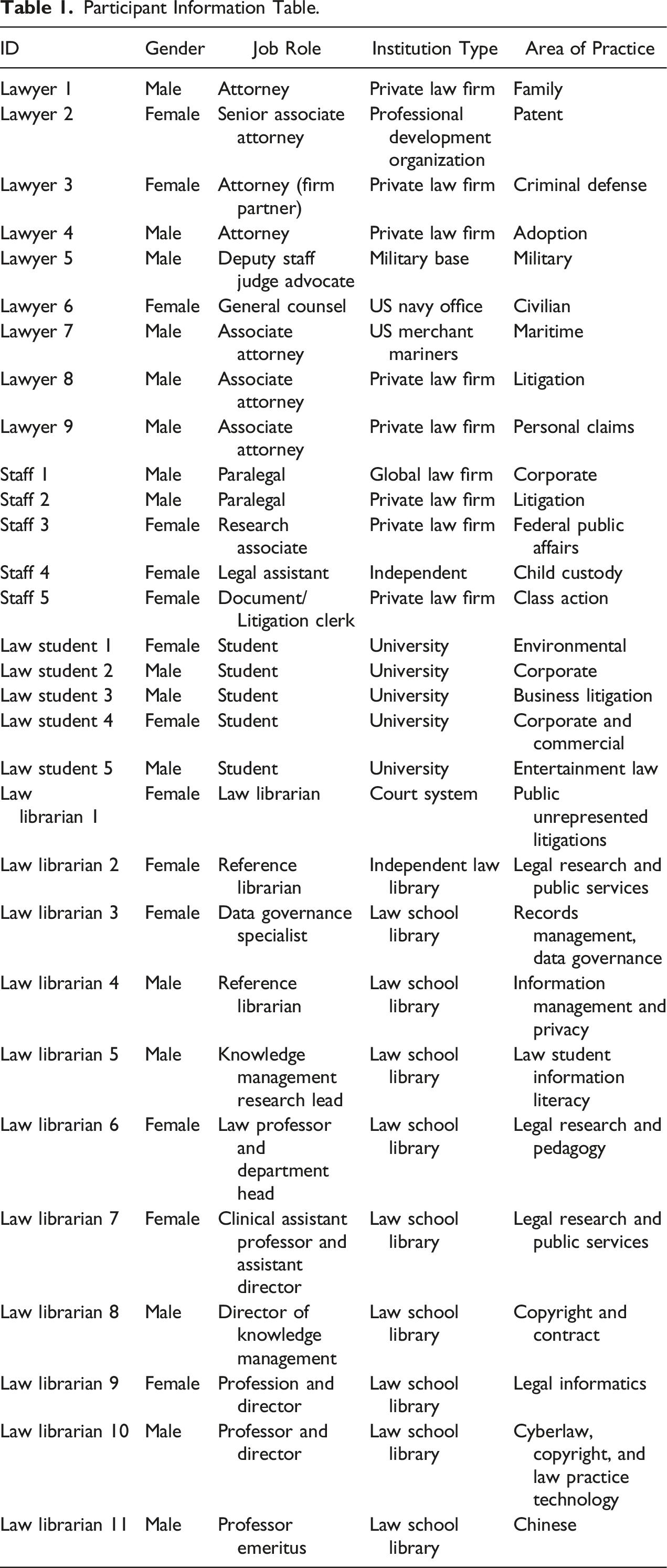
Our interview questions focused on four themes: participants’ expertise and work environment, their experience using technology to facilitate their work, their institutional beliefs, and their opinions on intelligent technologies. Sample questions included: “What types of decisions would you trust an AI to make for you?,” “how will AI impact your work processes?,” “what are some of the benefits and concerns about using AI technologies in the legal field?,” and “do you see AI replacing human functions in legal work?.” Given that many participants were unfamiliar with specific AI technologies, the researchers provided a definition of intelligent technologies and gave examples of algorithms in legal search databases as well as legal chatbots, after first asking participants for their spontaneous associations with the term. A copy of the interview protocol is available from the authors.
Data Analysis
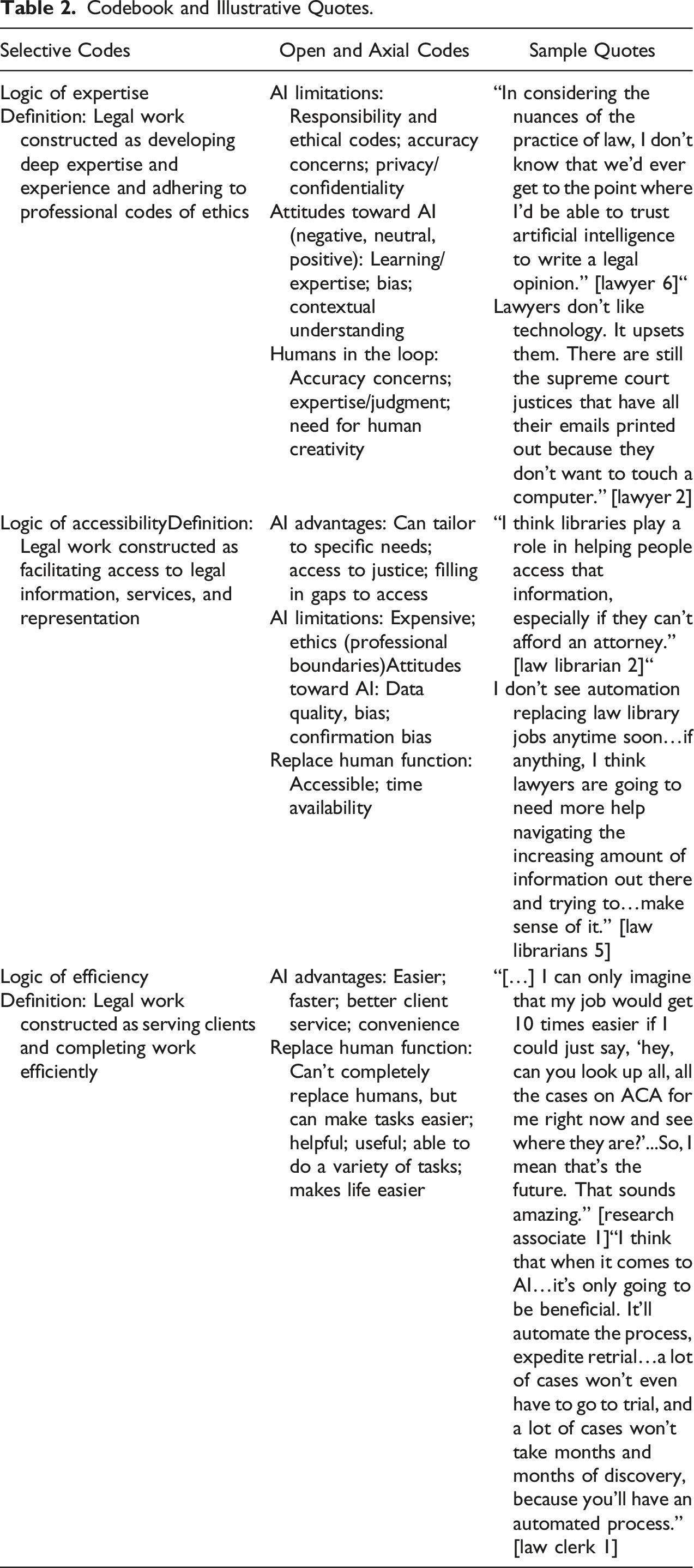
To analyze our data, we transcribed the 28 remaining recordings using TEMI automated transcription software, followed by manual cleaning of transcripts. This resulted in 556 pages of double-spaced transcripts. The clean transcripts and field notes were coded and analyzed in Atlas.ti Cloud through an iterative process. All authors participated in each stage of the coding process, meeting weekly for several months to discuss and reconcile codes in order to reach consensus. A theme was considered a code when all four of the coders unanimously agreed to it. If coders did not agree, the code was removed, merged with another code, or recategorized.
Codebook and Illustrative Quotes.
Findings
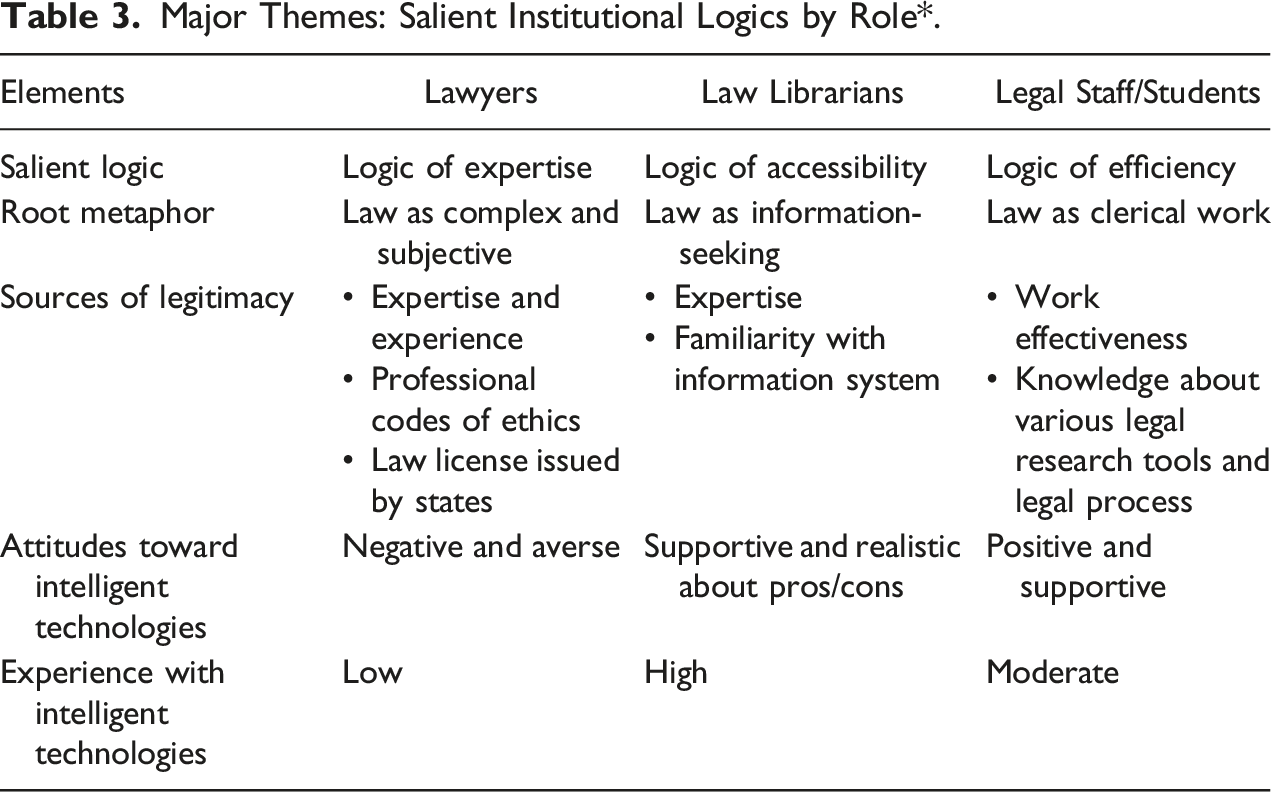
Major Themes: Salient Institutional Logics by Role*.
Logic of Expertise: AI Cannot Replace Lawyers
Legal professionals (lawyers) tended to have limited experience with AI and to be skeptical of its efficacy in legal work. They often invoked a logic of expertise by citing the complexity and subjectivity of the law as reasons why intelligent technologies would be unable to perform their work. They saw practicing law as a prestigious profession and discursively constructed legal work as something that could never be replaced by technology due to its complexity – as it was always evolving, complex, subjective, and novel. One lawyer commented that she would never trust AI to write legal opinions because of the nuances of law and the inability of AI to engage in “that kind of weighing and balancing of factors and facts [that humans do]” (Lawyer #6). Another pointed out that supervising the information provided by AI “is always going to be there and it’s going to be there as an attorney’s duty” (Lawyer #1). Thus, lawyers did not trust intelligent technologies to perform their work and felt they had an ethical obligation to monitor and check their output.
Lawyers were also skeptical of the ability of an AI lawyer to represent a client, due to its lack of humanity, flexibility, and creativity, which made it unable to handle the subjectivity of the law. The legitimacy of lawyers’ work and identity often comes from their expertise, strict compliance with professional codes of ethics, and state-issued practice licenses. For instance, as one lawyer pointed out, lawyers “have an ethical obligation, a professional responsibility to [their] clients” (Lawyer #8). As this quote illustrates, ethical obligations to their clients were deeply engrained into lawyers’ professional identity and sense of expertise. Lawyers often saw the core of their work as to represent their clients to the best of their ability. As one lawyer pointed out: “So much is dependent on how you do your presentation and how you make your arguments and how you present yourself…It’s not necessarily about anything that a computer program can do. It’s about, you know, it’s about people” (Lawyer #8). By saying “it’s about people”, this lawyer makes the case that litigation required subjective, human skills of persuasion that could not be replicated by a computer.
Lawyers also argued that creativity was an inherent part of the law, and that each case was different and required a novel application of case law. Another lawyer explained that law was more of an art than a science: “You know, it’s art and so, to tie it to some scientific formula is striking me as folly. People spend their whole lives studying the law, even in narrow areas of the law, and they never master it. You practice it, you never master it” (Lawyer #4).
These accounts reveal that the logic of expertise emphasizes human qualities of persuasion, judgment, creativity, and subjectivity and involves adaptive, relational work that could never be adequately performed by intelligent technologies.
In sum, lawyers considered the law so complex and subjective that it could never be fully mastered by a legal expert, much less a machine. As a result, professionals invoked the logic of expertise in their discursive accounts, arguing that while intelligent technologies could be used to do some repetitive work, they were not sophisticated enough to replace human legal expertise.
Logic of Accessibility: AI Will Enhance the Value of Law Librarians
A second salient institutional logic, accessibility, emerged and was largely shared among the semi-professionals that we interviewed – especially the law librarians. As previous studies on librarian identities have shown, librarians often see themselves as translators of knowledge and experience who bring new information into their respective communities (Jantz, 2012). Garcia and Barbour (2018) further characterize librarianship by a mission to establish commitment to information access bound by ethical standards to serve all populations equitably, and note that librarians are often eager to use new technologies in their work that can increase access of information to their patrons. A logic of accessibility was invoked to explain and justify the mediating role played by law librarians between front-line legal practitioners and information embedded in legal databases. They tended to have the most experience with intelligent technologies, and they also had the most nuanced view of their advantages and limitations.
The logic of accessibility was evident in the law librarians’ discursive accounts as they constructed their core work as helping legal practitioners and members of the public construct searches and gain access to accurate legal information. They expressed wanting to “make sure that they [library users] have the accurate information and complete information” (Law Librarian #2). In other words, they saw themselves as a bridge to provide access to legal information. This included both contextualizing and interpreting the results of legal search results from databases such as Westlaw and LexisNexis for lawyers, as well as helping deliver legal services to “underrepresented populations” (Law Librarian #7), for whom access to legal representation could be a luxury. Thus, they saw their role as librarians as helping people access information through public computers, online databases, or resources needed during the legal process.
Law librarians thus saw the advent of intelligent technologies in legal work as further enhancing their value in terms of providing access to legal information, since many lawyers did not know how to interpret search results from legal search tools powered by algorithms. The digitization of legal information has expanded the skillset of law librarians beyond simply acting as reference librarians, to requiring expertise as data scientists as well. Their discursive accounts highlighted the critical role they played in providing accessibility to information by helping lawyers formulate queries and interpret search results: “the main caveat with them is being able to look at the data and put it in perspective, what you’re looking at, which I think is why lawyers still need help from librarians with it” (Law Librarian #9). Others noted the importance of knowledgeable librarians, worrying that novice software users may lack a basic understanding of the software and thus form incorrect impressions about search results (Law Librarian #5). This librarian stated explicitly that he did not see AI replacing law library jobs anytime soon: “And if anything, I think lawyers are going to need more help navigating the increasing amount of information that’s out there and trying to make sense of it”. As a result, they felt that increased use of intelligent technologies would enhance their value, as the digitization of legal services and databases required greater technical knowledge that they possessed.
Logic of Efficiency: AI will benefit Legal Staff and Law Students
A third institutional logic of efficiency was invoked by the other semi-professional groups (legal staff and law students) who offer administrative support to lawyers. They tended to have moderate experience with intelligent technologies and to view them positively as supporting them by automating their work and making them more efficient and productive. The discursive accounts of legal staff emphasized an appreciation of the time saving and convenience of AI tools. For them, legal work was primarily clerical work that involved timely and accurate collection and synthesis of a voluminous amount of information to assist the lawyers for whom they worked – and they welcomed the use of intelligent tools that could automate this work for them and thus increase their work efficiency and accuracy in conducting legal research. When asked about adopting intelligent technologies in their work, a common response was that the adoption of AI could make “everyone’s job a lot easier” (Paralegal #1). Similarly, a female law clerk suggested that with intelligent technologies like chatbots and legal search tools, “a lot of cases won’t even have to go to trial… and a lot of cases won’t take months and months of discovery, because you’ll have an automated process” (Law Clerk #1). Semi-professionals also used more specific examples to illustrate areas in which intelligent technologies could boost efficiency and save time. Several students pointed out contract drafting as an important application that could potentially save lawyers time to be more efficient. For instance, one student shared her experience working through the process of contract drafting: “If I could automate anything, I think it would be the drafting the contract process. Having to go through it all…is a huge waste of time” (Law Student #1).
Semi-professionals were also conscious about their position in the professional hierarchy when voicing their support for intelligent technologies. They recognized that having lawyers and firm owners’ buy-in on AI adoption was essential since they were the ones making decisions about whether to adopt intelligent technologies in legal work and which platforms and systems to use. As one student explicitly pointed out, even though she felt comfortable with AI and would prefer to use it, her boss felt differently: “[My boss] knows how everything’s done. She doesn’t want to change that” (Law Student #1), underscoring that this decision essentially fell into the hands of her supervisor. Another paralegal reflected more explicitly on this and described lawyers’ roles as gatekeepers in the legal institution, stating that their resistance to AI might limit the kinds of efficiency frontline semi-professional workers hoped to achieve (Paralegal 2).
Tensions Across Institutional Logics
Expertise vs. Efficiency
Our analysis further revealed that the discursive accounts of professionals and semi-professionals were often in tension, due to the fact that they invoked different institutional logics, often in contradictory ways. For instance, the logic of efficiency was often in tension with the logic of expertise. Whereas semi-professionals in staff roles emphasized the positive role of intelligent technologies in automating more routine tasks and making their work more efficient, professionals (lawyers and law librarians 1 ) did not consider their expertise to be replaceable by AI and felt that intelligent technologies would actually reduce their efficiency. They raised concerns that AI would introduce more bias or would not be able to replicate their expertise, decreasing their efficiency as they would need to spend more time verifying its accuracy and checking its work.
While some lawyers and law librarians acknowledged the benefits of intelligent technologies for efficiency, they tended to be more concerned with its efficacy than its efficiency. Lawyers tended to have little experience with AI and to be suspicious of its ability to produce accurate results. For instance, lawyers raised concerns about having to redo the work of automated systems if they produced undesirable results. For example, one lawyer pointed out the possibility of having to repeat the work if automated systems produced undesirable results: “I think the drawback is that you might end up spending more time than you would otherwise because you can open a position where you have to do the work twice, once to input the information into the system and then go back through and check in and find out that it’s not what you want and have to do it again” (Lawyer #8). Other lawyers echoed this concern. One shared her experience about how conducting legal research using algorithm-supported databases actually decreased her efficiency: “So if the bot did it, it would leave out a lot of that stuff. Cause you don’t know it’s not what you need until you read it” (Lawyer #3). Lawyers also mentioned needing to invest significant time to learn to use intelligent technologies, and that this learning curve would further reduce their efficiency. For instance, one lawyer found Westlaw “incomprehensible” for him and pointed out that law students spent at least a whole semester learning how to navigate this software (Lawyer #4).
While law librarians tended to have much more experience with intelligent tools such as natural language processing or chatbots, they also considered them less efficient for them since they were experts on the process of legal information search and spent all day conducting searches, stating “it’s not the most efficient thing for me to do to use a natural language tool or a chatbot, but that’s really me being somebody who knows where to look” (Law Librarian #5). For law librarians, concerns about efficiency were coupled with accuracy concerns and biases embedded in the system: “It [intelligent technology] technically could [increase efficiency], but whether those [systems] will be good or reliable is another question” (Law Librarian 1). Another law librarian further elaborated that “as long as humans are training the system and writing algorithms that drive the system, it’s going to reflect the implicit or explicit biases that folks have” (Law Librarian #11). In this way, the logic of efficiency was invoked to support the view that AI technology would introduce more biases and reduce efficiency due to the need to verify its accuracy and correct its work.
In addition to the constant need to double check their work, professionals also expressed concerns that the efficiency brought about by intelligent technologies would have negative effects by undermining the expertise of legal professionals. Several lawyers and law librarians expressed the view that the convenience and ease of use of legal search tools would encourage users to become more passive and overly reliant on these technologies, without understanding the data they were producing. This view was prominent with older, experienced lawyers and law librarians who had been in the field for a long time. As one lawyer put it, “I just would not want them to get lazy and rely on it [AI] to the exclusion of their own thought processes” (Lawyer #6). One librarian also argued that search results could be substituted for professionals’ own knowledge and critical thinking: “I wonder if people could get too reliant on the easy answer and not spend the extra hour to, you know, find the case or statute” (Law Librarian #8). Another law librarian expressed a similar sentiment: “I always thought one of the myths was that the users of the information would get more sophisticated as time went on. And I think it’s the opposite. I think the users of the information have grown more passive, that they know less about what’s going on” (Law Librarian #11).
These quotes reflect a concern that intelligent technologies would reduce legal expertise to the ability to use legal search software rather than having a deep and comprehensive, contextual understanding of the content and practice of the law. While most of our interviewees did not believe that AI would get to the point where it would offer legal advice to everyone, nevertheless, the concern that “people will get lazy” due to over-reliance on technology suggests that efficiency will lead to reduced expertise. The prior concern about taking more time to check the work of automated systems suggests that the need for expertise will lead to less efficiency. Either way, efficiency and expertise are discursively constructed as at odds with one another.
Expertise vs. Accessibility
A second discursive tension arose between the institutional logics of expertise and accessibility. The juxtaposition of the accounts of lawyers (professionals) and law librarians (semi-professionals) revealed that both groups were similarly driven by professional codes of ethics around intelligent technologies, although the codes differed for each professional group: librarians felt obligated to evaluate legal tools and systems, whereas lawyers felt obligated to evaluate the law in particular contexts. Thus, each group answered to its own professional logics around expertise and ethics. This tension produced a dilemma for the law librarians in terms of access to information versus access to advice.
Law librarians wanted to help provide the public with access to legal information, but they faced a dilemma in that they were not qualified to give legal advice, which limited their ability to help make legal services and knowledge accessible to them. Our interviewees saw themselves as “the experts in evaluating the systems and letting people know what’s available for them to use” (Law Librarian #9) but made a point of respecting legal professional codes of ethics by providing legal information but refraining from giving legal advice. They were often explicit in interviews that even when they had a general idea of what legal steps library users should take, they still “can’t necessarily tell them [library users] that”. As Law Librarian #2 put it, “Our family court has a help center…we would go there a couple times a week and just help people understand the process for simple, no-fault divorce and help them understand the forms.” For Law Librarian #2, her job was to look for specific documents or construct a search to find helpful material for lawyers, but she tried not to interpret or evaluate the results, or give legal advice, and left it up to the attorneys to decide what was relevant to their case as they were the ones writing the legal opinion or brief. She further stated that “it’s harder with a member of the public who doesn’t really know exactly what they’re looking for” and said that in those cases, her expertise was in helping people narrow down and figure out the right question to ask and find the right information – but stopping short of offering them legal advice. In this way, librarians aimed to provide the public with access to legal services and information, but their professional codes prevented them from overstepping their own expertise as semi-professionals by giving legal advice or counsel (which fell into the lawyer’s domain of expertise) and this ended up limiting the amount of legal information they could provide. Their desire not to threaten the professional expertise of lawyers thus worked against their desire to provide broader access to legal information. In this way, the logics of expertise and accessibility were at odds with one another.
Accessibility vs. Efficiency
A third discursive tension was evident between the logics of accessibility and efficiency. This tension was most evident within the discourse of the semi-professionals (law librarians and legal staff). On one hand, many semi-professionals attributed great potential for access to the existence of AI chatbots that provided basic legal services and eliminated the need for expensive law counsel, especially if the problems were small or individuals needed basic information such as where to go or who to turn to. For instance, Paralegal #2 mentioned the need for basic legal services and felt that intelligent technologies could fill needed gaps: “You can get a will from Zoom legal for roughly a hundred dollars versus paying a thousand to an attorney. So, I think we’re already starting to see services like that fill back that need.” A law student echoed this comment: “I think there’s a big problem with access to the legal services. And I think a lot of the work that gets done is not that difficult…people who need sort of like basic legal services, I think [legal AI chatbots] can be really valuable” (Law Student #3). These quotes reveal that law students and staff were concerned about the lack of access to legal services and felt that the automation of legal work would help increase access to at least basic legal services.
On the other hand, several professionals believed that the cost of technologies such as legal search tools would inhibit access and exacerbate existing inequalities, as software cost is a major barrier to underserved populations, and that the implementation of such technology may lead to increased billing rates for lawyers. Despite the availability of these tools, some participants noted that their access was still limited for those without the means to purchase or subscribe to them. AI legal services are also limited in that they cannot provide tangible advice on nuanced issues, in which cases individuals would still need human legal counsel. Further, as AI legal services increase efficiency and decrease lawyer’s workloads, some legal professionals predicted that they would begin to charge more for their services, making legal counsel even more inaccessible than before. As one law librarian stated, “...if lawyers are using more AI in their workflows to get the groundwork done, and they’re able to spend more time working on meatier, higher-level thinking, well then, they’re going to be billing less hours and probably their billable rate per hour is going to go up” (Law Librarian #5). In this way, the efficiency of intelligent technologies in automating lawyers’ workloads may end up making legal representation less accessible as lawyers become even more unaffordable. While most agreed that AI tools provided increased accessibility to basic legal services, they also felt the rising cost of both software developers and human lawyers would make more advanced legal services inaccessible to underserved areas and populations.
Overall, the findings reveal the nuanced institutional pressures that constitute legal work practices for various legal professionals. Tensions were evident in the ways in which institutional logics were invoked by professionals (lawyers) and semi-professionals (law librarians, legal staff) to justify attitudes toward intelligent technologies. Negotiating these contradictory institutional logics helps to explain how intelligent technologies are contributing to organizational change by challenging and redefining professional boundaries.
Discussion
This study sought to understand the role that institutional logics played in shaping professionals’ and semi-professionals’ attitudes toward intelligent technologies and how these logics are in tension. Our analysis illuminates a discursive struggle among various groups of legal professionals and semi-professionals over what AI and intelligent technologies mean for the legal field. We found that each group’s vested interests in maintaining the legitimacy of their work impacted the ways in which they discursively constructed these technologies and their role in legal work. We identified three key institutional logics driving their discursive accounts: expertise, accessibility, and efficiency. Professionals (lawyers) were more likely to invoke a logic of expertise, while semi-professionals (law librarians) appealed to a logic of accessibility, and other semi-professional groups (legal support staff, law students) were motivated by a logic of efficiency. We found that students were most aligned with legal staff, as their limited work experience in the legal field tended to be in support roles. Further, these logics were invoked in contradictory ways, producing discursive tensions among professionals and semi-professionals. These tensions represent a struggle for legitimacy of one’s work as the legal industry begins to adopt intelligent technologies and the uneven spread of its use within the legal field, which serves to enhance legal work in some ways while undermining it in others.
Theoretical Implications
Theoretically, this paper makes several important contributions. First, our findings highlight the constitutive role of tensions in institutional logics across professional roles within the legal industry surrounding the adoption and use of intelligent technologies. Previous theorizing has pointed out the importance of understanding multiple institutional logics within organizations or professional fields (Besharov & Smith, 2014). Research has shown that different occupational groups, including both professionals and semi-professionals, may have differing attitudes toward technology adoption (Currie & Spyridonidis, 2016; Kellogg, 2019). In the context of the legal field, while the primary focus is about law, lawyers, paralegals, legal assistants, and law librarians are distinguished by their differing roles, responsibilities and certifications. More importantly, these professionals and semi-professionals held differing logics and each of them answered to their own professional logics around expertise and ethics. In other words, we showed empirically that legal professionals held varying attitudes toward intelligent technologies and that this could be explained by the varying logics that were embraced by people in different professional roles. When tensions exist between plural logics, the institutional logics embedded in their primary “target” profession influence how individuals approach intelligent technologies and make sense of its impact in their profession and work.
Second, our paper helps to illuminate discursive mechanisms of micro-level institutional change. While our findings do not directly address macro level institutional change, discursive tensions constitute moments in which micro-level changes could occur as they have the potential to shift and redefine professional boundaries. Negotiating tensions among institutional logics may result in the reconstruction of these logics through generative praxis that leads to institutional change (Ahmadsimab & Chowdhury, 2021; Barbour & Manly, 2016; Seo & Creed, 2002). Our findings provide support for the important roles played by both legal professionals and semi-professionals in this process (Kellogg, 2019). They further suggest that boundaries between these professional roles may be blurred as some (law librarians in our case) could simultaneously occupy multiple roles. Thus, examining tensions among plural institutional logics helps to explain contradictory attitudes toward intelligent technologies held by professionals and semi-professionals, and the ways in which it may lead to digital transformation and renegotiation of professional boundaries in the legal industry.
Third, this study raises theoretical questions about the relationship between professions, intelligent technologies, and agency. Though scholars have studied the implementation of technology and its impact on various industrial fields for decades (Barley, 2017; Beniger, 1986; Braverman, 1974; Zuboff, 1988), technology has primarily been viewed as a tool that needed human intelligence and manipulation. Artificially intelligent software products, however, are being used in more agentic roles by taking over decision-making tasks, and this increasing ability to take on intellectual roles has prompted a need to redefine what it means to be an expert and a professional (Guzman & Lewis, 2020). In other words, intelligent technologies bear the potential to take on these knowledge intensive tasks previously thought to be exclusively human, which can threaten the profession itself and affect both professionals and semi-professionals. The adoption of these technologies call attention from our participants to what kinds of expertise they think are most essential at defining their profession and maintaining their legitimacy in a landscape with rapidly changing technologies. Additionally, their responses highlight how intelligent technologies can privilege certain types of expertise while hindering others.
Practical Implications
Findings from our paper also provide several practical implications. First, our research points to the need for developers to understand how intelligent technologies may influence a professional’s sense of their power, autonomy, and agency, and how this in turn might impact their adoption of these new technologies. Recent work by Ciardo et al. (2020) found that when individuals worked with an intentionally agentic robotic partner to make decisions, they experienced a reduction in their sense of their own agency. In other words, sharing responsibility with a humanlike machine has the same effects as sharing responsibility with a fellow human partner. For legal professionals, and lawyers in particular, their sense of power and autonomy is critically important. As many of our participants noted, they felt a sense of accountability for legal decisions. Sharing decision-making with an intelligent machine could threaten professionals’ sense of power or agency, and subsequently create resistance to using the technology. If developers and organizations market intelligent technologies as “fellow lawyers,” this could create more resistance. Technological capabilities are advancing at an exponential rate, and given the current trajectory, resistance by professionals may ultimately prove ineffective.
In addition, understanding how institutional logics shape attitudes and behaviors can also provide ideas for workarounds for improving technology adoption in a historically resistant field. For example, the professionals’ concern about over-reliance on intelligent technologies suggests that when training students, it is vital to encourage critical thinking about the use of these intelligent software tools, rather than a passive acceptance of a “black box” system. In other words, the logic of efficiency should not take precedence over the logic of expertise. Indeed, discursive tensions allow for the balancing of competing goals and needs (Putnam et al., 2016). Additionally, our findings suggest that semi-professionals in the legal field were more accepting of intelligent technologies and can thus play a role in furthering the adoption and dispersion of these new technologies. Less defined by a sense of autonomy and power, these individuals could shape the discourse surrounding the purpose of these tools and their value.
Limitations and Future Research
Despite our findings, this research is not without limitations. This study considers one particular field (legal) but future research should examine the extent to which these findings apply to other professions and types of professionals. Further, this study did not capture differences between subfields within the legal field or firm sizes with varying resources. Future scholarship should also examine legal professionals’ communicative interactions and technology use rather than just self-reported attitudes about technology. While the legal professionals in our study did not feel particularly concerned that intelligent technologies would take away their tasks, their experience with using them was low overall. It is possible that they might react differently in situations in which their jobs were directly threatened. Finally, while this research provides insights into micro-level processes of change, future work should study organizational-level usage, policies and practices that influence the adoption of intelligent technologies, as well as capturing macro level institutional change.
Professionals are increasingly adopting intelligent technologies in their work. We have already seen journalists competing with AI content writing software begin to question the understanding of what it means to be an author; the legal field is certainly not far behind (Christin, 2017). As new generations of workers enter the legal field, proficiency with intelligent technologies will increase and professionals and semi-professionals will likely need to redefine and expand the boundaries of their domains to incorporate more intelligent, seemingly agentic technologies (Yonck, 2017). While shifting of roles due to the introduction of technology is not new, technology capable of sharing a professional designation is novel. Professionals in every field will face the question of whether an intelligent machine can be a colleague. Can an intelligent machine be a lawyer? A doctor? Maybe even a professor? Intelligent algorithms are already capable of assisting with research, annotating, and writing (Chubb et al., 2021).
We are just starting to see the impacts of intelligent technologies on knowledge-based professions. Increasingly complex intelligent technologies have implications beyond transforming the organizations that adopt them. Understanding how professionals make sense of their work using institutional logics and how they negotiate tensions among differing logics during the process of technology adoption provides clues for how other professional institutions, such as academia, will change. As intelligent technologies become more powerful and take on more agency in organizational actions and decision-making processes (Gibbs et al., 2021), understanding how intelligent technologies shape how professionals construct their identities and expertise, and how this in turn shapes professional fields and institutions, will become even more critical.
Footnotes
Acknowledgments
We would like to thank William Barley, John Lammers, Rebecca Meisenbach and our three anonymous reviewers for their developmental comments and feedback on this work.
Declaration of Conflicting Interests
The author(s) declared no potential conflicts of interest with respect to the research, authorship, and/or publication of this article.
Funding
The author(s) received no financial support for the research, authorship, and/or publication of this article.
