




Abstract
A recurring set of questions in the multidisciplinary literature on interorganizational collaboration concerns the relationships between collaboration structures, processes, activities, and outcomes for the coalition as well the societal problem(s) the coalition seeks to address. These questions apply to counter-human trafficking coalitions as well. This mixed-method study helps address several gaps in extant scholarship via a comparative analysis of three nationally-scoped, counter-human trafficking coalitions comprised of nonprofit organizations operating in Global South countries. The key finding is that constructive leadership practices explain positive outcomes in ways that structures and activities do not. Implications are articulated for coalition leaders.
Rationale for the Study
It has been well-established by scholars across fields that forming, developing, and sustaining multiorganization coalitions to address large-scale societal problems is complicated and difficult (Gray & Purdy, 2018; Keyton et al., 2008; Mizrahi & Rosenthal, 2001). A recurring set of questions in the multidisciplinary literature on interorganizational collaboration concerns the relationships between collaboration structures and processes and the outcomes produced—both for a coalition and its member organizations, and for the societal problem(s) the coalition seeks to address (Shumate et al., 2017). Much is at stake, in view of the human suffering stemming from the societal problems on which many coalitions engage. Effective collaboration is difficult to achieve and positive outcomes are not guaranteed (Page et al., 2015). To the contrary, collaboration can cause harm as well as good for collaborators and those they seek to benefit (Keyton et al., 2008).
Shumate et al.’s (2017) recent review of scholarship on interorganizational communication reported that extant empirical research and theory are conflicting on the relationships between collaboration outcomes and both structures and processes, and called for further study. Although existing literature addresses general aspects of leadership, according to Kramer et al. (2019) there is a lack of grounded research on how collaboration leaders work with representatives of multiple organizations to achieve goals. Moreover, Pugel et al. (2020) describe the Global North focus of most scholarship on collaboration, noting the “overwhelming need for (. . .) studies to investigate factors that influence collaborative approaches (. . .) in low-income countries” (p. 19). This article helps fill all three gaps via a comparative analysis of three nationally-scoped, counter-human trafficking coalitions (CTCs) comprised of nonprofit organizations (NPOs) operating in Global South countries, and collaborating voluntarily.
Terms such as alliance, coalition, and partnership are employed along with network by various practitioners and scholars to describe such multiorganization assemblages—sometimes as synonyms, sometimes in distinction from each other (Pugel et al., 2020). In this article, coalition is employed generically to represent any form of multiorganization partnership. Coalitions of nonprofit organizations are frequently formed to address large-scale societal problems and function as important collective actors in societal change efforts and take various forms (Ashman & Luca Sugawara, 2013). Indeed, participation in collaborative interorganizational relationships has become a “defining characteristic” of NPOs (Lewis et al., 2010). Even so, due to the complexity of collaborating, many practitioners grapple with “how to understand collaborations and their moving parts well enough to actually produce good results and minimize failure” (Bryson et al., 2015, p. 656). In addition to the complexity challenges that NPO collaborators face, some funders have created programs mandating their NPO grantees to not only collaborate with other grantees, but also to employ the funder’s preferred coalition structure and/or processes (Kania et al., 2014, p. 4). Such dynamics are especially problematic between funders based in relatively high income/Global North countries and grantee NPOs based or operating in lower income/Global South countries.
In view of the knowledge needed by both scholars and NPO coalition developers, we designed this study with the aim of contributing not only to scholarship on collaboration between NPOs, but also to praxis, in the hope of generating practical knowledge to guide coalition conveners and developers in their organizing strategies. The overarching research question motivating this study was: How do robust CTCs in Global South countries compare in terms of their self-assessed outcomes, activities, structural characteristics, and leadership practices, and how might the differences and similarities between them contribute to greater understanding of the relationship of each factor vis-a-vis outcomes? More concretely, if CTC outcomes are perceived similarly, do those outcomes correspond with similarities in the coalitions’ activities across their differing national contexts? Or with similar structural characteristics across the CTCs? Or were there leadership practices employed across the CTCs in correspondence with certain outcomes? Answers to these questions will contribute not only to scholarship on multi-NPO collaboration, but also to praxis, as coalition developers gain more knowledge on which to base their organizing strategies.
Coalitions to Counter Human Trafficking
The crime of human trafficking which precipitated the creation of the coalitions we analyzed is defined by the United Nations and many governments as “the recruitment, transportation, transfer, harbouring or receipt of persons, by means of the threat or use of force or other forms of coercion, of abduction, of fraud, of deception, of the abuse of power or of a position of vulnerability or of the giving or receiving of payments or benefits to achieve the consent of a person having control over another person, for the purpose of exploitation” (U.N. General Assembly, 2000). It is a violation of human rights. Although difficult to determine definitively, experts claim there are currently around 40 million victims of human trafficking globally (International Labour Organization, Walk Free Foundation, & International Organization for Migration, 2017), and victims include men, women, adults, and children.
Since 2000, there has been a marked increase in actions by NPOs, as well as governments, intergovernmental organizations (IGOs), and private sector entities around the world to counter human trafficking and to serve those who have been victimized by it (Foot et al., 2015). Working in concert with other organizations within and across sectors is widely perceived to be necessary whenever possible, albeit challenging (Cockayne, 2015; Foot, 2016; Jeter, 2016; Lagon, 2015). There has been a dearth of knowledge about CTCs, but recent research is beginning to redress that gap (e.g., Jones & Lutze, 2016; Laboratory to Combat Human Trafficking, 2013; Lagon, 2015). A developmental analysis of self-reported anti-trafficking efforts by approximately 150 organizations from multiple sectors worldwide found that the percentage of organizations claiming to be engaged in building counter-trafficking coalitions increased from 74% in 2008 to 81% in 2011 (Foot et al., 2015, Supplemental Material p. 4). Heiss and Kelley’s (2017) survey of nearly 500 anti-trafficking NPOs worldwide found that every respondent reported collaborating, partnering, or otherwise interacting with other NPOs, as well as with IGOs, foreign embassies, and the governments of the countries in which they operate.
Despite a few notable exceptions including those cited above, there is a geographical myopia in the extant literature, because most of the peer-reviewed research on counter-trafficking coalitions (CTCs) published in English to date was conducted in the U.S. There have been some evaluation reports of collaborative counter-trafficking efforts commissioned and/or conducted by governmental entities or NPOs outside the U.S., but nearly all of those have focused on European networks. Aside from three studies of collaborative counter-trafficking efforts in Cambodia and the Mekong region (Brammer & Smith-Brake, 2013; Davy, 2013a, 2013b), we have found no published research in English on CTCs in the Global South. This is a grievous lack, because in view of the extensive differences in political, economic, and societal characteristics in Global South nations, gaps in communication-based theorizing of collaboration could be enhanced by closely examining coalitions operating in different Global South countries. This article helps fill those empirical and geographical knowledge gaps, along with contributing to scholarship on NPO/voluntary organizing, and articulating implications for conveners and developers of NPO coalitions.
Before proceeding, we need to acknowledge that our Global North backgrounds shape our ideas and color our perceptions of every aspect of this research despite our best efforts to be reflexive about our situatedness. We recognize that in many parts of the world, and often in Global South countries, NPOs operate in highly volatile, “fragile” political and economic environments (Ashman, 2015; Liebler & Ferri, 2004). Fluctuations in the levels and forms of influence—and outright control—that governments exert over NPOs can dramatically affect their autonomy and ability to execute their organizational aims and operations, as well as their ability to build and sustain coalitions (Butcher, 2015; Ye & Onyx, 2015). Dramatic shifts in the political, economic, and/or legal landscapes in Global South countries create significant challenges for NPOs, as do swings in the funding available to them. Conceptual frameworks developed in national and regional contexts with relatively stable political institutions, infrastructure systems, and business communities cannot be assumed to be relevant for analyses of NPO-led counter-trafficking coalitions in Global South countries. Therefore we have made conscious choices to hold all our prior knowledge loosely, check each other’s assumptions, steep ourselves deeply in the spoken and written words and response options provided to us by the leaders of and participants in the CTCs we studied, and search systematically for patterns that emerged therein.
Analytical Framework
The analytical framework for this study is anchored by the constructs of coalition processes, structures, and outcomes—each used widely and variously across extant collaboration scholarship. Collaboration processes are conceptualized in quite different and somewhat conflicting ways which include activities, modes of interaction, goal-setting, tensions and leadership practices, among other elements (Christens, 2019; Gray & Purdy, 2018; Lewis et al., 2010; Shumate et al., 2017). In this study, we analyzed two process elements: activities related to either coalition-sustaining or countering human trafficking and leadership practices. Defining practices as sets of actions (Schatzki, 2001), we drew on research articulating multiple aspects of coalition leadership including practices of communication and organizing (Bryson et al., 2015; Gray & Purdy, 2018; Kramer et al., 2019; Milward & Provan, 2006; Mizrahi & Rosenthal, 2001) to inform our analysis.
Coalition structures refer to many aspects of collaboration, including types of configuration and coordination, forms of relationships, governance, membership models, rules, cultural values, and power relations (Kramer et al., 2017; Whetten, 1981). Bryson et al. (2015) note that potential and actual structures of collaboration are “influenced by numerous external factors, including windows of collaborative opportunity; public policies and policy fields; system stability; and degree of resource munificence, environmental complexity, and dynamism” (p. 653). Among all these considerations, we chose to analyze the structure of CTCs via a typology of interorganizational relationships developed by Varda and Retrum (2012) and a set of facets of coalition structure derived inductively from our data. Both are explained further in the findings section.
Outcomes of collaboration are conceptualized and labelled in various ways in extant scholarship. Christens’ (2019) discussion of the conceptual relationship between process and outcome provides a useful summary of distinctions some scholars make between intermediate-term, internal-to-the-collaboration outcomes or outputs and “external” or community/societal outcomes. The latter may require perseverance in collaboration processes over long periods of time as well as changes beyond the collaboration’s resources/authority to effect. Within those general distinctions, we chose to label the two types of outcomes germane to this study as coalition outcomes and problem-focused outcomes. Coalitions oriented toward a societal problem aim to generate beneficial outcomes regarding that focal problem such as reducing human trafficking. However, coalitions may also generate beneficial outcomes for the coalition and its member organizations such as increased knowledge-sharing, expertise, and resources. Positive perceptions among members regarding coalition outcomes are important for sustaining a coalition, as members assess the cost of participation against the benefits they perceive. Over time, coalition outcomes are likely to improve the coalition’s problem-focused outcomes such as increased success in identifying human trafficking cases and expanded legal services for survivors. In this study, both types of outcomes were self-assessed by members and leaders of the CTCs, for reasons explained below.
Methods of Data Collection
Through mixed-method data collection and a comparative analysis of three national-level CTCs operating in the regions of sub-Sahara Africa, Asia-Pacific Islands, and Southeast Asia (coalition and country names are withheld for the safety of those affiliated with them), similarities and differences between the outcomes, activities, structural characteristics, and leadership practices of each coalition were assessed. The analysis and findings presented in this article are unique, but part of a larger set of analyses and findings based on the extensive data corpus generated in this project (Foot et al., 2019). For consistency, we have taken care to describe the three CTCs studied and our methods consistently with prior presentations of other analyses and findings from this project.
In preliminary interviews we conducted with leaders from multiple CTCs prior to launching this study, we learned that NPO-led coalitions in Global South countries that have been operating for at least 3 years have established patterns of communication and organizing practices among member organizations, and a track record of activities. Coalitions that make it to 5 years are considered mature as most coalitions fail within the first 2 years. We also learned that coalitions led by a single individual were more likely to dissolve; sharing and/or rotating leadership between at least two people was foundational to coalition survival and sustainability.
Comparative analyses are best-designed by purposely selecting cases that share some key characteristics or facets, and vary in other facets pertinent to the overarching research question(s) of the study (Ragin, 1987, 1994). Because some factors for coalition failure have been well-established in other issue arenas (Ashman & Luca Sugawara, 2013; Koschmann, 2016), we decided to center on robust CTCs because they have demonstrated sustainability and are likely to have established a track record of at least some positive (i.e., beneficial) outcomes. We focused our study on determining whether there are cross-case patterns in the structures, activities, and/or leadership practices that correspond with outcomes, again following comparative case research design recommendations by Ragin (1987, 1994). We therefore established the following criteria by which to select CTCs for this study:
Operational for at least 3 years in a Global South country;
Involved at least two people leading the coalition (one of whom may be the founder);
Included a minimum of five member organizations;
Goals and activities with a national scope.
Through our professional networks, we identified five CTCs that met these criteria and operated in different Global South countries (and regions), three of which agreed to participate in this study. One operates in a sub-Sahara African country, one in Asia Pacific, and the other in a Southeast Asian nation. All three CTCs were initiated by NPOs and their respective memberships were comprised primarily or exclusively of NPOs. A brief history and description of each CTC are presented later.
After the leaders of the three CTCs agreed to participate in this research and to invite the leaders of their member organizations to participate as well, we proceeded to collect multiple types of data about each CTC that would provide a comparable evidence base for our analyses. Our research design employed a convergent parallel mixed-methods approach (Creswell, 2014) in which qualitative and quantitative data were collected during the same period and integrated during analysis. Our aims for using mixed methods were complementarity and completeness (Tashakkori & Teddlie, 2009). That is, the mix of methods we employed enabled us to probe the complementary self-reported views of CTC leaders and members and to achieve a more holistic understanding of the complexity of each CTC.
The data we collected were:
Coalition documents including charters, bylaws, membership agreements, and meeting minutes.
Responses from at least one leader of each CTC to a questionnaire with 54 (multiple-choice and short-answer) questions about the structure, governance, and membership of the coalition.
Hourlong, semi-structured interviews conducted via Skype with two or three leaders from each CTC that were audio-recorded and subsequently transcribed. The interviews probed the development of and leadership history in the coalition, and how coalition processes and activities had developed over time.
Data from an online survey, customized for each CTC, to which a leader of each member organization of the CTC was asked to respond. The survey utilized the platform of the Program to Analyze, Record, and Track Networks to Enhance Relationships (PARTNER Tool, 2018), and included a core set of network relationship questions and measures developed and validated by the PARTNER Tool creators along with a set of questions we crafted specifically for this study. In total, the survey comprised 52 questions: 47 structured questions (nine of which were posed regarding each of the other member organizations with which the responding organization had any interaction), and five open-ended questions. The response rates by member organizations on the survey for each CTC were 60% (27 out of 43 organizations), and 76% (35 out of 49 organizations) and 31% (11 out of 36 organizations). Although it was not possible to ascertain definitively the reason(s) for the lower response rate in the third CTC, emails from some respondents in that CTC indicated that slow and erratic Internet connections made it difficult for them to complete the PARTNER Tool survey.
Methods of Data Analysis
To analyze our data, we read through and across the organizational documents, questionnaire responses, open-ended survey responses, and interview transcripts from each coalition, multiple times. We coded the transcripts from interviews with CTC leaders and the open-ended responses from the members’ survey and leaders’ questionnaire thematically, using the qualitative data analysis software Atlas.ti. We distilled information about the history, structure, governance, membership, leadership practices pertinent to communication and organizing, activities, and self-reported outcomes of each coalition in narrative summaries using a structured comparative framework we developed for that phase of analysis. Through this process, we created “word tables that display data from the individual cases according to some uniform framework” (Yin, 2003, p. 134). We then compared the coalitions across those categories to identify commonalities and variances, as is standard in comparative case analyses (Miles et al., 2014; Ragin, 1987). PARTNER Tool staff provided some descriptive statistical and network analyses of the structured data from the survey which we augmented with additional statistical analyses.
To integrate our qualitative and quantitative data regarding the structures, activities, leadership practices, and outcomes of each CTC—and compare them systematically—we adapted the comparative case methodology developed by Drozdova and Gaubatz (2017). After converting multifaceted data into a set of binary measures, we created an analytical template for tabulating differentiation on each binary across the CTCs. More detailed descriptions of our methods of analysis accompany the findings we present below.
Findings
Each of these coalitions is operating in nations where there has been political violence, instability and endemic corruption, yet all three coalitions work collaboratively with their governments. One of the coalitions includes a small proportion of government officials as members. In the other two, even though the government is not part of the membership, government officials and agency representatives are considered key partners and a significant effort is made to engage with them, and have them participate in coalition activities (Foot et al., 2019).
Following a brief descriptive sketch of each CTC—to which we assigned the pseudonyms of Covenant Alliance, Community Nexus, and Sector Bridge—we summarize the outcomes for the CTCs and in counter-trafficking as perceived by representatives of the member organizations in each CTC and their leaders. We then present findings regarding the CTCs’ activities, structures, and leadership practices.
Sketches of the CTCs
Covenant Alliance had been operating in an Asia Pacific nation for 3 years at the time of this analysis. In stark contrast to the other two CTCs, Covenant Alliance had stable, albeit modest, funding. It was supported financially in equal portions by three religious institutions from different traditions, as well as an international faith-based NPO. It had 35 member organizations, almost all of which were religious institutions and faith-inspired NPOs. It was led by a small executive committee comprised of the funding institutions, together with a medium-sized secretariat, and it employed one person to coordinate communication within and between the executive committee, the secretariat, and member organizations. A leader of Covenant Alliance characterized it as a formal partnership based on a shared memo of understanding and/or other protocols, and reported that it participated in more than nine other counter-trafficking partnerships involving non-member entities, none of which were government-mandated.
Community Nexus was the oldest CTC in this study, having operated in a Southeast Asian nation for over 10 years. Its leaders characterized it as a formal partnership based on a shared memo of understanding and/or other protocols. At the time of this study, Community Nexus had several paid leaders and staff and 47 member organizations. These were faith-based NPOs, plus a few small businesses engaged in social enterprise, economic development, and/or job creation. Community Nexus differentiated clearly between member and external partner organizations, and had the most explicit and stringent membership requirements. To qualify for membership, an NPO must be faith-based, have legally registered with government, work on counter-trafficking issues, and have implemented—or be in the process of implementing—a child protection policy. This CTC had the most diverse funding base: it had received grants and donations from many sources over the course of its operational life, including intergovernmental organizations, businesses, private foundations, churches, and individual donors. It did not charge dues from its member organizations, but it did charge registration fees from member organizations for some events.
Sector Bridge was 5 years old at the time of this study, operating in a Sub-Sahara African nation with volunteer leaders and no paid staff. Like the other CTCs in this study, the founding of Sector Bridge was initiated by NPOs, and the majority of its members were NPOs including migrant worker assistance, women’s welfare, community development, faith-based, and philanthropic organizations. Unlike the other CTCs, the founders of Sector Bridge intended from the beginning that its membership would be multisector, including businesses, government agencies, media organizations, and researchers. At the time of this study, its membership included a few representatives from each of these sectors, comprised of 49 organizations and five individuals. The volunteer leaders of Sector Bridge characterized it as a network of organizations and individuals working together toward a shared vision.
To sum up this brief overview of the three CTCs in this study, members of each are primarily grassroots, nonprofit organizations which reflect their national contexts. Perceptions of salient resources vary in loose correspondence with coalition structures for all three CTCs. In the Global South countries in which this study was conducted, there was little expectation of material, political, financial, or human resources from external sources when initiating a coalition. Further, the founding leaders of the CTCs were adaptive to this reality and resourceful within their contexts in finding new sources or ways in which to form and sustain a coalition. Community Nexus leaders and member organizations articulated a need for financial resources to support coalition project staff. Sector Bridge leaders saw volunteers as their core resources because volunteer labor is the foundation of their structure. Sector Bridge leaders and members worked voluntarily in order to resource the vision and objectives of the coalition as well as being involved in or leading other organizations. In Covenant Alliance, the primary resources were the three institutions that funded and led the coalition as the backbone of its structure.
Comparison of CTC Members’ Perceptions of CTC Outcomes
Analysis of the outcome-related data integrated perspectives from both members and leaders of the CTCs, considering both coalition outcomes and problem-focused outcomes. In response to the survey question “How successful has the coalition been at achieving positive outcomes regarding human trafficking?,” a majority of the members in Covenant Alliance, and more than two-thirds of respondents in the other two CTCs selected the response options “successful” or “very successful.” When asked to indicate any of 19 possible positive outcomes (including both coalition and problem-focused outcomes) members perceived their coalition accomplishing, each of the nineteen outcome options were selected by multiple respondents in each CTC. These data indicate both that in each CTC there was a widespread perception of success, and that members considered a diverse array of positive outcomes—both coalition and problem-focused—as being achieved by their coalition.
When asked to select the single most important outcome achieved by their coalition, the members’ top response was unique in each of the three CTCs. The outcome selected as most important by the greatest number of respondents from Covenant Alliance was “increased public awareness of trafficking.” “Improved staff capacity” was the most important outcome to respondents from Community Nexus. Members of Sector Bridge were nearly evenly divided between “increased sharing of knowledge,” “reduction of human trafficking via awareness-raising,” and “improved care for survivors.”
Alongside members, the leaders of each CTC were unanimously enthusiastic in their views that their respective coalitions were catalyzing stronger counter-trafficking efforts in their nations and generating beneficial outcomes for member organizations. Leaders from each CTC described success in terms of reduced redundancies. To illustrate, a leader from Sector Bridge explained: What [Sector Bridge] is all about is trying to share information like if a lady’s coming up with an awareness tool or she’s designing a program to present at schools, I mean I’ve got five people which I want her to talk to before she actually even starts. So that she doesn’t waste time reinventing the wheel. (Interview)
CTC leaders also all mentioned improved care for trafficking victims as one of the beneficial outcomes of their respective coalitions. In the words of a leader from Community Nexus: The whole coalition, we are focused on how we support our members, so we need to know what members are doing, what are their gaps of our member organizations and how we can support them to grow more and more, to get standards of care for [victims]. Our focus is excellent care for victims, so we require our team to support our members and our members are required to provide good services. (Interview)
In sum, we found that the leaders and members organizations in all three CTCs uniformly perceived their coalitions to be successful in producing positive outcomes both for their member organizations and against human trafficking.
We now take up the analytical questions we introduced earlier in the paper: Do those positive outcomes correspond with similarities in the three coalitions’ activities across their differing national contexts? Or with similar structural characteristics across the CTCs? Or are there leadership practices employed consistently across CTCs that may explain their positive outcomes? When examined in relation to outcomes through comparative analysis, interesting patterns become apparent.
Activities
As would be expected, the perceived positive outcomes presented in the previous section corresponded with strong engagement in activities intended to counter human trafficking and to build and sustain the coalition. We examined all the data we collected to comparatively analyze how each CTC engaged in a) three coalition-sustaining activities (information-sharing, training/capacity-building for member organizations, and collectively setting and reviewing goals), and b) an array of activities that counter human trafficking directly.
Coalition-sustaining activities
Our analysis of the CTCs’ coalition-sustaining activities was based on member survey data and on data gleaned from the CTCs’ documents and responses from leaders on the written questionnaire and in interviews. When asked to indicate which of ten possible coalition-sustaining activities also contributed to the coalition’s success in reducing human trafficking, the most frequently selected activity by members in all CTCs was “exchanging info/knowledge.” “Bringing together diverse stakeholders” was a tie for Covenant Alliance, and a close second for both Sector Bridge and Community Nexus.
Aside from those two activities, each CTC was unique in regard to its other coalition-building activities. Only Community Nexus held regular training sessions for its members multiple times per year; Sector Bridge had offered its member organizations one training, and Covenant Alliance had not provided its members any trainings at the time of this study. Each CTC developed and framed goals in a unique way. Sector Bridge leaders characterized its goals as “informal” yet they tracked progress toward those goals on an excel spreadsheet monthly. Covenant Alliance leaders established goals within their executive committee based on input from the secretariat and brought these goals to the membership at an annual gathering for review and approval. Community Nexus leaders elicited input for goal development from members routinely, reviewed goals collectively semi-annually, and documented progress toward each goal.
Counter-trafficking activities
To compare the CTCs’ counter-human trafficking activities we drew on members’ responses to a list of 18 specific counter-trafficking activities such as “increase identification of victims” and “increase legal services for survivors.” Respondents were asked to select all of the activities in which their own organization engages. All eighteen activities were selected by at least two respondents from each CTC. However, the activities in which at least 60% of the respondents from each CTC were engaged varied greatly. Among Community Nexus member organizations, the only activity meeting that threshold was “improve care for survivors” (74% of the respondents). For Sector Bridge, there were just two activities in which at least 60% of respondents engaged: “knowledge sharing” (among coalition members) and “public awareness raising.” In contrast, more than 60% of the respondents from Covenant Alliance reported engaging in nine of the activities.
The fact that just one to two counter-trafficking activities were engaged in by a supermajority of the member organizations in Community Nexus and Sector Bridge evidences both specialization and diversity in the types of activities pursued by members of those coalitions. The fact that nine counter-trafficking activities were all engaged in by a supermajority of member organizations of the Covenant Alliance suggests greater homogeneity within that coalition’s membership in comparison with Community Nexus and Sector Bridge, and/or redundancies in members’ efforts which may or may not have been intentional.
In sum, our analysis of both coalition-sustaining activities and counter-trafficking activities evidenced substantive variation between the three CTCs. The differences in both categories of activities were qualitatively more significant than the similarities. Based on these findings, we argue that while engagement in both categories of activities were important for each CTC’s success, no particular set of activities within each category were shared by all CTCs. Therefore, activities do not fully explain the beneficial outcomes reported by the leaders and member organizations of the CTCs in the previous section. We compare structures next, via structural facets and types of interorganizational relationships.
Comparison of CTC Structures
Structural facets
The first way we compared the CTCs was by employing Drozdova and Gaubatz’s (2017) methodology for quantifying qualitative data to compare complex cases. Via an inductive process of analysis across all our qualitative data, we identified 51 facets pertinent to the structure of a CTC. We then grouped those facets into seven categories, simply as heuristics (not analytical constructs): (1) formation, (2) leaders, (3) members, (4) partners, (5) finances, (6) mission and vision statements, and (7) shared definition of human trafficking. (Heuristic categories and comprising facets are presented in Table 1 below.) Next, we created a binary yes/no question for each facet (yes = 1, no = 0), and took a second pass through all the data for each CTC to determine whether to code the CTC with a “1” or “0” for each facet. If the data were not determinative, we queried the coalition leaders for clarification. The assignment of 1/0 numerical codes for each facet was not to conduct statistical analyses but rather to distill a very large data corpus into meaningful heuristics. Such heuristics would enable close comparison of the correspondence between clusters of structural facets.
Shared and Differing Structural Facets.
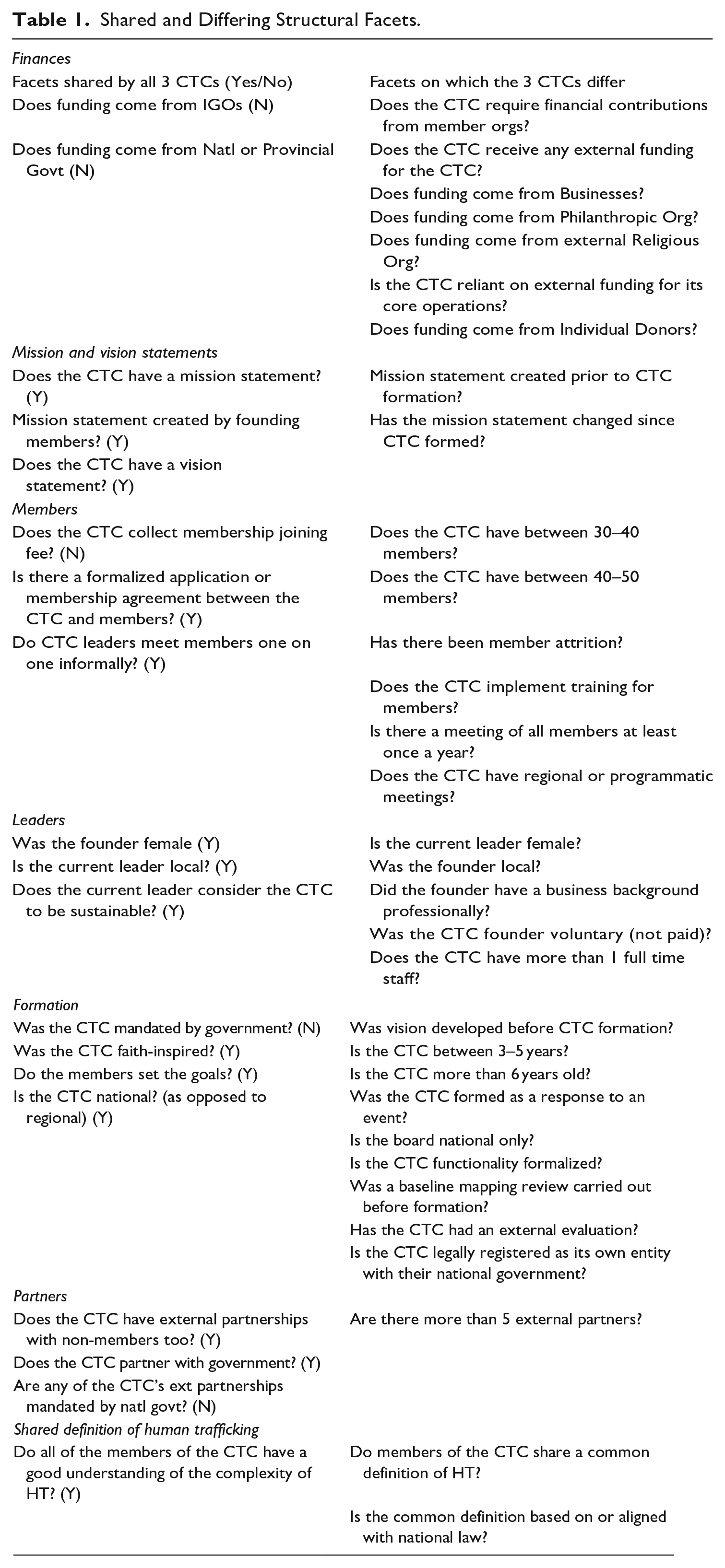
To illustrate, because a founding leader of one coalition mentioned in an interview that there had been a needs assessment of anti-trafficking organizations in her country just prior to the formation of a national CTC which influenced the founding aims of that CTC, we included “baseline mapping review prior to formation” to the list of structural facets in the category of formation. We then searched the data from both of the other CTCs for evidence of that facet. We discovered that a baseline mapping review had indeed been conducted in one other country prior to its CTC formation, but not the third. So two CTCs received “1s” for that facet and the third CTC received a “0” for that facet.
After summing the 1s and 0s for each CTC across all 51 structural facets, we found that the three CTCs shared only 19 facets. Those 19 are presented in the left column of Table 1 by category. On the other 32 facets, presented in the right column of Table 1, one or another CTC differed from the other two.
The differences in structural facets were well-distributed across the coalitions. Covenant Alliance was the outlier on 13 of the 32 facets of structure, meaning that either it had a “1” on 13 facets for which the other two CTCs had “0s,” or vice versa. Sector Bridge was the outlier on eight of the 32 facets of differentiation, and Community Nexus was the outlier on the remaining 11 of the 32 facets of differentiation. In other words, of the structural facets identified through our inductive analysis of data from each coalition which were not shared by all three CTCs, each of the three coalitions had a significant number of unique facets in comparison with the other two. The results of this analysis evidence significant variation between the structural facets of the three CTCs.
Types of interorganizational relationships
The second way we compared the structures of the CTCs was via the types of relationships member organizations reported having with each other. A strong majority of the member organizations in Community Nexus and Covenant Alliance, and nearly half of the member organizations in Sector Bridge, reported that they first met via coalition activities. Using the definitions provided in the core measures of the PARTNER Tool survey (described in Varda & Retrum, 2012), in “awareness only” relationships, organizations have some knowledge of each other, but do nothing together. In “cooperative” relationships, organizations support each other by meeting together, or informing each other of available resources. “Coordinated” relationships include but go beyond the elements of cooperative relationships to engage in one or more joint activities. In “integrated” relationships, organizations share funding, develop joint programs, offer combined services, share accountability, and/or share decision-making. The prevalence of each type of relationship by CTC is presented in Table 2.
Prevalence of Relationship Types by CTC.
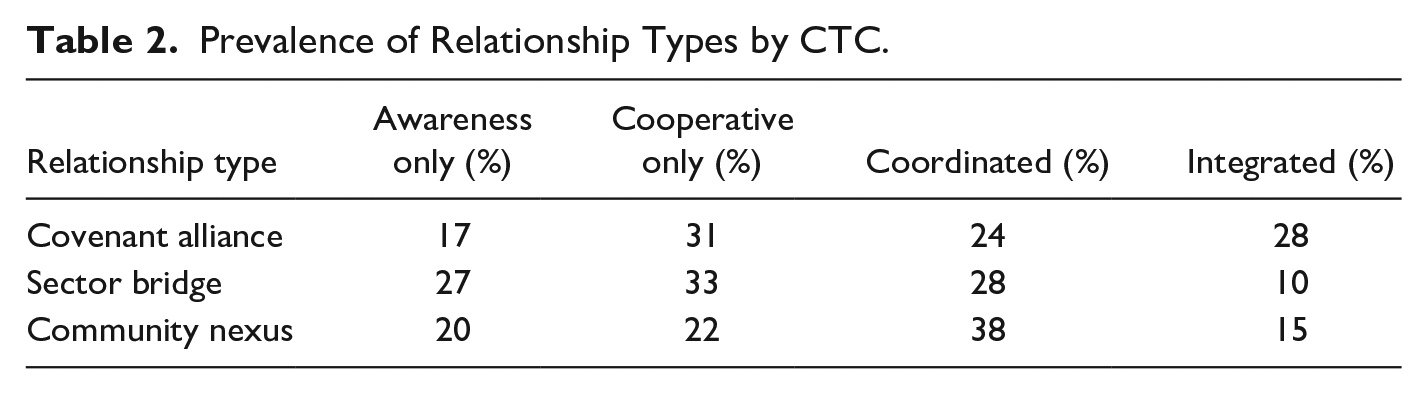
The data in Table 2 demonstrate that the CTCs’ structures varied significantly by the types of relationships between member organizations. Although in Covenant Alliance and Sector Bridge cooperative-only relationships were the most prevalent type at 31% and 33% respectively, 28% of the relationships in Covenant Alliance were integrated, contrasting with only 10% of the relationships in Sector Bridge. The least prevalent type of relationship in Covenant Alliance was awareness-only (17%), whereas the least prevalent type in Sector Bridge was integrated (10%). In contrast, in Community Nexus, coordinated relationships were the most prevalent type (38%), and integrated were the least prevalent type (15%). Stated another way, Covenant Alliance had nearly double the percentage of integrated relationships as Community Nexus, and nearly triple the percentage of integrated relationships as Sector Bridge. The relatively high level of awareness-only and low level of integrated relationships in Sector Bridge corresponds with it having the most geographically distributed membership and the least centralized structure.
To summarize, the CTCs shared only 19 of 51 structural facets, and each CTC was the outlier in a substantial number of those facets. The types of relationships reported by member organizations also varied greatly across the CTCs. There were no similarities in either analysis of structural characteristics across the CTCs. Therefore, we argue that structures have no correspondence with the uniformity of beneficial outcomes reported by the leaders and member organizations of the CTCs. Next we present our findings regarding the coalitions’ leadership practices.
Leadership Practices
CTC members were asked to indicate the extent to which CTCs evidenced 18 distinct leadership-related actions. We standardized those action-level measures on 6-point scales, and normalized them for valence from 1 = very positive valence to 6 = very negative valence. Then, to move beyond action-level findings, distill our extensive survey data, and compare the CTCs systematically, we inductively categorized each action as co-comprising one of six broader leadership practices: (a) fostering equity, (b) constructive decision-making, (c) goal-oriented interaction, (d) positive influence of the coalition on member organizations, (e) cultivating a positive relational environment, and (f) including diverse member organizations. Each of the six practices was indexed from the averaged scores of two to six actions. In Table 3, the index score in each cell represents the combined average scores on the action measures comprising each leadership practice.
Comparison of CTC Scores on Indices of Leadership Practices.
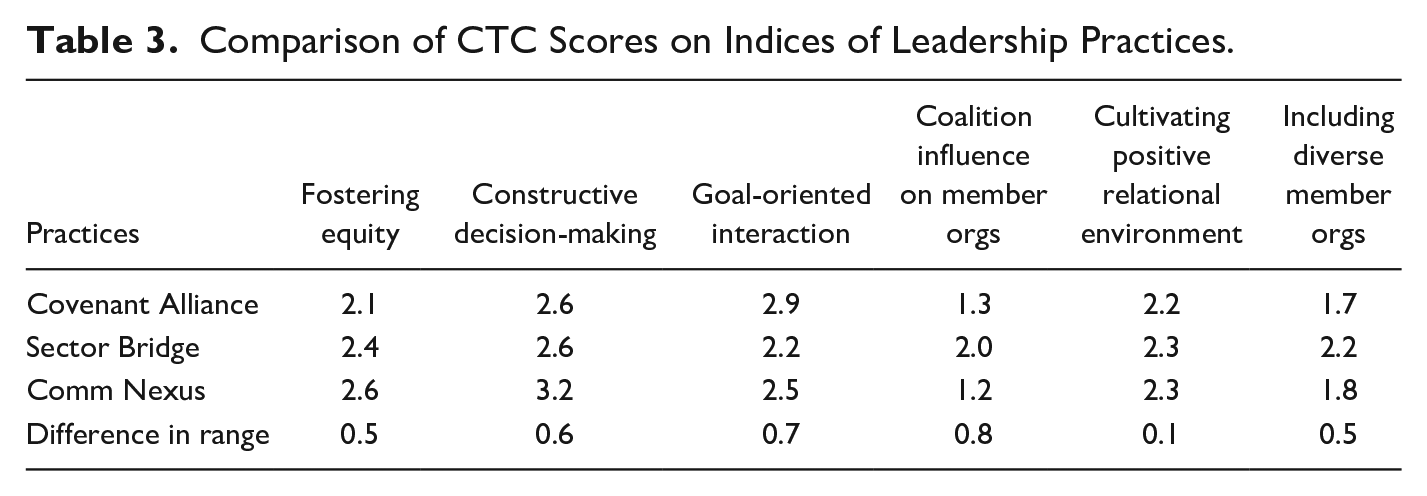
All of the index scores for leadership practices were under 3.0, indicating strong positive valence on each for all three CTCs, with just one exception: the constructive decision-making score for Community Nexus was 3.2, signifying weak positive valence. Moreover, member organizations in all three coalitions scored the same two practices most positively: their coalition’s influence on member organizations, and their coalition’s inclusion of diverse organizations. It is even more striking that the differences between the index scores for all six leadership practices were all less than 1 point on the 6-point scale, and ranged from only a 0.1 point difference between the CTCs in the practice of cultivating a positive relational environment within the coalition, to a 0.8 point difference between the CTCs in the practice of the coalition’s positive influence on member organizations.
Members of all three CTCs agreed unanimously that their organizations have adopted the shared goals and program standards developed by the coalition, and all member organizations indicated they have developed or improved the programs or services they deliver as a result of participation in the coalition. These data indicate that victim-serving organizations within CTCs are more likely to have higher standards regarding service provision (due to positive peer pressure) than organizations outside of CTCs. In the countries in which these CTCs operate, there were few government standards for—or monitoring of—victim services. One example is policies regarding victim/client confidentiality in terms of case management and media and communications. The government of Community Nexus’s nation had begun to carry out standards checks in NPO-operated shelters for trafficking victims prior to this study, according to coalition leaders. Those leaders reported in our interviews that government officials commented to them that the shelters for victims run by members of Community Nexus all measured higher on government standards than shelters run by NPOs that were not members of Community Nexus.
A majority of the member organizations within each CTC indicated they perceived the coalition leaders as attempting to include them in collective goal-setting and decision making, and that coalition leaders were responsive to member organizations’ needs and were open to being challenged on and changing decisions. Leaders of each CTC reported experiencing challenges in gaining participation from members, but articulated in similar terms a desire for members to be more involved and to listen to members’ requests, suggestions, and concerns so the coalition would be relevant and responsive to members.
Responses from CTC member organizations to open-ended questions on the PARTNER Tool survey confirmed the positive relational environment within the coalitions. To illustrate, the following are a representative sample of responses to the survey question “What do the coalition leaders do that builds trust among members?”:
“The coalition [leaders] keep contact and communication with members (. . .) Members’ comments, and requests for support are taking into consideration and responded to. Coalition has regular member annual meeting, sharing, building networking. Coalition has been a huge support for [our] staff development and good practices” (Community Nexus).
“They do well in their relationships with members by [being] respectful, open, trusting, and transparent” (Community Nexus).
“Decision making process is consensus. Suggested or recommended action is acted upon through consensus decision otherwise no action to be done” (Covenant Alliance).
“True openness to other members’ ideas” (Covenant Alliance).
“There is the active encouraging of organizations for activities they are doing (. . .) Seeing other organizations championed by [CTC] leadership does help to build confidence in [those] other organizations (. . .) Leadership promote and champion organizations to each other where there are shared goals/ ability to mutually benefit from working together. Having that endorsement also builds trust” (Sector Bridge).
“By encouraging interaction and sharing of information and expertise” (Sector Bridge).
“I have often had messages [from a CTC leader] asking how I was doing, and if I needed any help with the work we are doing. I think the fact that leadership sees all of us as people and not just work-horses is important” (Sector Bridge).
To summarize, the findings from our comparative analysis demonstrate that the CTCs’ leaders’ practices of communication and organizing are remarkably similar in both form (i.e., fostering equity and constructive decision-making), and effects (i.e., a warm relational environment and positive influence on member organizations).
Discussion
The finding that members as well as leaders of all three CTCs assessed their respective CTC as generating positive outcomes is not entirely surprising, as the fact that CTCs selected for this study were well-established with sizable and relatively stable memberships made it likely that they had achieved some positive outcomes. But that could not be presumed, because although members are likely to exit an ineffective coalition when the costs of participating outweigh the benefits (Whetten, 1981), coalition longevity does not ensure success (Mizrahi & Rosenthal, 2001). Although a coalition’s age and membership stability may indicate success/effectiveness in terms of outcomes, they are not guarantees. Moreover, since it is common for coalition participants to express dissatisfaction with gaps between expected and actual outcomes (Varda & Retrum, 2012), the positive perceptual assessments of each CTC’s outcomes by members as well as leaders is significant.
Because the leaders and member organizations of each CTC uniformly assessed their coalitions as both achieving beneficial coalition outcomes and having made significant advances in counter-human trafficking efforts in their country, we can add nuance to the question that motivated this study. The nuanced question is: How do robust CTCs that self-assess similarly as generating positive outcomes compare in terms of their activities, structural characteristics, and leadership practices, and how might the differences and similarities between them contribute to greater understanding of the relationship of each factor vis-a-vis collaboration outcomes? We interpret this study’s findings as evidence that the positive outcomes perceived by both CTC leaders and member organizations are largely attributable to leadership practices pertinent to communication and organizing, and specifically those of fostering equity, constructive decision-making, goal-oriented activity, positive influence of the coalition on member organizations, positive relational environment, and inclusivity of diverse member organizations.
This study confirms and fleshes out a key finding from Mizrahi and Rosenthal’s (2001) study of 41 “social change coalitions” in the New York/New Jersey region that “competent leadership” was the factor most often identified with “coalition success.” Members’ adoption of shared goals and program standards developed by the coalition is also a strong indicator of positive collective leadership (Kramer et al. (2019), and effective management (Milward & Provan, 2006).
The variety of structures and activities of each CTC in this study may well have been essential to the sustainability and positive outcomes of the CTCs within their respective national contexts. However, the variation among the structural characteristics and activities of the CTCs in this study evidences that no specific structure nor particular activities within the broad categories of coalition-sustaining and counter-trafficking are universally necessary for positive outcomes. This finding counters some widely-promoted models of interorganizational collaboration (e.g., Kania & Kramer, 2011), and is a significant contribution to theory on coalitions.
The mix of methods we employed enabled us to probe the complementary self-reported views of CTC leaders and members, and to achieve a more holistic understanding of the complexity of each CTC. Quantifying some elements of our qualitative data enabled more robust comparative analysis. Limitations of this study included that observation of the CTCs interaction was not possible due to distance and fiscal constraints, and that assessments of each CTC’s outcomes were limited to the perceptions of its members and leaders, as there was no reliable way to get external perspectives nor comparable verifiable measures of outcomes.
Conclusion
This comparative analysis of CTCs in Global South countries contributes groundbreaking findings regarding collaborative counter-human trafficking efforts in nations outside of the relatively high income countries of the Global North—a vast realm in which there is a dearth of collaboration research (Pugel et al., 2020). Our findings evidence that the CTC’s leadership practices explain the positive, beneficial outcomes reported by coalition members as well as leaders. The similarities in leadership practices across all three CTCs, confirming extant research based in Global North contexts (Kramer et al., 2019; Mizrahi & Rosenthal, 2001), can be interpreted as indicating leadership practices essential to developing and sustaining counter-trafficking coalitions across differing national contexts. These findings are likely relevant to coalitions addressing other societal problems as well, but that will need to be explored through further research.
Our findings regarding the substantially different structures of the CTCs in this study are consistent with the wide array of structures that Ashman and Luca Sagawara (2013) found in their study of thirty civil society networks in five regions of the world. We concur with Ashman and Luca Sagawara that the optimal structure for a coalition should be determined based on the assessment by its founders—and developers—of evolving cultural, political, economic factors and the outcomes it aims to generate. Although the coalition-sustaining activities of information-sharing, setting and reviewing goals, and capacity-building for member organizations may well prove to be consistently prevalent among NPO coalitions around the world, our findings suggest that the particular activities through which coalitions aim to redress societal problems are likely to vary by national context even among coalitions focused on the same societal problem.
There are at least three implications of our findings for the praxis of coalition convening, development, and sustainment. One is that decisions regarding structural facets of a coalition should be made on the basis of national and local contexts rather than on structural models developed in other contexts (e.g., an international funder’s blueprint or preference). A second implication is that, at least in the realm of anti-trafficking work, there is no particular problem-oriented activity that must be engaged in by all member organizations of a coalition. Perhaps the most important implication is that opportunities for knowledge-sharing among leaders of diverse coalitions in different nations regarding key leadership practices—such as those that foster equity and the inclusion of diverse member organizations, support a positive relational environment and constructive decision-making between member organizations, facilitate goal-oriented activity, and seek to benefit member organizations—are worth creating and investing in.
Finally, we must highlight that the leaders of the CTCs in this study had persevered through leadership turnovers, funding shortfalls, and interference attempts by governments in addition to the challenges of addressing human trafficking and exploitation. As attested to by the members of these CTCs, the coalition leaders’ actions had been consistent with their goals despite these challenges, and that stability of focus enabled them to develop and sustain these coalitions. The leaders had not been mandated by government or other external stakeholders to set up these coalitions. To the contrary, these CTC leaders were compelled by visions of a society without slavery and the passion to fight the injustices of human trafficking.
Moreover, the leaders of these CTCs were innovative in developing coalitions in often-hostile political environments where their governments had little or no intention of either facilitating or funding coalitions of this nature and which were generally suspicious of NPO coalitions. The leaders of all three CTCs described incidents in which governmental entities in their respective countries sought to restrict the convening of NPOs for collective action on issues pertaining to human trafficking and human rights due to government officials’ fear of—or outright opposition to—the impact of the coalition’s collective voice and action in calling out the government’s contributions to the problem of human trafficking. Future research should focus further on the challenges and practices of NPO coalition leaders in Global South countries. Finally, we hope this article helps equip coalition leaders everywhere and especially in the Global South to assess how various coalition structures and processes affect outcomes in their context.
Footnotes
Declaration of Conflicting Interests
The author(s) declared no potential conflicts of interest with respect to the research, authorship, and/or publication of this article.
Funding
The author(s) disclosed receipt of the following financial support for the research, authorship, and/or publication of this article: This article was produced with financial support from the Department of Communication, University of Washington, and collaboration support from the Helen Riaboff Whiteley Center at Friday Harbor Laboratories, University of Washington.
