




Abstract
This study analyzes how team members perceive changes in relational leadership processes over time. Interview data from three virtual teams (N = 18) were analyzed using qualitative thematic analysis. The findings illustrate how ideals of well-functioning leadership and teamwork communication can differ both between and within teams at different times. Team members may perceive benefits of the passage of time in teamwork, including experienced closeness, adjustment, and clarification of practices, as well as challenges such as rigidity and historical baggage. Organizations and teams may experience a shift in the ideals of leadership, but adapting to and adopting new forms of leadership over time may not be unproblematic. The findings also highlight how relational leadership is neither stable nor linear in its development. Overall, the study contributes to leadership and team research by increasing understanding of the relational construction of leadership among naturally occurring teams and by challenging assumptions about how leadership and time are perceived by team members. The implications of studying subjective time in connection with relational leadership are discussed.
Keywords
Time is a key factor in team processes. As social entities, teams are always temporal and comprise “processes that unfold over time and operate on different time scales” (Salas et al., 2009, p. 66). Similarly, time is a core aspect of all leadership. As Tourish (2014) argued, leadership cannot be understood as separate from the social, organizational, and temporal contexts in which it takes place. Furthermore, communication is at the nexus of negotiating both the meanings and actions related to time in groups (Ballard & Seibold, 2003). However, research has often overlooked—or taken for granted—the importance of time in both team and in leadership processes, leading scholars to call for more research in the area (Bluedorn & Jaussi, 2008; Castillo & Trinh, 2018; Dinh et al., 2014; Shamir, 2011, 2012). This study aims to understand how time is perceived in relation to relational leadership processes in teams. We are interested in the ways relational leadership—the mutual accomplishment of leadership between multiple actors (Tourish, 2014)—is seen as changing and evolving over time throughout successive interactions in virtual teams. To this end, we conducted an empirical interview study with three virtual teams operating in three different organizations.
Studies considering the connections between time and leadership in teams have approached the topic from a variety of viewpoints. Time may refer to coordinating the rhythm, pace, and synchronization of leadership; the temporal horizon of leadership (Bluedorn & Jaussi, 2008); both measurable clock time and experienced subjective time (Castillo & Trinh, 2018); culturally influenced orientations to organizational time (Lee & Flores, 2019); or an intersubjective negotiation of time (Ballard & Seibold, 2003). Another approach is to examine the phases or performance cycles of groups (Arrow et al., 2005; Marks et al., 2001; Morgeson et al., 2010) and their relation to effective leadership behavior, though such phase models have been contested. The idea that group members need socially-oriented leadership behaviors (such as support) mainly in the initial phases was recently challenged by results indicating their importance throughout a group’s life cycle (Bergman et al., 2014). Research has also shown that team contexts and fields of operation play a part in how distinct team phases and relevant leadership behaviors are (Graça & Passos, 2015). Relevant competencies of leadership may also be subject to change over time. For example, some scholars argue that the increase in technologically-mediated communication and virtuality in teamwork has produced entirely new skills that are required for leadership (Eberly et al., 2013).
While connections between time and leadership have been studied, such research has been sparse and scattered (Bluedorn & Jaussi, 2008). Overall, time has been largely ignored in studies of leadership (Shamir, 2011, 2012), virtual teams (Gilson et al., 2015), and shared leadership in teams (Nicolaides et al., 2014; Wang et al., 2014). Moreover, workplace teams often exist for much longer periods of time than teams studied in controlled laboratory settings.
In this study, we examine temporality as the experienced passage of time in teamwork. We are interested in team members’ perceptions of change in an attempt to understand the evolution of relational leadership processes over time (Shamir, 2012). We are interested in time both as “clock time” (relatively long periods of time such as months or years) and, especially, as subjective experiences of the passage of time (Castillo & Trinh, 2018). In line with Ballard and Seibold’s (2003) meso-level model of time and organizing, we approach the experience of time as relationally negotiated in communication at the nexus of several levels (e.g., individual, group, and organization). We expect factors such as occupational and team norms, organizational culture, and leadership relationships influence how time is experienced and enacted at the individual and relational levels. In the following sections, we provide a more detailed look at how relational leadership processes have been studied and at how time and change have been operationalized in previous research.
Processual and Relational Approaches to Leadership
We approach leadership from a relational and communicative standpoint. In recent decades, leadership research has experienced a shift from examining individual appointed leaders exerting power and influence on their subordinates to how leadership might emerge as a complex process entailing mutual influence (Tourish, 2014). Similarly, studies on leadership communication have developed from employing linear models of communication to more systemic and complex understandings of meaning-making and interaction (Ruben & Gigliotti, 2016). This approach highlights leadership as a dynamic social process that is constantly being co-constructed by multiple social actors in communication and is also influenced by time (Fairhurst & Connaughton, 2014).
There are several overlapping and partly differing views on relational and processual leadership (Fitzsimons et al., 2011; Uhl-Bien, 2006). It is not within the scope of this article to elaborate on the conceptual and operational differences between these different approaches. Rather, over the next few paragraphs we will discuss how these frameworks relate to changes occurring in teams over time.
Studies conceptualizing leadership as relational and processual emphasize that it should not be seen as something one person does to another but, rather, it should be viewed as a mutual accomplishment among multiple actors (Tourish, 2014). Thus, “failures” or “successes” of leadership should not be attributed merely to an individual leader or to their competencies (Endres & Weibler, 2016; Ruben & Gigliotti, 2016). Instead, leadership consists of reflexive practices and co-created realities that leaders and members shape and by which they themselves are shaped (Fairhurst & Connaughton, 2014). From a relational standpoint, the focus is not on individual abilities, traits, or behaviors (i.e., identifying which leadership behaviors are effective in team contexts). Rather, the interest is in emergent processes of leadership and their interpretations (Uhl-Bien, 2006). These include how meanings of effective leadership are constructed through continuous interactions in all relationships, not just between appointed leaders and members. Leadership is also seen as embedded in contexts including the relationship, the team, the organization, culture, and time (Fitzsimons et al., 2011; Uhl-Bien, 2006).
Most forms of leadership can be understood as being affected by or dependent on processes of mutual influence. For example, shared leadership develops in different ways depending on relational issues and the interpersonal ties within the team (Clarke, 2012). However, relational and processual approaches to leadership put interaction and relations at the forefront (Fitzsimons et al., 2011), focusing on leadership as a joint product of interaction and meaning-making (Ruben & Gigliotti, 2016).
The term “relational leadership” refers to both processes and outcomes (Uhl-Bien, 2006). In the process of communication, social influence and order are produced through, for example, the negotiation of leadership roles or the coordination of team meetings. At the same time, the rules, structures, and norms of leadership relationships are being constructed, further shaping communication processes. While research widely acknowledges leadership as dynamic and developing, understanding of how these dynamic processes occur, especially over long periods of time, is still lacking (Castillo & Trinh, 2018).
Temporal Changes in Leadership Processes in Teams
An implicit assumption of relational and processual perspectives is that, over time, leadership changes. Thus, in order to understand these processes in their context, time cannot be ignored in research (Shamir, 2011). Leadership is seen as a distributed practice embedded in constantly developing and changing social processes (Fitzsimons et al., 2011). From the viewpoint of group and team communication, time can be approached as developmental progress, cycles, or merely change (Poole et al., 2005). However, operationalizing time and change in empirical research has been challenging.
In existing theorizing regarding temporality of leadership, changes over time have often been examined as development. This approach relates to a common presumption that, in teams, processes of learning, development, and maturation occur over time (Salas et al., 2009), or that as interactions between members regularize over time, some shared structures (such as mental models, attitudes, or modes of behavior) usually emerge, and may even “crystallize” (Kozlowski & Ilgen, 2006). Group development models often assume that leadership needs change as groups progress from one stage to another (Wheelan et al., 2003). As Castillo and Trinh (2018) argued in their review of leadership studies focusing on time, researchers often assume that change processes follow linear trajectories. This is at odds with the growing understanding that change can manifest in nonlinear and uncertain ways (Castillo & Trinh, 2018).
The majority of leadership research has been conducted from an atemporal viewpoint or with atemporal methods (Shamir, 2011). Similarly, in team research, phenomena are often studied as situational, ignoring temporal aspects and processes (Arrow et al., 2005). In studies that have taken time into account, time has often been operationalized by focusing on a few arbitrary time points over a time period that is relatively short—even as short as a few weeks (Castillo & Trinh, 2018; Nicolaides et al., 2014; Shamir, 2011). Team leadership studies have also been critiqued for focusing on variables that are treated as fixed attributes (Roe et al., 2012). Regarding controlled experiments, even if time is taken into account, it has been argued that the studies fail to represent leadership phenomena that occur in authentic settings as the time scales in these studies often differ from long-term, real-life processes (Shamir, 2011). Indeed, these methodological tendencies are at odds with the lived reality of many natural teams. For example, organizational teams may operate for years, sometimes even for decades.
Processual perspectives on leadership challenge these linear and progressive assumptions, focusing more on the ongoing fluctuation of leadership (Endres & Weibler, 2016) rather than seeing it as developing into some fixed “end state” (Tourish, 2014). Similar ideas have been advanced in studies on shared leadership. Teams may share leadership during stable periods of time, but, in crisis situations, an appointed leader may take charge (D’Innocenzo & Mathieu, 2014), or leader and follower roles may be continuously renegotiated in extreme and rapidly changing contexts (Eberly et al., 2013). Shared and distributed forms of leadership may occur either situationally or as formal institutionalized structures arising from design and/or adaptation (Gronn, 2002). Thus, leadership may be temporary or emerge as formalized structures over time.
Leadership processes do not change and fluctuate in arbitrary ways. Rather, leadership communication (like all communication) can be described as a “bell that can’t be un-rung.” That is, previous interaction always shapes current meaning-making, which in turn influences future interaction and interpretation (Ruben & Gigliotti, 2016). For example, an individual leader cannot independently determine the interpretations or outcomes of the team’s communication. Instead, previous leadership processes shape interpretations and may cause relationships to “spiral up or down” (Shamir, 2011, p. 309). In other words, there is a relational level to change that must be taken into account. Instead of focusing only on linear developments or the quality of leadership relations, the focus of the research should be on the “social dynamics by which leadership relationships form and evolve” (Uhl-Bien, 2006, pp. 672–673). Thus, in leadership processes, leaders and members influence each other cyclically, influencing both the relationships and the context in which leadership is embedded (Eberly et al., 2013).
Change processes over time can be viewed as a central element of leadership in teams. Existing theory and research suggest that some changes over time are inevitable in groups (Arrow et al., 2005) and in leadership, including leader–member relationships or expectations regarding leadership (Bluedorn & Jaussi, 2008; Wheelan et al., 2003). However, there is a need for more empirical research that takes leadership processes occurring and unfolding “over time” into account and examines them from the viewpoint of communicative practices. In addition, there is a distinct lack of research that examines time as a subjective or intersubjective phenomenon, rather than as a measurable, homogenous variable (Castillo & Trinh, 2018). The experience and enactment of time occurs at various levels, such as the individual, the relationship, the group, or the organization. For example, occupational and team norms as well as organizational culture influence how individuals experience and enact time with one another (Ballard & Seibold, 2003).
While there is some research examining leadership in teams from a temporal, relational, and communicative standpoint (Gerpott et al., 2019), studies considering teams existing for as long as years or even decades are sparse. In this study, we aimed to examine change and subjective time on a wide scale. We were interested in how participants describe change on several levels (individual, relational, team, organizational) as well as on any possible forms of leadership they discuss (appointed, emergent, shared, etc.). Specifically, our aim was to understand the relational aspect of leadership communication: leadership as co-constructed in ongoing and developing relationships over time as opposed to examining task-related functions of leadership. We were interested in these relational processes over relatively long periods of time such as several months or even years, as perceived by virtual team members. To this end, we formulated the following research question:
RQ: How do team members perceive relational leadership processes as changing over time?
Method
Study context
Qualitative and interpretive research allows examining how change processes related to leadership occur or are understood as occurring over time. The focus is on the creation and interpretation of intersubjective social realities, relations, and identities occurring in day-to-day work and experiences (Endres & Weibler, 2016). In this study, we chose to employ thematic, open-ended interviews as a method of data collection. Interviewing allows participants to remember past events and reflect on leadership activities and change processes (Eberly et al., 2013). Interviews are especially useful when aiming to record people’s experiences and perceptions of change over long periods of time.
We collected interview data (N = 18) from individual members of three different teams (hereafter, teams A, B, and C). The interviews were part of a larger research project with a focus on communication in natural (Poole, 1999) workplace teams. The teams were identified by the organizations themselves, including self-identified membership boundaries. We included all team members—including appointed team leaders—in the interviews. Our interest was not to compare organizations or the teams per se, but rather to benefit from their diverse viewpoints in building a rich description of leadership and change. By including teams from different organizational and occupational cultures (Ballard & Seibold, 2003) and with differing time orientations and histories, we sought to increase the possibility of capturing a variety of experiences and perceptions regarding the meaning of time for relational leadership processes. Next, we will introduce the participating teams’ structures, levels of distribution, and the technologies used. In doing so, we utilize Hollenbeck et al.’s (2012) dimensional conceptualization of temporal stability, skill differentiation, and authority differentiation in teamwork. Table 1 provides an overview of the teams and their key characteristics.
Teams Included in the Empirical Study.
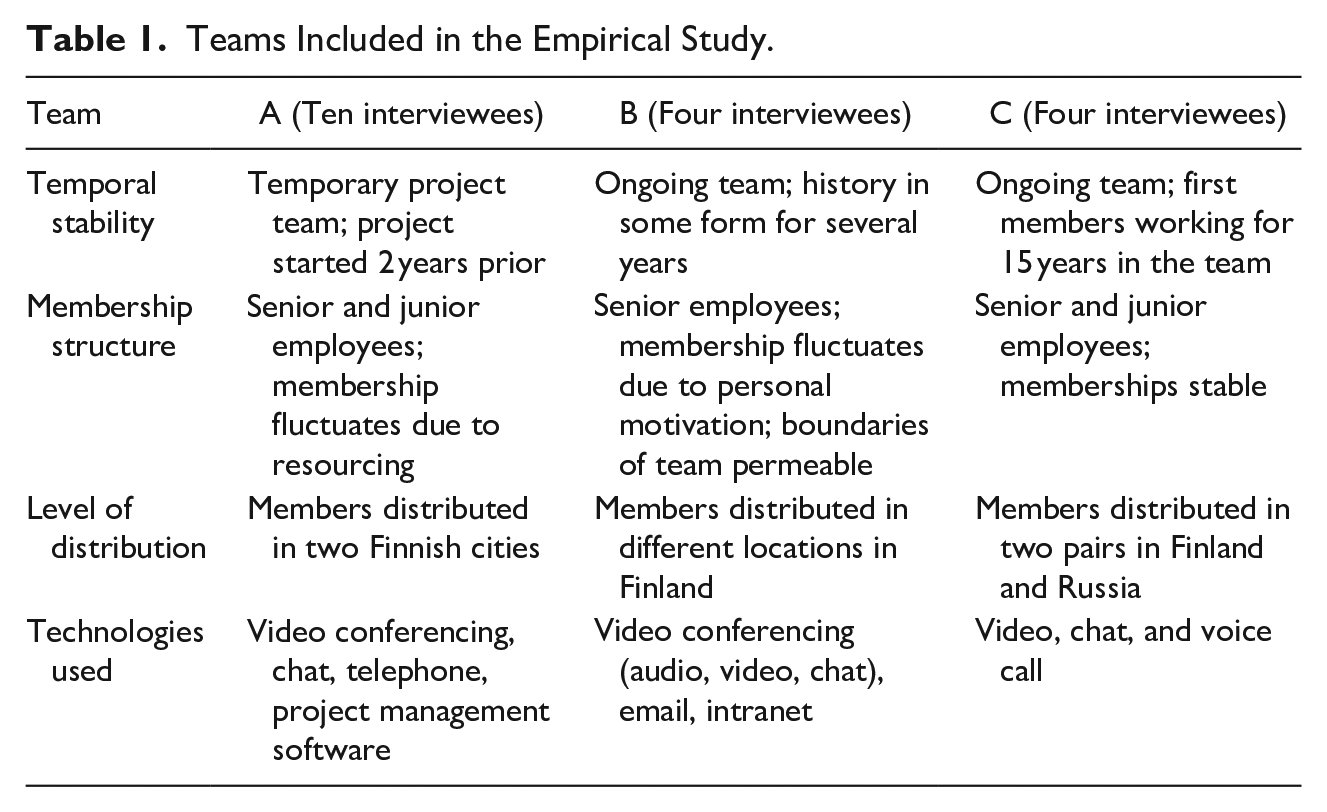
The participating teams represented typical workplace teams in that they had both a history and an anticipated future, thus allowing for the study of leadership processes occurring over time. The teams were either very high or relatively high on the temporal stability continuum (Hollenbeck et al., 2012), with some members of team C working together for 15 years, members of team B for several years, and some members of team A for 2 years.
Team A (eight interviewees) was a project team in a large software development organization tasked with developing a new service for an external client. The team was distributed between two cities in Finland. In their work, the team applied Scrum, an agile software development framework. Team A could be described as rather high in the skill and authority differentiation dimensions (Hollenbeck et al., 2012), as the Scrum framework entails defined roles with fixed team monitoring and decision-making responsibilities such as “Scrum master” and “project owner” (Moe et al., 2010). However, team members also described their circulating daily tasks and roles rather flexibly and depending on current needs of the team and the project.
Team A’s project had begun approximately 2 years prior to the interviews and the team’s membership had since changed. Some members had worked on the project since the beginning, while others had joined a few months prior to the interviews. The project was estimated to finish within a year. Team A described communicating via a number of channels and tools such as video conferencing, chats, the telephone, and via their project management software.
Team B (four interviewees) was an intra-organizational development team located in a business consultation organization. Its goal was to generate and test new ideas. The team had a very loose membership structure. Team members worked partly from different locations in Finland. The mobile nature of the work increased the need to rely on communication technology in their teamwork. Members also worked with each other in other teams. The team communicated via a video conferencing platform with video, audio, and chat tools. They also communicated via email and the organization’s intranet. The team was temporally relatively stable, having been in existence in some form or another for several years. The team was rather low on the authority differentiation scale in that members described deliberately rotating the leadership roles (Hollenbeck et al., 2012).
Team C (four interviewees) was a permanent internationalization promotion and marketing team tasked with helping outside organizations. The team members were dispersed as two pairs in Finland and Russia. Two team members had been working together for 15 years, and the newest member had been in the team for 3 years at the time of the data collection. They primarily communicated by text-based chat via a video chat and voice call service, and occasionally made audio calls. Authority distribution in the team was moderate: there were some clear leadership responsibilities (regarding, e.g., budgets), but members described other leadership responsibilities as having emerged due to familiarity over time.
Interviews
Because the study was undertaken within the framework of a larger research project, the interview protocol covered a variety of themes, some of which were only tangentially related to this study. To understand team members’ conceptions of time, we aimed to also understand their everyday realities in their organizations (Ballard & Seibold, 2003). The themes covered in the interviews included: (1) team structure and the role of the interviewee, (2) technological tools and channels of communication, (3) leadership and leadership communication practices, (4) expectations concerning leadership and leadership communication, and (5) learning and developing leadership. The average duration of the interviews was 51 min, with individual interviews ranging from 30 to 74 min. The interviews were conducted by both researchers, some separately, some together. Each interview followed the same thematic protocol. However, there was some variation in the wording of the questions as well as in follow-up questions asked. The follow-up questions were used, for example, to clarify the discussion or to get interviewees to provide concrete examples of specific issues.
The interviews were conducted face-to-face, with the exception of one member from team A and one from team C. These members were interviewed via video conferencing software. All interviews were conducted in Finnish. The interviews were recorded, and then transcribed verbatim. The transcripts totaled 278 pages of single-spaced text.
Analysis
We employed thematic analysis (Braun & Clarke, 2006) in this study. Qualitative analysis methods overlap, and thematic analysis is sometimes also labeled as qualitative content analysis or thematic coding (Schreier, 2014). What is common to these methods is the attempt to reduce a dataset to patterned responses and abstract categories from individual passages in order to discover importance and meaning within a dataset and to construct an understanding of the phenomenon under study (Braun & Clarke, 2006; Schreier, 2014). This is an active process in which the researcher constantly makes choices about areas of interest, the analysis itself, and reporting (Braun & Clarke, 2006).
Our process was inductive and interpretive (Braun & Clarke, 2006), with no pre-existing coding frame derived from any specific theory. Instead, we were interested in the ways the interviewees would describe change processes in leadership. This allowed us to derive codes from the terms and accounts used by the interviewees to build explanations (Barbour, 2014).
The typical phases of thematic analysis include familiarizing oneself with the data, generating initial codes, searching and reviewing themes, defining and naming themes, and finally, producing a report (Braun & Clarke, 2006). Our process began with a close reading of the whole dataset followed by analysis with ATLAS.ti software. The first author was primarily responsible for the analytical process. However, peer-debriefing phases were employed to ensure rigor, crystallization, and triangulation (Tracy, 2010) in the analysis. The second author regularly looked into the emerging codes and categories and provided critical feedback and comments. Peer-debriefing is a continuous process involving several rounds of re-evaluating and revision (Barbour, 2014).
After becoming familiar with the data, initial codes were generated by marking any meaning units—sentences or paragraphs related to similar contents and contexts (Graneheim & Lundman, 2004)—that included interviewees describing (1) change as development, fluctuation, or learning relating to leadership over time, and (2) descriptions of different types of leadership (appointed, emergent, and/or shared leadership) in relation to time. The interviewees did not have to specifically reference terms such as “leadership” or “time” for their response to be counted within the initial codes. The first round of coding produced a little over 300 codes, which is typical for an inductive analysis process using ATLAS.ti (Friese, 2012). To gain control of and structure the codes, we hierarchically structured the codes into categories or sub-themes, and further into themes. In this process, several codes were merged and renamed. Data examples chosen for this manuscript were translated by the first author, and checked by both authors.
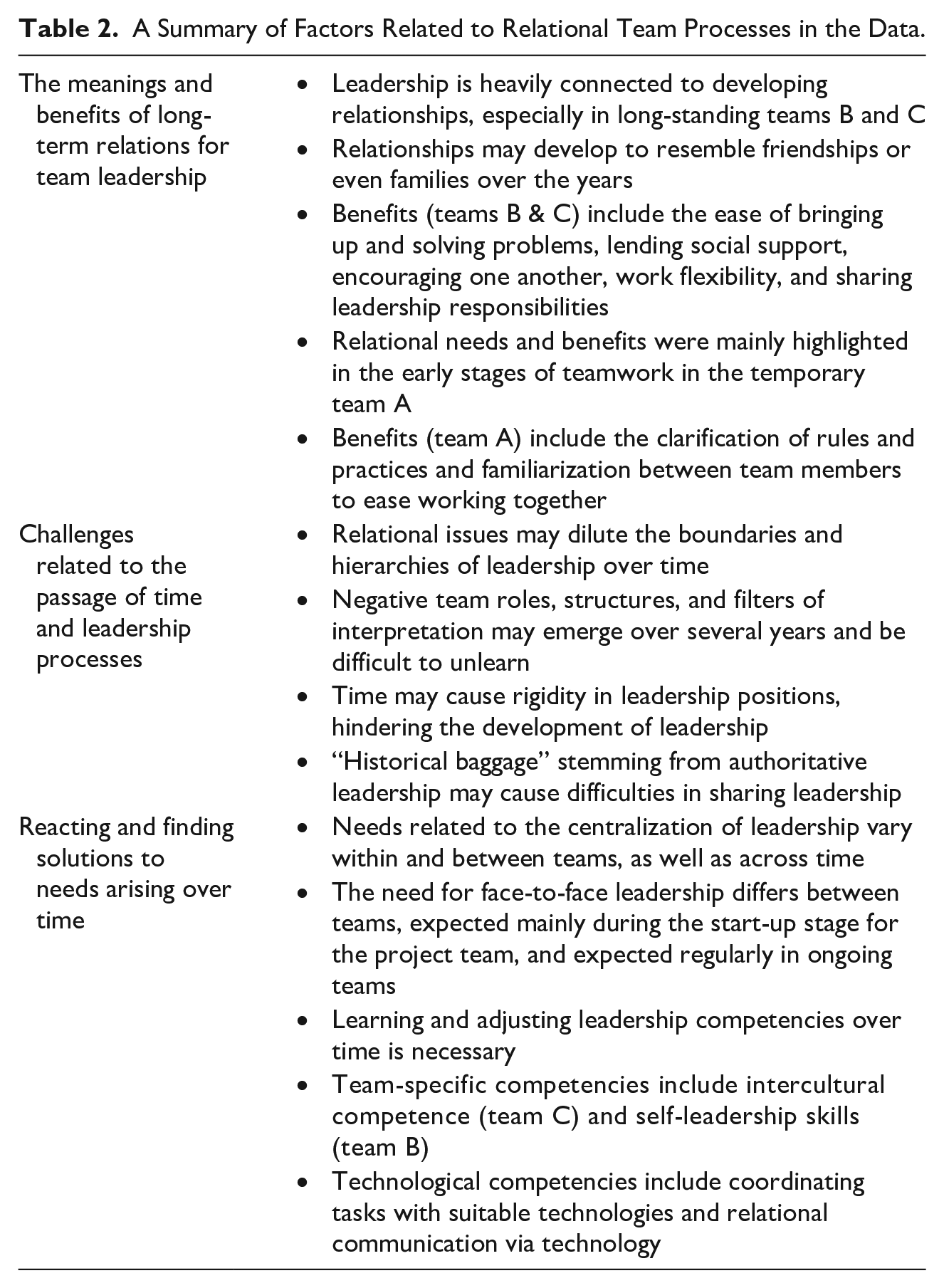
Through several rounds of coding and peer-debriefing, we ended up with three main themes explaining notions of temporal change in relational leadership processes, as presented in Table 2. These themes include (1) the meaning and benefits of relational leadership processes over time, (2) challenges of relational leadership processes over time, and (3) solutions to challenges over time.
A Summary of Factors Related to Relational Team Processes in the Data.
Findings
The meanings and benefits of long-term relations for team leadership
A key feature emerging across the interviews was the way the participants discussed the meaning of time for relational dynamics in teamwork and for leadership. This meaning appeared to be somewhat different for the members of the temporary project team (A) compared to the teams with longer trajectories (B and C). In the following paragraphs, we will explore each viewpoint in turn.
Relational development and maintenance processes, and their connection to leadership over time, were brought up in numerous ways by the participants. This emphasis on relationships was especially prevalent in the accounts of the members of the two long-standing teams, B and C, who saw leadership as heavily connected to developing relationships. They described teamwork as a process that develops and changes alongside relationships and even used terms such as “friendship” or “family.” In team C, two members said that they were friends before starting work on the same team. One of the benefits they identified as stemming from their long-term relationship was the ease and speed of bringing up and solving various issues:
We know each other so well already so that we notice instantly if there’s something on the other person’s mind. [. . .] Over the years we have learned, quite well, to boldly ask one another what the problem is. That means we are able to, quite quickly, to dissolve issues, hopefully.
Members of teams B and C also described other benefits stemming from long-term relational dynamics. These included, for example, lending social support, encouraging and boosting one another, being flexible about work, and sharing leadership responsibilities when needed. A member from team C described the benefit of flexibility as a personal favor:
It makes working easier because sometimes, when you do personal favors, talk about your families, how everyone is, and then you work, I think it creates flexibility in the work. You’re ready to work longer hours or pick up the pace when someone asks you to . . . I see it as a kind of an internal obligation also. [. . .] It creates flexibility, and when someone else says, “Hey I really need this information here,” I will think, “Hey, this person is my friend, of course I will do it,” even if I have to work overtime or something.
Long-term relational development, occurring over several years, may sometimes even be seen as blurring or diluting the lines between teamwork and leadership. This may lead to a viewpoint whereby “everything” appears to be related to leadership communication. Effectively, relations between team members may be viewed as constantly affecting leadership actions and interpretations:
It has become clear to me over time that everything we discuss is leadership. If we have to make tough decisions, develop tough procedures, or make tough statements, the relationship that has been built in all the preceding communication becomes very meaningful.
Contrary to the long-standing teams, members of the temporary project team (A) did not point out such deep connections occurring over time between teamwork, leadership, and interpersonal relationships. They described well-functioning teamwork and leadership as based more on the allocation of necessary resources and developing effective work structures and practices. According to their accounts, they often do not know other team members prior to collaboration. Once a project ends, they might also never work together again:
We won’t necessarily look for people to do the work from the same group but . . . situations change a lot—who happens to be available and who knows how to do what, that’s the basis.
The type of relational needs highlighted by team A seemed to arise more in the early stages of the team’s life cycle. These included clarification of work-related rules and practices, and familiarization with other team members, for example, in the form of face-to-face meetings.
If a negotiation situation occurs there around a table, or here, or, or, through video conferencing, there’s not much of a difference. But there’s a lot more difference when we go there, we eat together, and so forth. Especially at the beginning of a project, this is important. They say you can’t get to know someone well via video; you just talk about [task-related] issues.
However, team A’s members did not express a need or desire to develop relationships beyond this point. They seemed cognizant of their temporary relationships, some of which may even have ended before the project was to come to a close, and they only anticipated a satisfactory level of familiarization with others. Interestingly, while they did not place major emphasis on relationships, some members anticipated that challenges in leadership and teamwork communication would decrease over time due to, for example, stability developing in terms of team membership and relations over several months:
The composition of the team at this end was also quite lively. There’s probably none of the original members left. But after that, the composition has stayed pretty stable [. . .] and it probably eases cooperation and collaboration.
Ultimately, for both the short-term and the long-term teams, there was an acknowledged realization that time matters both to relationships and to leadership. However, possibly due to their extensive experience, the members of the long-term teams were able to paint a more nuanced picture of the many meanings time may take in teamwork.
Challenges related to the passage of time and leadership processes
While interpersonal relationships were seen as a central element of—or even a prerequisite for—well-functioning teamwork and leadership, the members of the long-standing teams (B and C) also identified challenges arising over time. For example, members of team C described the impact of close relationships on the boundaries and hierarchies of leadership. They pointed out how interpersonal closeness may affect leadership communication in negative ways:
Our team is best described by the word “friendship,” almost too much . . . there’s no clear . . . of course, in a way, there are leader–member relationships. [. . .] I know that my personality can be a bit too pushy, and I don’t know if I trust too much that the others do know me, so that if I did start overriding others, then at some point, maybe the rest of the team would stop me.
Members of the long-standing teams also noted that negative team roles and interaction structures may emerge over the course of several years. According to the interviewees’ accounts, these patterns may be difficult to unlearn. Roles and established interaction structures produce layers or filters through which other people’s communication may be interpreted:
We have quite a long history . . . the business has been running for twelve, thirteen years now, and people know each other quite well, on the whole. [. . .] Negative baggage leads to assumptions accumulating regarding how people will behave in a certain way. [. . .] For example, when reading an email or a comment, a sort of filter easily comes into play; what do they mean by that when it’s this person who’s writing that? [laughs].
According to the interviewees’ accounts, time may also cause unwanted rigidity regarding leadership positions. Growing accustomed to certain roles and leadership structures may inhibit team members’ ability to distribute or centralize leadership in new and possibly more productive ways. A member of team B described their observations of an established appreciation of self-leadership in the organization and their perception of this as hindering the development of leadership:
A very big challenge in leadership is that people here are afraid of being led. It’s like you shouldn’t tell anyone what to do or that something should be done. Everything should be voluntary somehow and . . . I continue to disagree with that. I think that if you’re part of an organization, then you have certain obligations toward that organization. If you want to operate completely freely, then perhaps you should operate independently.
Members of team A and B discussed how the concept of leadership had changed over the years. They referred both to the social reality within their organizations, as well as more broadly to the changes within the surrounding society. Overall, participants saw the expected style of leadership as having changed from traditional and authoritarian to more shared forms and practices. This perceived change, again, had an impact on how teamwork and leadership processes were interpreted. To some, the change from authoritative to shared practices had made leadership an entity that might be difficult to pinpoint as “leadership.” Rather, it might be regarded as joint responsibilities and self-directing teamwork:
There are things I don’t always register as leadership communication because they’re not the kind of traditional—to exaggerate—having someone tell you what to do kind of (leadership), I don’t, kind of. There’s probably a lot of leadership communication that maintains or strengthens the structure of self-direction or builds it toward something, and I just don’t always recognize it as leadership communication.
Team A had moved from a previously used waterfall project model to the iterative and more collaborative Scrum model. This transformation was described as propelling a shift to distributed and less visible forms of leadership:
The role of leadership is not quite as visible as it used to be. Back when I started on the job, there was always a project manager who pretty much led others more visibly.
These changes were not without challenges. In particular, members of team A discussed the “historical baggage” of being accustomed to more authoritative forms of leadership and appointed project leaders. According to their accounts, this baggage may show itself as reluctance to sharing or taking on leadership responsibilities in a flexible manner. This, in turn, may challenge the possibility of distributing power and responsibilities.
The idea of Scrum really gets watered down by a Scrum master who hasn’t internalized the idea of Scrum but still thinks of themselves as a project leader, which is something I’ve also been in my past life. And the kind of self-leadership and other benefits that could potentially be achieved, they are lost pretty quickly. Team members are pretty quick to adopt an attitude that they are just working there, and it’s not . . . there’s no kind of atmosphere of cooperation, joint responsibility, or taking responsibility for one’s own actions. Everything just sort of starts going the same way that it always has.
Reacting and finding solutions to needs arising over time
Expectations regarding the ways in which leadership should be shared varied in respondents’ accounts. Some interviewees expressed a preference for a traditional model of leadership; they expected an appointed leader to routinely enact leadership functions throughout a project’s or team’s life cycle. They also expected the leader to regularly allocate time to leadership communication such as informing team members about organizational issues and ensuring a shared understanding among members. These views were especially prevalent in team A:
To have someone, a kind of vague or some sort of understanding of what we’re about to do here and what our goals are. And then, along the way, we can ask whether we have something to ask and do more outlining if we need to. You have that, a contact person to move things forward. Perhaps that’s the way to get things finished.
Alternatively, some participants expressed that clear, authoritarian leadership should occur mainly as needed or during certain phases. They pointed out, for example, how an appointed leader is needed to act as a “primus motor” when starting new projects, or to direct the team during times of decision-making, or when transitioning from one major task to another. Members of both team A and team B emphasized the importance of an appointed leader during team start-ups. While team A’s members expected the leader to continuously look over the team, members of team B emphasized that once a team was functioning, members were expected to negotiate and share leadership responsibilities. They also described the deliberate circulation of leadership roles such as “summoners,” or people who are in charge of convening meetings: “The idea is not that whoever has gathered the team would only do those things. Rather, what will happen in the group is up to all of us” (B3).
We also noted differences across teams in relation to the expressed need for face-to-face leadership over time. Members of the temporary team A described how they mainly expected virtual leadership communication, except during team start-ups. Members of the ongoing teams emphasized the need for regular face-to-face meetings. Such meetings were seen as especially important in the early stage of team start-ups to ensure relational satisfaction and trust in the later stages:
Whether the customary way of communicating happens face-to-face or online or through writing . . . if you don’t have a relationship that is deep enough, the risk of all kinds of misunderstandings and problems grows bigger. And the way trust is built early on (is important), the kind that can take a little turbulence, which will always happen.
One solution to changes over time brought up by the interviewees was the potential for learning and accommodating the competencies of teamwork. For example, members of team C often brought up issues related to intercultural competence, while members of team B highlighted the importance of self-leadership skills. One common denominator in the team members’ accounts was the importance of technological competencies when working in distributed teams. According to our interviewees, this area of competency is subject to a multitude of change processes. Overall, they recognized that communication technology had become a pervasive aspect of teamwork. A member of team B described how new technologies must be gradually accepted into teamwork and leadership:
There’s no use longing for face-to-face communication; now we just have new communication tools that are gradually put to use . . . and then they sort of find their place.
The interviewees highlighted various technological competencies as essential in everyday leadership processes. They described the need to learn how to coordinate work tasks with suitable communication technologies. They also described the need to learn to use communication technology for relational purposes, which is understandable in a work context where team members may more commonly engage virtually rather than face-to-face. Team B had recognized the need for scheduling “social time” at the start of its virtual meetings:
People have a need, when they go into these kinds of web-based platforms, to cut straight to the chase and deal with things really quickly. Maybe they feel like they’re in a kind of a discomfort zone. And as you get used to using it and understand that just as there’s social time in a regular meeting, it’s also important there to chat a little and warm up and . . . it affects so much. And after that, it’s almost like . . . almost like being in a face-to-face meeting. Of course, you can’t quite get to the same level.
In summary, participants saw time as opening windows for change and new solutions. Not only can expectations and needs related to leadership change over time, but the interviewees’ accounts revealed how time may be related to what kinds of solutions and reactions are available for the team.
Discussion
The findings of this study paint a nuanced picture of the way team members understand what happens over time in relational leadership processes. The analysis illustrates how the concept of time can differ markedly based on the individual team members and the teams: how long they have operated, where they are in their life cycle, what kind of anticipated future is evident, and so forth. The novelty of our findings stems from a broad focus on relational processes over time, instead of focusing only on task-related communication structures (Ballard & Seibold, 2003). The findings contribute to our understanding of leadership processes in natural organizational teams, while challenging some assumptions of what happens over time.
The Benefits and Challenges of Relational Development
The teams, especially team C, had long histories and anticipated futures. Team members emphasized the development and maintenance of relationships, which they saw as quite close and inseparable from leadership. Relationships may thus be seen as “a common context” of leadership for team members. Shared experiences and similar backgrounds have been suggested as important in producing high-quality communication, coordination, and a shared understanding in leadership (Eberly et al., 2013), and building relationships has been highlighted as important for well-functioning team communication in general (Thompson, 2009). Our findings illustrate that relationships may be seen as providing both benefits and challenges. Team members described the benefits of strong relationships such as increased trust, the ease of problem solving, and the motivation to share leadership. Thus, there seem to be several “virtues of maturity” stemming from temporal stability (Hollenbeck et al., 2012).
However, our findings illustrate that time should not be seen as a “one-way street” leading toward positively connoted change and anticipated development. Members of the long-standing teams identified challenges in distinguishing leadership from other team-related interaction or in growing accustomed to ineffective or rigid patterns of leadership over time. In this way, both relational challenges and the need to solve them were described as increasing over long periods of time.
Time does not necessarily decrease chaos and increase clarity, as was seen in the accounts of some members of Team B. Indeed, while there is merit in thinking time will “do good” for teams in that members will learn from each other, learn how to work together, and improve at sharing expertise and leadership and utilizing knowledge, skills, and abilities (Hollenbeck et al., 2012; Salas et al., 2009), we should acknowledge that time can also “do harm” (Nicolaides et al., 2014). Teams do not necessarily develop positive qualities or become “better” over time. In the reality of prolonged teamwork, there may be ineffective or even harmful patterns of interaction that team members may learn and become accustomed to. It has been suggested that temporal stability might also bring about negative phenomena as groupthink, or hinder creativity (Hollenbeck et al., 2012). Our findings indicate that temporal stability can also be harmful in leadership relationships in the sense that it can produce negative filters through which the intentions and communication of others are interpreted. We concur with Endres and Weibler (2016) that researchers interested in emergent in social processes must be open to different types of leadership relationships and qualities emerging, instead of assuming “an overly harmonistic and idealistic view of leadership as a socially constructed phenomenon” (p. 17).
“Good Leadership” is Subject to Change
The interviewees’ accounts illustrate that the ideals of well-functioning leadership and teamwork communication can differ both between and within teams at different times. In the long-standing teams, well-functioning leadership was seen as connected to maintaining and balancing tensions regarding task and relational communication as well as individual and shared leadership over time. Most leadership communication research has focused on the task-oriented goals of communication. However, all leadership communication has both content and relational consequences (Ruben & Gigliotti, 2016). The relational dimension of leadership, based on our results, may be even more important when balancing complex and close relations over the course of several years, as was the case in teams B and C. In the temporary team A, relational communication was more connected to particular phases of the team. For example, relationship building was mostly anticipated to occur in the beginning of the team effort.
Our findings illustrate how an organization or team may experience a shift in the ideals of leadership. For example, the ideal of a strong individual appointed leader may shift toward notions of shared leadership and “collective wisdom.” Interestingly, all of the studied teams described developing some forms of shared leadership over time.
Shared and distributed forms of leadership have sometimes been offered as a solution for organizations struggling in the face of increasing competition, constantly developing technology, and fast changes in the economy (Fitzsimons et al., 2011). While this may be the case in some instances, our findings also highlight that adapting to and adopting new forms of leadership over time can also be problematic. For example, a team member may have internalized the idea of how to communicate well in a leader–subordinate relationship but may have difficulty adjusting to the new ideal of shared leadership in a team. It is then a matter of trying to balance individual and organizational ideals. This could lead to frustration and the inability to change established patterns of leadership.
The findings also touch on the question of the specificity of leadership in distributed or virtual teaming. A common presumption is that leading virtual teams requires specific skills (Eberly et al., 2013), is more challenging than leading face-to-face teams, and requires more work and learning effort from leaders, although these ideas have not received much empirical attention (Hoch & Kozlowski, 2014). Our interviewees valued face-to-face leadership in grounding virtual teams and did reflect on some new requirements for both teamwork and leadership. However, challenges regarding virtuality were not emphasized. It may be that the participants simply have developed adequate levels of individual and team-level technological competencies, as some level of dependence on technology was an established feature of all teams in the study. Whatever the reason, the findings of this study do not highlight the special nature of virtual team leadership as opposed to face-to-face contexts. Rather, the results remind us that we should be cautious before assuming difficulties or challenges just because a team primarily operates in a virtual environment.
In sum, the findings offer three types of insights into changes in leadership processes in teams over time. First the needs, ideals, expectations, and values related to leadership processes in teams are in a state of flux rather than stable or progressing linearly. Second, relational leadership, by its very nature, is neither stable nor does it develop in a linear fashion, but is subject to change and fluctuation in cyclic processes. Third, the challenges of virtuality in team leadership may not be as significant as is often assumed.
Practical Implications
From a practical viewpoint, it is important to remember that time does not automatically “do good.” It is not a magic bullet that solves problems, nor does its passage automatically mean that expertise and competence emerge. For example, it has been suggested that temporally stable teams would benefit from changing membership and team restructuring (Hollenbeck et al., 2012). We propose a cognizant approach to time in which organizations allocate time for teams to explicitly negotiate their leadership structure and also to build and maintain relationships (“backstage talk,” Thompson, 2009). Such explicit discussions could inhibit the development of inaccurate assumptions or ineffective roles and communication practices. Furthermore, leadership in teams should be regularly renegotiated, as situations, contexts, needs, and even entire organizational cultures may change over time. Indeed, there may be an element of wishful thinking when imagining the ease of times ahead as well as an expectation that certain challenges will be solved or that difficulties will fade away over time. Instead, such expectations may lead to rigidness and further challenges.
Our findings also suggest that team members and leaders should be cautious of re-telling the story of drastic difficulties and changes caused by technology. Virtuality, and especially difficulties related to it, were not highlighted by our interviewees. While scholars often remind us of these drastic changes in leadership in the past decades caused by new technologies (Eberly et al., 2013), working virtually has been commonplace for many employees for quite some time now. For example, the so-called millennial generation has grown up with an abundance of communication technologies (Gilson et al., 2015). In this study we interviewed team members who had been using communication technology in their work for decades. Our findings hint at the possibility that technology may not always present an overarching challenge for teamwork and leadership anymore and should not be treated as such.
Finally, team members’ subjective understandings of time should not be overlooked or taken lightly when trying to understand or improve the dynamics of teaming in workplace contexts. We found that the subjective understanding of phrases such as “a long time” or “soon” can vary significantly within and between teams, depending on, for example, a member’s status within a team and the team’s history and anticipated future. For some, a team that had been working for over a year was a long-standing one. For others, 3 years represented a short period—barely enough to get into the team. Understanding these differences and negotiating a sociotemporal order—a shared, group-specific understanding of time (Norris et al., 2019)—may help reduce conflict and increase coordination (Ballard & Seibold, 2003).
Strengths, Limitations, and Future Directions
The research setting and data allowed us to examine perceptions of change in teams with relatively long histories. Studies with an interest in temporality sometimes focus on zero-history groups whereby the timeframe is differs significantly compared to organizational teams. We argue that not only should research on leadership processes take better account of time, it should be sensitive to how the concept is used in different circumstances and by different actors; for example, regarding what is perceived as a long time in teamwork. This study can serve as a springboard for future research considering leadership across time in teaming, especially from the viewpoint of subjective time, often eschewed over studies examining clock time (Castillo & Trinh, 2018).
The dataset of this study also has limitations. While the study yielded insights into how changes over time in leadership processes are perceived and understood, interview data cannot shed light on what actually happens over time in leadership. While our study focused on individual accounts, future research could approach leadership negotiation processes employing, for example, observational data.
Our findings also highlight a particular challenge and asset of qualitative interviewing as a method. Both expectations and experiences related to time can be examined, but researchers must be careful when making interpretations. It may well be that some of our participants idealized time, especially when they were discussing expectations and anticipations regarding the future. Looking at accounts for members of Team A, for example, we find that the team members were sometimes discussing ideals of leadership or phases of the team that they themselves had not yet faced but were anticipating. In other words, they were discussing the future temporal depth in their leadership processes (Bluedorn & Jaussi, 2008).
Another critical issue regarding our research setting and method relates to the difficulty of separating when interviewees were referring to leadership and when they were referring to more general team processes. This might also be related to the concept of “seeing leadership everywhere.” Some authors argue that processual relational perspectives on leadership run the risk of diluting leadership and seeing all kinds of mutual processes as leadership (Endres & Weibler, 2016). However, others (Ruben & Gigliotti, 2016) encourage a shared ownership of leadership products and processes in order to decrease the unnecessary romanticizing of leadership. While the challenges of diluting leadership must be acknowledged, it could also be that in prolonged teamwork, “team talk,” or “team processes” might in fact be impossible to separate entirely from “leadership talk” or “leadership processes.” The commonalities and differences of leadership and teamwork, especially over time, could also be further examined in research.
Conclusion
The aim of this study was to examine understandings of change in relational leadership processes over time. Change over time has long been understudied in relational and processual leadership studies (Shamir, 2011, 2012). This study contributes to our understanding of the many ways in which time and relational leadership processes may intertwine.
While accepting that all leadership is processual and affected by both leaders and followers, researchers and practitioners must remain cautious about over-idealizing certain forms of leadership. For example, shared leadership has aroused much interest in team research and organizations. However, both positive and negative relationships between time and shared leadership have been suggested. Some scholars have assumed that over time, teams will become better at sharing leadership, which will in turn lead to better leadership. Based on a meta-analysis, Wang et al. (2014) suggested that those teams with relatively long memberships will most likely benefit from shared leadership, as over time, teams are able to build a clearer common vision, form effective ways of collaborating, and become familiar with each other’s expertise. Based on another meta-analysis, Nicolaides et al. (2014) suggested otherwise. They stated that over time, teams may, for example, experience increasing conflicts over power and leadership role distribution and develop rigidities in following procedures and policies. The present study contributes to this discussion by unveiling the nature of the differences between understandings of sharing leadership in teams over time. While our results hint at both types of experiences occurring over time, most existing theorizing as well as empirical studies usually focus on teams with much shorter trajectories than those exceeding a decade.
Research on what happens over long periods of time in leadership (Nicolaides et al., 2014; Wang et al., 2014), and especially with awareness of subjective time (Castillo & Trinh, 2018) in teams, is still scarce. As subjective understandings of time vary greatly, it is not possible to present generalized time frames for relational processes. Tapping into the meanings given to time in teams allows us to develop a better understanding of relational leadership processes and the social construction of teamwork.
Footnotes
Declaration of Conflicting Interests
The authors declared no potential conflicts of interest with respect to the research, authorship, and/or publication of this article.
Funding
The authors disclosed receipt of the following financial support for the research, authorship, and/or publication of this article: The research has been supported by the Academy of Finland.
