




Abstract
Few studies have explored how line managers respond to employees’ use of voice in interaction and the challenges facing the line managers in relation to voice. While some scholars have argued that managers’ reactions to voice are generally shaped by personal dispositions, such as the managers’ degree of “openness,” this study draws on the approach of discursive psychology to demonstrate that line managers’ responses are closely fitted to the organizational context and the unfolding interactional context. Through detailed analysis of a single episode from a voice activity in an industrial setting, the study exemplifies various rhetorical strategies used by the line managers and how these strategies may change as discussions proceed. The study also shows that psychological concepts such as openness should not be seen only as stable features of managers, but also as actively enacted in interaction. Various practical steps are suggested for improving both line managers’ and employees’ experiences with participating in formal voice activities.
Keywords
Voice can be conceptualized as employees’ “discretionary communication of ideas, suggestions, concerns, or opinions about work-related issues with the intent to improve organizational or unit functioning” (Morrison, 2011, p. 375). Although considerable research attention has been paid to the phenomenon of voice, including as a communicational process, many studies focus on just one side of the voice process, such as how employees assess whether and how to use voice, or how the targeted manager responds to voice on the basis of their personal dispositions or the type of voice message. Scholars have called for a stronger focus on the actual interactions between employees and managers where voice is uttered and responded to (e.g., Stohl & Cheney, 2001), including how managers contribute to this interaction beyond their overall positive or negative stances toward the voice message (Garner, 2013).
Line managers hold an important role in relation to voice, but also a potentially problematic one. Line managers have in recent years been given greater responsibility for facilitating human resource (HR) management practices in the workplace (Perry & Kulik, 2008), including implementing and supporting activities in which employees are invited to voice their work-related problems and suggestions (Townsend, 2014; Townsend, Wilkinson, & Burgess, 2013). Such formal voice activities potentially bring about a number of positive outcomes for both employees (such as increased learning, motivation and well-being, and improved working conditions) and the organization (such as improvements to product quality and efficiency, increased employee engagement) (Heery, 2015; Pohler & Luchak, 2014). In practice, however, line managers’ implementation of voice activities and other HR practices varies considerably (Townsend, 2014). For example, some line managers may reject employees’ concerns and suggestions on the basis that they conflict with the obligations tied to the line managers’ supervisory role, which is typically focused on reaching organizational goals such as high productivity and profitability (Donaghey, Cullinane, Dundon, & Wilkinson, 2011; Dundon & Gollan, 2007; Mowbray, Wilkinson, & Tse, 2015). In addition, factors related to the line manager, such as their openness to voice, their leadership style, and their relationship with the employee expressing voice, have a crucial impact on how employees engage in voice activities (Detert & Burris, 2007; Mowbray et al., 2015). Some have observed that when employees’ voiced problems or suggestions are rejected, employees are likely to exhibit “frustration effects,” such as an increased sense of injustice (Harlos, 2001) and skepticism toward future voice activities (Pohler & Luchak, 2014).
However, in spite of the line manager’s considerable influence on how employees experience the voice process, managers’ reactions to voice have mostly been studied from the employees’ perspective, leading to critiques that the literature is “dissenter-centric” (Garner, 2013, p. 375). Few have attended to the potential challenges that engaging in discussions regarding voice entails for the line manager or how these challenges are dealt with (Bashshur & Oc, 2015; Musson & Duberley, 2007; Townsend, 2014). Furthermore, actual interactions between employees and managers have received very little attention in the voice literature (Garner, 2013), where most studies of managers’ behavior rely on retrospective methods such as questionnaires or interviews, thereby disregarding the finer details of how the managers respond to voice in practice.
This study explores these details with a focus on situations where line managers challenge employees’ suggestions. First, the literature on line managers’ responsibilities in relation to voice and factors thought to influence managers’ reactions to voice is reviewed. Following this, I present discursive psychology as both a body of empirical work and an analytical approach that is especially relevant for understanding the line managers’ concerns and practical strategies when reacting to voice. A defining feature of discursive psychology is a strong focus on how people manage potential moral criticisms in discourse. This focus is relevant for studying line managers’ negative reactions to voice, as the line managers may be seen as failing to give fair consideration to the voice suggestions, for example. The discursive psychological approach is applied in a detailed single-case analysis of an audio-recorded and transcribed discussion among line managers and employees in participatory meetings taken from a larger data corpus. The analysis demonstrates how even in settings where employees’ use of voice is sanctioned by the upper management, line managers are able to influence the trajectory of voice-related discussions through various more or less directive means, thereby shaping their long-term outcomes. However, the line managers also visibly orient to the possibility that their actions may evoke criticism from the employees, and the line managers draw upon a number of rhetorical strategies to avoid such criticisms, including changing strategies as the discussion progresses. Besides highlighting these strategies and their situated use, the study suggests the need to consider the role of morality as a locally enacted phenomenon in future voice research. On this basis, practical suggestions are presented about how to consider the role of line managers when planning and conducting voice activities.
Line Managers’ Role and Reactions in Relation to Voice
In association with an overall increase in HR-related responsibilities in recent years, line managers have been described as playing a key role in both implementing structured voice activities in the workplace (Townsend et al., 2013) and encouraging employees’ voice behavior (Detert & Burris, 2007; Detert & Treviño, 2010). Furthermore, line managers, rather than top management, are often the recipients of employee voice, especially where union-based consultation is missing or weak (Dundon & Gollan, 2007), which presumes a “linking pin” role for line managers in passing information between employees and the upper levels of management (Mowbray et al., 2015, p. 393). However, as the format of voice activities is rarely formalized or described in protocols, line managers may handle employees’ complaints and suggestions differently due to idiosyncratic judgment (Harlos, 2001).
In relation to the positive effects of voice, some have argued that the success of voice activities fundamentally depends on whether the employees perceive “that their boss listens to them, is interested in their ideas, gives fair consideration to the ideas presented, and at least sometimes takes action to address the matter raised,” that is, that the participating managers are seen as “open” (Detert & Burris, 2007, p. 871). Detert and Burris claimed that by being open, managers reduce the power inequalities between themselves and the employees. In addition, Detert and Treviño (2010) showed that employees’ expectations about whether their use of voice would lead to success or not are more closely related to their perceptions of their immediate supervisors (and skip-level managers) than to their opinions regarding the structured voice activities themselves. Indeed, it has been claimed that if sufficiently competent, managers can “capture employee views and turn them into benefits for both the organization and the employees” (Townsend et al., 2013, p. 350).
However, line managers may also discourage employees from using voice. Donaghey and colleagues (2011) argued that managers can actively use their prerogative to control the employees’ use of voice, thereby avoiding certain undesired changes that could come as a result of the problems or employees’ suggestions. Some scholars have claimed that managers are fundamentally reluctant to relinquish power by increasing employees’ decision latitude (Denham, Ackers, & Travers, 1997), and that managers tend to downplay the importance of employees’ viewpoints in formal voice activities, emphasizing instead organizational outcomes such as increased efficiency (Dundon & Gollan, 2007). Also, Morrison and Milliken (2000) suggested that managers, believing that they know better than the employees, may regard employees as self-interested and may wish to avoid dissent in the workplace, leading them to take an unreceptive or “closed” approach to voice. The tendency of some line managers to take a negative stance toward employee voice has also been ascribed to a lack of adequate training in people management (Townsend, Wilkinson, Bamber, & Allan, 2012).
While the studies mentioned above generally suggest that individual managers are likely to either mostly support or oppose employee voice, others have argued for a more contingent understanding, focusing on how line managers’ responses are shaped by situation-specific circumstances. For example, line managers are typically more supportive or critical toward certain issues or voice strategies than others (Garner, 2016; Kassing, 2002). Furthermore, managers may draw upon a variety of understandings when discussing the broader phenomenon of workplace participation, even sometimes seemingly conflicting ones (Musson & Duberley, 2007). According to Musson and Duberley, this finding indicates that the managers face various opposing demands, such as being expected to support participation even though it might potentially challenge their authority, and that managers seek to reconcile these opposing demands in relation to the specific situation when responding to participation in practice.
The contingent understanding of the line managers’ behavior has been furthered by Garner (2013) who argued for the relevance of regarding dissent, a phenomenon closely related to voice, as a process rooted in interaction in which the meaning of a voiced problem or suggestion is co-constructed between employees and managers. For example, employees who engage in voice might be labeled as heroes, villains, or victims, depending on the motivations ascribed to their actions. By extension, the motivations ascribed to managers’ behavior in relation to voice can also be seen as co-constructed. As an example, if employees construe their line managers as acting in their own interest or that of the organization, rather than giving fair consideration to employees’ voice messages, it might lead the employees to question their managers’ reaction, or to criticize it covertly. Although it seems likely that line managers would be on guard against this type of criticism and proactively attempt to avoid it when they engage in voice-related discussions, the topic has received little attention in the voice literature. It is thus relevant to consider the research approach of discursive psychology, where people’s active management of potential criticism has been a central research theme.
Discursive Psychology
Within the tradition of discursive psychology, it is well established that people hold a strong orientation toward presenting their actions as reasonable and warranted, not only when criticism is raised by others, but also simply “in the context of potential blame” (Edwards, 1997, p. 97). Overall, discursive psychology focuses on how phenomena which are typically considered as belonging to the domain of psychology, such as stake, interest, or dispositions such as openness, are defined as discursive topics, things people topicalize or orient themselves to, or imply, in their discourse. And rather than seeing such discursive constructions as expressions of speakers’ underlying cognitive states, they are examined in the context of their occurrence as situated and occasioned constructions whose precise nature makes sense, to participants and analysts alike, in terms of the social actions those descriptions accomplish. (Edwards & Potter, 1992, p. 2)
Thus, studies which draw on a discursive psychological approach are characterized by a pragmatic understanding of communication (Augoustinos & Tileagă, 2012), which focuses on interlocutors’ visible orientations (rather than the analysts’ “deep” interpretation), understands language use as situated and occasioned (rather than meaning being inherent in language), and, perhaps most importantly, attends to constructions as resources with which to conduct actions (rather than merely being descriptive statements about the world). When discussing topics that are potentially controversial and where several different positions can be taken, people often construct their discourse for rhetorical effect, such as preempting potential counterarguments, even when such counterarguments do not surface explicitly in the interaction (Dick, 2013). As a result, some have claimed that discursive psychology is especially well-suited for studying how leaders exert influence through discourse in their daily interactions with others (e.g., Fairhurst, 2007; Larsson & Lundholm, 2010).
Fundamental to discursive psychology is the notion originally proposed by Garfinkel (1967) that social interaction is regulated by a moral order and that people design their conduct so as to be morally accountable. In other words, people are generally held accountable (and expect to be so) for their actions. These actions must be “sensible,” meaning that others should be able to make sense of what they are doing and also that the action must meet certain moral standards. The moral significance of people’s actions, such as whether an action represents “fair consideration,” cannot be established as a factual and objective property of the actions—instead “the moral texture of the matter has to be publicly accomplished, negotiated and displayed, offered and made available as something for others to see and judge” (Tileagă, 2010, p. 224).
Studies have described a number of discursive strategies or devices (Edwards & Potter, 1992) whereby speakers may question another person’s moral accountability. For example, descriptions that categorize persons as belonging to a certain type, such as being an open or closed manager, typically carry moral judgments and overshadow alternative accounts that relate that person’s actions to the specific circumstances of the situation (Jayyusi, 1984). Also, when accounting for the actions of others, speakers sometimes employ formulations which suggest that actions have a “scripted” character given the circumstances, implying that the described actions are highly regular and thus should be expected to be repeated in the future, rather than being a product of how the speaker chose to construct them (Edwards, 1995). By describing situations where a “script” is broken, speakers can point attention to how the person breaking the script might have conducted a moral transgression, ascribing such transgressions to that person’s disposition. For example, in Edwards’s study, examples were presented of how a couple used script formulations in counseling sessions to attribute jealousness or being flirtatious to one another.
Strategies are also available for preempting moral judgments from others. For example, people might seek to account for their actions through “role discourse,” such as by arguing that their actions are made necessary by formal obligations (Edwards & Potter, 1992). Another strategy is to use “counter-dispositionals” to preempt claims that one’s stance on an issue is attributable to holding a stake or a vested interest (Edwards, 2007). Counter-dispositionals are claims that people make about themselves which suggest that they are unbiased, such as formulations of the kind: “I’m not against X, but . . .” Overall, because a number of strategies for addressing one’s own moral status or that of others in interaction pass as merely “doing description,” analysts should engage closely with these descriptions and constructions to understand their situated meaning and consequences (Sneijder & te Molder, 2005).
It is important to note that from a discursive psychological perspective, “individuals’ understandings are driven not necessarily by underlying psychological processes, such as attitudes, but by the specific context in which such ideas are mobilized and how this may trigger attempts to defend or contest particular versions of reality” (Dick, 2013, p. 650). Within voice activities, we can expect the participating employees to assume a right to make proposals and, to some degree, to have their perspective considered by the management and their proposals accommodated (Detert & Burris, 2007), even if they do not hold the right to decide on these proposals themselves (Donaghey et al., 2011). But when line managers invoke their supervisory role rights and obligations, rather than their obligations to encourage and facilitate voice, attention is potentially drawn to the moral appropriateness of the managers’ reactions. In these situations, handling conflicting interests satisfactorily and being open as a line manager is not simply an expression of a certain personal disposition, but something that is actively performed in interaction with the employees. Therefore, the analytical section of this study addresses the following research question:
Method
Approach
The pragmatic approach to communication that discursive psychology draws upon means that a special methodological approach is needed. First, researchers must collect and analyze data that allow them to describe “the ways by which things get organized through interactions” (Cooren, 2006, p. 335). Whereas interviews and questionnaires are often used in voice research, these types of data are subject to participants’ post hoc rationalizations and recall bias (Potter & Hepburn, 2005). Instead, by analyzing interaction in workplace voice activities and providing a detailed transcript of it, readers can critically engage with the data in ways not possible with isolated quotes from interviews, for example. As language is not simply viewed as a window to reality, the point of analysis in the pragmatic tradition is not to establish the truth value of what is said, but to treat talk itself as a form of social action and understand how its strategic design shapes the studied events (Edwards, 1997).
Research Context
The data for this article was collected in connection with a larger research project that studied the implementation of employee voice activities in the manufacturing divisions of two Danish companies producing pharmaceuticals and plastic packaging. The intervention project provided access to a number of structured voice activities, activities that might be challenging to gain access to due to the potentially critical perspectives expressed about the organization. The studied voice activities specifically targeted circumstances related to the employees’ well-being and safety, and the author was present for the majority of the activities as either a workshop facilitator or a nonparticipating observer. In all workshop meetings, the participating employees all came from the same team, and their first-line managers (or line managers, if the team was comanaged) were also present. Many of these managers had previously worked as employees in the production and had considerable experience at the companies. No middle managers participated in the workshops. The overall data corpus included approximately 98 hr of audio recordings spanning 38 workshops.
Analytical Strategy
This study’s focus on line managers’ reactions to employee voice is explored in this article through an in-depth analysis of one episode presented in the form of three transcribed excerpts. This episode was selected due to its relevance for exemplifying a number of different points, and thus, the study can be said to present an explanatory case study (Yin, 2009). Within discursive psychology, detailed analyses of single episodes are common, as these make it possible to demonstrate how interactions progress over time and the practices that the participants draw upon to manage their accountability (Tileagă, 2010; Whittle & Mueller, 2016).
Although it is sometimes claimed that analyzing discourse is subjective or that “anything goes,” there is wide agreement among discourse scholars that conducting discourse analyses means engaging systematically with the empirical material on the basis of clearly explicated theoretical suppositions (Antaki, Billig, Edwards, & Potter, 2003). Discursive psychology draws upon methods developed in conversation analytical studies where the problem of meaning is addressed through the “next-turn proof procedure” (Edwards, 1997): What some utterance “counts” as doing in the interaction is displayed in the recipients’ subsequent turns, providing a resource for both the speaker (who can thus verify whether he or she has succeeded in coordinating meaning with the recipient) and the analyst (who can focus the analysis on the pragmatic effects of the participants’ utterances). Furthermore, because speakers have at their disposal a number of ways to express some point, it is relevant to consider how their choices potentially influence the interaction in ways that other alternatives wouldn’t—in other words, to consider the rhetorical effects of individual pieces of discourse (Edwards, 1997). Specifically, I directed my attention toward what the participants treated as relevant and morally delicate and how these delicate matters were managed in the interaction (Mäkitalo, 2006), drawing on the extant literature to identify the more or less elaborate rhetorical devices that participants, and especially the line managers, employed to manage the facticity of accounts and issues of stake and interest (Edwards & Potter, 1992). This approach ensures rigor by presenting the empirical material in a way that allows readers to assess the inferences on which the analysis is based, and, in this case, through the analyst’s familiarity with the setting.
In the early phases of the analytical process, the data corpus was reviewed in an exploratory manner, moving between careful readings of the data and the extant literature and making analytical notes in a topically organized research memo (Charmaz, 2006). During the analytical process, episodes where line managers opposed employees’ suggestions were noted as typically being at least somewhat delicate, leading to the closer analysis of more than 20 such episodes. The presented episode is particularly relevant for the aim of the study because it displays how the line managers’ rhetorical strategies might change as the discussion proceeds if the line managers’ initial attempts at influencing the discussion are not successful, and how these strategies are used in the local interactional and organizational context. What can be generalized from the study is thus not how managers typically respond to employee voice, but rather the more general point that various strategies are available to the managers in similar situations (many of which we know from the discursive psychology literature to be common in interaction in general), and how these strategies are fitted to specific delicacies that arise in the interaction (Dick, 2013).
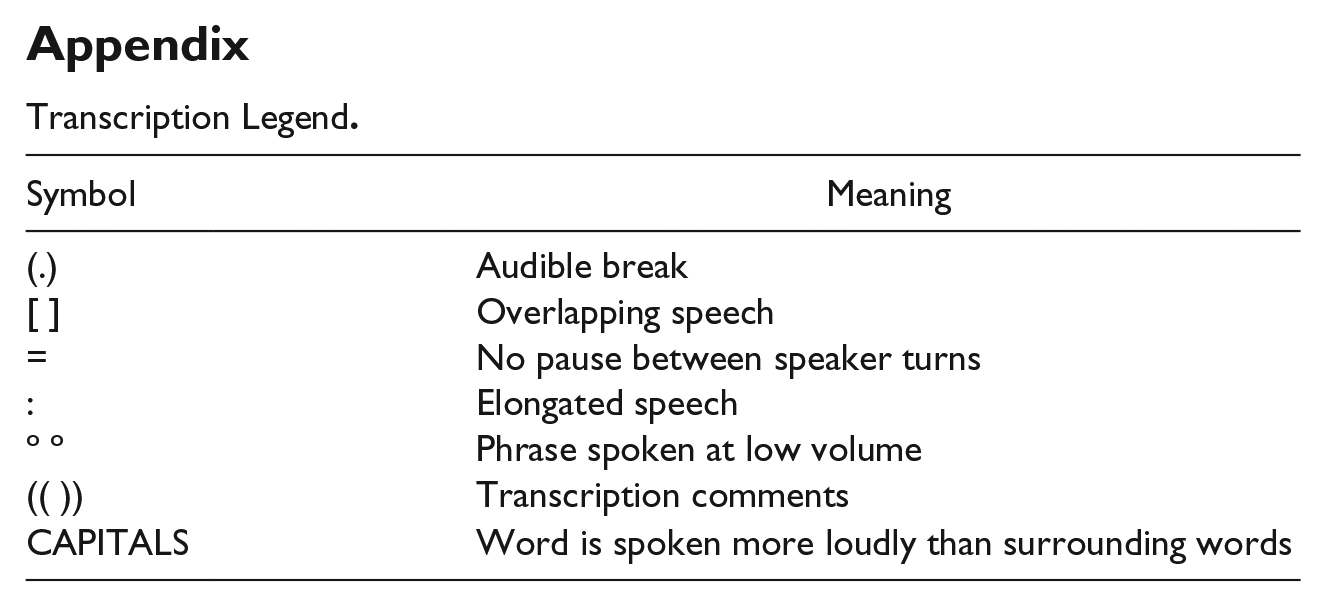
In line with other studies within discursive psychology, the transcript excerpts are presented in a simplified Jefferson transcription style (Jefferson, 1984, see transcription legend in the appendix), which makes it possible to convey features of talk that are important for understanding the actions produced by the interlocutors, such as emphases, overlaps, and pauses.
Setting the Scene: The Workshop Setting
The excerpts presented are taken from a workshop meeting focusing on action planning. The main agenda of the workshop was to discuss issues related to the employees’ health and well-being that the participants had identified at a previous workshop and to develop action plans describing initiatives addressing these issues. The 3-hr workshop was held in a meeting room at the worksite. Among the participants were seven employees from a large production team of roughly 50 employees, whose daily work consisted of various more or less strenuous physical tasks related to the production of pharmaceuticals, cleaning, and completing documentation paperwork. 1 Also present were the team’s two line managers and an external workshop facilitator who guided the participants through various tasks according to the voice activity program. Three observers were also present, sitting approximately 6 ft from the other participants, including the author who had been the facilitator for the previous workshop with the group. The observers did not participate in workshop discussions.
For the workshop, the participants were seated around a rectangular table, with the process facilitator (Frank) and the line managers (Nick and Anita) sitting together at one end. The facilitator presented this arrangement to the participants as a method for keeping the line managers somewhat in the background, yet still able to participate in the discussion. The pseudonyms and formal organizational roles of the participants are described in Table 1.
Workshop Participants.
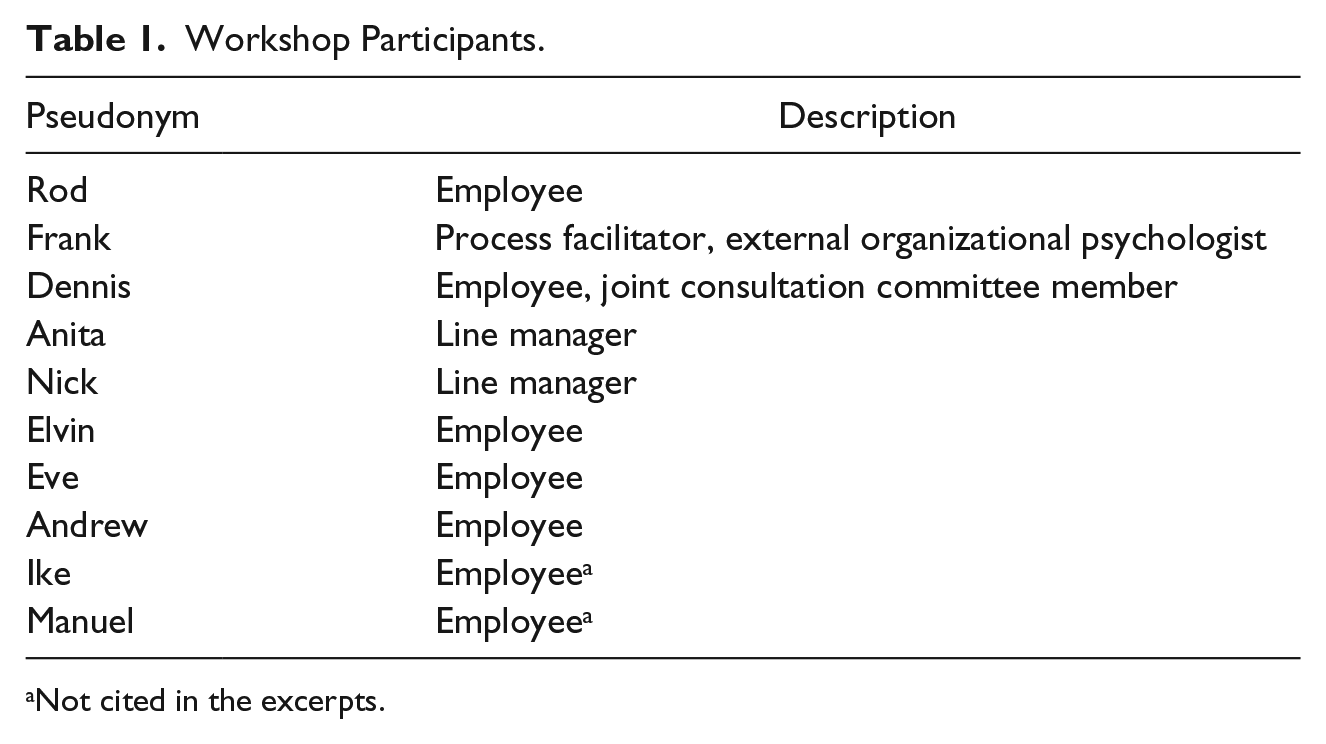
Not cited in the excerpts.
Analysis
In the following, three excerpts are presented from an extended discussion of a suggestion for an initiative. The suggestion revolves around providing opportunities for the employees to exercise during their shifts by allowing them to go for a walk or a run. Other exercise opportunities were already in place for white-collar employees throughout the company, and some blue-collar work teams in the production plant had taken less formal initiatives to support exercise as well. In the first excerpt, two points are especially relevant: (a) the employees’ displays of awareness that voiced suggestions must be compatible with organizational goals and (b) the line managers’ orientations toward these organizational goals as well as obligations toward giving what we might call “reasonable” consideration to employees’ suggestions.
Excerpt 1: Line managers’ initial positioning toward the suggestion.
In the excerpt, Rod first takes up the suggestion that employees should be able to take a walk during work hours. Referring to the suggestion as a “challenge” suggests that a previous decision had been made against such an initiative. Indeed, Rod’s suggestion is challenged by another employee, Dennis, who describes the suggestion as “shelved forever” (l. 6). In his next turn, Dennis describes that the last time the topic was raised, employees “were told” to run or walk during their lunch breaks, framing walks during work hours as unlikely to be allowed. When Frank asks Dennis about having been a member of the joint consultation committee, line manager Nick confirms Dennis’s membership (l.13), suggesting that the decision might have been made in the committee, and thus by a middle manager placed one level above Dennis and Anita in the organizational hierarchy. Thus, although Rod and Dennis take different stances, they both orient to how management is likely to react to the suggestion, even before their line managers have given a response.
Next, line manager Anita disaffiliates with Dennis’s account through another report that describes implementing the suggestion as conditionally feasible. Specifically, Anita formulates a sequence of action steps for how the suggestion could be realized in compliance with the rules of the voice activities (ll. 18-21). Although she indicates that employees would be responsible for drafting the suggestion (by the pronoun “you”; l. 19), she also indicates a willingness to implement the suggestion with the employees (“we”; l. 21). While this study approaches interaction from a pragmatic perspective, it is relevant to note that in terms of Detert and Burris’s (2007) definition, Anita could be said to demonstrate openness to voice by both listening and showing interest in Rod’s suggestion. That is, she gives the suggestion “fair” consideration by mitigating Dennis’s challenge and by offering to take action to address the matter. However, as her turn progresses, Anita’s openness becomes less clear. She next mentions that the production process has to run, marking this requirement as well known to the participants (ll. 22-23: “of course we have to”). Along with other features of her turn, such as offering only to try out the suggestion for a “short period” (l. 21) and attributing the warrant for trying out the proposal to the steering group rather than openly supporting the suggestion herself (l. 16), Anita projects a somewhat “neutral” stance. Still, though her suggestion of adopting a trial period does not rule out that management could reject Rod’s suggestion at a later time, it implies that the decision would be based on the results of the trial rather than on personal judgment which might be influenced by stake and interests.
Whether intentional or not, Anita’s neutral stance may preempt potential criticisms that her openness toward the suggestion might compromise organizational goals. Nick’s next turn suggests this potential problem as foreseeable: While he ostensibly affiliates with Anita’s statement that “the process has to run” (“yes I was just about to”; l. 25), Nick’s turn also implies that he would have brought up the participants’ obligations toward the production if Anita failed to do so. Instead, both Anita and Nick recycle their statements (ll. 26-27), further stressing their outward focus on this obligation. Thus, the excerpt illustrates that being open toward employees’ suggestions as a manager may be problematic if the suggestions are thought to conflict with other managerial obligations.
Nick’s displays of concern for keeping the production running in Excerpt 1 preface his increasingly critical stance toward the suggestion in the next excerpts. For Excerpt 2, we focus on the rhetorical strategies Nick draws upon to warrant his resistance while preempting potential criticisms of holding a stake against the suggestion. The exchange in Excerpt 2 occurred after two additional minutes of discussion, during which the participants considered various scenarios wherein the action plan could lead to problems.
Excerpt 2: Nick’s challenge to the suggestion.
In this second excerpt, Rod first proposes changing the content of the suggestion. However, Nick then begins a turn which is not fitted as a response to Rod’s suggestion. Nick first aligns with Anita’s suggestion of making a “decent proposal” (with “put it up there” referring to a board for suggestions that were to be implemented later), before transitioning into disaffiliating with the prospect of “generally enacting” the suggestion (l. 5). Nick also claims that employees would potentially neglect their tasks as an outcome of the suggestion (ll. 7-9). While Nick does not describe a punishment for employees in this case, his turn is formatted as a threat (“you will damn well not be . . . cause then it’ll be”) (Hepburn & Potter, 2011), and swearing underscores his strong stance. Still, it should be noted that, at this point, Nick merely describes the scenario as potential.
In the remainder of the excerpt, Nick brings up other negative consequences of the suggestion, and he formulates these consequences as highly likely. While Elvin and some other employees overlap with Nick, denying that they would neglect their work tasks (“it’s not like that”; l. 11), Nick next describes a scenario in which he and Anita are notified of Dennis’s “scurrying about” (l. 19). Several aspects of this turn are interesting. First, how does the description of the scenario function as an argument against the suggestion? Based on the data, it can be seen that the person who would be notifying the line managers would be a non-team member, because the person would not know that running had been sanctioned. “Scurrying about” deprecates Dennis’s running, suggesting that the person notifying Nick and Anita would be invoking a script (Edwards, 1995) that employees should not exercise during work hours, and by reporting Dennis’s running to Nick and Anita, the critic would be orienting to an expectation that line managers should know the whereabouts of their employees. However, both of these scripts are broken in the specific case, and, as mentioned previously, broken scripts are sometimes used rhetorically to make negative dispositional attributions to those breaking them (Edwards, 1995). The formulation “it’ll be said” (l. 18) can also be heard as indexing this sort of negative attention. Thus, Nick’s turn implies that if he and Anita were to accept Rod’s suggestion, others might accuse them of neglecting their managerial obligations. Using reported speech (in this case hypothetical speech) is a common strategy for conveying such affectively loaded points (Nielsen, 2014).
Nick also prefaces the scenario as highly probable and scripted (Edwards, 1995) (“but you know that it will take NEXT to nothing,” “you know that you here around the table”), thereby indirectly addressing the matter of whether he holds a stake in bringing up this potential negative consequence of Rod’s suggestion. Specifically, his formulation is claimed to represent a form of “common knowledge.” Furthermore, Dennis’s role in the account is taken as humorous by the other employees (ll. 20-21). The use of humor can be seen as a device for managing reactions (Schnurr, 2009). In this case, humor mitigates the directness of Nick’s strong language and repeated emphases. While descriptions of problematic events are often provided without reference to a clear “perpetrator” (Pomerantz, 1978), Nick here names Dennis as the would-be culprit. This is seemingly taken by the employees as ironic given Dennis’s outspoken skepticism toward Rod’s proposal.
In the last part of the excerpt, Nick takes the floor again by sternly indicating that he will act to avoid the scenario he has just described (“over my dead body”; l. 22). After some joking remarks about Dennis’s running, employee Andrew affiliates with Dennis’s critical description of the suggestion. Finally, Nick describes himself as being “totally” supportive of exercise. Nick’s claim to support exercise can be seen as a counter-dispositional device (Edwards, 2007), preempting attributions that he might be overly negative toward exercise in the workplace. Thus, Nick again addresses the possibility that others might attribute his critical stance toward the suggestion to a personal disposition or stake. Compared with Anita’s neutral position, we see Nick adopting a more skeptical stance toward the suggestion which he accounts for by describing two problematic and probable consequences.
The third and final excerpt shows Nick taking an even more critical stance toward the suggestion. In spite of Nick’s disaffiliations, the discussion regarding the suggestion continued for another 15 min, and several variations of Rod’s original suggestion were brought up. Both supportive and critical comments were voiced by various employees toward the suggestion, with a number of references being made to Nick’s previous disaffiliations. Between the time of the Excerpts 2 and 3, Nick had left the meeting table and taken a standing position at the other end of the meeting room. Excerpt 3 starts when a noise is heard from Nick’s end of the room.
Excerpt 3: Nick’s upgraded challenge.
This last excerpt begins with Frank asking Nick from across the room about the noise. After a few turns about the noise, Nick alludes to his previous statements about the suggestions (“I’ve sent my signal”; l. 5), while Andrew formulates Nick’s “signal” as an unconditional disaffiliation with the suggestion (“you’ve said you won’t be a part of that”). While moving closer to the table, Nick next takes a long turn, ending in a claim that the suggestion will certainly lead to Nick having to go search for employees who are out running (“because I would have to do that”), thus projecting a more certain stance toward the suggestion as problematic. The first part of Nick’s turn is especially notable. Here, he provides another counter-dispositional by describing himself as “not negatively disposed” (l. 9) toward exercise, mentioning that he plays badminton. It is also noteworthy that Nick’s claim that the suggestion will lead to problems falls after marking the claim as a personal opinion (“I’m just saying,” “that’s my personal opinion and I have great respect for the fact that others have a different one”). Labeling claims as an “opinion” in this way may seem puzzling, as much of what is said in relation to voice is taken as expressions of opinion without being explicitly marked as such. However, downgrading the certainty of claims in this way can help manage the risk of challenges from others (Sneijder & te Molder, 2005). Because Nick has just taken the floor and changed the subject to repeat his criticism of the suggestion, he could be seen as “doing insisting,” and labeling his assessment of the suggestion’s consequences as an opinion potentially mitigates the force of his argument.
After Andrew’s “yes” in line 16, Nick describes another problematic future scenario, which is also marked as certain to occur (“there will be days”). In this scenario, Dennis is once again recruited as the troublemaker, and Nick now addresses and accounts for this choice explicitly (“Dennis can take it”). Nick next presents an extreme case formulation (Pomerantz, 1986) of a situation in which almost all members of the team are affected negatively by the suggestion (ll. 19-23). Toward the end of his turn, Nick vows to fight the suggestion if pursued further (“I will do EVERYTHING in my power to see that it does not get carried out”). By foreshadowing his active resistance if the suggestion is pursued further, this utterance has the force of a threat (Hepburn & Potter, 2011), and Nick’s strong expressions frame the suggestion as highly inappropriate (Edwards, 1997). However, while Nick could have invoked his supervisory rights to direct employees to drop the suggestion, such a strategy would clearly mark his obligation to support the employees’ use of voice as having been overridden. Nick’s use of the future tense (“will,” l. 23) directs attention at the different order that is in place outside of the present formal voice setting—an order in which he is less obliged to consider the employees’ interests and can thus oppose the suggestion more forcefully. Threats set up compliance or defiance as main response options (Hepburn & Potter, 2011). With the response “then we might as well close the topic,” Rod proposes the first: ending the discussion with a nondecision (ll. 26-27). Still, the indirectness of Nick’s threat, the recurrent accounts for his stance, and the mitigated expressions of disagreement all highlight his orientation to the situation as being delicate (Sneijder & te Molder, 2005). In any case, the suggestion was not brought up again.
Finally, we can see that in her overlap with Rod’s last turn, Anita acknowledges the possibility that the suggestion could, in fact, create problems, but again takes the neutral stance that for her to support the suggestion, its actual consequences would have to be known and be positive (“it has to solve more problems than it creates”). Because few would argue against this stance (i.e., for implementing suggestions which “created more problems than they solved”), Anita’s turn can be seen as an attempt to inoculate herself against being positioned in contrast to Nick, that is, as failing to see the potential for later problems and thus as being too open.
Discussion
The aim of the analysis was to illustrate how line managers address potential criticisms of their responses to employees’ suggestions in voice activities. By analyzing three excerpts from an extended discussion about a voiced suggestion, the analysis sheds light on aspects of the line managers’ reactions to voice that are not well described through methods that focus on the employees’ or managers’ retrospective accounts of voice interactions. This analysis offers a number of contributions to voice theory.
First, although some studies have attributed managers’ reactions to voice to stable features of the manager, such as their leadership style or how open they are (e.g., Detert & Burris, 2007; Mowbray et al., 2015), the analysis demonstrates that in practice, managers’ reactions to voice reflect both the nature of the employees’ suggestions and the organizational and interactional context they are made in. For example, in relation to the organizational context, Anita in Excerpt 1 invoked knowledge about how the setup of the formal voice activities meant that the employees would be allowed to try out suggestions that had previously been dismissed, and Nick in Excerpt 2 presented a scripted account of how other organization members would likely react to seeing employees running outside the plant during work hours. In relation to the interactional context, the participants could be seen to design their comments about the suggestion on a turn-by-turn basis to address utterances that had come directly before, and on some occasions, even meanings that were merely alluded to or inferable (e.g., in Excerpt 1, ll. 11-12 and Excerpt 3, l. 25). And on a wider scale, it was shown how Nick oriented to the contextual delicacy of taking a critical stance toward employees’ voiced suggestions in a setting where employees are ostensibly invited to exercise voice (e.g., in Excerpt 3, ll. 9-13). In addition, while looking across the three excerpts, we saw how Nick took an increasingly critical stance toward the suggestion as the other participants kept discussing the suggestion, thus failing to heed his “signal” (Excerpt 3, l. 5). This last point highlights that line managers’ reactions are dynamic, and that line managers might draw upon a repertoire of arguments and stances in different ways throughout discussions of a voiced theme. Thus, while many studies have focused on how managers respond to employee voice in isolation, the analysis shows that reacting to voice as a line manager may require extensive discussions, involving a form of social negotiation.
Second, the analysis demonstrated what can be glossed as three different types of stances toward the employees’ suggestions: what was referred to as Anita’s “neutral” stance in Excerpt 1, Nick’s skeptical stance in Excerpt 2, and Nick’s more dismissive stance in Excerpt 3. Surely, line managers are also likely to take other types of stances toward employees’ voiced suggestions, such as more positive stances, and the number of stances that can be identified analytically will likely depend on the granularity of one’s approach. However, the point is that while managers’ personal dispositions have received substantial attention in the voice literature, these dispositions are not directly identifiable in actual interactions—instead, they are attributed to the manager by others (such as the employees) or claimed by the managers themselves (Edwards & Potter, 1992; Jayyusi, 1984). A discursive psychological perspective helps us see how managers may project such dispositions through the stances they take and how these are accounted for: in other words, how the manager “does being open” (Edwards, 2007).
For example, Anita’s stance projected an attempt to balance openness toward the suggestion with meeting her and the other participants’ obligations toward fulfilling organizational goals. And in Nick’s case, rhetorical strategies, such as script formulations, downgraded knowledge claims and counter-dispositionals were employed to counter attributions of being “negatively disposed” while describing three different negative potential consequences (production neglect, criticism of the line managers, and conflict among the employees) as warrants for his critical stances toward the suggestion. It is noteworthy that even in his critical comments toward the suggestion, Nick’s utterances avoided directly criticizing Rod or others who supported the proposal, attributing the hypothetical negative consequences of the proposal to the proposal itself, rather than particular employees’ inability to engage in the proposed initiative adequately. Both Nick and Anita thus spontaneously oriented to potential criticisms regarding displaying a lack or an excess of openness, even though employees are unlikely to voice dissatisfaction with the managers’ reactions to their use of voice due to the face-threatening potential of such forms of dissent (Bisel, Messersmith, & Kelley, 2012). As an upshot, we as analysts must avoid becoming “trapped by mundane reasoning” (Dick, 2013, p. 649), assuming that openness is simply a disposition of the managers which can be assessed without controversy by organization members—instead, a discursive psychological lens helps us see how important communicational aspects shape that which is normally thought to fall within the domain of psychology, with the line managers being highly active agents in the process (Fairhurst, 2007).
Relatedly, the study highlights the important role of morality in voice interactions. Although studies within the ethical dissent literature have also discussed morality in relation to voice (e.g., Bisel & Adame, 2019), it is important to note that these authors rely on a more limited conceptualization of morality focusing on voice in relation to certain topics that are considered “ethical,” than do studies from the discursive psychological perspective, which highlight people’s constant orientation to the locally enacted moral order in their discourse and actions. However, a number of studies on voice support the broader understanding of morality promoted by the discursive psychology perspective: For example, both employees (Kassing, 2005) and managers (Garner, 2016) have been shown to expect dissent expressions to be formulated as “factual” appeals or suggestions, rather than using emotional or face-threatening strategies. And employees who believe they will be seen as “troublemakers” or “complainers” are likely to refrain from speaking up (Kassing, 2008). The fact that socially “appropriate” strategies are generally also considered more effective (Garner, 2016) further suggests that employees’ use of voice is normatively regulated. The analysis presented here adds that line managers’ reactions to voice are also normatively regulated.
The study also offers various contributions to practice. One point is that rather than inverting the organizational hierarchy, formal voice activities allow managers to exercise considerable influence over the employees’ suggestions through discourse. For example, line managers might be able to influence voice-related discussions through their critical assessments of the employees’ suggestions, possibly convincing the employees that a suggestion should be dropped or affecting how problems and suggestions are formulated and thus approached practically. Line managers may also, as we saw in Excerpt 3, pose indirect threats that effectively close down the discussion without explicitly announcing a decision. Thus, while managers may invoke their prerogative to challenge voice messages (Donaghey et al., 2011), more subtle influence strategies are also available (Fairhurst, 2007). Therefore, organizations that actually implement formal voice activities with an intention of encouraging substantial and diverse forms of voice should take steps to ensure that managers do not dominate local interactions about voice, for example monitoring these activities and training managers to resolve differences of opinion in ways which are mindful of the employees’ interests.
As the analysis suggests, there may also be different opinions between line managers about what it means to mind the production process, for example, and how such concerns should influence their reactions to employees’ voiced suggestions. This finding suggests it as relevant that a space is provided for the managers to discuss their experiences and establish a common line and potentially also opportunities for employees to approach skip-level managers instead. This is important not only for the sake of ensuring that employees have equal opportunities to have their voiced suggestions acknowledged throughout the organization, but also for the managers who might otherwise end up taking conflicting positions toward a voice message (as Nick and Anita did in the analysis provided here), something which could strain managers’ interpersonal relations. In this respect, taking a critical stance toward employees’ suggestions as a line managers would perhaps also become less challenging if this stance was known to be in alignment with other managers in the organization. In contrast, managers have to rely on their own judgment in many organizations today.
Interactional approaches to studying managers’ reactions to voice also hold limitations. For one, the specific strategies that line managers draw upon to manage their accountability in a given setting are likely to depend on local circumstances, such as what the manager is aiming to achieve and how the power balance between employees and managers is enacted in the setting. On the other hand, studies suggest that both the pressure for managers to act accountably and legitimately (e.g., Whittle & Mueller, 2016), as well as the repertoire of discursive devices that can be employed to manage similar pressures (e.g., Whittle, Mueller, & Mangan, 2008), are common to most organizational contexts.
Another limitation of the interactional perspective is that the focus on analyzing relatively brief excerpts of interaction does not address how discussions are connected across different settings (Garner, 2013). Also, in relation to the specific excerpts analyzed here, it is possible that the participants may have reacted to the presence of the author and the other observers, such as by taking greater effort to act in a socially desirable way. Finally, the voiced suggestion discussed in the analysis could be categorized as an example of prosocial voice (Van Dyne, Ang, & Botero, 2003), which, as noted above, would be expected to elicit a more positive response from managers than other types of voice (Garner, 2016). Thus, it is possible that managers would not experience taking a negative stance toward a more aggressive or otherwise “inappropriate” form of voice as being equally delicate.
Besides arguing for a stronger engagement with actual interactions between employees and managers about voice in the future, this study also suggests a need for voice research to address the challenges that line managers face in relation to voice, for example by documenting which situations managers orient to as morally delicate. Furthermore, as employees’ experiences with voice processes are known to be affected in a positive direction when managers explain the basis of their decisions to heed or not heed complaints (Bies, 1987), it might be relevant to test whether managers’ ability to convincingly account for their stance toward voiced messages (what can be called managers’ “rhetorical competence”; Whittle et al., 2008) influences whether the managers are perceived by their employees as being open.
Conclusion
Despite its long history, voice research has been criticized for neglecting the interactional dynamics of how voice is uttered and responded to, and the challenges facing managers in relation to voice. This article introduces discursive psychology as a research approach that addresses both of these lacks. A main point of this study is that line managers’ reactions to voiced suggestions are dynamic, reflecting the organizational context and the interactional context as it develops on a turn-by-turn basis. Various discursive strategies are available to the managers when challenging employees’ suggestions, and managers may exert considerable influence over the voice process through these strategies, even without formally announcing decisions. However, the analysis also illustrates how managers project openness and perform complex interactional work to account for their stances. Thus, the perspective of discursive psychology highlights how concepts such as openness are not simply trait-like features of the manager but also morally implicative attributions that can be made to managers, and which managers orient to even without dispositional attributions being topicalized by the employees. On this basis, the study aims to inspire future voice research to engage more closely with social interaction processes by providing an example of how such interactions may be approached methodologically. Also, future voice studies should address how the voice process is shaped by employees’ and managers’ orientations to what can be called mundane morality, such as expectations about which kinds of suggestions are appropriate and how employees can expect to be responded to.
Footnotes
Appendix
Transcription Legend.
| Symbol | Meaning |
|---|---|
| (.) | Audible break |
| [ ] | Overlapping speech |
| = | No pause between speaker turns |
| : | Elongated speech |
| º º | Phrase spoken at low volume |
| (( )) | Transcription comments |
| CAPITALS | Word is spoken more loudly than surrounding words |
Acknowledgements
The author wishes to thank Magnus Larsson, Marian Iszatt-White, David Speeckaert, Editor Patty Sias, and the three anonymous reviewers for their many relevant comments and suggestions.
Declaration of Conflicting Interests
The author(s) declared no potential conflicts of interest with respect to the research, authorship, and/or publication of this article.
Funding
The author(s) disclosed receipt of the following financial support for the research, authorship, and/or publication of this article: This work was supported by the Danish Working Environment Research Fund, grant 44-2014-03, drawing on data collected with funding from the Danish Rate Pools.
