




Abstract
The Netherlands is characterized by extensive national work–life regulations relative to the United States. Yet, Dutch employees do not always take advantage of existing work–life policies. Individual and focus group interviews with employees and managers in three (public and private) Dutch organizations identified how employee and managerial communication contributed to acquired rules concerning work–life policies and the interpretation of allocative and authoritative resources for policy enactment. Analyses revealed differences in employees’ and managers’ resistance to policy, the binds and dilemmas experienced, and the coordination of agreements and actions to complete workloads. There are also differences between public and private contexts in the enactment of national and organizational policies, revealing how national (e.g., gender) and organizational (e.g., concertive control) mechanisms play out in employee and managerial communication that determine the use of work–life policies.
As research continues to validate the connections among work–life policies, corporate reputation, corporate performance, and employee well-being (Butts, Casper, & Yang, 2013; Fulmer, Gerhart, & Scott, 2003; Kelly et al., 2008), organizations and governments are paying increasing attention to their work–life policies (Allen et al., 2014; Den Dulk & Peper, 2016; Organisation for Economic Co-Operation and Development [OECD], 2011). The introduction of policies such as reduced hours, parental leave, and child care support is commensurate with increased numbers of women in national workforces and the rise of dual income earners over the last three decades (Allen et al., 2014; OECD, 2011). Although these work–life policies are lauded for the support they offer to the modern workforce, many employees report refraining from or being unable to use work–life policies even though they have the right to do so (Anderson, Coffey, & Byerly, 2002; Eaton, 2003; Kirby & Krone, 2002).
Work–life balance policies are mediated, translated, and enacted within the workplace. For example, managers may be required to approve leaves of absence, but they report feeling pressured to discourage employees from using such a program lest their unit’s performance decline (Lewis, 2003). Coworkers may be pleased that policies exist, but they express annoyance at having to carry the workloads of absent employees (Lewis, Brannen, & Nilsen, 2009). Such annoyance may contribute to concertive control conditions, where employees implicitly or explicitly derive consensus on policy interpretation and constrain members to that interpretation (Barker, 1993). Employees may also be forced early in their tenure to select between career-primary or career-and-family tracks, which may significantly restrict or enhance their promotion and income-earning opportunities (Budig & England, 2001; Crosby, Williams, & Biernat, 2004; Peper et al., 2014; Schwartz, 1989). This selection leads to gendered use of work–life policies in organizations, meaning that men and women use the policies differently (Hegewisch & Gornick, 2011; Toffoletti & Starr, 2016). Cultural norms and expectations influence the division of work and care and therefore affect the way existing policies are used and play out (Budig, Misra, & Boeckmann, 2012). For example, in countries with a strong motherhood culture, in which women are viewed as the primary caretakers of children, mothers use work–life policies more often than fathers (K. J. Morgan, 2006).
This study explores discrepancies between stated policy and actual practice in three Dutch organizations by examining how employee and managerial discourses contribute to the interpretation and enactment of work–life policies provided by the state and/or as part of the human resource (HR) policies of organizations. The Dutch case is particularly interesting because it is a national context where, legally and culturally, work–life policies have considerable support. The work–life policies and regulations of European countries more closely match family and health experts’ recommendations than in North America, and, typically, European work–life policies are described in admirable terms in American writings (Hegewisch & Gornick, 2011). However, despite having extensive national work–life policies in European countries like the Netherlands, there is considerable variability in organizations’ and employees’ interpretation and use of existing policies (Lewis et al., 2009; Yerkes & Den Dulk, 2015).
It is important to consider employee and managerial discourses to gain insight into why, even in the case of strong national and cultural work–life support at the macro level, employees sometimes lack the agency, within the local organizational context, to fully use existing policies (Den Dulk, Peper, Kanjuo Mrĉla, & Ignjatović, 2016). Following Watson (2001), discourses refer to “connected sets of statements, concepts, terms and expressions which constitute a way of talking and writing about a particular issue, thus framing the way people understand and act with respect to that issue” (p. 113). Analysis of employees’ and managers’ discourses on work–life issues can reveal the reproduction or recreation of work–life policy implementation and utilization (Kirby & Krone, 2002), which is influenced by organizational and national contexts (Trefalt, Drnovšek, Svetina-Nabergoj, & Adlešič, 2013; Wieland, 2011). So far, little research explores how employee perceptions and interactions between employees and managers shape the use of existing polices within diverse organizational contexts (Kossek, Lewis, & Hammer, 2010). Kirby and Krone’s (2002) study on the structuration of work–life policies at an American Midwest government bank regulation agency reveals how individuals’ discourses can influence the emergence and form of organizational structures (Giddens, 1984; Whitbred, Fonti, Steglich, & Contractor, 2011), constraining employee action but also providing cues that prompt other actions (Hoffman & Cowan, 2010). Yet, studying these processes in a national context in which there is a strong sense of work–life support in both public and private organizations can yield insight into how employees and managers address conflicting personal, work, and cultural demands and how their discourses create structures that enable and constrain employees’ use of leave policies (Lewis & Smithson, 2001; Putnam, Myers, & Gailliard, 2014).
This present study analyzes discourses pertaining to acquired rules concerning work–life policies, such as full-time availability and career consequences, within one public- and two private-sector Dutch organizations. We also analyze allocative and authoritative resources pertaining to policy use. These are shaped by the tensions and binds experienced by managers, managers’ and coworkers’ resentment, and employees’ coordinated actions and agreements when taking up policies. The research questions raised in this article are as follows:
The Dutch Context
Of interest here are the work–life policies and regulations in the Netherlands, which in the 1990s enacted a series of laws applicable to all organizations (Den Dulk, & Peper, 2007; Rijksoverheid, 2011a, 2011b, 2011c). At the time of the research, the Work and Care Act (Wet Arbeid en Zorg) provided 16 weeks of paid pregnancy and childbirth leave to female employees and 13 unpaid weeks of parental leave until the child reached the age of 8. To care for family members, employees may use 6 weeks of long-term care. Under the policy of short-term care leave, employees may use 10 working days per year. In addition, the Day Nursery Act (Wet Kinderopvang) divides the responsibilities for and costs of day nursery care among the government, employers, and parents. Employees using registered day nurseries receive partial tax refunds for these expenses. Furthermore, the Working Hours Adjustment Act (Wet Aanpassing Arbeidsduur) gives employees the right to reduce or extend their working hours unless this conflicts with critical business needs.
The Netherlands has a strong motherhood culture, and the ideals of motherhood influence the enactment of the available work–life policies (Kremer, 2007; K. J. Morgan, 2006). The majority of Dutch working women work part-time (75%; Merens & van den Brakel, 2014). Reduced hours have long been promoted as a strategy to combine work and family life. This has resulted in the dominance of the one-and-a-half earner family, in which fathers work full-time and mothers work part-time. Compared with the United States, the Netherlands has extensive national work–life policies and cultural support for care tasks and personal time. However, in the Dutch context, employees do not always use existing work–life policies when they need to (van Luijn & Keuzenkamp, 2004), and the actual uptake is gendered (Merens & van den Brakel, 2014). This suggests that, in addition to the national context, the organizational context is important to understanding how policies are interpreted and enacted (Den Dulk et al., 2011; Wieland, 2011).
This study provides greater understanding of managers’ and employees’ roles in response to and construction of national and organizational work–life policies in three ways. First, evidence suggests that a considerable number of Dutch employees refrain from using work–life policies or do so at career and economic costs (Yerkes & Den Dulk, 2015), a pattern present in America (Kirby & Krone, 2002; Klein, Berman, & Dickson, 2000) and paradoxically at times in the Netherlands (Den Dulk & Peper, 2007; Den Dulk, & Van Doorne-Huiskes, 2007; van Luijn & Keuzenkamp, 2004). How employees wittingly or unwittingly contribute through conversations to abrogation of the leaves designed for their needs may have considerable impact. Second, in considering public versus private organizations, the link between national policies and organizational practices becomes clearer. Evidence suggests that with a wider array of work–life policies (Den Dulk, Peters, Poutsma, & Ligthart, 2010; Peper et al., 2014), Dutch governmental managers respond more positively to requests to use policies than managers in the business sector (Van Doorne-Huiskes, Den Dulk, & Peper, 2005), which may influence how employees and managers discuss work–life policies and, in turn, how policies are enacted and developed. Third, we demonstrate that employees also play an important role in organizing and making up for the work of colleagues on leave. Employees shape the actual use of policies through their conversations, coordinated action, and mutual agreement. These interactions also show concertive control, wherein employees may influence or reprimand their colleagues to act in line with negotiated values about the use of work–life policies (Barker, 1993). Conversations between colleagues about the use and misuse of work–life policies, managers’ approval or disapproval of an application for leave, and stories about the nature of employees’ requests can provide insight into how policies are interpreted and why employees refrain from using certain leave opportunities.
Interpretation and Enactment of National and Organizational Work–Life Policies
Structuration theory (Giddens, 1984) offers a framework for understanding how work–life policies are perceived and enacted within particular contexts. Structuration refers to the process of creating and reproducing social systems (Giddens, 1984). Structures emerge from interactions that produce and reproduce social systems, and structures consist of rules and resources. Rules, in official and acquired forms, are guidelines; they emerge from experience and serve as principles to direct employee actions (Hoffman & Cowan, 2010). “Requests must be submitted two weeks in advance” is an example of an official rule concerning work–life policies; that an employee should never ask for a Monday morning off illustrates an acquired rule. Both types of rules inform employees of contextual nuances regarding social activities in the organization (Hoffman & Cowan, 2010). In turn, resources are material (e.g., computers) or non-material elements (e.g., interactions) available to individuals (Poole & McPhee, 2005). Giddens (1984) refers to material resources as allocative resources; these are “involved in the generation of power, including the natural environment and physical artifacts” (p. 373). Non-material resources are called authoritative resources and are “involved in the generation of power, derived from the capability of harnessing the activities of human beings” (p. 373).
Regarding work–life policies, at least two layers of context, or social systems, can be distinguished: the national level and the organizational level. These two inform each other but are distinct. The Dutch national context consists of official rules and acquired rules. The work–life policies discussed above, such as The Work and Care Act and The Working Hours Adjustment Act, are official rules. Dutch national culture, of which motherhood culture is an example, provides acquired rules. Organizations must conform to national regulations, although with most of these policies, the manager has the final say in the practical feasibility of actually using them. So, on the organizational level, potential additional work–life regulations can be regarded as official rules, whereas the assessments of managers and the distinct customs and beliefs in each organization create the acquired rules.
Through discourse, employees make use of existing structures, national and organizational, official and acquired, while existing structures are reproduced or changed during interactions (Kirby & Krone, 2002; Putnam, Philips, & Chapman, 1996). In effect, structures are the means upon which individuals base their interactions and are the result of interactions (Golden, Kirby, & Jorgenson, 2006). Hoffman and Cowan (2010) posit that it is essential to examine how rules and resources reproduce as well as change existing structures, especially with regard to work–life issues. The discourses and conversations associated with requests can express acquired rules within the organization (Heracleous & Barrett, 2001) and influence other employees’ decisions about making similar requests, which leads to adjustments to the social system (Giddens, 1984) on the organizational level. Discourses and conversations about acquired work–life rules and resources may be particularly revealing of underlying norms and tensions in organizational work–life policies, and might also be a reflection of cultural norms.
The work–life policy literature is considerable and informed by research handbooks (e.g., Kossek & Lambert, 2005; Pitt-Catsouphes, Kossek, & Sweet, 2006) and government and non-government reports (e.g., Klerman & Leibowitz, 1999; Oun & Trujillo, 2005). However, even a cursory reading is likely to reveal at least three tensions related to the utilization of work–life policy. First, employees’ use of policies is associated with career and economic costs. Labels often associated with these career costs are plateau, glass ceiling, bias, “not committed,” and mommy track, all of which signify a degradation of status and a perceived inability to complete work at a high level (Lyness & Judiesch, 2001; Schwartz, 1989). In many organizations, the image of the ideal worker as someone who works full-time and is fully available for work year-round is still very prominent (Kossek et al., 2010). Estimates of economic costs vary, but they range from lost wages due to extended leaves to lack of promotion due to family commitments (Budig & England, 2001).
A second tension resides in the immediate manager’s decision-making authority, as she or he is usually the one to decide whether an employee’s request for use of a work–life policy will be honored or rejected. Managers are tasked with facilitating employee leaves in keeping with government regulation and organizational policy. Yet, they must minimize workflow disruptions, retain talented employees by providing a healthy work environment (which includes the ability to take short- and long-term leaves), and balance production and employee welfare demands (Den Dulk & De Ruijter, 2008; Den Dulk et al., 2011). When considering employees’ requests, managers appear to consider the extent to which their unit’s work processes will be disturbed (Den Dulk & De Ruijter, 2008; Powell & Mainiero, 1999), and at least in America, their prior experiences with employees taking leaves (Halpert, Wilson, & Hickman, 1993). As Kirby and Krone (2002) note, in an American sample, in many cases, a policy of considerable value to employees exists, but they cannot use due to managers’ explicit discouragement through inconsistent standards and displays of favoritism. Reports of discouraging the use of various short- and long-term leave policies also exist in other American examples (Brown, Ferrara, & Schley, 2002; Buzzanell, & Liu, 2007; Halpert et al., 1993).
Third, policies exist, but their use might be suppressed by coworkers who resent the inconvenience of extra work, particularly when facing heavy workloads associated with a focal employee’s absence, and who may at times be on-guard against policy abuse (Halpert & Burg, 1997; Lewis & Den Dulk, 2010). It is not uncommon for coworkers to manifest strong, visceral reactions to those who violate informal unit norms (Barker, 1993). Employees may also refrain from applying for a certain leave because they know that their colleagues will have to shoulder their workload (Peper et al., 2014). In situations where there is not only strong national cultural support for work–life policy but also a strong organizational work culture that values work agendas over personal life, employees can find themselves facing competing pressures. The work–life dilemma may be especially acute in workplaces where careers are viewed as linear and family interruptions are almost inconceivable (Buzzanell & Goldzwig, 1991; Corse, 1990; Lewis & Den Dulk, 2010).
Method
Sample
The sample consists of 75 employees and 43 managers from three organizations, one public and two private. As part of a survey on work–life policies, employee participants were invited to indicate their interest in joining focus group interviews on the same theme. Participating managers were identified by their HR departments as key persons in granting or denying work–life policy requests by their employees, and their participation was voluntary. The first organization was a public tax department (named TAX for this study), employing 30,000 employees. In addition to collecting taxes from individuals and organizations, it is responsible for border control. Benefits available to TAX employees included flexible working hours, part-time work, teleworking, child care support, parental leave, career breaks for education/care, choices in terms of employment, short-term care leave, and a compressed work-week pattern of 4 days at 9 hr per day (a.k.a. 4 × 9).
The second organization (BANK) offers three core services: banking, insurance, and asset management. Its 30,000 employees were eligible for flexible working hours, part-time work, child care support, parental leave, choices in terms of employment à la carte, short-term care leave, a compressed work-week pattern of 4 × 9, and saving for sabbatical leave and calamity leave. The third organization was a Dutch subsidiary of a private international financial consultancy office (CONSULT) with approximately 5,000 employees. It offers accounting, tax advice, transaction advisory services, and legal advice. It provides flexible working hours, part-time work, teleworking, occasionally working at home for a day, flexible work stations, a day nursery, parental leave, career breaks for education or care, employment choices, and saving for maternity, sabbatical, or calamity leave.
At TAX, 117 employees responded positively to the invitation to participate in a focus group or interview, and in total, n = 30 were eventually invited (a response rate of 26%). At BANK, 235 employees indicated an interest in participating and n = 53 eventually did participate (a response rate of 23%). At CONSULT, 186 of the survey respondents reported being interested in participating and n = 35 did (a response rate of 19%). Out of the respondents who indicated their willingness to participate in the focus groups, we invited the final participants based on their life stage. We distinguished four life stages: (a) employees younger than 30 years without children, (b) parents with children younger than 6 years old, (c) parents of children older than 6, and (d) employees 35 years or older without children or with older children living on their own. In each of the three participating organizations, we conducted four focus groups, thus covering each of these life stages in each organization.
The 75 focus group participants represented all hierarchical levels of their respective organizations, from management assistants to team leaders, and they reflected a cross-section of work–family circumstances. Fifty-five (n = 41) percent were women, and close to one quarter of focus group members represented each of the life stages, as follows: 30 years of age without children (29%, n = 22), with children below 6 years of age (17%, n = 13), with children above 6 years of age (26%, n = 20), and averaging 49 years of age with no children or children who had moved away (26%, n = 20), thus reflecting the balance among work–life experiences. The managers interviewed were generally male (77%, n = 33), with a high level of education (88%, n = 38), and married or cohabiting with children (56%, n = 24; married or cohabiting with no children, 28%, n = 12; single or divorced with children, 16%, n = 7).
Procedure
Collecting data
The two data sources, individual answers by managers and interactive focus group discussions with employees, enable us to triangulate the individual and collective experiences of the respondents as being part of an organizational culture (Smithson, 2006). Focus groups enable us to discuss topics related to work–life as well as to capture group dynamics and the way respondents reach agreement or disagreement based on the feedback given by other participants (Kitzinger, 1994; D. L. Morgan, 1988).
We first conducted interviews with individual managers to explore their points of view. Primary interview questions with managers asked, “Do you draw the attention of your employees to this regulation?”; “How familiar are you with this regulation?”; and “What do you recommend with regard to work–life policies to someone who seeks a career?” In both the focus groups and individual interviews, official policies were also discussed. (Interview schedules of questions are available from the first author upon request.)
Next, the researchers, in consultation with the organizations, arranged four focus groups per organization, 12 in total, each with three to 13 participants (M = 6.25). The focus group participants were invited based on the different life stages mentioned above. Three of this study’s researchers conducted the focus groups and interviews in Dutch. Subsequently, a professional translator rendered the transcripts into English. We asked the focus group participants to discuss six topics that were complementary to the managers’ interview questions: the balance between work and private life, the use of work–life policies, their perception of the work, their evaluation of the work–life policies, the organization where they worked, and employee securities and insecurities.
Data analysis
We initially coded the data using the analysis program ATLAS.ti, which structured the data into codes following a grounded theory approach (Charmaz, 2006; Glaser & Strauss, 1967). For example, first, we divided all focus group and interview responses by topics and first-order codes (see Figure 1): “Part-time employees are less committed,” “The policy is not clear,” “E-mail culture creates distance,” and “It is all arranged together, among parents.” After coding all relevant data for answering the research question, we looked for similarities between the first-order codes, and clusters of similar codes were formed, resulting in five categories, or the second-order codes. The second-order codes are the following: full-time presence is necessary for good performance, use of work–life arrangements can have career consequences, managerial binds and resentment, coworker workloads and resentment, and employee-coordinated action and mutual agreement. Then, the key concepts of structuration—rules and resources—organize the second-order codes. This resulted in two overarching concepts: acquired rules concerning work/life policies and allocative and authoritative resources for policy enactment. The connections between the first-order and the second-order codes and the two sensitizing concepts are presented in Figure 1. After coding, we compared the first-order codes of the public organization with the first-order codes of the two private organizations to see if there were any differences in interactions about leave-taking between sectors.
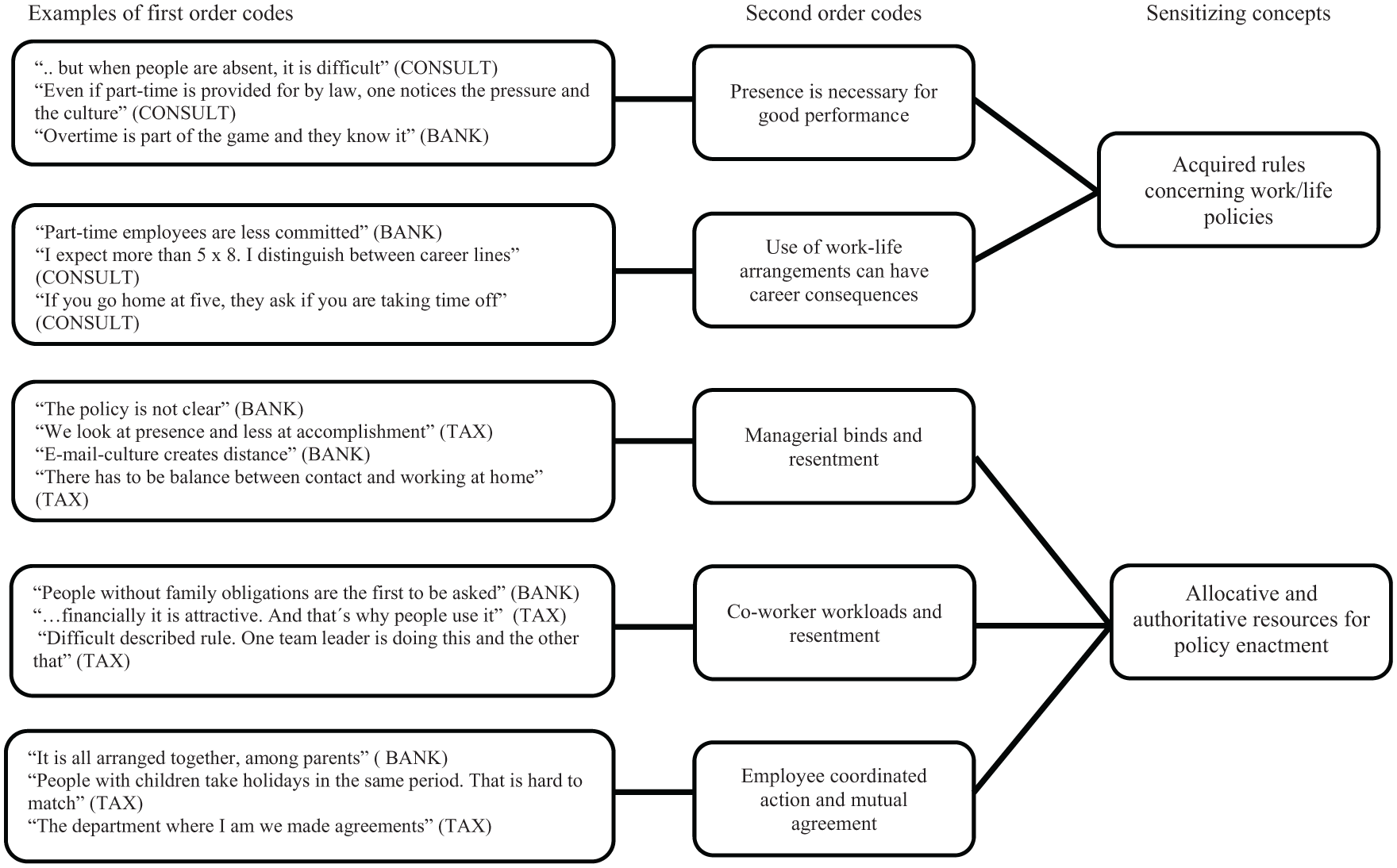
Relationships between first- and second-order codes and sensitizing concepts.
Results
Data analysis was organized around two related sensitizing concepts: acquired rules concerning work/life policies and allocative and authoritative resources for policy enactment. These, in turn, are the two key concepts in examining the construction, implementation, and actual use of work–life policies (see Table 1).
Representative Quotes From Research Participants by Concept, Code, and Organization Type.
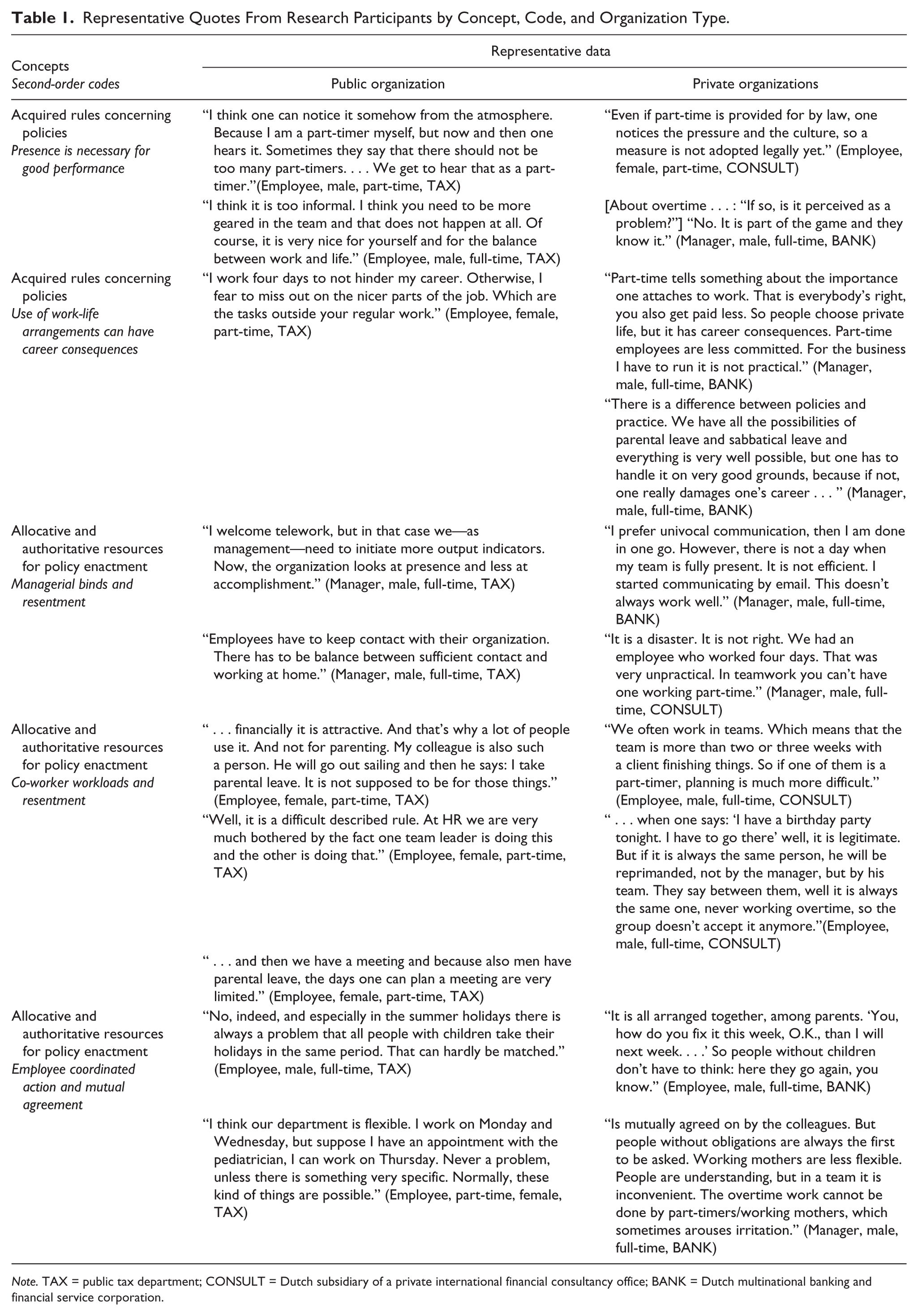
Note. TAX = public tax department; CONSULT = Dutch subsidiary of a private international financial consultancy office; BANK = Dutch multinational banking and financial service corporation.
Acquired Rules Concerning Policies
The theoretical concept “acquired rules” encompasses two major beliefs surrounding work–life policies that are derived from the data (the second-order codes). These beliefs guide employees’ decisions regarding the use or non-use of work–life policies. The first rule resulting from our analysis is that “full-time presence is necessary for good performance.” The second rule is that the “use of work-life arrangements can have negative career consequences.” Acquired rules are what Giddens (2003) describes as “practical consciousness: ‘knowing how to go on’ in a whole diversity of contexts of social life” (p. 455). As such, these rules are acquired by experience and serve as a guiding principle for communicative behavior and practice (Hoffman & Cowan, 2010).
Full-time presence is necessary for good performance
It was common for employees and managers to make disparaging remarks about part-time workers. In expressing the challenge of working with part-timers, a male full-time employee of CONSULT said, “We often work in teams. Which means that the team is more than two or three weeks with a client finishing things. So, if one of them is a part-timer, planning is much more difficult.” A comment by a male full-time manager, also from CONSULT, exemplified frustration with part-time work arrangements: “It is a disaster. It is not right. We had an employee who worked four days. That was very unpractical. In teamwork you can’t have one working part-time.” Through statements and conversations among coworkers and managers, employees developed ideas of how other influential colleagues judge those submitting leave requests. Remarks sent cues to employees about whether to submit work–family requests. A female part-time employee of TAX commented about the implementation of formal regulations: “I think one can notice it somehow from the atmosphere. . . . Sometimes they say there should not be too many part-timers. . . . We get to hear that as a part-timer.”
Discourse on parental leave also focused on its consequences for the leave taker and work team. For instance, in two organizations (CONSULT and BANK), it was more acceptable to take parental leave on a part-time basis than to take a full-time leave. When pressed as to whether he had a preference between part-time or full-time leave, one manager responded, “Part-time parental leave is better for team continuity. If someone leaves full-time and also after maternity leave, it will be difficult to come back because your position will be occupied by someone else. The work must go on” (Manager, male, full-time, CONSULT). Here, the organizational culture influenced the attitudes and behaviors of employees and managers alike, such that any type of long-term absence of team members was framed negatively. These statements shaped the “practical consciousness” (Giddens, 2003) of organizational members and the (non-)use of national policy.
In short, although working reduced hours or taking full-time parental leave are legal rights of all employees in the Netherlands, the ruling norm for “good” performers holds that employees should work full-time and be present as much as possible. As discussed in a subsequent section, this rule appeared much stronger in the two participating private organizations compared with the public organization under study. Furthermore, it is notable that the statements of the male managers underline the impractical nature of leave policies for teamwork, while female employees notice that managers do not like to work with part-timers.
Use of work–life arrangements can have career consequences
Despite support from national and organizational policies, both managers and employees were aware that a formal, long-term leave or a move to part-time work was to be avoided. As a full-time male BANK manager stated,
Part-time tells something about the importance one attaches to work. That is everybody’s right, you also get paid less. So people choose private life, but it has career consequences. Part-time employees are less committed. For the business I have to run it is not practical.
The organizational culture also determined what was customary and legitimate in the organization, which influenced work–life policy implementation in a manner similar to other work settings (e.g., Anderson, Coffey, & Byerly, 2002; Kossek et al., 2010). Again, there seemed to be a bias against part-time work, which is primarily conducted by women in the Netherlands. These organizational norms, or learnt rules, became evident through conversations at work, for example, through subtle jokes made by employees about other employees who go home “early.” A manager explained an acquired rule that he applies when evaluating employees’ career opportunities: “I expect more than 5 × 8. I distinguish between career lines. We expect everyone here to possibly become a senior consultant and to do his best to achieve it” (Manager, male, full-time, CONSULT). Employees were perceptive of these types of expressions and make decisions on this basis.
The organizational rules also greatly influenced how policies were enacted. When submitting a request, employees could refer to official written, formal policies. An employee could also make informal agreements with a manager; these agreements or unwritten rules could be regarded as informal policy and are an expression of the work–life culture of the organization. So, although employees might have sufficient legal grounds on which to file a request, they chose not to use their legal rights. Perceptions of fairness were paramount:
Imagine, two sick children, grandparents and partner are occupied. That is not the moment that I got the idea to take up care leave. It depends more on the team leader: children are sick and then? I think I will take the day off. (Employee, male, part-time, TAX)
Managers also articulated the personal consequences of the differences between policies and practice regarding the right to take leave:
There is a difference between policies and practice. We have all the possibilities of parental leave and sabbatical leave and everything is very well possible, but one has to handle it on very good grounds because if not, one really damages one’s career. . . . (Manager, male, full-time, BANK)
As in other settings (e.g., Budig & England, 2001; Lyness & Judiesch, 2001), economic and career costs were associated with the possibility of part-time work. With regard to the career consequences of requesting leave, predominantly full-time male managers noted that part-time arrangements, parental, and/or sabbatical leave could communicate that the leave taker values private life over work and that working overtime was the norm for someone who wanted career advancement (see also Table 1). As presented below, these value configurations that emphasize full-time over part-time work and not taking leaves, though available, became a substantive reality that guides members in everyday interactions though they may be unaware of its control over their actions (Barker, 1993).
Allocative and Authoritative Resources for Policy Enactment
The theoretical concept of “allocative and authoritative resources for policy enactment” contains three second-order codes: managerial binds and resentment, coworker workloads and resentment, and employee coordinated action and mutual agreement. These second-order codes refer to resources, or in this case, mostly the lack of resources and how these spur employees’ and managers’ efforts to address the pressures of work. Typically, resources are articulated as material (i.e., allocative resources) or non-material (i.e., authoritative resources) elements available to individuals (Poole & McPhee, 2005), such as computers, time, information, and friendships at work. The resources identified in our data represent both the material and non-material types. First, the second-order code “managerial binds and resentment” emphasizes the material resource of staffing needs and how managers struggle with work that needs to be done, on one hand, and entitlement to take leave, on the other hand. The second-order code “coworker workloads and resentment” addresses similar concerns from the point of view of employees. Finally, the second-order code “employee coordinated action and mutual agreement” reflects interactions among colleagues who seek to coordinate their schedules. Here, interactions with colleagues serve as an authoritative resource that provides information and shapes negotiated agreements, enabling the use of certain leave arrangements.
Managerial binds and resentment
Managers appeared particularly concerned about the quality of work and about coordination complications when requests for part-time work, parental leave, and teleworking were filed. As a reason for regulating or rejecting work–life requests, managers regularly mentioned the physical absence of employees, which results in less contact with colleagues in the office and with clients. Face-to-face communication was considered important for team and customer relations. In the words of one manager discussing formal organizational telecommuting policy, “I am not in favor of it. I consider personal contact important. Face-to-face communication is very important. I see an email-culture growing. It creates distance” (Manager, male, full-time, BANK). Physical absence seemed to present challenges for employees in working together, especially when working on teams. Therefore, managers considered to what extent a requested leave would disturb the work flow. Furthermore, managers differentiated among employees regarding the granting of requests: “Who would be opposed to someone who works like mad the whole week and wants to go home once because of a sick child?” (A full-time, male manager at BANK discussing care leave).
The approval or rejection of requests by managers also served as a resource for employees: It provided insights into anticipating which requests will be approved or rejected. As such, acquired rules arose about what was considered reasonable and what was not when employees used work–life policies. Yet, the rules on policies were not always evident. Among managers, uncertainties existed about the content of some policies, which in turn led to confusion and to mixed signals: “Well, it is a difficult described rule. At HR we are very much bothered by the fact one team leader is doing this and the other is doing that” (Employee, female, part-time, TAX). The rules, for example, of submitting a request for care leave, could be vexing for managers despite formal stated policies:
The policy is not clear. A case: My wife broke her leg; the house has to be vacuumed. Do I stay at home? I don’t think so. The limits are not clear. I want to have a range. Because in a big organization one easily gets: “yes, but, they may and we may not.” (Manager, male, full-time, BANK)
In interviews, managers reported that they found employees’ teleworking, a leave provision, to be troublesome when used frequently, and in an attempt to restrict this practice, they set rules about the frequency with which it can be used. They expressed their dislike as a dilemma, citing the necessity of physical presence for an effective work climate: “I prefer univocal communication, then I am done in one go. However, there is not a day when my team is fully present. It is not efficient. I started communicating by e-mail. This doesn’t always work well” (Manager, male, full-time, BANK). A manager from TAX suggested that there needed to be a certain degree of attendance to effectively go about one’s own and the unit’s work: “Employees have to keep contact with their organization. There has to be balance between sufficient contact and working at home” (Manager, male, full-time, TAX).
Coworker workloads and resentment
Despite national policy and norms, employees expressed resentment about taking on the workloads of coworkers who are on leave. Although managers had the power to reject or grant requests, employees influenced such decisions by making negative remarks about shifting workloads to other employees. In colleague interactions, the emerging informal workload rule surfaced often in the form of jokes: “If you go home at five, they ask if you are taking the afternoon off,” said a female full-time CONSULT employee. Such jokes made employees feel compelled to work overtime or to continue working during their private time. If an employee did not meet the expectations of other employees, his or her team was likely to increase the pressure to conform:
When one says: “I have a birthday party tonight. I have to go there” well, it is legitimate. But if it is always the same person, he will be reprimanded, not by the manager, but by his team. They say between them, well it is always the same one, never working overtime, so the group doesn’t accept it anymore. (Employee, male, full-time, CONSULT)
These jokes and/or reprimands by colleagues reminded employees of existing norms and the expectation to conform to these norms. In this way, colleagues exerted forms of concertive control, regulating among themselves what uses of work–life policy are permissible. These concertive control interactions among employees operated as authoritative resources, clarifying which types of leaves were accepted by colleagues and which ones were not (Hoffman & Cowan, 2010). The rule (leaving overtime work to other employees will be followed by negative reactions) and the resource (the type of interactions among employees) both led to the structuring of when it was appropriate to use (formal) policies.
Different degrees of work flexibility could also cause friction among coworkers. With regard to part-time workers, some experienced planning difficulties, especially working on a team: “We often work in teams. Which means that the team is more than two or three weeks with a client finishing things. So if one of them is a part-timer, planning is much more difficult” (Employee, male, full-time, CONSULT). Although it was generally accepted that working parents tended to be less flexible than employees without children, it was assumed that those without family obligations could take on extra work to prevent understaffing:
. . . people without obligations are always the first to be asked. Working mothers are less flexible. People are understanding, but in a team it is inconvenient. The overtime work cannot be done by part-timers/working mothers, which sometimes arouses irritation. (Manager, male, full-time, BANK)
In addition, in private organizations colleagues expected more work hours of each other. At CONSULT and at BANK, we found a long-hours culture where colleagues (and managers) counted on each other to work overtime.
With no formal, standard replacement procedure in the organizations we studied, the actual utilization of work–life policies posed a threat to solidarity among coworkers. Additional pressure in these organizations was due to the difficulty of replacing employees in this business sector. Therefore, if one employee went on leave, colleagues had to take over his or her work, which could be a source of discontent, especially between employees with and without children (Peper, Den Dulk, & Van Doorne-Huiskes, 2009).
Employee-coordinated action and mutual agreement
To arrive at and operate under informal policies, considerable mutual matching and coordination occurred among employees. These negotiated agreements among colleagues reflected employees’ need and ability to optimally match their work and private lives. Interview participants commonly reported collaborating with other employees to enable them to take short-term leaves and develop flexible work: “It is all arranged together, among parents. ‘You, how do you fix it this week, O.K., than I will next week. . . .’ So people without children don’t have to think: here they go again, you know” (Employee, male, full-time, BANK). In these work groups, it appeared common for coworkers to display flexibility in covering work assignments through negotiated agreements and to develop protocols outside of supervisory influence.
In all three organizations, employees could make use of flexible working hours and pursue agreements with colleagues to optimally balance their work and private lives. These negotiated agreements between coworkers reflected employee creativity in identifying integrative solutions, which could provide acceptable options for each party:
The department where I am we . . . made agreements. And every day, at least two persons staffing have to be there and those two have to stay there till five o’clock, and I must say that, well, we are a group of fifteen, so it is everyone’s turn once in 2 weeks, so that is not the problem. And as such it is rather well solved, indeed. (Employee, female, full-time, TAX)
However, some negotiations occurred for reasons unrelated to formal leaves. As one employee stated, “No, indeed, and especially in the summer holidays there is always a problem that all people with children take their holidays in the same period. That can hardly be matched” (Employee, male, full-time, TAX).
Managers appeared to be content with employees’ matching and negotiation activities because these practices generally tended to work well. Interventions to settle disputes were inconvenient and could require substantial amounts of time, and at least one party would be unhappy with the decision. In the words of one manager, “It is mutually agreed on by the colleagues” (Manager, male, full-time, BANK). Thus, managers might have avoided interfering in coworker collaborations unless high levels of antagonism developed. Collaborations among employees to cover for a full-time leave taker or a colleague working part-time has been, in one sense, a manifestation of coworker supportiveness, as noted by Mesmer-Magnus and colleagues (Mesmer-Magnus & Glew, 2012; Mesmer-Magnus, Murase, DeChurch, & Jiménez, 2010). At the same time, informal collaborations may have also been an act of role negotiation to cope with work demands (Miller, Jablin, Casey, Lamphear-Van Horn, & Ethington, 1996; Medved, 2014), which could have led to the emergence of informal patterns that became acquired rules and structures. Healthy workplace outcomes have depended on how employees verbalize their disagreements (Druskat, Sala, & Mount, 2006) and how they formulate perceived injustices (Sias, 2009).
Managerial discourses that reinforced coworker coordination and negotiated agreements appeared to strengthen the binds of concertive control (Barker, 1993). In Barker’s study, employees on a self-managing team developed and enforced their norms essentially independent of management. In this study’s three organizations, managers’ active or passive consent to unit norms of presence via full-time work further overrode the national support created for those who need part-time work or who take leaves to promote family or personal well-being.
Similarities and Differences in Private and Public Contexts
Interactions concerning leave-taking in private and public organizations had notable similarities and differences. The two sensitizing concepts, “acquired rules” and “allocative and authoritative resources,” were found in both sectors. However, a look at the five distinguishing second-order codes suggested that some were more pronounced in one sector than in the other. For example, “presence is necessary for good performance” and “use of work-life arrangements can have career consequences” were more present in the private sector as opposed to the public sector. The idea that employees should work and be present full-time to be able to deliver good work was more evident in the two private organizations studied (see Table 1 and Figure 1). In public organizations, national regulations were followed more closely and were less questioned than in private organizations. In addition, public organizations were expected to set an example with regard to enacting national policies (e.g., Den Dulk, 2001). Moreover, they did not have to produce a profit per se, which may have lessened public organizations’ focus on long hours compared with the private sector.
Private and public context differences also emerged in the second-order codes “managerial binds and resentment,” “coworker workloads and resentment,” and “employee coordinated action and mutual agreement.” In the private organizations, managers stated that they expected employees to work hard and demonstrate a great deal of responsibility and self-reliance (“I expect more than 5 × 8”; Manager, male, full-time CONSULT). In addition, employees’ expectations of hard work from their colleagues were also high (“They will say between them, well it is always the same one, never working overtime, so the group doesn’t accept it anymore”; Employee, male, full-time, CONSULT). In the public organization, reports of informal workloads were less pervasive, and managers and employees did not emphasize that they expected their colleagues to work hard. Reasons for these differences sprung, in part, from cultural differences between the sectors, as these private organizations—with their cultures of long-hours—expected employees to work more hours per week than formally required. Managers and employees in the private organizations also had high productivity expectations of each other, which translated into higher workloads than in the public organization.
Negotiations between colleagues in both the private and public organizations often concerned the equitable matching of work hours. Only when employees could not reach a joint solution did managers step in and construct a solution with the employees. Yet, differences existed between private and public organizations regarding the nature of their agreements. Agreements in the public organization were mainly between colleagues and about working hours. In the private organizations, agreements were made about granting leave, the option to work at home, the results expected to be achieved by the employees, and the working hours of employees. With more to “lose,” full-time employees in private organizations worked out a rational plan to insure unit productivity, and, as in Barker (1993), “. . . collaboratively created, value-laden premises (manifest as ideas, norms, and rules) become the supervisory force that guide activity in the concertive control system” (p. 412).
Overall, the emerging picture emphasized the differences between private and public sectors in how leaves were granted, how acquired rules concerning work–life policies were operationalized, and how units enacted work–life policies. The second-order codes “full-time presence is necessary for good performance” and “use of work-life arrangements can have career consequences” appeared to be more dominant in the private sector. Practical consequences—as barriers to taking leaves—also appeared to be more dominant in the private sector.
Discussion
In this study, we aimed to understand why Dutch employees in public and private organizations sometimes lack the agency to fully use existing work–life policies within the local organizational context, even in the presence of strong national and cultural support. Through the lens of structuration theory (Giddens, 1984), we analyzed the production and reproduction of rules and resources concerning work–life policies by examining the discourses of employees and managers. Similar to other research in this domain (Hoffman & Cowan, 2010; Kirby & Krone, 2002; Kossek et al., 2010), the discourses pertaining to acquired rules of work–life policies were shaped by two major beliefs surrounding these policies: first, “full-time presence is necessary for good performance” and second, “the use of work-life arrangements can have negative career consequences.” In addition, we identified how allocative and authoritative resources relating to work–life policy use were shaped by the tensions and binds experienced by managers, managers’ and coworkers’ acts of resentment, and employees’ coordinated action and mutual agreements when using policies. We also found that employees who took over leave takers’ tasks, especially those without young children, felt frustrated when they had to pick up extra work.
These results resonate with the findings of Kirby and Krone (2002) and Hoffman and Cowan (2010), who reported that employees do not always feel comfortable using work–life policies, and, when they do use them, they experience backlash. This study adds to these previous findings by illustrating that (a) similar tensions and constraints are experienced in a context where work–life policies are supported and provided on a national level, (b) the gendered nature of the national context is ingrained in the interactions between employees and is structuring policy usage, and (c) coordinated action and mutual agreement among employees, along with implicit supervisory consent, contribute to concertive control conditions. Although side agreements among coworkers on how they will cover for absent leave takers are essential to employees coping with work demands, these side agreements also appear to constrain leave use, alleviate unit managers’ coordination difficulties, and absolve top management of properly staffing units where leaves are granted. Contrary to espoused idealistic views of European work–life (e.g., Hegewisch & Gornick, 2011), our findings suggest that national policies are helpful but not sufficient in alleviating the obstacles facing primarily female employees. Altogether, this study implies that rather than concentrating solely on national and organizations’ work–life policies, work–life advocates, HR professionals, and top management should pay greater attention to informal work unit interactions and the proper staffing of units that perpetuate limited leave use (Kirby, Wieland, & McBride, 2013; Medved, 2014).
Theoretical Implications
The gendered nature of the Dutch national context is reflected in the dominance of the one-and-a-half earner family (Merens & van den Brakel, 2014). This model promotes combining work and family life, and, simultaneously reinforces the ideals of motherhood. In the discourses we studied, the gendered nature of the Dutch context surfaced in our data on several occasions. Full-time male managers primarily noted that an employee’s use of part-time and leave arrangements communicates that she or he prioritizes family over work, which has career consequences. In contrast, part-time female employees identified the tensions related to using work–life policies and how they deal with those tensions in practice (“Even if part-time is provided for by law, one notices the pressure and the culture” [Employee, female, part-time, CONSULT]; “I work four days not to hinder my career” [Employee, female, part-time, TAX]). In short, managers in this study struggled with organizational norms about productivity, on one hand, and the available national policies, on the other (Kossek et al., 2010), whereas female employees struggle with overcoming organizational norms, on one hand, and cultural norms about motherhood, on the other (Budig & England, 2001; Budig et al., 2012; Kremer, 2007; K. J. Morgan, 2006). Consequently, two layers of context can be distinguished concerning work–life policies: the national level and the organizational level. Both the cultural and organizational meanings of work influence interactions between employees and managers that then determine the acquired rules concerning work–life policies (Trefalt et al., 2013; Wieland, 2011).
Following Kirby and Krone’s (2002) suggestion to analyze the role of coworkers in relation to the use of work–life policies, we discovered that employees themselves are producing and reproducing certain rules in their use of work–life policies. Employees on leave were not replaced by temporary workers, which created an extra burden for coworkers and managers in terms of workloads and coordination. Unlike earlier research, which found that employees cannot use leave policies largely due to managerial pressures and accompanying structural impediments, we found that employees created both barriers and alternative coping strategies (“ . . . if it is always the same person, he will be reprimanded, not by the manager, but by his team” [Employee, male, full-time, CONSULT]; “It is all arranged together, among parents” [Employee male, full-time, BANK]), which suggests that employees created norms that could help them but could also constrain their choices. Through employee discussions, informal rules emerge for what are deemed appropriate leaves as well as how to address dichotomies in the work setting (Kirby et al., 2013). These rules create means of handling conversations about prospective leaves, which create structures at the unit level. In essence, unwritten rules both help and hinder the remaining employees’ coping abilities, and their actions are entwined with national, organizational, and work unit issues.
Under the second-order codes of “coworker workloads and resentment” and “employee coordinated action and mutual agreement,” manifestations of concertive control mechanisms emerge. According to Barker (1993), employees
achieve concertive control by reaching a negotiated consensus on how to shape their behavior according to a set of core values. . . . This negotiated consensus creates and recreates a value-based discourse that workers use to infer “proper” behavioral premises: ideas, norms, or rules that enable them to act in ways functional for the organization. (p. 411)
In this study’s organizations, employees enact concertive control by reminding their colleagues, in various ways, of the values they have negotiated. For example, when employees make jokes about colleagues going home “early,” and allow part-time colleagues to overhear that there should not be too many part-timers, they exert concertive control. One employee explicitly states that employees reprimand each other when coworkers shirk overtime too often. Because doing overtime is harder for employees with certain family demands, employees with these obligations try to soothe the annoyance of their colleagues by arranging and negotiating work among employees with similar responsibilities.
Concertive control interactions prove to be an important means by which social structures, related to the enactment of work–life policies, are reproduced. Value-based discourses on the necessity of full-time availability and the career consequences of policy use generate acquired rules that are produced and reproduced. These acquired rules seem to perpetuate stereotypes of ideal workers (Kossek et al., 2010). Due to the strong influence of these acquired rules, the official rules (i.e., national and organizational policies) do not realize their full potential in helping employees to manage their work and non-work responsibilities. The concertive control interactions serve as an authoritative resource that informs employees about the negotiated values concerning policy use, and, as such, help to reproduce structures that are based on the premise of the ideal worker, who is expected to place his or her work role ahead of his or her personal life role at all times (Kossek et al., 2010). The tension between the purpose of the official rules (enabling employees to combine work and non-work roles) versus the enacted acquired rules seem to correspond with the tension between structural work–life support (the official policies) and cultural work–life support (informal social and relational support), as described by Kossek et al. (2010). The latter refers to the (lack of) support from supervisors and coworkers in combination with organizational norms about how employees with non-work responsibilities are valued. In a similar vein, Putnam et al. (2014) describe the organizational tension in “supportive versus unsupportive work climates.” This tension focuses on supervisor reactions, formal and informal interactions, and work norms for enacting work–life arrangements.
Managers in this sample seemed to be aware of coworkers’ pressuring each other, but either did not feel obliged to interfere or strategically opted out of interfering. Reports of employee ingenuity may reflect confidence in employees’ collegiality and/or belief in work unit culture. At the same time, reliance on employees to negotiate among themselves creates structures in which strong mechanisms of control limit the use of work–life policies. Because these concertive control interactions are reproducing “old” structures and preserving ideal worker work norms, efforts are needed to transform the official rules into strategies that encompass both structural and cultural work–life support. The current approach of managers, that is, letting employees coordinate among themselves so as to not disrupt the work flow, has the side effect that concertive control interactions, which maintain ideal worker norms, can flourish. This norm can be convenient for managers because it helps to reduce their planning difficulties, and therefore facilitates one of their main responsibilities. However, if governments and organizations aim to mainstream, rather than marginalize, work–life policies into organizational structures, managers should be empowered to support work–life policies unambiguously.
Limitations and Future Research
This research examined organizations in the financial sector, which emphasizes teamwork and individual customer service to construct detailed fiscal analyses for clients. However, relying on colleagues’ expertise and work differs considerably across various types of work units (Hollenbeck, Beersma, & Schouten, 2012); different levels of autonomy and different skills can generate different rules and enactment of policies. Future studies should investigate how the variation in interdependencies, due to industry sector or work design, account for the emergence of structures and if patterns found in this study exist mainly in Dutch organizations. For example, earlier work indicates that differences exist in the use and implementation of work–life policies in European countries (Den Dulk, 2001; Den Dulk & De Ruijter, 2008). In addition, research could be extended to international firms to investigate differences in the structuration of work–life policies as such firms develop their HR policies regardless of national influence (Schneper & von Glinow, 2014).
We examined statements of employees and managers to gain an understanding of the role of discourse in the use of work–life policies. To capture the role and influence of interactions more accurately, future research should study actual dialogue between employees and managers and employees (Fairhurst, 2007). Actual dialogue might provide clearer understanding of the development of acquired rules and the evolution of unit norms. The discovery of concertive control interactions among coworkers provides interesting new research questions. Because concertive control interactions reproduce existing structures and preserve ideal worker work values and discourses, future research could focus on how organizational, supervisory, and individual change efforts succeed in transforming acquired rules to encompass both structural and cultural work–life support. Alternatively, what is the role of top management and HRs in addressing work–life tensions, modifying discourses at the unit level, or supporting employee resistance (Medved, 2014)? What structural and epistemological changes are necessary for managers to be able to support work–life policies unambiguously versus marginalize them due to demands for unit productivity? Addressing such questions seems critical to the mainstreaming of work–life values in organizations.
Practical Implications
In the organizations we studied, implicit gendered national policies can be traced back to discourses at the organizational level. Especially with regard to part-time work that is mostly performed by women, male managers expressed that leaves are impractical for teamwork and detrimental to leave takers’ career prospects. Moreover, female employees mostly reported that working part-time leads others to view the leave taker as being less committed to the organization and their work. Regardless of national context, when work–life policies at the organizational level are consequently verbalized as rights, instead of as favors, greater gender equality may be evidenced by a greater utilization of work–life policies, instead of the current reproduction of gendered national policy use (Putnam et al., 2014).
A particular concern is the lack of clarity in managers’ interpretation of policy, which fuels employees’ generation of acquired rules about leaves. At minimum, it is important that managers do not give mixed signals to employees (Kirby, 2000; Kirby et al., 2013; Kossek et al., 2010). The results show, for example, that the conditions for care leave are not clear for managers (“Well, it is a difficult described rule. At HR we are very much bothered by the fact one team leader is doing this and the other is doing that” [Employee, female, part-time, TAX]; “The limits are not clear. I want to have a range. Because in a big organization one easily gets: ‘yes, but, they may and we may not’” [Manager, male, full-time, BANK]). To create clarity for employees, managers must first have a clear idea of the eligibility of each policy. When these conditions are communicated to the employees, employees get a better idea of what is ahead of them when submitting a request. In addition, manager awareness of the available work–life policies (in terms of eligibility as well as their instrumental value) might be an important determinant of the granting behavior of managers (McCarthy, Darcy, & Grady, 2010).
It is also vital that managers be mindful of employees’ use of concertive control discourses as related to applying for and taking leaves. For the well-being of all unit members and to foster constructive employee relations, managers should not take a laissez-faire approach in which they feign ignorance of pressure practices among employees and avoid taking responsibility for employees not taking leaves to which they are entitled (Kirby et al., 2013). An illustrative perspective on manager-employee tensions is represented in Erhardt and Gibbs (2014), who explicate impression management behaviors as managers distance themselves yet maintain relationships with their employees in email interacts. Similar tensions may be present in managers’ attempts to engage in work unit dynamics, yet remain aloof from coworkers’ dilemmas of task management and coordination.
A number of regulations regarding work–life policies particularly focus on employees with children (pregnancy leave, parental leave, and the day nursery regulation). Managers have to pay attention to employees without children to ensure that they do not experience injustice with regard to requests of work–life policies. Managers face the challenge of creating a culture where the requests of employees with children are respected without slighting employees who do not have children (Bakker, Oerlemans, & Ten Brummelhuis, 2013; Putnam et al., 2014). To prevent some employees from feeling slighted, managers have to establish clear criteria for cases in which employees are qualified to make requests regarding work–life policies (Poelmans & Beham, 2008). Human resources could be more active in engaging managers in conveying the value of leave opportunities and in engaging aid units in hiring additional personnel to replace leave takers (Medved, 2014).
In closing, the existence of formal regulations does not guarantee that work–life policies will actually be enacted in organizations (Canary, 2010). Central to understanding successes or failures in implementing work–life policies is grasping the importance of the underlying assumptions and values of the national and organizational culture (Callan, 2007; Lewis & Lewis, 1996), as well as how employees and managers create communication structures that work for and against their interests.
Footnotes
Acknowledgements
The authors thank Lindy Voskuil for her help with the analysis and Caryn Medved for her helpful comments on an earlier version of this manuscript. Also, the authors thank Patricia Sias and the three anonymous reviewers for their insights and suggestions.
Declaration of Conflicting Interests
The author(s) declared no potential conflicts of interest with respect to the research, authorship, and/or publication of this article.
Funding
The author(s) disclosed receipt of the following financial support for the research, authorship, and/or publication of this article: This work was supported by The Netherlands Organization of Scientific Research under Grant 451-13-012.