An analytical investigation on the buckling and postbuckling behavior of carbon nanotube-reinforced composite beams integrated with surface-bonded piezoelectric layers under uniform temperature rise is presented in this paper. Carbon nanotubes (CNTs) are reinforced into isotropic matrix through uniform distribution and functionally graded distributions. The properties of material constituents are assumed to be temperature-dependent and effective properties of CNT-reinforced composite are estimated using an extended rule of mixture. Equilibrium equations of the beams are established based on Euler-Bernoulli theory including von Kármán nonlinearity and solved using analytical solutions and Galerkin method. Critical temperatures and postbuckling load-deflection paths are determined using an iteration algorithm. Parametric studies are performed to examine the influences of CNT distribution and volume fraction, applied voltage, in-plane and out-of-plane conditions of the ends, slenderness, and thickness ratio of layers on the critical loads and postbuckling load carrying capacity of beams. Results reveal that CNT volume fraction and degree of in-plane ends constraint have slight and significant influences on the critical temperatures and thermal postbuckling paths, respectively. The study also finds that negative and positive voltages increase and decrease the thermal buckling temperatures of piezoelectric CNT-reinforced composite beams.
Since structural components are frequently exposed to thermal environments and gradients, thermally induced instability of these components is a problem of considerable importance. Li and Batra1 used analytical and shooting methods to investigate the thermal buckling and postbuckling of isotropic and homogeneous beams resting on nonlinear elastic foundations. Linear buckling problem of functionally graded material (FGM) beams under thermal loads was dealt with by Kiani and Eslami2 employing adjacent equilibrium criterion and analytical solutions. This approach was extended by Kiani and collaborators to study thermal linear buckling of FGM beams with piezoelectric layers basing on Euler-Bernoulli beam theory3 and Timoshenko beam theory.4 Thermal buckling and vibration analyses of FGM beams have been executed by Wattanasakulpong et al.5 utilizing an improved third order shear deformation theory and Ritz method. Fu et al.6 presented the thermal buckling, free vibration and dynamic stability analyses of FGM beams with piezoelectric layers and clamped ends. The nonlinear vibration, bending and thermal postbuckling of thick FGM beams have been dealt with by Shen and Wang7 employing a higher order shear deformation beam theory (HSDBT) and perturbation technique. Based on an analytical approach, Trinh et al.8 investigated the vibration and buckling of FGM beams under mechanical and thermal loads. The effects of nonlinear elastic foundations on the thermo-mechanical buckling and nonlinear free vibration response of FGM beams were analyzed in work of Fallah and Aghdam9 using analytical solution. Thermal postbuckling analyses of single-layered and sandwich FGM plates with temperature-dependent properties were performed in works of Shen10 and Tung,11 respectively.
Due to advanced properties, carbon nanotube (CNT) is used as filler into homogeneous matrix to constitute carbon nanotube-reinforced composite (CNTRC). Stimulated by concept of FGM, Shen12 proposed functionally graded carbon nanotube reinforced composite (FG-CNTRC) in which CNTs are reinforced into matrix according to functional rules of volume fraction. Yas and Samadi13 employed Timoshenko beam theory and generalized differential quadrature method (GDQM) to study the mechanical buckling and linear vibration of CNTRC beams resting on elastic foundations. Large amplitude vibration, nonlinear bending and thermal postbuckling of FG-CNTRC beams have been analyzed by Shen and Xiang14 using a HSDBT. Using shear deformation beam theory and Navier-type solutions, Wattanasakulpong and Ungbhakorn15 executed the linear bending, vibration and buckling analyses of FG-CNTRC beams on elastic foundations with both simply supported ends. Linear buckling and vibration responses of cantilever CNTRC beams under axial load have been analyzed by Nejati et al.16 making use of two-dimensional elasticity theory and GDQM. The GDQM based on various beam theories has been employed in work of Fattahi and Safaei17 investigating the axial buckling characteristics of CNTRC beams with arbitrary boundary conditions. Linear free vibration and buckling analysis of sandwich beams with CNTRC face sheets were performed by Wu et al.18 using Timoshenko theory and differential quadrature method. Dynamic buckling of thin CNTRC beams with piezoelectric layers under axial periodic force and applied voltage was treated by Yang et al.19 Employing Timoshenko beam theory and GDQM, Mohseni and Shakouri20 presented a numerical investigation on free vibration and mechanical buckling of FG-CNTRC beams with variable thickness. The effects of initial geometric imperfections on the postbuckling of FG-CNTRC beams have been examined by Wu et al.21 utilizing a first order shear deformation beam theory (FSDBT) and Newton-Raphson iterative technique. Recently, Karamanli and Vo22 used finite element method (FEM) and shear deformation theory to explore the linear bending, vibration and buckling behaviors of composite beams reinforced by CNT and graphene nanoplatelet. More recently, Belarbi et al.23 employed FEM within the framework of a hyperbolic shear deformation theory to investigate the linear bending and mechanical buckling of FG-CNTRC beams.
Thermal instability of CNTRC structures is a problem of essential importance and should be addressed. Besides the work of Shen and Xiang,14 thermal buckling and postbuckling of CNTRC beams have been considered in some works. Rafiee et al.24 used the Euler-Bernoulli beam theory and analytical solution to study the thermal buckling of FG-CNTRC beams with piezoelectric layers. The linear bending, buckling and free vibration characteristics of FG-CNTRC beams under different types of non-uniform thermal loadings have been analyzed by Mayandi and Jeyaraj25 employing FEM. The effects of geometrical imperfection on the thermal postbuckling of FG-CNTRC beams were considered in work of Wu et al.26 making use of differential quadrature method. Postbuckling response of CNTRC sandwich beams without and with elastic foundations under uniform temperature rise was dealt with by Kiani and coworker27,28 using Ritz method within the framework of FSDBT. Khosravi et al.29 studied thermal buckling of rotating CNTRC beams using adjacent equilibrium criterion and GDQM. Thermal buckling and postbuckling behaviors of FG-CNTRC rectangular plates have been analyzed in works.30,31 Thermal buckling and postbuckling of FG-CNTRC annular sector plates were numerically analyzed by Gholami and Ansari32 using HSDBT and pseudo-arc-length method.
Elastic constraints of boundary edges are inherent in practical applications and should be considered in structural analyses. The mechanical buckling and vibration behavior of FG-CNTRC beams with elastic boundary conditions are analyzed by Wattanasakulpong and Mao33 using Chebyshev collocation method. Nonlinear vibration and dynamical response of FG-CNTRC plates with elastically restrained edges were presented in work of Anh et al.34 The influences of different boundary conditions on the nonlinear bending and dynamical characteristics of nanocomposite rectangular plates, cylindrical panels and circular cylindrical shells with CNT and graphene platelet reinforcements have been analyzed in works of Gholami and collaborators35–39 using analytical and numerical approaches. The influences of tangentially elastic constraints of edges on the thermal buckling and postbuckling of plates and shells made of FG-CNTRC and porous FGM have been examined in works.40–49 To the best of authors’ knowledge, there is no investigation on thermal postbuckling of CNTRC beams with elastically restrained ends.
In this paper, for the first time, the influences of tangentially elastic constraints of ends on the thermo-electrical postbuckling behavior of FG-CNTRC beams with surface-bonded piezoelectric layers under uniform temperature rise are investigated. CNTs are reinforced into matrix according to uniform and functionally graded distributions. The effective properties of CNTRC are determined using an extended rule of mixture. Formulations are based on Euler-Bernoulli beam theory including von Kármán nonlinearity. Analytical solutions of deflection are assumed to satisfy simply supported and clamped conditions of two ends and Galerkin method is used to derive the nonlinear relation of thermal load and deflection. Due to temperature dependence of material properties, critical buckling temperatures and postbuckling paths are determined using an iteration process. Parametric studies are carried out to examine the effects of CNT volume fraction and distributions, boundary condition, degree of in-plane end constraint, applied voltage, thickness of layers and slenderness ratio on thermal buckling and postbuckling of hybrid CNTRC beams.
Structural model and effective properties
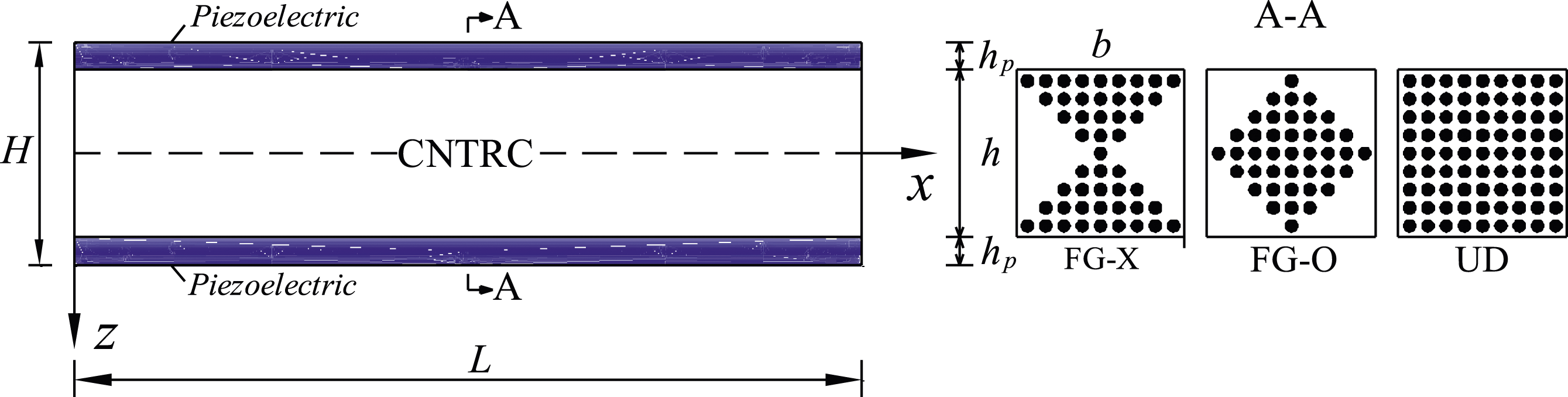
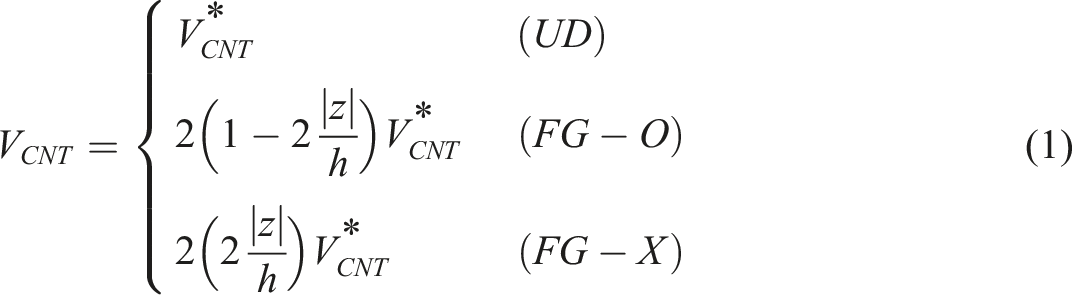
Structural model of this study is a hybrid beam constituted from CNTRC host and two surface-bonded piezoelectric actuator layers. The length, width and total thickness of the beam are , and , respectively. The thickness of substrate CNTRC host and that of each piezoelectric layer are and , respectively, as shown in Figure 1. The beam is defined in a coordinate system origin of which is located at one end, axis lies on the middle surface of the beam and axis is perpendicular to the mid-axis with downward positive points. It is assumed that CNTs are straight and aligned in the direction of axis, and adhesive thickness is neglected. CNTs are reinforced into matrix according to three mid-plane symmetric patterns, namely functionally graded distributions in the forms of X and O, which are respectively referred to as FG-X and FG-O distributions, along with uniform distribution (UD). The volume fraction of CNTs is varied across the thickness according to functional rules as12
where total volume fraction of CNTs is defined as
in which is the mass fraction of CNTs, whereas and are the densities of CNT and matrix, respectively. In this study, the effective elastic modulus in the longitudinal direction of CNTRC is determined using an extended rule of mixture as12
where and are elastic moduli of CNT and matrix, respectively, is volume fraction of matrix and is CNT efficiency parameter which account for size dependence of reinforcement on the effective elastic modulus. Effective Poisson’s ratio is assumed to be constant and evaluated using conventional rule of mixture as12
where and are Poisson’s ratios of CNT and matrix, respectively. The effective coefficient of thermal expansion in the longitudinal direction of CNTRC is estimated basing on Schapery model as14
in which and are thermal expansion coefficients of CNT and matrix, respectively. In this study, the properties of CNT and matrix like are assumed to be temperature-dependent and, hence, the effective properties of CNTRC depend on both temperature and position. Alternatively, piezoelectric layers are made of isotropic homogeneous material with temperature-independent properties. Specifically, the elastic modulus, thermal expansion coefficient and Poisson’s ratio of piezoelectric material are denoted by , and , respectively.
Geometry of a piezoelectric CNTRC beam and three types of CNT distribution.
Mathematical formulations
In the present study, hybrid CNTRC beams are assumed to be thin and geometrically perfect. The classical beam theory (CBT) basing on Euler-Bernoulli assumptions and including von Kármán nonlinearity is used for mathematical formulations. Within the framework of the CBT, the displacement components and in the axial and lateral directions, respectively, are expressed in the form24
where and are axial and lateral displacements of a point on the middle surface, respectively. Herein, subscript comma means the derivative with respect to the followed variable, e.g. . Axial strain of the beam has the form
where is uniform temperature rise from reference temperature assumed to be room temperature in the present work. Axial stresses in the layers are determined using constitutive relations. Specifically, the axial stress in the CNTRC substrate is expressed as24
Axial stresses in the piezoelectric layers are computed as24
where is piezoelectric strain constant and is thickness direction electric field defined as with is potential field. Since the thickness of piezoelectric layer is very thin, self-induced electric potential is marginal, and electric field within a piezoelectric actuator is defined as24
where is applied voltage across the piezoelectric layer. The force and moment resultants per unit length are computed in terms of stresses through the thickness as follows
Using equations (8) and (9) into equation (11), the force and moment resultants are expressed in the form
where
in which
For hybrid CNTRC beams with mid-plane symmetric types of CNT distribution, , and are zero-valued. Non-zero quantities in equation (13a) are expressed in the form
Based on the CBT, the equilibrium equations of hybrid CNTRC beams are written as6,24
From equation (16a) it is deduced that which is independent of . Using this expression into equation (12a), we obtain
Using equation (12b) into equation (16b) we receive equilibrium equation in the form
where is fictitious force resultant induced by thermo-electrical loads and tangential constraints of ends. In this study, two ends of the beam are assumed to be elastically restrained in tangential direction. Fictitious force resultant is concerned with average end-shortening displacement according to the following expression
in which is average tangential stiffness of two ends. It is evident that movable, immovable and partially movable ends will be represented by , and , respectively. Using equation (17) into equation (19), we obtain
Two ends of the beam are assumed to be simply supported or clamped. For simply supported ends, the deflection of beam is assumed in the form50
where is amplitude of deflection and is number of half wave. For clamped ends, the deflection solution is assumed in the form50
By introducing the deflection solution into equilibrium equation (18) and applying Galerkin method, we obtain the following equation
where and for simply supported and clamped ends, respectively, and
Substituting the deflection solutions (21) and (22) into equation (20) yields the following expression of fictitious force resultant
where
Above-defined non-dimensional parameter will be used to measure the degree of tangential constraints of ends in numerical results. It is readily recognized that movable (), immovable () and partially movable () ends will be characterized by values of , and , respectively. Introduction of from equation (25) into equation (23) leads to the following expression
Above expression is nonlinear relation between thermal load and non-dimensional maximum deflection of CNTRC beams integrated by surface-bonded piezoelectric layers with tangentially restrained ends. Obviously, buckling thermal loads are obtained from equation (27) by setting and as the following
Since material properties of CNT and matrix are temperature dependent, critical thermal loads and postbuckling load-deflection paths are determined adopting an iteration process. Theoretically, it is evident from equation (28) that critical thermal loads can be reduced to zero in case the applied voltage is enough large. Nevertheless, in practical applications of piezo-CNTRC beams, the applied voltage can be not large and, as a result, electrically-induced buckling cannot occur. In the present study, the applied voltage is assumed to be pre-existing and non-destabilizing.
Numerical results and discussion
This section presents parametric studies of thermal buckling and postbuckling behaviors of CNTRC beams with piezoelectric actuators. The CNTRC material is made of Poly (methyl methacrylate), referred to as PMMA, as matrix and (10,10) single-walled carbon nanotubes (SWCNTs) as reinforcements. The properties of PMMA are , GPa, K in which and K (room temperature).14 The properties of (10,10) SWCNTs at specific temperatures are given in the work of Shen and Zhang.30 The properties of (10,10) SWCNTs are expressed as continuous functions of temperature in the works27,31 adopting mathematical interpolation and omitted here for the sake of brevity. In numerical results, piezoelectric material is PZT-5A the temperature-independent properties of which are GPa, K, and m/V.24 In addition, CNT efficiency parameter is chosen as that given in works,14,30 specifically , 0.142 and 0.141 for the values of , 0.17 and 0.28, respectively.
Verification
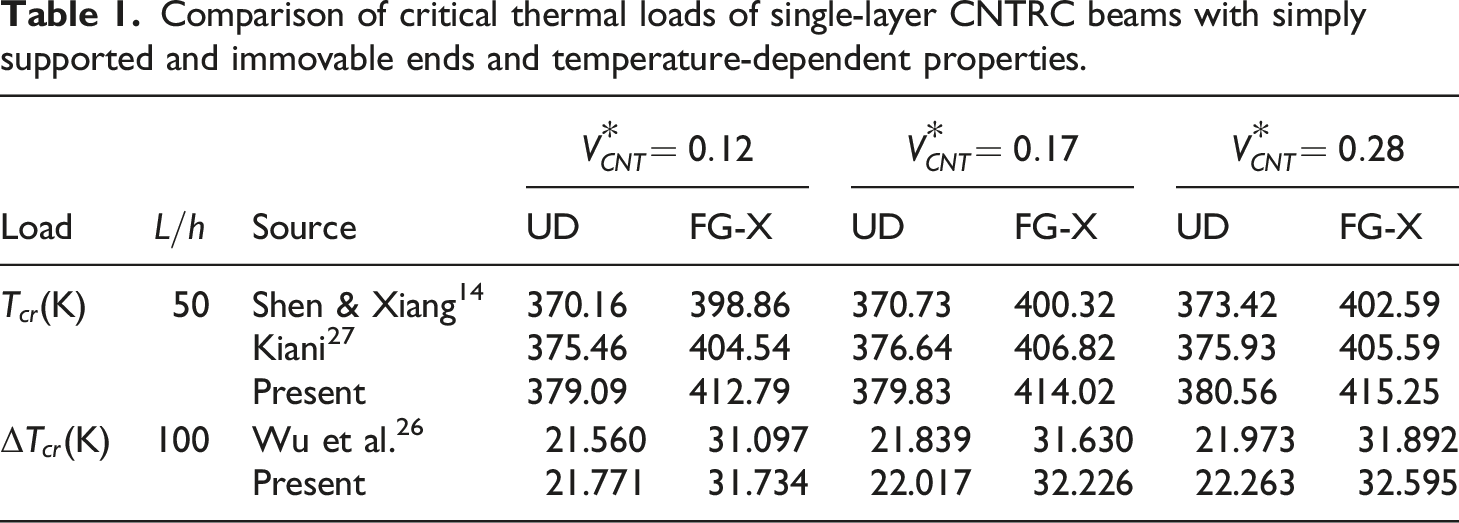
To verify the proposed approach, three comparative studies are carried out for thermal buckling and postbuckling of CNTRC beams with and without piezoelectric layers. First, the thermal buckling of single-layer CNTRC beams with simply supported and immovable ends and temperature dependent properties is considered. This problem was also dealt with in works of Shen and Xiang14 using asymptotic solutions and a HSDBT-based perturbation technique, Kiani27 employing FSDBT-based Ritz method, and Wu et al.26 making use of FSDBT along with differential quadrature method. Critical thermal loads obtained by the present study are compared in Table 1 with results presented in the works14,26,27 for different values of slenderness ratio and volume fraction of CNTs. As can be seen, the present results are slightly higher than those presented in the works.14,26,27 This difference is expected because the present study employs the classical beam theory overestimating critical loads of shear deformable beams.
Comparison of critical thermal loads of single-layer CNTRC beams with simply supported and immovable ends and temperature-dependent properties.
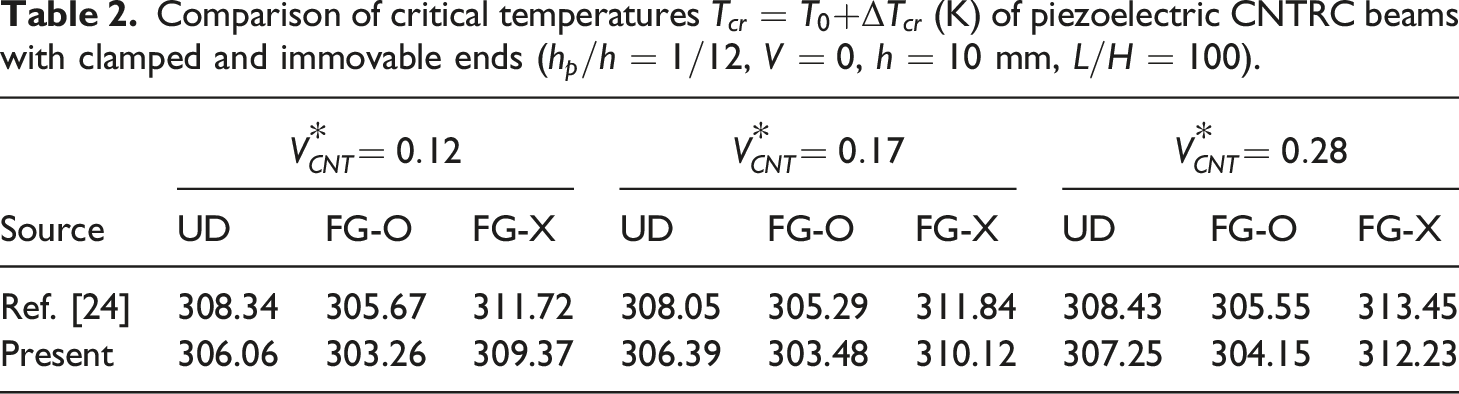
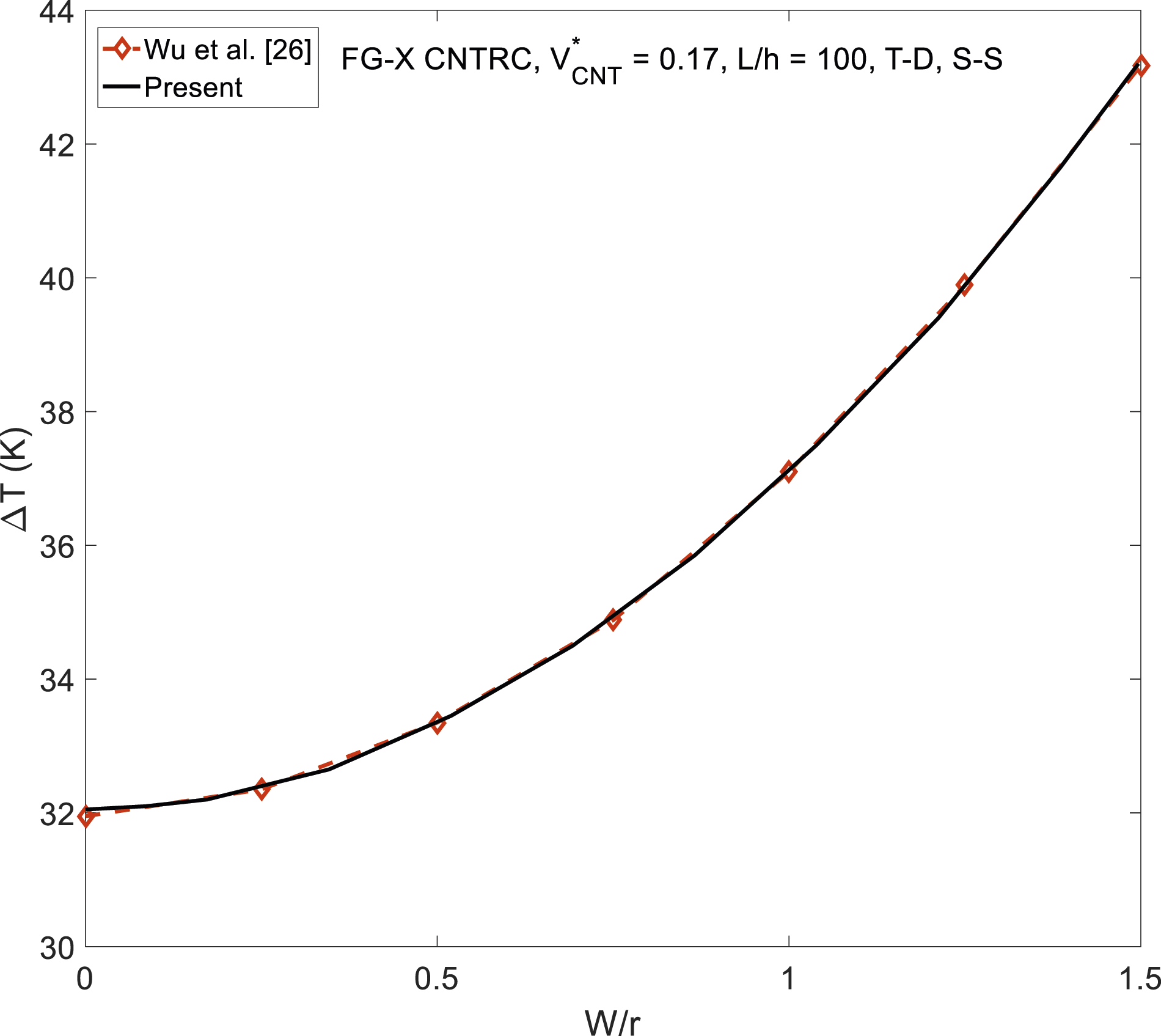
As the second comparative study, thermal buckling of CNTRC beams integrated with surface-bonded piezoelectric actuators with two clamped and immovable ends is investigated. The critical buckling temperatures computed by the present work are given in Table 2 in comparison with those reported in the work of Rafiee et al.24 using Euler-Bernoulli beam theory and eigenvalue-based approach. It is evident from Table 2 that a good agreement is achieved in this comparison. As final example for verification, the thermal postbuckling of a single-layer FG-X CNTRC beam with simply supported and immovable ends and temperature dependent properties under uniform temperature rise is considered. The postbuckling temperature-deflection path traced using the present approach is compared in Figure 2 with result obtained by Wu et al.26 employing FSDBT-based differential quadrature method. Within the Figure 2, is the radius of gyration of the beam cross section. It is evident from Figure 2 that the present result very well agrees with that reported in the work.26
Comparison of critical temperatures (K) of piezoelectric CNTRC beams with clamped and immovable ends (, , mm, ).
Comparison of thermal postbuckling paths of single-layer FG-X CNTRC beams with simply supported and immovable ends.
In what follows, parametric studies of thermal buckling and postbuckling of CNTRC with piezoelectric layers and tangentially restrained ends will be carried out. In the parametric studies, the thickness of CNTRC substrate is mm, buckling mode and the degree of tangential constraints of two ends is measured by non-dimensional tangential stiffness parameter defined in equation (26a). Temperature-dependent and temperature-independent properties will be referred to as T-D and T-ID, respectively. Simply supported and clamped boundary conditions at two ends will be briefly mentioned as S-S and C-C, respectively. The material properties and two ends are assumed to be temperature-dependent (T-D) and immovable, respectively, unless otherwise specified.
Thermal buckling analysis
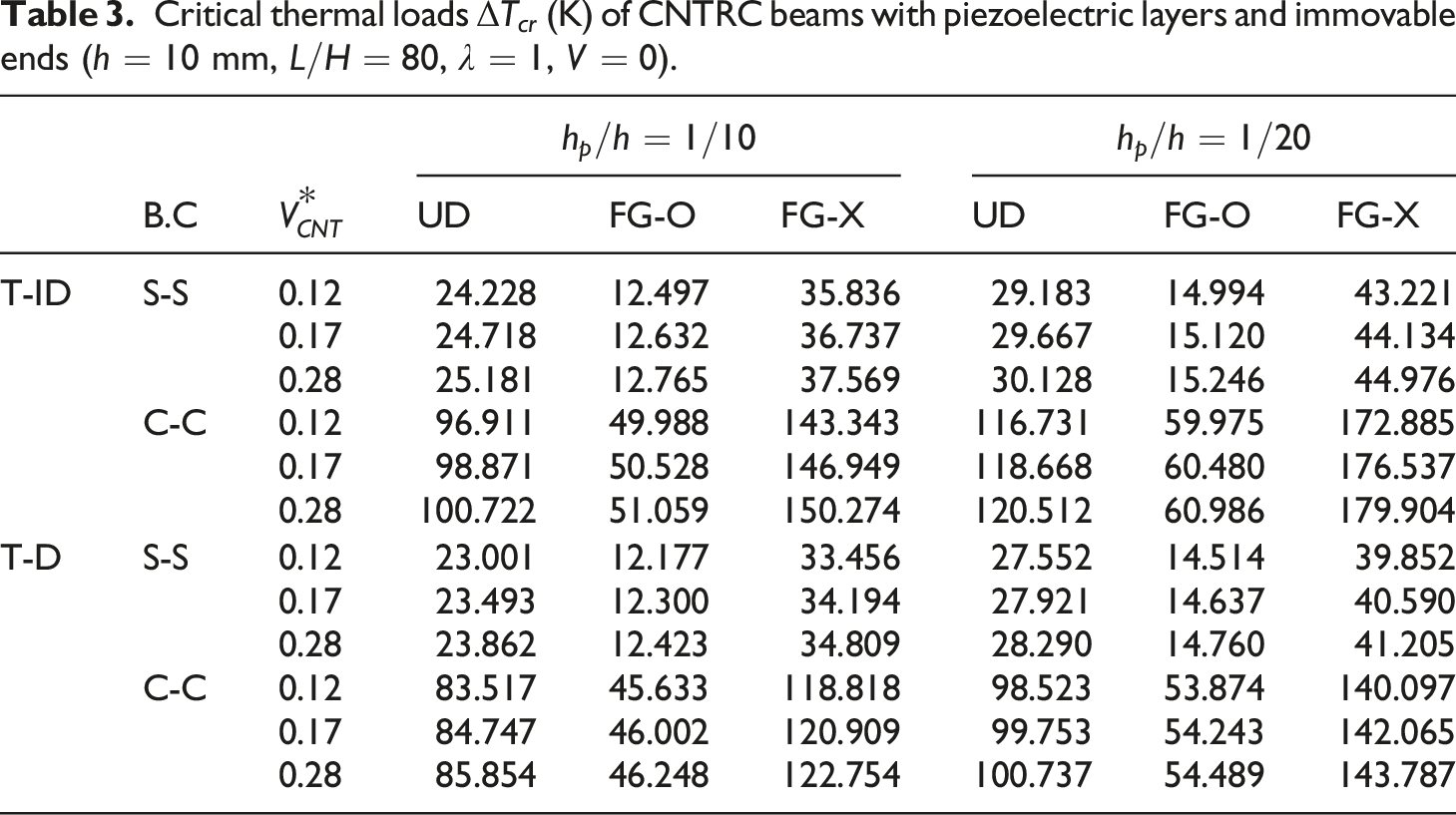
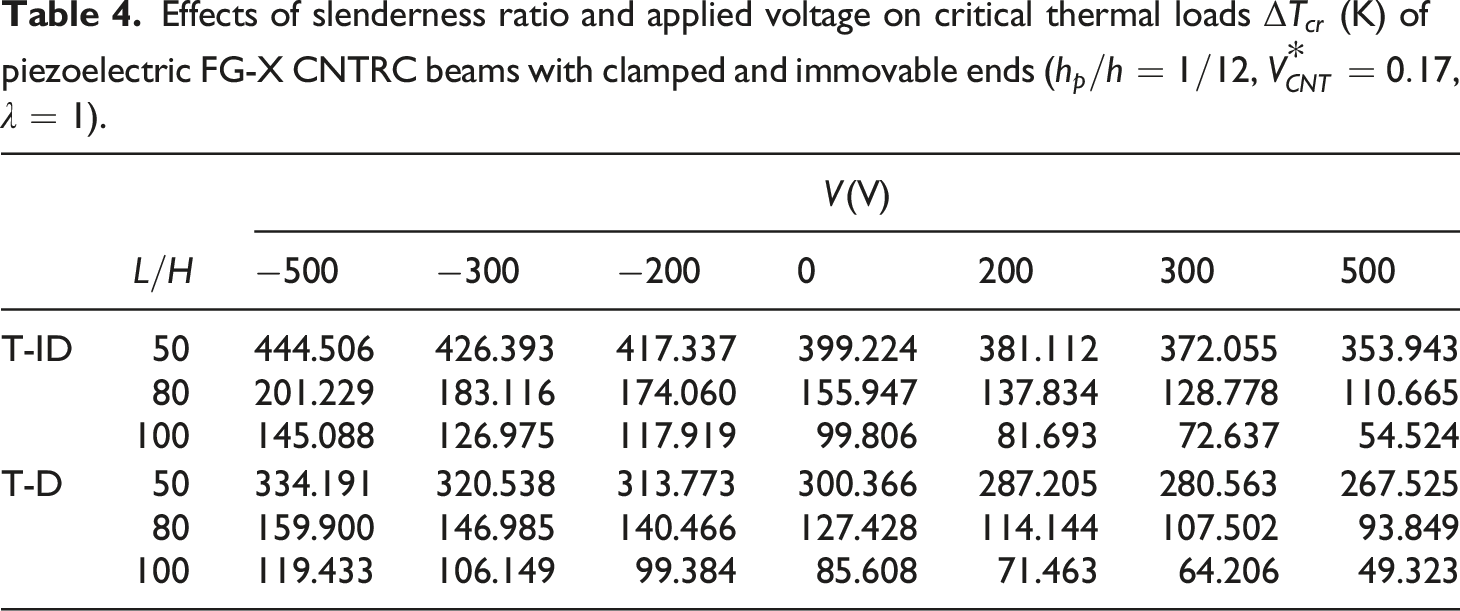
Different influences on the critical thermal loads of CNTRC beams with piezoelectric layers are analyzed in this subsection. First, the effects of boundary condition (B.C), CNT volume fraction , CNT distribution patterns, and ratio of piezoelectric layer-to-CNTRC host thicknesses on the thermal buckling behavior under a grounding condition () are given in Table 3. Equation (28) and Table 3 indicate that when the properties are T-ID, critical thermal loads of C-C beams are about four times those of S-S beams under a grounding condition. Additionally, the temperature dependence of material properties renders critical thermal loads lower, and detrimental influence of T-D properties on thermal buckling resistance capability is more significant when two ends are clamped. It is demonstrated in Table 3 that CNT distribution pronouncedly affects thermal buckling behavior and critical thermal loads of FG-O and FG-X beams are lowest and highest, respectively. Alternatively, volume percentage of CNTs slightly influence the thermal buckling of CNTRC beams and critical thermal loads are benignly larger as is increased. Furthermore, critical thermal loads are enhanced when ratio becomes smaller under a grounding condition. Next, the effects of slenderness ratio and applied voltage on the thermal buckling behavior of FG-X CNTRC beams with clamped and immovable ends are shown in Table 4. Obviously, the critical thermal loads are considerably dropped when enhancing ratio. In addition, minus and plus voltages increase and decrease the critical thermal loads of CNTRC beams with piezoelectric actuators, respectively. This fact can be interpreted that the minus and plus voltages induce axial tensile and compressive forces prior to application of thermal loading, respectively.
Critical thermal loads (K) of CNTRC beams with piezoelectric layers and immovable ends ( mm, , , ).
B.C
UD
FG-O
FG-X
UD
FG-O
FG-X
T-ID
S-S
0.12
24.228
12.497
35.836
29.183
14.994
43.221
0.17
24.718
12.632
36.737
29.667
15.120
44.134
0.28
25.181
12.765
37.569
30.128
15.246
44.976
C-C
0.12
96.911
49.988
143.343
116.731
59.975
172.885
0.17
98.871
50.528
146.949
118.668
60.480
176.537
0.28
100.722
51.059
150.274
120.512
60.986
179.904
T-D
S-S
0.12
23.001
12.177
33.456
27.552
14.514
39.852
0.17
23.493
12.300
34.194
27.921
14.637
40.590
0.28
23.862
12.423
34.809
28.290
14.760
41.205
C-C
0.12
83.517
45.633
118.818
98.523
53.874
140.097
0.17
84.747
46.002
120.909
99.753
54.243
142.065
0.28
85.854
46.248
122.754
100.737
54.489
143.787
Effects of slenderness ratio and applied voltage on critical thermal loads (K) of piezoelectric FG-X CNTRC beams with clamped and immovable ends (, , ).
(V)
0
200
300
500
T-ID
50
444.506
426.393
417.337
399.224
381.112
372.055
353.943
80
201.229
183.116
174.060
155.947
137.834
128.778
110.665
100
145.088
126.975
117.919
99.806
81.693
72.637
54.524
T-D
50
334.191
320.538
313.773
300.366
287.205
280.563
267.525
80
159.900
146.985
140.466
127.428
114.144
107.502
93.849
100
119.433
106.149
99.384
85.608
71.463
64.206
49.323
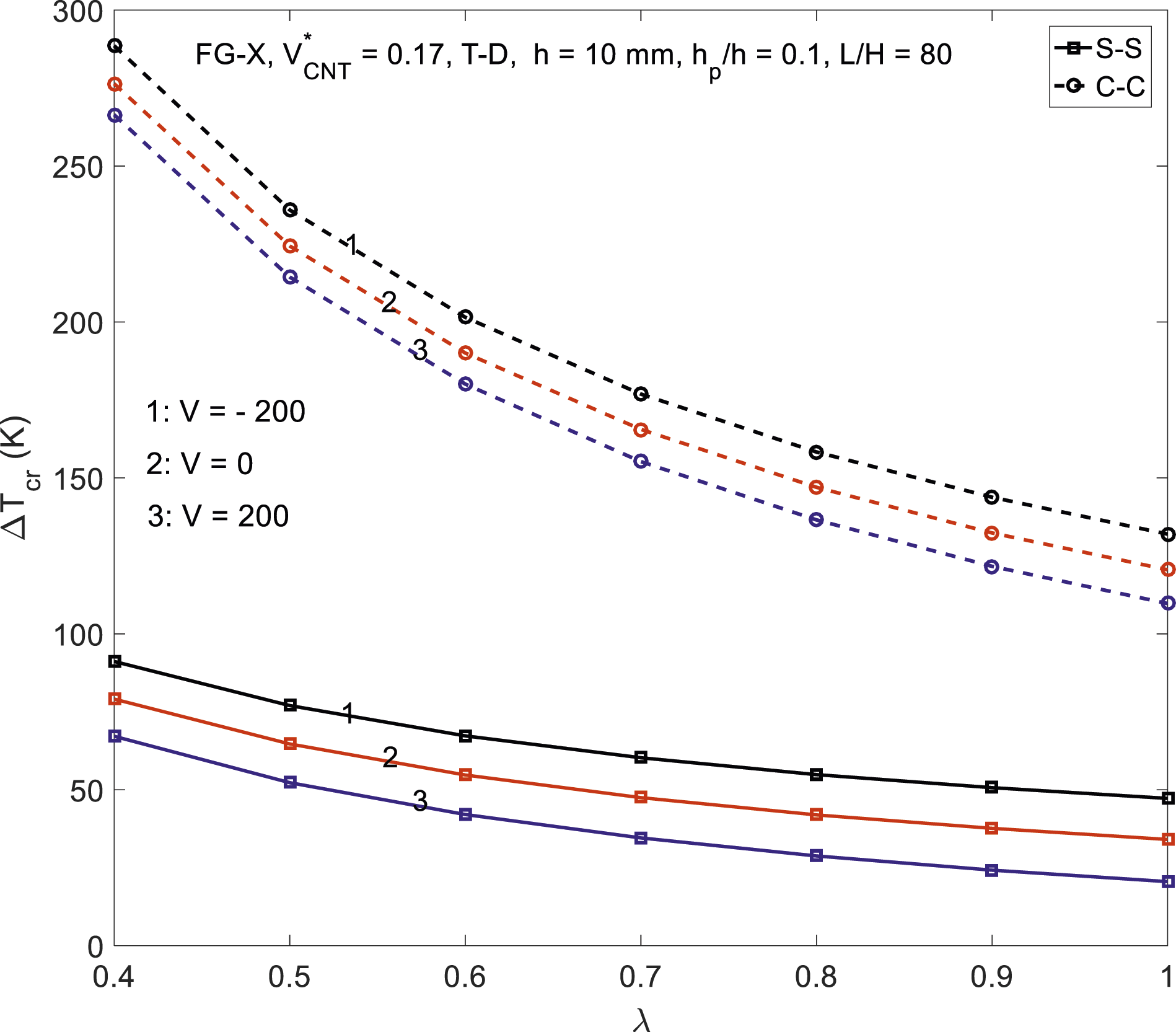
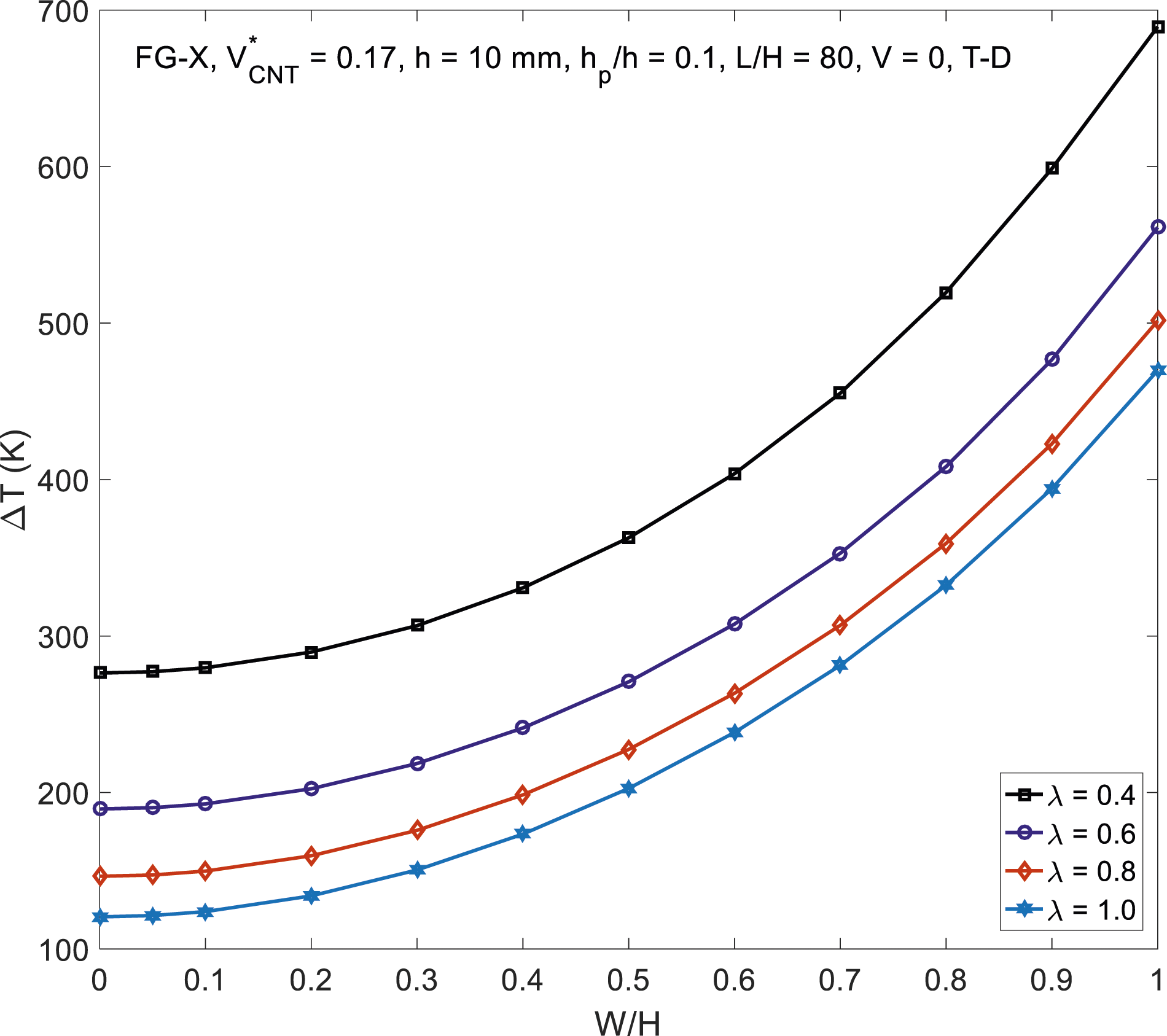
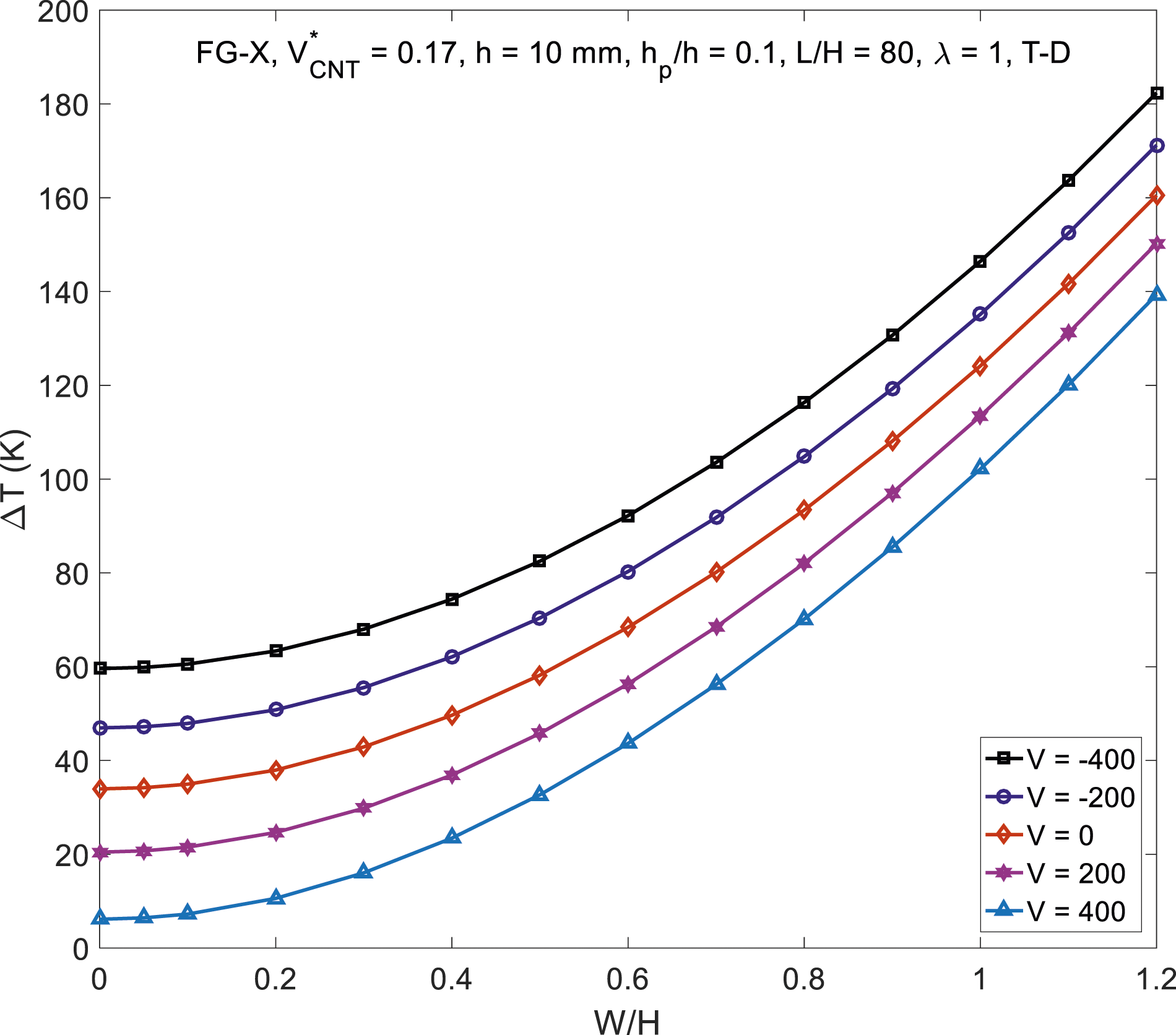
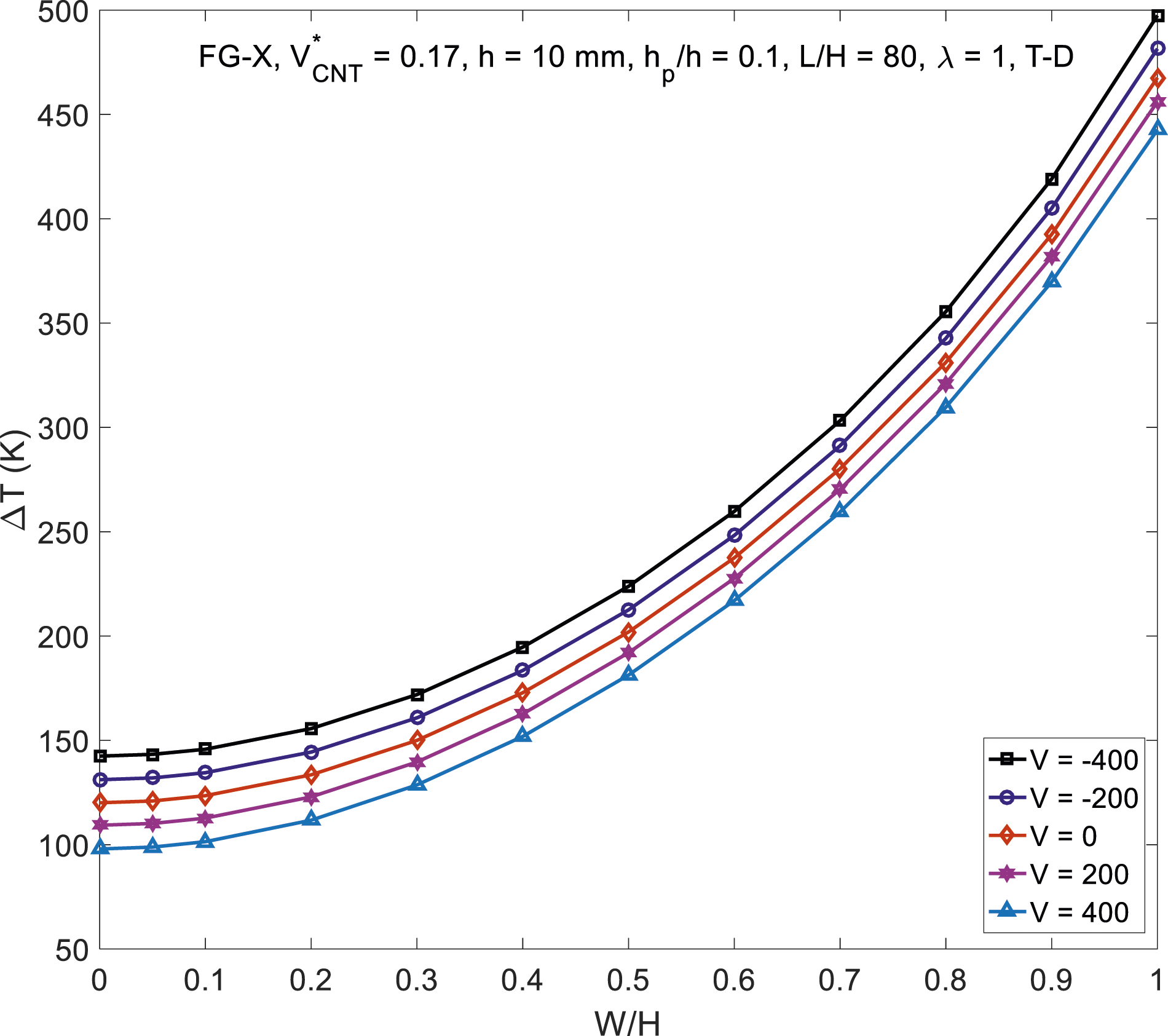
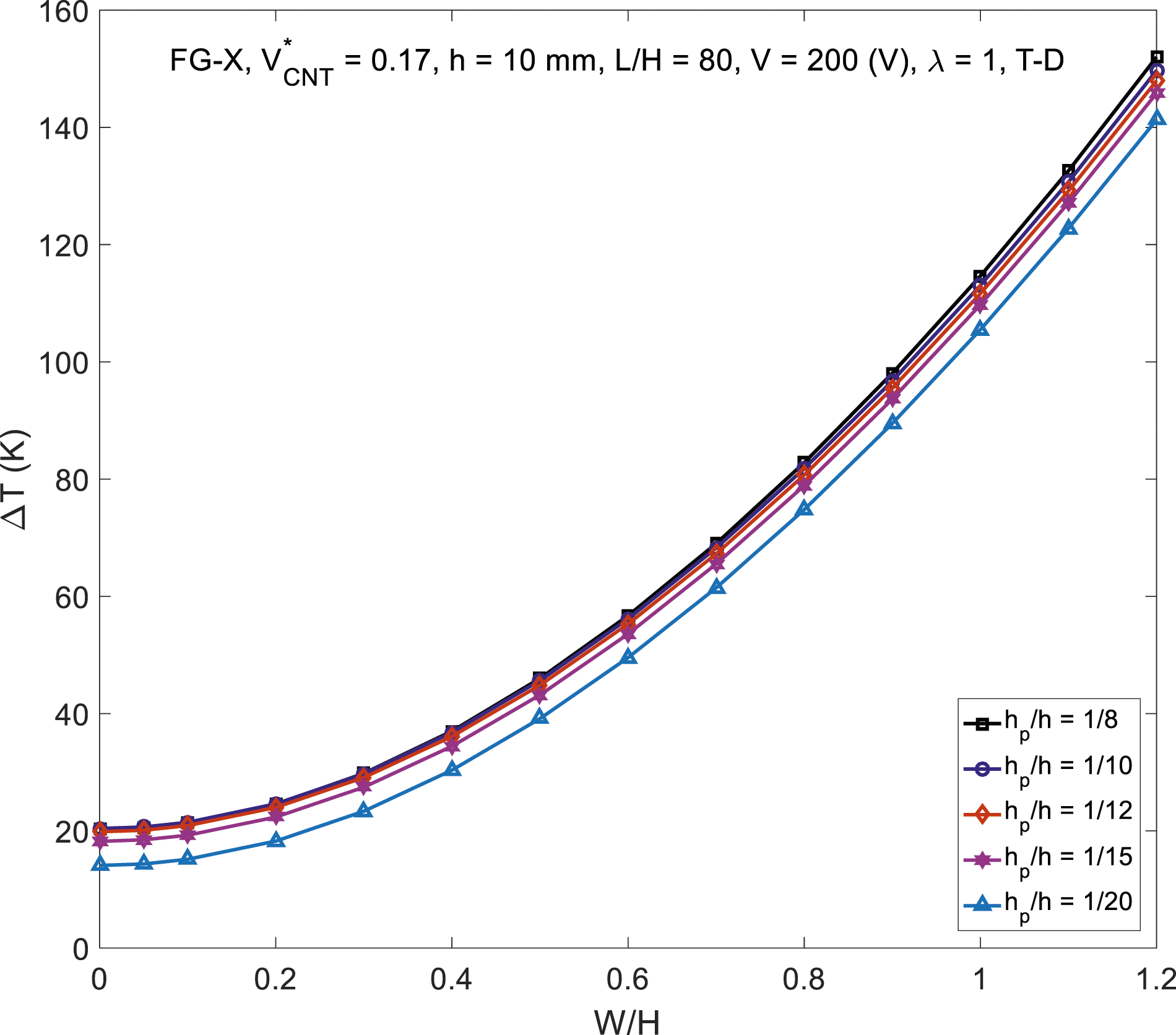
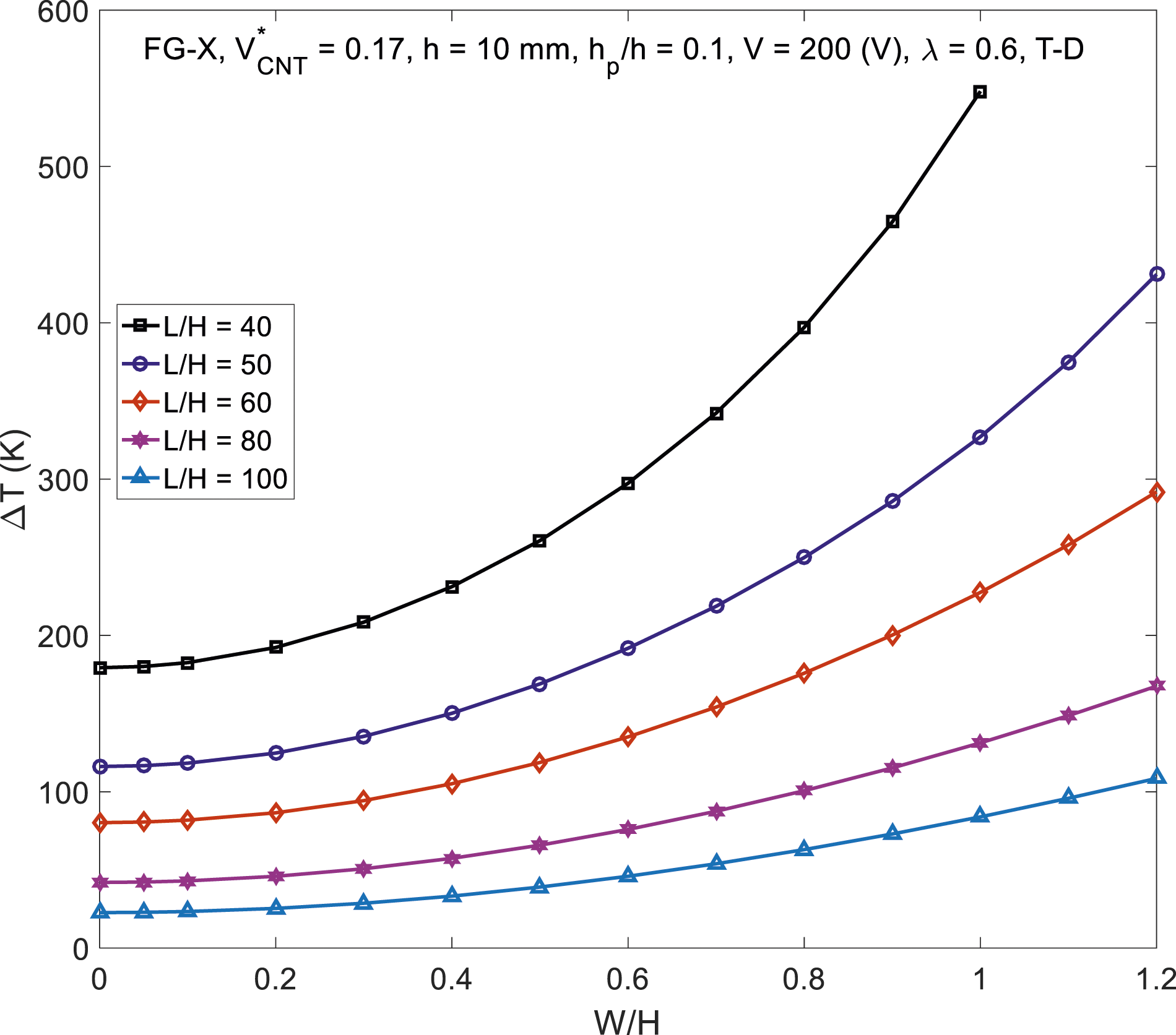
The ultimate study in this subsection is displayed in Figure 3 considering the effects of in-plane and out-of-plane boundary conditions along with applied voltage on the thermal buckling of FG-X CNTRC beams with piezoelectric layers. In general, both in-plane and out-of-plane boundary conditions substantially affect thermal buckling behavior and the critical thermal loads are pronouncedly decreased when ends are more rigorously restrained in tangential direction, specifically parameter is increased. In addition, it is recognized from Figure 3 that effect of applied voltage on S-S beams is more significant and difference between critical loads of C-C and S-S beams is smaller as parameter become larger.
Effects of boundary conditions and applied voltage on critical thermal loads of FG-X CNTRC beams with piezoelectric actuators.
Thermal postbuckling analysis
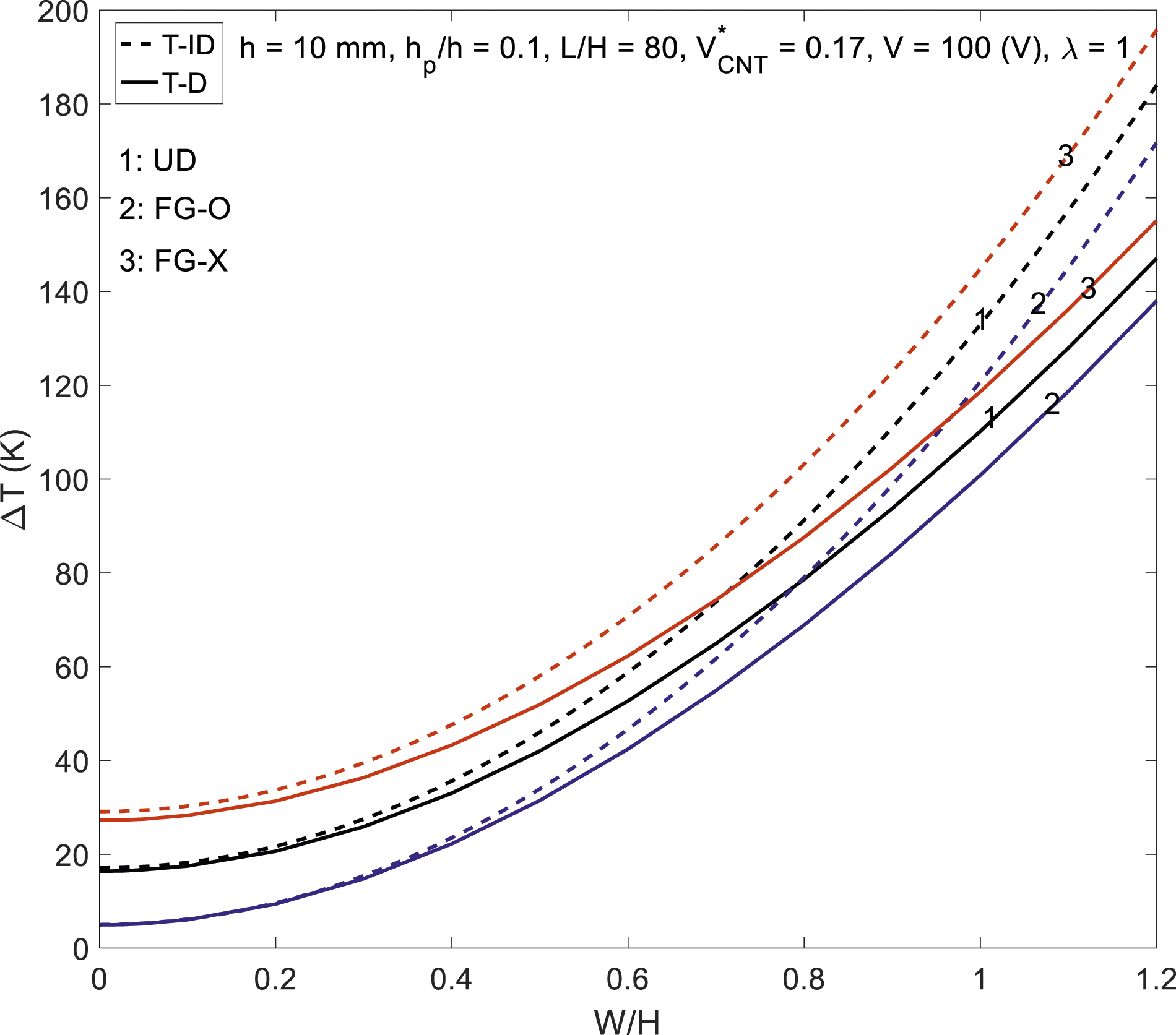
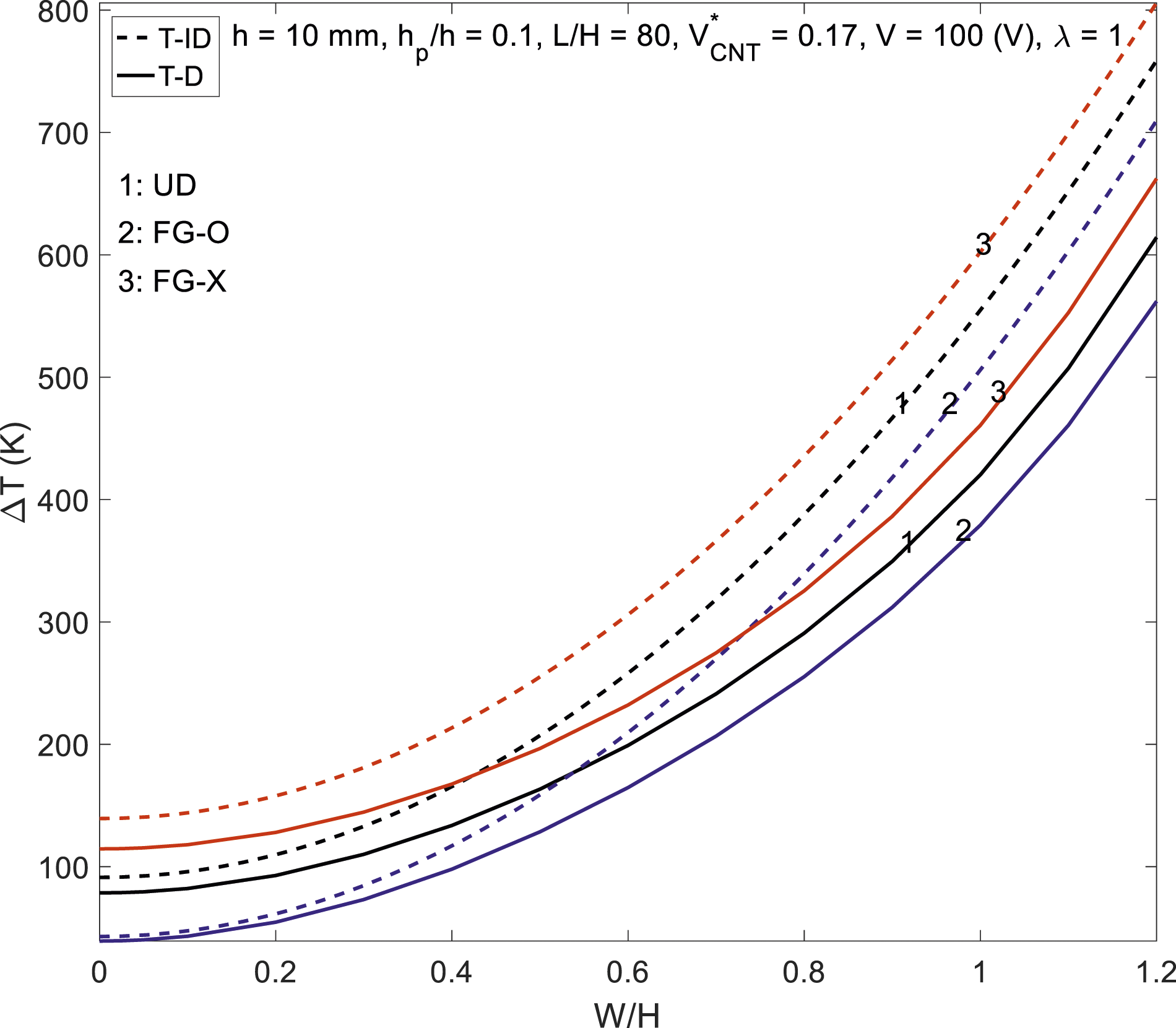
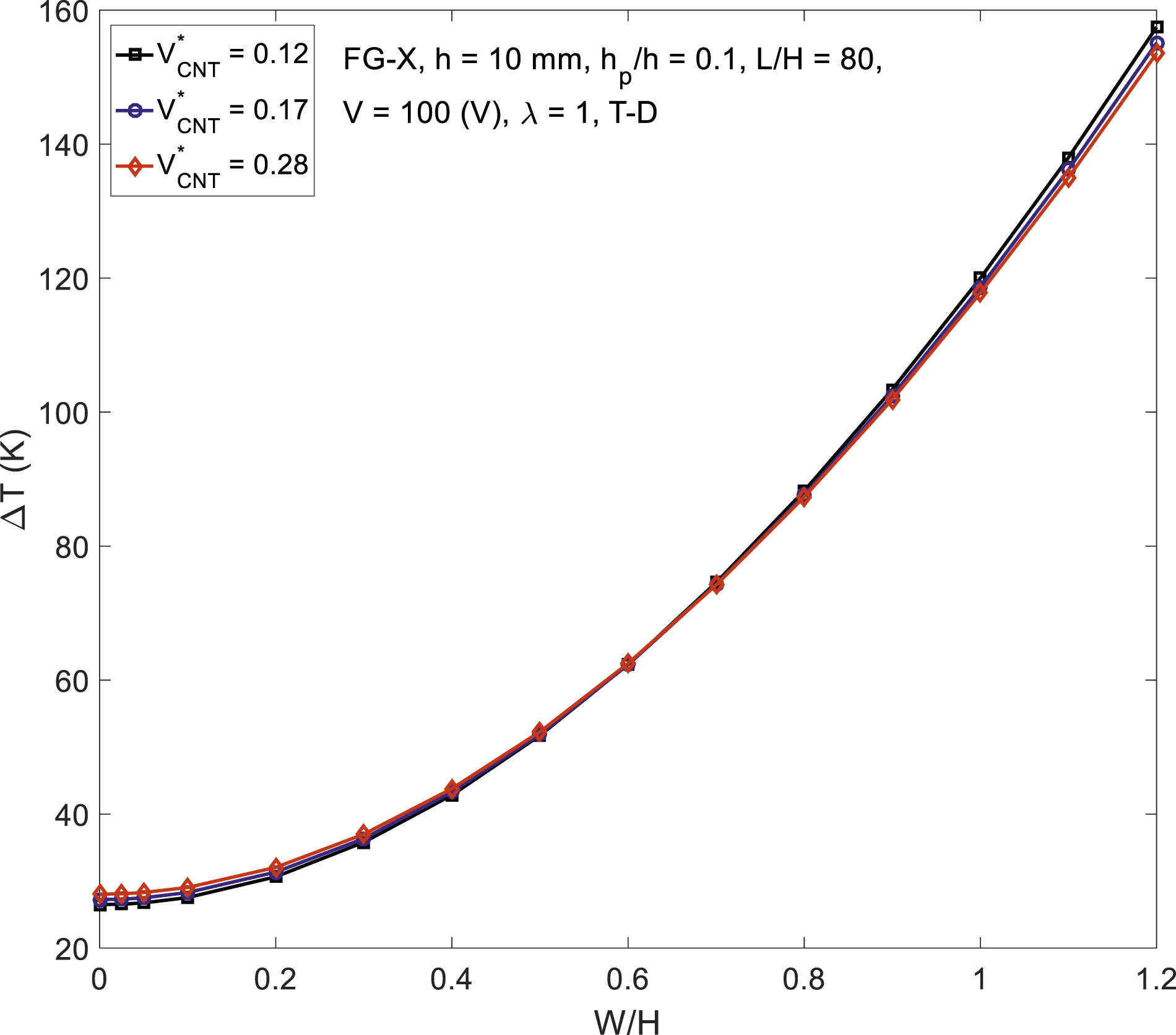
Numerous influences on thermal load-deflection response in the postbuckling region of CNTRC beams integrated with piezoelectric actuators are studied in this subsection. As the first analysis, the effects of CNT distribution on thermal postbuckling of piezoelectric CNTRC beams with simply supported and clamped ends undergoing positive voltage ( V) are shown in Figures 4 and 5, respectively. As can be observed, FG-X beams in which CNTs are more densely reinforced at near two surfaces possess the strongest capacity of loading carrying, and uniform distribution brings to an intermediate capability of thermal loading bearing of CNTRC beams. Besides, temperature dependence of material properties negatively influences the thermal postbuckling behavior of the beams, especially in the region of large deflection. The remaining analyses are performed for FG-X CNTRC beams with temperature-dependent (T-D) properties. Unlike CNT distribution, volume percentage of CNTs has slight effects on the postbuckling response of hybrid beams undergoing thermo-electrical loads, as demonstrated in Figure 6. More concretely, increase in CNT volume fraction leads to slight decrease and increase in postbuckling deflection of the beam when the deflection is small and large, respectively.
Effects of CNT distribution on thermal postbuckling of CNTRC beams with simply supported and immovable ends.
Effects of CNT distribution on thermal postbuckling of CNTRC beams with clamped and immovable ends.
Effects of CNT volume fraction on thermal postbuckling of hybrid CNTRC beams with simply supported and immovable ends.
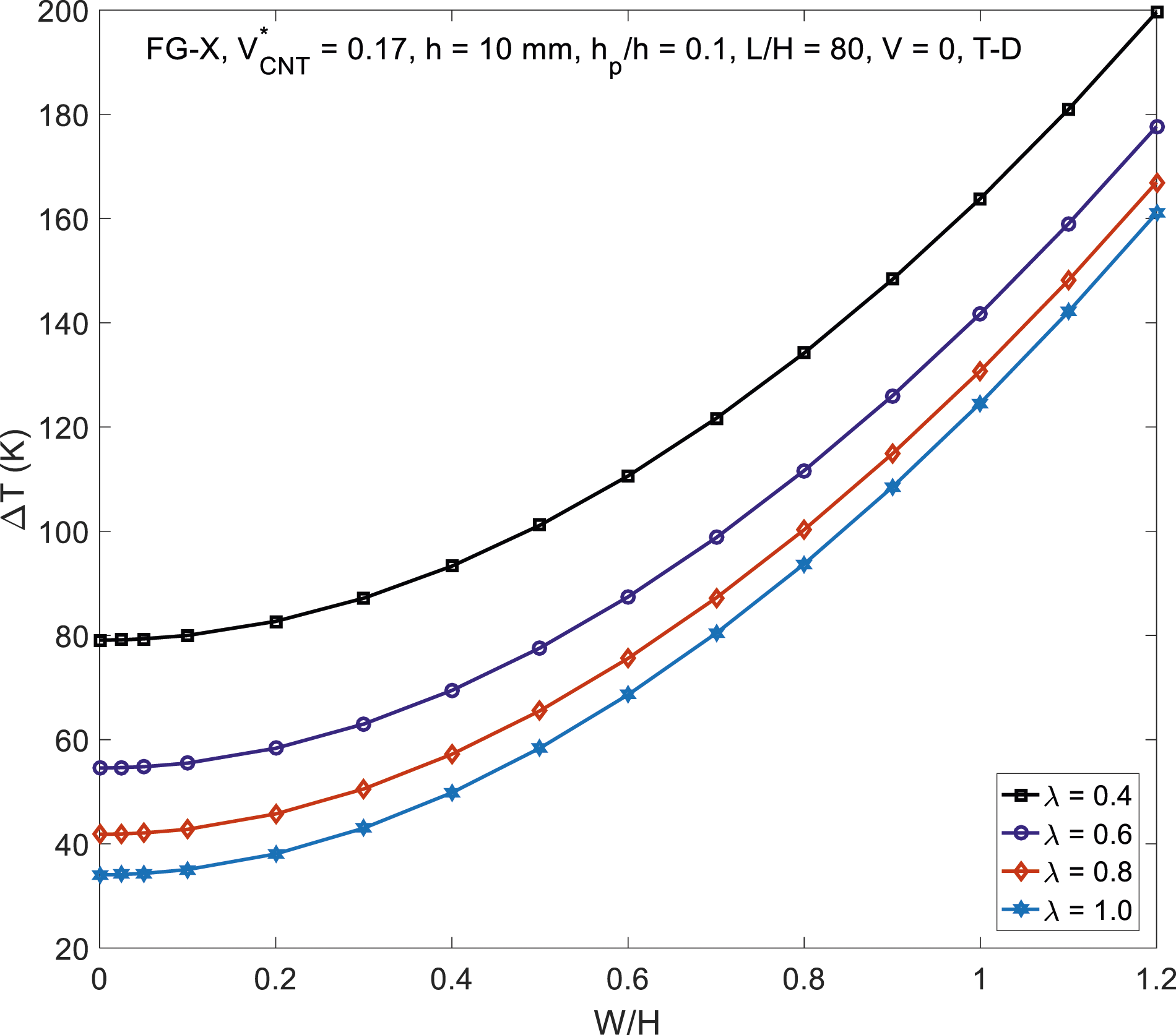
The influences of in-plane constraints of two ends, i.e. parameter, on the thermal postbuckling behavior of piezoelectric CNTRC beams under a grounding condition () are depicted in Figures 7 and 8 for S-S and C-C cases of out-of-plane boundary condition, respectively. Obviously, like out-of-plane boundary condition, the in-plane boundary condition dramatically affects the thermal postbuckling of hybrid CNTRC beams, and postbuckling strength is significantly weakened when ends are more severely restrained in tangential direction. Next, the effects of applied voltage on the thermal postbuckling behavior of piezoelectric CNTRC beams with S-S and C-C ends are examined in Figures 9 and 10, respectively. Evidently, the postbuckling deflection is decreased and increased when piezoelectric layers are actuated by negative and positive voltages, respectively. Accordingly, the postbuckling loading capacity can be controlled by means of variation of applied voltage. It is also realized from Figures 9 and 10 that the effect of applied voltage is more pronounced when two ends are simply supported.
Effects of tangential constraints of ends on thermal postbuckling of simply supported FG-CNTRC beams with piezoelectric layers.
Effects of tangential constraints of ends on thermal postbuckling of clamped FG-CNTRC beams with piezoelectric layers.
Effects of applied voltage on thermal postbuckling of hybrid FG-CNTRC beams with simply supported and immovable ends.
Effects of applied voltage on thermal postbuckling of hybrid FG-CNTRC beams with clamped and immovable ends.
Subsequent study is sketched in Figure 11 examining the effects of ratio of piezoelectric layer-to-CNTRC host thicknesses on the thermal postbuckling paths of S-S beams with immovable ends under a positive voltage ( V). Contrary to situation in Table 3 where critical thermal loads are increased as a result of decreasing ratio under a grounding condition (), Figure 11 finds that the critical thermal loads and post-critical curves of the hybrid CNTRC beams under a positive voltage are lowered as a result of decrease in ratio. Finally, the effects of slenderness ratio on the thermal postbuckling behavior of S-S hybrid CNTRC beams with partially movable ends () under a positive voltage ( V) are plotted in Figure 12. As shown, the ratio strongly affects the thermal postbuckling of CNTRC beams with piezoelectric layers. Specifically, the postbuckling paths are lower and more gradually developed when ratio is larger.
Effects of thickness of piezoelectric layers on thermal postbuckling of FG-CNTRC beams with simply supported and immovable ends.
Effects of slenderness ratio on thermal postbuckling of hybrid FG-CNTRC beams with simply supported and partially movable ends.
Concluding remarks
Thermo-electrical buckling and postbuckling behaviors of CNTRC beams with surface-bonded piezoelectric layers and tangentially restrained ends under uniform temperature rise and applied voltage have been investigated. The results indicate that distribution patterns and volume percentage of CNTs have significant and slight influences on thermal postbuckling of the beams, respectively. Besides, the following remarks are concluded:
(i) In-plane constraint of ends substantially affects thermal stability of hybrid CNTRC beams. Critical thermal loads along with postbuckling paths are strongly dropped and difference between critical loads of S-S and C-C beams is narrowed when tangential end constraints are more rigorous.
(ii) The thermal postbuckling loading capacity of piezoelectric CNTRC beams is stronger and weaker when applied voltages are negative and positive, respectively. The effects of applied voltage is more significant when two ends are simply supported.
(iii) The influence of piezoelectric layer thickness depends on the sign of applied voltage. Specifically, increase in piezoelectric layer thickness enhances and lowers the thermal postbuckling curves of beams under positive and negative voltages, respectively.
Footnotes
Declaration of conflicting interests
The author(s) declared no potential conflicts of interest with respect to the research, authorship, and/or publication of this article.
Funding
The author(s) received no financial support for the research, authorship, and/or publication of this article.
ORCID iD
Hoang Van Tung
References
1.
LiSRBatraRC. Thermal buckling and postbuckling of Euler-Bernoulli beams supported on nonlinear elastic foundations. AIAA J2007; 45(3): 712–720.
2.
KianiYEslamiMR. Thermal buckling analysis of functionally graded material beams. Int J Mech Mater Des2010; 6: 229–238.
3.
KianiYTaheriSEslamiMR. Thermal buckling of piezoelectric functionally graded material beams. J Therm Stresses2011; 34(8): 835–850.
4.
KianiYRezaeiMTaheriS, et al.Thermo-electrical buckling of piezoelectric functionally graded material Timoshenko beams. Int J Mech Mater Des2011; 7: 185–197.
5.
WattanasakulpongNGangadhara PrustyBKellyDW. Thermal buckling and elastic vibration of third-order shear deformable functionally graded beams. Int J Mech Sci2011; 53: 734–743.
6.
FuYWangJMaoY. Nonlinear analysis of buckling, free vibration and dynamic stability for the piezoelectric functionally graded beams in thermal environment. Appl Math Model2012; 36: 4324–4340.
7.
ShenHSWangZX. Nonlinear analysis of shear deformable FGM beams resting on elastic foundations in thermal environments. Int J Mech Sci2014; 81: 195–206.
8.
TrinhLCVoTPThaiHT, et al.An analytical method for the vibration and buckling of functionally graded beams under mechanical and thermal loads. Composites Part B2016; 100: 152–163.
9.
FallahAAghdamMM. Thermo-mechanical buckling and nonlinear free vibration analysis of functionally graded beams on nonlinear elastic foundation. Composites Part B2012; 43: 1523–1530.
10.
ShenHS. Thermal postbuckling behavior of shear deformable FGM plates with temperature-dependent properties. Int J Mech Sci2007; 49(4): 466–478.
11.
TungHV. Thermal and thermomechanical postbuckling of FGM sandwich plates resting on elastic foundations with tangential edge constraints and temperature dependent properties. Compos Struct2015; 131: 1028–1039.
12.
ShenHS. Nonlinear bending of functionally graded carbon nanotube-reinforced composite plates in thermal environments. Compos Struct2009; 91: 9–19.
13.
YasMHSamadiN. Free vibrations and buckling analysis of carbon nanotube-reinforced composite Timoshenko beams on elastic foundation. Int J Pres Ves Pip2012; 98: 119–128.
14.
ShenHSXiangY. Nonlinear analysis of nanotube-reinforced composite beams resting on elastic foundations in thermal environments. Eng Struct2013; 56: 698–708.
15.
WattanasakulpongNUngbhakornV. Analytical solutions for bending, buckling and vibration responses of carbon nanotube-reinforced composite beams resting on elastic foundation. Comput Mater Sci2013; 71: 201–208.
16.
NejatiMEslampanahANajafizadehM. Buckling and vibration analysis of functionally graded carbon nanotube-reinforced beam under axial load. Int J Appl Mech2016; 08(1): 1650008.
17.
FattahiAMSafaeiB. Buckling analysis of CNT-reinforced beams with arbitrary boundary conditions. Microsyst Technol2017; 23: 5079–5091.
18.
WuHLKitipornchaiSYangJ. Free vibration and buckling analysis of sandwich beams with functionally graded carbon nanotube-reinforced composite face sheets. Int J Struct Stabil Dynam2015; 15(7): 1540011.
19.
YangJKeLLFengC. Dynamic buckling of thermo-electro-mechanically loaded FG-CNTRC beams. Int J Struct Stabil Dynam2015; 15(8): 1540017.
20.
MohseniAShakouriM. Vibration and stability analysis of functionally graded CNT-reinforced composite beams with variable thickness on elastic foundation. Proceedings of the IMechE2019; 233(12): 2478–2489.
21.
WuHLYangJKitipornchaiS. Imperfection sensitivity of postbuckling behaviour of functionally graded carbon nanotube-reinforced composite beams. Thin-Walled Struct2016; 108: 225–233.
22.
KaramanliAVoTP. Finite element model for carbon nanotube-reinforced and graphene nanoplatelet-reinforced composite beams. Compos Struct2021; 264: 113739.
23.
BelarbiMOSalamiSJGargA, et al.Mechanical behavior analysis of FG-CNT-reinforced polymer composite beams via a hyperbolic shear deformation theory. Continuum Mech Therm2023; 35: 497–520.
24.
RafieeMYangJKitipornchaiS. Thermal bifurcation buckling of piezoelectric carbon nanotube reinforced composite beams. Comput Math Appl2013; 66: 1147–1160.
25.
MayandiKJeyarajP. Bending, buckling and free vibration characteristics of FG-CNT-reinforced polymer composite beam under non-uniform thermal load. Proc Inst Mech Eng Part L2013; 229(1): 13–28.
26.
WuHLKitipornchaiSYangJ. Imperfection sensitivity of thermal post-buckling behaviour of functionally graded carbon nanotube-reinforced composite beams. Appl Math Model2017; 42: 735–752.
27.
KianiY. Thermal postbuckling of temperature-dependent sandwich beams with carbon nanotube-reinforced face sheets. J Therm Stresses2016; 39(9): 1098–1110.
28.
KianiYMirzaeiM. Nonlinear stability of sandwich beams with carbon nanotube reinforced faces on elastic foundation under thermal loading. Proc IME C J Mech Eng Sci2018; 233(5): 1701–1712.
29.
KhosraviSArvinHKianiY. Interactive thermal and inertial buckling of rotating temperature-dependent FG-CNT reinforced composite beams. Composites Part B2019; 175: 107178.
30.
ShenHSZhangCL. Thermal buckling and postbuckling behavior of functionally graded carbon nanotube-reinforced composite plates. Mater Des2010; 31(7): 3403–3411.
GholamiRAnsariR. Thermal postbuckling of temperature-dependent functionally graded nanocomposite annular sector plates reinforced by carbon nanotubes. Int J Struct Stabil Dynam2021; 21(02): 2150026.
33.
WattanasakulpongNMaoQ. Stability and vibration analyses of carbon nanotube-reinforced composite beams with elastic boundary conditions: Chebyshev collocation method. Mech Adv Mater Struct2017; 24: 260–270.
34.
AnhNDThinhNVTungHV. Thermoelastic nonlinear vibration and dynamical response of geometrically imperfect carbon nanotube-reinforced composite plates on elastic foundations including tangential edge constraints. J Thermoplast Compos Mater2023; 0(0): 1–27. DOI: 10.1177/08927057231191454
35.
GholamiRAnsariR. Nonlinear bending of third-order shear deformable carbon nanotube/fiber/polymer multiscale laminated composite rectangular plates with different edge supports. Eur Phys J Plus2018; 133: 1–14.
36.
GholamiRAnsariRGholamiY. Numerical study on the nonlinear resonant dynamics of carbon nanotube/fiber/polymer multiscale laminated composite rectangular plates with various boundary conditions. Aero Sci Technol2018; 78: 118–129.
37.
GholamiRAnsariR. Nonlinear primary resonant characteristics of higher-order shear deformable FG-CNTRC circular cylindrical panels. Int J Appl Mech2021; 13(04): 2150046.
38.
SalehiMGholamiRAnsariR. Analytical solution approach for nonlinear vibration of shear deformable imperfect FG-GPLR porous nanocomposite cylindrical shells. Mech Base Des Struct Mach2023; 51(4): 2177–2199.
39.
SalehiMGholamiRAnsariR. Nonlinear resonance of functionally graded porous circular cylindrical shells reinforced by graphene platelet with initial imperfections using higher-order shear deformation theory. Int J Struct Stabil Dynam2022; 22(06): 2250075.
40.
TungHV. Thermal buckling and postbuckling behavior of functionally graded carbon nanotube-reinforced composite plates resting on elastic foundations with tangential-edge restraints. J Therm Stresses2017; 40(5): 641–663.
41.
Van TungHTrangLTN. Thermal postbuckling of shear deformable CNT-reinforced composite plates with tangentially restrained edges and temperature-dependent properties. J Thermoplast Compos Mater2020; 33(1): 97–124.
42.
LongVTVan TungH. Thermal postbuckling behavior of CNT-reinforced composite sandwich plate models resting on elastic foundations with tangentially restrained edges and temperature-dependent properties. J Thermoplast Compos Mater2020; 33(10): 1396–1428.
43.
TrangLTNVan TungH. Thermally induced postbuckling of thin CNT-reinforced composite plates under nonuniform in-plane temperature distributions. J Thermoplast Compos Mater2022; 35(12): 2331–2353.
44.
TrangLTNVan TungH. Thermoelastic stability of thin CNT-reinforced composite cylindrical panels with elastically restrained edges under nonuniform in-plane temperature distribution. J Thermoplast Compos Mater2023; 36(2): 768–793.
45.
TrangLTNTungHV. Thermally induced postbuckling of higher order shear deformable CNT-reinforced composite flat and cylindrical panels resting on elastic foundations with elastically restrained edges. Mech Base Des Struct Mach2022; 50(8): 2812–2835.
46.
HieuPTTungHV. Thermal buckling and postbuckling of CNT-reinforced composite cylindrical shell surrounded by an elastic medium with tangentially restrained edges. J Thermoplast Compos Mater2021; 34(7): 861–883.
47.
HieuPTVan TungH. Thermal and thermomechanical buckling of shear deformable FG-CNTRC cylindrical shells and toroidal shell segments with tangentially restrained edges. Arch Appl Mech2020; 90(7): 1529–1546.
48.
LongVTTungHV. Thermal nonlinear buckling of shear deformable functionally graded cylindrical shells with porosities. AIAA J2021; 59(6): 2233–2241.
49.
Nhu TrangLTVan TungH. Thermal nonlinear stability of functionally graded porous material nearly cylindrical shells with surrounding elastic media and tangentially restrained edges. Math Methods Appl Sci2023; 46(6): 7285–7304.
50.
EisleyJG. Nonlinear vibration of beams and rectangular plates. Z Angew Math Phys1964; 15: 167–175.