



Abstract
Polymer blends have got considerable attention for their potential optoelectronic and photonic applications due to several advantages such as easy processing, low cost, flexibility, and good mechanical properties. This work reports the structure and optical properties of solution cast binary blends of poly (methyl methacrylate) (PMMA) and poly (vinyl carbazole) (PVK). Here, the position and/or intensity of characteristic FTIR peaks reveal the changes of the structure of PMMA on PVK content while the surface morphology changes from highly smooth for pure PMMA to flaky structured (PVK 5%) and then to agglomerated morphologies for these blends. A red shift in optical absorption edge and decrease in optical transmission with PVK content in PMMA based blends. The emission spectra exhibit intensity escalation by 340 times with respect to PMMA for PVK-15 blends and then decreases with further addition of PVK in these blends. These results are very important for the advent of new optoelectronic functionalities for these polymer blends.
Keywords
Introduction
In the recent years, the blending of polymers is most important methods to develop new polymeric materials with improved physical characteristics for various functional applications. 1 The optimization of relative proportions of the components along with their miscibility is important for determining the physical characteristics of final blends. Abdelghany et al. 2 (2015) have reported the spectroscopic investigations for polyvinyl chloride/polymethyl metharcylate (PVC/PMMA) blends prepared in tetrahydrofuran at room temperature . Zhang et al. (2008) have reported the initial polymer concentration role on the crystallization of solution casting polyvinylidene fluoride/polymethyl methacrylate (PVDF/PMMA) blends. 3 Sharma et al. 4 (2012) have reported the decrease in optical gap with an increase in Urbach’s energy for solution cast polymethyl metharcylate/polyvinyl pyrrolidone (PMMA/PVP) blends. The change in relative dielectric constant of DMSO/water solvent mixture influences the miscibility of blends of polyvinyl alcohol/polyvinyl pyrrolidone (PVA/PVP) system. 5
Also, the addition of the nanofillers have found to positively impacting on the characteristics of the parent polymer systems. The transition metal (Mn, Fe, Cu and Ag) doping in ZnS nanoparticles have yielded improvement in optical gap of polyvinyl carbazole (PVK) based composites and found the luminescence quenching for ZnS:Mn doped PVK composites. 6 The increase in fluorescence intensity with ZnS content upto 30 wt. %, and then increase in ZnS content results into intensity drop due to self-reabsorption in optically transparent ZnS/PMMA nanocomposite films. 7 Abdullah et al. 8 reported the improvement in optical constants of pure PMMA in composite films of PMMA and Si powder prepared using solution casting technique for UV blocking and optoelectronic applications . The enhancement of the UV–Vis absorption and photoluminescence behaviour for the solution cast polymethyl methacrylate (PMMA)/carbon nanodots (CNDs) nanocomposite films could be considered as a promising candidate to be used in future nanotechnology-based devices. 9 Al-Ahmad et al. 10 have assigned the increase in water trace amount to increase the polarization effects for the decrease in electrical parameters of calcium carbonate doped with poly (ethylene oxide) based composite films. The very high increase in both the saturation magnetisation and coercivity has been reported by loading cobalt iron oxide magnetic amorphous nanoparticles with PVA using casting technique. 11 The dielectric response of the nanocomposite of GO-PVA featured a simultaneous increase of both real and imaginary part of the complex permittivity toward low frequency due to the contribution of charge carriers. 12 Falqi et al. 13 have reported an increase in elongation break by 62% for the PVA/PEG (10%) blend to 209% for the nanocomposite with graphene (0.2 wt. %) as nanofiller in PVA/PEG (10%) nanocomposites .
The most suitable organic optical material widely used to fabricate multiplicity of optical devices such as optical fibres and lenses etc. is by using polymethyl methacrylate (PMMA). Polyvinyl carbazole (PVK) is well known for its photoconducting and electroluminescence properties. 14 An aggregation-induced emission with ATRP content in PMMA polymers lead to red emission for the realization of high performance luminescent solar concentrators (LSCs). 15 The self-trapped excitons emission for Bi doped double perovskite nanocrystals in PMMA matrix have resulted into enhanced optical quantum efficiency of LSCs. 16 The role of polymer form and their concentration for polymer PVK and polymer nanoparticles poly (2-methoxy-5-(2-ethylhexyloxy) −1,4-phenylenevinylene) (MEH-PPV) in film form on the mechanisms of injection and transport of charge carriers and the radiative recombination in the studied structures have been investigated in detail. 17 The new organic-inorganic hybrid structures have got the potential for the development of either photovoltaic devices (∼20 wt. % of nanoparticle) or UV optoelectronics devices (50 and 70 wt. % of nanoparticles) for n-ZnO nanoparticles in PVK based nanocomposites. 18 Cyprych et al. studied the influence of rhodamine 6G dye doping on PMMA/PVK double phase system on the parameters of random lasing phenomena improvement to support the localised modes in this phase separated system fabricated by simple spin coating technique. 19
However, the literature reports are deficit of the detailed study of the optical and structural characteristics of the PMMA/PVK system. Therefore, the present work reports the role of PVK concentration in optically transparent PMMA polymer i.e. PMMA/PVK blends by utilizing various spectroscopic and microscopic techniques.
Experimental details
The precursor chemicals such as polyvinyl carbazole (PVK, mol. wt. 1,000,000, Sigma Aldrich), polymethyl methacryalate (PMMA, mol. wt. 100,000, Loba Chemie) and chlorobenzene (Loba Chemie) were used without further purification. Here, solution casting method was used to prepare films of different polymer blends of PVK and PMMA. For the preparation of blends, the PMMA polymer was mixed with appropriate weight percentage in 20 mL of chlorobenzene, stirred for 2 h at 40 oC and after that appropriate amount of polymer PVK was added into same solution. The solution was further stirred for another 2 h. The resulting solution was poured into the petridis and solvent was allowed to evaporate for 12 h in open air. When the solvent gets fully evaporated, then the petridis was put in a hot air oven maintained at 60 oC for further 6 h. Once the film dried, it was peeled off from the petridis and stored in a desiccator for further characterization.
The surface morphology of PMMA/PVK blends was examined using scanning electron microscope (Model: Quanta 450 FEG, FEI, USA). The molecular structure was studied by using the fourier transform infrared (FTIR) spectroscopy (Model: Spectrum 65, Perkin Elmer, USA). The optical absorption spectra were studied by using the UV–visible spectrophotometer (Model: UV160 A, Shimadzu, Japan). The emission spectra were recorded at 400 nm excitation by using fluorescence spectrophotometer (Model: Carry Eclipse, Agilent, USA).
Results and discussion
Figure 1 shows the SEM micrograph of pure PMMA and PMMA/PVK blends. For pure PMMA sample, it is clear that it has a uniform surface morphology and degree of roughness has been found to increase with PVK content. The surface morphology of pure PMMA have highly smooth morphology, while it changes to flaky structures (PVK-5) and then to agglomerated morphologies for these blends. The variation in morphology of blends is due to inter/intra chain molecular interaction between the components of blends or the formation of agglomerates with PVK addition in PMMA polymer. SEM micrographs for polyblends of polymethyl methacrylate/polyvinyl carbazole membranes.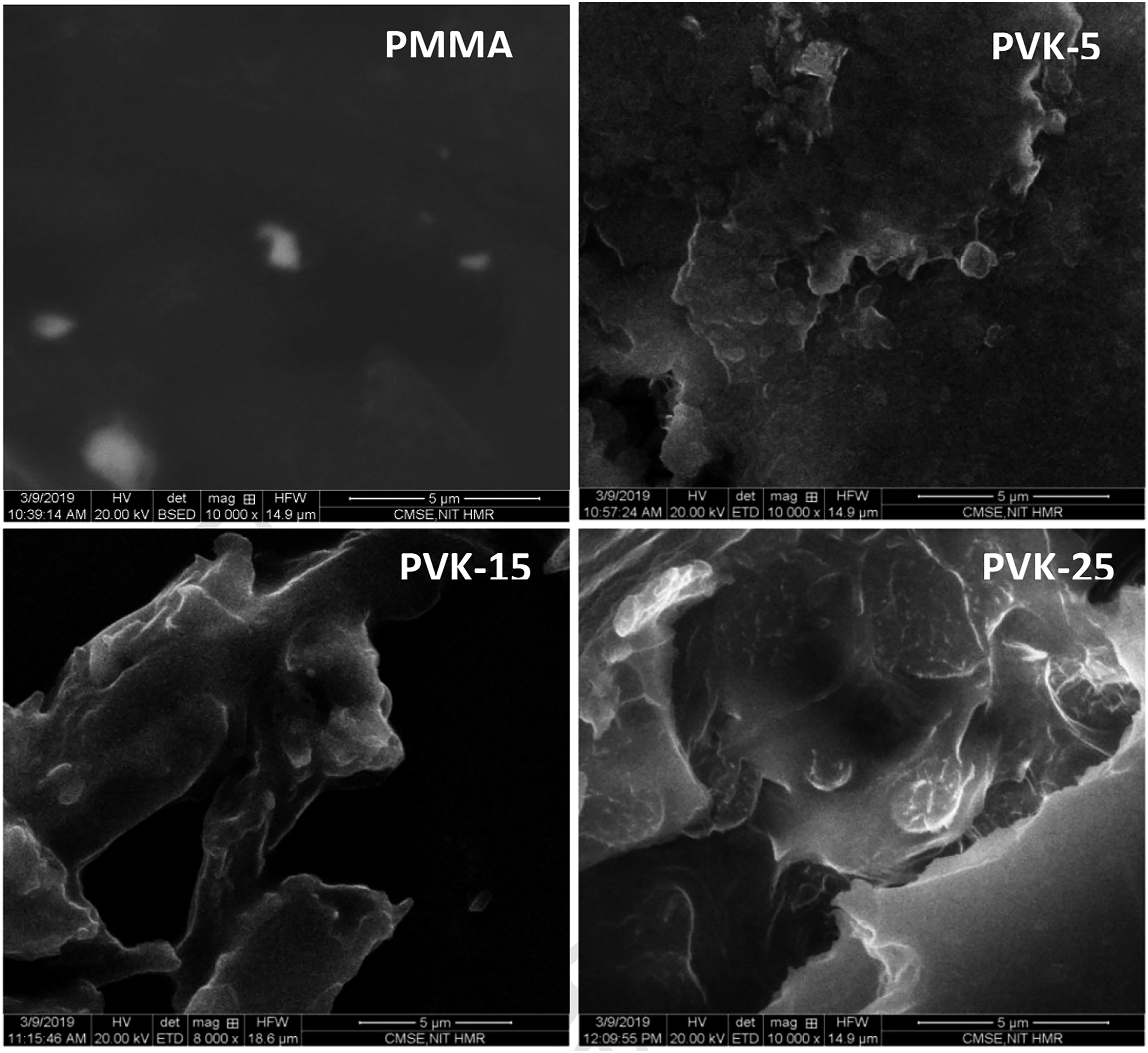
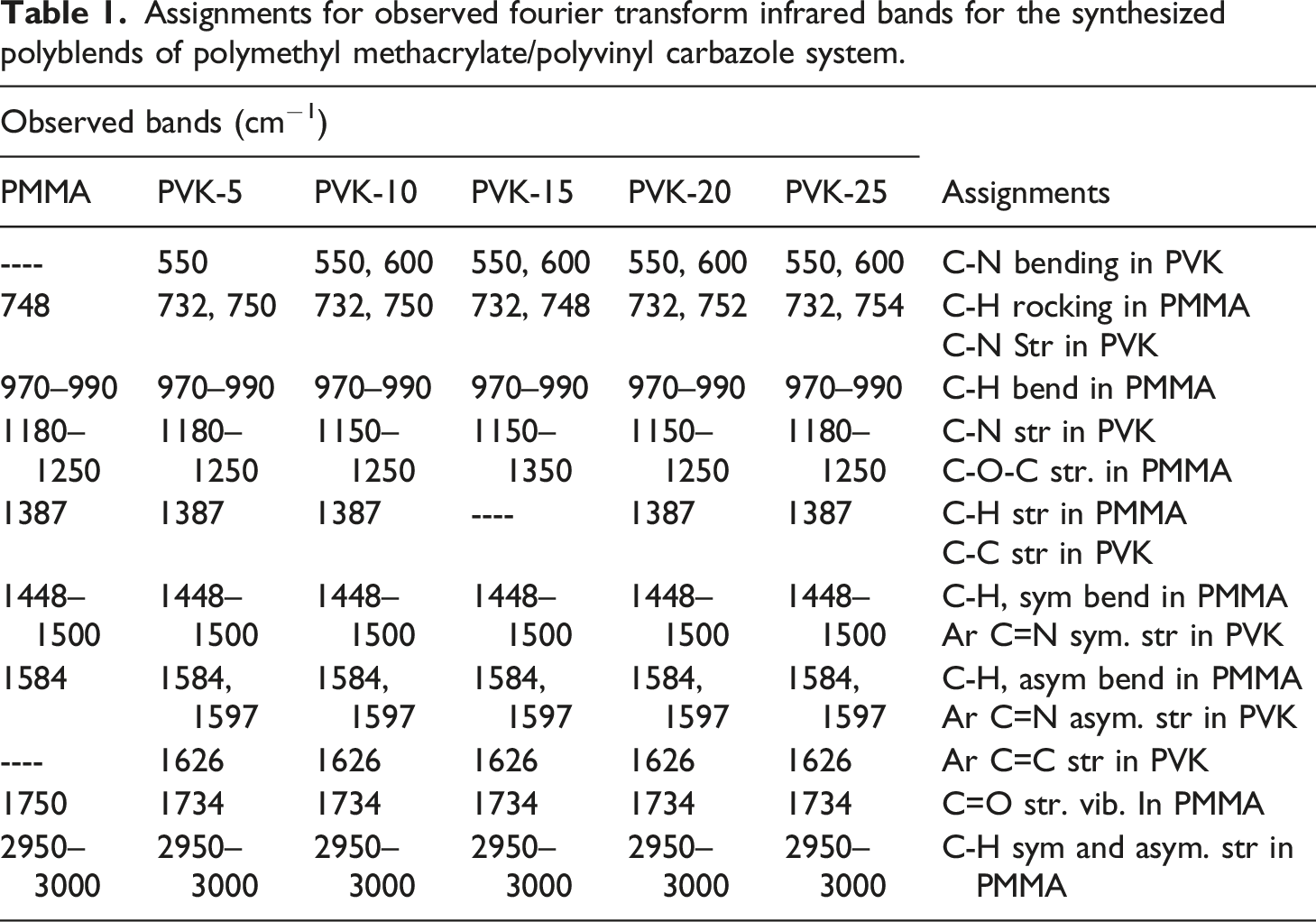
Figure 2 shows FTIR spectrum of PMMA and PMMA/PVK blends in the frequency range 3000-500 cm−1. The characteristic vibrational modes observed in infrared region are given in Table 1. In this work, the major vibrational bands consisting are doublets appeared at 2950-3000 cm−1 (due to asymmetrical and symmetrical stretching of C–H bonds in the methyl group), 1448-1500 cm−1 (due to symmetrical bending of C–H bonds), 1180-1250 cm−1 (due to C-O-C bond stretching) and 970-990 cm−1 (C-H bond bending modes) have been assigned for PMMA membranes.20,21 Also, the bands at ∼700–800 cm−1 range (out-of-plane deformation and stretching vibration of aromatic –C–H), 1100–1150 cm−1 (in-plane deformation and stretching vibration of aromatic –C–H), and 1600 cm-1(C=C stretching) in PVK have been assigned by Thinh et al.
22
Also, the shift in characteristic of C=O stretching vibrations in PMMA position (∼1750 cm−1) to lower wavenumber (∼1734 cm−1), disappearance of peak 1387 cm−1 (C-H and C-C stretching in PMMA and PVK respectively) and appearance of doublet near ∼748 cm−1 (due to C-H rocking in PMMA and C-N stretching in PVK) till PVK-15 has been observed.20,23,24 The doublets appeared at 2950-3000 cm−1 has been converted into broad band PVK-15 and further, the same doublet appears with PVK content in PMMA. Further increase in PVK content cause a weakening in the intensities of characteristic bands in this blend system. The appearance of feeble intensity peaks at ∼1597 cm−1 (aromatic C=N asymmetric stretching of PVK), ∼1584 cm−1 (C-H asymmetric bending in PMMA) and 600-550 cm−1 (C-N bending in PVK) have been observed.23,24 This behaviour shows the formation of phase separated blends in PMMA/PVK system. The intermolecular bonding between the PMMA and PVA for PMMA/PVA blends in the whole FTIR spectra is responsible for relative variation in characteristic vibrational bands. Fourier transform infrared spectra for polyblends of polymethyl methacrylate/polyvinyl carbazole membranes. Assignments for observed fourier transform infrared bands for the synthesized polyblends of polymethyl methacrylate/polyvinyl carbazole system.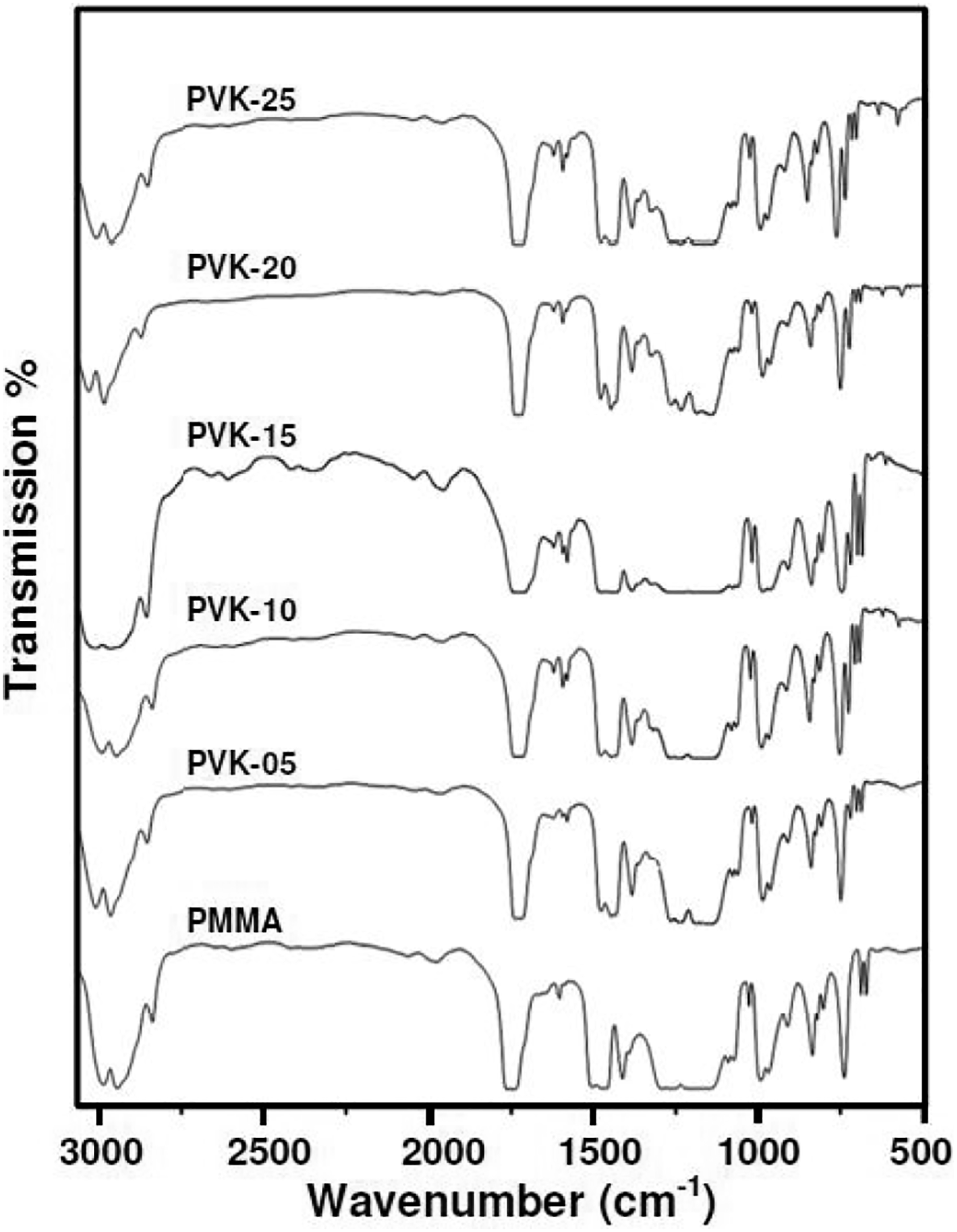
The optical absorption spectroscopy is a powerful technique to explore the presence of additional absorption bands arisen with PVK content in PMMA blend system. Figures 3(a) and (b) shows the optical transmission spectra and absorption spectra for membranes of PMMA/PVK blends. The absorption spectra of pure PMMA consists only one defined peak at about 280 nm which may be assigned to π-π* transition due to the unsaturated groups in the polymer. Similarly, two absorption peaks at 289 and 336 nm are ascribed to П-П* and n-П* transition respectively of the carbazole groups present in the polymer backbone.
25
The two absorption peaks at 300 and 340 nm have been observed with PVK content in PMMA based polymer blends. Further, the red shift and broadening of absorption bands has been observed with PVK content. It is found that the absorbance hugely increments till PVK-10 and then significantly decreases till PVK-20 and then again shows the increasing behavior for PMMA/PVK blends. The initial increase may be due to the uniform distribution of PVK molecules in PMMA matrix. While the decrease in absorbance till PVK-20 can be ascribed to phase separation to form PVK rich and PVK poor regions and further, the increase in size of PVK rich phases may cause light scattering to give increasing behavior in absorption spectrum. It is also found that the PVK content intrinsically modifies the optical transmission characteristics of PMMA in blends of PMMA/PVK system. (a, b) Optical transmission and absorption spectra, (c) photoluminescence spectra at 275 nm excitation energy and (d) deconvoluted emission spectra for polyvinyl carbazole-25 polyblends for polyblends of polymethyl methacrylate/polyvinyl carbazole membranes.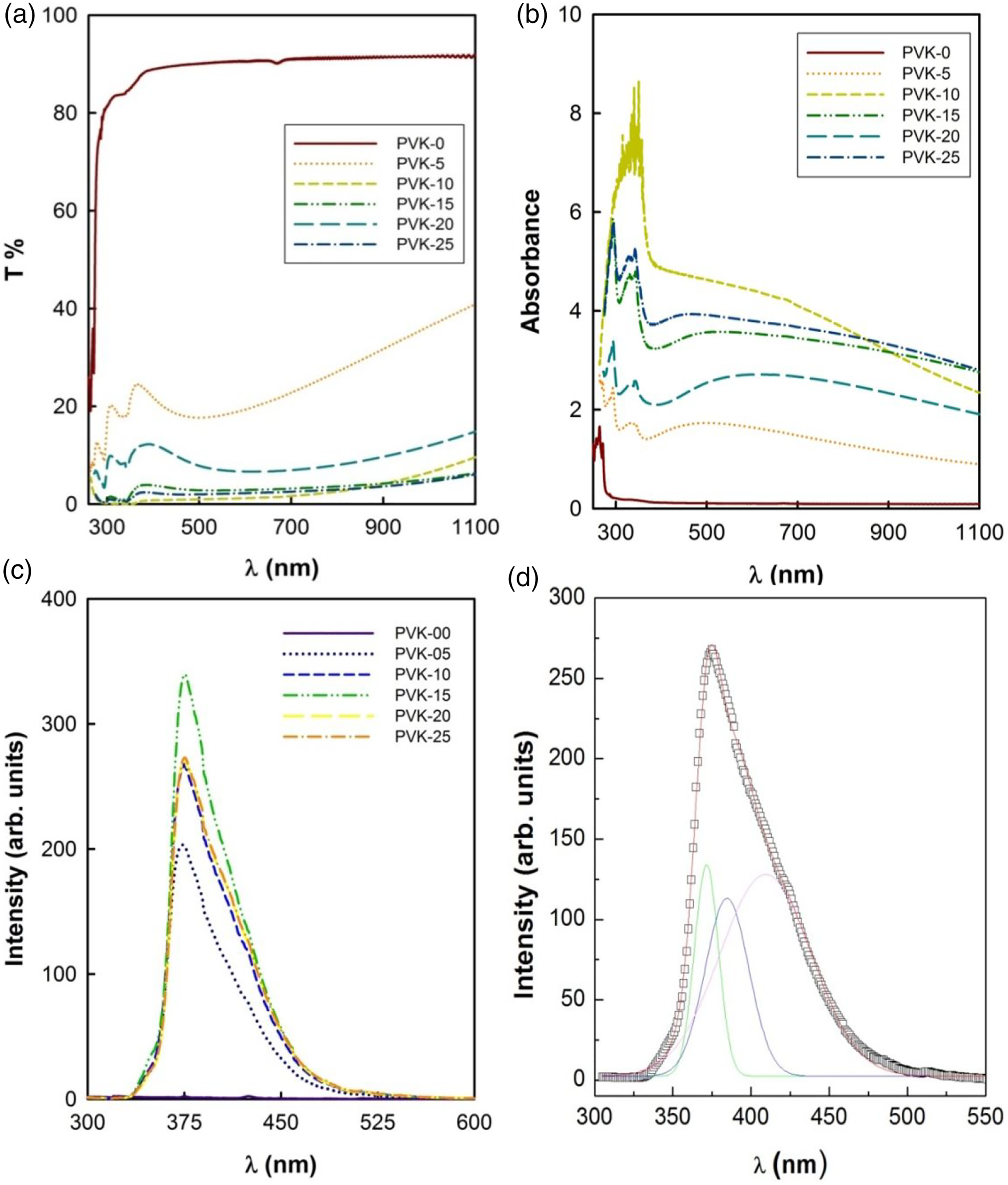
Photoluminescence (PL) study provides the information of different energy states available between valence and conduction bands responsible for radiative recombination. Figure 3(c) shows the photoluminescence spectra of pure PMMA and PMMA/PVK samples recorded at room temperature at excitation energy of 275 nm. Here, pure PMMA membranes reveal very minute intensity luminescence that can be ascribed to very small absorbance or high transparency at excitation energy. But, the incorporation of PVK in PMMA leads to increasing trend in luminescence till PVK-15 and then, the intensity decreases with PVK content. The spectral behaviour of the luminescence is characterized by broad band with a maximum at 375 nm along with tail regions in longer wavelengths. Similar spectral features of the emission spectra have also been reported in literature.6,26 The shape of emission peak remains the same for these samples with relative change in intensity. The intensity is found to be increases with PVK content up to PVK-15 and thereafter decreasing trend has been observed. Sharma et al. 18 have also reported the observation luminescence peak at 300 nm with minor blue shift with PVP content in homogenous blend of PMMA/PVP system. Figure 3(d) shows the de-convoluted emission spectra for PVK-25 blends. It is seen that three Gaussian peaks at 371, 384 and 409 nm were fitted to the spectra of PVK-25 membranes. It also reveal that the area under these peaks and full width at half maximum (FWHM) also increases towards higher wavelength peaks. Similar spectral features have been observed for deconvoluted spectra have been found for other samples. Tailoring of the peak maxima in the visible region is very important for the designing of energy efficient and low cost illumination devices. Thus, it is concluded that the formation of phase separation in the polymer blend system occurs due to inter/intra chain or molecular interaction between PMMA and PVK to give this type of spectral features. The structure-property relationship with improved luminescence in visible region has been elaborated for designing efficient optical devices using PMMA/PVK blends.
Conclusion
The effect of PVK on the optical absorption and emission spectra for solution cast PMMA/PVK blends has been studies. The highly smooth surface morphology of PMMA turns to flaky morphology and then to agglomerated morphology with PVK content. The change in the optical absorption spectra revel changes in dissolution characteristics from homogenous mixing to the phase separated regimes in PMMA/PVK system. The luminescence peak intensity at ∼370 nm is enhanced by 340 times for PVK-15 blends with respect to that of pure PMMA membranes. The three peaks are fitted with highest intensity and lowest FWHM for peak centred at 370 nm, while the top most FWHM is found for the peak centred at 409 nm. The intermolecular interaction and change in the local structure of the blends has been used to discuss the behaviour of PMMA/PVK blends for commercially viable low cost products with unique properties.
Footnotes
Acknowledgements
The authors (JPS and PKS) are thankful to CMSE, NIT, Hamirpur (HP) for providing the SEM facility.
Declaration of conflicting interests
The author(s) declared no potential conflicts of interest with respect to the research, authorship, and/or publication of this article.
Funding
The author(s) received no financial support for the research, authorship, and/or publication of this article.
