




Abstract
Magnetorheological (MR) materials are kinds of smart materials whose rheological characteristics are controllable with the application of external magnetic fields. In the last few decades, MR materials are well established as one of the leading smart materials for use in adaptive sandwich structures and systems for salient vibration control. This article reviews the semi-active vibration suppression of flexible structures with smart materials of MR fluids (MRFs) and MR elastomers (MREs). Stiffness and damping characteristics of beams, plates, panels, and shells integrating the core layer of MRFs and MREs are discussed in terms of field-dependent controllability. To keep the integrity of the knowledge, this review includes a study on free and forced vibration characteristics of sandwich structures with fully and various configurations of partial MR treatments, stability analysis of MR sandwich structures under rotating conditions and developments in identifying the optimal locations of MR sandwich structures for better vibration control are also discussed. Further, this article focuses on the role of carbon nanotubes in enhancing the field-dependent stiffness and damping properties of MR materials. A few of the most relevant research articles are reviewed and presented here briefly.
Introduction
Vibration control plays an important role in a wide range of machines and structures in aerospace, marine, transport, civil engineering, and so on. Nowadays, the control of structural vibrations can be implemented by several methods such as passive control, active control, semi-active control, and hybrid control based on the requirement.1,2 It is known that the passive control method requires no external power source and the control devices are embedded to the structural members. The passive control methods are classified as unconstrained layer damping (UCLD) and constrained layer damping (CLD) treatments. 3 The UCLD and CLD treatments generally consist of viscoelastic materials (VEM) that are freely attached to the structure or constrained between a constraining layer and the base structure. 4 In an active vibration control method, it typically requires a large amount of power source to generate the control forces on the structure. The active control method consists of VEM sandwiched between an active material (piezoelectric layer are used for the constraining layer along with a suitable controller) and the base structural member. 5 The hybrid control method refers to a combination of passive and active vibration control methods. It uses the advantages of both passive and active control methods. 6 A semi-active control method usually requires a small amount of external power to control the mechanical properties of the damping material. However, passive, active, and hybrid control methods have many limitations, due to real-time avoidance, high cost, and large power source. Recently, numerous researchers are implementing semi-active control approach in many practical applications due to its better performance to alter the stiffness and damping properties of structures. 7 Piezoelectric materials, shape memory alloys, electrorheological (ER) materials, and magnetorheological (MR) materials are the most commonly used active smart materials. MR materials belong to smart materials family whose rheological characteristics vary significantly in the presence of external magnetic fields. 8 This group of materials includes MR fluids (MRFs) and MR elastomers (MREs), whose field-dependent shear modulus and damping properties are controlled under the influence of applied magnetic fields. The material recovers its original properties within a millisecond after the external field is removed. In recent decades, MR materials have gained great attention from researchers significantly because of their controllable stiffness and damping properties. MR materials are very useful in solving damping problems and suppress vibrations which are one of the main engineering problems in the fields of construction, machines, devices, and structural elements. 9 To improve the dynamic behavior of such systems, the MR materials have been incorporated into the sandwich structures. The integration of MR materials in the mechanical systems and adaptive structure with tunable dynamic responses can be attained. These MR materials-based sandwich structures can be effectively used in aerospace, automotive, and construction industrial fields. MR materials can be operated in valve mode (fluid flowing through an orifice), shear mode (fluid shearing between two plates), and sequence mode (fluid between two plates moving in the direction perpendicular to their planes) depending upon the application. 10 The valve mode devices include servo-valves, dampers, shock absorbers, and actuators; the shear mode devices include clutches, brakes, chucking, locking devices, dampers, and structural components; and the squeeze mode has been explored for the use of small amplitude vibration and impact dampers. In recent decades, due to the improvement in MR technology, the applications of MR materials are growingly increased. 11
MRF belongs to a smart materials group whose rheological properties vary considerably in the presence of an externally applied magnetic field. Thus, in the presence of magnetic fields, the MRF converts into a semi-solid state (chain-like structure) with an increase in its yield strength. But in the absence of a magnetic field, the MRF is back to its original status in the same fashion. Schematic representations of the MR material working principle are shown in Figure 1. MRFs are discovered by Rabinow 12 who developed an MRF-based clutch. The MRF usually has three main constituents: base fluid, magnetizable particles, and stabilizer or additives. MRFs are prepared in a very simple procedure which is the mixing of all the constituents together. The base fluid behaves like a carrier that contains magnetizable particles suspended in it. Magnetizable particles play a key role in the MR effect and are dispersed in the base fluid. Stabilizers are used to overcome the sedimentation problem of heavy particles. The rheological properties of MRF depend on the strength of the magnetic field, size of iron particles, the concentration of iron particles, and additives.13,14 The rheological properties of MR materials were evaluated using the rheometer equipped with an MR device. 15 MRFs can be used in various devices such as automotive suspension systems, MR vehicle seat suspension systems, MRF damper, MRF-based flexible fixtures, MR actuator, MRF-based clutch system, MRF-based human prosthetic legs, and MRF in military equipment. 16 A limitation of the MRF is leakage and sedimentation, which affects the performance of the MRF. To solve this problem, a new MR material has been proposed, which is MRE.
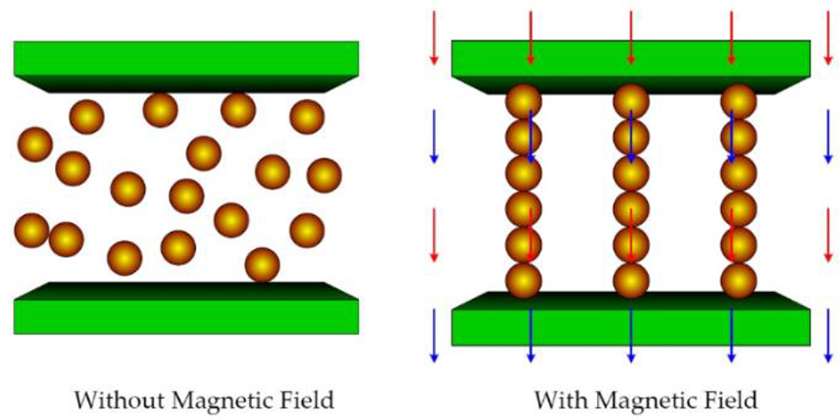
Schematic representations of MR material working principle. 13
MRE is a type of rubber-like solid material similar to MRF in many ways but with rubber or elastomer as the matrix, and it is also known as MRE. Compared to MRFs, MREs have high stability and do not have leakage and sedimentation problems. Generally, MREs consist of carbonyl iron particles, natural or synthetic rubber or elastomer matrix, and additives. MREs are fabricated using two different methods. 17 The MRE is cured in the presence of the magnetic field to form chain-like structures in the direction of the magnetic field called anisotropic-type MRE. While the MRE is cured without magnetic field conditions, the iron particles are randomly dispersed in the matrix, thus generating isotropic-type MRE. When the MREs are exposed under a magnetic field, the iron particles are magnetized to form a chain-like structure in the direction of magnetic fields and change in their viscoelastic properties. 18 Bellan and Bossis 19 analyzed the viscoelastic behavior of MRE made of room temperature vulcanizing (RTV) silicone rubber and carbonyl iron powder (CIP). It is observed that the shear storage and shear loss modulus were influenced under applied magnetic fields condition. Gong et al. 20 analyzed the rheological characteristics and microstructures of various groups of isotropic MRE samples. MRE samples are fabricated using different weight percentages carbonyl iron particles, silicon rubber, and silicone oil. Experiments showed that 60 wt% of CIP, 20 wt% of silicone oil, and silicone rubber sample give the best MR effect. Chen et al. 21 investigated the shear properties of anisotropic MREs and found that when the magnetic fields increase the shear modulus of MREs increases. MREs have been used in adaptively tuned vibration absorber (ATVA), MRE-based vibration isolator, variable impedance surface devices, MRE-based suspension bushing, MRE-based force sensors, and MRE-based actuators. 16 Sun et al. 22 developed an ATVA based on multilayered MRE. They showed that the ATVA with multilayered MRE could change its tuning frequency from 13.5 Hz to 19 Hz by applying an electric current of 3.5 A. Kim et al. 23 proposed an MR gel (MRG)-based tunable vibration absorber (TVA), which could tune the natural frequency from 56 Hz to 67 Hz under a magnetic field of 100 mT. Later, Xin et al. 24 analyzed the frequency shift property of the MRE-based vibration absorber for powertrain mount systems. It showed that the natural frequency could shift from 22.7 Hz to 31.9 Hz when the applied current was increased from 0 A to 2 A. The MRE-based absorber for propulsion shaft systems has been developed by Liu et al. 25 who have shown that the natural frequency shifts from 43.09 Hz to 56.88 Hz by applying a current of 5 A. Wang et al. 26 investigated the transient vibration response of primary systems attached with MRE-based dynamic vibration absorber under impulse excitation. The transient vibration of the system was decreased by changing the stiffness of the vibration absorber. In another study, Jang et al. 27 developed a compact TVA using MRE. The experiments have shown that the proposed TVA can change its tuning frequency from 51.6 Hz to 71.9 Hz under a magnetic field of 340 mT. Yang et al. 28 designed an MRE-based absorber consisting of eccentric mass and multilayered MRE structure. The experiments indicate that the translational frequency tune from 6.99 Hz to 9.66 Hz and rotational natural frequency tune from 3.51 Hz to 4.45 Hz under 2 A of current. Recently, the self-sensing features of MRE-based systems have been introduced. Sun et al. 29 introduced and tested a self-sensing MRE vibration absorber based on a hybrid magnetic system and self-sensing laminated MRE structure. The experimental results illustrated that the natural frequency of the proposed absorber can be altered to 4.8 Hz at −3 A and 11.3 Hz at 3 A from 8.5 Hz at 0 A. The vibration controllability of the proposed self-sensing MRE absorber was more effective than a passive absorber. Komatsuzaki et al. 30 developed an MRE-based dynamic vibration absorber with a self-sensing feature. The natural frequency and the electrical resistance of the elastomer can be affected by the external magnetic field. It was concluded that the system tuning frequency varies from 25.8 Hz to 37.4 Hz under a magnetic field of 316 mT. Park et al. 31 analyzed the electric resistance and impedance variations of the MRG under external magnetic fields. The experimental data showed that the MRG sample significantly influences the resistance and impedance properties under various magnetic fields with the input voltage. In addition, the MR materials are used in sandwich structures to control their stiffness and damping by varying the applied magnetic fields.
The review articles of MR materials have addressed the characterization of MRF (de Vicente et al. 32 ), characterization of MRE properties (Ismail et al. 33 ), MRE-based devices (Li et al. 34 ), control strategies for MRF and MRE-based devices (Choi et al. 35 ), modeling of MRE devices (Cantera et al. 36 ), vibration control of sandwich structures using ER/MR materials (Eshaghi et al. 37 and Kolekar et al. 38 ), and applications of MRF and MRE materials (Ahamed et al. 16 ). Although previous works reviewed the fabrication and characterizations of MR materials, applications of MR-based systems and vibration control of sandwich structures were not focused on dynamic and stability analysis of MRF/MRE sandwich structures and influence of carbon nanoparticles in MR materials and structures. Therefore, this review of studies addresses the recent developments in MRF/MRE-based sandwich structures and the role of carbon nanoparticles in MR materials. Abundant research have been carried out in the area of vibration analysis of MR materials-based sandwich structures such as beams, plates, panels, circular plates, cylindrical panel, and shell. A few of the crucial observations for dynamic analysis of MR structures are presented here. Figure 2 shows schematic representations of three different sandwich structures with smart material cores. The number of research articles related to MRF and MREs published in international journals has increased significantly in recent years. This review article is intended to present the latest developments in the numerical and experimental investigation of MRF-based sandwich structures, MRE-based sandwich structures, partial treatments of MRF/MRE-based sandwich structures, and optimal locations of MRF/MRE structures. In the second section, MRF-based sandwich structures are described. In the third section, the MRE-based sandwich structures are reviewed and in the fourth section incorporation of nanoparticles in MR materials and structures are discussed. Figure 3 shows the graphical representation of the number of research articles published in international journals from 2003 to 2020 in the topic of MRFs and MREs sandwich structures.
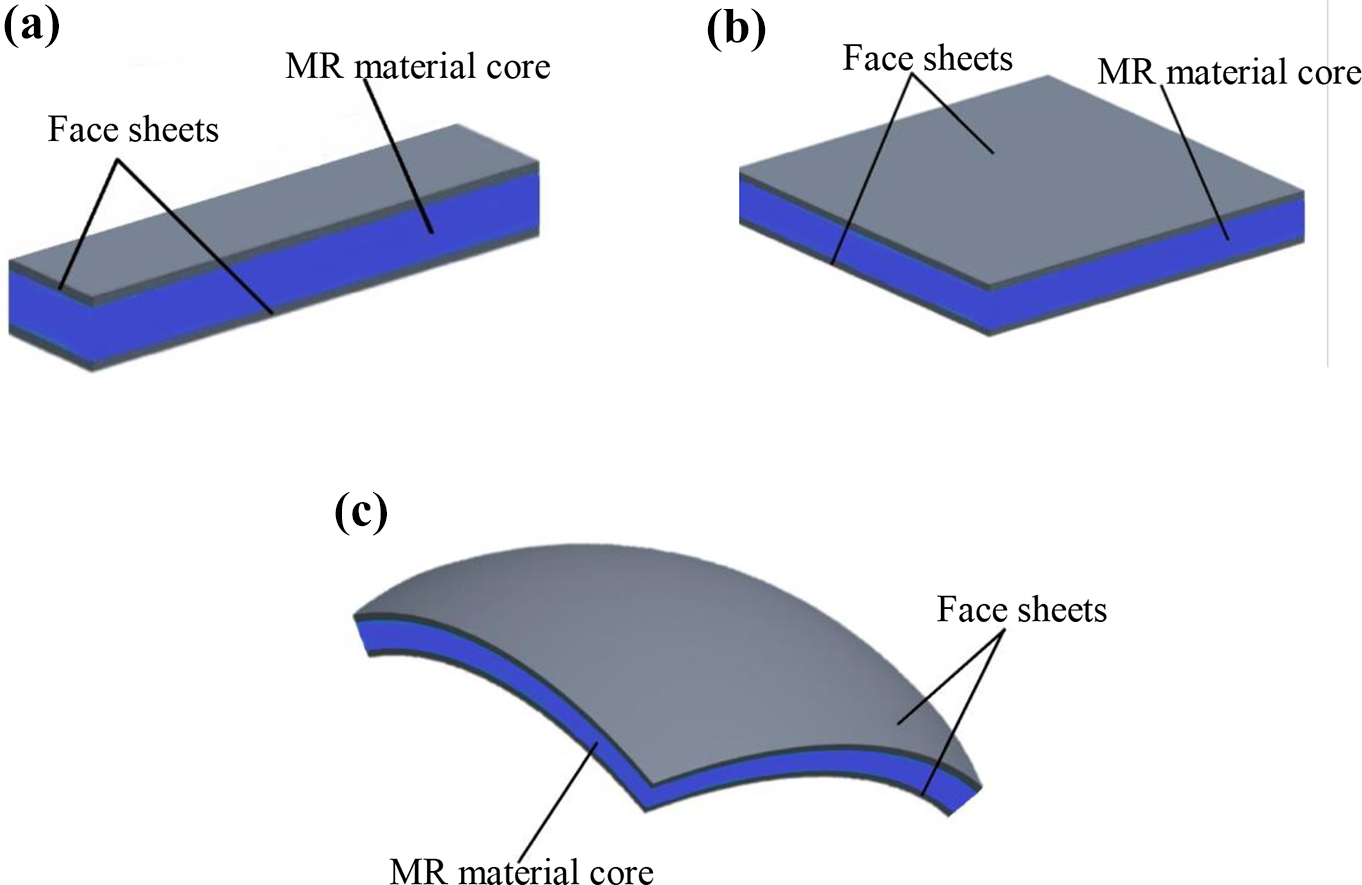
Graphical representations of sandwich structures (a) beam, (b) plate, and (c) shell.
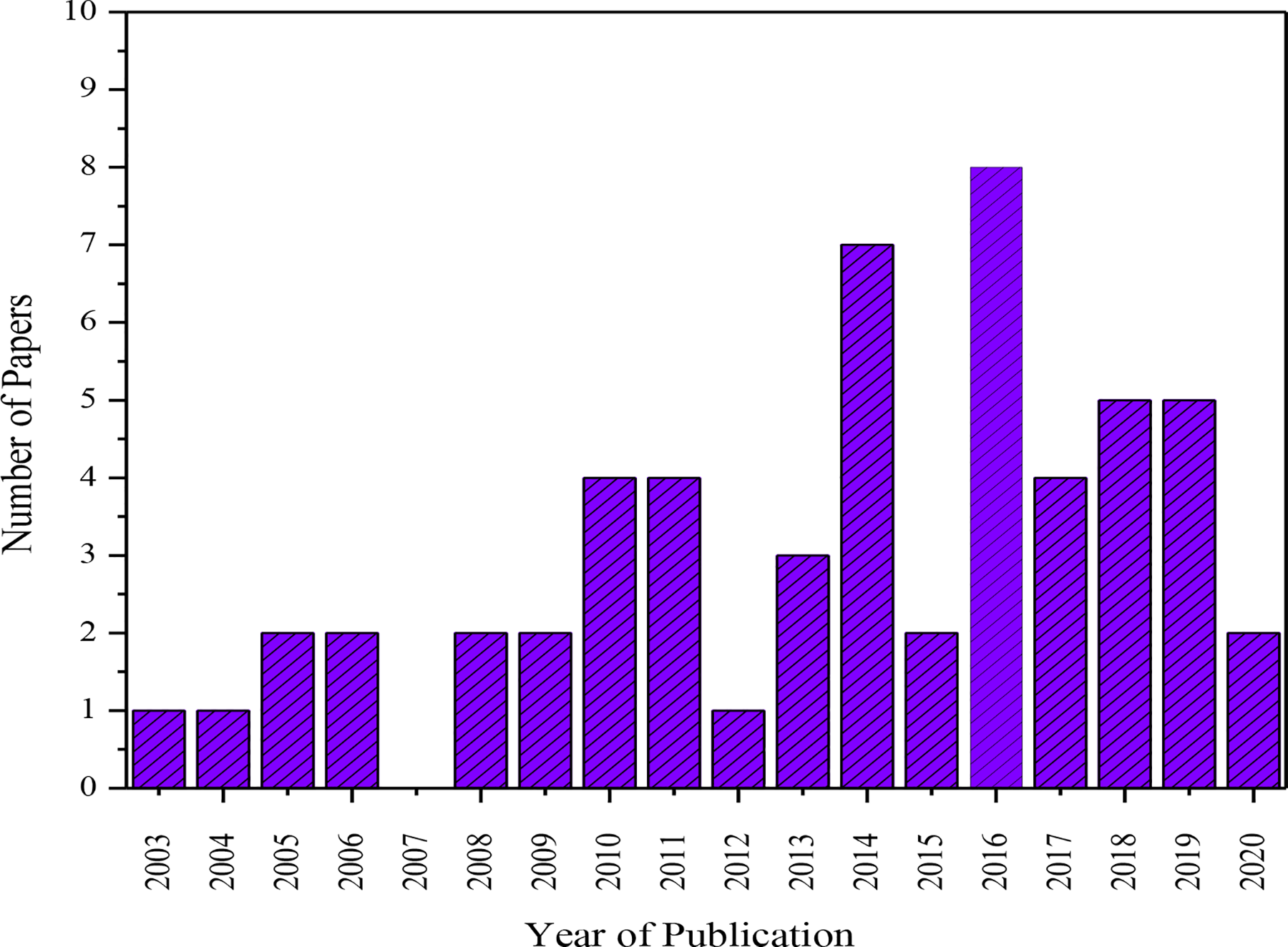
Schematic representations of the recent progress of the research articles for MRF- and MRE-based sandwich structures.
MRF-based sandwich structures
The field-dependent vibration and damping characteristics of MRF-based sandwich structures such as beams, plates, panels, and circular plates are addressed in this section. The MRF-based composite structures are discovered by Weiss et al. 39 MRFs can be used in structural elements to obtain controllable behavior of mechanical systems such as beams, plates, panels, and bars. The MRF-based sandwich structures contain MRF as a core layer where it was sealed with rubber sealant and elastic materials as face layers. The stiffness and damping properties of MRF composite structures are controlled by varying the magnetic field intensity. These MRFs-based composite structures may be incorporated into a wide variety of mechanical systems for control of vibrations in aerospace and automotive fields.
Sandwich beams
Table 1 shows a summary of the reported literature on MRF-based sandwich structures. Many researchers have focused mainly on the numerical method, specifically the finite element method (FEM). Sun et al. 40 analyzed the vibration characteristics of an MRF sandwich beam using the analytical and experiment method. They derived the governing differential equations using the Hamilton principle. The configuration of the beam consists of MR material between two aluminum strips and the beam was considered as simply supported at both ends. From the analysis results, it was observed that the natural frequencies and loss factors of the MRF beam increase with the increase in applied magnetic field intensity. Yalcintas and Dai 41 investigated the vibration control capabilities of MR materials in adaptive structures. They developed the mathematical model of MR adaptive beams based on the energy method. Experiments were performed to evaluate vibration responses such as natural frequencies, loss factors, and vibration amplitudes. It was concluded that both theoretical and experimental studies illustrated that MR adaptive beam shifts the natural frequencies, loss factor, and minimizes the vibration amplitudes with the application of applied magnetic fields. Chen and Hansen 42 presented an analytical model for the MR sandwich beam based on the Kelvin–Voigt model and also numerically modeled an active vibration controller using the Lyapunov stability theory. The results suggested that in the presence vibration controller, the MRF beam was found to be effective. Yeh and Shih 43 analyzed the dynamic response and instability of MR adaptive sandwich beams under an axial harmonic load. They derived the governing equation of motion based on Di Taranto sandwich beam theory and simplified the equations using the Galerkin approach. They presented the instability regions under the influence of the magnetic field, the core thickness ratio, the beam length, and the static load parameter ratio. The MR adaptive beam stabilizes by the magnetic field, core thickness ratio, or beam length increases, and destabilizes as the static load parameter factor is increased. Hu et al. 44 developed an analytical model for the MRF sandwich beam using the Di Taranto sixth-order partial differential equations. The numerical results conclude that the natural frequencies are shifted to a higher level when the applied magnetic field increases. Sapiñski and Snamina 45 numerically analyzed the vibration responses of the MRF sandwich beam. They concluded that the MRF layer changes both the stiffness and the damping properties of the sandwich beam under the influence of applied magnetic field intensity.
The summary of reported literature in vibration analysis of magnetorheological fluid-based sandwich structures: numerical and experimental method.
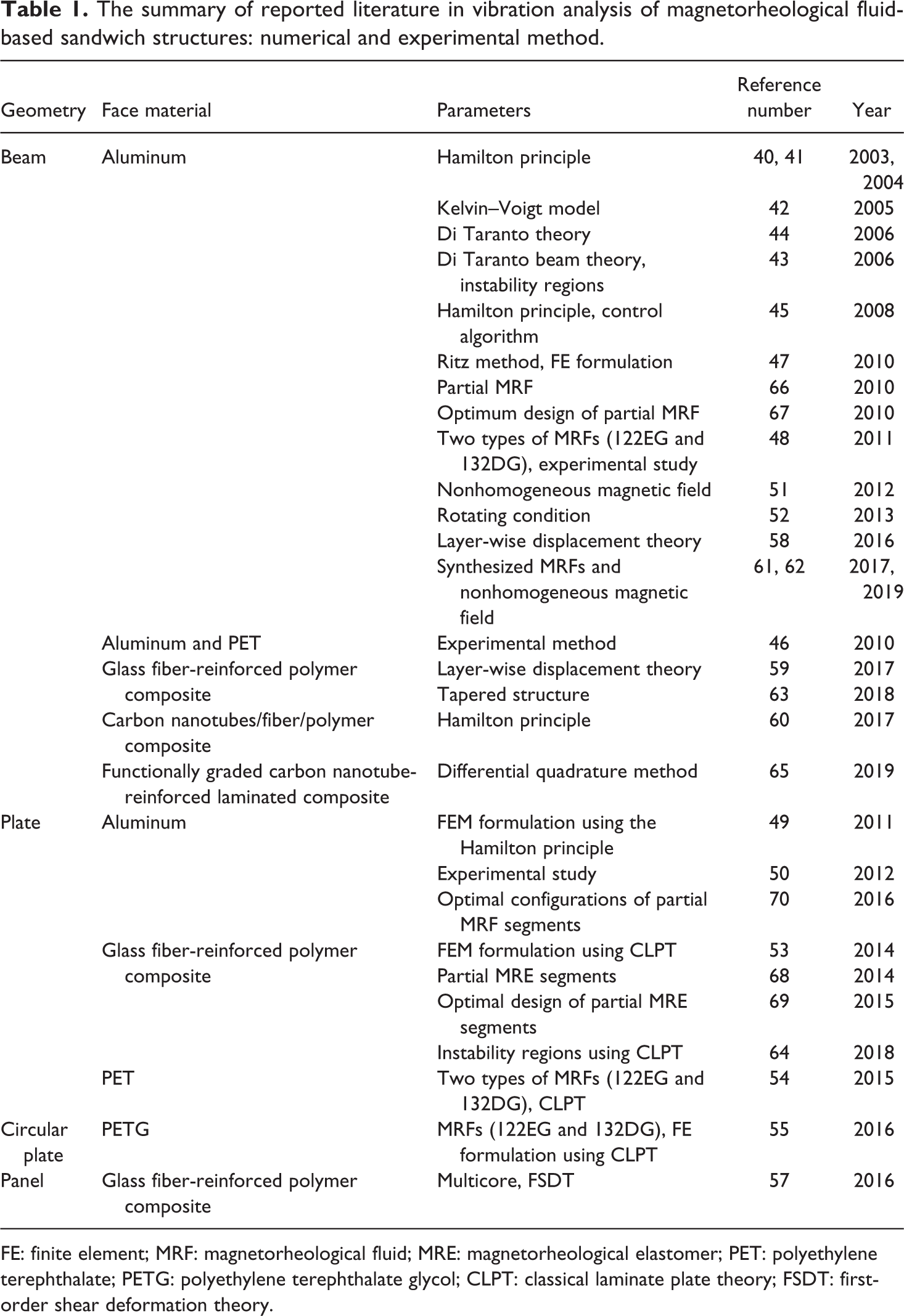
FE: finite element; MRF: magnetorheological fluid; MRE: magnetorheological elastomer; PET: polyethylene terephthalate; PETG: polyethylene terephthalate glycol; CLPT: classical laminate plate theory; FSDT: first-order shear deformation theory.
Lara-Prieto et al. 46 performed an experimental investigation on the MRF sandwich beams. They fabricated two types of MR sandwich beams for comparison purposes, and the first beam consists of aluminum as face layers and the MRF as core material sealed by polyethylene terephthalate (PET) material and the second beam consists of PET as face layers and MRF as the core layer. The test specimen and experimental setup are shown in Figure 4. It was observed that the increase in damping ratio for the aluminum beam was more significant than PET, and the PET beam also showed higher shifts in natural frequencies than the aluminum beam under magnetic field conditions. Rajamohan et al. 47 derived the governing equations of motion of an MRF sandwich beam using finite element (FE) formulation. The results show that the natural frequencies for all the modes and the loss factor at the higher modes of the MR sandwich beam could be increased by increasing the strength of the magnetic field. Further, they concluded that the natural frequency of all modes decreases with an increase in the thickness of the MR layer. Romaszko et al. 48 presented a comparison between the vibration characteristics of sandwich beams with two types of MRFs (122EG and 132DG). The fluids were characterized by different weight percentages of iron particles. Experiments were conducted based on the different magnetic intensity and various positions of the applied magnetic fields. It was noted that a higher proportion of iron particles exhibits higher changes in the natural frequency and damping ratio. The damping ratio increases with the increasing applied magnetic field intensity, and the changes in the location of the magnetic field increase the damping ratio and fundamental frequency. Rajamohan and Ramamoorthy 49 investigated the dynamic characteristics of a nonhomogeneous MRF-embedded sandwich beam using FE formulation. Six different configurations of the MR sandwich beam have been studied and then various parametric studies have been conducted. Their study showed that the location of the MRF segments significantly influences the natural frequencies and the loss factors with respect to various boundary conditions and magnetic fields. In addition, they investigated the vibration characteristics of a rotating axially nonhomogeneous MRF-embedded sandwich beam. They reported that the natural frequencies increase and loss factors decrease with the increase in rotational speed and hub radius of the structure. 50
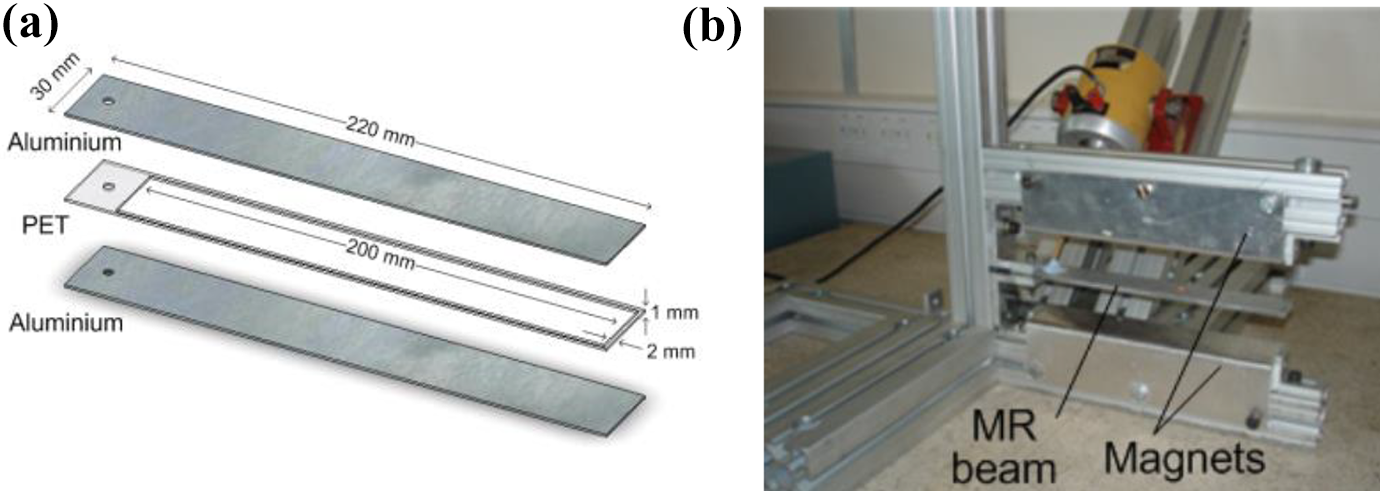
MRF sandwich beam (a) schematic diagram and (b) testing setup. 46
Naji et al. 51 analyzed the dynamic behavior of aluminum-based sandwich beam with MRF core using layer-wise displacement theory. The shear properties of MRFs were identified using ASTM E756-98 standard experimental test. Also they performed the free and forced vibration characteristics of laminated composite MRF sandwich beam. 52 They observed that with the increase in magnetic field intensity, the vibration amplitudes decrease and the stiffness of the MR beam increases. Arani et al. 53 numerically studied the vibrations of sandwich beam made of carbon nanotubes (CNTs)/fiber/polymer composite face sheets with MRF core. They noted that the stiffness of sandwich beams increases by increasing the volume fraction glass fiber and weight percentages of CNTs. It was concluded that the stability and natural frequency of sandwich beams increase with the increase in magnetic field intensity. Kolekar et al. 54 experimentally evaluated the vibration characteristics of sandwich beams with synthesized MRFs. It was observed that the natural frequency of the sandwich beam increased and the amplitude of vibration decreased when the magnetic field increased. Further, they analyzed the vibration characteristics of sandwich beams under nonhomogenous magnetic fields and concluded that the stiffness of the sandwich beam increased but the damping decreased. 55 Momeni et al. 56 analyzed the dynamic behavior of tapered laminated MRF sandwich beams using a layer-wise model and validated with an experimental study. It should be noted that increasing the magnetic fields to the MRF-tapered beam results in increasing natural frequency. Talebitooti and Fadaee 57 numerically analyzed the vibration responses of functionally graded CNT-reinforced composite face sheets with MRF core using differential quadrature method (DQM). Variant patterns of CNTs distributions along the thickness direction were analyzed. Their results showed that the natural frequencies and loss factors significantly influence the effects of CNT distributions, boundary conditions, magnetic fields, and thickness of the MRF core on sandwich beams.
Sandwich plates and shells
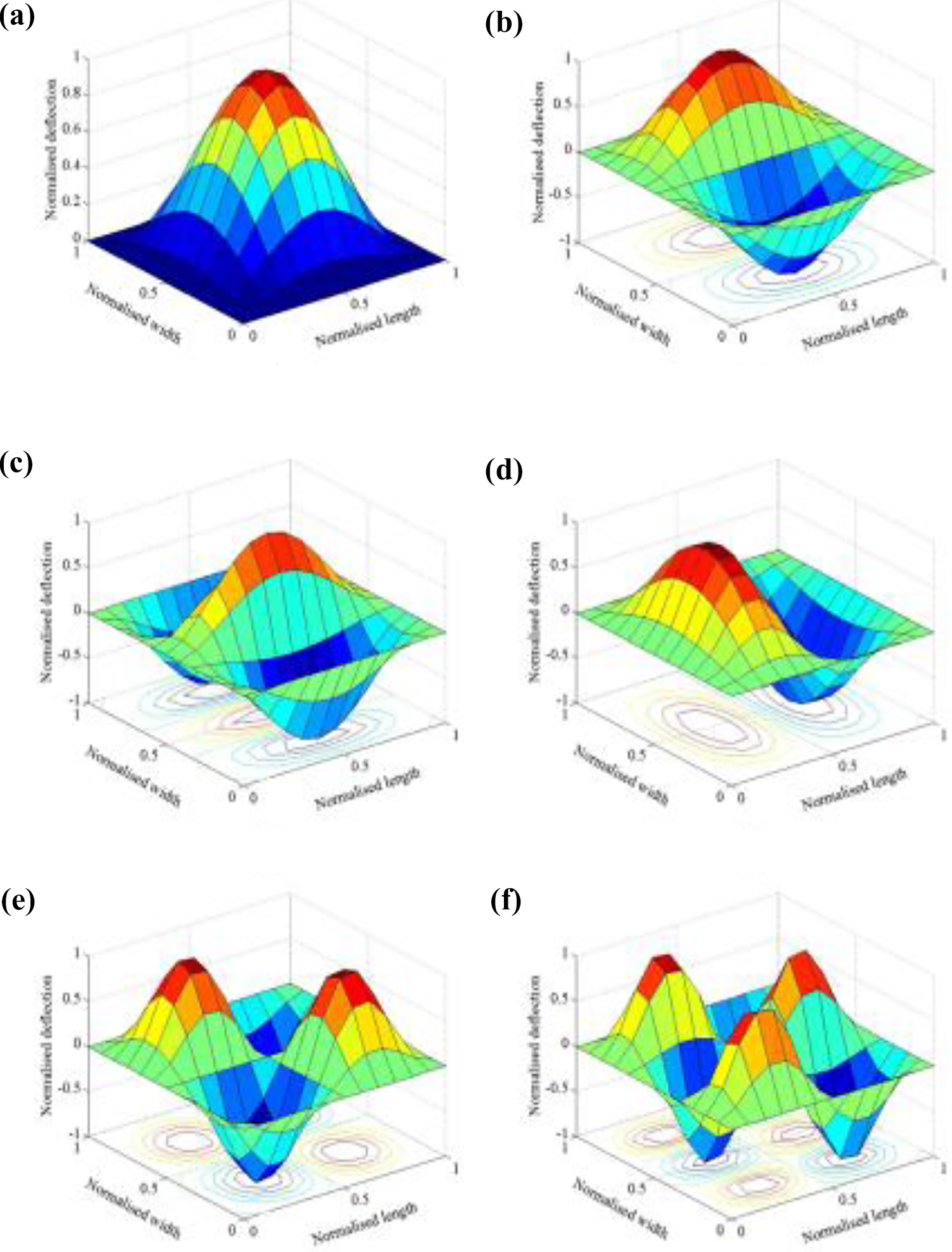
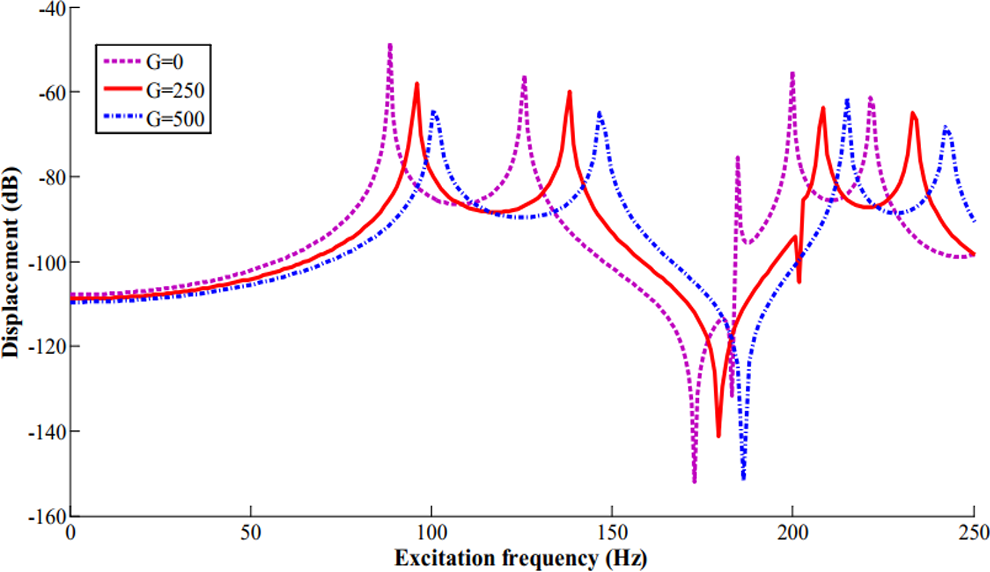
Compared to MRF beam structures, few studies have been reported on sandwich plates containing MRF as the core layer. Li et al. 58 investigated the dynamic analysis of a sandwich plate with an MRF layer and a constraining layer using FEM. They investigated the natural frequency and loss factors of the sandwich plate with the effects of magnetic field intensities and MRF thickness. They reported that increasing the magnetic field intensity increased the natural frequency and decreased the loss factor. Also they concluded that when there is an increase in MRF thickness, the loss factor increases whereas the fundamental frequency decreases and the remaining frequency increases. Snamina 59 developed the test facility to investigate the vibration characteristics of the sandwich plate filled with MRF. The test facilities were used to perform the experimental measurements on free and forced vibrations of the MR sandwich plate. Experiments were performed based on electromagnet position with respect to the plate and different magnetic field intensities. It was observed that the vibrations are reduced more effectively. Manoharan et al. 60 studied the vibration characteristics of the laminated composite MRF sandwich plate using classical laminate plate theory (CLPT). Figure 5 shows the first six free vibration mode shapes of the laminated composite MRF sandwich plate. It was concluded that the natural frequencies and loss factors of the MRF sandwich plates were influenced by the effects of magnetic field intensity, boundary conditions, fiber angle orientations, and the thickness of the MRF layer. Figure 6 shows the effect of magnetic fields on the forced vibration characteristics of the MRF sandwich plate under all the edges clamped condition. The results show that the natural frequencies shift to the higher level and the magnitude of displacement shifts to a lower level with an increase in magnetic fields. Eshaghi et al. 61 worked on vibration analysis of two types of MRF sandwich plates with PET face layers using CLPT. Various parametric studies were performed to analyze the effects of aspect ratio, core layer thickness, and boundary conditions on the sandwich plates. They concluded that the MRF-132DG type MRF sandwich plate (MRF-132DG larger iron particles) has higher resonant frequencies compared to the MRF-122EG sandwich plate under various magnetic field conditions. Also they investigated the dynamic characteristics of MRF embedded circular plate with PET glycol (PETG) face layers using the analytical and experimental method. 62 The experiment setup was designed to measure the dynamic characteristics of the MR circular plate under different boundary conditions and varying levels of magnetic flux. They observed that with an increase in magnetic flux up to a certain limit, the natural frequency of MRF plate increases, and the natural frequency decreases with the increase in core layer thickness.
Free vibration mode shapes of laminated MRF sandwich plate with clamped end conditions at all the edges in a magnetic field of 100 G. 60
Transverse vibration response of laminated MRF sandwich plate under clamped end conditions at all the edges at various magnetic field intensity. 60
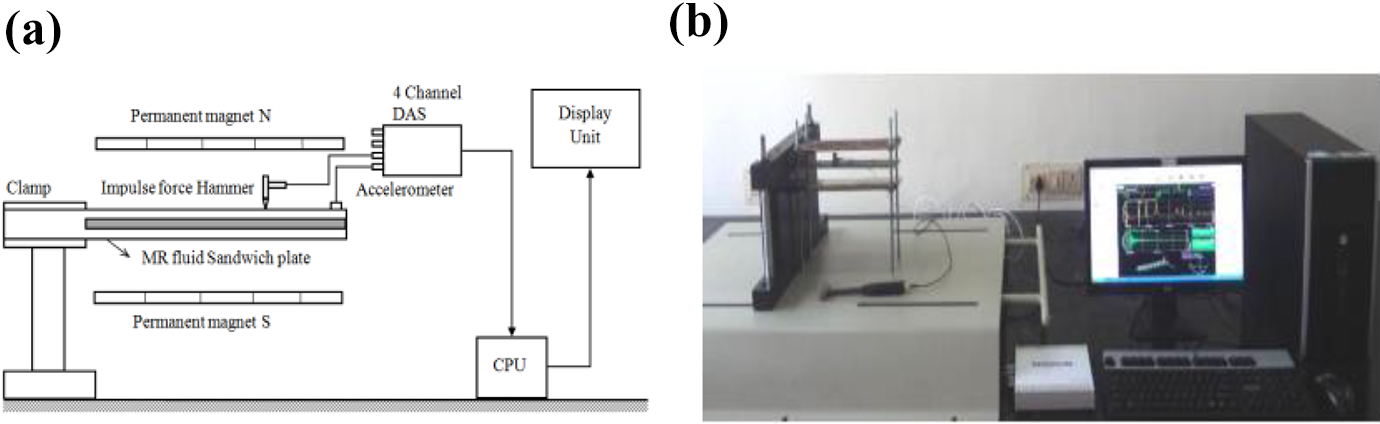
Manoharan et al. 63 studied the experimental investigation on vibration responses of fully and partially treated laminated composite MRF sandwich plates. The schematic and real images of the experimental setup are shown in Figure 7. They concluded that the higher natural frequencies were obtained in a partially treated laminated composite MRF sandwich plate compared to a fully treated plate. The natural frequencies of the partially treated MRF plates were highly influenced by the location of MRF pockets, applied magnetic field strength, and end conditions. Payganeh et al. 64 proposed the free vibrational analysis of a multicore sandwich panel. It consists of composite face layers, MRF and foam are the core layers, and the corresponding equations are derived using first-order shear deformation theory. They investigated the natural frequency of sandwich panel using simply supported condition with the effects of magnetic fields, length to width ratios, length to thickness ratios, core thickness to overall thickness ratios, and MR layer thickness to overall thickness ratios. They concluded that the sandwich panels influenced by the effect of magnetic field intensity and MRF layer. Arumugam et al. 65 analyzed the dynamic response and instability regions of laminated composite MRF sandwich plates under periodic in-plane load. They presented the instability regions with the influences of the magnetic field, rotational speed, and setting angles. Their study illustrated that increase in rotating speed and magnetic fields the instability regions were decreases and also increases with an increase in setting angle of laminated composite MRF sandwich plates.
Laminated composite MRF sandwich plate (a) schematic diagram and (b) experimental testing setup. 63
Sandwich structures with partial MRF treatments
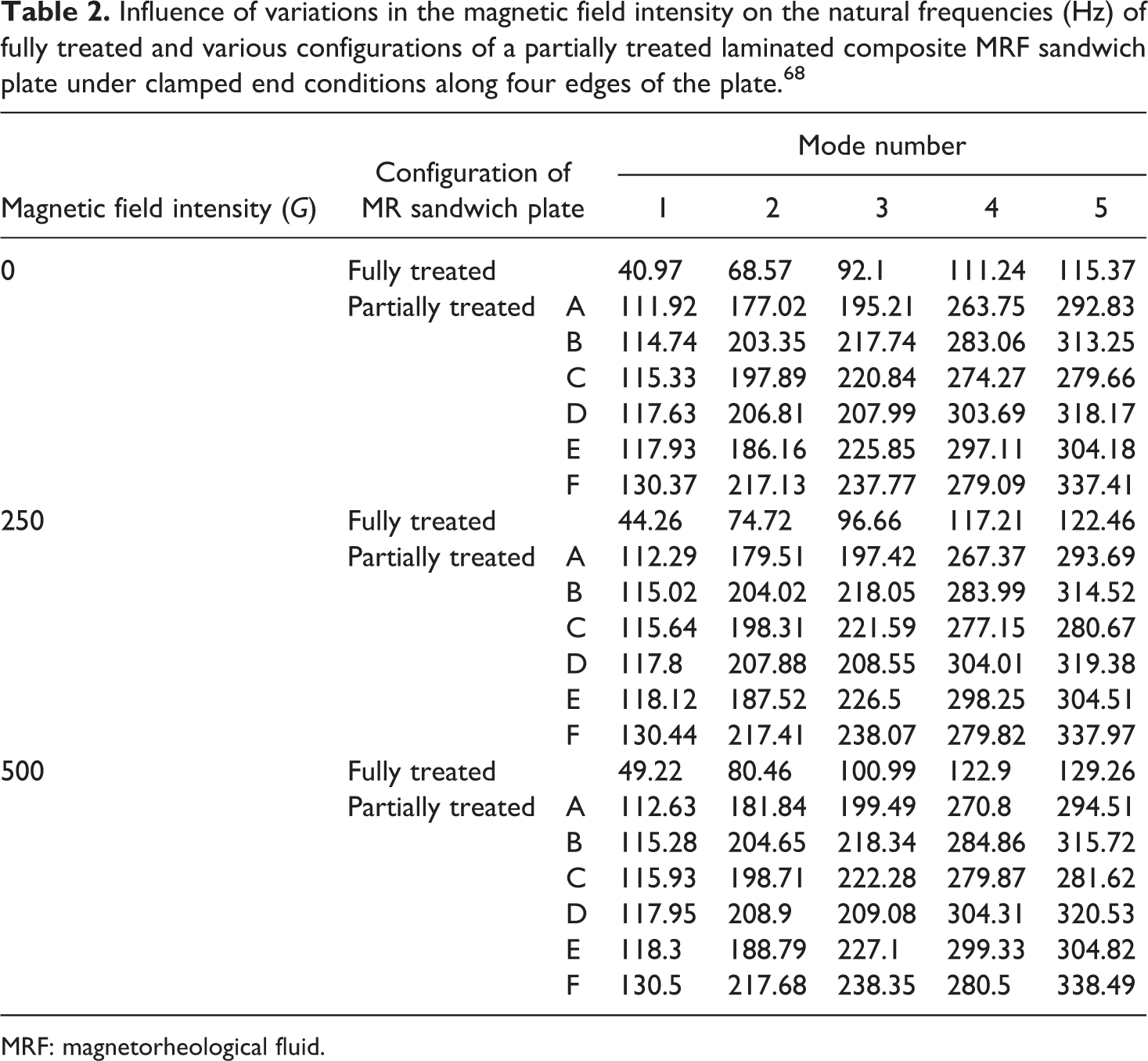
Some numerical investigations have been conducted to study the vibration characteristics of partially treated MRF sandwich structures. In the partially treated sandwich plates, MRF is applied to the selected segments of the core layer and the remaining segments were considered to be VEM. Rajamohan et al. 66 studied the vibration characteristics of a partially treated MRF sandwich beam with aluminum skins using FE formulation. They observed that the natural frequencies and the loss factors were influenced by the length and locations of MR pockets. Further, they investigated the optimum design of a partially treated MRF beam to maximize the modal damping factor. The design optimization methodology was formulated by combining the developed FE analysis and optimization algorithms based on the genetic algorithm (GA) and sequential quadratic programming (SQP). 67 They concluded that GA yields better optimal results compared to SQP in terms of location of the MRF segments and the optimal modal damping factor. Manoharan et al. 68 investigated the dynamic characteristics of various configurations of partially treated laminated composite MRF-based sandwich plates using CLPT. Various configurations of MRF plates are presented in Figure 8. The effect of magnetic field intensity on the fully and various partially treated MRF sandwich plates was examined under all sides clamped boundary conditions as shown in Table 2. It was observed that the natural frequencies of the fully treated configuration are much lower than those of partially treated configurations. This can be attributed to the relative increment in mass than that of the stiffness of the sandwich plate. Furthermore, it was concluded that the partial MRF sandwich plate is strongly influenced by applied magnetic field intensity. Apart from the number of segments, the size and location of the MRF segments could influence the dynamic properties of the partially treated MRF composite sandwich plates. Manoharan et al. 69 analyzed the optimal locations of a partially treated MRF sandwich plate using GA. The vibration characteristics of the laminated composite sandwich plate with a localized MRF treatment were experimentally evaluated under clamped-clamped boundary conditions. The FEM was verified based on experimental data. Their study showed that the optimal location of the MRF treatment strongly influences the natural frequencies and loss factors apart from the boundary conditions. Eshaghi et al. 70 analyzed the dynamic responses of partially treated MRF sandwich plates and identifications of optimal treatment locations using GA. The vibration responses of an aluminum sandwich plate with a localized MRF treatment were experimentally evaluated under harmonic excitations at the fixed support. Figure 9 shows the real and schematic experimental configurations of partially treated MRF sandwich plates. They concluded that the optimal location of the MRF treatment significantly influenced the vibration characteristics of MR sandwich plates.
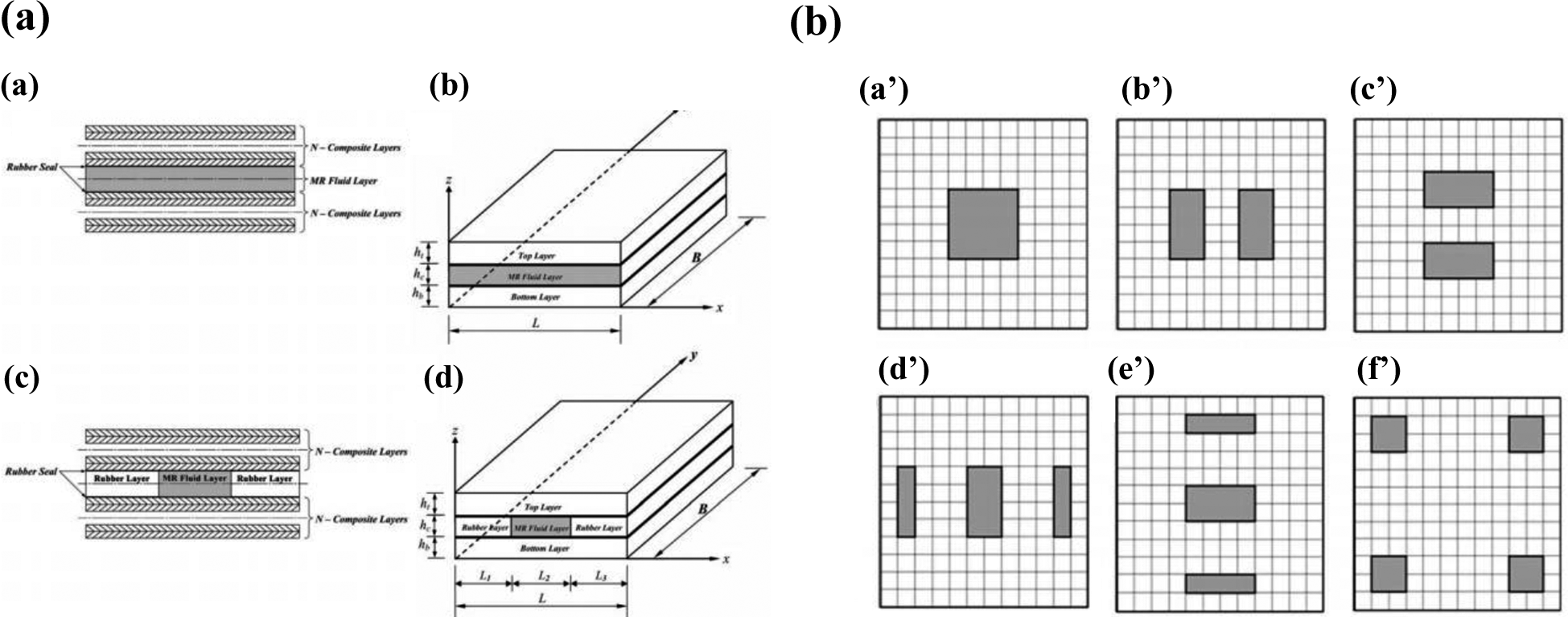
(a) Schematic representation of MRF composite sandwich plate with N-number of composite plies (a′) fully treated MRF composite sandwich plate and (b′) partially treated MRF composite sandwich plate. (b) Schematic representation of the various configurations of partially treated laminated composite MRF sandwich plate. 68
Influence of variations in the magnetic field intensity on the natural frequencies (Hz) of fully treated and various configurations of a partially treated laminated composite MRF sandwich plate under clamped end conditions along four edges of the plate. 68
MRF: magnetorheological fluid.
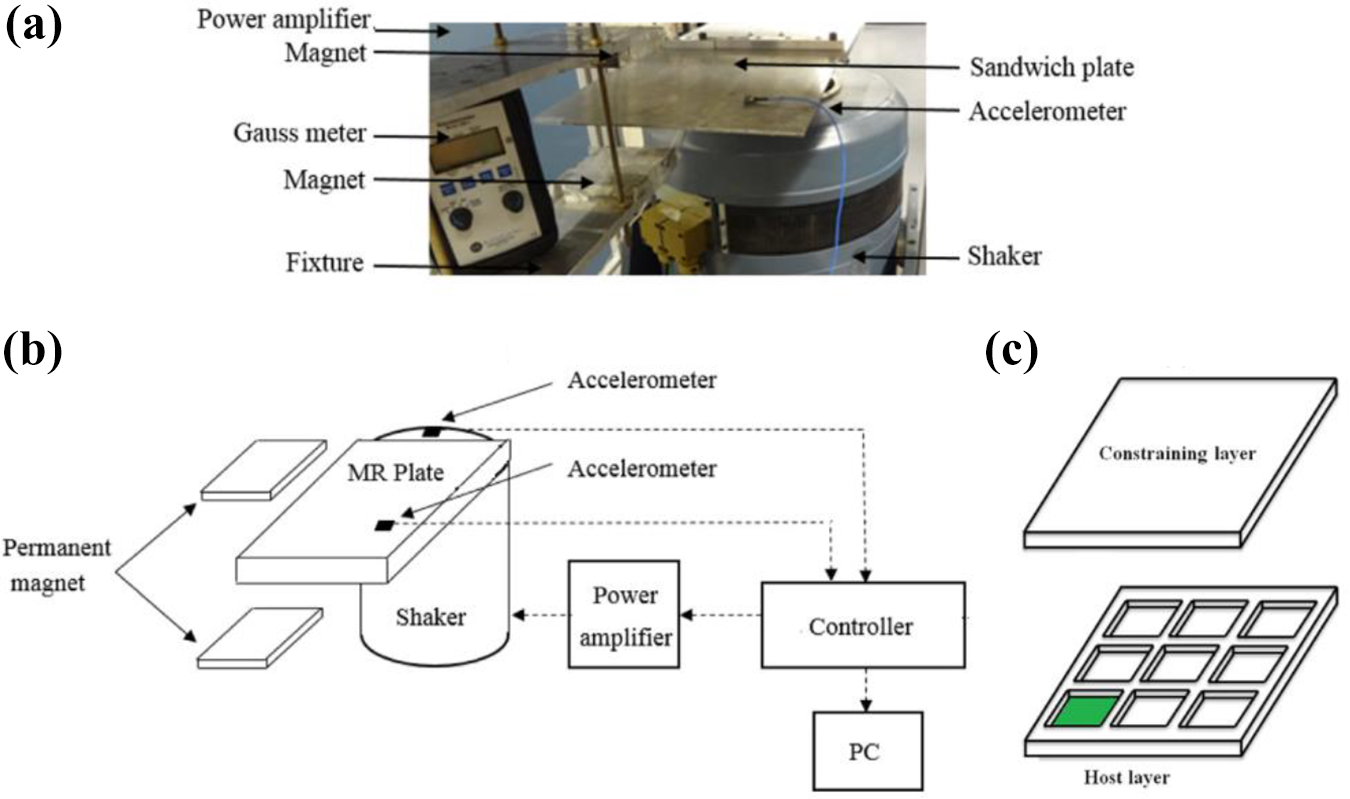
Experimental setup for MRF sandwich plate. 70
MRE-based sandwich structures
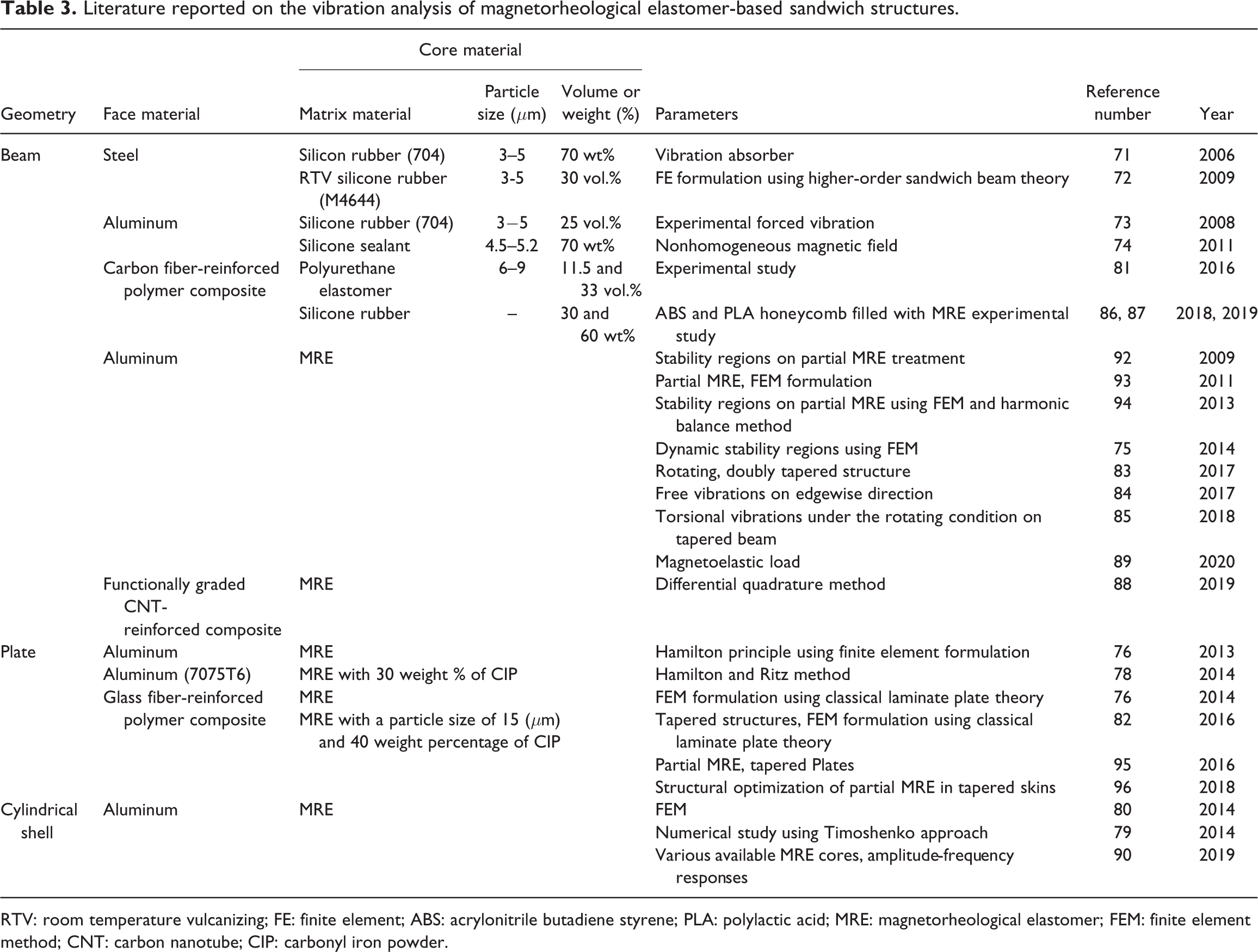
MREs are also a class of smart materials the field-dependent stiffness and damping characteristics of MRE-based sandwich structures are reviewed in this chapter. Table 3 shows the summary of numerical and experimental investigations on magnetorheological elastomer-based sandwich structures such as beams, plates, and shells.
Literature reported on the vibration analysis of magnetorheological elastomer-based sandwich structures.
RTV: room temperature vulcanizing; FE: finite element; ABS: acrylonitrile butadiene styrene; PLA: polylactic acid; MRE: magnetorheological elastomer; FEM: finite element method; CNT: carbon nanotube; CIP: carbonyl iron powder.
Sandwich beams
Deng et al. 71 developed an ATVA based on MREs, whose modulus were controlled by an applied magnetic field. The natural frequencies of the ATVA under various magnetic fields were analyzed theoretically and validated experimentally under two ends supported condition. It was observed that the developed ATVA has better performance than the conventional passive absorber in terms of its frequency-shift property and vibration absorption capacity. Ke-Xiang et al. 72 performed the forced vibration responses of aluminum beam with MRE core using the experimental method. It was concluded that by increasing the magnetic field intensity the natural frequencies increase and the vibration amplitude decreases. Choi et al. 73 studied the dynamic behavior of a sandwich beam made of steel skins and MRE core using higher-order sandwich beam theory. The numerical results were validated with experiments in terms of natural frequencies. It showed that the damping of MRE sandwich structures has been enhanced with the effect of magnetic fields. Hu et al. 74 experimentally analyzed the vibration characteristics of the MRE sandwich beam under a nonhomogeneous magnetic field. The schematic experimental test setups of the MRE sandwich beam are shown in Figure 10. They reported that the first natural frequency of the MRE sandwich beam decreased by 13.9% due to the presence of a nonhomogeneous magnetic field. Nayak et al. 75 presented the works on dynamic stability of rotating MRE sandwich beam under axial periodic force. This study illustrates that the natural frequencies and loss factors were influenced by magnetic fields, rotational speed, setting angle, hub radius, and static load factor of MRE sandwich beams.
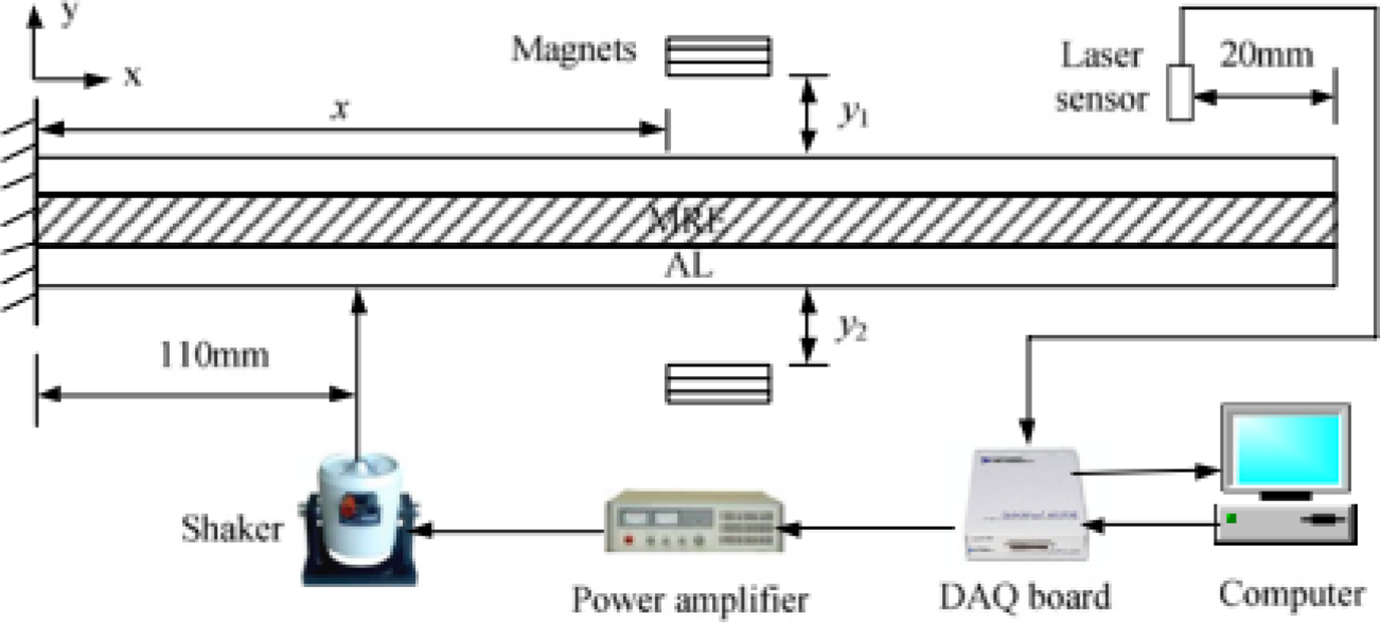
Schematic experimental test setup for MRE sandwich beam. 74
Kozlowska et al. 76 determined the free vibration behavior of carbon fiber-reinforced polymer (CFRP)/MRE sandwich beam using an experimental study. The microstructure and rheological properties of MRE and CFRP/MRE samples were examined using a scanning electron microscope and rheometer. They investigated the effect of a nonuniform magnetic field, amplitude, and logarithmic decrement on CFRP/MRE sandwich beams. The results concluded that due to the stiffening effect of MRE, the vibration amplitude has reduced and damping enhanced in CFRP/MRE structure. Navazzi et al. 77 analyzed the free vibrations of rotating MR doubly tapered sandwich beam. The effects of induced rotational speed, taper ratio, magnetic field intensity, and setting angle were studied. Bornassi et al. 78 theoretically analyzed the free vibration of rotating MRE sandwich beam along edgewise direction based on the effects of applied magnetic field intensity, core thickness, rotational speed, setting angle, and hub radius. Further, they investigated the torsional vibrations of the tapered MRE sandwich beam under rotating condition. 79 The effects of tapering ratios, rotational speed, MRE layer thickness, applied magnetic field intensities, setting angle, and hub radius were studied. Eloy et al. 80 experimentally studied the free and forced vibrations of sandwich panels with CFRP skins and MRE honeycomb core. The 3D printed honeycomb core-filled MREs and the forced vibration setup are shown in Figure 11. They concluded that with the increase in the magnetic field on the free end of the sandwich panel, the vibration amplitude has reduced and natural frequencies shifted toward lower. 81 Fadaee and Talebitooti 82 numerically analyzed the vibration responses of functionally graded CNT-reinforced composite face sheets with the MRE sandwich beam using DQM. Variant patterns of CNTs distributions along the thickness direction were considered. The natural frequencies and loss factors with the effects of CNT distributions, boundary conditions, magnetic fields, and thickness of the MRE core on sandwich beams were studied. Rokn-Abadi et al. 83 investigated the effects of magnetoelastic loads on the dynamic behavior of the MRE-based sandwich beam with elastic face layers. The influence of the magnetoelastic loads are more noticeable with higher magnetic fields and beam length for various boundary conditions.
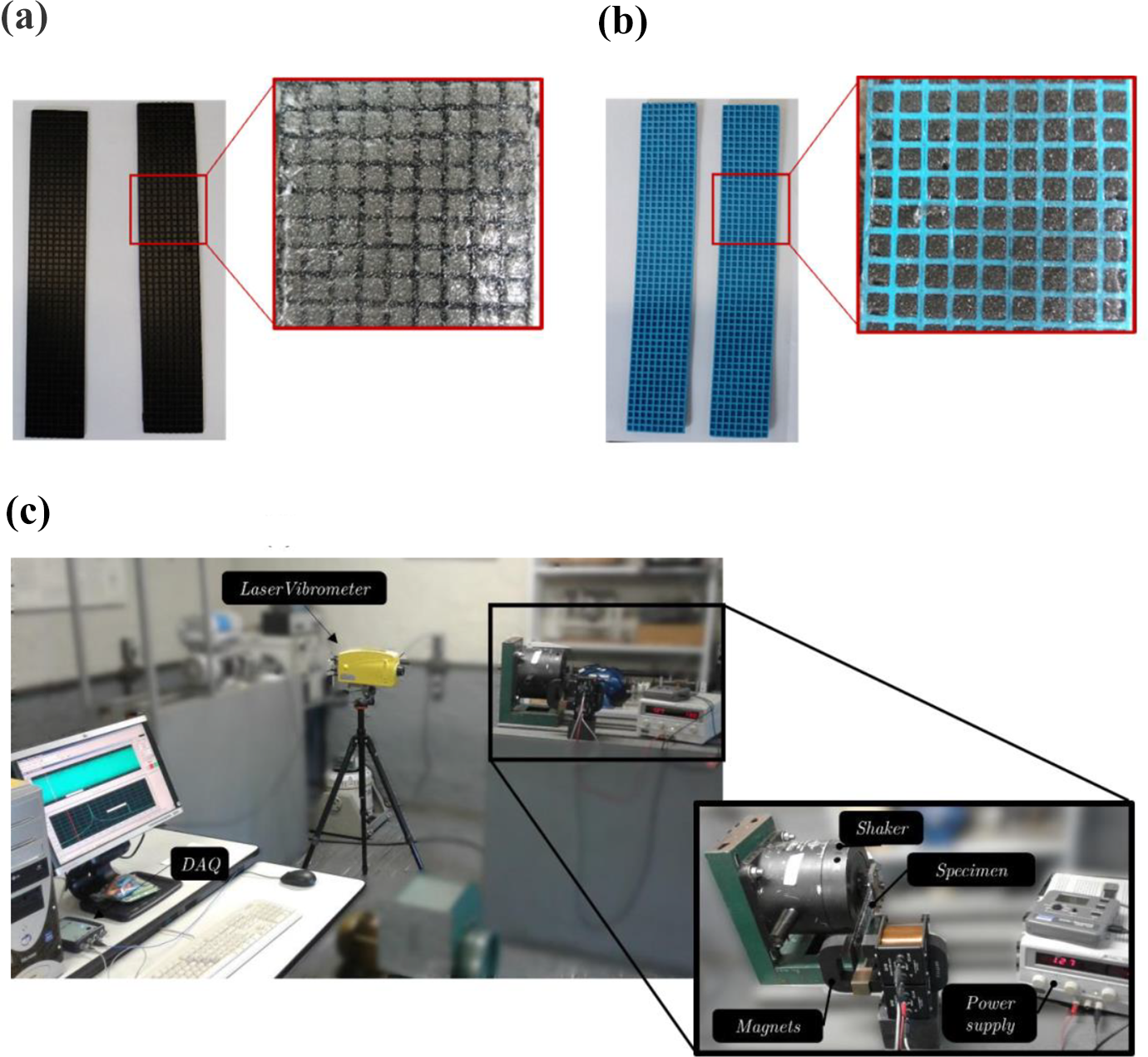
3D printed honeycomb core filled with MRE (a) ABS, (b) PLA, and (c) experimental setup with cantilevered sandwich beam under a magnetic field. 81
Sandwich plates and shells
Compared to MRE beam structures, few studies have been reported on sandwich plates and shells containing MRE as the core layer. Yeh 84 investigated the damping characteristics of the rectangular sandwich plate with the MRE core using CLPT. It was concluded that the stiffness and modal loss factor has been controlled by varying magnetic field intensity and the thickness of the MRE core layer. Yeh 85 analyzed the dynamic characteristics of the orthotropic sandwich plate with the MRE core and constraining layer. They obtained the natural frequencies and modal loss factors using FEM and found that the larger intensity of magnetic fields increases the natural frequencies at all the modes and decreases the modal loss factors at larger modes. Aguib et al. 86 employed the numerical and experimental studies on the vibration response of the MRE sandwich plate under forced excitation. It was concluded that the damping characteristics increases and vibration amplitude decreases to 52% with increasing magnetic fields up to 0.5 T. Mikhasev et al. 87 theoretically analyzed the eigen modes of laminated MRE sandwich cylindrical shell structure. They observed that the damping characteristics increase with an increase in the magnetic field of the MRE sandwich shell. Yeh 88 analyzed the vibration characteristics of the sandwich cylindrical shell with the MRE core and constraining layer. They derived the governing equation of motion for a sandwich cylindrical shell using CLPT in FE formulation. It was concluded that increasing the intensity of magnetic fields will increase the natural frequency and decrease the modal loss factors. Also, they reported that increasing the thickness of the MR layer decreases the natural frequency and increases the modal loss factor. Vemuluri and Rajamohan 89 derived the governing equations of motion of tapered composite MRE sandwich plates using CLPT in FE formulation. The efficiency of FE formulation was validated with experimental measurements and available literature. From the parametric studies, it was observed that the stiffness and loss factors of the tapered MRE sandwich structures could be varied with the effects of an applied magnetic field, ply orientation of the face layers, taper angle, and aspect ratios. Mikhasev et al. 90 studied the effect of magnetic fields on free and forced vibrations of laminated cylindrical shells containing various available MREs. The influence of the magnetic field levels, thickness ratios, and opening angles on the amplitude-frequency characteristics of sandwich cylindrical shells were presented.
Sandwich structures with partial MRE treatments
Some of the numerical investigations have been carried out to study the vibration characteristics of partially treated MRE sandwich structures. Zhou and Wang 91 numerically investigated the vibration responses of the sandwich beam with the MRE part and non-MRE part. The numerical results indicated that the flexural rigidity of the sandwich beam could be controlled with the influence of a magnetic field. Dwivedy et al. 92 numerically studied the instability regions of with and without the MRE patch on the sandwich beam under periodic axial load. The graphical representation of a partially treated MRE sandwich beam under the magnetic field condition is given in Figure 12. It was observed that the stability of the structures enhances significantly using the MRE patch and applied magnetic fields under various boundary conditions. Nayak et al. 93 employed the free vibration characteristics of a sandwich beam composed of conductive face sheets with a core made of viscoelastic part and MRE part. They reported that up to 30% vibration reductions were achieved in MRE sandwich beam compared with the viscoelastic cored sandwich beam. They also concluded that by increasing the number of MRE patches, more vibration reduction can be achieved. Nayak et al. 94 carried out the dynamic stability of different configurations of MRE sandwich beam using the FEM and harmonic balance method. Their results concluded that the stability of the MRE sandwich beam was influenced by external magnetic fields. Vemuluri et al. 95 derived the governing equations of motion of tapered composite partially treated MRE sandwich plates using CLPT in FE formulation. The schematic configurations of various tapered composite partially treated MRE sandwich plates are shown in Figure 13. Further, they analyzed the tapered partially treated MRE sandwich plates and observed that the distribution of MRE pocket into four segments leads to an increase in the highest natural frequencies. Also a significant variation in the natural frequencies was observed for a small variation in taper angle for all the boundary conditions. Vemuluri et al. 96 investigated the optimal locations of partially treated MRE segments in various tapered composite sandwich plates using GA. It could be concluded that the optimal locations of the MRE treatment strongly influence the dynamic properties with respect to boundary conditions.
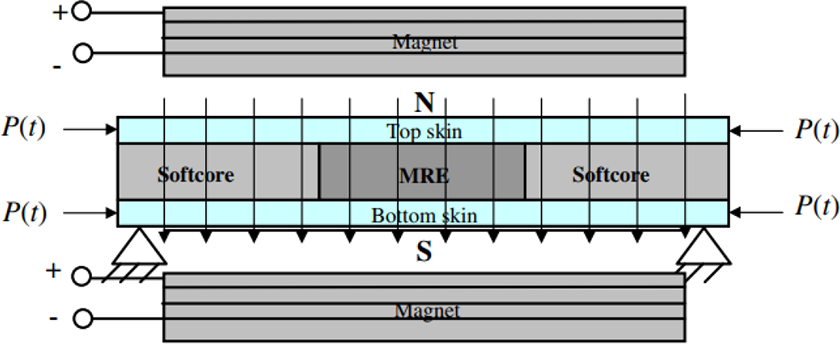
Graphical representation of partially treated MRE sandwich beam under magnetic field condition. 92
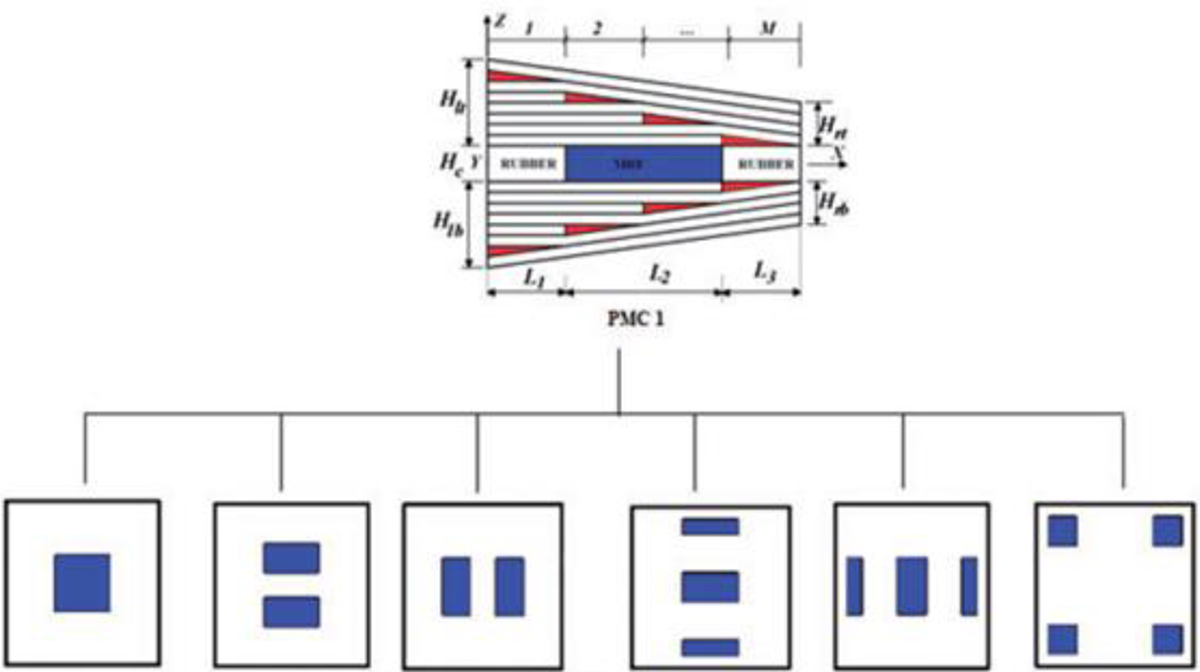
Tapered laminated composite sandwich plates partially treated with MRE. 95
Role of nanoparticles in MR materials and structures
Currently, nanoparticles have attracted more attention of the researchers due to their extremely high stiffness, aspect ratio with low density, and damping properties. Nanoparticles or fillers in MR materials are added to improve the MR effect and to increase the sedimentation stability, stiffness, and damping properties. Some of the researchers investigated the behavior of MR effect when the nanoparticles were reinforced into MR materials. However, the highest MR effects were achieved depending on the optimum concentration and particle size of nanoparticles in MR materials. Recent works have suggested that to improve the mechanical and dynamic behavior of the MR materials, the nanoparticles have been incorporated. Pu et al 97 investigated the sedimentation stability and MR effects on polyvinylpyrrolidone (PVP) and CNTs infused with MRFs. They fabricated the samples using glycol, iron powder, PVP, and CNT. Their results concluded that the addition of PVP and CNTs not only improves the sedimentation stability of the MRF but also enhances its MR effect. Yang et al. 98 analyzed the viscoelastic properties on single-walled CNTs (SWCNTs) of 1.24, 2.5, and 6.41 vol% dispersed in mineral oil. They performed the rheological tests of strain sweep, frequency sweep, magneto sweep, and shear test on different magnetic field intensities. It was observed that the 2.5 vol% in SWCNT/metal oxide (MO) shows the higher shear modulus and viscosity of the sample. It could be indicated that SWCNTs of 2.5 vol% in mineral oil sample shows higher MR behavior. D’Souza and Yang 99 investigated the MR effects on multiwalled CNTs (MWCNT) of 0.5, 1.5, and 2.5 vol% dispersed in mineral oil. They performed the oscillation test, rotational test, and magneto sweep on different magnetic field intensities. It was observed that the addition of 2.5 vol% of MWCNT/MO has higher in shear modulus and yield stress. Also, it was indicated that MWCNTs of 2.5 vol% in mineral oil showed higher MR behavior. Finally, it was concluded that lower concentrations of MWCNTs are more effective in contributing to MR response. Ko et al. 100 analyzed the effect of the addition of polymethyl methacrylate (PMMA) and MWCNT into MRF. They prepared the samples using CI particles doubly coated with PMMA and MWCNT via polymerization and ultrasonication. MR characteristics of MRF were measured using a rotational rheometer. From the outcome of results, it could be observed that CI-PMMA-CNT improves the shear stress, yield stress, and sedimentation stability of MRFs. Ko et al. 101 analyzed the effect of polymer-coated magnetite particle and MWCNT infused in MRF. Their rheological tests indicated that by increasing the magnetic fields, the shear stress, storage modulus, and loss modulus have been increased. They concluded that polymer-coated magnetic particles with MWCNT infused MRFs possess superior rheological property. Fang et al. 102 investigated the MR properties of the SWCNT additive on CI-based MRF. They prepared the samples using 70 wt% of CI particles and 0.5 wt% of SWCNT. It was observed that the influence of SWCNT in MRF increases the field-dependent storage modulus compared with conventional MRF. The sedimentation ratio has significantly improved with the addition of SWCNTs into MRF.
Chena et al. 103 investigated the mechanical behavior of different weight ratios of (0–7%) carbon black infused in MRE. It was shown that the addition of carbon black into MRE increases the MR effect, improves tensile strength, and decreases the damping ratio due to poor bonding between MRE and carbon black. Nayak et al. 104 investigated the mechanical behavior of carbon black infused in MRE. It was shown that the addition of carbon black into MRE increases MR effect, improves tensile strength, and decreases the damping ratio due to poor bonding between MRE and carbon black. Lu et al. 105 investigated the rheological properties of the anisotropic MREs reinforced with three types of carbon blacks (N330, N660, and N990). The results show that the carbon black N990 sample improves the MR effect and damping than other samples. Also, the MR properties increased with the increase in carbon black N990 content. Li and sun 106 investigated the rheological properties of MWCNTs reinforced with MRE. The MR samples were prepared using 1 wt% of MWCNT and 20 vol.% of iron particles with RTV rubber. From the outcome of the results, it was found that the MR nanocomposites showed the absolute MR effect in zero and higher magnetic field levels. Further they studied the mechanical behavior of (0–3.5) wt% of MWCNT-reinforced MREs with 10 and 20 vol.% of iron powders. 107 The storage modulus and loss factor of the MRE and MWCNT-MRE are shown in Figure 14. It could be observed that the addition of MWNTs in MRE improves the stiffness and damping performance in both zero and higher magnetic fields. At zero magnetic field, storage modulus and loss factor of 1 wt% of MWNT-reinforced MRE are 30% and 40% higher than those of conventional MRE. Aziz et al. 108 investigated the viscoelastic properties on different types of MWCNT (0.1 wt%) reinforced with natural rubber-based MRE. It was observed that the MRE filled with COOH and OH-MWCNT exhibits better MR performance compared to pristine MWCNT. Aziz et al. 109 investigated the mechanical, morphological, thermal, and rheological tests on MWCNT reinforced with natural rubber-based MRE. From the experimental results, it could be observed that the addition of CNT to MRE improves the tensile strength up to 11% and decreases the thermal stability due to surface defects in MWCNT. In rheological properties, the storage modulus has increased compared to conventional MRE and the loss factor of MRE with CNT increases with increasing magnetic field. Further, Aziz et al. 110 studied the viscoelastic properties of 0–1.5 wt% of MWCNT-reinforced MREs. It was observed that the stiffness of the MRE with 1 wt% of CNT was distinctly increased. Kim et al. 111 analyzed the rheological properties of 0–0.4 wt% of MWCNTs reinforced with hydrophilic-based MRG. The results showed that MWCNTs decreases the MR effect on hydrophilic MRG. These contradictory results reveal that MRGs of hydrophilic material have a different interaction with MWCNTs than other matrix materials. Selvaraj and Ramamoorthy 112 analyzed the viscoelastic properties of with and without MWCNT-reinforced MRE using ASTM756-05 standard test. Also, they studied the free vibration characteristics of MRE and MWCNT-MRE sandwich beams using experimental and FEM. It was shown that the presence of MWCNTs in MRE not only imparted a higher stiffness to the sandwich beam but also enhanced its damping characteristics of the structure.
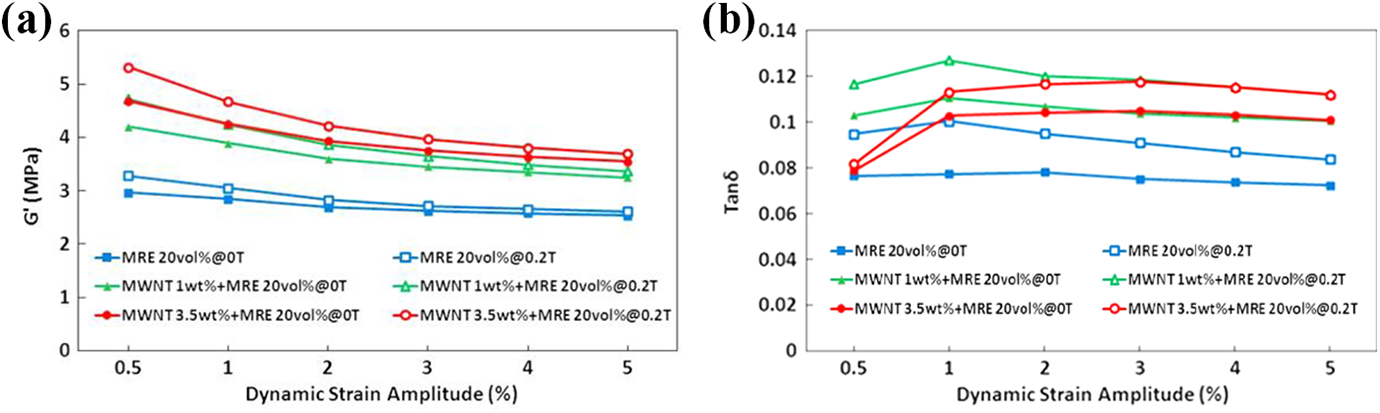
Viscoelastic properties of the MRE and MWCNT-MRE with and without applied magnetic fields. (a) Storage modulus (G′) of MRE and MWCNT-MRE. (b) Loss factor (Tanδ) of MRE and MWCNT-MRE. 107
According to the above characterization studies, all the referred journals are listed in Table 4, it could be observed that the SWCNT and MWCNT improve the sedimentation stability and viscosity of the MRFs, which leads to an improvement in the field-dependent rheological properties and MR effect. The incorporation of carbon black fillers into MRE provides better bonding with the elastomer matrix, causing an enrichment in the viscoelastic properties of MRE materials, which leads to an improvement in the MR effect. On the other hand, the reinforcement of CNTs into the MRE provides an enhancement in the storage modulus, loss factor, and MR effect. Furthermore, the CNTs filled the micron-sized voids between CIP and provided better interaction with the matrix. Hence, the properties of the matrix and the interfaces between the CIP and elastomer matrix are changed due to the rheological properties of MRE materials are enhanced with and without magnetic field conditions.
Reported literature on the characterization of reinforcement of nanoparticles in magnetorheological materials.
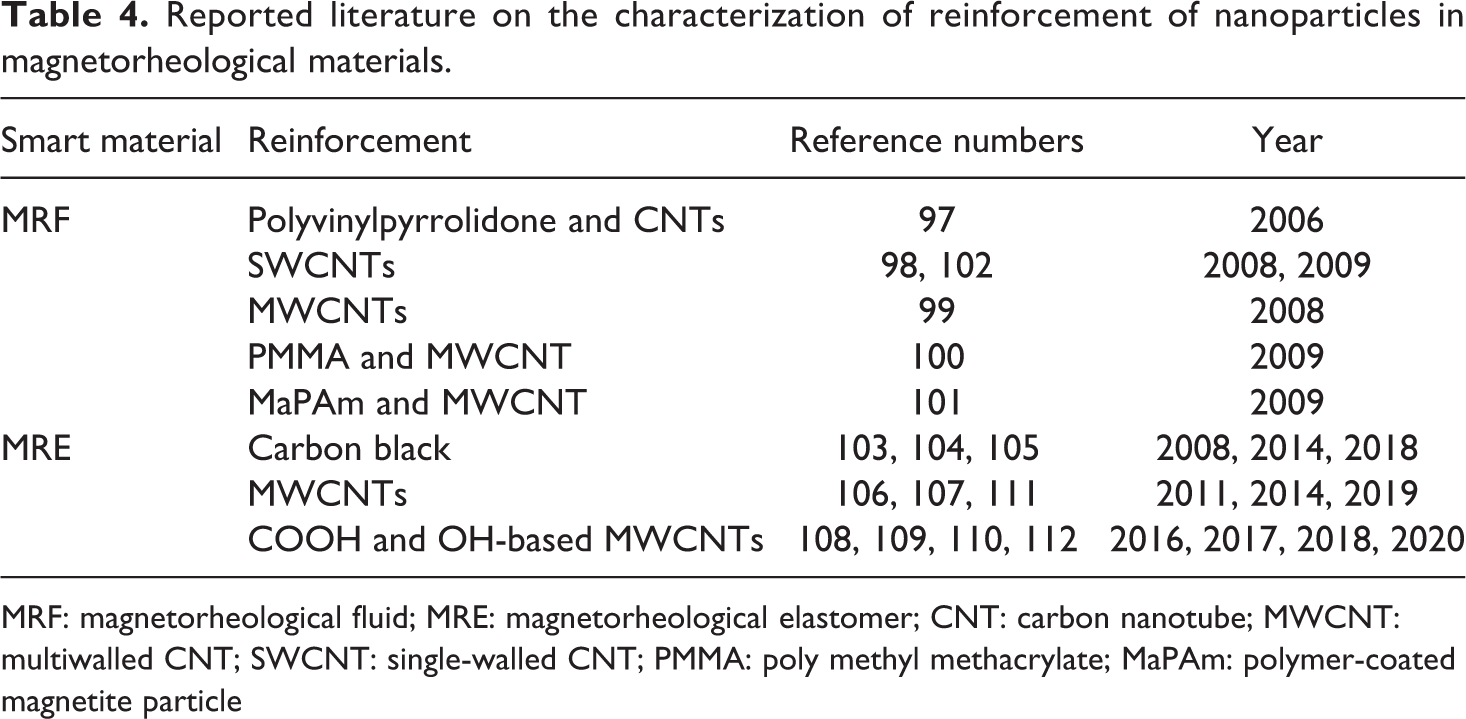
MRF: magnetorheological fluid; MRE: magnetorheological elastomer; CNT: carbon nanotube; MWCNT: multiwalled CNT; SWCNT: single-walled CNT; PMMA: poly methyl methacrylate; MaPAm: polymer-coated magnetite particle
Concluding remarks with future direction
A vast number of research have taken place in the area of vibration and stability analysis of MR materials-based sandwich structures. Many of the related articles were considered for this review on vibration and stability analysis of MRF- and MRE-based sandwich structures. A few of the crucial observations on MR materials-based sandwich structures are discussed below.
The presence of MRFs and MRE in sandwich structures subject to magnetic field conditions could significantly increase the natural frequencies, damping properties, and minimize the transverse displacement of the structures.
The dynamic properties of the fully and partially treated MRF- and MRE-based sandwich structures could be altered by changing the applied magnetic field strength, geometry configurations, face layer material, and boundary conditions.
The optimal locations of MRF and MRE sandwich structures were identified using FEA coupled with GAs. It was concluded that the location and size of MR pockets influence the stiffness and damping properties of sandwich structures apart from the applied magnetic fields and boundary conditions.
It was observed that increasing the tapering ratio on width and thickness of the face layers/MR layer increases the natural frequencies and decreases the loss factors of the sandwich structures. Similarly, various tapered configurations were analyzed and plotted the comparative results.
Also, the sandwich structures were analyzed under the rotating condition. From this analysis, it was concluded that intensifying the rotational speed and hub radius provides a stiffening effect on sandwich structures and increases the natural frequencies and decreases the loss factors. However, intensifying the setting angle has no considerable influence on the natural frequencies and corresponding loss factors of the sandwich structures.
In addition, the sandwich structures were investigated with the reinforcement of carbon nanoparticles in composite face layers. It enhances the stiffness and damping of the sandwich structures. Also, the addition of nanoparticles or fillers in MR materials provides better sedimentation control and enhances the rheological properties of MR materials.
Despite of many works available on dynamic characteristics of MR materials-based sandwich beams, the studies on dynamic characteristics and stability analysis of MR sandwich plates and shells are limited in the literature. It should be the main focus of researchers in the future research. Further, there is limited work reported in the literature on the numerical analysis of functionally graded (FG) composite face sheets with MR sandwich beam, but the MR sandwich plates and shells with FG face sheets need more attention in the future.
