




Abstract
Fabrics from commingled natural (flax), thermoplastic (polypropylene (PP)/polylactic acid (PLA)) polymeric fibres were fire retarded with an oragnophosphonate flame retardant (FR). The fire-retarded flax/PP and flax/PLA fabrics were melt pressed to prepare respective thermoplastic composites. The effect of FR concentration on the fire and mechanical properties of composites was studied and the results analysed in terms of concentration of FR elements in the composites. While the UL-94 test was used as a benchmark to achieve a V-0 rating, cone calorimetric parameters were used for in-depth analysis of fire performance. The results show that flax/PP and flax/PLA composites require a minimum 0.9 and 0.6% phosphorus, respectively, to achieve a V-0 rating in the UL-94 test. Mechanical properties, evaluated in tensile and flexural modes, are however slightly impaired, most probably due to the acidity of the FR solution (pH = 3.2). In order to improve the mechanical properties, a buffer solution was used to change the pH to 6.0, which while having a minimal effect on mechanical properties of flax/PP, significantly reduced those of flax/PLA and increased flammability of both composites and hence overall showed no benefit.
Keywords
Introduction
Flax fibre owing to its widespread growth in Europe and North America, and high stiffness (27.6–85 GPa) and strength (800–2000 MPa), 1 is one of the most widely used lignocellulosic fibres for composites. 1,2 Flax fibre’s most use is in thermoplastic composites, particularly, in the automotive industry 3 though its use with thermoset resins such as epoxy and unsaturated polyester has also been reported 2 and is on the increase. From the manufacturing point of view, there is a considerable pressure from industry to develop easy composite fabrication processing with a reduced number of steps. In that context, NetComposites in the recent past developed commingled, twistless and aligned flax/polypropylene (flax/PP) and flax/polylactic acid (flax/PLA) yarns and woven fabrics from these yarns. Composites from such fabrics can be prepared just by melt pressing the required number of stacked layers of such fabrics. Commingling is a technique used to intimately mix different fibres/yarns, typically using compressed air. The alignment gives 50% better fibre efficiency over conventional twisted yarns. 4 Since the two fibre types are in intimate contact, during melt pressing the fibres wet easily, giving improved fibre/matrix interaction and better performance of the derived composites. Moreover, these fabrics can be easily impregnated with fire retardants using a conventional textile processing ‘pad-dry’ technique, which is the focus of this work.
Natural fibres are flammable and hence add to the flammability of the composites in which the matrix being organic in nature is also flammable. 2,5 Hence, as applications of natural fibre composites are becoming more widespread, their fire performance is becoming more important. Most often fire retardants are added to the thermoplastic matrix by melt blending prior to making composites. 6–8 Alternative method is to apply fire retardant treatments on the fibres 9 –11 Fire retardant treatments for natural fibres, typically cellulosic fibres such as cotton, have been well established for many years. Fire retardants can be simply applied using aqueous solutions of phosphorus–nitrogen (P–N), sulphur or halogen containing fire retardants. 12,13 In principle, whatever is suitable for cotton should also be effective on other cellulosic fibres such as flax, jute and so on. The use of different fire retardants on woven fabrics from commingled flax/PP and flax/PLA prior to melt-pressing stacked layers of such fabrics in order to make fire resistant composites has been previously reported. 14 Four commercially available fire retardant formulations commonly used for cellulosic textiles were (i) ammonium sulphamate, (ii) ammonium bromide, (iii) guanidine dihydrogen phosphate (an oganophosphate) and (iv) guanylurea methyl phosphonate (an organophosphonate). While all of these formulations were effective in flax/PLA in terms of achieving a V-0 rating in a UL-94 test, only the organophosphonate flame retardant (FR) was capable of imparting a V-0 rating for flax/PP. However, all fire retardants reduced the mechanical properties of composites, and the reduction seemed to be related to the pH of the fire retardant formulation used, being maximum for the organophosphonate FR (pH 3.3). The reduction in mechanical properties was more pronounced in flax/PLA than in flax/PP. The purpose of this work is to establish the factors affecting the mechanical properties of both flax/PP and flax/PLA composites using the most effective FR, the organophosphonate, and to develop composites with optimized FR and mechanical properties, that is, achieving V-0 rating, with a minimal effect on mechanical properties.
Experiment
Materials
Fabrics
Woven fabrics from flax and commingled flax/PP and flax/PLA fibres (50/50 wt%) were supplied by Composites Evolution (UK). These woven fabrics were of 4 × 4 plain weave structure with the following area densities: flax = 467 g/m2, flax/PP = 465 g/m2 and flax/PLA = 493 g/m2.
Fire retardant
A commercially available organophosphonate (guanylurea methylphosphonate) fire retardant formulation with a pH of 3.3 was used. Due to commercial sensitivity, details of the fire retardant formulation and source have not been identified and the fire retardant is hereinafter referred to simply as ‘FR’.
Sodium acetate (NaOAc), 98% purity supplied by Fisher Scientific UK Ltd, was used as a buffering agent to reduce the acidity of the FR solution.
Sample preparation
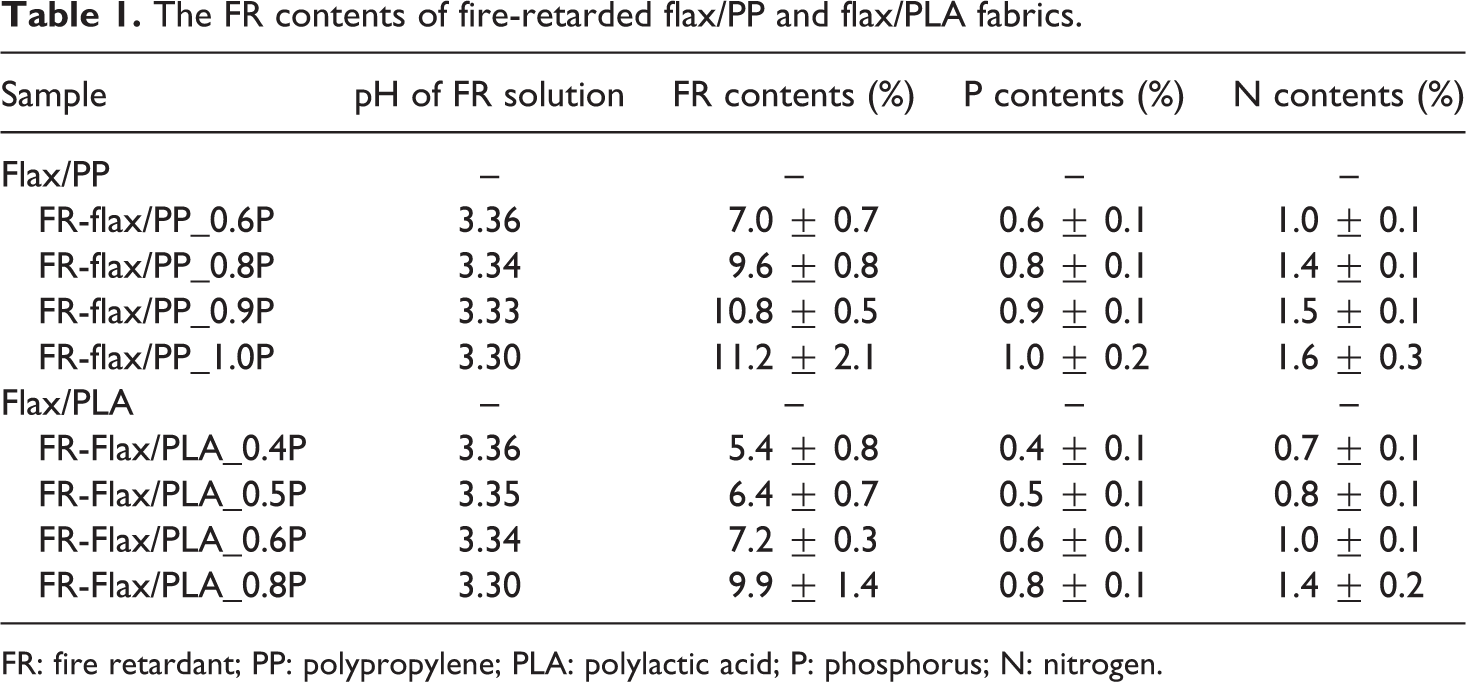
Flax/PP and flax/PLA fabrics were treated with aqueous FR solutions using a pad-dry technique to obtain specified fire retardant element concentrations, determined by the formulation used, in the composites as given in Table 1.
The FR contents of fire-retarded flax/PP and flax/PLA fabrics.
FR: fire retardant; PP: polypropylene; PLA: polylactic acid; P: phosphorus; N: nitrogen.
For samples where pH had to be changed, the required amount of NaOAc was added to the solution to work as a buffering agent. Flax fabrics were treated with different solutions of pH 3–7. Based on the results, flax/PP and flax/PLA fabrics were treated with FR solutions of pH 3.3 and 6.0.
Composite samples from control and FR-treated flax/PP and flax/PLA fabrics were prepared by melt-pressing eight layers of each fabric at 180°C and 40 kg/cm2 pressure for 3 min and then transferring them to a cold press to cool down under pressure (20 kg/cm2) to ambient temperature. The thickness of each composite was approximately 3 mm.
Fire performance evaluation
The fire performance of the composites was evaluated using the UL-94 burn test and cone calorimetry. The UL-94 test was conducted according to ISO 1210 in both the horizontal and vertical orientations, from which the rate of burning for each sample was also recorded. For cone calorimetry, three specimens of each sample were tested using a Fire Testing Technology Ltd, UK instrument at 35 kW/m2 according to ISO 5660.
Mechanical performance evaluation
The mechanical performance of composites was evaluated in tensile and flexural modes. Tensile and flexural tests were conducted using an Instron 3369 (Instron Universal Testing Machine [Type 3369]). Three specimens of 150 × 20 × 3 mm3 sizes were tested for each sample. Tensile tests were performed using a 50-kN load cell with the crosshead speed at 1 mm/min. The gauge length of each specimen was 100 mm. Polymeric tabs were bonded at the end of specimens to improve the gripping and to ensure failure within the gauge region. In the flexural mode, three-point bending tests were carried out using a 100-N load cell at 0.5 mm/min crosshead speed.
Tensile properties of FR-treated flax fabrics were determined using a 100-N load cell with the crosshead speed at 100 mm/min on fabric strips 50 mm wide. The gauge length was 100 mm.
Results and discussion
The effect of FR content on fire and mechanical performances of FR flax/PP and flax/PLA composites
A number of composite samples with different FR contents were prepared (Table 1) in order to determine the minimum amount of FR element required to achieve an acceptable level of fire retardancy. The primary FR element in the organophosphonate FR (guanylurea methylphosphonate) used in this work is P, followed by P–N ratio for a synergistic action. The results in the following sections are analysed in terms of concentration of P in the composites.
Fire performance
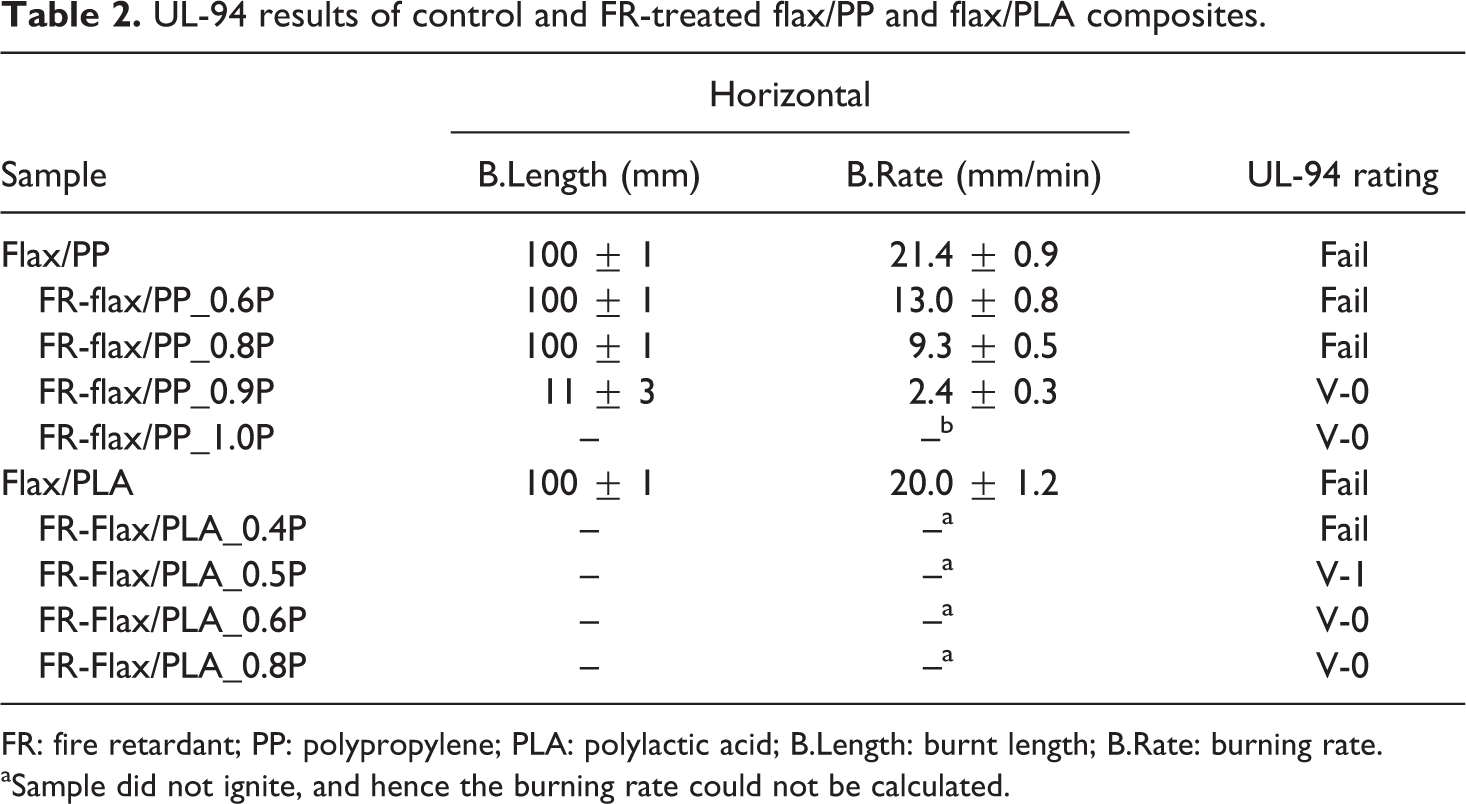
The results for control and FR-treated flax/PP and flax/PLA composites are reported in terms of UL-94 rating and rates of burning (vertical and horizontal orientations) in Table 2. The UL-94 is a plastics flammability standard to determine the material’s tendency to either extinguish (V-0 rating when tested in vertical orientation; V-1 or V2 if it burns for <30 s without or with flaming drips, respectively) or spread the fire once the specimen has been ignited (determined in a horizontal orientation). In this section, the focus is to find the critical P concentration in flax/PP and flax/PLA samples that could lead to the achievement of a UL-94 V-0 rating.
UL-94 results of control and FR-treated flax/PP and flax/PLA composites.
FR: fire retardant; PP: polypropylene; PLA: polylactic acid; B.Length: burnt length; B.Rate: burning rate.
aSample did not ignite, and hence the burning rate could not be calculated.
The control flax/PP composite failed the UL-94 rating test; the specimen completely burnt up to the sample holder. Even in horizontal mode, it burnt up to the sample holder with a burning rate of 21.4 mm/min. On addition of fire retardant, the flammability of flax/PP composites was significantly reduced. As expected, if the effectiveness of the FR was greater the higher the FR content in FR-treated flax/PP composites. As seen from Table 2, the addition of FR to flax/PP composites at 0.6 and 0.8% P contents significantly decreases the burning rates of the composites by about 40 and 60%, respectively, but still does not change the UL-94 rating of the composites. When the FR content of flax/PP composites is further increased to at least 0.9% P, the composites then achieve a V-0 rating.
The control flax/PLA composites have slightly lower flammability compared to the control flax/PP as shown by the slightly lower burning rate (20.0 mm/min, Table 2), but fail the vertical rating test and burn completely. The burning rate of flax/PLA composites is significantly reduced with the addition of FR at 0.4 and 0.5% P contents; in the horizontal test, the rates of burning could not be calculated as the fire went out before reaching the timing mark. Moreover, to achieve V-0 rating, flax/PLA composites require only an FR content of 0.6% P.
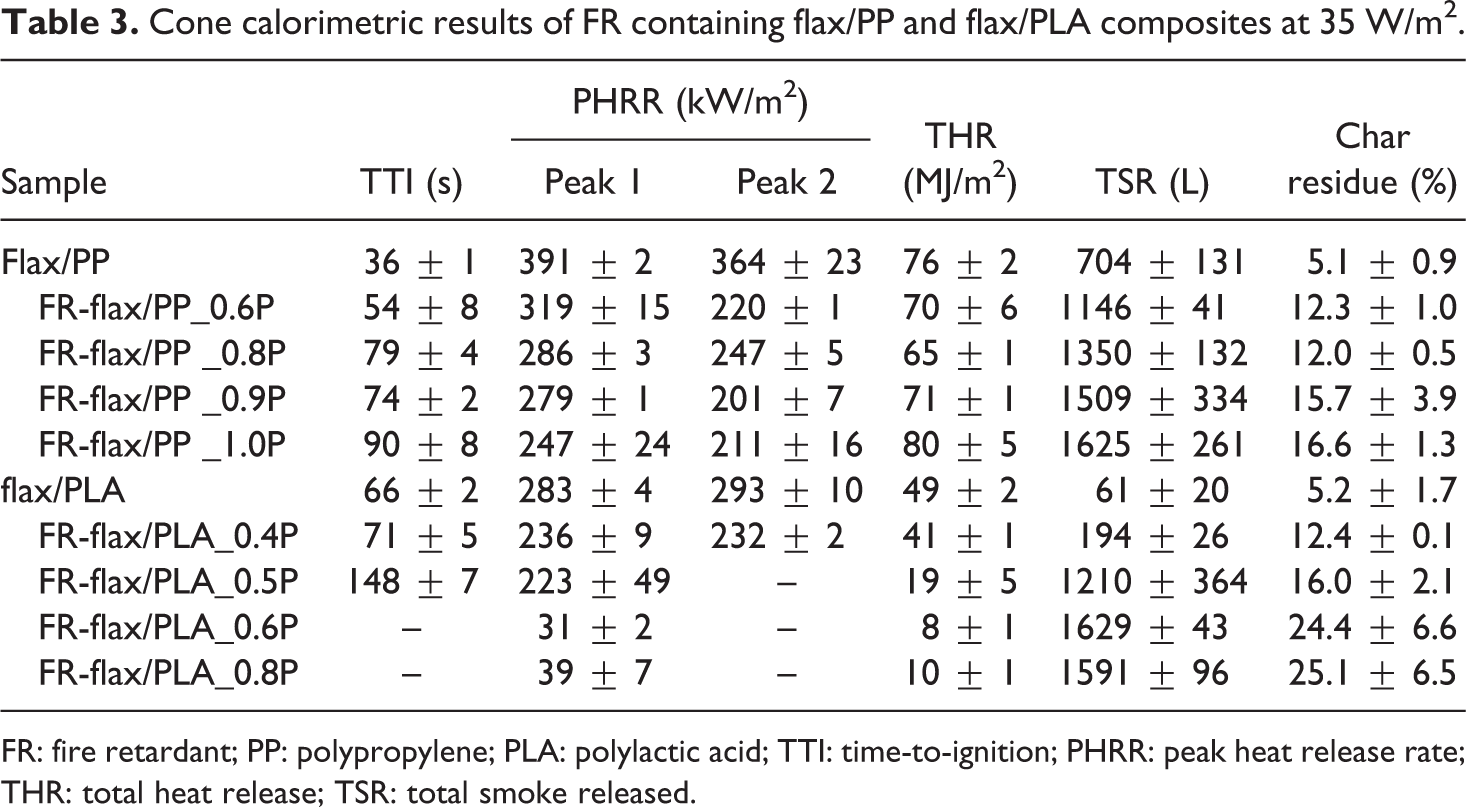
The cone calorimetric results for fire-retarded flax/PP and flax/PLA composites with different FR contents tested at 35 kW/m2 are graphically presented in Figure 1. The derived results from the curves are given in Table 3. Both flax/PP and flax/PLA ignited and burned showing two peaks of heat release, peak heat release rate (PHRR; Figure 1). This behaviour is typical of a cellulosic fibre – composite, where the ignition of the thermoplastic polymer present on the surface leads to the first peak of heat release. In the meantime, the flax fibres start charring. When the charred layer is thick enough to act as a thermal barrier for the underlying polymer, the burning slows down until the charred layer cracks and then the second peak appears. 7 The lower flammability of flax/PLA than flax/PP is indicated by the slightly greater time-to-ignition (TTI), lower PHRR and total heat release (THR) and much lower smoke production (61 L compared to 704 L in flax/PP). The lower smoke production in flax/PLA may be due to the presence of oxygen in the structure of PLA (absent in that of PP), which may assist the complete combustion of polyesters at lower oxygen concentrations than are required for complete combustion of PP.
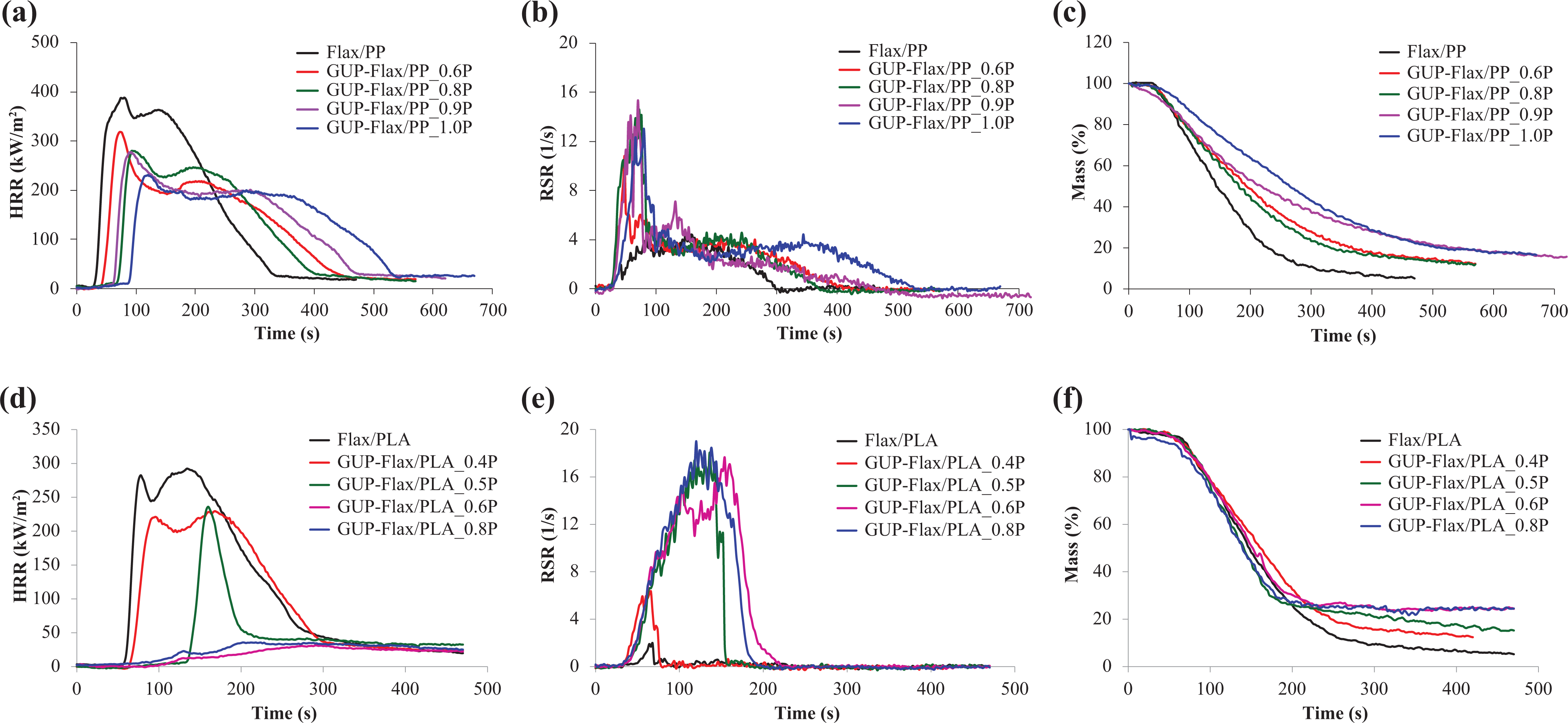
Cone calorimetric results of control and FR treated (a), (b) and (c) flax/PP and (d), (e) and (f) flax/PLA at 35 kW/m2: (a) and (d) HRR, (b) and (e) , RSR and (c) and (f) mass loss curves as a function of time.
Cone calorimetric results of FR containing flax/PP and flax/PLA composites at 35 W/m2.
FR: fire retardant; PP: polypropylene; PLA: polylactic acid; TTI: time-to-ignition; PHRR: peak heat release rate; THR: total heat release; TSR: total smoke released.
The cone calorimetric results in Table 3 show that at 0.6% P content of FR in flax/PP composites, the TTI increases from 36 s of the control to 54 s, and the PHRR and THR are reduced by about 18% and 10%, respectively, compared to those of the control. With the increase in amount of FR, the TTI of flax/PP further increases, reaching 90 s in FR-flax/PP_1.0P. The change in each parameter as a function of P content is shown in Figure 2(a). A similar trend is also seen in the reduction in PHRR and the increase in char residue, indicating that the higher FR content in the composites is more effective than the lower ones (Figure 2(b) and (c)).
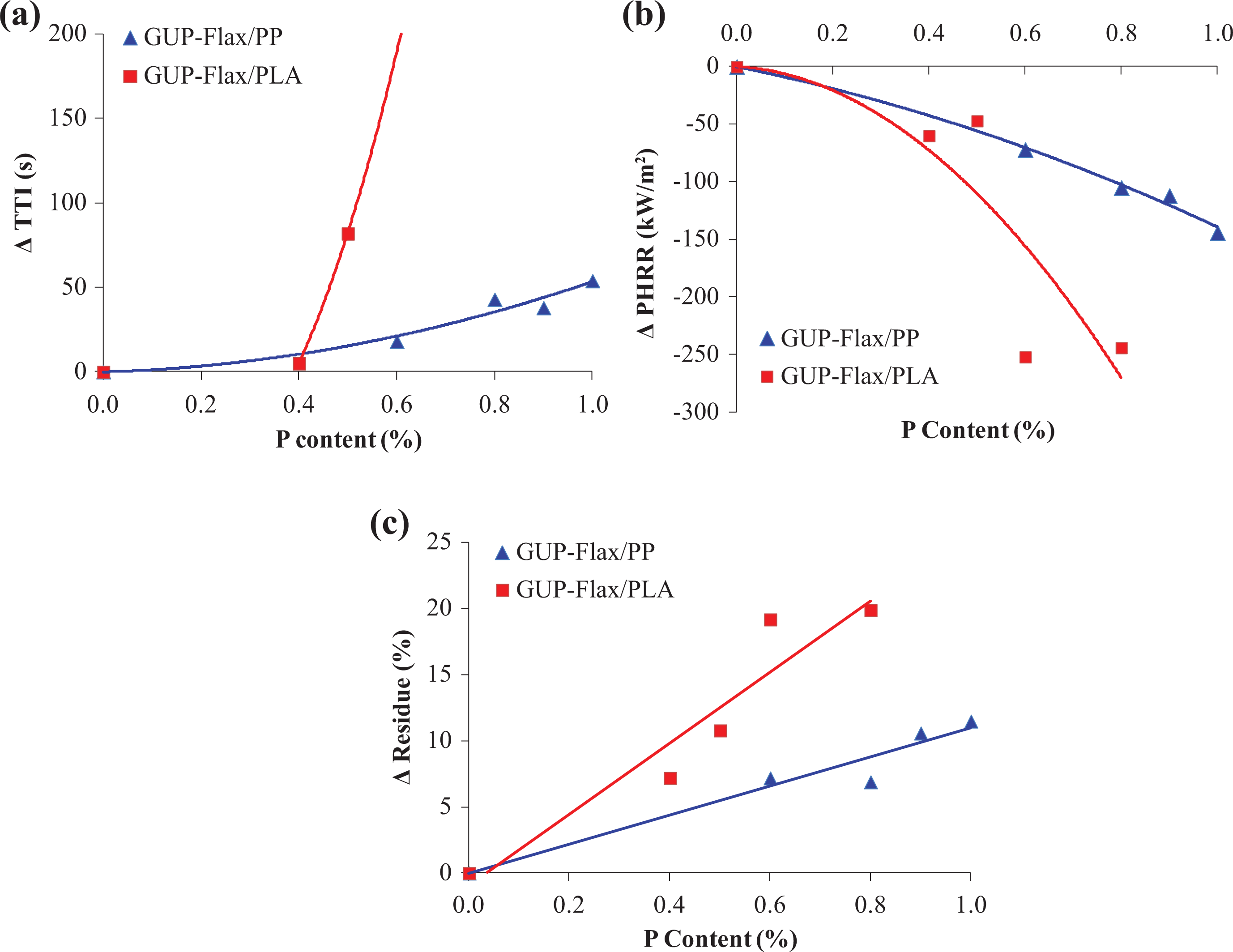
The change in TTI, first PHRR and charred residue of FR-treated flax/PP and flax/PLA samples compared to those of the control at 35 kW/m2 as a function of phosphorus content.
The fire retardant significantly enhances the fire performance of flax/PLA composites, and the effect is more pronounced than of when used in flax/PP, as seen from Figures 1 and 2. The results in Table 3 show that the addition of FR at 0.4% P content has a marginal effect on the TTI of flax/PLA and decreases PHRR by about 20% in both peaks. On increasing the FR content to the 0.5% P level, the fire performance of flax/PLA is further enhanced as seen by the significant increase in TTI (148 s) and also the change in burning behaviour from double peaks of HRR to a single peak (Figure 1(a)), which is due to the early formation of increased amounts of char in FR-flax/PLA_0.5P (16.0% compared to 5.2% in the control) and which may more efficiently protect the remaining material from further combustion. With further increases in FR content to 0.6 and 0.8% P, the efficiency of the FR is enough to prevent ignition (Figure 1(d)).
Mechanical performance
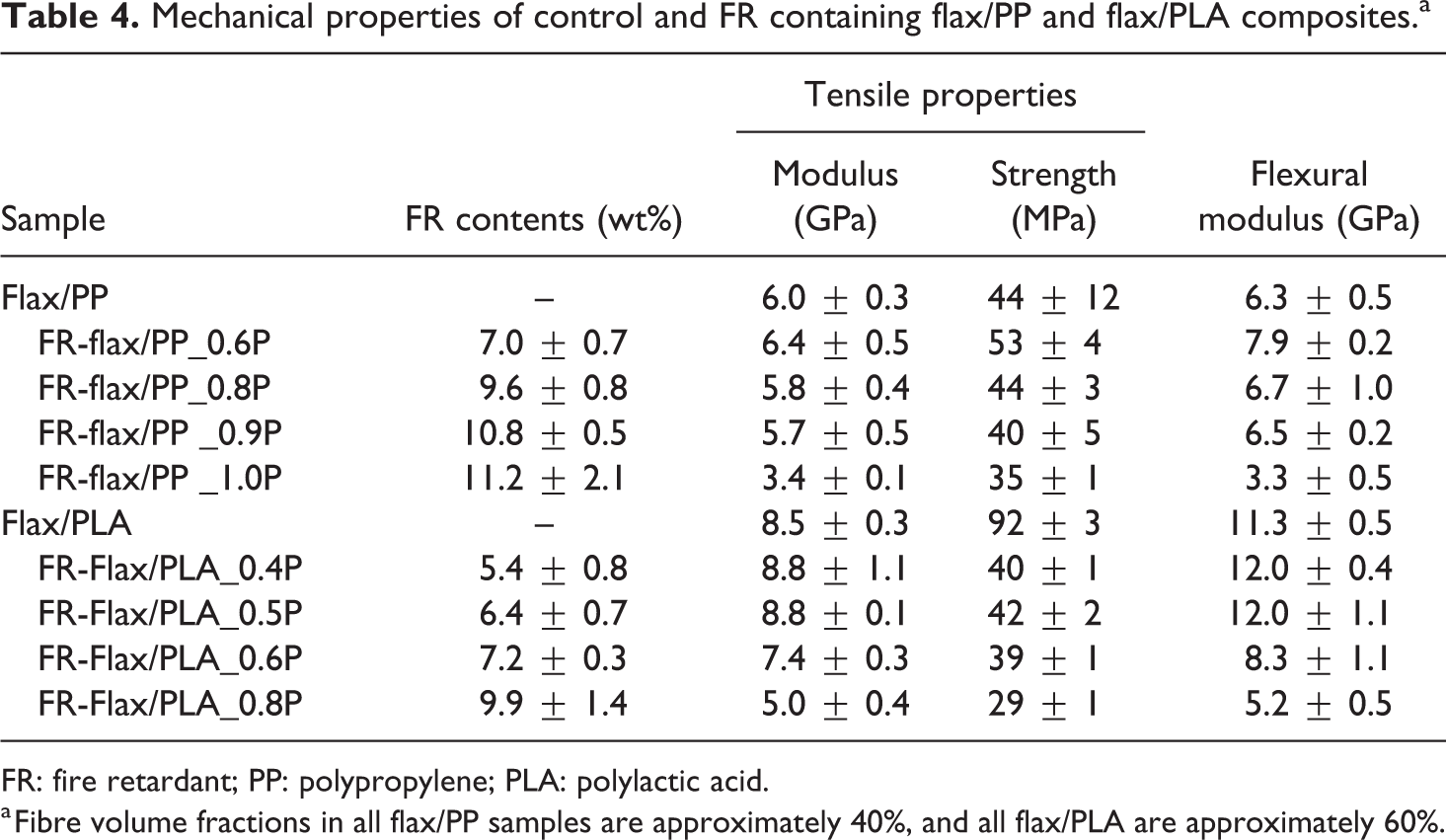
The mechanical performances of control and FR-treated flax/PP and flax/PLA composites are reported in the tensile and flexural modes in Table 4. The tensile and flexural moduli of these composites were calculated from the elastic region of the stress–strain curves. Since the mechanical properties are affected by the FR content of the fabric/composite composites, the results here are discussed in this context as opposed to in terms of P contents (although they are related) as in the previous section.
Mechanical properties of control and FR containing flax/PP and flax/PLA composites.a
FR: fire retardant; PP: polypropylene; PLA: polylactic acid.
a Fibre volume fractions in all flax/PP samples are approximately 40%, and all flax/PLA are approximately 60%.
In tensile mode, the control flax/PP composite has a modulus of 6.0 GPa and a tensile strength of 44 MPa. On addition of fire retardant, the tensile modulus of flax/PP composites gradually decreases with increasing FR content (Table 4). However, the extent of reduction of the tensile modulus is not linear with respect to the increase in FR content. In Figure 3(a), it can be seen that the tensile modulus of flax/PP gradually reduces from 6.0 GPa for the control to 5.7 GPa in FR-flax/PP_0.9P with 10.8 wt% of FR content, and then significantly drops to 3.4 GPa when the FR content reaches 11.2 wt% in FR-flax/PP_1.0P composites. Addition of the FR also decreases the tensile strength of flax/PP composites, and the reduction increases further with an increase in the amount of FR in the composites (see Table 4). As the tensile properties of composites are reinforcing fibre-dependent, the reduction in the tensile properties of flax/PP could be due to a change in flax properties after treatment with FR solution. Since a strong acid can cause damage to cellulose in flax fibre and lead to a loss of fibre properties, the pH of FR solutions is an important parameter in explaining the reduction of tensile properties of FR-treated composites. 15 As seen from Table 1, the pH values of FR solutions decrease with an increase in FR concentration, indicating that the solution becomes more acidic. Therefore, at higher concentrations of FR solution, the damage to flax fibre could be more severe and, hence, result in a larger reduction of tensile properties in the FR-treated flax/PP composites.
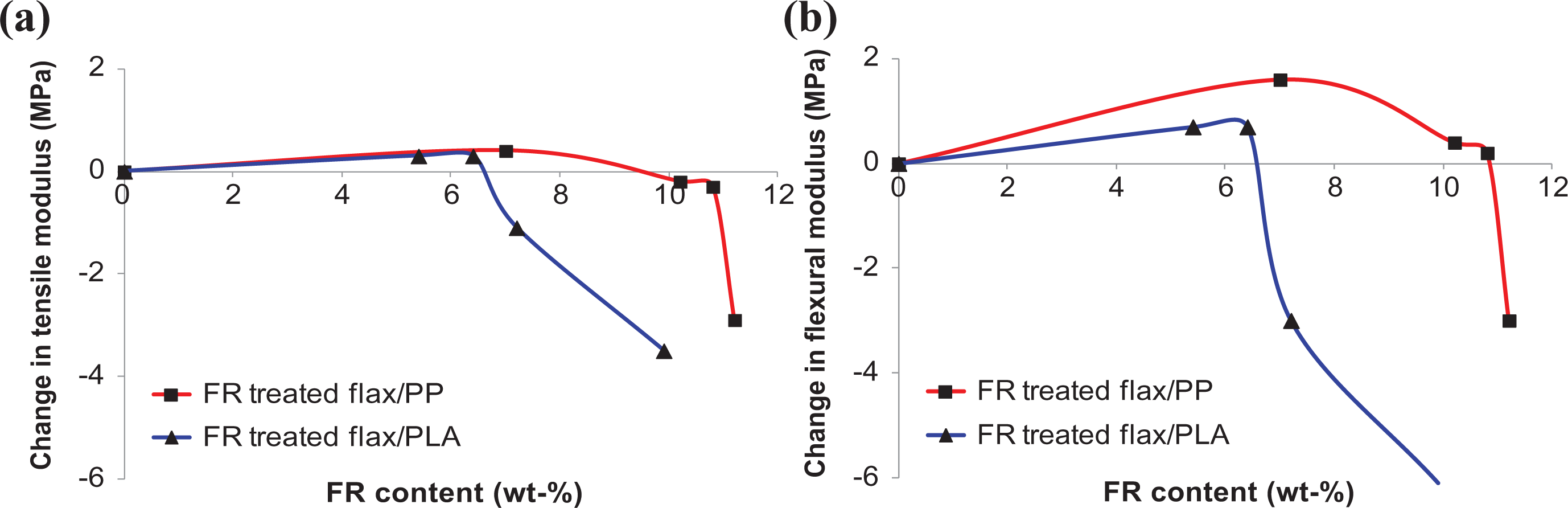
The change in (a) tensile and (b) flexural moduli of FR-treated flax/PP and flax/PLA composites at different FR contents compared to the control samples (calculated by E of FR composites − E of control).
The flexural modulus of control flax/PP composites is 6.3 GPa. The addition of FR at 7.0 wt% content slightly increases the flexural modulus from 6.3 GPa to 7.9 GPa for the FR-flax/PP_0.6P. However, once the FR content is further increased, the flexural modulus of flax/PP starts to decrease gradually to 6.7 and 6.5 GPa with the presence of FR at 9.6 and 10.8 wt%, respectively, and then, when the FR content reaches 11.2 wt%, the flexural modulus further decreases significantly to 3.3 GPa. This can be explained by the fact that although the flexural properties of composites are generally polymer matrix dependent, the fibre–matrix interfacial adhesion could also affect the properties as the low adhesion can lead to a delamination failure and, hence, cause a reduction in the flexural properties. 16,17 Since PP has high chemical resistance, the reduction in the flexural properties of FR-treated flax/PP could be due to a decrease in the fibre/matrix interfacial adhesion of the composites, evidence for which was seen in the scanning electron microscopic (SEM) images of the fractured surfaces reported in the study by Pornwannachai et al. 14
The addition of FR to flax/PLA composites at low content, 5.4 and 6.4 wt% has a minimal effect on the tensile modulus (8.5–8.8 GPa), which then gradually decreases to 7.4 and 5.0 GPa when the FR content is increased to 7.2 and 9.9 wt%, respectively. The FR significantly decreases the tensile strength by more than 50% in all samples. The results in Table 3 also show that the tensile properties of flax/PLA composites are more severely affected by the presence of FR compared to those of flax/PP composites, as it can be seen that at the same FR content, the reduction in tensile properties, in particular tensile strength, of FR-treated flax/PLA composites is larger than those of FR-treated flax/PP composites. As explained before, this is due to the reaction of the FR with PLA as could be seen in the SEM images reported in our previous publication. 14 In Table 4, the results show that FR also causes a reduction in the flexural properties of FR-treated flax/PLA, and that the reduction is more severe at higher FR content, especially at FR contents above 7.2 wt% at which the flexural modulus of flax/PLA was reduced by more than 50% (see Figure 3(b)).
From these results, it can be concluded that for flax/PP, FR contents up to approximately 10.5 wt% (0.9% P) and, for flax/PLA, FR contents up to approximately 6.5 wt% (0.5% P) are the critical levels below which mechanical properties remain unaffected. As seen from the flammability results in Table 2, flax/PP achieves a UL-94 V-0 rating, whereas flax/PLA has a borderline V-1 rating.
The effect of pH of FR solution on the fire and mechanical performances of FR flax/PP and flax/PLA composites
Since the FR solution used in the above-mentioned section was very acidic (pH 3.2), it is suggested that one of the reasons for the reduction in the mechanical properties of the FR-treated flax/PP and flax/PLA composites is damage to the flax fibres caused by the acidic solution. The first step to test this hypothesis was to study the effect of pH of FR solution on the tensile strength of flax fabric. Flax fabric was treated with 20 wt% FR solution. To adjust the pH of the solution, NaOAc was added to the solution as a buffering agent to reduce the acidity of the FR solution. The results in Figure 4 show that the tensile strength of FR-treated flax fabric gradually increases with the increase in pH value of the FR solution (i.e. less acidic), and that this increase then ceases when the pH value increases above 6.0. From this, the optimal pH of the FR solution capable of maintaining the mechanical properties of the flax fabric was established as 6.0.
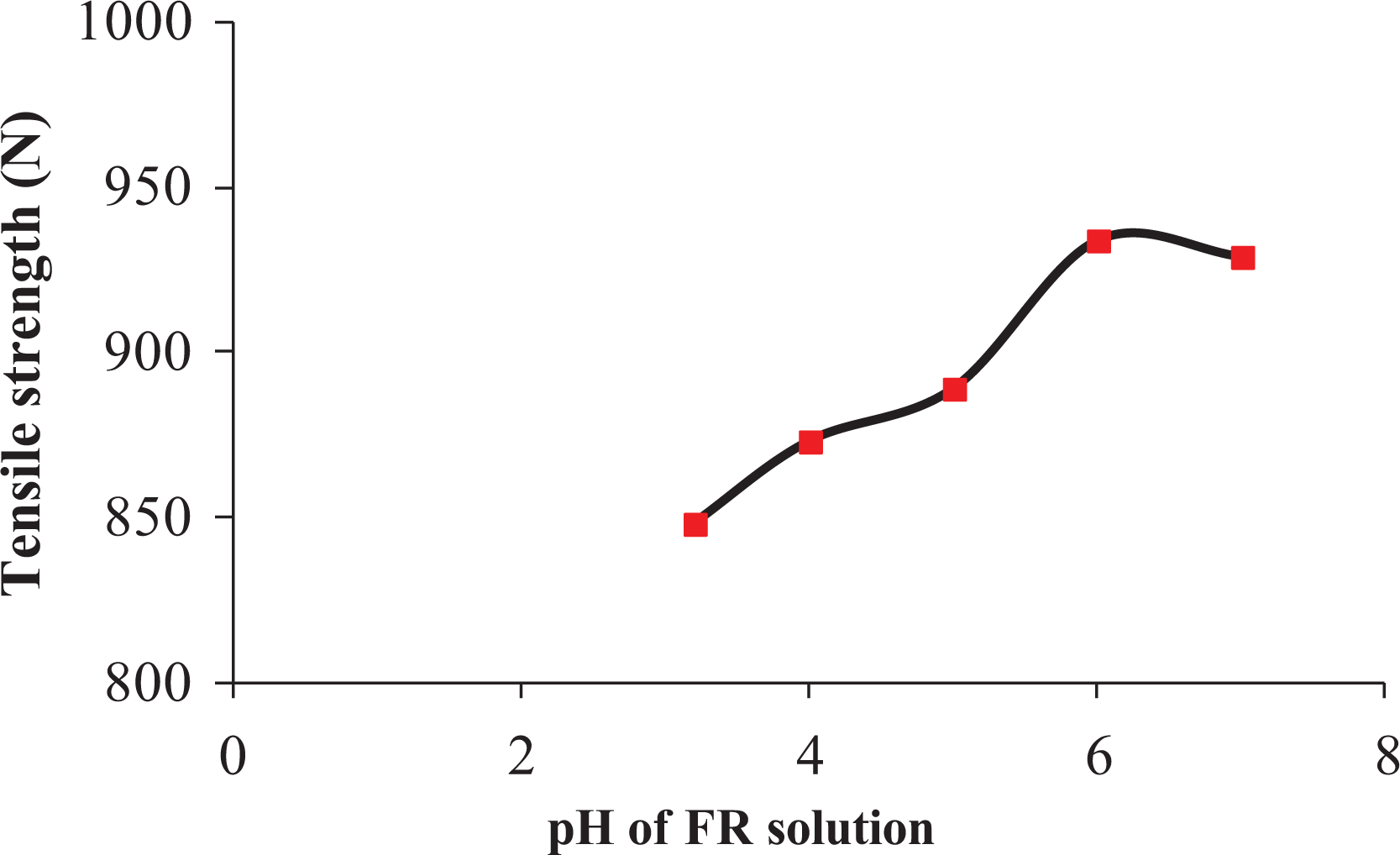
Tensile strength (N) of flax fabrics treated with FR solution at different pH values.
In order to study the effect of pH on the fire and mechanical performances of FR-treated flax/PP and flax/PLA composites, composites were prepared from the fabrics treated with FR solutions of pH 3.2 (i.e. without pH modification as in the earlier section) and pH 6.0. Based on the results in ‘The effect of FR content on fire and mechanical performances of FR flax/PP and flax/PLA composites’ section, the FR contents of the treated flax/PP and flax/PLA fabrics were adjusted to give levels of 0.9 and 0.6% P, respectively, as these are the minimum levels of the FR that are required if the composites are to give a V-0 pass rating in UL-94 tests. The details of the FR solutions and the actual FR contents of the fabrics are given in Table 5.
Details of flax/PP and flax/PLA fabrics treated with FR solutions at different pH levels.
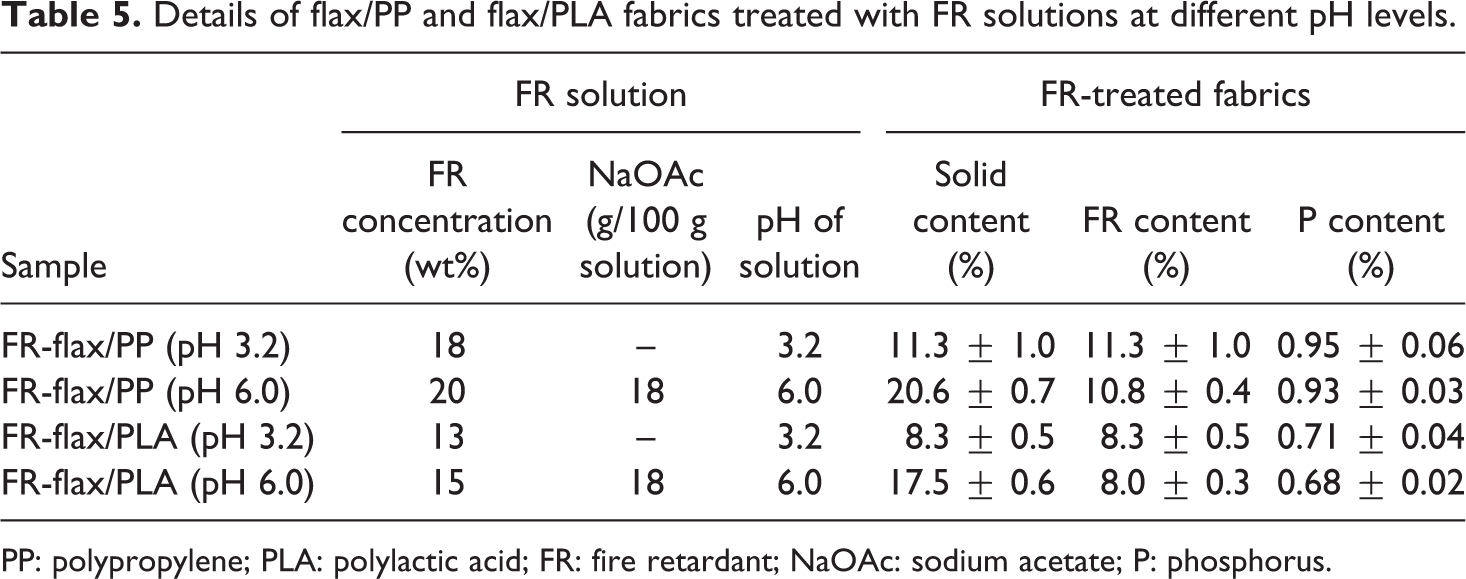
PP: polypropylene; PLA: polylactic acid; FR: fire retardant; NaOAc: sodium acetate; P: phosphorus.
Composites from these treated fabrics were prepared by melt-pressing eight layers of the fabrics into 3-mm-thick composites and tested for fire and mechanical properties.
Fire performance of FR flax/PP and flax/PLA composites
The UL-94 results in Table 6 show that while the flax/PP sample treated with an FR solution of pH 3.2 (without the use of buffering agent, NaOAc) could achieve a V-0 rating, the one treated with a pH 6.0 solution (with the addition of NaOAc to adjust the pH of the FR solution) fails the UL-94 test. The cone colorimetric results at 35 kW/m2 in Table 7 show a similar distinction, although the difference is not as dramatic as in the UL-94 test. With the addition of NaOAc, FR-flax/PP (pH 6.0) ignites slightly earlier (46 s as opposed to 60 s with pH 3.2), and while the first PHRR was unaffected, the second increases from 262 kW/m2 to 292 kW/m2 and THR increases from 91 MJ/m2 to 112 MJ/m2. This could be due to the phosphoric acid produced from the FR on heating not only reacting with the composite’s components through phosphorylation, but also reacting with NaoAc to form sodium phosphate and acetic acid, 18,19 hence leading to a reduction in the FR performance of FR in FR-flax/PP (pH 6.0) compared to that of FR-flax/PP (pH 3.2).
UL-94 results of control and FR-treated flax/PP and flax/PLA composites.
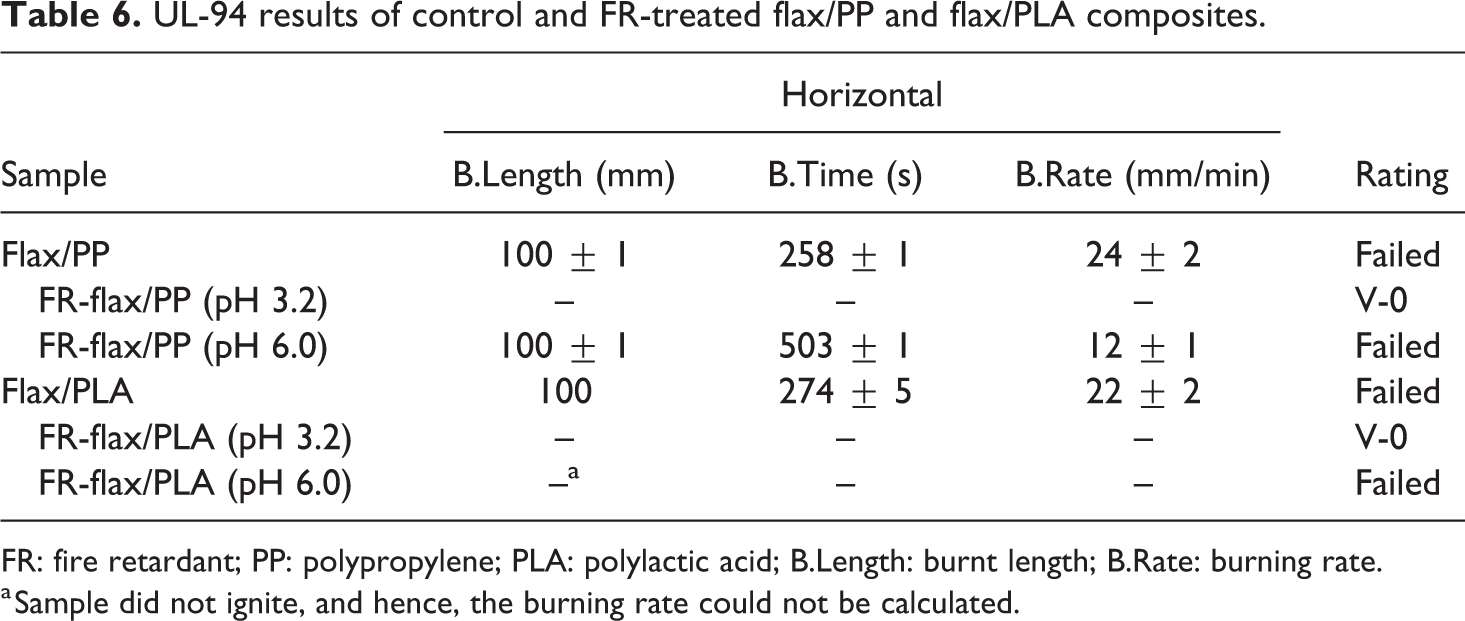
FR: fire retardant; PP: polypropylene; PLA: polylactic acid; B.Length: burnt length; B.Rate: burning rate.
a Sample did not ignite, and hence, the burning rate could not be calculated.
Cone calorimetric results of control and FR-treated flax/PP and flax/PLA composites at 35 kW/m2.
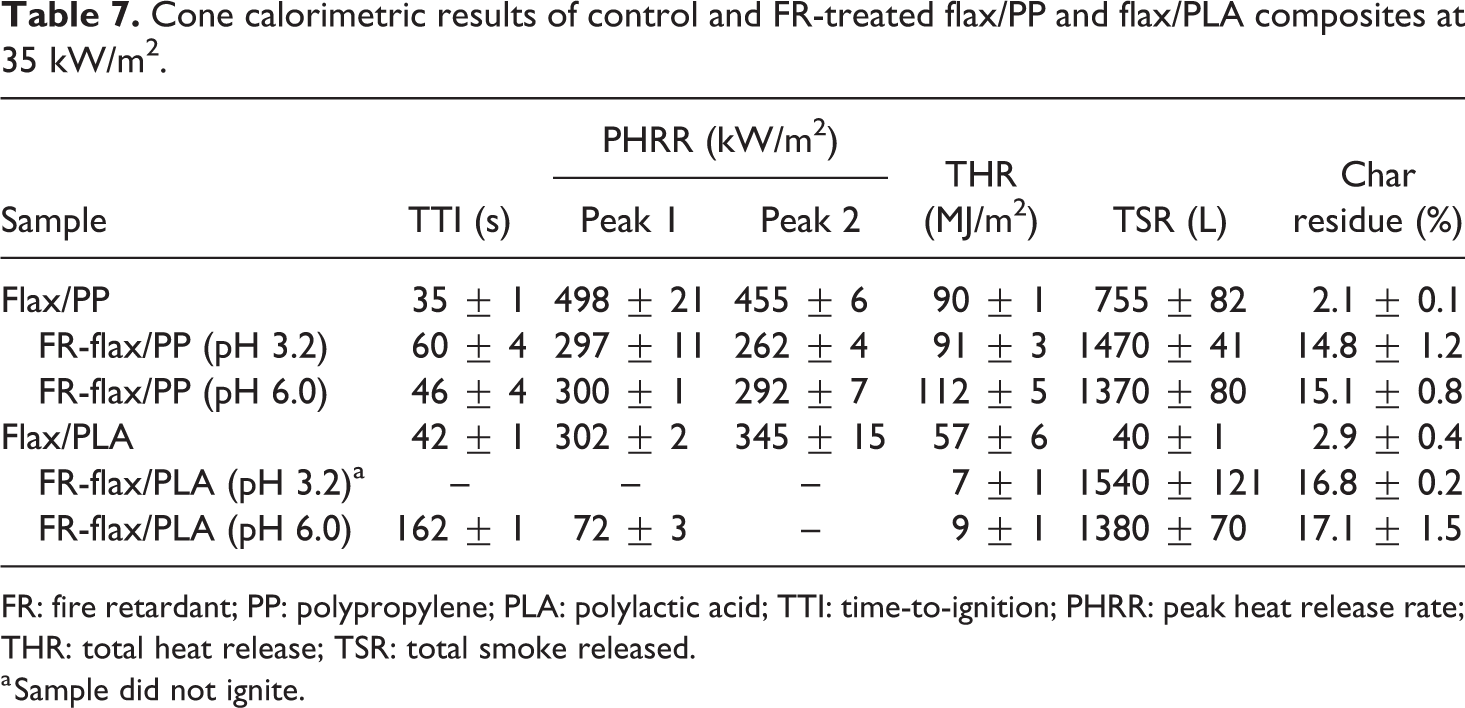
FR: fire retardant; PP: polypropylene; PLA: polylactic acid; TTI: time-to-ignition; PHRR: peak heat release rate; THR: total heat release; TSR: total smoke released.
a Sample did not ignite.
In the case of flax/PLA composites, the use of NaOAc in the FR solution results in a similar trend as that observed in flax/PP samples, namely that the presence of NaOAc increases the flammability of FR-flax/PLA from V-0 in FR-flax/PLA (pH 3.2) to ‘fail’ in FR-flax/PLA (pH 6.0).
The cone calorimetric results in Figure 5 and Table 7 also show that while at pH 3.2, the FR helps in the prevention of ignition in flax/PLA, with the addition of NaOAc to the FR solution, FR-flax/PLA (pH 6.0) ignited at 162 s and burned with 72kW/m2 PHRR, producing 9MJ/m2 THR. This reduction in the fire retardancy can be explained in a similar way to that proposed for FR-flax/PP, that is, that the presence of NaOAc causes a decrease in the reaction between phosphoric acid, produced from the FR, and the composite components, as phosphoric acid also reacts with sodium ions from NaOAc through an ion-exchange reaction to form sodium phosphate.
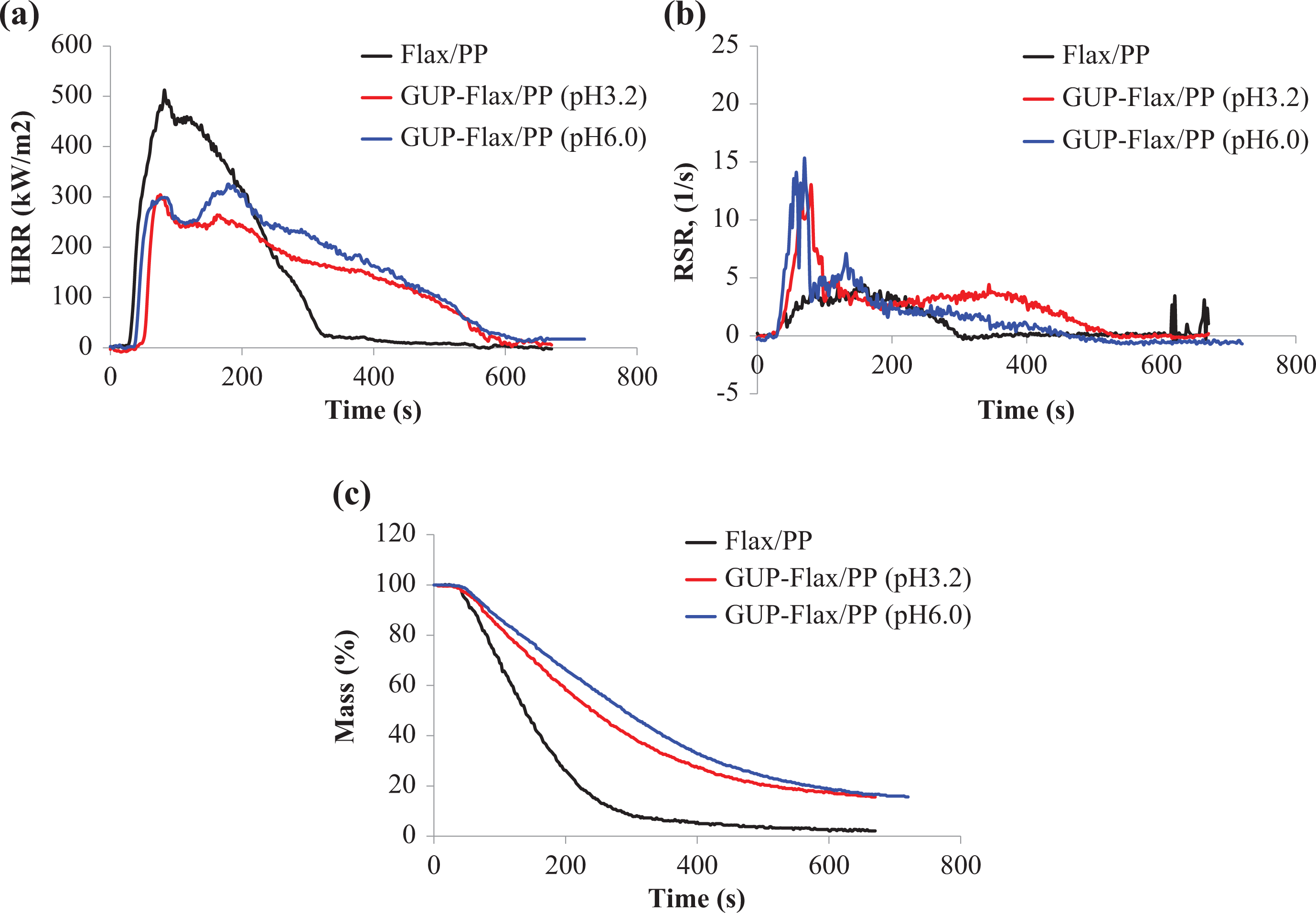
(a) HRR, (b) RSR and (c) mass loss curves of control and FR-treated flax/PP composites at 35 kW/m2.
Mechanical performance of FR flax/PP and flax/PLA composites
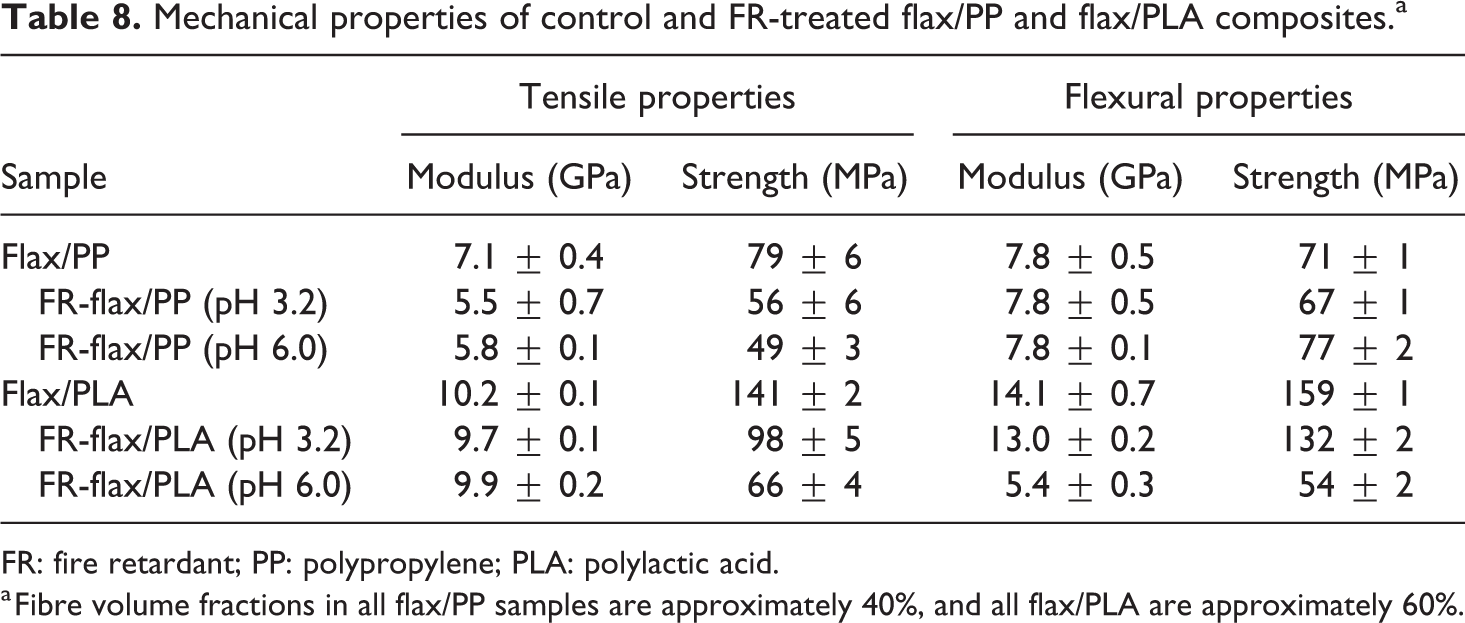
The mechanical properties of composites prepared from the flax/PP and flax/PLA fabrics treated with FR solutions of pH 3.2 and 6.0, evaluated in the tensile and flexural modes, are reported in Table 8. The control sample was also prepared and tested again to eliminate any differences due to using different batches of raw materials.
Mechanical properties of control and FR-treated flax/PP and flax/PLA composites.a
FR: fire retardant; PP: polypropylene; PLA: polylactic acid.
a Fibre volume fractions in all flax/PP samples are approximately 40%, and all flax/PLA are approximately 60%.
The results show that the addition of NaOAc to the FR solution to give a pH of 6.0 had only a minimal effect on the tensile properties of FR-flax/PP composites prepared from solution with a pH of 3.2, considering the error range. Within the error range, however, there seems to be slight increase in tensile modulus, but decrease in tensile strength. This is surprising, since the tensile properties of composites are fibre-dependent, and the reduction in the acidity of the FR solution used for treating flax/PP fabrics should have increased the tensile strength. As flax fibre can be hydrolysed and lose its mechanical strength under acidic conditions, the reduction in acidity of the FR+NaOAc solution should have helped to minimize the damage to the flax fibre, and so to the impairment in the tensile properties of the derived composites, thus resulting in improved tensile properties of FR-flax/PP (pH 6.0) compared to those of the FR-flax/PP (pH 3.2). In flexural mode, the addition of FR with and without NaOAc did not affect the properties of flax/PP composites as can be seen from the fact that the control and FR-flax/PP samples have similar flexural moduli of 7.8 GPa and flexural strength of approximately 70 MPa. These similarities arise from the flexural properties of composites being matrix-dependent and PP being non-reactive towards acids, and therefore not affected by the change in pH.
In the case of flax/PLA composites, the addition of NaOAc to the FR solution to give a pH of 6.0 does not affect the tensile modulus, considering the error range (9.7 GPa with pH 3.2 to 9.9 GPa with pH 6.0). The tensile strength, however, shows significant decrease from 98 MPa to 66 MPa in samples made with FR solutions of pH 3.2 and 6.0, respectively. The reduction in the tensile strength of FR-flax/PLA (pH6.0), even though the NaOAc helps to reduce the damage on FR-treated flax fibres, may be due to the alkaline NaOAc catalysing hydrolysis of ester groups (–COO–) in the PLA, hence resulting in the reduction in the mechanical strength of PLA and its composites. The flexural properties of control and FR-treated flax/PLA composites show that the presence of only FR did not show significant effect on the flexural properties of flax/PLA as can be seen from the only slight reductions in flexural modulus (13.0 GPa) and strength (132 MPa) in FR-flax/PLA (pH 3.2) compared to those of the control (see Table 8). However, with the addition of NaOAc to adjust the pH of the FR solution, the reduction in the flexural properties of FR-flax/PLA sample becomes significant as FR-flax/PLA (pH 6.0) shows much lower flexural modulus (5.4 GPa) and strength (54 MPa) than those observed for FR-flax/PLA (pH 3.2). Once again, this may be due to alkaline catalysed hydrolysis of PLA caused by NaOAc, leading to the reduction in the mechanical properties of PLA and, therefore, the matrix-dependent flexural properties.
Conclusions
The organophosphonate FR significantly improves the fire performance of flax/PP and flax/PLA composites and its efficiency is higher in PLA composites, which require a lower amount of FR than those with a PP matrix to achieve the same level of fire performance. It is also seen that the efficiency of the FR is not in a linear relationship with the fire performance. The fire performance of composites improves with increasing FR content up to 0.9% P of FR content for flax/PP and up to 0.6% P for flax/PLA; further increases in FR content do not provide any further significant improvement in fire performance. On the other hand, the increase in FR content causes a significant reduction in the mechanical properties of the composites, especially at high FR contents. Based on these results, the optimum FR contents for producing fire retardant flax/PP and flax/PLA composites were found to be 0.9% P and 0.6% P, respectively.
The flammability and mechanical properties of FR-flax/PP composites prepared from the flax/PP fabrics treated with FR solution at different pH values (i.e. 3.2 and 6.0) show that the use of NaOAc to reduce the acidity of the FR solution (pH 6.0) helps in maintaining the mechanical properties of FR-treated flax/PP composites, particularly tensile properties. The effect, however, was marginal. The addition of NaOAc to the FR solution has a negative impact on the flammability as NaOAc increased the flammability of FR-flax/PP composites, especially in the UL-94 test, where a previous V-0 rating in FR-flax/PP (pH 3.2) was reduced to ‘fail’ in FR-flax/PP (pH 6.0). In the case of FR-flax/PLA, the results show that the addition of NaOAc to the FR solution decreases the mechanical properties, especially in flexural mode. This is due to the NaOAc, an alkali agent, catalysing hydrolysis of PLA, hence resulting in the reduction in the mechanical properties of PLA and of the derived composites. NaOAc also increases the flammability of FR-flax/PLA similar to that observed in flax/PP samples, particularly giving rise to a ‘fail’ in a UL94 test compared with the previously achieved V-0 rating in the absence of NaOAc. Hence, it can be concluded that there is no benefit in using NaOAc to reduce the acidity of the FR solution for preparing FR-treated flax/PP and flax/PLA composites.
Footnotes
Acknowledgements
The authors would like to thank Innovate UK for financial support and the consortium: NetComposites Ltd, IFG Drake Ltd, Tilsatec Ltd, Sam Weller & Sons Ltd and Exel Composites UK, for providing samples and technical support.
Funding
The author(s) disclosed receipt of the following financial support for the research, authorship, and/or publication of this article: This work was supported by Innovate UK (TSB project no. 100982).
