




Abstract
Many review articles were published on free vibration and buckling of laminated composites, sandwich plates, and shells. The present article reviews the literature on the buckling and free vibration analysis of shear deformable isotropic and laminated composite sandwich plates and shells using various methods available for plates in the past few decades. Various theories, finite element modeling, and experimentations have been reported for the analysis of sandwich plates and shells. Few papers on functionally graded material plates, plates with smart skin (electrorheological, magnetorheological, and piezoelectric), and also viscoelastic materials were also reviewed. The scope for future research on sandwich plates and shells was also accessed.
Keywords
Introduction
Today’s modern world is concerned about the speed and efficiency of machines and structures. It demands for better materials to be used for the applications in the hands of the designer. Researchers have developed and are developing newer and newer materials for many different applications such as space, aerospace, marine, and automobile, and the materials hence developed need to be analyzed for better understanding of the material in service condition. For this reason, in the last years, the dynamic design of lightweight structures has received more emphasis, particularly in engineering applications where dynamic loads can produce high amplitudes of vibration.
Sandwich panels are thin-walled structures fabricated from two flat sheets separated by a low-density core. The entire panel combines high mechanical properties with a very low areal mass. Their superior properties like lightweight, high strength, high stiffness, material anisotropy, and very high stiffness-to-weight ratio with respect to equivalent solid plate because of low-density core of sandwich plates and shells are forcing the designers to extensively use them in civil, mechanical, aerospace, construction, and transpiration engineering applications. The expanded use of sandwich plates and shells, particularly those with composite face sheets in structures and industry, demands accelerated research works in the next decades. An essential item for that purpose is to explore the sandwich structures behavior.
Buckling and free vibration of sandwich structure is vital when operated in dynamic service conditions. For this reason, sandwich structures are of highly researched area of intersect in recent years. To know the exact behavior of the sandwich structures, many theories and numerical techniques have been developed by researchers for analysis of shear deformable isotropic and laminated sandwich plates and shells.
Technical literature dealing with buckling and post-buckling behavior of laminated composite plates and shell panels is reported for all possible types of loading conditions for both symmetrically and unsymmetrically laminated configurations, and complicating effects are considered. 1,2 A review of the literature was made on dynamic behavior of composite shells, 3 homogeneous shells, 4 and static analyses of composite shells. 5 A survey of the literature concerning dynamics of plate-type structural elements of either the composite material or the sandwich construction with particular attention on experimental method was reported. 6 Various computational models for sandwich plates and shells, predictor–corrector procedures, and the sensitivity of the sandwich response to variations in the different geometric and material parameters, 7 with the increase of the range of rotations considered in the particular model and the decrease of the degree of complexity of the through-the-thickness representation of deformation profiles were observed. 8 Theoretical-based prediction of the mechanical behavior of structural elements 9 and a large variety of plate theories are described to evaluate the bending and vibration of sandwich structures. 10 The accuracy of the plate theories is enhanced by deducing the errors due to the length-to-thickness ratio (LTR), geometrical parameter, and to the face-to-core stiffness ratio (FCSR) mechanical parameter. It has been concluded that higher order theories (HOTs) can be conveniently used to reduce the error due to LTR in thick plate cases. But HOTs are not effective in increasing the accuracy of the classical theory analysis whenever the error is caused by increasing FCSR values; layerwise (LW) analysis becomes mandatory in this case. 11 Finite element (FE) analyses of beams, plates, and shells are also reported in the literature. 12,13 The effects of delamination on free vibration for composite laminates by various analytical models and numerical analyses with particular attention to composite laminates having piezoelectric sensors and actuators and ones subjected to axial loadings are reviewed. 14 A devoted review is made on free vibration and dynamic analysis, buckling analysis, failure analysis of composite laminated plates, and optimization. 15 FE analysis for laminated composite plates with various laminated plate theories for the free vibration and dynamics, buckling and post-buckling analysis, geometric nonlinearity and large deformation analysis, and failure and damage analysis of composite laminated plates were discussed. Also material nonlinearity effects and thermal effects on the buckling and post-buckling analysis, the first-ply failure analysis, and the failure and damage analysis were emphasized specially. 16
In laminated composites, two dissimilar materials are bonded together, and the laminates may tend to debond. Cracks are likely to initiate at interfaces and propagate into the weaker material section. Further, the difference in thermal coefficients of the materials may result in residual stresses. These problems can be mitigated by replacing conventionally used laminated composites with functionally graded materials (FGMs), where the material properties are gradually varied at microscopic scale in the thickness direction. A comprehensive review of the various methods employed to study the static, dynamic, and stability behavior of FGM plates 17 by analytical and numerical methods was made, FGM beam. 18 Many articles on geometrically nonlinear free and forced vibrations of shells for closed shells and curved panels made of isotropic, laminated composite, piezoelectric, functionally graded (FG), and hyperelastic materials are presented. 19 Various methods for free vibration analysis of multilayered laminated composite and sandwich plates, 20 sandwich beams, 21 are also available. For the accurate analysis of FG sandwich structures, several modeling techniques and solution methods have been proposed. Using elasticity theory, analytical methods, and numerical methods based on classical and refined shear deformation theories were presented by many researchers and were reviewed in a study by Sayyad and Ghugal. 22
From now on, the present article is an attempt to review the available literature, made in the past few decades, on isotropic and laminated composite sandwich plates using different analytical models, numerical techniques, and experimental methods.
Buckling (review) introduction
Several works have been done before the year 2000 on buckling of isotropic and laminated sandwich plates and shells by many researchers with different analytical models, 23,24 Galerkin method, 25 –27 Rayleigh–Ritz method, 28 –30 and numerical technique. 31 –33 The other works that are carried out after the year 2000 were classified and presented as follows.
Analytical models
Initially, classical laminate theory (CLT) was modeled by considering sandwich structures as one-layer structures using Kirchhoff approximations. Then attention has been given to transverse shear deformation effects by imposing a Mindlin–Reissner model, presenting the first-order shear deformation theory (FSDT). On the other hand, according to the three-dimensional (3-D) elasticity theory, the shear strains vary at least quadratically through the thickness and the transverse shear stress on the surfaces is equal to zero. Then the so-called shear correction factors were introduced to correct the discrepancy in shear forces of the FSDTs and 3-D elasticity theory. Continuous through-the-thickness distribution of the transverse normal stress with zeros at the sandwich faces was achieved by establishing higher order shear deformation theories (HSDTs). The HSDT-based models are those in which the displacement is expanded up to higher powers polynomial. Kinematics formulations introduced with effects of the shear deformation in different proposed theories and the equilibrium equations are obtained in a consistent manner using the principle of virtual work. Design of multilayered structural components was extensively and successfully done by classical models and higher order models (CLT, FSDT, and HSDT). The discontinuity of physical and mechanical properties in the thickness direction makes inadequate those theories that are originally developed for one-layered structures. Few review articles for estimation of transverse interlaminar stresses in laminated composites, 34 refined shear deformation theories for isotropic and anisotropic laminated beams, 35 and zigzag theories for multilayered plates and shells 36 were published.
Sandwich plates
The differential quadrature method (DQM) is used to study flat sandwich composite panels. 37 The wrinkling analysis of anisotropic sandwich panels was made by developing Benson–Mayers unified theory for isotropic sandwich panels into general anisotropic sandwich panels, 38 anisotropic sandwich panels containing a hole, 39 and also overall buckling of anisotropic sandwich panels containing a hole. 40
For predicting the global performance and optimal design of sandwich panels with square honeycomb cores, a semi-analytical method (SAM) has been developed, 41 and the effects of the normal stresses and their influence on the sandwich behavior were investigated. 42 The transverse shear is included in an analysis to predict the critical buckling load. 43 Shear correction factors are employed to investigate the elastic stability behavior of simply supported anisotropic sandwich flat panels subjected to mechanical in-plane loads. 44
Reddy’s Layer-wise plate theory was extended for the analysis of delamination, and the proposed model assumes layer-wise linear variation of in-plane displacements and constant transverse displacement through the plate thickness. 45 Zigzag plate theory possesses the advantages of single-layer and layer-wise theories including the transverse compressibility of the core. The theory also satisfies the conditions of transverse shear stress continuity at all the layer interfaces including transverse shear stress-free conditions at the top and bottom surfaces of the plate. The variation of in-plane displacements through thickness direction is assumed to be cubic for both the face sheets and the core, while transverse displacement is assumed to vary quadratically within the core, but it remains constant over the face sheets. 46 The geometry and coordinates of a sandwich plate are shown in Figure 1(a), and cross-sectional details are shown in Figure 1(b).
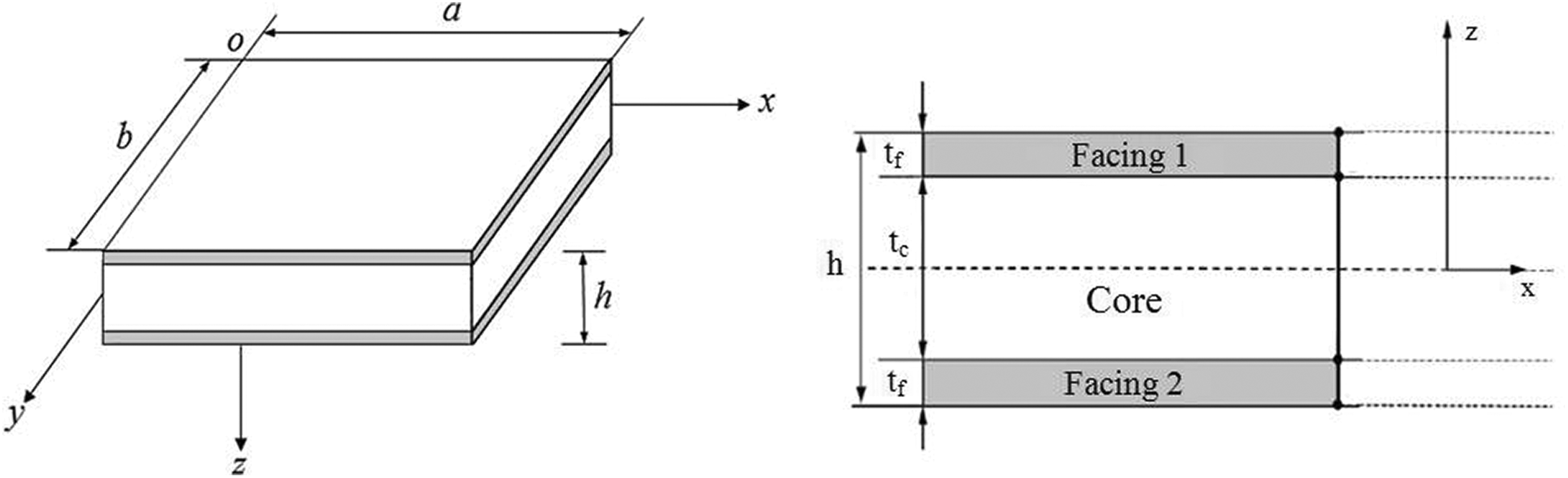
Geometry and coordinates of a sandwich plate.
It is proved that global higher order plate theory can accurately predict the distribution of modal displacements and stresses by taking into account the effects of both transverse shear and normal stresses satisfying the continuity conditions at layer interfaces and stress boundary conditions at the external surfaces in cross-ply multilayered composite plates 47 and in angle-ply multilayered composite plates subjected to critical temperatures. 48 Overall biaxial buckling analysis of sandwich plates with soft orthotropic core considering transverse flexibility was presented. Also wrinkling loads as well as the mode number can be predicted accurately. 49 A new improved higher order theory for global and local buckling analysis of sandwich plates with soft orthotropic core was presented. The effect of geometrical parameters and material properties of face sheets and core are examined on the overall buckling and face wrinkling of sandwich plates. 50 Shear stresses for free boundary conditions at the top and bottom surfaces of the plates are satisfied and shear correction factors are ignored. 51 Using FSDT along with the second method of Frostig’s HOT, a simple analytical method is formulated based on shear stresses in the core. 52 A trigonometric shear deformation theory (TSDT) taking into account transverse shear deformation effect as well as transverse normal strain effect used to obtain in-plane normal and transverse shear stresses through the thickness of plate was presented. 53 Uniaxial and biaxial buckling analysis of rectangular plates based on new trigonometric shear and normal deformation theory was proposed. 54 A problem of stress distribution in orthotropic and laminated plates subjected to central concentrated load was presented using an equivalent single-layer (ESL) TSDT. 55 An ESL TSDT taking into account transverse shear deformation effect as well as transverse normal strain effect is presented for static flexure of cross-ply laminated composite and sandwich plates. 56 A sinusoidal shear and normal deformation theory taking into account the effects of transverse shear as well as transverse normal was proposed, and the theory was used to develop the analytical solution for the bidirectional bending analysis of isotropic, transversely isotropic, laminated composite, and sandwich rectangular plates. The theory accounts for adequate distribution of the transverse shear strains through the plate thickness and traction-free boundary conditions on the plate boundary surface, thus a shear correction factor is not required. 57 A new fifth-order shear and normal deformation theory is developed for the bidirectional bending analysis of laminated composite and sandwich plates subjected to transverse loads. The theory proposed does not require a problem-dependent shear correction factor as it satisfies traction-free boundary conditions at the top and bottom surfaces of the plate. 58 An overview of the exact relationships between the solutions (i.e. deflections, buckling loads, and natural frequencies) of the classical plate theory (CPT)-FSDT and CPT-TSDT for isotropic and sandwich plates of various shapes and boundary conditions is presented. 59
A unified mixed higher order analytical formulation based on individual-layer and ESL theories has been presented to predict general buckling as well as wrinkling of a general multilayer, multicore sandwich plate having any arbitrary sequence of stiff layers and cores. Continuity of displacements as well as the transverse stresses through thickness has been explicitly satisfied in the formulation. 60 A variable kinematics model based on the sublaminate generalized unified formulation has been presented with regard to the thermal buckling analysis. 61
FGM plates
Generalized differential quadrature (GDQ) method is applied to study four-parameter FG and laminated composite shells and panels of revolution. The mechanical model is based on the so-called FSDT, in particular on the Toorani–Lakis theory. The solution is given in terms of generalized displacement components of points lying on the middle surface of the shell. The generalized strains and stress resultants are evaluated by applying the differential quadrature rule to the generalized displacements. The transverse shear and normal stress profiles through the thickness are reconstructed a posteriori using local 3-D elasticity equilibrium equations. 62 A refined shear deformation theory that accounts for parabolic distribution of the transverse shear strains and satisfies the zero-traction boundary conditions on the surfaces of the plates was presented. The mechanical properties of the plate are assumed to vary continuously in the thickness direction by a simple power-law distribution in terms of the volume fractions of the constituents. 63 The effects of rotatory inertia considered in the sinusoidal shear deformation plate theory are presented. The present sinusoidal theory contains the same dependent unknowns as FSDT and third-order shear deformation theory but accounts for according to a cosine law distribution of the transverse shear strains through the thickness of the plate. 64 An equivalent ‘single-layer approach’ is used, considering all displacement components (u, v, w) that linearly vary across the panel thickness for hybrid laminated faces and a transversely flexible core subjected to in-plane biaxial and shear loads. 65 Compressive post-buckling under thermal environments and thermal post-buckling due to heat conduction are presented for sandwich plate with FGM face sheets by attending the initial geometric imperfection of the plate. 66 A simple FSDT was developed and validated for a variety of numerical examples of the thermal buckling response of FG sandwich plates with various boundary conditions. 67 A simple analytical approach was used to investigate the thermal buckling behavior of thick FG sandwich by employing both the sinusoidal shear deformation theory and the stress function. 68 A simple but accurate sinusoidal plate theory (SPT) for the thermomechanical bending analysis of FG sandwich plates is presented. The main advantage of this approach is that, in addition to incorporating the thickness-stretching effect, it deals with only five unknowns as the FSDT, instead of six as in the well-known conventional SPT. 69 A refined TSDT taking into account the transverse shear deformation effects was presented for the thermoelastic bending analysis of FG sandwich plates. The number of unknown functions involved is only four, as against five in the case of other shear deformation theories. The theory presented is variationally consistent and does not require shear correction factor. 70 A new displacement field is presented that includes undetermined integral terms for analyzing thermal buckling response of FG sandwich plates. The proposed kinematic uses only four variables, which is even less than the first shear deformation theory (FSDT) and the conventional higher shear deformation theories (HSDTs). The theory considers a trigonometric variation of transverse shear stress and verifies the traction-free boundary conditions without employing the shear correction factors. 71 The plate–foundation interaction was estimated by a micromechanical model and multi-scale approach for compressive and thermal post-buckling of an exponentially graded sandwich plate resting on an elastic foundation. 72 The vibration and buckling behavior of an exponentially graded material (EGM) sandwich plate resting on elastic foundations under various boundary conditions was observed. 73
A new hyperbolic shear deformation theory considering transverse shear deformation effects is presented for thick FG sandwich plates. The theory is variationally consistent. The transverse shear stress satisfies zero shear stress boundary conditions on the top and bottom surfaces of the beam perfectly. The theory obviates the need for shear correction factor, and the results obtained are more accurate than those obtained using the CPT but are almost comparable to those obtained using HOTs. 74 A simple hyperbolic shear deformation theory is developed and applied for the bending, vibration, and buckling of powerly graded material sandwich plate with various boundary conditions. 75 A new shear deformation plate theory is introduced to illustrate the bending, buckling, and free vibration responses of FGM sandwich plates. A new displacement field containing integrals is proposed which involves only four variables. 76 A new higher shear deformation theory (HSDT) is developed for the free vibration and buckling of FG sandwich plates. The proposed theory presents a new displacement field using undetermined integral terms. Only four unknowns are employed in this theory, which is less than the classical first shear deformation theory (FSDT) and others (HSDTs). 77 A hyperbolic sine shear deformation theory is demonstrated for the analysis of FG plates by emphasizing through-the-thickness deformations. 78 Improved transverse shear stress and stiffness associated shear correction factor for FG sandwich plates based on the FSDT is proposed. 79 Post-buckling behavior of laminated composite, sandwich, and FG skew plates is analyzed in the present work. The problem formulation is based on HSDT and von Karman’s nonlinear kinematics. 80 The buckling response of rectangular sandwich plates with FGM core is studied using the second-order shear deformation theory. 81 An exact analytical solution for FGM sandwich plates with clamped boundary condition subjected to uniform, linear, and nonlinear temperature rises across the thickness direction is developed. The theory accounts for parabolic distribution of the transverse shear strains and satisfies the zero-traction boundary conditions on the surfaces of the plate without using shear correction factor. 82 A refined shear deformation theory is presented for the vibration and buckling of EGM sandwich plate resting on elastic foundations under various boundary conditions. 83 A unified formulation coupled with collocation with radial basis functions was proposed; a thickness-stretching HSDT was successfully implemented for the analysis of FG plates 84 and no shear correction factor is required 85 ; and optimized hyperbolic displacement under Carrera’s unified formulation (CUF) is presented for FG sandwich plates. 86 A displacement-based unified shear deformation theory is developed for the analysis of shear-deformable advanced composite beams and plates. The theory is developed with the inclusion of parabolic (PSDT), trigonometric (TSDT), hyperbolic (HSDT), and exponential (ESDT) shape functions in terms of thickness coordinate to account for the effect of transverse shear deformation. The in-plane displacements consider the combined effect of bending rotation and shear rotation. The use of parabolic shape function in the present theory leads to Reddy’s theory, but trigonometric, hyperbolic, and exponential functions are used for the first time in the present displacement field. The present theory is accounted for an accurate distribution of transverse shear stresses through the thickness of plate; therefore, it does not require problem-dependent shear correction factor. 87
Sandwich shells
Buckling of cylindrical sandwich shells subject to axial compression is addressed for shells having foamed metal cores. Constraints imposed by wrinkling and yielding of the face sheets and yielding of the core are all considered. The purpose is to examine the interaction between imperfections and plastic yielding to see whether buckling load knockdowns should be larger than those expected for elastic shells. 88 A reduced stiffness lower bound method for the buckling of laterally pressure loaded sandwich cylindrical shell without being concerned about geometrical imperfections is proposed. 89 Sandwich shell models without consideration of transverse core compressibility are not necessarily conservative in stress analysis during dynamic buckling, although the presence of a face wrinkling instability in general results in a decrease in the resulting stresses due to a general weakening of the structure. Therefore, several essential features in the dynamic buckling of sandwich structures are not captured by classical model with incompressible core which might yield inaccurate results. Henceforth, the effect of the transverse compressibility of the core on the transient dynamic response of plane and curved sandwich panels under rapid loading conditions is investigated. 90 The displacement and the stress fields of the core material are determined through a 3-D elasticity solution, 91 and the elastic solutions were demonstrated for accurately assessing the limitations of shell theories in predicting stability loss in sandwich shells. 92 Shear strain function yields nonlinear distribution of transverse shear stresses. 93 An investigation was carried on the static behavior of doubly curved laminated composite shells and panels. A 2-D general higher order ESL approach based on the CUF is proposed. The geometry description of the middle surface of shells and panels is computed by means of differential geometry tools. All structures have been solved through the GDQ numerical methodology. A 3-D stress recovery procedure based on the shell equilibrium equations is used to calculate through-the-thickness quantities, such as displacement components and the strain and stress tensors, 94 and is extended to an ESL approach based on a general higher order formulation, in which the thickness functions of the in-plane displacement parameters are defined independently from the ones through the shell thickness. 95 The static problem of laminated composite doubly curved shell structures subjected to concentrated loads was considered. 96 Also FG free-form and doubly curved sandwich shells using higher order ESL theory was presented. 97 A global–local higher order laminated shell model has been derived for analyzing multilayered shells satisfying free surface conditions and transverse shear stress continuity at interfaces. 98 Also transverse flexibility and transverse normal strain and stress of the orthotropic core are considered. 99 Special observation was made confirming the importance of enriching the model kinematic description by means of a zigzag function rather than increasing the order of the approximation for the in-plane displacement components compared to other zigzag models. 100
Numerical technique
Sandwich plates
Permissible approximations in modeling of structural sandwiches are studied. Three-dimensional solutions of sandwich panels subjected to combined temperature change and applied edge compression are obtained. Sensitivity coefficients of initially stressed sandwich panels are also evaluated. 101 The overestimation of buckling solutions from different HOTs was addressed using two C0 isoperimetric FE formulations, 102 and the elastic buckling of composite and sandwich plates subjected to thermal loads was first presented. 103 Also transverse normal strain deformation and thermal expansion in the thickness direction can be neglected in thermal buckling analyses. 104 An improved first-order zigzag theory and an associated FE model were employed. Here the element stiffness coefficients are integrated exactly, yet the element exhibits no shear locking due to the use of an interdependent interpolation scheme and consistent shear strain fields. 105 A new improved discrete Kirchhoff quadrilateral (IDKQ) element, which is accurate than the DKQ, is formulated and is presented based on the third-order zigzag theory. 106 A six-noded triangular element having seven degrees of freedom (DOFs) at each node was used to study sandwich plates with stiff laminated face sheets. The element formulation was based on a refined higher order plate theory having all the features for an accurate modeling of sandwich plates with affordable unknowns. 107 A new six-node multilayered triangular FE has been presented, which gives accurate results when compared with the exact 3-D elasticity solution for a sandwich plate. It was observed that all stresses are continuous at the corner nodes of adjacent elements. The element has good properties in the field of FEs (no spurious energy modes, very fast convergence, and no shear locking), 108 and geometrically nonlinear investigation was made. 109 A comparative study of analytical solutions with different modeling approaches for predicting sandwich panel buckling and wrinkling response has been presented. 110
A B-spline finite strip method is demonstrated in which the in-plane displacements vary quadratically through the thickness, while the out-of-plane displacement varies linearly for rectangular sandwich plates. 111,112 New formulations for B-spline finite strip have been established through the use of a three-layer, third-order plate theory for the main sandwich plate, and an ESL plate theory for the compact stiffeners. This formulation is not suitable for thick stiffener plates; in such case, shear deformation theories are more suitable. 113 The effects of initial stresses on the natural frequencies and stability response of composite sandwich plates are determined using two new C0 assumed strain FE formulations of a refined form of Reddy’s HOT. The developed elements are free from any major defects such as shear locking and parasitic spurious zero energy modes due to the assumed strain approach 114 ; bending elements were developed based on a refined higher order shear deformation theory (HSDT) 115 and isoparametric assumed strain FE formulation was developed based on a refined third-order theory. 116 A displacement-based FE is formulated using a three-layer sandwich model. 117 Due to discarding of transverse normal stress in buckling loads of simply angle-ply laminated composite and sandwich plates subjected to thermal/mechanical loading, less accurate solutions were presented in comparison with LW theory. 118 It was found that no solution exists in the literature for the problem of sandwich plate subjected to partial edge loading and investigated by a newly developed triangular element based on an RHSDT, where the continuity of stresses is satisfied at the layer interfaces by taking jumps in the transverse shear strains at the interfaces. It is interesting to note that the plate model having all these refined features requires unknowns at the reference plane only, 119 –122 and the different degrees of imperfections at the layer interfaces were investigated. 123 An FE analysis is carried out using commercial ABAQUS software, version 6.14. Problems were analyzed to assess the role of the core on the natural frequencies and critical loads of sandwich plates. It is concluded that FE models taking into account the transversal shear deformation should be used even for cases of “thin” sandwich plates. 124
The free vibration and damping characteristics of plates consisting of composite stiff layers and an isotropic viscoelastic (VEL) core were studied under thermal loads using FE method. The temperature dependence of VEL core properties and effects of prestresses are taken into account. The inherent composite damping and damping due to VEL layer are compared. 125 A work dealing with thermal buckling and vibration behavior of multilayer rectangular VEL sandwich plates has been investigated by paying attention to temperature-dependent characteristics of complex shear modulus of VEL core, and a decoupled thermomechanical analysis using FE method is made. 126 Thermally induced deformation buckling and post-buckling analysis of a unidirectional sandwich panel with a soft core with mathematical formulation is based on the higher order sandwich panel theory, and it incorporates the effects of the flexibility of the core in the vertical direction. The effects of the vertical thermal core normal strains of the core, which are usually ignored by various computational models, are studied at the buckling and post-buckling stages, with emphasis on the differences in the mechanical behavior along with FE analysis using ANSYS. 127 Buckling and free vibration behaviors of a smart skin, a simple conformal load-bearing antenna structure, are studied using the FE method. The smart skin is modeled as an asymmetry and multilayered sandwich structure. The formulation of the smart skin model is based on the first-order shear deformation plate theory, and numerical results are obtained by the FE method. 128
The local–global analysis of laminated composite and sandwich plates using an LW displacement model is studied numerically using an original MATLAB R2009a computer program coded for analytical and FE solutions of the theory. 129 It was illustrated that the strength of a sandwich panel can be considerably enhanced using a stepwise variable thickness that increases at the critical region of the structure without a detrimental increase of the weight, and such structures are analyzed using numerical technique. 130 A gap in the literature on solutions for laminated composite and sandwich skew plates based on refined theories was found. To overcome the problem of C1 continuity associated with the plate theory, an efficient C0 continuous isoparametric element model developed based on the refined higher order zigzag theory (HOZT) was used to estimate the global behavior of the sandwich skew plates, 131 and C0 FE model is developed by implementing the inverse hyperbolic shear deformation theory and formulation has been generalized for all existing shear deformation theories involving shear strain function. 132 An improved C0 plate FE model has been developed for the static analysis of a laminated soft core sandwich plate based on the RHSDT with a least square error (LSE) method to accurately calculate the deflections as well as stresses for different problems of composite and sandwich laminates. 133 An eight-noded C0 continuous element with adequate choice of nodal field variables is developed based on secant function-based shear deformation theory. The shear deformation is expressed in terms of a secant function of thickness coordinate and the theory satisfies the zero transverse shear conditions. 134 A C0-type zigzag theory has been proposed for laminated composite and sandwich plates with general configurations. Compared with the zigzag model considering the transverse normal strain, the proposed model is accurate and efficient. 135 A C0 FE model based on refined HOZT is used to study the stability analysis of laminated sandwich plates. 136
Electrorheological sandwich plates
The rheological properties of an electrorheological (ER) material, such as viscosity, plasticity, and elasticity, may be changed when applying an electric field. When an electric field is applied, the damping of the system is more effective. The rectangular plate is covered in an ER fluid core and a constraining layer to improve the stability of the plate system. The ER fluid core is found to have a significant effect on the dynamic stability and the location of the boundaries of the dynamic instability regions.
The dynamic stability problems of such a sandwich plate subjected to an axial dynamic force are investigated using FE method to calculate instability regions in sandwich plate, 137 which is orthotropic facing. 138 A new novel trigonometric zigzag theory is developed in combination with an efficient C0 continuous isoparametric serendipity FE model for the analysis of laminated composite and sandwich plates. The theory is based on shear strain shape function assuming nonlinear distribution of transverse shear stresses. The excellent mesh convergence with minimum number of elements, solution accuracy that is in well agreement with the 3-D elasticity results and the available published results, and the wide range of applicability with minimum computational efforts enhance the richness of the presented model. Thus, zig-zag theory with secant function (ZZTSF) may be recommended as the most efficient one for the free vibration and stability analysis of laminated composite and sandwich laminates. 139 A buckling optimization technique was investigated on isotropic sandwich plates with FE coding for different core geometries. 140
Sandwich shells
Thin-walled cylindrical structures are found extensively both in engineering components and in nature. The weight- to-load-bearing ratio is a critical element of design of such structures in a variety of engineering applications, including space shuttle fuel tanks, aircraft fuselages, and offshore oil platforms. In nature, thin-walled cylindrical structures are often supported by a honeycomb- or foam-like cellular core, as, for example, in plant stems, porcupine quills, or hedgehog spines. Studies have suggested that a compliant core increases the buckling resistance of a cylindrical shell over that of a hollow cylinder of the same weight. Currently, engineering cylinders used in load-bearing applications are typically supported by an internal-mesh supporting structure. An internal support increases the load-bearing capability of the cylinder and makes it less sensitive to defects and more resistant to local buckling.
The linear elastic buckling theory is used for optimization analysis, by coupling it with basic plasticity theory to provide a more comprehensive analysis of isotropic cylindrical shells with compliant cores. The optimization analysis provides tractable analytical equations, which can be used to successfully optimize the design of a cylinder with a compliant core. Factors contributing to the deviation from the theoretical design include the weight of the epoxy required to bond the core to the shell, the increased sensitivity to the shell thickness tolerance, the increased sensitivity to imperfections, and the short buckling wavelength of the shell. The analytical analysis does not account for the weight of the epoxy to bond the compliant core to the cylinders. 141 The linear buckling behavior of sandwich cylindrical panels with isotropic or orthotropic cores with different boundary conditions was optimized using the FE method, and a genetic algorithm toolbox in MATLAB is implemented. 142
Experimental method
Sandwich plates
Experiments to determine the overall buckling and faceplate wrinkling loads of sandwich panels with carbon fiber–reinforced plastic (FRP) faces and honeycomb cores when loaded under uniaxial compression are described. The results are compared with theoretical predictions which assume that the faceplates are orthotropic. The effect on the experimental loads of certain coupling terms, which occur in the constitutive equations of those faceplates which are not orthotropic, is then considered. 143 Experimental buckling tests were carried out on rectangular orthotropic sandwich FRP panels for buckling in uniaxial compression with either balsa or linear polyvinyl chloride (PVC) foam cores for two aspect rations, that is, 1.3 and 2.0. Post-buckling analysis is also investigated. The sandwich panels were fabricated using the vacuum-assisted resin transfer molding (VARTM) technique. The two short edges of sandwich panels were clamped and long edges simply supported. The experimental results were obtained with a difference of 5–8% for both sizes of balsa from numerical and analytical results and for foam 15–23%. 144 The experimental elastic buckling loads were then measured using strain gauges fixed to both sides of the panels. In balsa core specimens, the type of failure was easily identified as face sheet delamination followed by core shear failure, and in PVC foam core specimens, the type of failure consisted of core shear failure with little or no face sheet delamination. In the failed balsa core panels, there was little or no evidence of balsa remaining on the FRP face sheet, however, in the PVC foam core panels, there were ample amounts of foam left on the FRP face sheet. It was concluded that although the buckling loads for the foam core panels were not as high as those for the balsa core panels, PVC foam core bonding to the FRP face sheets was superior to balsa core bonding. 145 Rectangular orthotropic glass FRP sandwich panels with either balsa or foam cores were tested for two aspect rations, that is, 1.3 and 2.0, under uniform out-of-plane pressure, and the strains and deflections were compared with those from FE models of the panels and fabricated VARTM technique. Uniform external pressure was applied using two large water inflatable bladders in series. The deflection and strains were measured using dial gages and strain gages placed at quarter and half points on the surface of the panels. Measurements were made up to a maximum out-of-plane pressure of 0.1 MPa (15 psi). 146 A special test rig is designed to furnish simply supported boundary conditions in order to describe the buckling behavior of orthotropic plates. The critical buckling load of the panels was evaluated by fitting the analytical expression by nonlinear regression to experimentally measured load–displacement curves. A 15–20% difference in results was observed both analytically and experimentally. This is mainly attributed to the absence of transverse shear deformations in the analytical model. A significant difference was also observed between analytically predicted and experimentally measured load–displacement curves at large out-of-plane deformation. This is probably caused by the nonlinear material behavior of paper and local buckling of the panel facings, that is, the liners. 147 Significant wrinkling strength increases (up to 7.5 times) are predicted for corrugated panels when compared with equal weight traditional flat panels was calculated in an examination for wrinkling behavior is of sandwich panels with soft relatively thick core material. Semicircular and sinewave-shaped corrugations are studied as a means of stiffening the skins against uniaxial in-plane loading. Results are derived from an FE buckling analysis with analytic and experimental justification provided for fiberglass and foam core sandwich specimens. Semicircle-shaped corrugations hold the promise of increasing critical load capacity by 7.5 times over their flat counterparts, provided that skins of sufficient strength are used and loading occurs in a single direction. Sine wave-shaped corrugations have been shown to be less effective in strengthening the panels, 148 and the effect of initial imperfections on the wrinkling load of composite foam core sandwich panels. 149 Buckling analysis of sandwich plates made of two composite laminates as skins and a VEL core was investigated analytically using LW theory and experimentally. The study demonstrated that LW theory could describe buckling behavior of sandwich plates with high accuracy and represents more realistic and acceptable description of behavior of the plates with much less computational cost. 150
Sandwich shells
Experiments were carried out to examine the response of carbon fiber–reinforced composite (CFRC) sandwich cylinders with lattice cores for different failure modes. 151 The mechanical behavior of sandwich-walled cylindrical shells with aluminum pyramidal truss core and CFRC skins co-cured with the metallic truss core is estimated. It is found that local buckling and face crushing modes can exist together and are the most important modes of failure of the fabricated structure. 152
Vibration introduction
The free vibration of plate structure is of utmost important aspect of the design parameter. Sandwich structures having the lightweight compared to traditional material plate structures under dynamic service conditions will lead to resonant conditions if the plates are not designed properly by considering the natural frequency and damping concepts. There were many theories, techniques, and advanced equipments discovered from approximations to exact solutions of the sandwich plate and shell structures. Before the year 2000 many researchers conducted research on free vibration of isotropic and laminated sandwich plates and shells with different analytical models 153 –167 and numerical techniques 168,169 . The other works that are carried out after the year 2000 were classified and discussed as follows.
Analytical models
Sandwich plates
The global behavior of the sandwich plate can be accurately predicted by taking all the parameters involved in free vibration behavior, such as effects of extension and transverse shear deformation, rotary and translator inertias, and flexural and extensional rigidities. The material densities, thickness, dimensions, and material constants also have an effect on the free vibration behavior of the plate. The magnitude of the first natural frequency is often used as a criterion for the design efficiency of sandwich panels.
The vibration analysis of rectangular sandwich plates having two adjacent edges fully clamped and the remaining two edges free (CFCF) is performed by applying Hamilton’s principle and generalized Galerkin method in conjunction with the FSDT, 169 and the size variation of different sandwich cores and the homogenized cores was presented. 170 The vibrations of fully clamped sandwich plate are analyzed using Galerkin method. The effects of the panel dimensions, elastic properties and densities of the facings, and core on the fundamental frequency have been studied using the numerical solution, analytical approach, and FE analysis. 171 Vibration frequencies and mode shapes of honeycomb sandwich panels with various structural parameters were studied using computational and experimental methods. 172 Low-order and high-order shear deformation models are applied to investigate the effect of honeycomb core (transversely shear deformable) on flexural vibration of thick rectangular sandwich panel with isotropic face sheets. 173 The effect of different boundary conditions on the free vibration analysis response of a sandwich plates is presented using HSDT. The frequency and mode shapes of the structure are obtained using DQM. 174 The FSDT is a relatively simple tool that has been found to yield accurate results in the nonlocal problems of sandwich structures, such as buckling and free vibration. However, a key factor in practical application of the theory is determination of the transverse shear correction factor (K), which appears as a coefficient in the expression for the transverse shear stress resultant. The physical basis for this factor is that it is supposed to compensate for the FSDT assumption that the shear strain is uniform through the depth of the cross section. Six methods for evaluating the shear correction factor of the sandwich structures have been compared. 175 The bending and free vibration analysis of multilayered plates and shells was presented by utilizing a new HSDT, involving only four unknowns, which is even less than the first shear deformation theory (FSDT) and without requiring the shear correction coefficient. 176
Study indicates that the classical plate theories are not adequate for the flexural vibration analysis of honeycomb panels. Using Reddy’s third order shear deformation plate theory and corrected Gibson formula, the effects of panel thickness and core thickness were studied (SSSS 177 and SCSC 178 ). The improved Reddy’s third-order theory coupled with shear correction factors in predicting free flexural vibration of symmetric honeycomb panels is examined by being compared with the experimental value and the FE analyses based on 3-D models. 179 An extended high-order sandwich panel theory for sandwich beams/wide panels is considered, in which the axial stresses, as well as the shear and transverse normal stresses in the core, are taken into account. 180
The exact solution of the natural frequencies for rectangular honeycomb sandwich panels with all edges simply supported is obtained. 181 The vibration of a sandwich panel with two identical isotropic face sheets and an orthotropic core was studied. 182 A simple four-variable TSDT considering the effects of transverse shear deformation and rotary inertia is evaluated for the free vibration analysis of antisymmetric laminated composite and soft core sandwich plates. The theory is displacement-based ESL theory in which the in-plane displacements use trigonometric function in terms of thickness coordinate for calculating out-of-plane shearing strains. The number of unknown variables involved in the present theory is only four as against five or more than five in the case of other HOTs. 183 Higher-order ESL theory is used to study the effects of adding a distributed attached mass to the face sheets of sandwich panels on free vibration of the system. 184 An analytical framework has been proposed to analyze the effect of random structural irregularity in honeycomb core for natural frequencies of sandwich panels. 185
A truss-core sandwich panel that is similar to conventional sandwich systems is considered, which eliminates many of the attendant problems associated with fabrication of conventional forms. The dynamic response of the truss-core–clamped sandwich panel is formulated as a homogeneous orthotropic thick plate. 186 Using these equivalent constants in conjunction with a closed-form solution, free and forced vibration response of the sandwich panel as an orthotropic, thick-plate continuum are derived. The calculated dynamic response using the closed-form solution for an orthotropic thick plate is compared with the exact solution and Mindlin plate theory. 187 No literature is found for the free vibration of skew sandwich plates composed of an orthotropic core and laminated facings. The p-Ritz method has been adopted for the analysis for the first time. 188 The coordinates system and dimensions of skew sandwich plate is shown in Figure 2.
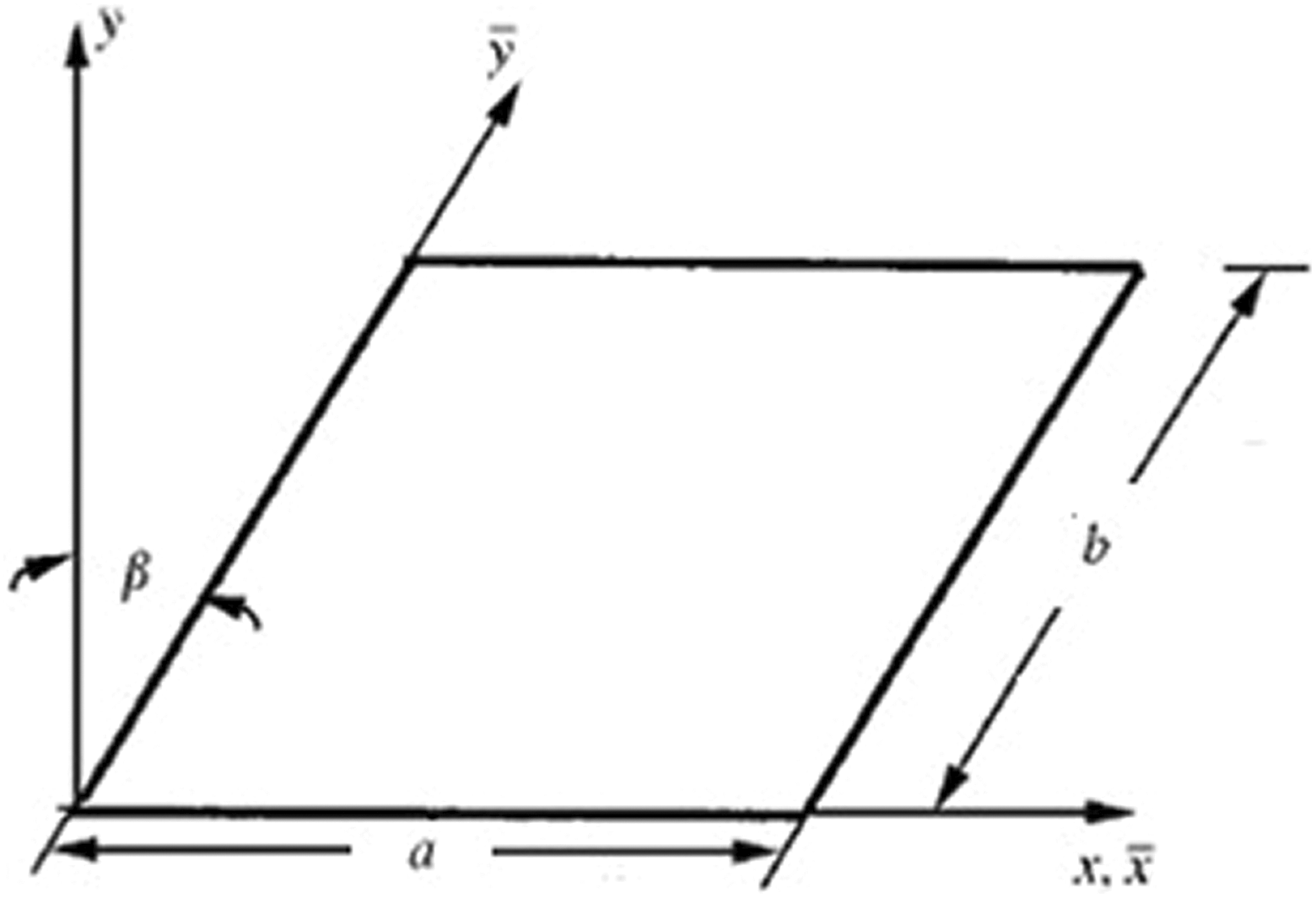
Coordinates system and dimensions of skew sandwich plate.
A consistent refinement of FSDT for laminated composite and sandwich plates using improved zigzag kinematics is used. 189 For the first time, the natural frequency analysis of composite and sandwich plates was analytically formulated using two higher-order refined theories, 190 antisymmetric angle-ply composite, and sandwich plates. 191,192 A theoretical approach for the free vibration analysis of delaminated unidirectional sandwich panels with a flexible core is developed. 193 The difference in the free vibration response of the sandwich facings with open and closed matrix cracks was studied. 194 A higher order displacement–based formulation has been developed to investigate the plane strain edge vibrations or end modes in composite-laminated sandwich plates. 195 A structural dynamic analysis of skew sandwich plate with laminated composite faces based on the high-order shear deformation plate theory (HSDT) is performed. 196
The first-order shear deformation LW theory for static and free vibrations response of sandwich and laminated composite plates 197 and multiquadrics discretization with independent rotations in each layer 198 were used. A variable-kinematic Ritz formulation based on 2-D higher order LW and ESL theories is described to accurately predict free vibration of thick and thin, rectangular and skew multilayered plates with clamped, free, and simply supported boundary conditions. 199 A GDQ technique is used for predicting the static deformations and free vibration behavior of sandwich plates. 200 A new inverse hyperbolic and inverse trigonometric zigzag theory is proposed for laminated composite; sandwich plates are extended for the free vibration analysis of the laminated composite and sandwich plates, 201 and the dynamic stability analysis of the laminated composite and sandwich plate due to in-plane periodic loads is studied. 202 Although the global HSDTs may predict the gross responses of the sandwich plates sufficiently accurate, their results may show considerable errors in predicting the local effects. LW and mixed LW theories are computationally expensive, and generally, the interlaminar transverse stresses continuity conditions are not enforced in the former category of theories. Majority of the available zigzag and global–local theories suffer from the point that the transverse normal stress continuity that influences the transverse deformation significantly, especially in sandwich plates with soft cores, is not satisfied at the layer interfaces. To prevail over the difficulties, a generalized global–local high-order theory for bending and vibration analyses of sandwich plates subjected to thermomechanical loads was presented. Also stress components are considered in the formulations and can be used for sandwich plates with stiff or soft cores. 203
The free vibration response of a unidirectional sandwich panel with an incompressible core using shear deformable and layered models is presented. 204 Two enhanced plate theories for the laminated composite and sandwich plates via the mixed variational formulation for free vibration studies are considered. By obtaining the transverse shear stresses based on HOZTs, the mixed variational formulation embraces them as the classical FSDT and HSDT, which renders the enhanced plate theories (EFSDT and EHSDT). 205 The hierarchical trigonometric Ritz formulation developed in the framework of CUF has been employed in conjunction with the Ritz method to carry out the free vibration analysis of soft-core and hard-core sandwich plates with anisotropic face sheets in thermal environment. 206 A unified method is proposed, a modified Fourier method based on the FSDT for the vibration and damping analysis of the laminated sandwich plates. 207 A study of the linear transient response of composite plates using radial basis functions and collocation method was presented. 208 The free vibration of composite truss-core sandwich plates is investigated to compare the response using the classic laminated plate theory, the FSDT, the Reddy’s third-order shear deformation theory, and a zigzag theory. 209
VEL plates
The analysis of the free vibration of rectangular sandwich plates with VEL cores is carried out evaluating two displacement theories of sandwich plates, classical and third-order plate theory. 210 FRP sandwich plates with PVC foam core are investigated. 211 An improved HOZT for vibration of soft-core sandwich plates with random material properties is proposed. 212 The dynamic behavior of sandwich panels were examined with flexible core, 213 sandwich structures with a core that is flexible and compliant in the vertical direction and with temperature-dependent mechanical properties 214 also based on the high-order sandwich panel theory. 215 The Reissner theory is inadequate for the analysis of hard-core sandwich plates due to the exclusion of in-plane stress and stiffness of the core. Different revision factors were put forward to revise the bending, buckling, and free vibration of soft-core Reissner theory for hard-core sandwich plates. 216 A mathematical model is coded in MATLAB for free vibrations analysis of the laminated composite and soft-core sandwich plates. 217 Two types of computational models for free vibration analysis of sandwich panels with a flexible core based on the high-order sandwich panel theory were presented. 218 The consistent higher order dynamic formulation for foam-type (soft) core sandwich beams was extended to the free vibration analysis of soft-core and honeycomb-core sandwich plates with antisymmetric and symmetric layups. 219
FGM plates
The FSDT is a highly efficient and convenient method for analyzing the moderate thick plates. But the shear correction factor of plate is a necessary parameter in FSDT to cater the non-uniformed shear strain in transverse section. The shear correction factor of homogeneous plate is not suitable for the FGM plate, as the variation of material properties is not considered in the theory. A convenient and efficient method is developed to obtain the shear correction factor for FGM plates based on thickness shear vibration. Thickness shear vibration is an in-plane vibration of infinite plates characterized by shear deformation. The frequencies of thickness shear vibration of an infinite FGM plate according to 3-D theory of elasticity is determined by Galerkin method. The shear correction factor can then be obtained by matching the fundamental frequencies of thickness shear vibration obtained by 3-D theory of elasticity and by FSDT. 220 A new higher order shear and normal deformation theory for the bending and free vibration analysis of sandwich plates with FG isotropic face sheets is developed. 221 The free vibration analysis of sandwich plates with power-law FG face sheets is performed and an improved high-order sandwich plate theory is used to analyze the free vibration of sandwich plates with FG face sheets. 222,223 A new hyperbolic shear deformation theory applicable to bending and free vibration analysis of isotropic, FG, sandwich, and laminated composite plates is presented. 224 A simple but accurate hyperbolic plate theory for the free vibration analysis of FGM sandwich plates is developed. The significant feature of this formulation is that, in addition to including the shear deformation effect, it deals with only three unknowns as the CPT, instead of five as in the well-known first shear deformation theory (FSDT) and HSDT. A shear correction factor is, therefore, not required. 225
An n-order shear deformation theory is proposed to analyze the free vibration of FG and composite sandwich plates. 226 A four-variable refined plate theory is developed for the vibration analysis of the rectangular FG sandwich 227 ; also various four-variable refined plate theories are presented to analyze vibration of FG sandwich plates. 228 It is seen that the thickness-stretching effect is more pronounced for thick sandwich plates, and it needs to be taken into consideration in modeling the free vibration response of FGM sandwich plates. A new five-variable refined plate theory for free vibration of FGM sandwich plates is presented without requiring a shear correction factor. 229 A thickness-stretching sinusoidal shear deformation theory was implemented for the static and free vibration analysis of FG plates. A novel application of a unified formulation by a meshless discretization is proposed. 230 The formulation of advanced 2-D Ritz-based models was used for accurate prediction of natural frequencies of thin and thick sandwich plates with core made of FGM. 231 Static and free vibration behaviors of two type of sandwich plates based on the 3-D theory of elasticity are investigated. 232 A 3-D vibration analysis of rectangular FGM sandwich plate has been carried out based on the linear, small strain 3-D elasticity theory via Ritz method. This study reveals that the thin plates are more sensitive to the material property than thick plates 233 and the small- and large-amplitude vibrations of compressively and thermally post-buckled sandwich plates with FGM face sheets in thermal environments. 234 Free vibration analysis of simply supported sandwich plate resting on elastic foundation is examined. Here the displacements vary as a sinusoidal function across the plate thickness. 235
Free vibration analysis of sandwich plates with non-monotonically graded flexible core is studied using a high-order sandwich panel theory. 236 Local and global damped vibrations of thin and thick FRP plates with a VEL soft flexible core show an improved higher order approach. 237 An improved high-order sandwich plate theory (IHSAPT) is applied to investigate the dynamic behavior of in-plane prestressed FRP sandwich thin and thick panels with VEL flexible core and arbitrary boundary conditions. 238 A refined plate theory is applied to investigate the free vibration analysis of FG nanocomposite sandwich plates reinforced by randomly oriented straight carbon nanotube (CNT). 239 The free vibration analysis of a sandwich plate with a transversely flexible core and FG-CNTs-reinforced nanocomposite face sheets subjected to magnetic field and temperature-dependent material properties is presented based on high-order sandwich plate theory (HSAPT). 240 The Rayleigh–Ritz method is used to calculate the vibrational characteristics of the annular sandwich plate with a constraining layer, and an ER fluid core is analyzed. The annular plate is fully treated with an ER fluid core layer and a constraining layer to improve the vibration behavior of the system, 241 and a rectangular sandwich plate with four simply supported edges is investigated. 242 The first study on the free vibrational behavior of sandwich panels with flexible core and composite sheets in the presence of magnetorheological (MR) smart oil between the layers in the presence of smart sheets of oil which is capable of the excitation of magnetic field was investigated. 243 An exact 2-D analytical solution is proposed for the free vibration analysis of simply supported piezoelectric adaptive plates. 244
Sandwich shells
The free vibration analysis of doubly curved open deep sandwich shells made of thin outer layers and a relatively thick core, the outer layer are assumed to be made of high strength and high density material. The core is a low-strength, low-density material, and the geometry and coordinates of the cylindrical sandwich panel are shown in Figure 3.
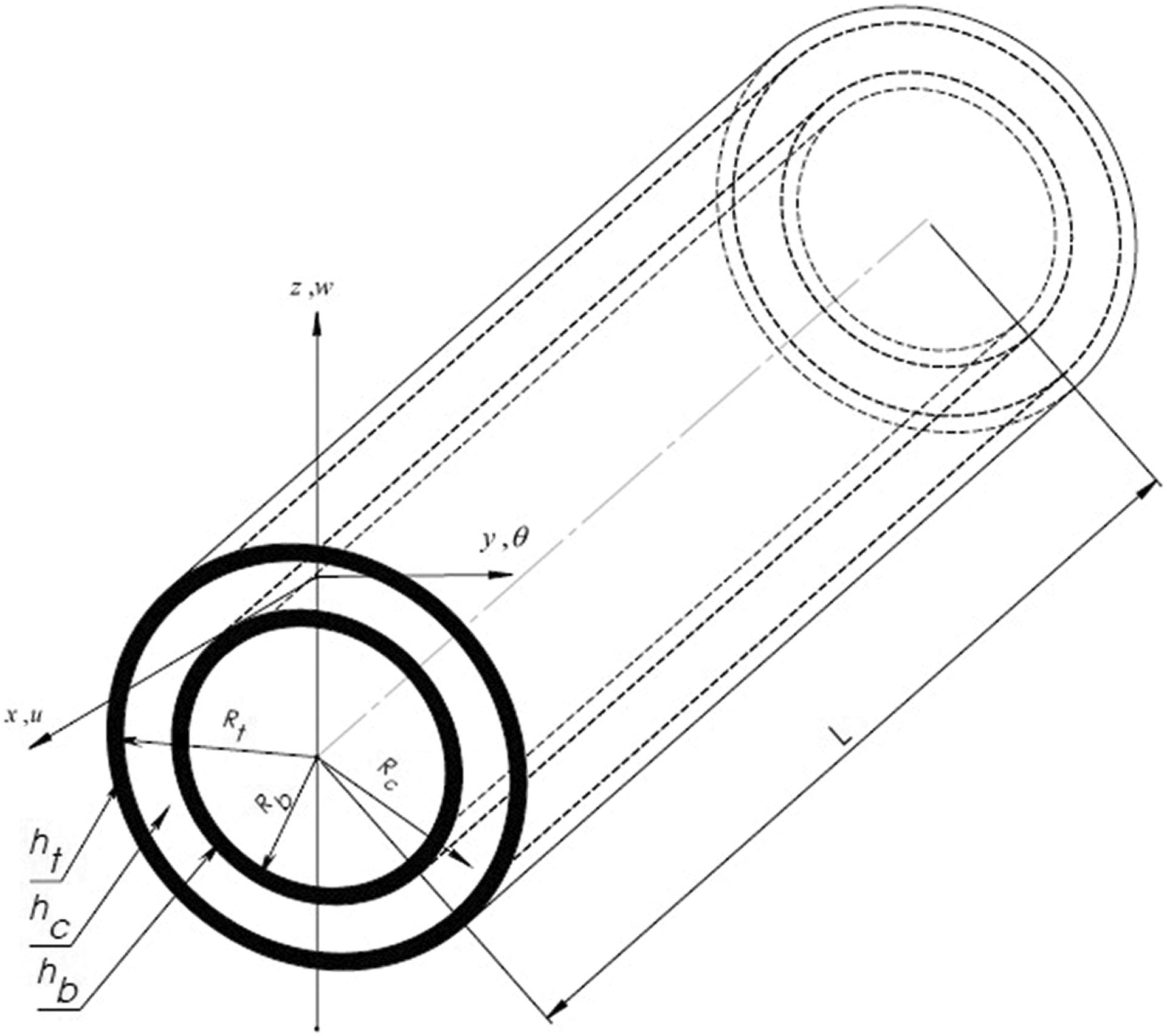
Geometry and coordinates of the cylindrical sandwich panel.
The Rayleigh–Ritz method, in which the displacement fields are defined by Bezier surface patches, is used to obtain the natural frequencies of open panels circumscribed by four curvilinear edges. 245 The GDQ method is applied to study the dynamic behavior of laminated composite doubly curved shells of revolution. The FSDT is used to analyze moderately thick structural elements. 246
A modified FSDT was employed to obtain the closed-form solutions of sandwich plates and shells. 247 A new HSDT for elastic composite/sandwich plates and shells is developed. 248 Free vibration analysis of thick cylindrical composite sandwich panels with simply supported boundary conditions based on a new improved higher order sandwich panel theory was presented. 249 A new kinematic model developed using higher order structural theory was presented for laminated composite shells. 250 A very general free vibration analysis of thick double-curved composite sandwich panels with simply supported or fully clamped boundary conditions based on a new improved higher order sandwich panel theory. 251 The free vibration analysis of simply supported cross-ply laminated composite and sandwich doubly-curved shells is presented based on HSDTs. 252 Zigzag function is implemented to introduce discontinuity at the core/faces interfaces to build HOTs to evaluate the free vibration response of sandwich plates and shells with soft cores. 253 The dynamic behavior of damaged composite plates and shells was investigated using a novel mathematical formulation developed to model decay by means of 2-D smooth functions for laminated composite plates and shells. The functions that are the Gaussian and the ellipse-shaped ones for the mechanical properties of one or more plies. The solutions of damaged structural elements have been evaluated by means of several higher order models including the Murakami’s function to capture the so-called zigzag effect. In fact, only the zigzag models are able to capture the effective behavior if sandwich structures are analyzed, if the soft core effect is negligible. 254
Higher order sandwich shell theory was adopted for the analysis to study the effect of core and face sheet anisotropy on the natural frequencies of plane and doubly curved sandwich structures with laminated composite face sheets and an anisotropic core. 255 The general-purpose proposed theory may be easily used for flat, cylindrical, spherical, and other geometries of sandwich structures, whereas different HSAPTs should be separately developed for using in flat, cylindrical, and spherical sandwich panels. Closed-form solution of doubly curved composite sandwich shells based on the refined high-order three-layered theory is presented for the first time. 256 Free vibration analysis of thick, doubly curved laminated composite shells and panels was made based on a higher order LW theory using a general displacement field based on the CUF, including the stretching effect for each layer 257 and doubly curved laminated shells and panels when soft-core properties for which the stretching effect of each layer is not neglected. 258 An exact free vibration solution of the laminated composite shell is provided based on Carrera’s approach. 259 The free vibration analysis of cylinders and cylindrical shells with all the edges is simply supported and the free frequencies are calculated using an exact 3-D shell model. The 3-D exact model gives all types of vibration modes, when the four edges are simply supported, changing the imposed half-wave numbers m and n in the two in-plane directions are α and β and when some of the modes have one of the two half-wave numbers equals zero. When this condition is simultaneously combined with the condition of transverse displacement different from zero, this vibration mode is defined as cylindrical bending (CB) mode. The free frequencies of isotropic single-layered plates, isotropic two-layered cylinders, and composite three-layered cylindrical shells with all the edges are simply supported and the free frequencies are calculated using an exact 3-D shell model. The model was able to improve the CB solutions. 260 The CB in the free frequency analysis of FGM plates and cylindrical shells was presented. Two-dimensional numerical approaches (the GDQ and the FE methods) are compared with an exact 3-D shell solution in the case of free vibrations of FGM plates and shells. It has been demonstrated that the actual CB is possible only with respect to straight edges. The CB conditions are not possible in 2-D numerical models when the half-wave number is zero in the curvilinear edge; in this case, the modification of boundary conditions does not properly work. All the considerations about the CB are valid for each geometry (plate, cylinder, and cylindrical shell), lamination scheme, FGM law, and thickness ratio. 261 The higher order sandwich plate theory of beams and plates with the cylindrical shells using the classical shell theory for the face sheets and the 3-D elasticity solution for the core, for the first time, is extended to the free vibration analysis of composite sandwich cylindrical shell with a flexible core. 262 A free vibration analysis of one-layered and multilayered isotropic composite and sandwich cylindrical and spherical shell panels was made. A comparative study was also made between classical 2-D and 3-D FEs, classical and refined 2-D GDQ methods, and an exact 3-D solution. 263 The free vibration analysis of several laminated composite doubly curved shells, singly curved shells and plates, characterized by a continuous thickness variation, was reported. 264 A study was made for free vibrations of laminated cylinders of oval and elliptic cross sections using the GDQ and shell theories of different order. 265 There are few reports on the free vibration of soft core doubly curved sandwich shells. Previous studies are largely based on the ESL theories in which the natural frequencies are grossly overestimated. For the first time, a closed-form solution of static problems and free vibrations of a doubly curved sandwich shell with flexible core based on a newly developed three-layered high-order sandwich panel theory (mixed theory) is presented. 266
A work concerned with the modeling, vibration, and wave propagation analysis of anisotropic nanoparticles according to the 3-D elasticity theory in conjunction with nonlocal strain gradient theory was presented. 267 The free vibration analysis of three-phase (CNT/polymer/fiber) laminated nanocomposite plates and shells using FSDT and the GDQ method is proposed. 268 The effect of CNT agglomeration on the free vibrations of laminated composite doubly curved shells and panels reinforced by CNTs was investigated. 269 Various investigations were conducted with regard to the free vibration analysis of laminated doubly curved shells and plates resting on elastic foundation and reinforced by CNTs. 270 An analytic method, that is, wave-based method, was presented to investigate free and forced vibrations of elastically coupled thin annular plate and cylindrical shell structures with arbitrary boundary conditions. 271 A variational approach for the wave dispersion in anisotropic doubly curved nanoshells is presented for the first time. To study the doubly curved nanoshell as a continuum model, a new size-dependent HSDT is introduced. To capture the small-scale effects, the nonlocal strain gradient elasticity theory has been implemented. 272
FGM shells
Free vibration analysis was made on simply supported cylindrical and rectangular sandwich panels with isotropic face sheets and a FG core based on the Reissner assumptions. 273 An investigation demonstrating the effect of continuously grading fiber orientation face sheets on free vibration of sandwich panels with FG core using generalized power-law distribution is presented. 274 A study dealing with free vibration analysis of thick nanocomposite laminated curved panels with continuously graded CNT-reinforced sheets with finite length resting on two-parameter elastic foundations, based on the 3-D elasticity theory, was presented. 275
Based on the theory of elasticity, a first known exact 3-D free vibration solution of simply supported FGM sandwich cylindrical panel was presented. 276 Free vibration analysis of thick laminated curved panels with finite length was based on the 3-D elasticity theory. 277 The 3-D free vibration of laminated cylindrical panels with finite length and FG layers is presented. 278 An analytical method for the 3-D vibration analysis of a FG cylindrical shell integrated by two thin functionally graded piezoelectric layers is presented. 279 An exact 3-D free vibration solution for sandwich cylindrical panels with FG core was analyzed. 280 The free vibration analysis of composite sandwich cylindrical shell with a flexible core submerged in water by using a higher order sandwich panel theory and considering the fluid pressure was studied, 281 and the free vibration response of circular cylindrical shells with FGM is investigated. 282
The free vibration of three-layered sandwich cylinders with VEL core is considered. 283 The vibration and damping characteristics analysis of the orthotropic cylindrical shells with an ER layer and a constraining layer are studied. 284 Compared with VEL materials, ER fluids can be effectively used to suppress the vibration over a broad frequency and temperature range. In this study, vibration analysis and damping characteristics of sandwich cylindrical panel structures using semiactive ER fluid treatments have been investigated for different boundary conditions. 285
Numerical technique
Sandwich plates
Because of the fact that high mathematical complexity is involved in solving initial and boundary value problems, analytical methods of solutions are limited to the problems with relatively simple geometry and boundary condition. The nonlinear variation of material properties through the thickness of FGM plates makes the solution even more tedious. Therefore, numerical methods are being extensively used for complex engineering problems.
The Galerkin element method, which combines Galerkin orthogonal functions with the traditional FE formulation and an improved iteration method, was developed for its eigensolution for the vibration of damped sandwich plates. 286 A 3-D FE method was employed for natural vibration analysis of the sandwich plates with flexible core and embedded shape-memory alloy wires in their face sheets with flexible core. 287
An optimization model with FE model is developed in MATLAB to evaluate the global behavior of general honeycomb sandwich panels undergoing in-plane loading with the help of Euler–Bernoulli beam elements. 288 A numerical simulation study on the effect of core topology on vibroacoustic behavior of truss-core, also triangular, trapezoidal, and cellular core sandwich panels with metal facings was made based on the equivalent 2-D models. 289 Frequency optimization of skew sandwich plate with laminated composite faces was carried out with FSDT for the FE solution of the laminates along with a program based on FORTRON. 290 The introduction of material into the void of honeycomb-like structures, such as foam, VEL, or particulate filling, has been credited with improving the damping properties of the honeycombs. Optimization of such damping inserts has been investigated and indicates that partial occupation of the void could be more efficient, on a density basis, than fulfilling. A study is made to explore fully the damping in honeycomb cells with inserts from the point of view of minimal increase in density and location of inserts. Damping of vibrations in the plane is investigated using analytical, FE, and topological optimization methods to find the best locations of a damping insert within the cell, 291 structural response of honeycomb sandwich panels for size effect, and topology design of sandwich cores. 292
The thin faces are modeled by Euler–Bernoulli beam theory, but the soft core is directly modeled by 2-D elasticity theory to remove limitations existing in various beam theories. The harmonic quadrature element method is presented for free vibration analysis of soft-core sandwich panels with general boundary conditions. 293 It was difficult to accurately predict the natural frequencies of sandwich plates with soft core by using the C0 plate bending elements. Hence the C1 plate bending elements have to be employed to predict accurately the dynamic response of such structures. 294 The free vibration analysis of sandwich panels with a core that is flexible and compliant in the vertical direction and with temperature-dependent mechanical properties is presented in two parts. The first part presents the mathematical formulation, 214 while the second deals numerically with the effects of the degrading properties of the core on the free vibration response of a simply supported sandwich panel. The analysis is based on the high-order sandwich panel theory approach. 295 A nine-node C0 quadratic plate FE is implemented to model the HOZT for the analysis. The most important feature of this FE model is that it has all the necessary features for an accurate modeling of the laminate problem. There is no need to use penalty functions in the C0 formulation as used by many previous researchers. This is due to the appropriate selection of nodal field variables for overcoming the problem of continuity requirements of the derivatives of transverse displacements. This element can be recommended for the analysis of composite and soft-core sandwich plates to predict the natural frequencies. 296 A refined C0 FE model has been utilized to study laminated soft core skew sandwich plate with stiff laminate face sheets. 297 Natural frequencies of the sandwich plates with soft flexible core and composite face sheets are obtained. A 3-D finite element method (FEM) is used for constructing and analyzing the sandwich plates to obtain their natural frequencies. 298
An FE displacement analysis of multilayer sandwich beams and plates, each with stiff layers and n − 1 weak cores is presented. The condition of common shear angle for all cores, which has been addressed in much literature, is not implied in the formulation. 299 A three-layer FE model for the vibration analysis of sandwich plates with laminated composite face sheets is evaluated here, face sheets are represented as Mindlin–Reissner plates, and the core is modeled as a 3-D continuum. 300 The simplifying assumptions made in classical plate theory(CPT) and program for first order shear deformation theory for five degrees of freedom (PFOST5) are reflected by the high percentage error in the results of thick composite sandwich plates. It is believed that the refined HOT and the Mindlin–Reissner theory presented are essential for reliable analyses of unsymmetrically laminated square composite and sandwich plates, in conjunction with a C0 continuous FE model. 301
Description is given for the development of a spline finite strip method for predicting the natural frequencies and modes of conventional rectangular sandwich plates. 302 A fast converging SAM was developed for assessing the vibration effect on thin orthotropic skew (or parallelogram/oblique) plates. A successive conjunction of the Kantorovich method and the transition matrix was exploited to develop a new modification of the finite strip method to reduce the complexity of the problem. 303
The inverse hyperbolic shear deformation theory is extended to analyze laminated composite and sandwich plates using a C0 continuous isoparametric biquadratic–quadrilateral serendipity element. 304 A comparative study was made of FOST and HOST using a simple C0 isoparametric FE formulation based on a shear deformable model of HOT using a higher-order facet shell element presented for the free vibration analysis of isotropic, orthotropic, and layered anisotropic composite and sandwich laminates 305 and for the free vibration analysis of isotropic, orthotropic, and layered anisotropic composite and sandwich skew laminates. 306 A study was made on the structural dynamic analysis of skew sandwich plate with laminated composite faces based on the high-order shear deformation plate theory (HSDT) using a nonlinear high-order FE program developed for this study. The dynamic characteristics of cross-ply skew sandwich laminates analyzed by HSDT and FSDT are significantly different as the skew angle increases, hence may not neglect the shear terms in analyzing skew sandwich structures with laminated facings, for contributions made by the high-order terms could be significant. 196 Two new C0 assumed strain FE formulations were made for isotropic, orthotropic, and layered anisotropic composite and sandwich plates. 307 The transient response of composite sandwich plates under initial stresses 308 and different loading conditions, 309 and stochastic damped free vibration analysis of composite sandwich plates 310 are investigated.
The development of the dynamic stiffness matrix of a completely free rectangular multilayer plate element based on Reddy’s HSDT, 311 together with the Mindlin–Reissner’s FSDT, 312 is derived. The free vibration analysis was made on composite thick rectangular plates, based on Reddy’s HSDT. The plate theory ensures a zero shear stress condition at the top and bottom surfaces of the plate and do not require a shear correction factor. Although the plate theory is quite attractive, it could not be used in the FE analysis. This is due to the difficulties associated with the satisfaction of the C1 continuity requirement. To overcome this problem associated with Reddy’s HSDT, a new C1-HSDT p-element with eight DOFs per node is developed and used to find natural frequencies of thick composite plates. The formulation is easily implemented into simple and efficient FE programs in which the trigonometric hierarchical shape functions are used. 313 By considering global–local HOT, a refined three-noded triangular element satisfying C 1 weak continuity conditions is presented to study the free vibration of laminated composite and sandwich plates. The theory can satisfy the free surface conditions and the geometric and stress continuity conditions at interfaces, and the number of unknowns is independent of the layer numbers of the laminate. 314 The response of the shear-deformable skew sandwich composite plate is investigated numerically with the help of an isoparametric quadrilateral Lagrangian element with 90 DOFs per element employed. 315 An isogeometric FE formulation in combination with a new inverse tangent shear deformation theory has been proposed for the analysis of laminated composite and sandwich plates requiring C 1 -continuity generalized displacements and has shown high reliability for all test cases from the thin to thick plates. 316 An isogeometric FE formulation was based on a fifth-order shear deformation theory in combination with isogeometric FE analysis (IGA) for composite sandwich plates. It is capable of capturing the exact representation of conic geometries (e.g. the elliptical and circular plates in this article) at the coarsest mesh level, which is almost impossible to the traditional FEM. It requires fewer DOFs than several other methods. The method is more efficient than semi-analytical, FE, and mesh-free methods. 317
An efficient six-noded triangular element based on refined plate theory is developed for the analysis of sandwich plates with stiff laminated face sheets, and it is applied to a free vibration problem. The plate theory represents parabolic through thickness variation of transverse shear stresses with continuity at the layer interfaces, which introduces discontinuity at these interfaces for the shear strains. It is to be noted that the plate theory requires unknowns at the reference plane only. Moreover, it ensures a shear stress-free condition at the top and bottom surfaces of the plate. Thus, the plate theory has all of the features required for an accurate modeling of laminated sandwich plates. The plate theory suffers from a problem in its FE implementation since it requires C 1 continuity of transverse displacement at the element interfaces. As very few elements based on this plate theory exist and they possess certain disadvantages, an attempt has been made to develop this new element. 318 A new triangular element developed using a refined plate theory for analysis of imperfect composite and sandwich laminates subjected to in-plane partial edge loading is studied. 319 A 72-DOF high-precision triangular plate element is developed for the free vibration analysis of thermally buckled composite sandwich plates. 320
A combination of an efficient C0 plate FE model based on refined HOZT with an LSE method was used to accurately predict the behavior of composite and sandwich laminates having different degrees of interlaminar imperfections. In-plane displacements are obtained by superposing a global displacement field having cubical variation across thickness, on a zigzag displacement field having linear variation with a different slope in each layer. To circumvent the problem of C 1 continuity, first derivatives of the transverse displacement have been treated as independent variables. 321 The new IDKQ element based on the third-order zigzag theory developed for the static analysis of composite and sandwich plates is extended for dynamics and assessed for its performance for the free vibration response. 322 An efficient FE model based on higher order zigzag theory (RHSDT) is presented for the analysis of composites and sandwich plates. An eight-noded isoparametric element with 7 DOFs per node is adopted in this study to model the RHSDT. 323
An edge-based smoothed stabilized discrete shear gap method (ES-DSG3) based on the FSDT was proposed. The ES-DSG3 is extended and incorporated with an LW theory for static and free vibration analyses of composite and sandwich plates using three-noded triangular elements. The condition of displacement continuity is imposed at the interfaces of layers, hence does not require shear correction factors. The results showed high accuracy of the ES-DSG3 for all test cases from the thin to thick plates. 324 A high-order LW C1 continuous FE methodology is presented, which enables prediction of the damped dynamic characteristics of thick composite and sandwich composite plates. 325
In the traditional analysis schemes of the composite sandwich structures, the core is firstly simplified as an equivalent anisotropic material and then modeled by the plates and shells theories. Its main disadvantage is that the equivalent core will result in large equivalent error, especially in the key area, and the thick core will further reduce the analysis accuracy of the plates and shells theories. Therefore, an LW/solid-element (SE) method is proposed, in which the LW theory is used to model the behavior of the composite laminated face sheets, while the eight-noded SE is employed to discretize the core. An LW/SE method is established based on the LW laminate theory and 3-D solid FEM for the composite sandwich plates. 326 The overall finite difference method and the SAM are employed to calculate the sensitivity coefficients of displacements, stresses, and natural frequencies. 327
An isogeometric FE formulation for laminated composite and sandwich plates using B-splines basic function (or nonuniform rational B-spline (NURBS)) is used to represent both geometric and field-variable approximations. The LW theory assumes an FSDT in each layer and the imposition of displacement continuity at the layer’s interfaces. Specially, transverse shear stresses derived from the proposed method are more accurate than those of several first-order theories and HOTs. 328 A new LW plate formulation based on a C0 higher-order eight-noded isoparametric FE model is presented for analyses of laminated composite and sandwich plates. The theory satisfies interlaminar displacement continuity. 329 A new LW quadrilateral FE model for static and free vibration analyses of multilayered sandwich plates was developed. Unlike the majority of the LW models, the number of DOFs is independent of the number of layers. The proposed model assumes third-order displacement field for the core and first-order displacement field for the face sheets, 330 and a consistent mass matrix is adopted for the free vibration behavior of multilayer sandwich plates. 331
A FE model has been developed here using the ANSYS 15.0 software to study the sandwich plates in the presence of cutouts; 332 a parametric study was made of sandwich panel. 333 A study has been made using enhanced assumed strain (EAS-SOLID8) 3-D solid FE for free vibration analysis of laminated composite and sandwich structures. 334 A 3-D FE analysis with MSC Visual Nastran is undertaken for modal, dynamic, and heat transfer analysis of the panel with a cutout and all sides fixed. 335 A comprehensive study on global and local responses of composite sandwich plates with corrugated core is conducted using MATLAB. 336
Delamination is the most common damage type of laminar and sandwich structures. It is of great importance that perfect bonding between layers, faces, and the soft core of sandwich plate remains intact under different types of dynamic loading for laminated composite and sandwich plates with embedded delaminations. Dynamic analysis of 3-D models of structures with delamination enables more realistic assessment of their behavior using Strand7 FE software package. 337,338 An LW FE model is derived using Reddy’s generalized laminated plate theory (GLPT). 339
New Reddy-type elements based on Reddy’s HOT are used in the analysis of composite sandwich plates with VEL core. 340 The characteristics of sandwich skew plates consist of composite stiff layers with VEL or ER fluid core. 341 A new sandwich LW plate FE model was proposed for the analysis of sandwich laminated plates with a VEL core and laminated anisotropic face layers via a unified formulation. 342 An LW differential quadrature hierarchical FE model for the analysis of sandwich laminated plates with a VEL core and laminated anisotropic face layers was presented. 343 A numerical method for linear and nonlinear vibrations analysis of VEL sandwich plates has been developed. 344
FGM plates
The bending and free flexural vibration behavior of sandwich FGM plates are investigated using QUAD-8 shear flexible element developed based on higher order structural theory, 345 sandwich plates with CNT-reinforced face sheets. 346 B-spline finite strip element models based on different shear deformation theories were used to analyze sandwich structures; they also consider the existence of outer skins of piezoelectric materials, thus achieving those adaptive characteristics. 347 An LW FE formulation is presented for the first time for dynamic analysis of two types of FGM sandwich plates with nonlinear temperature variation along the thickness and the FGM having temperature-dependent material properties. 348 Free vibration of sandwich plates with temperature-dependent FG face sheets in various thermal environments was investigated in ABAQUS. 349
The vibration problem of a sandwich plate with a constraining layer and an ER fluid core is investigated. The rectangular plate is covered with an ER fluid core and a constraining layer to improve the stability of the system. 350 The FE dynamic analysis of an orthotropic rectangular sandwich plate with orthotropic base plate and constraining layer and an ER fluid core is analyzed. 351 The free vibration characteristics of laminated composite and sandwich plates with embedded and/or surface-bonded piezoelectric layers are studied, where a hybrid plate theory is proposed for modeling the structural system. 352
Sandwich shells
Using a zigzag model, the free damped vibrations of sandwich shells of revolution, a specific triangular sandwich shell FE with 54 DOFs is employed for the investigation. 353 The free vibration analysis of laminated composite and sandwich shells based on an efficient HOZT has been studied using a C0 2-D FE model incorporating all three radii of curvatures including the effect of cross curvature in the formulation using Sanders’ approximations. 354 The layered FEs, based on the extended version of the GLPT of Reddy, are applied for the numerical solution and the element is capable of incorporating the independent motion of delaminated interfaces between layers. 355 Considering slippage between layers at the interfaces, a new higher order Taylor’s expansion of displacement fields in the core layer was developed. By combining the FE method and the optimization algorithms based on the genetic algorithm and sequential quadratic programming technique, a design optimization methodology has been formulated to maximize the damping characteristics of VEL sandwich structure, 356 using semi-analytical FE method. 357 A comparative study between classical 2-D FEs and an exact 3-D solution for the free vibration analysis of one-layered and multilayered isotropic composite and sandwich plates and cylinders was made. 358
Most of the literature deals with constant curvature; the structural behavior of doubly curved surfaces characterized by two radii of curvature is modeled by means of higher order displacement fields developed in the framework of a unified formulation. The numerical analysis of laminated composite plates and shells resting on nonlinear elastic foundation was made using the GDQ technique and the Newton–Raphson iteration. 359 The strong form of IGA which is a tool for numerical analysis employing strong form FEs with isogeometric mapping was presented and the procedure uses NURBS as blending functions for the geometric description of arbitrarily shaped elements. 360 A new numerical approach, termed strong formulation finite element method (SFEM), inside each element is a higher order numerical scheme, such as DQM, which is used for solving the governing equations in their strong form. The SFEM approach combines the two DQM and FEM techniques to obtain a hybrid scheme. 361 A numerical procedure based on the GDQ method is presented to solve the strong form of the differential equations that govern the free vibration problem of some structural elements. The dynamic behavior of several laminated campsite doubly curved shells with arbitrary shape was investigated using NURBS curves. 362 It is proved that using differential geometry and GDQ method, it is possible to describe and study the free vibration problem of elliptic thick structures such as cones, cylinders, and plates. Since laminated composite structures are investigated, HOTs are considered to capture the nonlinear behavior of the material fibers through the shell thickness. The problem is analytically complex, and with the help of the GDQ method, it is possible to numerically evaluate all the geometric quantities for the 2-D shell description. 363 A completely doubly curved FE has been developed for the first time to solve the weak formulation of the governing equations for the free vibrations of laminated composite shell structures with variable radii of curvature. 364 An investigation was carried out to compare the accuracy and convergence behavior of two numerical approaches based on DQM and integral quadrature method, respectively, in particular the strong and weak formulations of the governing equations of laminated composite plates and shells for the free vibration analysis. 365
FGM shells
An LW shear deformation theory for FG sandwich shells and laminated composite shells is discretized using a differential quadrature finite element method (DQFEM). The DQFEM is a weak-form DQM that can provide highly accurate results using only a few sampling points. The LW theory proposed by Ferreira is based on an expansion of Mindlin’s FSDT in each layer 366 and for FGM sandwich shell in thermal and nonthermal environments. 367 The dynamic characteristics of hemispherical sandwich shells with ER fluid core under clamped-free and clamped–clamped conditions by using the semi-analytical FEM was performed using three-noded line elements with seven DOFs per node. 368 Several HSDTs, defined by a unified formulation, are employed to solve numerically the free vibration problem of sandwich shell structures with variable thickness and made of FGMs. The thickness profiles have been defined through a number of smooth functions (linear, power-law, sinusoidal, and their combinations), whereas a four-parameter power-law function has been adopted to describe the through-the-thickness volume fraction distribution of the two constituents. 369
Experimental method
Sandwich plates
An experiment work was conducted to determine the vibrational characteristics of sandwich panels having aluminum honeycomb and polyurethane foam cores over a wide range of environmental pressure or density. 370 Later, the proper equipments, experimental procedures, and analytical expression, with the help of exciter generating the forcing function, were used and work is extended to detect the bonding defects by nondestructive method. 371 The resonant peaks of the frequency response function, steady-state vibrations along with the pulse and noncontact laser techniques. 372 Experimental works based on the method of holographic interferometry are conducted to confirm the theoretical findings. 373 To conduct dynamic modal tests, 374 a dynamo-mechanical test setup and a test plan are designed to evaluate the dynamic behavior of the panel tested on a wide frequency range, and a sensitivity analysis is carried out to explore the effects of different sensor number/position and excitation position. Impact tests were performed using a small and light hammer to increase the excitation frequency. 375 Detection of the presence and location of damage in aluminum plate and honeycomb core is made with the help of the fast Fourier transform (FFT) analyzer. 376
The traditional “strike method” has been used to measure the vibration properties by studying its impulse response through a hard tipped hammer, which is provided with a force transducer, and the response has been measured through the accelerometer. 377 The free vibration study of doubly curved sandwich panels by experimentally, theoretically and using a commercially available FE code, 378 acoustically excited composite sandwich panels, 379 impulsive vibration testing. 380
Broad band, random acoustic excitation in a progressive wave tube facility was used, and the strain measurements taken from various points close to the center of the panels on both the inner and the outer face plates were presented. 381 Delamination introduces more friction in a composite structure and thus makes the damping increase. However, delamination also reduces the stiffness as well as the natural frequencies of sandwich structures. Experiments on beams with different configurations and with delamination were carried out. 382 The dynamic characteristics of multilayer polyurethane foam glass/fiber composite sandwich panels were evaluated through a computer-aided FFT analyzing test system. 383 An error within 5% of sandwich panel was observed when an electro-dynamic shaker along with FFT analyzer was used for the measurement. 384,385 The effect of hexagonal cell size was studied using a computer-aided FFT analyzing test system. 386 The vibration and damping performances of hybrid carbon fiber composite pyramidal truss sandwich panels containing different thickness of VEL layers embedded in the face sheets were investigated using dynamic signal analyzer. 387,388 Modal information, wavelength dispersion, and damping were determined from a series of vibrometer measurements. 389 The contactless measurement of the response with a laser vibrometer of the specimen was implemented by exciting acoustically. 390
An experimental campaign was performed on two ecologically friendly sandwich panels. To evaluate, the vibrational characteristics of the sandwich panels are identified experimentally through modal tests, adopting the roving hammer technique. 391 In a special study, the vibration control using controllable MR fluids in the critical regions of the large structures was investigated for fully and partially treated laminated composite MR fluid sandwich plates experimentally, at various magnetic field intensities using impact hammer and data acquisition system. 392
Sandwich shells
The vibration and damping characteristics of free–free composite sandwich cylindrical shell with pyramidal truss-like cores, manufactured using a hot press molding method and modal tests, have been conducted with the help of dynamic signal analyzer, 393 all-composite axial and circular corrugated sandwich cylindrical shells with free–free boundary condition. 394
Conclusion and direction of future research
Sandwich plates are made up of two stiff face sheets separated by a weak core. This stacking enables high specific bending stiffness, lightweight, and strength under distributed loads with good energy-absorbing capacity. Sandwich structures are being widely used in the civil, mechanical, aeronautical, and aerospace industries because of their eye-catching characteristics such as high strength and stiffness-to-weight ratio and their anisotropic material property. The shear deformation effects are more pronounced in sandwich plates. Consequently, free vibration and buckling analysis of sandwich plates have received widespread attention in recent years. Various techniques/methods have been developed by researchers for the analysis of sandwich plates.
The present article surveys the literature mainly dealing with the buckling and free vibration of sandwich plates and shells. The analytical, numerical, and experimental methods of analysis of the sandwich structures are discussed, and some of the papers on FG and smart sandwich structures are reported.
The survey impinges the following conclusions: Analysis of sandwich plates using 2-D elasticity theory is difficult, and this has led to the development of refined shear deformation theories for plates which approximate the 2-D elasticity solutions with reasonable accuracy. Therefore, refined theories that consider the effects of transverse normal deformation need more attention in the future. Although both the transverse and the normal stresses are included in the HOTs, a detailed study has to be made considering the impacts of both the stresses for the analysis of the sandwich plates and shells. Bucking and vibration of sandwich plates subjected to constant, linear, and nonlinear thermomechanical load needs attention in the future. The influence of temperature profiles (heat conduction problem) on the thermomechanical response of multilayered structures considering classical and advanced theories needs to be studied extensively. The skew plate problem is often considered a benchmark for validation of a newly developed plate/shell FEs. The possibility of a cylindrical skew panel problem being considered as a benchmark for validation is to be explored for better understanding.
