




Abstract
The aim of this research is to study the physical, thermal, and rheological properties of bitumen modified with ethylene propylene diene monomer (EPDM) elastomer and hybrid nanoparticles including carbon nanotubes (CNTs) masterbatch and bentonite nanoclay. Modified bitumen samples were prepared by mixing 60/70 bitumen with 3% EPDM, 0.1% CNT masterbatch, and 1.5% and 4.5% bentonite nanoclay. It was found that addition of these nanoparticles increased the softening point, reduced the penetration degree as well as temperature susceptibility of the modified bitumens. Results of rheological studies in the linear viscoelastic range showed that for the hybrid samples reinforced with EPDM, CNT masterbatch, and nanoclay, complex shear modulus was increased at high temperatures and the rutting factor was shifted from 81°C for the unmodified bitumen to >90°C for the EPDM-nano-modified bitumens. Thermogravimetric analysis also showed the improvement in the thermal degradation behavior of the hybrid samples. Our results indicate that the addition of small amounts of the additives used in this work can highly enhance the viscoelastic behavior of the bitumen at elevated temperatures. According to the findings of this work, the addition of EPDM (3%) and hybrid nanoparticles of CNT masterbatch (0.1%) and bentonite nanoclay (1.5%) to bitumen can synergistically result in the lowest penetration degree, highest softening point, and lowest temperature susceptibility and has the potential to have a better performance in warm areas.
Introduction
The increasing traffic growth in the past years and also the number of vehicles are applying more forces on the asphalt pavements and reduce their service life. 1 Heavy and repetitive traffics reduce the flexibility at low temperatures and result in permanent degradation due to viscoplastic behavior at high temperatures. The high costs of asphalt pavements have motivated the researchers to look for solutions to increase the stability and durability of asphalt pavements. 2 Bitumen, as a consumable material in various industries, especially in road construction and building industries, has a strategic importance. Despite of the low content of bitumen in pavements (4–6%), because of its key role on the erosion stability and strength of road pavements, most of researches in road construction industries have been done on bitumen, and it has been concluded that any improvement in the properties of bitumen improves the performance of the asphalt. 3 Generally, bitumen is known as a black, funky, and almost unpleasant material which has two bright properties: stickiness and sealing property. It originated from crude oil and typically is used in asphalt production and isolation materials. 4 Because of low mechanical and physical properties, bitumen has a limited applicability and specified service time.
Polymers are known as the most important additives of bitumen and have been added to improve its performance and efficiency. 5 Despite the large amount of polymer production, only a small number of them are used to correct bitumen properties. A polymer that is used to modify properties and behavior of bitumen should be compatible, not degrade at mixing temperature of asphalt, and improve thermal sensitivity of bitumen. 6 Different polymers from the groups of thermoplastics, thermosets, thermoplastic elastomers, or rubbers have been used to enhance the properties of bitumen. Among these, rubbers are more attractive due to their special characteristics such as low glass transition temperature, high molecular weight, and low cost. In the past years, bitumen has been modified with poly(ethylene), 7 –9 poly(propylene) (PP), 10,11 natural rubber (NR), 12,13 styrene–butadiene–styrene (SBS), 14 –17 styrene–butadiene rubber (SBR), 18,19 and other polymers. 20,21 Ethylene propylene diene monomer (EPDM) is a synthetic rubber with a wide range of applications as roofing membranes, sealants, tubing, belts, and electrical insulators. EPDM key properties are the ability to withstand high temperatures, strong resistance to acid and alkali media as well as excellent weathering properties. Reports are available on the modification of bitumen with recycled rubbers; 22 –24 however, modification of bitumen with EPDM is a subject that has been rarely studied in the literature. In this research, it is hypothesized that addition of EPDM to bitumen can improve its performance.
Recently, nanotechnology and nanomaterials have been developed and used in the production and modification of various materials. Application of nanocomposite materials as bitumen and asphalt modifiers is one of the newest developments in the road construction industry. 25 In the last few years, application of nanoclays and carbon nanotubes (CNTs) as modifiers of several materials such as polymers has been attracted lots of attentions. 26 The effects of organically modified nanoclays on the rutting, fatigue, and moisture damage performance of asphalt binder were evaluated and it was observed that the rutting resistivity was increased and fatigue life was enhanced. 27 It is also reported that the addition of nanoclays and CNTs to bitumen increases the fatigue performance of asphalts. 28 –31
The goal of this study is to examine the effect of EPDM rubber and a hybrid nanosystem containing bentonite nanoclay and CNT masterbatch based on PP on the physical, rheological, and thermal properties of bitumen. To the best of our knowledge, similar work has not been reported in the literature. Our hypothesis is that presence of hybrid nanoparticles can have a synergistic effect on the properties of bitumen. Though, bentonite nanoclay was added at 1.5% and 4.5% to a modified bitumen sample in which the contents of EPDM and CNT masterbatch were fixed at 3% and 0.1%, respectively. The compositions used were selected according to our previous study and literature data. 14,29,32 Finally, classical, rheological and thermal properties of the bitumen samples were evaluated and the best sample regarding high temperature performance was introduced.
Experimental
Materials
Bitumen 60/70 was used for modification. The specifications of the material used in the current study are listed in Table 1.
Specification of materials used for preparation of the samples.
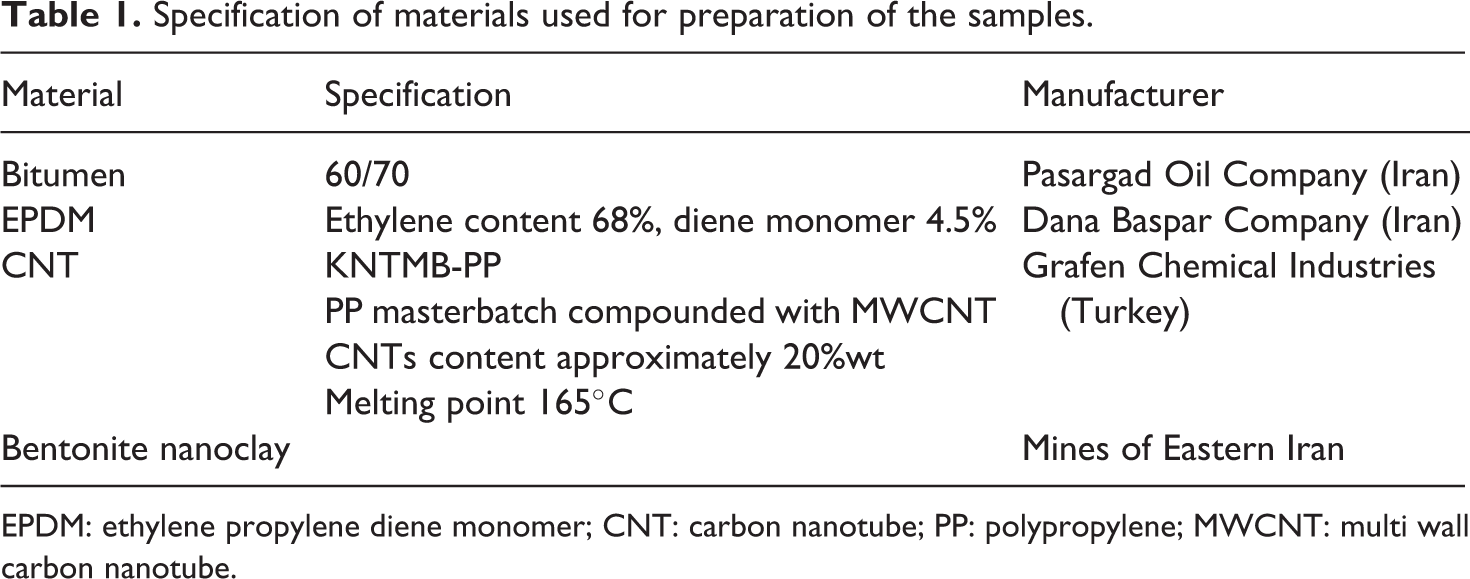
EPDM: ethylene propylene diene monomer; CNT: carbon nanotube; PP: polypropylene; MWCNT: multi wall carbon nanotube.
Sample preparation
In order to mix the additives with bitumen, pure bitumen was heated to 170°C and maintained in this temperature for 1 h. The mixing process was done in a high shear mixer at 7000 r/min. The samples were prepared by adding EPDM, CNT masterbatch, and bentonite nanoclay to the control bitumen (B) according to the designed concentrations (Table 2). The percentage of EPDM was selected according to our previous study with SBR. 32 In case of nanomaterials, the common compositions used for preparation of nanocomposites were selected. To prepare each sample, after heating the bitumen, CNT was added and mixed for 15 min and finally, bentonite nanoclay was added and allowed to mix for 15 min.
The code name and details of unmodified and modified bitumen samples.
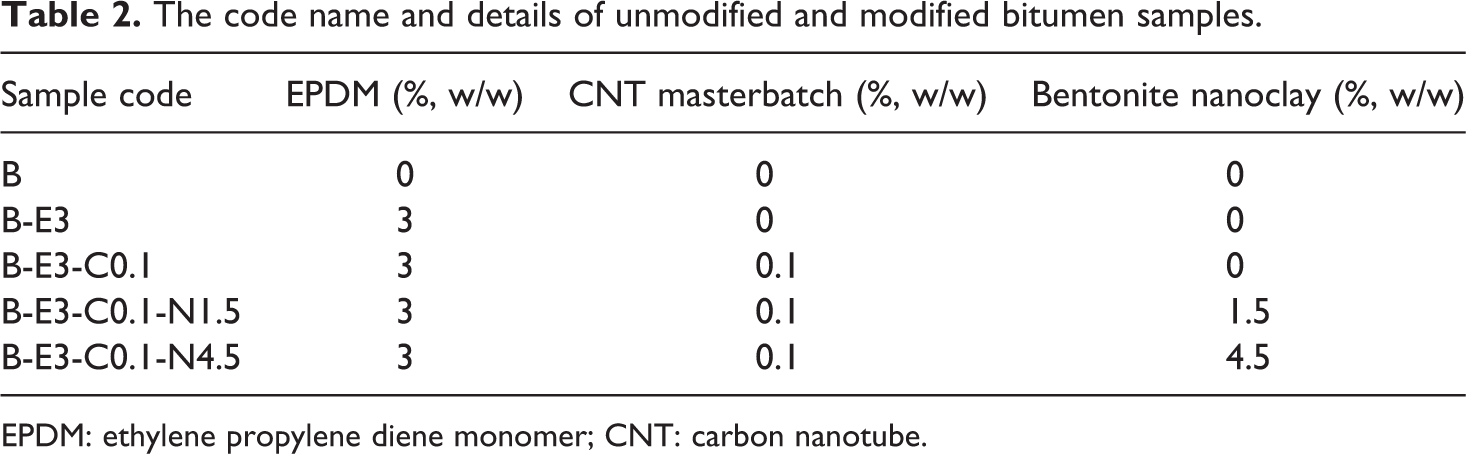
EPDM: ethylene propylene diene monomer; CNT: carbon nanotube.
Classical properties
The penetration test was implemented according to the standard ASTM-D5 in 25°C. A small container was filled with bitumen and placed in a water bath in 25°C for 1 h and the penetration of a standard needle in the bitumen sample under a constant load (100 g) for 5 s was determined. The distance traveled by the needle was reported as penetration with the unit of 0.1 mm (dmm).
The softening point (ring and ball test) of the primary and modified bitumen samples was determined according to the standard ASTM-D36. Two plates of bitumen were casted by two brass rings. After cooling, the tufts were removed by a hot knife and then a standard shot was placed in the center of each plate. Then, the plates were heated with a rate of 5°C/min. The temperature at which the bitumen and shot reaches the end of device is known as the softening point of the corresponding sample.
Ductility or elongation of a bituminous substance is the distance which the substance can resist stretching (at a given temperature and velocity) before rupture. For the samples of this study, the test was implemented according to the ASTM-D113 standard. Samples were formed into dumbbells, immersed in a water batch with a constant temperature of 25 ± 0.5°C, and stretched with the velocity of 5 ± 0.5 cm/min.
To calculate the temperature susceptibility of the modified bitumens, the penetration index (PI) was calculated using the data obtained from softening point and penetration tests. The following equation was used for calculation of PI according to the approach given in the Shell bitumen handbook 33

where Pen25 is the penetration at 25°C and SP is the softening point temperature (°C) of the bitumen sample.
Rheological test
To study the rheological behavior of the modified and unmodified bitumen samples, a temperature sweep was performed with a dynamic shear rheometer (DSR) (SmartPave 101, Anton Paar, Germany) from room temperature to 90°C with a heating rate of 2°C/min. At the temperatures of measurement, rheological properties such as complex modulus, phase angle, and complex viscosity were recorded at constant frequency of 10 Hz and amplitude of 0.5% to ensure that properties were measured in the linear viscoelastic region. The Arrhenius equation was used to describe the effect of temperature on the viscosity of the bitumen samples

where μ is the viscosity at constant shear rate (10 Hz), A 0 is the pre-exponential factor, R is the universal gas constant (8.314 J/mol·K), and T is the absolute temperature.
Thermogravimetric analysis
Thermogravimetric analysis (TGA) test (Mettler Toledo, USA) was performed from room temperature to 500°C at the heating rate of 10°C/min under nitrogen atmosphere. Temperatures of 10%, 50%, and 70% weight loss and ash content at 500°C were reported. Differential thermogravimetry (DTG) curves were obtained and plotted and the temperature of maximum degradation rate was determined for each sample.
Results and discussion
Conventional properties of the nano-reinforced bitumens
The results of penetration, PI, softening point, and ductility tests for the unmodified bitumen as well as modified bitumens are reported in Table 3. As it can be seen, the addition of 3% EPDM did not change the penetrability of the samples remarkably, but when 0.1% CNT was added to the EPDM-modified bitumen, penetrability was decreased and subsequently improved the properties of pure bitumen. Similarly, the addition of 1.5% bentonite nanoclay significantly decreased the penetrability; however, it was increased when the amount of nanoclay was 4.5%.
The classical properties of the unmodified and EPDM-nano-modified bitumens.
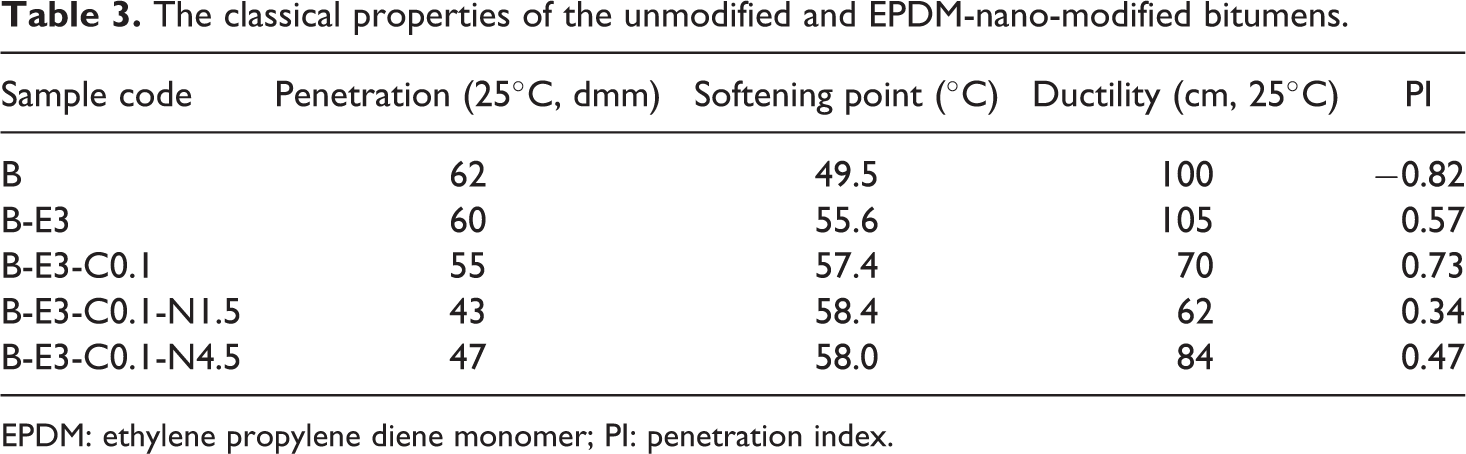
EPDM: ethylene propylene diene monomer; PI: penetration index.
The trend observed for the softening point results completely verifies with the results of the penetration test. As it can be seen from Table 3, addition of EPDM and CNT masterbatch to the bitumen increased the softening point of the samples. Also, the addition of 1.5% and 4.5% nanoclay slightly increased the softening point temperatures. The bitumen sample containing 3% EPDM, 0.1% CNT, and 1.5% nanoclay (B-E3-C0.1-N1.5) showed the highest softening point among the samples of this work.
Unlike to penetration degree and softening point tests which are important at high temperatures, ductility test is considered in low temperatures. Since most of bitumen is crispy and brittle, cracking due to high pressures is more probable in these conditions. As it can be seen from Table 3, ductility parameter was increased with adding EPDM but on the other hand, it was decreased by adding CNT masterbatch. Addition of the nanoclay to 1.5% (w/w) caused a reduction in ductility while adding more nanoclay up to 4.5% (w/w) increased the ductility parameter. Results of ductility test shows that addition of EPDM increases the cohesive strength of the base bitumen which is in accordance with the literature data. 33 However, aggregations of the nanomaterials may be present in the bitumen matrix which act as stress concentration areas and reduce the cohesive strength of the modified bitumens.
The values of PI represent the temperature susceptibility of bitumens. Higher values of PI show that the bitumen is less temperature susceptible. For the base bitumen, PI was negative while it was increased to higher values after addition of EPDM and the nanomaterials. Similar results were reported for bitumen modified with SBR, weathered coal, and carbon black. 19 The sample containing 3% EPDM and 0.1% CNT showed the highest PI and lowest temperature susceptibility.
Rheological behavior
Rheological studies can provide valuable data about viscoelastic behavior of polymer blends and composites. The rheological behavior of pure bitumen is brittle in elastic form, so the changes due to applying loads will be irreversible if it does not cause to crack or breaking. Variations of complex shear modulus of the modified and unmodified bitumen samples with temperature are presented in Figure 1. Complex shear modulus was reduced with increasing the temperature for all samples because the rheological behavior of bitumen samples changes from elastic to viscous when the temperature is elevated. At the temperatures of measurement, the values of complex modulus were higher for the modified bitumens compared to the unmodified bitumen. Elevation of the storage modulus for the modified samples was more obvious at high temperatures. Addition of EPDM to the base bitumen increases the average molecular weight and formed a dominant polymer network which consequently increases the complex shear modulus. Similar observation was reported for the bitumen samples modified with SBR and weathered coal. 19 CNTs and bentonite nanoclays are high strength materials which their addition reduces the penetrability and also increases the complex shear modulus. This result indicates the reinforcing effect of CNT and bentonite nanoclays at high temperatures. Similar results were observed for bitumen samples modified with carbon microfiber, nanosilica, and polymer-modified nanoclay. 34 It can be concluded that bitumen samples reinforced with CNT masterbatch and nanoclays used in this work would have a better performance at high temperatures.
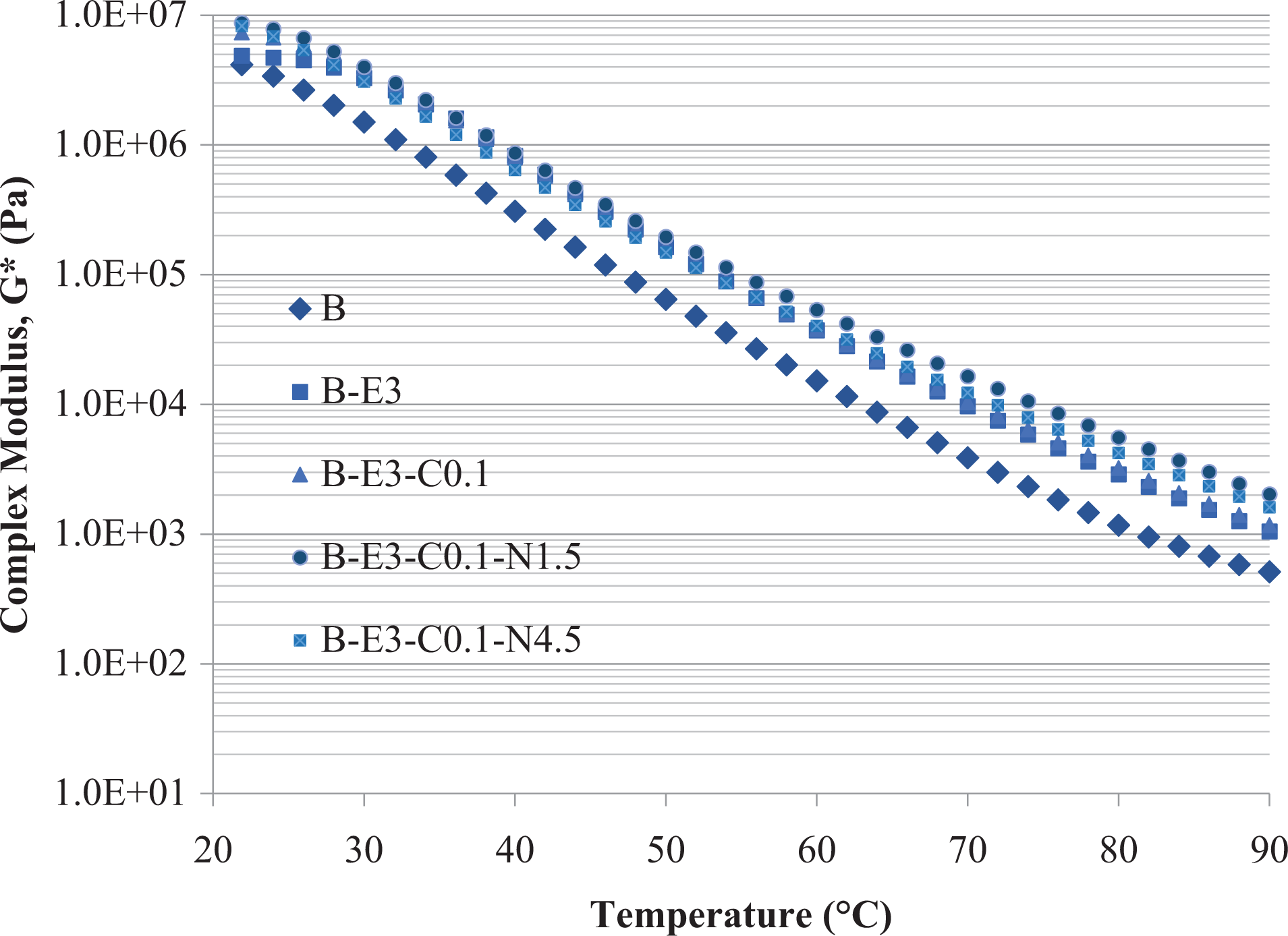
Changes of complex shear modulus with temperature for the unmodified and modified bitumen samples (ω = 10 Hz).
Results of complex shear modulus also indicate the compatibility of EPDM, CNT masterbatch, and bentonite nanoclay with the bitumen because any phase separation due to incompatibility would result in decay of storage modulus. However, further morphological and colorimetric studies should be performed to evaluate the compatibility of the components. 35
Variation of phase angle (δ) with temperature is shown in Figure 2. In contrast to the complex modulus, phase angle is small at low temperatures and increases at high temperatures. For the unmodified bitumen sample which had a lower complex modulus, a higher phase angle was observed while other samples having higher complex modulus showed a lower value of phase angle. This is consistent with the complex modulus results. Reduction of phase angle by addition of polymer nanocomposites is also reported for conventional asphalt reinforced with SBS/nanoclay. 36 Phase angle is a measure of damping of the bitumen samples. Reduction of δ indicates that addition of EPDM, CNT masterbatch, and nanoclay has reduced the damping of the modified bitumen samples over the temperature range of measurement. This result also means that the modified bitumen samples are more resistant to permanent deformation. As mentioned, by addition of EPDM to the bitumen, the average molar mass increases which lowers the damping of the samples. Besides, the phase angle curve is nearly a straight line for the unmodified bitumen sample, but it has a distortion for the modified samples. The reason for observation of this behavior may be due to the alteration of the average molar mass and overall molar mass distribution of the bitumen samples due to addition of EPDM as well as the interactions between the nanolayers of bentonite and nanotubes of CNT which limits the molecular motions of EPDM chains and reduces the damping.
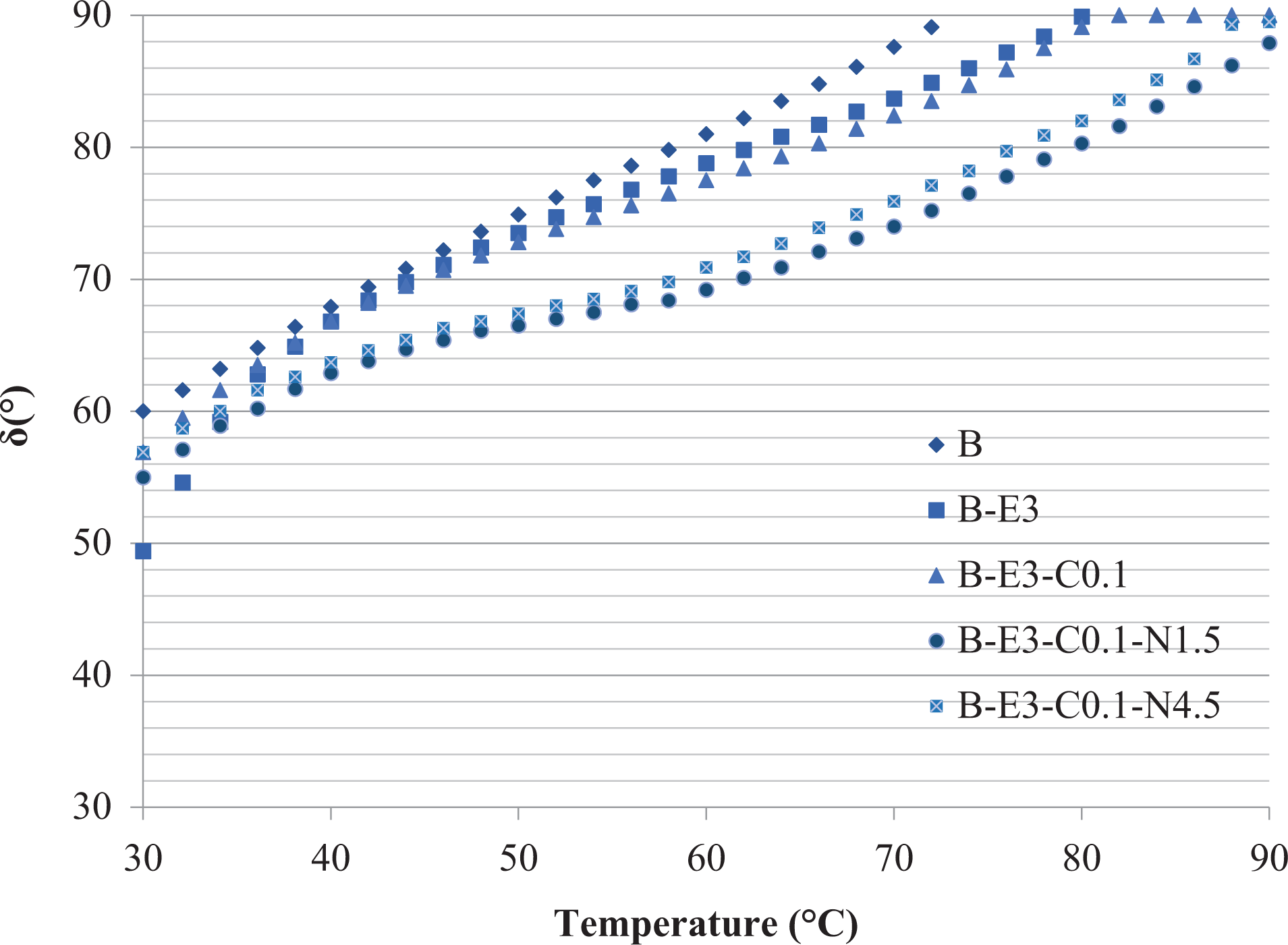
Phase angle (δ) versus temperature for the modified and unmodified bitumen samples (ω = 10 Hz).
As specified by AASHTO MP1 standard and strategic highway research program, 37,38 the maximum temperature which identifies a proper viscoelastic performance for a bitumen is the temperature where |G*|/sin δ = 1 kPa. Figure 3 shows the plots of |G*|/sin δ known as the rutting parameter versus temperature for the unmodified and modified bitumen samples. According to our data presented in Figure 3, for the unmodified bitumen sample, this temperature is around 81°C while it is increased to around 90°C for the B-E3 sample. For the other samples, it was shifted to even higher temperature which could not be detected by the temperature range of our experiment. This result reveals that the bitumen sample modified with EPDM, CNT masterbatch, and bentonite nanoclay will have a higher performance grade than the base bitumen. Similar results were reported for the bitumen samples reinforced with SBR, weathered coal, and carbon black in which the maximum resulting temperature was 82°C. 19
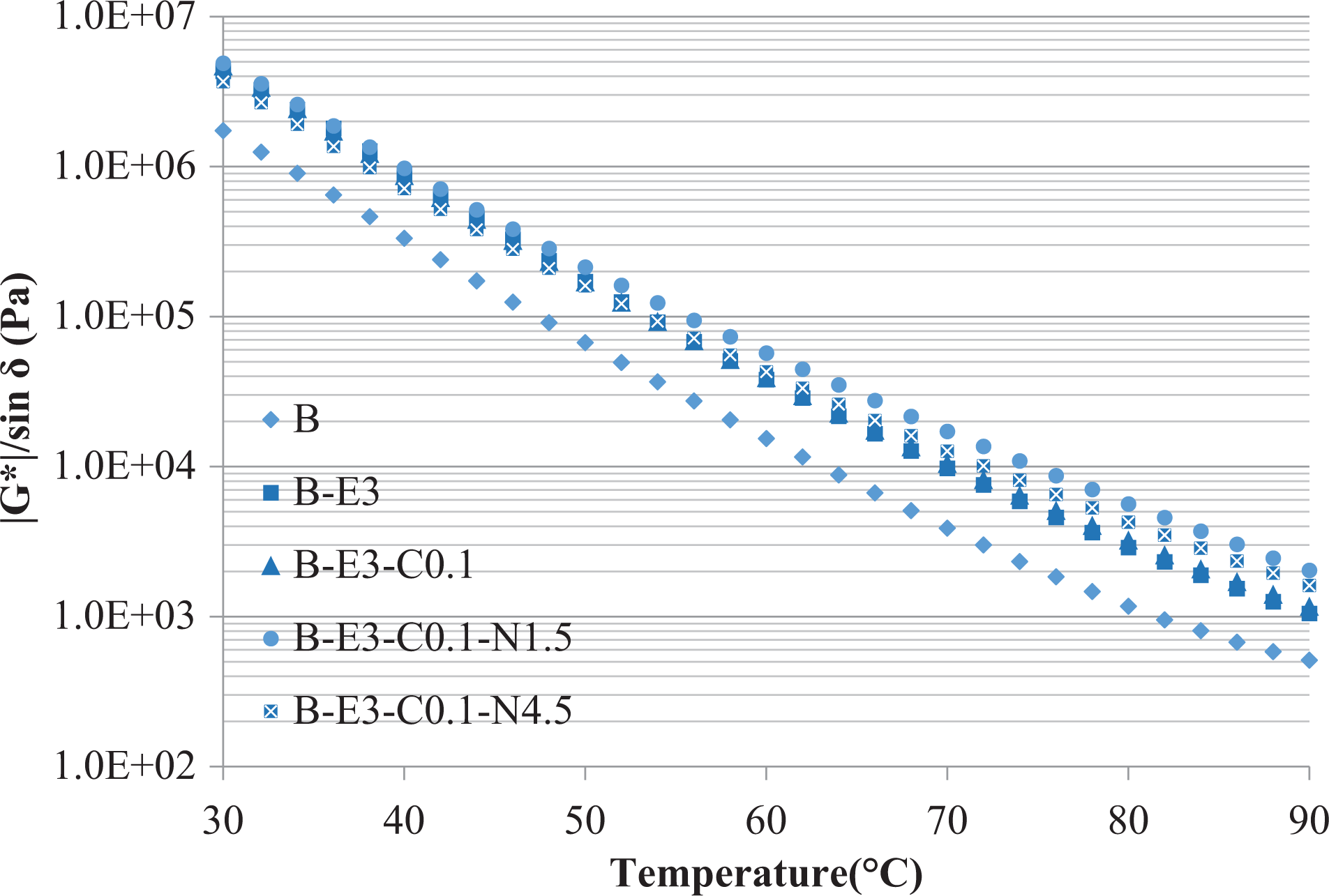
|G*|/sin δ versus temperature for the unmodified and modified bitumen samples.
Complex viscosity of the samples versus temperature is shown in Figure 4. A higher viscosity was observed for all of the modified samples compared to the unmodified bitumen over the temperature range of study. Samples containing CNT masterbatch and nanoclay even showed a higher viscosity at high temperatures; however, addition of bentonite nanoclay from 1.5% to 4.5% did not change the complex viscosity of the samples significantly. Our rheological results showed that the mechanical behavior of bitumen at high temperatures was improved by incorporation of EPDM, CNT masterbatch, and nanoclay. It can be concluded that modification of bitumen by EPDM, CNT, and bentonite nanoclay can improve the high temperature performance of the bitumen samples.
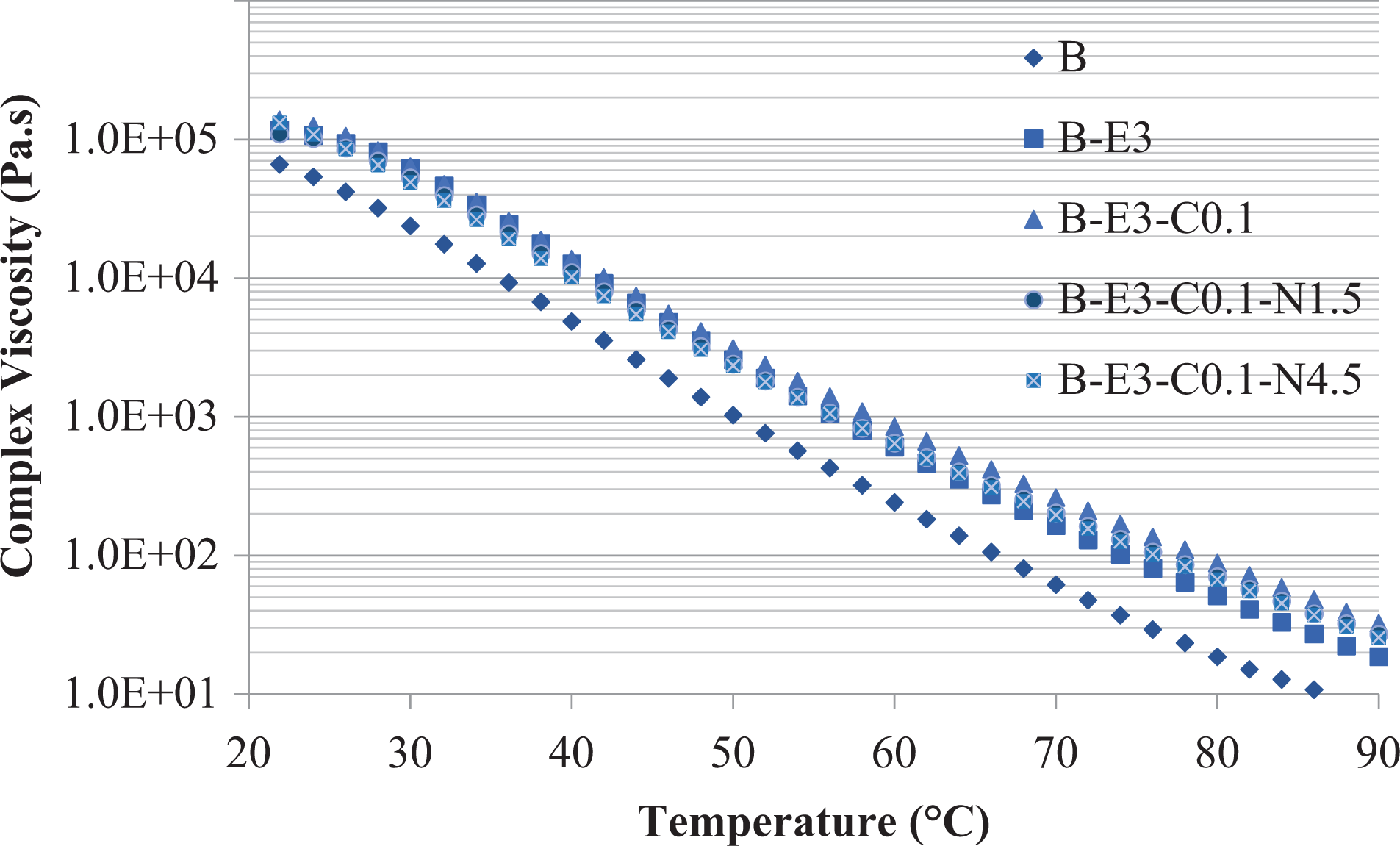
Complex viscosity versus temperature for the modified and unmodified bitumen samples (ω = 10 Hz).
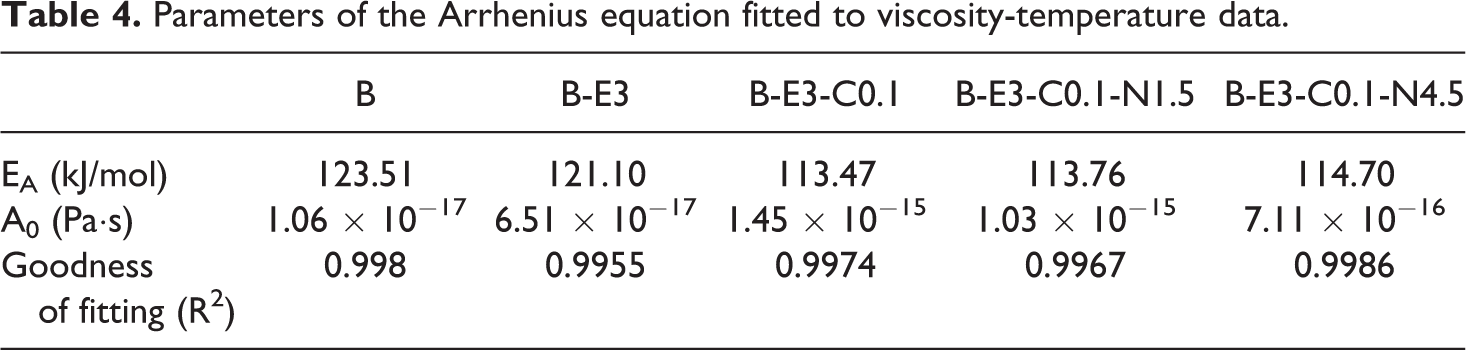
In order to model the viscosity-temperature behavior of the unmodified and modified samples, the Arrhenius model was fitted to the data of Figure 4. The values of activation energy (EA ) and pre-exponential factor (A 0) are presented in Table 4. It can be seen that Arrhenius model can predict the viscosity-temperature behavior of the samples of this study with a good fitness. The value of EA was reduced by addition of EPDM while its reduction was more significant when CNT was added. It increases when bentonite nanoclay was added. A 0 was increased by addition of EPDM while significantly increased when CNT and bentonite nanoclay were added. A 0 is related to the viscosity of the samples and its trend is the same as the results of Figure 4. Results of EA shows that addition of EPDM, CNT, and bentonite nanoclay reduces the energy required to overcome the intermolecular forces and ensures the flow.
Parameters of the Arrhenius equation fitted to viscosity-temperature data.
Thermal behavior
Thermal degradation of bitumen is an important issue in construction processes. Early stage thermal degradation will cause quality loss and serving limitations in bitumen. TGA lets us to evaluate the weight reduction of samples in terms of temperature. Figure 5 shows the TGA curves for the modified and unmodified samples. A one-step weight reduction is observed for all of the samples with a little shift to lower weights for the modified bitumen samples. In order to perform a better comparison, the temperature of 10%, 50%, and 70% weight loss (%W Red) and corresponding ash content at 500°C are presented in Table 5. The temperature for 10% weight loss is shifted to lower values for the modified bitumen samples while the temperatures of 50% and 70% weight loss did not show a remarkable change between the modified and unmodified samples. Bitumen is composed of aliphatic and aromatic compounds while EPDM has linear aliphatic chains which degrade at lower temperatures. Though, we observed that samples containing EPDM degrade at lower temperatures.
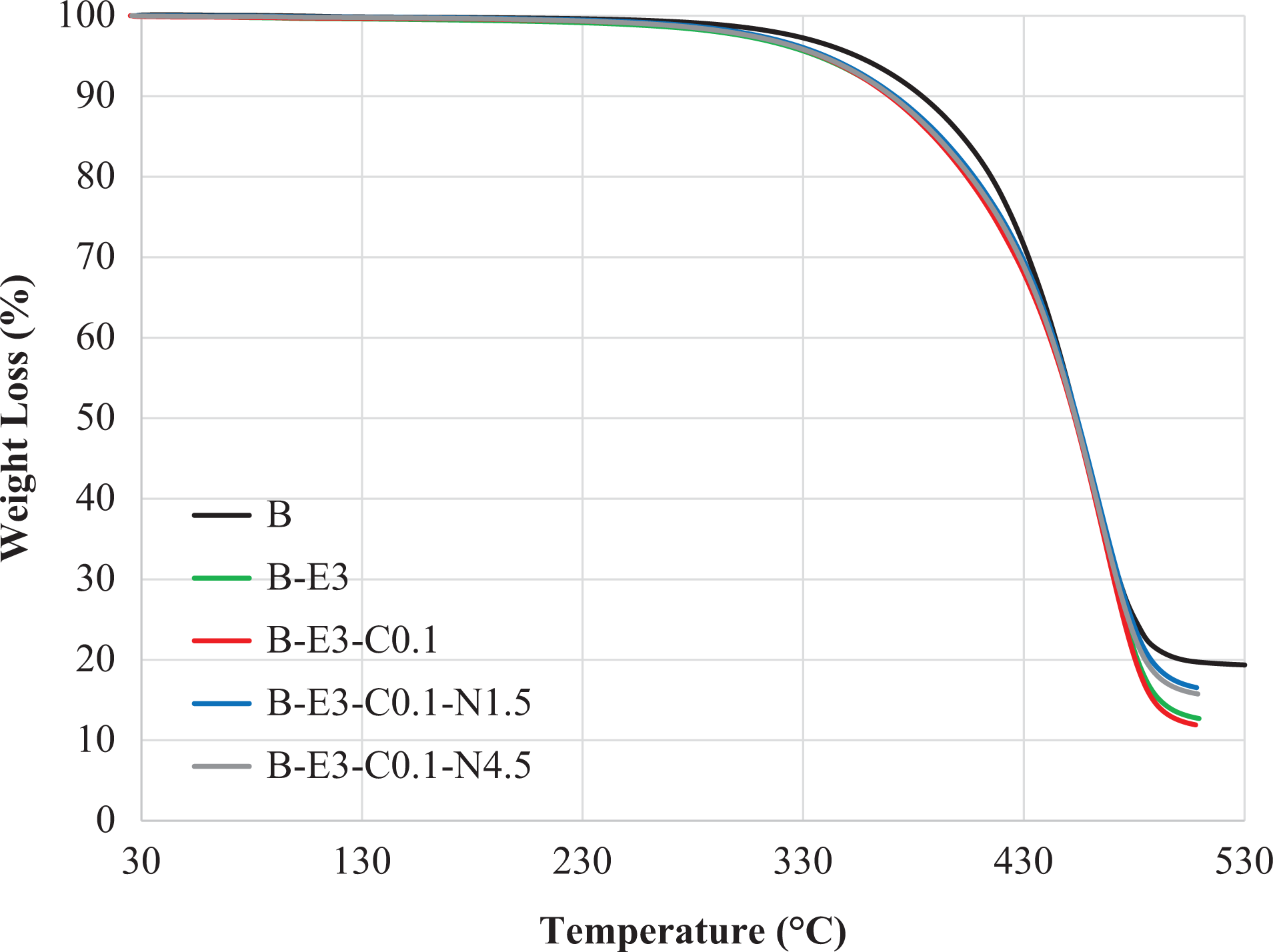
TGA results for the modified and unmodified samples at the heating rate of 10°C/min under nitrogen atmosphere.
Temperature of 10%, 50%, and 70% weight loss, remained ash at 500°C and temperature of maximum degradation rate (Tmax) for the samples.
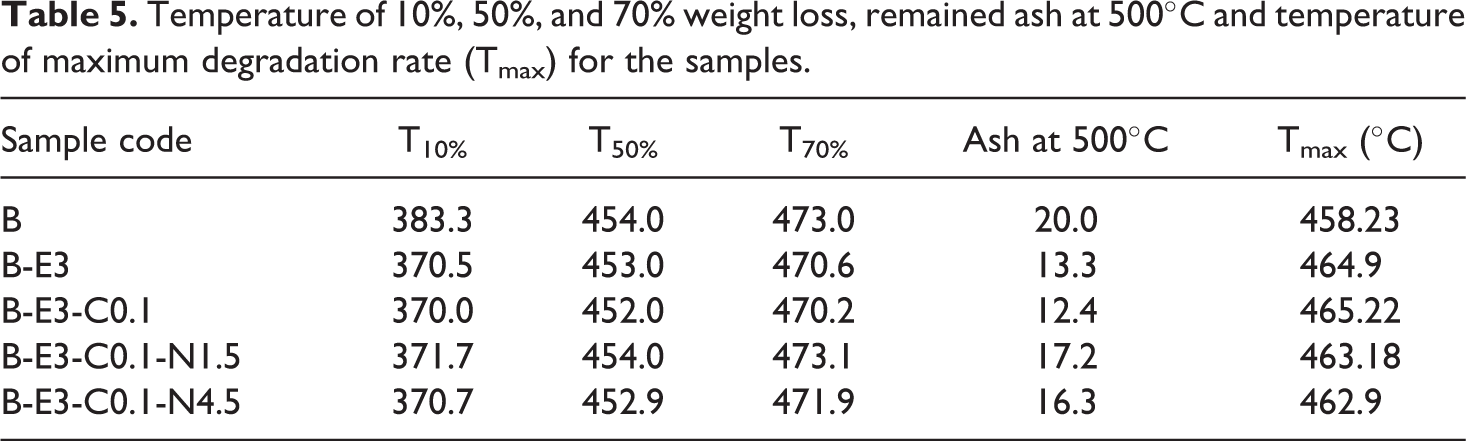
According to Table 5, the ash content at 500°C has the highest value (20%) for the unmodified bitumen. It is reduced to 12% and 13% for the samples B-E3 and B-E3-C0.1, respectively. By addition of nanoclay, it increases again and reaches the 17.2% and 16.3% for the samples B-E3-C0.1-N1.5 and B-E3-C0.1-N4.5. This result is due to the inorganic nature of bentonite nanoclay which degrades at very high temperatures and increases the ash content of the samples. 39
DTG curves of the unmodified and modified samples are presented in Figure 6. The temperature of the maximum weight loss was increased for the modified bitumens compared to the unmodified bitumen. The corresponding values are listed in Table 5. The maximum degradation rate was occurred at higher temperatures for the modified samples.
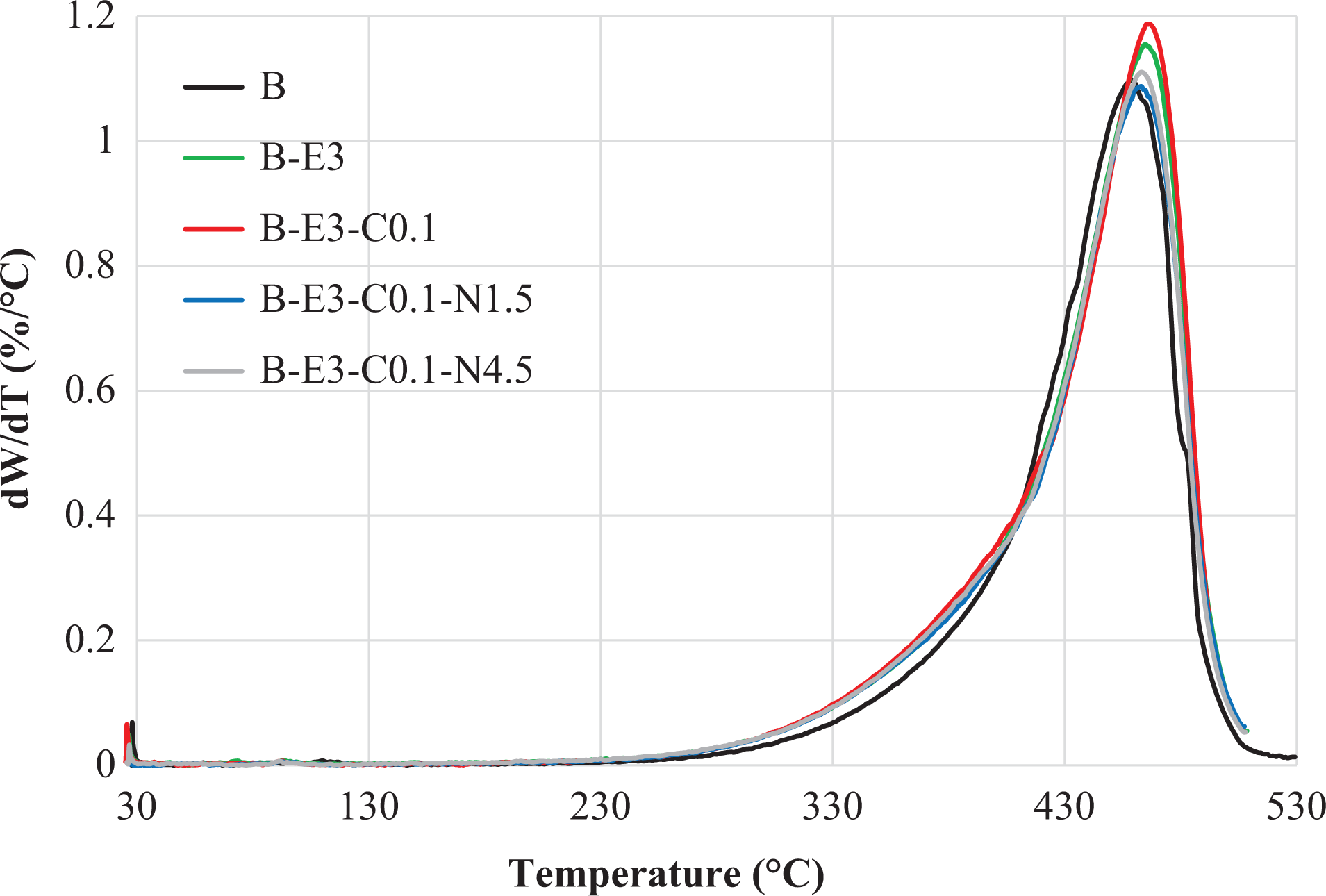
DTG results for the modified bitumen samples.
Conclusions
In this work, we reported the effect of EPDM, CNT masterbatch, and bentonite nanoclay on the physical, rheological, and thermal properties of pure bitumen. The results of this study showed that the addition of 3% EPDM, 0.1% CNTs, and 1.5% or 4.5% bentonite nanoclay reduces the penetration degree, increase the softening point and PI of the base bitumen. The complex modulus increases and phase angle decreases compared to the base bitumen. According to the curves of |G*|/sin δ versus temperature, the maximum temperature for a suitable viscoelastic behavior was shifted to higher temperatures for the modified bitumen samples which indicates that the rheological properties of the bitumen was modified by addition of EPDM, CNT masterbatch, and nanoclay. Finally, we conclude that the bitumen modified with 3% EPDM, 0.1% CNT, and 1.5% bentonite nanoclay can be used as high performance grade bitumen for application in warm areas.
