




Abstract
Filler materials are widely used in combination with polymer materials. Conventional filler particles generally cause light scattering and absorption because of their optical characteristic or refractive index difference. With nanoparticles (NPs) as a filler material, it is theoretically possible to manufacture transparent compounds due to their small particle dimensions reducing the interaction with light. Nevertheless, the particles tend to build agglomerates and aggregates which reduce the composite’s transparency considerably. This review gives an overview of the effect different particle materials have on the properties of transparent polymer composites with consideration of the composite’s transparency. There are very few reports on highly transparent and thick (>1 mm) polymer nanocomposites with such an amount of particles that affect other properties of the polymer significantly. In the majority of cases, NPs lead to a significant lower transparency. This indicates that the homogeneous dispersion of the particles is still a major difficulty in producing transparent nanocomposites with enhanced properties.
Introduction
Nanoparticles (NPs) as a filler for polymers have gained a great deal of attention since 1993 when researchers increased the yield and tensile strength of nylon-6 by an amount of about 2.5 by adding only 7 wt% clay platelets. 1 The main difference in NPs is the enormous specific surface area which is one to two orders of magnitude higher than for conventional fillers. 2,3 The amount of surface atoms is 20% for a 10 nm particle and increases to a percentage of 80% of all atoms for a particle with a diameter of 2 nm. 4 A larger surface area leads to a higher surface reactivity. 5 Therefore, it is possible to improve the polymer’s properties with considerably low filler loadings or even to integrate new properties. 6 –8 Moreover, low filler loadings and a filler size far smaller than the wavelength of visible light enable the manufacture of transparent composites.
Nevertheless, scattering and absorption of light by NPs impair the transmittance of a composite. The absorption and scattering cross-section express the efficiency absorption and scattering. In standard spectroscopy measurements, the intensity losses represent the extinction, which is composed of the losses due to absorption and scattering. 9 The scattering intensity IS of a particle depends on the following correlation 10 –12

where d is the particle diameter and λ is the wavelength of light. Therefore, a proper dispersion of the particles in the matrix is very important to reduce their effective diameter. However, homogeneous particle dispersion is one of the main challenges in manufacturing nanocomposites, 7,13,14 because the particles’ high surface energy causes strong interactions between them. 15 There exist different approaches to the dispersion of NPs and the preparation of composites with a polymer matrix. Several methods for the preparation of transparent composites are described by Demir and Wegner 14 and Althues et al., 16 whereas in situ polymerization and in situ particle processing are mentioned as an advantageous way to avoid particle aggregation. Other routes are the incorporation of NPs into the polymer melt by means of shear mixing with an extruder 17 –19 or the injection of a NP solution into the polymer melt during extrusion. 20 Chemically more demanding processes include the improvement of the particle dispersion and stabilization with grafted polymer chains. 21
The aim of this work is to give an overview of different NP materials for transparent composites and their effect on the composite’s properties. Another focus lies on the transparency of these composites, which is critically evaluated with respect to the part thickness.
Following the “Introduction” section, this article summarizes the influence of NPs on transparent polymers sorted by particle material. A table offers an overview of the effects the fillers have on the properties and on the transparency. The different filler materials and the effect on the properties, as well as the contradiction between the composites’ enhanced properties and maintained transparency, is discussed in the subsequent section.
Particle materials and their effects on polymer properties
Gold and silver
Silver (Ag) NPs are often used because of their antibacterial properties in different matrix materials. 22 –24 Apart from this, an increase in the degradation temperature of 26 K (thermogravimetric analysis measurements) was observed with a filler content of 2 wt% by Vodnik et al. 25 Caseri 26 and Zimmermann et al. 27 demonstrate that it is possible to decrease the refractive index (RI) of gelatin by the incorporation of gold (Au) particles. At very high contents of 92.9 wt%, the RI is reduced from about 1.54 to 0.96 at 632.8 nm. The absorption and scattering of single metal particles is described in more detail in the study by Van Dijk et al. 28 and Nie and Emory. 29 This behavior can be applied to the coloring of polymers 14 with Au NPs, whereas the resultative color of the nanocomposite depends on the particle size and geometry. 30
Titan oxide
Titan oxide (TiO2) on the microscale is often used as a white colorant for polymers because it scatters all visible wavelengths. 31 Nano-TiO2 in transparent polymers causes absorption primarily in the ultraviolet (UV) region and is therefore often used as an UV absorber for wavelengths below 400 nm. 19,32 –34 Additionally, influences on the RI and the mechanical and thermal properties have been reported. Nussbaumer et al. observed an increase in the RI in poly(vinyl alcohol) 32,34 and Tao et al. raised the RI of PGMA (poly(glycidyl methacrylate)) and epoxy which also increased the Abbe number of the material. 35 Han and Yu 33 reported reduced elongation at break values in poly(ethylene phthalate), whereas Chatterjee 19 showed an increase in the tensile modulus, decomposition temperature, and thermal stability of poly(methyl methacrylate) (PMMA).
Zinc oxide and cerium oxide
These kinds of NPs are utilized to produce luminescent nanocomposites. 36 –41 For cerium ions, the relationships among blueshift, the valence state of ions, and particle size are described by Tsunekawa et al. 40 Regarding other effects on the composite’s properties, an increase of 26°C in the glass transition temperature, 39 an increase in the thermal stability, 42 and an increase in the RI 43 were observed with a PMMA matrix. The transmittance of rather thin specimen (0.4 mm thickness, 0.5 wt% zinc oxide (ZnO) quantum dot (QD)) is high. 37 On the other hand, thicker specimens have a low transmittance in the visual range (thickness: 3.5 mm, 1 wt% ZnO NP) 44 or simply a “transparent appearance” (thickness: 3 mm, ZnO QD). 38
A remarkable effect of the transmission of composites made of transparent polystyrene (PS) and cerium oxide (CeO2) NPs was observed by Parlak and Demir. 45 The transmittance of the thin films showed a first-order exponential decay up to a particle concentration of 20 wt%, as the Rayleigh scattering theory proposes. Higher filling degrees do not impair further the transmission. This fact is explained as a result of interference in the multiple instances of light scattering by the quasi-ordered internal microstructure, developing at high filling degrees.
Modified tin oxide (ATO and ITO)
The conductivity and antistatic behavior of antimony-doped tin oxide (ATO) NPs dispersed in transparent polymers is described by Wakabayashi et al. 46 and Sun et al. 47 These examined films exhibit antistatic properties above a threshold value of only 0.2 vol%. 46 This is explained by the forming of chain-like aggregates in the NPs. Modified indium tin oxide (ITO) NPs as processed by Zhou et al. 48 affect the transparency such that both a UV and infrared (IR) absorption occur in poly(urethane acrylate) (PUA) while showing high transmittance values between 500 and 1000 nm (thickness: 0.1 mm).
Iron oxide and cobalt
Iron oxide (Fe3O4) NPs 49 –51 and cobalt (Co) NPs 52 can lead to a ferromagnetic behavior in a composite. Peluso et al. 50 show that composites starting as iron(II)mercaptides show higher transmittance values in the range from 400 to 900 nm than composites starting as iron(III)mercaptides. High transparency in the composites is observed for wavelengths over 550 52 or 700 nm. 51 Potential applications mentioned by Barnakov et al. 53 can be found in the magneto-optic field or in electromagnetic interference blocking substrates.
Aluminum oxide
Aluminum oxide (Al2O3) NPs have a primarily positive effect on the mechanical properties of the composite. They increase the elastic modulus, 54,55 the yield stress, 55 and the impact strength. 56,57 According to Sarwar et al., the optimum loading for the best mechanical properties is 2.5 wt%. 55
Zirconium oxide
Zirconium oxide (ZrO2) NPs diversely affect the composite properties. They can lead to improvements to the hardness and scratch resistance (for which a high filling degree of 15 wt% is needed), 58 enhancements to the mechanical properties, 59 adjustments to RI, 59,60 and improvements to thermal properties. 59,61 The different filler loading of 20 wt% for a variation in the RI between 1.475 to 1.625 59 and only 1 wt% for a variation between 1.515 and 1.659 60 proves most remarkable.
Silicon dioxide
Rahman and Padavettan 62 offer a good summary of property changes in composites with silicon dioxide (SiO2) particles. The mostly attained property changes are enhanced mechanical properties 63,64 and influences on the glass transition temperature in both directions.
Cadmium
Composites with NPs containing cadmium (Cd) are mainly prepared to achieve luminescent properties. 16,65 –70 The luminescent properties increase with a good dispersion of the NPs 68 and primarily depend on the particle concentration 66,67 and the particle size. 65,69 The transmittance decreases strongly below a wavelength of 550 nm, whereas the composites have a good transmittance above. 68,70 Mohan et al. 70 also investigated the mechanical properties and observed an increase in the tensile modulus.
Zinc sulfide
The main purpose behind using zinc sulfide (ZnS) particles is also luminescent properties 71,72 or high RI materials. 73 –75 Zhang et al. 73 increased the RI of poly(vinylpyrrolidone) linearly from 1.5061 to 1.7523 with an increasing particle content up to 80 wt% while reducing the Abbe number. The transparency of thin films (thickness: 25 µm) above 500 nm was maintained.
Lead sulfide
As with ZnS, lead sulfide (PbS) is used to increase the RI. 76 –78 As such, Zimmermann et al. 76 and Weibel et al. 78 claim to have achieved the highest RIs of 2.5 and 2.9 (600 nm), respectively, known for polymeric composite materials. Lü et al. 77 offered insights into the transparence, indicating their nanocomposite films containing PbS particles exhibit good transparency (>90%) above 600 nm, although the PbS particles exhibit strong absorption below 600 nm in the UV–visible region.
Carbon nanotubes
A great deal of research has been done on transparent polymer composites with CNTs, whose production is described by Sun and Wang. 79 The authors manufactured electrically conductive transparent films, 80 –84 a transparent composite with enhanced mechanical properties 85 or a combination of mechanical, electrical, and transparent properties. 86 Another application reported by Yu et al. lies in advanced materials for packaging with increased mechanical and barrier properties as well as an enhanced decomposition temperature. 87
Table 1 offers a summary of the affected properties according to particle material with information about the transparency and specimen thickness.
Summary of the effects on the composite properties of different filler materials with information about thickness and transparency.
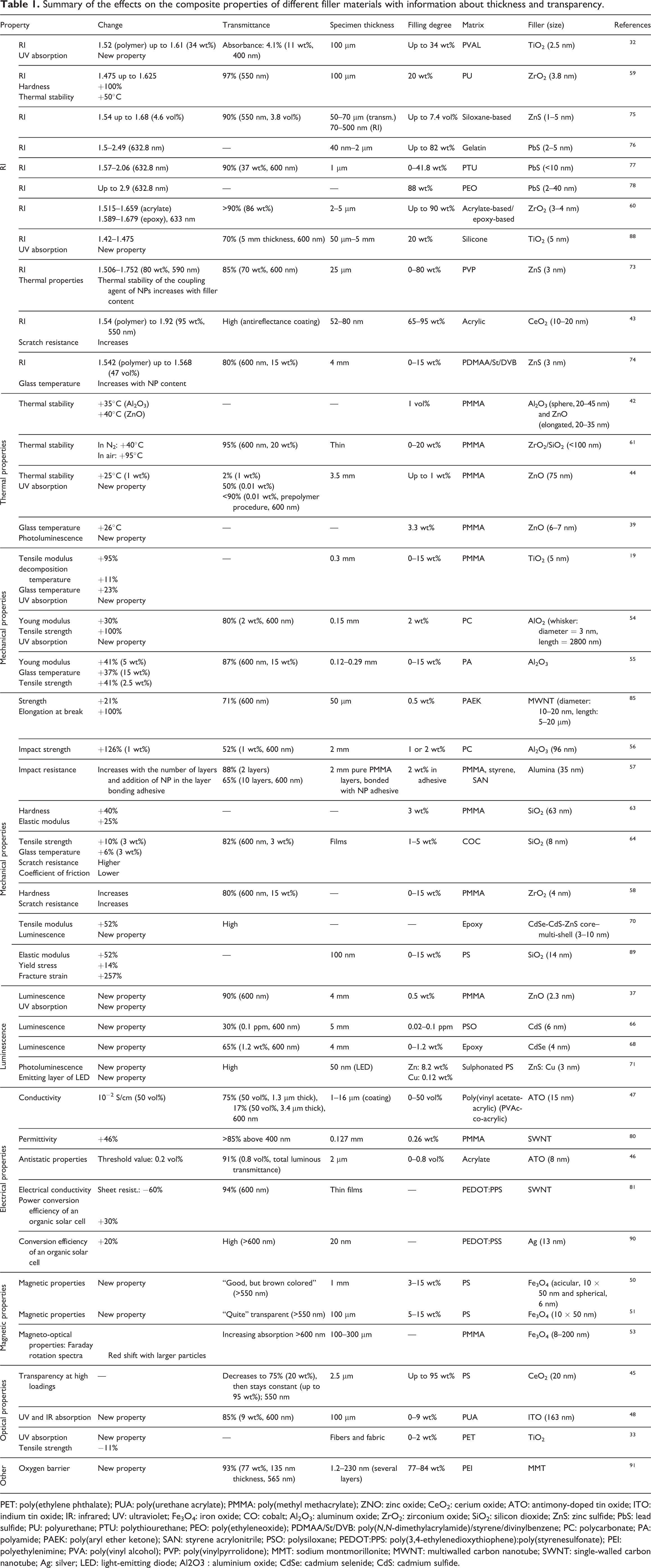
PET: poly(ethylene phthalate); PUA: poly(urethane acrylate); PMMA: poly(methyl methacrylate); ZNO: zinc oxide; CeO2: cerium oxide; ATO: antimony-doped tin oxide; ITO: indium tin oxide; IR: infrared; UV: ultraviolet; Fe3O4: iron oxide; CO: cobalt; Al2O3: aluminum oxide; ZrO2: zirconium oxide; SiO2: silicon dioxide; ZnS: zinc sulfide; PbS: lead sulfide; PU: polyurethane; PTU: polythiourethane; PEO: poly(ethyleneoxide); PDMAA/St/DVB: poly(N,N-dimethylacrylamide)/styrene/divinylbenzene; PC: polycarbonate; PA: polyamide; PAEK: poly(aryl ether ketone); SAN: styrene acrylonitrile; PSO: polysiloxane; PEDOT:PPS: poly(3,4-ethylenedioxythiophene):poly(styrenesulfonate); PEI: polyethylenimine; PVA: poly(vinyl alcohol); PVP: poly(vinylpyrrolidone); MMT: sodium montmorillonite; MWNT: multiwalled carbon nanotube; SWNT: single-walled carbon nanotube; Ag: silver; LED: light-emitting diode; Al2O3 : aluminium oxide; CdSe: cadmium selenide; CdS: cadmium sulfide.
Discussion
Filler materials and properties
As described above, NPs affect the composite properties in a broad range. Additional to the materials of filler and matrix, the achievable properties depend on the filling degree, particle size and shape, processing method, particle dispersion, matrix–particle adhesion and other factors. Nevertheless, Figure 1 gives a comparative overview over the materials listed in Table 1 and their effects on the nanocomposites properties. The figure shows that specific materials diversely affect the properties due to the numerous additional influences mentioned above. However, some materials are particularly suitable to improve specific properties, like Al2O3 and SiO2 for better mechanical properties or PbS for a higher RI.

Percentage changes of properties in dependence of the filler material including the references.
Influence of the particles on the transparency
According to Rayleigh scattering, the scattering section Cs of a particle merely depends on its diameter d, the RI relation m between particle and matrix and the wavelength λ 12

Furthermore, some materials absorb shares of the incident light. Only dielectric particles with zero electrical conductivity are completely nonabsorbing. 12 The absorption of a material is expressed by the material’s complex RI. Nevertheless, almost dielectric materials like glass have a negligible dielectric loss in the visual range and therefore hardly absorb the light. On the contrary, metal particles, even with small diameters, have a strong wavelength-dependent absorption in the visual range due to the oscillation of free surface electrons. 97 –99 The absorption cross-section of particles varies as d3. Therefore, the absorption of very small particles exceeds their total scattering. 28,100,101
Transparency and enhanced properties
Regarding the specimen from the listed references in this article, most authors analyze very thin specimen or give no exact information about the thickness. However, the thickness is crucial for classifying the transparency gains, as transmission decreases strongly with it. Investigations of thin films have several advantages: The specimens enable easy preparation from a polymer solution via drying or melt spinning and thin films require only a small amount of NPs. In addition, a high rate of transparency can be easily achieved.
In few of the analyzed papers, specimens with a thickness of ≥1 mm are described and information about the transparency is given. 37,44,50,56,66,68,74,88,94 These specimens mostly have very low NP content if they exhibit a relatively high amount of transparency. With this low particle loading, hardly any influence on properties other than the specimen’s optical characteristics (luminescence and UV absorption) is ascertainable. For example, Anžlovar et al. 44 reach high transparency values with a filler content of 0.01 wt%, but for a significant change in thermal stability, a filler content of 1 wt% is needed. However, with this filler content, the transparency at 500 nm is almost zero. Magnetic behavior is reported by Peluso et al. 50 who claim that the 1-mm thick specimens have perfect transparency above a wavelength of 550 nm, but there is no specific transparency value given and the specimens are simply “brown colored”. Chandra et al. 56 attained an increased impact strength but also have a high transmission loss (transmittance: 40% at 500 nm and 1 wt% of Al2O3 NPs). There is little information about transparent thick specimens with NP filling that enhances the properties: Guan et al. 74 describe 4-mm thick, highly transparent composites with a filling degree of up to 15 wt% ZnS NPs which had been prepared through one-pot in situ bulk polymerization. The particles cause an increase in RI and in glass transition temperature of the transparent composite. Also thick (5 mm), highly filled (20 wt%) specimens with enhanced RI are described by Li et al. 88 They achieved a good dispersion in silicone by using bimodal-poly(dimethyl siloxane)-brush-grafted TiO2 particles.
On the other hand, optical properties can be affected by very low filling degrees, which maintain the transparency in the visual range. Luminescent properties were integrated by Zou et al. with very low filling degrees of 0.3 wt% and by maintaining the transparency (73% for 530 nm). 68 As shown by Anžlovar et al. 44 UV absorption is possible with a very low ZnO content of 0.01 wt% while exhibiting high transparency values in the visual range.
As mentioned above, more recent approaches focus on core–shell particles and polymer–graft modification of particles. Li et al. 94 achieved high rates of transparency (70% at 500 nm) with a filling degree of 1 wt% of SiO2/TiO2 core–shell particles and a specimen thickness of 4 mm. It was possible to control the RI of the total particle with the ratio of core to shell. If the RI does not match the matrix, the specimen has a completely opaque appearance. Incel et al. 92 manufactured highly transparent PS films, filled with ceria/silica hybrid particles. The particles have the same RI as the matrix due to their controlled core–shell ratio. The approach of RI matching by grafting polymer chains which are different to the polymer matrix is described by Parlak and Demir. 102 and Dang et al. 95 Methods of synthesis, analysis, and some properties of nanocomposites with polymer-grafted NPs are summarized by Kumar et al. 21 An increase in the mechanical properties observed by Maillard et al. 89 was attributed to the uniform dispersion and strong interfacial binding due to the polymer-grafted NPs. The achieved transparency values are promising. However, in combination with transparent polymers, most authors focus on the transparency only and the impact on other properties is scarcely investigated. Furthermore, these particles are more challenging to synthesize, so they are produced in very small quantities only. To investigate the role of film thickness and to validate these results on a macroscopic scale, it would be necessary to produce larger quantities of these particles. 21
Conclusion
NPs are widely used in research to enhance material properties and to functionalize transparent polymers. For a significant impact on the mechanical and thermal properties, for example, the glass transition temperature or decomposition temperature, very low filler loadings compared to conventional fillers are necessary. However, there are considerable shortcomings in the transparency after integrating NPs into the transparent polymers. Despite several approaches to dispersing the particles homogeneously, achieving transparency for thicker parts while simultaneously enhancing other properties significantly has largely remained an insurmountable hurdle. Also, thin films mostly show a significant decrease in the transmission. Only optical properties such as luminescence and UV absorption can be included with very low filler contents enabling to maintain the polymer’s transparency. These shortcomings in the transmission of transparent nanocomposites indicate that the homogeneous dispersion of the particles remains a major difficulty, which has not yet been satisfactorily solved on a macroscopic level. However, there are promising approaches in NP chemistry to improve their dispersion and/or to adapt their RI to the matrix in order to achieve high transparency values. However, until now, there is sparse information available about the effect on other properties. Consequently, future research should focus on the upscaling of the particle production and on a comprehensive analysis of the macroscopic nanocomposites properties to identify and exploit their potential in practical applications.
Footnotes
Funding
The author(s) disclosed receipt of the following financial support for the research, authorship, and/or publication of this article: This work was financially supported by the Deutsche Forschungsgemeinschaft (DFG) through the Cluster of Excellence Engineering of Advanced Materials.
