




Abstract
In this article, investigations on the influence of openings and additional mass on free vibration analysis of laminated composite sandwich skew plates using improved higher order shear deformation theory (IHSDT) have been done. The IHSDT model satisfies the interlaminar shear stress continuity at the layer interfaces and also ensures zero transverse shear stress conditions at the top and bottom of the plate. The piecewise parabolic shear stress variation across the thickness of each layer is considered. No shear correction factors are required. The 2-D C0 finite element (FE) model has been developed by authors based on IHSDT. FE model based on IHSDT has been coded in FORTRAN. The problem of C1 continuity requirement associated with the IHSDT is overcome using an appropriate C0 FE formulation. The free vibration frequencies of laminated composite and sandwich plates obtained using the present 2-D FE model are in good agreement with the 3-D elasticity results. The influence of the side-to-thickness ratio, skew angles, boundary conditions, and mode shapes is taken into consideration for the present study.
Keywords
Introduction
In the era of the present scenario, composites and sandwich plates are becoming one of the most crucial materials for construction in Civil Engineering. Composites are those materials which are tougher and lighter and can be derived from the properties that can be customized to meet particular design requirements. Its property by virtue of which, the ease with which complex shapes can be feigned, helps in the complete innovation of an established design in which can often be advantageous to both cheaper and better solutions. A free vibration response, a mechanical behavior of the laminated composite sandwich plates, is the focus of this research.
Cutouts, in the design of composite structures, are used for easy access, assessment for passing hydraulic, fuel, and electric lines, and also to reduce the weight of the structures. 1 In many cases, the vibration responses of such perforated structural components are risky in nature for the purpose of which, to prevent premature failure and utilization of full strength, a complete knowledge of the stability performance of such panels is vital.
Due to the complex nature of composites, various theories have been proposed by researchers till date. The first plate theory developed was Kirchhoff’s popularly known as classical laminate plate theory. 2 The first attempt was made by Ashton and Whitney 3 to analyze laminated composite plates using the classical plate theory for modeling of plate deformation. But the theory failed in predicting accurate results for thick plates due the neglection of the transverse shear strains by the present theory.
Reissner 4,5 had first provided a steady theory to include the shear deformation effects. The basic assumption made in the research gives a consistent representation of stress distribution across the thickness, which resulted in a through-thickness linear variation of in-plane displacements (i.e. two terms of Taylor’s series expansion) and constant normal deflection across the plate thickness. The same degree of approximation has been employed by Mindlin 6 on kinematic assumptions of the displacement fields given by Reissner 4,5 without introducing corresponding stress distribution assumptions and obtained the governing equations from a direct method.
Yang et al. 7 had derived a 2-D linear theory of motions from the 3-D theory of elasticity for heterogeneous plates. The transverse shear strains and rotatory inertia were taken into account during the analysis. This is broadly coming to be known as the first-order shear deformation theory (FSDT) for laminated plates. But the theory was restricted with the use of complex shear correction factors. Pagano 8 later on extended the work of Yang et al. to develop a theory including shear deformation and rotatory inertia as given in Mindlin’s theory. For the analysis of laminated composite plates, Reddy 9 developed a simple higher order theory. The theory contains the same independent unknowns as in FSDT and accounts for the parabolic distribution of transverse shear strains through the thickness of the plate without the involvement of the shear correction factors in computing the shear stresses.
Thus, higher shear deformation theory (HSDT) came into existence to remove the complex factor, as it was free from shear correction factors. The origin of HSDTs goes back to the work of Hildebrand et al. 10 who made significant contributions by dispensing all the assumptions of Kirchoff. Lo et al. 11,12 presented a plate deformation theory taking into account the effects of transverse shear and normal deformation in addition to the nonlinear distribution of the in-plane displacement with respect to thickness coordinate. Kant et al. 13 derived the complete set of equations of an isotropic version of the Lo et al. theory and presented extensive numerical results with a proposed numerical integration technique. Khdeir and Reddy 14 proposed a second-order shear deformation theory for the analysis of laminated composite plates. To access the transverse stresses in laminated composite and sandwich laminates, higher order theories were proposed by Kant and Manjunatha. 15 The theory consisted of C0 isoparametric finite elements (FEs) and exact 3-D equations. Furthermore, a refined higher order model is proposed by Swaminathan and Patil 16 to solve the natural frequency of simply supported antisymmetric angle-ply composites and sandwich plates. Some of the other higher order theories from the literature that included the unknown terms in the assumed kinematic model were: seven unknowns (Pandya and Kant 17 ) and nine unknowns (Ren 18 ; Pandya and Kant 19 ; Nanda and Bandyopadhyay 20 ).
Till current years, many analytical methods have been proposed for the dynamic analysis of laminated plates using different theories as mentioned earlier. Ferreira, 21 Natarajan et al., 22 and Ferreira et al., 23,24 have exercised radial basis functions for the static and dynamic analyses of composite and sandwich laminated plates. Kulkarni and Kapuria 25 had proposed a new improved discrete Kirchhoff quadrilateral element based on the third-order zigzag theory analysis of composite and sandwich plates. Kant and Swaminathan 26 had used higher order refined theory for analytical formulations and solutions to obtain the natural frequencies of simply supported laminated composite sandwich plates. Fiedler et al. 27 had studied the vibration behavior of rectangular laminated composite plates subject to in-plane loading employing a global higher order theory.
For the study of vibration of plates with rectangular or circular cutout, the Rayleigh–Ritz method or the FE method was used by Ali and Atwal 28 to study the vibration effect on rectangular plates with rectangular cutouts. For the free vibrations with a central circular cutout on a rectangular elastic plate, Hegarty and Ariman 29 proposed the method of least squares point matching, which had shown that the relation between cutout size and minimum frequency was also dependent on both the boundary conditions as well as Poisson’s ratio.
The forced and free vibrations of simply supported and symmetric stacked composite plates with cutouts had been investigated by Rajamani and Prabhakaran 30,31 with an assumption that the cutout is almost equivalent to an external loading on the plate. With the aid of FE method, the hole diameter effect is investigated by Chai, 32 on the natural frequencies for fiber-reinforced composite plates with a circular hole. Sheikh et al. 33 developed a high precision thick element, which was applied on laminated plates for free vibration analysis. Makhecha et al. 34 studied the effects of free vibration on natural frequencies of thick laminated plates using higher order theory. HOSDT has been used by Asadi and Fariborz 35 to assess composite plates’ natural frequencies. Sahoo and Singh 36 studied the free vibration of laminate composite plates using inverse hyperbolic and trigonometric zigzag theory.
The impact of the additional mass on the vibration analysis of the laminated composite sandwich plates was not considered for all of the literature mentioned earlier. In some of the modern era applications, a mass is needed to be attached to a plate that may be subjected to vibration, such as, electronic boards, aerospace and naval applications. Coupled free vibration analysis using Rayleigh–Ritz method has been done on a cantilever plate with an attachment of spring mass system on any arbitrary point by Chen et al. 37 Watkins et al. 38 investigated elastically point supported isotropic plate, for the various natural frequencies and modes shapes with attached masses under the effect of impulsive loadings.
According to the literature review, most of the vibration studies of sandwich plates are without skew angle and without cutouts and concentrated mass. Hence, there is no result, based on improved higher order shear deformation theory (IHSDT) to analyze the effect of openings and additional mass on natural frequencies of composite and sandwich laminated skew plates.
Taking into account all the abovementioned aspects, a nine-noded C0 2-D FE model based on IHSDT developed by authors is used to study the effect of openings and additional mass on free vibration frequencies of laminated composite sandwich skew plates. To overcome C1 continuity problem related to the theory, a C0 isoparametric FE has been developed. The element proposed is having seven unknowns at each node with a total number of nine nodes. Many numerical examples of angle-ply, cross-ply laminates and skew angles with different thicknesses and different boundary conditions are therefore investigated here.
In the present study, using IHSDT, vibration analysis of thin and thick laminated composite and sandwich skew plates is explored. Several stacking sequences are considered. The accuracy of the proposed 2-D FE model is assessed for earlier researches.
Mathematical model
For the present analysis, the following equation of in-plane displacement fields is being adopted and is also shown in Figure 1(a)

where
For constant transverse displacement over the plate thickness, an assumption is considered, that is

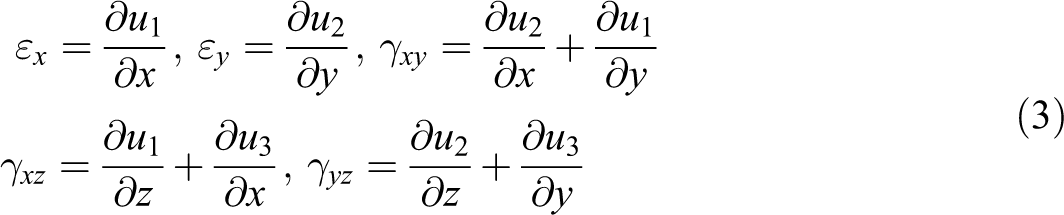
According to Sanders’ approximation, the linear strain–displacement relations are as follows
Conditions at layer interfaces
The laminated composite is being transformed to Cartesian coordinate system; x, y are adopted to be the laminate reference for the bottom plane, and z is considered for thickness coordinate. Using this coordinate system, now zk represents the interface coordinate of k and suffix with (−) or (+) is used to define the stresses above and below the interface. Using Pagano’s 8 elascticity theory, the conditions as listed in the following are required for accurate prediction of interlaminar stresses. The following contact conditions are included in the present model at the interfaces of adjacent layers by transverse shear stress


The zero stress boundary conditions at the

The present model and element also mete out the following kinematic contact conditions

where uα is the elastic displacement’s component.
For typical lamina (kth), the constitutive relations with respect to the material axis are given as follows
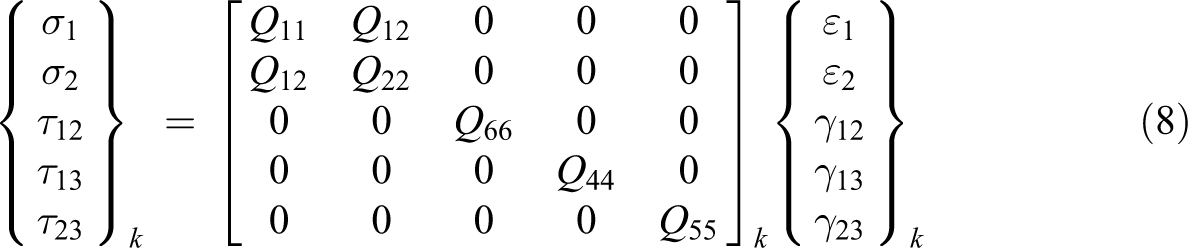
or, it may also be represented as

where
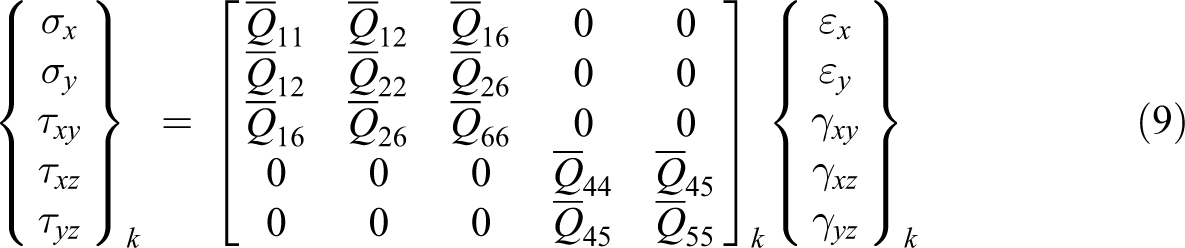
The relationship of stress versus strain for a lamina with reference to the structure axis system (x, y, and z) after doing the necessary transformation may be given as follows
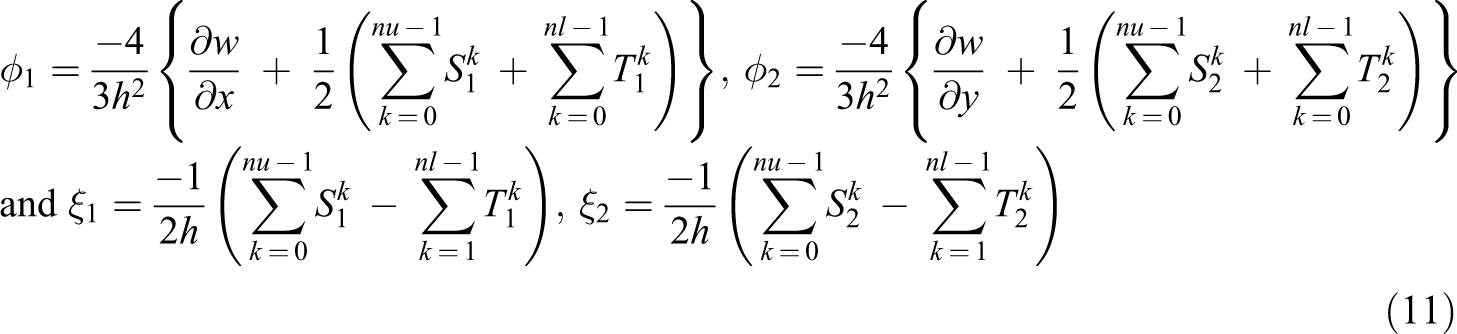
For the FE implementation, it is required by the in-plane displacement fields to have C1 continuity of the transverse displacement. To circumvent the difficulties related to C1 continuity, the first-order derivatives of w are considered as independent variables given by

With the help of which all the variables can be defined as C0 continuous.
So by utilizing the transverse shear stress free boundary condition, that is
Substituting equation (11) in equation (1), (
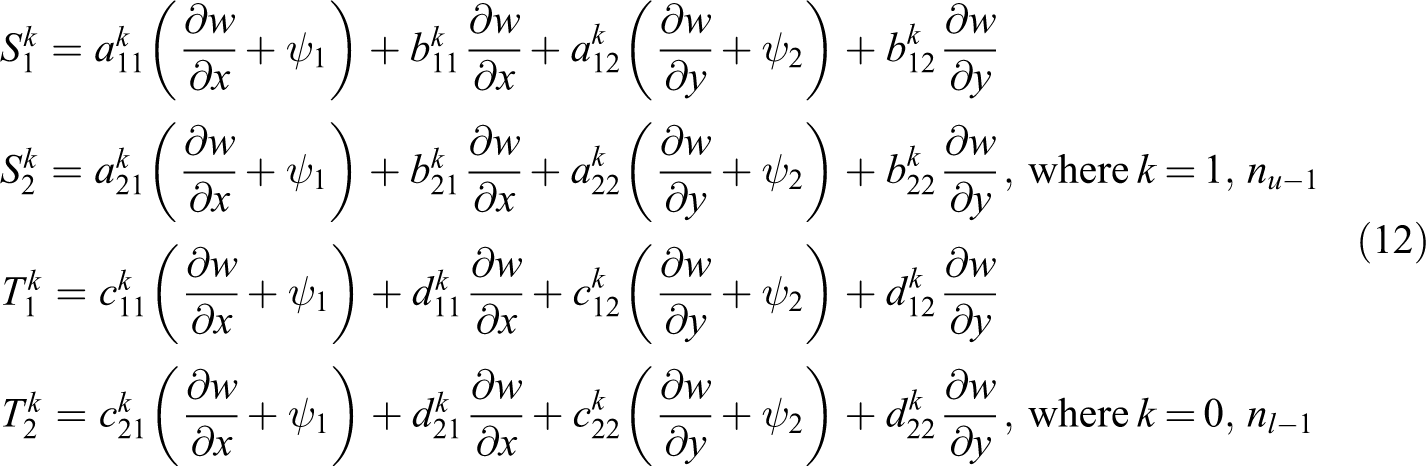
where ψ
1 and ψ
2 represents the rotations of normal with respect to the midplane about the y and x axes, respectively, whereas
Thus, under the influence transverse load (q), the laminate’s potential energy (V) can be given as follows

Using abovementioned equation, we can derive element stiffness matrix, [ke ]
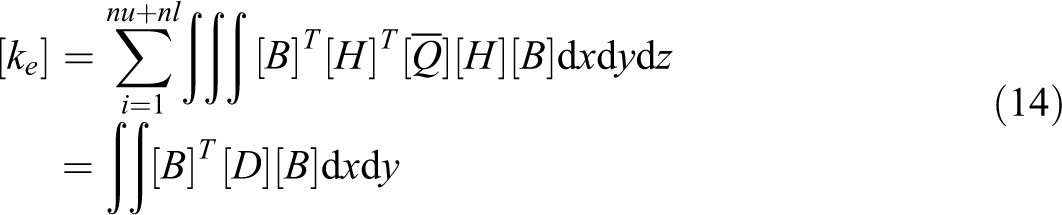
In the abovementioned equation, matrices [B],

The strain field vector is given by

where

Now the relationship of strain displacement may be given as follows

In the abovementioned equation, [B] represents the matrix of strain displacement having size 17 × 63, whereas {δ} is of size 63 × 1 representing the nodal unknown vector.
FE formulation
In this article, C0 isoparametric elements having nine nodes, with seven unknowns per node (Figure 1(b)), that is,
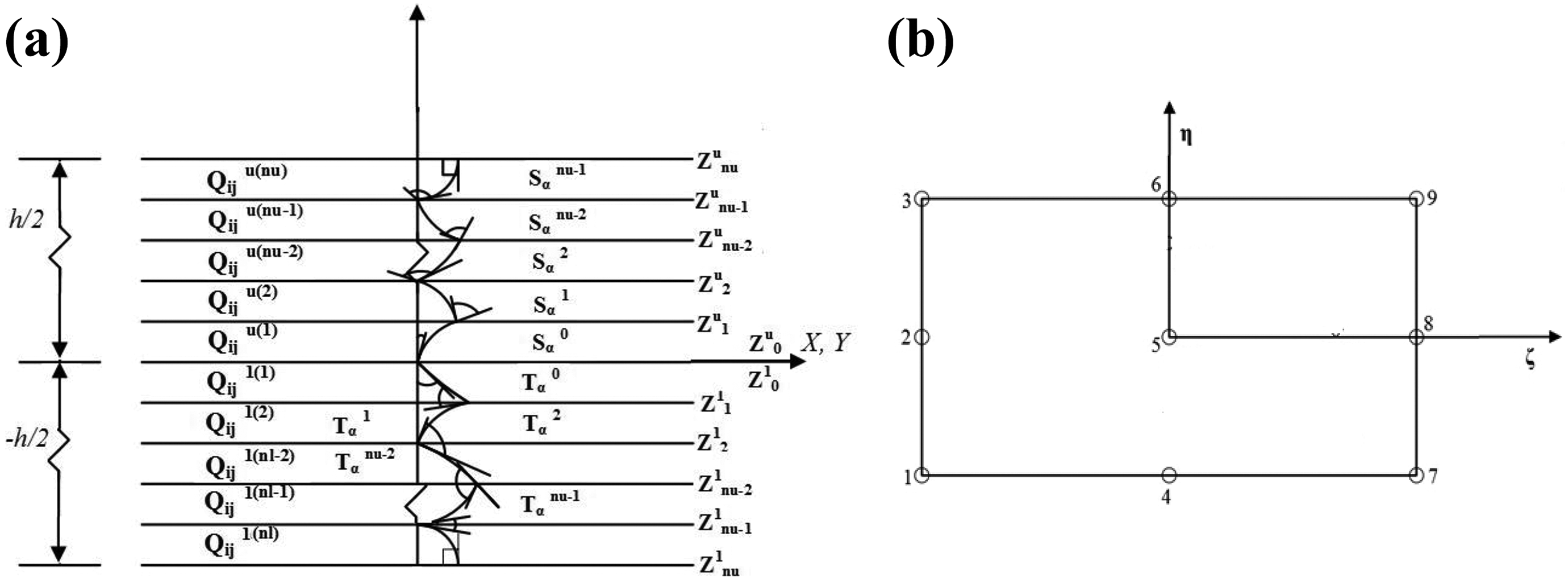
(a) General lamination layup and in-plane displacement across the cross section of a plate and (b) nine-noded curved isoparametric element with typical node numbering.

In the abovementioned equation, the shape function of the related node is represented by Ni .
After knowing the nodal unknown vector within an element, the mid-surface strains at any point in the plate, in terms of global displacements can be expressed in the matrix form as follows

In the equation, [Bi ] is used to express the differential operator matrix of the shape function developed from equation (20).
For an element, the element stiffness matrix (say, eth), including the transverse shear effects, flexure, and membrane can be given as

For all numerical integrations, a 3 × 3 Gaussian quadrature format has been used. Then, the element matrices are grouped together to attain the global stiffness matrices, [K], in accordance with the typical procedure of the FE method as considered by Bathe. 39
Free vibration analysis
In this analysis, the governing equation (22) is solved using the simultaneous iteration technique of Corr and Jennings (1976) for the computation of eigenvalues and eigenvectors.

In this method, [K] represents the positive definite and can be decomposed into Cholesky factors as

Numerical application and results
New problems are tied to be solved in this article, for natural frequencies of free vibration for laminated composite and sandwich skew plates considering the effect of openings and additional mass. The mode shapes are also presented for the same using IHSDT. For the execution of the abovementioned FE model, a FORTRAN code is developed based upon the abovementioned mathematical formulation.
Boundary condition
The boundary conditions mainly applied in following examples are clamped boundary condition (CCCC) and simply supported boundary condition (SSSS) which are as follows
CCCC:
at x = 0, a and at y = 0, b

SSSS:
at x = 0, a

at y = 0, b

Other than these four, more support conditions are used in different examples: CCFF = Clamped, Clamped, Fixed, Fixed CCSS = Clamped, Clamped, Simply supported, Simply supported CFCF = Clamped, Fixed, Clamped, Fixed CSCS = Clamped, Simply supported, Clamped, Simply supported
Engineering properties (geometrical and material)
For all the further investigations, unless mentioned otherwise, the composites with the following properties are taken: E
1 = 25E
2, E
2 = 1, G
12 = G
13 = 0.5E2, G
23 = 0.2E
2, ρ = 1, and ν
12 = 0.25. The properties for sandwich case taken in off-axis system for the core and face sheets are as follows: Face: E
1 = 40E
2, E
2 = 1, G
12 = G
13 = E
2, G
23 = E
2, ρ = 1, and ν
12 = 0.25 and Soft Core: E
2/Ec
= 11.945, G
12/Ec
= G
13/Ec
= 1.173/6.279, G
23/Ec
= 2.415/6.279, ρ/ρc
= 0.6818, and ν
12 = 0.25. The geometrical properties taken are a/h = 5, 10, 100 and a = 1 and b = 1 in. Face sheet and core thicknesses are taken as 0.2h and 0.8h, respectively. The nondimensional frequency for composites is taken as
Convergence and comparison studies
Convergence study is done to determine the required mesh size N × N at which the dimensionless free vibration fundamental frequencies values may converge. After the variation of mesh sizes from 8 to 22, it may be concluded from Table 1 that the values of nondimensional fundamental frequencies have converged at N = 20. Therefore, for all subsequent analyses, mesh size of 20 × 20 (Full) is taken into consideration. The numbering of edges in plate is shown in Figure 3(a). The converged results are found to be in good accordance with the results of Chakrabarti and Sheikh 40 based upon refined higher shear deformation theory (RHSDT).
Convergence study of nondimensional fundamental frequencies
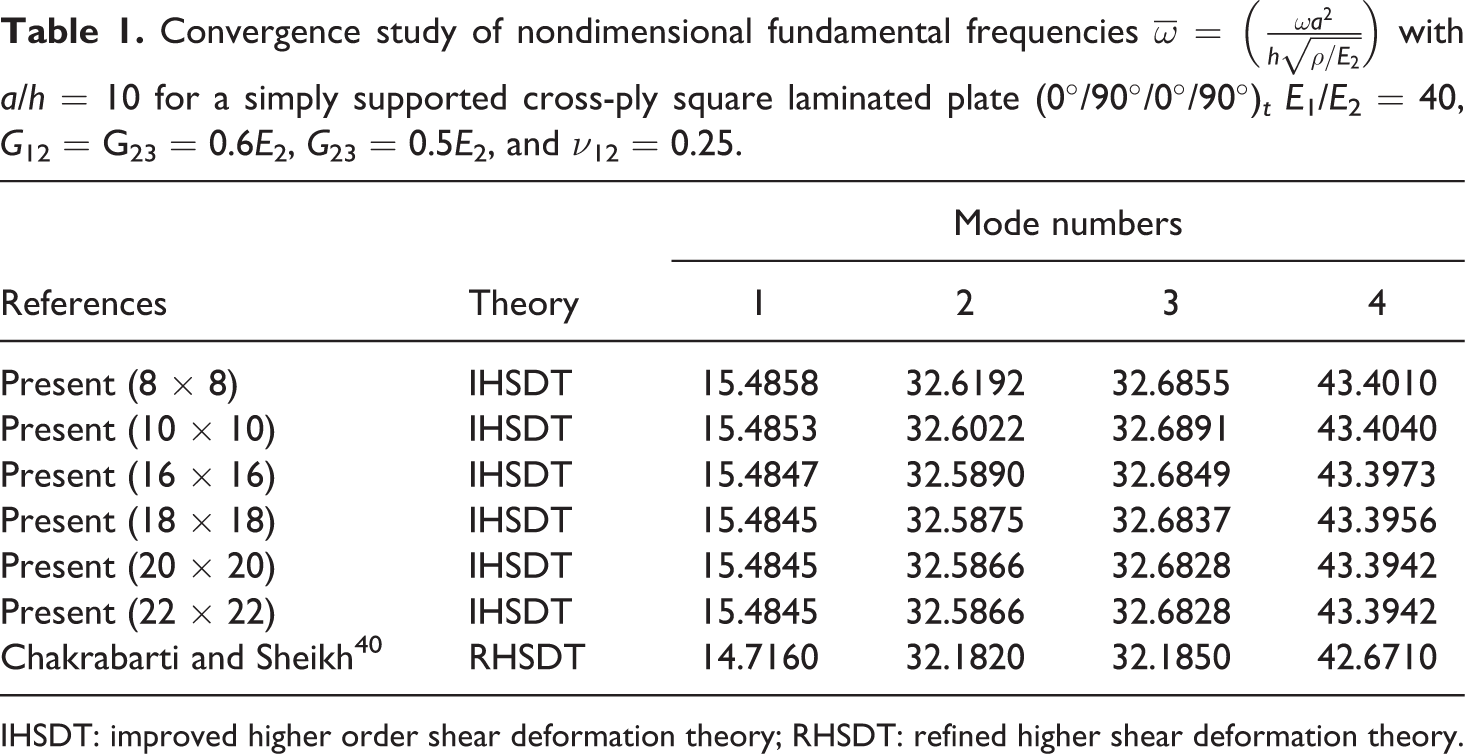
IHSDT: improved higher order shear deformation theory; RHSDT: refined higher shear deformation theory.
To show the performance of different plate theories, a cross-ply (0°/90°/90°/0°) square laminate under the effect of free vibration is taken for consideration in this example. In Table 2, the analysis of full plate is done with different mesh divisions and different a/h ratios. As from literature review, it is much clearer that there are no results available on the free vibration analysis of the composite and sandwich laminated skew plates with cutout and concentrated mass based on IHSDT; the results obtained are hence evaluated with reference to those obtained by Whitney and Pagano, 41 Reddy and Phan, 42 Senthilnathan et al., 43 and Kant and Swaminathan. 26 The percentage errors shown in Table 2. have been evaluated with respect to the analytical solution of Kant and Swaminathan. 26 Table 2 shows the utility of the present FE model in predicting nondimensional fundamental frequencies close to exact analytical results given by Kant and Swaminathan. 26 The different elastic modulus ratios have been considered in Table 3, and the results of the present formulation have been compared with those of 3-D elastic solutions of Noor 44 and other results of Reddy and Phan 42 and Kant and Swaminathan. 26
Validation of nondimensional fundamental frequencies
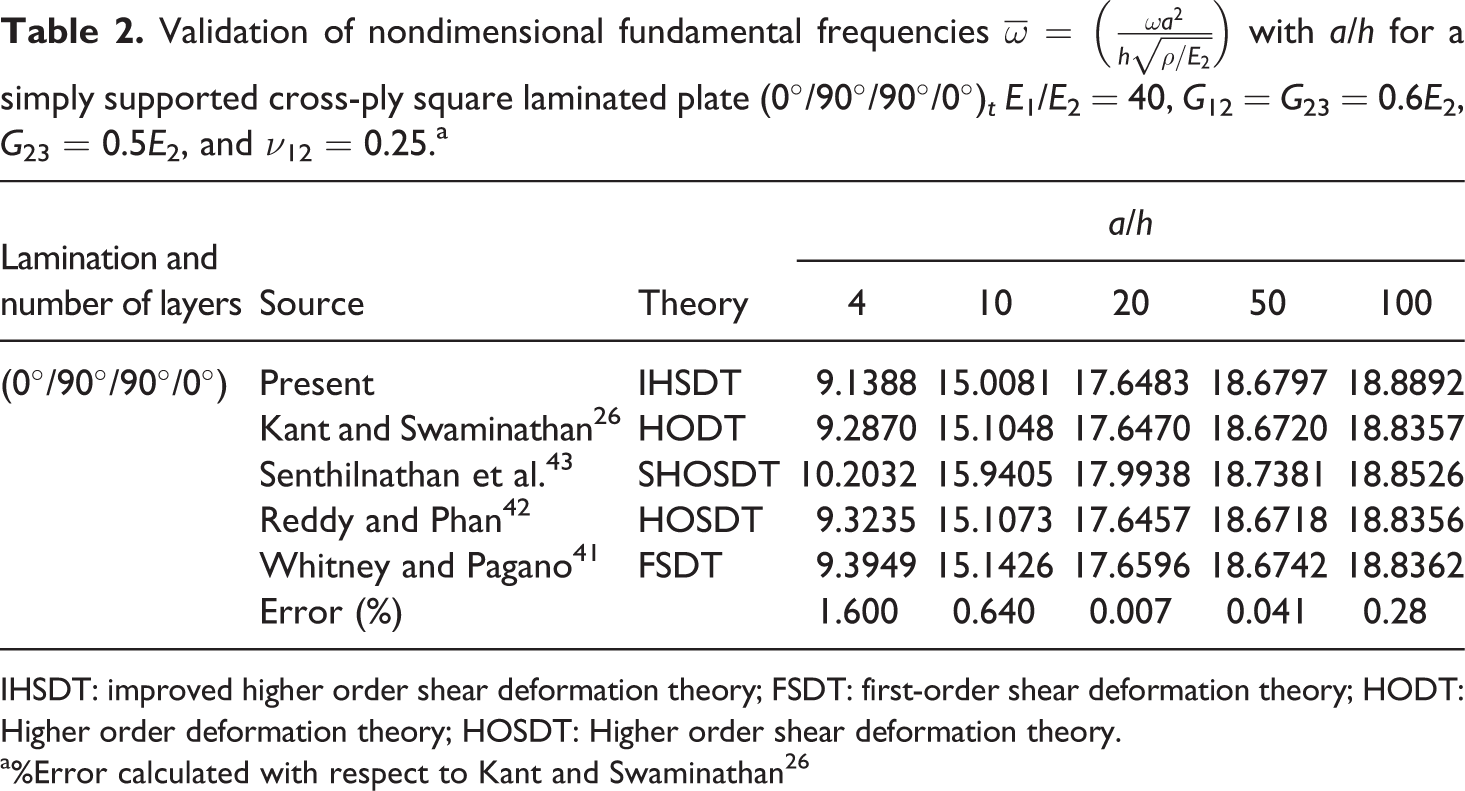
IHSDT: improved higher order shear deformation theory; FSDT: first-order shear deformation theory; HODT: Higher order deformation theory; HOSDT: Higher order shear deformation theory.
a%Error calculated with respect to Kant and Swaminathan 26
Validation of nondimensional fundamental frequencies
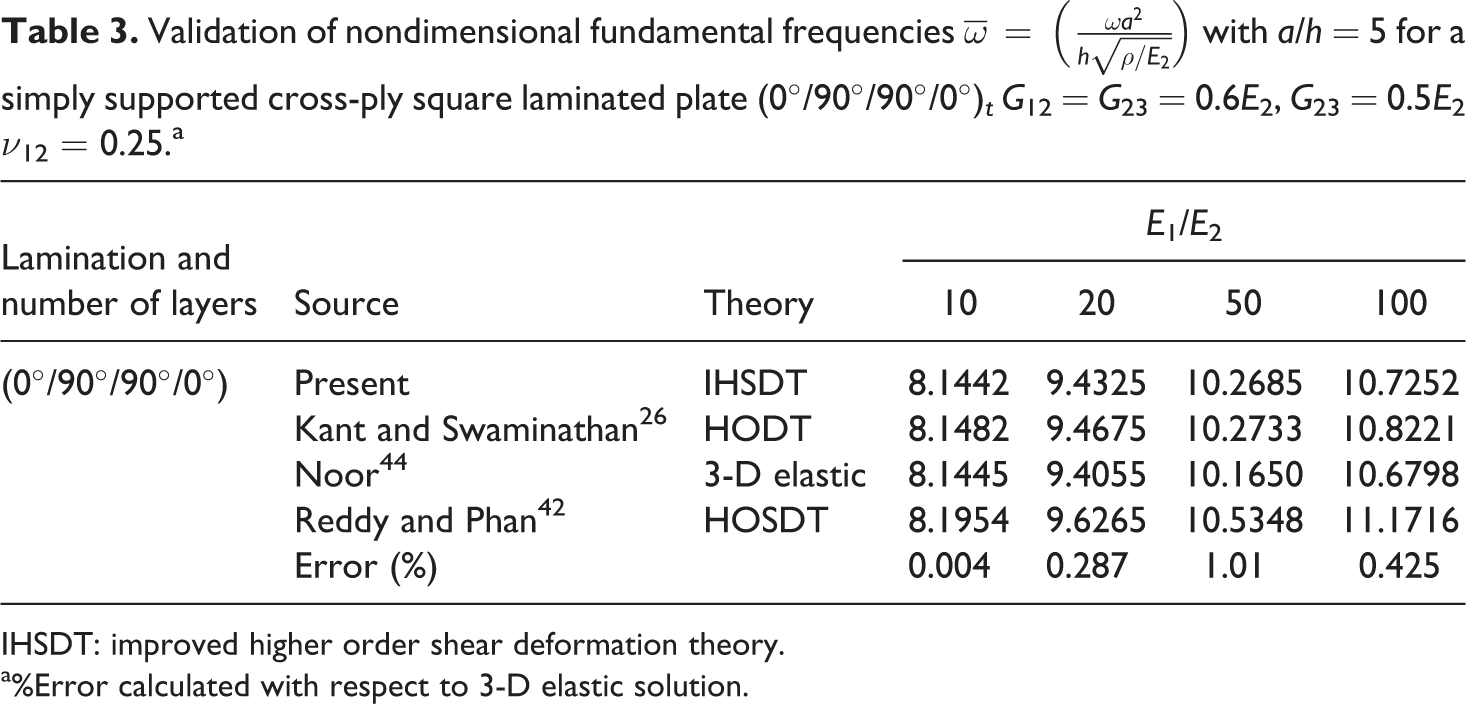
IHSDT: improved higher order shear deformation theory.
a%Error calculated with respect to 3-D elastic solution.
To show the efficiency of the present model, all edges clamped laminated composite plate (0°/90°/90°/0°) have been analyzed. The frequencies for different modes of vibration and a/h ratios are compared with the results of Kulkarni and Kapuria 25 based upon 3-D FE ABAQUS model and zigzag theory as shown in Table 4. The results based upon present formulation when compared are found to be in good accordance with the results of Kulkarni and Kapuria. 25 The material properties adopted for the present analyses are E 1 = 181 GPa, E 2 = 10.3 GPa, G 12 = G 13 = 7.17 GPa, G 23 =2.87 GPa, ρ = 1578, and ν 12 = 0.28.
Frequency parameter
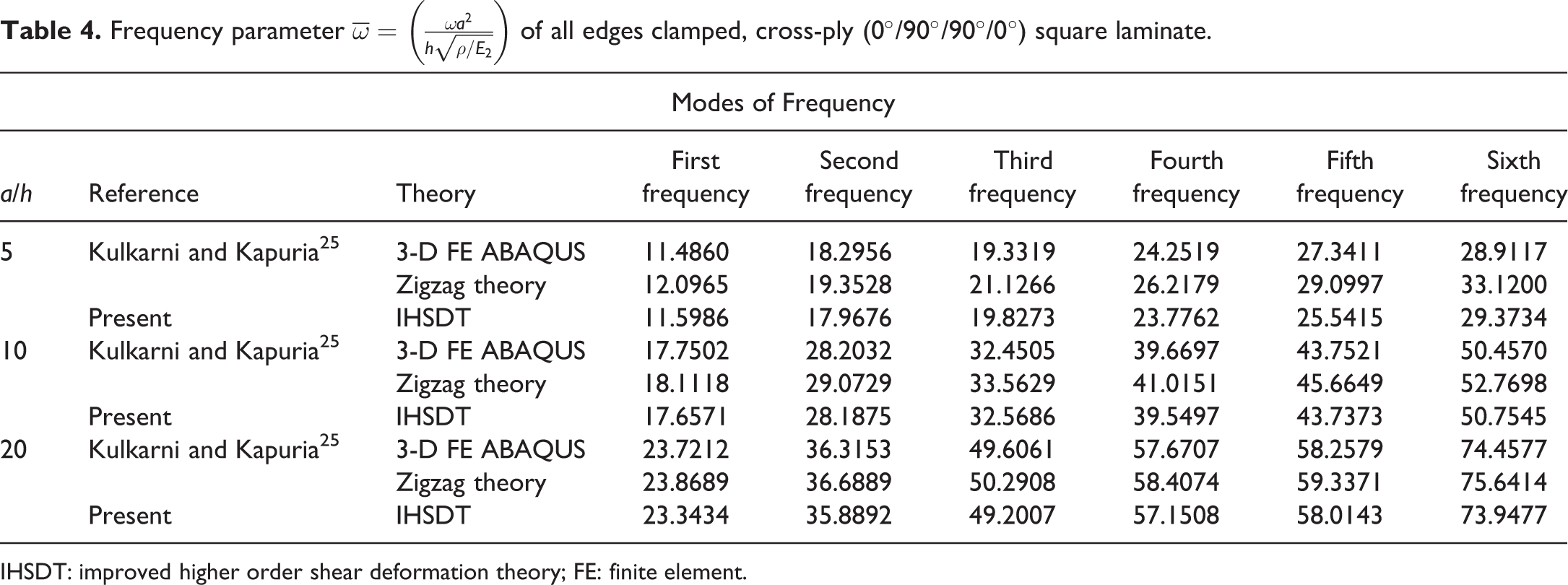
IHSDT: improved higher order shear deformation theory; FE: finite element.
Another example of laminated composite plate having lamination scheme as (0°/90°/90°/0°) has been analyzed. The nondimensional frequencies for various aspect ratio have been computed and compared with different theories of Cho et al., 45 Wu and Chen, 46 Matsunaga, 47 and Fiedler et al. 27 based upon individual layer theory, HSDT, and RHSDT, respectively, and shown in Table 5. For all aspect ratios, frequencies predicted by the present model are closer to the results predicted by other theories.
Frequency parameter
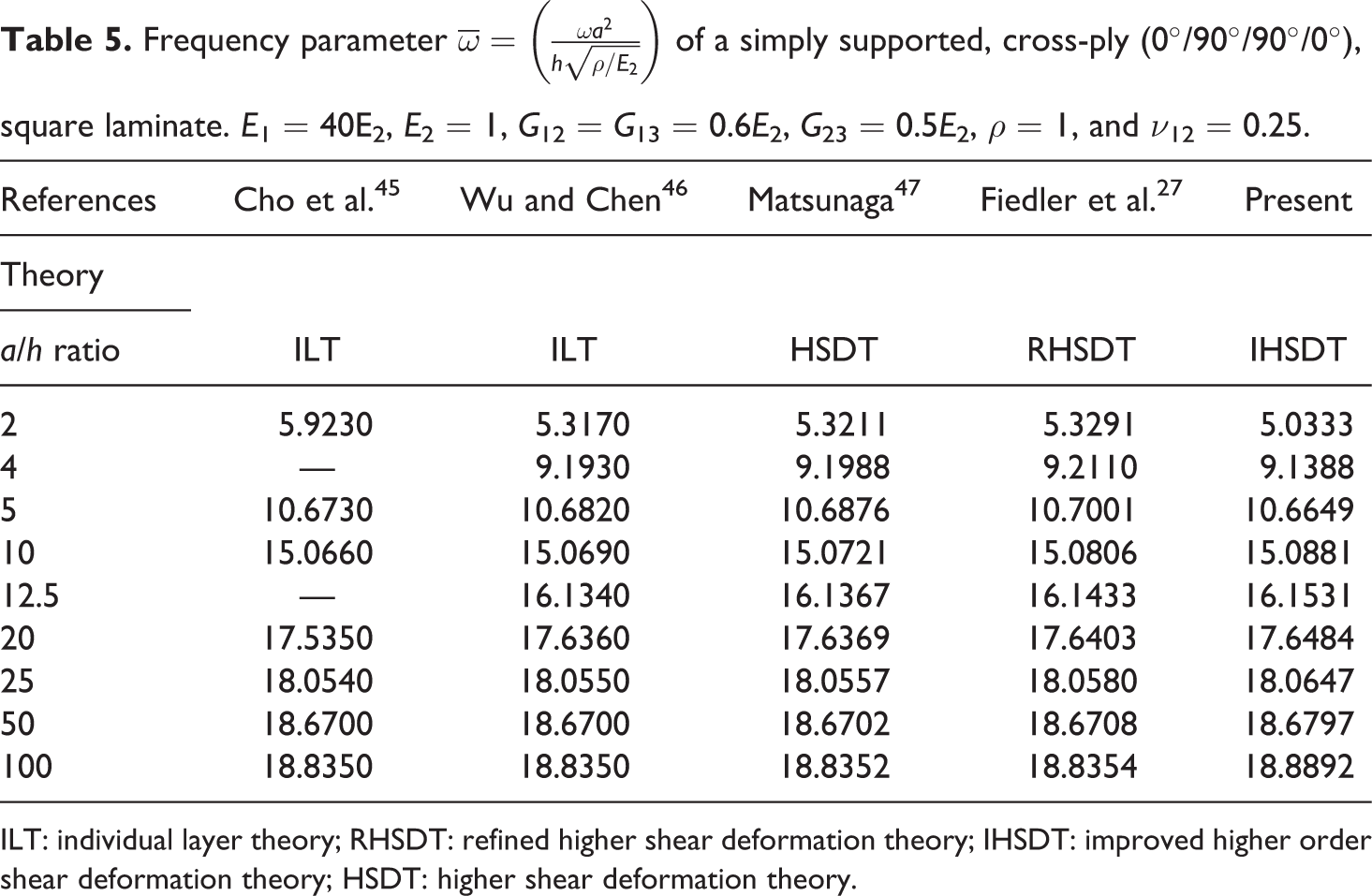
ILT: individual layer theory; RHSDT: refined higher shear deformation theory; IHSDT: improved higher order shear deformation theory; HSDT: higher shear deformation theory.
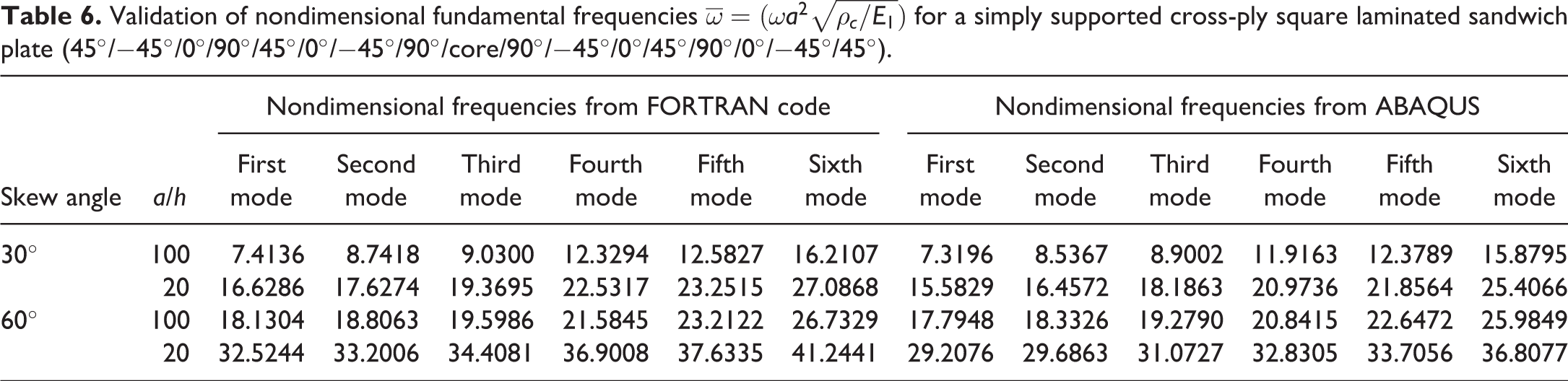
In Table 6, the results are calculated for laminated sandwich plate (45°/−45°/0°/90°/45°/0°/−45°/90°/core/90°/−45°/0°/45°/90°/0°/−45°/45°) with the help of present FORTRAN code and FE tool ABAQUS. A square cutout of size 0.4a has been taken at the center of the plate for the present analysis. In Table 6, nondimensional frequencies for different modes of vibrations are calculated for different values of skew angles and a/h ratios. The results predicted from both methods are found to be nearly the same for any condition.
Validation of nondimensional fundamental frequencies
Novel results
After validating the present FE model based upon the abovementioned theory through comparison studies, new problems are worked out to analyze the effect of openings and additional mass on free vibration of laminated composite sandwich skew plates. For the following examples, various laminated composite skew plates having different lamination schemes with different boundary conditions have been analyzed for free vibration. The geometrical and material parameters used for analysis are defined in the previous sections. The ply numbering scheme, as shown in Figure 2, is in such a way that the counting of lamina is done from bottom to top. The skew layup is shown in Figure 3(b).
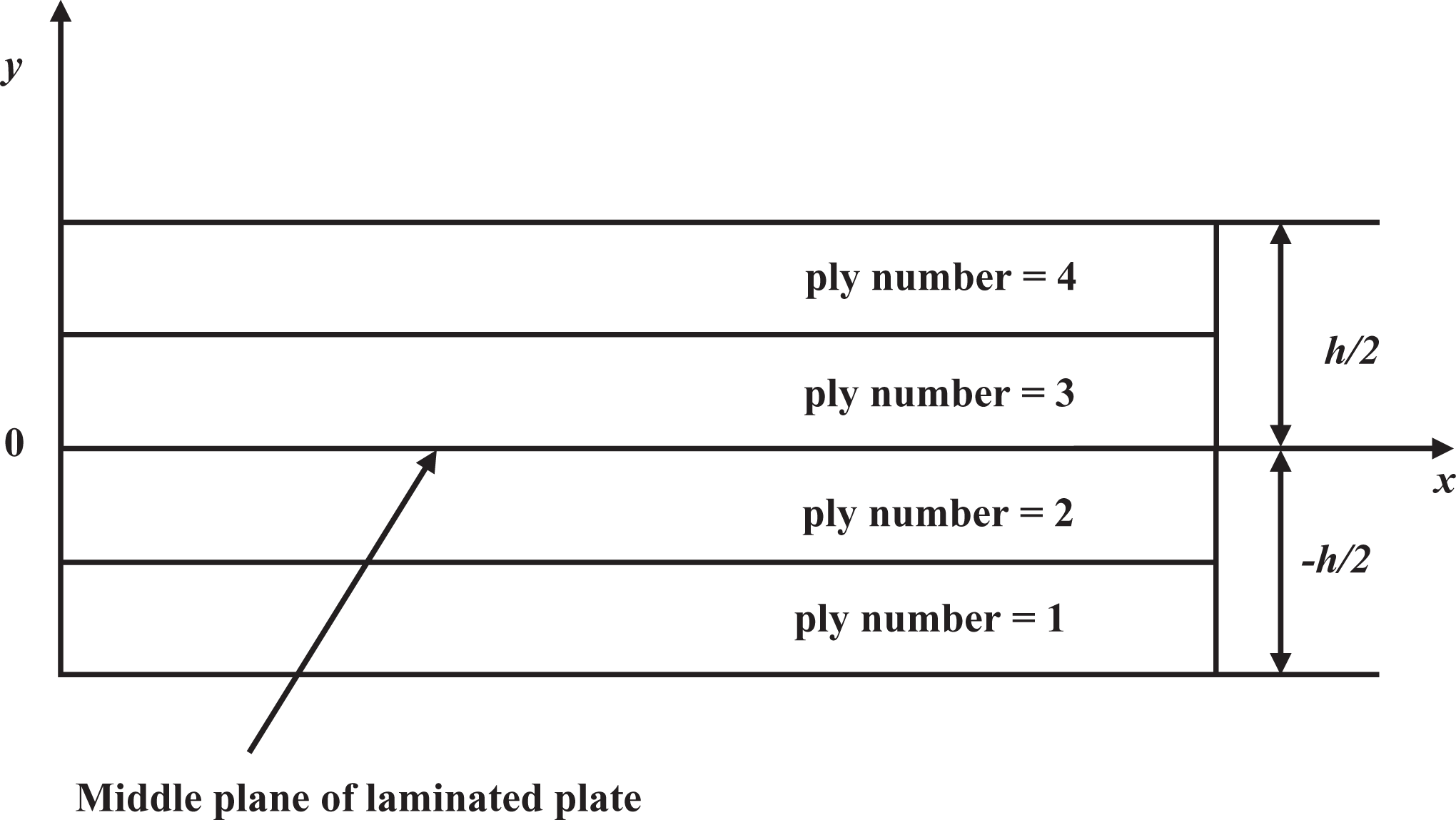
Typical front view of four-layer laminated plate with ply numbering.
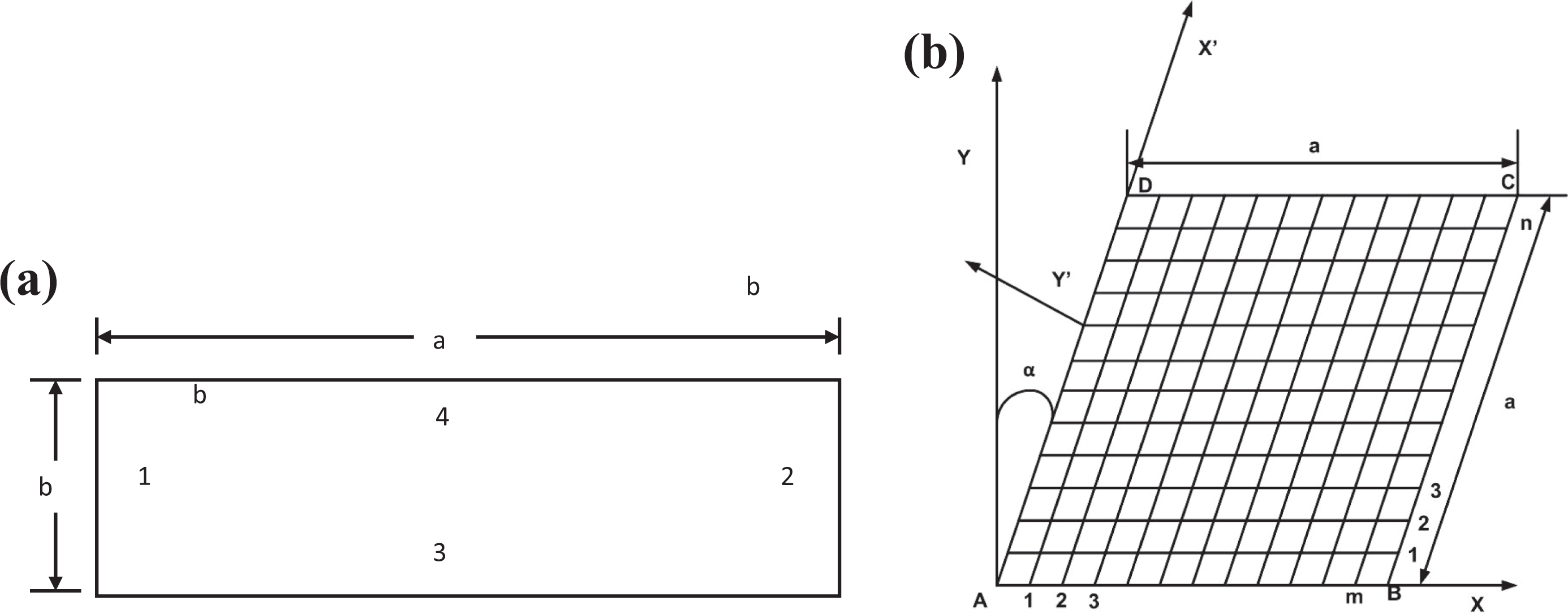
(a) Numbering of edges of plate and (b) a skew plate having a mesh of m × n.
The comparison of nondimensional frequencies is shown in the following examples for the composite and sandwich plates with additional mass (
Laminated skew composite plates
Laminated skew composite plates with additional mass
For a particular value of additional mass, it was found that on increasing the skew angles the value of frequencies is increasing irrespective of change in a/h values as shown in Figure 4(a). But for a particular a/h ratio, it was found that irrespective of change in additional mass value, the frequencies other than fundamental frequency are almost the same for a particular skew angle. On decreasing the a/h value, the frequencies are decreasing with their corresponding additional mass and skew angle.
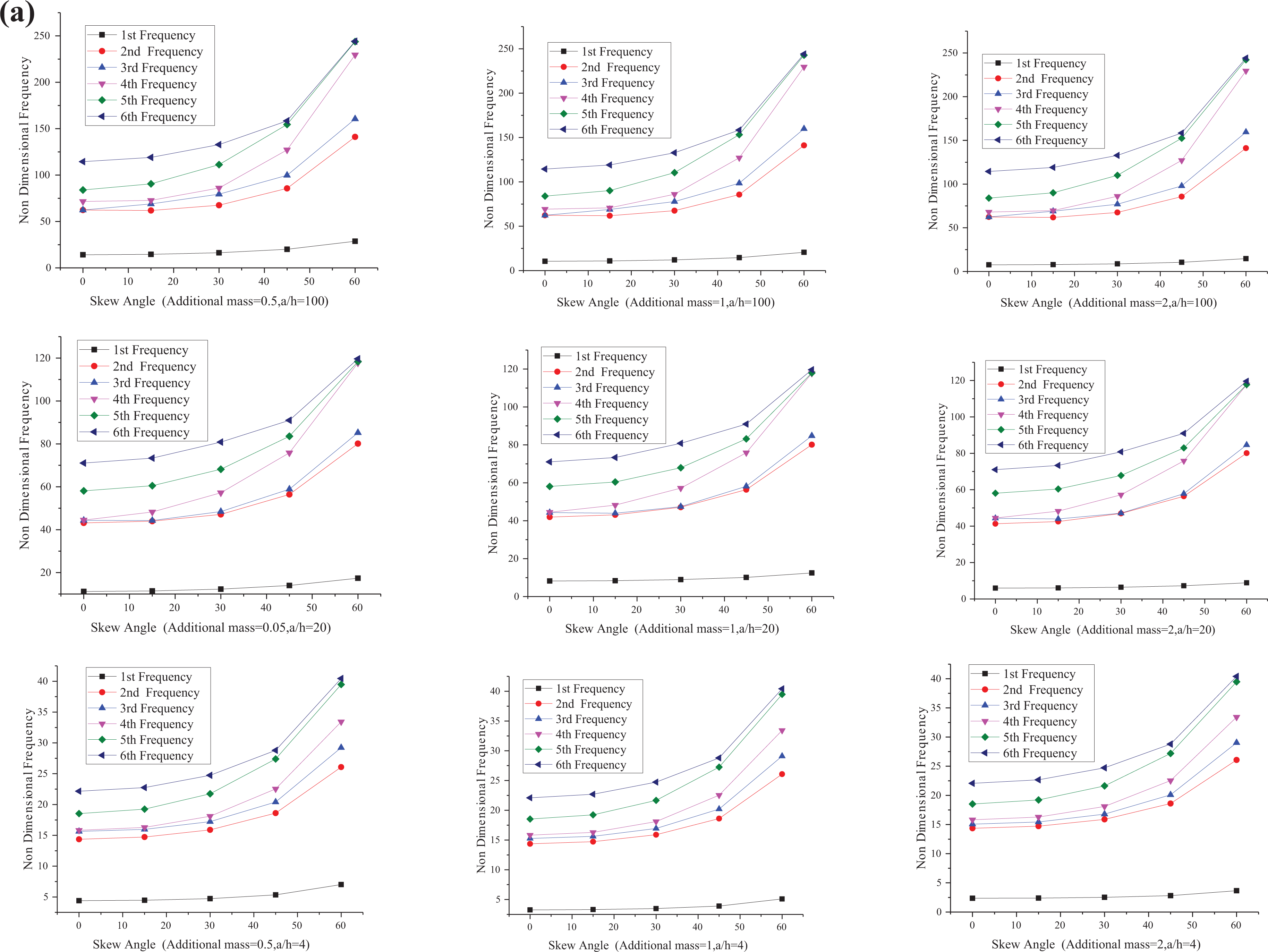
Variation of nondimensional frequencies with (a) skew angle for different additional mass
The values of frequencies for a/h ratio = 5 have been compared for different ply layup and skew angles as shown in Figure 4(b). The variation of frequencies was almost the same for different ply layups for skew angle other than 60°.
The variation was also analyzed for different boundary conditions for which CCFF and CFCF only show variations in nature of frequencies for any skew angle as shown in Figure 4(c).
The mode shape plotted in Figure 5(a) and (b) shows the variation on the basis of boundary condition. The CCCC and SSSS boundary conditions were taken for a fixed a/h ratio, skew angle, and additional mass. It shows that the pattern of mode shape remains the same only its value changes. It may be due to the fact that the variation of skew angle only effects the mode shape as it is shown in Figure 6(a) and (b). The pattern of mode shape of fundamental frequency remains the same on the variation of skew angles but for other mode shapes it reverses.
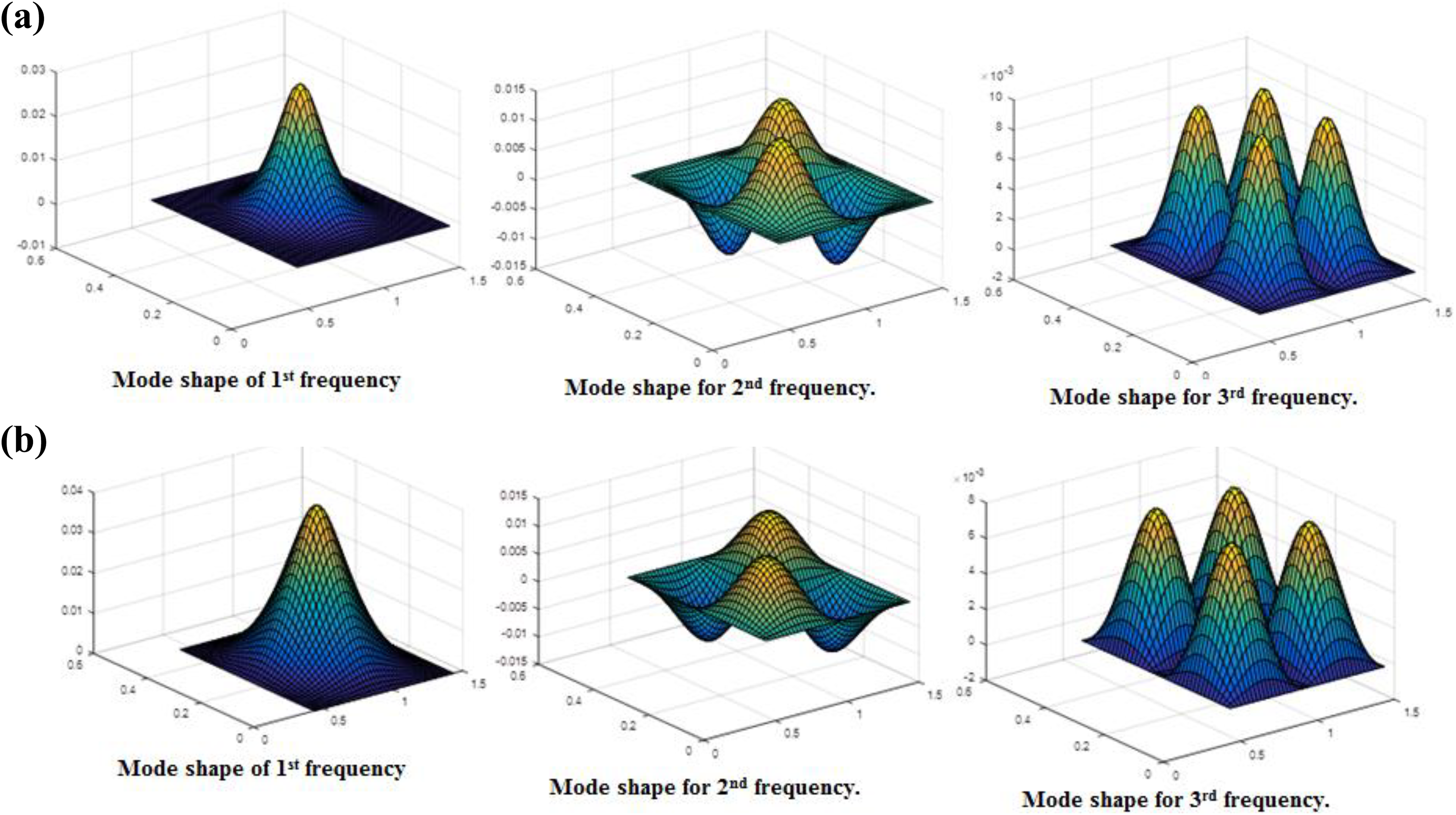
Mode shapes of skew (60°) laminated composite plate (45°/0°/−45°/0°/−45°/90°/0°/45°/0°/90°/−45°/0°/−45°/0°/45°)
t
with (a) lumped mass (
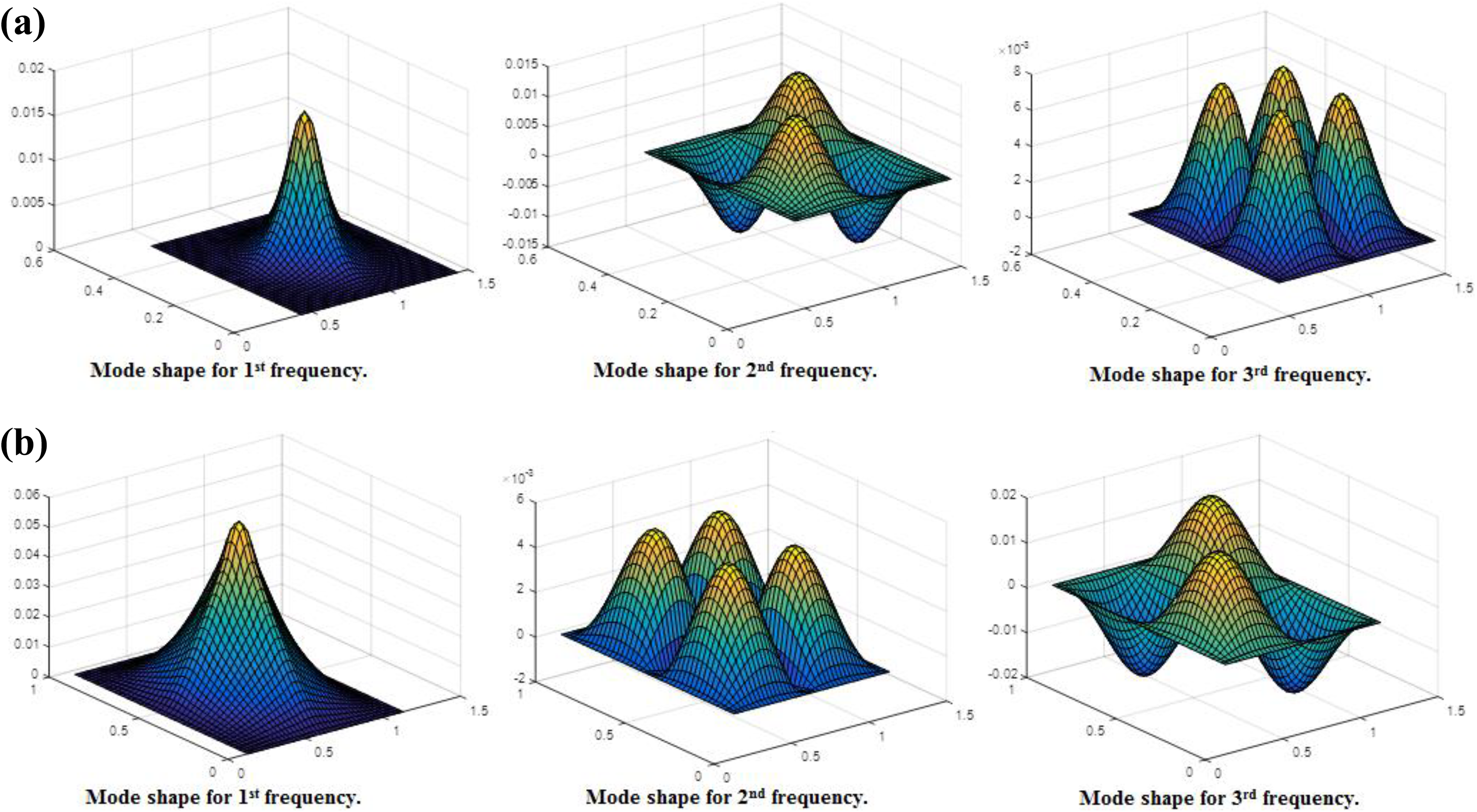
(a) Mode shapes of skew (60°) laminated composite plate (45°/0°/−45°/0°/−45°/90°/0°/45°/0°/90°/−45°/0°/−45°/0°/45°)
t
with (a) lumped mass (
Laminated skew composite plates with square cutout
The square cutout in the plates is taken from the center and it is with the ratio of a. For a particular value of cutout, it was found that on increasing the skew angles the value of frequencies are increasing for a fixed a/h values, whereas on decreasing the a/h values the values of frequencies decreases as shown in Figure 7(a).
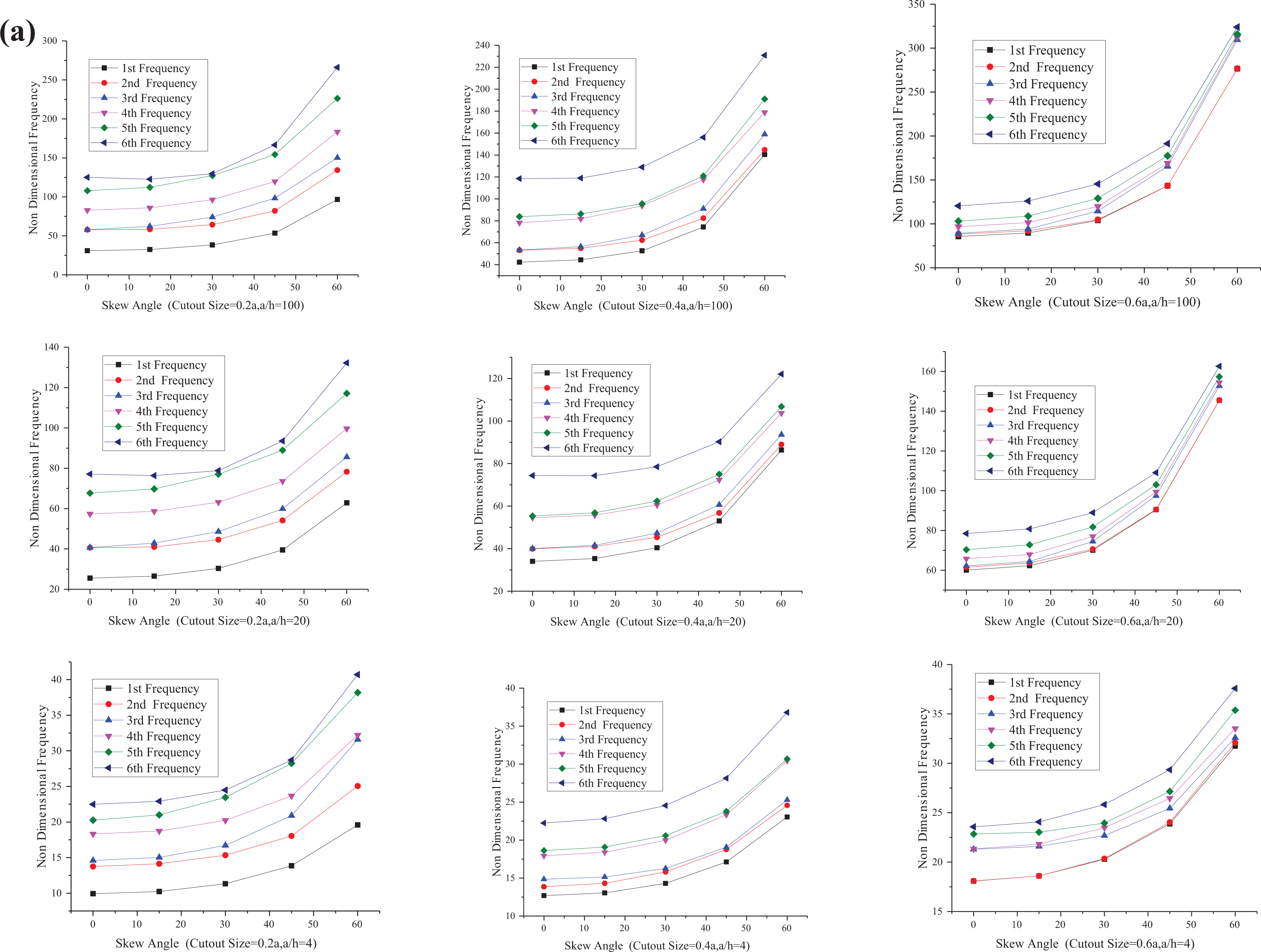
Variation of nondimensional frequencies with (a) skew angle for different cutout area and a/h ratios for 0°/90°/0°/90° ply layup and CCCC boundary condition, (b) different ply layups for different skew angles and a/h for CCCC boundary condition, and (c) different boundary conditions for different ply layup and skew angles.
In Figure 7(b), the variation of frequencies is shown for different ply layups. It can be seen from the figure that for skew angle 60° the larger ply layups show a different trend of variation of frequencies other than that, on increasing the number of plies there is no much rise in the frequencies value with increase in ply numbers.
The variation was also analyzed for different boundary conditions for which CCFF and CFCF only show variations in nature of frequencies for any skew angle as shown in Figure 7(c).
Laminated skew sandwich plates
Laminated skew sandwich plates with additional mass
The behavior of sandwich plates is similar to composites but the values of frequencies are very less in comparison with composites with the same a/h ratio and additional mass value. For a particular value of additional mass, it was found that on increasing the skew angles the value of frequencies is increasing irrespective of change in a/h values as shown in Figure 8(a). On decreasing the a/h value, the frequencies are decreasing with their corresponding additional mass and skew angle.
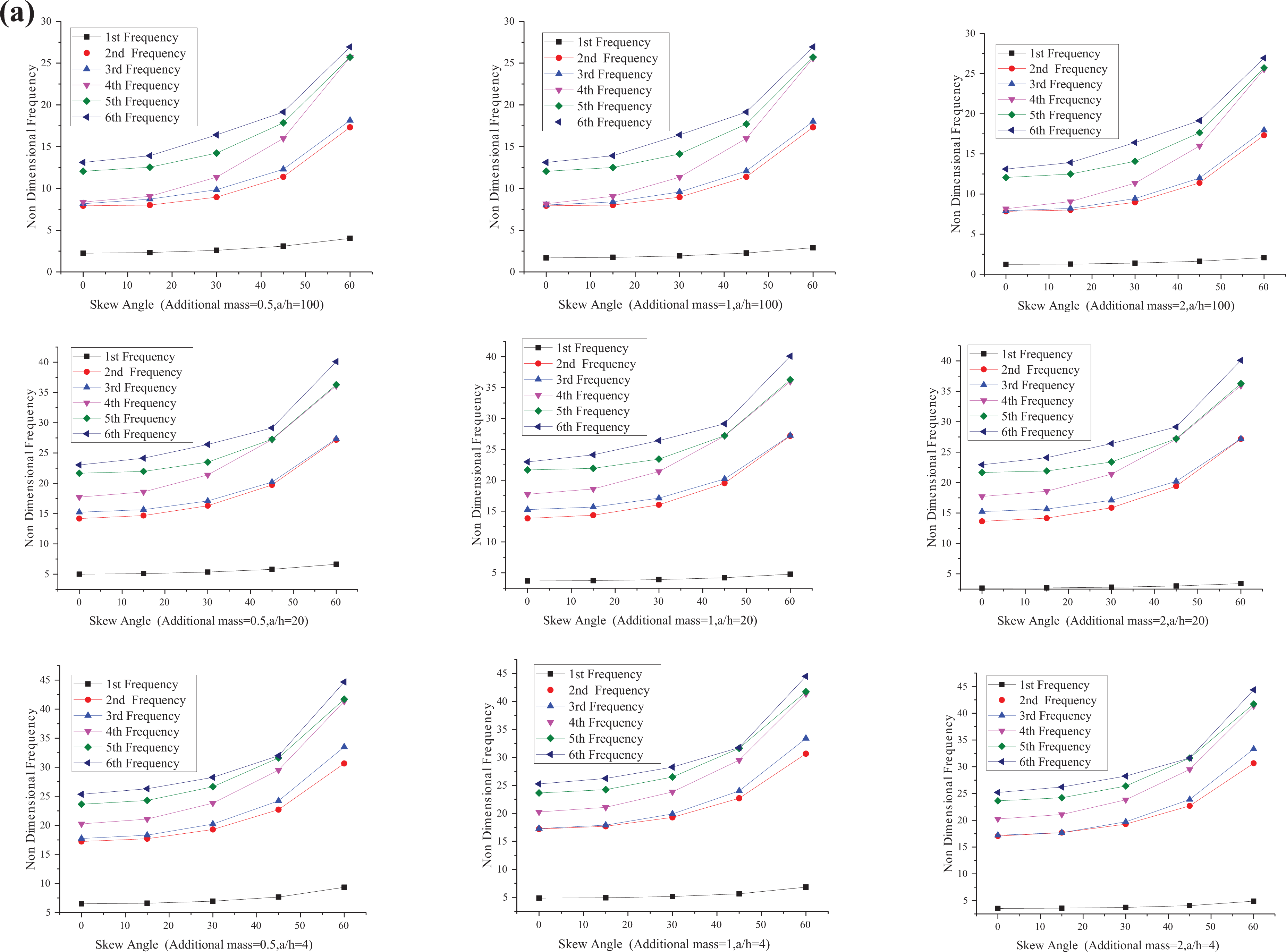
Variation of nondimensional frequencies with (a) skew angle for different additional mass and a/h ratios for (−45°/45°/core/−45°/45°) ply layup and CCCC boundary condition, (b) different ply layups for different additional mass and skew angles for CCCC boundary condition, and (c) different boundary conditions for different ply layups for given additional mass (
In Figure 8(b), the variation of frequencies is analyzed for different ply layups. All the ply layups have almost the same frequencies other than 0°/90°/0°/90°/0°/core/0°/90°/0°/90°/0° for any skew angle.
The variation was also analyzed for different boundary conditions for which CCFF and CFCF only show variations in nature of frequencies for any skew angle as shown in Figure 8(c). All these trends are similar for any ply layup and on increasing the number of plies.
Laminated sandwich plates under square cutout
The square cutout in the plates is taken from the center and it is with the ratio of a. The behavior of sandwich plates is similar to composites but the values of frequencies are very less in comparison with composites with the same a/h ratio and cutout value as shown in Figure 9(a). For a particular value of cutout, it was found that on increasing the skew angles, the value of frequencies is increasing irrespective of change in a/h values. On decreasing the a/h value, the frequencies are increasing with their corresponding cutout area and skew angle.
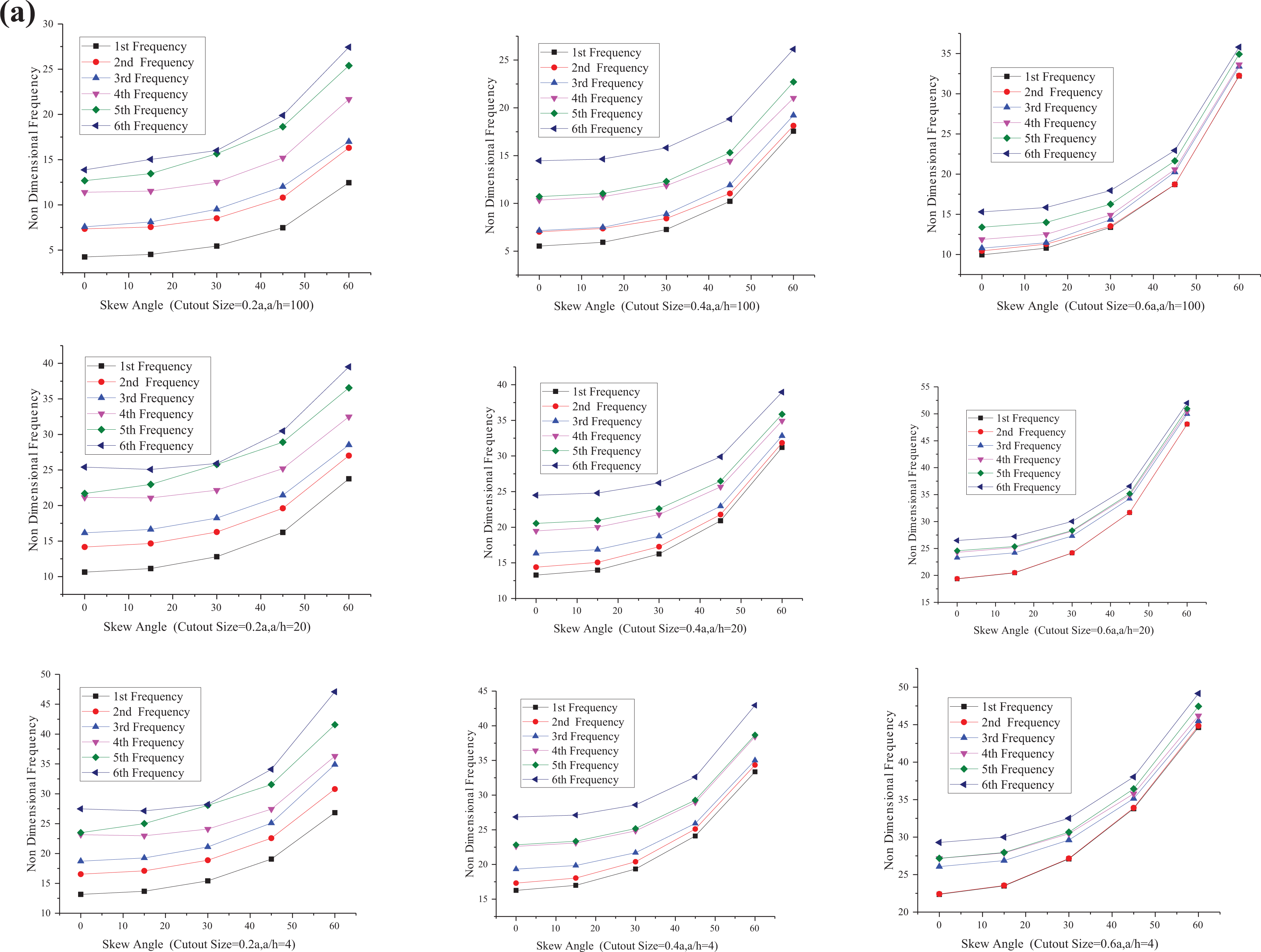
Variation of nondimensional frequencies with (a) skew angle for different additional mass (
In Figure 9(b), variation of nondimensional frequencies with different ply layups for different skew angles for CCCC boundary condition has been analyzed which shows the similar trend for variation in frequencies for different ply layups
The variation was also analyzed for different boundary conditions for which CCFF and CFCF only show variations in nature of frequencies for any skew angle as shown in Figure 9(c). All these trends are similar for any ply layup and on increasing the number of plies.
The mode shape plotted in Figure 10(a) and (b) shows the variation on the basis of boundary condition. The CCCC and SSSS boundary conditions were taken for a fixed a/h ratio, skew angle, and cutout. It shows that the pattern of mode shape remains the same only its value changes. It may be due to the fact that the variation of skew angle only affects the mode shape as it is shown in Figure 11(a) and (b). The pattern of mode shape of fundamental frequency remains the same on the variation of skew angles but for the other mode its shape reverses.
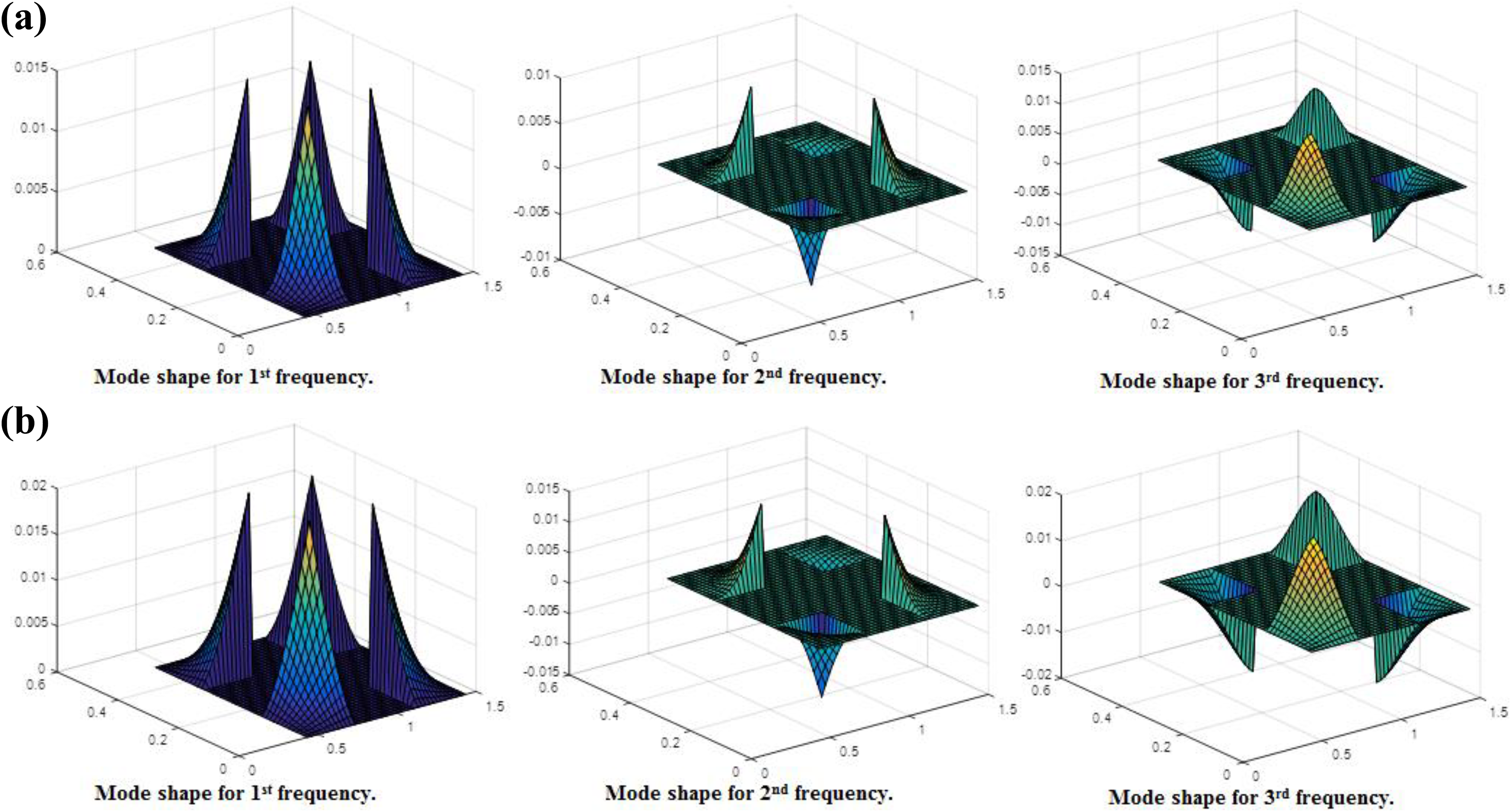
Mode shapes of skew (60°) laminated sandwich plate (45°/−45°/0°/90°/45°/0°/−45°/90°/core/90°/−45°/0°/45°/90°/0°/−45°/45°) t with (a) central cutout (0.4a) (CCCC) (a/h = 100) and (b) central cutout (0.4a) (SSSS) (a/h = 100).
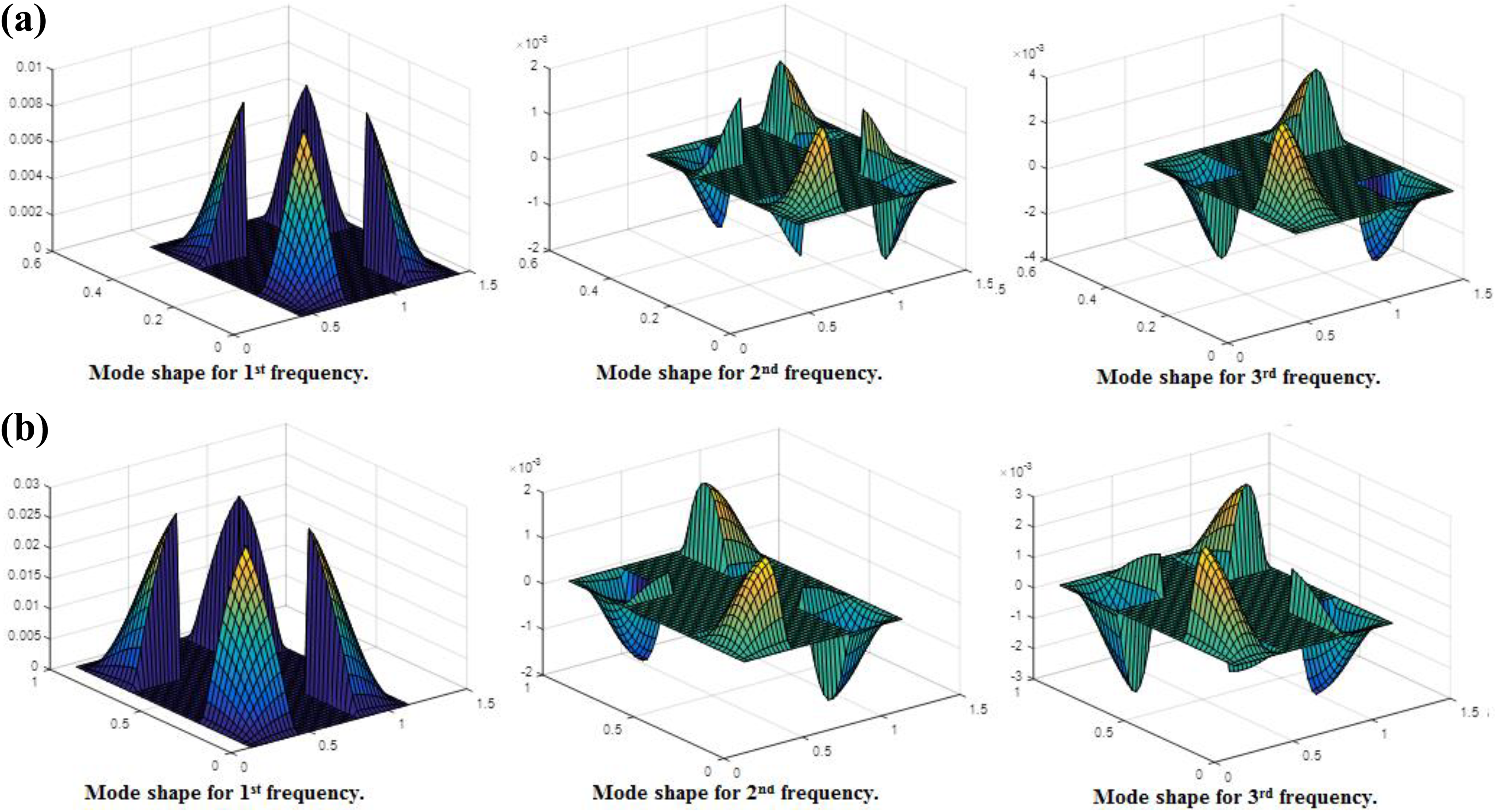
(a) Mode shapes of skew (60°) laminated sandwich plate (45°/−45°/0°/90°/45°/0°/−45°/90°/core/90°/−45°/0°/45°/90°/0°/−45°/45°) t with central cutout (0.4a) (CCCC) (a/h = 20). (b) Mode shapes of skew (15°) laminated sandwich plate (45°/−45°/0°/90°/45°/0°/−45°/90°/core/90°/−45°/0°/45°/90°/0°/−45°/45°) t with central cutout (0.4a) (CCCC) (a/h = 20).
Conclusion
Various cases have been investigated with additional mass and cutout on laminated composite and sandwich skew plates. The variation of boundary condition and ply layup has been taken into consideration. Various results of frequencies other than fundamental frequencies have been shown for the first time for the case of sandwich plates. Along with frequencies, various mode shape has been plotted to study its variation. The results show that skew angle plays a vital role in the value of frequencies as for a fixed skew angle, variation of additional mass does not affect the higher mode of frequencies except the fundamental frequency. The 2-D FE C0 model based on IHSDT solutions presented in this article is in good agreement with the analytical solutions and, hence, quite elegant enough to explore the effect of openings and additional mass on free vibration behavior of laminated composite sandwich skew plates.
