



Abstract
Properties of ultrahigh molecular weight polyethylene (UHMWPE) fiber-reinforced composites depend largely on the interfacial bonding strength between fiber and matrix. In the present work, UHMWPE was irradiation treatment. The existence of functional groups introduced to the fiber surface and the changes of surface roughness were confirmed by Fourier transform infrared (FTIR), X-ray photoelectron spectroscopy (XPS), and scanning electron microscopy (SEM). To evaluate the possible applications of this surface modification of UHMWPE fiber (UF), we examined the mechanical properties as well as the friction and wear performance of thermoplastic polyvinyl chloride (PVC) composites and found that the mechanical properties of PVC composites were all significantly improved. Scanning electron microscope investigation of worn surfaces of PVC composites showed that surface-treated UF/neoprene/PVC (UF/NO/PVC) composite had the strongest interfacial adhesion.
Introduction
Interfacial properties between fiber and matrix are very important to control the mechanical performance in composite materials. The single-fiber pullout test and single-fiber composite (SFC) test (also known as fragmentation test) have been commonly used to characterize the fiber–matrix interfacial properties of microcomposites in tension, whereas the microindentation test was used in compression. 1 –3 The single-fiber pullout test (which is also known as microdroplet test) can measure the interfacial shear strength (IFSS) by pulling out a fiber from a lump or microdroplet of the polymer matrix. In the microindentation test, a rigid indenter pushed in a cross-sectional head of the fiber in a thin plate of real composite. The interest in using natural fibers in composites has increased in recent years due to their lightweight, nonabrasive, combustible, nontoxic, low cost, and biodegradable properties. 4,5 Particularly, natural fibers, such as flax, hemp, sisal, and jute, are interesting, environmentally friendly alternative to the use of glass fibers as reinforcement in polymer-based engineering composites. 6 Composites manufactured using them find applications in diverse fields such as automobile components, building materials, and furniture. 7 –9
However, its hydrophilic character due to the high hydroxyl group content of cellulose is the main cause of poor compatibility between cellulose fibers and the polymers used as matrix, which leads to unsatisfactory mechanical properties of composites. 10 –12 Namely, the low interfacial properties between fiber and polymer matrix often reduce their potential as reinforcing agents due to the hydrophilic character of natural fibers. 13 However, the main problem that was faced to develop composite from natural fiber is interfacial bonding between fiber and matrix. It is caused by the hydrophilic behavior of fiber with high content of hydroxyl groups (OH), and hydrophobic matrix behavior produces the poor adhesion between them. As a consequence, stress transfer cannot be fully transferred when composites subjected to loading, and the strength of composites was not maximized. Some researchers everywhere usually carried out several treatments to solve this problem. 14 Some most methods usually used are alkali treatment, silane treatment, and graft copolymerization of monomer directly on the surface. Alkali treatment has been proved significantly improving the sugar palm fiber-reinforced thermoset matrix polymer. 15 Their study showed that the combination of parameters, such as soaking time and solution concentration, plays a role to get optimum mechanical strength of the composites.
In this study, irradiation modification was used to improve the interfacial adhesion of ultrahigh molecular weight polyethylene (UHMWPE) fiber and polyvinyl chloride (PVC) matrix. The objective of this work is to study the mechanical properties of the PVC composites filled with differently surface-treated UHMWPE fibers (UFs). Moreover, the interfacial characteristics of surface-treated UFs were shown.
Experimental
Materials
The PVC resin (C92N8 from Camelyaf, Istanbul, Turkey) was used as the polymer matrix. Methyl ethyl ketone peroxide (MEKP) as the catalyst and cobalt naphthenate as the accelerator were used. The quantities of the accelerator and the catalyst were 0.8 and 0.85 phr of the resin, respectively. The UF (mass density of 300 g/m2) was purchased from Anil Limited (Istanbul, Turkey).
Specimen preparation
Composites were prepared by melt-mixing in a co-rotating twin-screw extruder (Thermoprism TSE 16 TC, L/D:24 [Shanghai Hangtian Equipment Co.]). The blends were fed from the main and side feeders. The molten composite obtained from the die of the extruder was water-cooled and pelletized. The unidirectional composite panels molded were then cut into specimens according to size required.
The three point bending tests
Interlaminar shear strength (ILSS) values of composites were determined by conducting short-beam shear tests according to ASTM D-2344. A Shimadzu AUTOGRAPH AG-IS Series (Shanghai Wanshu Co.) universal testing machine was used by attaching a 5-kN load cell. System control and data analyses were performed using Trapezium software. A span-to-depth ratio of 5:1 was chosen for specimen dimensioning while a cross-head speed of 1.3 mm/min was preferred for testing. At least five specimens were tested to ensure repeatability of the results.
Results and discussion
The results of flexural tests for the UF treatment comparison are reported in Table 1. It can be seen from this table that the surface treatment improves the flexural strength of PVC composites. The flexural strength and modulus values of untreated UF/PVC composite were obtained to be 195 and 3300 MPa, respectively. In irradiation system, the flexural strength of untreated UF/PVC composite was enhanced by approximately 5% as a result of fiber surface treatment.
The effect of surface treatment on flexural properties.

Fourier transform infrared (FT-IR) spectral analysis of UFs
The FT-IR transmittance spectra of UF before and after chemical treatments are shown in Figure 1. The FT-IR is a sensitive technique for surface functional group analysis of fibers. The infrared spectra of various species are presented in Figure 5. For untreated one (Figure 1(a)), a characteristic peak appears at 1715 cm−1 which was assigned to the stretching vibration of O–C=O in carboxylic group. The peak at 1227 cm−1 was commonly associated with the stretching of C–O bonds in carboxylic group. For treated one (Figure 1(b)), The characteristic signals for C=O stretching band of the acyl chloride at 1803 cm−1 and C–Cl stretching vibration at 719 cm−1 indicated the presence of newly formed acyl chloride groups. The bands at 1652 cm−1 were assigned to the C=O stretching of amide (amide I band). The band at 1552 cm−1 corresponds to the scissoring vibration of the N–H of the amide functionality (amide II band). The band at 3209 cm−1 corresponds to the N–H stretching vibration. The new peaks appeared in the spectrum. The broad peak at 2925 cm−1 was assigned to C–H stretch vibration of polymer backbone, and the peaks at 1803 cm−1 originated from C=O stretching vibration of acyl chloride. The C=O stretching vibration of acyl chloride at 1803 cm−1 and C–C stretching vibration at 719 cm−1 still exist, which means the residual acyl chloride groups can further react with UF. A small peak at 1625 cm−1 was associated with the C=C stretching. Thus, characteristic signals for C=O stretching of the acyl chloride at 1803 cm−1 and C–C stretching vibration at 719 cm−1 disappeared.
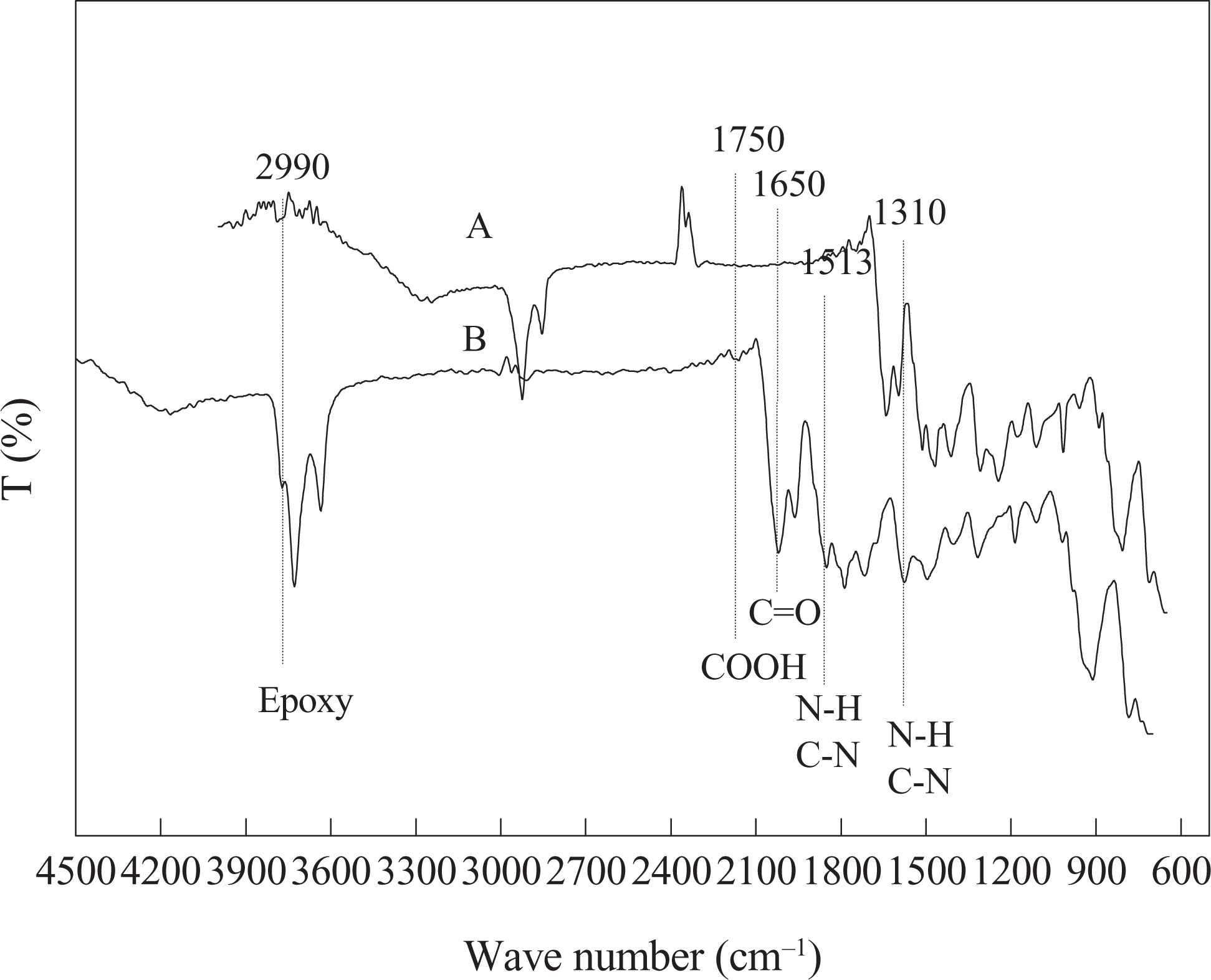
FT-IR transmittance spectra of UHMWPE fibers (a) original, (b) irradiation.
Surface chemical elemental composition
The surface compositions of the pristine and irradiated UFs were determined by X-ray photoelectron spectroscopy (XPS), and the results are shown in Figure 2. The impurities and oxide on the surface of UFs have been removed by irradiation. While the presence of quinone groups (C=O), carboxyl groups (COOH), and the increased percentages of oxygen containing functional groups on the surface of UFs reveal that obvious oxidation has occurred on surface treatment of UFs.
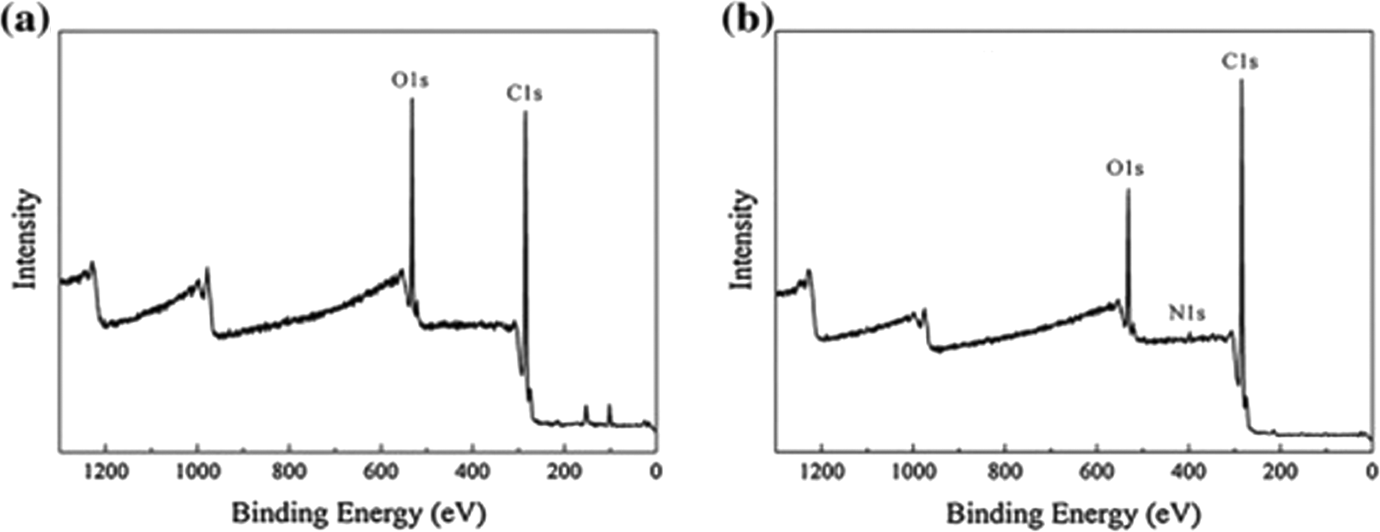
XPS spectra of fiber.
In order to study the varying pattern of functional groups on UFs’ surface, the wide scan and C1s XPS spectra of pristine UFs and irradiated one were analyzed as shown in Figure 2. The C1s spectra have been resolved into, at most, six individual component peaks. They are carbon atoms in polyaromatic structures (C(sp2)) at 284.5–284.6 eV, carbon atoms in aliphatic structures (C (sp3)) at 285.4 eV, alcohol hydroxyl or/and ether oxygen (–C–O–C– or/and C–OH) at 286.2 eV, carbonyl or quinine groups (C=O) at 287.05 eV, carboxyl functions or ester groups (–COO–) at 288.5–288.9 eV, and carboxyl (COOH) at 289.45 eV.
Mechanical properties
The tensile strength of UF/neoprene/PVC (UF/NO/PVC) composites with and without irradiation at different fiber loading is shown in Figure 3. It was found that the tensile strength for irradiated UF/NO/PVC composites is higher. The present of reinforcement, however, has significantly enhanced the tensile strength for both types of composite.
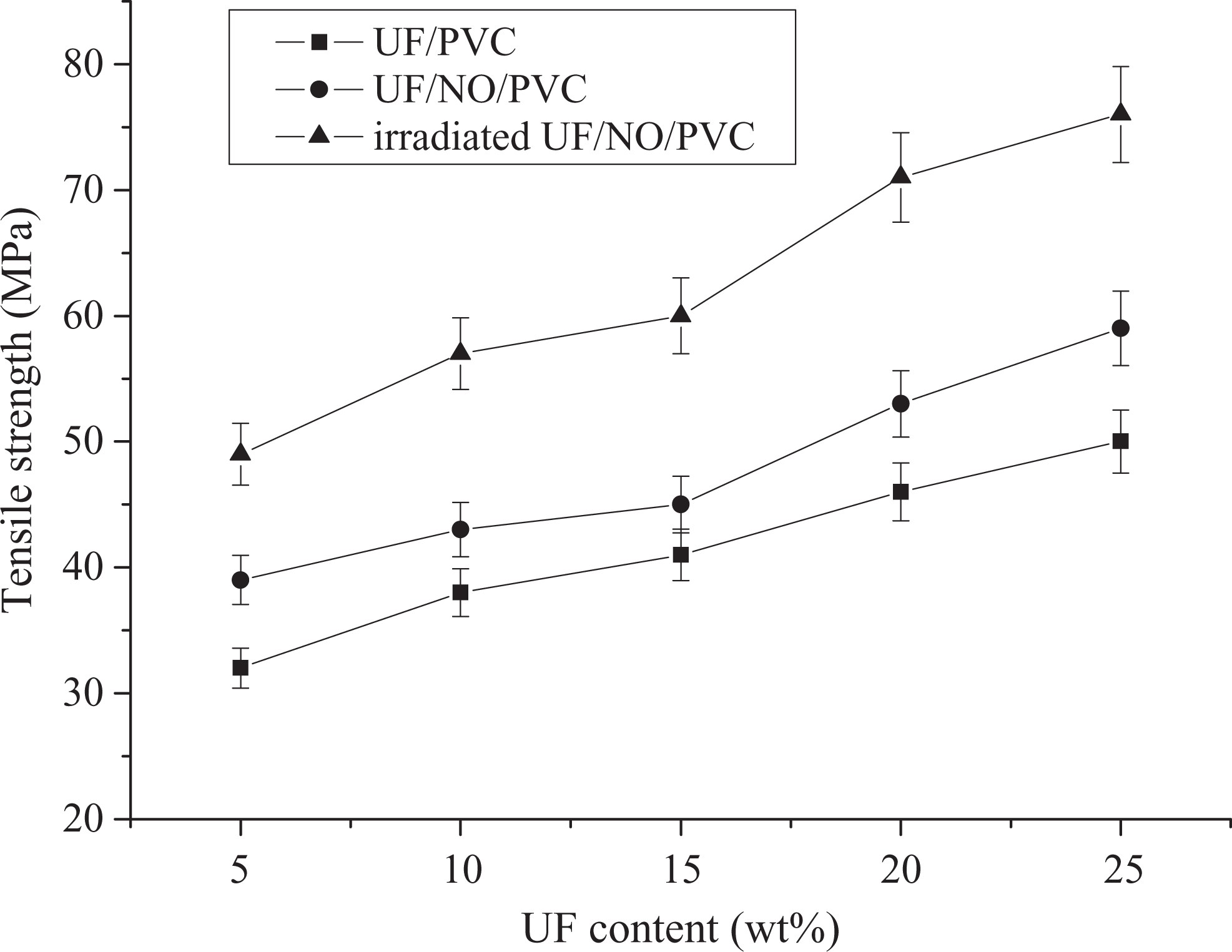
The tensile strength of UF/NO/PVC composites.
It can be seen in Figure 3 that the presence of UF has considerably increased the tensile strength of the composite both with and without irradiation. As expected, the strength of composite without irradiation is always lower than the irradiated composite. This shows that UF effectively plays its role as reinforcement and rendered its good mechanical properties to the matrix materials. This indicates that irradiation improves interfacial adhesion and yielding a greater strength.
Variation of the Charpy impact strength with fiber loading for UF/NO/PVC composites is shown in Figure 4. Figure 4 depicts the performance of impact strength of UF/NO/PVC composites with irradiation treatment. The improvement was shown for all the types of treatment. It was caused by the development of rough surface fiber which offers good fiber–matrix adhesion as the effect of irradiation treatment. It also removes the hemicelluloses and lignins part in fiber and remain the strength cellulose components on the fibers. It was also attribute to get the higher impact strength of composites. The compatibilizing agent also could influence the impact strength due to chemical reaction of hydroxyl groups of fibers with the anhydride groups of the copolymers lead to good interface adhesion fiber-matrix. Finally, it contributed to enhancement of impact strength of the composites.
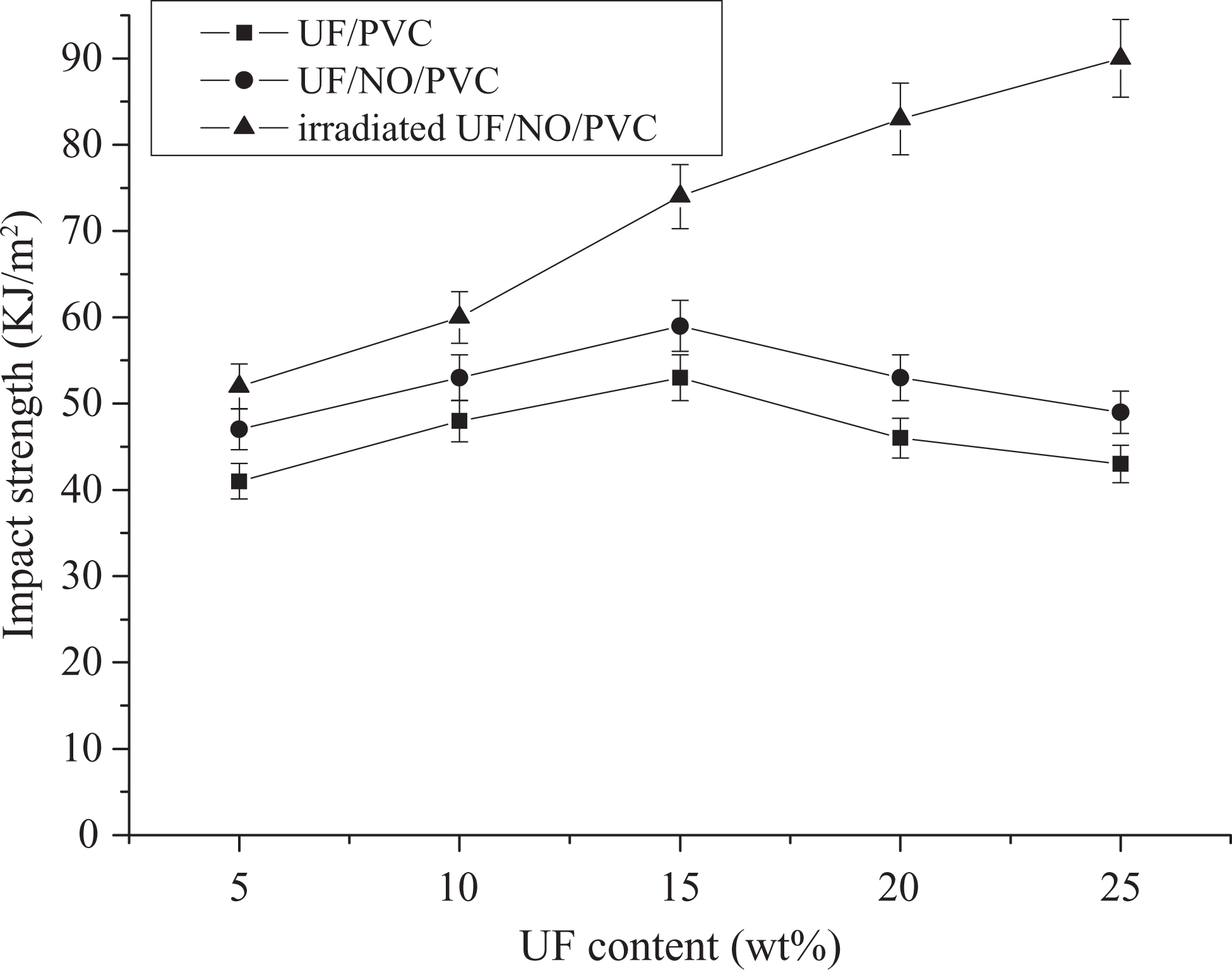
The impact strength of UF/POE/PVC composite.
Figure 5 shows the fracture surfaces of a flexural specimen from the UF/polyethylene octene elastomer/PVC (UF/POE/PVC) composites. The fracture surface after fiber pullout from the composites was investigated by studying scanning electron microscope (SEM) micrographs of tensile stress specimens. Clean pulled out fibers without any resin indicated that interface debonding between fibers and matrix had occurred, leaving distinctive cavities in the PVC matrix; thus, the adhesion between fibers and matrix was weakened. Larger black areas in the SEM micrographs showed the breakout of UF from the matrix, which proved stronger bonding between UF, NO, and resin. The presence of NOs embedded in the polymer chunks points to their strong tethering to the fiber surface. Furthermore, the irradiation methods showed that the NOs were still found in the matrix surrounding UF. All these observations demonstrated that the interfacial adhesion of the UF with the matrix was weaker. Consequently, improved flexural strength was also expected for composites where better adhesion between fibers and matrix is present. These observations also supported the claim that perpendicular NOs attached onto the fiber surface provided a mechanical interlocking mechanism against pullout.
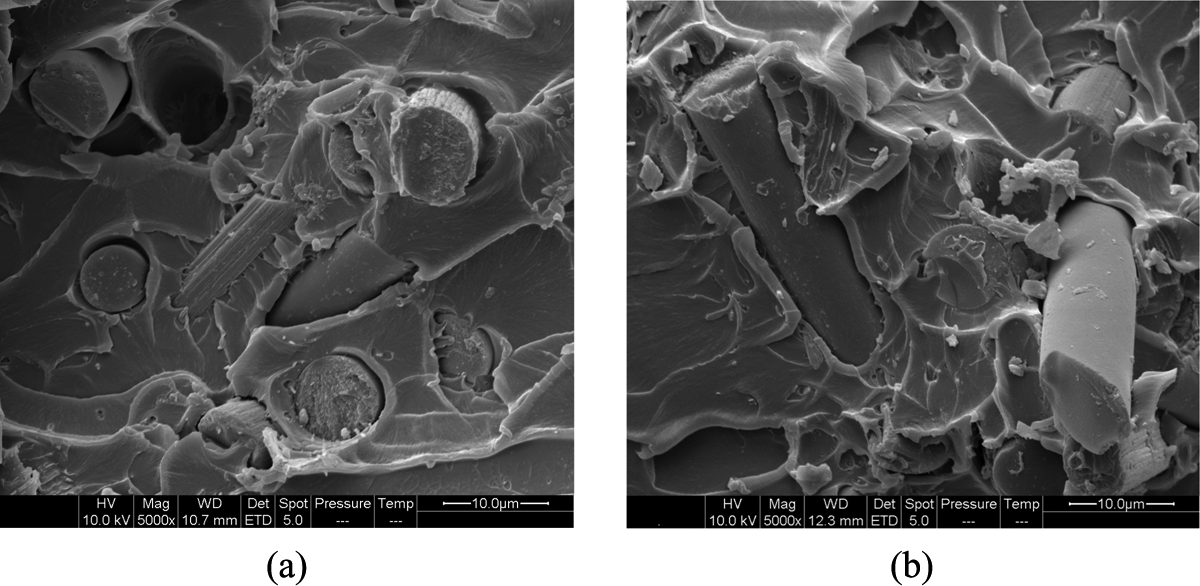
The fracture morphology of UF/POE/PVC composite.
Conclusion
The irradiation surface treatment of the UF improves the interfacial adhesion of PVC composites through the mechanical interlocking. The flexural strength of surface-treated UF/PVC composite is superior to that untreated, and the flexural strength of surface-treated UF/PVC composite is improved The results demonstrated that the irradiation surface treatment on the UF surface could improve the mechanical properties of the PVC composites and the morphology characterization of the fracture surfaces showed that the irradiation had the better interfacial adhesion with PVC matrix.
Footnotes
Declaration of Conflicting Interests
The author(s) declared no potential conflict of interest with respect to the research, authorship, and/or publication of this article.
Funding
The author(s) received no financial support for the research, authorship, and/or publication of this article.