




Abstract
Nanofluids, which are formed by suspending nanoparticles into conventional fluids, exhibit anomalously high thermal conductivity. Renovated Maxwell model was developed by Choi in which the presence of very thin nanolayer surrounding the solid particles was considered, which can measurably increase the effective thermal conductivity of nanofluids. A new model is proposed by introducing a fitting parameter χ in the renovated Maxwell model, which accounts for nanolayer, nonuniform sizes of filler nanoparticles together with aggregation. The model shows that the effective thermal conductivity of nanofluids is a function of the thickness of the nanolayer, the nanoparticle size, the nanoparticle volume fraction and the thermal conductivities of suspended nanoparticles, nanolayer and base fluid. The validation of the model is done by applying the results obtained by the experiments on nanofluids, other theoretical models, and artificial neural network technique. The uncertainty of the present measurements is estimated to be within 5% for the effective thermal conductivity.
Keywords
Introduction
A relatively new class of fluids known as nanofluids was coined in the field of thermal science and first discovered by Choi. They are produced by dispersing nanoparticles in conventional fluids such as water, ethylene glycol, engine oil, and so on. Nanofluids have been found to possess enhanced thermophysical properties such as thermal conductivity, thermal diffusivity, viscosity, and convective heat transfer coefficients compared to base fluids. Thermophysical properties, particularly thermal conductivity of a fluid, play a vital role in the development of energy-efficient heat-transfer equipments. Nanofluids as a new innovative class of heat-transfer fluid represent a rapidly emerging field. Nanofluids have been found to possess superior thermal performance compared to their base fluids. They can offer numerous potential benefits such as microelectronics, micro fluidics, biomedical, transportation, and many more. They are likely to be the future heat-transfer fluids.
Classical models such as Maxwell model 1 and Hamilton–Crosser model 2 were developed for predicting the effective thermal conductivity of a continuum with well-dispersed solid particles. These models are unable to predict the high value of thermal conductivity of nanofluids. Therefore, nanofluids present challenges to modeling as well as to theory. Various attempts have been made to investigate the enhancement mechanism of effective thermal conductivity. This enhancement was supposed to be due to a nanolayer around the solid nanoparticle and aggregation of nanoparticles. The solid-like nanolayer acts as a thermal bridge between a solid nanoparticle and a bulk liquid and so is a key to enhancing thermal conductivity. A number of theoretical studies by Xue, 3 Xie et al., 4 Yu and Choi 5,6 , and Leong et al. 7 proposed the existence of a thin-ordered nanolayer between particle surface and nanofluid for the enhancement of effective thermal conductivity of nanofluids. This suggested that existence of nanolayer is a newer concept for enhancing thermal conductivity of nanofluids.
The aggregation of nanoparticles is another major mechanism for enhancing the thermal conductivity of nanofluids. Nanoparticle aggregation effect was studied by Xuan et al., 8 Hong et al., 9 Prasher et al., 10 and Keblinski et al. 11 Xuan et al. derived a theoretical model for the effective thermal conductivity (ETC) of nanofluids by considering the physical properties of both the base liquid and the nanoparticles and the structure of the nanoparticles aggregation. Hong et al. studied the effect of the clustering of nanoparticles on the thermal conductivity of nanofluids. Their work revealed that the nanoparticles agglomerate rapidly right after sonication stops and form larger nanoclusters continuously. By light-scattering measurements, they demonstrated that iron nanoparticles aggregate into micron-sized clusters. Prasher et al. combined aggregation kinetics, which is based on colloidal chemistry with the physics of thermal transport to interpret the thermal conductivity of nanofluids. They thought that the enhancement of thermal conductivity is not feasible without including the effects of chemistry and aggregation. Keblinski et al. qualitatively analyzed the effect of clusters in nanofluids at the molecular level, but they did not give an appropriate mathematical expression. Furthermore, they thought that “liquid-mediated” clusters, that is, these particles do not touch each other physically but stay just within a specific distance may contribute to the dramatic increase in the ETC. Feng et al. 12 developed an aggregation model that includes the effect of agglomeration. They showed that the effective thermal conductivity of nanofluids is the sum of two portions, one is renovated Maxwell model and other due to clustering of nanoparticles. They derived the ETC of nanofluids through thermal–electrical analogy technique with one-dimensional heat conduction model.
Thus, the experimental and theoretical studies strongly suggested that the nanolayer surrounding the solid particles and the clusters formed by nanoparticles, that is, aggregation plays an important role in the increment of thermal conductivity of nanofluids. A new fitting parameter χ is introduced in the renovated Maxwell model, which takes into account the nonuniform sizes of nanoparticles which may be responsible for aggregation and the presence of nanolayer simultaneously. Artificial neural network (ANN) simulations have also been done for predicting the ETC of nanofluids using MATLAB R2010bSP1.
Artificial neural network
The network consists of the nodes as artificial neurons. It is a computational model inspired by the natural neurons. Natural neurons receive signals through synapses located on the dendrites or membrane of the neuron. The complexity of real neurons is highly abstracted when modeling artificial neurons. It basically consists of inputs (like synapses), which are multiplied by weights (strength of the respective signals) and then computed by a mathematical function, which determines the activation of the neuron. Another function computes the output of the artificial neuron. Weights can also be negative, so we can say that the signal is inhibited by the negative weight. Depending on the weights, the computation of the neuron will be different. Adjusting the weights of an artificial neuron, we can obtain the output for specific inputs. We can adjust the weights of the ANN in order to obtain the desired output from the network. This process of adjusting the weights is called learning or training. The back propagation algorithm is used in layered feed-forward ANN. This means that the artificial neurons are organized in layers and send their signals “forward,” and then the errors are propagated backward. The network receives inputs by neurons in the input layer, and the output of the network is given by the neurons on an output layer (Figure 1).
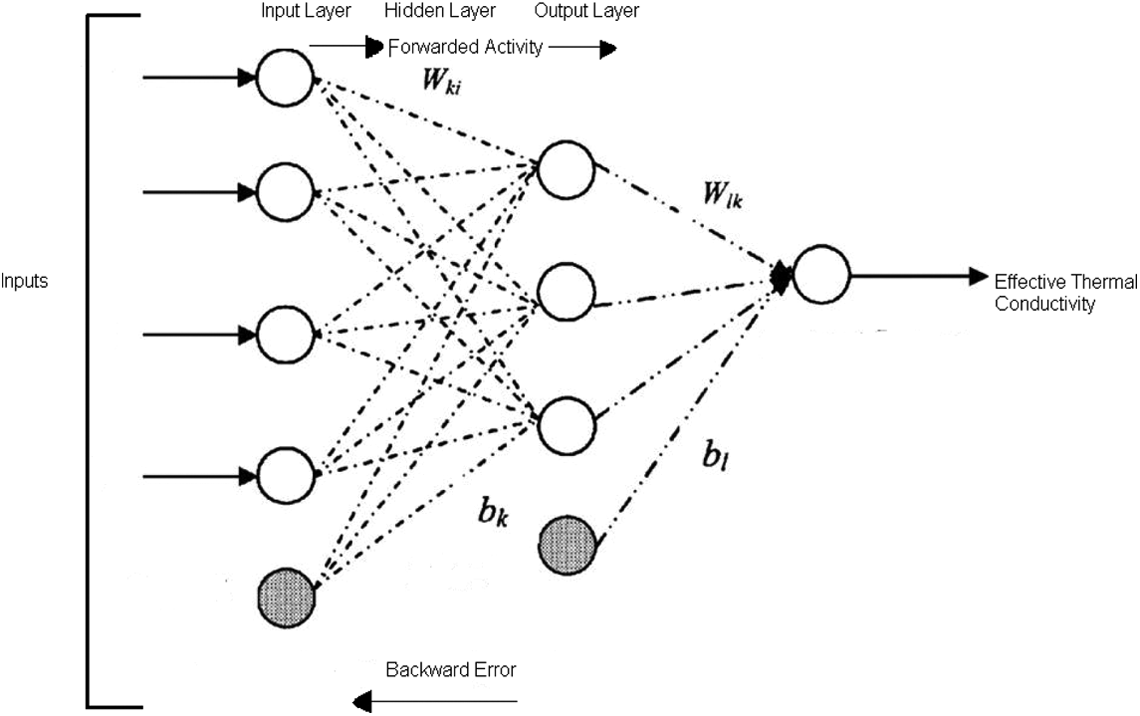
Basic structure of ANN. ANN: artificial neural network.
Theory
Yu and Choi 5 modified the Maxwell model to include the effect of interfacial layer for the first time at the interface of solid nanoparticle and liquid for the prediction of ETC of a homogeneous suspension. They assumed that a nanolayer is formed at the solid surface by nearby liquid molecules, which is responsible for the enhancement of thermal conductivity of nanofluids. For this, they considered a liquid in which monosized spherical particles of radius r and volume fraction φ are suspended. The thickness of solid-like layer around the particles was assumed to be h. Hence, the nanolayer around each particle forms an equivalent particle of radius (r + h). This gives an equivalent particle whose equivalent thermal conductivity is given by k pe: 13

where k
p is the nanoparticle thermal conductivity, δ = h/r is the ratio of nanolayer thickness to the original nanoparticle radius, and
Thus, the modified Maxwell equation known as renovated Maxwell model is given by the following equation:

where k f is the fluid thermal conductivity.
Most of the studies are done by considering the uniform distribution of nanoparticles of equal sizes in the nanofluid. The size effect of the nanoparticles is ignored in the renovated Maxwell model. Microscopically nanofluids are inhomogeneous. The reason for this inhomogeneity is the presence of agglomeration in nanofluids which can be associated with nanoparticle manufacturing and nanofluid formulation, which is due to attractive forces between nanoparticles. The distribution of particles of different sizes and the presence of agglomeration and clustering in nanofluids may further influence the ETC of nanofluids and hence must be included. But in practice, some of the nanoparticles dispersed in nanofluids may have different diameters, and aggregation of such particles may take place in the nanofluid. To include such effects for spherical filler nanoparticles of different sizes, the renovated Maxwell model is further modified by introducing a fitting parameter χ through a shape parameter s discussed in detail by Holotescu and Stoian 14 and Singhvi and coworkers 15 for composite polymers. This χ is assumed to have the following form:

and

where φ e is an equivalent volume fraction and s is an important quantity which defines the filler particle size distribution law and influences the, ETC of nanofluids together with other parameters like volume fraction and thermal conductivities of the constituents. Optimized value of s is used in the renovated Maxwell model to estimate the ETC of nanofluids.
The Rosin–Rammler distribution with its probability density f(x) as given in the following equation:

is used to determine the value of s. In general, variation in thermal conductivity is presented in the literature as a function of the volume fraction, with information regarding the size distribution being limited mostly to the mean diameter. We determined a Rosin–Rammler distribution, which approximated sufficiently well the reported experimental size distribution. Using the obtained size distribution, a new model is proposed for evaluating the, ETC of nanofluids which has the following form:

The new model given by single equation (6) for the ETC of nanofluids have now taken into account the effect of nanolayer, nonuniform sizes of nanoparticles, and the effect of aggregation.
Results and discussion
Knowledge of the matrix thermal conductivity, the filler thermal conductivity, volume fraction, thermal conductivity of nanolayer, and radius and thickness of nanolayer are not sufficient to calculate the ETC of nanofluids. To calculate the ETC precisely, nonuniform sizes and aggregation of nanoparticles have been introduced in renovated Maxwell model through a new parameter χ and modified according to equation (6).
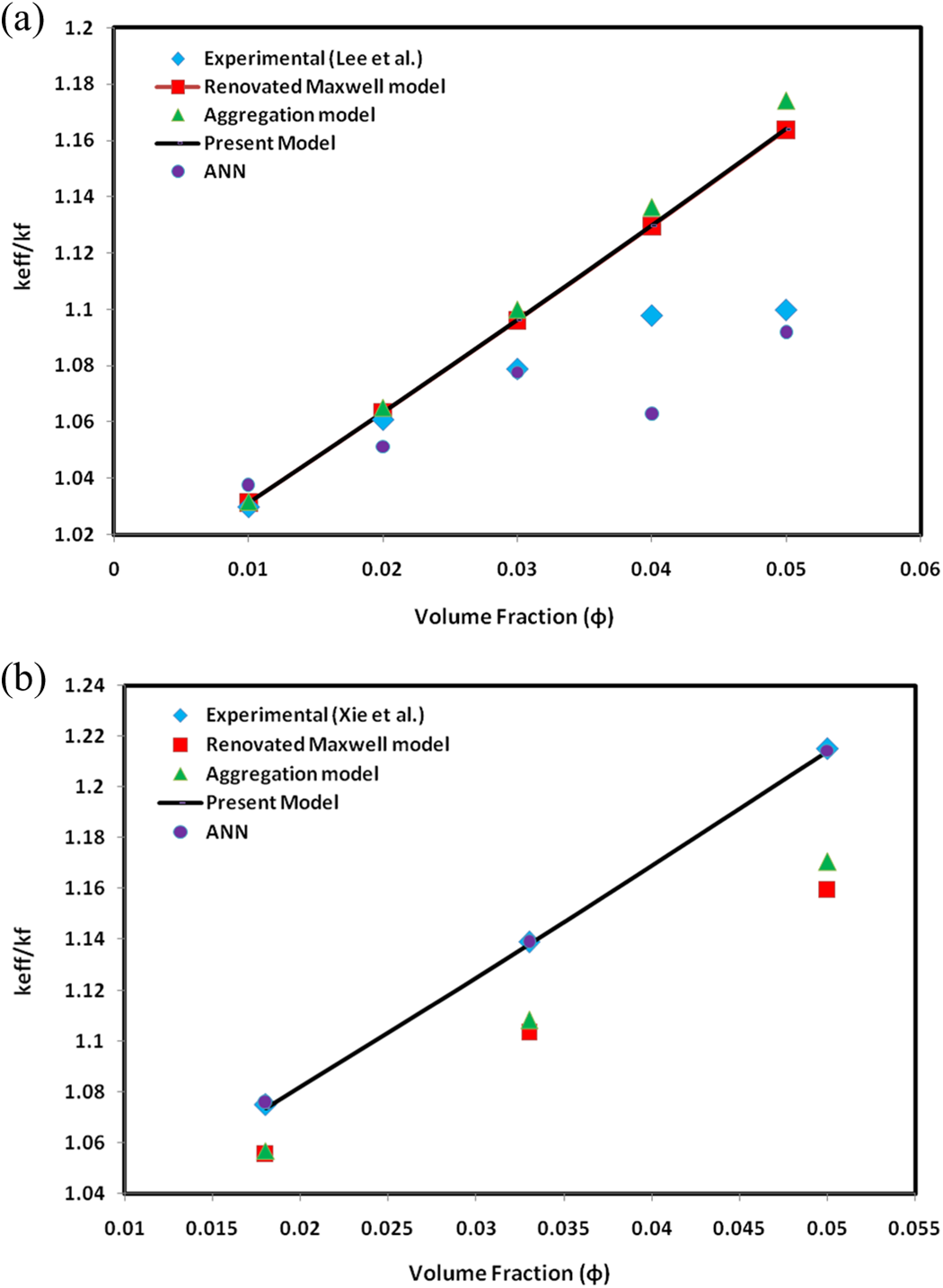
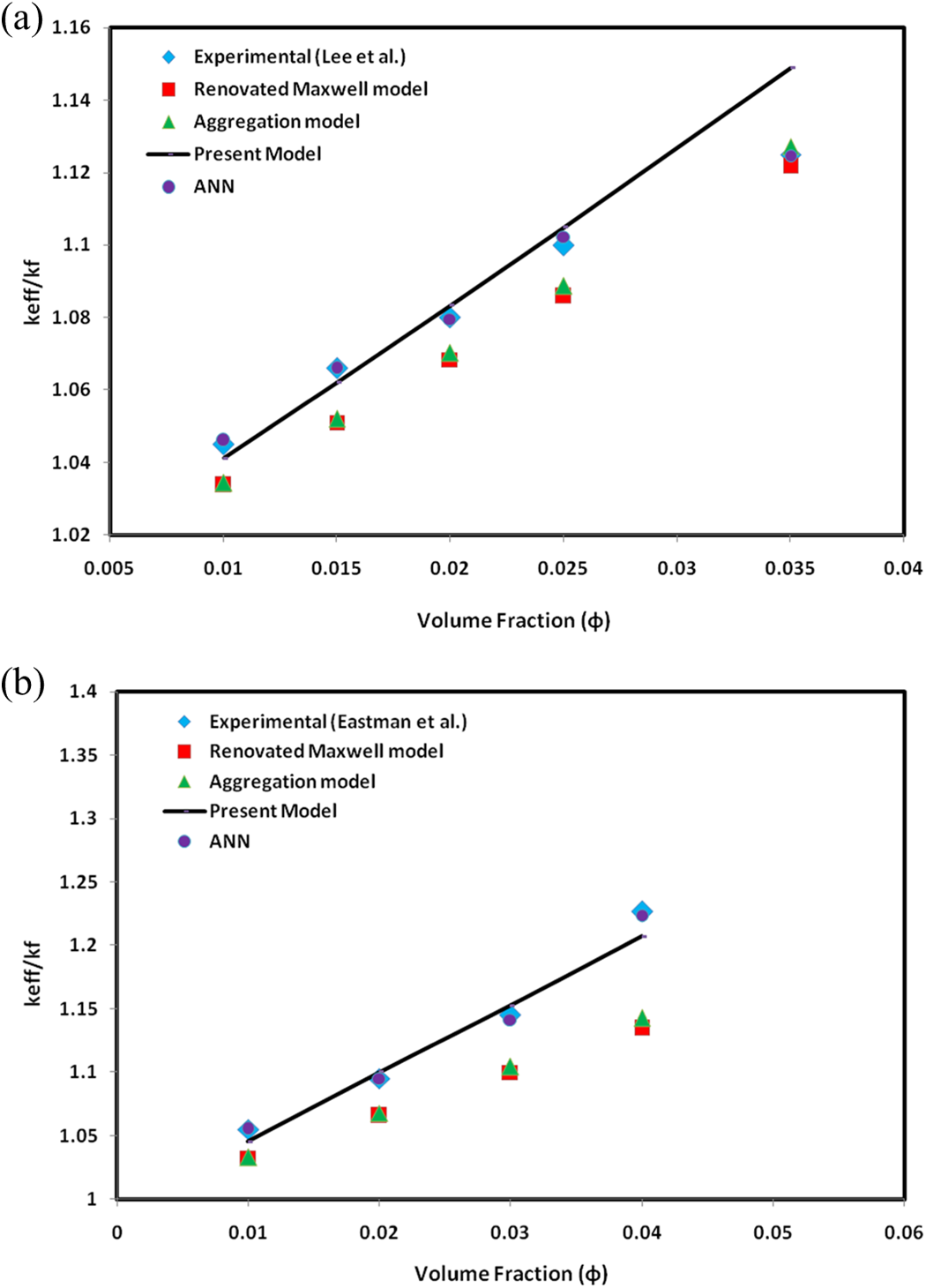
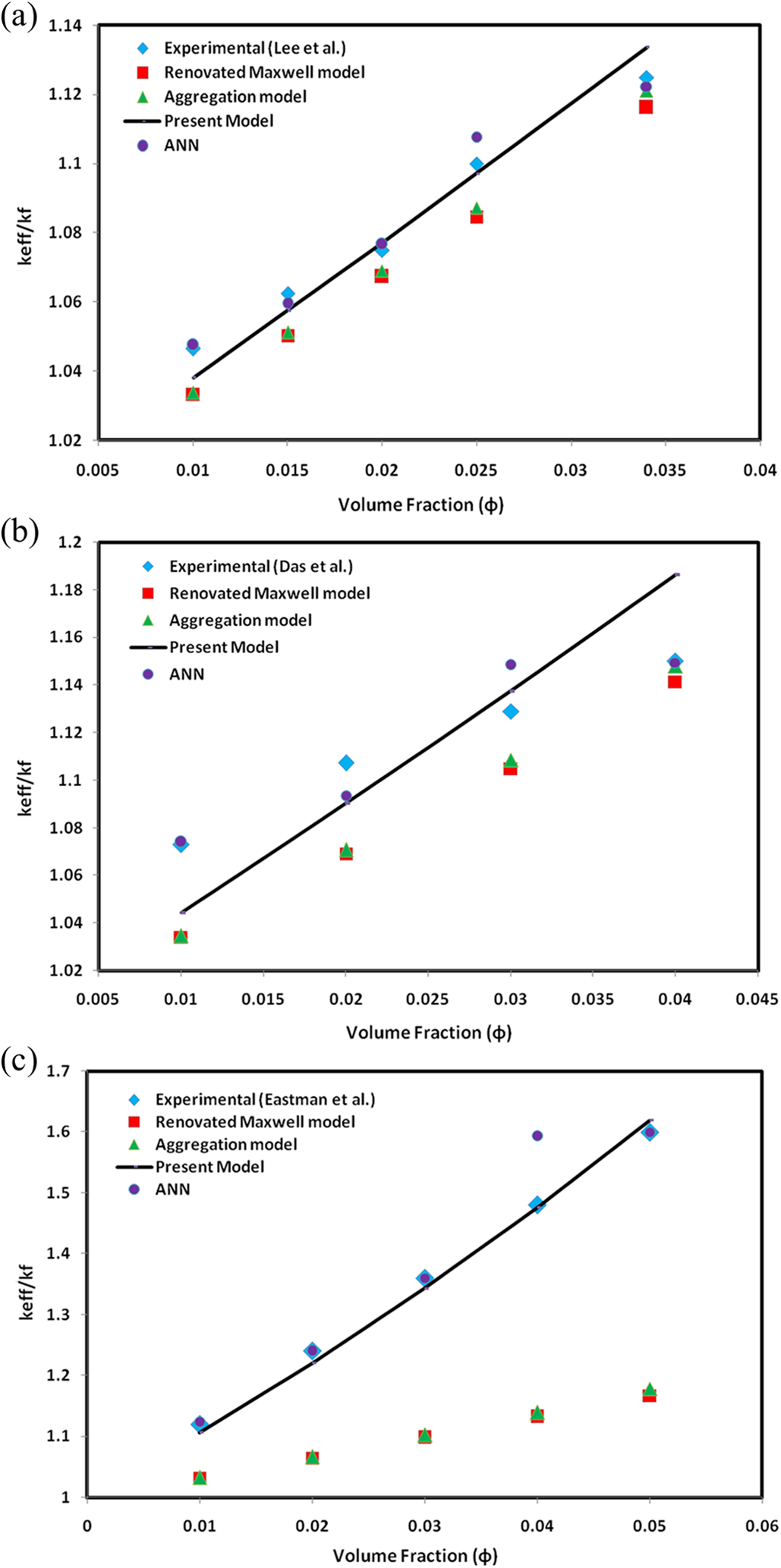
The thickness of the nanolayer is an arbitrary parameter of the order of few nanometers. As it is not possible to find or calculate this thickness through any experimental method or theoretical model, we have taken it 1 nm as used by many researchers (Leong et al. 7 and Feng et al. 12 ). The thermal conductivity of the ordered nanolayer k layer is chosen greater than that of base fluid but less than that of solid filler nanoparticles. Hence, it is chosen as (k layer = 2k f). Assuming these parameters, we have modified the renovated Maxwell model for predicting the ETC of nanofluids by introducing a fitting parameter χ through a shape parameter s. The Rosin–Rammler distribution is used to fit the experimental results for predicting the ETC by choosing random values of s and hence Figure 2 shows such representative graph for Copper oxide–water (r = 18 nm, Eastman et al. 16 ), where random values of s are taken for fitting, and the best fit of s and the corresponding χ value is chosen for calculating the ETC. We have calculated the ETC from our proposed model given by equation (6) for the samples listed in Table 1, where the parameters used for the calculation are also given. Metal oxide nanoparticles of aluminum and copper with water and ethylene glycol as base fluids are used. For a combination of higher conductivity fluid as water and lower conducting oxide nanoparticles, the fitting parameter χ is found to have a value greater than 1, whereas it is of the order of 1 for lower conducting ethylene glycol fluid and lower conducting oxide nanoparticles as shown in Table 1. It is seen from the Figures 3 to 6 that the ETC increases linearly with increase of volume fraction. This result is the same as observed in most of the results found in literature for spherical nanoparticles suspension in nanofluids. The trend is same with increasing size of filler nanoparticles. Further, it is observed that for smaller sizes of nanoparticles, all the models give a good fit with experimental results, but for large sizes of nanoparticles, renovated Maxwell model and aggregation model match well with each other but underestimate the experimental results, while our model gives an excellent match with the experimental results. This is due to the fact that for large nanoparticle sizes, the redistribution of the volume fraction 20 and distribution of different sizes of nanoparticles resulting as effective volume fraction is playing an important role. It is therefore concluded that for smaller sizes of filler nanoparticles, the renovated Maxwell model is sufficient to evaluate the ETC of nanofluid and fitting parameter introduced is having no effect on ETC, but as the size increases, the predicted ETC depends on χ, which in fact changes the effective volume fraction and thus the effective surface area also increases. The high specific surface area per unit volume of nanoparticles facilitates large heat transfer between liquid and particles, thereby increasing the effective heat-transfer capacity of the suspension. The increase in the ETC with increasing nanoparticle size of filler might be attributed to greater stability of thermal conductive pathways for larger particles. The thicker conductive pathways have less chance of being disrupted by contacting grains. The results from our model have been compared with available experimental results in the literature. They are also compared with renovated Maxwell model, aggregation model, and results from ANN technique. The results confirm the increase in ETC with increase in the particle concentration for spherical nanoparticles.
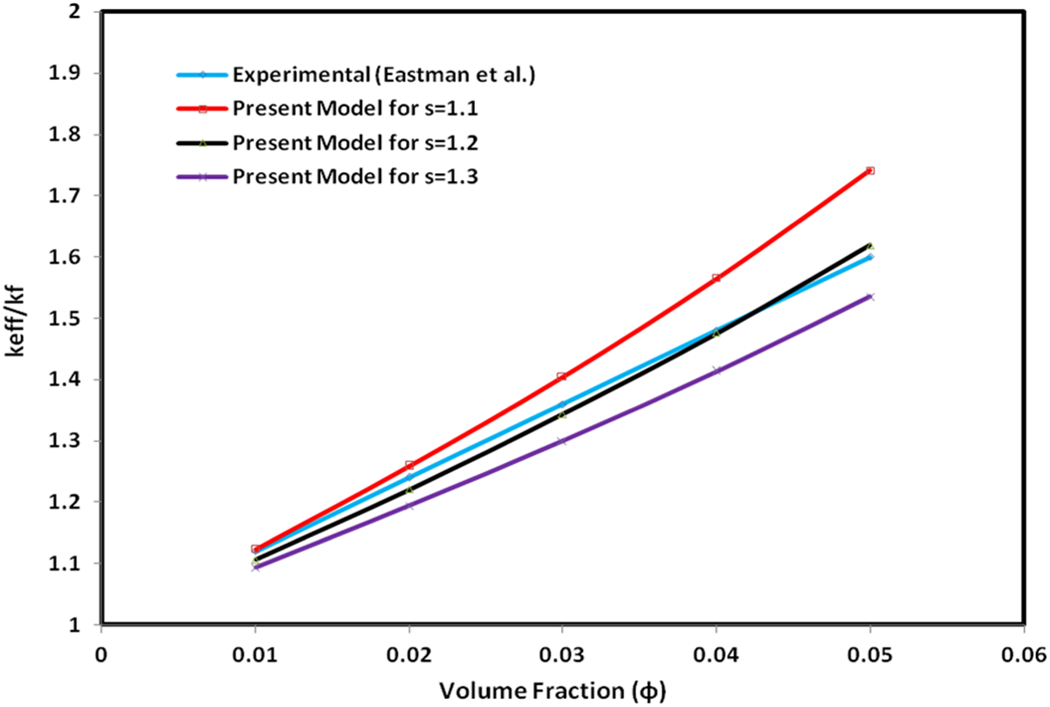
Comparison of the present model with experimental results for different values of s for CuO-water (r = 18 nm, Eastman et al. 16 ).
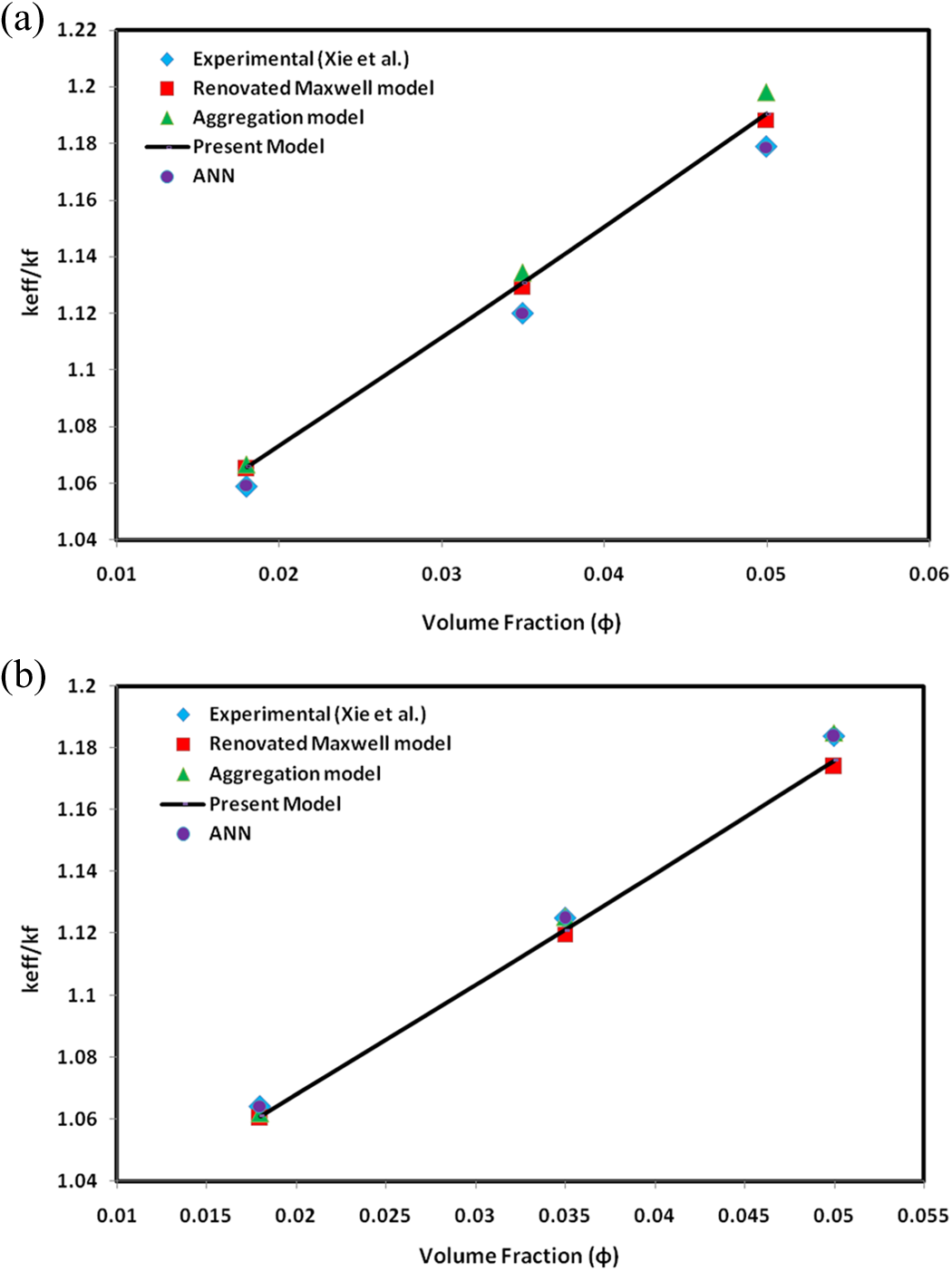
A comparison between the model predictions, renovated Maxwell model, aggregation model, ANN technique, and experimental results. (a) Al2O3-EG (r = 7.5 nm, Xie et al. 17 ); (b) Al2O3-EG (r = 13 nm, Xie et al. 17 ); (c) Al2O3-EG (r = 19.2 nm, Lee et al. 18 ); and (d) Al2O3-EG (r = 40 nm, Eastman et al. 16 ).
Thermal conductivity, size, and value of fitting parameter χ for various samples.
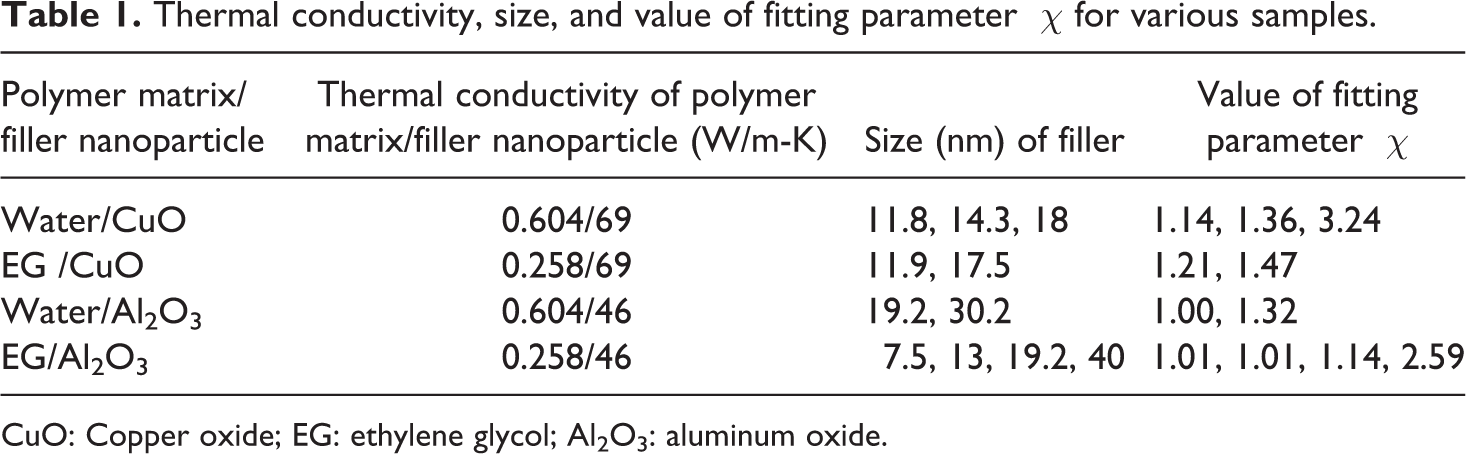
CuO: Copper oxide; EG: ethylene glycol; Al2O3: aluminum oxide.
Thus, our model is successful in predicting the similar trends, observed in experiment over a wide range of nanoparticle sizes. The model validation and its accuracy is performed by enormous experimental data published in literature and outperform previously derived models. The proposed model accounts for the interfacial layer, nonuniform sizes, and aggregation of nanoparticles simultaneously. The results of ANN technique is also compared with our results, and the results from different models match well with the experimental results from our proposed model. The overall deviation from experimental results is less than 2–3%, except the sample whose experimental results are shown to be nonlinear (Patel et al. 21 ), as shown in Figure 4(a) and 6(b). The deviation is within 5%. Hence, to get the accurate prediction, size distribution of filler particle should be included with other parameters.
Conclusion
The present work proposes a new model for calculating the ETC of nanofluids, taking into account the effect of nanolayer, nonuniform sizes of nanoparticles, and the effect of aggregation by introducing a fitting parameter χ through a shape parameter s, which defines the size distribution law. The size distribution law allows for the possibility of obtaining theoretical results in accordance with the experimental data. The impact of interfacial layer, nonuniform sizes of nanoparticles, and aggregation is investigated simultaneously. Although the model is an empirical one, it is in good agreement with the experimental results. The validation of the new model is carried out using experimental data for reference and compared with the renovated Maxwell model and aggregation model, which shows that our theory is successful in getting the good results for metal oxide nanoparticles as filler in nanofluids. It can be concluded from the results that the size distribution of the filler nanoparticles and aggregation together with nanolayer influences the value of the ETC and that this model offers the possibility to quantify this dependence.
Footnotes
Declaration of Conflicting Interests
The author(s) declared no potential conflicts of interest with respect to the research, authorship, and/or publication of this article.
Funding
The author(s) received no financial support for the research, authorship, and/or publication of this article.