




Abstract
Filler networking is considered as the most important parameter in controlling the mechanical and rheological properties of highly filled systems. Besides, the interparticle distance as a function of filler size and concentration seems to be the main parameter to govern the filler network strength or filler–filler interaction. In this article, considering the importance of filler networking, estimation of the interparticle distance for different values of filler size and concentration, investigation of the architecture of filler network in the nanocomposite for various filler sizes as well as analysis of the effects of filler size and concentration on the dynamic behavior of the filler networks are discussed and atomic force microscopic imaging is used to investigate the filler network parameters. In addition to the proposed filler network structure, the results suggest that the rheological properties of nanocomposites in the linear region could be related to the interparticle distance independent of filler size and concentration. On the other hand, by studying the linear and nonlinear viscoelastic properties of these highly filled systems, the results indicate that an increase in loss and storage modulus would occur by increasing the filler concentration and reducing the filler size.
Introduction
Lately, there has been much attention paid to the enhanced properties of polymers containing nanosized fillers. Many experimental studies have shown improved properties of polymer nanocomposites over those of the neat polymer. 1 When a low-volume fraction of spherical nanofiller was added to a polymer melt, the viscosity jumps up to an order of magnitude higher than that of the neat polymer.
For the nanocomposites, the particle volume fraction, 2 size, 3,4 surface properties, 5 and also properties of the neat polymer 6 are the major concerns investigated in some studies. Reducing the particle size in the order of nanometers provides special conditions for composites. Besides adding particles, especially high amounts of nanoparticles, to the neat polymers would help the system to reach some desirable goals.
Hydrodynamic motion of filler particles as a function of shape and concentration of particles, 7 interaction of filler with polymer 8 which relates to the behavior of polymer chains at the filler surface, 9 and interaction of fillers with each other or filler networks 10,11 concerning the agglomeration and particle structure of filler in a composite 12 are three important parameters affecting the rheological properties of composites.
In composites, particles are in the form of aggregates, 13 and so it is not possible to access the total surface of individual particles. For a known system, the dimension of the aggregates depends on the mixing condition, which affects the mixing quality and composites properties. 14 At high concentrations, in order to reduce the enthalpy of the system, aggregates approach other aggregates and form a structure like subchain. 15 Nolte et al. 16 analyzed the particle structure in nanocomposites and predicted the aggregate and chain-like formation in them. When the number of subchains increase in a system, they form chains.
In highly filled systems, particle chains overlap and form filler networks, 17 which is created because of direct filler contacts and overlap of hard adsorbed polymer shell on the filler. 18 Adsorbed polymer layer and filler–filler contact are brittle, so the properties of a highly filled composite extremely depend on the applied strain or stress amplitude. 11 Some believe that Payne effect as nonlinear behavior of nanocomposites is related to filler network breakdown. Zhao et al. 19 measured the composite resistivity of conductive fillers in polystyrene (PS) with the amplitude sweep test, and they found decrease in storage and increase in the resistivity with increase in amplitude which could be an evidence to the breakage of the conductive network of fillers in the nanocomposites with amplitude. El-Tonsy et al. 20 proved the formation of filler network with thermal conductivity tests. They found that the possibility of the filler network formation increases with reduction in particle size and increase in particle volume fraction. As such, the strain amplitude dependence of filled polymer viscoelastic properties is due to deformation, flow, and alignment of the polymer chains attached to the filler surface. 21
In small strain amplitude, the effect of energetically elastic contribution of the rigid filler network on the viscoelastic properties of highly filled systems is dominated. However, at higher strain amplitude, filler network breaks up and becomes loose, so viscoelastic properties decrease. Also viscoelastic properties of these systems depend on filler–polymer interaction and hydrodynamic motion of fillers. In these strain conditions, storage modulus determines the strength of filler–polymer interaction. 22 At high strain amplitude, the adsorbed polymer on the filler surface can flow, and viscoelastic properties become strain amplitude independent and only hydrodynamic effect of solid filler exists that controls the properties. Effect of hydrodynamic is constant with strain and is a function of volume fraction and shape of fillers.
Filler network strength or filler–filler interaction is a function of interparticle attraction. 23 Interparticle attraction changes with filler and polymer surface tension and interparticle distance. Interparticle distance depends upon particle size or surface area per known weight and particle concentration. Accordingly for a constant interparticle distance and same dispersion state, the strength of filler network changes with filler surface tension.
Surface tension of particles is the energy that is needed to separate fillers from each other. With decrease in surface tension of a filler, the energy for distribution of the filler decreases and the filler surface area that is available for free polymers increases. Modification of the particles with nonpolar groups ends to the lower surface tension of particles 24 and provides higher surface area of particles for polymer adsorption. Blum and Krisanangkura 25 represented the Fourier transform infrared spectra for the neat and covered silica (SiO2) particles with polymethyl methacrylate and found that the hydrogen bonding between the particle surface and polymer chains is the driving force for the polymer adsorption on the particle surface. Furthermore, using nuclear magnetic resonance, they proved that the adsorbed polymer chains have lower mobility compared with the free chains. At last, from the differential scanning calorimetry tests they concluded that the modification of particle surfaces with the nonpolar groups decreases the particle–polymer interaction because of the lower hydrogen bonding. Zheng et al. 26 studied reputation dynamics of PS melt near SiO2 surface and they found that the adsorbed polymer chains have higher relaxation time and the relaxation time depends on the polymer interaction strength with the surface. Effect of the increase in surface area and decrease in filler surface adhesion to the polymer with replacing the polar groups on the particle surface with every nonpolar group has an inverse effect on the viscoelastic properties of composites so a change in filler surface tension can increase or decrease those properties.
Rheological, 27,28 mechanical, 29,30 and dielectric 31,32 properties of the filled systems are interesting research area for scientists and engineers. In this study, the rheology of highly filled PS with nano-SiO2 in linear and nonlinear region is investigated. Based on the data of the linear region, a structure for this nanocomposite is proposed and studied with atomic force microscopy (AFM). A master curve of the storage modulus in the linear region as a function of the interparticle distance for different values of particle size and concentration is presented. Nonlinear studying of nanocomposites at different filler size and concentration is performed to provide a good evidence for the proposed structure.
Experimental
Materials
PS grade 336 provided by EN CUAN Industrial (Taiwan, Hsien), with a density of 1.05 g/cm3 (ISO 1183) and a melt flow index of 12 g/10 min was used as the matrix. Nonporous SiO2 Aerosil 200, 90, OX50 (supplied by Degussa Chemical, Germany, Essen) and microsilica (supplied by Iran Ferroazna, Iran, Azna) were used for the preparation of the nanocomposites under investigation. All SiO2 particles are hydrophilic with the surface area of 200, 90, 50, and 20 m2/g and an average primary particle size of 12, 20, 40, and 100 nm, respectively.
Sample preparation
Mixing of SiO2 powder and the PS matrix was performed in toluene by the following procedure. First SiO2 powder was sonicated in toluene for 30 min and then PS was added to the suspension under magnetic stirring for 1 h. The mixture was subjected to high shear mechanical stirring at the room temperature for 6 h. The resulting solution was cast on a Teflon sheet followed by drying for 6 days and vacuum drying at 60°C for 1 day. Samples of PS-nano-SiO2 used in this study are given in Table 1.
Samples of PS–SiO2 nanocomposites.
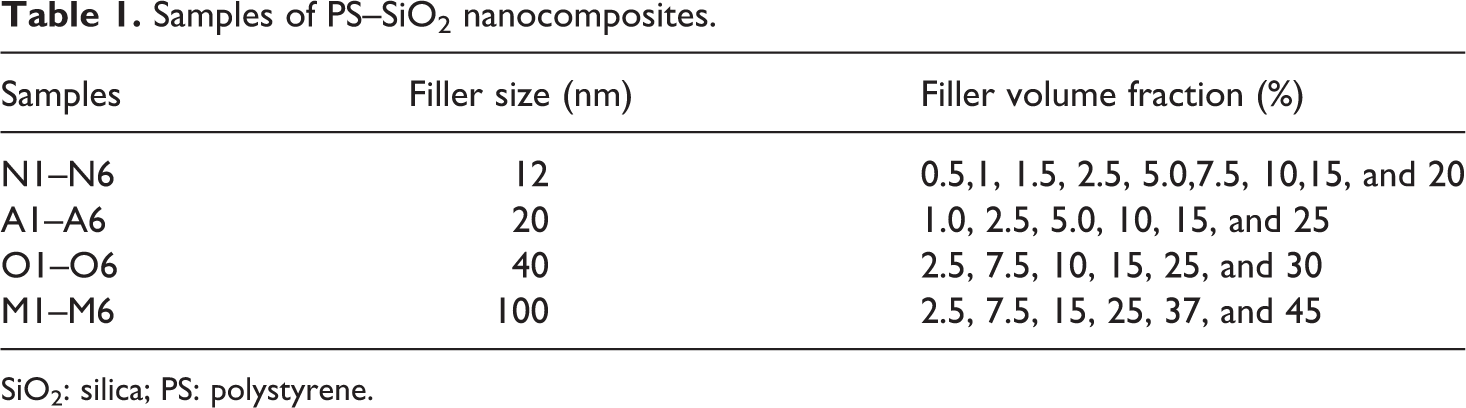
SiO2: silica; PS: polystyrene.
Also the PS-SiO2 melt samples were prepared with internal mixer at a rotational speed of 50 r/min for 10 min at 200°C. The collected molten materials were compression molded into 1 mm thick and 25 mm diameter plates by hot pressing under 100 bar for 20 s at 200°C.
Rheological measurements
Dynamic measurements were performed using a stress-controlled rotary shear rheometer (Paar-Physica UDS 200) by a plate–plate geometry. Plate–plate geometry is more suitable than cone and plate geometry for the gap control of the geometry cell for samples having a high viscosity or permanent elasticity.
Analysis of nonlinear behavior was performed in the range of deformation from 0.1% to 60% at a frequency of 5 Hz and a temperature of 200°C.
AFM study
To study the microstructure and morphology of the nanocomposites, AFM (Veeco PC-Research, Plainview, New York, USA). For low-filled systems, this experiment is carried out in noncontact mode, and for investigating high-filled systems, contact mode was used.
Results and discussions
Linear study
The changes in filler composite rheological properties by increasing filler volume fraction are the result of the growth of available surface area for adsorption of polymer chain because these chains have different properties compared with the free chains. 25
With changes of chains configuration in the space at the solid or crystalline surface, which is related to the adsorption energy, the entropy of chains decreases. 33 The chains not connected directly to the filler surface but next to the directly adsorbed chains also have a lower entropy compared with the free chains. So these overall adsorbed chains form a shell near the particles. The shell thickness and its modulus as functions of directly adsorbed polymer chain’s entropy or adsorption energy are the main parameters that control the composite properties.
On the other hand, the numbers of particles in a unit volume increase with an increase in particle concentration, so interparticle distances decreases. The reduction in interparticle distance tends to increase the filler–filler interaction and the tendency of the fillers to form a network. Highly filled composite properties are related to filler concentration because of the relation between filler network properties and its concentration.
Effect of filler particle size on composite properties is similar to filler particle concentration. With a decrease in particle size, both the number of particles in a given volume and the available surface of fillers for adsorption of chains increase. 34
Filler–filler interactions could be divided into direct and indirect interactions. At higher particle concentration, adsorbed layers around particles can overlap and form three-dimensional (3D) structure of fillers in the filled system. In this state, stresses that are applied to the system transfer between fillers through the adsorbed layer so fillers can interact with each other indirectly.
In the direct filler–filler interaction, fillers connect with each other directly and create aggregates and chains. However, there is no polymer chain inside the aggregate structures because those structures are dense and do not destruct during the mixing process to be available to the polymer chains. In Figure 1, AFM image of the low-filled composite is shown.
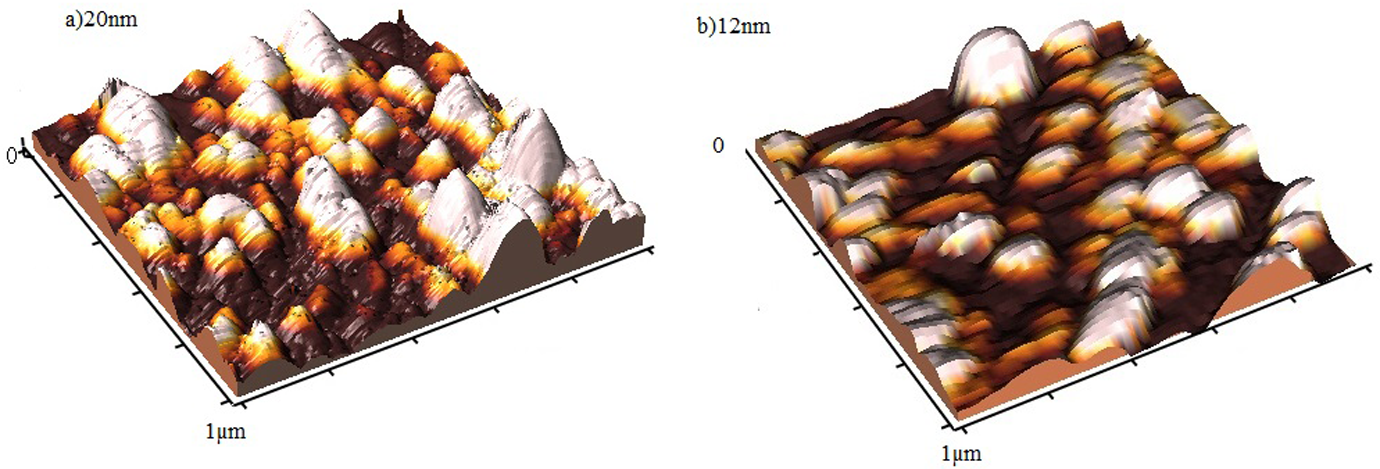
AFM image of low-filled systems (a) 20 nm and (b) 12 nm. AFM: atomic force microscopy.
In Figure 1, the bright zone attributed to nano-SiO2 and dark zone are polymers. The primary particle size of the two used fillers are 12 and 20 nm and the dimension of the bright zone is in the order 100 nm, so the particles are in the aggregate and chain-like forms. In 20 nm image, some structures in the order of 30–50 is seen. Those structures are primary particles.
Dimensions of filler aggregates determine the mixing quality or dispersion state. 14,16 This dimension varies from the individual particle diameter for good mixing to larger than hundreds of particles, depending on the mixing state and physical properties of filler and polymer. Aggregates tend toward larger diameters to minimize their internal energy of construction. The energy that is required to break down these aggregates structures are provided by the energy of filler–polymer interaction and the hydrodynamic forces exerted from media to the aggregate. Formation of aggregates decrease the real surface area of fillers available for free polymer, therefore aggregation has a negative effect on the rheological properties. Figure 2 shows the scheme of filler network in the composites. Dense structure of particles labeled with d in Figure 2 is an aggregate with d as its effective diameter. As mentioned before, an aggregate consists of some particles that cohere to each other strongly with physical and chemical interaction, where polymer chains can’t diffuse into its structure. The volume of aggregate is partially filled with voids so its density is lower than the primary particle.
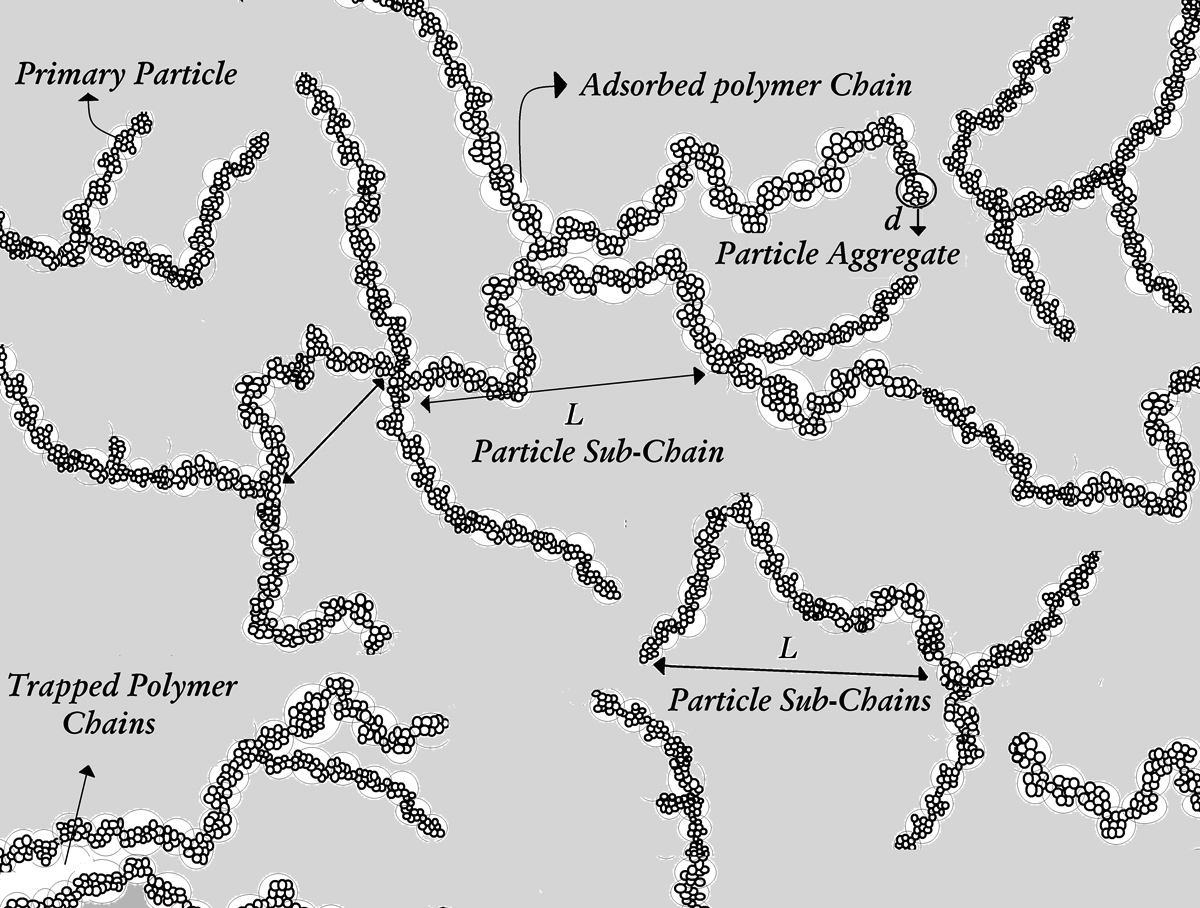
Filler structure definition. The aggregates are labeled with d, characteristic length of the particle chains labeled with L. White and gray zone represent adsorbed and free polymers, respectively.
In a concentrated system, aggregates are close enough to connect with each other directly and create a chain. The number of particles in the particle chains is a function of particle volume fraction in the media, particle size, temperature, and interaction of particles with media and with each other. 35 In Figure 2, the characteristics length of this chain is indicated with L. The characteristic length can be defined as the smallest length of the particle chain that can have viscoelastic behavior in the nonviscoelastic media. The highly filled system consists of some particle chains, adsorbed polymer chains around aggregates, and free polymer. In this figure, the white zone shows the adsorbed polymer layer.
In these systems, the dimensions of the particle chain depend on stress state exerted on the system. The particle chain dimensions reduce to the aggregates at higher exerted stress so dependence of the highly filled system to the amplitude of exerted strain or stress could be related to the dependence of the particle chain length to those parameters. 36
Multiplying the number of aggregates in a subchain with the number of one-directional subchain, we find the number of the segments in particle chains that behave like viscoelastic chains. The number of particles or aggregates in a subchain is constant. With increase in particle concentration, the number of subchains increases. A particle chain is a large structure of the particles that contain some subchains; this structure has a viscoelastic behavior. The higher concentration tends to the larger chain and the higher number of subchains.
Critical concentration for particle network formation in nanocomposites compared with the ordinary composites is very low, so the space-filling configuration of particles changes to the chain same as the cluster structure for the ordinary composites. This structure is similar to the structure of the star polymers. The arms of the particle structure can move independent of its backbone, so the total structure of the particles could be considered as linear chains entangled with each other.
The particle chains can interact with each other in the highly filled systems. This type of interactions creates a 3D structure, which is stronger than other structures, such as polymer chain network, and controls the system properties. Direct filler–filler interactions are strong short-range forces, therefore concentrated composites have high modulus which is strongly dependent on the amplitude of exerted stress or strain.
Particles in the polymer media are a suspension and created chains behave like a supramolecular chain. A supramolecular chain contains some repeat units that are joined by reversible bonds. The behavior of a supramolecular chain is similar to the polymer chain. The behavior of a chain is proportional to the number of its repeat units. For a polymer chain, the properties extremely change with the number of its repeat units. Based on the linear viscoelastic relations and proportionality of material constants to the number of repeat units, the relation for a supramolecular could be written as follows:

The number of the repeat units in the supramolecular chain is a function of the number of repeat units in the whole system and physical interaction of the components with each other. This parameter is estimated as follows
35
:

In equation (2), Es is the energy needed to separate two particles and z is the number of the particles in the system. The number of the particles is a function of the primary particle size and concentration as follows:

In equation (1), G0 is the modulus of a system at linear zone. Finally, substituting equations (2) and (3) to equation (1) results in a relation that determine the dependence of the highly filled system to the material constants like particle size and concentration.

where parameters a and k are constants. At low strain amplitude, for the filler aggregate 3D structure, the parameter a is equal to 3.5, which shows the scale of particle structure size. 37 Lower values of this constant show that since the dimensions of particle chain are smaller than particle structure in a good mixing state, the state of mixing is not good. The constant k is a function of physical properties of components and surface area of filler or filler size. This constant is filler–filler interaction modules and determines the strength of filler network. The regression data are shown in Figure 3, which is an estimation of the storage modulus of highly filled systems at the linear zone (strain amplitude of 0.1% and frequency of 5 Hz) in different filler volume fractions.
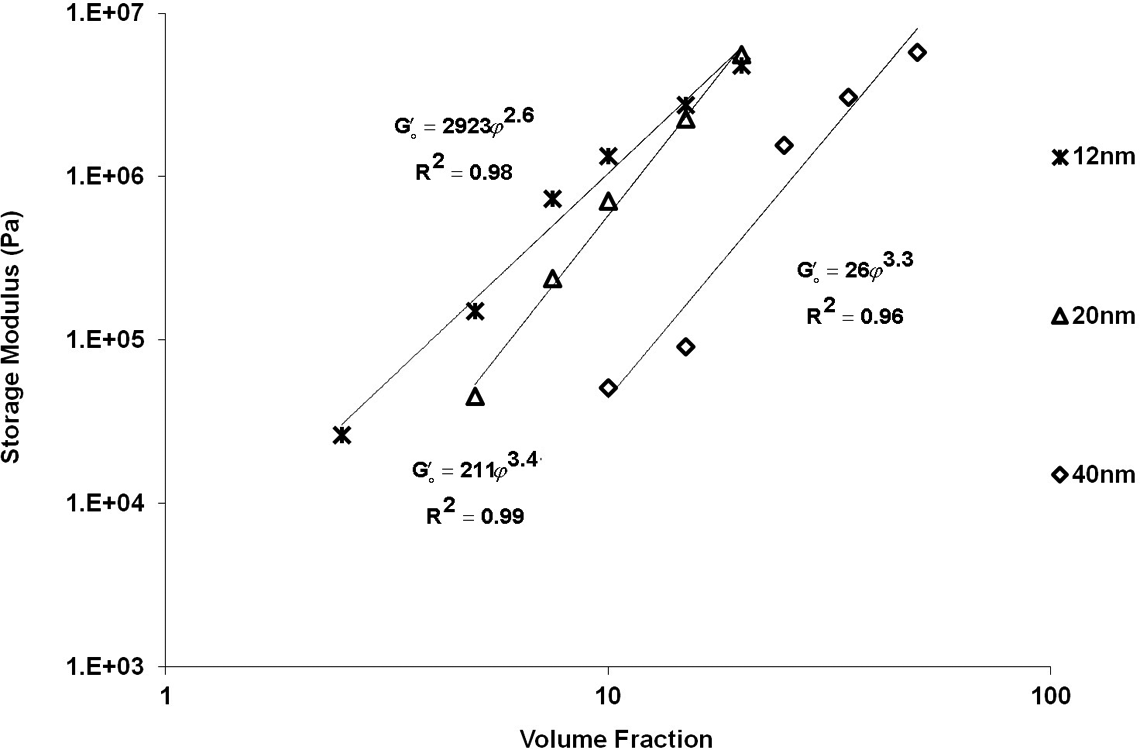
The regression data of storage modulus at linear zone.
The regression lines with the values resulted from equation (4) for the values of constants, a and k, for different particle sizes are shown in Figure 3. These data show that decreasing the particle size results in increase in filler network strength. Clearly, Figure 3 concluds that for fillers with the diameter of 12 nm, distribution is not very good so the characteristic length is lower and some energy is needed to separate aggregates and expand the formed particle chains. The AFM image of the composites containing 12 and 20 nm are investigated and shown in Figure 4.
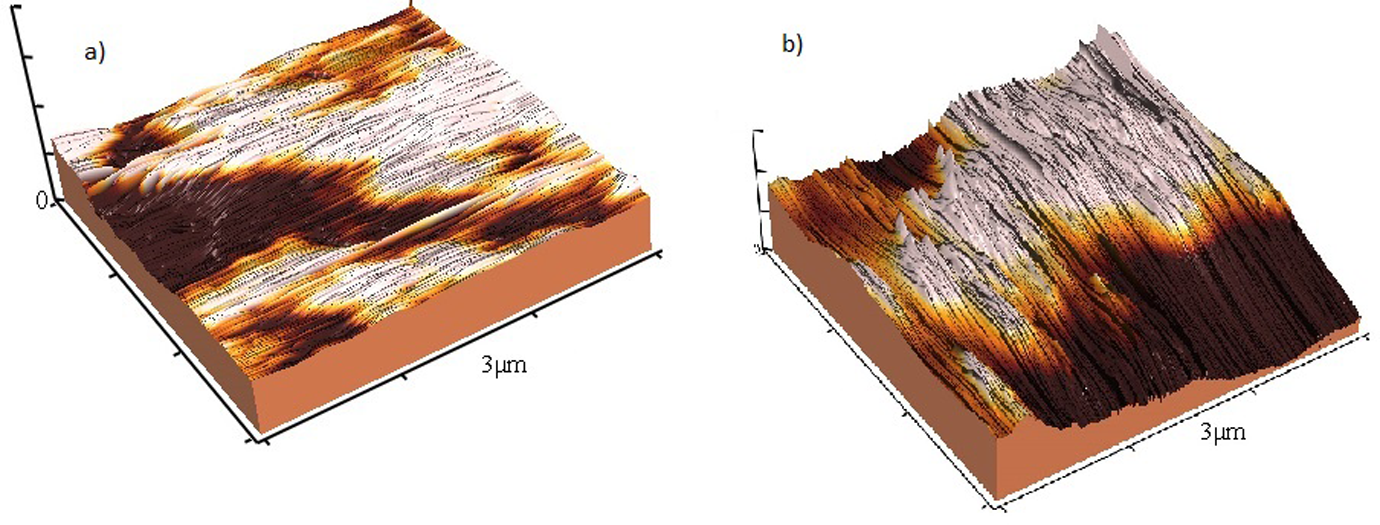
AFM image of composites containing (a) 20 and (b) 12 nm nano-SiO2. AFM: atomic force microscopy; SiO2: silica.
Bad distribution for the composites containing 12 nm nano-SiO2 compared with 20 nm ones are clearly shown in Figure 4. The AFM images confirm the structure parameter that are estimated from rheological data.
Probability of filler network formation determines dimension and strength of the 3D structure of fillers. This probability is the function of interparticle distance and physical properties of filler and polymer. Equation (5) offers interparticle distance as a function of filler surface area, concentration, and surface properties.
38

In equation (5), ρ is filler density, s is filler surface area, K is constant and equal to 0.806 for spherical filler, φ is the filler volume fraction, and β is the ratio of effective to real volume fraction which is a function of physical properties of polymer, filler, and interaction of composite’s components. For compatible components, β is near 1 and for noncompatible components it is less than 1, so this parameter could be determined from an aggregate’s dimension. In highly filled systems where particles are connected directly, interparticle distance could be defined as the diameter of the smallest uniform repeating unit in a region that has the same structure as the whole system.
As before, interparticle distance is a parameter determining the tendency of filler to form networks, and it is clear from equation (5) that the interparticle distance decreases with the volume fraction and surface area of particles. In Figure 5, elastic modulus of nanocomposites versus interparticle distance at 0.14% strain amplitude is shown for different particle sizes. For a known particle size, the interparticle distance changes with particle concentration.
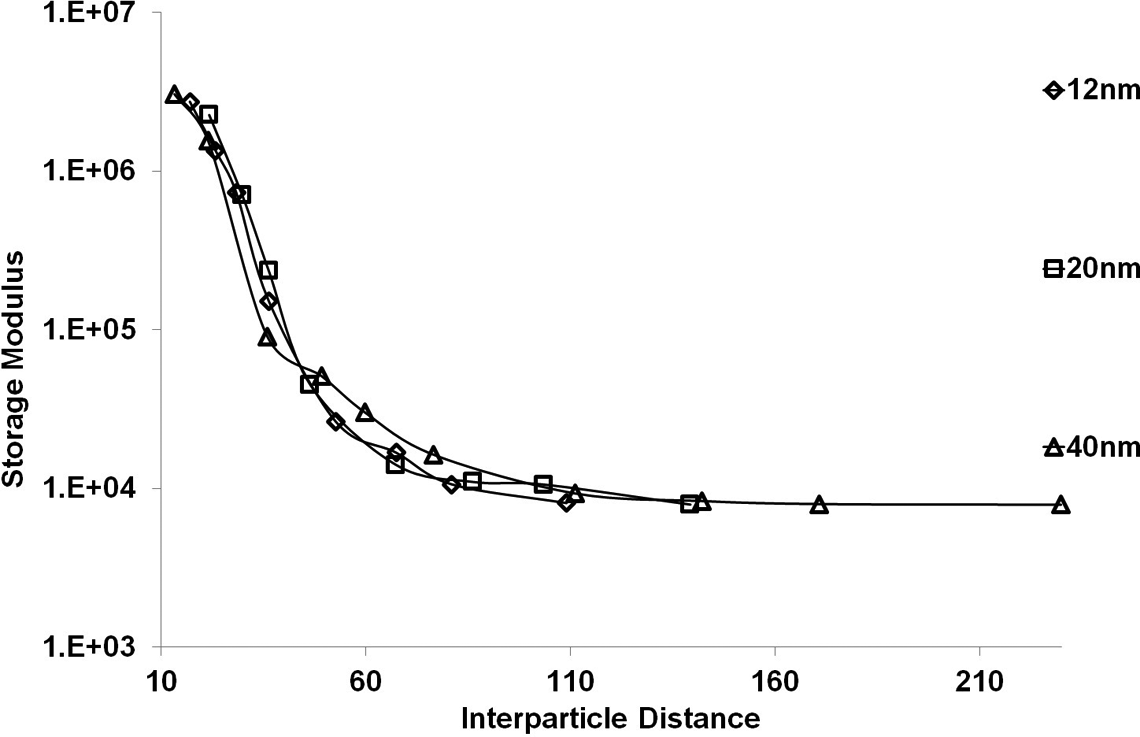
Storage modulus at different interparticle distances.
All the data of the different particle sizes are combined in a single master curve. From Figure 5, it is clear that for known surface properties of particles, the elastic modulus is a function of interparticle distance, or in other words, nanocomposites with the same interparticle distance have the same elastic modulus. Reduction of the interparticle distance increases the elastic modulus. In a composite, higher interparticle distances mean lower particle concentration or larger particles. At this state, particles are far and away from each other and cannot attract their surrounding particles. At higher interparticle distances, the elastic modulus does not change drastically with this parameter; however, at lower interparticle distances, the elastic modulus changes considerably with this parameter. Lower interparticle distance results in higher probability of filler network formation and higher filler network strength, so it could be stated that probability of filler networking increases with a decrease in distance between the filler particles.
Nonlinear study
Effect of filler volume fraction
Effect of filler volume fraction on the storage modulus for 12, 20, and 40 nm filler is shown in Figure 6. It is clear that the storage modulus increases for all amplitudes, which is due to the increase in the available surface area for adsorption of free polymer and also the increase in tendency of fillers to form 3D structure.
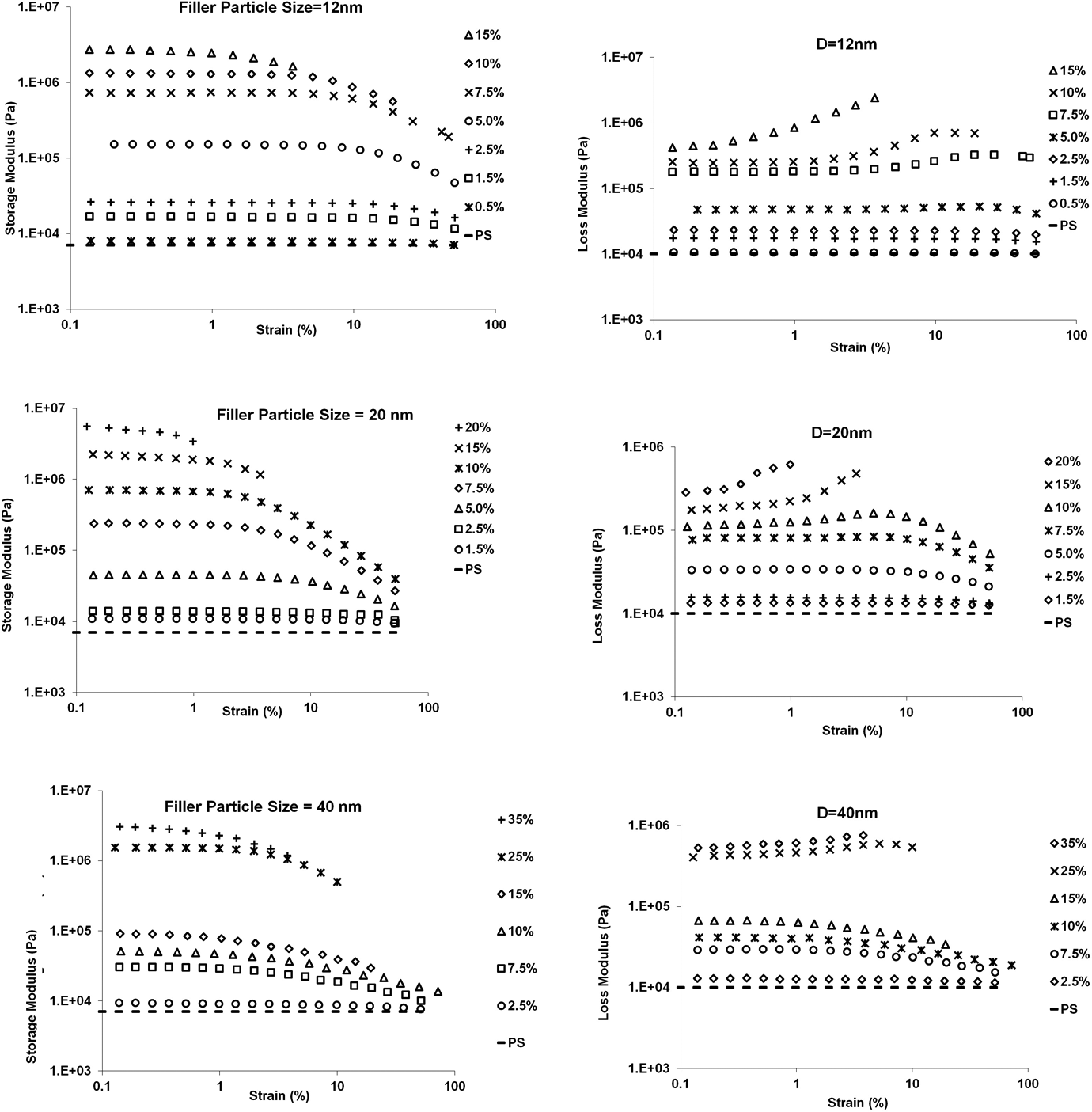
Shear relative storage modulus of SiO2-filled PS as a function of strain amplitude for different values of SiO2 filler size. SiO2: silica; PS: polystyrene.
As shown in Figure 6, for the strain amplitude of γc, storage modulus starts to decrease and the composite shows a nonlinear behavior. From Figure 6, it is clear that γc decreases with increasing the filler volume fraction. The γc determines the strength of the filler network and resistance of this network to the input energy. Filler network is brittle, and by increasing the tendency to networking, brittleness of the system increases, hence γc decreases. In general, any parameter that increases the tendency of filler networking in a ductile polymer matrix would decrease the linear region of the composite and γc.
In Figure 6, the effect of filler concentration on the loss modulus is shown. A noticeable peak in the loss modulus for highly filled system is observed at γm. In this figure, it is worth paying attention to the two parameters of loss modulus and intensity of the peak at γm.
Loss modulus relates to energy dissipated per cycle. Dissipated mechanism in a composite system is related to the irreversible deformation and breakdown of the 3D structure and relative movement of components. With the increase in amplitude, the 3D structure of fillers is distorted, since this distortion needs energy. Range of particles interactions are short, so 3D structure of filler is extremely brittle. The effect of a filler network on the viscoelastic properties of a composite is a function of direct interaction of particles on each other, number of particles surrounding a particle, and interparticle distance. Brittleness of the filled system and dissipated energy of the dynamic processes are increased with the filler volume fraction. Because of the difference between the filler particles and polymer matrix densities, they have different velocities and polymer chains can move over the particle surface. Due to the relative movement of polymer matrix and filler particle, which lead to physical interaction and friction at the interface, the energy is wasted in the filled system. Higher relative movement between components and higher interfacial area would cause a rise in the dissipated energy, and consequently higher loss modulus. Higher volume fraction of the fillers results in a higher available surface area and thus a higher loss modulus.
Appearance of the peak in the loss modulus of a highly filled system at the relatively large strain amplitude shows the importance of the filler network formation. At highly filled state, filler–filler interaction is stronger and more dominant than other reinforcing mechanisms, and system behaves like a solid. At the solid state, dissipated energy is low. With an increase in the strain amplitude, particles start to flow in the system. Particle movement results in strain deformation and breakdown of the structure of filler network; hence, a portion of the energy that is exerted on the system due to high strains is lost. This behavior shows itself by the peak in the loss modulus.
As the filler concentration increases, intensity of this peak in the loss modulus increases, and the amplitude γm, where the peak appears, reduces. This peak shows the tendency of fillers to form a network and its intensity is related to the energy that is needed to breakdown this network. The decrease in the γm with concentration is due to the decrease in the linear zone of viscoelastic properties.
Effect of filler size
Effect of filler size on the viscoelastic properties has already been reported. 39 –41 It is generally observed that the effect of decrease in filler size is similar to increase in filler concentration. Effect of filler size on the storage modulus of composite with 5% nano-SiO2 at various filler sizes is shown in Figure 7.
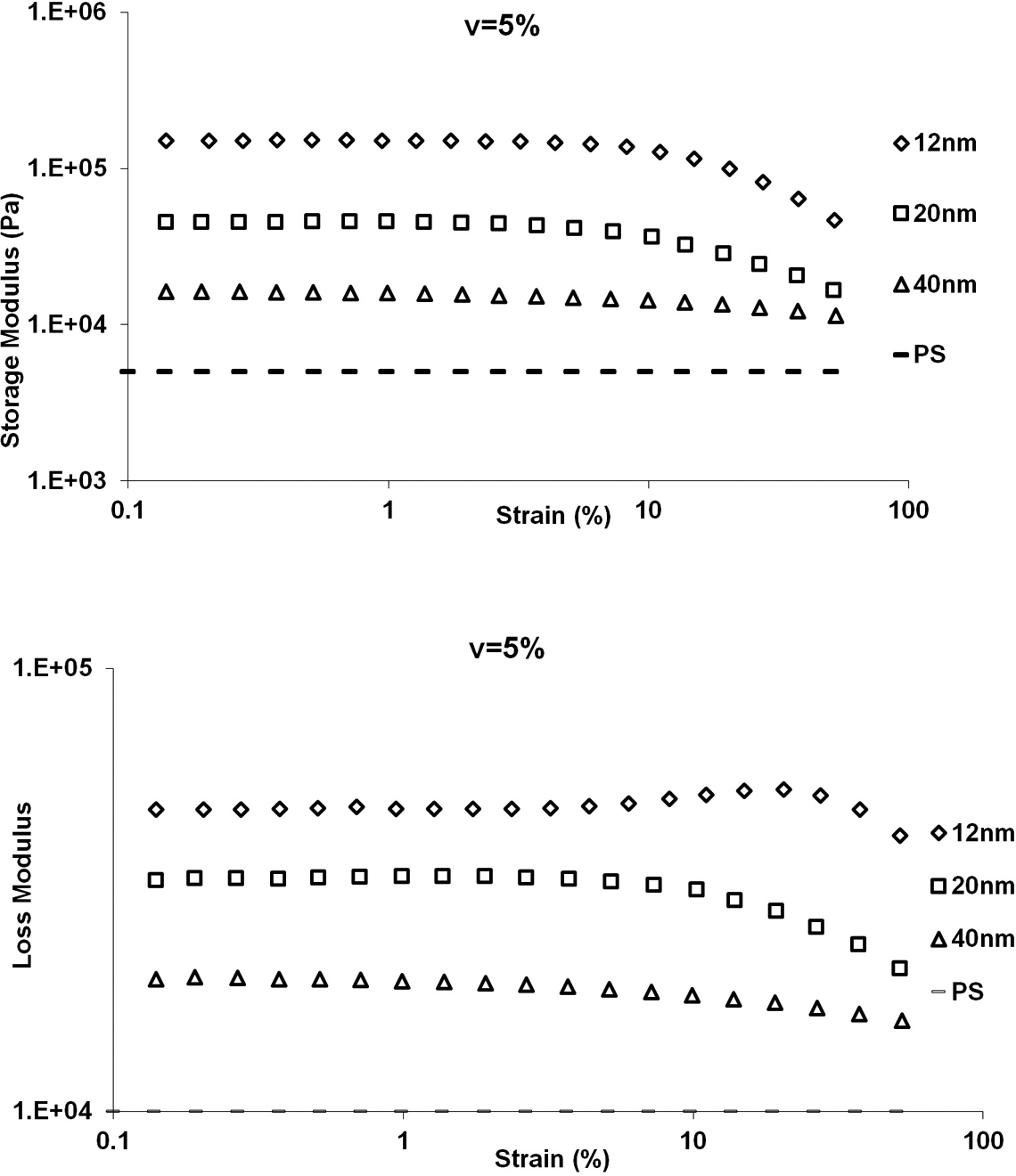
Storage modulus for different filler sizes, in volume fraction of 5%.
It is seen that the storage modulus increases and γc decreases with a decrease in filler size. For a constant filler weight or volume fraction, when the filler size decreases, the surface area of filler increases; hence, the effect of filler size on the storage modulus is similar to the effect of filler concentration. Furthermore, smaller particle at a constant particle fraction represents a higher number of particles and, consequently, a lower interparticle distance and a higher particle–particle interaction. Effect of surface area on the interparticle distance is similar to filler concentration. So decrease in filler size tends to increase the tendency of fillers to form a network, thus increase in filler concentration would have a similar effect.
With the decrease in filler size, that is, increase in surface area, loss modulus increases, and the intensity of peaks at γm that shows the tendency for filler networking increases too. Effect of filler size on the loss modulus is shown in Figure 7. With the decrease in filler size, filler percolation as well as the probability of filler networking increase, accordingly the intensity of peak at γm and loss modulus increase.
In this volume fraction, 5%, for the composites with 20 and 40 nm particles, the filler network is so loose that a peak in the loss modulus diagram does not appear. At higher strain amplitude, the loss modulus starts to decrease. At this strain amplitude, all structures are broken down, and the mechanism that is losing energy terminates and the loss modulus starts to decrease.
Effect of adsorbed layer
In a nanocomposite, particle size is in the order of magnitude of polymer chain gyration radius. 42 Reduction in the size of a particle in the order of dimensions of polymer chains would change the properties of nanocomposites compared to the ordinary composites. Since polymer chains and particle dimensions are in the same order, a polymer chain can embrace some particles and form indirect network of particles. This network is stronger than network of polymer chains and is more ductile compared to the direct networks of particles. For the composites with different particle size but same interparticle distance, the composite contains a smaller particle that is more ductile and has larger linear zone of viscoelastic properties. In Figure 8, storage modulus of composites with the same interparticle distance but different particle size is shown. Same interparticle distance means same properties at the linear zone or same direct particle–particle interaction.
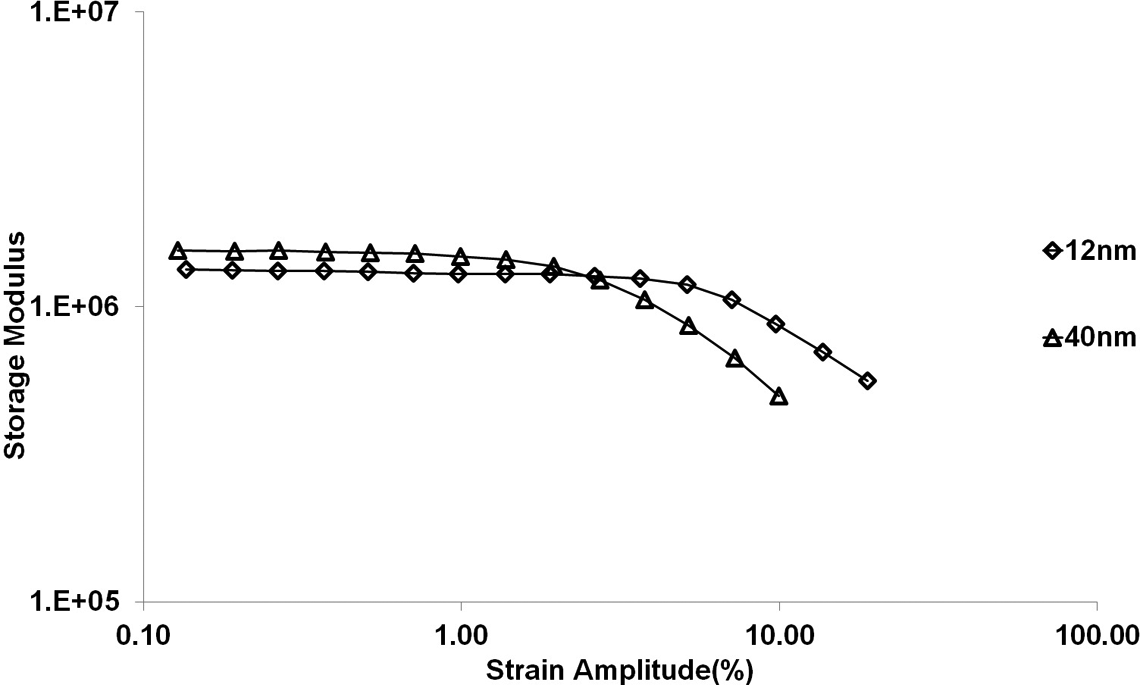
Storage for composites with the same interparticle distance.
It is clear from Figure 8 that the linear zone for the composite with 12 nm particles is higher than the one with 40 nm particles. It could be concluded that a more flexible structure is connecting the particles with each other, and the effect of this structure is higher for smaller particles. This structure is the adsorbed polymer chains that are covering the filler network. Therefore, in addition to the network of fillers and free polymer chain, the highly filled system contains network of adsorbed polymer chains. These three networks act in parallel to each other.
Conclusion
According to the importance of filler network properties that control the properties of highly filled systems, in this article, it is shown that filler network dimensions are a function of filler size and quality of mixing. Properties of composites and their filler network are related to the interparticle distance independent of filler size and concentration. Furthermore, a structure for the filler network is proposed. It is shown that a highly filled system contains three parallel networks, namely, filler, free polymer chains, and adsorbed polymer chain networks. For studying the dynamic behavior of the filler network, the viscoelastic properties of highly filled nanocomposites are investigated. It is shown that the dynamic behaviors of a composite are a function of filler size and concentration. Decrease in the filler size and increase in the concentration will increase the loss and storage modulus of a composite for all strain amplitudes. To summarize, it is concluded that filler networking is a function of interparticle distance; also the filler network is brittle and could be destroyed with exerted strain amplitude.
Footnotes
Declaration of Conflicting Interests
The author(s) declared no potential conflicts of interest with respect to the research, authorship, and/or publication of this article.
Funding
The author(s) received no financial support for the research, authorship, and/or publication of this article.