




Abstract
Different concentrations of fillers such as manganese dioxide (MnO2) and magnetite (Fe3O4) were incorporated into acrylonitrile butadiene rubber (NBR)-interlinked composites. The prepared composite systems were irradiated by electrons at a constant dose of 50 kGy to induce radiation cross-linking under atmospheric conditions. The effect of different contents of fillers and temperature variations on direct current (DC) electrical conductivity, σ DC, in NBR/MnO2 and NBR/Fe3O4 mixture systems was investigated. The calculated activation energy, ΔE DC, from σ DC was found to be highly affected by both the type and concentration of the fillers, while the dielectric properties namely dielectric constant, dielectric loss, and the alternating current (AC) electrical conductivity (σ AC), were measured as functions of frequency and temperature and for different filler concentrations of MnO2 and Fe3O4. The σ AC value was calculated from dielectric measurements and by employing a simple relationship. The analysis of the σ AC results shows that the conductivity increases up to a temperature of about 330 K. Further increase of temperature reduces the conductivity of Fe3O4 samples, while the conductivity of MnO2 samples tends to show almost constant values after this temperature. Mechanical properties, tensile strength (TS), tensile modulus at 100% elongation, and hardness were established as a function of different concentrations of fillers MnO2 and Fe3O4. It was found that filler incorporation into the NBR matrix is one of the major factors that enhance the TS as well as hardness resistance, while the elongation at break shows an adverse behavior by increasing the content of MnO2 and Fe3O4 fillers.
Introduction
The incorporation of fillers into rubbery polymers imparts many interesting and useful properties to the particle-filled composite materials. 1 –3 Fillers are introduced into rubbery polymers for many varied reasons, more generally to help in tailoring the physical and/or chemical properties of the rubber for various applications where flexibility is an important parameter. 4,5 The ability of fillers to interact physically and/or chemically with rubber compounds, under suitable conditions, is also an important aspect of reinforcement, primarily contributed by the cross-linking mechanism. 6 While the physical and chemical nature of the filler will determine its effectiveness in a functional role, the extent to which this occurs depends on many factors including the amount of filler present and possible interactive effects between the filler and rubbery polymer or between the filler particles themselves.
Electrical properties of such composites are of particular importance, not only from the application point of view but also from the fundamental point of view, as these composites are essentially very good dielectrics. 7,8 Therefore, study of these materials, particularly in an alternating current (AC) field, sheds light on the behavior of charge carriers’ mobility and the mechanism of conduction. A filled rubbery polymer differs substantially from a free one in a wide range of properties. The presence of filler affects both the electrical and mechanical properties. A survey of literature reveals that the conductivity studies on manganese oxide (MnO2)- and magnetite (Fe3O4)-incorporated rubber composites are rather scarcely or seldom reported.
Various rubbers are being widely used for preparation of such conductive composites, for example, natural rubber, styrene–butadiene rubber, acrylonitrile butadiene rubber (NBR), silicone conductive rubber, butyl rubber (IIR), ethylene propylene rubber, and ethylene propylene diene monomer. 9 –11 In the present study, we used NBR due to its good low temperature flexibility, heat and aging resistance, swelling resistance, and especially remarkable oil resistance because of the polar nitrile groups. MnO2 and Fe3O4 were prepared and used as conductive fillers because metals are unstable to oxidation. In addition, the relationship between NBR composites loaded with different concentrations of fillers and direct current (DC)/AC electrical conductivity, dielectric properties as well as mechanical properties were investigated.
Experimental
Materials
NBR with 34% acrylonitrile content was manufactured by EniChem Company Inc. (Italy, Europrene N3345). The antioxidant used is 1,2-dihydro-2,2,4-trimethyl quinoline (TMQ) and was obtained from Birla Tyres Limited (Kolkata, West Bengal, India). The activators namely zinc oxide (ZnO), stearic acid, and dioctyl phthalate used in the study are of commercial grade and purchased from Shandong Kexing Chemical Co. (China). The acrylate polyfunctional monomer, trimethylol propane trimethacrylate (TMPTMA), was obtained from Aldrich Chemical Company Inc. (Germany). Fe3O4, Fe = 88%, and MnO2, Mn = 92%, were supplied by El Nasr Chemicals Company (Egypt).
Mixing and compounding
The rubber composites were prepared on a two-roll opened laboratory mixer under identical conditions of mixing time, temperature, and gap between the rolls. First, NBR was masticated for 2 min followed by the addition of ingredients, antioxidant (TMQ), stearic acid, and ZnO, then the curing agent TMPTMA, and finally the fillers Fe3O4 and MnO2 were added. The nip gap, mill roll speed ratio, and the number of passes were kept constant for all mixtures. Compounds were finally sheeted again in the rolling direction into slabs of about 1 mm thickness, and the sheets were pressed in clean molds of an electric press. The molds were brought to 160°C and held at this temperature for 5 min at a pressure of 160 kg/cm2. The different formulations of mixes and the sample code are tabulated in Table 1.
Formulation of the mixes.
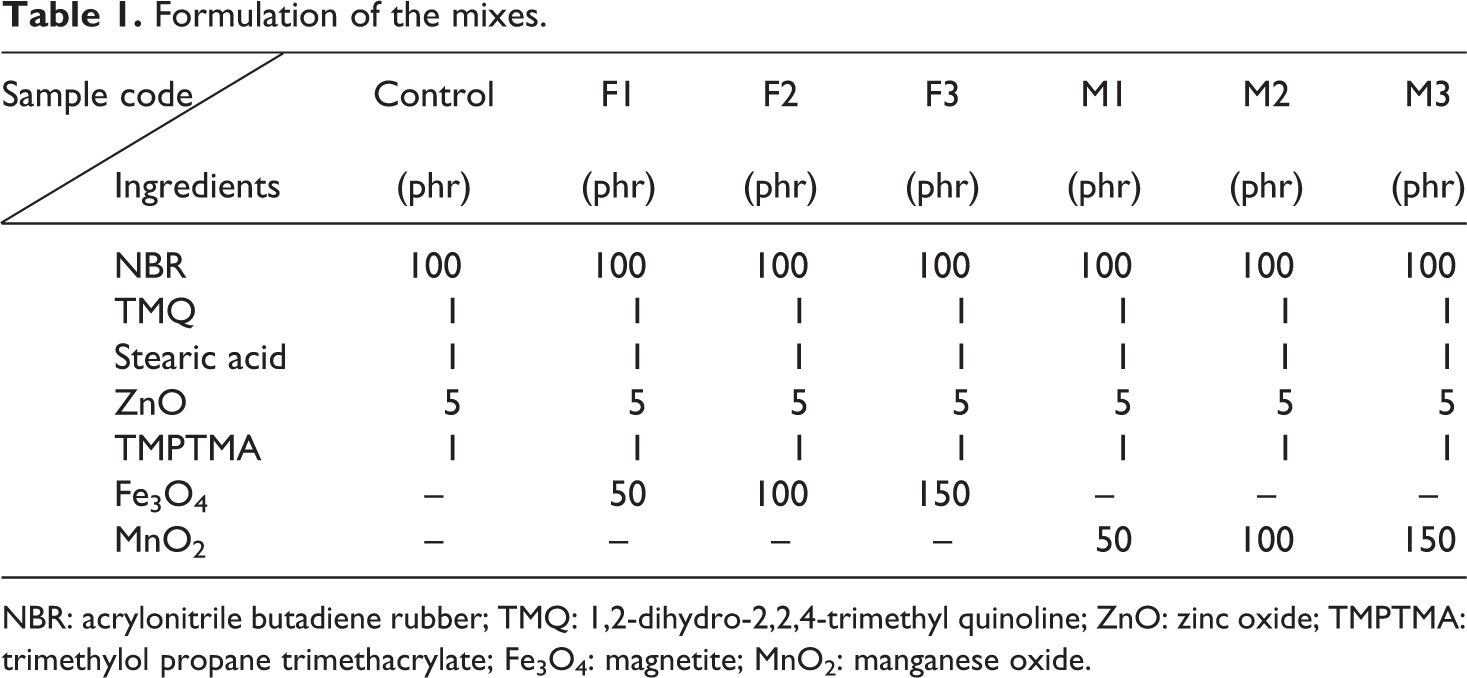
NBR: acrylonitrile butadiene rubber; TMQ: 1,2-dihydro-2,2,4-trimethyl quinoline; ZnO: zinc oxide; TMPTMA: trimethylol propane trimethacrylate; Fe3O4: magnetite; MnO2: manganese oxide.
Irradiation of samples
The samples were irradiated at a constant dose of 50 kGy using an electron beam accelerator in the presence of air at the National Center for Radiation Research and Technology, Cairo, Egypt. The irradiation was done at a beam current of 5 mA, an accelerator energy of 1.5 MeV, and a conveyor speed of 3.2 m/min.
Electrical measurements
Electrical conductivity measurements were carried out in a cell with brass electrodes in the temperature range of 293–383 K, using an electric heater in an isolated chamber with a thermocouple placed very close to the sample. For the DC conductivity measurements, a programmable electrometer (model 617; Keithley Instruments, USA) was used for measuring the resistance of the samples at different temperatures within the range. The frequency-dependent measurements of impedance (Z), capacitance (C), dissipation factor (tan δ), and the phase angle (θ) between the applied AC voltage and the resulting current through the sample were obtained using a computer-controlled inductance–capacitance–resistance bridge (model 3535; HIOKI, Nagano, Japan) at different frequencies ranging from 50 Hz to 5 MHz and temperatures from 293 K to 383 K.
Mechanical measurements
Five individual dumbbell-shaped specimens were cut out from the sheets using a steel die of standard width (4 mm). The minimum thickness of the test specimens was determined using a gauge graduated to 1/100th of a millimeter. A benchmark of 1.5 cm was made on the working part of each test specimen. Tensile strength (TS) tests was carried out according to ASTM D412-66T, 1967 standard at a crosshead speed of 500 mm/min on a rubber tensile testing machine (Hounsfield, England) with modulus at 100% elongation estimated from stress–strain curve and expressed in mega pascal. Hardness was carried out using a durometer type A (Model 306L), from Pacific Transducer Corp. (Los Angeles, California, USA), according to ASTM d 2240, 2000 standard.
Results and discussion
DC conductivity
The DC electrical conductivity of NBR composites with different filler concentrations of MnO2 and Fe3O4 and irradiated at 50 kGy is computed at different temperatures. The electrical conductivity is calculated according to the following equation:
where t is the thickness of the test piece, A is the cross-sectional area, and R is its resistance. The dependence of the electrical conductivity on temperature can be described according to the Arrhenius equation:
where σ 0 is the pre-exponential factor and ΔE DC is the activation energy. The conductivity mechanism in this temperature range is expected to be due to the thermally activated conduction of electrons over the potential barrier. 12,13 Figure 1 shows the variation of the activation energy of NBR composites with respect to the concentration of fillers MnO2 and Fe3O4. The calculated activation energy is found to be highly affected by both the type and concentration of the filler. The response of ΔE DC to MnO2 concentration remains near a constant activation energy level up to 50 phr, but then it suddenly increases when the fraction of MnO2 in the mixture exceeds this amount. This concentration is known as the critical concentration. On the other hand, the activation energy increases almost linearly with increase of Fe3O4 concentration. These behaviors of ΔE DC with both types of filler concentrations (MnO2 and Fe3O4) are evident that the fillers are dispersed in the NBR matrix uniformly forming an interconnected conducting network.
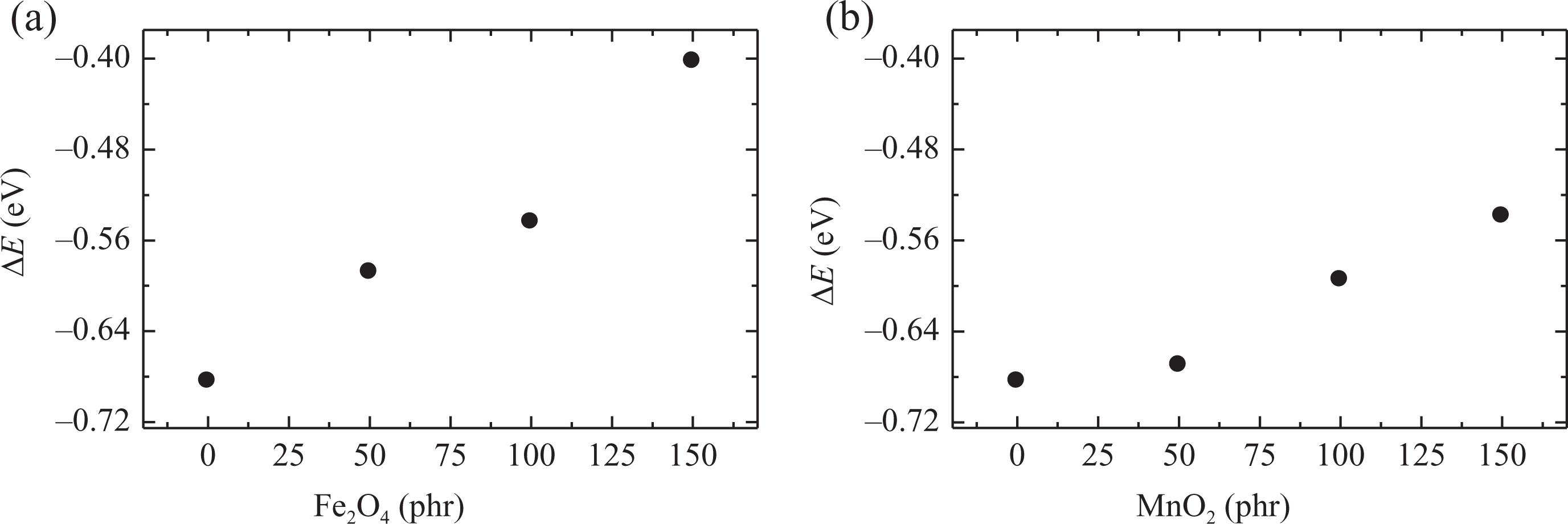
Activation energy of NBR composites loaded with different concentrations of fillers (a) Fe3O4 and (b) MnO2 and irradiated at 50 kGy. NBR: acrylonitrile butadiene rubber; Fe3O4: magnetite; MnO2: manganese oxide.
Dielectric studies
The frequency dependence of dielectric constant (ε′), dielectric loss (ε″), and dielectric loss tangent (tan δ) are studied for all composites under investigation at different frequencies, varying from 50 Hz to 5 MHz, within the temperature range 293–383 K. The values of the dielectric properties are calculated from the frequency–capacitance measurement and the complex dielectric constant is described by:
where i = (−1)1/2, ω = 2Πf, and f is the frequency of the applied electric field. The real part of the permittivity, ε′(ω), is a measure of the energy stored from the applied electric field in the material and identifies the strength of alignment of dipoles in the dielectric. The imaginary part, ε″(ω), or loss factor, is the energy dissipated in the dielectric associated with the frictional dampening that prevents displacements of the bound charge from those remaining in phase with the field changes. 14
The values of the real part of the dielectric constant (ε′) at various frequencies are calculated using the measured capacitance values (C) according to the relation:
15

where A is the area of the sample and ε
0 is the permittivity of free space charge (8.854 × 10⁻¹² F/m). The imaginary part, or loss factor (ε″), is expressed as:
The dissipation factor (tan δ) is recorded directly from the equipment.
Figures 2 and 3 represent the experimentally obtained comparison plots of the temperature dependence of ε′ and ε″, respectively, at a frequency of 1 MHz as an example, for the composites under investigation. It is obvious from these figures that the values of ε′ and ε″ show a strong dependence on temperature as well as filler concentration (MnO2 and Fe3O4). The change in dielectric constant (samples F1, F2, F3, and M2) exhibits a pronounced peak at about 333 K, while for the other samples (control, M1, and M3) the dielectric constant is observed to increase with increasing temperature up to about 333 K and then remains almost constant at higher temperatures. On the other hand, Figure 3 shows well-defined peak formed for the dielectric loss at about 303 K with a maximum value and then tends to decrease rapidly at further higher temperatures.
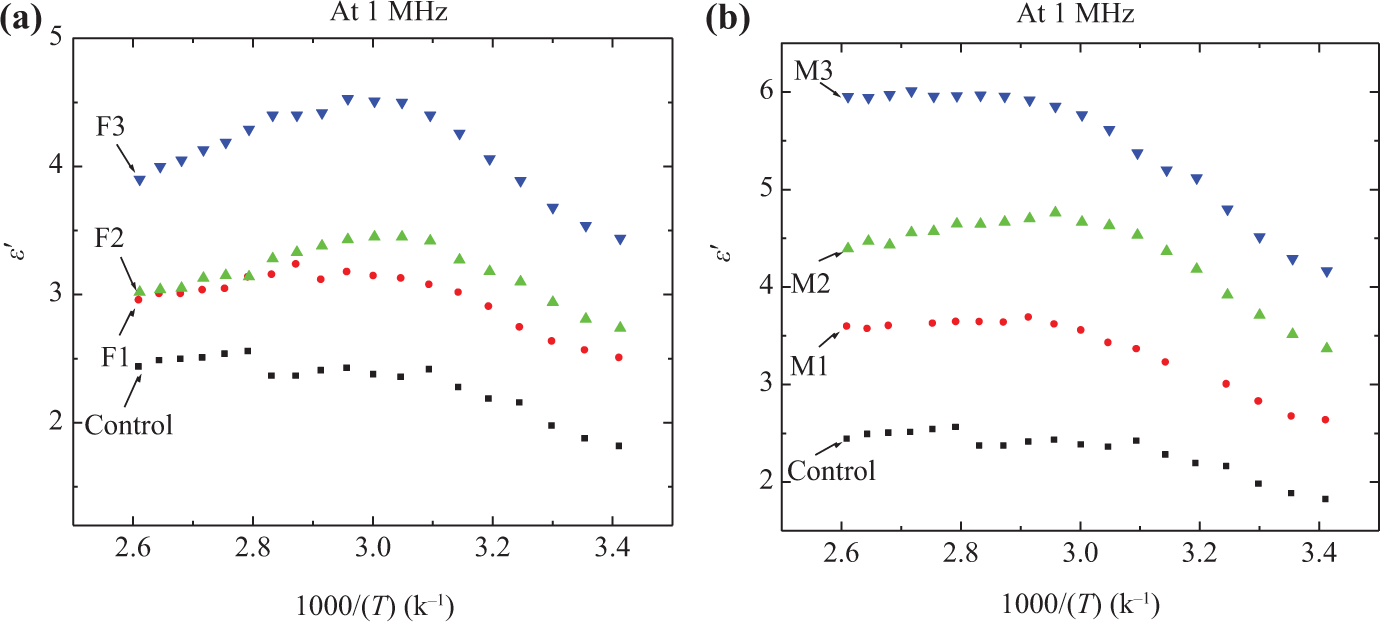
Temperature dependence of the dielectric constant, ε′, measured at fixed frequency (1 MHz) of NBR composites loaded with different filler concentrations of (a) MnO2 and (b) Fe3O4 and irradiated at 50 kGy. NBR: acrylonitrile butadiene rubber; Fe3O4: magnetite; MnO2: manganese oxide.
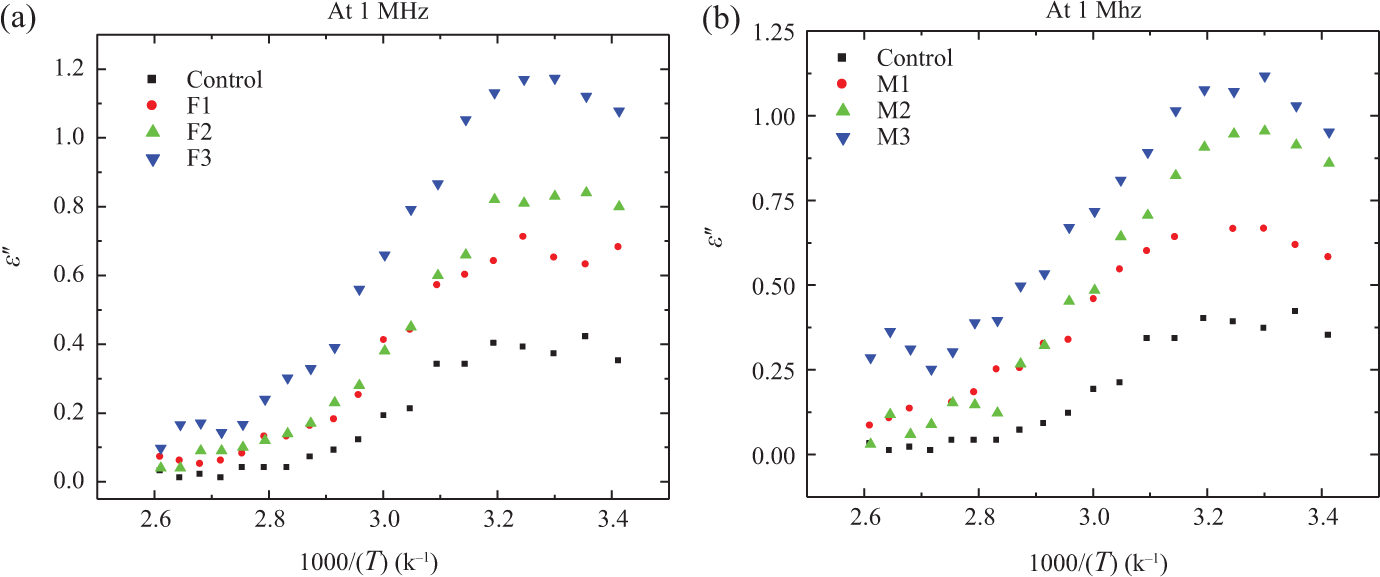
Temperature dependence of ε″ measured at fixed frequency (1 MHz) of NBR composites loaded with different filler concentrations of (a) MnO2 and (b) Fe3O4 and irradiated at 50 kGy. NBR: acrylonitrile butadiene rubber; Fe3O4: magnetite; MnO2: manganese oxide; ε″: dielectric loss.
The observed behavior of increasing ε′ and ε″ with temperature may be due to a decrease in bond energies and the consequent increase in diffusion or oscillation process through the NBR matrix. In other words, as the temperature increases, two effects on the dipolar polarization may occur: (i) the NBR network relaxes which weakens the intermolecular forces and hence the displacement of ions takes place, that is, orientation polarization becomes easier and (ii) it increases the thermal agitation and hence strongly disturbs the orientation vibrations. 16,17 The observed behavior above 333 K and 303 K for ε′ and ε″, respectively, can be explained as follows: when the temperature is further increased, the dipoles will no longer be able to rotate sufficiently rapidly so that their oscillations begin to lag behind temperature. From Figures 2 and 3 it is notable that ε′ and ε″ increase by increasing MnO2 and Fe3O4 contents in NBR. This increase is attributed to the presence of permanent electrical dipoles in the matrix that arise from charge pairs formed by the Fe and Mn ions (cations) and nonbridging oxygen (anions). As the MnO2 and Fe3O4 concentration increases, more of these permanent dipoles will be present, contributing to the dipolar polarization.
Figures 4 and 5 show the frequency dependence of ε′ and ε″, respectively, for the composites under investigation, at temperature of 383 K as an example. These figures clearly display that ε′ and ε″ decrease abruptly with increase in the applied frequency. These increases of dielectric properties, ε′ and ε″, toward lower frequency regions may be attributed to the presence of polarization process, which could be effective at low frequency. 18,19 On the other hand, beyond 1000 Hz, the change in dielectric properties, of ε′ and ε″, continues slightly to decrease and also remains almost constant at higher frequencies (10–5000 kHz), with increasing frequency. This behavior in dielectric properties, ε′ and ε″, at low frequencies may be due to the fact that the ions in the composite matrix are able to oscillate and respond to the applied field and thus contribute fully to the polarization. At higher frequency, where the ions cannot oscillate as quickly as the applied field, dispersion takes place and ε′ and ε″ decrease to a constant value. Which means that, the carrier lifetime of the charges is much larger than 1/ω at very high frequency, that is, the charges cannot follow the AC signal. 20 –22 It is also notable that ε′ almost increases by increasing MnO2 and Fe3O4 contents in the NBR as compared to the blank one, especially MnO2 content, as can be seen in Figure 4. This may be attributed to the increase in electronic contribution to the polarizability.
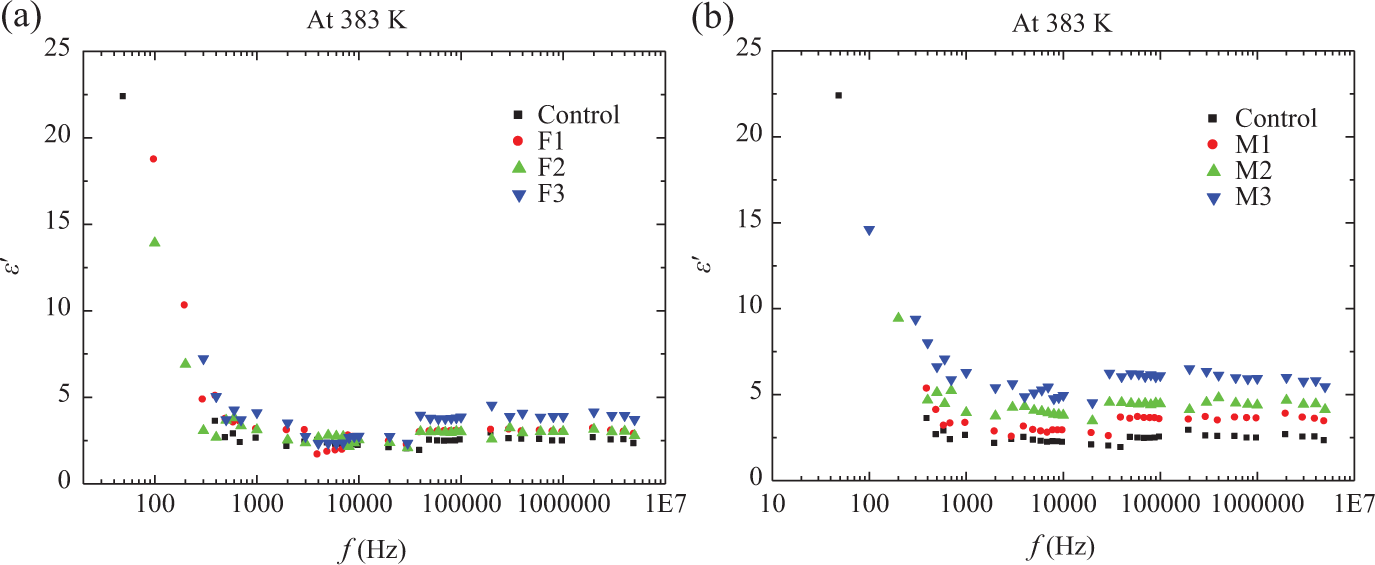
Frequency dependence of ε′ at T = 383 K of NBR composites loaded with different concentrations of fillers (a) Fe3O4 and (b) MnO2 and irradiated at 50 kGy. NBR: acrylonitrile butadiene rubber; Fe3O4: magnetite; MnO2: manganese oxide; ε′: dielectric constant.
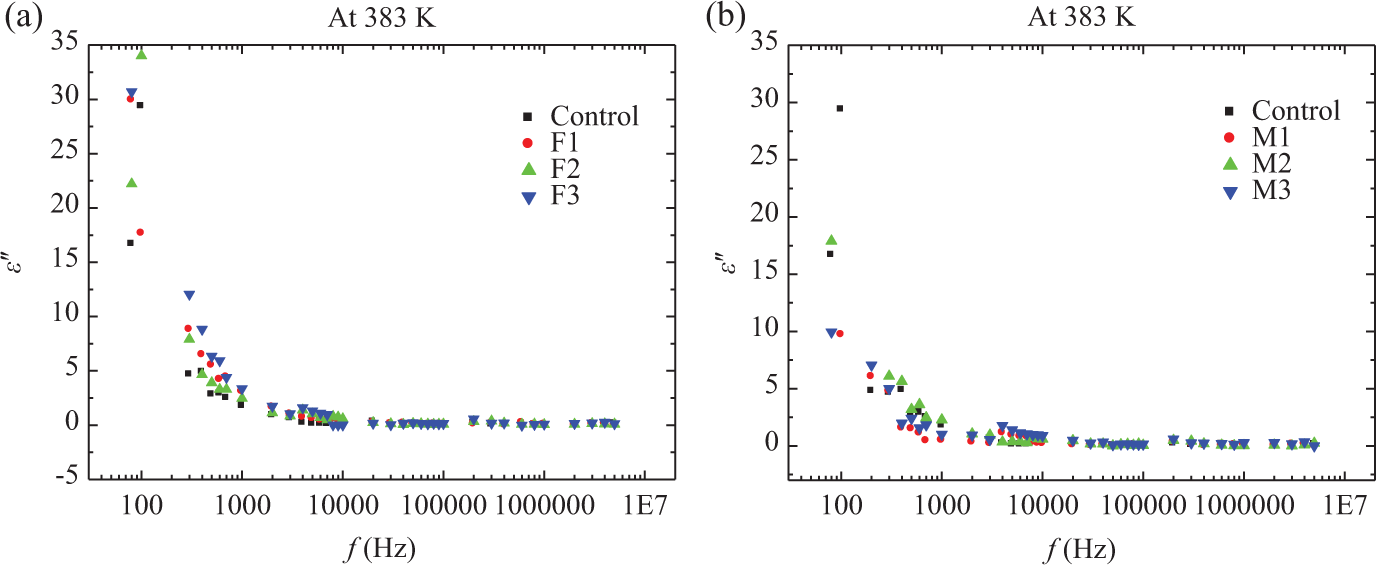
Frequency dependence of ε″ at T = 383 K of NBR composites loaded with different concentrations of fillers (a) Fe3O4 and (b) MnO2 and irradiated at 50 kGy. NBR: acrylonitrile butadiene rubber; Fe3O4: magnetite; MnO2: manganese oxide; ε″: dielectric loss.
AC conductivity
The frequency dependence of the AC electrical conductivity, σ
AC(ω), is obtained by subtracting the σ
DC from the measured total conductivity σ
tot according to the formula:
The AC electrical conductivity, for NBR composites loaded with different concentrations of fillers Fe3O4 and MnO2 and irradiated at 50 kGy, is computed for different frequencies and also at different temperatures. Figure 6 represents the frequency dependence of AC electrical conductivity for all composites under investigation at a temperature of 398 K, as an example. As can be seen from this figure, the electrical conductivity generally shows a sharp increase with increasing frequency. In addition, as it is expected, conductivity also increases with increasing filler Fe3O4 and MnO2 concentrations in NBR. This indicates that a continuous conductive network forms in the rubber permitting a higher percentage of electrons to flow through the samples. Similar behaviors are observed in the literature. 19,23 The increase in the electrical conductivity leads to an increase in the eddy current, which in turn increases the energy loss tan δ. This behavior can be attributed to a gradual decrease in series resistance with increasing frequency. 24
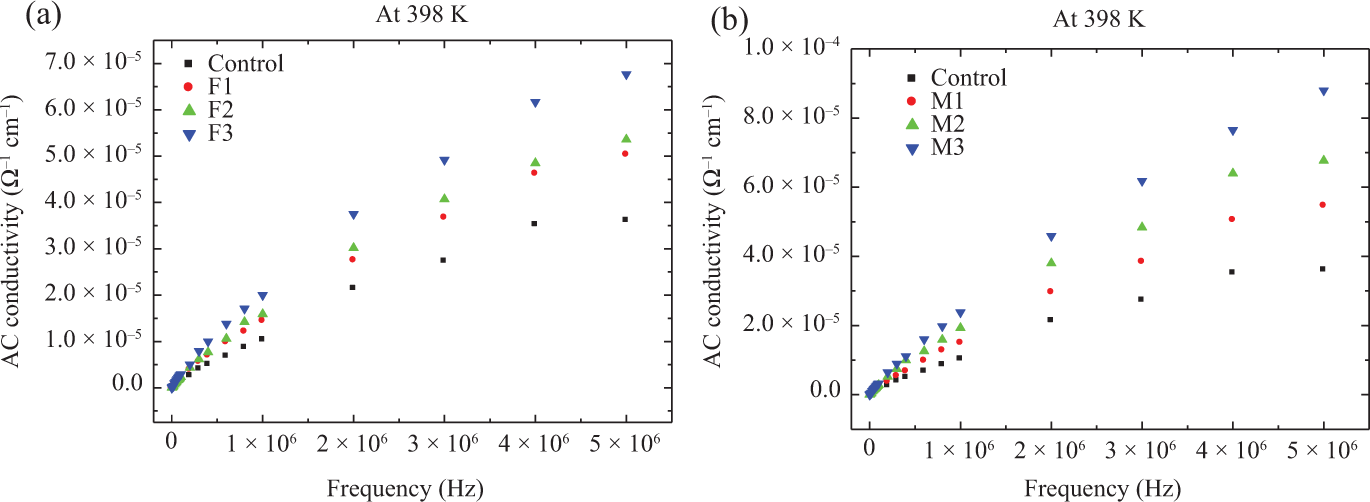
Frequency dependence of the AC conductivity measured at 398 K of NBR composites loaded with different filler concentrations of (a) MnO2 and (b) Fe3O4 and irradiated at 50 kGy. NBR: acrylonitrile butadiene rubber; Fe3O4: magnetite; MnO2: manganese oxide.
The variations of conductivity with temperature for different compositions are shown in Figure 7. This figure shows that the conductivity increases up to a temperature of about 330 K. Further increase of temperature reduces the conductivity of ferrite samples, while the conductivity values of the MnO2 samples tend to be almost constant after this temperature. The influence of temperature on conductivity can be explained by considering the mobility of charge carriers responsible for hopping. As temperature increases, the mobility of hopping ions also increases thereby increasing the conductivity. 7 The electrons that are involved in hopping are responsible for electronic polarization in these ferrites and manganeses. The decrease in conductivity at higher temperature can be due to the thermal expansion of NBR. At higher temperatures, the NBR density is reduced by thermal expansion and this reduces the conductivity. 7
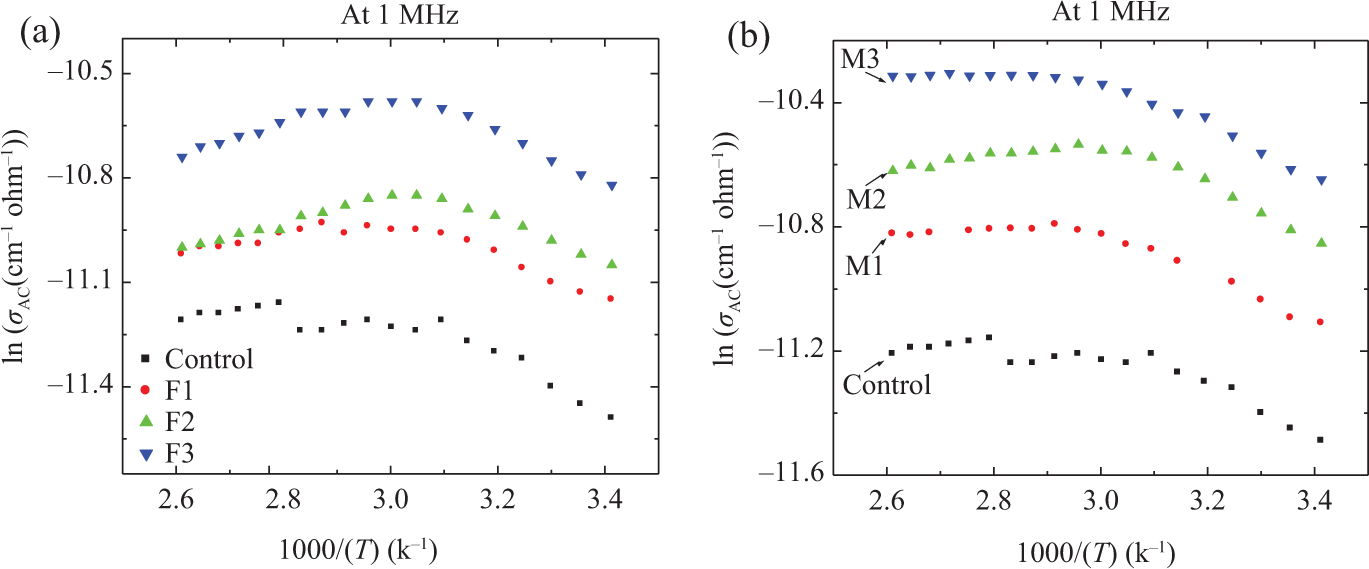
Variation of ln σ AC with 1000/T at fixed frequency (1 MHz) for NBR composites loaded with different filler concentrations of (a) MnO2 and (b) Fe3O4 and irradiated at 50 kGy. NBR: acrylonitrile butadiene rubber; Fe3O4: magnetite; MnO2: manganese oxide.
Mechanical properties
Figure 8 shows the mechanical properties of NBR composites loaded with different concentrations of ferrite and irradiated at 50 kGy. From this figure it can be seen that the values of TS as well as hardness increase by increasing the filler content. On the other hand, the values of elongation at break decrease by increasing the content of the ferrite filler. These data indicate that the ferrite filler is considered as reinforced filler for NBR, and some type of adhesion occurs between the ferrite filler and rubber matrix.
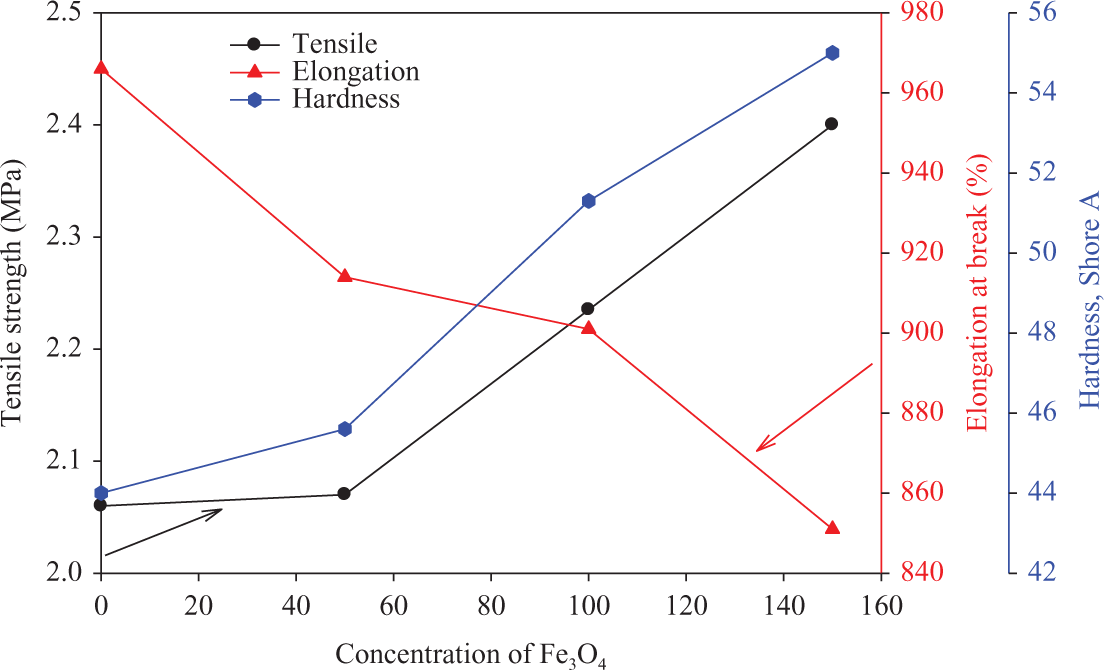
TS, elongation at break, and hardness of NBR composites loaded with different concentrations of ferrite and irradiated at 50 kGy. TS: tensile strength; NBR: acrylonitrile butadiene rubber.
Figure 9 illustrates the effect of concentration of MnO2 on the mechanical properties like TS, elongation at break, and hardness of NBR composites irradiated at 50 kGy. The data obtained from this figure showed that the values of TS increases with increasing the filler content up to 100 phr, and then it tends to decrease at higher content namely 150 phr. In addition, the values of hardness increase sharply up to 150 phr of filler. Meanwhile, the values of elongation at break decrease by increasing the filler content. The data obtained for TS may be explained also by the fact that MnO2 acts as reinforcing filler in NBR matrix up to 100 phr; also, some type of chemical adhesion occurs between the filler and rubber matrix during milling and pressing under heating and also by electron irradiation, resulting in increased cross-link density as shown in Figure 10. On the other hand, the decrease in the values of TS at a higher loading content of 150 phr may be due to agglomeration in the filler, which acts as nodes and separate macromolecules from attaching with each other, leading to a decrease in the values of TS at higher concentration of MnO2 filler. Generally, the hardness increases by increasing the cross-link density, while the elongation decreases by increasing the latter. 25
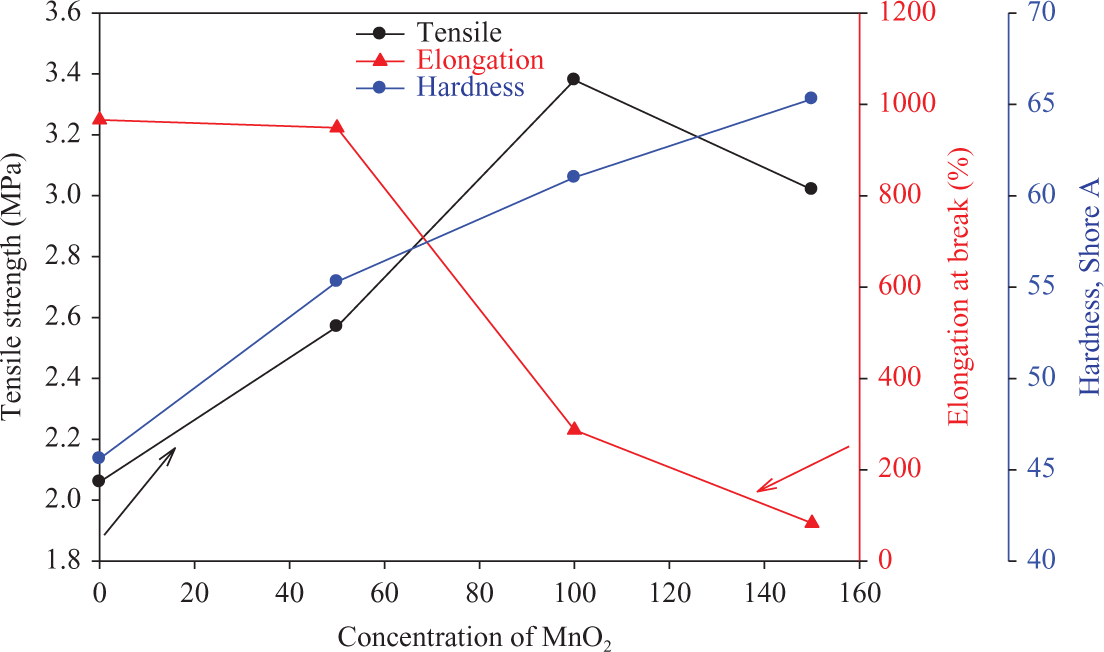
TS, elongation at break, and hardness of NBR composites loaded with different concentrations of MnO2 and irradiated at 50 kGy. TS: tensile strength; MnO2: manganese dioxide.
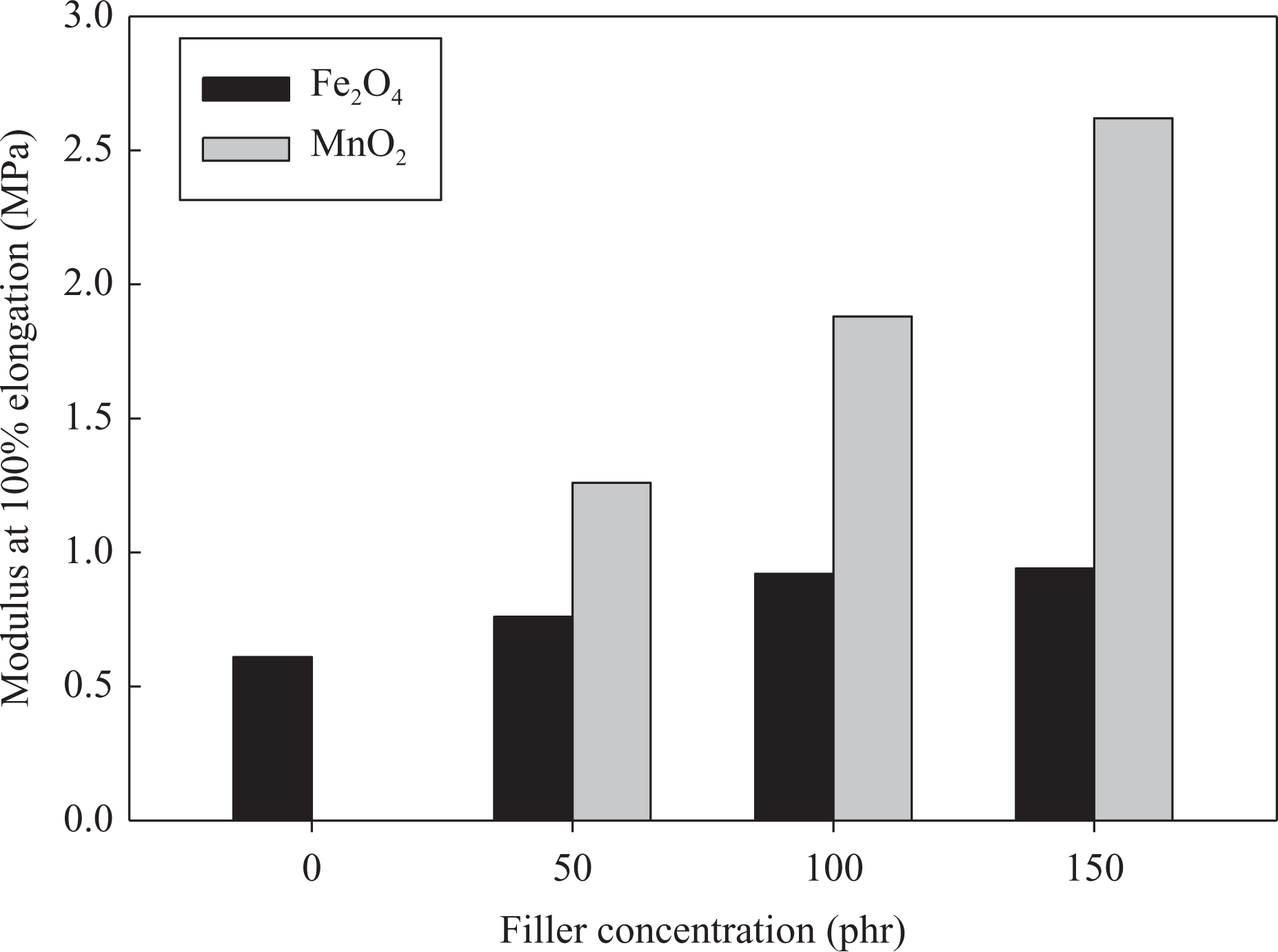
Modulus at 100% elongation of NBR composites loaded with different concentrations of fillers MnO2 and Fe3O4 and irradiated at 50 kGy. NBR: acrylonitrile butadiene rubber; Fe3O4: magnetite; MnO2: manganese oxide.
Conclusion
The DC conductivity results indicate that the increase in filler (MnO2 and Fe3O4) concentrations yielded a significant increase in the conductivity and lowering of the activation energy of the NBR matrix. The AC electrical conductivity is directly proportional to the frequency. It shows an increase in conductivity with increasing frequency for both MnO2 and Fe3O4 fillers. In addition, it has been observed that both dielectric constant and dielectric loss decrease exponentially with increasing frequency for all composites under investigation. This is ascribed to the decrease in electronic contribution and increase in dipolar contribution to the total polarizability. The DC/AC electrical conductivity proved that both types of fillers are dispersed in the NBR matrix uniformly to form an interconnected conducting network. The mechanical properties of composites show that the TS as well as hardness increase by increasing filler contents of MnO2 and Fe3O4. This increase is attributed to the improvement of interfacial bonding between the filler and NBR matrix.
Footnotes
Declaration of Conflicting Interests
The author(s) declared no potential conflicts of interest with respect to the research, authorship, and/or publication of this article.
Funding
The author(s) received no financial support for the research, authorship, and/or publication of this article.