



Abstract
Automotive steel, accounting for about 70% of a car’s weight, has already been successfully recycled. Hence, the target of most researchers is to improve the recycling technologies for automotive plastics from the scrap automobile throughout the world. This article gave a short introduction to typical automotive plastic parts recycling in developed countries and then introduced the status quo of automotive plastic recycling in China. This article also introduced the development of new automotive plastics recycling in China. The most important is that according to China’s actual situation, we put forward automotive plastic part design, recycling, research, and development in China.
Introduction
It is well known that lightweight construction plays an important role in the automotive sector due to energy shortages, vehicle emissions, and rising oil prices. Due to low cost, lightweight, and great design flexibility, compared with metals, plastic parts can save about 20–30% of weight under the same strength of them, so more and more automotive plastic parts take the place of metal parts. As mentioned by Zoboli et al., 1 from 1965 to mid-1980s, the weight of plastics weight in a European car rose from 2 to about 10% of the car’s weight, while the content of metals dropped from 82 to 75%. It is believed that 100 kg weight reduction of a vehicle results in fuel saving of about 0.7 L/100 km. 2 However, introducing plastics to vehicles also leads to more and more environmental problems including toxic materials, water pollution, and soil pollution after they are being disposed of by landfilling. To protect the environment and improve resource utilization, European Parliament 3 enacted the “European Directive 2000/53/EC on end-of-life vehicles (ELVs)” in 2000. In 2002, the ELV recycling law was passed in Japan, 4 while the National Development and Reform Commission (NDRC) 5 of China enacted “Automotive Products Recycling Technology Policy” in 2006. Each year, there are about 50 million automobiles that reach the end of their lifetime all over the world and enter the dismantling companies. A great number of researchers have been undertaking research to improve the recycle rate of ELVs in the world. Due to technical developments, especially shredding technology, magnetic separation that allowed employees to recover and separate steel in large quantities, automotive steel, accounting for about 70% of a car’s weight, has already been successfully recycled, much into high-value uses, almost removing the visible pollution. If every country achieves their automobile recycling goal, they must avert their eyes to the recycling of nonmetallic materials. As the automotive plastic is the main component of automotive nonmetallic materials, with very complex components, automotive plastic recycling is particularly difficult. Until now, many countries dispose off scrap automotive plastics in landfill. How automotive plastics can become another recycling success story is a very big challenge! Hence the target of most researchers is to improve the recycling technologies for automotive plastics from the scrap automobile throughout the world. There are four levels of plastic recycling: primary; secondary; tertiary; and quaternary recycling. Primary recycling is also named as “closed loop recycling” 6 in which the polymer from a single product or product type is collected and recycled to the same product. Secondary recycling 7 –12 uses reclaimed postconsumer materials as a source of material for new products. Tertiary recycling 13,14 involves chemical breakdown of materials which are then reutilized further back in the feedstock chain. Quaternary recycling is often termed energy recycling. 15 Most researchers have focused on typical automotive plastic parts recycling except for automotive shredding residue (ASR) using tertiary and quaternary recycling.
Typical automotive plastic parts recycling
In general, for the typical automotive plastic parts recycling, researchers did more research on bumper recycling, fuel tank recycling, dashboard recycling, and seat recycling.
Bumper recycling
Mazda 16 has developed the world’s first automated bumper-to-bumper recycling technology that used 30% recycled material and 70% raw material to make new bumpers which have sufficient surface quality and mechanical properties to meet the needs of bumper properties. The researchers of Mazda invented a kneading machine that uses a powerful shear force to effectively peel the paint of the crushed bumper pellets. After separating the paint, about 14% of the pellets still had residual paint. Then, these materials were passed through a selection mechanism that has a charge-coupled device sensors to detect any paint adhered to the fragments and can remove it, and the rate of paint removal reaches to 99.85%. Makuta et al. 6 compared bumper-to-bumper recycling and cascade recycling of bumpers into splash shields. They proved that both these recycling can reduce the consumption of crude oil, atmospheric emissions of carbon dioxide, nitrogen oxide, and sulfur oxide and can reduce solid wastes. They further proved that cascade recycling is superior at reducing environmental load. Luda et al. 17 found that bumper-to-bumper recycling produces different reduction of the mechanical properties, especially impact strength value, only to about one-third of the new bumpers made from the raw material, because of the occurrence of thermooxidative reaction in recycling process. For bumpers recycled with the addition of additives, their mechanical properties are almost the same as the new bumpers made by virginal material. Froelich et al. 18 depicted the common process steps of bumper in Europe as shredding, inserts removal, cleaning, size reduction, paint removal, plastics sorting, granulation, upgrading, and filtration. Martins et al. 19 found that because of better dispersion of elastomeric domains in the polypropylene (PP) matrix in the recycled phase, the impact resistance of the recycled PP from used bumper, 260 J/m, is almost 10 times higher than the values obtained for virgin materials. The recycled materials are suitable to make bumpers and other automotive plastic parts.
Fuel tank recycling
Due to excellent properties, such as lightweight, corrosion resistance, impact resistance, heat insulation, and easy molding, more and more steel fuel tanks are substituted by plastic fuel tanks. Plastic fuel tank is usually a multilayer structure including gas barrier layer, adhesive layer, and high-density polyethylene (HDPE) layer. Graham et al. 20 described in detail the mechanical recycling route of the uncoated plastic gasoline tanks in a pilot plant, which included shredding, magnetic separation, eddy current separation, grinding, density separation, oil removal, and so on. Then, workers used a continuous coextrusion blow molding process to make a six-layer tank which includes virgin HDPE layer, adhesive layer, ethylene vinyl alcohol layer, recycled material layer, and virgin HDPE layer from inner to outer, respectively. The recycled material layer was 40% of the structure. This layer is made from recycled material and virgin material. The recycled material takes up 68.5% of this layer weight. Their research found that yield stress, rupture stress, impact resistance, and elongation at break of the regenerated fuel tank are almost the same as new fuel tank made from virgin materials. Gorrasi et al. 21 used HDPE without any additives, HDPE, and carbon black (CB), a blend of HDPE and CB, and the recycling materials of scrap fuel tanks to mold in a hot press into films of 0.15 mm thickness, respectively. By comparing the study of the sorption–desorption isotherms with the rheological analysis of the molten materials and their processability, they found that the mechanical properties of the films containing recycling materials are slightly inferior to the ones made of virgin polymer, nevertheless, it is still acceptable.
Dashboard recycling
Dashboard is an automotive interior trim divided into two classes as rigid and soft dashboards. Rigid dashboard is usually made from a single polymeric material and recycling is easy, and most of the studies focus on soft dashboard recycling. Soft dashboard has a three-layered structure: a leather-like skin, an intermediate layer of foamed polyurethane (PU), and a backing layer which is made from differential materials varying with car types. Ragosta et al. 22 analyzed the thermal, spectroscopic, mechanical, and morphological properties of the recycled material and they found that their mechanical and impact properties decreased very much because of thermooxidative and thermomechanical degradation phenomena taking place during recycling. By adding a suitable antioxidant, stabilizer, and virgin PP, deformation at break, impact toughness, and overall morphology have been greatly improved and suitable to be reused for the same or for similar applications in car. Grimmer 23 invented a method for recovering dashboard which is made from vinyl, urethane foam, and styrene. Through granulation and air separation, urethane foam is removed. On applying pressure to the residual mixture, styrene particles became big, while the shape of vinyl particles didn’t change. Finally, using size separation, styrene was separated.
Seat recycling
Because PU foam has characteristics of softness, comfort, durability, and excellent sound-absorbing, vibration-dampening, shock absorption, and low density, it is widely used for car seats and can be relatively easily dismantled. Therefore, the research of recycling or recovery for the PU seating material is comparatively mature. Cannon, 24 a world leader in PU processing technology, developed a prototype filler injection kit that used recycled PU powder added to new virginal materials to produce PU foam. The amount of recycled PU powder in the mixture took up 7.1% of the total foam weight. Experiments indicated that the recycled PU materials had little influence on the mechanical and physical properties of the molded foam parts. Seats made from this PU foams were still meeting the specific original equipment manufacturer specifications. Mark and Kamprath 25 made a brief introduction of the dismantling, washing, and common recycling methods of PU seats. Gasification, similar to the process mentioned before, and its products such as hydrogen, carbon monoxide, methane, and some higher hydrocarbons are used as useful products. Blast furnace recycling used scrap PU in substitution for coal as a reducing agent in a blast furnace for converting the iron ore to metallic iron. Chemical decomposition of PUs is a kind of depolymerization where the macromolecule is decomposed into monomer by means of reactive agents. Water (hydrolysis), glycols (glycolysis), acids (acidolysis), and amines (aminolysis) are common reactive reagents to break the urethane bond. The decomposition products, monomer, may be reassembled into PU polymers suitable for making car seats again.
Status quo of automotive plastic recycling in China
Automobile ownership in China has already numbered approximately 120.89 million by the end of 2012. Approximately 4.8 million vehicles were scrapped. As estimated by experts, the amount of scrapped automotive plastics would have reached 480,000 tons in 2010. Qualified ELV dismantlers approved by the state administrative department number approximately 356, 26 and over 800 take-back stations are located in cities all over China. Unlike the dismantling process adopted by developed countries, scrapped automotive plastics in China are removed using a crowbar before the “hulks” are shredded. The above-mentioned process is employed to prevent the automotive plastics from burning when the car body is subjected to oxygen–acetylene cutting. As the car body is cut, the small, undismantled plastic, and rubber parts may burn, consequently emitting heavy smoke with an unpleasant smell. One example is the Shanghai East China Vehicle Dismantling Co Ltd, where workers dismantled the seat PU foam by hand and sent to PU recycling companies for free. These companies also collect all kinds of PU foam waste, including mattresses and sofas. Without undergoing any cleaning process, the PU foam is shredded, and a kind of glue is added. After mixing the shredded PU foam and glue by hand, the mixture is placed in a cuboid box and pressed into a cuboid shape. The cuboid material is then cut to fit the customers’ preferences for sale. The PU foam-recycling process is shown in Figure 1. This product can be easily identified because of the red, yellow, and pink components blended with the white foam. This recycled material, is inferior to virgin materials in terms of strength, elasticity, and comfort. However, the low cost of these recycled products provide a good competitive advantage over the products offered by qualified companies. Customers who purchase such recycled materials are generally illegal furniture factories that produce mattresses, sofas, and other furniture. The employees of recycling factories dismantle bumpers, tanks, dashboards, and other big plastic parts with crowbar by hand and sell these materials for ¥ 1000/ton to plastic collectors. The plastic collectors usually hire approximately two to three workers who have little knowledge about automotive plastic. These workers use a simple plastic classification process based on feel and experience. However, some plastics cannot be determined through this rough process, thereby necessitating the use of fire. The color, smoke, and odor emitted are then used to identify the types of plastics. Bumpers and fuel tanks are the materials that are usually sorted. For the instrument panel, only a single plastic material dashboard is collected. If the dashboard contains a steel plate, the plastic attached to steel plate is burned off and only the steel plate is collected. If the instrument panel has more than two kinds of plastic that cannot be separated from each other by hand, the entire panel is directly discarded. The sorted plastics are sold for approximately ¥ 3000/ton to individual plastic recycling businesses. The sorted bumpers undergo a process of reagent soaking, paint stripping, cleaning, drying, grinding, and pelletizing. Virgin materials are then added to the processed bumpers, and the resultant material is then used to produce basic household items, such as basins, lunch boxes, containers, pipes, bags, insulation materials, garbage bins, and so on. Individual companies that recycle fuel tanks remove oil from the tank surface using detergent and wastewater, which is allowed to flow into rivers without further treatment. However, the oil infiltration into the fuel tank is not removed. After these fuel tanks are dried, grinded, and pelletized, they are generally used for the production of plastic pots, buckets, containers, shoe soles, plastic–wood products, plastic tiles, and so on. The high cost involved in dismantling and recycling hinders the utilization of other plastic parts, such as door inner panels and roofs, which are consequently discarded as litter.
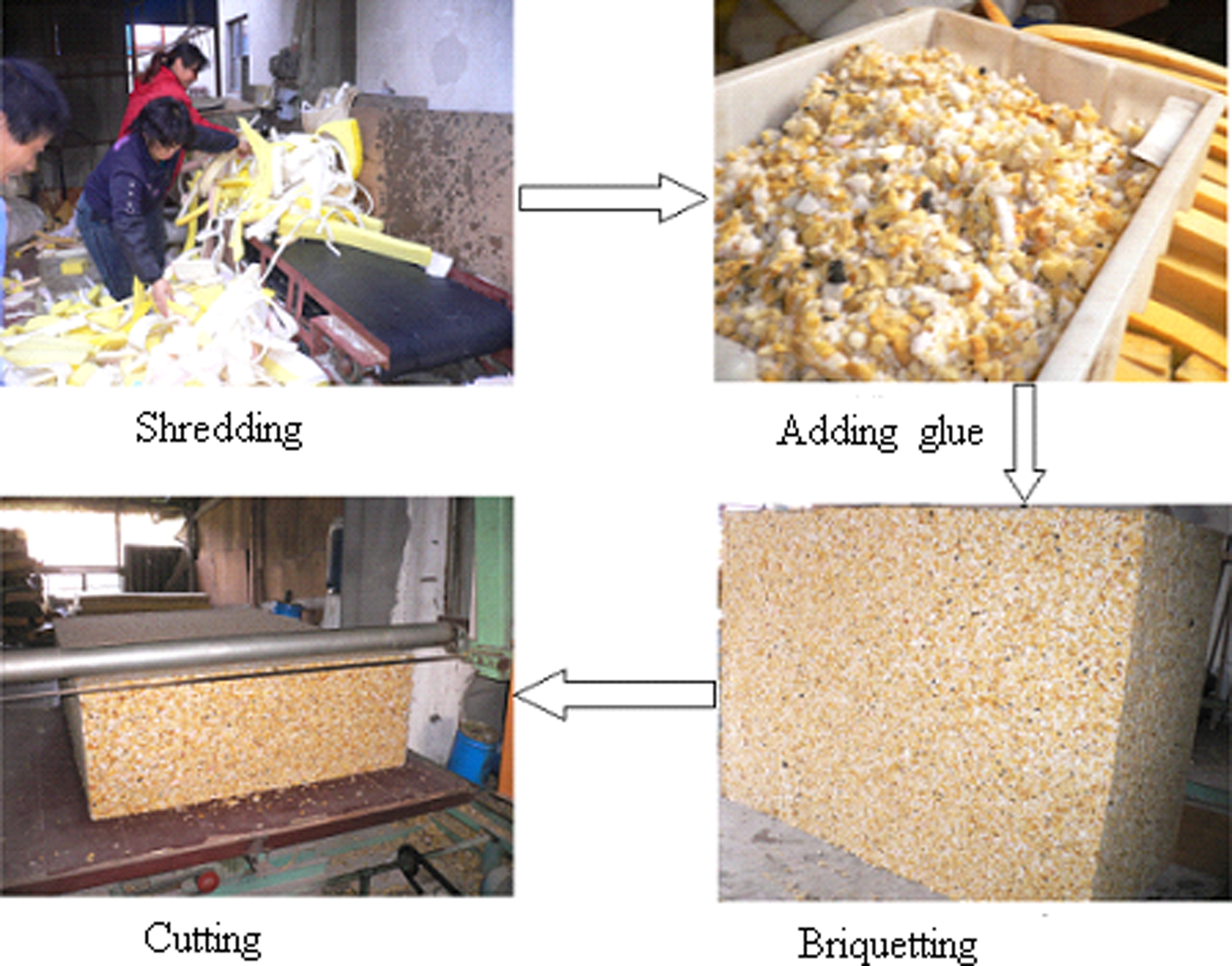
Seat polyurethane foam recycling process.
China’s automotive plastic recycling industry is characterized by (1) serious environmental pollution because most automotive plastic recycling companies focus only on economic benefits and completely disregard about environmental protection; (2) a low level of recycling process of mechanization, particularly in the dismantling, identification, and sorting stages, where manual operation is generally adopted; (3) small-scale automotive plastic recycling companies that are usually self-employed businesses having no business licenses and are often illegal enterprises; and (4) lack of technology, whereby all kinds of scrap plastic are simply separated. Moreover, the degree of separation is incomplete. Products made from recycled plastics usually have poor performance, low added value, and bulky plastic parts.
Cost-benefit analysis
Anywhere in the world any kind of economic activity is carried out for the purpose of getting profit, and automotive plastic recycling is no exception. The profitability of automotive plastic recycling has close connection with the below-mentioned factors described in the following sections.
Dismantling cost
Design for disassembly (DfD) is the process of designing automobile that can be easily, cost-effectively, and rapidly taken apart at the end of their life because the parts are connected with reversible fasteners and the clearance have been offered to facilitate the use of crowbars so that components can be reused and/or recycled. DfD, labeling the automotive plastic parts, reducing the type of automotive plastic, and developing a system for quickly dismantling and separating these plastic components, can reduce dismantling cost. It is unfortunate that most car manufacturers still did not do these until now. As many automotive plastic parts use nonreversible connection such as, bonding, riveting, and welding, these bring great difficulties to the automotive plastics dismantling and increase the dismantling time, so the labor cost required removing and separating the plastics from automobiles is excessive. In developed countries, duo to high labor cost, dismantling companies are unwilling to remove automotive plastic parts and they are generally shred with car body. In contrast, automotive plastic parts have been removed before automobile body shredding because of low labor cost in China.
Transportation cost
The most important way of lowering transportation costs is that automotive plastic recycling plant builds in the vicinity of dismantling plant. However, due to various reasons, it is not the case. It is a good phenomenon that China’s plastics recycling companies are generally located in developed regions. This will help to reduce transportation costs. Increasing transport capacity can reduce the portion of the cost per pound of recycled plastics, so increasing the scale of automotive plastic recycling can also reduce transportation costs.
Recycling cost
Automotive plastic recycling is generally through four main stages of identification, cleaning, separation, and pelleting, and also the cost of cleaning and separation are closely related with dismantling methods. In developed countries, because automotive plastics and automobile body are shred at the same time, brake fluid, steering fluids, motor oils, and gasoline often remain on the plastic fragments. These bring great difficulties to the automotive plastics cleaning and increase the cleaning cost. As the composition of ASR was very complicated, it makes the separation of plastics from ASR difficult. Even if plastics can be separated from ASR, it is difficult for us to separate one targeted plastic from these plastics. As the automotive plastic parts were removed before crushing the body, in comparison with foreign ASR, the Chinese scrap automotive plastics are used with less oil pollution, relatively few compositions, easy recycling, and low recycling cost.
According to economic theory, if two commodities have the same quality, low price of goods will win the market. If equation (1) holds true, that is,

the price of recycled plastic is lower than the price of raw plastic and recycled plastic will have a market, otherwise the customers will use cheaper new plastic, and recycled plastic will have no market. In order to facilitate analysis,
A: dismantling cost, B: transportation cost, C: recycling cost, D: the profit of recycled plastic, and E: new plastic price−recycled plastic price has been set.
Then we can describe equation 2:

When E is greater than zero, the recycled plastic will have a market. When D is greater than zero, automotive plastic recycling will have profit. Only when D and E are greater than zero, automotive plastic recycling will be realized. As previously mentioned, because dismantling cost and recycling cost in China are relatively low, China has the economic conditions of automotive plastic recycling. In addition, automotive plastic recycling has connection with the price of crude oil. If the price of crude oil decreases, the price of new plastic will become low and consumers will use cheaper new plastic, so, it will hinder the recovery of automotive plastics. Conversely, high oil prices can promote the development of automotive plastic recycling.
New development
Other than a number of individual enterprises and small businesses engaged in automotive plastic recycling, very few research institutions engage in research on automotive plastic recycling technology. To solve the aforementioned issues in the Chinese automotive plastic recycling industry, Shanghai Jiao Tong University’s “green design team” is currently conducting a study on automotive plastic recycling technology.
In March 2011, the green design team launched the project “The Key Technique Investigation and Equipment Development of ELV Green Dismantling and Recycling” under the label “2011BAF11B05,” supported by the Ministry of Science and Technology, People’s Republic of China. This project was funded with $1 million funding, with another $2 million provided by collaborating companies. Thus, a total of $3 million funding was accepted to finance this research project, the primary focus of which is high value-added automobile plastic recycling.
Identification of waste plastic is an important step of recycling. The simplest way to identify the plastic is to label identification tags in the product. Directive 2000/53/EC stipulated that vehicle plastic components and materials having a weight of more than 100 g need to be labeled according to ISO1043-1, ISO1043-2. and ISO11469 standards for the sake of reuse and recovery. In 2008, China developed the automotive industry standards QC/T797-2008 “automotive plastic parts, rubber, and thermoplastic elastomer material identification and marking” for automobile manufacturers reference. However, automotive plastics still need to be identified in the recovery of them for the following reasons: (1) Many automotive plastic parts were incorrectly labeled because the compositions in the production of plastic parts are subject to changes, but the manufacturers are still using the original mold; (2) There are many automakers in China almost including all big automakers in the world. Requiring these automobile manufacturers to mark automotive plastic parts in accordance with uniform standards is very difficult. (3) Scarcely labeled, automotive plastic parts were produced before the introduction of these standards. Near-infrared spectroscopy identification apparatus 27 has already been initialized by an advanced inspection facility in green design team from the Jiao da, Shanghai, China. This facility can identify six kinds of automotive plastics (i.e. PP, PE, acrylonitrile butadiene styrene, polyamide, polycarbonate, and poly(methyl methacrylate)) with an accuracy rate of 98%.
Removal of contaminants is also an important step of recycling. Contamination affects the recyclability of automotive plastic by impacting on the properties of the recycled material. The green design team has already invented high-pressure cleaner and shot blasting machine. The former is used to remove dust, mud, and dirt from the surface of automotive plastic part and the latter is used to remove paint from the surface of bumper.
Common plastics separation methods.
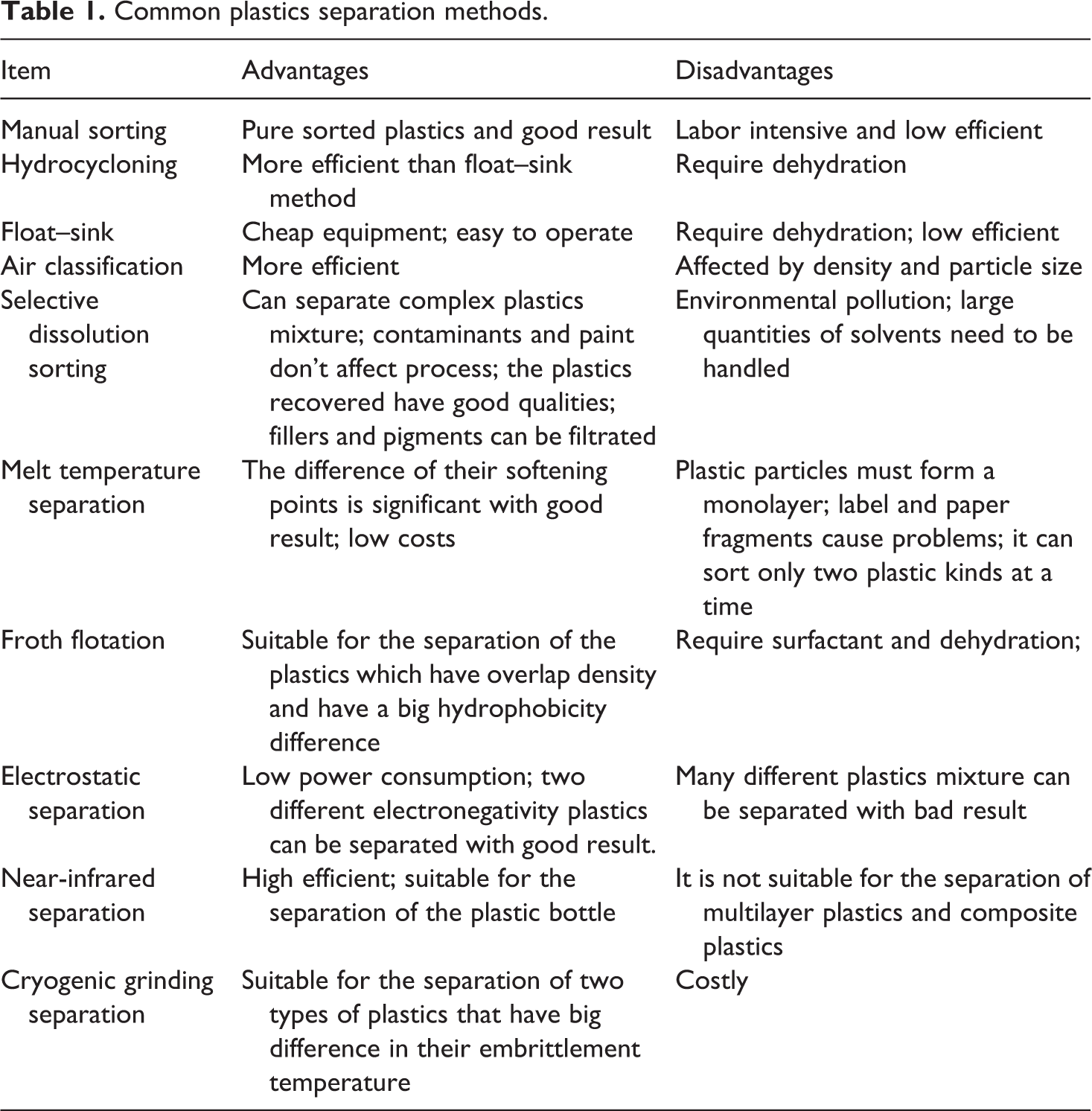
Density: Different types of plastics usually have different densities. Hydrocycloning separation, float–sink separation, and air classification make use of density difference to separate. Float–sink separation is a low cost method but has low efficiency than hydrocycloning separation. Air classification is suitable for separating lighter particles from heavier ones, but it is also affected by particle size. Theoretically, we can separate plastics by density separation as long as they have density difference. However, automotive plastics are usually not pure resins—they usually contain fillers, modifiers, and colorants, among other materials, which lead to the change in density of these materials—all of these cause their density to overlap. Therefore, other techniques making use of the other properties are required to separate automotive plastics.
Solubility: If one substance dissolves in some fluid, we can say it is soluble. Although plastics do not dissolve in water, they are soluble in many organic solvents. Different types of plastics can dissolve at different temperatures in different solvents, and we can separate automotive plastics by solubility difference. As shown in Table 1, compared with the other separation methods, selective dissolution sorting has incomparable advantages; however, it also has a fatal flaw, that is, large quantities of solvents should be handled properly to prevent from causing environmental pollution.
Softening temperature: plastics become sticky when the temperature exceeds their softening point. When this difference is significant, that is, on the basis of differences in their softening points, we can separate automotive plastics with good result. Unfortunately, a lot of plastic softening point overlaps bring obstacles to the melt (softening) temperature separation.
Hydrophobicity (hydrophilicity): Plastics usually have hydrophobicity property, but we can use wetting agent to change their hydrophobicity, which enables some plastics to become hydrophilic. There are some common wetting agents such as sodium lignin sulfonate, tannic acid, aerosol OT, and saponin. Hydrophobicity (hydrophilicity) difference between plastics is an excellent characteristic, which is suited for separating plastics with a similar density. Froth flotation is a process for selectively separating plastics on the basis of hydrophobicity (hydrophilicity) differences. Furthermore, we can select a surfactant that can alter the hydrophobicity of one targeted plastic, while do not change others, and that can be separated from the plastics mixture. The froth flotation has very broad application prospects. Argonne National Laboratory 29 has already separated four types of pure plastics from ASR, and the recycled plastics have sufficient quality to meet the need of new car parts properties.
Electrostatic property: Different types of plastics have different dielectric constant. When two plastics rub each other, electrons may be transferred (or moved) from one to the other. The plastic with the higher dielectric constant that releases negative charges will have a positive charge, and the plastic with the lower dielectric constant is negatively charged. The more the rubbing, the more electrons move, and the larger is the static charge that builds up. These different charged particles can be separated in a high-voltage field according to their polarity. Electrostatic separation is well suited for separating various plastics with density overlap which have significant difference in their dielectric constant.
Optical property: When infrared light encounters a material, some of it may be absorbed by the chemical bonds in the material. Each type of bond absorbs specific wave numbers of infrared light. The absorption of infrared light will be indicated by a valley (called a peak) in a graph called a spectrum. Spectra of known plastics will be used to find a peak or group of peaks that is unique to each type of plastic and that can be used to identify unknown plastics.
Embrittlement temperature: Embrittlement is a loss of ductility of a material, making it brittle. When the temperature is lower than the embrittlement temperature of the plastic, it will become brittle with little change in other mechanical properties. Various plastics have different embrittlement temperature which can make use of this property to separate the mixture of plastics. This method is suited for separating the plastics that have significant differences in their embrittlement temperature, but its cost is high.
In general, the more complete the separation is, the more pure the separated materials get, and higher the quality the recycled materials have, greater the value the recycled materials have. No single method can completely separate the automotive plastics; only with comprehensive utilization of these separation methods, good separation results could be obtained.
Automotive plastic parts are typically removed before automobile body shredding. Thus, less pollution is generated, and easy sorting and separation are facilitated compared with ASR. According to the actual situation of the automotive dismantling industry in China, the green design team decided to adopt typical automotive plastic part recycling and study the instrument panel, bumper, fuel tank, and other automotive plastic part recycling technologies. The difficulties in recycling these plastic parts lie in the processes of separating dashboard layers, bumper paint stripping, and fuel tank oil removal. The differences in the various physical and chemical properties of automotive plastics will be used as a basis for the removal of contaminants and for the separation of targeted plastics, which can meet the product property requirements. An environmentally friendly, economical, and reasonable recovery process will be developed for all typical automotive plastic parts. This process will be suitable for large-scale use in the automotive plastic recycling industry. Necessary experimental instruments have already been purchased. Moreover, a number of relative experiments are currently being conducted. If such experiments yield positive results, these achievements shall then be presented.
Automotive plastic parts design, recycling, research, and development in China
Developing technologies focused on vehicle recycling and establishing a national laboratory
China’s auto recycling industry is sorely lacking skilled technical personnel. Most dismantling plants, collectors, sorters, and automotive plastic recycling companies employ no specialized technical personnel, not to mention skilled workers. This finding is relevant to the entire social environment for the following reasons: (1) China pays little attention to car recycling; (2) colleges and universities do not have specialization areas for training professional personnel on vehicle recycling; and (3) automobile manufacturers disregard automotive recycling. China has to change this situation as soon as possible. Moreover, the country has to develop technologies relevant to vehicle recovery, accelerate the pace of training for vehicle recovery personnel, and encourage universities to establish an automobile recycling national laboratory.
Correctly label the automotive plastic parts
China should develop a mandatory standard for marking plastic parts, which will make the auto parts suppliers and automotive plastic plants accountable for marking vehicle plastic parts correctly and clearly. The world’s major automobile manufacturers produce their automobiles in China. Thus, asking these companies to label automotive plastic parts correctly and clearly based on uniform standards is very difficult. However, the fact that Chinese scrapped automotive plastics are basically hand-sorted makes marking highly significant to the Chinese automotive plastic recycling industry.
Material selection principles
Material selection in automobile design involves a skillful balance between two material attributes, namely, cost and recyclability. The recyclability of automotive plastics is not yet viewed as a major factor considered by material engineers in material selection decisions. Moreover, recyclability ranks far below the traditional factors, which relate to the automaker’s suppliers. Recyclability is regarded as, at most, of importance to the customer and the society. Therefore, China should enact legislation or apply economic leverage (such as taxes) to encourage car manufacturers to use recyclable plastic. Recyclability is ultimately the most important factor that automotive manufacturers should consider in the process of material selection.
Reduce the type of automotive plastic
Reducing the types of automotive plastics will be of great benefit for plastic classification, separation, and recycling. Such a measure decreases recycling cost and is bound to promote automotive plastic recycling industry development. A BMW disassembly plant in Landshut, Bavaria, has manufactured instrument panels entirely from one type of material, thus reducing dismantling time and removing the requirement for material classification and separation. The director of the BMW disassembly plant 30 said, “Five types of automotive plastics would be much better, and should be possible.” Only seven different resins are currently available, and these resins account for 90% of the plastic parts used in Peugeot’s new cars. A bumper system, 30 including the sheath, core, and beam, is made from PP and could be easily removed and recycled. China should accelerate the development of the automotive plastic industry, enhance the research and development for automotive plastics for improved performance, and exert effort to reduce the types of automotive plastics.
Design for disassembly
In order to decrease manufacturing costs and improve reliability in vehicle usage, many automakers usually use bonding, adhesives, and welded joints when two different automotive plastic parts connect. These may bring about a substantial barrier to dismantling and/or parts recycling: increase dismantling time, contaminate the materials, and most importantly, destructive dismantling. If we use design for disassembly, avoiding the use of adhesives and bonding, the dismantler could more easily and economically dismantle plastic parts from scrapped vehicles, and then the dismantler may be willing to reuse automotive plastic parts. A snap-fit, which can be easily disassembled, is a mechanical joint system commonly used as an assembly method for injection-molded parts. DuPont Automotive Products 31 developed a software system that enables engineers to better accommodate snap-fit designs into production, allowing more precise connection points and more efficient assembly. Nut/bolt is also a connection method that can be disassembled. However, steps should be taken to prevent the nut/bolt from loosening, thus also preventing the plastic parts from cracking at the point where they connect. To be effective, these strategies must be employed in their entirety, not individually. As Figure 2 presents, the strategy will not succeed unless the government, automakers, dismantlers, recycling enterprises, and the national laboratory work together.
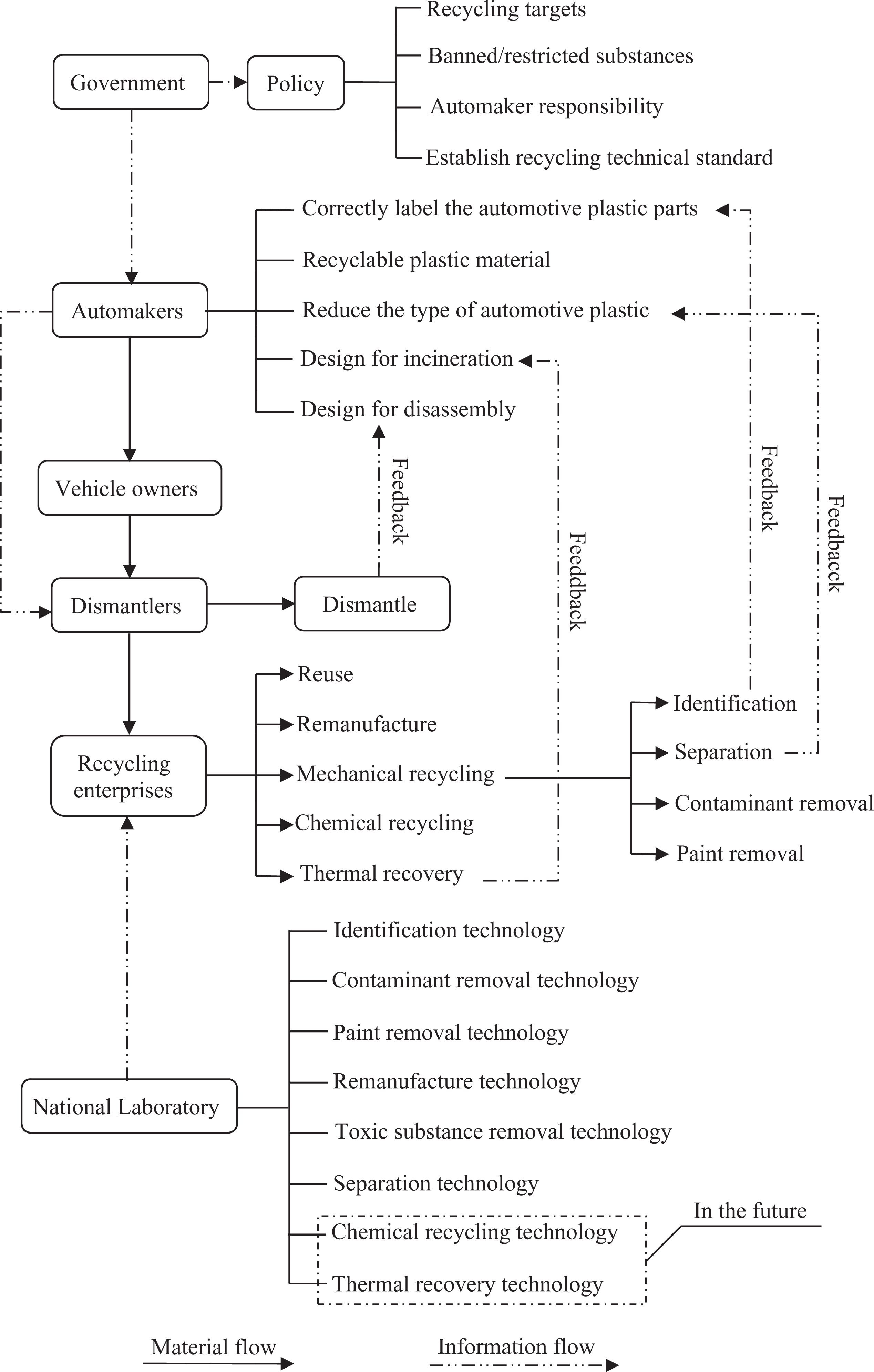
Proposed automotive plastic parts design, recycling, research, and development procedure in China.
Conclusion
In addition to the aforementioned strategies, China should also encourage automotive plastic recycling considering economical methods. With the increase in Chinese car ownership, the number of scrapped automobiles in China may inevitably exceed that of the United States and the European Union in the near future. In the coming years, hand dismantling could not keep up with this development. Thus, a number of companies will resort to mechanized dismantling and crushing to produce large amounts of ASR. From a long-term perspective, the recycling problems that emerge from ASR should be considered. So we should consider the development of chemical recovery and energy recovery technologies in the future (Figure 2). The success of the scrapped automotive plastic recycling industry depends on technical, regulatory, and market developments. Other significant contributors include resin producers, molders, vehicle manufacturers, the dismantling industry, the shredding industry, and the varying levels of government collaboration. This road is long and tortuous, but the future of the automotive plastic recycling industry remains bright.
Footnotes
Funding
The author expresses sincere thanks to the Ministry of Science and Technology, People’s Republic of China, for financing this research within the National High Technology Research and Development Program of China, “The Technique Investigation & Equipment Development Pilot Project of End-of-life Passenger Vehicles Efficient Dismantling, Shredding & Sorting” under the label 2013AA040202 and also expresses their thanks to the National Natural Science Foundation of China for financing this research within the project “Fundamental Research on ASRs Pyrolysis/Gasification Mechanism and Its Recovery in China” under the label 51175342.