




Abstract
This is a study on evaluating the effect of nano-calcium carbonate (CaCO3) particles on the mechanical properties of thermoplastic casts, which were performed by mechanical tests, such as scanning electron microscopy and energy dispersive spectroscopy. Composites loaded with a mass rate of 1–2 wt% of nano-CaCO3 particles in polyethersulphone (PES) showed the most excellent mechanical function. The increase in the rate of compressive strength, the maximum compressive modulus and the flexural modulus increases is 47%, 51% and 32% in contrast to neat thermoplastic resin, respectively. The improvement in mechanical properties is attributed to the nanocomposites based on the modified nano-CaCO3 fillers that perform higher modulus and lower Poisson’s ratio than neat PES resin.
Introduction
Thermoplastics resins are recently considered the most competitive materials class because of their inherent properties such as superior impact resistance, high toughness, recyclabilities, corrosion resistance and high energy absorption level. Thermoplastics resins have many applications. 1 –4 Besides its usage as one of the structural materials, it can also be used as a matrix for fibre reinforced composites. However, even polyphenylence sulphide (PPS) and polyethersulphone (PES) have some drawbacks, which do limit their application spectrum, such as higher preparation cost and poorer mechanical properties than traditional thermosetting resins. PES is an outstanding thermoplastic, with a high glass transition temperature (T g = 225°C), good flexibility and excellent flame resistant. PES also has great dimensional stability due to the amorphous property. However, the high molten viscosity of PES requires that the hot-press facilities must be expensive and complicated in order to sustain molten PES working into the mould.
Studies have shown that the mechanical properties of polymer can be improved by embedding cheap nanofillers, such as silica (SiO2), alumina (Al2O3), titania (TiO2) and calcium carbonate (CaCO3). 2,5 –10 However, most of research focused on thermosetting resins because they have been in use since several decades. As for thermoplatics resins, there have been few reports of the influence of nanofillers on their mechanical properties. 9 –11 High cost and relative poor mechanical properties are two major negative factors that restricted their application.
In this article, it was innovatively validated that the mechanical properties of thermoplastic resin casts were greatly improved by well surface-modified nano-CaCO3. The mechanisms of performance improvement were also investigated by scanning electron microscopy (SEM) and energy dispersive spectroscopy (EDS).
Experimental
PES was purchased from Sinosteel Jilin Carbon Co. (Changchun, China), which is in powder form with a diameter of about 50 μm. A KH550 silane coupling agent, supplied by Nanjing Chemical Industry Co. Ltd (Nanjing, China), was employed to treat the surface of nano-CaCO3. The nano-CaCO3 used in this study, with mean particle size of 40–60 nm and specific surface of 20–30 m2/g, was produced by Shanxi Ruicheng Chemical Industry Co. Ltd (Ruicheng, China). Modified nano-CaCO3 was achieved by the reaction of silane coupling agent with the hydroxyl groups. CaCO3 nanoparticles of 2.0 g and KH550 of 2.0 g were added to 100 mL of 95% ethanol solution in a flask. The mixture was stirred with a magnetic stirrer and subjected to sonication at 60°C for about 1 h. Afterwards, the nano-CaCO3 was centrifuged, and the precipitate was washed with ethanol for 8 h to remove the excess silane coupling agent that was absorbed on the nano-CaCO3 surface. Then the treated nano-CaCO3 was dried at 110°C for 24 h in a vacuum oven. The modified nano-CaCO3 particles varied from 0 to 10 wt% were added to the PES resin. The mixture with adding ethanol was stirred by a high speed homogenizer for 60 min. Then, it was dispersed by ultrasonic waves for 60 min. After degasification, it was quickly poured into a preheated steel mould coated with the lubricant. The mould was kept at 280°C and 8 MPa for 0.5 h.
In mechanical test, five samples were tested at each point of an experiment and then the average value was reported. The relative error was estimated to be with 10% based on reproducibility of the data among different specimens. All the tests were performed according to American Society for Testing and Materials (ASTM) standards at 50% humidity and 23–25°C. 12 SEM and EDS were performed on JSM-6360LV system (Japan Election Optics Laboratory CO. LTD., Tokyo, Japan) with an excitation voltage of 15–30 kV.
Results and discussions
The mechanical properties of the pure PES cast and nano-CaCO3/PES cast are shown in Figure 1. The strength of the modified PES resin is found to increase, reaches the maximum and then continually decrease with increasing nano-CaCO3 content, indicating that over-dose of nano-CaCO3 particles would perform negative effect on the strength of the PES cast. The results of the maximum compressive strength, flexural strength and impact strength are about 96.7 MPa, 145.5 MPa and 30 kJ/m2, respectively, for the 2 wt% nanoparticles in composites. However, the increase in the rate of compressive strength, the maximum compressive modulus and flexural strength is 47%, 51% and 32%, respectively. It is reasonable to conclude that nano-CaCO3 particles have very more positive effect on compressive strength and impact strength than flexural strength. The results proved, in agreement with our previous study, that both the thermosetting resins and thermoplastics resins performed the downward trend in resistance to bending fatigue when the CaCO3 particles were mixed into the composites in inappropriate proportion. 1 By comparing with our previous study, the increase in compressive strength rate of modified PES cast is more than three times than that of epoxy cast-treated CaCO3. 1,9 Contrarily, it can be found that the impact strength decreased with an increase in the nano-CaCO3 content, 10 which suggest that the interface effect between the nanofillers and the resins is different. 9 –11
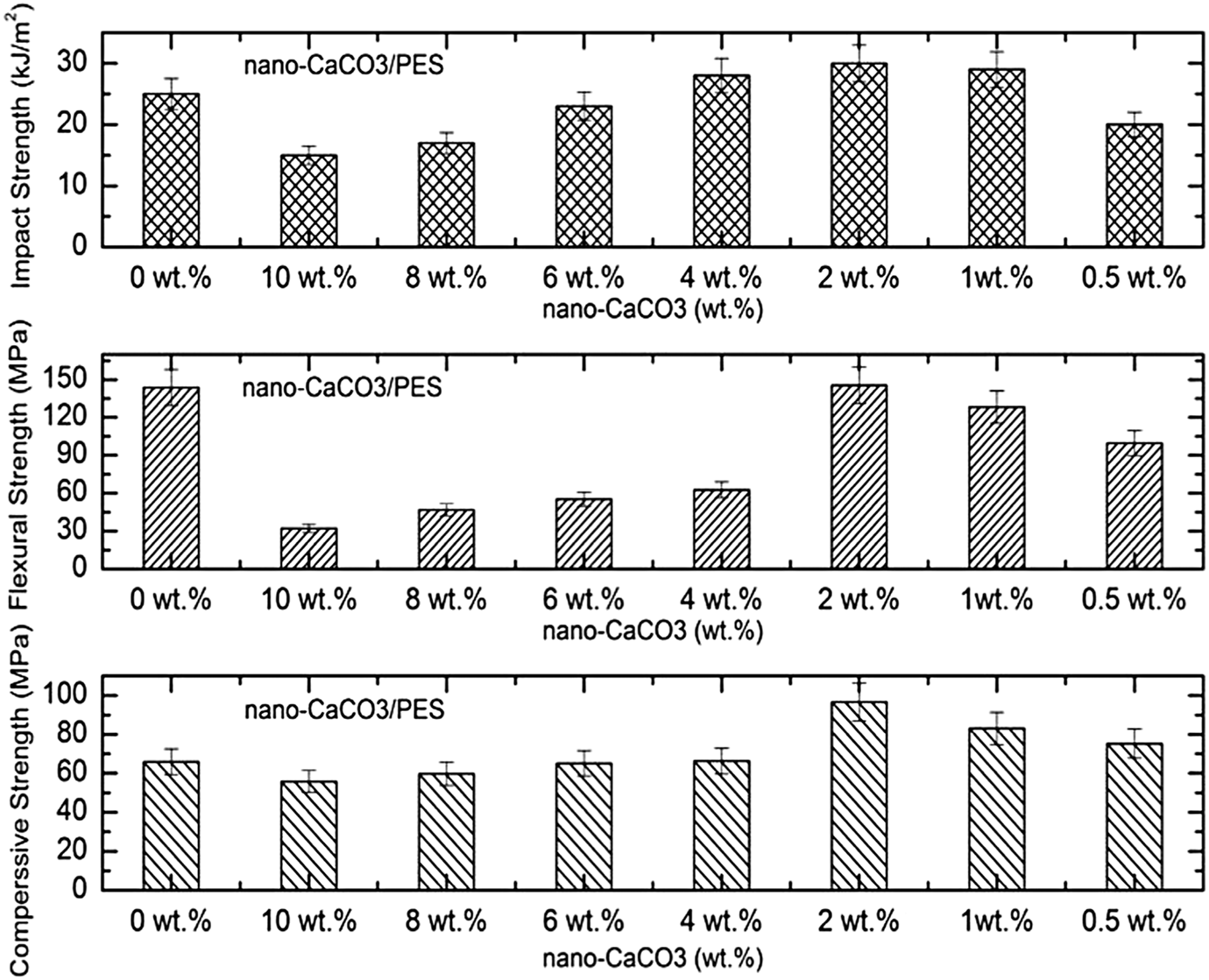
Mechanical properties of the neat and treated nano-CaCO3/PES cast. CaCO3: calcium carbonate; PES: polyethersulphone.
Figure 2 showed the influence of nanofillers on mechanical modulus of PES cast. When compared with Figure 1, Figure 2 showed that modified PES cast performed more increased trend in mechanical modulus than mechanical strength.
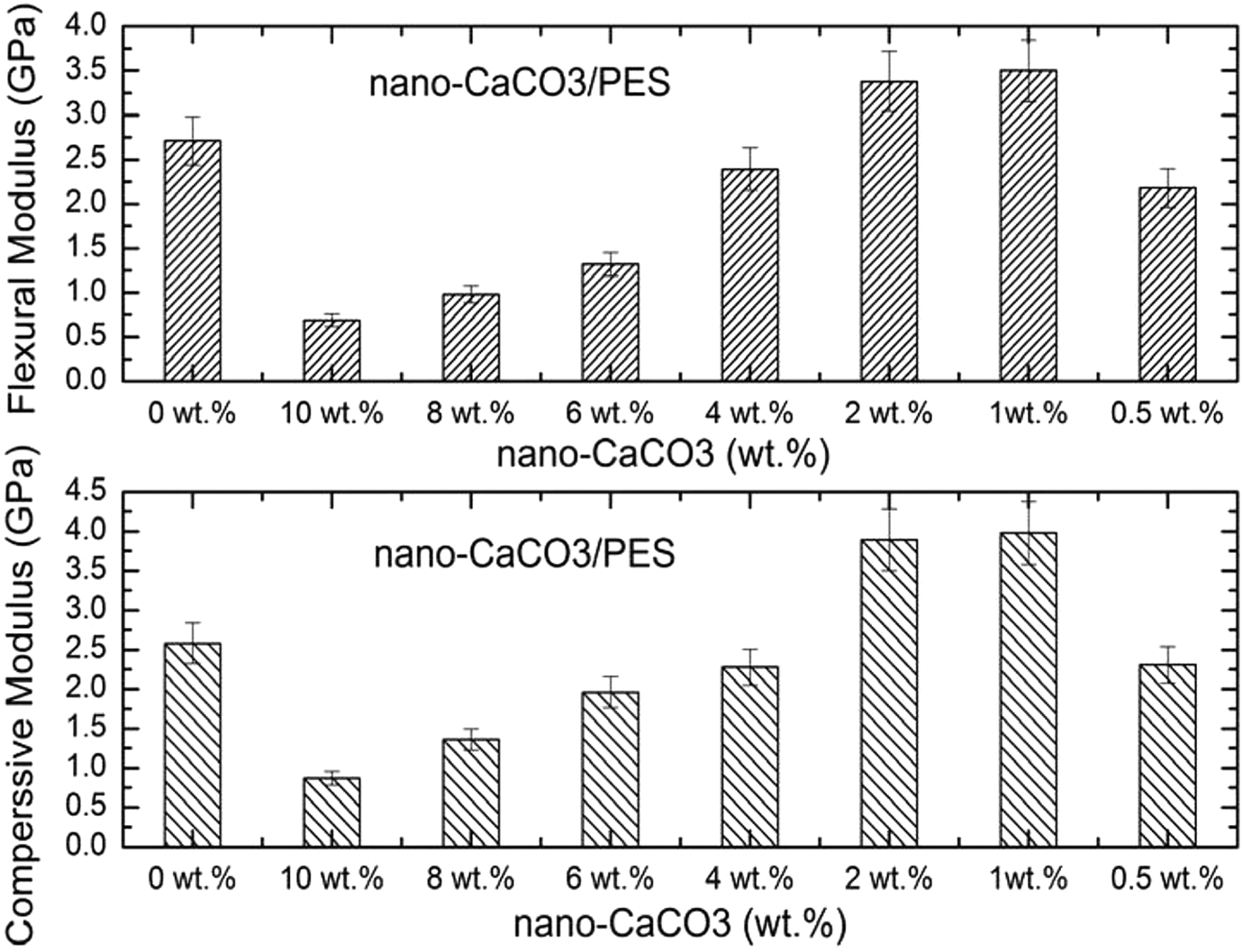
Modulus of the neat and treated nano-CaCO3/PES cast. CaCO3: calcium carbonate; PES: polyethersulphone.
The results of the maximum compressive modulus and flexural modulus are about 3.98 GPa and 3.50 GPa for the nano-CaCO3 particles of 1 wt%, which can increase to 51% and 32%, respectively, in contrast to neat thermoplastic resin. This result indicates that nanocomposites with lower filler content have higher modulus than strength. Such enhancement is contributed to the fact that the coupling agent forms a transition layer between nano-CaCO3 particles and PES, which can efficiently transfer stress, can timely eliminate the stress concentration as well as increases the strength. 1,13,14 The phenomena can be caused by the reaction that occurs among PES resin, KH550 coupling agent and nano-CaCO3. The maximum value of the strength is reached for 2 wt% nano-CaCO3; however, the maximum value of the modulus is reached for 1 wt% nano-CaCO3. The illustration of Figures 1 and 2 also shows that the flexural strength and modulus are inferior to the pure PES when the concentration of the calcareous filler is low (i.e. 0.5 wt%), and the reason for the decreased performance is the less amount of nanofillers may have negative effect on the integrity of composite. Therefore, the stress concentration is easily found in the composite, and the mechanical properties are decreased.
The specimens containing less than 2 wt% nano-CaCO3 fall rapidly after reaching the maximum force without any yielding feature, and a raspy noise was heard while the specimens broke, indicating a typical brittle failure model. Figures 1 and 2 indicate that nanofillers are not well uniformly dispersed in PES matrix once the composites are loaded with less than 1 wt% and more than 2 wt%. Results show that when the nanocomposites are subjected to load, the stress concentration around the nanofillers is severe enough to cause decrease in toughness and increase in brittleness in composites.
The SEM image of nano-CaCO3/PES is shown in Figure 3. When the hot-press process parameters are appropriate, the void in neat PES is hardly found in neat PES cast. On the other hand, medium proportion of void can be observed in Figure 3. The void can absorb much more energy before fracture than neat thermoplastics resins cast. 13,14 Moreover, the improvement in fracture toughness was a result of nano-CaCO3/PES system that performed more plastic deformation under external stress around resins that was surrounded by rigid inorganic fillers than neat PES, as shown in Figure 3.
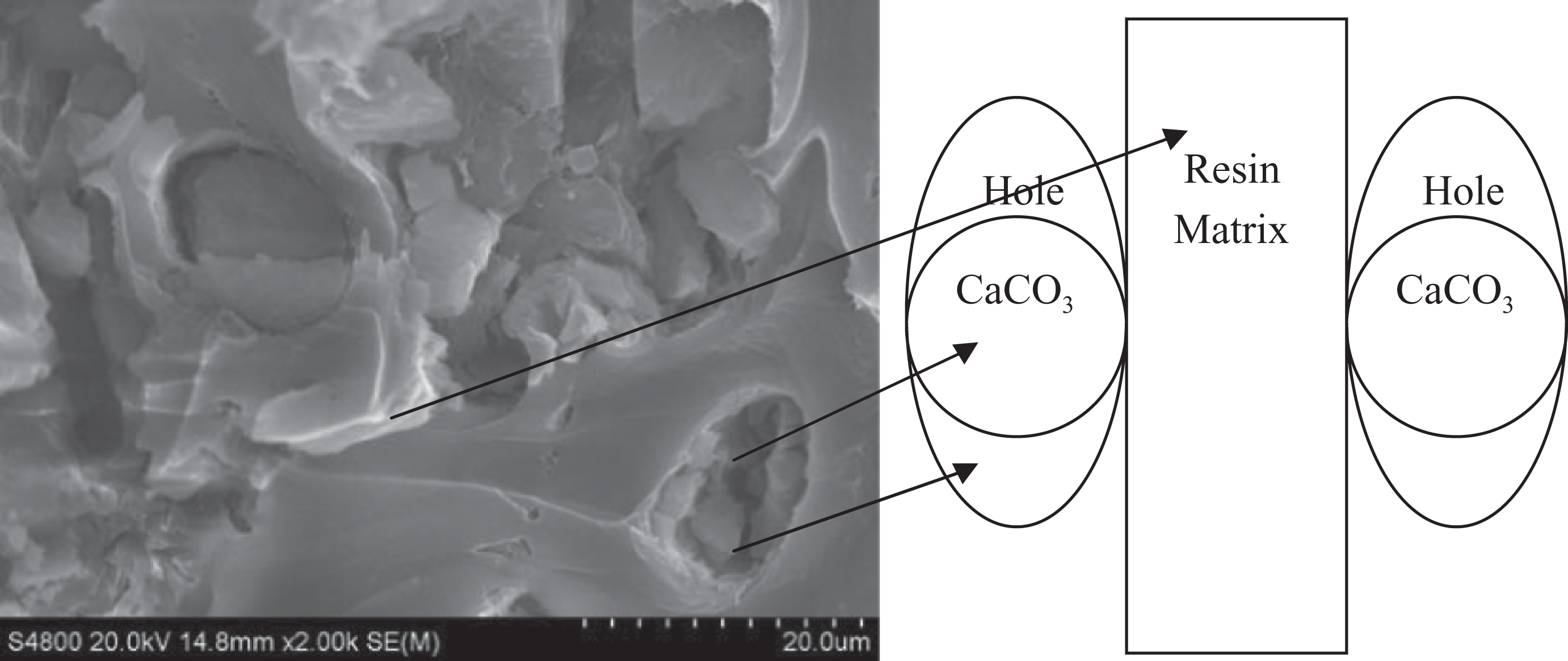
Model of toughening mechanism by nano-CaCO3 (1 wt%)/PES. CaCO3: calcium carbonate; PES: polyethersulphone.
Figure 4 shows the damage morphology and energy dispersive spectroscopy along the cross-section in nanofiller/PES composites and the EDS analysis of nano-CaCO3 in composites. As shown in Figure 4, nano-CaCO3 particles were covered by PES resin in composites. It is reasonable to conclude that the nanocomposites perform better mechanical properties than neat resin cast. There are two factors to be taken into account that affect their strength behaviour: the modulus and Poisson’s ratio. The increase in the modulus value and the decrease in Poisson’s ratio guarantee the composite form stronger interface band and better fracture strength than neat PES resin.
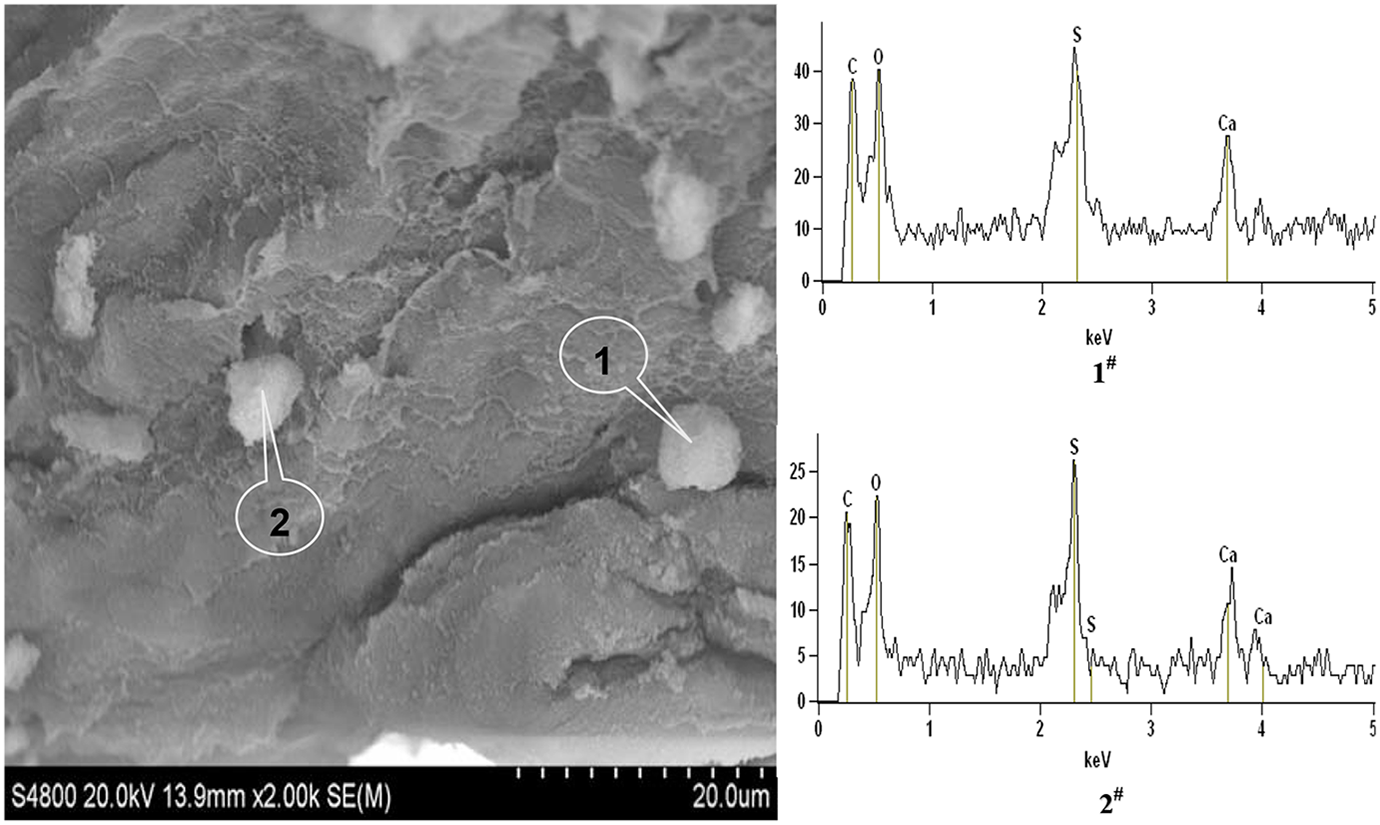
SEM fracture feature and energy spectrum analysis of modified nano-CaCO3 (1 wt%)/PPS/PES. SEM: scanning electron microscopy; PPS: polyphenylence sulphide; PES: polyethersulphone; CaCO3: calcium carbonate.
Conclusions
The study covers the effect of nano-CaCO3 particles on the mechanical properties of the PES resin cast and its composites. The studies proved that even small contents (1–2 wt%) of nano-CaCO3 in the PES cast can increase the compressive strength and mechanical modulus of the nanocomposites. The reason is that the voids absorb much more energy before fracture than neat thermoplastics resins cast. The nano-CaCO3 particles with higher modulus and lower Poisson’s ratio than neat PES are located in cracks, thereby increasing mechanical properties.
Footnotes
Funding
This work was supported by a grant from China Academy of Sciences and Taiyuan University of Science and Technology (No. 20122038).