




Abstract
Poly-p-phenylenebenzobisoxazole (PBO)-filled polytetrafluoroethylene (PTFE) has been successfully prepared at different compositions in a corotating twin-screw extruder, where PTFE acts as the polymer matrix and PBO as the dispersed phase. The morphology and impact properties of these blends were investigated using scanning electron microscopy. The presence of PBO particles dispersed in the PTFE continuous phase exhibited a coarse morphology. Increasing PBO contents in the blend improved the impact properties at weak deformation. It was found that the interfacial adhesion played an important role in the creation of an interphase that was formed by the interaction between the PTFE and the PBO. This induced an improvement in impact properties. In addition, the optimum impact properties were obtained when the content of PBO is 30 vol%.
Introduction
In many advanced engineering applications, such as automotive and aviation industries, hybrid composites have been extensively used due to their high strength, low weight, good fatigue life and corrosion resistance. In addition, their behavior under impact loading has been of significant concern in engineering. There are many studies in the literature 1 about the impact response of composite materials and structures.
The applications of fiber composite materials are widespread due to several advantages possessed by them, for example high specific strength and stiffness. However, their performance under impact loading is generally poor and it restricts their applications. 2
The polymer-based materials are preferred in recent years over metal-based counterparts in view of their excellent mechanical properties. 3 Poly-p-phenylenebenzobisoxazole (PBO) fibers are well known for their excellent mechanical property, high flame resistance, high thermal stability, and good resistance to creep, chemicals, and abrasion among all commercial synthetic polymer fibers, which have a wide application in military and business fields. Especially, PBO fiber has great potential applications as reinforcement fibers for advanced composites. 4 Therefore, the combination of PBO with other polymers in containers for volatile products opens a new and important field for the application of rotational molding that is already being explored with PBO. 5 A majority of polymer blends are thermodynamically immiscible in nature due to the low entropy of mixing. Binary blends of two immiscible components form coarse and unstable phase morphology with high interfacial tension and low interfacial adhesion. As a result, the mechanical properties of immiscible polymer blends are inherently inferior in nature.
As an important parameter of engineering materials, fracture property of PBO-reinforced composites has been widely studied. 6 In addition, they offer a high tolerance against impact damage. Improvements in the toughness of the matrix, using thermoplastics, so as to reduce the damage area and to resist delamination growth on subsequent compression loading have also been reported. Literature has showed that the impact performance of the composite is (generally) directly linked to the content of reinforcement. 7,8
Polytetrafluoroethylene (PTFE) possesses some extraordinary characteristics such as very low friction coefficient, good high-temperature stability and chemical stability. 9 However, its application has been greatly limited because of its poor mechanical properties and low resistance to creep. In order to obtain better mechanical properties, PTFE is usually reinforced and modified by other reinforcements. 10 –13 The compatibilization of blends is affected by the composition of the system.
In this study, we aimed to prepare PBO/PTFE blends with different content of PBO by twin-screw extrusion to characterize the impact properties of synthesized polymer composites. And the effects of composition on the improvement of interfacial adhesion between the fibers and the polymer matrix were also observed.
Experimental
Materials and specimens
The reinforcement was PBO fibers produced by Toyobo Co. Ltd., Tokyo with the following specified properties: tensile strength, 5800 MPa; tensile modulus, 180 GPa; density, 1.54 g/cm3; diameter, 12.8 μm; length 3 mm. PTFE powder with a grit size of about 30.0 μm was used as matrix resin of the composites.
Preparation process
PBO/PTFE blends were prepared by the twin-screw extruder with the following volume composition: 0/100, 10/90, 20/80, 30/70 and 40/60. The extrudate was chopped into small pellets. The produced PBO/PTFE pellets were vacuum dried again at 80°C for 12 h. The twin-screw extruder was operated at the same processing conditions used during the blend preparation. For the mechanical characterization experiments, the specimens were molded using a injection-molding machine at a barrel temperature of 230°C and mold temperature of 80°C.
Impact tests
Specimens of size measuring upto the GB/T16420-1996 standard were prepared from the molded board for impact tests. Impact tests were conducted in an impact machine Type ZBC-4B (made in Shen zhen, China) at room temperature. The bottom surface of impact specimens was ground and polished. The fracture was in a brittle mode at the midpoint of the specimen. The maximum in the test was used to calculate the impact strength. For a more accurate determination of the material parameters and consideration of the possible scatter in the experimental data, the measurements were made at five magnitudes of a constant load for five specimens in impact. The obtained quantities were then averaged. Fractured surfaces were coated with gold to provide conductive surfaces.
Results and discussion
Impact properties
The impact properties of PBO/PTFE blend with different contents are detailed in Figure 1. It is obvious that the impact properties of pure PTFE were inferior to PBO/PTFE. After adding PBO, the mechanical properties of these blend systems improved greatly. With the increase in the content of PBO, the impact properties of PBO/PTFE blends increase. When the content of PBO fiber is over 30 vol%, the impact strength decreases greatly. So there is an optimum PBO content for the well-compatibilization effect in this experiment, when the composition ratio of PBO/PTFE blend is 60/40, the blend gets the optimal impact properties.
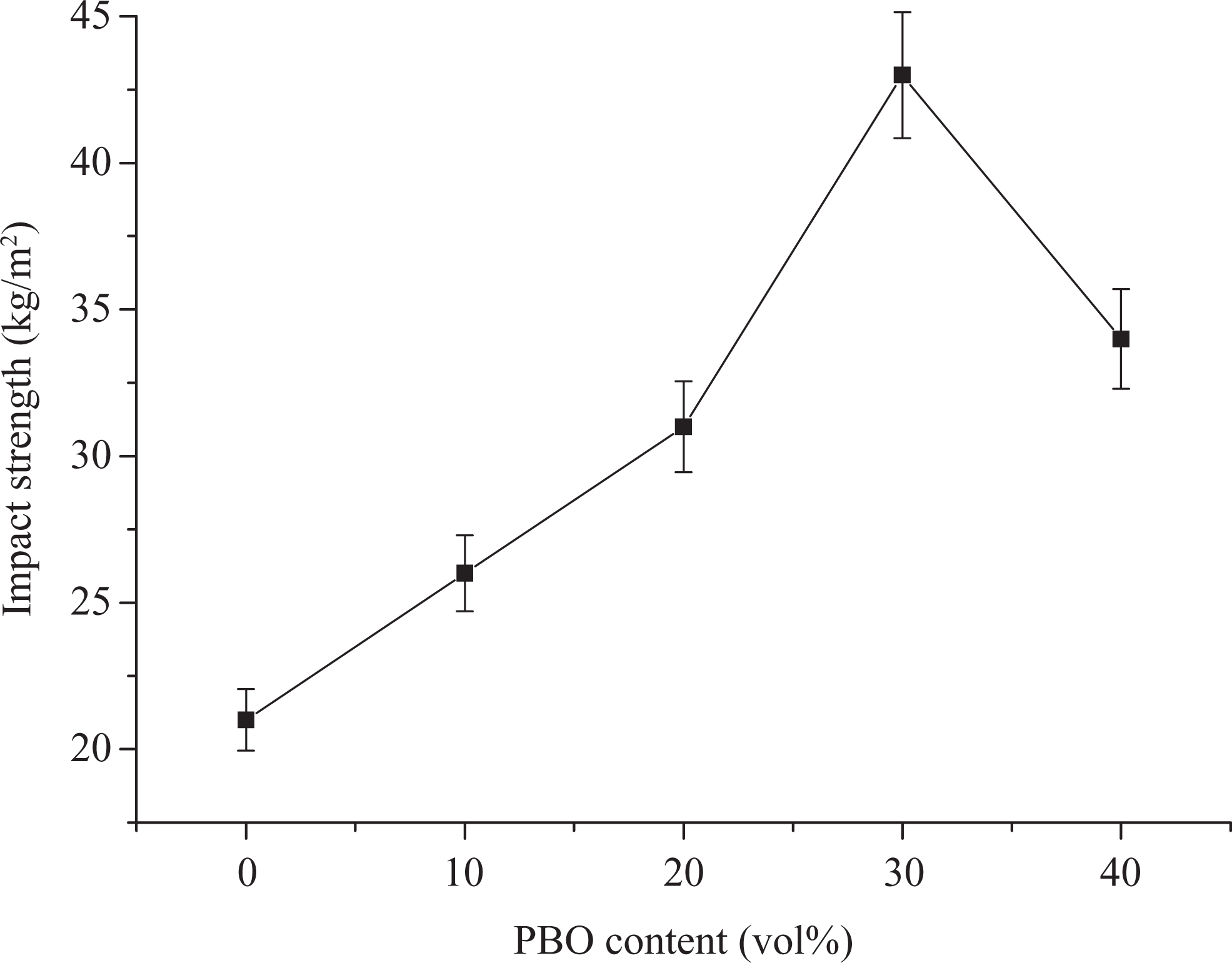
The impact properties of PBO/PTFE composites. PBO: poly-p-phenylenebenzobisoxazole; PTFE: polytetrafluoroethylene.
This result can be attributed to decreased number of particles per unit area of PTFE. When the PBO content increases, the number of particles per unit area increases and becomes more difficult to obtain a homogeneous particle distribution which may result in the formation of clustering making preferential sites for crack formation and propagation. When this failure combines with the failures of debonding in the particle–matrix interface, particle cracking and interface cracking, the impact strength of composites decrease significantly.
Fracture mechanism
Figure 2(a) to (e) shows scanning electron micrographs of PBO/PTFE blend with 0, 10, 20, 30 and 40 vol% PBO, respectively. The micrographs of the fracture surface of PBO/PTFE show that crazing and shear banding of the matrix are the major toughening mechanism in these PBO/PTFE blends. The crazing and shear banding are initiated by the stress concentrations of PBO particles. Meanwhile, the surfaces of the two phases are partially deformed; and when they suffer from exterior forces, first the PTFE is deformed because of its small modulus and induce surrounding matrix producing much crazes and shear banding, which absorb substantive energy. The PBO/PTFE interface plays important roles not only in transmitting stresses between two phases but also in preventing the cracks’ further enlargement, and the shear banding can also hinder and terminate the progress of the existing small crazes. PBO blends absorbed considerable energies through induce deformation, production of multicrazes, progress and formation of shear banding and result in improvement in the impact strength. The morphology of the blends was the smoothest at optimum PBO content. The PBO/PTFE blends tested showed visual evidence of the incompatibility between PTFE and PBO, it can be seen that PBO is dispersed in a continuous PTFE matrix and will obviously reduce the efficiency of stress transfer from the matrix to the fillers. This will then result in a detrimental effect on the ultimate performance, namely, the impact strength of the PBO/PTFE composites. There is also an indication of a small-scale plastic deformation process in the form of matrix tearing and shear yielding of the PTFE matrix. The dispersed phase forms a coarse morphology. There is also evidence of poor interfacial bonding in this system, with particles of PBO pulled from the PTFE matrix lying loose on the fracture surface and with some microvoids observed around PBO. The distribution is broad with the increase in PBO content.
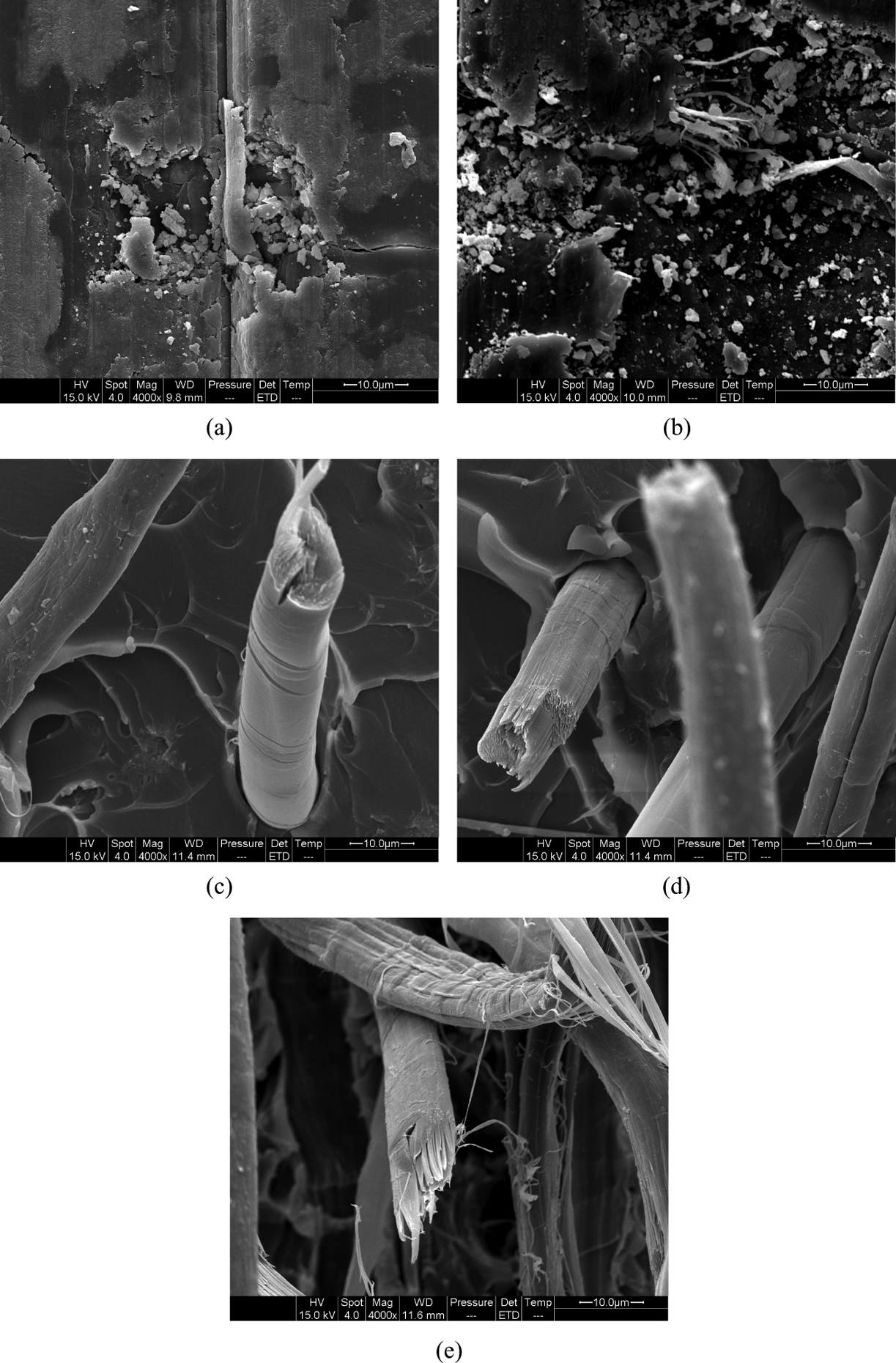
The scanning electron microscopy of the fracture surfaces of PBO/PTFE composites. (a) Pure PTFE, (b) 10 wt% PBO/PTFE, (c) 20 vol% PBO/PTFE, (d) 30 vol% PBO/PTFE and (e) 40 vol% PBO/PTFE. PBO: poly-p-phenylenebenzobisoxazole; PTFE: polytetrafluoroethylene.
Changes in the topographical features accounted for the impact fracture mechanism. In the case of unfilled PTFE (Figure 2(a)), the matrix material exhibited very poor impact properties. Figure 2(b) shows the scanning electron micrograph of the fracture cross section of an impact bar for the PBO/PTFE system with 10 vol% PBO. It can be observed that the matrix layer around the PBO becomes stress whitened and some ribbons appear. This suggests that at lower inclusion concentrations, the PTFE matrix in this region will first yield to form plastic deformation and crazes because of the stress concentration of the interfacial layer around the particle under the action of an outside force. This plastic deformation will absorb deformation energy to improve the impact toughness of the filled PTFE composites.
It can also be seen from Figure 2(c) and (d) that the plastic deformation region of the PTFE matrix for the latter is larger than that of the former. Thus, the impact toughness of the 30 wt% PBO/PTFE system is better than that of the 20 wt% PBO/PTFE system. With the addition of the PBO, the particles of the dispersed phase seem to be firmly embedded in the matrix and the dispersed phase boundaries become unclear, as shown in Figure 2(d). This result indicates the better interfacial adhesion between the PBO particles and the matrix PTFE, as a consequence of the ability of the reinforcement to reduce the interfacial stress between the dispersed phase PBO and matrix PTFE.
Additionally, the high percentage (40 vol%) of fillers in the composite degraded the impact properties of the PBO/PTFE blends because the fillers themselves caused stress concentrations in the matrix. The microcracks would be originated and extended in the process of impact since there existed stress on the interface, which resulted in a strain fatigue. Thus, the reinforcing effect is poor. The PBO tips were clearly observed, protruding out of the polymer surface. Evidently, this is so because PBO has much better mechanical properties compared with matrix material. Probably, a crack follows the two phases’ boundary and passes between the PBO at their closest distance. The crack propagates under the original surface matrix layer and causes fragments of the matrix to be broken off, leaving the PBO bare. Where the PBO are close to each other, the matrix between the PBO are often fragmented and broken off when the crack propagates along the PBO surface. Figure 2(d) also shows that filler PBO were fractured into fragments and many small filler particles were detached from the matrix material leaving cavities in the matrix. The generation of voids and defects at interfaces affects the load transfer between the reinforcement and matrix and finally affects the impact properties of the composites. It can be seen that filler–bundle debonding is evident on the crack plane. The significant reduction in the impact strength of the composites is believed to be related to weak regions formed at the filler–matrix interface. While for the 30 vol% PBO/PTFE composite (Figure 2(d)), the fracture surface is relatively smooth and the peeling of matrix and PBO is constrained. The PBO on the fracture surface is adhered strongly with the matrix, leaving less holes.
In addition to this, the amount of more ductile and tougher metallic matrix in the interparticle regions slightly increases, and it may also enhance the impact toughness. But, one problem about increasing filler content is the higher probability of filler cracking. For instance, voids formed by broken fibers and remainders of particles at the bottom of voids can be seen from fracture surface.
Conclusions
The incorporation of PBO into PTFE can obviously increase the impact properties of PBO/PTFE blends. The optimum impact property was obtained at the PBO content of 30 vol%.
The adherence and plastic deformation are primary fracture mechanisms for the PBO/PTFE composites during the course of impact.
Footnotes
Funding
The work is supported by National Natural Science Foundation of China #11261066, Applied Basic Research Programs of Science and Technology Department Foundation of Yunnan Province of China #2010CD21 and Educational Commission Important Project of Yunnan Province of China #2011Z008.