




Abstract
In order to improve the tribological properties of poly(methyl methacrylate) (PMMA) frictional parts, nano-silica (SiO2) and -titanium dioxide (TiO2) particle-reinforced PMMA composites were prepared by hot press. The tribological behavior and wear mechanisms of the composite were investigated in dry friction condition. The results show that great strengthening effects are obtained using nano-SiO2 and -TiO2 particles to reinforce PMMA composite. The composite exhibits excellent tribological properties. The wear mechanisms change from microcutting wear, multiplastic deformation wear and adhesive wear into abrasive wear and brittle fracture wear.
Keywords
Introduction
Nowadays, many attempts have been made to develop nanoparticle-filled polymer composites to improve their tribological property. 1 Recently, nanometer inorganic compounds, such as titanium dioxide (TiO2), zinc oxide (ZnO), silica (SiO2), aluminum dioxide (Al2O3), silicon nitride (Si3N4), and so on, were tried as the fillers of fabric composites and polymers to improve the tribological properties. 2 This is related to the specific properties such as high surface activity and energy and small size effect of the nanoparticulates.
On the other hand, a better adhesion between polymer and nanoparticles is expected due to the high surface area of the nanoparticles, which is believed to avoid the particles pulling-out and thus to reduce the wear. 3 –6
It was found that some microscale inorganic fillers showed distinct effect on the friction and wear behavior of polymer composites, and many researchers had also studied the mechanism of filler action in reducing the wear of polymer. 7
Recently, nanometer particles were used as fillers of polymer in order to obtain good tribological properties. Recent investigations on inorganic nanoparticle- and solid lubricant-filled polymer composites revealed their significant potential in producing materials with low friction and high wear resistance. 8 –10
With a view to the feasibility to improve the tribological properties of fabric composites by the introduction of nanoparticulates, TiO2 and SiO2 nanoparticulates were selected to prepare filled poly(methyl methacrylate) (PMMA) composites in the present work. This article deals with the preparation and investigation of the tribological properties of the PMMA composites filled with nanometer TiO2 and SiO2. The mechanism of the fillers in reducing wear and friction is also discussed.
Experimental
Materials and specimens
Nano-SiO2 with an average diameter of 40 nm was applied as additional reinforcement. Commercially available PMMA plates (thickness, ds = 2.0 mm; Shinkolite A, Mitsubishi Rayon, Tokyo, Japan) were used as matrix.
PMMA plates and nanofillers with different content were hot-pressed at 452 K for 2 h under applied pressure of 1.5 MPa. Hot pressing was done in ambient air. After hot-press, the composite was allowed to furnace cool. Parallel surfaces of the hot-pressed specimen were mechanically ground and polished to 0.05 μm finish to obtain optically flat surfaces. For the purpose of comparison, a pure PMMA specimen was fabricated by the same hot-press process and the surfaces were polished.
Evaluation of mechanical and tribological properties
The tribological tests were carried out in a ball-on-disc tribometer of HT-500 at room temperature (25°C). The upper specimen was a GCr15 ball with a diameter of 4 mm, whose microhardness was 800 HV. The down specimen was a disc of the composite specimen. The GCr15 ball slid against the down specimen under dry friction condition at the loads of 100 N, 150 N, 200 N and 250 N (speed was 0.28 m/s) for a distance of 500 m. The friction coefficients of the specimens were obtained by the software attached to HT-500 and the wear losses of which were measured by the analytical balance of TG328B with precision of 0.1 mg.
Results and discussion
Effects of loads on friction and wear properties of the TiO2/PMMA composite
The variation curves on friction coefficients and wear losses of the composite at different loads are shown in Figure 1. It can be seen that the friction coefficients of all PMMA composites take on downward trend with the increase in loads (Figure 1(a)). At the small load of 50 N, the friction coefficient of PMMA is 0.59, and gradually decreases to 0.48 as the load increasing. The friction coefficient of the TiO2/PMMA composite is reduced and presents a decreasing trend with the increasing TiO2 content. At the same sliding condition, the 7-vol% TiO2-filled composite shows lower friction coefficient. This can be attributed to fact that at low and medium loads, the tribochemical reaction layers formed at the interface controls the tribological behavior of the composite.
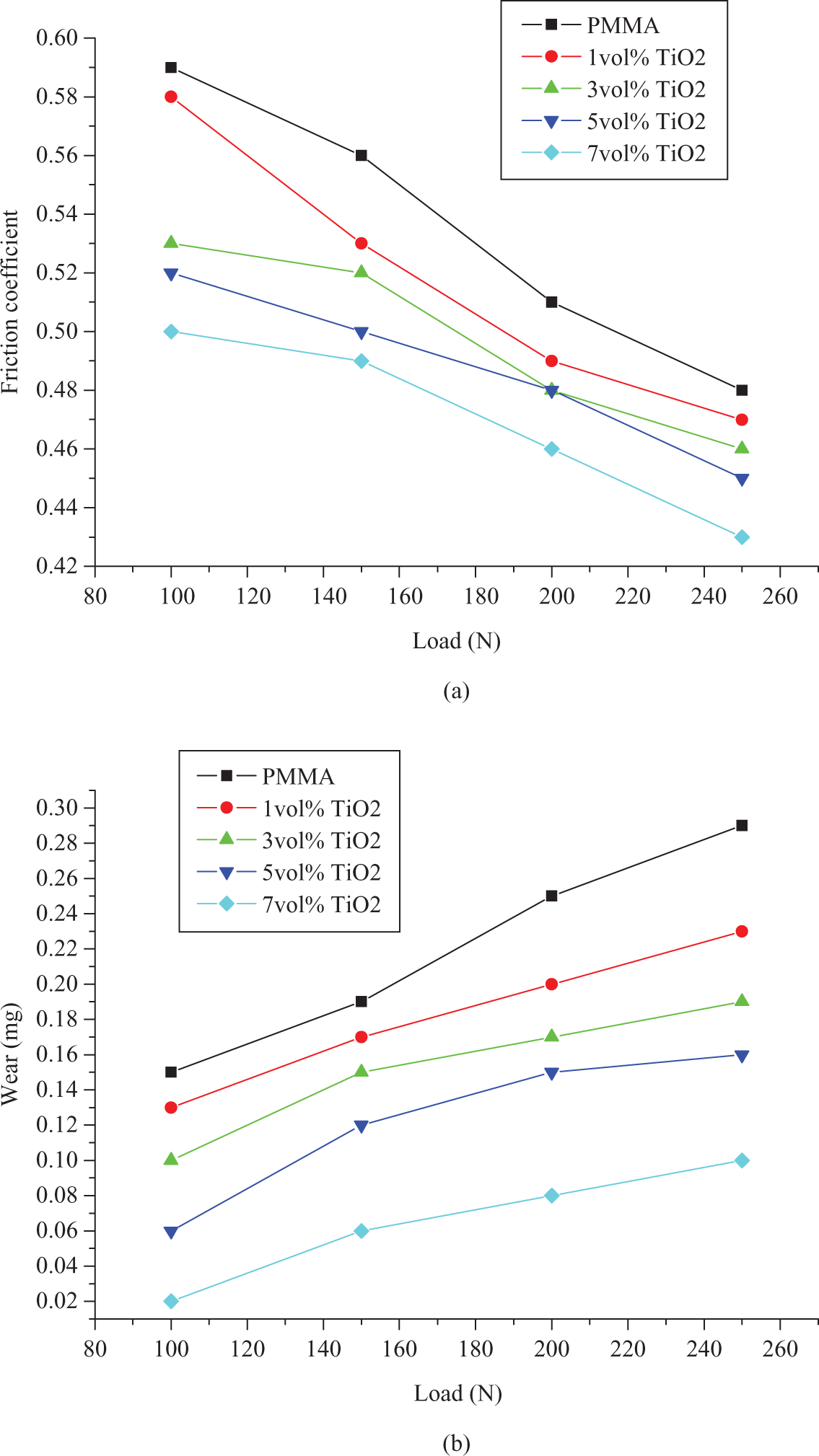
The variation curves on friction coefficients and wear losses of the TiO2/PMMA composite at different loads.
Figure 1(b) exhibits the wear losses of both the TiO2/PMMA composite and PMMA increase with the increase in loads. The wear decreased significantly with increasing TiO2 content, which indicated that TiO2 had good friction-reducing and antiwear abilities.
When the TiO2 content is about 7 vol%, the wear of the TiO2/PMMA composite is the lowest, which is only 56% of that of the pure PMMA. A minimum point of friction coefficient is formed at the TiO2 content of about 7 vol% in Figure 1 and the minimum friction coefficient is 87% that of pure PMMA for the TiO2/PMMA composite. However, at higher loads, mechanical stability and hardness of such oxide layers decreases and may partially be removed resulting in actual surface contacts, leading to higher wear.
Effects of loads on friction and wear properties of the SiO2/TiO2/PMMA composite
The coefficient of friction decreased with increasing SiO2 content up to 5 vol% and then assumed little change with further increase in SiO2 content from 1 vol% to 5 vol%. Moreover, the coefficient of friction decreased with increasing SiO2 content up to 7 vol% and then showed a very large increase at SiO2 content above 15% (Figure 2(a)). In addition, the friction modifier SiO2 was beneficial to increasing wear resistance of the PMMA-based composites within a volume fraction of 1%–5% but harmful to the wear resistance of the composites above a volume fraction of 7 vol%.
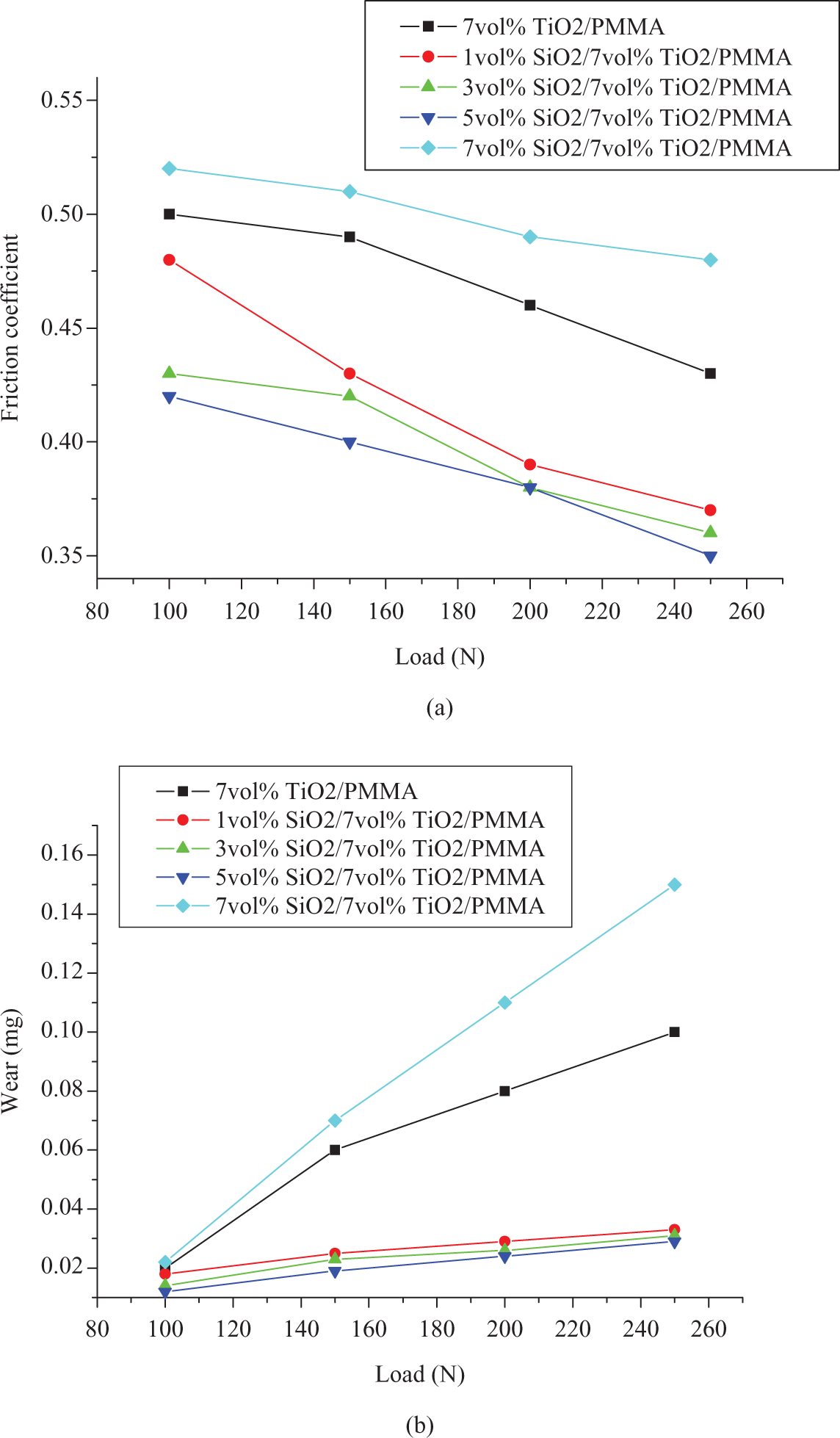
The variation curves on friction coefficients and wear losses of the SiO2/TiO2/PMMA composite at different loads.
It can be seen that the wear losses are also found to increase in ascending order with loads. The wear of all PMMA composites decreased with increasing SiO2 content. This improvement in the wear resistance correlates with an increase in the hardness with increasing SiO2 content. The addition of 5 vol% SiO2 to the PMMA matrix caused about 50% reduction in the wear.
It is not as obvious for mixing SiO2/TiO2/PMMA as for TiO2/PMMA, as the friction coefficient changes with the variation in filler content. It can be seen from Figure 2(b) that the wear is much lower for the SiO2/TiO2/PMMA than for the mixing TiO2/PMMA with the same components. Choosing the appropriate content of SiO2 can obviously reduce the wear of PMMA.
The typical worn surface morphologies of SiO2/TiO2/PMMA composite with different content of SiO2 are shown in Figure 3. When the content of SiO2 is null (Figure 3(a)), the worn surface is flat with some shallow and narrow scratches along the sliding direction, which were created by microcutting of asperities on the surface of GCr15 counterpart. So the composite experienced slight microcutting wear. The friction coefficient and wear loss of the composite are minimum. With the increase in the content of SiO2 (Figure 3(b) and (c)), the worn surface becomes rough accompanied with some furrows and cracks as well as some wear debris; moreover, obvious ridges and delamination caused by plastic deformation are observed, which indicates that multiplastic deformation wear, adhesive wear and abrasive wear occur in the friction process. This is because the frictional surface suffered higher contact stress and was severely ploughed and extruded by counterpart with the increase in loads, and adhesion between the contact surfaces were exacerbated. Meanwhile, the repeating plastic deformation leading to occlusion between the worn surfaces and the material of composite coating was desquamated and changed into debris under relatively big contact stress, which also acted as abrasives and resulted in the increase in friction coefficient and wear loss. While due to the grain boundary strengthening of SiO2 particles in the composite coating, the surface hardness and deformation resistance were improved.
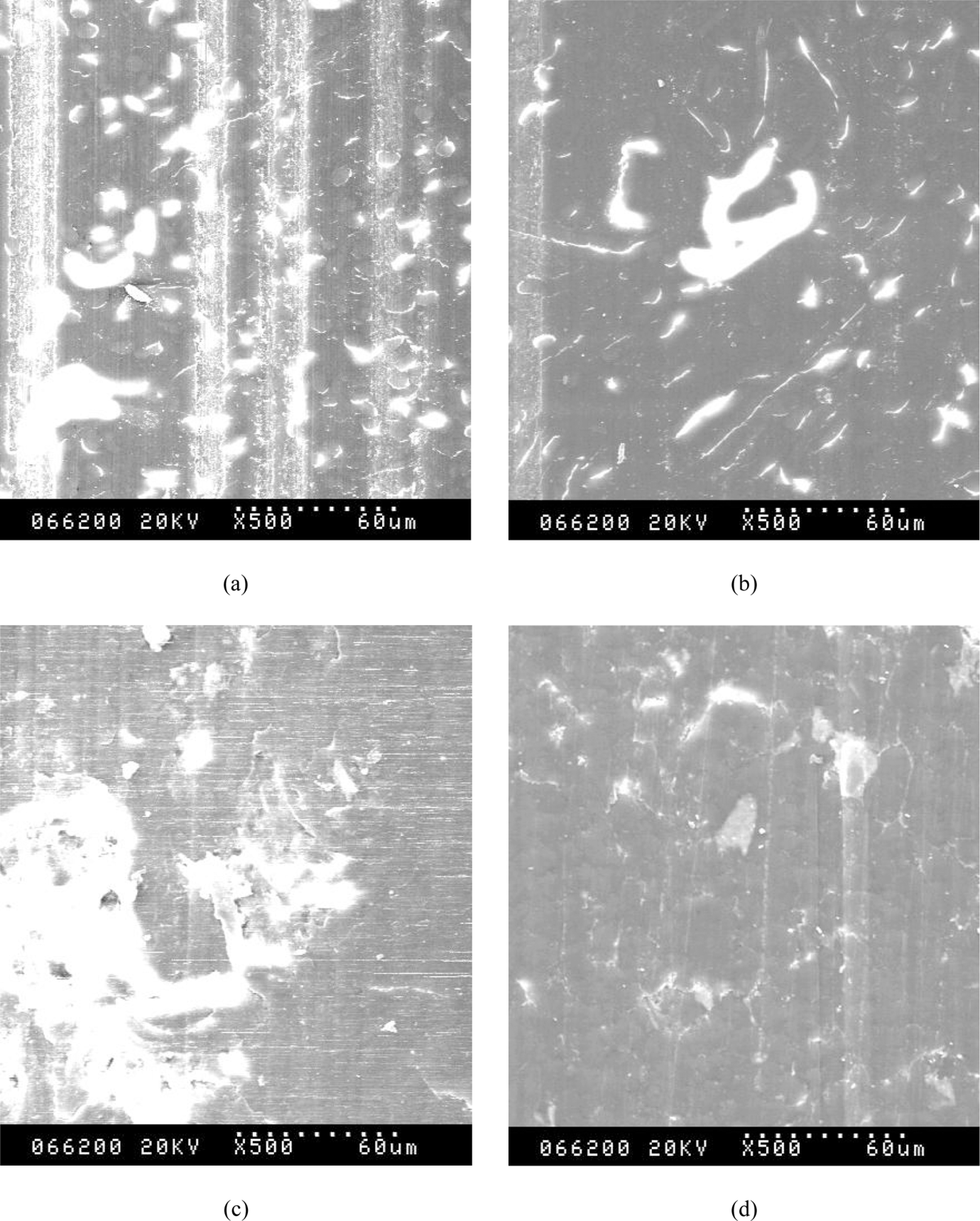
The worn surface morphologies of SiO2/TiO2/PMMA composite.
For the SiO2/TiO2/PMMA composite filled with low content of SiO2, the worn surface is relatively flat with slight scrapes caused by abrasion of rough surfaces (Figure 3(b)). Because of the low content of SiO2, the asperities on contact surfaces were able to separate friction pairs and reduce adhesion, so the composite shows lower friction coefficient and wear loss. The shear force on the surface increased and more asperities were ruptured and worn off to act as abrasives. So deep furrows on the worn surface are obvious, which indicate the existence of abrasive wear. More obvious cracks are found on the worn surface. So the microcracks in subsurface gradually propagated to surface forming macrocracks, which illuminated that the wear mechanism was fatigue wear. Therefore, the friction coefficient and wear loss also increased.
The wear grooves and the material fragments indicate that the solely incorporated SiO2 particles, in particular at high content, result in a severe wear, although the hard particles also help to develop the toughness and stiffness of the matrix to some extent. This effect is ascribed to that the particles act as an abrasive third body and meanwhile increase the discontinuities in matrix. The combination of the two kinds of fillers, however, promotes a pronounced change in wear process. It can be seen in Figure 3(c) that a considerable amount of compacted wear debris are collected around the fibers, acting temporarily as a distance holder between the composite pin and the steel counterpart, and thus protect the fibers.
The TiO2 particles, when being used in combination with the SiO2, are not easily ploughed out of the matrix by counterpart asperities. Instead, they are gradually released and likely start to act as a rolling body between the two mating surfaces.
Conclusions
The friction coefficient of the TiO2/PMMA composite is reduced and presents a decreasing trend with the increase in TiO2 content. At the same sliding condition, the 7-vol% TiO2-filled composite shows lower friction coefficient. The wear loss of both theTiO2/PMMA composite and PMMA composite increases with the increase in the loads. The wear is much lower for the SiO2/TiO2/PMMA than for the mixing TiO2/PMMA with the same components. Choosing the appropriate content of SiO2 can obviously reduce the wear of PMMA.
Footnotes
Funding
This research received no specific grant from any funding agency in the public, commercial, or not-for-profit sectors.