




Abstract
Mechanical and tribological properties of polymethyl methacrylate (PMMA) composites filled with titanium oxide (TiO2) were studied with particular interest on the HCl surface treatment. Increasing the TiO2 content in the PMMA matrix from 1 wt% to 7 wt% resulted in improved tensile strength and then decreased. The tensile and tribological properties show the optimum TiO2 content is obtained at 3 wt%. HCl treatment largely improved the friction and wear of TiO2/PMMA composites. Scanning electron microscope (SEM) investigation of worn surfaces of PMMA composites showed that HCl-treated TiO2/PMMA composite had strong interfacial adhesion and smooth worn surface under given load.
Introduction
Nanoparticles (NPs) have an enabling role in various branches of nanotechnology due to their capability of being a bridge between bulk materials and atomic or molecular structures. 1,2 It has become increasingly important to understand and manipulate nanomaterials to develop new functional materials for engineering and biomedical applications. Nanostructured and nanocomposite materials can show dramatic improvement in mechanical, tribological, electrical and chemical properties. 3
Recently, composite materials made of polymers and NPs, such as inorganic, metal, semiconductor, carbon black, and magnetic nanomaterials have attracted great attention because of the stabilizing effects of the polymer matrix on the NPs and relative easiness and flexibility of engineering this class of materials with advanced functionalities. 4 –7 Such composites exhibit macroscopically novel properties for a wide variety of applications. Polymethyl methacrylate (PMMA) is one of the most commonly used thermoplastic polymers. PMMA has several desirable properties, including exceptional optical clarity, biocompatibility, good weatherability, high strength, and excellent dimensional stability. 8,9
It can also be processed at the micro- and nanoscale by lithography (deep UV and electron beam) and replication technologies (injection moulding and hot embossing) and has applications in microoptical and microfluidic devices. 10 –12 The materials formed by embedding of inorganic particles into polymeric matrices represent a new class of polymeric materials that combine the properties of the inorganic particles (in terms of mechanical strength, modulus, and thermal stability), with the processability and the flexibility of organic polymer matrix. Of course, such materials can be obtained by simply mixing the organic and inorganic components. However, in order to achieve the best dispersion of the inorganic particle in polymer matrix and interfacial adhesion between the polymer and inorganic particle, the techniques for synthesizing composite particles made of inorganic particles coated by polymers have been developed.
The inorganic particles were mainly nano silicon dioxide, nano titanium dioxide, nano aluminum oxide, and so on, all of which have high surface activities and more active radicals. The composite material composed of titanium oxide (TiO2; or silicon oxide (SiO2)) is a new class of prospective composite material because of its selective gas permeability, catalyst and potential advantage in the photoelectric domain. Many research articles have been published in recent years. 13,14
The objective of the present study is to investigate on the tribological behavior of PMMA composites filled with TiO2 particles. Moreover, the wear mechanism for the synergistic effect of the fillers of TiO2 particles and surface treatment of TiO2 was also studied based on the scanning electron microscopy (SEM) analysis of the surfaces of sliding bodies.
Experimental
Materials
These TiO2 obtained in powder form were dispersed and mixed with poly methyl methacrylate (PMMA) crystals (0.001 g) to make a PMMA solution in liquid chloroform (5 ml). Solutions of 0.25–3 wt% colloidal TiO2 in PMMA were formed.
The TiO2 was prepared by adding dropwise HCl solution and stirred for 3 h at room temperature until a with reaching up to the molar ratio of Ti/H+ = 4 and stirring for 3 h at room temperature.
Specimen preparation
Unidirectional composite laminates were produced by filament winding equipment and a Teflon sheet was used to obtain the plate form. After resin wetting, the treated TiO2 were incorporated into these sheets and, subsequently, were cured in the furnace at 100°C.
Mechanical tests
For the tensile strength tests of the TiO2/PMMA matrix composite, a MTS 310 tension testing machine at a constant speed of 7 mm/min was used with a 5-kN load cell. The specimens were manufactured according to ASTM D3039.
Tribological test
An M-2000 friction and wear tester (Xuanhua Tester Factory, China) was used to examine the friction and wear behavior of the composites sliding against SAE52100 steel in a block-on-ring configuration. The block specimens of size 6 × 7 × 30 mm3 were made of the composites and the counterpart rings of diameter 40 mm and thickness 10 mm were made of SAE52100 steel. The friction and wear tests were performed at a normal load of 50, 100, 150, 200 and 250 N, sliding velocities of 0.424 m/s.
Results and discussion
Tensile properties
The effects of TiO2 content on the tensile strength of PMMA composite are shown in Figure 1. The pure PMMA shows the averaged tensile strength of 98 MPa. The 1 wt%, 3 wt%, 5 wt% and 7 wt% TiO2-filled PMMA composites show the average value of 110 MPa, 140 MPa, 130 MPa and 120 MPa, respectively. The increase in tensile strength is also enhanced with the addition of TiO2. The tensile strength of pure PMMA is lower than the TiO2-filled PMMA composite. The optimum tensile strength value occurs when the TiO2 content is 3 wt%, which means the best combination between the TiO2 particle and the surrounding PMMA matrix.
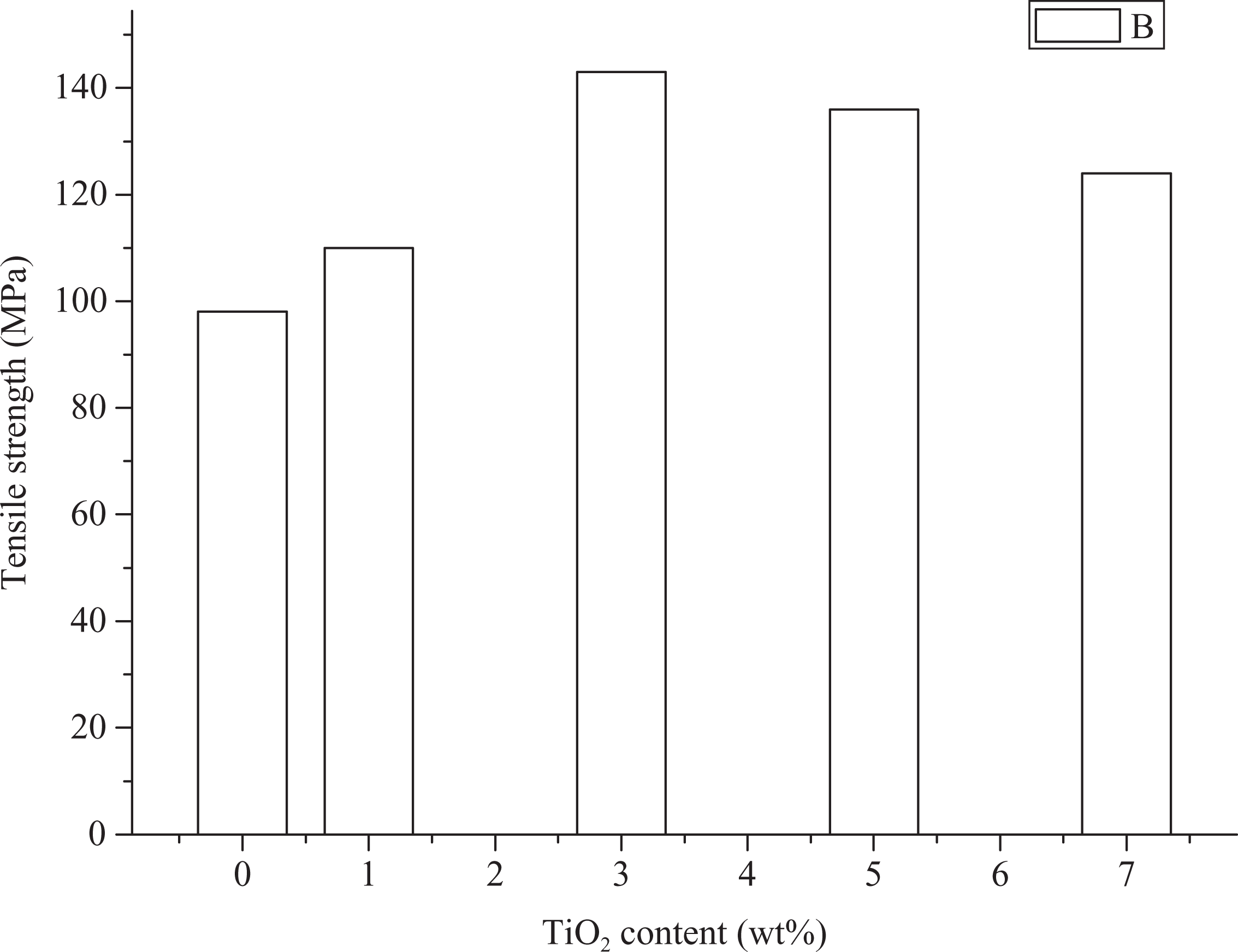
The tensile strength of TiO2-filled PMMA composite with different contents of TiO2. TiO2: titanium oxide; PMMA: polymethyl methacrylate.
The treated TiO2/PMMA composite shows the average value of 160 MPa. It has been evidenced that the HCl treatment process has introduced surface bonding points and caused the increase in the tensile strength, as shown in Figure 2.
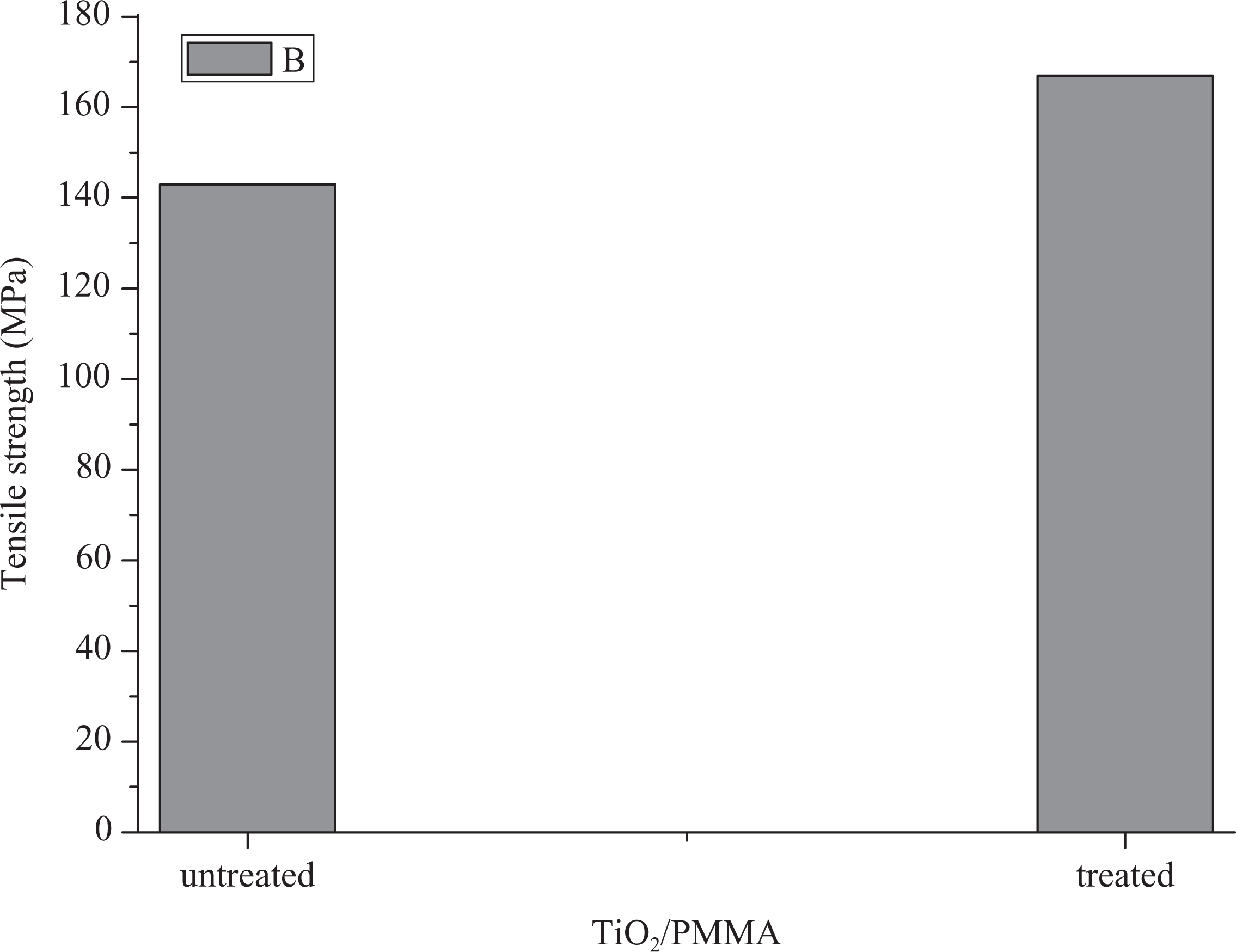
The effect of TiO2 surface treatment on the tensile strength of the TiO2-filled PMMA composite. TiO2: titanium oxide; PMMA: polymethyl methacrylate.
Sliding wear
The wear resistance of the PMMA composites was increased with the fiber content when the fiber content was less than about 3 wt%, as shown in Figure 3. When the filler content was more than the filler content of 3 wt%, the wear resistance of the PMMA composites decreased. That is, the PMMA composites had the highest wear resistance when the TiO2 content was about 3 wt%.
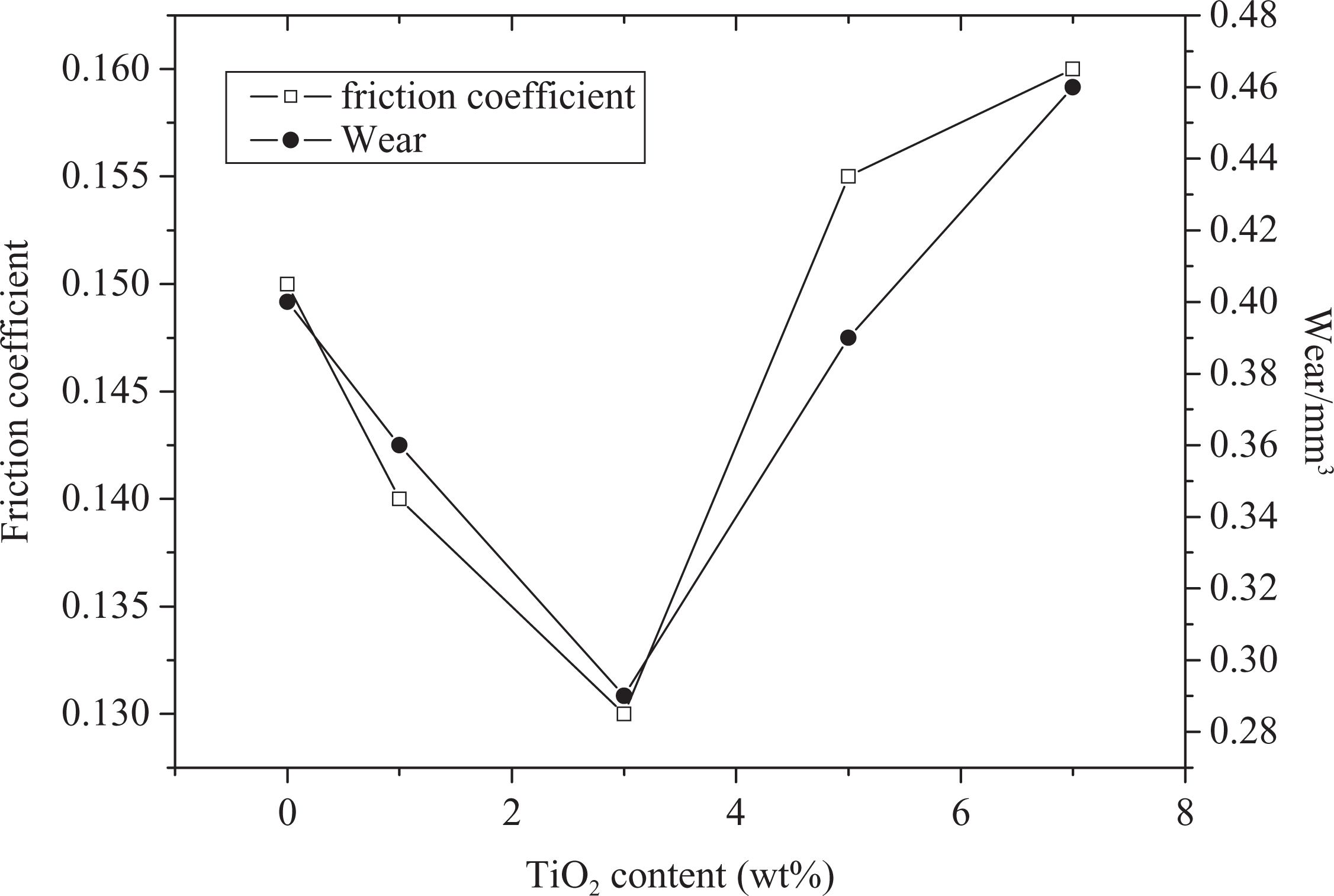
The tribological properties of TiO2-filled PMMA composite with different contents of TiO2. TiO2: titanium oxide; PMMA: polymethyl methacrylate.
Owing to the increased hardness of composites with TiO2 compared to those with pure PMMA, it is believed that the TiO2 plays an important role in hardness strengthening. If a little TiO2 is added, the hardness of the composite increases because the TiO2 fills the microvoids of the PMMA. However, if a lot of TiO2 is added, the excess TiO2 that remains after filling the microvoids forms conglomerates with the each other. This conglomeration interrupts the sintering and causes defects.
The effects of surface modification of the TiO2 on (a) the friction coefficient and (b) the wear of the PMMA composites with the applied normal load are shown in Figure 4. Results show that surface treatment of TiO2 can enhance the antiwear property but reduce the antifriction performance of the TiO2 composites under different loads. The friction coefficients and wear of three different TiO2 composites increase with increase in load. This is because the friction surface temperature goes up with increasing load, which results in the composites bonding to the counterpart surface and thus decreases the antiwear property. It was shown that the wear volume of the PMMA composites increased when normal load was applied, approximately, following a linear relation. It can be seen from Figure 4 that the modification of the TiO2 can improve the wear resistance of the PMMA composites, reflecting the effectiveness of TiO2 modification in increasing the combining strength of the interface between the TiO2 and PMMA. The tribological behavior of TiO2 composites after treatment is better than that without treatment.
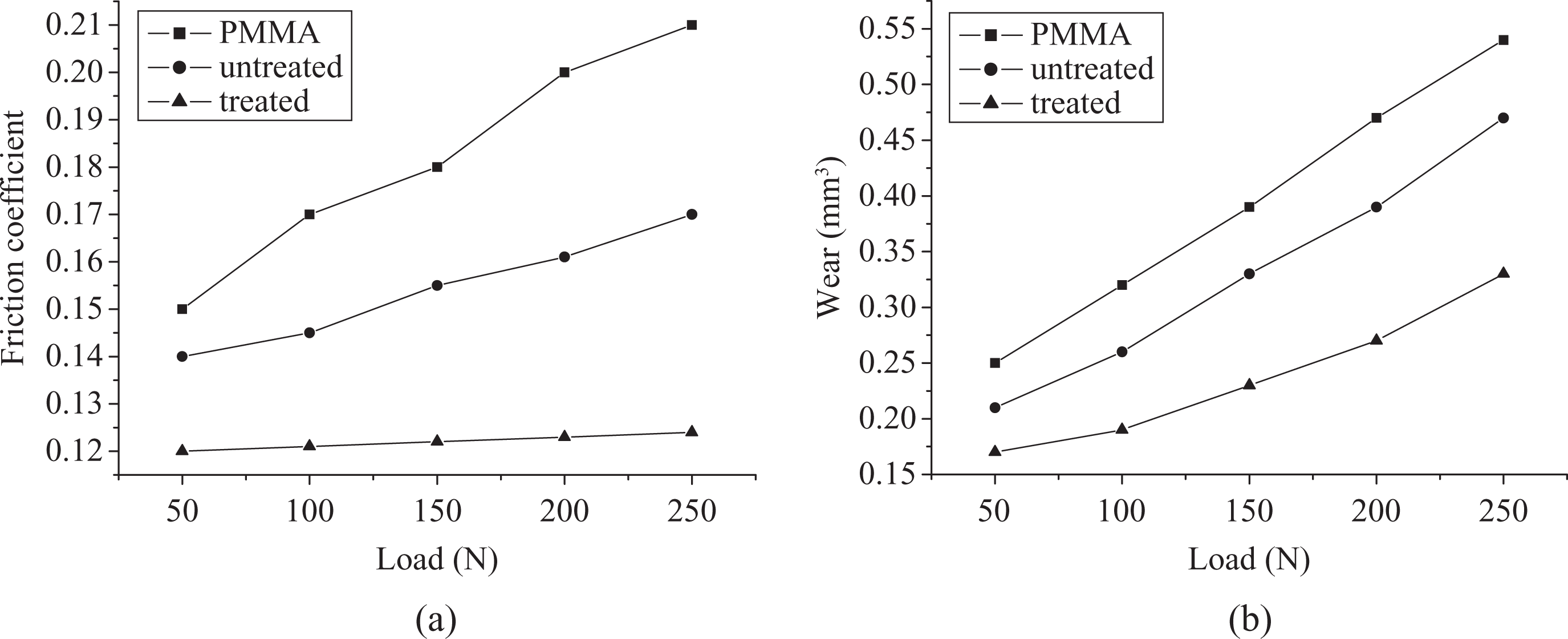
The effect of TiO2 surface treatment on the tribological properties of the TiO2-filled PMMA composite (3 wt% TiO2). TiO2: titanium oxide; PMMA: polymethyl methacrylate.
The micrographs of the untreated and surface-treated TiO2/PMMA composites after sliding wear under 100 N are showed in Figure 5 (sliding velocities: 0.424 m/s). An obvious increase in surface roughness can be observed before treatment, with some small globular-like microstructure substituting the clean surface, presenting a worn surface (Figure 5(a)). This decreases the mechanical interlocking of the adhesive and fiber surface and then detriment the antiwear property of the TiO2/PMMA composites. With the TiO2 treated for the effective bonding with PMMA (Figure 5(b)), the worn surface is smooth and the damage is not as bad as that without treatment. Thus the tribological behavior of the untreated TiO2/PMMA composites is not as good as that of the treated composites.
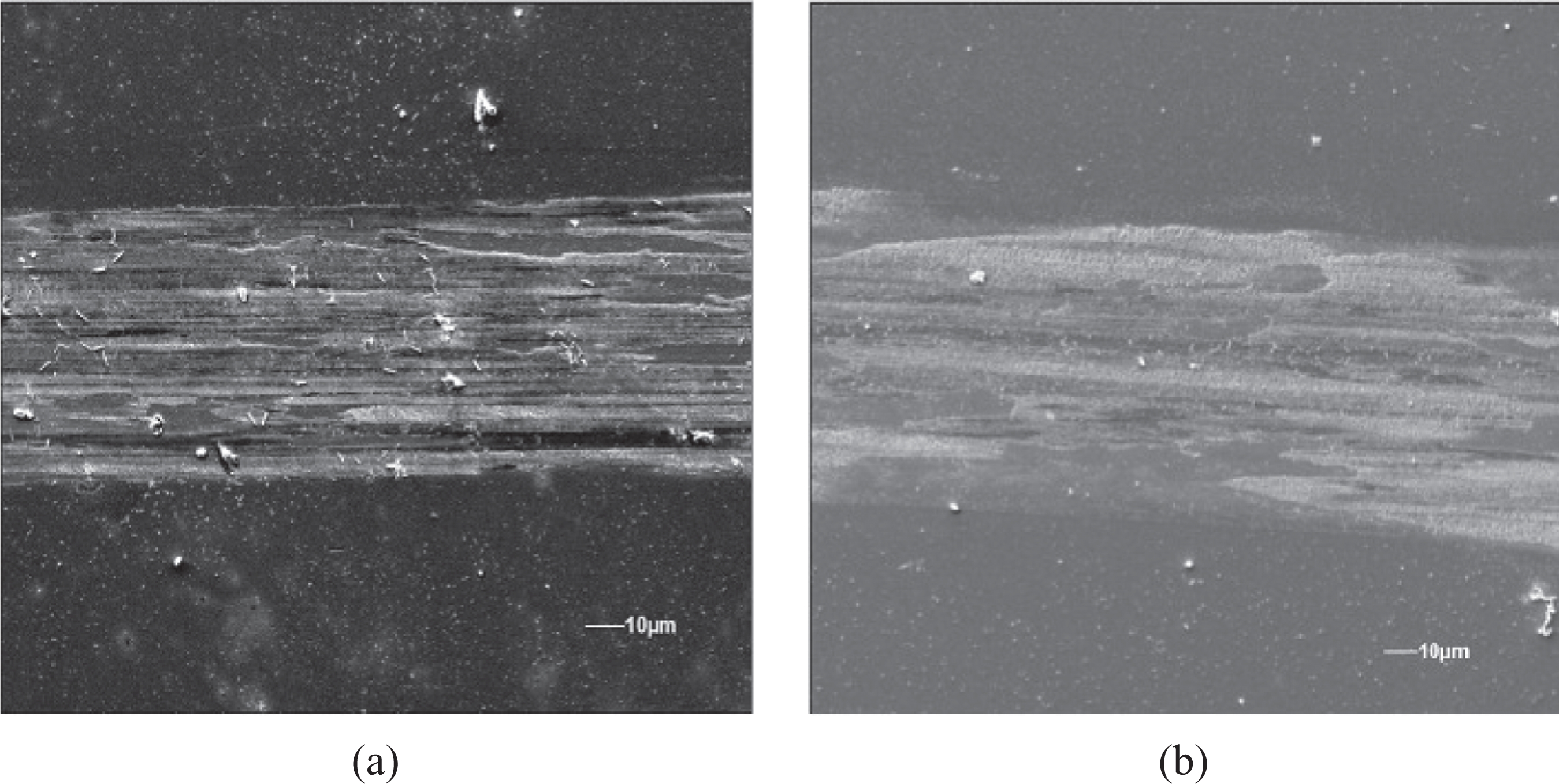
The worn surface of the untreated and surface-treated TiO2/PMMA composite. TiO2: titanium oxide; PMMA: polymethyl methacrylate.
It is seen that the PMMA after sliding is characterized by peeling off (Figure 5(a)), which indicates that the PMMA experiences severe damage. The wear grooves and the material fragments indicate that the solely incorporated TiO2 particles result in a severe wear, though the hard particles also help to develop the toughness and stiffness of the matrix to some extent. This effect is ascribed to that the particles act as an abrasive third body and increase the discontinuities in matrix. With the surface-treated TiO2/PMMA composites (Figure 5(b)), there are relatively fewer wear debris peeled off and cut from the composites in the worn surface. The TiO2/PMMA composite experiences mild damage. In friction, the load force can be well transferred to the fiber, the adhesive and substrate due to the enhancement of the bond property among the filler, the adhesive and metallic substrate. The antiwear property is also improved. The wear mechanisms of the TiO2/PMMA composites are adhesive wear and spalling, as indicated by SEM analysis of the worn surfaces. The surface treatment of TiO2, however, promotes a pronounced change in wear process. Furthermore, the matrix is much smooth with fewer small scratches in comparison to the TiO2/PMMA composites without treatment. An additional positive effect of the microparticles is considered to be occurring.
Conclusions
The optimum tensile strength value occurs when the TiO2 content is 3 wt%, which means the best combination between the TiO2 particle and the surrounding PMMA matrix. The treated TiO2/PMMA composite caused the increase in the tensile strength compared to that without treatment. The surface treatment of TiO2 can enhance the antiwear property but reduce the antifriction performance of the TiO2 composites under the load of 50, 100, 150, 200 and 250 N and sliding velocities of 0.424 m/s. The friction coefficients and wear of three different TiO2 composites increase with increase in load. The PMMA composites had the highest wear resistance when the TiO2 content was about 3 wt%.
Footnotes
Funding
This research received no specific grant from any funding agency in the public, commercial, or not-for-profit sectors.