




Abstract
In this article, the impact of laser-induced thermal damage on the static strength properties of consolidated continuous carbon fibre reinforced thermoplastics induced by high-power laser cutting is presented. Organic sheets based on a polyphenylene sulphide matrix are machined using a fibre laser providing a maximum output power of 6000 W. In this context, the influence of the applied laser power and the feed rate on the cut quality as well as the resulting tensile strength is discussed. In order to analyse the laser cutting edge through a quantitative evaluation of the damaged areas due to laser impact, optical micrographs are prepared. The results of tensile strength tests are compared with those measured from the specimens that were generated by a conventional processing technique (milling). A linear dependency between a specific part of the heat-influenced zone and the corresponding maximum tensile load is found. A reduced load bearing area, as a consequence of a modified fibre–matrix-structure due to laser impact, is identified as the responsible factor for reduced tensile strengths, especially for low feed rates.
Introduction
Due to their superior specific strength and stiffness, carbon fibre reinforced plastics (CFRPs) are considered to have great potential for weight reduction in the aerospace industry as well as the automotive and energy sectors. Limited automation techniques are one important aspect to be investigated in order to drive down costs in mass production of CFRP-based goods. 1,2 Although thermoplastic-based composites offer some processing advantages compared with reinforced thermoset-based matrix materials, thermosets are still the predominant form of CFRP. The thermoplastic-based materials are weldable, formable, easy to store and recyclable. 3 Hence, their use increases, and the manufacturing processes for these composites must be further developed.
In contrast to the fabrication of CFRP-parts, laser processing is already common in metal parts fabrication. The major benefits that promote laser use in production are flexibility for three-dimensional machining and its noncontact operation. Hence, tool wear is no issue with lasers, and they offer a process free of forces. Furthermore, high-power lasers allow high feed rates but, as a thermal process, during laser cutting, heat-induced damage appears at the cutting edge of processed CFRP. This heat affected zone (HAZ) of the workpiece is evident for CFRP due to different melting temperatures and the thermal conductivity of the matrix material and the reinforcing carbon fibres. In order to determine the laser-induced influence on the mechanical properties of CFRP workpieces, static tensile strength data must be provided as an important input parameter for the construction steps.
The influence of cutting parameters on the HAZ of CFRP with a thermoset matrix has been investigated for different laser sources. In the study by Riveiro et al. 4,5 the influence of different pulse shapes of a CO2 laser on the HAZ and the kerf width was explored, while in the studies by Garcia et al. 6,7 and Tuersley and Pashby 8 pulsed Nd: YAG-lasers were used. The influence of a CO2 laser on the HAZ and the kerf width with varying laser power and feed rates was investigated. 9,10 In the study by Jaeschke et al., 11 analysis of the HAZ with varying laser power and feed rate at constant energy per unit length using a continuous wave (cw) disk laser was performed. Efforts to develop models to predict the kerf width and the HAZ in dependence of different laser cutting parameters were studied 12 –16 and compared with the results from experiments. Here, the developed models agree with corresponding experiments.
For the thermoplastic-based composites, the majority of investigations have focused on CO2 laser machining. A correlation between feed rate, material thickness, kerf width and HAZ has been demonstrated 3,17 using CO2 lasers. It is shown that the thermal impact on the cutting edge is a function of the fibre orientation. For unidirectional noncrimp fabrics, the highest damage occurs for carbon fibre tows showing a perpendicular orientation relative to the cutting direction. In the study by Tagliaferri and coworkers, 18 –20 CO2 lasers were used and the experiments were compared with models to predict heat-induced damage of the thermoplastic-based composite. It was shown that the quality of the cutting kerf increases and the extent of the HAZ decreases the more similar the thermal material properties of polymer matrix and reinforcing fibres are.3 Therefore, the cutting results for glass- or aramide fibre-reinforced composites are better than for CFRPs.
In contrast to the investigations on CO2 laser machining, few investigations have been published on cutting thermoplastic CFRP with a high power near infrared (NIR) laser operated in cw mode. 1,21 Until now, the impact of thermal loads on the mechanical properties of laser processed reinforced composites has been hardly discussed. In the study by Howarth and Strong, 22 the mechanical properties of aramide fibre-reinforced thermosets were tested after laser cutting. The mechanical properties of carbon fibre-reinforced thermosets were investigated by Herzog et al. 23 But the impact of laser cutting on the interlaminar shear strength properties of carbon fibre-reinforced thermoplastics was only studied by Jaeschke et al. 21 In this article, corresponding interlaminar shear strength tests reveal a reduction in the maximum shear stress for laser cut specimens compared with conventionally treated samples, provided by milling and abrasive water jet technique. Within the laser working range, an increase in the achievable shear strength for a certain material thickness with a decreasing HAZ was found. For comparably thin laminate arrangements, interlaminar shear strengths of laser-machined specimens converged with those of conventionally treated CFRP samples. Further studies correlating the HAZ with static strength properties are not known in the literature.
Experimentation
Material characterization
The laminate used within the frame of the investigations is a consolidated thermoplastic composite material based on a semicrystalline polyphenylene sulphide (PPS) matrix in conjunction with reinforcing high tenacity fibres. The organic sheets consist of 5-harness satin carbon weaves with an orthotropic fabric design in a 0°/90° fibre orientations [(0,90)]3s/(0,90), with a thickness of
Cutting setup and procedure
The cutting experiments were performed using a multimode fibre laser emitting in the NIR range of the electromagnetic spectrum at a wavelength of
Material testing
Tensile tests according to the standard DIN EN 2561 were performed. During the tests, specimens were prepared to be tested with the force along the warp direction of the composites. For reasons of comparison, reference specimens were prepared by milling. The specified test method evaluates the ultimate tensile strength (
Results
In order to analyse mechanical properties with respect to laser machining parameters, the static strength properties and the HAZ were quantified and then correlated. Two parameter series were analysed, one with varying feed rate (
Investigations on the static strength properties
In order to investigate the influence of the feed rate on the mechanical properties of laser cut CFRP specimens, static tensile strength tests were conducted. During the investigations, the feed rate was varied within a range of
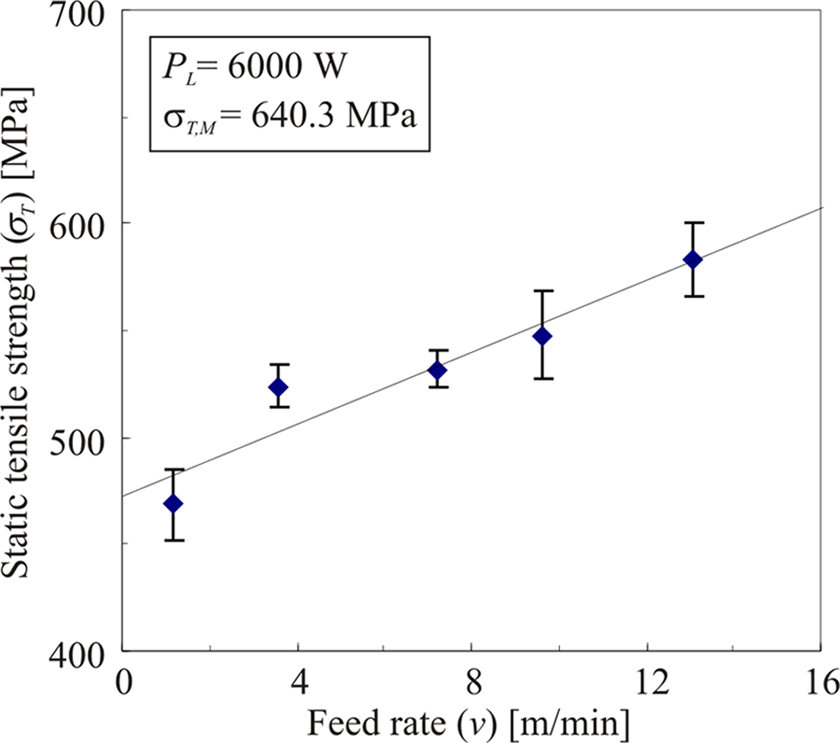
Tensile strength as a function of feed rate.
With a feed rate of
Varying the laser output power from
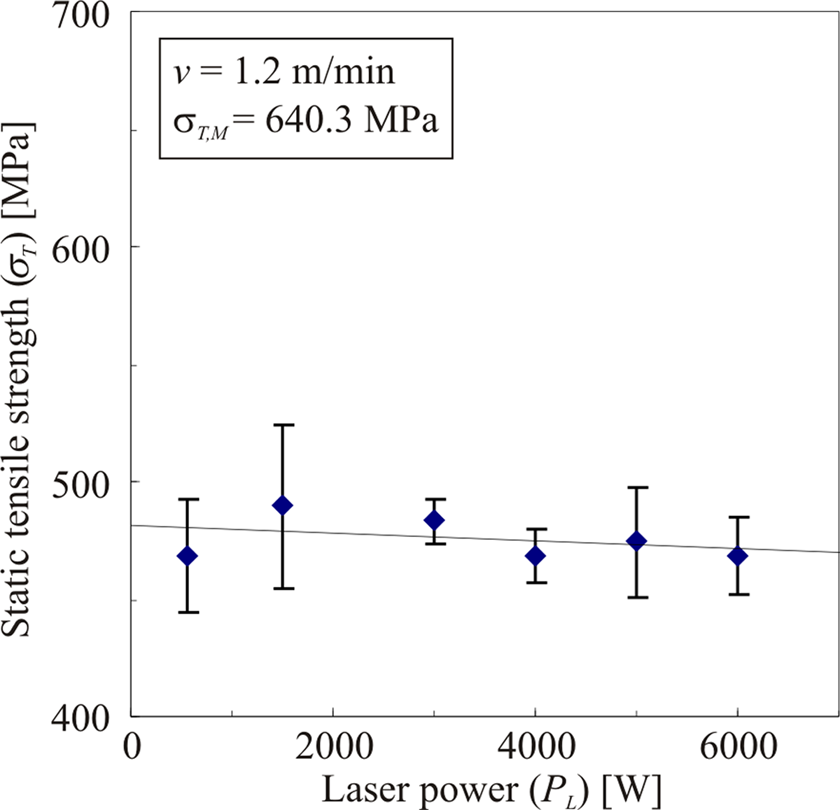
Tensile strength as a function of laser power.
Analysis of HAZ
Analyzing the cross sections of laser cut PPS-based CFRP laminates, three different HAZs can be defined (Figure 3). In these regions, the heat-induced damage appears in different forms. In the cutting kerf (w
k), the reinforcing carbon fibres and the PPS matrix are vaporized. Close to the cutting kerf, the section nominated as A
1 is affected by temperatures exceeding the level, where the matrix is supposed to be vaporized and the fibre tows are charred. In the adjacent area A
2, it appears that the matrix damage predominantly occurs due to the temperatures exceeding the PPS decomposition temperature of
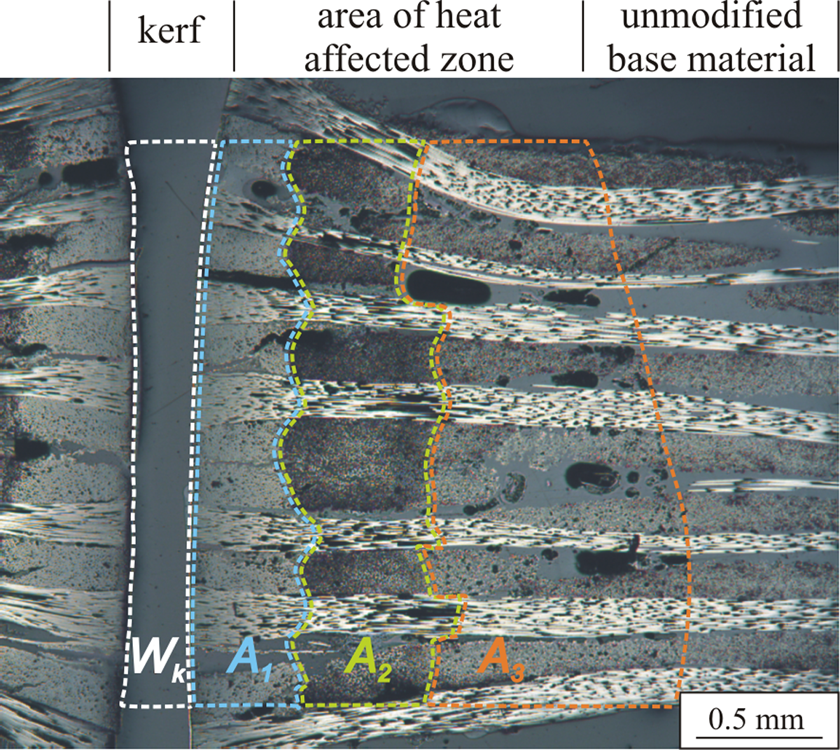
Identification of different regions of the heat-influenced area due to laser impact.
A quantitative analysis of the HAZ was conducted by taking cross section images of the HAZ and measuring each heat-influenced area (

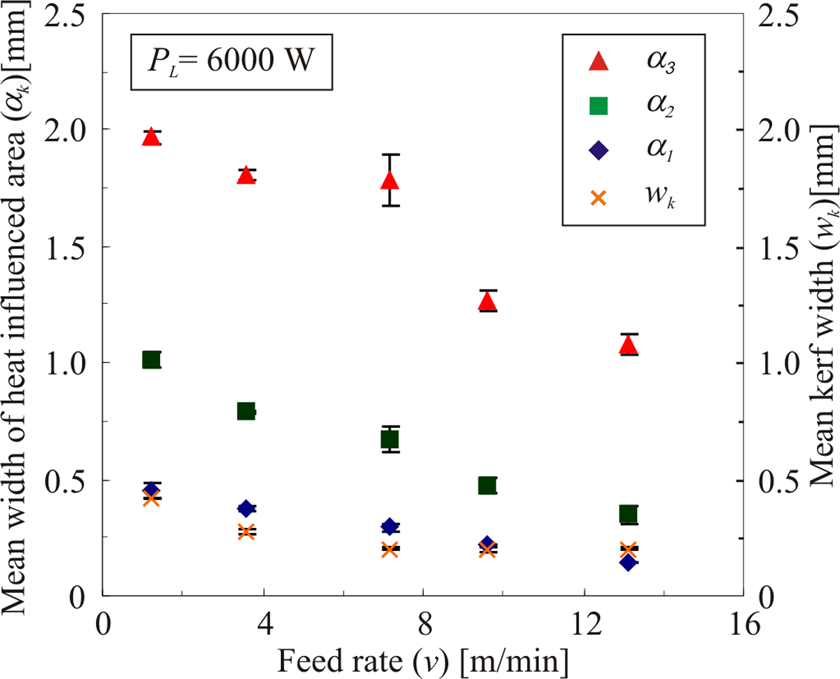
Mean width of heat-influenced area and kerf width as a function of the feed rate.
Altering the laser output power
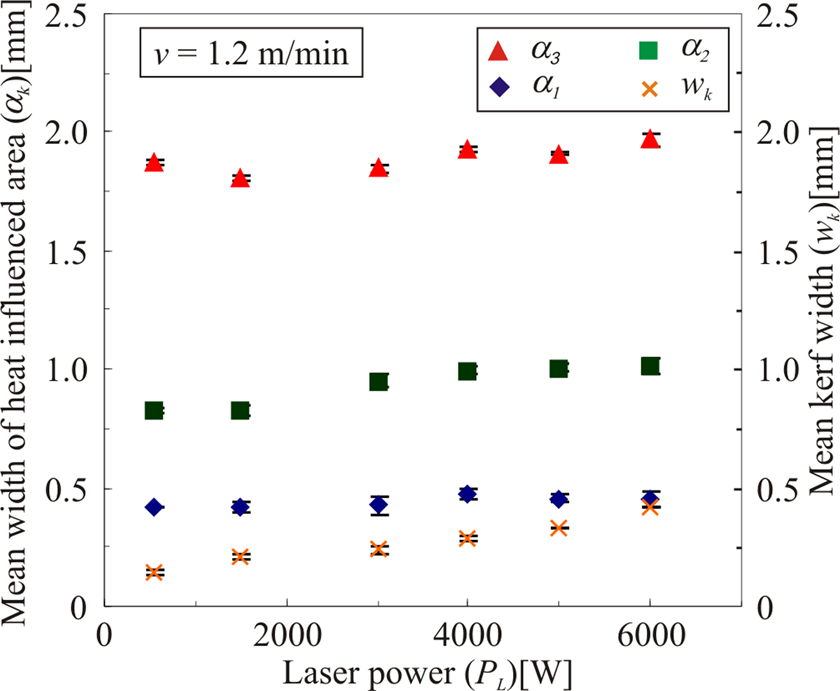
Mean width of heat-influenced area and kerf width as a function of laser power.
Correlation of static strength properties and the HAZ
In this chapter, the static tensile strength
By changing laser output power
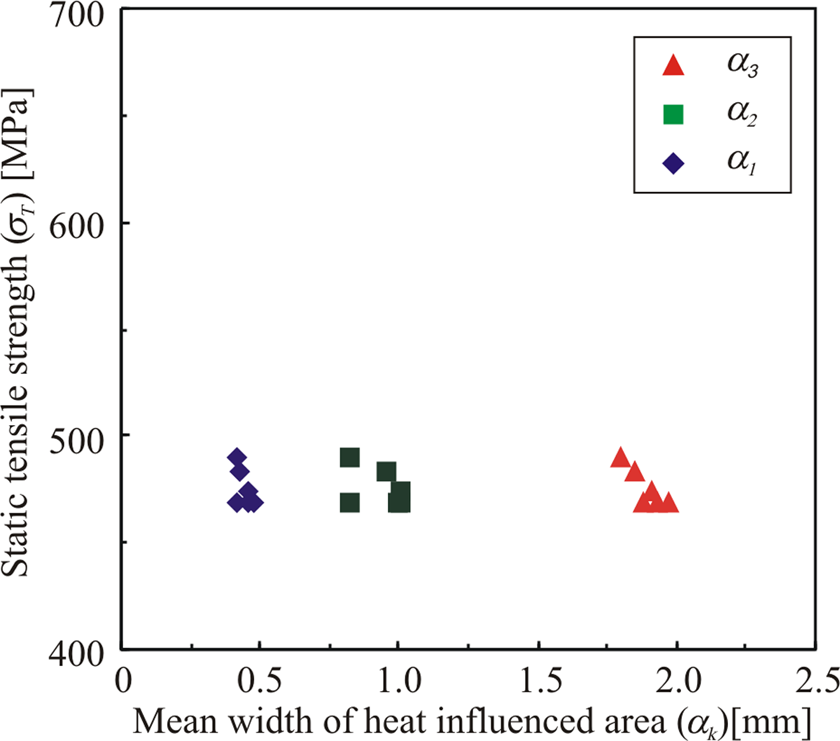
Tensile strength as a function of mean width of the heat-influenced area at varying laser power.
In contrast, varying the feed rate
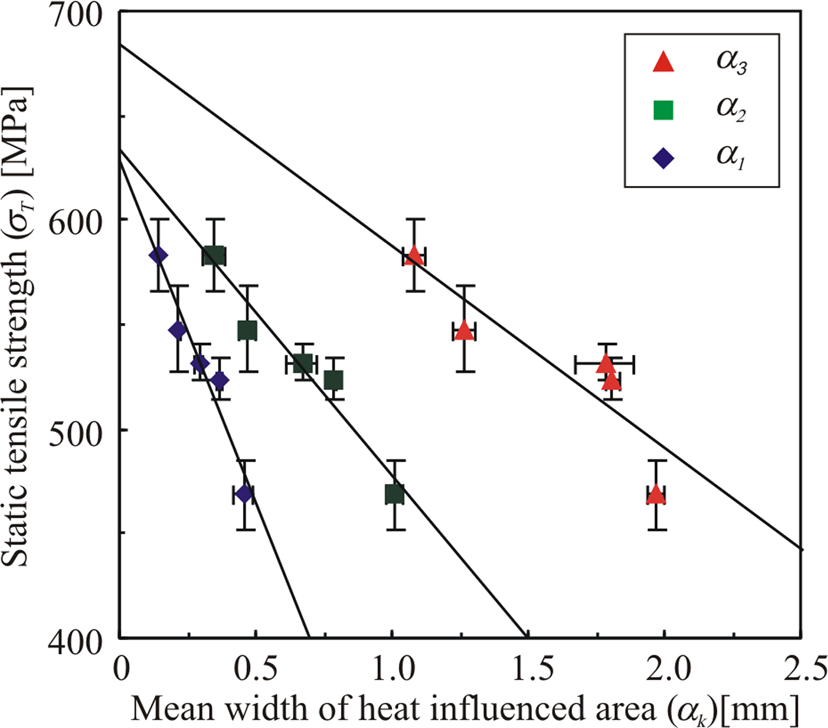
Static tensile strength as a function of mean width of the heat-influenced area for varying feed rates.
Supposing that a section
As shown in Figure 7, an increasing width of the heat-influenced area
In Figure 8, the maximum tensile load Maximum tensile load as a function of width reduction with varying feed rates.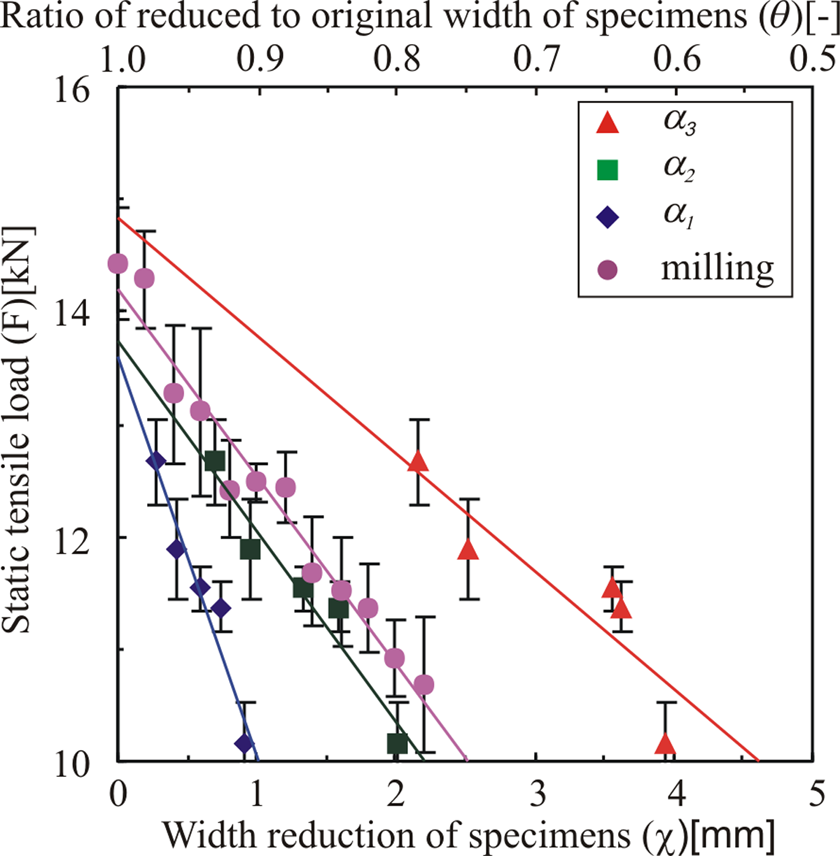


It is obvious that the lines of best fit due to the mean width
In Figure 9, the reduction in the load bearing area due to the subtraction of the heat-influenced area
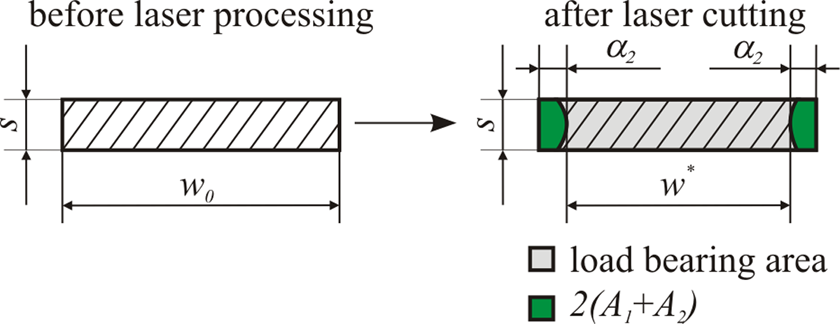
Reduction in load bearing area of specimens due to laser impact.
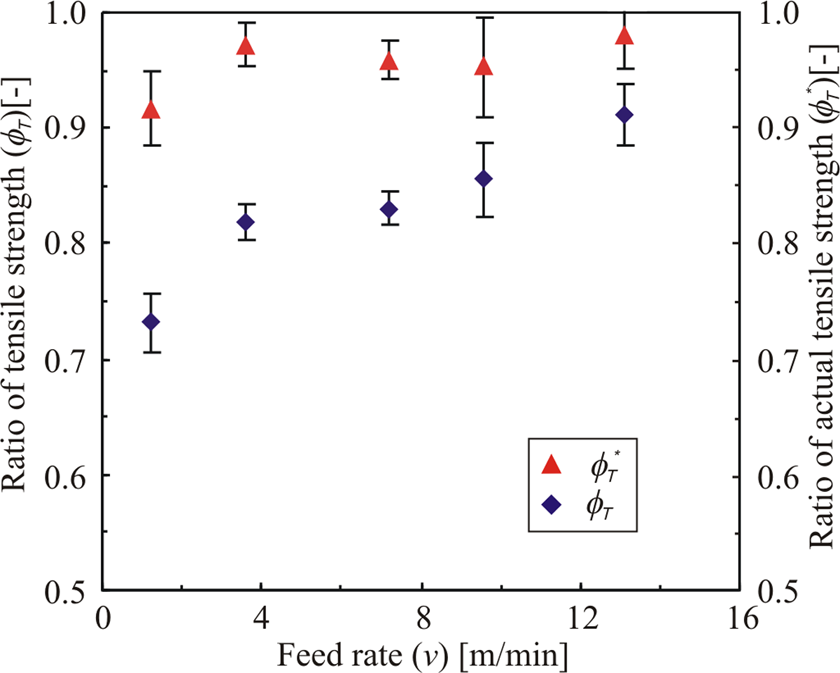
Ratio of tensile strength and ratio of actual tensile strength for laser machined specimen to those of milled samples as a function of feed rate.
Due to the reduction of the load bearing area, resulting from the mean width of the heat-influenced area



Conclusions
In this article, investigations on whether thermal damage caused by high-power laser processing reduces the static tensile strength properties of continuous carbon fibre reinforced thermoplastics are given. To this end, laminates consisting of 5-harness satin carbon weaves in conjunction with a semicrystalline PPS matrix were cut using a multimode fibre laser.
It was demonstrated that the thermal cutting process induces a HAZ within the composite laminate, starting at the cutting edge. It turned out that the HAZ could be described as a modified composite structure, consisting of three different areas, each of them representing a zone where damage occurs in a different manner. Within the frame of the investigations, it was found that the cutting velocity significantly determines the extent of all three areas of the HAZ. The higher the feed rate, the smaller the thermal damage at the cutting edge.
The resulting HAZ was correlated with corresponding static tensile strength measurements. In this context, specimens which were cut by laser at varying feed rates were tested with respect to tensile load. A comparison with samples prepared by milling revealed the reduction in the load bearing area due to thermal influence as the main factor for a reduction in tensile strength found for laser-treated composite laminates. In order to evaluate the decrease in tensile strength, an effective width was introduced, taking into account the remaining load transmitting width of laser cut specimens.
For future investigations, it is intended to further reduce or even to eliminate the HAZ. Taking into account that high feed rates decrease the extent of the HAZ, an additional augmentation of the velocity of the laser beam seems to be promising. Therefore, multiple crossings of the cutting outline are necessary to achieve the required energy per unit length to cut the CFRP. The application of a quasi-simultaneous cutting process using a laser scanning head could lead to the desired result.
Footnotes
Appendix 1
Funding
This work was supported by the German Research Foundation (DFG) for their support within the project HA 1213/74-1.