



Abstract
This article presents the hygrothermal effects on the free vibration of laminated composite plates resting on a two-parameter Winkler and Pasternak elastic foundations with random system properties using micromechanical model. System properties such as material properties, hygroscopic expansion coefficients, thermal expansion coefficients and foundation stiffness parameters are modeled as independent basic random variables which are affected by the variation in temperature and moisture based on a micromechanical model of a laminate for accurate prediction of system behavior. A C 0 finite element method based on higher-order shear deformation theory has been used for deriving the standard eigenvalue problem. A Taylor series-based mean-centered first-order perturbation technique is used to find mean and standard deviation of the natural frequency subjected to uniform moisture concentration and temperature rise, plate aspect ratio, total number of plies, fiber orientations and elastic foundation parameters with different boundary support under hygrothermal environmental conditions. Typical numerical results have been validated with those available in the literature and independent Monte Carlo simulation.
Keywords
Introduction
Laminated composite plates resting on elastic foundation as structural components play an important and vital role in exceptional performance extreme engineering structures as aeronautical and aerospace engineering for construction, manufacturing of aircrafts structure components, aerospace vehicles, aircraft runways and launching sites of missile and spacecraft. In construction of above mentioned structure/components, there is operational and functional requirement of inherent characteristic ability to tailor structural properties through appropriate lamination schemes for achieving high strength to weight ratio according to use. Nowadays advanced reinforced composites are being widely used in modern aerospace transportation systems and for high performance in other areas also. Plates made up of these composites are often subjected to mechanical loading in hygrothermal environment. Due to boundary constraints in composite plates, varying moisture and temperature environments besides other factors induce significant strains, thereby needs ensuing hygrothermal free vibration behavior. Therefore, it is of utmost importance to understand the hygrothermal free vibration behavior of these structural systems in order to estimate the reserve strength. The deterministic analysis is based on the assumptions that the system properties are completely determinate i.e. only the mean response is considered. The dispersion caused by the randomness in the system parameters is neglected. For reliable design, especially for sensitive application, it is important for the designer to understand and have sound knowledge of structural response. Otherwise the predicted response by deterministic analysis may differ significantly from the actual response which may be the cause of unsafe structure. Considering the above aspects to enhance accuracy in the response evaluation favors a probabilistic analysis for laminated composite by modeling their system properties as random variables (RVs).
Considerable literature is available on the vibration response of conventional structures and composite structures with randomness in system properties. Leissa and Martin 1 have analyzed the vibration and buckling of rectangular composite plates and have studied the effects of variation in fiber spacing using classical laminate theory (CLT). Zhang and Chen 2 have presented a method to estimate the standard deviation (SD) of eigenvalue and eigenvector of random multiple degree of freedom (DOF) system. Zhang and Ellingwood 3 have evaluated the effect of random material field characteristics on the instability of a simply supported beam on elastic foundation and a frame using perturbation technique. A comprehensive summary of extensive literature is available on the response analysis of the structures with deterministic material properties to random excitations. 4 However, the analysis of the structures with random system properties is not adequately reported in the literature. Manohar and Ibrahim 5 have presented excellent reviews on structural dynamic problems with parameter uncertainties. Using CLT in conjunction with First Order Perturbation Technique (FOPT), Salim et al. 6 have studied the static deflection, natural frequency and buckling load of composite rectangular plates with random material properties. Venini and Mariani 7 have investigated the eigen problem associated with the free vibrations of uncertain composite plates. The elastic moduli of the system, the stiffness of the Winkler foundation on which the plate rests and the mass density are considered to be uncertain. Given their random field-based description, a new method is presented for the computation of the second-order statistics of the eigen properties of the laminate. Yadav and Verma 8 have investigated the free vibration of composite circular cylindrical shells with random material properties employing CLT and FOPT for obtaining the second-order statistics natural frequencies. Singh et al. 9 ,10 have analyzed the composite cross-ply laminated composite plate/panel with random material properties for free vibration employing higher-order deformation theory (HSDT) with FOPT. The mean and coefficient of variation of the natural frequencies have been obtained for the first five natural frequencies using exact mean analysis approach and finite element method (FEM) with a C 0 element. Onkar and Yadav 11 have investigated nonlinear response statistics of composite laminates with random material properties under random loading and nonlinear free vibration of laminated composite plate with random material properties. Kitipornchai et al. 12 have studied the random free vibration response of functionally graded plates with general boundary conditions and subjected to a temperature change to obtain the second-order statistics of vibration frequencies. Tripathi et al. 13 have investigated the free vibration response of laminated composite conical shells with random material properties using FEM in conjunction with FOPT based on HSDT.
Most recently, the present authors investigated the effect of randomness in system properties on elastic buckling and free vibration of laminated composite plates resting on elastic foundation by assuming the system properties such as Young’s modulus, shear modulus, Poisson’s ratio and foundation parameters are modeled as random inputs variables. Lal et al. 14 applied C 0 linear and nonlinear FEM based on higher-order shear deformation in the presence of small deformation theory and von-Karman large deformation theory in conjunction with mean centered first-order perturbation technique to obtain the mean as well as SD of linear and nonlinear frequency response using macromechanical model. Whitney and Ashton 15 investigated the effects of environment on the elastic response of layered composite plates using deterministic FEM with macromechanical model. Chen and Chen 16 found out the vibrations of hygrothermal elastic composite plates using deterministic FEM. They investigated the different behavior of plates when exposed to moisture and temperature environments. Ram and Sinha 17 investigated the hygrothermal effects on the free vibration of laminated composite plates using deterministic finite element approach with first-order shear deformation theory. Patel et al. 18 analyzed the hygrothermal effects on the structural behavior of thick composite laminates using higher-order theory. They found that moisture and temperature significantly affect the thin plates compared to thick plates in buckling, vibration and static bending. Huang and Zheng 19,20 studied the nonlinear vibration and dynamic response of simply supported shear deformable laminated plates on elastic foundations and in hygrothermal environments using deterministic finite element approach. Atmane 21 investigated the free vibration analysis of functionally graded plates resting on Winkler–Pasternak elastic foundations using a new shear deformation theory. Benyoucef et al. 22 studied the bending of thick functionally graded plates resting on Winkler–Pasternak elastic foundations. Omurtag et al. 23 investigated the free vibration analysis of Kirchhoff plates resting on elastic foundation by mixed finite element formulation based on Gateaux differential. Matsunaga 24 studied the vibration and stability of thick plates on elastic foundations using shear deformation theory. Tounsi et al. 25 applied a new computational method for prediction of transient hygroscopic stresses during moisture desorption in laminated composite plates with different degrees of anisotropy.
It is evident from the available literature that the studies on the free vibration response of laminated composite plates resting on elastic foundations with random system properties in hygrothermal environment using micromechanical model are not dealt by the researchers. In the present work, an attempt is made to address this problem. The laminated composite plate is analyzed using the C 0 linear FEM with HSDT based on von-Karman linear strain–displacement relations. FOPT approach has been employed for the first time to develop a novel probabilistic solution procedure for random linear problem with a reasonable accuracy. The approach is valid for system properties with small random variations in the system variables compared with the mean value. The condition is satisfied by most engineering materials and it hardly puts any limitation on the approach. The efficacy of the probabilistic approach is examined by comparing the results with an independent Monte Carlo simulation (MCS).
Mathematical formulation
Consider a rectangular laminated composite plate of length a, width b and total thickness h, defined in (X, Y, Z) system with x and y axes located in the middle plane and its origin placed at the corner of the plate. Let Geometry of laminated composite plate resting on elastic foundation.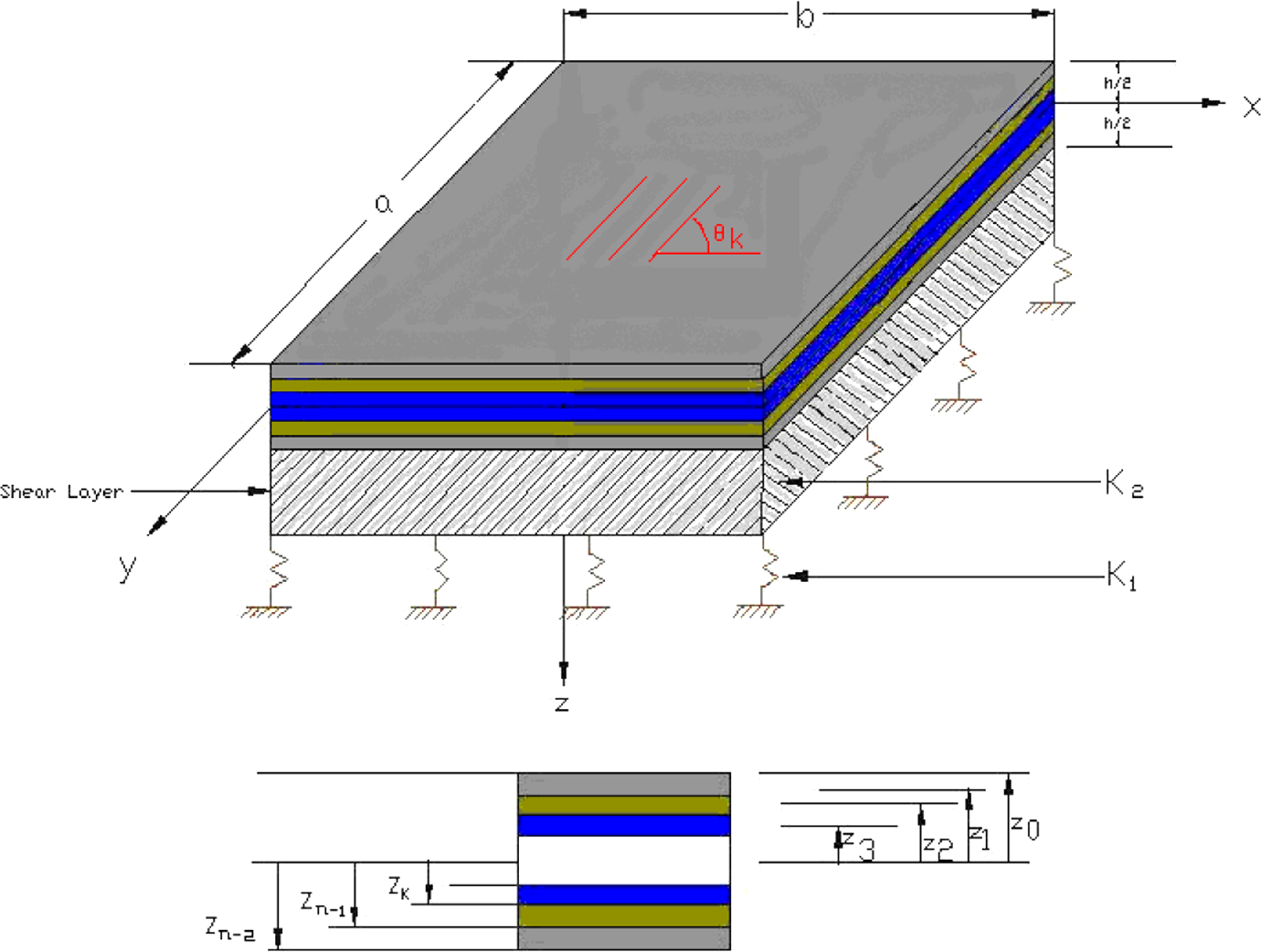

Displacement field model
In the present study, the Reddy’s higher-order shear deformation theory has been employed. 26 The displacement field model, after incorporating zero transverse shear stress conditions at the top and the bottom of the plate, is slightly modified, so that a C 0 continuous element would be sufficient. In modified form, the derivatives of out-of-plane displacement are themselves considered as separate DOF. Thus, five DOFs with C 1 continuity are transformed into seven DOFs due to conformity with the HSDT. However, the literature 27 demonstrates that without enforcing these constraints, the accurate results can be obtained. In this process, the artificial constraints are imposed which should be enforced variationally. The modified displacement field along the x, y and z directions for an arbitrary composite laminated plate is now written as. 27

where u, v and w are corresponding displacements of a point on the mid-plane, ψ x and ψ y are the rotations of normal to the mid-plane about the y and x axes, respectively, where θ x = w, x and θ y = w, x

The displacement vector for the modified models is

where, comma (,) denotes partial differential.
Strain–displacement relations
The strain–displacements relations in von Karman sense is expressed as {∊} = {∊l}. 28

where, {∊ l } is the linear strain vector.
Stress–strain relation
Law of thermoelasticity for the materials under consideration relates the stresses with strains in a plane stress state for the kth lamina oriented as an arbitrary angle with respect to the reference axis for an orthotropic layer is given by Reddy. 29 The constitutive relationship between stress resultants and corresponding strains of laminated composite plate accounting for hygrothermal effect can be written as:

or

where



The hygrothermal stress and moment resultants per unit length due to temperature and moisture change are calculated and the equivalent hygrothermal loads are defined as:

For the hygrothermal free vibration, it is assumed that the temperature and moisture fields exhibit the linear variation through the plate thickness. For the plate subjected to uniform temperature rise (UT), it is expressed as

Strain energy of the plate
The strain energy of the plate is given by

Using Eqs. (4) and (5), the strain energy Π can be rewritten as

where πi is the linear strain energy, which can be expressed as

Using strain vector expressed in terms of thickness coordinate, mid-plane strain vector and linear strain–displacement relations 29 , Eq. (11) can be rewritten as

where
and

Strain energy due to elastic foundation
The potential energy (π2) for linear elastic foundation having shear deformable layers can be written as
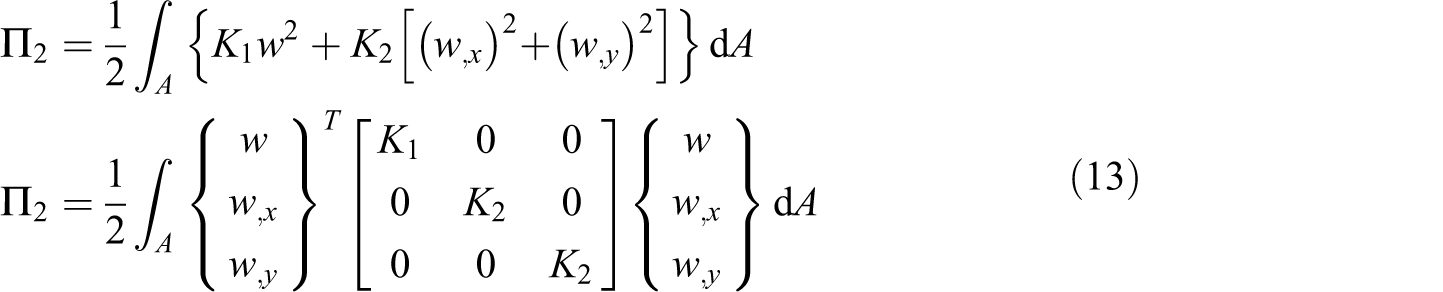
External work done
Due to uniform change in temperature, prebuckling stresses in the plate are generated. The in-plane prebuckling stress resultants are the reason for buckling. The work done by the in-plane thermal stress resultants in producing out-of-plane displacement ‘w’ is expressed as

where, Nx , Ny and Nxy are in-plane applied thermal compressive stress resultants per unit length.
Kinetic energy of the laminate
The kinetic energy (T) of the vibrating laminated plate can be expressed as

where ρ and
Finite element model
In the FEM, the domain is discretized in to a set of finite elements. Over each of the elements, the displacement vector and element geometry are represented as

where φ i is the interpolation (shape function) function for the ith node, {Λ} i is the vector of unknown displacements for the ith node, NN is the number of nodes per element and xi and yi are Cartesian coordinates of the ith node.
Strain energy of the laminated plate
The linear functional are computed for each element and then summed over all the elements in the domain to get the total function. Following this, Eq. (16) can be written as

where, NE is the number of elements

Here, [Kl ](e) is the elemental linear stiffness matrix and {L(e)} is the elemental nodal displacement vector
With
where global bending stiffness matrix [Kb ], shear stiffness matrix [Ks ], global displacement vector {q} and hygrothermal load vector [F] are defined in Appendix.
Strain energy due to elastic foundation
Using finite element notation, Eq. (16) after summing the entire element can be written

here [Kfl ](e) is the elemental linear foundation stiffness matrix.
Geometric stiffness matrix due to in-plane hygrothermal stress
Using the finite element model (Equation (16)), Equation (14) can also be written as

where λ HT and [Kg](e) are defined as the critical hygrothermal buckling load parameters and the elemental geometric stiffness matrix for the eth element, respectively.
Kinetic energy of laminated plate
Using Eq. (16), Eq. (14) can also be written as

where

where [M](e) is consistent inertia matrix of eth element.
Adopting Gauss quadrature integration numerical rule, the elemental linear, foundation stiffness matrices and geometric stiffness matrix, respectively, can be obtained by transforming expression in Cartesian x and y coordinate systems to natural coordinate systems ξ and η.
Governing equation of motion
The governing equation for hygrothermal free vibration analysis of the laminated plate can be derived using the Lagrange’s equation of motion 30 in terms of global matrices. This gives

Substituting Eqs. (17b), (18), (19) and (20a) in Eq. (21a) will result in:

where
{q}, [Kl ], [Kfl ], [M] and λ HT are defined as the global displacement vector, the global linear stiffness matrix, the global foundation stiffness matrix, the global mass matrix and the critical hygrothermal buckling parameter, respectively.
The above equation can be expressed in the form of linear generalized eigenvalue for hygrothermal linear free vibration as

Solutions-perturbation technique
Step 1. By setting amplitude to zero, the random linear eigenvalue problem
Step 2. The mean mode shape of the desired linear mode is normalized with respect to the given amplitude at the point of maximum deflection.
Step 3. Using the normalized mode shape, the linear random stiffness matrix is computed. Again, the zeroth- and the first-order eigen equations are obtained using perturbation technique.
Step 4. The zeroth- and the first-order equations are then solved to obtain new eigenvalue and corresponding eigenvectors and SD using updated zeroth- and first-order equations, respectively.
Step 5. Ste7ps (2)–(4) are repeated until convergence is attained for {q}max, ω2 and the SD; and corresponding to the converged mode shape, the mean and SD are computed.
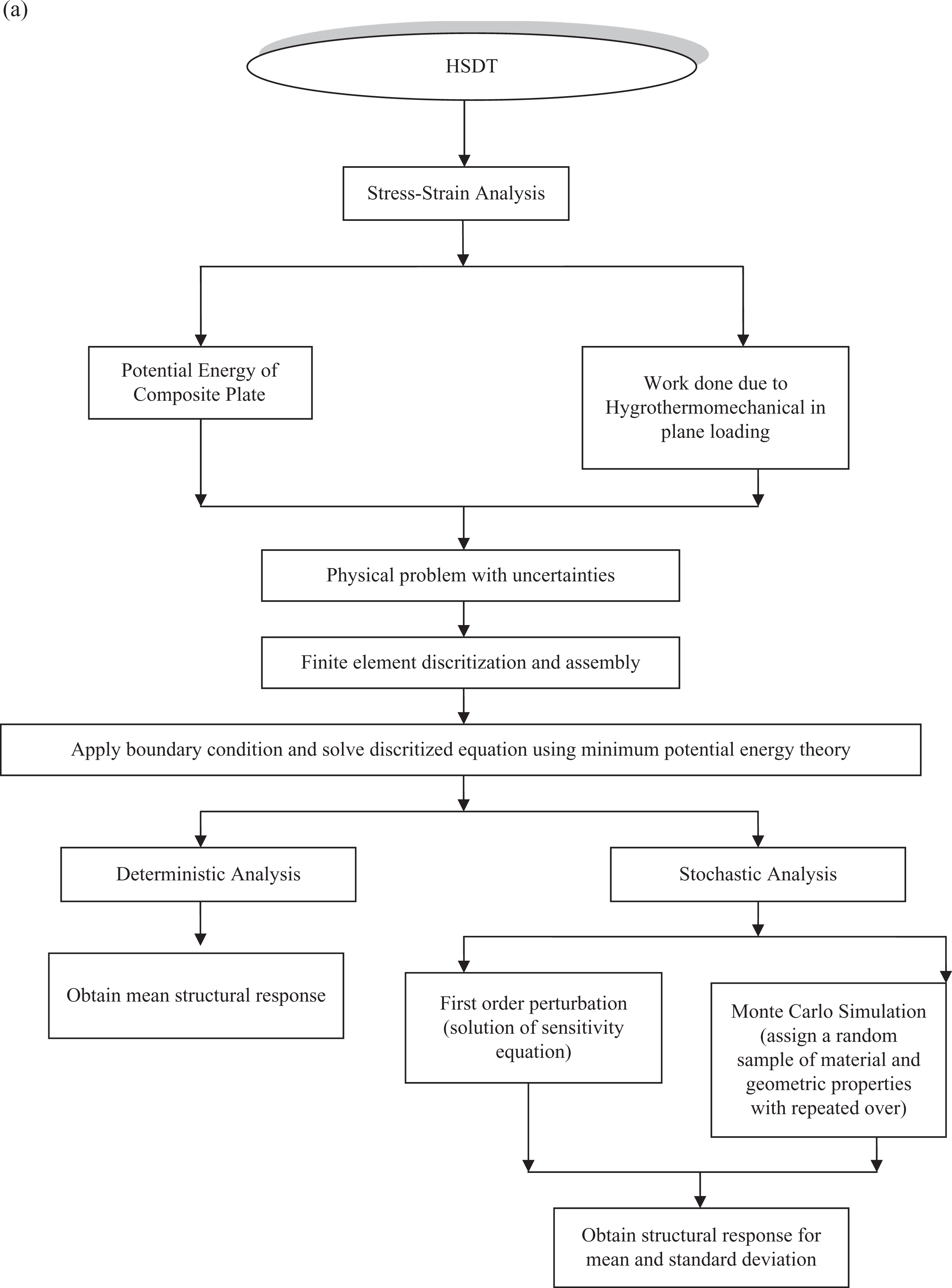
(a) Overview of stochastic analysis procedure. (b) Flow chart of solution procedure of stochastic linear vibration problem.
Due to the result of randomness in basic input variables, all the quantities in Eq. (20), that is [K], {q} and λ are random as well. However, M is a constant mass matrix because it relates only the mass densities ρ that is taken as the deterministic in the present analysis. Further, it is quite logical to assume that the random input variables are independent of each other and random part of each input variable is small with respect to its mean value; fortunately, most of the engineering problems including composite materials fall in this category. Based on this, the mean-centered first-order perturbation techniques in which all the system parameters are expanded in Taylor series is used to determine the stochastic characteristics of the linear frequency of laminated composite plates.
Solution approach—SFEM for hygrothermal free vibration problem
Stochastic Finite Element Method (SFEM) approach has been adopted for obtaining the second-order statistics of dimensionless hygrothermal fundamental frequency response of laminated composite plate resting on elastic foundation with randomness in material properties, coefficients of hygroscopic expansion, coefficient of thermal expansion and foundation parameters. The material properties coefficients of hygroscopic expansion, coefficient of thermal expansion and foundation parameters are assumed to be the basic input RVs. Without any loss of generality, the RV can be spite up as the sum of a mean and a zero random part. 10 In general, a RV can be represented as the sum of its mean and zero mean RV, denoted by the superscripts ‘d’ and ‘r,’ respectively.

where
Consider a class of problems where the random variation is very small as compared to the mean part of material properties. Further, it is quite logical to assume that the coefficient of variation in the derived quantities like λr, ωr, q r and K r are also small as compared to mean values.
By substituting Eq. (23) in Eq. (22) and expanding the random parts in Taylor’s series (keeping the first-order terms, neglecting the second- and higher-order) one obtains as 31
For hygrothermal linear free vibration analysis
Zeroth-order perturbation equation:

First-order perturbation equation:

Eq. (24) is the deterministic equations relating to the mean eigenvalues and corresponding mean eigenvectors, which can be determined by conventional eigen solution procedures. Eq. (25) the first-order perturbation approach is employed in the present study. 32
Using this, Eq. (25) can be decoupled and the expression for hygrothermal free vibration is obtained. The FEM in conjunction with first-order perturbation has been found to be accurate and efficient. 31 ,33,34 According to this method, the RVs are expressed by Taylor’s series. Keeping the first-order terms, neglecting the second and higher order terms. Eq. (24) can be expanded up to first order, as the first order is sufficient to yield results.

Using the above equation, the expression
Using Eq. (26), the variances of the eigenvalues can now be expressed as:

where
Results and discussion
The stochastic finite element analysis has been applied to obtain the mean and Coefficient of Variation (cov), considering different random parameters of the hygrothermal free vibration of laminated composite plate of graphite epoxy material resting on elastic foundations. The lamina coefficients of hygroscopic and thermal expansion including foundation stiffness parameters and material properties are modeled as basic RVs. The mean and SD of the hygrothermal free vibration are obtained considering all the random material input variables and thermal expansion coefficients, moisture expansion coefficients as well as foundation parameters taking separately as basic RVs as stated earlier. However, the results are only presented taking coefficient of variation (
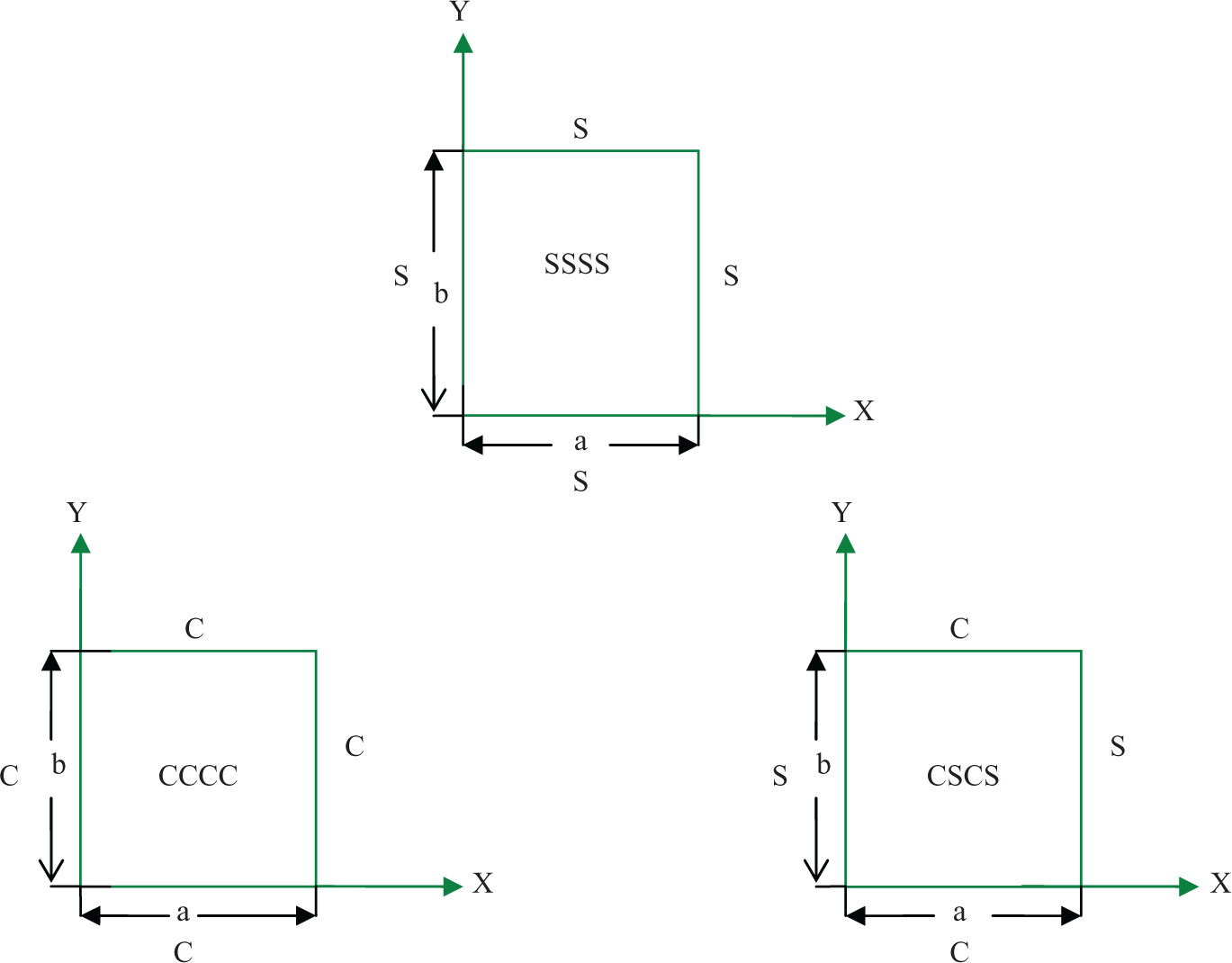
Schematic representation of various boundary conditions for the plate.
All edges simply supported (SSSS [S1]):

All edges simply supported (SSSS [S2]):

All edges clamped (CCCC):

The plate geometry used is characterized by aspect ratios, a/b = 0.5, 1.0, 1.5 and 2, and side-to-thickness ratios, a/h = 5, 10, 20, 30, 40, 50, 60 and 100. The mean values of coefficients of hygroscopic expansion, coefficients of thermal expansion and material constants are used for computation. We now consider a second step as the elastic constants; thermal expansion coefficients and coefficients of hygroscopic expansion of each layers are assumed to be linear functions of temperature and moisture. The only exception is the Poisson’s ratio, which can reasonably be assumed as constant due to the weak dependency on temperature change. For the ratio of the SD to the mean of material and geometric properties varying from 0% to 20%,
34
plate thickness ratios of a/h = 5, 10, 20, 30, 40, 50, 60 and 100 have been considered. The thermoelastic material properties such as E
11, E
22, G
12, G
13, G
23, V
12, α1, α2, β2 and k
1 and k
2 are modeled as basic RVs. The input random variables b
i is related as b
1 = E
11, b
2 = E
22, b
3 = G
12, b
4 = G
13, b
5 = G
23, b
6 = V
12, b
7 = α
1, b
8 = α
2, b
9 = β2, b
10 = k
1 and b
11 = k
2. The following dimensionless quantities have been used in this study: the dimensionless expected mean fundamental frequency (ϖl) = ωa
2
√(ρ0/E
22/h
2), nondimensionalized elastic foundation stiffness parameters
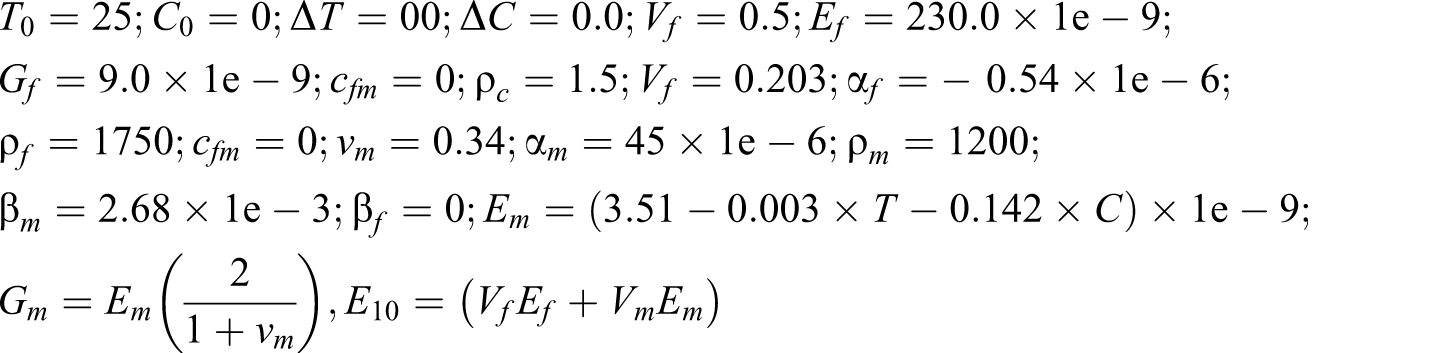

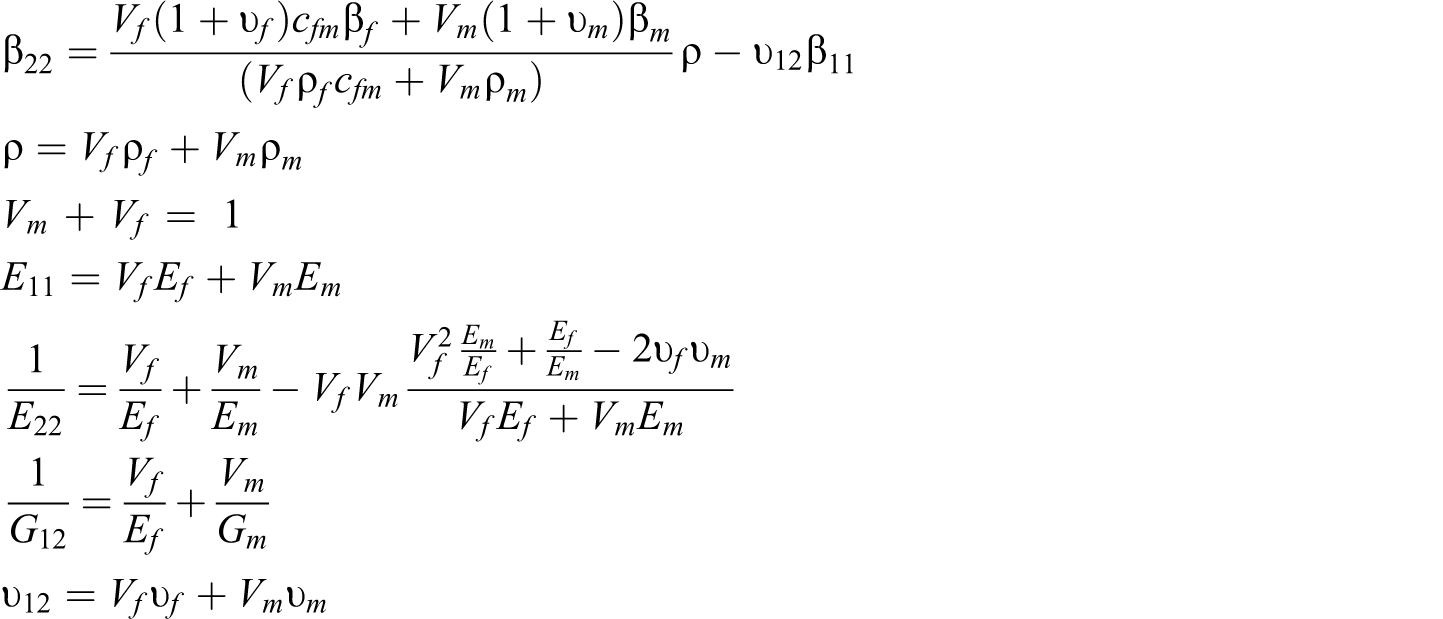
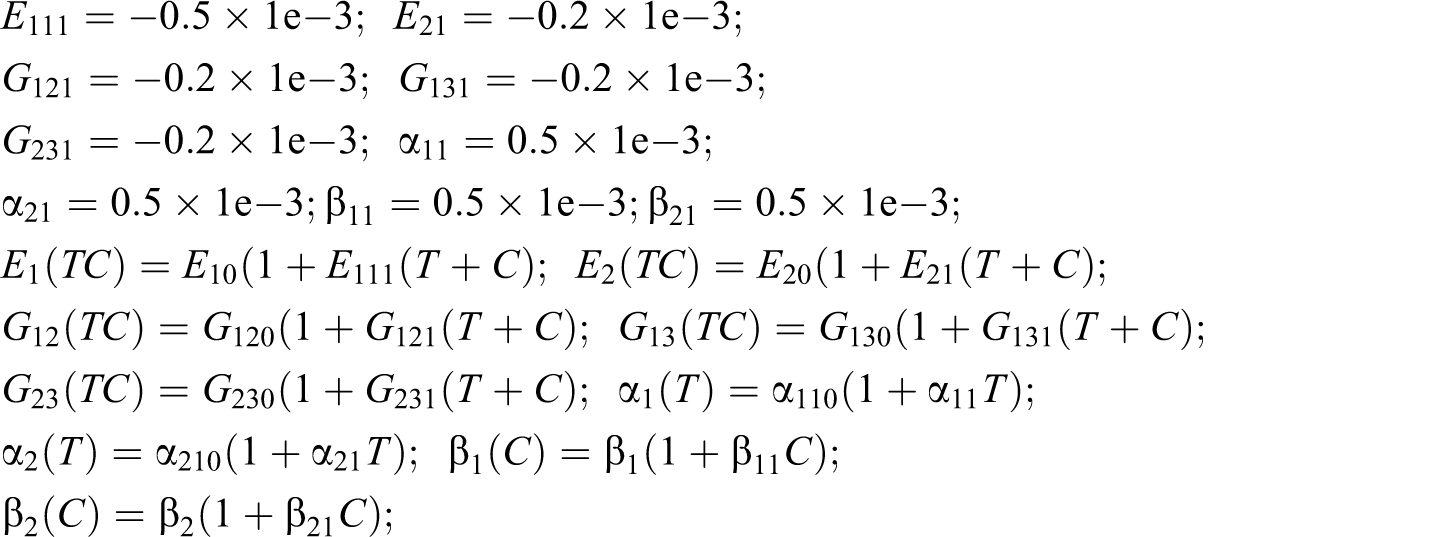
Temperature- and moisture-independent (TID) material property constants used for present study are

Validation study for expected mean values
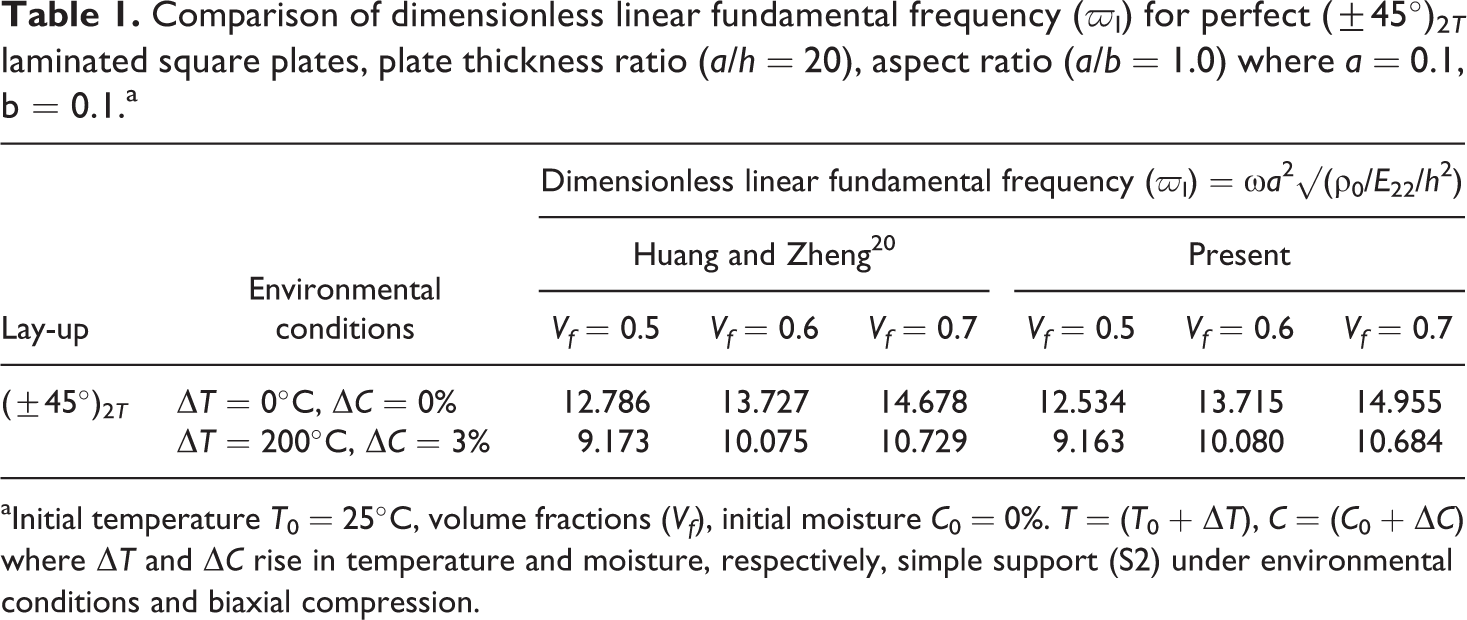
Table 1 shows the comparison of dimensionless linear fundamental frequency (ϖ
l
) for perfect (±45°)2T
laminated square plates, biaxial compression volume fractions (V
Comparison of dimensionless linear fundamental frequency (ϖl) for perfect (±45°)2T laminated square plates, plate thickness ratio (a/h = 20), aspect ratio (a/b = 1.0) where a = 0.1, b = 0.1.a
aInitial temperature T 0 = 25°C, volume fractions (Vf ), initial moisture C 0 = 0%. T = (T 0 + ΔT), C = (C 0 + ΔC) where ΔT and ΔC rise in temperature and moisture, respectively, simple support (S2) under environmental conditions and biaxial compression.
Validation study for random hygrothermal free vibration
The present results of random hygrothermal free vibration of laminated composite plate without foundation (k
1 = 00, k
2 = 00) and resting on Winkler (k
1 = 100, k
2 = 00) elastic foundations obtained from present perturbation approach have been compared and validated with an independent MCS approach. Figure 4 plots the normalized SD,
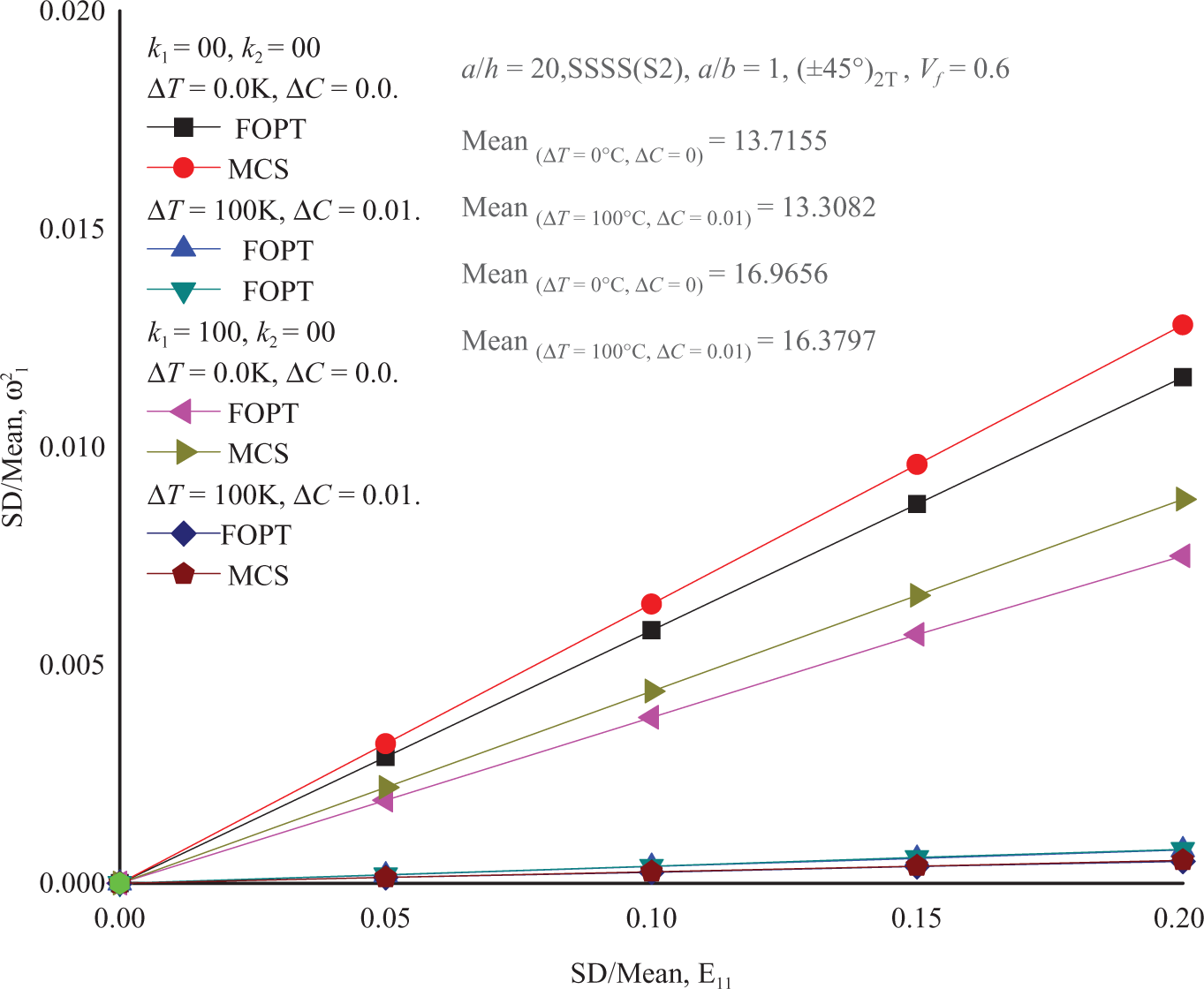
Validation of present First Order Perturbation Technique (FOPT) results for hygrothermal free vibration with independent Monte Carlo simulation (MCS) results for only one material property E 11 varying for all edges simply supported SSSS (S2), a/h = 20, volume fraction V f = 0.6, angle-ply antisymmetric (±45°)2T square laminated composite plate, ΔT = 100°C, ΔC = 0.010 with hygrothermomechanical properties varying from 0% to 20%.
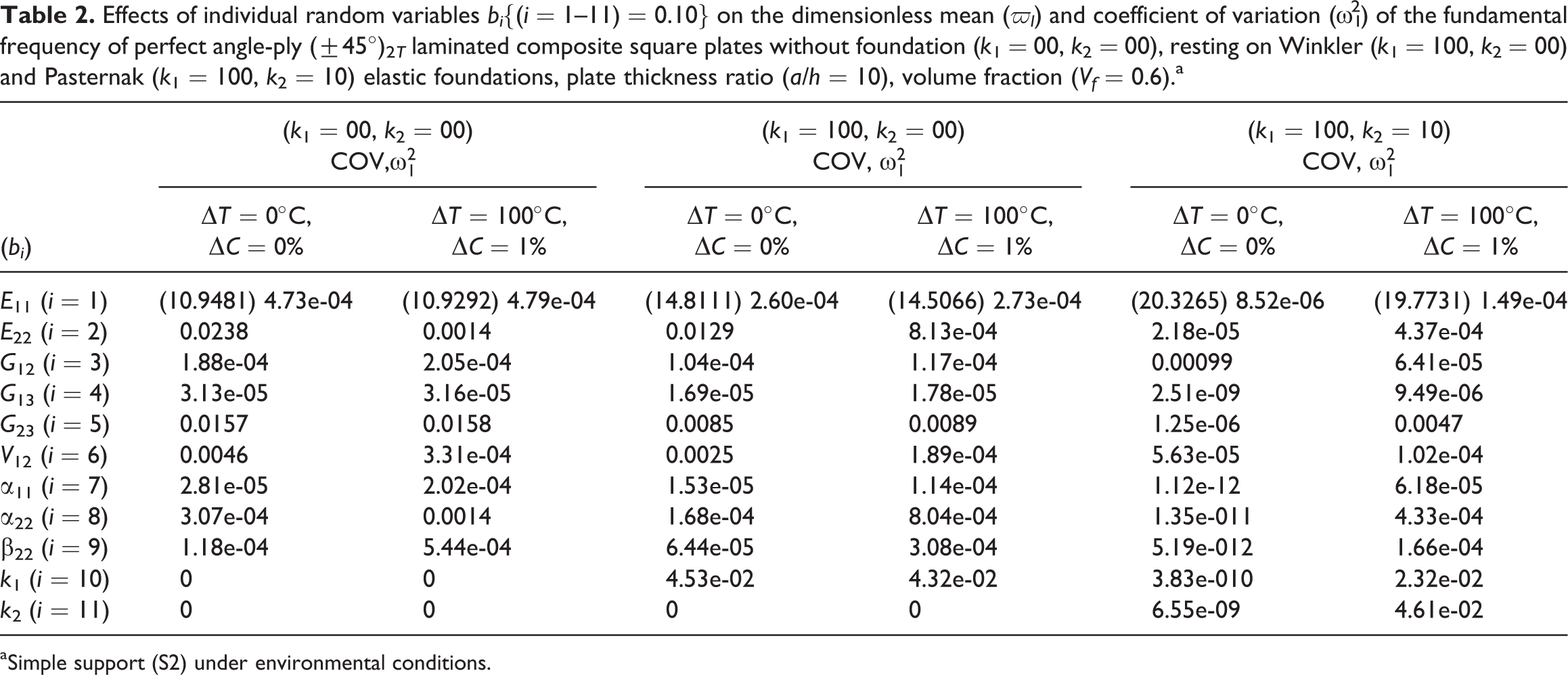
Table 2 shows the effects of individual random variables bi
, {(i = 1–11) = 0.10} on the dimensionless mean (ϖ
l
) and
Effects of individual random variables bi {(i = 1–11) = 0.10} on the dimensionless mean (ϖ l ) and coefficient of variation (ω1 2) of the fundamental frequency of perfect angle-ply (±45°)2T laminated composite square plates without foundation (k 1 = 00, k 2 = 00), resting on Winkler (k 1 = 100, k 2 = 00) and Pasternak (k 1 = 100, k 2 = 10) elastic foundations, plate thickness ratio (a/h = 10), volume fraction (Vf = 0.6).a
aSimple support (S2) under environmental conditions.
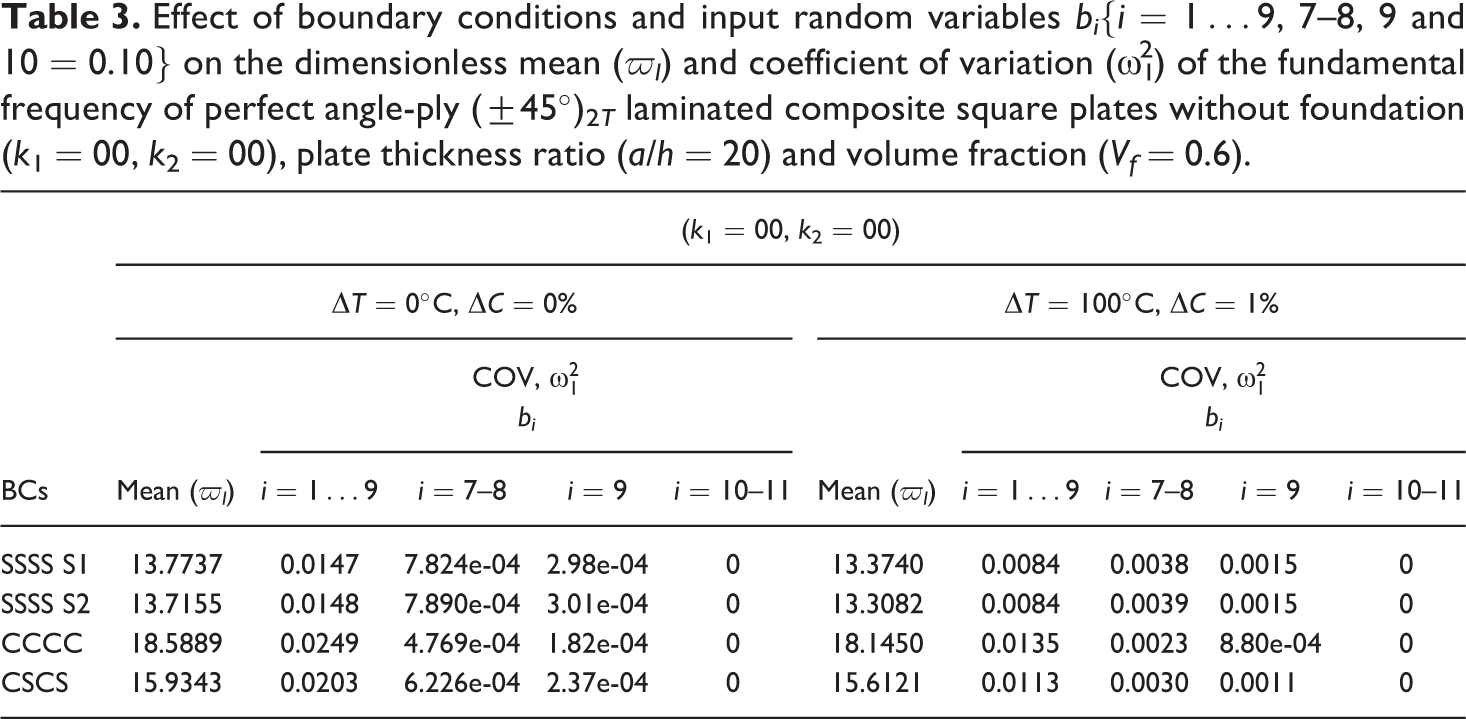
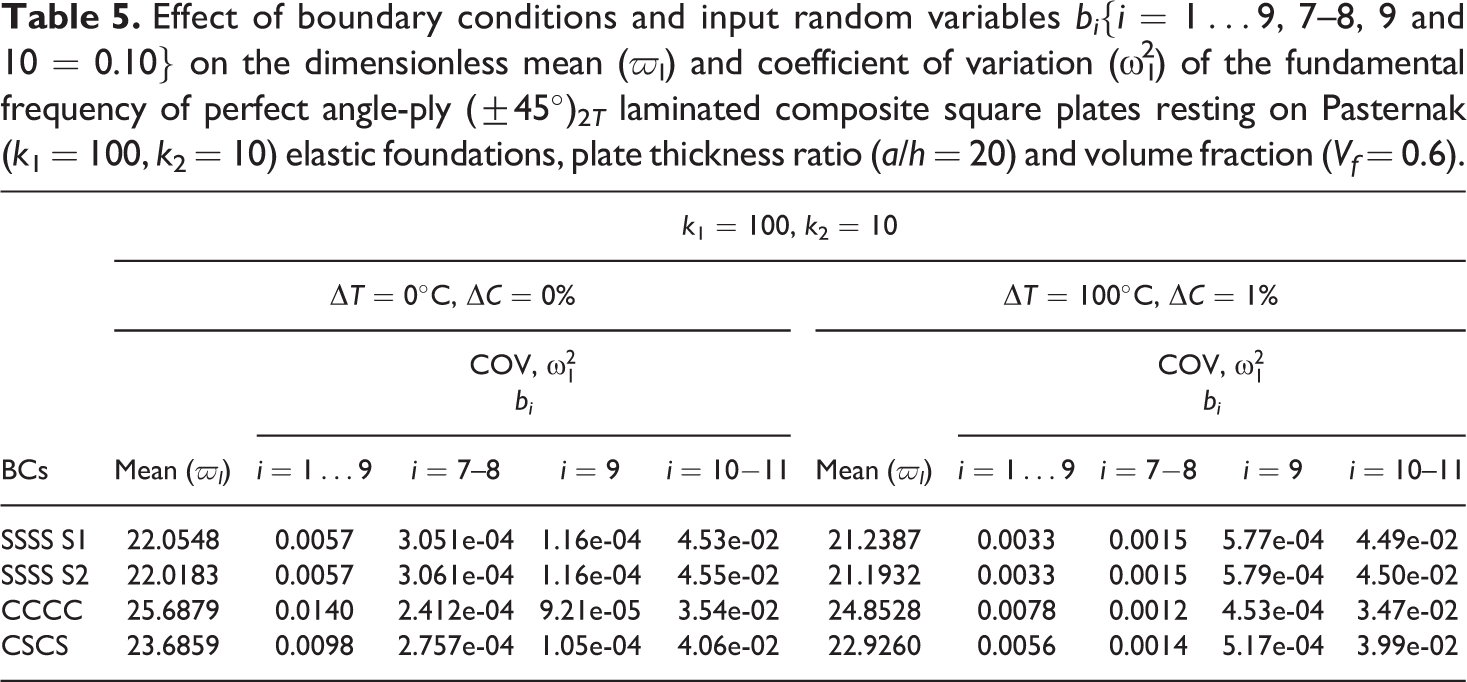
Effect of boundary conditions and input random variables bi
{i = 1…9, 7–8, 9 and 10 = 0.10} on the dimensionless mean (ϖl) and
Effect of boundary conditions and input random variables bi {i = 1…9, 7–8, 9 and 10 = 0.10} on the dimensionless mean (ϖ l ) and coefficient of variation (ω1 2) of the fundamental frequency of perfect angle-ply (±45°)2T laminated composite square plates without foundation (k 1 = 00, k 2 = 00), plate thickness ratio (a/h = 20) and volume fraction (Vf = 0.6).
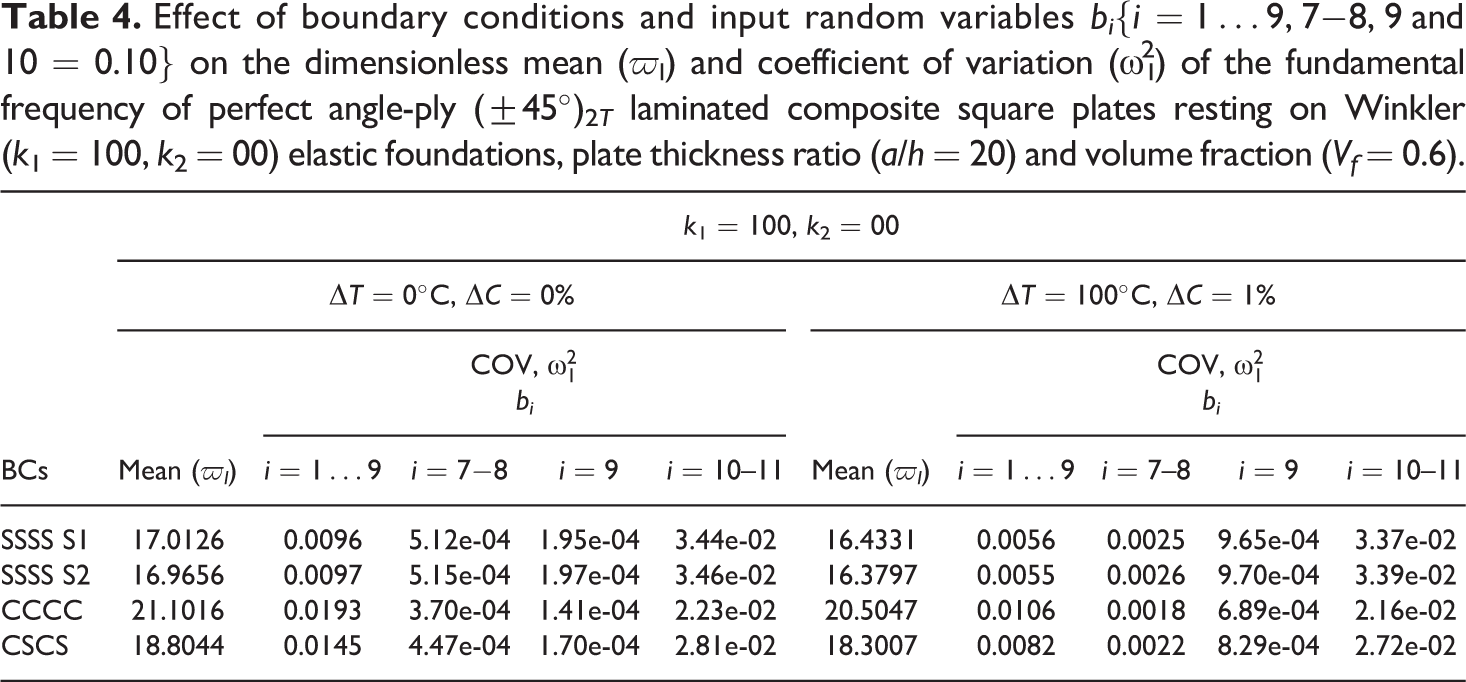
Effect of boundary conditions and input random variables bi {i = 1…9, 7−8, 9 and 10 = 0.10} on the dimensionless mean (ϖl) and coefficient of variation (ω1 2) of the fundamental frequency of perfect angle-ply (±45°)2T laminated composite square plates resting on Winkler (k 1 = 100, k 2 = 00) elastic foundations, plate thickness ratio (a/h = 20) and volume fraction (Vf = 0.6).
Effect of boundary conditions and input random variables bi {i = 1…9, 7–8, 9 and 10 = 0.10} on the dimensionless mean (ϖl) and coefficient of variation (ω1 2) of the fundamental frequency of perfect angle-ply (±45°)2T laminated composite square plates resting on Pasternak (k 1 = 100, k 2 = 10) elastic foundations, plate thickness ratio (a/h = 20) and volume fraction (Vf = 0.6).
Tables 6–8 show the effect of plate thickness ratios (a/h) and input random variables bi
{i = 1…9, 7–8, 9 and 10 = 0.10} on the dimensionless mean (ϖl) and
Effect of plate thickness ratios (a/h) and input random variables bi {i = 1…9, 7–8, 9 and 10 = 0.10} on the dimensionless mean (ϖ l ) and coefficient of variation (ω1 2) of the fundamental frequency of perfect angle-ply (±45°)2T laminated composite square plates without (k 1 = 00, k 2 = 00) elastic foundations, volume fraction (Vf = 0.6).a
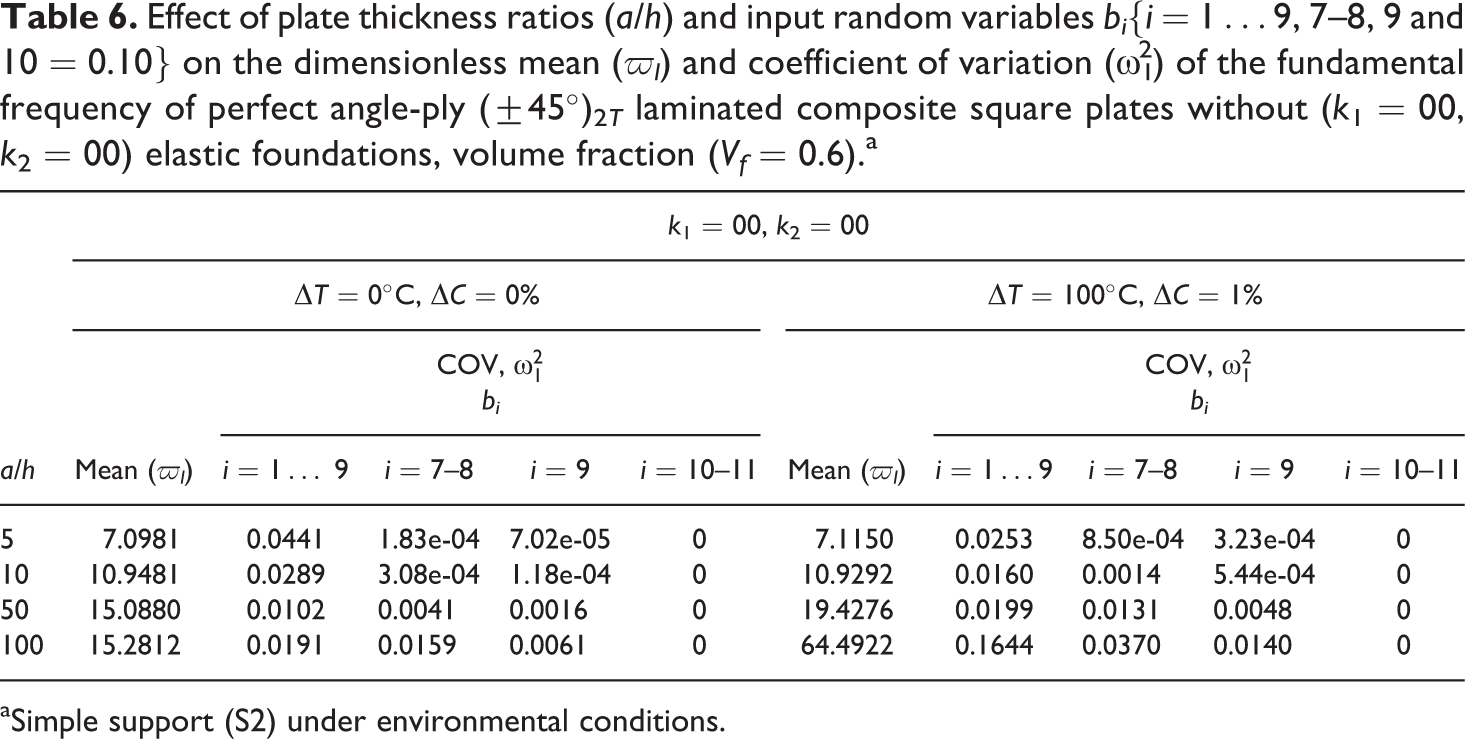
aSimple support (S2) under environmental conditions.
Effect of plate thickness ratios (a/h) and input random variables bi {i = 1…9, 7–8, 9 and 10 = 0.10} on the dimensionless mean (ϖ l ) and coefficient of variation (ω1 2) of the fundamental frequency of perfect angle-ply (±45°)2T laminated composite square plates resting on Winkler (k 1 = 100, k 2 = 00) elastic foundations, volume fraction (Vf = 0.6).a
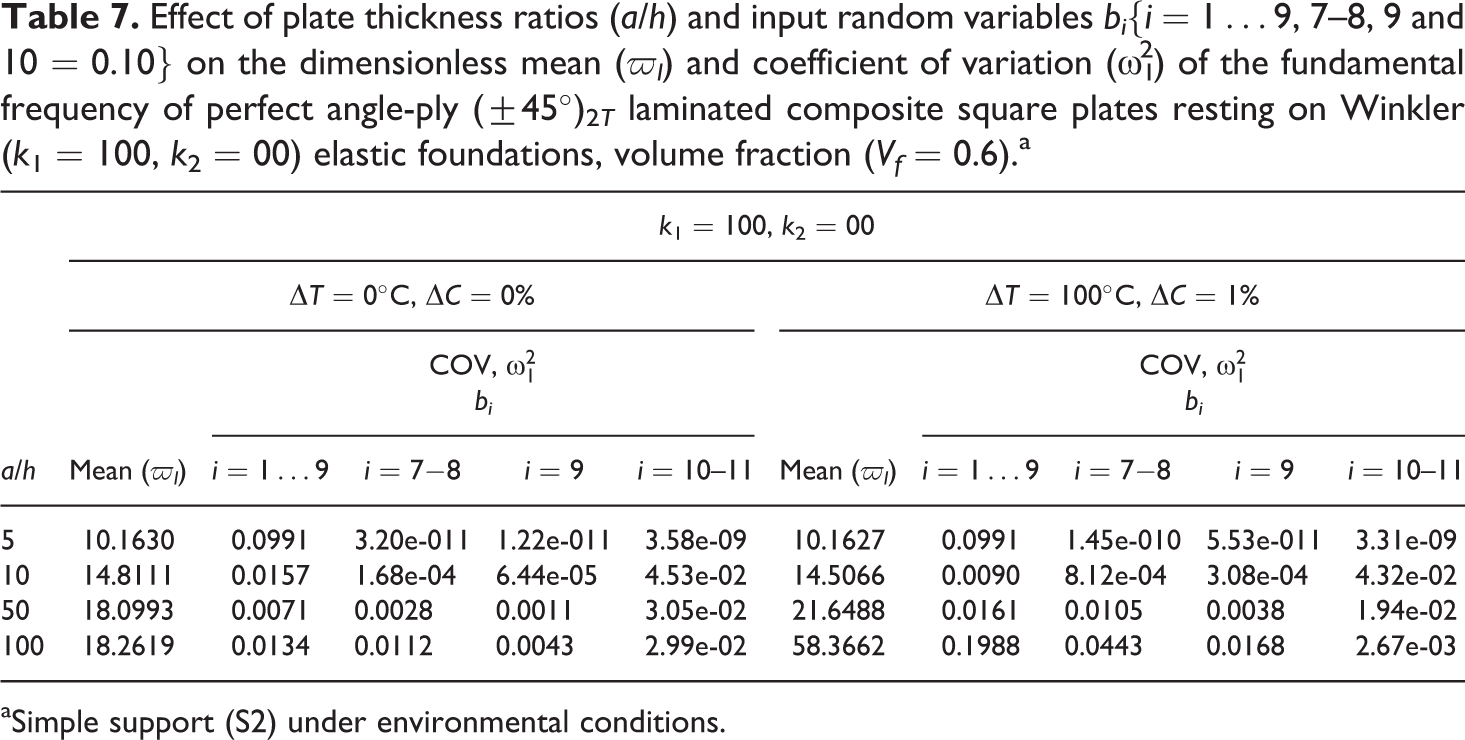
aSimple support (S2) under environmental conditions.
Effect of plate thickness ratios (a/h) and input random variables bi {i = 1…9, 7–8, 9 and 10 = 0.10}on the dimensionless mean (ϖ l ) and coefficient of variation (ω1 2) of the fundamental frequency of perfect angle-ply (±45°)2T laminated composite square plates resting on Pasternak (k 1 = 100, k 2 = 10) elastic foundations, volume fraction (Vf = 0.6).a
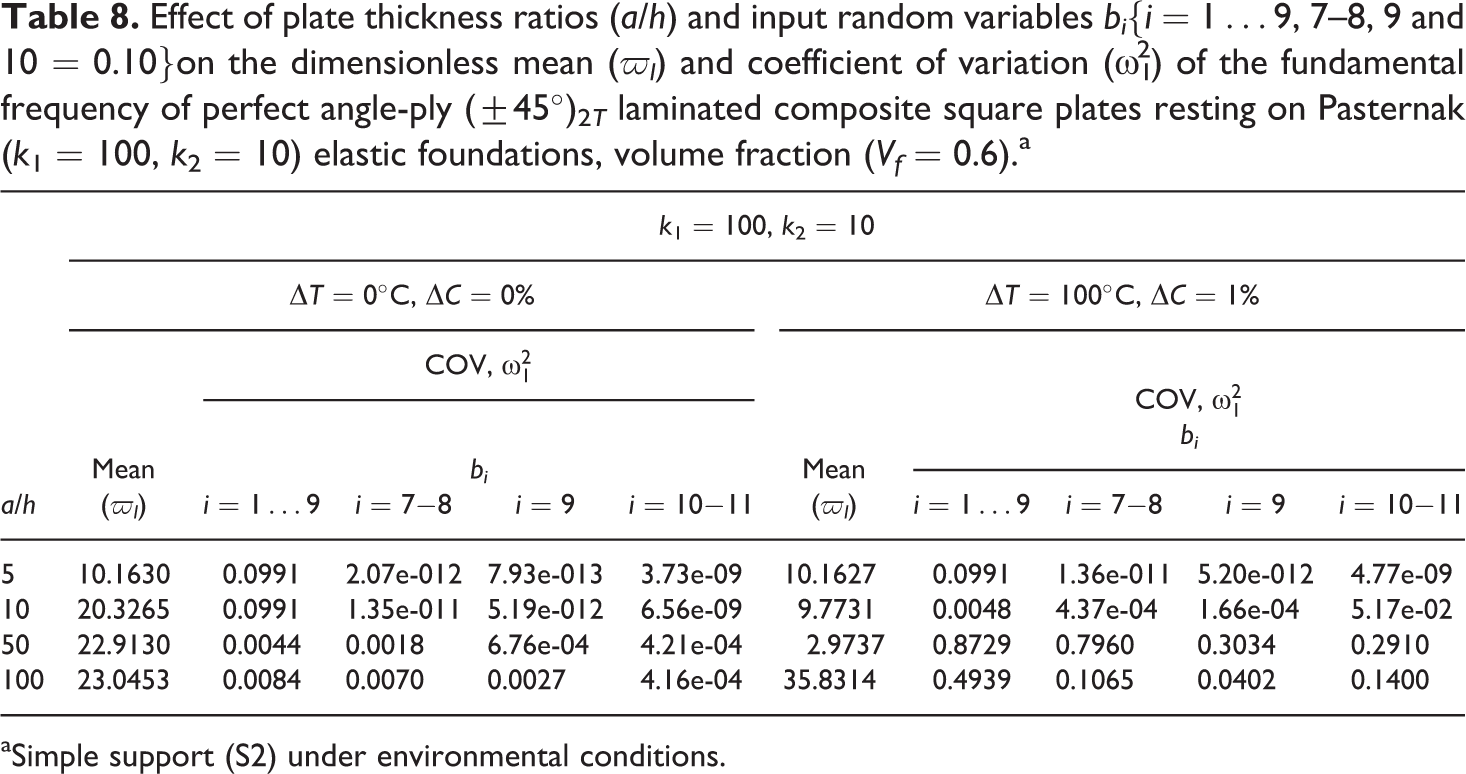
aSimple support (S2) under environmental conditions.
Effect of aspect ratio (a/b) and input random variables bi
{i = 1…9, 7–8, 9 and 10 = 0.10} on the dimensionless mean (ϖ
l
) and
Effect of aspect ratio (a/b) and input random variables bi {i = 1…9, 7–8, 9 and 10 = 0.10}on the dimensionless mean (ϖ l ) and coefficient of variation (ω1 2) of the fundamental frequency of perfect angle-ply (±45°)2T laminated composite square plates without (k 1 = 00, k 2 = 00) elastic foundations, plate thickness ratio (a/h = 30), volume fraction (Vf = 0.6).a
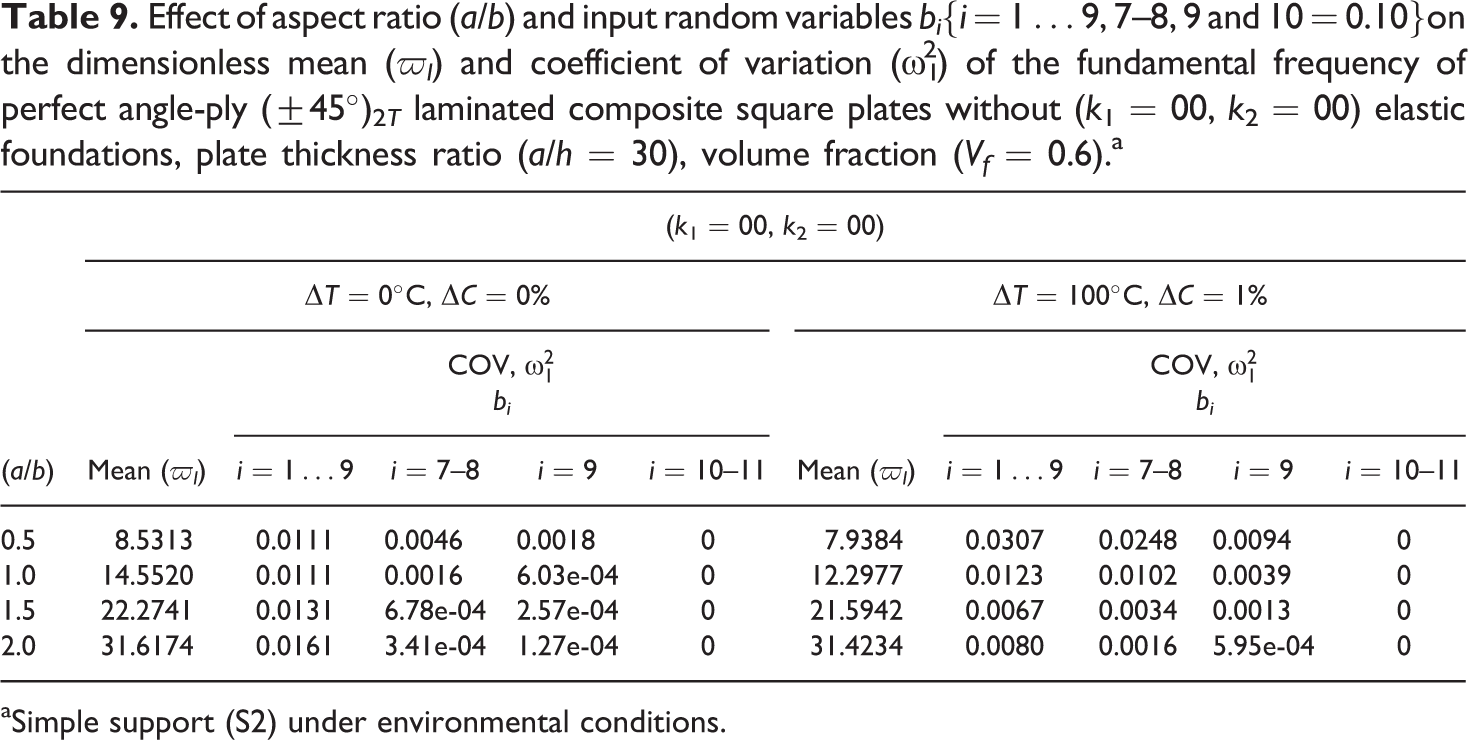
aSimple support (S2) under environmental conditions.
Effect of aspect ratio (a/b) and input random variables bi {i = 1…9, 7–8, 9 and 10 = 0.10} on the dimensionless mean (ϖ l ) and coefficient of variation (ω1 2) of the fundamental frequency of perfect angle-ply (±45°)2T laminated composite square plates resting on Winkler (k 1 = 100, k 2 = 00) elastic foundations, plate thickness ratio (a/h = 30), volume fraction (Vf = 0.6).a
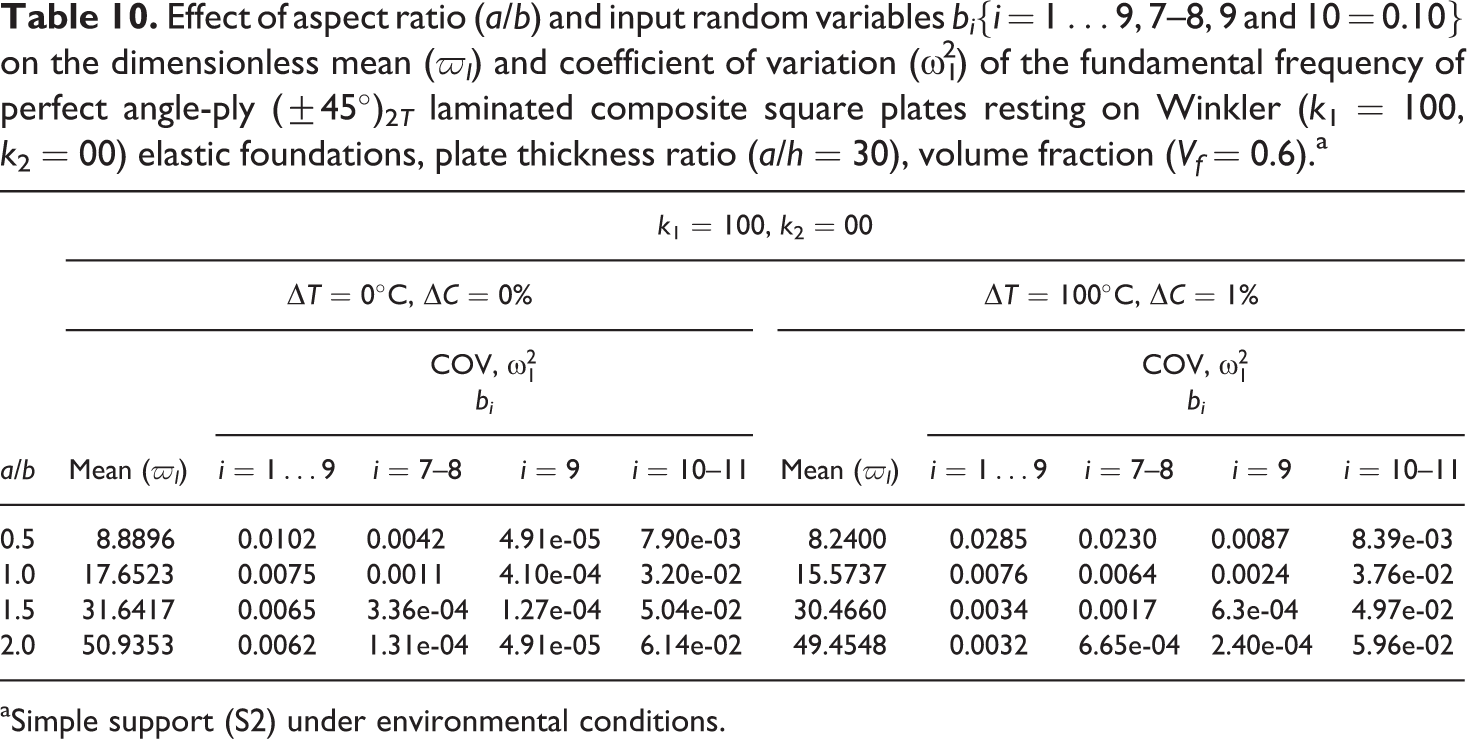
aSimple support (S2) under environmental conditions.
Effect of aspect ratio (a/b) and input random variables bi {i = 1…9, 7–8, 9 and 10 = 0.10} on the dimensionless mean (ϖ l ) and coefficient of variation (ω1 2) of the fundamental frequency of perfect angle-ply (±45°)2T laminated composite square plates resting on Pasternak (k 1 = 100, k 2 = 10) elastic foundations, plate thickness ratio (a/h = 30) and volume fraction (Vf = 0.6).a
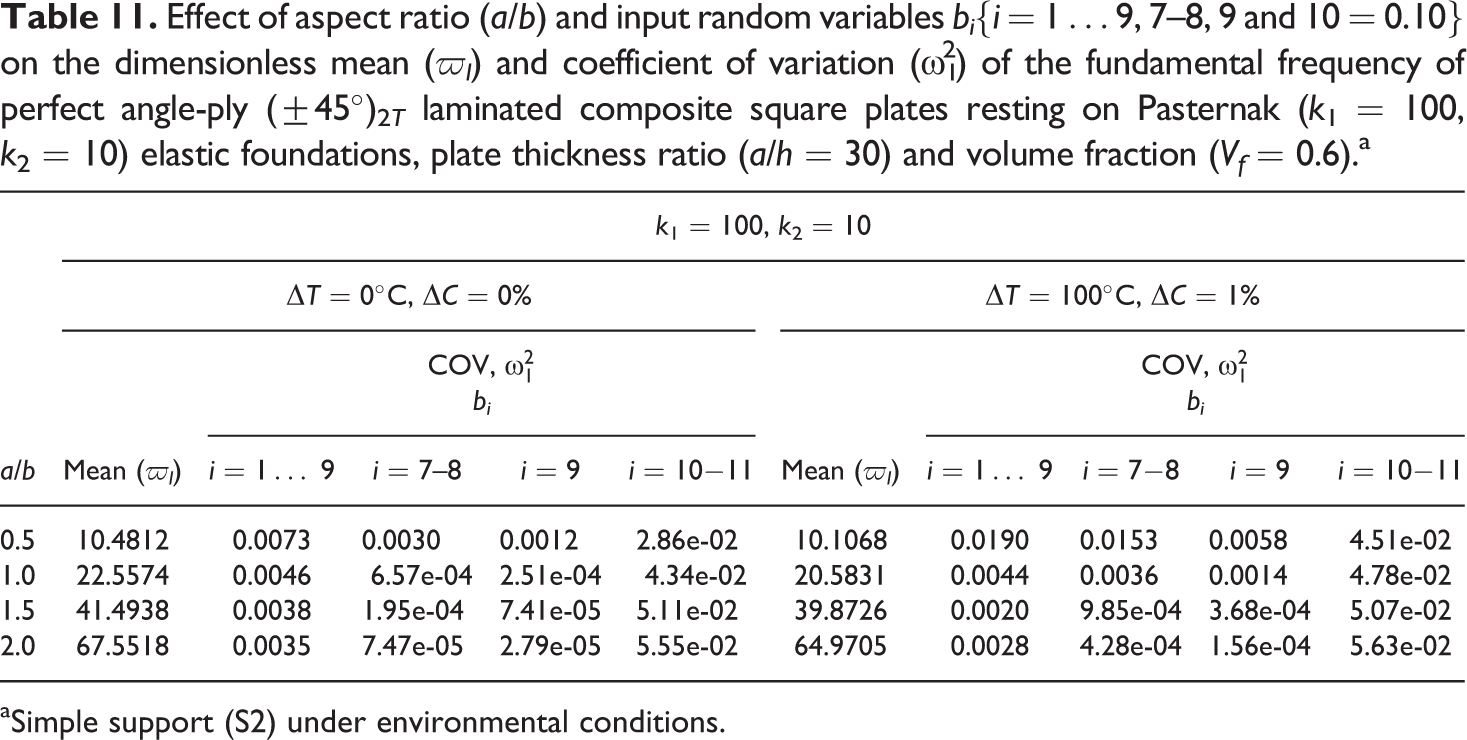
aSimple support (S2) under environmental conditions.
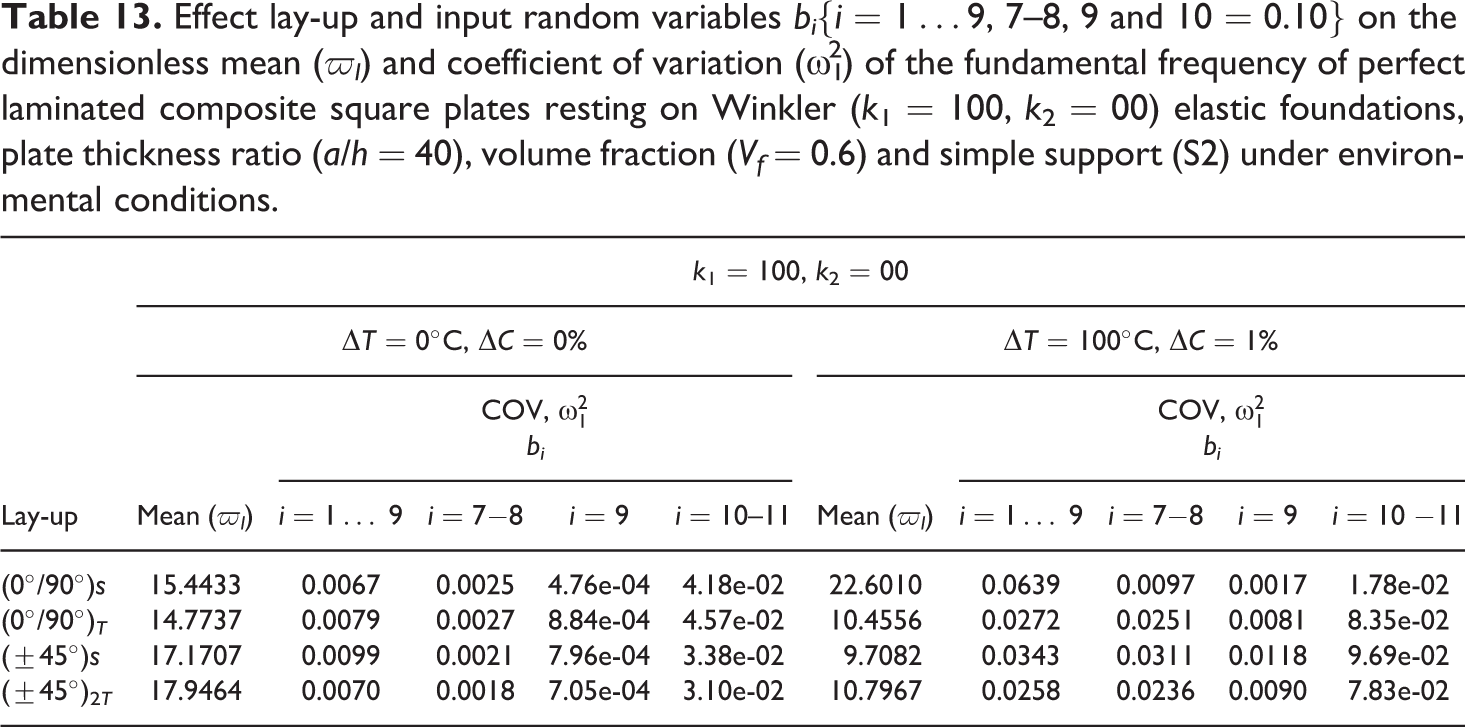
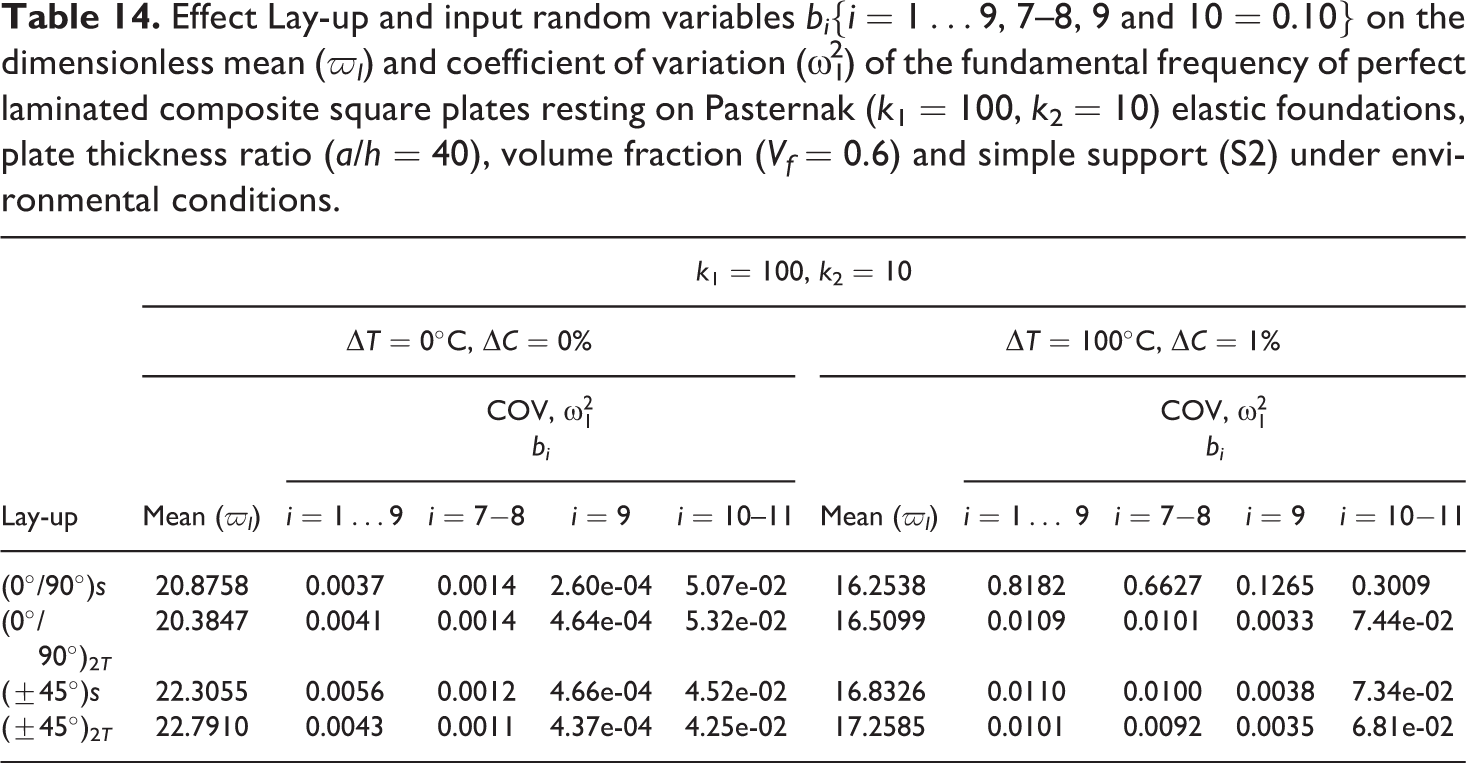
Tables 12–14 show the effect of lay-up and input random variables bi
{i = 1…9, 7–8, 9 and 10 = 0.10} on the dimensionless mean (ϖ
l
) and
Effect lay-up and input random variables bi {i = 1…9, 7–8, 9 and 10 = 0.10} on the dimensionless mean (ϖ l ) and coefficient of variation (ω1 2) of the fundamental frequency of perfect laminated composite square plates without (k 1 = 00, k 2 = 00) elastic foundations, plate thickness ratio (a/h = 40) and volume fraction (Vf = 0.6).a
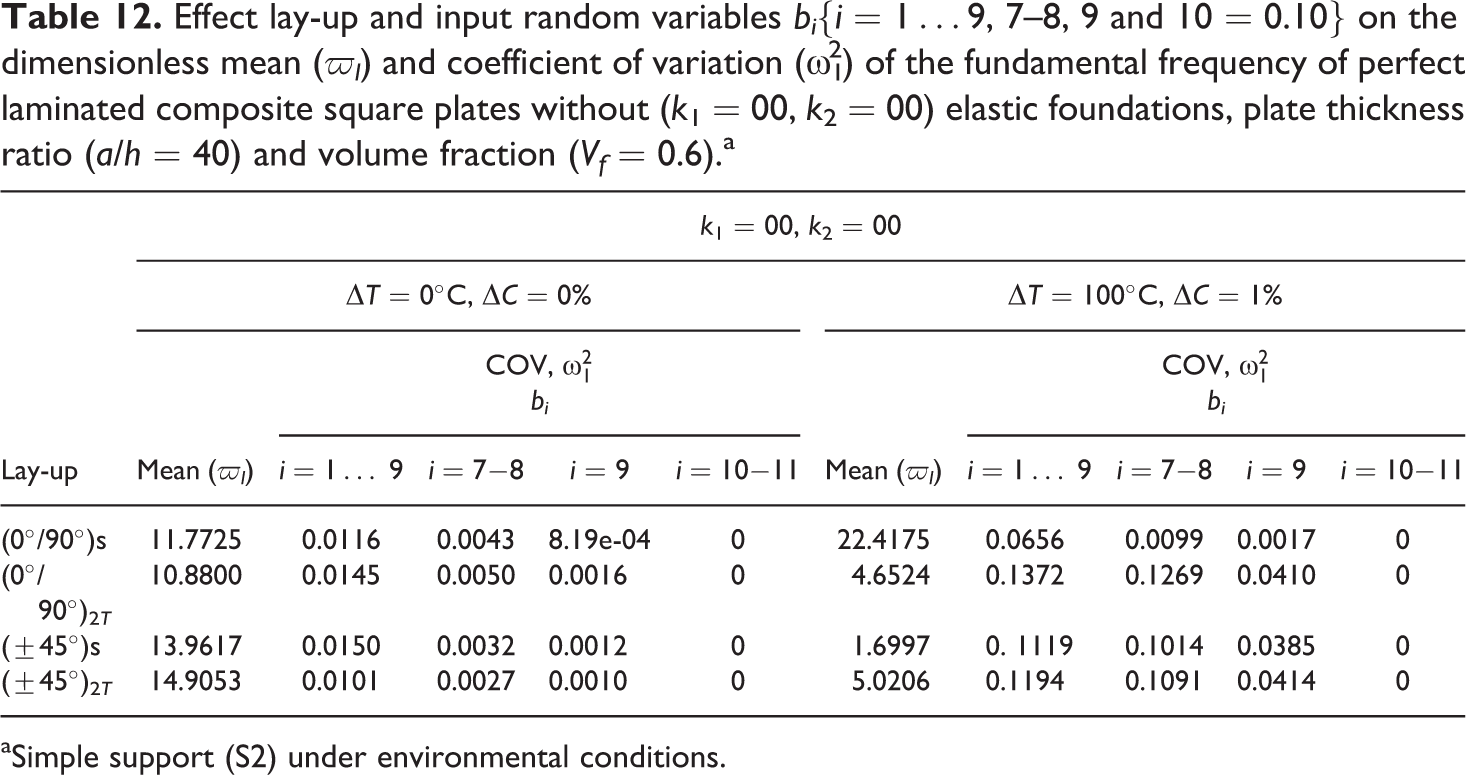
aSimple support (S2) under environmental conditions.
Effect lay-up and input random variables bi {i = 1…9, 7–8, 9 and 10 = 0.10} on the dimensionless mean (ϖ l ) and coefficient of variation (ω1 2) of the fundamental frequency of perfect laminated composite square plates resting on Winkler (k 1 = 100, k 2 = 00) elastic foundations, plate thickness ratio (a/h = 40), volume fraction (Vf = 0.6) and simple support (S2) under environmental conditions.
Effect Lay-up and input random variables bi {i = 1…9, 7–8, 9 and 10 = 0.10} on the dimensionless mean (ϖ l ) and coefficient of variation (ω1 2) of the fundamental frequency of perfect laminated composite square plates resting on Pasternak (k 1 = 100, k 2 = 10) elastic foundations, plate thickness ratio (a/h = 40), volume fraction (Vf = 0.6) and simple support (S2) under environmental conditions.
Effect of volume fraction (Vf
) and input random variables bi
{i = 1…9, 7–8, 9 and 10 = 0.10}on the dimensionless mean (ϖ
l
) and
Effect of volume fraction (V f) and input random variables bi {i = 1…9, 7–8, 9 and 10 = 0.10} on the dimensionless mean (ϖ l ) and coefficient of variation (ω1 2) of the fundamental frequency of perfect angle-ply (±45°)2T laminated composite square plates without (k 1 = 00, k 2 = 00) elastic foundations, plate thickness ratio (a/h = 40), volume fraction (Vf = 0.6).a
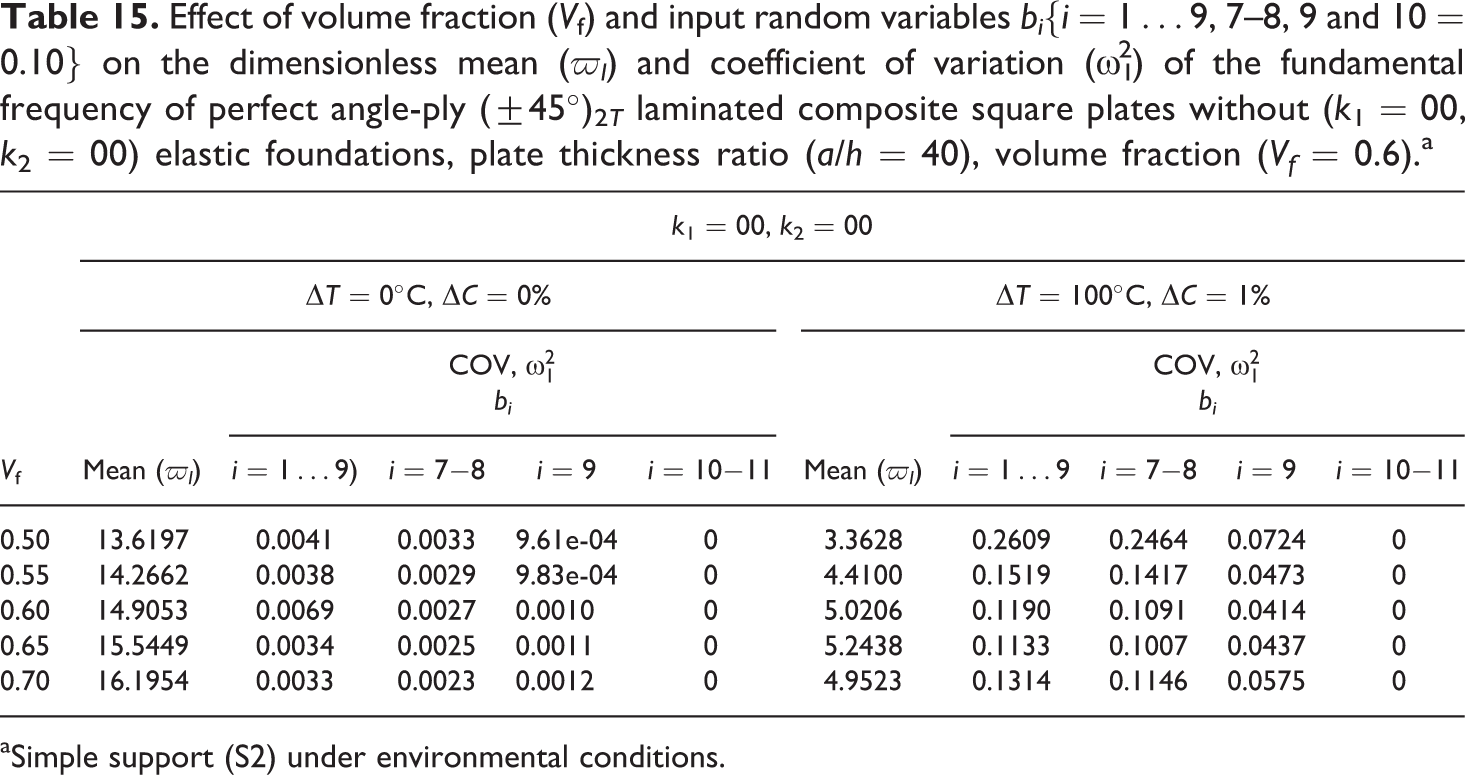
aSimple support (S2) under environmental conditions.
Effect of volume fraction (Vf ) and input random variables bi {i = 1…9, 7–8, 9 and 10 = 0.10} on the dimensionless mean (ϖ l ) and coefficient of variation (ω1 2) of the fundamental frequency of perfect angle-ply (±45°)2T laminated composite square plates resting on Winkler (k 1 = 100, k 2 = 00) elastic foundations, plate thickness ratio (a/h = 40), Vf = 0.6.a
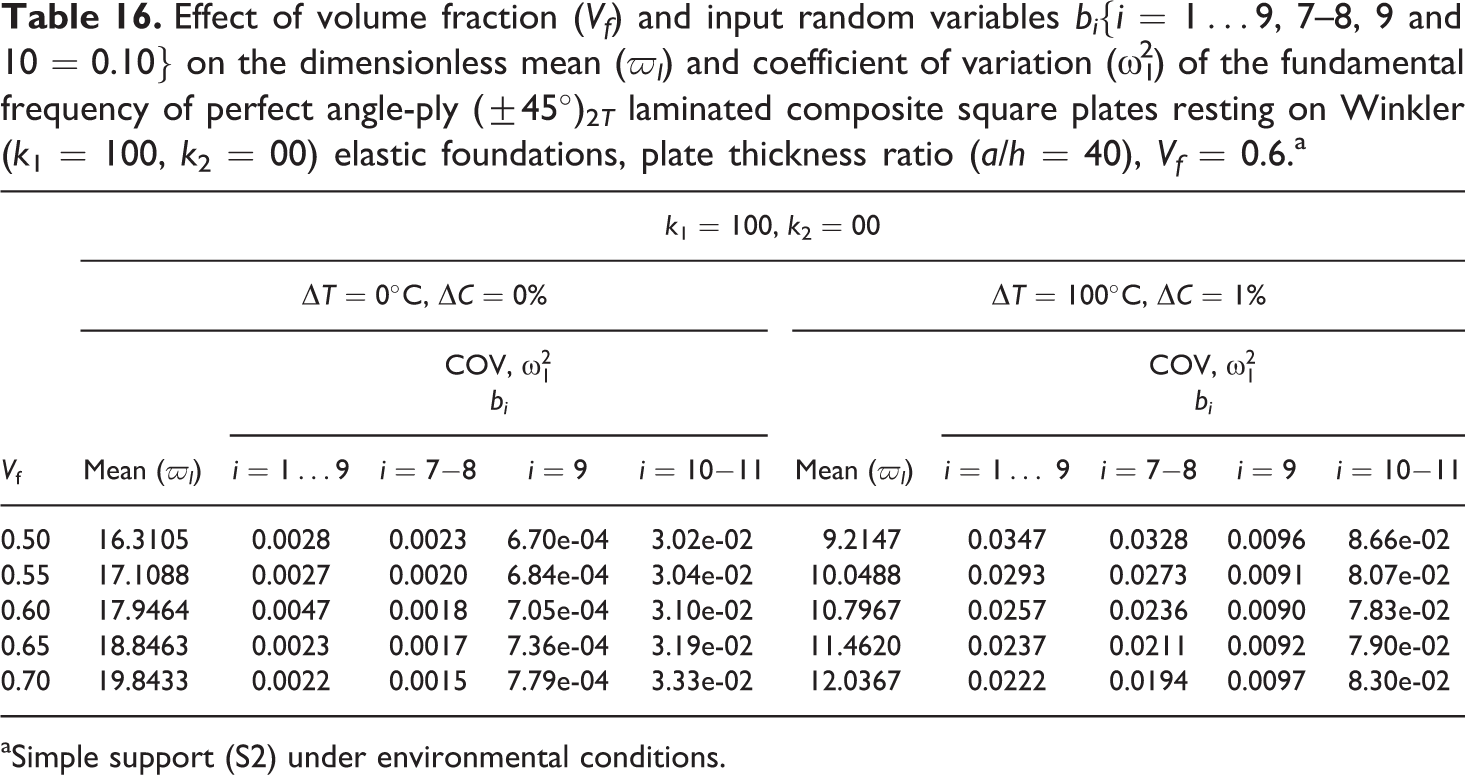
aSimple support (S2) under environmental conditions.
Effect of volume fraction (Vf ) and input random variables bi {i = 1…9, 7–8, 9 and 10 = 0.10} on the dimensionless mean (ϖ l ) and coefficient of variation (ω1 2) of the fundamental frequency of perfect angle-ply (±45°)2T laminated composite square plates resting on Pasternak (k 1 = 100, k 2 = 10) elastic foundations, plate thickness ratio (a/h = 40), Vf = 0.6.a
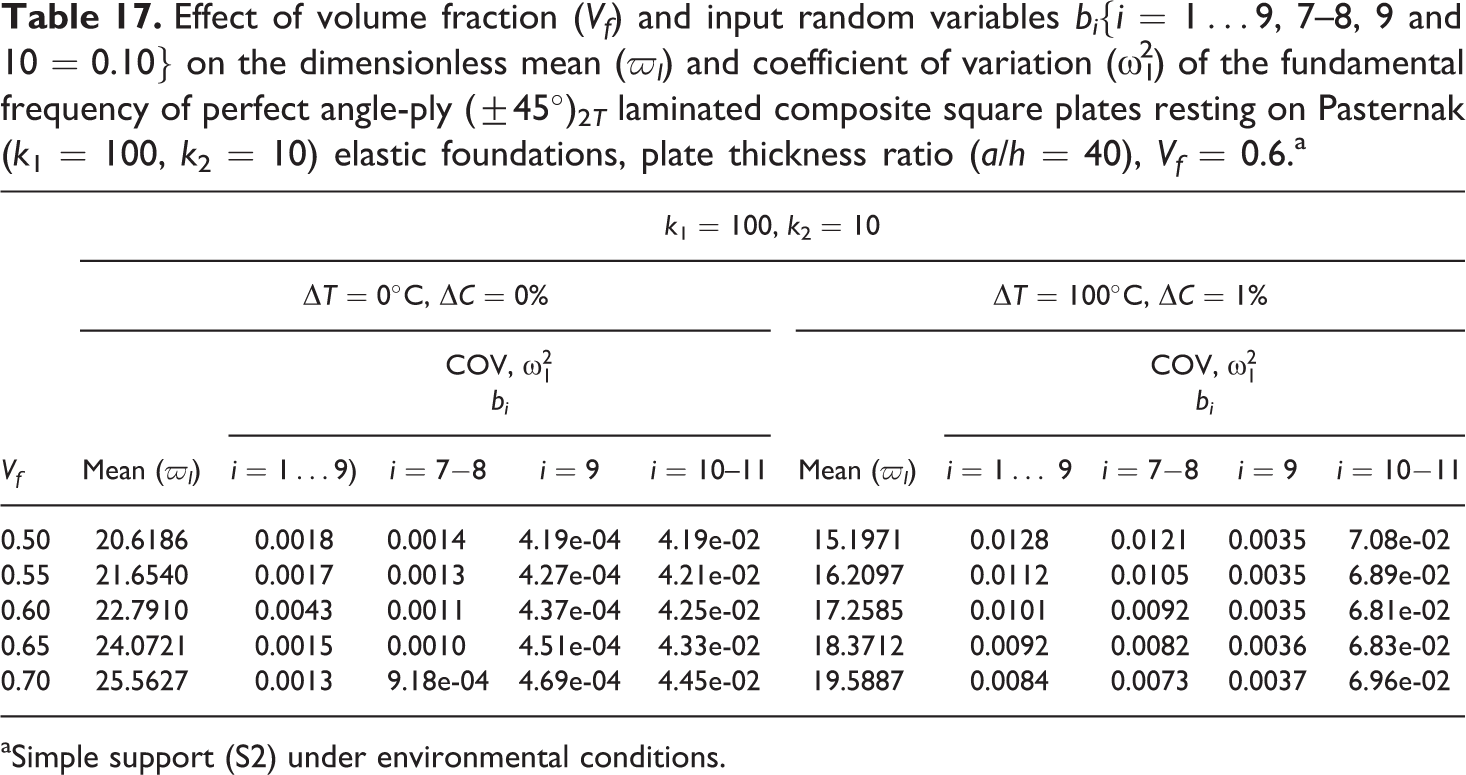
aSimple support (S2) under environmental conditions.
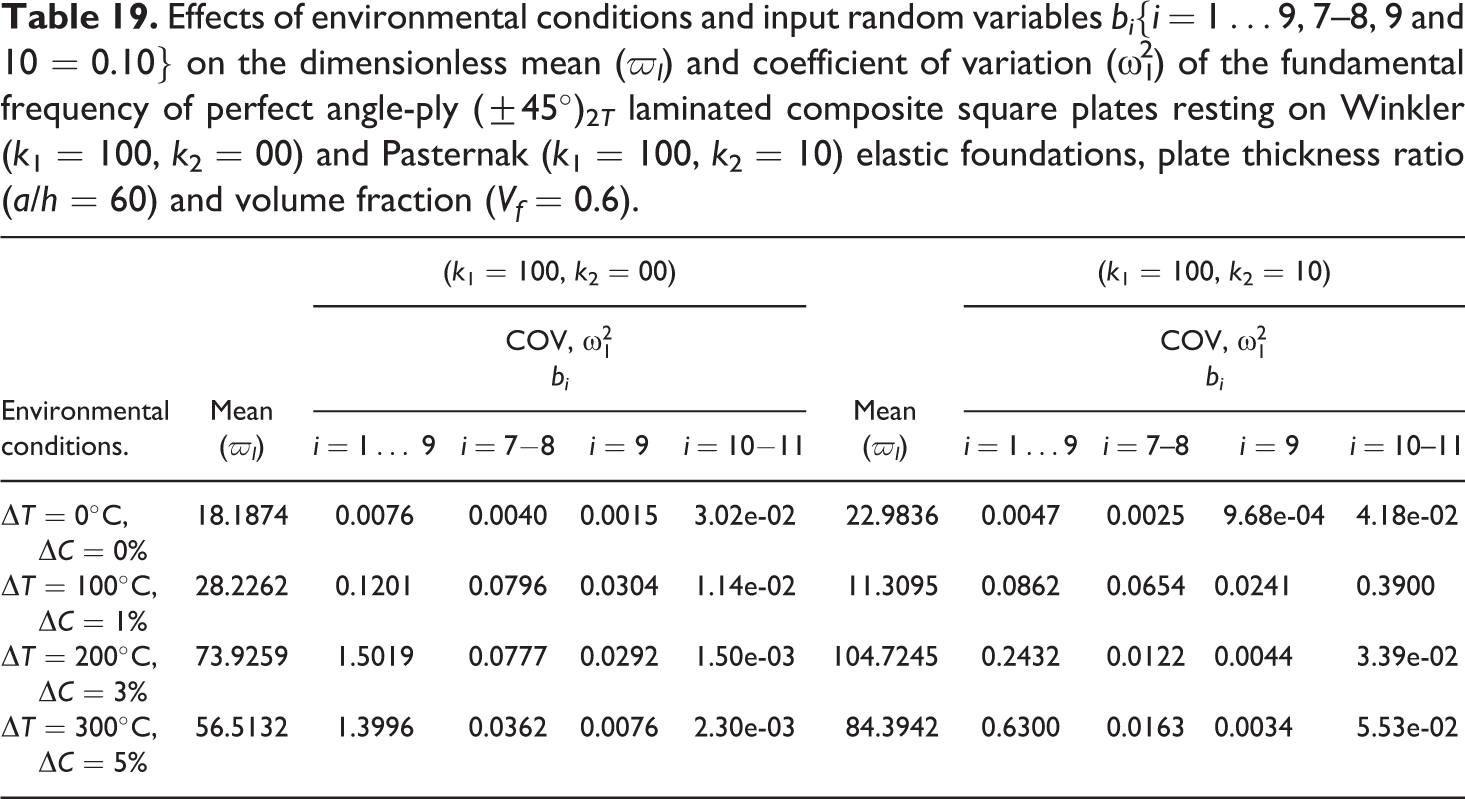
Tables 18 and 19 show the effects of environmental conditions and input random variables bi
{i = 1…9, 7–8, 9 and 10 = 0.10} on the dimensionless mean (ϖ
l
) and
Effects of environmental conditions and input random variables bi {i = 1…9, 7–8, 9 and 10 = 0.10} on the dimensionless mean (ϖ l ) and coefficient of variation (ω1 2) of the fundamental frequency of perfect angle-ply (±45°)2T laminated composite square plates without (k 1 = 00, k 2 = 00) elastic foundations, plate thickness ratio (a/h = 60) and volume fraction (Vf = 0.6).a
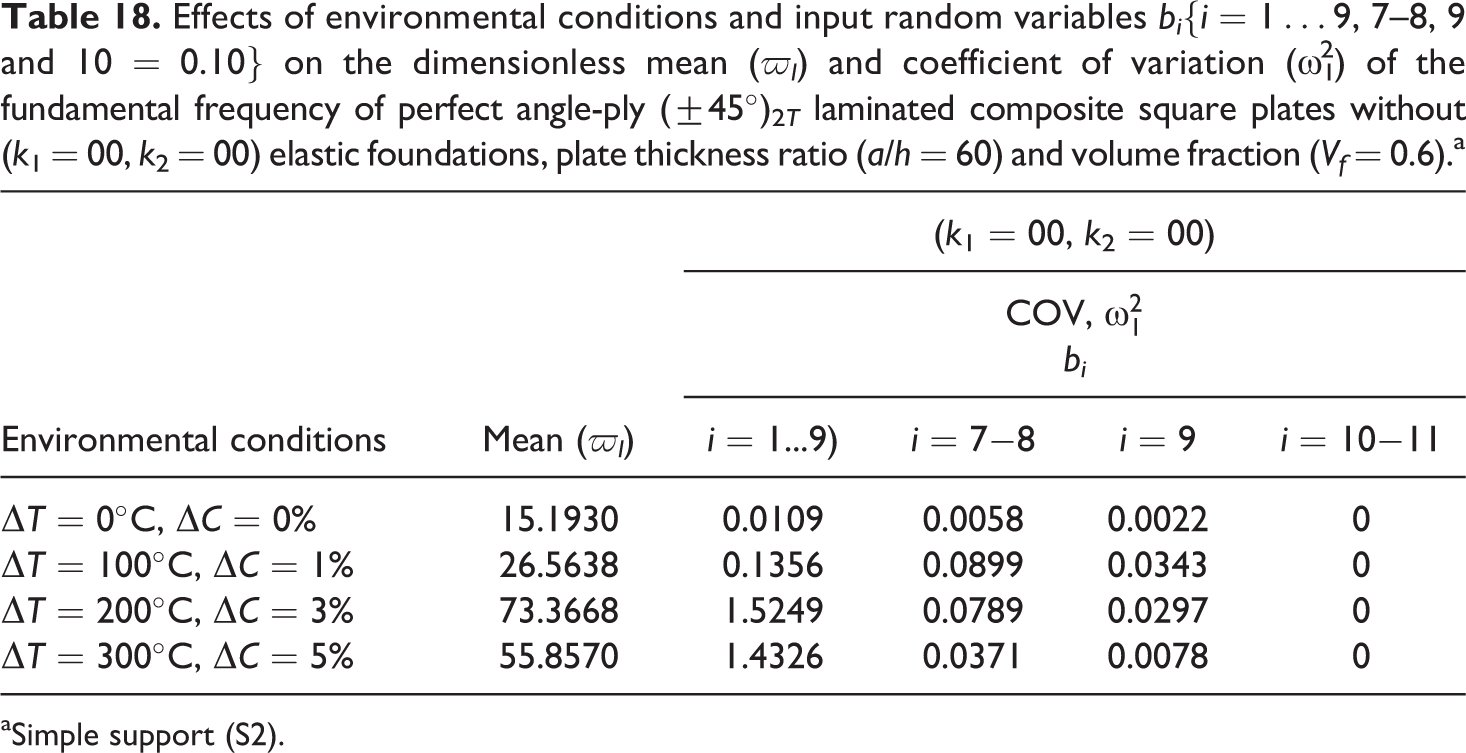
aSimple support (S2).
Effects of environmental conditions and input random variables bi {i = 1…9, 7–8, 9 and 10 = 0.10} on the dimensionless mean (ϖ l ) and coefficient of variation (ω1 2) of the fundamental frequency of perfect angle-ply (±45°)2T laminated composite square plates resting on Winkler (k 1 = 100, k 2 = 00) and Pasternak (k 1 = 100, k 2 = 10) elastic foundations, plate thickness ratio (a/h = 60) and volume fraction (Vf = 0.6).
Conclusions
A C
0 FEM in conjunction with FOPT is employed to compute the mean and COV of the hygrothermal fundamental frequency of the laminated composite plate with random change in all input variables, aspect ratios and Winkler and Pasternak elastic foundations. Assumptions are made for uniform distribution of temperature and moisture over entire surface and through the thickness of laminated composite plate. The following main things are concluded from the limited present investigation.
The first-order perturbation technique gives acceptable results for the range of COV taken in the study. It is observed that COV for E
11 and E
22 is of significance compared to all other random input variables in case plates resting on Winkler and Pasternak foundations. The characteristics of hygrothermal fundamental frequency of laminated composite plate is significantly influenced by various support conditions, plate thickness ratios, aspect ratios, volume fraction, elastic foundations, temperature and moisture changes. The mean and COV of fundamental frequency plate is significant when the plate is subjected to hygrothermoelastic material properties. The clamp-supported plate vibrates at slightly higher temperature and moisture compared to other supports when resting on Pasternak elastic foundation. Vibration is less dominant in moderately thick plate compared to thin plate. It is also noticed that with Pasternak foundation support the mean fundamental frequency is higher and COV of fundamental frequency is lower compared to Winkler foundation. The sensitivity of hygrothermal fundamental frequency, COV due to variation in material properties, is dependent on thickness ratio and boundary conditions of the laminate. The study is meaningful for the aerospace applications where such environmental conditions may occur besides other factors. The importance of elastic foundations on which laminated composite plate is resting is quite important from the design point of view.
Footnotes
Appendix A