




Abstract
Creep behavior of rotating discs made of functionally graded materials with linearly varying thickness has been investigated. The discs contain silicon carbide particles in a matrix of pure aluminum. The effect of varying disc thickness gradient (TG) has been investigated on the stresses and strain rates in the composite disc. The study shows that with the increase in disc TG, the radial, tangential and effective stresses decrease throughout the disc. The strain rates in the disc also reduce significantly with the increase in TG of the disc.
Introduction
Rotating disc is a widely used structural component in steam and gas turbine rotors, turbo generators, pumps, compressors, flywheels, automotive braking systems, ship propellers and computer disc drives. 1 ,2 In most of these applications, it has to operate at high temperature and under high stresses caused by disc rotation at high speed. 3 Due to severe thermomechanical loadings, the disc undergoes significant creep deformations, which may severely affect its performance. 1 ,4–6
Under high temperature, rotating disc made of monolithic material may not perform well. The excellent mechanical properties like high specific strength and stiffness and high temperature stability offered by aluminum (Al) matrix composites reinforced with silicon carbide (SiC) particles, whiskers or fibers make them suitable for rotating disc applications exposed to elevated temperature. 7–9
The problem of creep in rotating disc made of functionally graded materials (FGMs) subjected to high stresses and high temperature has attracted the interest of many researchers. In FGMs, the content of two or more constituent materials is gradually varied with respect to certain dimension/dimensions. 10 FGMs have been designed and developed to sustain high-temperature environments. Singh and Ray 11 investigated steady state creep in an isotropic, constant thickness rotating disc made of functionally graded (FG) Al-SiCp (subscript ‘p’ refers to particle shape of SiC) and subjected to a constant temperature. The content of SiCp in the disc was assumed to decrease linearly from the inner to the outer radius. The study indicates that the creep response of the FGM disc is significantly superior when compared with a similar disc having uniform distribution of SiCp. Gupta et al. 1 further extended the analysis for a rotating FGM disc having uniform thickness but operating under a radial thermal gradient, which results due to braking action of the disc. The study further established the superiority of FGM disc over uniform composite disc having uniform distribution of SiCp. Bayat et al. 12 performed thermoelastic analysis of a FG rotating disc of constant thickness with small and large deflections. They observed that for particular values of the grading index (n) of material properties, mechanical responses in the FG disc can be smaller than in a homogenous disc. Bayat et al. 6 further extended their work to obtain elastic solutions for rotating FG discs having variable thickness.
Some of the studies 13–17 indicate that the stresses in rotating disc having variable thickness, with thickness at the center being more than the periphery, are much lower than those observed in a uniform thickness disc operating at the same angular velocity. The use of variable thickness disc increases its plastic limit angular velocity and reduces the magnitude of stresses and deformations in the disc. 15 The study of Jahed et al. 16 indicates that the use of variable thickness disc is helpful in minimizing the weight of the disc in aerospace applications. Our earlier work 18 also indicates that the creep stresses and creep rates in a rotating disc made of uniform composite are significantly reduced, when the disc has linearly varying thickness profile when compared with hyperbolic or constant thickness profile.
The literature consulted so far reveals that the studies pertaining to creep analysis in variable thickness rotating disc made of FG composite are rather scant. Therefore, it is decided to investigate steady state creep in a rotating disc made of FG Al-SiCp and having linearly varying thickness. In order to bring out the effect of imposing different types of linear thickness gradients (TGs) on the creep response, the results obtained for variable thickness FGM discs are compared with a similar FGM disc but having uniform thickness.
Disc profile
In the present work, the creep response has been estimated for rotating discs having two different linearly varying thickness profiles and for a constant thickness disc, while keeping volume of the discs same. For composite discs having linearly varying thickness, the thickness h(r) at any radius r is given by

where the constant
Since the volume of disc with linearly varying thickness is equal to the volume of uniform thickness disc, therefore,

where t is the thickness of constant thickness disc.
Substituting h(r) from Eq. (1) into Eq. (2) and simplifying, we get

Therefore, for given values of
Distribution of reinforcement
The distribution of SiCp in the FG disc is assumed to decrease linearly from the inner to the outer radius. The content (vol%) of SiCp, V(r), at any radius r, is given by

where
Following the rule of mixture, the density

where
Substituting

where

and

For comparison, it is assumed that the total amount of SiCp in the FGM disc having variable thickness, h(r), disc is equal to that in a similar disc but having uniform distribution of SiCp (say Vav ). Therefore,

Using Eq. (2) in the above equation, we get

Substituting h(r) and

Creep law and creep parameters
Similar to our previous work,
18
the steady state creep behavior of the composite is described by following threshold stress (

where


In this study, the constant values of P (=1.7 μm) and T (=623 K) are used. Therefore, the creep parameters will depend only on the content of SiCp in the FG disc, which is a function of radius alone. The values of M(r) and
Mathematical formulation
This section develops a mathematical model to describe the steady creep behavior of the FG disc having linearly varying thickness. The analysis carried out is based on the following assumptions.
Material of the disc is incompressible and locally isotropic.
Stresses at any point in the disc remain constant with time.
Elastic deformations in the disc, being small, are neglected when compared with creep deformations.
The disc is under plane stress condition, that is, axial stress (
The generalized constitutive equations for creep in an isotropic composite disc under plane stress condition, when the reference frame is along the principal directions r, θ and z, are 1
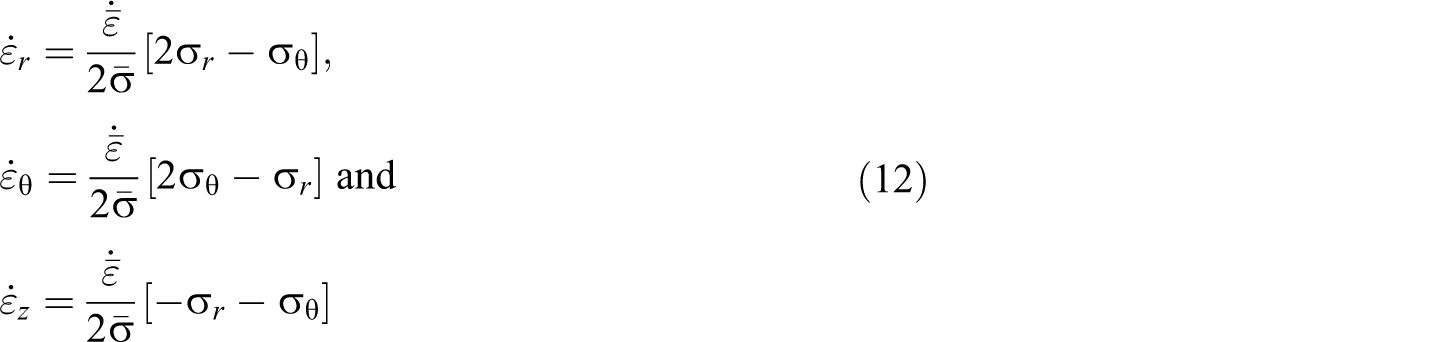
where
The effective stress (

Substituting

where
Similarly, the second equation among the set of equations in Eq. (12) becomes

Dividing Eq. (14) by Eq. (15) and integrating the resulting equation between limits a to r, we get

Where
Substituting

where

and

The equilibrium equation for a rotating disc having variable thickness is given by 22

Assuming that the disc is connected to the shaft by means of splines, where small axial movement is permitted, the boundary conditions 12 are

Integrating the equilibrium Eq. (20) between limits a to b under the boundary conditions given in Eq. (21), we obtain

where
Multiplying Eq. (17) by h(r)dr and integrating the resulting equation between limits a to b, one gets,

Knowing
Integrating equilibrium Eq. (20) again between limits a to r, the radial stress (

where J is the polar moment of area of the disc element with the inner and outer radii as a and r, respectively (Appendix B).
The distribution of stresses,
Results and discussions
A computer code, based on the mathematical analysis presented in previous section, has been developed to obtain the distribution of stresses and steady state creep rates in the FGM discs having two different linear TG as described in Table 1. The values of a, b and t are taken, respectively, as 31.75, 152.4 and 25.4 mm. These dimensions are similar to those used in earlier study by Bhatnagar et al. 13 The results obtained for FGM discs D2 and D3 are compared with a similar FGM disc but having uniform thickness, while keeping volume of all the discs equal.
Description of rotating discs.a
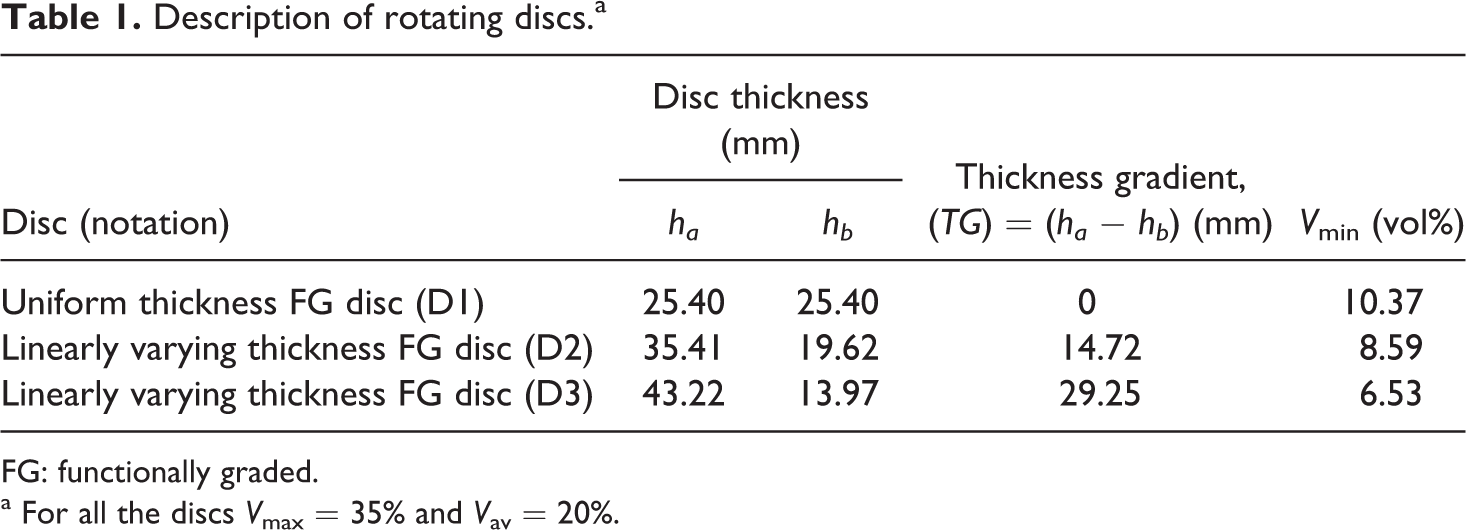
FG: functionally graded.
a For all the discs V max = 35% and V av = 20%.
Variation of creep parameters
Figure 1a and b show the variation of creep parameters M and
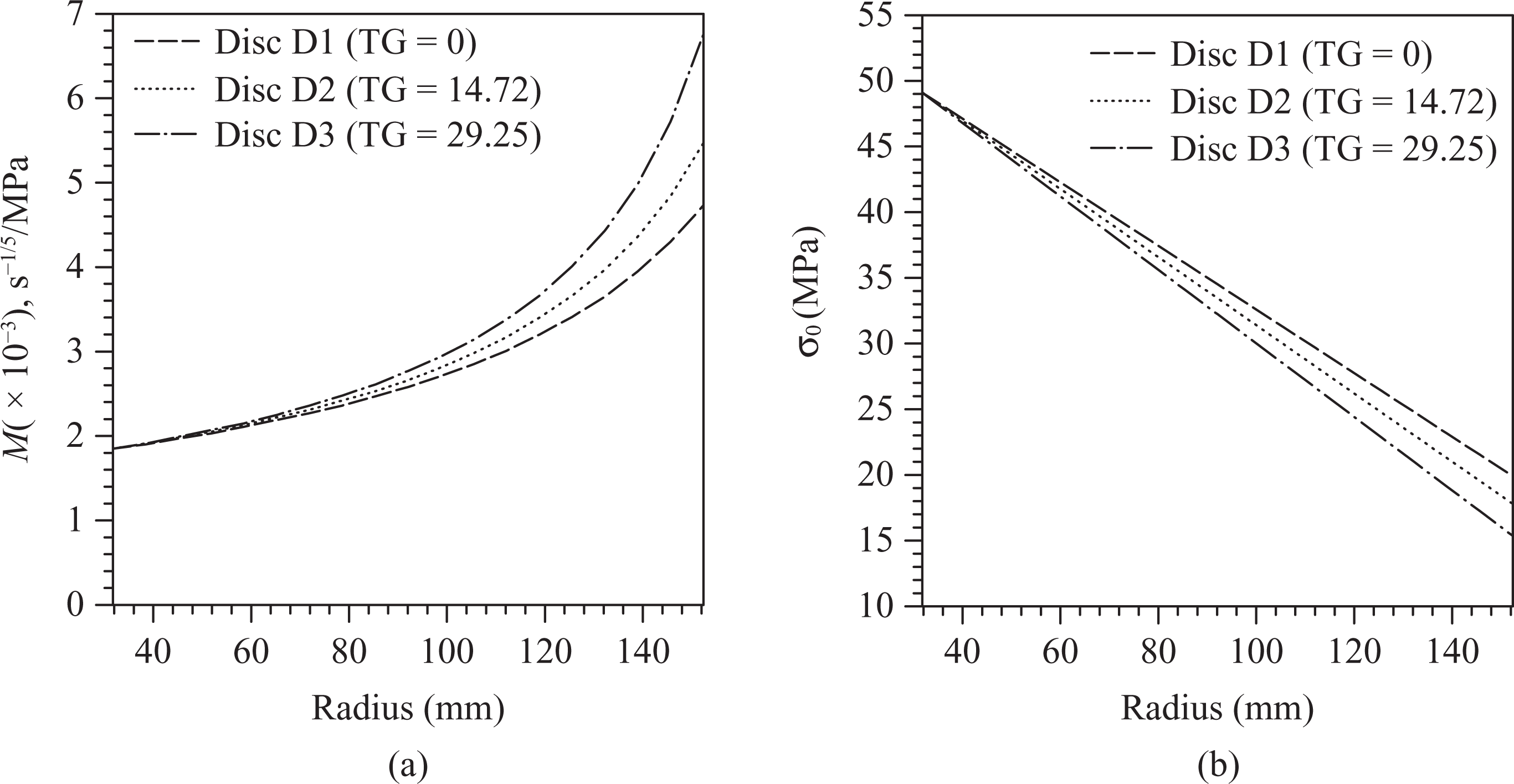
Variation of creep parameters in composite discs.
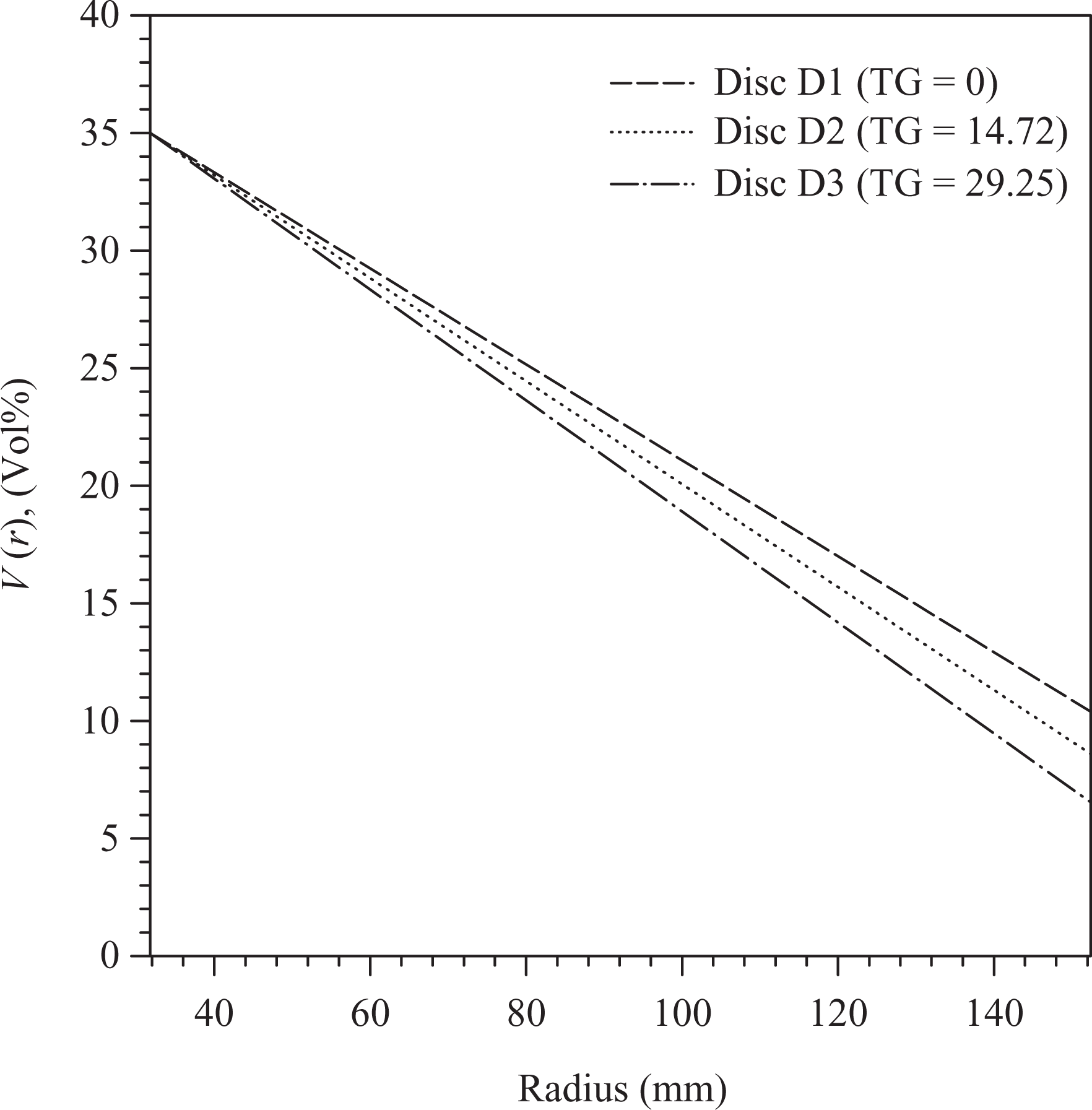
Variation of reinforcement content in composite discs.
Distribution of stresses and strain rates
The effect of imposing TG on creep behavior of the FG discs is shown in Figures 3–7. The radial stress in all the discs (Figure 3) increases from zero at the inner radius, reaches maximum before decreasing to zero again at the outer radius, under the imposed boundary conditions given in Eq. (21). The radial stress in FG disc having linearly varying thickness (i.e., D2 and D3) is lower than the uniform thickness disc D1. By increasing TG of the disc, the radial stress is observed to decrease over the entire radius. The FG disc D3 having maximum TG exhibits lower radial stress over the entire radius compared with any other FG disc. The maximum value of radial stress in the FG discs D2 and D3 is lower, respectively, by about 8% and 19%, when compared with FG disc D1.
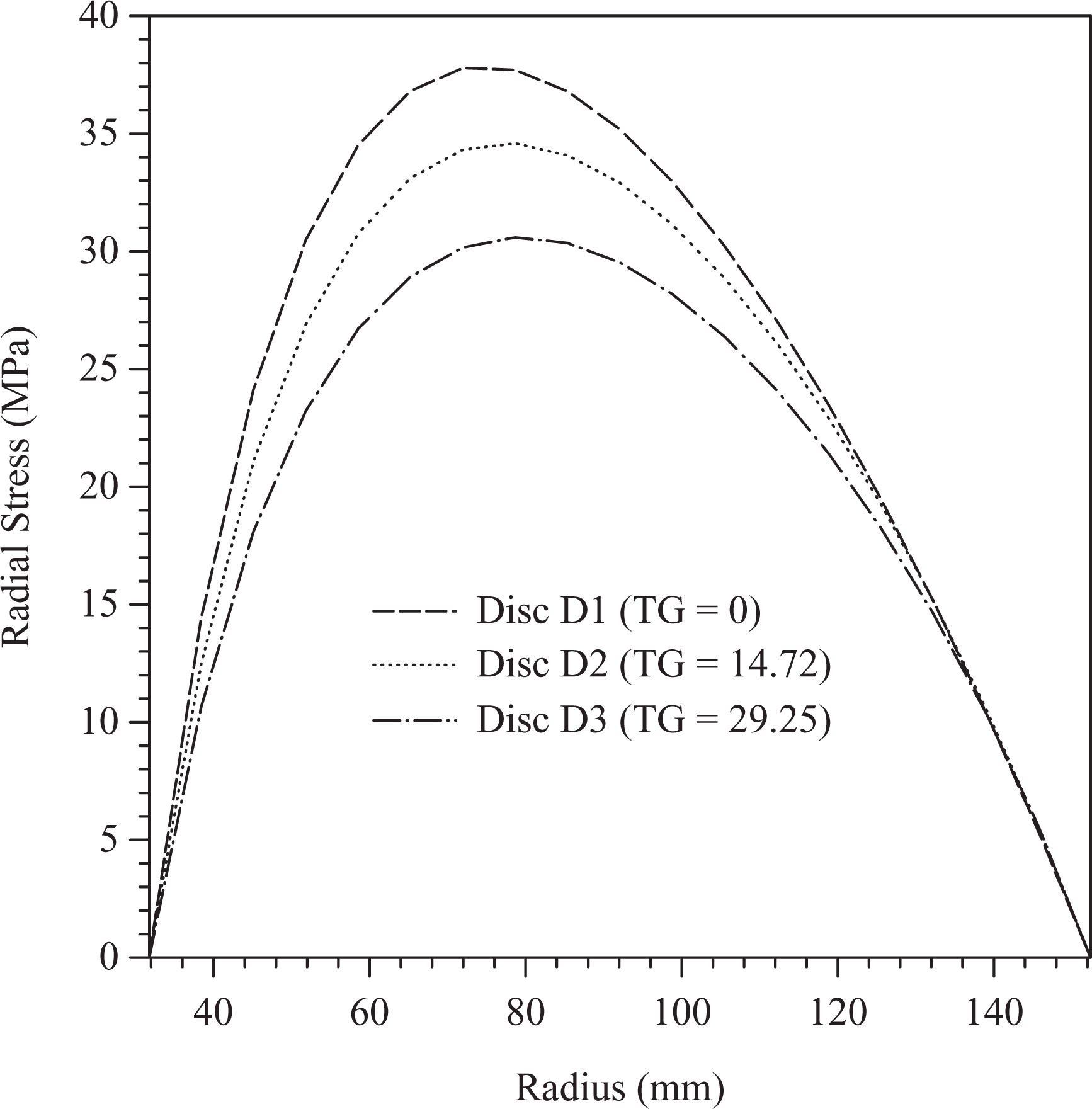
Effect of thickness gradient on radial stress.
Figure 4 shows the variation in tangential stress of different FG discs. The tangential stress increases a little on moving from the inner to outer radius of the disc, becomes maximum before decreasing again toward the outer radius. The effect of imposing TG on the tangential stress in FG disc is similar to that observed for radial stress in Figure 3. The tangential stress in FG disc D3 having maximum TG is lower than the FG discs D1 and D2. When compared with FG disc D1, the maximum values of tangential stress in FG discs D2 and D3 are lower, respectively, by about 13% and 24%. The effect of imposing TG on effective stress
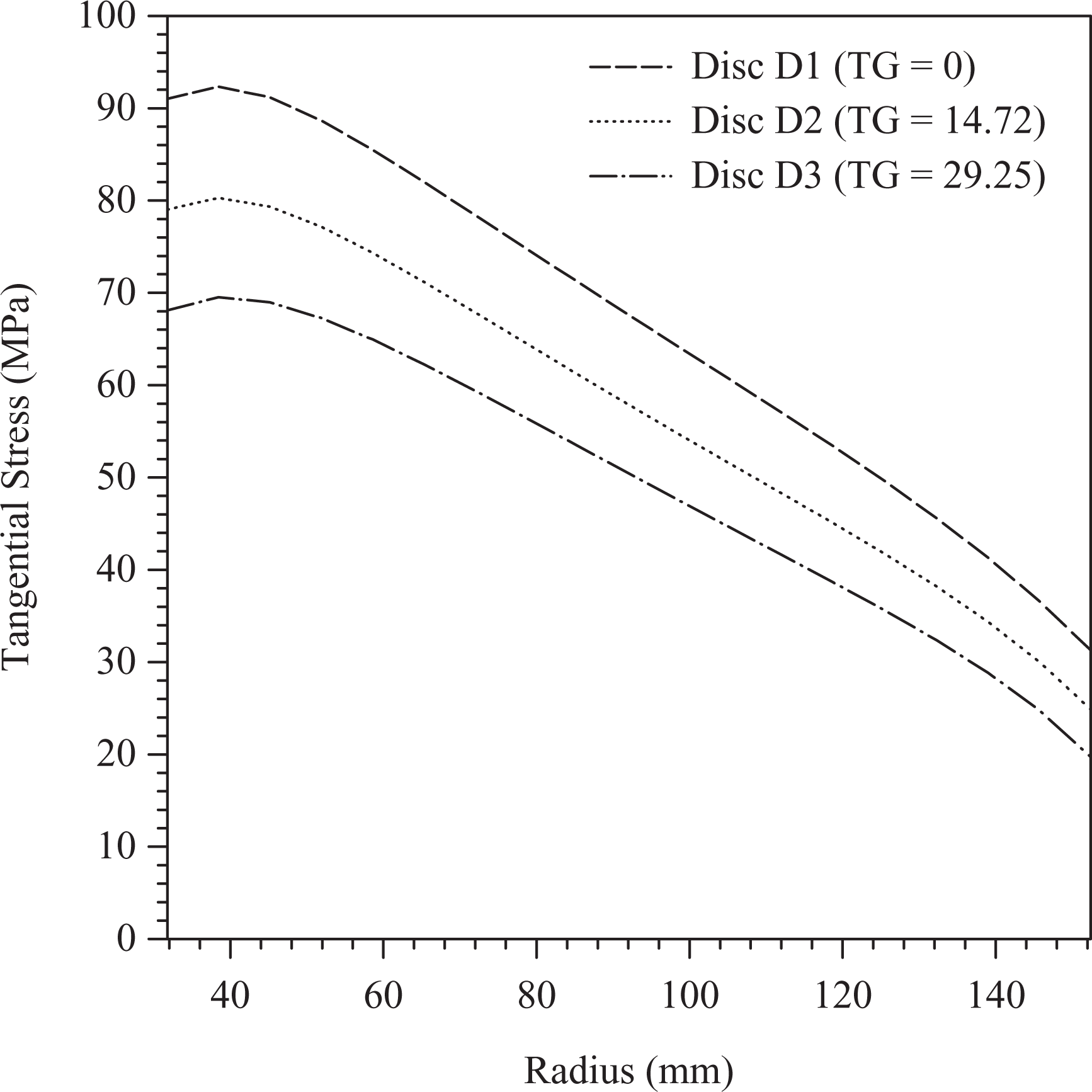
Effect of thickness gradient on tangential stress.
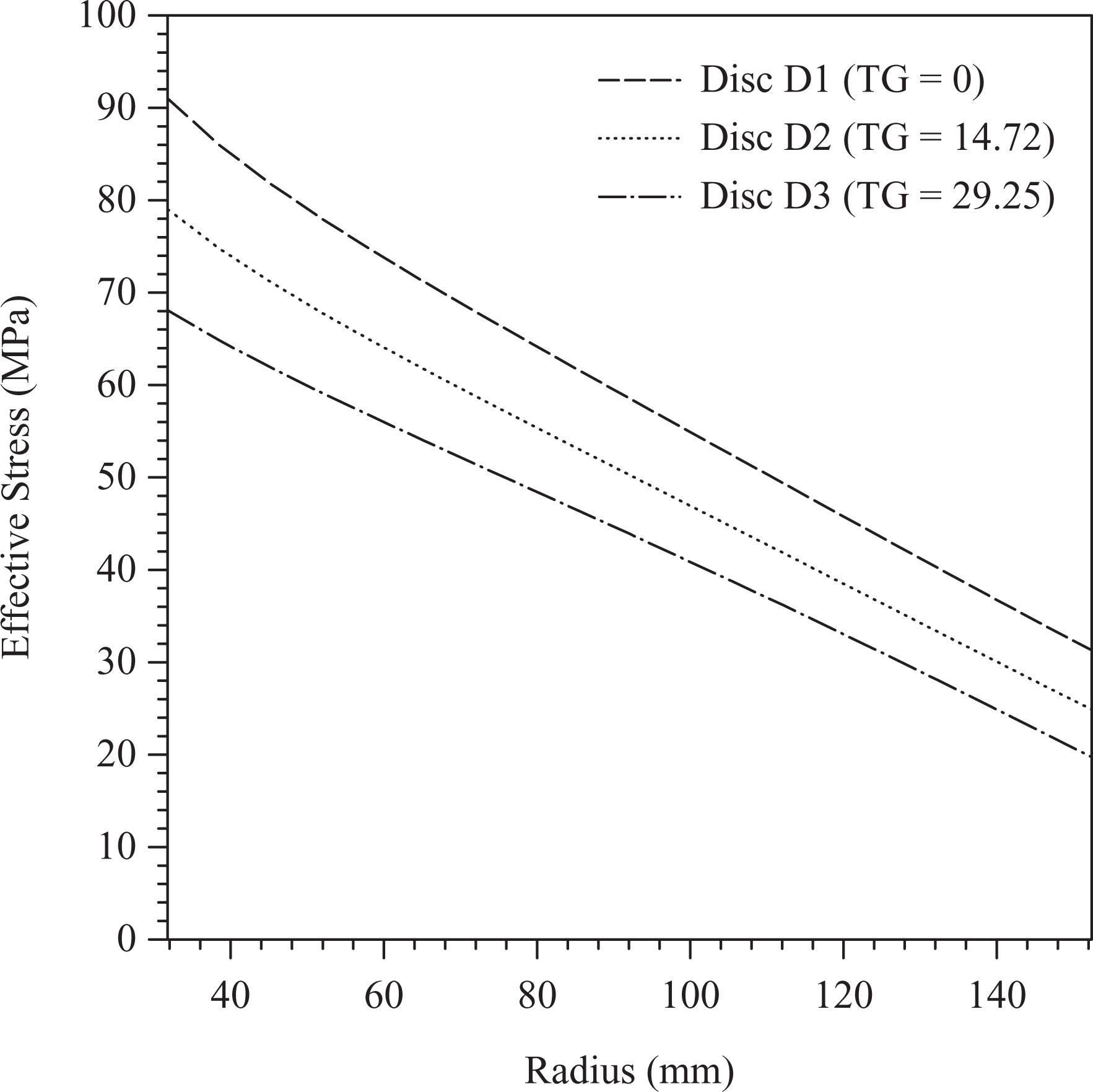
Effect of thickness gradient on effective stress.
The tangential strain rate in the FG disc remains tensile throughout and decreases on moving from the inner to the outer radius (Figure 6). By increasing TG in the FG disc, there occurs a significant reduction in the tangential strain rate. The reduction observed near the inner radius is much higher than that observed near the outer radius. Furthermore, by increasing TG in the FG disc (discs D2 and D3), the distribution of tangential strain rate becomes relatively more uniform, thereby decreasing the chances of distortion in the FG discs. Unlike tangential strain rate, the radial strain rate in the FG disc remains compressive throughout, except for some tensile value in the middle of FG disc D1 having uniform thickness (Figure 7). Furthermore, the magnitude of radial strain rate in the FG disc is relatively lower than the magnitude of tangential strain rate at the corresponding radius, as evident from the comparison of Figures 6 and 7. The effect of imposing TG on the radial strain rate (Figure 7) is similar to those observed for tangential strain rate in Figure 6. The radial strain rate in constant thickness FG disc D1 remains compressive, except for some tensile value in the middle of the disc. But on imposing TG, the radial strain rate in the disc becomes compressive over the entire radius. It is evident from the above discussion that when compared with constant thickness FG disc, the magnitude of stress and strain rates in a similar FG disc but having linearly varying thickness is much lower. The creep performance of the FG disc is further improved with the increase in TG of the FG disc.
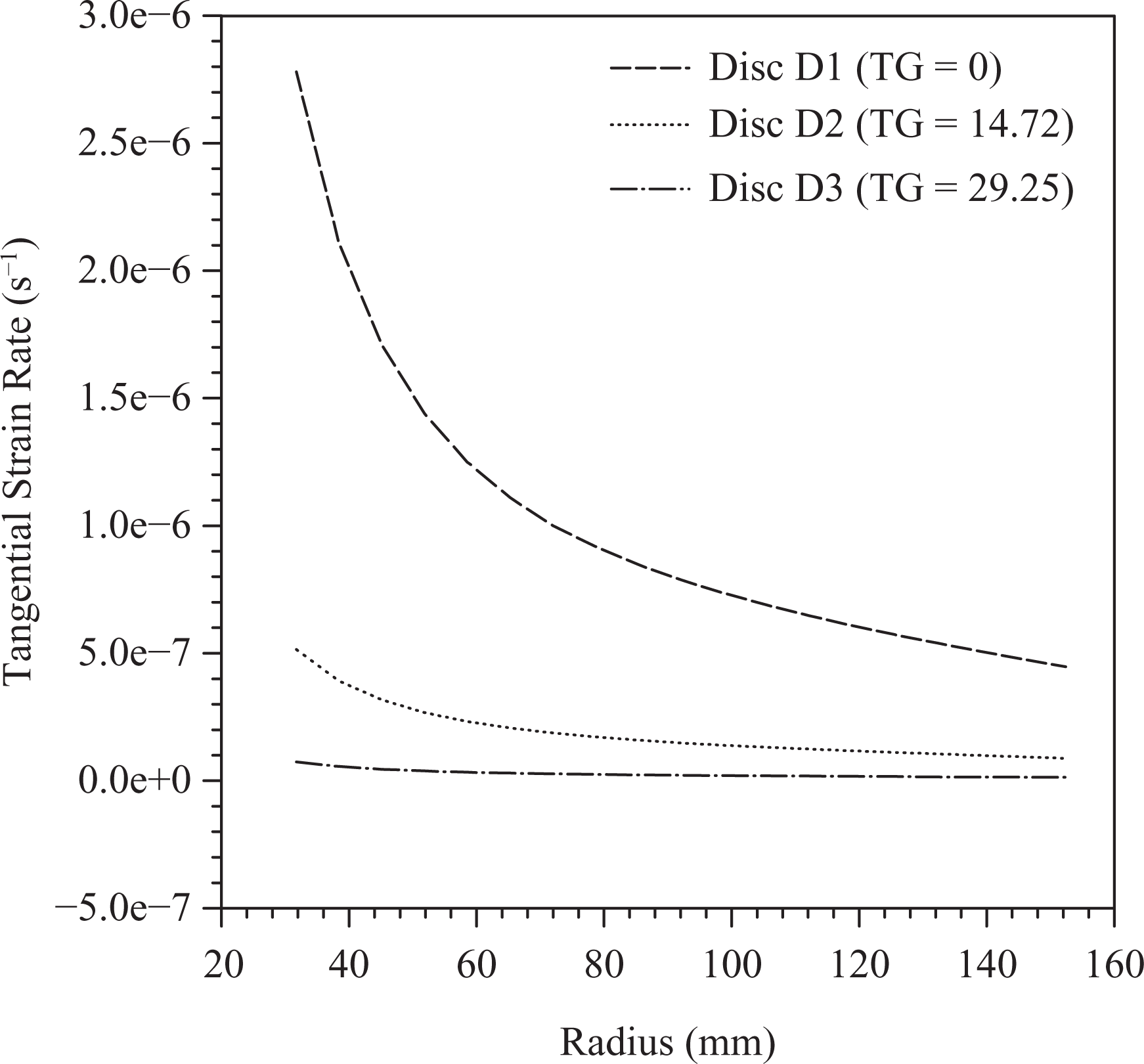
Effect of thickness gradient on tangential strain rate.
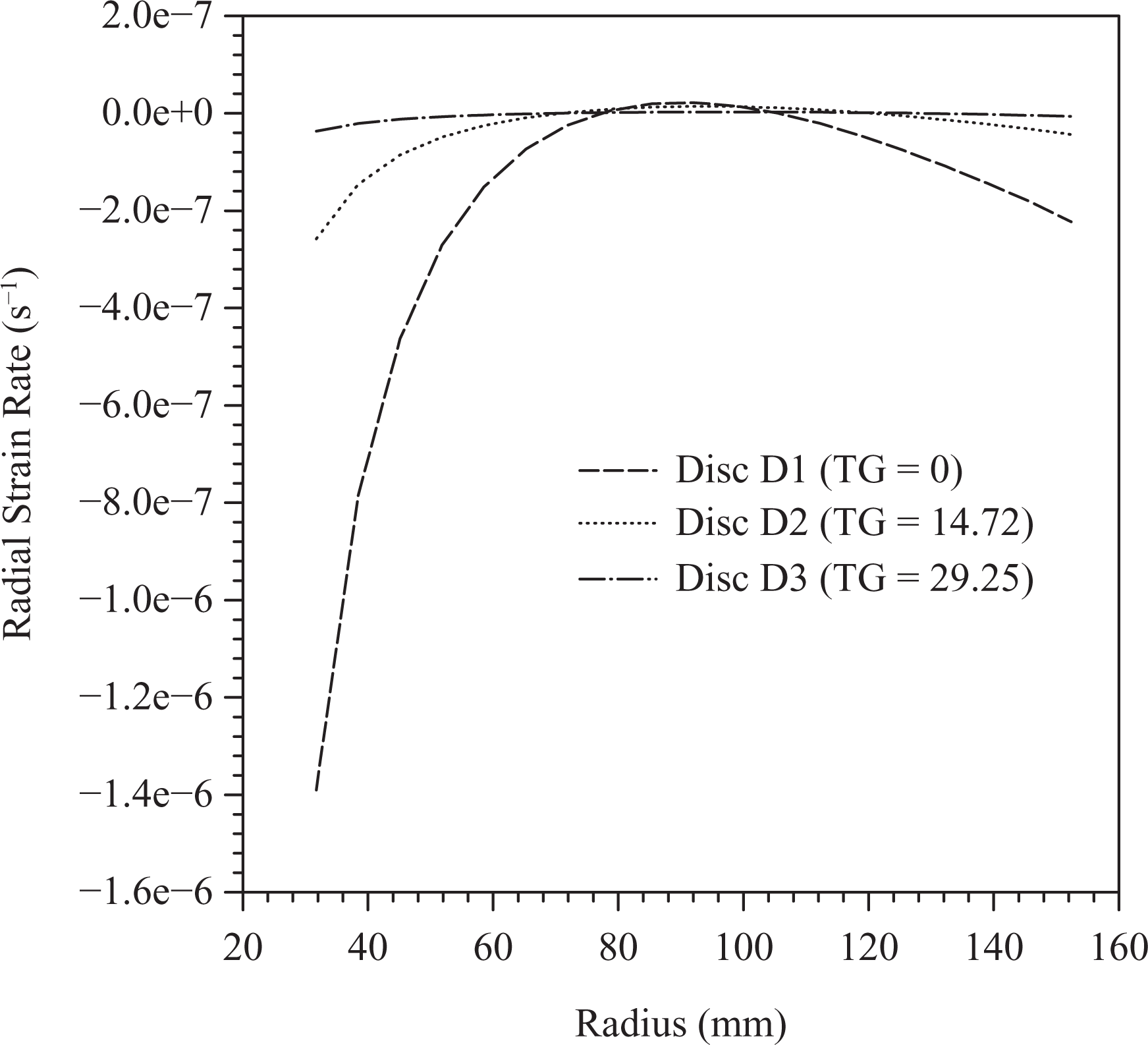
Effect of thickness gradient on radial strain rate.
Conclusions
The study carried out has led to the following conclusions.
The magnitude of radial, tangential and effective stresses in the FGM disc is significantly reduced when the disc profile is changed from uniform thickness to linearly varying thickness. The reduction observed in stresses further decreases with the increase in TG of the FGM disc.
The steady state creep rates in the FG disc are also reduced significantly when its profile changes from constant thickness to linearly varying thickness. The magnitude of strain rates in the FG disc reduces further with the increase in TG of the disc.
By employing FG disc with linearly varying thickness, the distribution of strain rates becomes relatively uniform when compared with a similar FG disc of constant thickness. Therefore, the chances of distortion in the FGM disc are reduced when a uniform thickness FG disc is replaced by a similar FG disc but having linearly varying thickness.
Footnotes
Appendix A
Appendix B
Let A and A0 denote the areas of transverse section of the disc element with outer radii r and b, respectively, but with the same inner radius a. The areas A and A0 may be expressed as follows
The polar moment of area J and J
0 of these disc elements having inner radius a but with outer radii r and b, respectively, are given by
Funding
This research received no specific grant from any funding agency in the public, commercial, or not-for-profit sectors.