



Abstract
The effective thermal conductivity of several series of polymer composite materials constituting two polymeric matrixes: ethylene vinyl acetate (EVA) filled with micrometric particles of barium titanate (BaTiO3) and polypropylene (PP) filled with copper (Cu) particles were investigated. The finite-element software COMSOL 3.5a was used to model the thermal heat transport for an elementary cell in order to estimate the effective thermal conductivity of the composites. The effect of the filler concentrations and the nature of the particles on the effective thermal conductivity were also numerically investigated. The present work compares the numerically calculated and the measured thermal conductivities for various samples.
Introduction
Composite materials are widely used today in numerous applications in many engineering fields. One of the most attractive features of composites is the wide scope for physical property applications through constitutional design. 1 Thermal conductivity is an important property for several composite applications, such as electronic packaging, heat spreader, heat exchangers and so on. 2 Information on thermal conductivity of materials is also necessary for determining the optimum conditions during processing of materials, as well as for analysing heat transport in materials during practical applications. 3 The design of composite materials for such applications requires a thorough understanding of heat conduction. The foundation of this understanding lies in the development of micromechanics models for accurately predicting the effective thermal conductivity of multiphase composites. 4
Modelling of the effective thermal conductivity of heterogeneous materials is necessary for many heat transfer applications. Several theoretical, empirical and semi-empirical models have been published in the literature to describe the thermal properties of particulate composites. 5–10 Progelhof et al., 8 Carson et al., 7 Bigg 5 and Mottram and Taylor 11 provided reviews on relevant modelling approaches. A substantial number of effective thermal conductivity models have been proposed, some of which have been intended for highly specific applications, while others have wider applicability. The effective thermal conductivity of the composite is strongly affected by its composition and structure, and, as yet, there does not appear to be any single model equation that is applicable to all types of structure. 12 Besides, most of theoretical models cannot correctly estimate the thermal conductivity of composites for the high filler contents and especially when the ratio between the thermal conductivity of the fillers and the matrix is greater than 200. 11 ,13 The shortcomings of the analytical models became evident when one considers the thermal conductivity of a combination of three-dimensional (3D) randomly distributed fillers with two or more different shapes of materials. 14 Most theoretical models suffer from inherent nonphysical assumptions and/or the empirical parameters included. 15
For more complex structures, there is an incentive to study the relationship between material structure and thermal conductivity to facilitate the selection of thermal conductivity models. Ideally, real experimental measurements would be employed for this task; however, this is often complicated by two significant factors: first, thermal conductivity measurement is a relatively complex process and accuracy is often limited by the sample itself (particularly for anisotropic materials); second, with real materials it is very difficult to isolate and manipulate the structure and composition of the samples, to examine the effects of each variable individually. 1
Numerical modelling constitutes another way to study the complex systems. In some cases, the physical problems do not admit analytical exact solution: numerical modelling is a useful tool in this situation. However, it is generally suitable to compare numerical results to experiments. A lot of methods which enable the solving of numerical physical problems have been developed in the past. At this time, an increasing number of commercial softwares or freewares are available to perform numerical modelling. 14 ,16 Numerical techniques such as finite element method are utilized to investigate the composite thermal conductivity due to the variations in type, shape, size and volume fraction of fillers. For example, Xu et al. 16 proposed a finite element model to predict the macroscopic effective thermal conductivity of polymer composites based on its microstructural characteristics such as aspect ratio, volume fraction of fillers, interfacial thermal resistance and filler dispersion. Kumlutas and Tavman 17 performed finite element analysis to calculate the effective thermal conductivity of particle and fiber filled composites as a function of volume fraction of fillers. Recently, Karkri et al. 14 used the finite-element software COMSOL 3.5a to investigate the effect of the filler concentrations, the ratio of thermal conductivities of filler to matrix material and the thermal contact resistance between inclusion and matrix on the effective thermal conductivity of the composite for three elementary cells. In many other numerical studies, the microstructure being analysed has been restricted either to 2D or to regular arrays of simple shapes such as cubes, spheres or cylinders, which can be accurately represented by repeating unit cells. 1 ,17
In this article, thermal conductivity of ethylene vinyl acetate (EVA) filled with barium titanate (BaTiO3) spheres and polypropylene (PP) filled with copper (Cu) powder were investigated numerically as fractions as of filler concentration and the particle size and compared to the experimental and the theoretical values. Finite element method was used to estimate the effective thermal conductivity of these materials for one elementary cell.
Experimental
In this study, two different polymers were used as a polymer matrix. First, the EVA copolymer matrix was filled with BaTiO3 spheres of 105 μm diameter. The second composites constituted PP filled with Cu particles of 234 μm diameter. The morphology of composites was observed by scanning electron microscope (SEM) and was presented in a previous work. 13 The observed surfaces were obtained by breaking the samples at liquid nitrogen temperature (cryo-fracture). A good dispersion of particles into the polymeric matrix was observed. BaTiO3 particles are randomly dispersed and surrounded by the polymeric matrix, and the shape of particles is irregular. As a conclusion, SEM observations have indicated a rather good mixing and only few regions of particle aggregation. 13
For thermal conductivity measurements, specimens with dimension of 44 mm × 44 mm × 3 mm were performed at room temperature. The preparation method and the thermophysical characterisation of the composites were presented in our previous articles. 13 ,18 The properties of the polymers and the particle fillers can be found in Table 1. 13 ,18
Thermophysical properties.
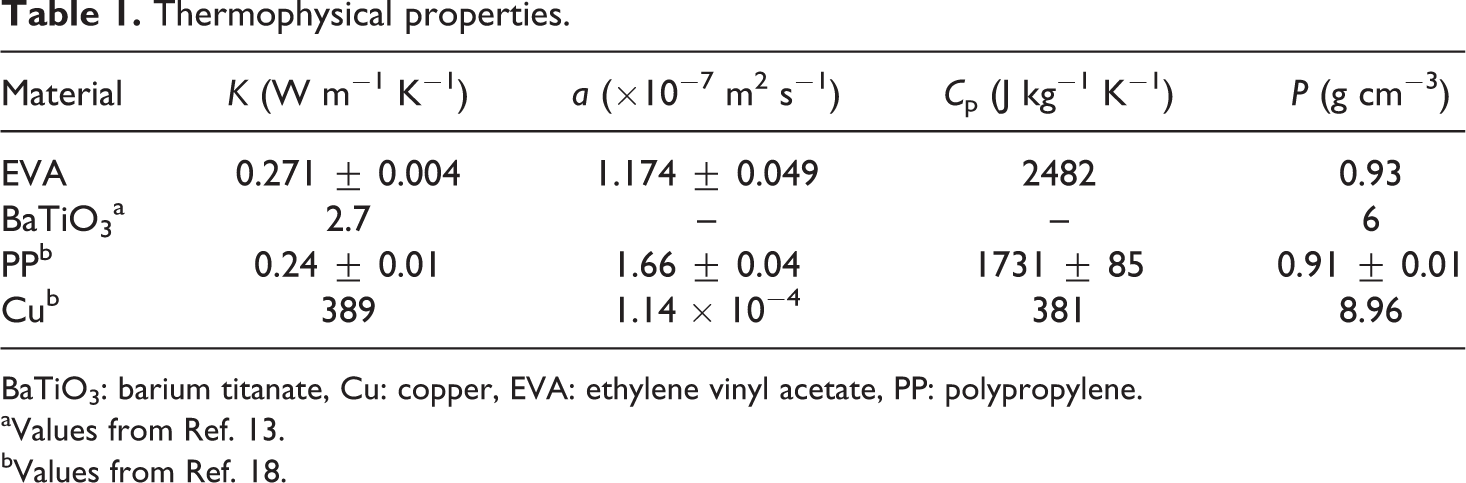
BaTiO3: barium titanate, Cu: copper, EVA: ethylene vinyl acetate, PP: polypropylene.
aValues from Ref. 13.
bValues from Ref. 18.
Thermal conductivity models
Several models have been proposed in the literature regarding the thermal conductivity of particle filled composites as a function of filler content and a number of researchers have tried to fit their experimental and numerical data with the various models. 19 The main idea of this article is not to present a large review of the analytical models of the thermal conductivity of composite materials, but we have focused only on three analytical models that are widely used in the literature for comparison with the experimental data. Moreover, several references 5,11 were given in the article so that the reader can easily get with more details relating to the kind of models, their order and their application domain. In this study, we found that our numerical points shown in Figures 2 and 3 could fit very well with models such as the Maxwell, the Bruggeman and the Hashin and Shtrikman.
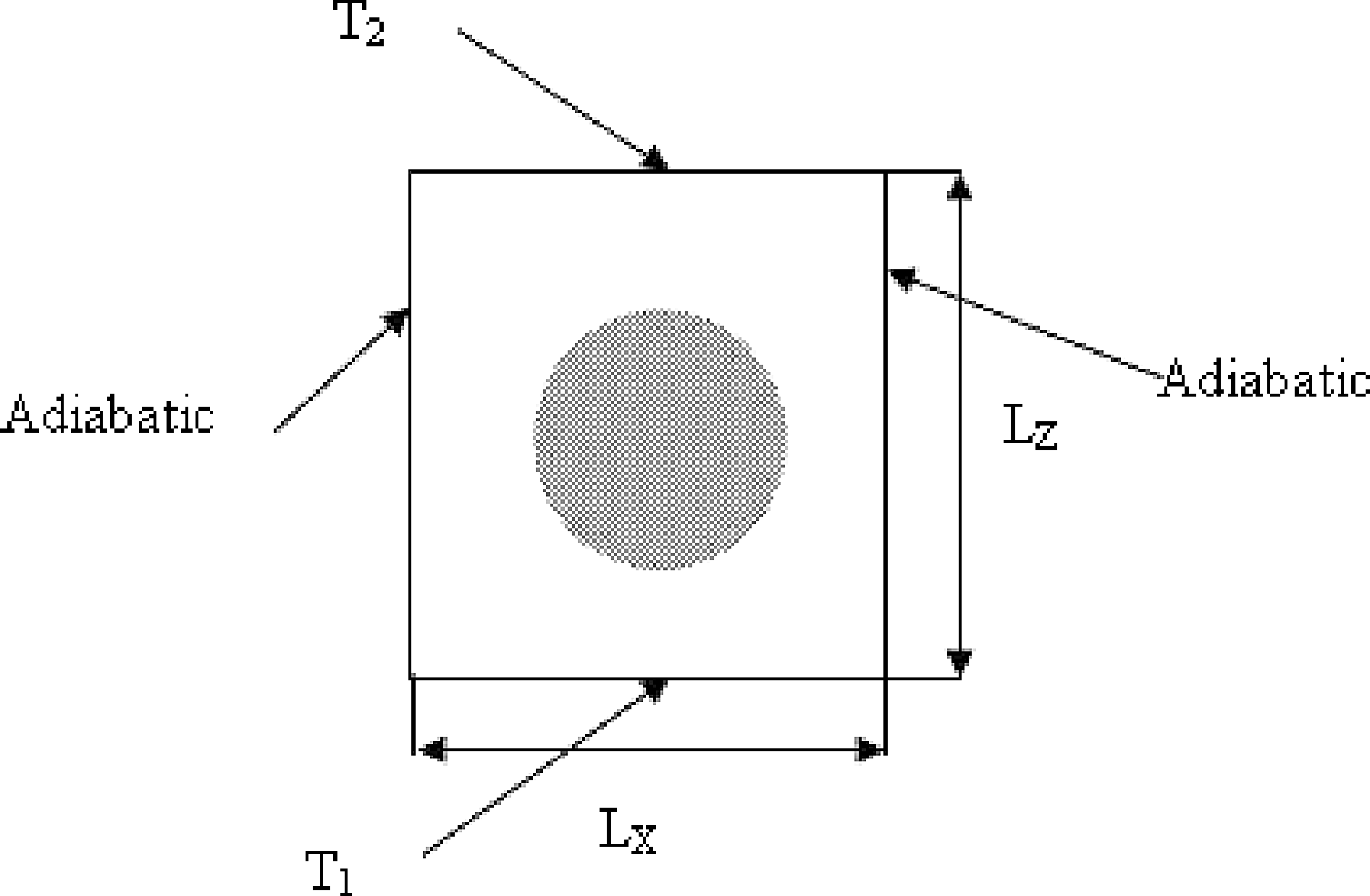
Two-dimensional model of the composite material.
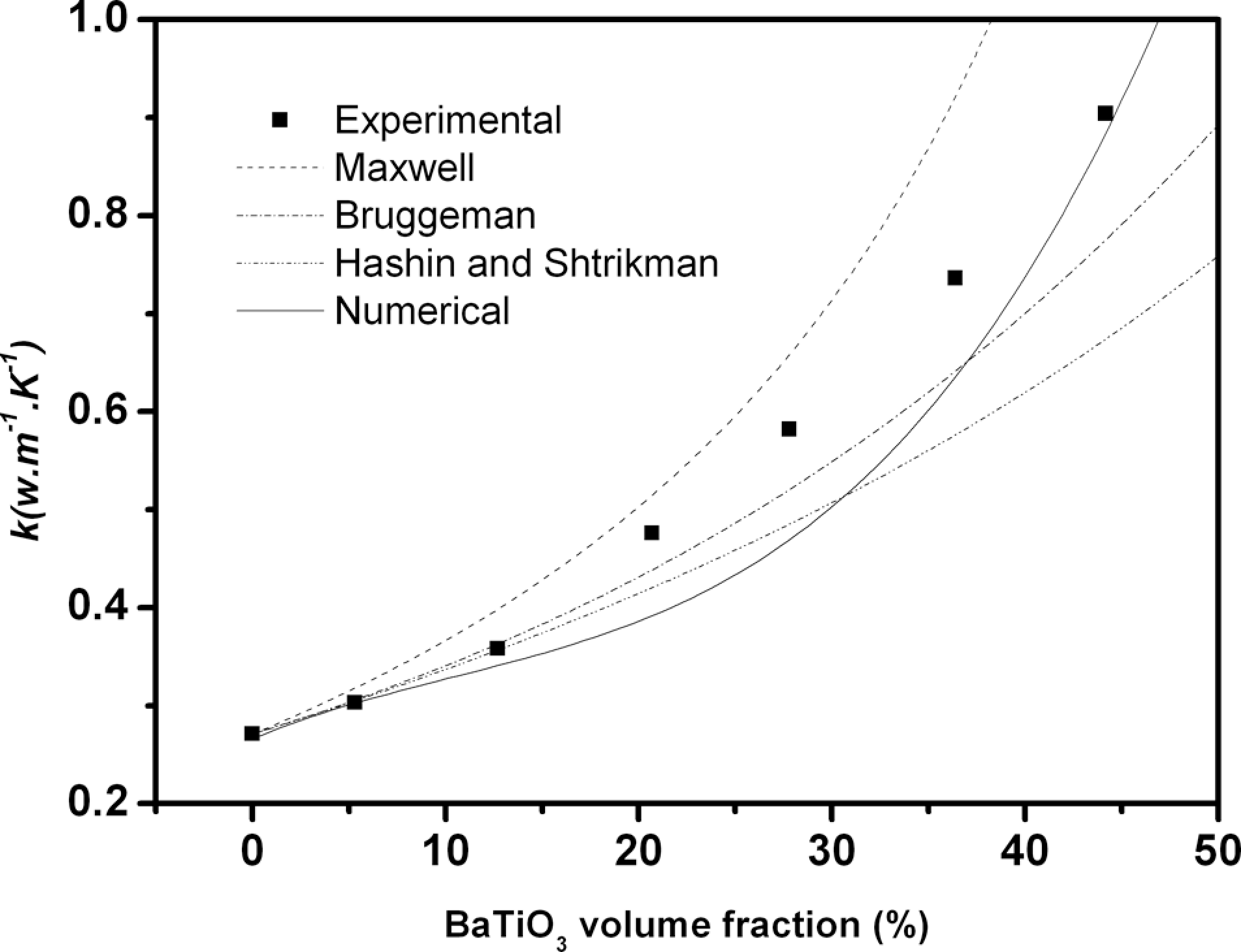
Comparison between numerical, experimental and theoretical data of EVA/barium titanate (BaTiO3) composites.
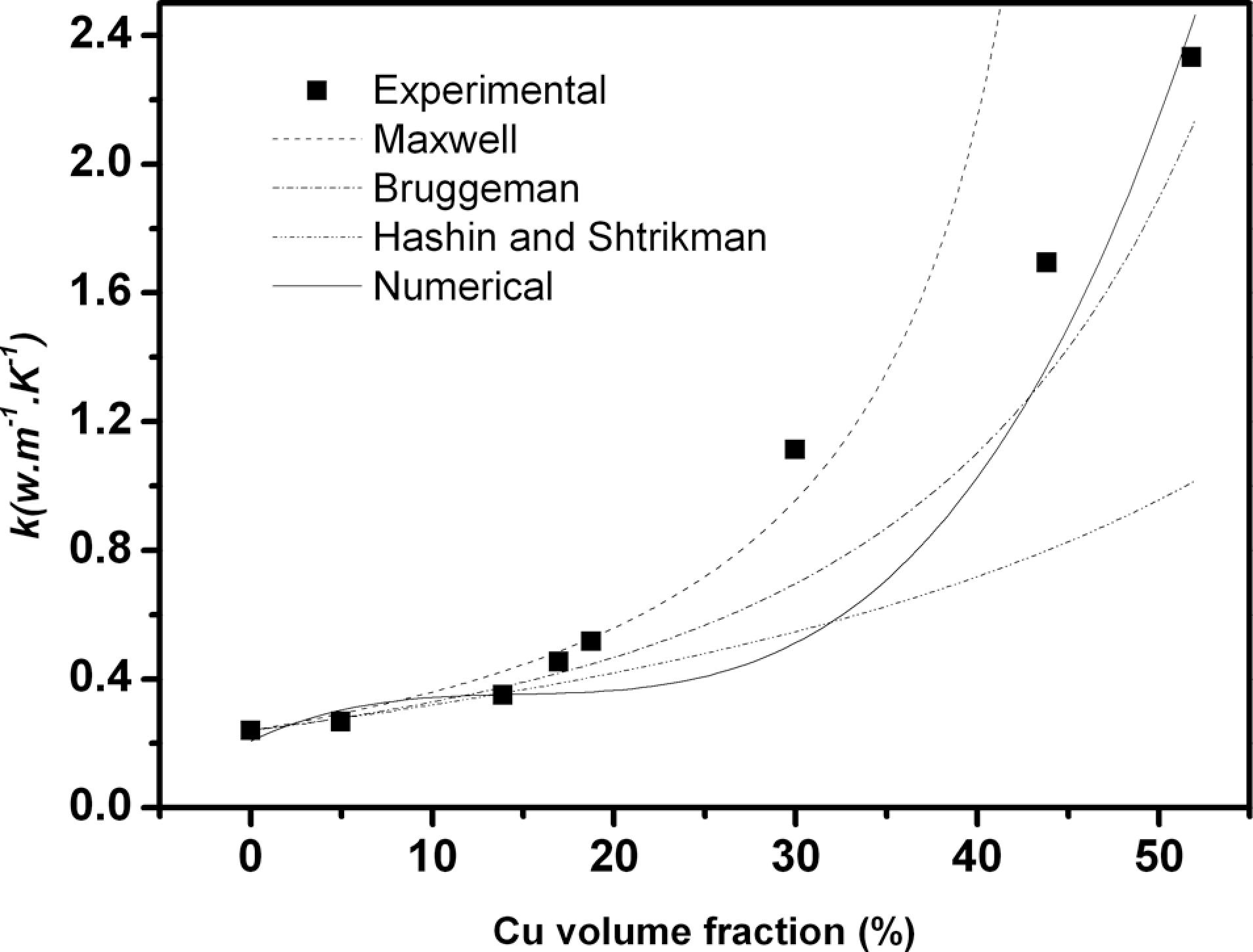
Comparison between numerical, experimental and theoretical data of polypropylene (PP)/copper (Cu) composites.
Using potential theory, Maxwell obtained an exact solution for the conductivity of randomly distributed and noninteracting homogeneous spheres in a homogeneous medium. 17

Where k, k m and k f are the thermal conductivity of the composite, the polymer matrix and the filler, respectively. φ is the filler volume fraction. This model predicts fairly well the effective thermal conductivities for the low filler concentrations; whereas for high filler concentrations, the particles begin to touch each other and form conductive chains in the direction of heat flow, so that this model underestimated the value of effective thermal conductivities in this region. 17
Relating to several works5,11,20, the Bruggeman model is one of the most effective thermal conductivity prediction models. This approach is based on the assumption of isolated filler particles with the following equation:

Where x is the constant which depends on filler geometry: x = 2 for spherical particle and x = 1 for cylinders.
Hashin and Shtrikman derived the following lower bound equation to describe the effect of spherical filler particles on the thermal conductivity of a randomly dispersed particle in matrix, two-phase system 5 :

where

And d = 3 for spherical filler particles.
Numerical analysis
The use of numerical simulations to investigate the effective thermal conductivity is common and several different numerical methods have been employed, including finite element methods. 21 The basis of Finite Element Method (FEM) relies on the decomposition of the domain into a finite number of subdomains (elements) for which the systematic approximate solution is constructed by applying the residual methods. Using the finite element COMSOL software, the thermal heat transfer is carried out with conduction through the composite body. In order to make a thermal analysis, 2D physical models with circles in rectangle lattice have been used to simulate the microstructure of composite materials (Figure 1).
The temperature field in the composite material was defined by solving Laplace’s equation numerically using a finite element formulation by imposing the following boundary conditions:
The perpendicular faces to the direction of the heat flow are isothermal;
The parallel faces to the direction of the heat flow are adiabatic.
In the considered heat conduction problem, the temperature at the nodes along the boundary y = 0 and y = L Z are imposed and known as T 1 and T 2, but the temperature at the inner region and on the adiabatic boundaries are unknown. Consequently, the problem includes many unknown temperatures. The equations required for the determination of these temperatures are obtained by writing the appropriate finite element equation for each of these nodes. The number of nodes in the Finite Element (FE) grids was approximately 2500, depending on the number of the number of inclusions implicated in the simulation.
So, the effective thermal conductivity is determined using the following relation:

Q is the heat flux in the unit cell obtained by integrating the fluxes across the outlet face of the unit cell. Hence, for heat flow in the z direction:

Results and discussion
In this study, a numerical approach is used for the determination of the effective thermal conductivity of particle filled composite materials. The simulation results are shown in Figures 2 and 3. In these figures, the thermal conductivity values obtained from the numerical study are compared to several thermal conductivity models and to the experimental results. It is found that there is a nonlinear increase in thermal conductivity with increasing filler content. This increase in the effective thermal conductivity is probably because the filler has higher thermal conductivity than the polymer matrix.
It is seen that the numerical results, experimental values and all the models are close to each other at low particle content, φ < 20, as the particles are dispersed in the polymer matrix and they are not interacting with each other. For particle content greater than 20%, the conductive chains are formed by thin particles causing a large increase in effective thermal conductivity of the composite. The numerical results obtained from this study agree very well the Bruggeman model. 8 It can also be seen that for particle content greater than 20% of volume fraction, the simulation results do not agree very well with the experimental results. This deviation can be attributed to the fact that the numerical analysis does not take interfacial thermal barrier resistance into account which strongly affects the thermal conductivity of composites.
Effect of particle size
The effect of particle size on thermal properties of composite materials has been studied by many authors. 22–24 In order to investigate the effect of particle size of inclusion on the effective thermal conductivity, spherical inclusions with different sizes of conductivity k 2 were located in a continuous phase of conductivity k 1. Despite the difference between the numerical simulation and the experimental results for high filler volume content, we used the 2D physical model to study the effect of particle size on the thermal conductivity of composites. As illustrated in Figure 4, the composite with smaller BaTiO3 particles showed a higher thermal conductivity than those with larger filler particles for the same filler content. Thus, the thermal conductivity decreased with increasing particle size of the inclusion content greater than 20%.
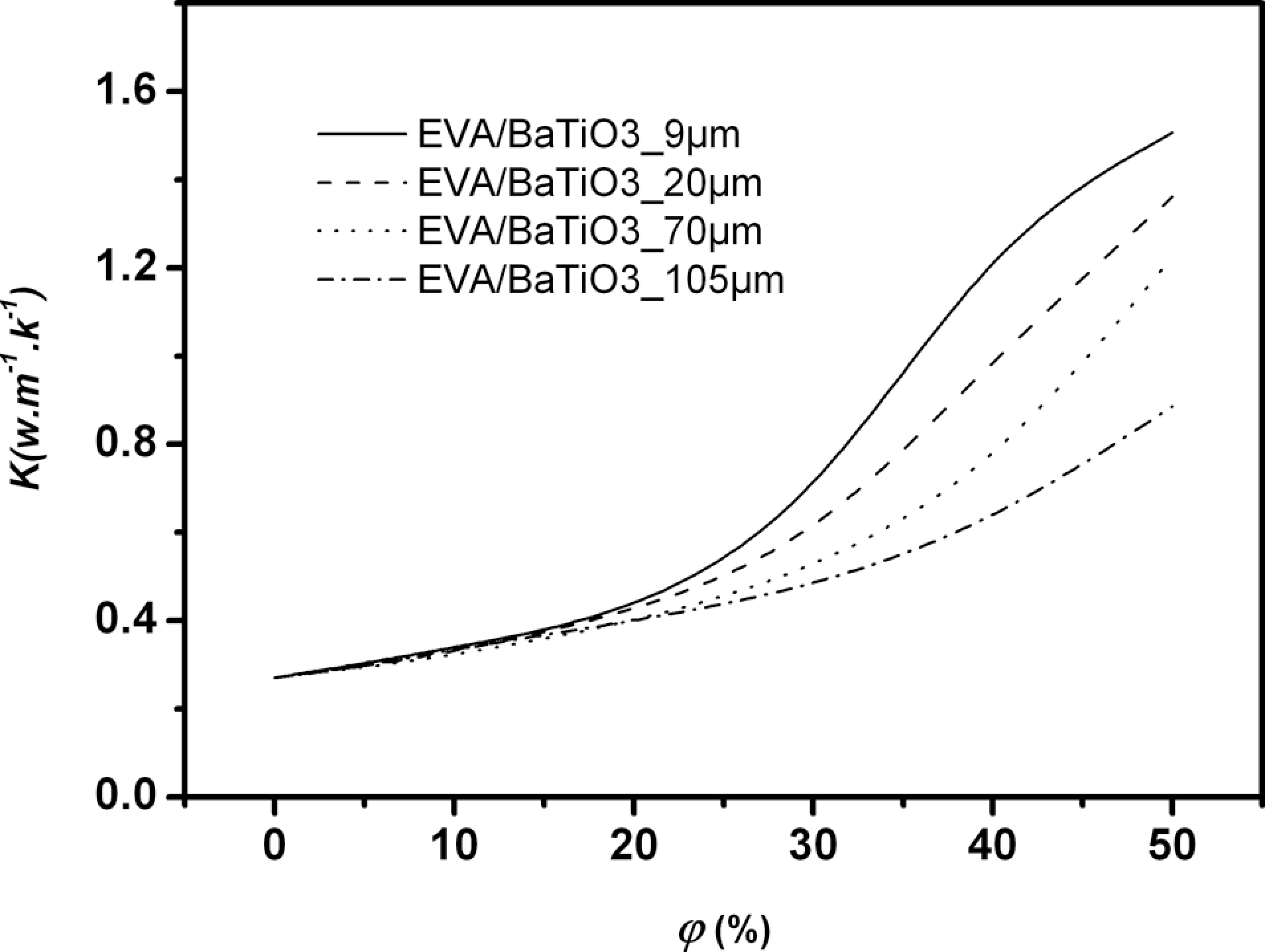
Effect of particle size of barium titanate (BaTiO3) on thermal conductivity of composites.
This result was also described by several authors for other particle filled polymeric matrix. Boudenne et al. 18 investigated the effect of particle size on the thermal conductivity of PP matrix filled with spherical particles of Cu. They found that the particle size has an effect on the thermal conductivity. The numerical results relating to the estimation of the thermal conductivity variation in terms of the function of size of Cu particles and concentration of PP matrix are shown in Figure 5. It can be seen that the use of larger particles is an effective way of decreasing the thermal conductivity of composite.
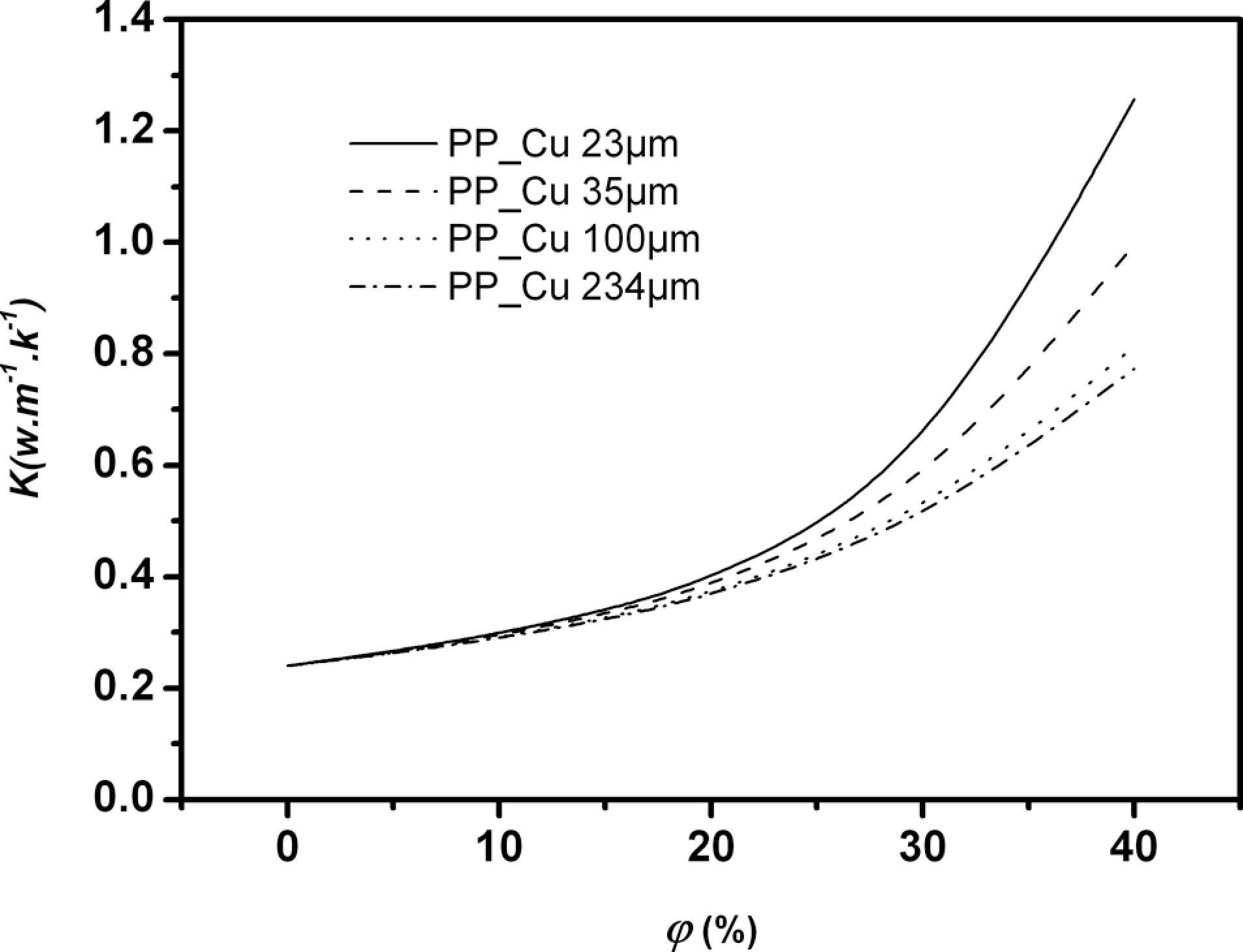
Effect of particle size of copper (Cu) on thermal conductivity of composites.
To conclude, though our model does not predict fairly well the thermal conductivity of the composites in high filler volume fraction, we have obtained the same behaviour as cited in the literature, 18 wherein the increase in particle size is inversely proportional to the thermal conductivity. Nevertheless, this result must not be considered a general rule as some authors 10,25 reported that the thermal conductivity of composites do not depend on the size of particles. Thus, there is no good general rule about the effect of the particle size on the thermal conductivity properties of composites. In our point of view, there is probably an effect of the particles size on the properties of the composites which is linked to the shape of particles and the degree of adhesion between filler and matrix.
Conclusion
In this article, thermal conductivity of EVA filled with BaTiO3 spheres and PP filled with Cu powder was investigated numerically. Finite element method was used to estimate the effective thermal conductivity of these composite materials and to examine the effect of the size and the volume fraction of the filler. The thermal conductivity obtained from numerical method was also compared to the theoretical models and experimental data.
As a result, up to 20% of filler volume content the numerical model developed in this study predicted fairly well the thermal conductivity of the polymer composites. For particle content greater than 20% of volume fraction, the simulation results do not agree very well with the experimental results. This deviation can be attributed to the fact that the numerical analysis does not take interfacial thermal barrier resistance into account, which strongly affects the thermal conductivity of composites. The particle size also proved to be an important influencing parameter in effective thermal conductivity of composite material. Overall the thermal conductivity tends to decrease as the particle size increases. Thus, it is very useful to use the numerical model proposed in this article to study the effect of the particle size on the thermal conductivity of composites.
Footnotes
Funding
This research received no specific grant from any funding agency in the public, commercial, or not-for-profit sectors.