




Abstract
Using variable separation approach and series solving method of differential equations, analytical solutions for temperature and thermo-mechanical stresses in cross-ply laminated composite cylinder with finite length are presented in this article. The cylinder is assumed to be simply supported at its two ends and is subjected to non-uniform thermal and mechanical loadings on the inner and outer surfaces. As an example, numerical results of temperature distribution, stress fields, and interlayer stresses of a four-layer laminated composite cylinder are graphically presented and briefly discussed.
Introduction
Laminated composite structures have been widely used in modern industries. Besides possessing superior material properties like high strength-to-weight ratio, composite laminates also can be tailored to achieve desired performance for a given application. Because of their non-uniformity layers and material anisotropy, the induced thermo-mechanical stresses are further complicated by the internal mutual constraints and the thermal incompatibility between the layers. These stresses in turn can easily lead to the delaminate between layers. Thus, it is necessary for structure designers to accurately predict the thermo-mechanical behavior of these structures.
In recent years, extensive researches have been devoted into the thermo-mechanical problems of such non-homogeneous materials and structures. A comprehensive review for thermo-mechanical behavior of non-homogeneous materials and structures has been carried out by Birman and Byrd 1 and Reddy. 2 Using different beam theories, Khdeif and Reddy 3 studied the symmetric and antisymmetric cross-ply beams with arbitrary boundary conditions subjected to arbitrary loadings. Lee and Reddy 4 studied the non-linear response of laminated composite plates under thermo-mechanical loading using the third-order shear deformation theory, in which the effects of lamination scheme, magnitude of loading, layer material properties, and boundary conditions are considered. Cheng and Batra 5 studied the effects of thermal loads on composite laminated shells containing interfacial imperfections. Yuan 6 found that thermal twist would occur even for symmetric laminated shells. Using Frobenius series, Nie and Reddy 7 theoretically studied the static deformations of functionally graded cylinders with complex surfaces, i.e., elliptical inner surface and circular outer surface. Thermoelastical analysis considering the temperature-dependent materials was carried out by Mohammad, 8 in which a functionally graded circular hollow cylinder made of ceramic and metal is investigated and the Hermitian element is employed to analyze the thermo-mechanical stresses of the cylinder. Transient thermal stresses in two-dimensional (2-D) functionally graded thick circular hollow cylinder were solved by Masoud and Mehdi. 9 The volume fraction distribution of materials, geometry, and thermal load are assumed to be axisymmetric but not uniform along the axial direction. In their analysis, the finite element method with graded material properties within each element is employed to model the structure. Shao and Wang 10 numerically analyzed fiber wound composite shell subjected to internal pressure. The free-edge effect on composite laminates is one of the main factors of structural failure. This problem was studied by Pipes and Pagano in the early 1970s. 11 They indicated that there exist obvious interlaminar stress concentration phenomenon near the free edges, and this phenomenon disappears soon away from the edges.
The above efforts are mainly focused on the effect of transverse stresses. Due to the theoretical limit of plate and shell’s hypothesis, thermo-elastic analysis is also needed for some thick structures. Using extended power series method, Huang and Tauchert12,13 derived the analytical solutions of thermo-elastic stresses in cross-ply laminated cylindrical panels and doubly curved cross-ply laminates subjected to mechanical and thermal loads. Ootao and Tanigawa14–16 exactly analyzed the transient thermal stress problem of cross-ply laminated rectangular plate, strip, and cylindrical panel due to non-uniform heat supply. Ghosh and Kanoria 17 investigated the displacements and stresses in composite multi-layered media due to varying temperature and concentrated load. Shao and Wang 18 successively derived the analytical solutions of thermo-elastic stresses in laminated cylindrical panels by using variable separation method and series solving method. Eduljee and Gillespie 19 invested layered cylinders subjected to mechanical and thermal loads where cylinder ends were subjected to generalized strain boundary conditions. And an enhanced model is given.
In this article, our effort will be focused on the theoretical investigation into the thermo-mechanical stresses in laminated composite cylinder. A simply supported laminated cylinder subjected to non-uniform temperature distribution and pressure on its inner and outer surface will be considered. Based on related published results, variable separation method and series solving method of differential equation is employed to obtain the analytical solution for this problem. To verify the present method, a four-layer cross-ply aluminum-reinforced laminated cylindrical shell will be numerically investigated and briefly discussed.
Basic equations
A laminated composite cylinder with finite length l, internal radius ra and external radius rb, as shown in Figure 1, is considered. Cylindrical coordinates r, θ, and z are used in analysis. This cylinder is simply supported at its two ends subjected to non-uniform steady-state thermal loads Laminated composite cylinder subjected to non-uniform thermo-mechanical loads.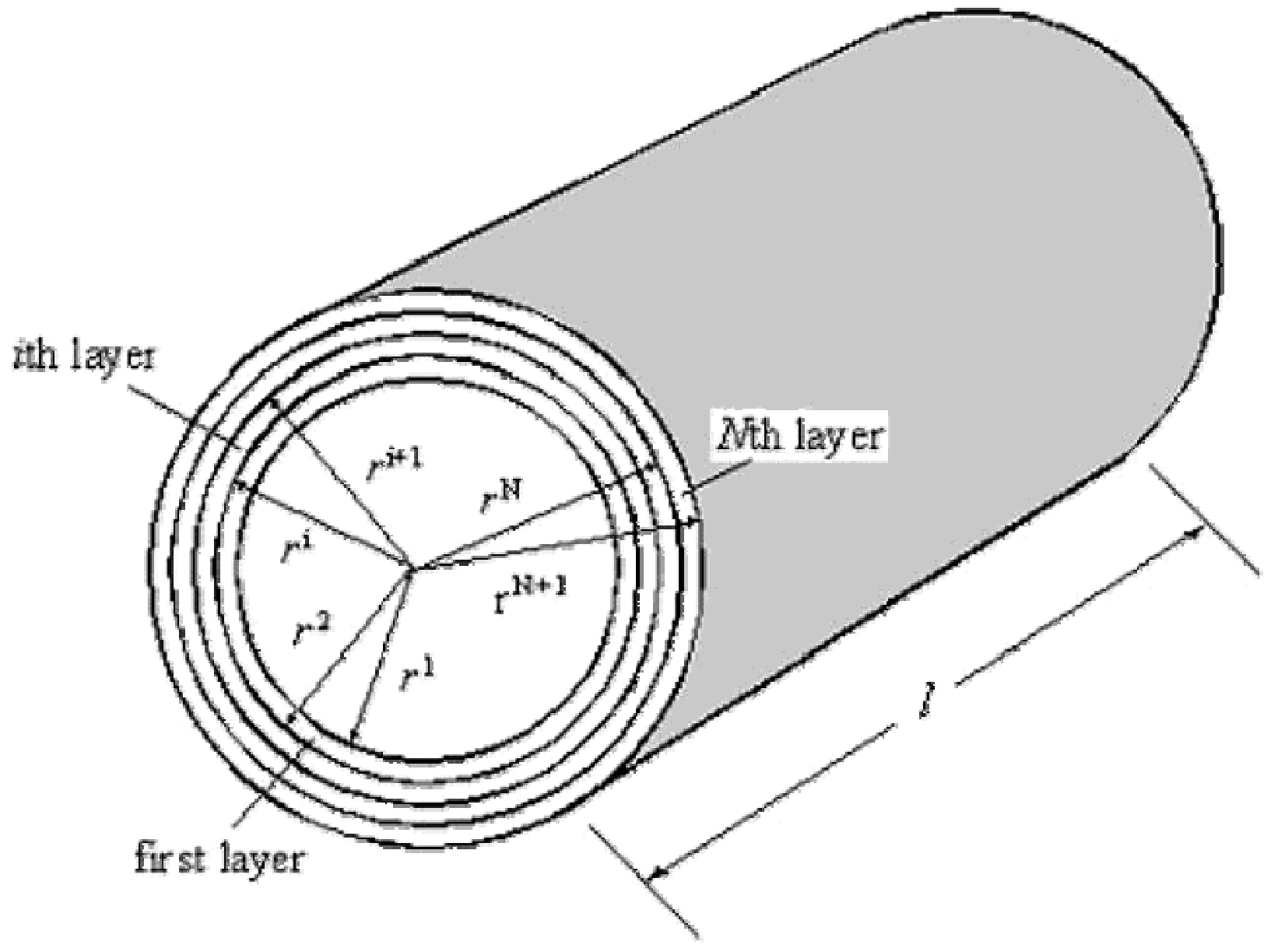
Under the cylindrical coordinate system as shown in Figure 1, the steady-state heat conduction equation for ith layer of the laminated composite cylinder can be expressed as

Boundary and continuous conditions of temperature of laminated composite cylinder can be expressed as




Under the cylindrical coordinate system, the thermo-elastic constitutive relations for ith layer can be expressed as





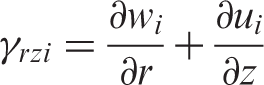

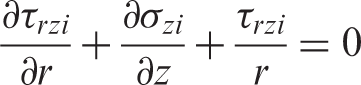
Boundary conditions and continuous conditions between layers of displacements and stresses can be expressed as




To simplify the solving process of the 2-D thermo-mechanical problem, the following dimensionless variables are introduced.
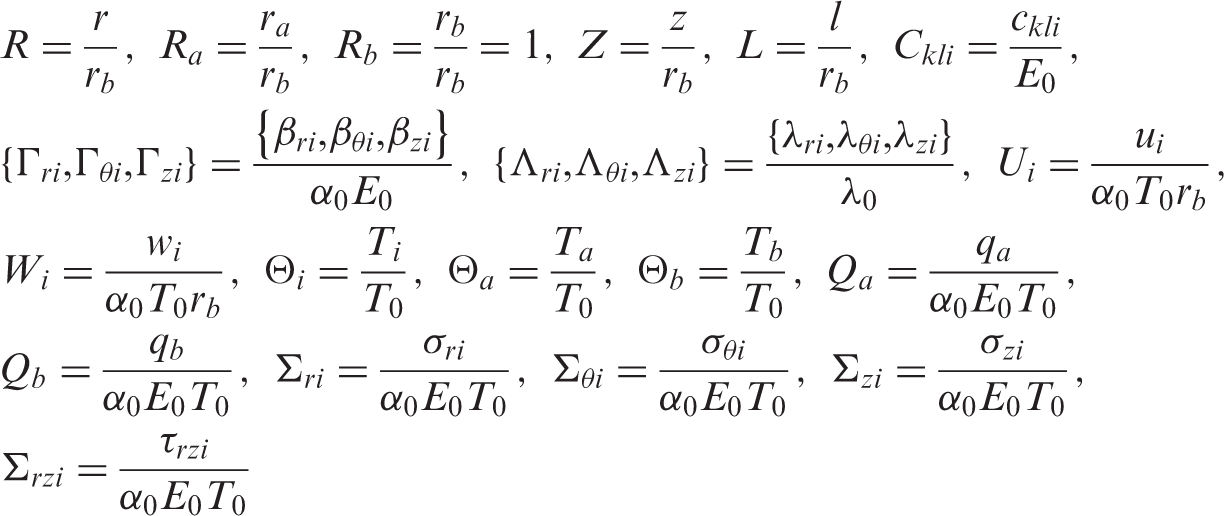
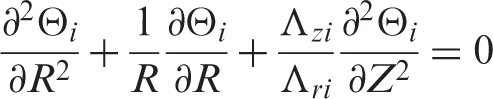
Using the dimensionless variables, the steady-state heat conduction equation for ith layer can be expressed as
Boundary and continuous conditions of temperature can be expressed as




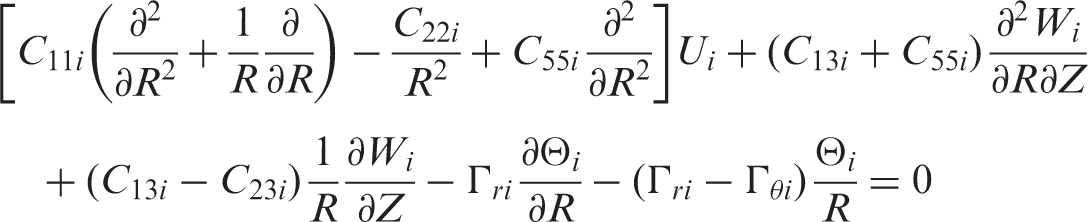
The displacement-expressed equilibrium equations can be expressed as

The boundary conditions and continuous conditions for displacements and stresses can be expressed as




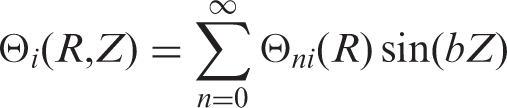
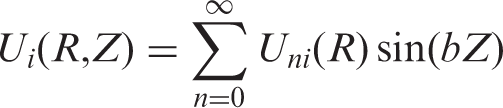
Using Navier trigonometric series, solutions of Equations (7) and (9a–b) which satisfy the ends displacements boundary conditions (8a), (10a) can be written as
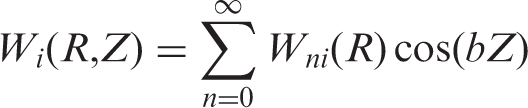



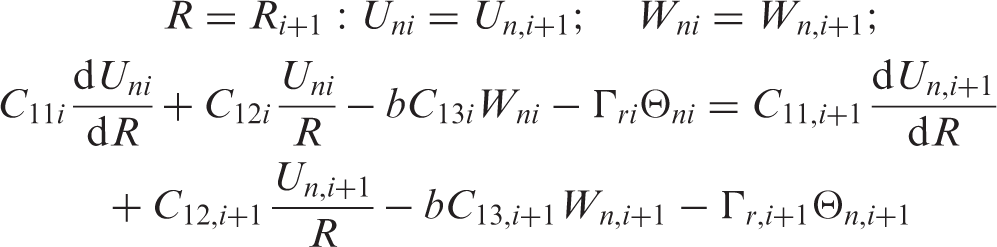
Furthermore, substituting the trigonometric series (10) into boundary and continuous conditions for temperature (7b–d) and stress (9b–d), we can obtain






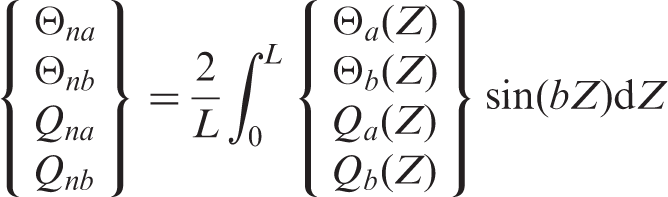
Using the orthogonality of trigonometric functions, we can obtain
Theoretical analysis
Based on the series solving method of ordinary differential equations, if the coefficient items of the ordinary differential equations were analytical at point
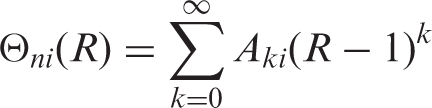
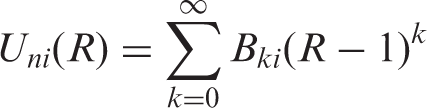
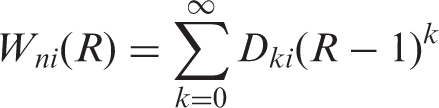
Substituting series (16) into Equations (11) and (12), comparing the coefficient of









Substituting solutions (19) into trigonometric series (15), we can obtain the solutions of steady-state temperature and thermo-mechanical displacements for the composite cylinder. Furthermore, using geometric equation and constitutive equation, the analytical solutions of thermo-mechanical stresses for the laminated cylinder can be obtained.




Numerical results and discussion
We investigate the thermo-mechanical stresses in a four-layer laminated composite cylinder, it is made of alumina fiber-reinforced aluminum composite with fiber-orientation

As an illustration, the following thermal/mechanical load case is considered
Dimensionless temperature distribution with R (z = 3.0).
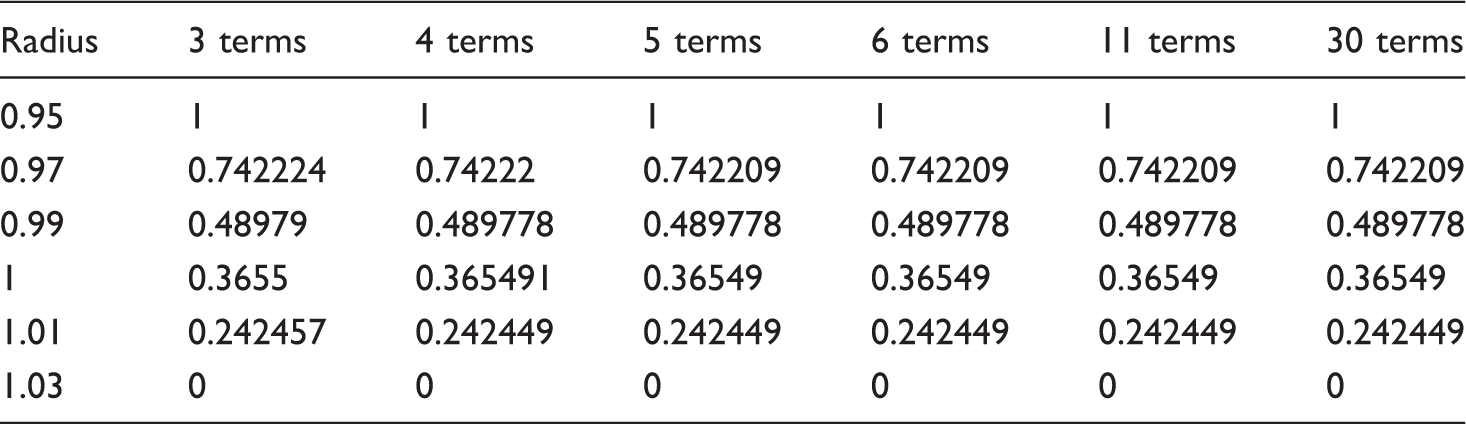
Figure 2 shows the numerical results of dimensionless temperature distribution of the laminated composite cylinder. The temperature decreases almost linearly in the radial direction, due to the slight difference of heat conductivity between layers, the non-linearity is not apparent along the radial direction. The results coincident with the linear temperature field assumption of the thin plate/shell theory.
Dimensionless temperature distribution.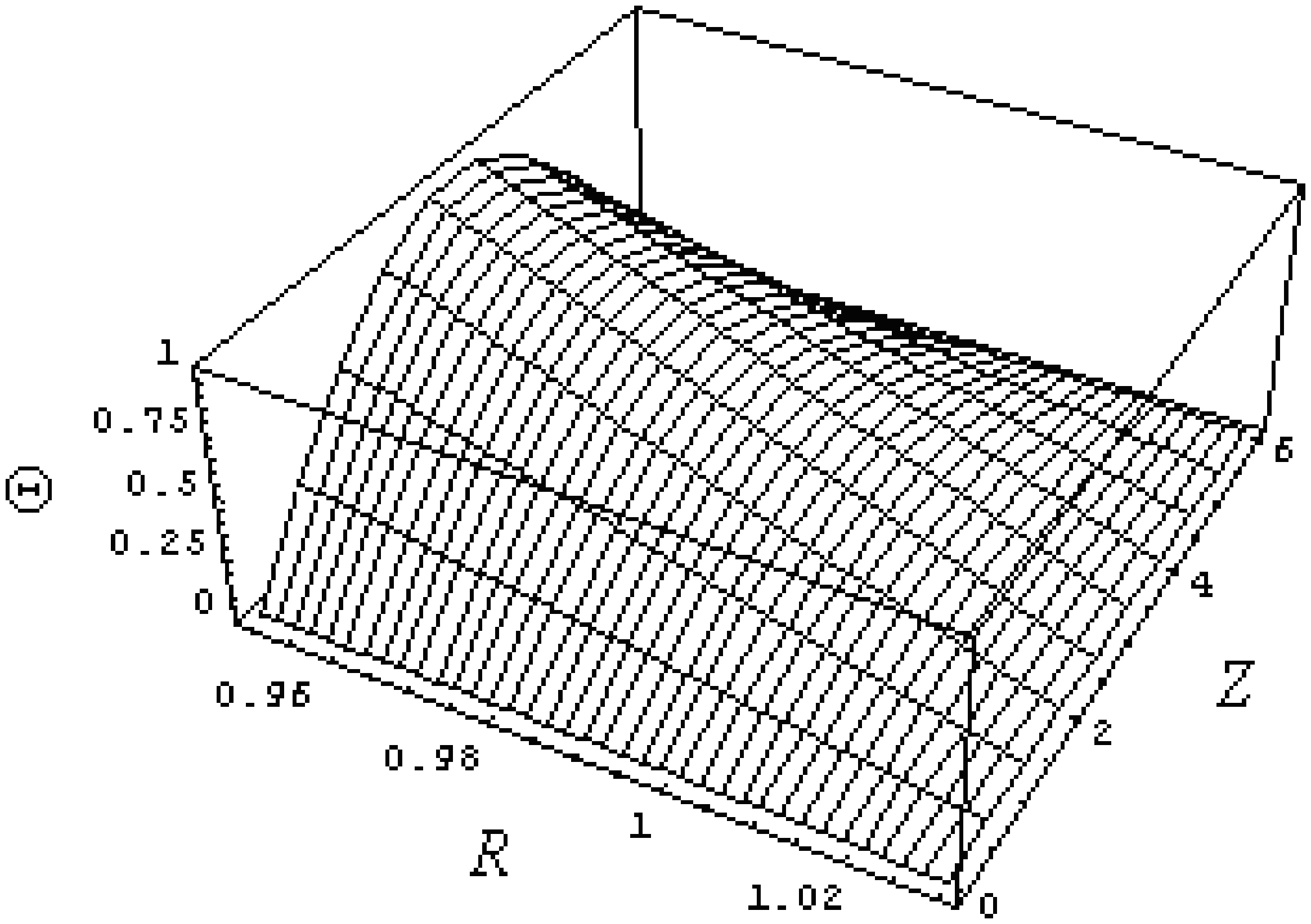
Figures 3 and 4 show the numerical results of dimensionless radial and axial displacement, respectively. Figures 5 and 6 show the numerical results of dimensionless radial stress and shear stress, respectively. Due to the assumed thermo-mechanical loadings, the radial stress is compressive stress and the maximum values of the radial stress occur at the inner surface of the cylinder and the variation of the shear stress is complex.
Dimensionless radial displacement distribution. Dimensionless axial displacement distribution. Dimensionless radial stress distribution. Dimensionless shear stress distribution.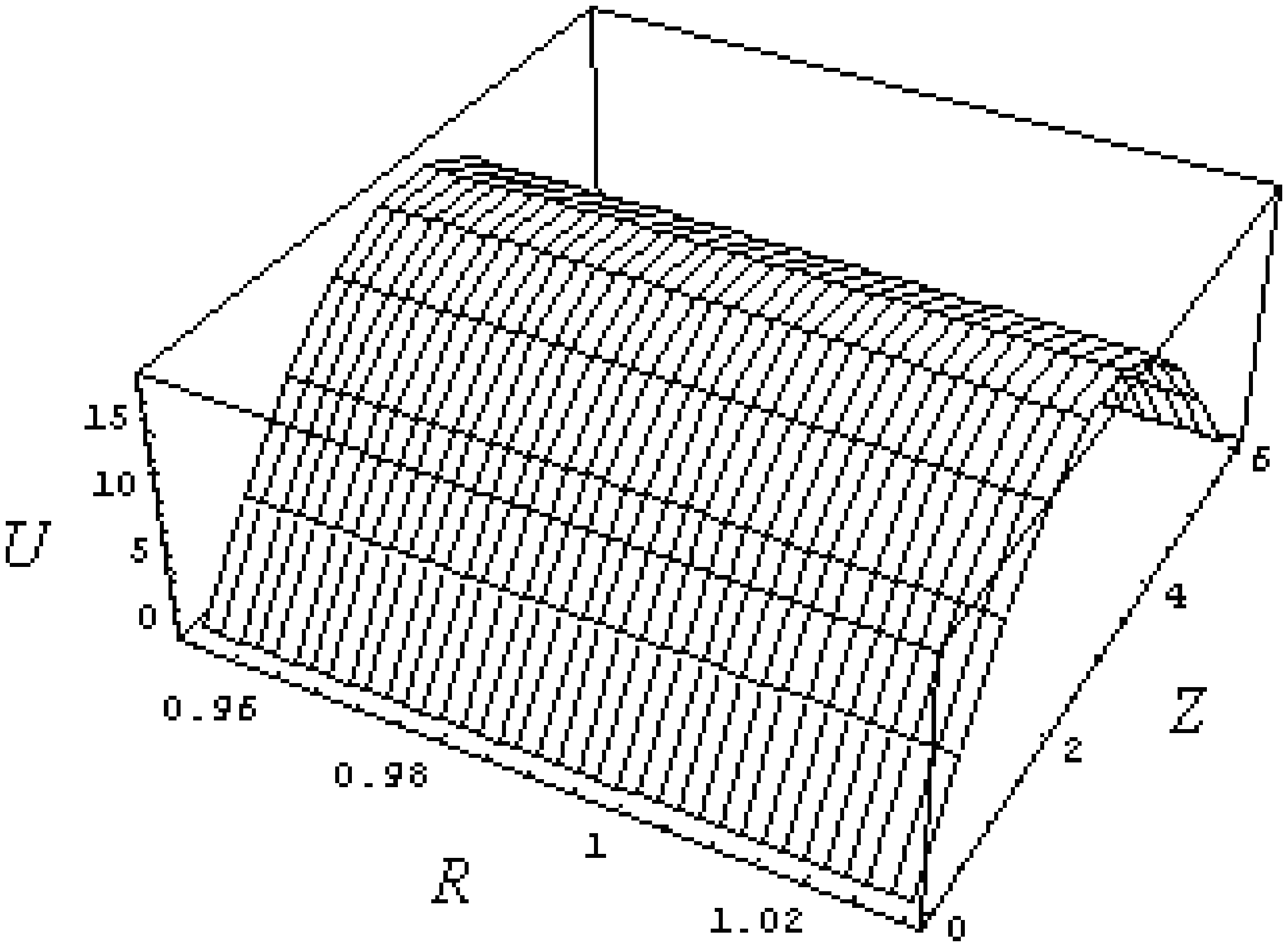
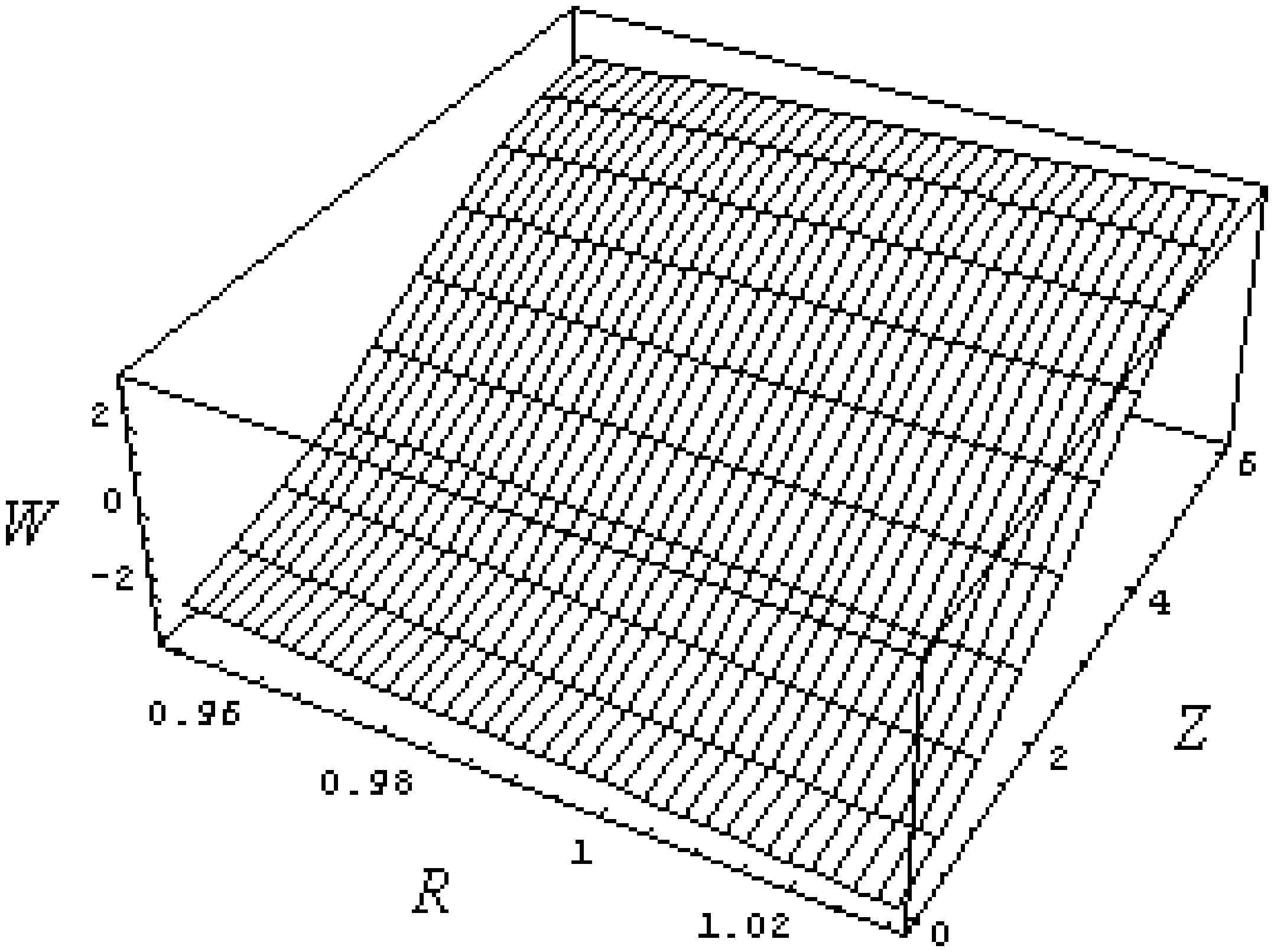
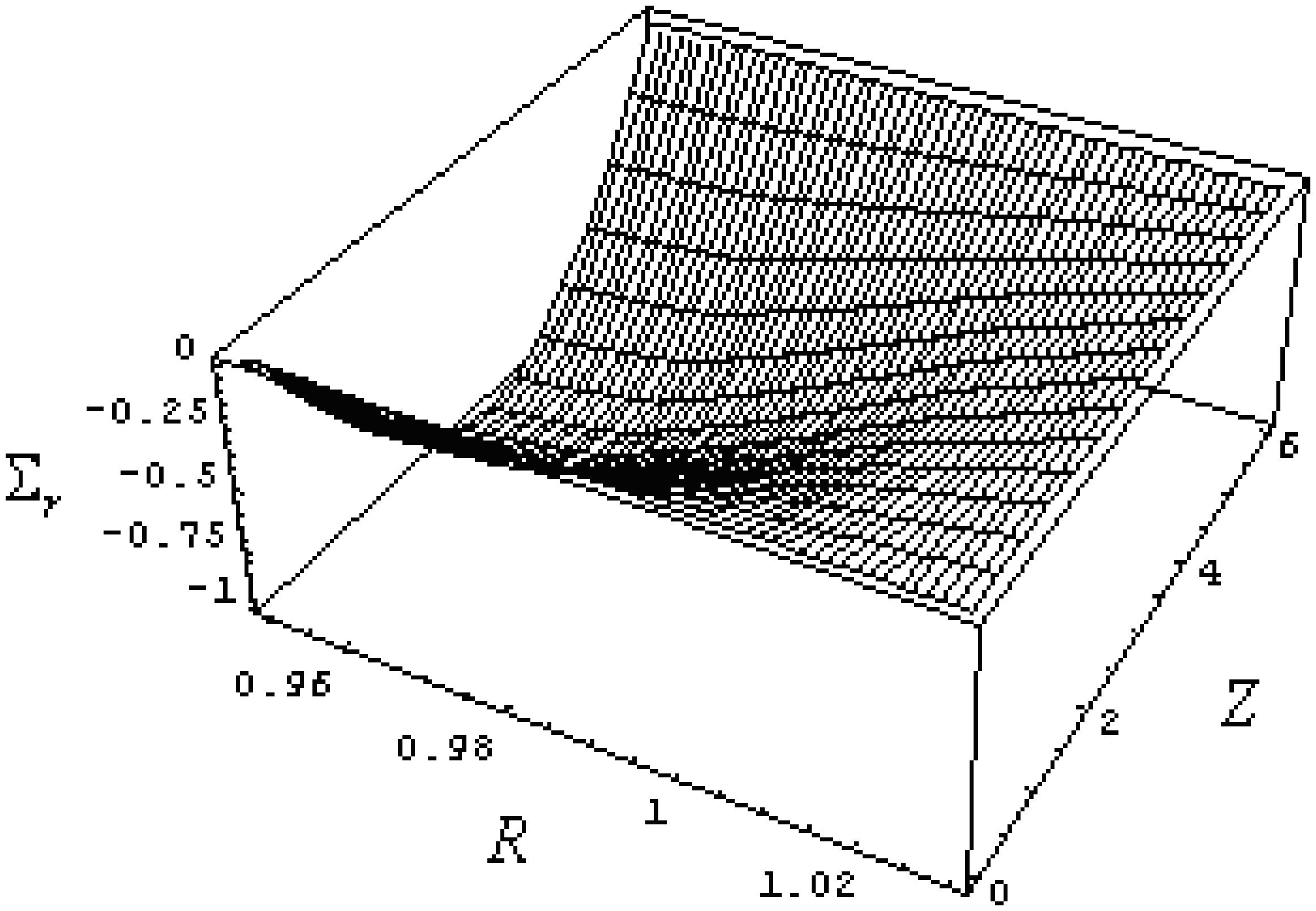
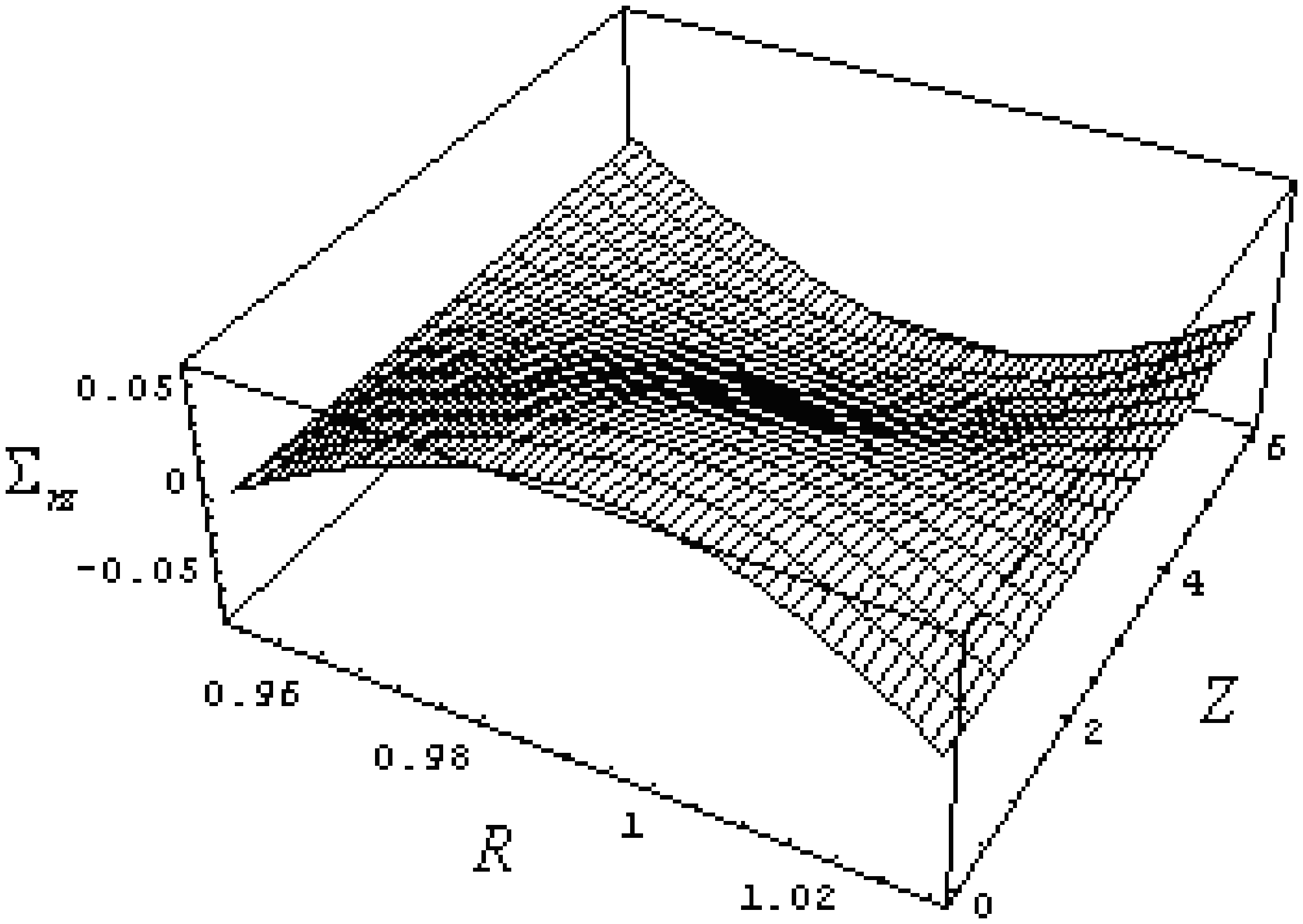
Figures 7 and 8 show the variations of the numerical results of dimensionless axial and circumferential stresses distribution on the thickness direction at section z = 3.0 of the laminated composite cylinder. For the sake of brevity, the distributions at other sections are omitted here. Due to the assumed thermo-mechanical loading and the different ply angles of aluminum fiber, the two stresses in the layer change in a linear variation, the maximum value of the axial stresses occur at the outer surface of the cylinder. Due to the mismatch material properties at the two interfaces ( Dimensionless axial stress at section z = 3.0. Dimensionless circumferential stress at section z = 3.0.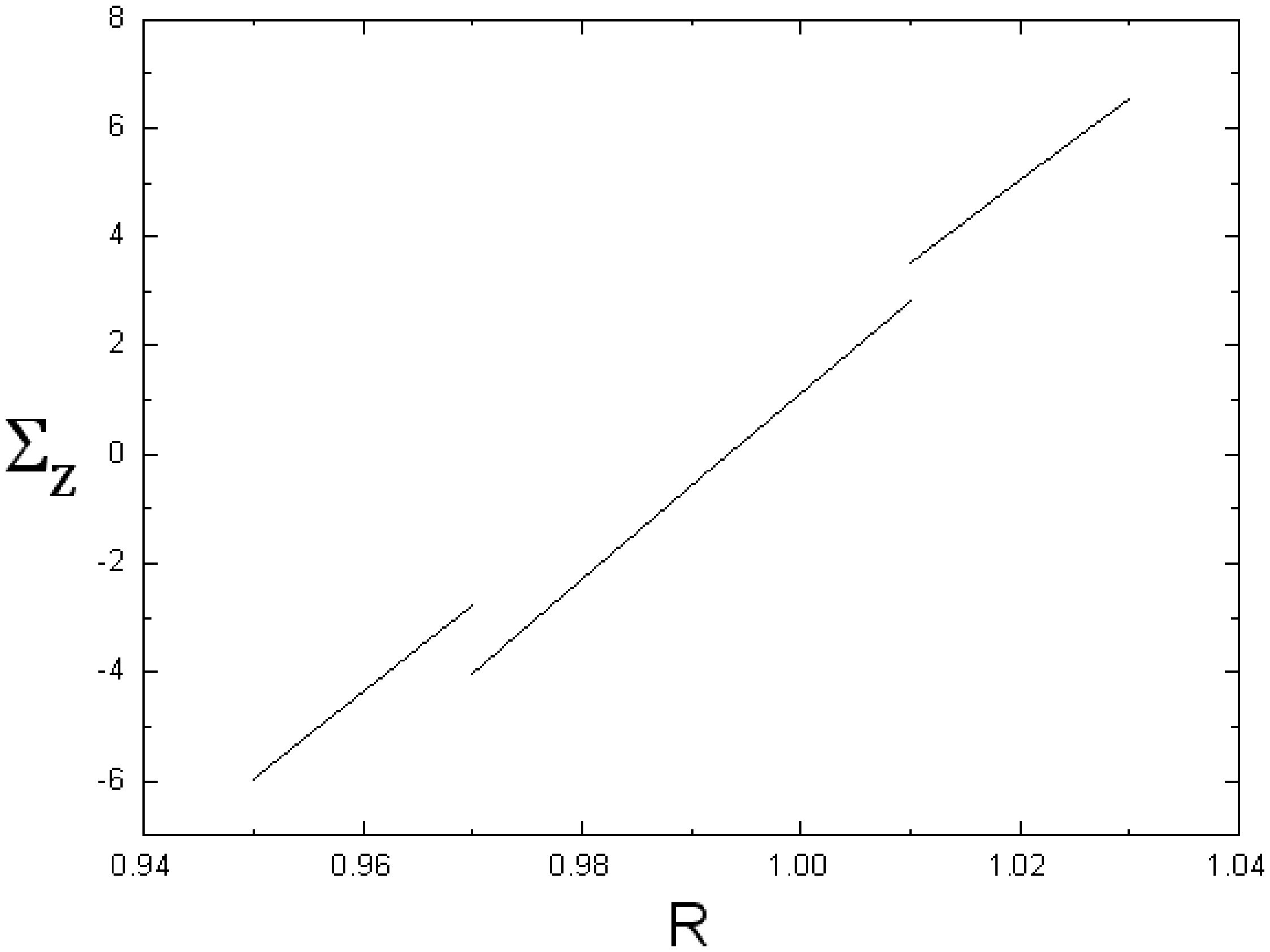
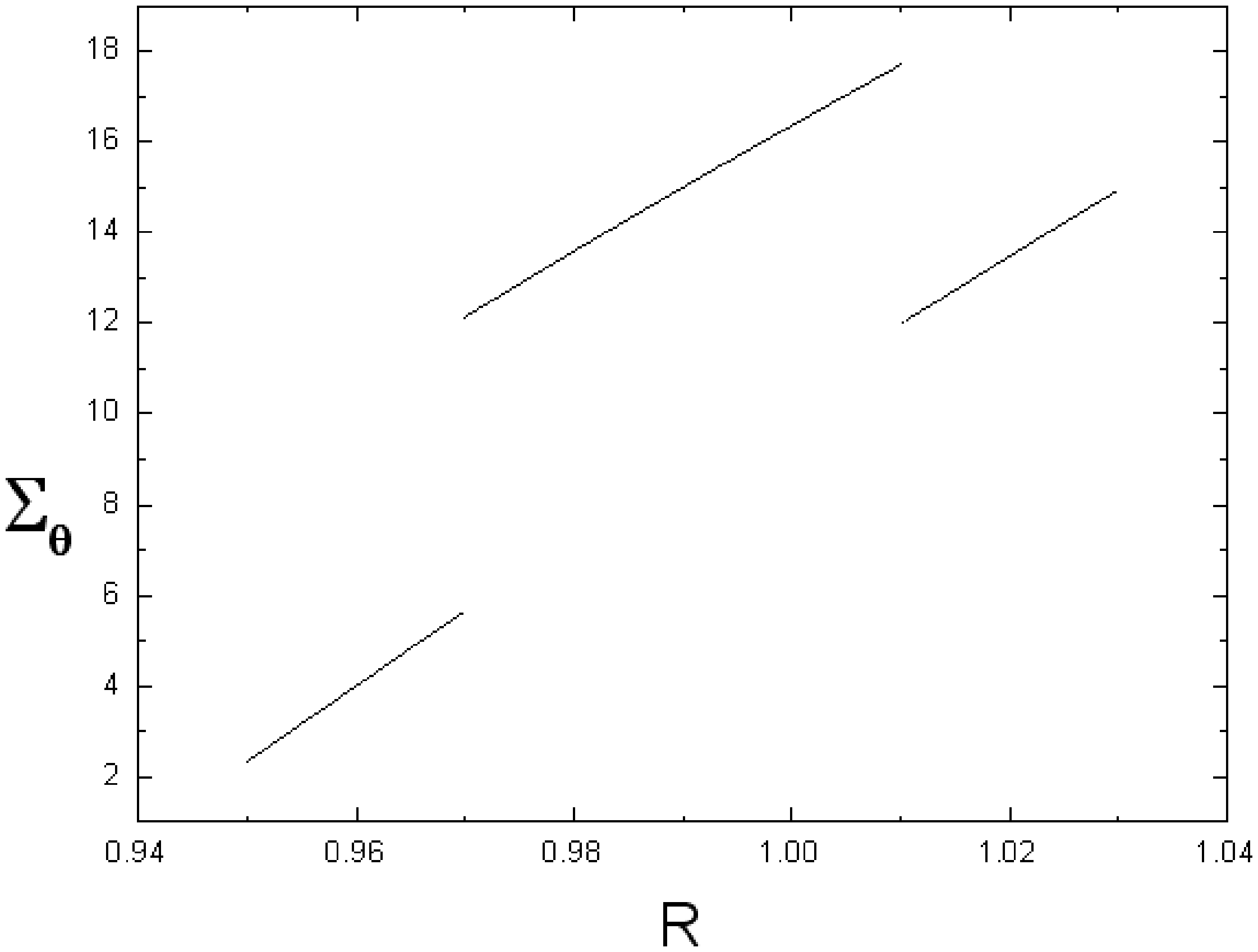
It also can be seen from Figures 5–8 that the dimensionless temperature, radial displacement, radial stress, hoop stress, and axial stress are symmetric about the section z = 3.0 due to the assumed thermal and mechanical loads. The axial displacement and shear stress are anti-symmetric about the section. The maximum magnitude of axial stress and hoop stress are larger than that of radial stress. The maximum magnitude of shear stress is much smaller than that of normal stresses.
Conclusion
Thermo-mechanical stresses of laminated composite cylinder with finite length are theoretically investigated in this article. The laminated composite cylinder is assumed to be subjected to non-uniform thermal and mechanical loadings on the inner and outer surfaces. Analytical solutions of temperature distribution and thermo-mechanical stresses are calculated by using variable separation approach and series solving method. Using the presented solution, a four-layer laminated composite cylinder is analyzed. All numerical results are graphically presented and briefly discussed. It is worth noting that:
The trigonometric series, which are used to separate variables, are only suitable for simply supported at both ends. For other supported boundary conditions, another suitable series must be considered to satisfy the related boundary conditions. Analysis in this article is based on thermo-elasticity theory. Namely, there is not any assumption adopted in present analysis. We adopted the simply supported boundary conditions (displacement constraints, stress-free tractions), namely, the ends of each layer are simply supported. According to Saint-Venant principle, the solutions we derived are available in addition to the very small neighborhood near the free edges. Therefore, the effect of free edge is not concerned in this article.
Footnotes
Acknowledgments
This study is supported by the National Natural Science Foundation of China (10772143), the Scientific Research Foundation for the Returned Overseas Chinese Scholars, State Education Ministry ([2010]1174), and the Foundation of Xi’an University of Architecture and Technology (RC0826).